
Read the given paragraph and answer the questions that follow.
One afternoon, Lata, Mohan and Saabir went exploring near a cave known for its strange echo. When Saabir shouted Hello! into the cave, the word came back to them. Lata was amazed, but Mohan explained, "it's the reflection of sound." He told them that sound is produced when something vibrates like our vocal cords. These vibrations travel through air, which is a medium.
- What surprised the friends when they shouted into the cave?
- How is sound produced, according to Mohan?
- Why can't sound travel through vacuum?
- In which medium does sound travel fastest, and why?
Answer
- The friends were surprised because the word they shouted into the cave came back to them. This was the echo, that is, the reflection of their sound from the cave walls.
- According to Mohan, sound is produced when something vibrates, just like our vocal cords vibrate when we speak. These vibrations then travel through a medium such as air.
- Sound cannot travel through a vacuum because there are no particles (molecules) in a vacuum to carry the vibrations. Sound needs a medium for its propagation, and a vacuum has no medium.
- Sound travels fastest in solids. This is because the particles in a solid are tightly packed, so the energy of the vibrations is transferred very rapidly from one particle to the next.
Circle the word that does not belong to other words given alongside it.
- Vibration, Soundproofing, Light, Echo
- Air, Steel, Vacuum, Water
- Longitudinal wave, Sound wave, Transverse wave, Echo
- Loudness, Pitch, Quality, Insulation
Answer
- Light
Reason — Vibration, soundproofing and echo are all related to sound, whereas light is a different form of energy that travels as a transverse wave. - Vacuum
Reason — Air, steel and water are media through which sound can travel, whereas a vacuum has no medium and sound cannot travel through it. - Transverse wave
Reason — A sound wave is a longitudinal wave and an echo is also produced by sound, whereas a transverse wave is a different type of wave (for example, light). - Insulation
Reason — Loudness, pitch and quality are characteristics of sound, whereas insulation is not a characteristic of sound.
Match the columns.
| Column A | Column B |
|---|---|
| 1. Vibration | (a) Reflected sound |
| 2. Echo | (b) A box designed to block sound |
| 3. Soundproof box | (c) To- and fro-motion that produces sound |
| 4. Foam | (d) Material used to absorb sound |
Answer
| Column A | Column B |
|---|---|
| 1. Vibration | (c) To- and fro-motion that produces sound |
| 2. Echo | (a) Reflected sound |
| 3. Soundproof box | (b) A box designed to block sound |
| 4. Foam | (d) Material used to absorb sound |
Answer in one or a few word(s).
- A form of energy that produces the sensation of hearing in our ears
- The wave in which the vibrations of the particles of the medium are in the direction perpendicular to direction of propagation of wave
- The wave in which the vibrations of the particles of the medium are in the same the directions as the propagation of the wave
- The distance between two consecutive compressions or rarefactions
Answer
- Sound
- Transverse wave
- Longitudinal wave
- Wavelength
Write the correct word(s) in the given blanks.
- The reflected sound which you hear some time after the direct sound is a/an ............... .
- The bouncing back of sound waves after striking a hard surface in the same medium is called ............... of sound.
- The sensation of hearing of any sound persists in our memory for ............... second.
- The speed of sound is more in ............... as compared to liquids and gases.
- The number of sound waves passing through a point in the medium in one second is called ............... .
Answer
- The reflected sound which you hear some time after the direct sound is an echo.
- The bouncing back of sound waves after striking a hard surface in the same medium is called reflection of sound.
- The sensation of hearing of any sound persists in our memory for 0.1 second.
- The speed of sound is more in solids as compared to liquids and gases.
- The number of sound waves passing through a point in the medium in one second is called frequency.
Write True or False for the following statements.
- The distance between two consecutive compressions or rarefactions is called frequency.
- Flute, cornet, shehnai and trumpet are some examples of reed instruments.
- An enclosure or a box that does not allow sound from within to come out and outside sound to enter is called a voice box.
- A single tuning fork produces a tone of fixed frequency when set into vibrations.
Answer
- False
Corrected Statement — The distance between two consecutive compressions or rarefactions is called wavelength. - False
Corrected Statement — Flute, cornet, shehnai and trumpet are some examples of wind instruments. - False
Corrected Statement — An enclosure or a box that does not allow sound from within to come out and outside sound to enter is called a soundproof box. - True
Find errors in the given sentences and correct them.
- Mouth organ and harmonium are some common examples of percussion instruments.
- Transverse waves are waves that are produced in the same direction as the direction of vibration of particles.
- The forward motion of a prong pushes air molecules horizontally to the left and the backward motion of the prong makes the air particles to move back to the right.
- Sound travels the slowest through solids and the fastest through gases.
Answer
- Mouth organ and harmonium are some common examples of reed instruments.
- In transverse waves, the particles of the medium vibrate in a direction perpendicular to the direction of propagation of the wave.
- The forward motion of a prong pushes the air molecules horizontally to the right, while its backward motion allows them to move back towards the left.
- Sound travels the slowest through gases and the fastest through solids.
Give reason — We cannot hear sound in space.
Answer
We cannot hear sound in space because space is a vacuum and has no medium (no air or other particles). Since sound needs a medium for its propagation, the vibrations cannot travel from one place to another, and so no sound is heard.
Give reason — Sound travels faster in solids than in gases.
Answer
Sound travels faster in solids than in gases because the particles in a solid are tightly packed. This allows the energy of the vibrations to pass very rapidly from one particle to the next. In gases, the molecules are far apart, so the transfer of energy takes more time and sound travels slower.
Give reason — Soft materials like foam are used in soundproof rooms.
Answer
Soft materials like foam are used in soundproof rooms because they are good absorbers (bad reflectors) of sound. They absorb the sound waves and reduce their amplitude (energy), which lowers the loudness and prevents the sound from bouncing back as echoes.
Give reason — We hear an echo when we shout inside a large empty hall.
Answer
We hear an echo inside a large empty hall because its walls act as reflecting surfaces placed far enough away (at least 17 m). The reflected sound reaches our ears more than 0.1 second after the direct sound, so we are able to hear the two sounds separately as an echo.
What is voice box?
Answer
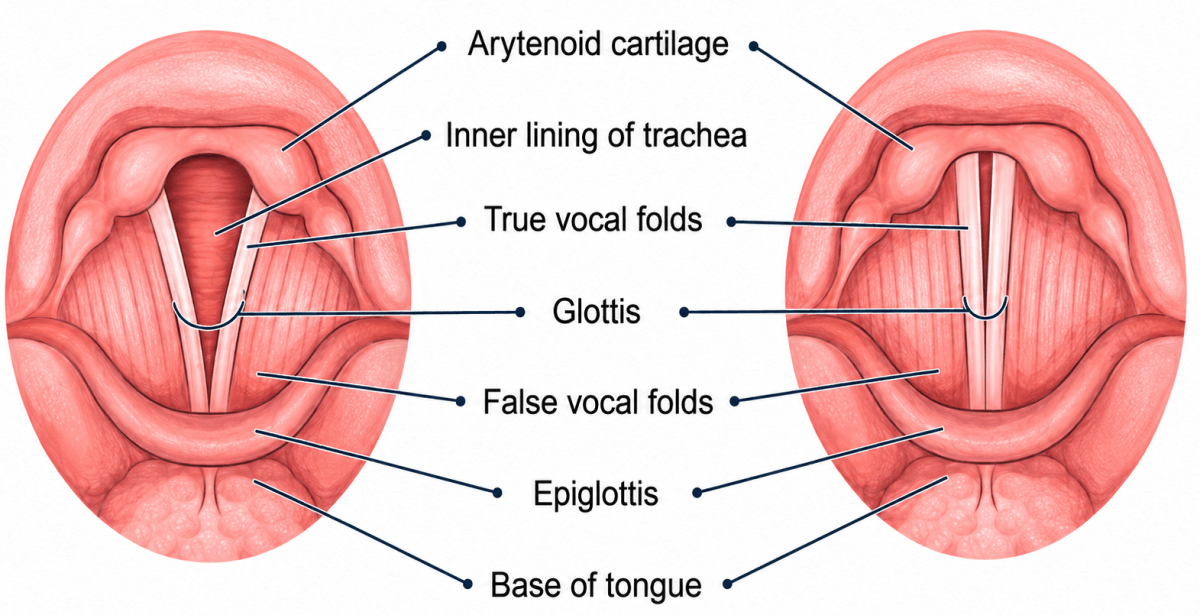
The voice box is the organ in our throat that produces sound in human beings. It contains two vocal cords stretched across it, with a narrow slit in between for air to pass. When air passes through this slit, the vocal cords vibrate and produce sound.
How are transverse waves different from longitudinal waves?
Answer
| Transverse Wave | Longitudinal Wave |
|---|---|
| The particles of the medium vibrate in a direction perpendicular to the direction of propagation of the wave. | The particles of the medium vibrate in the same direction as the direction of propagation of the wave. |
| It travels in the form of crests and troughs. | It travels in the form of compressions and rarefactions. |
| Example — Light travels as a transverse wave. | Example — Sound travels as a longitudinal wave. |
Write two laws of reflection of sound.
Answer
- The incident sound wave, the reflected sound wave and the normal all lie in the same plane.
- The angle of incidence is equal to the angle of reflection.
Define amplitude of a wave.
Answer
The amplitude of a wave is the maximum displacement of a particle of the medium on either side of its mean position. Its SI unit is the metre (m).
How do human beings hear a sound and recognise it?
Answer
When sound waves reach our ears, they make the eardrum vibrate. These vibrations are then sent to the brain in the form of messages (impulses). The brain interprets these messages, and this is how we hear a sound and recognise it.
"When the object stops vibrating, sound is not generated." Explain this statement in your own words.
Answer
Sound is produced only when an object vibrates, that is, when it undergoes rapid to- and fro-motion about its mean position. These vibrations create waves that travel through a medium and reach our ears, setting the eardrum into vibration and producing the sensation of sound. When the object stops vibrating, no waves are produced, and so no sound is generated.
This can be understood with some examples:
- When we speak and keep a hand on our throat, we feel the vibration of the vocal cords. The vibration is felt only while we speak and stops the moment we stop.
- When a drum is beaten, its membrane vibrates and sound is heard. As soon as we touch the membrane with our hand, the vibration stops and no sound is heard.
Mention the sources which produce sound.
Answer
Sound is produced by various vibrating sources:
- Human beings — Sound is produced by the voice box (larynx) in the throat, where the vocal cords vibrate as air passes through them.
- Tuning fork — A U-shaped metallic device that produces a tone of fixed frequency when its prongs are set into vibration.
- Musical instruments — These produce musical tones and are of four main types:
- Percussion instruments (for example, drum, tabla, dholak), which produce sound when their stretched membrane is struck.
- Reed instruments (for example, mouth organ, clarinet, harmonium), in which thin reeds vibrate when air is blown.
- Stringed instruments (for example, guitar, violin, sitar), which produce sound by the vibration of stretched strings.
- Wind instruments (for example, flute, shehnai, trumpet), in which an enclosed column of air vibrates.
What are the factors on which speed of sound depends?
Answer
The speed of sound depends on the following factors:
- Nature of the medium — Sound travels fastest in solids, slower in liquids and slowest in gases, because of the difference in the spacing of their particles.
- Elasticity and density of the medium — The speed of sound is greater in a medium of higher elasticity and lower density. A medium with high elasticity and low density is best for the propagation of sound.
- Temperature — As the temperature of the medium increases, the speed of sound in it increases. For example, sound travels faster in air on a hot day.
Differentiate between loudness and pitch of a sound.
Answer
| Loudness | Pitch |
|---|---|
| It depends on the amplitude of the wave. | It depends on the frequency of the wave. |
| It is a measure of the energy of the wave. | It does not depend on the energy of the wave. |
| It depends on the distance of the listener from the source and on the area of the vibrating body. | It is independent of the distance between the listener and the source, and of the area of the vibrating body. |
Read the given case study and answer the questions that follow.
While exploring her grandfather's attic, Sara found an unusual wooden box labeled: "Soundproof Box – Do Not Shout!" Curious, she called her friend Samar to investigate. Samar tried shouting into the box, but no echo came back. Sara noted that the box was lined with soft foam.
They began their investigation into why the box 'swallowed' the sound. Sara explained that sound is produced when an object vibrates. These vibrations travel through a medium like air or metal as longitudinal waves. She added that in a vacuum (like space), sound can't travel at all because there's no medium to carry the vibrations.
To test how sound travels in different materials, they tapped a metal pipe and noticed that the sound travelled quickly. Sara concluded that sound travels the fastest in solids because their particles are closely packed.
She also observed that pitch, loudness and quality are important characteristics of sound. They even recorded voices in the soundproof box to see how well it blocked outside noise, thanks to the foam absorbing the sound waves.
The box wasn't magic, it was science! The foam absorbed sound, preventing it from bouncing back or escaping, making the box nearly silent.
- Why didn't Samar hear an echo when he shouted into the box?
- What type of wave is sound, and how does it travel?
- Why can't sound be heard in a vacuum?
- What experiment did Sara and Samar do to prove that sound travels the fastest in solids?
- What are the three main characteristics of sound mentioned in the case?
Answer
- Samar did not hear an echo because the box was lined with soft foam. Foam is a good absorber of sound, so it absorbed the sound waves instead of reflecting them back, and no echo was produced.
- Sound is a longitudinal wave. It travels through a medium (such as air or metal) in the form of compressions and rarefactions, with the particles of the medium vibrating in the same direction as the wave moves.
- Sound cannot be heard in a vacuum because a vacuum has no particles (no medium) to carry the vibrations. Since sound needs a medium for its propagation, it cannot travel through a vacuum.
- They tapped a metal pipe and noticed that sound travelled rapidly through it. From this observation, they inferred that sound travels quickly through solids because the particles of a solid are closely packed.
- The three main characteristics of sound mentioned in the case are pitch, loudness and quality.
Read the given information carefully and answer the questions that follow.
What is Sound?
At its core, sound is a form of energy that travels through a medium, such as air, water, or solid materials. It is created when an object vibrates, causing the surrounding particles to move in waves. These waves travel outwards from the source, eventually reaching our ears and allowing us to hear.
Sound waves are characterised by several key properties.
Frequency: Frequency refers to the number of vibrations per second and is measured in Hertz (Hz). It determines the pitch of the sound – higher frequencies produce higher pitches, while lower frequencies produce lower pitches.
Amplitude: Amplitude is the height of the sound wave and determines its volume. Greater amplitude results in louder sounds, while smaller amplitude produces softer sounds.
Wavelength: Wavelength is the distance between two consecutive points of a sound wave, such as from crest to crest. It is inversely related to frequency – higher frequencies have shorter wavelengths, and vice versa.
Speed: The speed of sound varies depending on the medium it travels through. In air at room temperature, sound travels at approximately 343 metres per second (1,125 feet per second). It moves faster in liquids and even faster in solids.
The human ear is a remarkable organ that converts sound waves into electrical signals, which the brain interprets as sound. Here's how the process works.
Outer Ear: The outer ear captures sound waves and funnels them through the ear canal to the eardrum.
Middle Ear: The eardrum vibrates in response to the sound waves, transmitting these vibrations to three tiny bones called the ossicles (the malleus, incus and stapes).
Inner Ear: The vibrations reach the cochlea, a fluid-filled structure in the inner ear. Inside the cochlea, hair cells convert the mechanical vibrations into electrical signals.
Brain: The auditory nerve carries these signals to the brain, where they are processed and interpreted as sound.
Source: https://serenademagazine.com/the-science-of-sound-how-acoustics-shape-our-world/
- What is sound?
- In which state of matter does sound travel the fastest?
- How does frequency of a sound wave relates to its wavelength?
- Which nerves carry signals to the brain?
Answer
1. Sound is a form of energy that travels through a medium such as air, water or solid materials. It is created when an object vibrates, causing the surrounding particles to move in the form of waves that reach our ears.
2. Sound travels the fastest in the solid state of matter.
3. The frequency of a sound wave is inversely related to its wavelength. This means that a higher frequency has a shorter wavelength, while a lower frequency has a longer wavelength.
4. The auditory nerve carries the signals to the brain.
You are standing in an empty hall. You clap your hands and hear the same sound come back after a second. Why do you hear your clap again?
Answer
You hear your clap again because of an echo. The sound of your clap travels through the air, strikes the hard walls of the empty hall, and is reflected back to your ears. Since the walls are far enough away, the reflected sound reaches you more than 0.1 second after the direct sound, so you hear the clap again as a separate sound.
You notice that shouting in a forest doesn't produce an echo, but shouting in a bathroom does. Why?
Answer
In a forest, the trees, leaves and soft, uneven surfaces are bad reflectors of sound. They absorb and scatter the sound rather than reflecting it back cleanly, so no echo is heard. In a bathroom, the hard, smooth tiled walls are good reflectors of sound, so the sound bounces back and we hear it repeated.
Your friend is recording her voice for a school project. But there's too much echo in the room and the recording sounds bad. What can she do to stop the echo using things at home?
Answer
To stop the echo, she should cover the hard surfaces of the room with soft materials, which are good absorbers of sound. Using simple things at home, she can:
- Hang thick curtains or blankets on the walls and over the windows.
- Spread carpets or rugs on the floor.
- Place cushions, pillows or pieces of foam/sponge around the recording area.
These soft materials absorb the sound waves instead of reflecting them, so the echo is reduced and the recording sounds clear.
Your classroom is very noisy and your teacher wants it to be quieter. What can you suggest to reduce noise in the room?
Answer
To make the classroom quieter, we can use sound-absorbing (soft) materials and reduce the reflection of sound:
- Put curtains on the windows and a soft board or carpet on the walls and floor.
- Keep the doors and windows closed to stop outside noise from entering.
- Avoid unnecessary talking and dragging of furniture, which create noise.
Soft materials absorb the sound waves and reduce their loudness, which makes the room quieter.
You want to make a small soundproof box using simple things at home. What three things would you use to make the box?
Answer
To make a small soundproof box at home, I would use:
- A cardboard box (such as a shoebox) to form the frame of the box.
- Soft foam, sponge or cotton to line the inside of the box, as these absorb sound.
- A thick cloth or curtain material to cover the box and block sound from coming out or entering.
The soft lining and thick cloth absorb sound waves and reduce the amount of sound that enters or leaves the box.
Design a fun musical instruments using waste materials. What will you use and how will it make sound?
Answer
Aim — To design a simple stringed instrument, called a "box guitar", using waste materials.
Materials — An empty shoebox, a cardboard tube, rubber bands of different thicknesses, and a small straw or rolled paper tube.
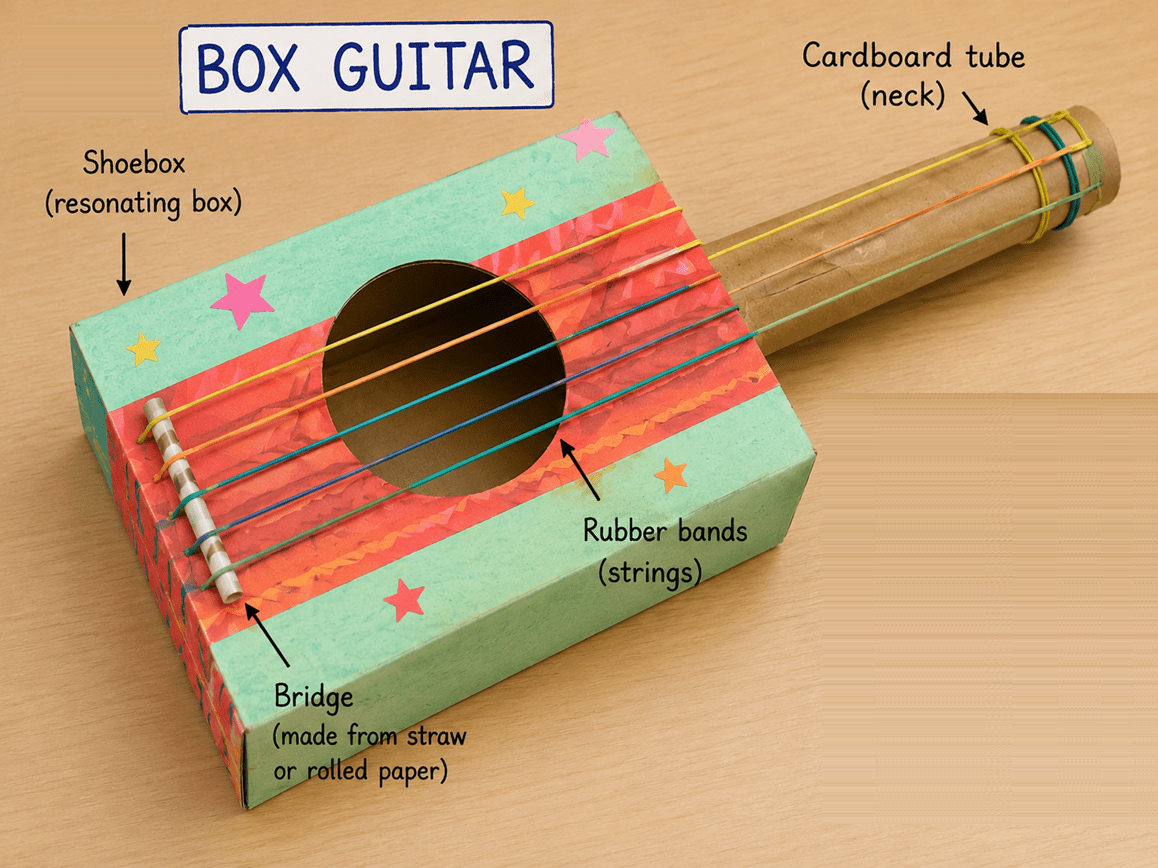
Description of the instrument — As shown in the figure, the instrument is a box guitar. The body of the guitar is made from an empty shoebox, which acts as a resonating box. A cardboard tube is attached to one end to form the neck of the guitar. Rubber bands are stretched across the opening of the box to act as strings. A small straw placed under the rubber bands serves as a bridge.
How it works — When a rubber band is plucked, it vibrates and produces sound. These vibrations cause the air inside the shoebox to vibrate as well, making the sound louder. The pitch of the sound depends on the thickness and tightness of the rubber bands. Thinner or tighter rubber bands produce a higher-pitched sound, whereas thicker or looser rubber bands produce a lower-pitched sound.
Kanika and her brother Mayur hiked up sunset hill. As they reached the top, Mayur shouted, "Hello!" To their surprise, the same word echoed back. "What was that?" Mayur asked. Kanika smiled, "That's an echo. It happens when sound bounces off hard surfaces like rocks."
She explained, "When we speak, our vocal cords vibrate, making sound. These vibrations travel through the air, which is the medium. Sound travels as a longitudinal wave moving forwards and backwards along the same path."
They later stood near a big rock and knocked on it. The sound was louder and reached faster than in open air. "That's because sound travels faster in solids," Kanika said. "Solids like rock carry vibrations better than air."
At home, they built a soundproof box using a shoebox, sponge, and cloth. "These soft materials absorb sound and stop it from bouncing around," Kanika said.
- What caused the echo on Sunset Hill?
- What makes sound when we speak?
- What is the role of air in hearing sound?
- Why did the sound travel faster through the rock?
- What materials did Kanika and Mayur use to make a soundproof box?
Answer
- The echo on Sunset Hill was caused by the reflection of sound. Mayur's shout struck the hard surfaces of the rocks and bounced back, so they heard the word again.
- When we speak, the vocal cords in our voice box vibrate as air passes through them. This vibration is what produces the sound.
- Air acts as the medium that carries the sound. The vibrations travel through the air from the source to our ears, allowing us to hear the sound. Without a medium like air, the sound could not reach us.
- The sound travelled faster through the rock because rock is a solid. The particles of a solid are closely packed, so they carry the vibrations faster and better than the particles of air.
- They used a shoebox, sponge and cloth to make the soundproof box.
Mehul lost his metal ring in the grass. While looking for it, he tapped two metal rods together and noticed the sound changed when he got closer to the spot where he thought it fell.
He shared this with his science teacher, who said, "Interesting! Sound changes depending on what it travels through. Let's investigate." They tried tapping the rods over grass, metal and wood. The sound was loudest and sharpest over metal.
They realised the ring was reflecting sound because it was a solid object, and solids carry sound faster and clearer than soft materials like grass.
Mehul finally found the ring under a thick bush. The sound trick helped! He concluded that sound reflections and media can help detect objects, even hidden ones.
- What unusual observation did Mehul make while looking for his ring?
- How did different surfaces affect the sound of the metal rods?
- Why was the sound clearer over metal?
- What did they learn about how sound helps find objects?
- What science idea helped solve the mystery?
Answer
- Mehul observed that the sound of the two metal rods tapped together changed as he got closer to the spot where he thought the ring had fallen.
- The surface changed the sound of the rods. The sound was loudest and sharpest over metal, but softer and less clear over grass and wood.
- The sound was clearer over metal because metal is a solid. Solids carry sound faster and more clearly than soft materials like grass, as their particles are closely packed.
- They learnt that sound reflections and the medium can help us detect objects, even hidden ones, because solid objects reflect and carry sound differently from soft surroundings.
- The science idea of reflection of sound, along with the fact that sound travels faster and clearer through solids than through soft materials, helped solve the mystery.
In a science class, some students did an experiment to test how sound moves through different materials. They tapped a wooden stick, and a string a spoon on the table and listened through air. Each time, the sound was different.
Through air, the sound was soft and took longer. Through the wooden stick, it was louder and clearer. The string also made the sound reach the ear faster. "That's because sound travels faster in solids than in air," said their teacher. "The particles in solids are closer together."
They also tested a foam-lined box. When they shouted into it, the sound became dull. "Foam absorbs sound," explained the teacher, "which is why it's used in soundproofing."
- What were the three materials used in the experiment?
- In which material did sound travel the fastest?
- Why does sound travel faster in solids?
- What happened when students shouted into a foam-lined box?
- Why is foam used in soundproof rooms?
Answer
- The three materials used in the experiment were a wooden stick, a string and a spoon.
- Sound travelled the fastest through the solids (the wooden stick, string and spoon), and slowest through the air.
- Sound travels faster in solids because the particles in a solid are closer together (closely packed). This allows the vibrations and their energy to pass quickly from one particle to the next.
- When the students shouted into the foam-lined box, the sound became dull because the foam absorbed the sound waves.
- Foam is used in soundproof rooms because it absorbs sound. Being a good absorber, it stops sound from reflecting and escaping, which reduces noise.
In class, a teacher gave a project: "Design a mini recording booth using your knowledge of how sound works."
Students had to think about how sound travels, what materials block or absorb sound and how to keep the inside quiet.
Team A used cardboard for the frame, sponge inside for absorption and cloth on the outside to block noise. Team B added foil between layers to reflect sound back inside. Each team tested their booths by clapping inside them and measuring echo.
They combined everything they'd learnt—vibrations, media, speed of sound and soundproofing materials to make a real-life solution.
- What was the goal of project?
- What materials did the students use to reduce sound inside the booth?
- Why did Team B add foil between layers?
- How did the students test the booths?
- What sound topics did they combine to make their final design?
Answer
- The goal of the project was to design a mini recording booth using the students' knowledge of how sound works, so that the inside stays quiet.
- To reduce the sound, the students used a cardboard frame, sponge inside the booth for absorption, and cloth on the outside to block noise. Team B also added a layer of foil.
- Team B added foil between the layers with the intention of reflecting sound and reducing its transmission through the booth. However, if the foil reflects sound back into the booth, it may increase internal reflections. Therefore, the inside should be covered with sound-absorbing materials such as sponge or thick cloth.
- The students tested their booths by clapping inside them and measuring the echo produced.
- They combined the topics of vibrations, media (how sound travels through different materials), speed of sound, and soundproofing materials to make their final design.
Fill in the blanks.
- Sound is produced by ............... bodies.
- The distance travelled by a wave in one second is called its ............... .
- The speed of sound is maximum in ............... and minimum in ............... .
- Echo is heard only when the reflecting surface is at least ............... metres away from the source of sound.
- The loudness of sound depends on the ............... of vibration.
Answer
- Sound is produced by vibrating bodies.
- The distance travelled by a wave in one second is called its speed (velocity).
- The speed of sound is maximum in solids and minimum in gases.
- Echo is heard only when the reflecting surface is at least 17 metres away from the source of sound.
- The loudness of sound depends on the amplitude of vibration.
Write True or False.
- Sound can travel through solids, liquids and gases.
- Pitch of sound depends on the amplitude of vibration.
- Sound waves are transverse in nature.
- SONAR is based on the principle of reflection of sound.
- Human beings can hear frequencies above 50,000 Hz.
Answer
- True
- False
Corrected Statement — Pitch of sound depends on the frequency of vibration. - False
Corrected Statement — Sound waves are longitudinal in nature. - True
- False
Corrected Statement — Human beings can hear frequencies between 20 Hz and 20,000 Hz.
Match the columns.
| Column A | Column B |
|---|---|
| 1. Amplitude | (a) Voice box of humans |
| 2. Larynx | (b) Quality that makes sound loud or soft |
| 3. Wavelength | (c) Solids |
| 4. Echo | (d) Distance between two consecutive crests |
| 5. Sound travels fastest in | (e) Reflection of sound waves |
Answer
| Column A | Column B |
|---|---|
| 1. Amplitude | (b) Quality that makes sound loud or soft |
| 2. Larynx | (a) Voice box of humans |
| 3. Wavelength | (d) Distance between two consecutive crests |
| 4. Echo | (e) Reflection of sound waves |
| 5. Sound travels fastest in | (c) Solids |
Why does sound need a medium to travel?
Answer
Sound needs a medium to travel because it propagates through the vibration of the particles of the medium. The particles pass on the vibrations from one to the next. In a vacuum there are no particles to carry these vibrations, so sound cannot travel without a medium.
Define frequency. What is its SI unit?
Answer
Frequency is the number of sound waves passing through a point in the medium in one second. It is also defined as the number of oscillations completed in one second. Its SI unit is the hertz (Hz).
Distinguish between loudness and pitch.
Answer
| Loudness | Pitch |
|---|---|
| It depends on the amplitude of the wave. | It depends on the frequency of the wave. |
| It is a measure of the energy of the wave. | It does not depend on the energy of the wave. |
| It distinguishes a feeble sound from a loud sound. | It distinguishes a flat sound from a shrill sound. |
Why can't we hear an echo in a small room?
Answer
We cannot hear an echo in a small room because the walls are too close, that is, less than 17 m away. The reflected sound reaches our ears in less than 0.1 second after the direct sound. Since the sensation of hearing persists in our memory for 0.1 second, we cannot distinguish the two sounds, and so no echo is heard.
Give one example each of a string instrument, a wind instrument and a percussion instrument.
Answer
String instrument — Guitar
Wind instrument — Flute
Percussion instrument — Drum
Explain the characteristics of sound waves with suitable examples.
Answer
The main characteristics of a sound are loudness, pitch and quality.
Loudness — Loudness is the characteristic that distinguishes a feeble sound from a loud sound of the same frequency. It depends on the amplitude of the wave; the greater the amplitude, the louder the sound. For example, when we tap a metal tumbler gently we hear a soft sound, but on beating it harder the amplitude increases and we hear a louder sound. Loudness is measured in decibels (dB).
Pitch — Pitch is the characteristic that distinguishes a shrill sound from a flat sound. It depends on the frequency of the wave; the higher the frequency, the higher the pitch. For example, a woman's voice is shriller (higher pitch) than a man's voice, and the buzzing of a mosquito has a higher pitch than the roar of a lion.
Quality — Quality is the characteristic that helps us to distinguish between two sounds of the same loudness and pitch produced by different sources, such as the difference between a flute and a violin playing the same note.
Describe an experiment to show that sound cannot travel through vacuum.
Answer
Aim — To show that sound needs a medium and cannot travel through a vacuum.
Materials required — A glass bell jar, an electric alarm clock (or a mobile phone), and a vacuum pump.
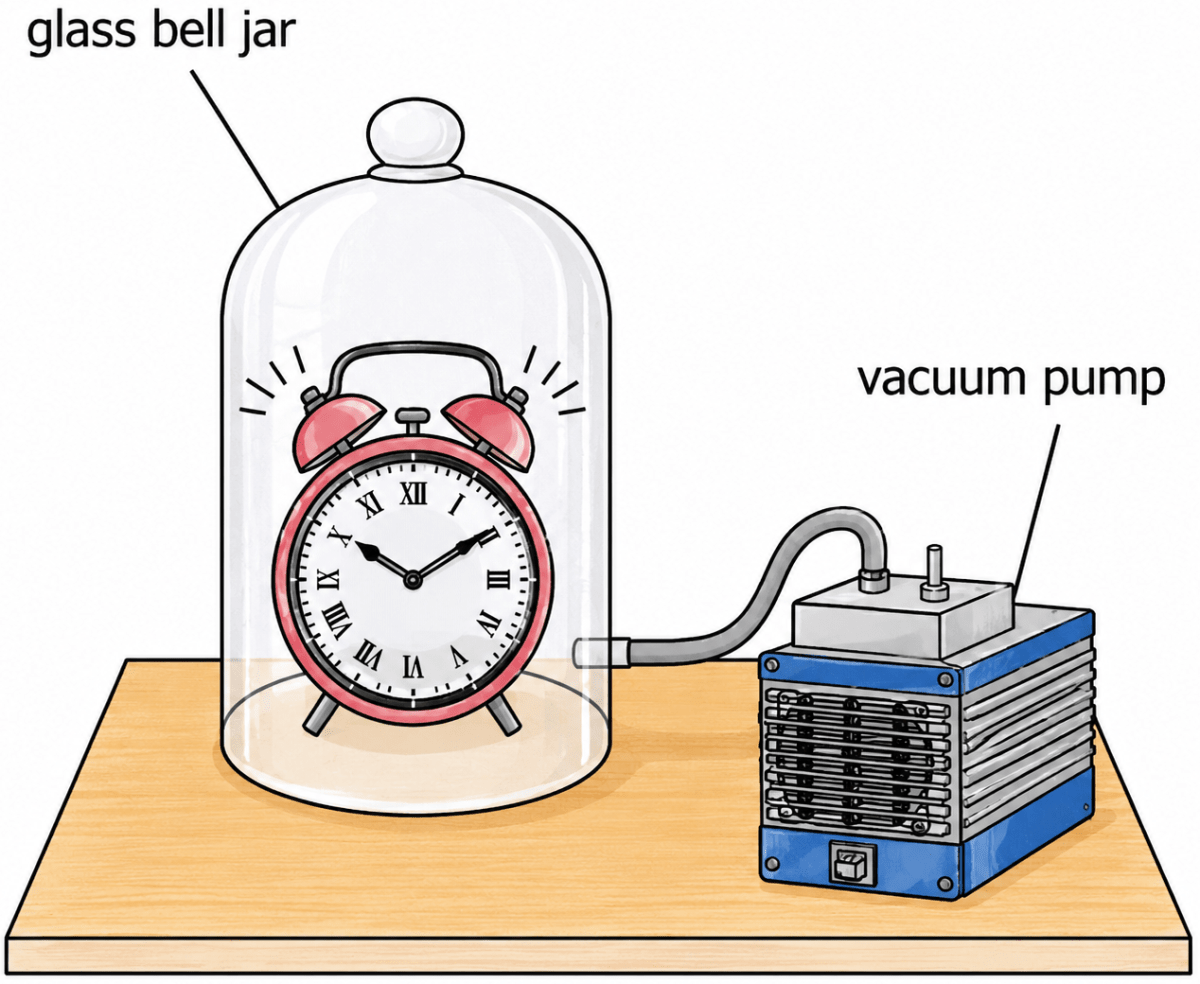
Procedure —
- Set the alarm in the clock and place it inside the glass bell jar. Observe from outside; you will be able to hear the alarm ringing.
- Set the alarm again, attach the vacuum pump to the jar, and slowly start removing the air from inside the jar as the clock rings.
Observation — As the air is pumped out, the volume of the sound keeps decreasing, and eventually no sound is heard even though the clock is still ringing.
Conclusion — In the absence of air, there are no particles to carry the vibrations, so sound cannot reach our ears. This proves that sound requires a medium for its propagation and cannot travel through a vacuum.
Discuss the differences between longitudinal and transverse waves.
Answer
| Longitudinal Wave | Transverse Wave |
|---|---|
| The particles of the medium vibrate in the same direction as the direction of propagation of the wave. | The particles of the medium vibrate in a direction perpendicular to the direction of propagation of the wave. |
| It travels in the form of compressions and rarefactions. | It travels in the form of crests and troughs. |
| Example — Sound travels as a longitudinal wave. | Example — Light travels as a transverse wave. |
Explain how SONAR works. State two of its applications.
Answer
SONAR stands for Sound Navigation and Ranging. It is an application based on the reflection of sound waves. A sonar device fitted on a ship transmits pulses of sound waves into the water. These sound waves travel through the water, strike the seabed or an object, and are reflected back to the sonar system. The time taken by the sound to return is used to calculate the depth of the sea or the distance of the object.
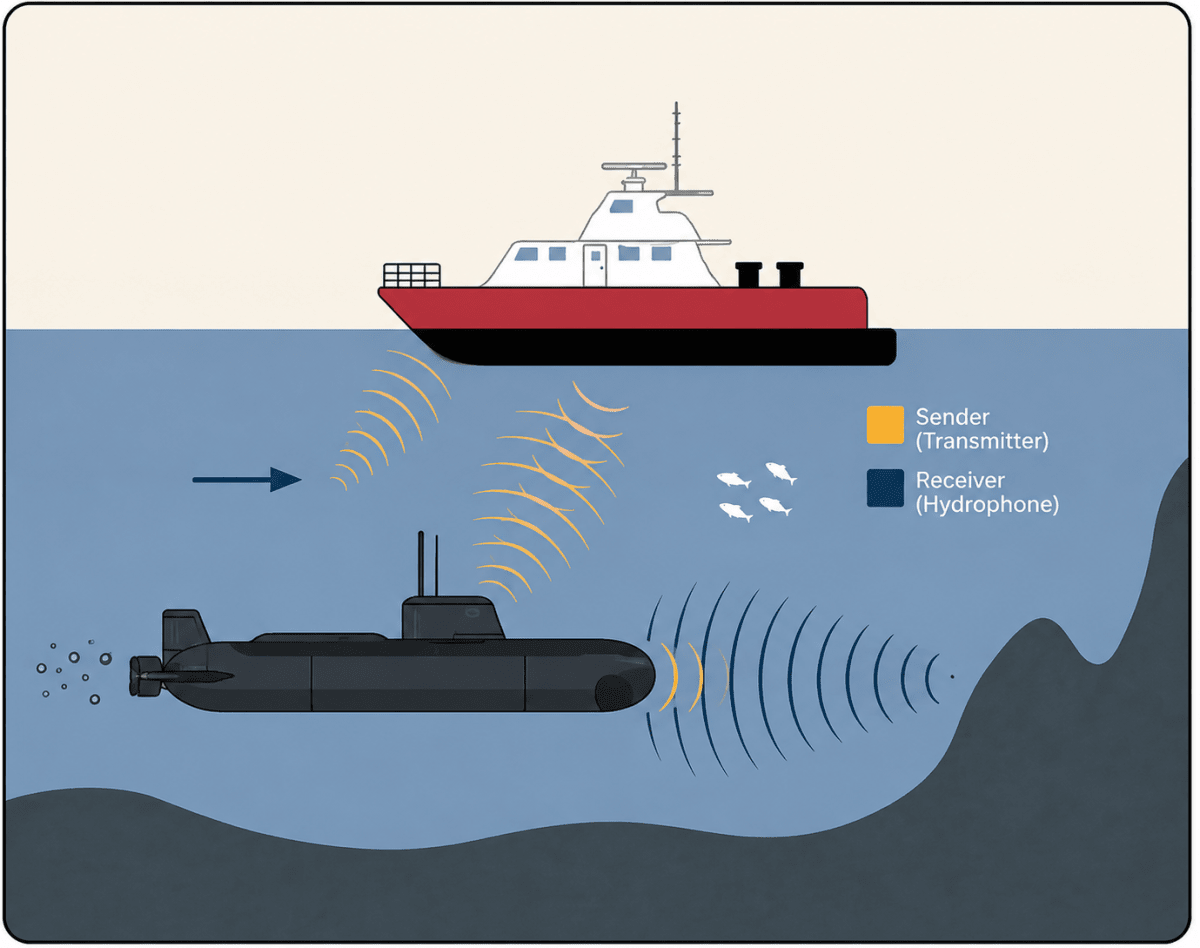
Two applications of SONAR are:
- To determine the depth of seas and oceans.
- To detect the presence of icebergs, submarines, minerals and oil under the water.
Compare the speed of sound in solids, liquids and gases with suitable reasons.
Answer
Sound travels at different speeds in different media. It travels the fastest in solids, slower in liquids and the slowest in gases.
- In solids, the particles are tightly packed, so the energy of the vibrations is transferred very rapidly from one particle to the next. Hence, sound travels the fastest in solids.
- In liquids, the particles are less closely packed than in solids but more than in gases. So liquids carry sound better than gases but not as well as solids.
- In gases, the molecules are far apart, so the transfer of energy takes more time. Hence, sound travels the slowest in gases.
The speed of sound in a medium depends on its elasticity and density — sound travels faster in a medium with greater elasticity and lower density. A few approximate speeds are shown below.
| Medium | Speed of Sound (m/s) |
|---|---|
| Air (gas) | 330 |
| Seawater (liquid) | 1533 |
| Iron (solid) | 5130 |