
How did a land of diverse geographies, languages and religions come together to challenge and finally end nearly two centuries of British rule?
Answer
India’s diverse people came together against British rule through a shared desire for freedom. Although freedom fighters followed different methods, they worked towards the same objective.
- Common grievances: Economic exploitation, racial discrimination, heavy taxation and restrictions on civil liberties created widespread discontent among Indians.
- National consciousness: Reform movements, newspapers, literature, patriotic songs such as Vande Mataram, and symbols such as Bharat Mata strengthened national feeling.
- Political organisation: The Indian National Congress and other organisations brought people from different regions and communities onto common political platforms.
- Mass movements: Movements such as Swadeshi and Boycott, Non-Cooperation, Civil Disobedience and Quit India involved peasants, workers, students, women and ordinary citizens across the country.
- Different paths towards the same goal: Moderates, Nationalists, revolutionaries, Gandhi’s followers and leaders such as Subhas Chandra Bose followed different methods, but all contributed to the struggle against colonial rule.
- Collective sacrifice: Generations of Indians from different regions and social groups fought, suffered imprisonment and made sacrifices. Their combined efforts, along with other developments such as military unrest and Britain’s weakening after World War II, ultimately contributed to the end of British rule in 1947.
What were the main developments and who were some important figures in India’s struggle for freedom?
Answer
The main developments in India’s freedom struggle were:
- Formation of the Indian National Congress (1885): A.O. Hume, Dadabhai Naoroji and W.C. Bonnerjee helped establish an organised political platform.
- Partition of Bengal and Swadeshi Movement (1905): The partition sparked the Swadeshi and Boycott movements. Leaders such as Bal Gangadhar Tilak, Lala Lajpat Rai, Bipin Chandra Pal and Aurobindo Ghose promoted national awakening.
- Home Rule Movement and Lucknow Pact (1916): Tilak and Annie Besant campaigned for self-government, while the Congress and the Muslim League reached an agreement at Lucknow.
- Rowlatt Act and Jallianwala Bagh massacre (1919): Repressive laws and the killing of unarmed people at Amritsar intensified opposition to British rule.
- Non-Cooperation Movement (1920–22): Under Mahatma Gandhi, large numbers of Indians joined nonviolent protests and boycotts.
- Revolutionary activities: Freedom fighters such as Ram Prasad Bismil, Ashfaqulla Khan, Chandrashekhar Azad and Bhagat Singh pursued armed revolutionary methods.
- Purna Swaraj and Civil Disobedience (1929–34): The Congress demanded complete independence in 1929. Gandhi launched the Civil Disobedience Movement with the Salt March in 1930.
- Quit India Movement (1942): Gandhi gave the call “Do or Die”, and protests continued despite mass arrests and repression.
- Indian National Army (1943): Subhas Chandra Bose reorganised the INA in Southeast Asia and proclaimed the provisional government of Azad Hind.
- Independence and Partition (1947): The INA trials, military unrest and Britain’s weakening after World War II contributed to the end of colonial rule. India gained independence on 15 August 1947, accompanied by Partition and widespread suffering.
What issues did the leading freedom fighters agree or disagree upon?
Answer
The leading freedom fighters agreed on the broad objective of freeing India from colonial rule, but they often disagreed on the methods and political arrangements needed to achieve it.
- Gandhi supported ahimsa, satyagraha and mass mobilisation, while revolutionaries such as Bhagat Singh and Chandrashekhar Azad believed that the use of force could be justified against colonial rule.
- Moderates initially favoured gradual reforms and autonomy within the British Empire, whereas Nationalists and later Congress leaders demanded Purna Swaraj or complete independence.
- Gandhi and B.R. Ambedkar both opposed untouchability, but disagreed over separate electorates for the Depressed Classes. Their disagreement eventually resulted in the Poona Pact.
- Many Congress leaders supported a united India, while some Muslim League leaders increasingly supported separate political arrangements, eventually leading to the demand for Pakistan.
Talk to your grandparents or elderly family members and find out what they remember or heard about India’s freedom struggle. Note which leaders or methods people supported. Discuss in class how, despite sharing the same goal of freedom, people followed different paths.
Answer
After talking to my grandparents, I learnt that people supported different leaders and methods during India’s freedom struggle. Some admired Mahatma Gandhi’s methods of ahimsa, satyagraha and mass mobilisation, while others supported Nationalists who promoted Swaraj, Swadeshi and boycott. Some people also admired revolutionaries who believed in armed resistance, and leaders like Subhas Chandra Bose, who organised the Indian National Army.
Despite following different paths, all of them shared the common goal of ending British rule and achieving freedom for India. This shows that people can have different methods and ideas while remaining united by a common objective.
Below are the first two stanzas of the song. Can you make out some of their meaning?
Vande mātaram!
sujalām suphalām malayajaśhītalām
śhasyaśhyāmalām, mātaram!
Vande mātaram!
Śubhrajyotsnām pulakitayāminīm
phullakusumita drumadalaśhobhinīm
suhāsinīm sumadhura bhāṣhiṇīm
sukhadām varadām, mātaram!
Vande mātaram!
Answer
Vande Mātaram means ‘I bow to the Motherland’ or ‘Praise to the Mother’. In these two stanzas, Bankim Chandra Chattopadhyay praises India as a divine mother and describes her natural beauty and generosity.
- First stanza: The motherland is rich in water (sujalām) and rich in fruits (suphalām), cooled by the breeze from the Malaya hills (malayajaśhītalām), and dark green with crops (śhasyaśhyāmalām).
- Second stanza: Her nights are bright with white moonlight (Śubhrajyotsnām) and thrill with joy (pulakitayāminīm). She is adorned with trees in full bloom (phullakusumita drumadalaśhobhinīm). She smiles sweetly and speaks sweetly (suhāsinīm sumadhura bhāṣhiṇīm), and she is the giver of happiness and blessings (sukhadām varadām).
The song expresses deep love and reverence for the motherland. It became a rallying cry during the national awakening of 1905 and was adopted as India’s National Song in 1950.
How are the values expressed by Swami Vivekananda above relevant in the 21st century? Can some of them help you achieve your goals? Share your thoughts with your classmates.
Answer
Swami Vivekananda’s values are highly relevant in the 21st century. He encouraged people to develop self-confidence, inner strength and courage, and to overcome fear, weakness and self-doubt. He also stressed the importance of education, scientific thinking and continuous effort, while remaining connected to India’s cultural and spiritual roots.
These values can help me achieve my goals by teaching me to believe in myself, work hard, think rationally and never give up until the goal is reached. They also remind us to learn from the past while moving confidently towards the future.
Why do you think the Bande Mataram daily avoided using the word ‘independence’?
Answer
The Bande Mataram daily avoided the word ‘independence’ mainly to escape action by the colonial government.
- The British authorities treated open calls against their rule as sedition. Tilak, for example, was sentenced to rigorous imprisonment for publishing seditious articles in Kesari.
- The Indian-language press was already regulated and censored under the Vernacular Press Act of 1878, and several publications were suppressed and shut down.
- By using words such as ‘Swaraj’ and ‘absolute national autonomy’, the paper could spread the idea of complete freedom from foreign control without inviting immediate prosecution or a ban.
Even this careful wording did not save the paper; Bande Mataram was suppressed while the Alipore Bomb trial was going on.
Comment on the phrase ‘absolute national autonomy’ in the above quotation from a Bande Mataram article.
Answer
The phrase ‘absolute national autonomy’ meant complete self-rule for India, free from British control. The Bande Mataram article made it clear that the agitation was not merely against the Partition of Bengal; its larger aim was to achieve full national freedom and the right of Indians to govern themselves.
Looking at the two boxes on either side of the daily’s title in Fig. 2.12, what do you observe?
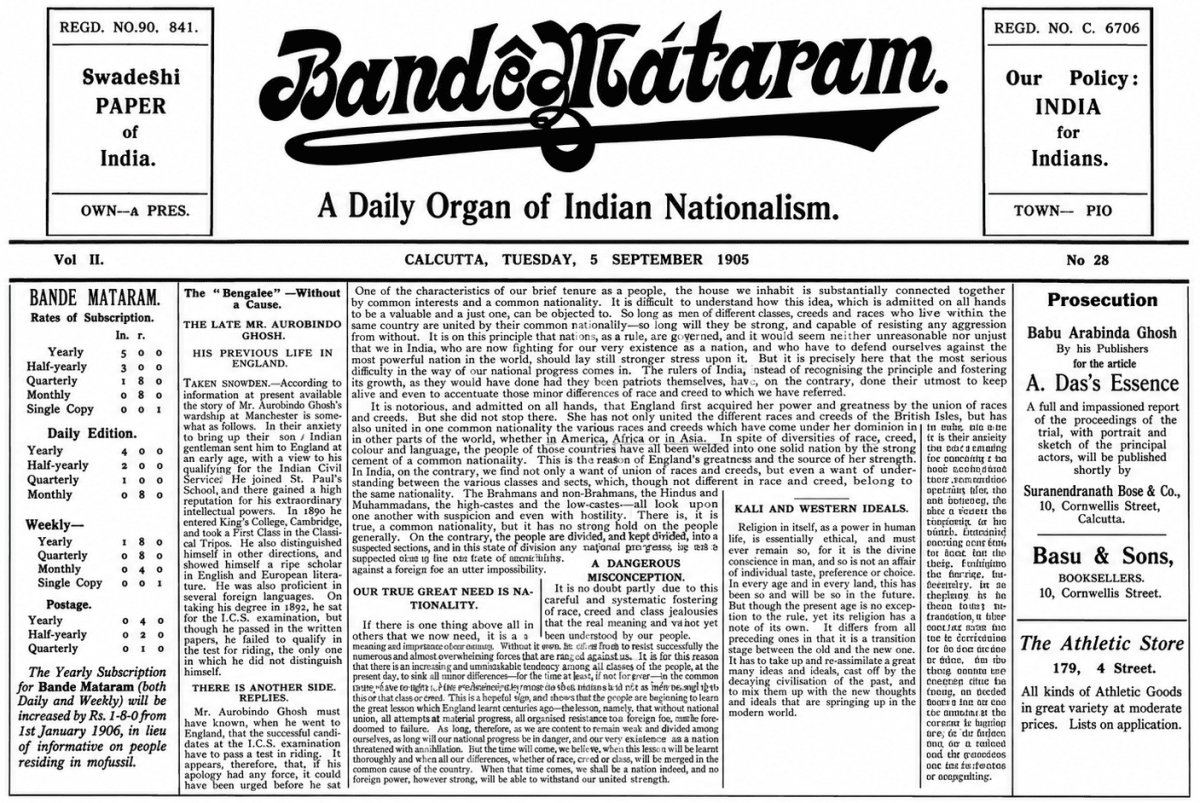
Answer
The two boxes on either side of the title carry short messages that reveal the aims of the newspaper.
- The box on the left describes the newspaper as ‘Swadeshi Paper of India’. This shows its support for the Swadeshi movement and its pride in being an Indian product.
- The box on the right states ‘Our Policy: India for Indians’. This expresses the Nationalist demand that India should be governed by Indians themselves, that is, Swaraj.
Along with the subtitle ‘A Daily Organ of Indian Nationalism’, these boxes show that the daily was the voice of the Nationalists and their programme of Swaraj and Swadeshi.
In what ways are these two representations of Mother India similar or different?
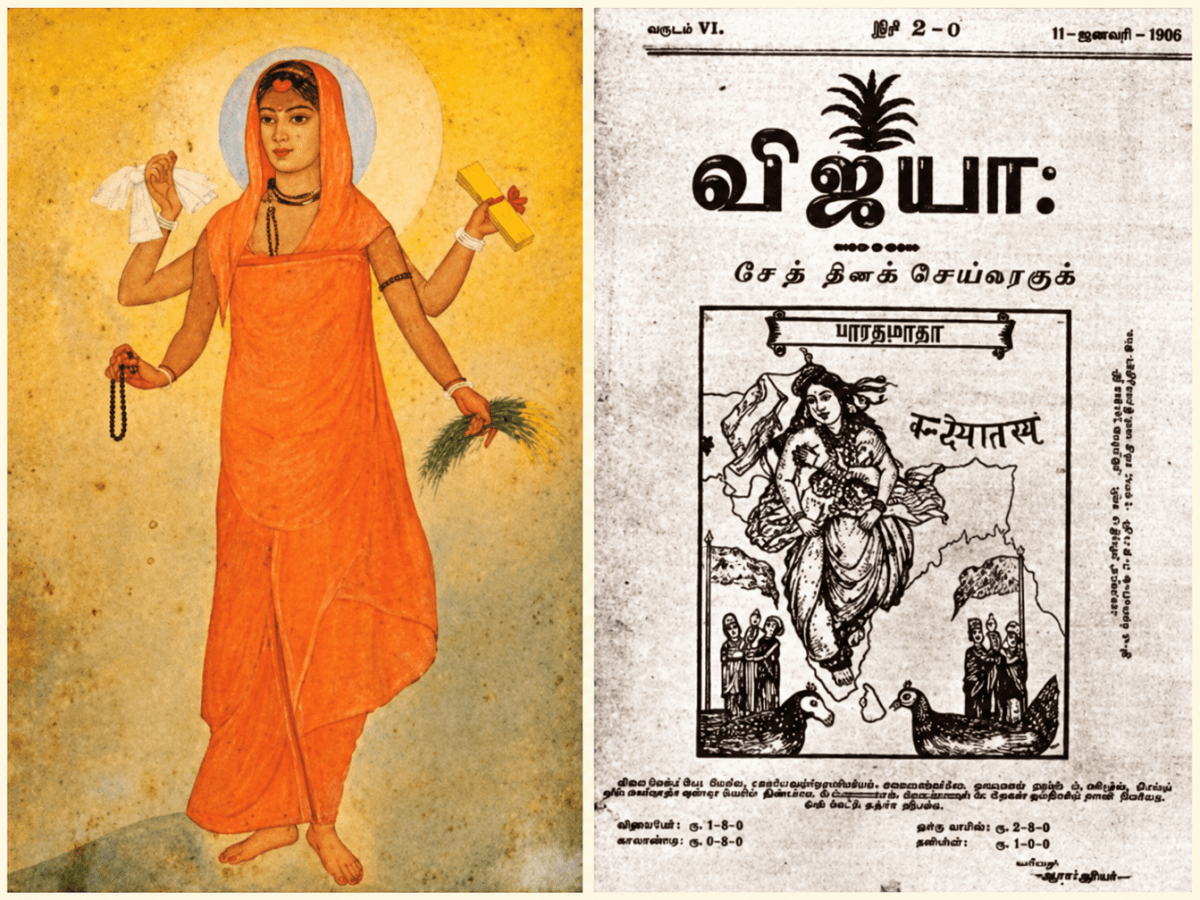
Answer
Similarities:
- Both portray India as ‘Mother India’ or ‘Bharat Mata’, a divine motherland, an idea partly inspired by Bankim Chandra Chattopadhyay’s Anandamath.
- Both were used by the Nationalists to arouse love and devotion for the motherland.
Differences:
- Abanindranath Tagore’s painting shows Bharat Mata as a calm, saintly woman dressed in saffron, with four arms holding symbolic objects; there is no map. The Vijaya cover shows Mother India drawn over the outline map of India, directly linking her with the territory of the nation.
- The painting is a colourful work of art, whereas the Vijaya cover is a printed black-and-white image meant for wide circulation among readers.
- The Vijaya cover carries the words ‘Vande Mataram’ and makes a direct political appeal, whereas the painting presents a gentle, spiritual image of the motherland.
What details can you discern in the front cover of Subramania Bharati’s Vijaya?
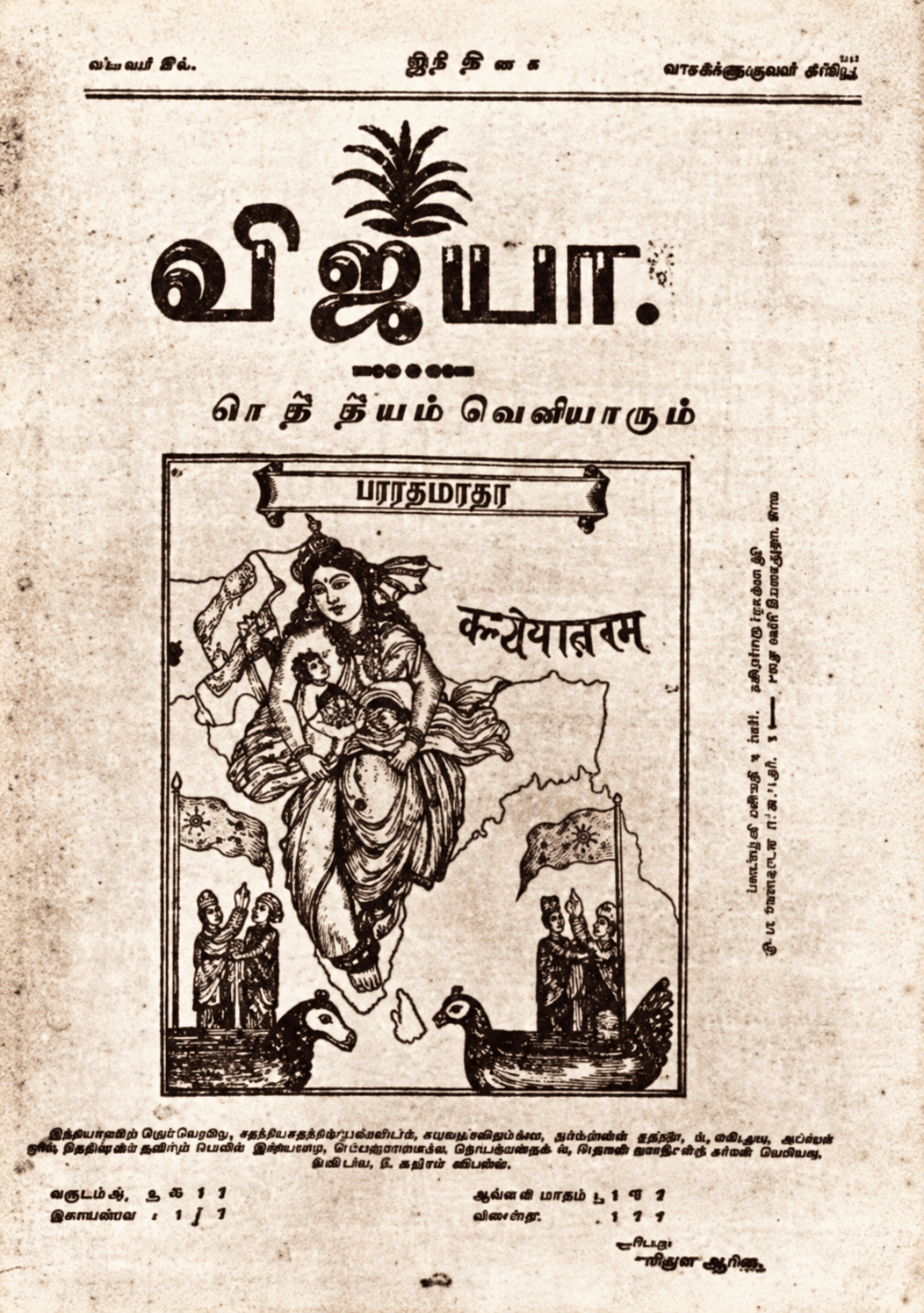
Answer
The front cover of Subramania Bharati’s Vijaya shows the following details:
- The title ‘Vijaya’ is written in large Tamil letters at the top, with a decorative emblem above it.
- A banner at the top of the picture carries the words ‘Bharat Mata’ in Devanagari script.
- Mother India is shown as a woman placed over the outline map of India.
- The words ‘Vande Mataram’ are written in Devanagari script beside her.
- Small groups of people appear in the lower corners of the picture, and two bird-like figures are drawn at the bottom.
These details show how the ideas of Bharat Mata and Vande Mataram spread from Bengal to the Madras Presidency and united people across different languages.
You may explore further and find out more about the freedom struggle in the North-East and known and lesser-known freedom fighters from this area.
Answer
The North-East made an important contribution to India’s freedom struggle. Several known and lesser-known freedom fighters resisted British rule at different times.
- Tirot Sing led the Khasi Revolt (1829–1833) in Meghalaya against British rule.
- The Singpho Rebellion of the 1830s–1840s was an important tribal resistance in eastern Assam.
- Maniram Dewan and Piyali Baruah participated in the resistance during the Revolt of 1857 in Assam and were publicly hanged by the British.
- During the Quit India Movement of 1942, freedom fighters such as Kanaklata Barua and Kushal Konwar sacrificed their lives for the country.
- In Manipur, Rani Gaidinliu began resisting British rule at a very young age. She encouraged people not to pay taxes or work for the colonial authorities.
When the judge asked Tilak if he had anything to say after being sentenced, Tilak replied, “There are higher powers that rule the destinies of men and nations; and I think, it may be the will of Providence that the cause I represent may be benefited more by my suffering than by my pen and tongue.”
(i) What message do you think he was trying to convey?
(ii) On another occasion, Tilak famously declared, “Swaraj is my birthright and I shall have it.” What does this reveal about Tilak’s character?
Answer
(i) Tilak meant that his suffering and imprisonment could strengthen the cause of freedom even more than his writings and speeches. He was willing to make personal sacrifices and believed that such sacrifice would inspire others to continue the struggle against British rule.
(ii) Tilak’s statement, “Swaraj is my birthright and I shall have it,” reveals his courage, determination, patriotism and firm belief in self-rule. It shows that he regarded Swaraj as a natural right and was determined to achieve it despite difficulties and sacrifices.
Rabindranath Tagore sent a strong letter of protest to the then Viceroy. “The accounts of the insults and sufferings by our brothers in Punjab,” wrote Tagore, “have trickled through the gagged silence, reaching every corner of India, and the universal agony of indignation roused in the hearts of our people has been ignored by our rulers—possibly congratulating themselves for what they imagine as salutary lessons.” In the same letter, Tagore returned the knighthood he had received from the British.
What does Tagore mean when he assumes that the colonial rulers ‘congratulated themselves’ after the Jallianwala Bagh massacre?
Answer
Tagore uses the phrase with bitter irony. He means that the colonial rulers did not see the Jallianwala Bagh massacre as a crime. Instead, they probably felt satisfied, even proud, believing that they had taught Indians a ‘salutary lesson’, that is, a harsh lesson meant to frighten them into obedience.
This attitude is seen in the way Dyer proudly defended his action, O’Dwyer supported him, and the inquiry committee recommended no penal action. By returning his knighthood, Tagore protested against the rulers’ indifference to the suffering of the people of Punjab.
Form groups to analyse, compare and discuss the various elements or demands contained in the above resolution.
We believe that it is the inalienable right of the Indian people, as of any other people, to have freedom and to enjoy the fruits of their toil and have the necessities of life, so that they may have full opportunities of growth. We believe also that if any government deprives a people of these rights and oppresses them the people have a further right to alter it or to abolish it. The British government in India has not only deprived the Indian people of their freedom but has based itself on the exploitation of the masses, and has ruined India economically, politically, culturally, and spiritually. We believe, therefore, that India must sever the British connection and attain Purna Swaraj or complete independence.
Answer
The Purna Swaraj resolution, passed at the Lahore session of the Congress in December 1929, contains the following elements:
- Right to freedom: Freedom is the inalienable right of the Indian people, as of any other people.
- Economic rights: People have the right to enjoy the fruits of their toil and the necessities of life, so that they have full opportunities of growth.
- Right to change an oppressive government: If a government deprives people of these rights and oppresses them, the people have the right to alter or abolish it.
- Charges against British rule: The British government has deprived Indians of freedom, is based on the exploitation of the masses, and has ruined India economically, politically, culturally and spiritually.
- Main demand: India must sever the British connection and attain Purna Swaraj or complete independence.
Comparison with earlier demands: In its early years, the Congress expressed faith in British rule and asked only for reforms. The Home Rule Movement (1916) and Motilal Nehru Report (1928) demanded self-government or Dominion status. The Lahore Resolution (1929) demanded complete independence (Purna Swaraj). To achieve this, Gandhi launched the Civil Disobedience Movement in 1930.
During the Non-Cooperation Movement of 1920–22, some 40,000 participants were jailed for various terms. The Salt Satyagraha of 1930 saw over 60,000 people jailed and a large number brutalised by the police. The Civil Disobedience Movement during 1931–34 saw another 40,000 freedom fighters jailed. During the Quit India Movement of 1942–45, over 100,000 freedom fighters were imprisoned and nearly 10,000 killed during the brutal repression of the movement.
You need not remember these figures. However, conduct a class discussion about their significance in terms of the huge collective sacrifice suffered by the Indian people.
Answer
These figures show the huge collective sacrifice made by the Indian people during the freedom struggle.
- Mass participation: Lakhs of ordinary men and women, not only leaders, joined the movements. This shows that the freedom struggle had become a mass movement.
- Growing determination: The number of people jailed rose from about 40,000 in the Non-Cooperation Movement to over 100,000 in the Quit India Movement. Repression could not break the people’s resolve.
- Brutal repression: Imprisonment, police brutality and nearly 10,000 deaths during the Quit India Movement reveal the harshness of colonial rule.
- Suffering of families: Behind every prisoner or martyr was a family that suffered the loss of income, safety and loved ones.
- Hard-won freedom: India’s freedom was a hard-won, collective victory. Remembering these sacrifices teaches us to value and protect our freedom.
As we said at the beginning, this chapter can only mention very few of those who fought for India’s liberation from colonial rule. Many more names would have deserved a mention. For instance, Acchamma Cherian, Achyutrao Patwardhan, Agarkar, Alluri Sitarama Raju, Anjana Devi Chaudhury, B.S. Moonje, Bhai Parmanand, Bhikaiji Cama, Bhogesvari Phukanani, C.F. Andrews, Dhondo Karve, Ganesh Srikrishna Khaparde, Ganjan Singh Korku, Gopinath Bordoloi, Gopalrao Deshmukh, Govind Giri, Harohalli Srinivasaiah Doreswamy, Jatindra Nath Das, Jayaprakash Narayan, Kanneganti Hanumanthu, Kasturba Gandhi, Kushal Konwar, Kuttimalu Amma, Lakshman Nayak, Lakshmi Sahgal, M.N. Roy (Manabendra Nath), Madan Lal Dhingra, Matangini Hazra, Mirabehn (Madeleine Slade), Pandit Kanshi Ram, Pingali Venkayya, Pritilata Waddedar, Rajendra Prasad, Govind Ballabh Pant, Sridev Suman, Baji Rout, Mahaveer Tyagi, H.N. Bahuguna, Rani Gaidinliu, Sardar Ajit Singh, Seth Govind Das, Shivram Rajguru, Sister Nivedita, Surya Sen, Tara Rani Srivastava, Thiruppur Kumaran, Usha Mehta, Umaji Naik, Umakant Prasad Sinha, Vasudeo Balwant Phadke, V. Ramaswamy Aiyangar, V.V.S. Aiyar.
You need not memorise this list. However, see if you can add any other name to the list. Besides, the support and sacrifice made by the women belonging to the families of the freedom fighters also needs to be acknowledged with gratitude.
Answer
Many more freedom fighters can be added to this list. Some of them are:
- Aruna Asaf Ali: Hoisted the national flag at Gowalia Tank Maidan in Bombay during the Quit India Movement and kept the underground resistance going for nearly four years.
- Kanaklata Barua: A 17-year-old from Assam who was shot dead in 1942 while leading a procession to hoist the national flag at the police station in Gohpur.
- Bina Das: A student of Calcutta University who made a daring attempt on the life of the Governor of Bengal and was sentenced to nine years of rigorous imprisonment.
- Kartar Singh Sarabha: A Ghadar revolutionary who was executed at the age of 19.
- Chandra Singh Garhwali: Led the soldiers of the Royal Garhwal Rifles who refused to fire on unarmed protesters in Peshawar in 1930.
- V.O. Chidambaram Pillai: Founded the Swadeshi Steam Navigation Company and was unfairly prosecuted and imprisoned.
Women of freedom fighters’ families: The mothers, wives, sisters and daughters of freedom fighters also made great sacrifices. They ran their homes alone while the men were in jail or in hiding, faced poverty and police harassment, and often lost their loved ones. Many of them also joined protests themselves. Their courage and support deserve our gratitude.
Find out whether the following statements are true or false:
(i) Right from its inception, the Indian National Congress called for India’s independence.
(ii) Bal Gangadhar Tilak turned a Shivaji festival into a popular event.
(iii) The Ghadar Movement of 1914–15 aimed to start a mutiny within the British Indian Army while British troops were busy with World War I.
(iv) Vallabhbhai Patel earned the title ‘Sardar’ for his leadership during the Satyagraha agitation in Gujarat.
(v) The Kakori train robbery of 1925 was carried out to fund the activities of the Hindustan Republican Association.
(vi) The ‘Do or Die’ call was given by Mahatma Gandhi during the Non-Cooperation Movement in 1920.
(vii) B.R. Ambedkar and Gandhi were in total agreement regarding the issue of ‘separate electorates’ for Dalits.
(viii) Sir Stafford Cripps was sent to India in 1942 because Winston Churchill supported immediate independence for India.
(ix) Subhas Chandra Bose raised an army during his stay in Germany.
(x) The Radcliffe Line, which divided India and Pakistan, was announced a few weeks before Independence Day.
Answer
(i) False.
Reason — At its inception, the Indian National Congress did not demand complete independence. It initially expressed faith in British rule and sought greater Indian participation in governance, protection of civil rights, and gradual social and economic reforms.
(ii) True.
Reason — Bal Gangadhar Tilak turned the Shivaji festival, along with Ganesh Chaturthi, into popular public events. He used these festivals and patriotic symbols to awaken people and encourage resistance against colonial oppression.
(iii) True.
Reason — The Ghadar Movement of 1914–15, organised by the Ghadar Party, was a daring attempt to trigger a pan-Indian mutiny within the British Indian Army during World War I. The British intelligence network uncovered the plot, and the mutiny failed.
(iv) True.
Reason — Vallabhbhai Patel led the Bardoli movement (1928) in Gujarat for peasant rights. His successful leadership earned him the title ‘Sardar’.
(v) True.
Reason — The Kakori Train Robbery was carried out by a group led by Ram Prasad Bismil, Ashfaqulla Khan and Chandrashekhar Azad. They robbed a train carrying government money to fund the revolutionary activities of the Hindustan Republican Association (HRA).
(vi) False.
Reason — Mahatma Gandhi gave the call ‘Do or Die’ when he launched the Quit India Movement in August 1942, not during the Non-Cooperation Movement of 1920.
(vii) False.
Reason — Gandhi and Ambedkar both opposed untouchability, but they disagreed on separate electorates. Ambedkar believed that separate electorates for the Depressed Classes were the only way to ensure their political voice, while Gandhi feared that they would permanently divide Hindu society and began a ‘fast unto death’. The Poona Pact increased reserved seats for the Depressed Classes instead of giving separate electorates.
(viii) False.
Reason — Churchill sent Stafford Cripps because he was under pressure to seek India’s support during World War II. The Cripps Mission offered dominion status only after the war, with a provision allowing provinces to opt out; it did not offer immediate independence.
(ix) False.
Reason — Subhas Chandra Bose spent almost two years in Germany seeking support from the anti-British forces. He formed the Indian National Army in Singapore in 1943 from Indian prisoners of war and volunteers.
(x) False.
Reason — Cyril Radcliffe was appointed only in July 1947 and given just five weeks to draw the new borders, so the line could not have been announced a few weeks before Independence Day. It was made public only after 15 August 1947.
Known as the ‘Lion of Punjab’, I was severely injured during a brutal lathi charge while protesting against the Simon Commission.
Answer
Lala Lajpat Rai
I famously declared, ‘Swaraj is my birthright, and I shall have it!’ I used the Kesari newspaper and festivals like Ganesh Chaturthi to unite people against British rule.
Answer
Bal Gangadhar Tilak
I was a leader of the Nationalist faction of the Congress. In the daily Bande Mataram, I wrote on the need for India to attain absolute autonomy.
Answer
Aurobindo Ghose (Sri Aurobindo)
I earned my nickname ‘Bagha’ after wrestling a tiger with my bare hands. I was a revolutionary leader who died in a gunfight at while waiting for a shipment of German arms to start an uprising.
Answer
Jatin Mukherjee (Bagha Jatin)
I organised the daring attempt to throw a bomb at the Viceroy in 1912. I later escaped to Japan, where I spent years working to organise a movement from there.
Answer
Rash Behari Bose
I was martyred at a young age after an attempt on the life of a British judge.
Answer
Khudiram Bose
I was martyred at a young age after throwing non-lethal bombs in Delhi’s Central Legislative Assembly.
Answer
Bhagat Singh
I turned the freedom struggle into a mass movement through the principles of ahimsa and satyagraha, leading campaigns such as the Dandi March.
Answer
Mahatma Gandhi
I sought help from the Axis powers during World War II to organise the Indian National Army.
Answer
Subhas Chandra Bose
A British lawyer, I was given just five weeks to draw the boundary line that would partition the Indian subcontinent into two separate nations.
Answer
Cyril Radcliffe
What kinds of sacrifices are needed to achieve freedom? Think about the lives of Indian soldiers during wars, families suffering during famines, leaders and ordinary people who were arrested, and countless others who lost their homes and safety while participating in protests. If you were living during India’s freedom struggle, would you have chosen to participate in it? What comforts, opportunities, or personal goals might you have been willing to give up for a cause you strongly believed in?
Answer
Freedom often demands courage, sacrifice and willingness to endure hardship. During India’s freedom struggle, soldiers risked their lives, families suffered during famines, and many leaders and ordinary people faced imprisonment, violence, loss of livelihood and displacement. Thousands were jailed or killed during movements such as Non-Cooperation, Civil Disobedience and Quit India.
If I had lived during the freedom struggle, I would have chosen to participate in it. For a cause as important as national freedom, I would have been willing to give up personal comfort, education or career opportunities, financial security and even my safety. Such sacrifices would have been difficult, but they would have contributed to the larger collective struggle for freedom.
What values does Tilak’s statement, “Swaraj is my birthright and I shall have it,” reflect? Can these values be meaningful for young people today?
Answer
Tilak’s statement, “Swaraj is my birthright and I shall have it,” reflects the following values:
- Patriotism: Deep love for the motherland and a strong desire to see it free.
- Self-respect: The belief that Indians have the right to rule themselves and should not accept foreign domination.
- Freedom as a natural right: Freedom is not a favour to be requested from rulers; it is the birthright of every people.
- Courage and determination: A firm resolve to achieve the goal despite imprisonment and hardship.
These values are meaningful for young people today. Self-respect and confidence help them pursue their goals with determination. Awareness of their rights encourages them to stand up against injustice through peaceful and lawful means. At the same time, rights come with duties, and freedom must be protected through responsible citizenship.
How did peasants, workers, tribals, and students contribute to the national movement in ways different from political leaders?
Answer
Political leaders gave ideas, organised the movement, wrote and spoke against colonial rule, and negotiated with the British. Peasants, workers, tribals and students made the freedom struggle a mass movement through direct action and sacrifice.
- Peasants: The indigo farmers of Bihar and the peasants of Kheda resisted exploitation and excessive land revenue. The peasants of Bardoli fought for their rights, and during the Civil Disobedience Movement many people refused to pay taxes.
- Workers: The mill workers of Ahmedabad protested against extremely low wages, and workers went on strike during the Quit India Movement.
- Tribals: Birsa Munda led the Ulgulaan (1899–1900) to reject colonial authority and reclaim tribal land. Rani Gaidinliu urged people not to pay taxes or work for the colonial masters.
- Students: Students joined processions against the partition of Bengal and left schools during the Quit India Movement. Some, like Bina Das, Suniti Chowdhury and Shanti Ghosh, took part in revolutionary actions.
These groups resisted colonial rule at the grassroots level, bore the brunt of repression, and kept movements alive even when the leaders were arrested.
Discuss in class this extract from Nehru’s speech on 15 August 1947:
“Long years ago we made a tryst with destiny, and now the time comes when we shall redeem our pledge, not wholly or in full measure, but very substantially. At the stroke of the midnight hour, when the world sleeps, India will awake to life and freedom. A moment comes, which comes but rarely in history, when we step out from the old to the new, when an age ends, and when the soul of a nation, long suppressed, finds utterance…”
What is meant by “redeem our pledge”? How would you define the ‘soul of a nation’?
Answer
“Redeem our pledge” means to fulfil a solemn promise. Indians had long pledged themselves to win freedom for India, as in the Purna Swaraj resolution of 1929. With independence on 15 August 1947, this promise was being fulfilled. Nehru said that it was fulfilled ‘not wholly or in full measure, but very substantially’, because independence came along with Partition, violence and displacement, and the task of building the nation still lay ahead.
The ‘soul of a nation’ is the shared spirit of its people — their culture, values, traditions, ideals and hopes for the future. Under colonial rule, India’s soul was ‘long suppressed’, as Indians could not live their own life according to their own nature and ideals. Independence gave the nation the freedom to express itself and shape its own future.
Imagine you are a freedom fighter.
(a) Explain the method you support to achieve freedom.
(b) Discuss with your classmates any other method they would support. Be respectful in your debate.
(c) What does this debate teach us about unity and disagreement?
Answer
(a) I would support Mahatma Gandhi’s method of ahimsa, satyagraha and mass mobilisation. I would take part in peaceful protests, non-cooperation and civil disobedience to oppose British rule without using violence.
(b) Some of my classmates may support other methods. The Nationalists supported Swaraj, Swadeshi and boycott, while some revolutionaries believed that armed resistance was necessary to challenge British rule. Their views should be heard and discussed respectfully.
(c) This debate teaches us that people can disagree about methods but remain united by a common goal. Respect for different opinions helps maintain unity even when there are differences in ideas and approaches.
Write a news report based on an important event in the Freedom Movement (Swadeshi, boycott, satyagraha, Non-Cooperation, Quit India, or Partition).
(a) Write a headline.
(b) Include one interview or public reaction.
(c) Explain why this event was important.
Answer
(a) Headline: Quit India Movement: “Do or Die” Call Shakes British Rule
Bombay, August 1942: Mahatma Gandhi launched the Quit India Movement with the powerful call of “Do or Die”, demanding that the British leave India immediately. Although most Congress leaders were arrested, protests and rallies spread across the country. Workers went on strike, students left schools, and underground leaders such as Ram Manohar Lohia and Jayaprakash Narayan continued the movement.
(b) Public reaction: Students left schools, workers went on strike, and demonstrators across India joined protests despite arrests and repression. Their participation showed widespread public determination to end British rule.
(c) Importance: The Quit India Movement showed the British that they could no longer rule India without the consent of the Indian people. Despite severe repression, arrests and deaths, it strengthened the demand for immediate independence.
Imagine you are part of a team creating a small museum exhibition on India’s freedom struggle for students of your age.
(a) Choose a title for your exhibit.
(b) Select three objects (for example: a letter, a photograph, a newspaper, a prison diary — you can add to these examples) and explain what each object represents.
(c) Write a short note on what visitors should learn or feel after seeing this exhibit.
Answer
(a) Title: Many Paths, One Goal: India’s Road to Freedom
(b) Objects:
- A charkha with khadi cloth: It represents Swadeshi, self-reliance and Mahatma Gandhi’s mass movement. Spinning khadi provided work to impoverished villagers and challenged British textile imports.
- Rabindranath Tagore’s letter to the Viceroy (1919): It represents the nation’s grief and anger after the Jallianwala Bagh massacre. By returning his knighthood, Tagore showed that Indians would not accept honours from rulers who ignored their suffering.
- A photograph of a cell in the Cellular Jail: It represents the suffering and sacrifice of revolutionaries sent to ‘Kala Pani’, where they faced solitary confinement, forced labour and brutal punishment.
(c) Note for visitors: Visitors should learn that India’s freedom was won through the efforts of many people who followed different paths but shared one goal. They should feel gratitude for the sacrifices made by known and unknown freedom fighters and understand their own responsibility to protect this hard-won freedom.
As a class activity, write and stage a small play or skit based on the Freedom Movement.
Answer
Title: The Salt of Freedom
Characters: Narrator, Ramu (a farmer), Kamla (his wife), Meena (their daughter, a student), a Police Officer, Villagers
Scene 1: A village in Gujarat, March 1930
Narrator: The British government holds a monopoly on salt and charges a high tax on it. Mahatma Gandhi has begun a 380-km march to Dandi to break the salt law.
Ramu: Even the poorest family needs salt. Why should we pay a tax on something the sea gives us freely?
Meena: Father, our teacher says this march is the beginning of the Civil Disobedience Movement. People will break unjust laws peacefully to demand Purna Swaraj.
Kamla: Then I shall join too. Women are also coming out of their homes to take part.
Ramu: Remember, whatever happens, there must be no violence. That is the way of satyagraha.
Scene 2: The seashore at Dandi, April 1930
Narrator: Gandhi reaches Dandi and symbolically collects some salt. The villagers follow his example.
Villagers (together): Vande Mataram!
Police Officer: Stop! Making salt is against the law. You are all under arrest!
Kamla (calmly): You may arrest us, but you cannot arrest our spirit. Thousands more will come.
Meena: We are not afraid. Freedom is worth every sacrifice.
Narrator: Thousands, including Gandhi, were arrested, but the Civil Disobedience Movement spread far and wide. People boycotted foreign cloth and refused to pay taxes. The Salt March showed that ordinary people, through peaceful protest, could challenge the mighty British Empire.
Staging tips: Use simple props such as a bag of salt, khadi clothes and placards. Keep the skit short and give every student a role, as narrator, character or part of the crowd.
India achieved freedom after great sacrifice. What responsibilities do citizens have today to protect and strengthen this freedom? Write 5 to 10 lines.
Answer
Citizens have several responsibilities to protect and strengthen India’s hard-won freedom:
- Respect the Constitution, the national flag and the national anthem.
- Maintain unity and harmony among people of different religions, languages and regions.
- Obey the law and oppose injustice only through peaceful and lawful means.
- Vote responsibly and take an active part in the democratic process.
- Respect the rights and dignity of others, especially women and marginalised groups.
- Protect public property and avoid violence.
- Support self-reliance by valuing Indian products, skills and enterprise.
- Honour the sacrifices of freedom fighters and work hard to build a strong nation.