
State whether the following statements are True or False. Correct that are false:
(i) A point whose x-coordinate is zero and y-coordinate is non-zero will lie on the y-axis.
(ii) A point whose y-coordinate is zero and x-coordinate is 7 will lie on y-axis.
(iii) The coordinates of the origin are (0, 0).
(iv) If the point (x, y) lies on x-axis, then its abscissa is zero.
(v) If the point (x, y) lies on y-axis, then its ordinate is zero.
(vi) The point (x, y) lies on y-axis if x = 0.
(vii) The point (-3, -2) lies in the fourth quadrant.
(viii) The point (5, -3) lies in the second quadrant.
Answer
(i) A point whose x-coordinate is zero and y-coordinate is non-zero is of the form (0, y), where y is non-zero.
We know that the abscissa of every point lying on the y-axis is zero.
So, the given point lies on the y-axis.
Hence, the given statement is True.
(ii) A point whose y-coordinate is zero and x-coordinate is 7 is the point (7, 0).
We know that the ordinate of every point lying on the x-axis is zero.
So, the point (7, 0) lies on the x-axis and not on the y-axis.
Hence, the given statement is False.
Correct statement : A point whose y-coordinate is zero and x-coordinate is 7 will lie on x-axis.
(iii) The origin is the point of intersection of the x-axis and the y-axis.
Since the origin lies on both the axes, its abscissa as well as its ordinate is zero.
So, the coordinates of the origin are (0, 0).
Hence, the given statement is True.
(iv) For a point lying on the x-axis, the distance measured above or below the origin is zero.
So, if the point (x, y) lies on the x-axis, then its ordinate is zero and not its abscissa.
Hence, the given statement is False.
Correct statement : If the point (x, y) lies on x-axis, then its ordinate is zero.
(v) For a point lying on the y-axis, the distance measured to the right or to the left of the origin is zero.
So, if the point (x, y) lies on the y-axis, then its abscissa is zero and not its ordinate.
Hence, the given statement is False.
Correct statement : If the point (x, y) lies on y-axis, then its abscissa is zero.
(vi) The abscissa of every point lying on the y-axis is zero.
So, the point (x, y) lies on the y-axis when x = 0.
Hence, the given statement is True.
(vii) In the point (-3, -2), the abscissa is -3 and the ordinate is -2.
Since both the abscissa and the ordinate are negative, the point lies in the third quadrant.
Hence, the given statement is False.
Correct statement : The point (-3, -2) lies in the third quadrant.
(viii) In the point (5, -3), the abscissa is 5 and the ordinate is -3.
Since the abscissa is positive and the ordinate is negative, the point lies in the fourth quadrant.
Hence, the given statement is False.
Correct statement : The point (5, -3) lies in the fourth quadrant.
Find the coordinates of the point
(i) which lies on x and y axes both.
(ii) whose ordinate is -4 and which lies on y-axis.
(iii) whose abscissa is 5 and which lies on x-axis.
(iv) the point whose abscissa is -2 and ordinate 3.
(v) the point whose ordinate is -2 and abscissa 3.
Answer
(i) The only point which lies on the x-axis as well as on the y-axis is the point of intersection of the two axes, that is, the origin.
Hence, the coordinates of the point are (0, 0).
(ii) The point lies on the y-axis, so its abscissa is zero.
The ordinate of the point is -4.
Since the abscissa precedes the ordinate, the coordinates are (0, -4).
Hence, the coordinates of the point are (0, -4).
(iii) The point lies on the x-axis, so its ordinate is zero.
The abscissa of the point is 5.
Since the abscissa precedes the ordinate, the coordinates are (5, 0).
Hence, the coordinates of the point are (5, 0).
(iv) The abscissa of the point is -2 and its ordinate is 3.
Since the abscissa precedes the ordinate, the coordinates are (-2, 3).
Hence, the coordinates of the point are (-2, 3).
(v) The abscissa of the point is 3 and its ordinate is -2.
Since the abscissa precedes the ordinate, the coordinates are (3, -2).
Hence, the coordinates of the point are (3, -2).
In which quadrant or on which axis each of the following points lie?
(-3, 5), (4, -1), (2, 0), (2, 2), (-3, -6)
Answer
The signs of the coordinates of a point in the four quadrants are shown in the table given below:
| Quadrants | x (abscissa) | y (ordinate) |
|---|---|---|
| 1st (XOY) | +ve | +ve |
| 2nd (YOX') | -ve | +ve |
| 3rd (X'OY') | -ve | -ve |
| 4th (Y'OX) | +ve | -ve |
In the point (-3, 5), the abscissa is negative and the ordinate is positive.
So, the point (-3, 5) lies in the second quadrant.
In the point (4, -1), the abscissa is positive and the ordinate is negative.
So, the point (4, -1) lies in the fourth quadrant.
In the point (2, 0), the ordinate is zero.
So, the point (2, 0) lies on the x-axis.
In the point (2, 2), both the abscissa and the ordinate are positive.
So, the point (2, 2) lies in the first quadrant.
In the point (-3, -6), both the abscissa and the ordinate are negative.
So, the point (-3, -6) lies in the third quadrant.
Hence, the given points lie in the second quadrant, fourth quadrant, on the x-axis, in the first quadrant and in the third quadrant respectively.
Which of the following points lie on (i) x-axis? (ii) y-axis?
A(0, 2), B(5, 6), C(23, 0), D(0, 23), E(0, -4), F(-6, 0), G(3.5, 0)
Answer
(i) The ordinate of every point lying on the x-axis is zero.
Among the given points, the ordinate is zero for C(23, 0), F(-6, 0) and G(3.5, 0).
Hence, the points C, F and G lie on the x-axis.
(ii) The abscissa of every point lying on the y-axis is zero.
Among the given points, the abscissa is zero for A(0, 2), D(0, 23) and E(0, -4).
Hence, the points A, D and E lie on the y-axis.
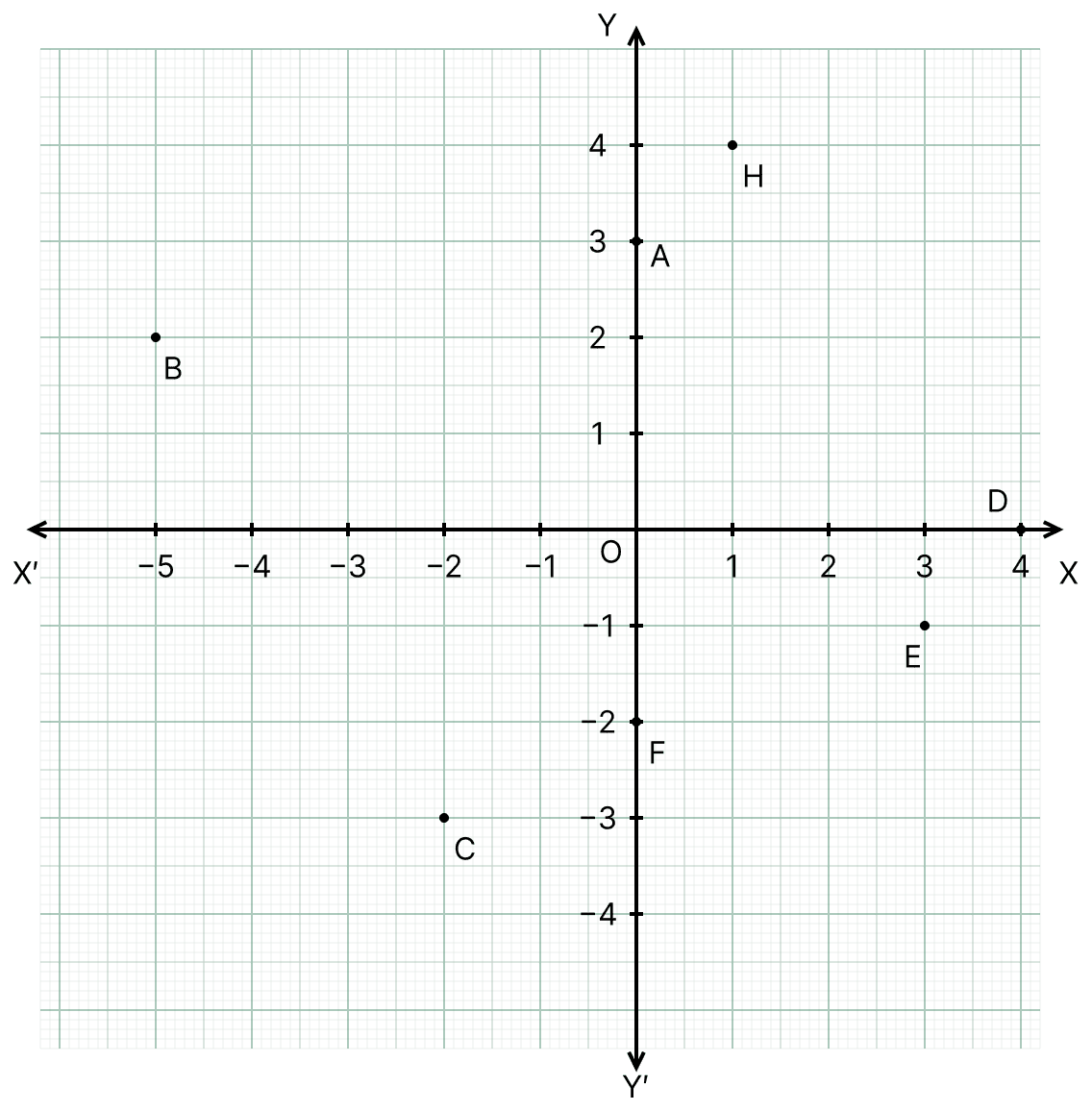
Look at the figure given below and write the following:
(i) Coordinates of B, C and E.
(ii) The point identified by the coordinates (0, -2).
(iii) The abscissa of point H.
(iv) The coordinates of points A and D.
Answer
(i) The point B is 5 units to the left of the origin and 2 units above it.
So, the abscissa of B is -5 and its ordinate is 2.
The point C is 2 units to the left of the origin and 3 units below it.
So, the abscissa of C is -2 and its ordinate is -3.
The point E is 3 units to the right of the origin and 1 unit below it.
So, the abscissa of E is 3 and its ordinate is -1.
Hence, the coordinates are B(-5, 2), C(-2, -3) and E(3, -1).
(ii) The point identified by the coordinates (0, -2) lies on the y-axis at a distance of 2 units below the origin.
From the figure, the point lying at this position is F.
Hence, the point identified by the coordinates (0, -2) is F.
(iii) The point H lies 1 unit to the right of the origin.
Hence, the abscissa of the point H is 1.
(iv) The point A lies on the y-axis at a distance of 3 units above the origin.
So, the abscissa of A is 0 and its ordinate is 3.
The point D lies on the x-axis at a distance of 4 units to the right of the origin.
So, the abscissa of D is 4 and its ordinate is 0.
Hence, the coordinates are A(0, 3) and D(4, 0).
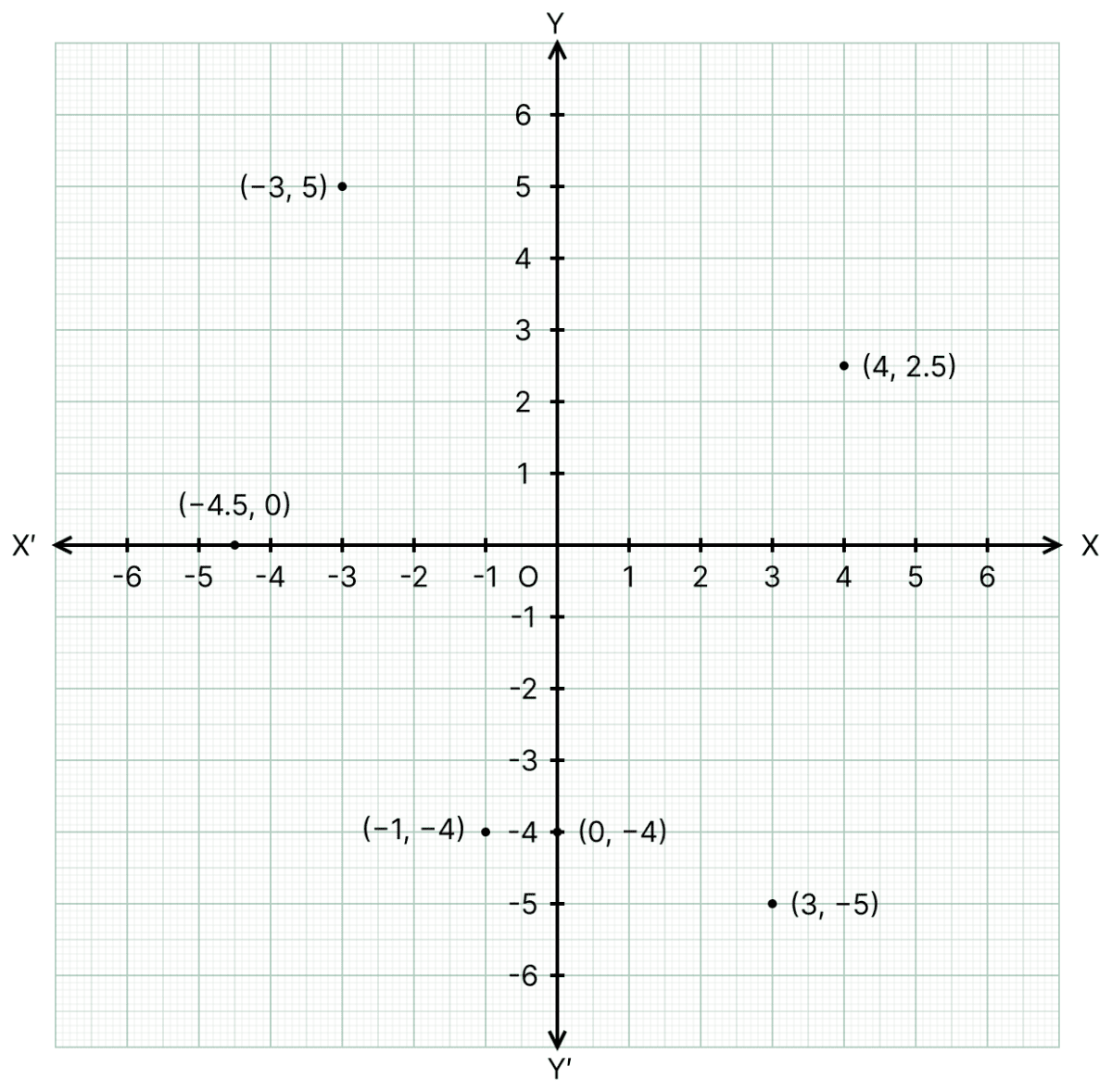
Plot the following points on the same graph paper :
(i) (-3, 5)
(ii) (4, 2.5)
(iii) (-1, -4)
(iv) (0, -4)
(v) (3, -5)
(vi) (-4.5, 0)
Answer
Draw the coordinate axes X'OX and Y'OY on a graph paper and choose the units such that 1 cm represents 1 unit on both the axes.
Steps:
To plot (-3, 5), start from the origin O, move 3 units to the left along the x-axis and then move 5 units upwards parallel to the y-axis. Mark a dot at this place.
To plot (4, 2.5), start from the origin O, move 4 units to the right along the x-axis and then move 2.5 units upwards parallel to the y-axis. Mark a dot at this place.
To plot (-1, -4), start from the origin O, move 1 unit to the left along the x-axis and then move 4 units downwards parallel to the y-axis. Mark a dot at this place.
To plot (0, -4), start from the origin O and move 4 units downwards along the y-axis, as its abscissa is zero. Mark a dot at this place.
To plot (3, -5), start from the origin O, move 3 units to the right along the x-axis and then move 5 units downwards parallel to the y-axis. Mark a dot at this place.
To plot (-4.5, 0), start from the origin O and move 4.5 units to the left along the x-axis, as its ordinate is zero. Mark a dot at this place.
The required points are plotted on the graph paper as shown below:
Plot the following points and check whether they are collinear or not:
(i) (-1, 0), (0, 1), (2, 3)
(ii) (1, 1), (2, -3), (-1, -2)
Answer
(i) Draw the coordinate axes on a graph paper and plot the points A(-1, 0), B(0, 1) and C(2, 3) on it.
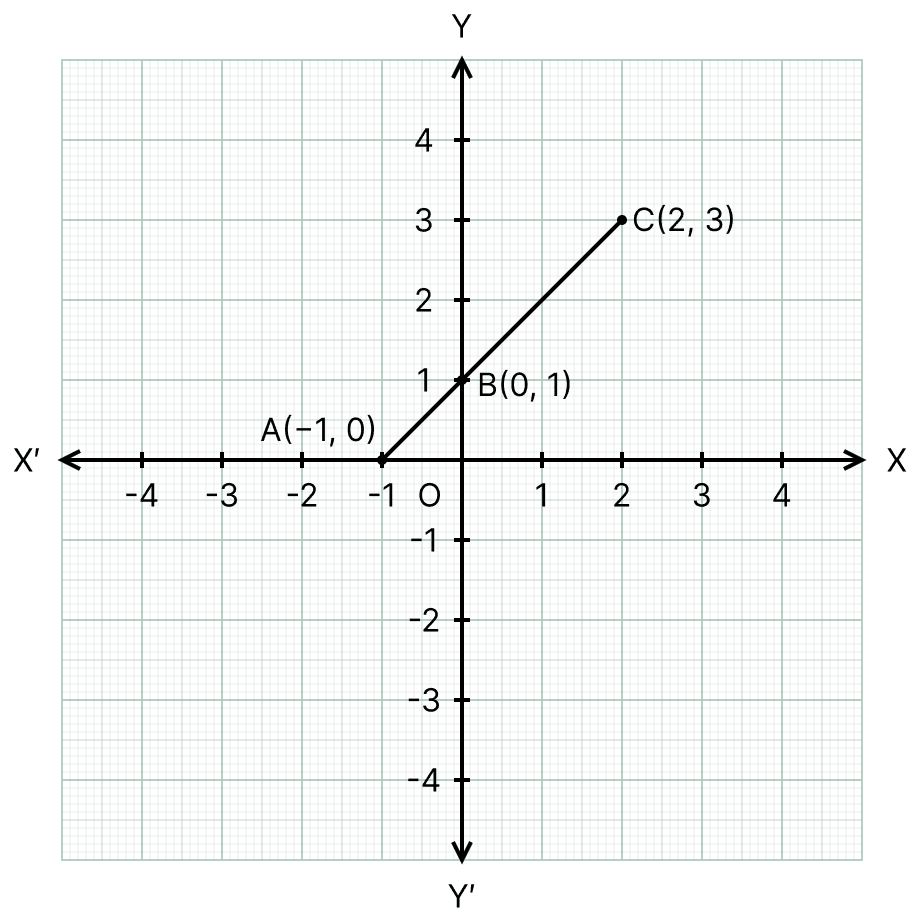
Draw a line passing through the points A and B.
We find that the point C(2, 3) also lies on this line.
Hence, the points (-1, 0), (0, 1) and (2, 3) are collinear.
(ii) Draw the coordinate axes on a graph paper and plot the points A(1, 1), B(2, -3) and C(-1, -2) on it.
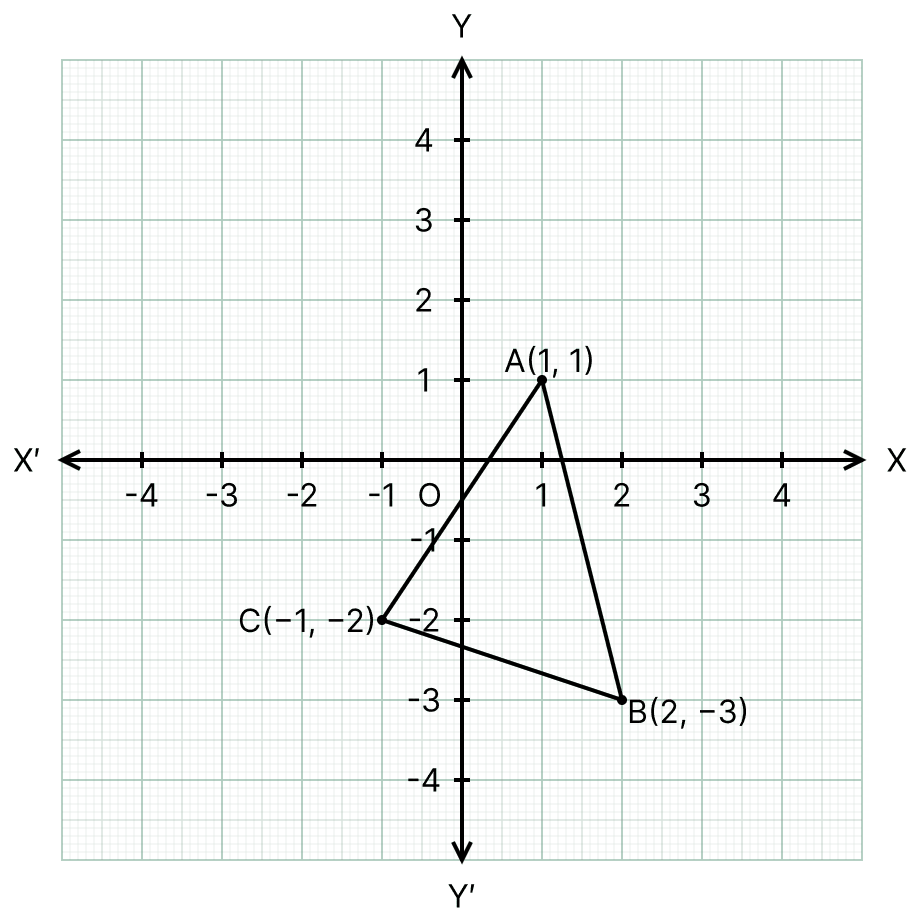
We note that the line passing through A and B does not pass through the point C(-1, -2).
Thus the three points do not lie on the same straight line.
Hence, the points (1, 1), (2, -3) and (-1, -2) are not collinear.