
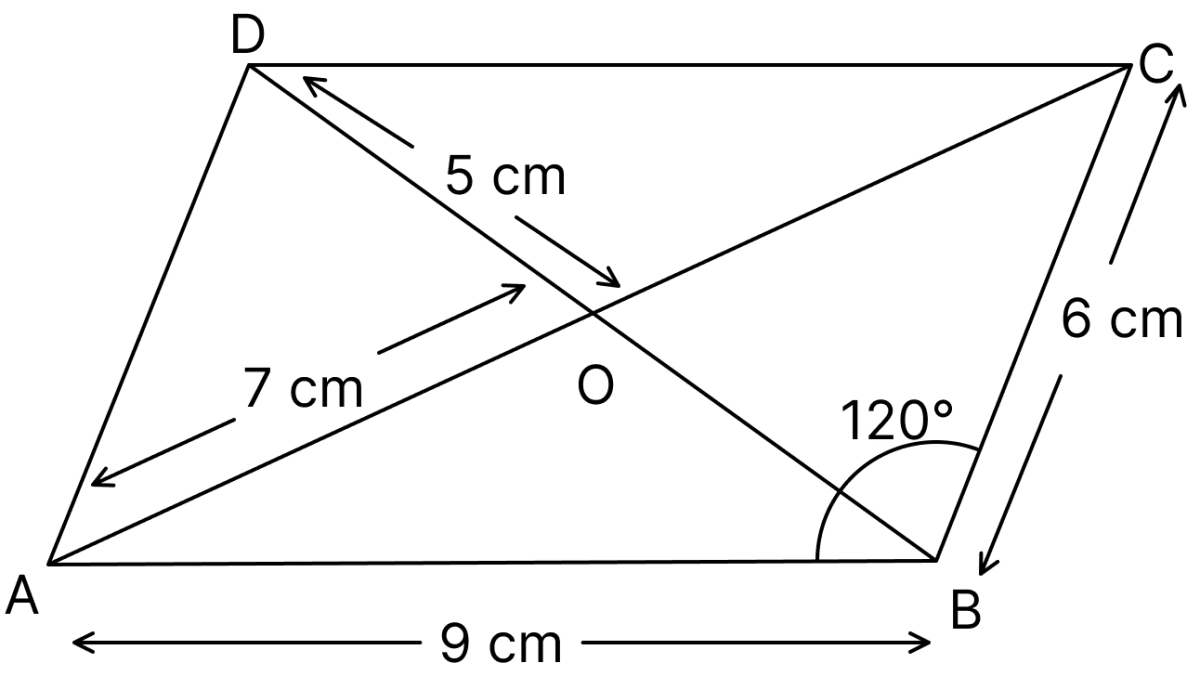
In the adjoining figure, ABCD is a parallelogram. Complete each statement along with the definition or property used.
(i) AD = .....
(ii) DC = .....
(iii) ∠DCB = .....
(iv) ∠ADC = .....
(v) ∠DAB = .....
(vi) OC = .....
(vii) OB = .....
(viii) m∠DAB + m∠CDA = .....
Answer
From the figure, in parallelogram ABCD, AB = 9 cm, BC = 6 cm, ∠ABC = 120°, AO = 7 cm and DO = 5 cm.
(i) The opposite sides of a parallelogram are of equal length.
AD = BC = 6 cm
Hence, AD = 6 cm.
(ii) The opposite sides of a parallelogram are of equal length.
DC = AB = 9 cm
Hence, DC = 9 cm.
(iii) The adjacent angles of a parallelogram are supplementary.
⇒ ∠DCB + ∠ABC = 180°
⇒ ∠DCB + 120° = 180°
⇒ ∠DCB = 180° - 120°
⇒ ∠DCB = 60°
Hence, ∠DCB = 60°.
(iv) The opposite angles of a parallelogram are of equal measure.
∠ADC = ∠ABC = 120°
Hence, ∠ADC = 120°.
(v) The opposite angles of a parallelogram are of equal measure.
∠DAB = ∠DCB = 60°
Hence, ∠DAB = 60°.
(vi) The diagonals of a parallelogram bisect each other.
OC = AO = 7 cm
Hence, OC = 7 cm.
(vii) The diagonals of a parallelogram bisect each other.
OB = DO = 5 cm
Hence, OB = 5 cm.
(viii) The adjacent angles of a parallelogram are supplementary.
m∠DAB + m∠CDA = 60° + 120° = 180°
Hence, m∠DAB + m∠CDA = 180°.
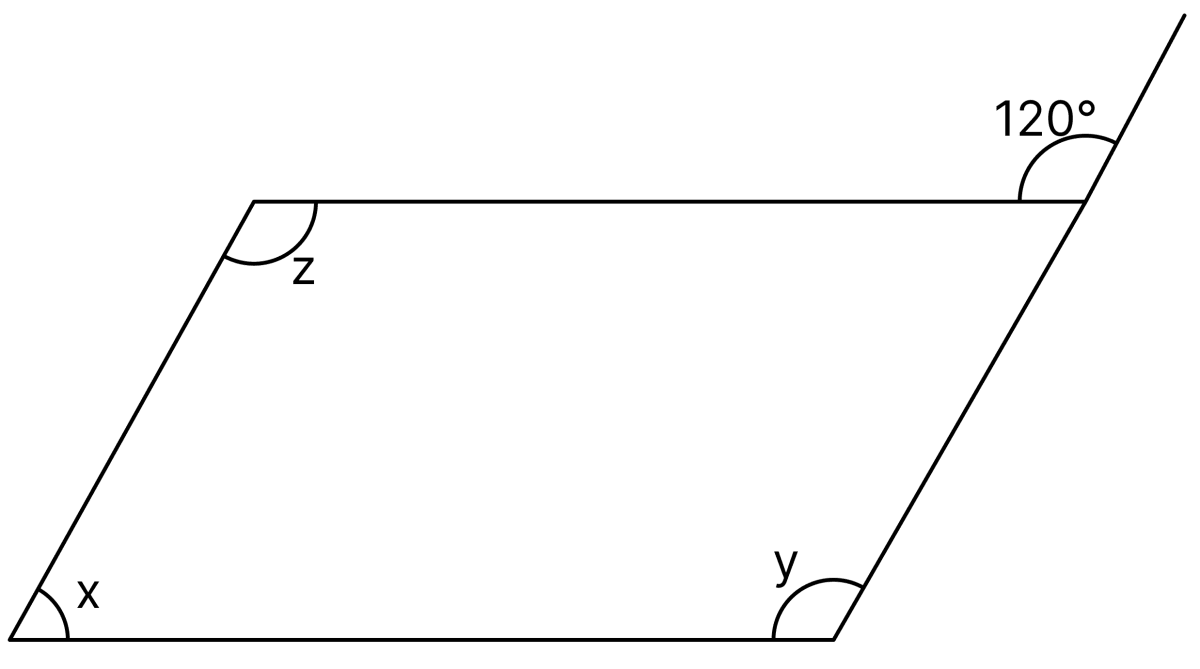
Consider the following parallelogram. Find the values of x, y, z in each.
Answer
From the figure, 120° is the exterior angle at the vertex where the side has been produced.
As the sum of an interior angle and its adjacent exterior angle is 180°, the interior angle at that vertex is:
= 180° - 120°
= 60°
As the opposite angles of a parallelogram are of equal measure,
x = 60°
As the adjacent angles of a parallelogram are supplementary,
⇒ z + 60° = 180°
⇒ z = 180° - 60°
⇒ z = 120°
As the opposite angles of a parallelogram are of equal measure,
y = z = 120°
Hence, x = 60°, y = 120° and z = 120°.
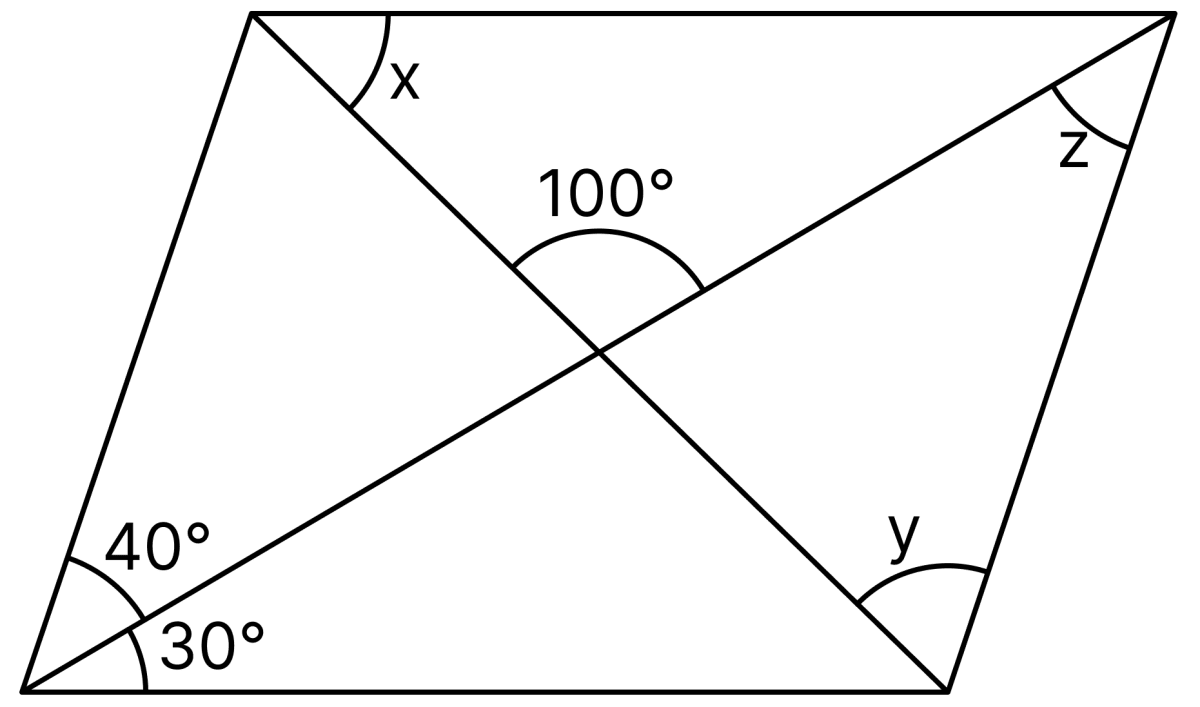
Consider the following parallelogram. Find the values of x, y, z in each.
Answer
Let the parallelogram be ABCD, where A is the bottom-left vertex, B is the bottom-right vertex, C is the top-right vertex and D is the top-left vertex, with diagonals AC and BD meeting at O.
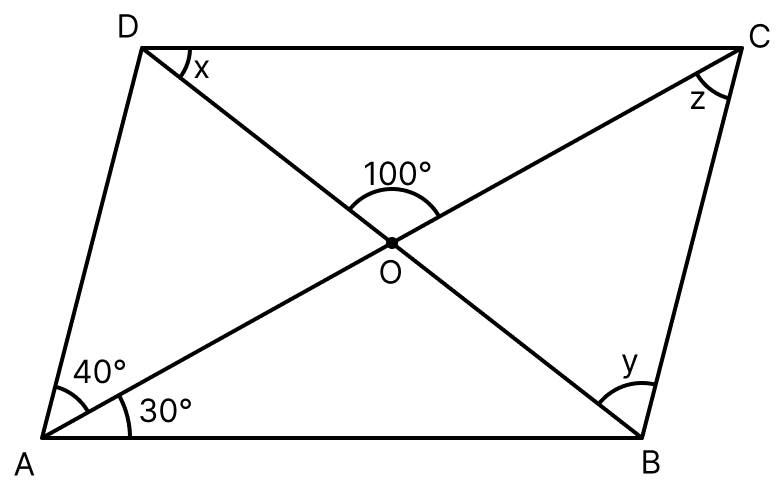
From the figure, ∠DAC = 40°, ∠CAB = 30° and ∠DOC = 100°.
As AB ∥ DC and AC is a transversal,
∠DCA = ∠CAB = 30° (alternate angles are equal)
In ΔDOC, the sum of all the angles of a triangle is 180°.
⇒ x + ∠DOC + ∠DCA = 180°
⇒ x + 100° + 30° = 180°
⇒ x + 130° = 180°
⇒ x = 180° - 130°
⇒ x = 50°
As AD ∥ BC and AC is a transversal,
z = ∠DAC = 40° (alternate angles are equal)
As ∠DOC and ∠BOC form a linear pair,
⇒ ∠BOC = 180° - 100° = 80°
In ΔBOC, the sum of all the angles of a triangle is 180°.
⇒ y + ∠BOC + z = 180°
⇒ y + 80° + 40° = 180°
⇒ y + 120° = 180°
⇒ y = 180° - 120°
⇒ y = 60°
Hence, x = 50°, y = 60° and z = 40°.
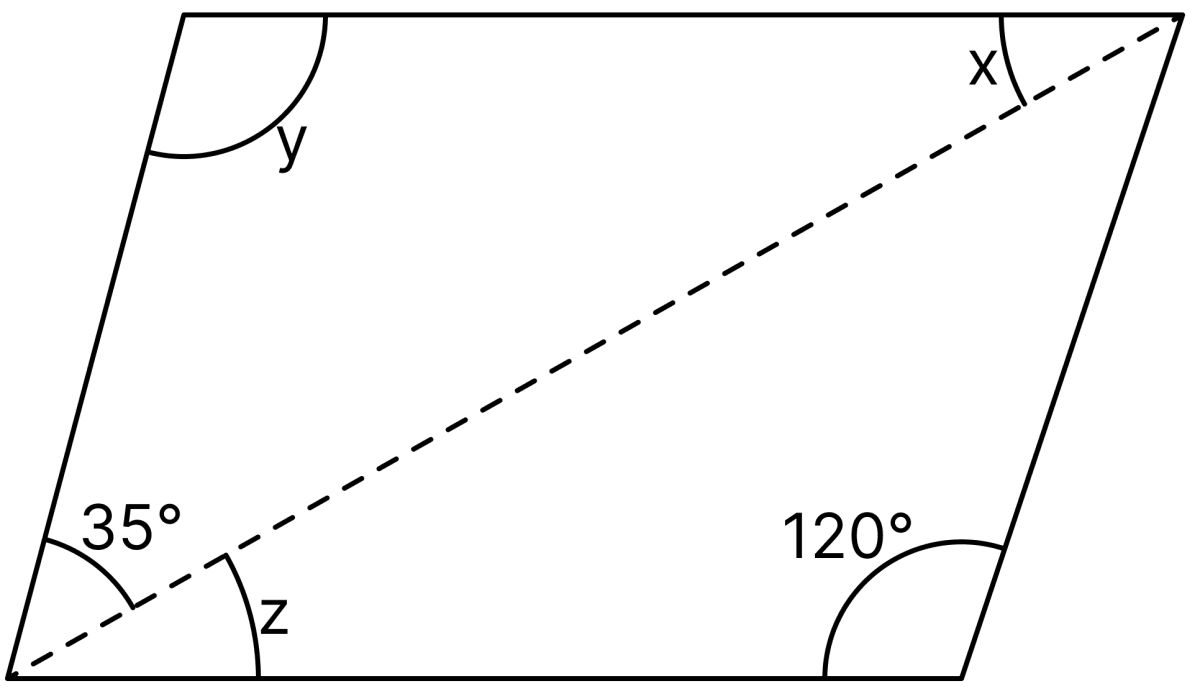
Consider the following parallelogram. Find the values of x, y, z in each.
Answer
Let the parallelogram be ABCD, where A is the bottom-left vertex, B is the bottom-right vertex, C is the top-right vertex and D is the top-left vertex, with AC as the diagonal.
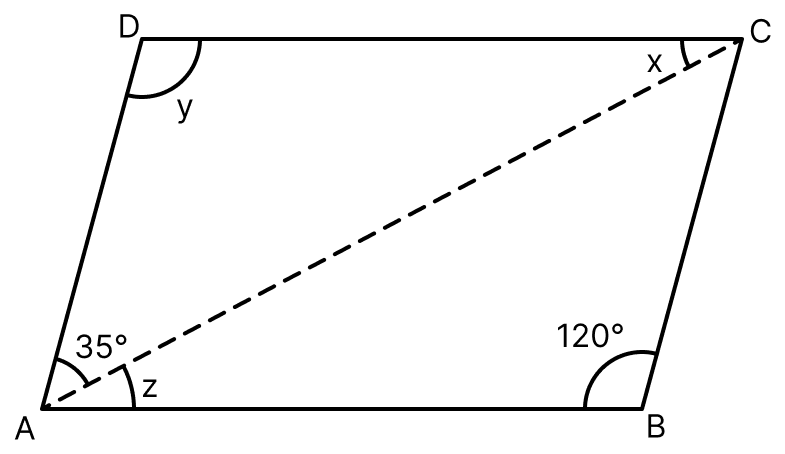
From the figure, ∠DAC = 35° and ∠ABC = 120°.
As the opposite angles of a parallelogram are of equal measure,
y = ∠ADC = ∠ABC = 120°
As the adjacent angles of a parallelogram are supplementary,
⇒ ∠DAB + ∠ABC = 180°
⇒ ∠DAB + 120° = 180°
⇒ ∠DAB = 180° - 120°
⇒ ∠DAB = 60°
From the figure,
⇒ ∠DAC + z = ∠DAB
⇒ 35° + z = 60°
⇒ z = 60° - 35°
⇒ z = 25°
As AB ∥ DC and AC is a transversal,
x = z = 25° (alternate angles are equal)
Hence, x = 25°, y = 120° and z = 25°.
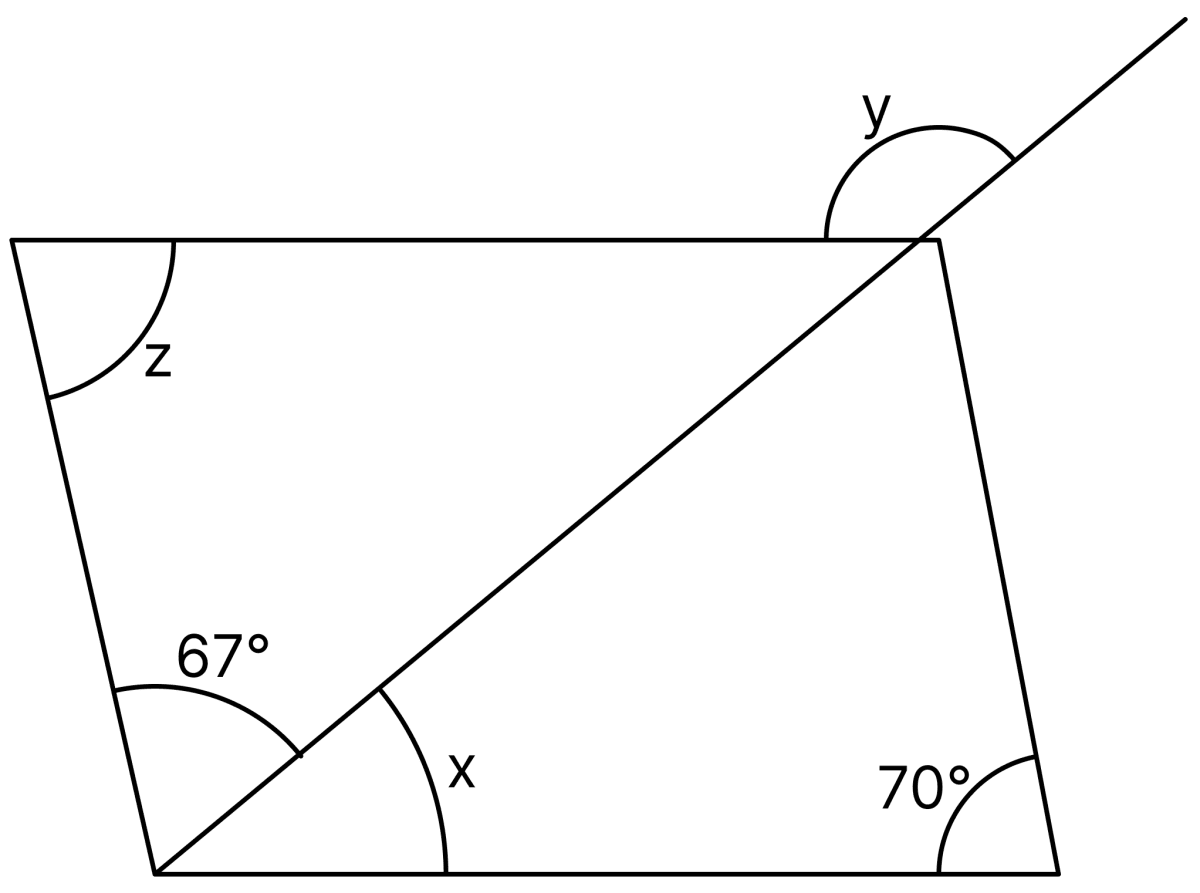
Consider the following parallelogram. Find the values of x, y, z in each.
Answer
Let the parallelogram be ABCD, where A is the bottom-left vertex, B is the bottom-right vertex, C is the top-right vertex and D is the top-left vertex, with the diagonal AC produced beyond C.
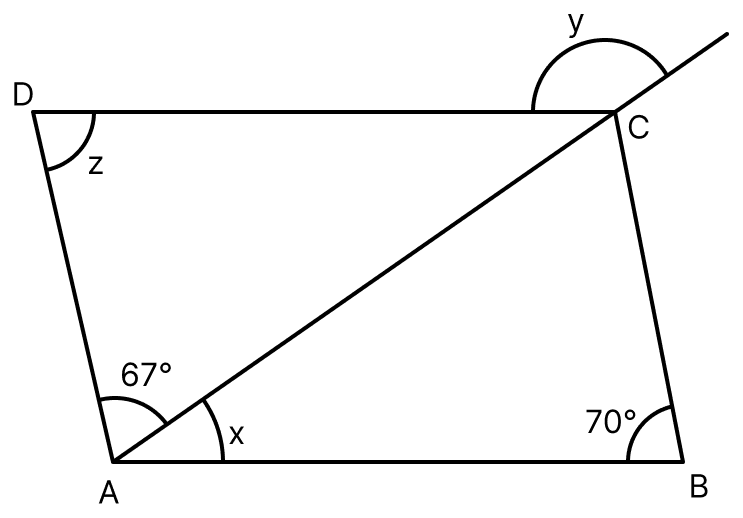
From the figure, ∠DAC = 67° and ∠ABC = 70°.
As the opposite angles of a parallelogram are of equal measure,
z = ∠ADC = ∠ABC = 70°
As the adjacent angles of a parallelogram are supplementary,
⇒ ∠DAB + ∠ABC = 180°
⇒ ∠DAB + 70° = 180°
⇒ ∠DAB = 180° - 70°
⇒ ∠DAB = 110°
From the figure,
⇒ ∠DAC + x = ∠DAB
⇒ 67° + x = 110°
⇒ x = 110° - 67°
⇒ x = 43°
As AB ∥ DC and AC is a transversal,
∠DCA = x = 43° (alternate angles are equal)
As the diagonal AC is produced, ∠DCA and y form a linear pair.
⇒ y + ∠DCA = 180°
⇒ y + 43° = 180°
⇒ y = 180° - 43°
⇒ y = 137°
Hence, x = 43°, y = 137° and z = 70°.
Two adjacent sides of a parallelogram are in the ratio 5 : 7. If the perimeter of parallelogram is 72 cm, find the length of its sides.
Answer
It is given that two adjacent sides of a parallelogram are in the ratio 5 : 7 and the perimeter of the parallelogram is 72 cm.
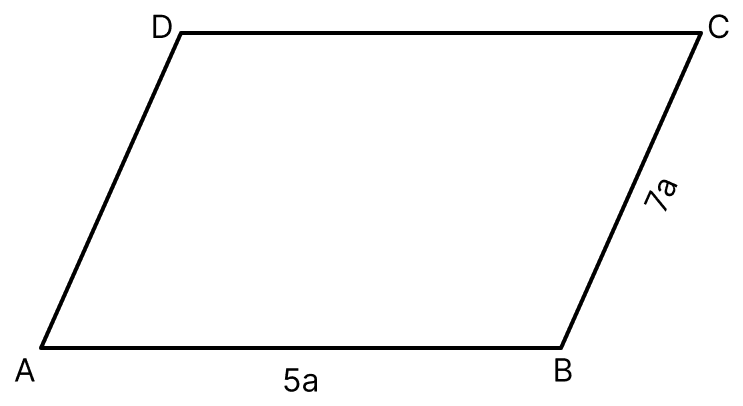
Let the parallelogram be ABCD and let the common factor be a. So, AB = 5a cm and BC = 7a cm.
As the opposite sides of a parallelogram are of equal length,
DC = AB = 5a cm and AD = BC = 7a cm
Perimeter of parallelogram ABCD = AB + BC + CD + DA
⇒ 72 = 5a + 7a + 5a + 7a
⇒ 72 = 24a
⇒ a =
⇒ a = 3
Thus, the sides are:
5a = 5 x 3 = 15 cm
7a = 7 x 3 = 21 cm
Hence, the lengths of the sides are 15 cm and 21 cm.
The measure of two adjacent angles of a parallelogram are in the ratio 4 : 5. Find the measure of each angle of the parallelogram.
Answer
It is given that the measure of two adjacent angles of a parallelogram are in the ratio 4 : 5.
Let the parallelogram be ABCD and let the common factor be a. So, ∠A = 4a and ∠B = 5a.
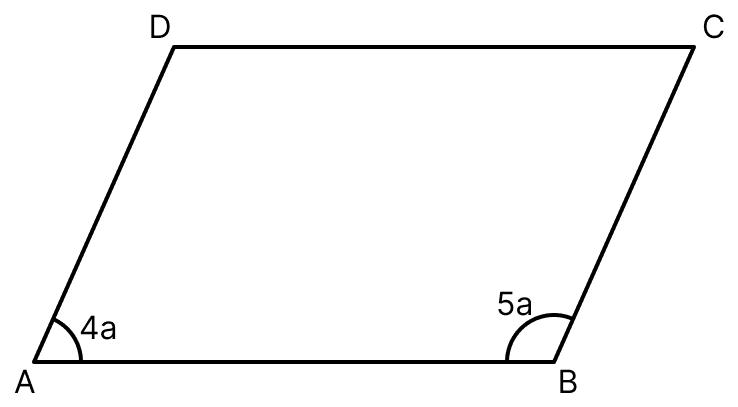
As the adjacent angles of a parallelogram are supplementary,
⇒ ∠A + ∠B = 180°
⇒ 4a + 5a = 180°
⇒ 9a = 180°
⇒ a =
⇒ a = 20°
Thus,
∠A = 4a = 4 x 20° = 80°
∠B = 5a = 5 x 20° = 100°
As the opposite angles of a parallelogram are of equal measure,
∠C = ∠A = 80° and ∠D = ∠B = 100°
Hence, the angles of the parallelogram are 80°, 100°, 80° and 100°.
Will the quadrilateral ABCD be a parallelogram, if following conditions are met? Give reasons in support of your answer.
(i) ∠A + ∠C = 180°
(ii) AD = BC = 6 cm, AB = 5 cm, DC = 4.5 cm
(iii) ∠B = 80°, ∠D = 70°
(iv) ∠B + ∠C = 180°
Answer
(i) ∠A + ∠C = 180°
In a parallelogram, the opposite angles are equal, that is ∠A = ∠C.
The given condition only tells us that ∠A and ∠C are supplementary, which does not mean that they are equal. For example, ∠A could be 100° and ∠C could be 80°.
Hence, ABCD may not be a parallelogram.
(ii) AD = BC = 6 cm, AB = 5 cm, DC = 4.5 cm
In a parallelogram, both the pairs of opposite sides are equal.
Here, AD = BC = 6 cm, but AB = 5 cm and DC = 4.5 cm, so AB ≠ DC.
Hence, ABCD is not a parallelogram as AB ≠ DC.
(iii) ∠B = 80°, ∠D = 70°
In a parallelogram, the opposite angles are equal.
Here, ∠B and ∠D are opposite angles, but ∠B ≠ ∠D.
Hence, ABCD is not a parallelogram as ∠B ≠ ∠D.
(iv) ∠B + ∠C = 180°
As ∠B and ∠C are co-interior angles, this condition shows that AB ∥ DC.
However, it gives us no information about the sides AD and BC, so we cannot say that AD ∥ BC.
Hence, ABCD may not be a parallelogram.
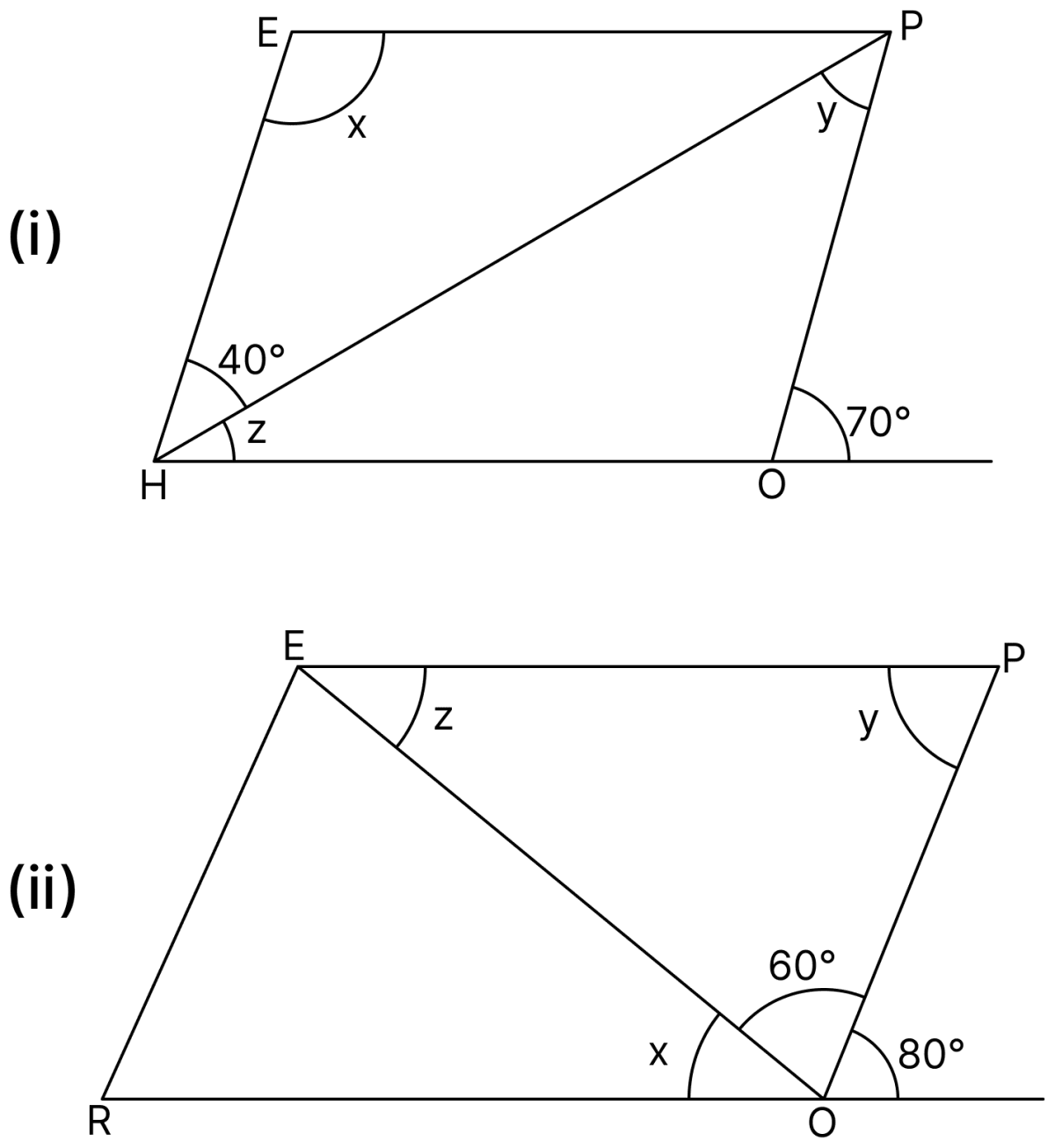
In the following figures, HOPE and ROPE are parallelograms. Find the measures of angles x, y and z. State the properties you use to find them.
Answer
(i) In parallelogram HOPE, the side HO is produced and the exterior angle so formed at O is 70°.
As the sum of an interior angle and its adjacent exterior angle is 180°,
⇒ ∠HOP + 70° = 180°
⇒ ∠HOP = 180° - 70°
⇒ ∠HOP = 110°
As the opposite angles of a parallelogram are of equal measure,
x = ∠HEP = ∠HOP = 110°
As HE ∥ OP and HP is a transversal,
y = ∠HPO = ∠EHP = 40° (alternate angles are equal)
In ΔHOP, the sum of all the angles of a triangle is 180°.
⇒ z + ∠HOP + ∠HPO = 180°
⇒ z + 110° + 40° = 180°
⇒ z + 150° = 180°
⇒ z = 180° - 150°
⇒ z = 30°
Hence, x = 110°, y = 40° and z = 30°. The properties used are that the opposite angles of a parallelogram are equal, that alternate angles formed by a transversal cutting two parallel lines are equal and that the sum of the angles of a triangle is 180°.
(ii) In parallelogram ROPE, the side RO is produced and the exterior angle so formed at O is 80°.
As the sum of an interior angle and its adjacent exterior angle is 180°,
⇒ ∠ROP + 80° = 180°
⇒ ∠ROP = 180° - 80°
⇒ ∠ROP = 100°
From the figure,
⇒ x + 60° = ∠ROP
⇒ x + 60° = 100°
⇒ x = 100° - 60°
⇒ x = 40°
As the adjacent angles of a parallelogram are supplementary,
⇒ y + ∠ROP = 180°
⇒ y + 100° = 180°
⇒ y = 180° - 100°
⇒ y = 80°
As EP ∥ RO and EO is a transversal,
z = x = 40° (alternate angles are equal)
Hence, x = 40°, y = 80° and z = 40°. The properties used are that the adjacent angles of a parallelogram are supplementary and that alternate angles formed by a transversal cutting two parallel lines are equal.
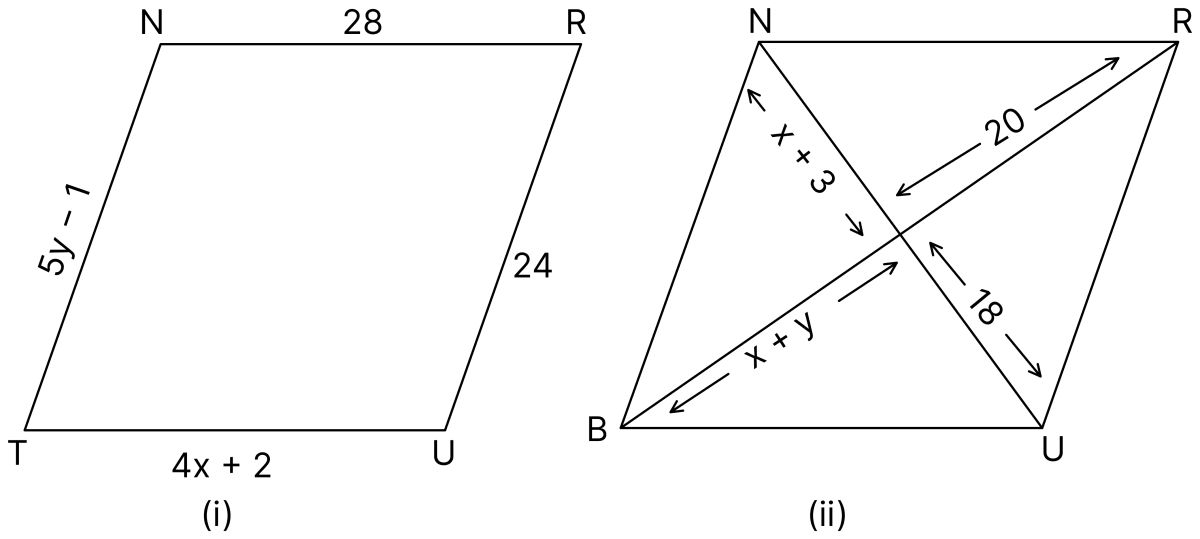
In the adjoining figures, TURN and BURN are parallelograms. Find the measures of x and y (lengths are in cm).
Answer
(i) In parallelogram TURN,
TN = 5y - 1, NR = 28, RU = 24 and TU = 4x + 2.
As the opposite sides of a parallelogram are of equal length,
⇒ TU = NR
⇒ 4x + 2 = 28
⇒ 4x = 28 - 2
⇒ 4x = 26
⇒ x =
⇒ x = 6.5
Also,
TN = RU
⇒ 5y - 1 = 24
⇒ 5y = 24 + 1
⇒ 5y = 25
⇒ y =
⇒ y = 5
Hence, x = 6.5 cm and y = 5 cm.
(ii) In parallelogram BURN, the diagonals BR and NU meet at O, where NO = x + 3, OU = 18, BO = x + y and OR = 20.
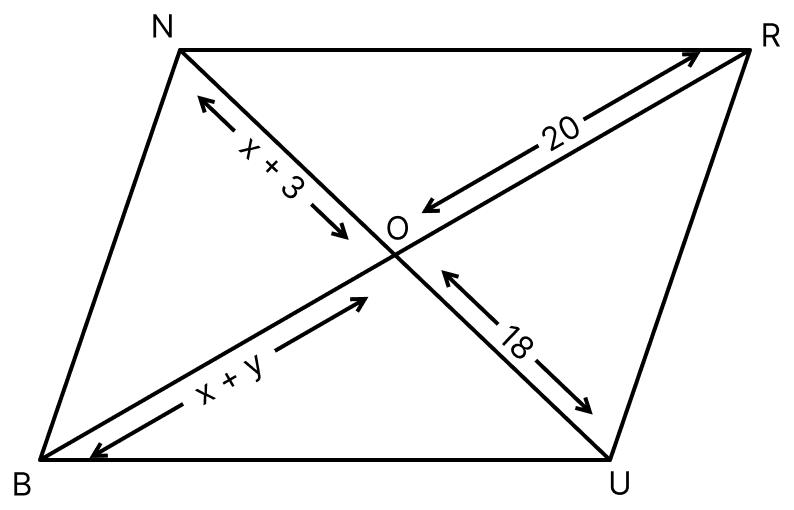
As the diagonals of a parallelogram bisect each other,
NO = OU
⇒ x + 3 = 18
⇒ x = 18 - 3
⇒ x = 15
Also,
BO = OR
⇒ x + y = 20
⇒ 15 + y = 20
⇒ y = 20 - 15
⇒ y = 5
Hence, x = 15 cm and y = 5 cm.
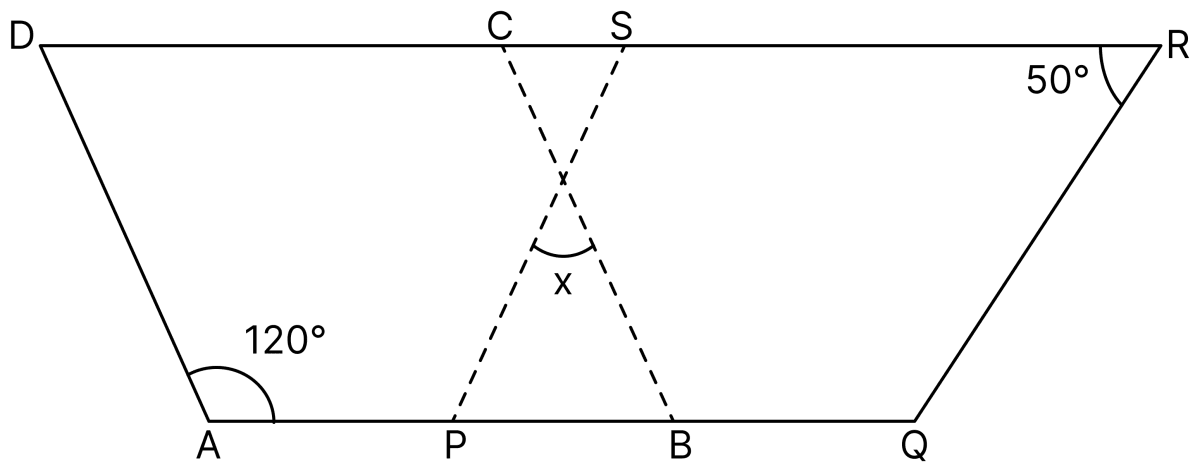
In the following figure, both ABCD and PQRS are parallelograms. Find the value of x.
Answer
It is given that both ABCD and PQRS are parallelograms.
Let BC and PS intersect at M.
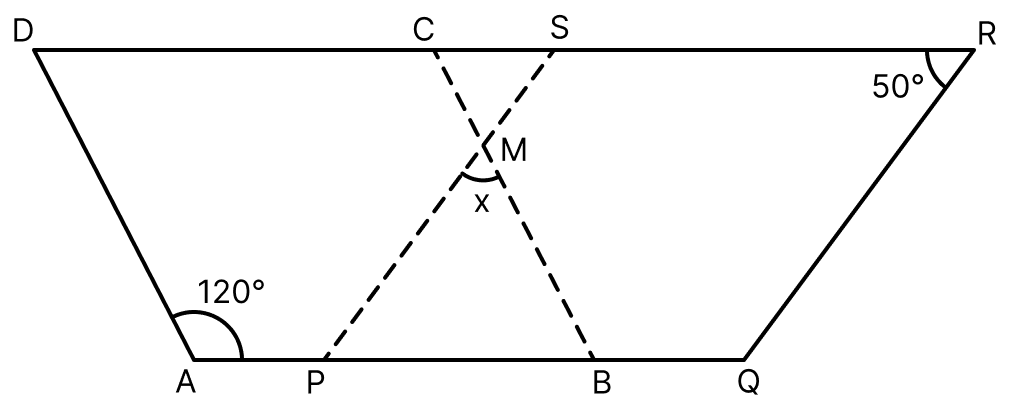
In parallelogram ABCD, ∠DAB = 120°.
As the adjacent angles of a parallelogram are supplementary,
⇒ ∠ABC + ∠DAB = 180°
⇒ ∠ABC + 120° = 180°
⇒ ∠ABC = 180° - 120°
⇒ ∠ABC = 60°
In parallelogram PQRS, ∠SRQ = 50°.
As the opposite angles of a parallelogram are of equal measure,
∠SPQ = ∠SRQ = 50°
Now, in ΔPMB,
∠MPB = ∠SPQ = 50° and ∠MBP = ∠ABC = 60°
As the sum of all the angles of a triangle is 180°,
⇒ ∠MPB + ∠MBP + x = 180°
⇒ 50° + 60° + x = 180°
⇒ 110° + x = 180°
⇒ x = 180° - 110°
⇒ x = 70°
Hence, the value of x is 70°.
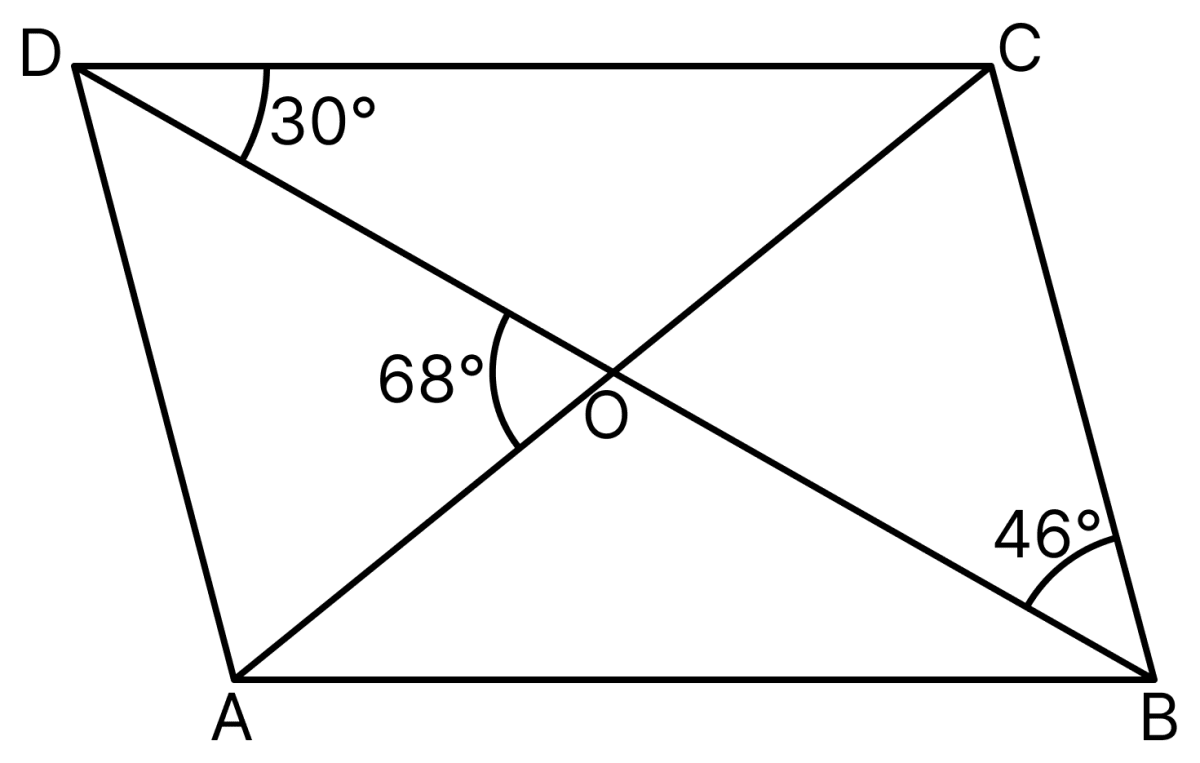
In the adjoining figure, ABCD is a parallelogram and diagonals intersect at O. Find
(i) ∠CAD
(ii) ∠ACD
(iii) ∠ADC
Answer
It is given that ABCD is a parallelogram whose diagonals intersect at O, ∠AOD = 68°, ∠BDC = 30° and ∠DBC = 46°.
(i) As AD ∥ BC and BD is a transversal,
∠ADB = ∠DBC = 46° (alternate angles are equal)
In ΔAOD, the sum of all the angles of a triangle is 180°.
⇒ ∠CAD + ∠AOD + ∠ADB = 180°
⇒ ∠CAD + 68° + 46° = 180°
⇒ ∠CAD + 114° = 180°
⇒ ∠CAD = 180° - 114°
⇒ ∠CAD = 66°
Hence, ∠CAD = 66°.
(ii) As ∠AOD and ∠DOC form a linear pair,
⇒ ∠DOC = 180° - 68° = 112°
In ΔDOC, the sum of all the angles of a triangle is 180°.
⇒ ∠ACD + ∠DOC + ∠BDC = 180°
⇒ ∠ACD + 112° + 30° = 180°
⇒ ∠ACD + 142° = 180°
⇒ ∠ACD = 180° - 142°
⇒ ∠ACD = 38°
Hence, ∠ACD = 38°.
(iii) From the figure,
∠ADC = ∠ADB + ∠BDC
= 46° + 30°
= 76°
Hence, ∠ADC = 76°.
In the adjoining figure, ABCD is a parallelogram. Perpendiculars DN and BP are drawn on diagonal AC. Prove that:
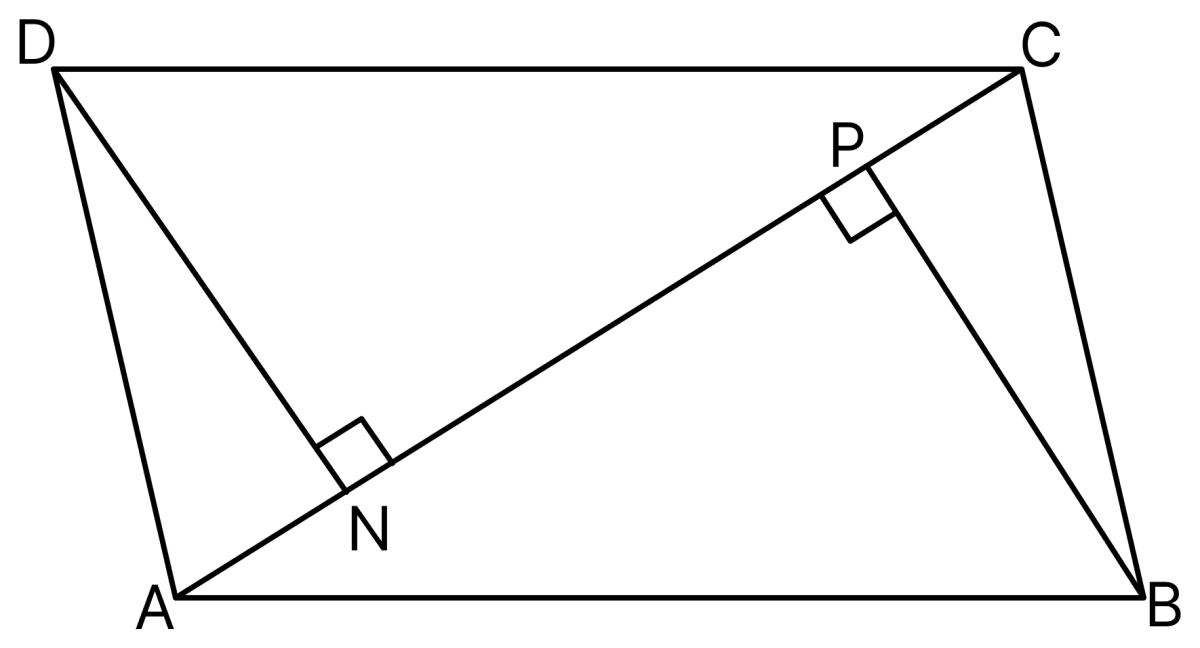
(i) ΔDCN ≅ ΔBAP
(ii) AN = CP
Answer
It is given that ABCD is a parallelogram and DN and BP are perpendiculars drawn on the diagonal AC.
(i) In ΔDCN and ΔBAP,
∠DNC = ∠BPA = 90° (as DN ⊥ AC and BP ⊥ AC)
DC = BA (opposite sides of a parallelogram are equal)
As DC ∥ AB and AC is a transversal,
∠DCN = ∠BAP (alternate angles are equal)
Therefore, by the A.A.S. congruence rule,
ΔDCN ≅ ΔBAP
Hence, proved that ΔDCN ≅ ΔBAP.
(ii) As ΔDCN ≅ ΔBAP, the corresponding parts of congruent triangles are equal.
So, CN = AP ...............(1)
From the figure,
AN = AC - CN ...............(2)
CP = AC - AP ...............(3)
Using equation (1) in equation (3),
CP = AC - CN ...............(4)
From equations (2) and (4),
AN = CP
Hence, proved that AN = CP.
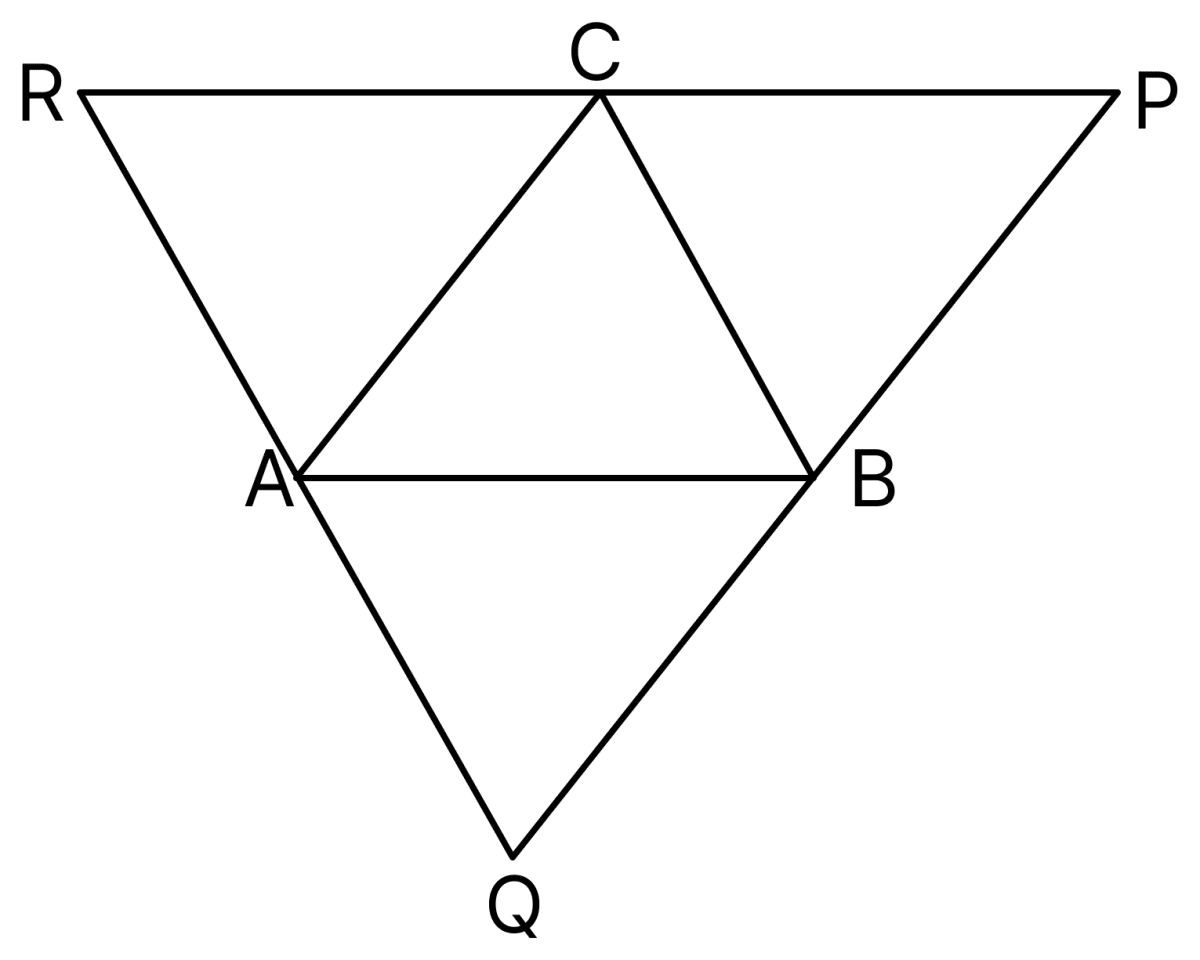
In the adjoining figure, ABC is a triangle. Through A, B and C lines are drawn parallel to BC, CA and AB respectively, which forms a ΔPQR. Show that
2(AB + BC + CA) = PQ + QR + RP
Answer
In quadrilateral ARCB,
AR ∥ BC (as the line through A is parallel to BC)
RC ∥ AB (as the line through C is parallel to AB)
As both the pairs of opposite sides are parallel, ARCB is a parallelogram.
So, AR = BC ...............(1)
In quadrilateral AQBC,
AQ ∥ BC (as the line through A is parallel to BC)
QB ∥ AC (as the line through B is parallel to CA)
As both the pairs of opposite sides are parallel, AQBC is a parallelogram.
So, AQ = BC and QB = AC ...............(2)
In quadrilateral ACPB,
CP ∥ AB (as the line through C is parallel to AB)
BP ∥ AC (as the line through B is parallel to CA)
As both the pairs of opposite sides are parallel, ACPB is a parallelogram.
So, CP = AB and BP = AC ...............(3)
Also, from parallelogram ARCB, RC = AB ...............(4)
Now, from the figure,
QR = QA + AR
Using equations (1) and (2),
⇒ QR = BC + BC = 2BC ...............(5)
RP = RC + CP
Using equations (3) and (4),
⇒ RP = AB + AB = 2AB ...............(6)
PQ = PB + BQ
Using equations (2) and (3),
⇒ PQ = AC + AC = 2AC ...............(7)
Adding equations (5), (6) and (7),
⇒ PQ + QR + RP = 2AC + 2BC + 2AB
⇒ PQ + QR + RP = 2(AB + BC + CA)
Hence, proved that 2(AB + BC + CA) = PQ + QR + RP.