
Long ago, scientists began to explore how sound works. The Greek philosopher Pythagoras studied musical notes and discovered how different lengths of strings produce different sounds. Later, Galileo and Newton helped explain that sound needs a medium like air to travel, which is called the propagation of sound. Scientists also found that sound travels at different speeds in solids, liquids and gases. Through experiments, they learnt that sound moves as longitudinal waves, with compressions and rarefactions. Terms like loudness, pitch and frequency were developed to explain how we hear sounds differently. Monotone was used to describe flat, unchanging sound, while timbre or quality explained why the same note sounds different on a piano and a guitar. Over time, these discoveries helped us understand and enjoy the world of sound better.

Answer
P – Point → In the above paragraph, I point out to the theory of: how sound is made, how it travels, and how we hear it.
E – Evidence → The evidence that supports the theory is: Pythagoras showed that different string lengths produce different sounds. Galileo and Newton proved that sound needs a material medium to travel. Later, scientists found that sound travels as longitudinal waves through solids, liquids, and gases.
E – Explanation → Now I explain my point: Terms like loudness, pitch, and frequency explain why we hear sounds differently. Timbre explains why the same musical note sounds different on a piano and a guitar.
L – Link → I link my knowledge of sound to: everyday experiences such as communication, hearing music, and the working of musical instruments.
Read the given paragraph and answer the questions that follow.
One breezy Sunday afternoon, Palak and her younger brother Surya were sitting in the garden. Surya was playing with his new toy drum, beating it loudly and laughing. Palak, a curious student, paused her book and said, "Do you know why you hear that sound when you hit the drum?"
Surya shook his head. Palak explained, "When you hit the drum skin, it vibrates. Those vibrations move through the air and reach our ears. That's how we hear sound. Without vibrations, there would be no sound at all."
Surya banged the drum harder. "This time it sounds louder!" he said.
"Exactly," said Palak. "That's because you're hitting it with more force, so the amplitude of the sound waves increases. A higher amplitude means a louder sound."
Palak then pulled out her phone and played two different musical notes. "Now listen to this," she said. "Which one sounds higher to you?"
Surya listened carefully. "The second one!"
"That's pitch," Palak smiled. "The second note has a higher frequency, so it sounds higher. Pitch depends on how fast the object vibrates."

- How did Palak explain the production of sound to Surya?
- What happened when Surya hit the drum harder, and what was the reason behind it?
- What is the difference between loudness and pitch as explained in the story?
- Why did the rustling leaves make a softer sound than the drum?
- Give one example from the story that shows how sound depends on vibration.
Answer
- Palak explained that when the drum skin is hit, it vibrates. These vibrations travel through the air and reach our ears, and this is how we hear sound. Without vibrations, there would be no sound at all.
- When Surya hit the drum harder, the sound became louder. This was because hitting it with more force increased the amplitude of the sound waves, and a higher amplitude produces a louder sound.
- Loudness depends on the amplitude of the sound waves — hitting the drum harder increases the amplitude and makes the sound louder. Pitch depends on the frequency, that is, on how fast the object vibrates — a higher frequency makes a sound seem higher.
- Rustling leaves vibrate with small amplitude, so they produce a soft sound. A drum vibrates with large amplitude when hit, so it produces a louder sound.
- When Surya hits the drum skin, it vibrates and produces sound. This shows that sound is produced by vibration, and without vibration there would be no sound.
Circle the word that does not belong to other words given alongside it.
- Vibration, Frequency, Volume, Evaporation
- Pitch, Loudness, Wavelength, Spoon
- Compression, Rarefaction, Light, Sound
- Drum, Guitar, Bell, Mirror
- Amplitude, Echo, Density, Speed of sound
Answer
- Evaporation
Reason — Vibration, frequency and volume are all related to sound, whereas evaporation is a change of state of matter and has nothing to do with sound. - Spoon
Reason — Pitch, loudness and wavelength are properties of a sound wave, whereas a spoon is an object. - Light
Reason — Compression, rarefaction and sound are all related to sound waves, whereas light is a different form of energy that travels as a transverse wave. - Mirror
Reason — A drum, guitar and bell all produce sound, whereas a mirror is used to reflect light and does not produce sound. - Echo
Reason — Amplitude, density and speed of sound are all measurable quantities related to a sound wave and its medium, whereas an echo is a phenomenon (the reflection of sound).
Match the columns.
| Column A | Column B |
|---|---|
| 1. Vibration | (a) Number of waves per second |
| 2. Frequency | (b) Back-and-forth motion that produces sound |
| 3. Amplitude | (c) Height of the wave; related to loudness |
| 4. Pitch | (d) How high or low a sound seems |
Answer
| Column A | Column B |
|---|---|
| 1. Vibration | (b) Back-and-forth motion that produces sound |
| 2. Frequency | (a) Number of waves per second |
| 3. Amplitude | (c) Height of the wave; related to loudness |
| 4. Pitch | (d) How high or low a sound seems |
Answer in one or a few word(s).
- What is a tuning fork?
- Why is the speed of sound higher in solids?
- Define amplitude.
- What is frequency?
- Write the factors on which the pitch of a sound depends.
Answer
- A U-shaped metallic device, supported by a stem, used to produce sound of a single frequency.
- Because the particles in a solid are tightly packed, so the energy of vibrations is transferred very rapidly.
- The maximum displacement of a particle on a wave on either side of its mean position.
- The number of sound waves (oscillations) passing through a point in one second.
- Length, mass, thickness and tightness of the vibrating body.
Write the correct word(s) in the given blanks.
- ............... is the characteristic of sound which allows us to distinguish between two sounds of the same pitch and loudness.
- A sound wave of single frequency is called a ............... .
- For ............... instruments, pitch of the sound produced can be controlled by closing holes.
- The pitch is determined by the ............... of vibrations of a sound wave.
- A ............... unit expresses the relative intensity of sound on a scale from 0 dB to about 100 dB.
Answer
- Timbre (quality) is the characteristic of sound which allows us to distinguish between two sounds of the same pitch and loudness.
- A sound wave of single frequency is called a monotone.
- For wind instruments, pitch of the sound produced can be controlled by closing holes.
- The pitch is determined by the frequency of vibrations of a sound wave.
- A decibel unit expresses the relative intensity of sound on a scale from 0 dB to about 100 dB.
Write True or False for the following statements.
- The amplitude of a sound wave is a direct measure of its loudness.
- The intensity of a vibrating source producing sound is called loudness of a sound.
- Oscillation can be defined as the maximum displacement of a particle on a wave on either side of the mean position.
- Sound travels the slowest through solids and the fastest through gases.
- For wind instruments like flute, clarinet and trumpet, pitch is changed by changing the string property.
Answer
- True
- True
- False
Corrected Statement — Oscillation is one complete to- and fro-motion about a mean position constituting a wave. (The maximum displacement on either side of the mean position is the amplitude.) - False
Corrected Statement — Sound travels the slowest through gases and the fastest through solids. - False
Corrected Statement — For wind instruments like flute, clarinet and trumpet, pitch is changed by opening or closing the holes, which changes the length of the air column.
Find errors in the given sentences and correct them.
- Frequency is measured in metres.
- Louder sounds have lower amplitude.
- Pitch depends on the amplitude of a sound wave.
- Vibrations are not necessary for sound to be produced.
- Amplitude of a sound wave tells us about its pitch.
Answer
- Frequency is measured in hertz (Hz).
- Louder sounds have higher amplitude.
- Pitch depends on the frequency of a sound wave.
- Vibrations are necessary for sound to be produced.
- Amplitude of a sound wave tells us about its loudness.
Give reason — Sound from a source travel in all directions.
Answer
Sound from a source travels in all directions because when an object vibrates, the molecules of the medium surrounding it in all directions are set into similar vibrations everywhere. As a result, the sound spreads out equally in every direction.
Give reason — Sound travels the fastest through solids and the slowest through gases.
Answer
In a solid, the particles are tightly packed, so the energy of the vibrations is transferred very rapidly from one particle to the next, and sound travels the fastest. In a gas, the molecules are far apart, so the transfer of energy takes more time, and sound travels the slowest.
Give reason — Different sources produce different types of sounds.
Answer
Different sources produce different types of sounds because of the three characteristics of sound — loudness, pitch and quality (timbre). Sources differ in these characteristics, especially in quality, and so the sounds they produce are different from one another.
Give reason — On slightly tapping a metal tumbler with a spoon, a soft sound can be heard. But on beating the tumbler a little harder, a loud sound is produced.
Answer
When the tumbler is tapped gently, it vibrates with a small amplitude and produces a soft sound. When it is beaten harder, the amplitude of its vibrations increases, which increases the amplitude of the sound wave. Since loudness depends on amplitude, a louder sound is produced.
Give reason — When we play the same note of music on a sitar, guitar and piano, we hear different sounds.
Answer
We hear different sounds because of the quality (timbre) of each instrument. The note produced by an instrument is a mixture of a fundamental frequency and a set of harmonics. Two instruments may have the same fundamental but never the same harmonics, so the quality of their sounds differs and we can tell them apart.
What is sound and how is it produced?
Answer
Sound is a form of energy that produces the sensation of hearing in our ears. It is produced when an object vibrates, that is, undergoes rapid to- and fro-motion about its mean position. When the object stops vibrating, the sound also stops.
What is the speed of sound and what factors affect it?
Answer
The speed of sound is the distance travelled by sound through a medium in one second. It depends mainly on the nature of the medium, that is, on how closely the particles are packed. Sound travels the fastest in solids, slower in liquids and the slowest in gases.
Define timbre.
Answer
Timbre (or quality) is the characteristic of sound which allows us to distinguish between two sounds of the same pitch and loudness produced by different sources.
Explain monotone.
Answer
A monotone is a sound wave of a single frequency. The word 'mono' means single and 'tone' means sound or frequency. A monotone is produced by a tuning fork, and its frequency is mentioned on the stem. Engines, motors, bees and wasps also produce monotonic sounds.
What is amplitude and how does it affect the loudness of sound?
Answer
Amplitude is the maximum displacement of a particle on a wave on either side of its mean position. The loudness of a sound depends on its amplitude — the greater the amplitude, the louder the sound. In fact, loudness is directly proportional to the square of the amplitude.
Write all the characteristics of sound.
Answer
The three main characteristics of sound are loudness, pitch and quality.
- Loudness — Loudness is the characteristic that distinguishes a feeble sound from a loud sound of the same frequency. It depends on the amplitude of the wave; the greater the amplitude, the louder the sound. It is measured in decibels (dB).
- Pitch — Pitch is the characteristic that distinguishes a shrill sound from a flat sound. It depends on the frequency of the wave; a higher frequency gives a higher pitch (shriller sound) and a lower frequency gives a lower pitch (flatter sound).
- Quality (Timbre) — Quality is the characteristic that allows us to distinguish between two sounds of the same pitch and loudness, such as the same note played on a guitar and a piano.
Explain the main terms related to sound waves: frequency, amplitude, wavelength and time period.
Answer
- Frequency — Frequency is the number of sound waves (oscillations) passing through a point in the medium in one second. It is measured in hertz (Hz) and is the reciprocal of the time period.
- Amplitude — Amplitude is the maximum displacement of a particle on a wave on either side of its mean position. Being a distance, it has the same unit as length.
- Wavelength — Wavelength is the distance between two consecutive compressions or rarefactions of a sound wave. Its SI unit is the metre (m) and it is denoted by λ (lambda).
- Time period — Time period is the time taken by the wave to complete one oscillation. It is denoted by T and is measured in seconds (s).
Why can sound not travel in a vacuum? How does the medium affect the speed of sound?
Answer
Sound cannot travel in a vacuum because it propagates through the vibration of the particles of the medium, which pass on the vibrations from one particle to the next. A vacuum has no particles to carry these vibrations, so sound cannot travel through it.
The medium affects the speed of sound as follows: sound travels the fastest in solids because their particles are tightly packed and transfer energy very rapidly; it travels slower in liquids; and it travels the slowest in gases because their molecules are far apart and take more time to transfer energy.
How can we change the pitch of different musical instruments?
Answer
The pitch of different musical instruments can be changed in different ways:
- Wind instruments (flute, clarinet, trumpet) — Closing the holes increases the length of the air column and lowers the pitch, while opening more holes shortens the air column and raises the pitch.
- Stringed instruments (guitar, violin, sitar) — The pitch is changed by changing the string property. A tight and thin string gives a higher pitch, while a thicker and looser string gives a lower pitch. A longer string also gives a lower pitch.
- Percussion (membrane) instruments (drum, tabla, dholak) — The tightness of the membrane is controlled by strings. A small, tight membrane produces a higher pitch.
Why do two instruments produce sounds of different timbre?
Answer
A note is a complex sound made of a fundamental frequency and harmonics. Different instruments may have the same fundamental frequency but different harmonics. This difference in harmonics changes the timbre, so the sounds of the instruments are different even for the same note.
Read the given case study and answer the questions that follow.
During the annual school music show, Vineeta stood between two performances. First, the school band's drummer struck a large bass drum. Vineeta felt a strong thud in her chest and heard a deep, booming sound. A little while later, the flautist played a light, high pitched melody that seemed to float in the air. Curious, Vineeta used her watch to time the interval between two successive drum beats and recorded 0.5 seconds.
- What caused the vibration Vineeta felt on the drum's surface?
- Compare the pitch and loudness of the drum and flute sounds?
- Explain why Vineeta could physically feel the drum's vibration?
Answer
- When the drummer struck the bass drum, its stretched membrane (skin) was set into vibration. These vibrations of the membrane produced the sound and could be felt on the surface of the drum.
- The drum produced a sound of low pitch (deep and booming) but high loudness (a strong thud). The flute produced a sound of high pitch (light and high-pitched) but lower loudness (soft and floating).
- Vineeta could physically feel the drum's vibration because the large drum vibrated with a large amplitude, producing a sound that carried a lot of energy (high loudness). These strong vibrations travelled through the air and reached her chest, so she could feel them.
Read the given information carefully and answer the questions that follow.
Sound waves are composed of compression and rarefaction patterns. Compression happens when molecules are densely packed together. Alternatively, rarefaction happens when molecules are distanced from one another. As sound travels through a medium, its energy causes the molecules to move, creating an alternating compression and rarefaction pattern. It is important to realise that molecules do not move with the sound wave. As the wave passes, the molecules become energised and move from their original positions. After a molecule passes its energy to nearby molecules, the molecule's motion diminishes until it is affected by another passing wave. The wave's energy transfer is what causes compression and rarefaction.
Source: https://www.pasco.com/resources/articles/sound-waves?srsltid=AfmBOoqmtqY7eT85znQiNAgCXLnF11YyljrlwlKnb07Yl2Tp-G8158HA
- What is compression?
- Define rarefaction.
- What is the cause of compression and rarefaction?
Answer
1. Compression is the region of a sound wave in which the molecules are densely packed together, so it is a region of increased density.
2. Rarefaction is the region of a sound wave in which the molecules are spread apart from one another, so it is a region of low density.
3. The transfer of energy by the wave is the cause of compression and rarefaction. As the wave passes through the medium, its energy makes the molecules move, creating an alternating pattern of compressions and rarefactions.
A guitar string and a violin string are plucked with the same force, yet the guitar produces a lower note. Analyse what differences in string properties lead to this outcome.
Answer
The pitch of a string depends on its length, thickness and tightness. The guitar produces a lower note because its string is longer, thicker and/or less tight than the violin string. Such a string vibrates more slowly (with a lower frequency) and so gives a lower pitch. The violin string, being shorter, thinner and tighter, vibrates faster (with a higher frequency) and gives a higher pitch. This is why the guitar produces a lower note even though both strings are plucked with the same force.
A school wants to use a whistle that can be heard clearly up to 100 m away in a noisy playground. Recommend suitable frequency and amplitude characteristics for the whistle, and justify your choices.
Answer
The whistle should have a large amplitude and a high frequency.
- Large amplitude — Loudness depends on amplitude, so a large amplitude will make the whistle loud enough to be heard 100 m away and above the noise of the playground.
- High frequency — A high frequency gives a high-pitched, shrill sound. Such a shrill sound stands out clearly from the low-pitched background noise of the playground, so it can be easily noticed by the listeners.
Design a small device or model that visually represents compressions and rarefactions in a sound wave. Explain how your design makes the longitudinal nature of sound waves clear.
Answer
I would use a slinky (a long, flexible spring) stretched along a smooth table.
How it works — One end of the slinky is given a quick push-and-pull along its own length. A wave then travels along the slinky in which the coils crowd together at some places (compressions) and spread apart at other places (rarefactions).
How it shows the longitudinal nature — As the wave moves forward, each coil only moves back and forth along the same direction in which the wave travels. This clearly shows that in a sound wave the particles vibrate in the same direction as the wave propagates, which is exactly what a longitudinal wave is.
Manav covered his ears when a loudspeaker passed by. Later, he played a flute and enjoyed the soft sound. He realised some sounds are pleasant and some are unpleasant. He also noticed that his voice sounded different from his friend's, even when they spoke at the same volume.

- What do we call a form of energy that travels in waves and can be heard?
- What are the main characteristics of sound?
- What is the difference between pleasant and unpleasant sounds called?
- Why does your voice sound different from someone else's, even if you sing the same note?
- What is the term for how loud or soft a sound is?
Answer
- It is called sound.
- The main characteristics of sound are loudness, pitch and quality (timbre).
- Pleasant sounds are called musical sounds, while unpleasant sounds are called noise.
- Your voice sounds different because of the quality (timbre) of sound. Each person's voice has its own unique timbre, so it can be recognised even on the same note.
- The term is loudness.
During a science class, students tried to make a bell ring inside a vacuum jar. When the air was removed, they saw the bell vibrating but could hardly hear it. Their teacher explained the importance of a medium in carrying sound.

- Can sound travel in a vacuum? Why or why not?
- What type of wave is a sound wave in air — transverse or longitudinal?
- What is required for the propagation of sound?
- What is the term for the number of vibrations per second?
- What do we call the highness or lowness of a sound?
Answer
- No, sound cannot travel in a vacuum. A vacuum has no particles (no medium) to carry the vibrations, and sound needs a medium for its propagation.
- A sound wave in air is a longitudinal wave.
- A material medium (solid, liquid or gas) is required for the propagation of sound.
- The term is frequency.
- It is called pitch.
In a lab activity, students plucked a tight and a loose string. The tighter string produced a high-pitched sound while the loose one made a low-pitched sound. They also noticed that hitting a drum harder made it louder.

- What factor affects the pitch of a sound?
- How is loudness related to the amplitude of vibration?
- What happens to the sound if the frequency of vibration increases?
- Why does tightening a string produce a higher pitch?
- What changes when you strike a drum gently versus forcefully?
Answer
- The frequency of vibration affects the pitch of a sound. (Frequency itself depends on the length, thickness and tightness of the vibrating body.)
- The greater the amplitude of vibration, the louder the sound, as loudness is directly proportional to the square of the amplitude.
- If the frequency of vibration increases, the pitch of the sound increases, so the sound becomes higher and shriller.
- Tightening a string increases its tightness, so it vibrates faster (with a higher frequency). A higher frequency produces a higher pitch.
- Striking a drum forcefully increases the amplitude of vibration, so the loudness increases and the sound becomes louder. The pitch, however, stays the same.
Shalini was blindfolded and asked to identify her classmates by their voices. She could easily tell who was speaking. Her teacher explained that each person's voice has a special quality called timbre, and that musical instruments also have their own unique sound patterns.

- What is timbre or quality of sound?
- How does timbre help us distinguish different voices or instruments?
- Can two sounds have the same loudness and pitch but different qualities? Explain.
- Why does a guitar sound different from a piano even if they play the same note?
- How does understanding pitch and loudness help in music and sound engineering?
Answer
- Timbre (quality) is the characteristic of sound which allows us to distinguish between two sounds of the same pitch and loudness.
- Each voice or instrument produces a note with its own unique mixture of a fundamental frequency and harmonics. This gives every voice or instrument a unique timbre, so we can tell them apart even when the pitch and loudness are the same.
- Yes. Two sounds can have the same loudness and pitch but still differ in quality (timbre), because they contain different harmonics. This is why a guitar and a piano playing the same note sound different.
- A guitar and a piano sound different because, although they may produce the same fundamental, their harmonics are different. This difference in harmonics gives them different qualities (timbre).
- Understanding pitch and loudness helps in producing and balancing sounds — adjusting the frequency (pitch) and amplitude (loudness) to create pleasant music, tune instruments correctly, and design good sound systems.
Fill in the blanks.
- The vibrating prongs of a ............... are commonly used to demonstrate production of sound.
- The ............... of sound depends on the amplitude of vibration.
- Sound waves are ............... waves consisting of alternate ............... and ............... .
- ............... is a one complete to- and fro-motion about a mean position constituting a wave.
- The sound produced by an instrument is a complex sound called a ............... .
Answer
- The vibrating prongs of a tuning fork are commonly used to demonstrate production of sound.
- The loudness of sound depends on the amplitude of vibration.
- Sound waves are longitudinal waves consisting of alternate compressions and rarefactions.
- Oscillation is a one complete to- and fro-motion about a mean position constituting a wave.
- The sound produced by an instrument is a complex sound called a note.
Write True or False.
- For wind instruments like flute, clarinet and trumpet, pitch is changed by changing the string property.
- Sound cannot travel through air, water and solids.
- Loudness of a sound is measured in decibels.
- Pitch depends on the frequency of sound waves.
- Timbre helps us to recognise a person's voice.
Answer
- False
Corrected Statement — For wind instruments like flute, clarinet and trumpet, pitch is changed by opening or closing the holes, which changes the length of the air column. - False
Corrected Statement — Sound can travel through air, water and solids, as it needs a medium for its propagation. - True
- True
- True
Match the columns.
| Column A | Column B |
|---|---|
| 1. Amplitude | (a) Distinguishes two sources of sound |
| 2. Frequency | (b) Loudness |
| 3. Pitch | (c) Vibrations per second |
| 4. Timbre | (d) Shrillness or flatness of sound |
| 5. Wavelength | (e) Distance between two compressions |
Answer
| Column A | Column B |
|---|---|
| 1. Amplitude | (b) Loudness |
| 2. Frequency | (c) Vibrations per second |
| 3. Pitch | (d) Shrillness or flatness of sound |
| 4. Timbre | (a) Distinguishes two sources of sound |
| 5. Wavelength | (e) Distance between two compressions |
Define vibration with one example.
Answer
Vibration is the rapid to- and fro-motion (back-and-forth motion) of an object about its mean position. For example, the prongs of a tuning fork vibrate when it is struck on a rubber pad, producing sound.
Why is a medium necessary for the propagation of sound?
Answer
A medium is necessary because sound travels through the vibration of the particles of the medium, which pass on the vibrations from one particle to the next. A vacuum has no particles to carry these vibrations, so sound cannot travel without a medium.
Differentiate between compressions and rarefactions in a sound wave.
Answer
| Compression | Rarefaction |
|---|---|
| It is the region where the molecules are densely packed together. | It is the region where the molecules are spread apart from one another. |
| It is a region of high density. | It is a region of low density. |
State two differences between loudness and pitch.
Answer
| Loudness | Pitch |
|---|---|
| It depends on the amplitude of the wave. | It depends on the frequency of the wave. |
| It distinguishes a feeble sound from a loud sound. | It distinguishes a flat sound from a shrill sound. |
What is meant by timbre? Give one example where it is useful.
Answer
Timbre (quality) is the characteristic of sound which allows us to distinguish between two sounds of the same pitch and loudness. It is useful, for example, in recognising a friend's voice even without seeing the person, as each voice has its own unique timbre.
Describe an activity using a tuning fork to show that vibrating bodies produce sound.
Answer
Aim — To show that sound is produced by vibrating objects.
Materials required — A rubber pad and a tuning fork.
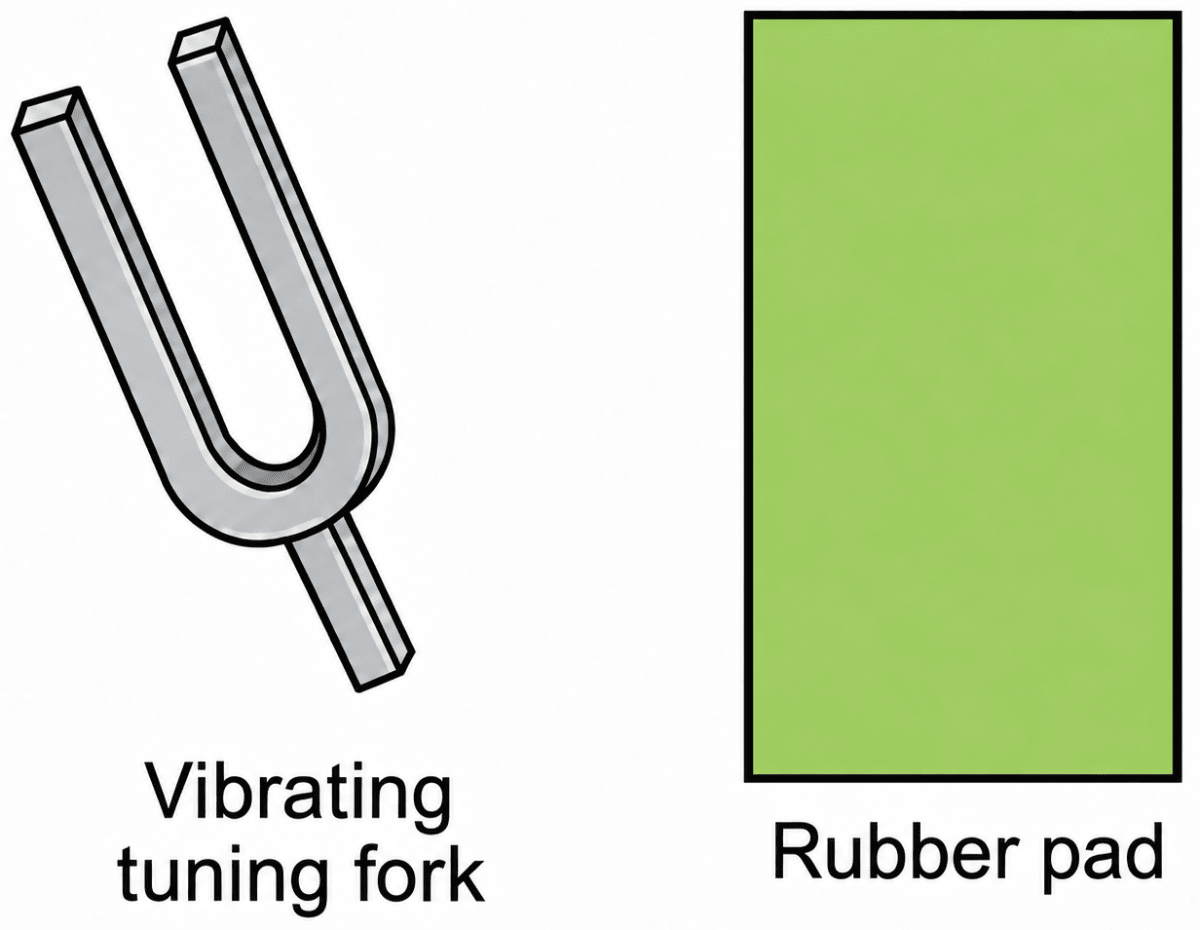
Procedure —
- Hold the tuning fork by its stem.
- Strike it against the rubber pad and observe its prongs.
- Bring the vibrating tuning fork close to the ear.
Observation —
- The prongs of the tuning fork are felt to vibrate.
- A sound is heard when the vibrating fork is brought close to the ear.
- The sound is no longer heard once the vibration of the fork stops.
Conclusion — This demonstrates that the vibrating tuning fork produces sound, that is, vibrating bodies produce sound.
Explain with a diagram how sound propagates as longitudinal waves through a medium.
Answer
When an object such as a tuning fork vibrates, it sets the particles of the surrounding medium into vibration. This disturbance is passed on from one particle to the next in the form of a wave. The particles of the medium only vibrate to and fro about their mean position in the same direction as the wave travels; they do not move along with the wave. Such a wave is called a longitudinal wave.
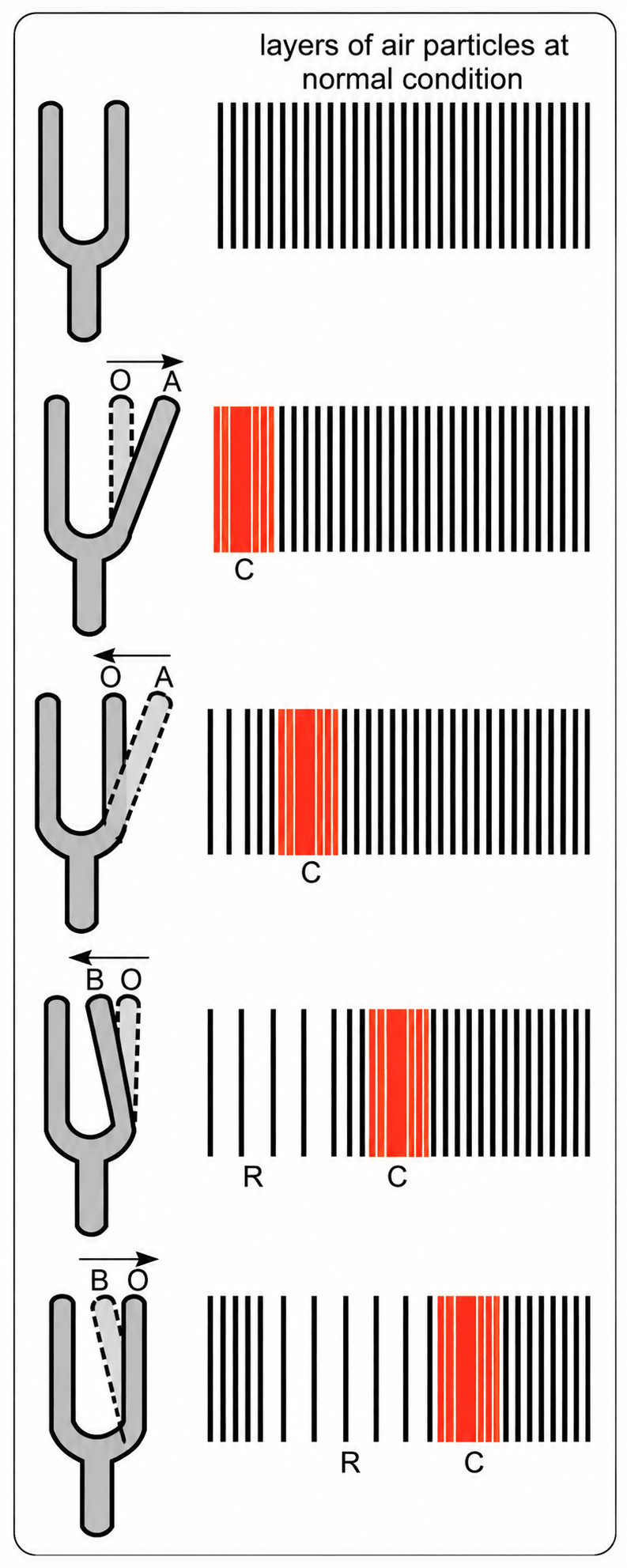
As a prong moves outwards, it pushes the nearby air particles together, increasing their density. This region of high density is called a compression (C). As the prong moves back, it leaves a region of low density behind it, which is called a rarefaction (R). As the prong keeps vibrating to and fro, compressions and rarefactions are produced one after another and travel forward through the medium. One compression and one rarefaction together make one complete sound wave.
Define amplitude, wavelength and frequency of a sound wave. Explain how they affect the characteristics of sound.
Answer
- Amplitude — Amplitude is the maximum displacement of a particle on a wave on either side of its mean position. The greater the amplitude, the louder the sound. So amplitude decides the loudness of the sound.
- Wavelength — Wavelength is the distance between two consecutive compressions or rarefactions of a sound wave. It is denoted by and its SI unit is the metre.
- Frequency — Frequency is the number of sound waves passing through a point in one second. It is measured in hertz (Hz). The higher the frequency, the higher the pitch. So frequency decides the pitch of the sound.
Explain the factors affecting the loudness of sound.
Answer
The loudness of a sound depends on the following factors:
- Amplitude of the sound wave — The greater the amplitude of the wave, the louder the sound. Loudness is directly proportional to the square of the amplitude.
- Distance between source and listener — The closer the listener is to the source, the louder the sound heard. As the listener moves away, the sound becomes fainter.
- Surface area of the vibrating body — A vibrating body with a larger surface area produces a louder sound. For example, a large drum produces a louder sound than a small drum.
Loudness is also affected by other factors such as the sensitivity of the listener, atmospheric pressure, temperature, humidity and wind velocity.
Discuss how musical instruments produce sound and explain why the same note sounds different when played on different instruments.
Answer
Musical instruments produce sound by setting some part of the instrument into vibration:
- Stringed instruments (guitar, violin, sitar) produce sound by the vibration of stretched strings.
- Wind instruments (flute, clarinet, trumpet) produce sound by the vibration of an air column inside them.
- Percussion (membrane) instruments (drum, tabla, dholak) produce sound by the vibration of a stretched membrane.
The note produced by an instrument is a complex sound made of a fundamental frequency and a set of harmonics. When the same note is played on different instruments, the fundamental may be the same, but the harmonics are always different. This difference in harmonics gives each instrument a different quality (timbre), so the same note sounds different when played on different instruments.