
Which of these correctly represents the SI unit of pressure?
- Newton
- Pascal
- Joule
- Watt
Answer
Pascal
Reason — Pressure is the force acting normally on a unit area of a surface . Its SI unit is the pascal (Pa), where 1 Pa = 1 Nm-2. The newton is the unit of force, the joule is the unit of work/energy, and the watt is the unit of power.
An object at rest possesses which form of energy?
- Kinetic
- Potential
- Thermal
- Electrical
Answer
Potential
Reason — Kinetic energy is the energy possessed by a body due to its motion. Since an object at rest has no motion, it has no kinetic energy. The energy it possesses by virtue of its position or state is called potential energy.
Which of the following is the process of charging without direct contact?
- Induction
- Friction
- Conduction
- Dissipation
Answer
Induction
Reason — In charging by induction, a charged body is brought close to a neutral conductor without touching it, and the near end of the conductor acquires an opposite charge. Charging by friction and by conduction both require the bodies to be rubbed together or brought into contact.
Friction – Requires rubbing two objects together.
Conduction – Requires direct physical contact between a charged and an uncharged object.
Dissipation – Refers to the loss or leakage of electric charge, not a method of charging.
Which of the following best describes matter at the molecular level?
- Continuous
- Discrete and made up of particles
- Composed of only one substance
- Always visible
Answer
Discrete and made up of particles
Reason — According to the kinetic theory of matter, all matter is made up of a large number of tiny particles (atoms or molecules) with spaces between them. So at the molecular level matter is discrete (particulate), not continuous.
What instrument is used to determine the density of an irregular solid?
- Electric balance
- Measured flask
- Measuring cylinder
- Spring balance
Answer
Measuring cylinder
Reason — The volume of an irregular solid is found by the water displacement method using a measuring cylinder, in which the rise in the water level gives the volume of the solid. This volume, together with the mass, gives the density .
What device is used to test whether a material is a conductor or an insulator?
- Electroscope
- Ammeter
- Thermometer
- Hydrometer
Answer
Electroscope
Reason — An electroscope is primarily used to detect electric charge. It can also be used to test whether a material is a conductor or an insulator by observing whether charge is transferred through the material to or from the electroscope. An ammeter measures current, a thermometer measures temperature and a hydrometer measures the relative density of a liquid.
Which of the following is the upward force experienced by an object immersed in a fluid?
- Gravitational force
- Buoyant force
- Magnetic force
- Frictional force
Answer
Buoyant force
Reason — When a body is immersed in a fluid, the fluid exerts an upward force on it called the buoyant force (upthrust). Gravitational force acts vertically downwards, so it cannot be the upward force.
Which of the following cannot transmit sound?
- Steel
- Air
- Vacuum
- Water
Answer
Vacuum
Reason — Sound travels through the vibration of the particles of a material medium (solid, liquid or gas). A vacuum has no particles to vibrate and pass on the disturbance, so sound cannot travel through a vacuum.
What will happen in an electric circuit, if one bulb in a parallel arrangement fuses?
- Other bulbs stop glowing.
- Other bulbs glow as usual.
- The circuit becomes open.
- The current becomes zero.
Answer
Other bulbs glow as usual.
Reason — In a parallel arrangement each bulb has its own separate path for the current. So if one bulb fuses, the current still flows through the paths of the other bulbs and they continue to glow as usual.
Which household safety device prevents damage due to excess current?
- Fuse
- Voltmeter
- Switch
- Transformer
Answer
Fuse
Reason — A fuse has a thin wire of low melting point connected in series in the live wire. When the current exceeds a safe value, the fuse wire melts and breaks the circuit, protecting the appliances from damage due to excess current.
Assertion (A): Ice floats on water.
Reason (R): The density of ice is less than that of water.
- Both A and R are true, and R is the correct explanation of A.
- Both A and R are true, and R is not the correct explanation of A.
- A is true, but R is false.
- A is false, but R is true.
Answer
Both A and R are true, and R is the correct explanation of A.
Explanation —
Assertion (A) is correct: Ice floats on water, so the assertion is true.
Reason (R) is also correct: This statement is true. When water freezes, it expands, increasing its volume while its mass remains unchanged. As a result, the density of ice becomes lower than that of liquid water.
Hence Reason (R) correctly explains Assertion (A).
Assertion (A): Convex mirrors are used as rear-view mirrors in vehicles.
Reason (R): A convex mirror always forms a virtual, diminished, and erect image.
- Both A and R are true, and R is the correct explanation of A.
- Both A and R are true, and R is not the correct explanation of A.
- A is true, but R is false.
- A is false, but R is true.
Answer
Both A and R are true, and R is the correct explanation of A.
Explanation —
Assertion (A) is correct: Convex mirrors provide a wide field of view, allowing the driver to see a larger area of the road behind the vehicle, which improves safety.
Reason (R) is also correct: A convex mirror always produces an image that is virtual, erect, and smaller than the object, enabling more objects to be seen within the mirror.
Hence Reason (R) correctly explains Assertion (A).
Assertion (A): Water boils at a lower temperature at high altitudes.
Reason (R): Atmospheric pressure decreases with altitude.
- Both A and R are true, and R is the correct explanation of A.
- Both A and R are true, and R is not the correct explanation of A.
- A is true, but R is false.
- A is false, but R is true.
Answer
Both A and R are true, and R is the correct explanation of A.
Explanation —
Assertion (A) is correct: Water boils at a lower temperature at high altitudes because the external atmospheric pressure is lower, so the vapour pressure of water equals the surrounding pressure at a lower temperature.
Reason (R) is also correct: Atmospheric pressure decreases with increasing altitude because the thickness and weight of the air column above a place become smaller.
Hence Reason (R) correctly explains Assertion (A).
Assertion (A): Current electricity can flow through all materials.
Reason (R): Metals are good conductors of electricity.
- Both A and R are true, and R is the correct explanation of A.
- Both A and R are true, and R is not the correct explanation of A.
- A is true, but R is false.
- A is false, but R is true.
Answer
A is false, but R is true.
Explanation —
Assertion (A) is incorrect: Current electricity cannot flow through all materials. It flows easily through conductors, while insulators such as rubber, plastic, and glass do not allow electric current to pass through them under normal conditions.
Reason (R) is correct: Metals are good conductors of electricity because they contain free electrons that can move easily and carry electric current.
Hence Assertion (A) is false, but Reason (R) is true.
Assertion (A): Pressure exerted by a liquid increases with depth.
Reason (R): Liquid particles at greater depth have higher velocity.
- Both A and R are true, and R is the correct explanation of A.
- Both A and R are true, and R is not the correct explanation of A.
- A is true, but R is false.
- A is false, but R is true.
Answer
A is true, but R is false.
Explanation —
Assertion (A) is correct: The pressure exerted by a liquid increases with depth because the weight of the liquid column above a point increases as depth increases.
Reason (R) is incorrect: Liquid particles at greater depth do not necessarily have higher velocity. Liquid pressure depends on the height (depth) of the liquid column and its density, not on the velocity of the liquid particles.
Hence Assertion (A) is true, but Reason (R) is false.
Name the following.
(a) The SI unit of pressure
(b) The process by which heat is transferred through empty space
(c) The property that causes materials to expand when heated
(d) The source of static electricity in everyday life
(e) The quantity that measures the 'loudness' of sound
Answer
(a) Pascal (Pa)
(b) Radiation
(c) Thermal expansion (expansion on heating)
(d) Friction (rubbing of two objects against each other)
(e) Amplitude
Given alongside is the picture of a hydrometer. Read the information and fill in the blanks.
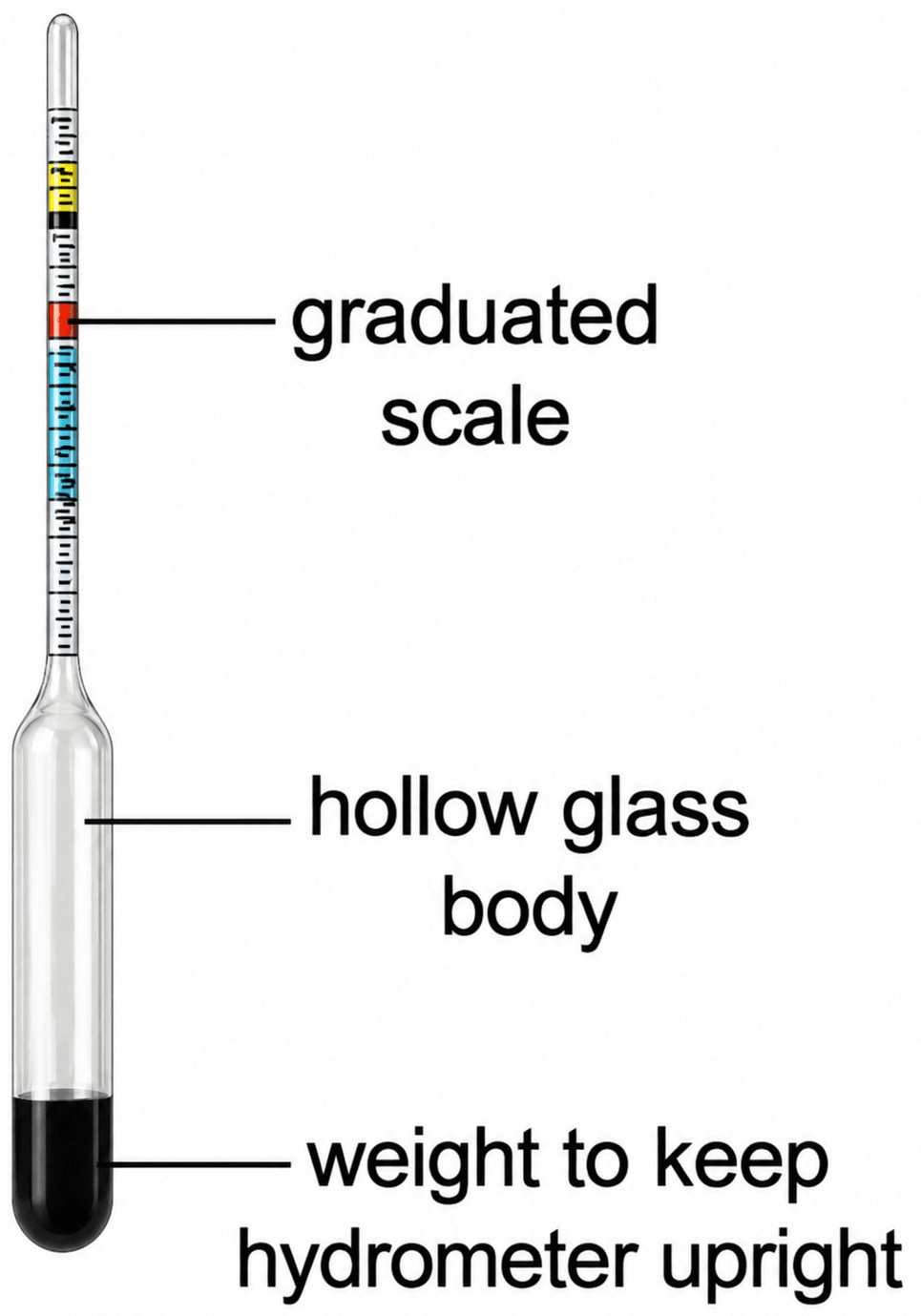
A hydrometer is generally made of glass and has a cylindrical stem and a bulb weighted with either mercury or lead shots to make it float upright. It is another instrument used for measuring the relative density of liquids. To read the specific gravity directly, it usually contains a scale inside the stem. In a graduated cylinder or a tall jar, the liquid to test is poured and the hydrometer is lowered into the liquid until it floats freely. The point at which the surface of the liquid touches the stem of the hydrometer is noted and the value on the scale is read.
A hydrometer is an instrument used to measure the ............... of liquids. It is made of ............... and consists of a ............... stem and a ............... weighted with mercury or lead shots. It floats upright in a ............... cylinder or jar containing the liquid. The scale inside the stem helps read the ............... directly at the level where the liquid touches the stem.
Answer
A hydrometer is an instrument used to measure the relative density of liquids. It is made of glass and consists of a cylindrical stem and a bulb weighted with mercury or lead shots. It floats upright in a graduated cylinder or jar containing the liquid. The scale inside the stem helps read the specific gravity (relative density) directly at the level where the liquid touches the stem.
Shuffle the following steps in correct order to measure the density of an irregular solid using Eureka can.
(a) Note the volume of water displaced.
(b) Measure the mass of the solid using a balance.
(c) Calculate density using the formula: .
(d) Immerse the solid fully into the Eureka can filled water.
Answer
The correct order of the given steps is:
- (b) Measure the mass of the solid using a balance.
- (d) Immerse the solid fully into the Eureka can filled with water.
- (a) Note the volume of water displaced.
- (c) Calculate density using the formula: .
So the correct order is b → d → a → c.
Read the explanations given below and name the terms.
(a) The change of a substance from solid state directly into vapour on heating
(b) The turning effect of a force about a fixed point
(c) The rate of doing work
(d) The maximum displacement of a vibrating particle from its mean position
(e) The safety device in household wiring that melts and breaks the circuit during overload
Answer
(a) Sublimation
(b) Moment of force (torque)
(c) Power
(d) Amplitude
(e) Fuse
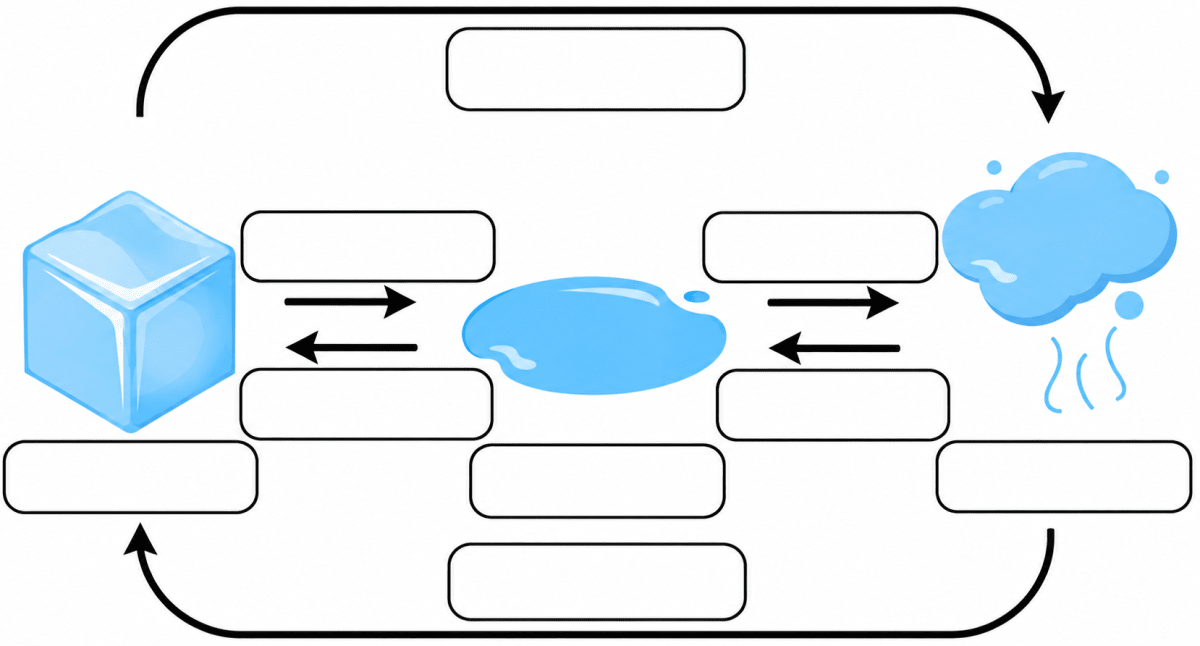
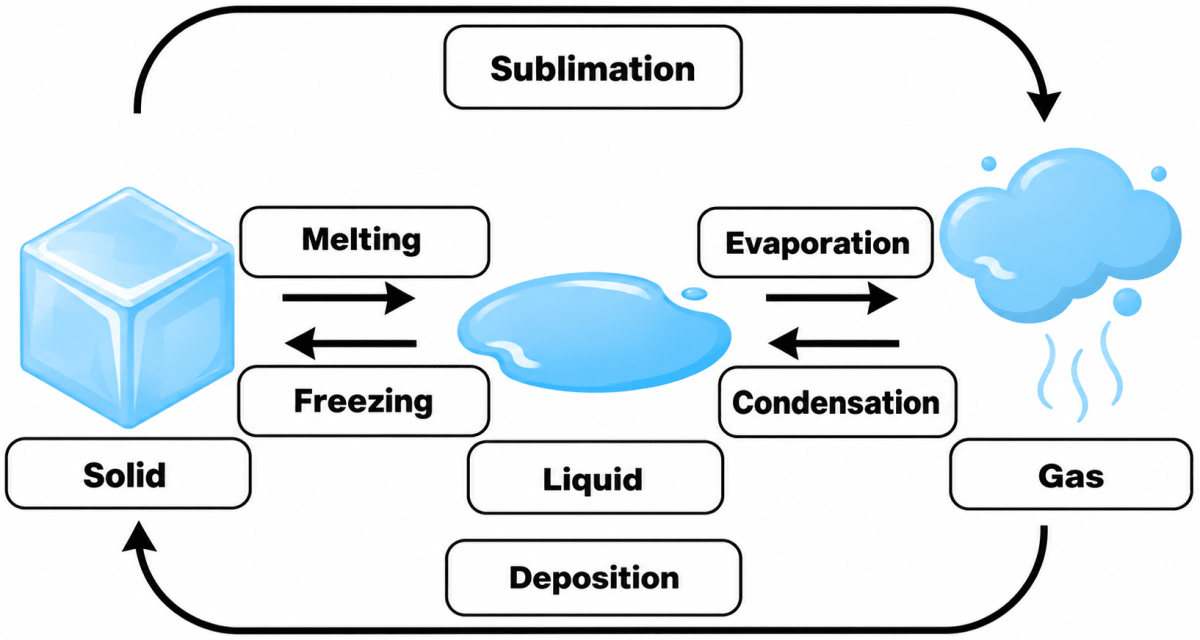
Write the correct words in the blank boxes given in the picture.
Answer
Define the following terms.
(a) Density
(b) Work
(c) Refraction
(d) Pitch of sound
Answer
(a) Density — The mass per unit volume of a substance.
(b) Work — Work is said to be done when a force applied on a body produces a displacement in the direction of the force. Work = force x displacement.
(c) Refraction — The bending of light when it travels from one medium to another.
(d) Pitch of sound — The characteristic of sound which differentiates a shrill sound from a flat sound. It is determined by the frequency of vibration.
Explain why a ship made of iron floats while a small iron nail sinks.
Answer
An iron nail sinks in water because the density of iron is more than that of water. So the weight of the nail is greater than the buoyant force of the water, and the nail sinks.
A ship, though made of iron, has a hollow design with large empty spaces inside it which contain air. Because of these spaces, the average density of the ship becomes less than that of water. As a result, the buoyant force is able to support its weight and the ship floats.
Distinguish between static electricity and current electricity.
Answer
| Static electricity | Current electricity |
|---|---|
| It is caused by the build-up of charges on the surface of an object. | It is the flow of electric charge through a conductor. |
| The charges are at rest. | The charges are in motion. |
| It is generally produced on insulators (non-conductors) by friction. | It flows through conductors such as metals. |
| Example: a comb rubbed with dry hair attracts bits of paper. | Example: the current from a cell that lights a bulb and runs appliances. |
Write three safety measures during lightning.
Answer
Three safety measures to be followed during lightning are:
- Do not stand under a tall tree in the open; if it is struck by lightning, you could get injured.
- Stay away from water bodies such as rivers, ponds and swimming pools, and do not carry an umbrella in the open ground.
- Take shelter inside a building or a parked vehicle with its doors and windows closed, and avoid using electrical appliances and metallic taps.
Define amplitude. On what factor does it depend?
Answer
Amplitude is the maximum displacement of a vibrating particle from its mean position.
The amplitude depends on the energy supplied to the vibrating body. The greater the energy supplied, the greater is the amplitude of vibration and hence the louder is the sound produced.
State the main postulates of the kinetic theory of matter. How does it explain the three states of matter?
Answer
The main postulates of the kinetic theory of matter are:
- Matter is made up of a large number of tiny particles called atoms or molecules.
- The molecules are always in continuous random (zigzag) motion.
- The molecules possess kinetic energy, which increases when the substance is heated and decreases when it is cooled.
- There are spaces between the molecules, called intermolecular spaces.
- The molecules exert an attractive force (intermolecular force) on one another.
Explanation of the three states of matter:
- Solids: The molecules are very closely packed and the intermolecular force is very strong. Therefore, solids have a fixed shape and a fixed volume.
- Liquids: The molecules are less closely packed than in solids and the intermolecular force is weaker. Therefore, liquids have a fixed volume but no fixed shape, and they take the shape of the container.
- Gases: The molecules are far apart and the intermolecular force is very weak. Therefore, gases have neither a fixed shape nor a fixed volume, and they fill the entire container.
Define moment of force. Derive its formula and explain its two factors. Give one daily life example.
Answer
Moment of force is defined as the product of the magnitude of the force and the perpendicular distance of the line of action of the force from the pivot (fixed point). It gives the turning effect of a force about a fixed point.
Formula: Consider a rod OA of length l pivoted at the point O. Let a force F be applied at the free end A, perpendicular to the rod.
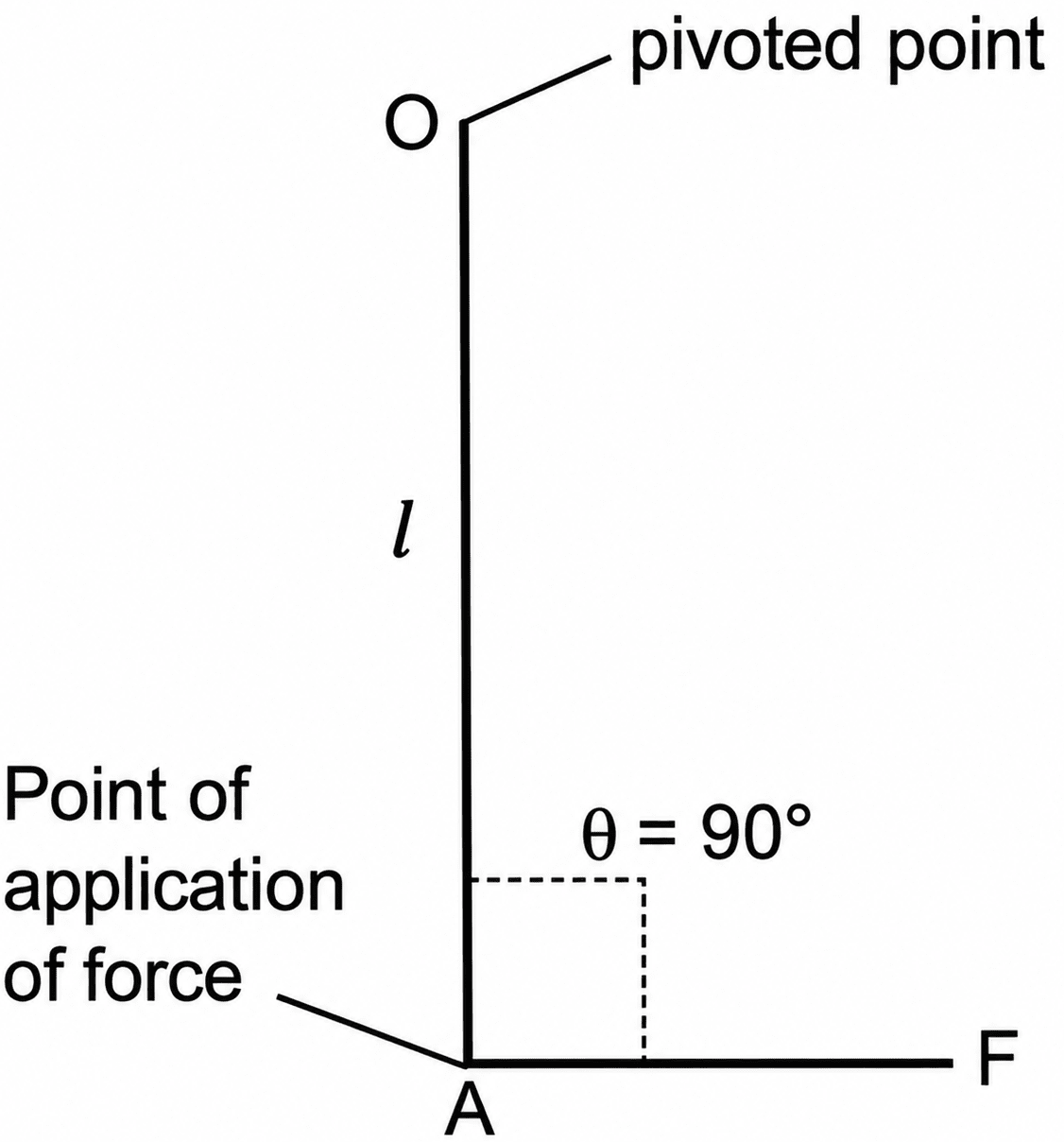
Then, the moment of force, M = F x OA = F x l (here d = l).
In general, if d is the perpendicular distance of the force from the pivot,
M = F x d
Its SI unit is the newton-metre (Nm).
Two factors on which moment of force depends:
- Magnitude of the applied force — The larger the force applied, the greater is the turning effect. So the moment of force is directly proportional to the applied force.
- Perpendicular distance from the pivot — The greater the perpendicular distance between the point of application of force and the pivot, the greater is the turning effect.
Daily life example: A door is opened or closed easily by applying force at its outer edge (the maximum distance from the hinges), because the larger distance increases the moment of force and hence the turning effect.
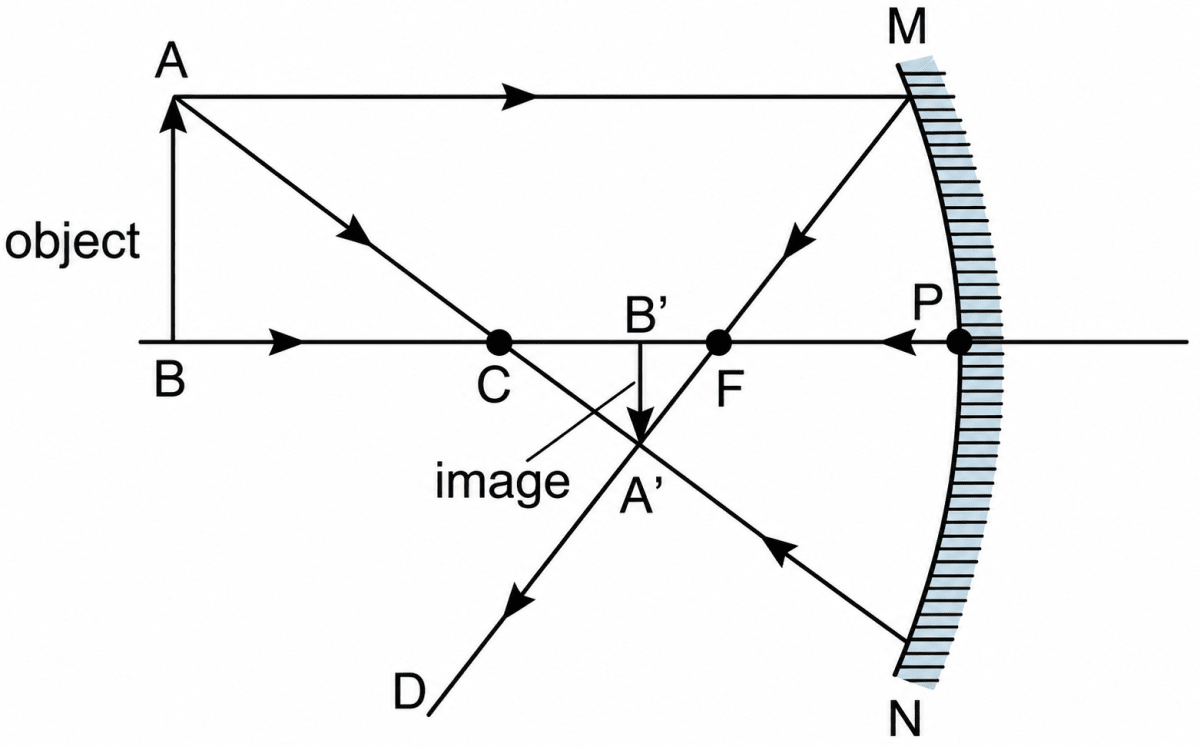
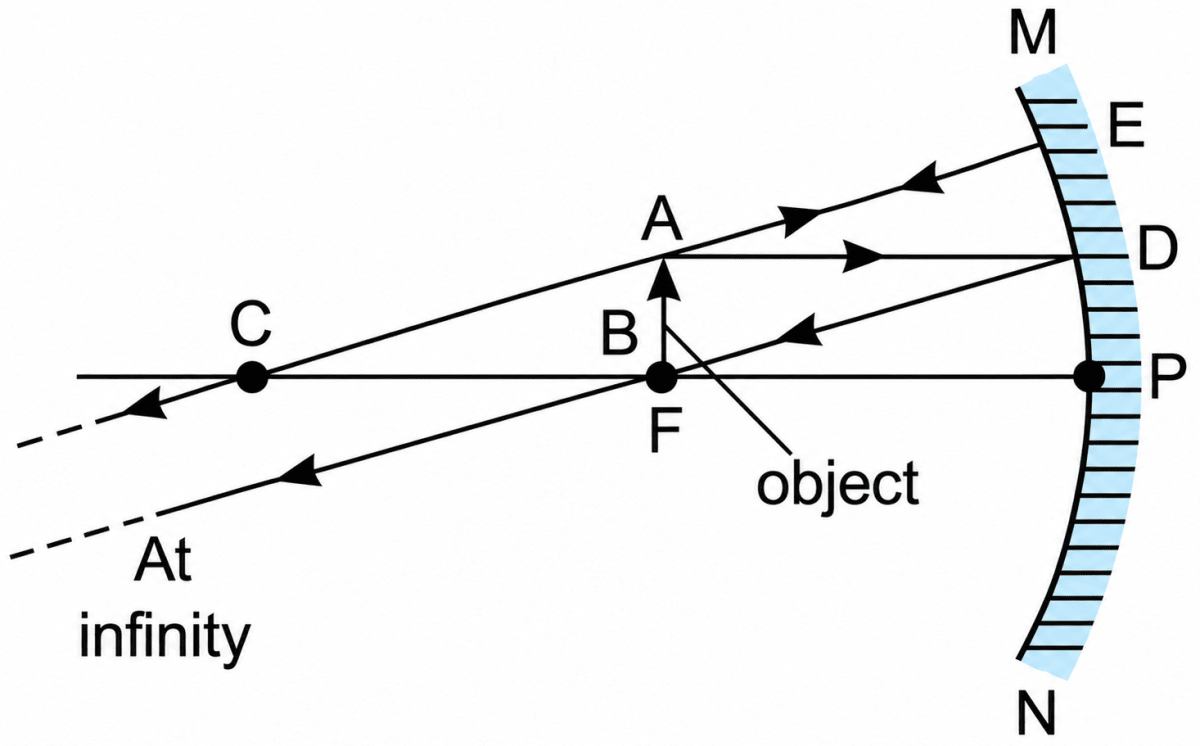
Distinguish between concave and convex mirrors. Draw ray diagrams to show the image formation by a concave mirror when the object is (a) beyond C (b) at F.
Answer
| Concave mirror | Convex mirror |
|---|---|
| Its reflecting surface is curved inwards. | Its reflecting surface is curved outwards. |
| It is a converging mirror, as it converges the rays of light. | It is a diverging mirror, as it spreads out the rays of light. |
| It can form both real and virtual images depending on the position of the object. | It always forms a virtual, erect and diminished image. |
| It is used in torches, headlights, shaving mirrors, dentists' mirrors and solar cookers. | It is used as a rear-view mirror in vehicles and as a vigilance mirror in shops. |
(a) Object beyond the centre of curvature (C): The image is formed between F and C. It is real, inverted and diminished.
(b) Object at the focus (F): The image is formed at infinity. It is real, inverted and highly magnified.
Explain with a diagram how sound propagates in the form of longitudinal waves showing compressions and rarefactions.
Answer
Sound is produced by a vibrating body and travels through a material medium in the form of a longitudinal wave. In a longitudinal wave, the particles of the medium vibrate to and fro about their mean positions along the same direction in which the wave travels.
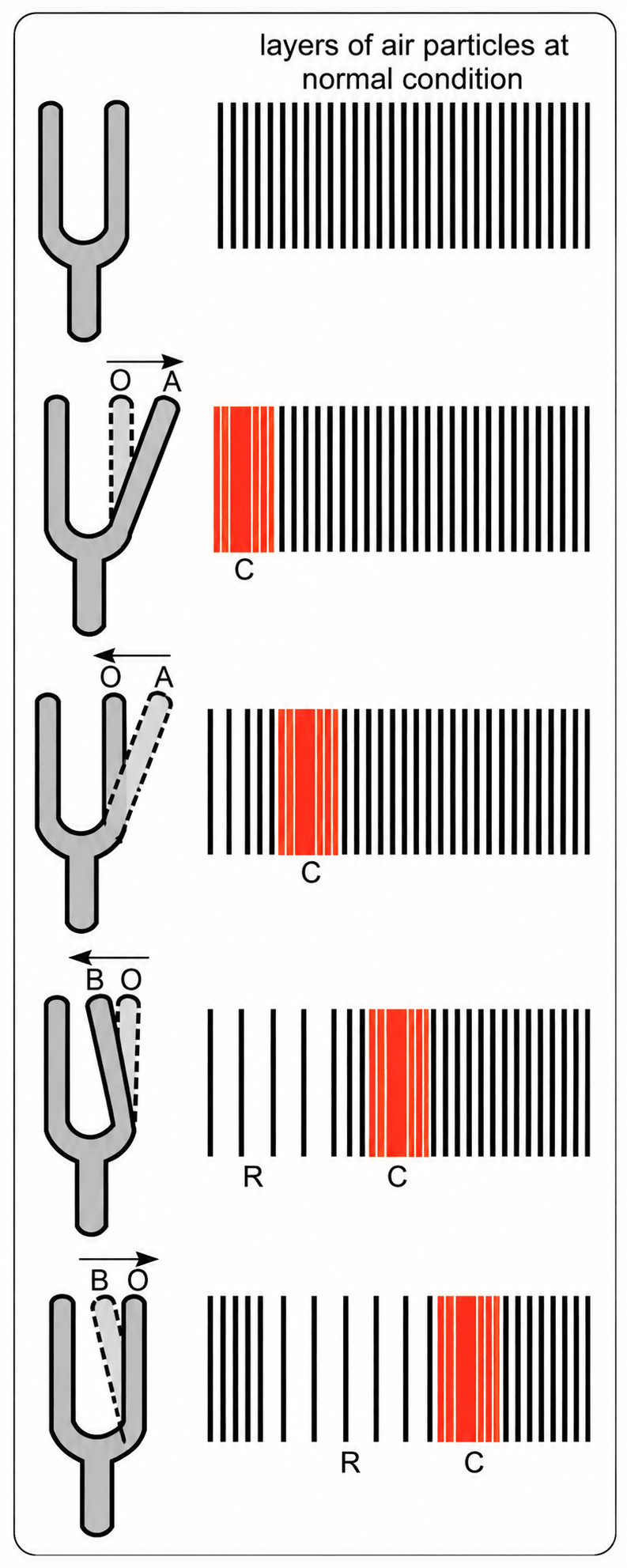
When a vibrating body, such as the prong of a tuning fork, moves forward, it pushes the air particles in front of it closer together. This region of increased density of particles is called a compression (C).
When the prong moves backward, it leaves behind a region in which the particles are farther apart. This region of decreased density is called a rarefaction (R).
As the body keeps vibrating, compressions and rarefactions are produced one after the other and travel forward through the medium, carrying the sound with them. One compression and one rarefaction together make one complete sound wave. The particles of the medium themselves only vibrate about their mean positions and do not move forward with the wave.
Describe household wiring with the functions of fuse, MCB, earthing and switch.
Answer
In household wiring, electricity is brought into the house through three wires — the live wire (red or brown), the neutral wire (black or blue) and the earth wire (green or yellow). All the appliances in the house are connected in parallel so that each one can work independently. The important safety and control devices in this wiring are:
Fuse: A fuse has a thin wire of low melting point (an alloy of lead and tin) connected in series in the live wire. When the current in the circuit exceeds a safe value due to an overload or short circuit, the fuse wire melts and breaks the circuit, protecting the appliances.
MCB (Miniature Circuit Breaker): An MCB is an automatic switch that is used in place of a fuse. When the current exceeds the safety limit, the MCB turns off (trips) on its own and breaks the circuit. It can simply be switched on again to revive the circuit, so it need not be replaced like a fuse.
Earthing: The metallic body of an appliance is connected to the earth wire (usually green-and-yellow), whose other end is connected to the earth through the earthing system. If the appliance gets short-circuited and the live wire touches its metal body, the leakage current flows safely to the earth. This prevents the user from getting an electric shock, so the earth wire acts as a safety wire.
Switch: A switch is a device used to make or break the circuit. It is connected in the live wire and is used to turn an appliance on or off by completing or breaking the path of the current.
Priya left some camphor and naphthalene balls in an open box. After a week, she found they had reduced in size.
(a) Which process caused this change?
(b) Explain it in terms of the kinetic theory of matter.
(c) Name another substance that undergoes the same change.
Answer
(a) The change was caused by sublimation — the process in which a substance changes directly from the solid state to the gaseous state without passing through the liquid state.
(b) On absorbing heat from the surroundings, some particles of camphor and naphthalene gain enough energy to overcome the intermolecular forces of attraction and escape directly into the vapour state without becoming liquid. As sublimation continues, the camphor and naphthalene balls gradually reduce in size.
(c) Another substance that undergoes sublimation is dry ice (solid carbon dioxide).
A boy throws a ball upward. It rises, stops for a moment, and then falls back to the ground.
(a) Which forms of energy does the ball possess during its motion?
(b) At which point is the potential energy maximum?
(c) Which law of physics is involved here?
Answer
(a) During its motion the ball possesses kinetic energy (due to its motion) and potential energy (due to its height). Together these make up its mechanical energy.
(b) The potential energy is maximum at the highest point of its path, where the ball momentarily stops and its height is the greatest.
(c) The law of conservation of energy is involved here, as the kinetic energy and potential energy keep changing into each other while the total energy remains constant.
A student drops a stone into a Eureka can filled with water. Water flows into the measuring cylinder kept below.
(a) Which method is being used here?
(b) What quantity is found from the volume of displaced water?
(c) If the mass of the stone is 200 g and the water displaced is 80 cm3, calculate the density of the stone.
Answer
(a) The water displacement method (using a Eureka can) is being used here.
(b) The volume of the displaced water gives the volume of the stone (the irregular solid).
(c) Given, mass of stone = 200 g and volume of stone = 80 cm3.
So the density of the stone is 2.5 g cm−3.
Nikhil notices a coin at the bottom of a glass of water appears raised when viewed from above.
(a) Name the phenomenon responsible.
(b) Why does this happen?
(c) State one more real-life example of the same phenomenon.
Answer
(a) The phenomenon responsible is refraction of light.
(b) The light coming from the coin bends as it travels from water (an optically denser medium) into air (an optically rarer medium). Because of this bending, the coin appears to be raised, that is, at a smaller depth than it actually is.
(c) Another real-life example is a pencil appearing bent when it is partly dipped in a glass of water.
A porter wears a thick cloth on his head while carrying heavy loads.
(a) Which concept of physics is being applied here?
(b) Explain how it reduces the effect of load.
(c) State another daily-life example where the same principle is applied.
Answer
(a) The concept of pressure (force acting on the area of contact) is being applied here.
(b) The thick cloth increases the area of contact between the load and the porter's head. Since pressure = force ÷ area, increasing the area of contact reduces the pressure exerted by the load on the head. Thus, less pressure is exerted on the porter's head, making the load more comfortable to carry.
(c) The same principle is applied in the broad straps of a school bag (or heavy bag), which spread the weight over a larger area of the shoulders and reduce the pressure on them.
Meena strikes a tuning fork and touches its base on the top of a wooden table. The sound becomes louder.
(a) Which property of sound is demonstrated here?
(b) Why does the table make the sound louder?
(c) What is the term for this process?
Answer
(a) The property of loudness of sound is demonstrated here. Loudness depends mainly on the amplitude of vibration.
(b) The vibrating tuning fork sets the large surface of the wooden table into vibration. A larger vibrating surface pushes a greater amount of air, so a louder sound is produced.
(c) The term for this process is forced vibration.