
The scientific idea of work and energy grew over time. In the 17th century, Galileo and Newton studied motion and forces, leading to the concept of work as force applied over a distance. In the 19th century, James Joule showed that work and heat are both forms of energy, and the unit joule (J) was named after him. Scientists found different forms of energy like kinetic, potential, heat and light, and learnt that energy can change form but can't be created or destroyed. Mechanical energy is a mix of kinetic and potential energy. Power is how fast work is done. Work and power differ in that work is the task done, while power is the speed of doing it. Energy and power also differ – energy is the ability to do work, power is how quickly it is used
Answer
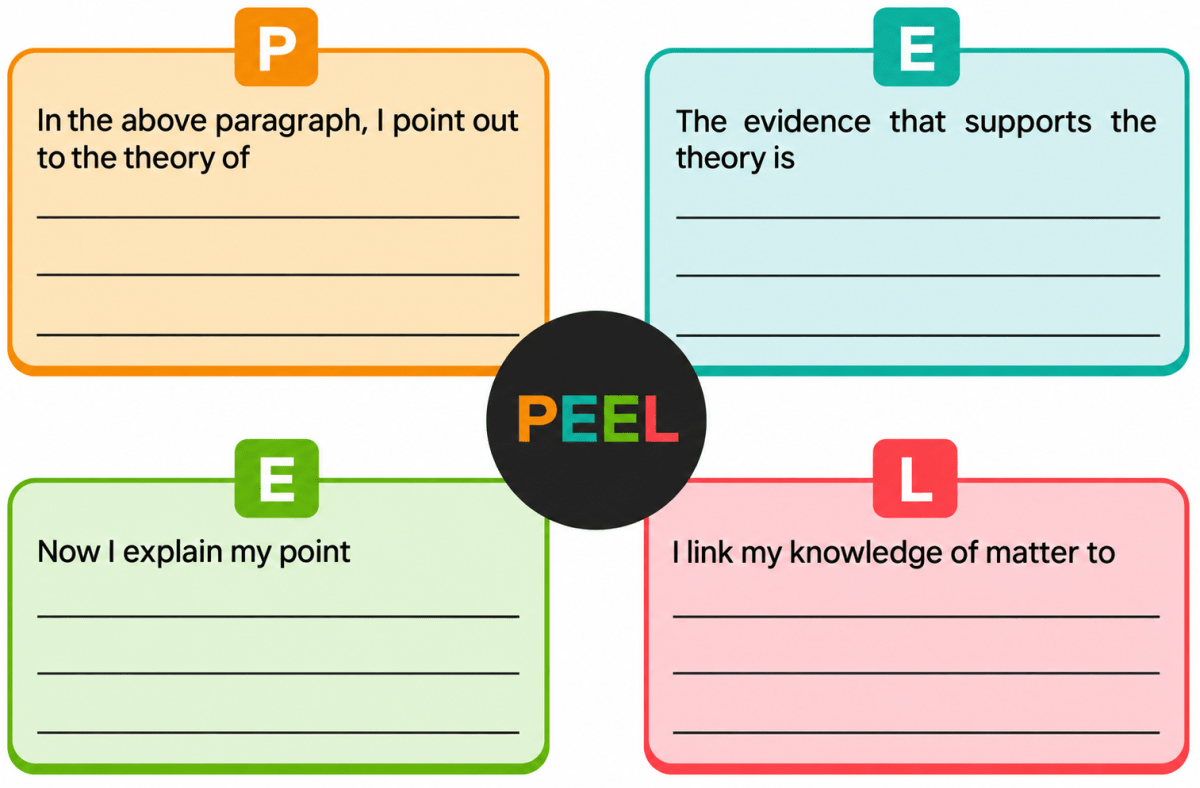
P – Point → In the above paragraph, I point out to the theory of: The Law of Conservation of Energy.
E – Evidence → The evidence that supports the theory is: Joule proved that work and heat are both forms of energy, and scientists discovered various interchangeable forms like kinetic, potential, heat, and light energy.
E – Explanation → Now I explain my point: While energy is the fundamental ability to do work, work itself is the actual force applied over a distance, and power measures the speed or rate at which that work is successfully completed.
L – Link → I link my knowledge of energy to: Real-world applications, such as how mechanical energy constantly shifts between potential and kinetic forms, and how different machines use power to complete tasks at varying speeds.
Read the given paragraph and answer the questions that follow.
Mohit was helping his mother move a stack of books from the ground floor to the first floor. He carried each stack up the stairs, applying force and covering a distance, which made him feel tired. His younger sister, Neera, tried to help by pushing a heavy cupboard across the floor, but it didn't move at all despite her effort.
Their elder brother, Rahul, who studies science, noticed this and explained to them that Mohit had done work because he applied a force and caused displacement. However, Neera, despite applying force, did not cause any movement, so no work was done in scientific terms.
Later, their father switched on a ceiling fan, which started rotating. Rahul explained that electrical energy was being transformed into kinetic energy to make the blades spin. He also showed them a stretched rubber band and asked what kind of energy it had. Mohit guessed correctly – it had potential energy.
Rahul then asked, "If both Mohit and I do the same work of lifting a bag, but I do it faster, who has more power?" Mohit understood that power depends on how fast the work is done, not just the amount of work.
By the end of the day, they had learnt a lot – not just by reading but by experiencing the concepts of work, energy, power, and energy transformation in their daily life.
- Why was Mohit considered to have done work, but Neera was not, even though both applied force?
- What type of energy was present in the stretched rubber band Rahul showed to Mohit?
- What kind of energy transformation occurred when the ceiling fan was switched on?
- If Rahul and Mohit both lifted the same bag to the same height, but Rahul did it in less time, who had more power and why?
- How can you explain the difference between work, energy and power based on the events in the story?
Answer
Mohit applied a force and also caused a displacement, as he carried the books up the stairs. Since both conditions for work were satisfied, work was done. Neera applied a force on the cupboard but it did not move, so there was no displacement. As displacement was zero, no work was done in scientific terms.
The stretched rubber band possessed elastic potential energy, as it was stored with energy on being stretched (deformed).
When the ceiling fan was switched on, electrical energy was transformed into kinetic energy of the rotating blades.
Rahul had more power. Power is the rate of doing work (power = work done ÷ time taken). Both did the same work, but Rahul did it in less time, so his power was greater.
Work was done when Mohit applied a force and moved the books (work = force × displacement). Energy was the capacity to do this work, which is why everyone felt tired as their energy was spent. Power decided how fast the work was done — Rahul lifting the bag faster showed greater power.
Circle the word that does not belong to other words given alongside it.
- Kinetic energy, Potential energy, Solar energy, Chemical energy
- Force, Displacement, Time, Work
- Work, Power, Energy, Friction
- Gravitational potential energy, Elastic potential energy, Light energy, Kinetic energy
- Work, Time, Mass, Power
Answer
- Solar energy
Reason — Kinetic energy, potential energy and chemical energy are forms of energy that a body itself possesses or stores (due to its motion, position or chemical make-up), whereas solar energy is the energy received as radiation from the Sun. - Time
Reason — Force, displacement and work are connected through the relation work = force × displacement, whereas time does not appear in this relation. - Friction
Reason — Work, power and energy are closely related quantities concerned with the doing of work, whereas friction is a force. - Light energy
Reason — Gravitational potential energy, elastic potential energy and kinetic energy are all forms of mechanical energy, whereas light energy is not a form of mechanical energy. - Mass
Reason — Work, time and power are connected through the relation power = work ÷ time, whereas mass is the amount of matter in a body and does not appear in this relation.
Match the columns.
| Column A | Column B |
|---|---|
| 1. Work | (a) Stored energy due to position |
| 2. Power | (b) Unit of work |
| 3. Joule | (c) Force applied × Displacement |
| 4. Potential energy | (d) Example of energy transformation |
| 5. Solar panel | (e) Rate of doing work |
Answer
| Column A | Column B |
|---|---|
| 1. Work | (c) Force applied × Displacement |
| 2. Power | (e) Rate of doing work |
| 3. Joule | (b) Unit of work |
| 4. Potential energy | (a) Stored energy due to position |
| 5. Solar panel | (d) Example of energy transformation |
Answer in one or a few word(s).
- When is work said to be done?
- Define displacement.
- Give an example for work not done.
- Define one joule.
- What is mechanical energy?
Answer
Work is said to be done when a force is applied on a body and the body is displaced in the direction of the applied force.
The shortest distance covered by a body from its initial position to its final position is called displacement.
Pushing a wall (the wall does not move, so the displacement is zero and no work is done).
One joule is the amount of work done when a force of one newton moves a body by one metre in its own direction (1 J = 1 N × 1 m).
Mechanical energy is the energy possessed by a body due to its position or motion.
Write the correct word(s) in the given blanks.
- ____________ is said to be done by a force when it displaces a body (on which it acts) in its own direction.
- ____________ is the total length between two points.
- Work done will be ____________ if either the force applied or displacement is zero.
- ____________ is the amount of energy possessed by a body when a force of 1 N moves it by 1 m in its direction.
- The energy possessed by a body due to its position or motion is called ____________ energy.
Answer
- Work is said to be done by a force when it displaces a body (on which it acts) in its own direction.
- Distance is the total length between two points.
- Work done will be zero if either the force applied or displacement is zero.
- One joule is the amount of energy possessed by a body when a force of 1 N moves it by 1 m in its direction.
- The energy possessed by a body due to its position or motion is called mechanical energy.
Write True or False for the following statements.
- Kinetic energy of a body is directly proportional to its mass. This means the heavier the body, the more is its kinetic energy.
- Gravitational potential energy of a body is directly proportional to its mass. This means the heavier the body, the less is its potential energy.
- Elastic potential energy is the energy stored in a body when work is done to deform, stretch or compress it.
- In an electric bulb, electrical energy gets converted into magnetic energy.
- Power is defined as the capacity of a body to do work.
Answer
True
False
Corrected Statement — Gravitational potential energy is directly proportional to mass, so the heavier the body, the more (not less) is its potential energy.True
False
Corrected Statement — In an electric bulb, electrical energy gets converted into light and heat energy, not magnetic energy.False
Corrected Statement — Power is the amount of work done in unit time (the rate of doing work). The capacity of a body to do work is called energy.
Find errors in the given sentences and correct them.
- Energy cannot be converted from one form to another.
- The SI unit of work is watt (W).
- In loudspeakers, electrical energy gets converted into heat energy.
- A wound up spring of a watch or a toy car has gravitational potential energy in it. As the spring uncoils, it does work in moving the arms of the watch.
- Kinetic energy is maximum when an object is at rest.
Answer
Energy can be converted from one form to another.
The SI unit of work is joule (J)
In loudspeakers, electrical energy gets converted into sound energy.
A wound up spring of a watch or a toy car has elastic potential energy in it. As the spring uncoils, it does work in moving the arms of the watch.
Kinetic energy is zero when an object is at rest. (It is maximum when the object moves with maximum speed.)
Work done is directly proportional to the force applied and the displacement caused in the body.
Answer
Work done is the product of force and displacement, W = F × s. So, for the same displacement, a greater force does more work, and for the same force, a greater displacement does more work. Hence, work done is directly proportional to both the force applied and the displacement caused in the body.
We may feel tired on reaching home from our school.
Answer
Energy is the capacity to do work, and energy is spent whenever we do work. While coming home from school, we do work and our energy is used up. As this energy is spent, we feel tired on reaching home.
When we pick a stone from the ground and drop it from a height on a glass piece, the glass breaks.
Answer
The work done in lifting the stone from the ground gets stored in it as gravitational potential energy. When the stone is dropped, this potential energy changes into kinetic energy. The moving stone uses this kinetic energy to do work on the glass, and so the glass breaks.
An accident of a fast moving car is dangerous and possibly fatal.
Answer
Kinetic energy is directly proportional to the square of the speed (KE = ). A fast moving car therefore has a very large kinetic energy. During an accident, this large kinetic energy causes great damage, which makes the accident dangerous and possibly fatal.
Landslides cause damage in hilly areas.
Answer
A stone or rock lying on the top of a hill possesses gravitational potential energy due to its height. During a landslide, when the rocks fall down, this potential energy changes into kinetic energy. The fast moving rocks can hurt people and damage property, so landslides cause damage in hilly areas.
Briefly explain kinetic energy with the help of some examples.
Answer
Kinetic energy is the energy an object possesses due to its motion. For example, flowing water, a flying aircraft, a fast moving football, a moving bus, wind and a running boy all possess kinetic energy.
What is gravitational potential energy?
Answer
Gravitational potential energy is the energy stored in an object due to its vertical position or height above the ground. For example, water stored in a dam possesses gravitational potential energy due to its height. It is calculated using equation: PE = m × g × h.
Write some examples of elastic potential energy.
Answer
- When you jump on a trampoline, its shape changes and elastic potential energy is stored in it.
- A stretched catapult has stored potential energy, which sends the stone a long distance when released.
- A wound up spring of a watch or a toy car has elastic potential energy that moves the arms of the watch as the spring uncoils.
List down the various devices and appliances which are based on the energy transformations.
Answer
- Electrical energy is converted into mechanical energy in a washing machine, a fan and an electric motor.
- Electrical energy is converted into sound energy in a loudspeaker.
- Sound energy is converted into electrical energy in a microphone.
- Light energy is converted into electrical energy in a solar cell.
- Chemical energy is converted into electrical energy in a dry cell.
- Electrical energy is converted into light and heat energy in an electric bulb.
- Electrical energy is converted into magnetic energy in an electromagnet.
What factors affect the power of a source?
Answer
The power of a source depends on the following two factors.
- The amount of work done by the source.
- The time taken by the source to complete the work.
Differentiate between energy and power.
Answer
| Energy | Power |
|---|---|
| Energy is the capacity of a body to do work. | Power is the amount of work done by a body in unit time. |
| Energy spent is not dependent on time. | Power is dependent on time. |
| The SI unit of energy is joule (J). | The SI unit of power is watt (W). |
| Energy can be converted from one form to another. | Power cannot be converted from one form to another. |
| Energy can be stored. | Power cannot be stored. |
Write some examples of energy transformation in detail.
Answer
- In photosynthesis, the light energy of the sun is converted into chemical energy stored in plants. When we eat this food, it is stored in our body as muscular energy, which is then used to do work and gets converted into mechanical energy.
- In a power plant, the chemical energy of fuels like coal is converted into heat energy. This heat boils water to form steam, which moves the shaft of a turbine, so heat energy is converted into mechanical energy. The generator then converts this into electrical energy.
- In an automobile, the chemical energy of the fuel is converted into heat energy, which moves the piston and changes into mechanical energy, finally moving the vehicle as kinetic energy.
- When we stretch a bow, it acquires elastic potential energy. On releasing the string, this potential energy is converted into the kinetic energy of the arrow.
- In a hydroelectric power plant, the potential energy of the water stored at a height is converted into kinetic energy, which moves the turbine and produces electrical energy.
What is potential energy? Explain its types.
Answer
Potential energy is the energy possessed by a body by virtue of its position or configuration. There are two types of potential energy.
Gravitational potential energy — the energy stored in a body due to its height in the gravitational field. The work done in raising a body to a height is stored in it as gravitational potential energy. It depends on the mass and the height of the body, and is given by PE = m × g × h. Example: water stored in a dam.
Elastic potential energy — the energy stored in a body when work is done to deform, stretch or compress it. Example: a stretched catapult or a wound up spring of a watch.
Explain mechanical energy and its types.
Answer
Mechanical energy is the energy possessed by a body due to its position or motion. There are two types of mechanical energy.
Kinetic energy — the energy possessed by a body by virtue of its motion. It depends on the mass and the speed of the body, and is given by KE = . Example: flowing water and a moving bus.
Potential energy — the energy possessed by a body by virtue of its position or configuration. It is of two kinds — gravitational potential energy (due to height) and elastic potential energy (due to deformation). Example: water stored in a dam and a stretched catapult.
"Work done will be zero if either the force applied or displacement is zero." Explain this statement.
Answer
Work done is given by W = F × s, where F is the force applied and s is the displacement.
If the force applied is zero (F = 0), then W = 0. For example, a man sleeping on a bed or a child standing and waiting for the school bus applies no force, so no work is done.
If the displacement is zero (s = 0), then W = 0 even though a force is applied. For example, when a boy pushes a tree or a man pushes a lawn mower on a circular path and stops at the same point, the displacement is zero, so no work is done.
Hence, work done becomes zero if either the force applied or the displacement is zero.
Read the given case study and answer the questions that follow.
Lata lives in a small town where power cuts are common. One day, the electric motor stopped working and the family needed to fill the water tank on the roof. Lata's brother Manav carried a 20-litre bucket (weighing 20 kg) up to the roof 10 metres high, 5 times.
Later, Lata asked him how tired he was. Manav replied, "I did a lot of work and I did it in less time than Papa usually does with the motor. But Papa says that the motor is more powerful than I am!"
Then Lata noticed something: when the motor runs, the electrical energy is converted into mechanical energy to lift water. But when Manav carries the bucket, his muscular energy is used. She also observed that a bucket at rest on the roof still holds some energy even if it's not moving.

- How much total work did Manav do in lifting all the buckets to the rooftop? (Take g = 10 m/s2)
- What form of mechanical energy does the water in the raised tank possess? Why?
- What kind of energy transformation takes place when the motor lifts the water?
- Manav and the motor do the same work, but her Papa says the motor is more powerful. Why?
- Manav feels tired after carrying the water. Is all the energy from his body used as work? Explain.
Answer
1. Work done in one trip = Force × displacement = (m × g) × h.
Force (F) = m × g
= 20 × 10
= 200 N
Work in one trip = 200 × 10 = 2000 J
Total work for 5 trips = 5 × 2000 = 10000 J
So, the total work done by Manav is 10000 J.
2. The water in the raised tank possesses gravitational potential energy. This is because it is stored at a height above the ground, so it has energy by virtue of its position.
3. When the motor lifts the water, electrical energy is converted into mechanical energy.
4. Power is the rate of doing work (power = work done ÷ time taken). The motor does the same work as Manav, but it completes the work in much less time. Since less time means more power, the motor is more powerful than Manav.
5. No, all the energy from his body is not converted into useful mechanical work. When Manav carries the water, part of his muscular energy is used to lift the water, while the remaining energy is mainly converted into thermal/internal energy and dissipated as heat. This is why he feels tired.
Read the given information carefully and answer the questions that follow.
A common example of energy transfer that we see in everyday life is the transfer of kinetic energy – the energy associated with motion – from one moving object to a stationary object via work. In physics, work is a measure of energy transfer and refers to the force applied by an object over a distance. When a golf club is swung and hits a stationary golf ball, some of the club's kinetic energy transfers to the ball as the club does 'work' on the ball. In an energy transfer such as this one, energy moves from one object to another, but stays in the same form. A kinetic energy transfer is easy to observe and understand, but other important transfers are not as easy to visualise.
Thermal energy has to do with the internal energy of a system due to its temperature. When a substance is heated, its temperature rises because the molecules it is composed of move faster and gain thermal energy through heat transfer. Temperature is used as a measurement of the degree of 'hotness' or 'coldness' of an object, and the term heat is used to refer to thermal energy being transferred from a hotter system to a cooler one. Thermal energy transfers occur in three ways: through conduction, convection and radiation.
Source: https://education.nationalgeographic.org/resource/energy-transfers-and-transformations/
- How does energy get transferred while playing golf?
- List three ways in which thermal energy get transferred.
- Explain briefly the energy transformation in a solar panel.
Answer
While playing golf, the moving golf club has kinetic energy. When it hits the stationary ball, it does work on the ball, and some of the club's kinetic energy is transferred to the ball. The energy moves from the club to the ball but stays in the same (kinetic) form.
Thermal energy gets transferred in three ways — conduction, convection and radiation.
In a solar panel (solar cell), the light energy coming from the Sun gets converted into electrical energy.
A child pushes two boxes – one heavy and one light – using the same force. The lighter one moves farther. Analyse why more work is done on the lighter box.

Answer
Work done is given by W = F × s. The child applies the same force on both boxes, so the work done depends on the displacement. The lighter box moves a greater displacement. As work done is directly proportional to displacement, more work is done on the lighter box because it is displaced farther.
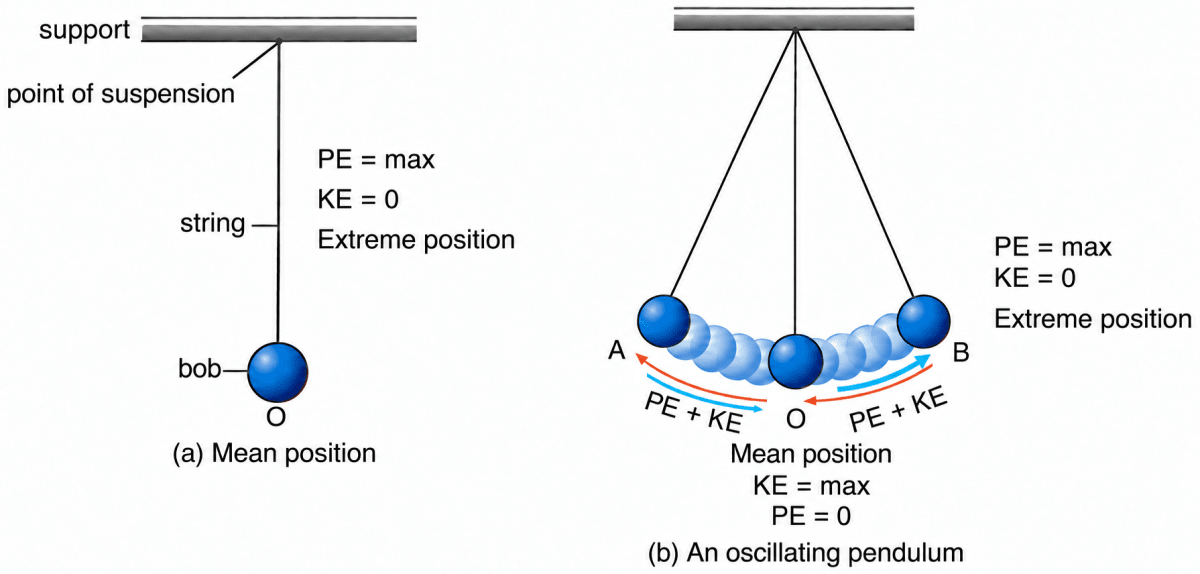
Compare potential energy and kinetic energy of a pendulum at its highest point and lowest point during its swing.
Answer
| Position | Potential energy | Kinetic energy |
|---|---|---|
| Highest point (extreme position) | Maximum | Zero (the bob is momentarily at rest) |
| Lowest point (mean position) | Zero | Maximum |
At the highest point, the bob is momentarily at rest at the greatest height, so its potential energy is maximum and kinetic energy is zero. At the lowest point, the bob moves fastest, so its kinetic energy is maximum and its potential energy is minimum. If the lowest point is chosen as the zero reference level, its potential energy there is taken as zero. At every point, the total mechanical energy (PE + KE) remains constant, neglecting friction and air resistance.
A person applies a force of 100 N to lift a 10 kg object to a height of 5 m. Calculate the work done. (Take g = 10 ms-2)
Answer
Given,
Force (F) = 100 N
Height (h) = 5 m
Work done (W) = F × h
= 100 × 5
= 500 J
So, the work done is 500 J.
A bulb consumes 60 J of energy in 2 seconds. Find its power.
Answer
Given,
Energy (E) = 60 J
Time (t) = 2 s
So, the power of the bulb is 30 W.
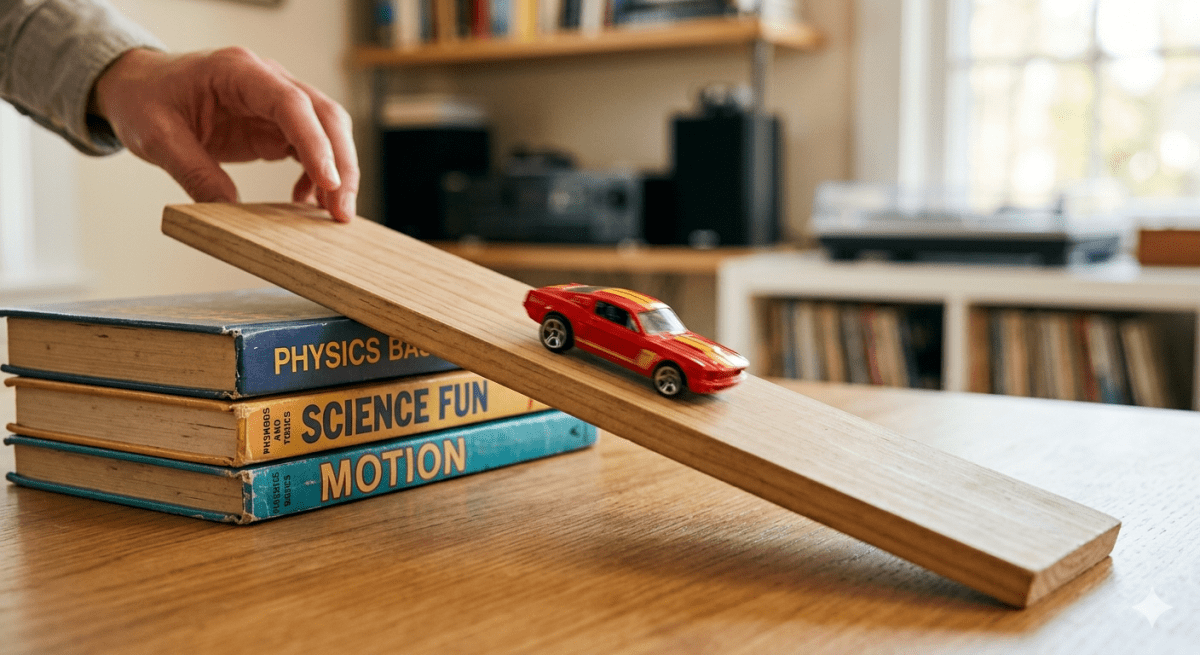
Design a simple activity or model to show transformation of energy from potential to kinetic using household items (like a toy car on a ramp).
Answer
Materials required: A toy car and a flat board or plank to act as a ramp.
Steps
- Place one end of the board on a few books to make a sloping ramp.
- Hold the toy car at the top of the ramp and let it stay there for a moment. At this height, the car has gravitational potential energy.
- Release the car so that it rolls down the ramp on its own.
Observation As the car rolls down, its height decreases and its speed increases. The potential energy of the car at the top is transformed into kinetic energy as it moves down, and the kinetic energy is maximum at the bottom of the ramp. This shows the transformation of energy from potential to kinetic.
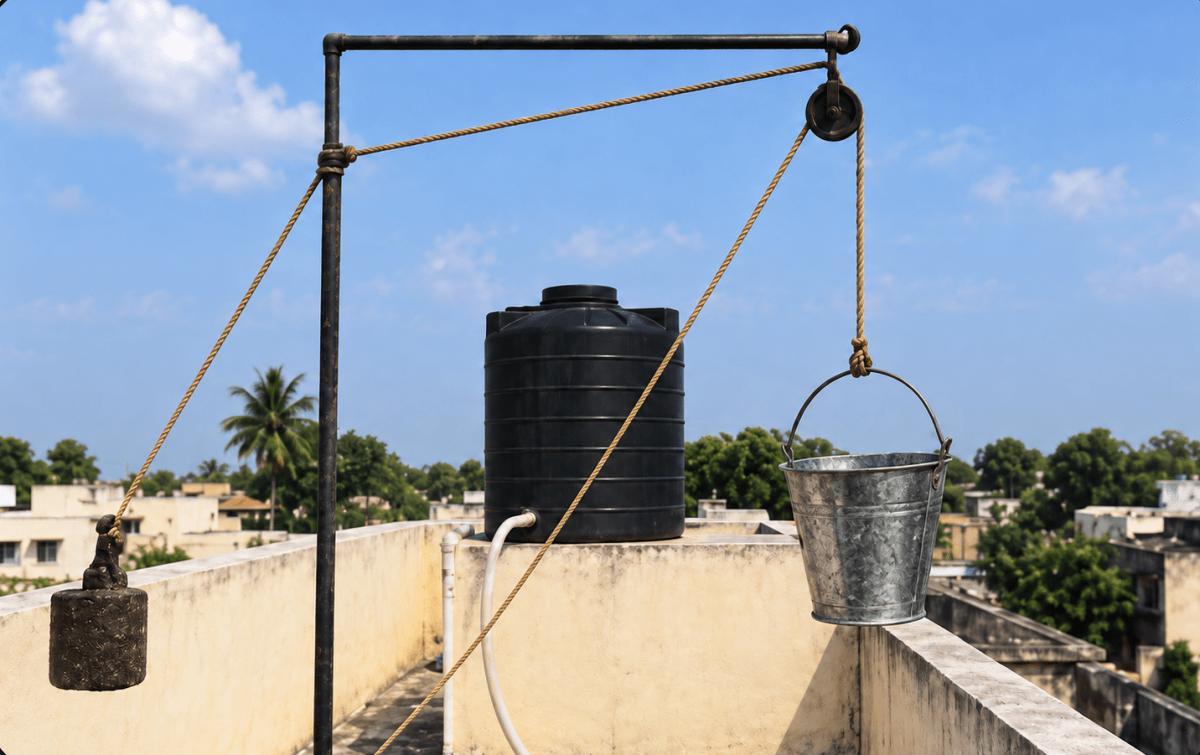
Imagine a world without electricity. Create a plan to lift water to a roof tank using a manual method that involves least human effort and explain the science behind it.
Answer
Plan: Fix a pulley to a strong beam above the roof tank. Pass a rope over the pulley and tie a bucket to one end of the rope. Fill the bucket with water at the ground and stand on the roof. Pull the rope downward to raise the bucket of water up to the tank, then empty it into the tank.
Science behind it: A pulley system provides mechanical advantage. The load is supported by more than one section of the rope, so a smaller effort force is required to lift the bucket, although a greater length of rope has to be pulled. Pulling downward also makes the task easier because the person can use body weight while applying the force.
Neelam tried pushing a wall with all her strength but it didn't move. Later, she helped her brother carry a bag of groceries upstairs. She was confused – she felt tired both times, but her teacher said only one of them involved work in the scientific sense.

- What is the scientific definition of work?
- Why is pushing a wall not considered work in science?
- What condition must be met for work to be said to be done?
- How does carrying a bag upstairs involve work?
- What are the two factors that determine the amount of work done?
Answer
In science, work is said to be done by a force when it displaces a body (on which it acts) in its own direction.
When Neelam pushes a wall, she applies a force but the wall does not move. As there is no displacement, no work is done in the scientific sense.
For work to be done, a force must be applied on the body and the body must move (be displaced) in the direction of the applied force.
While carrying the bag upstairs, a force is applied to lift the bag against gravity and the bag is displaced upward. As both a force and a displacement are present, work is done.
The two factors that determine the amount of work done are the force applied and the displacement caused (W = F × s).
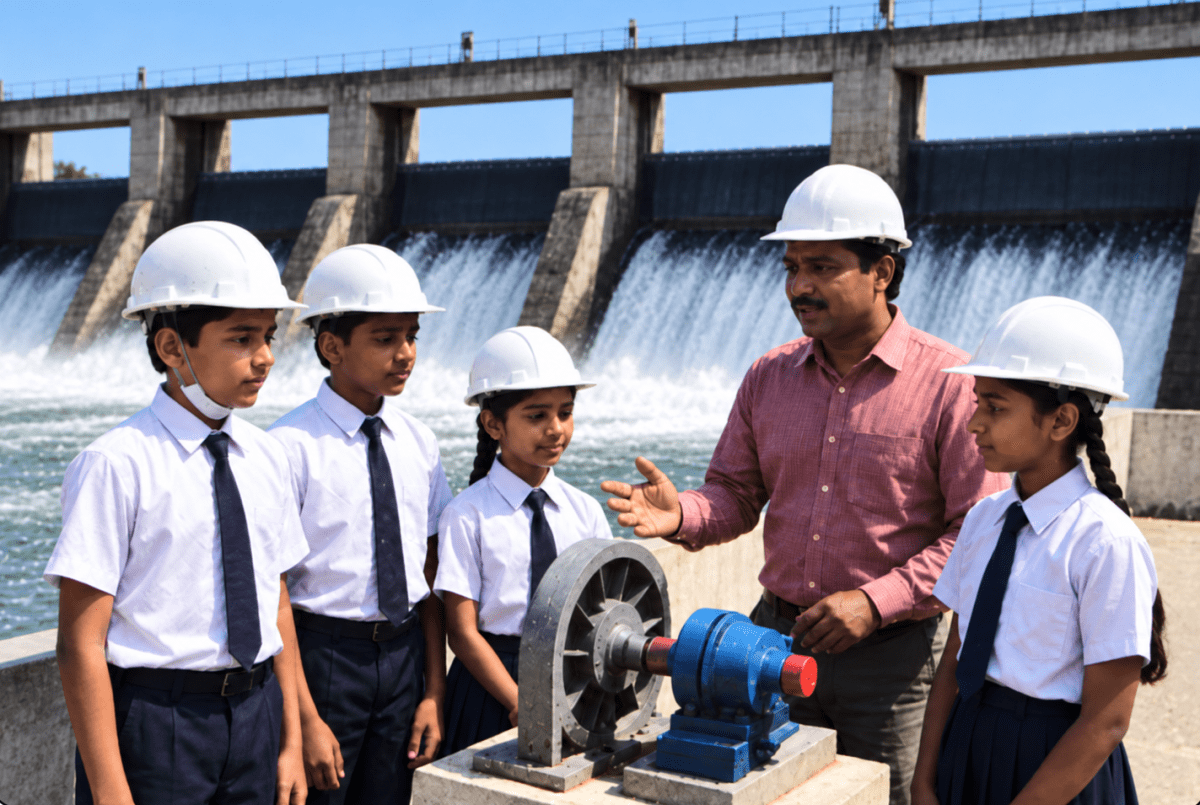
During a field trip, students saw water flowing in a dam turn a turbine, which produced electricity. Their teacher explained how energy was changing from one form to another and talked about different types of mechanical energy.
- What is the energy of a moving object called?
- What type of energy is stored in an object due to its height?
- In a dam, water's potential energy changes into which form of energy?
- What do we call the process of energy changing from one form to another?
- Can energy be created or destroyed?
Answer
The energy of a moving object is called kinetic energy.
The energy stored in an object due to its height is called gravitational potential energy.
In a dam, the potential energy of the water changes into kinetic energy, which then turns the turbine.
The process of energy changing from one form to another is called energy transformation (or energy conversion).
No, energy can neither be created nor destroyed. It only changes from one form to another. This is the law of conservation of energy.
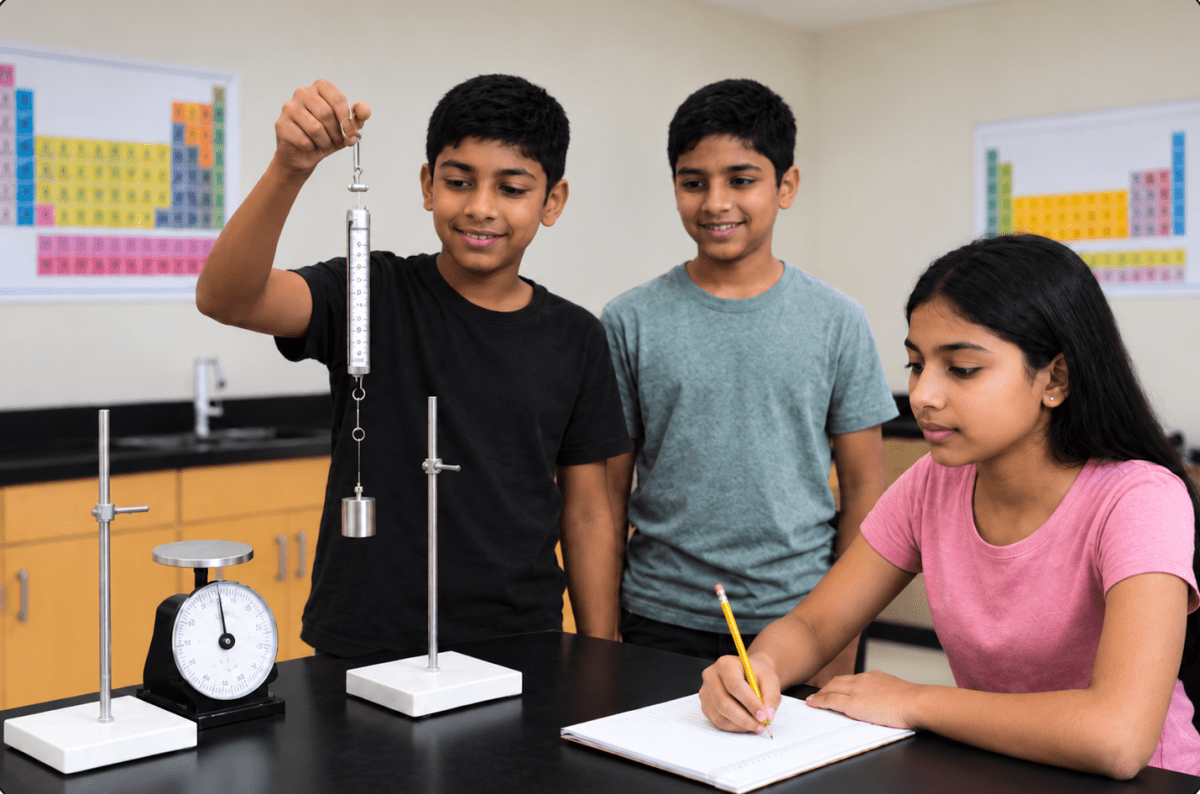
In a lab activity, students used a spring balance to lift objects to different heights and measured how much energy was used. They also compared how long it took two classmates to complete the same task – lifting the same weight to the same height. One finished faster.
- What is the formula to calculate work done?
- How is energy related to work?
- What is mechanical energy a sum of?
- What is the formula to calculate power?
- If two people do the same work but one does it faster, who has more power?
Answer
The formula to calculate work done is, work = force × displacement.
Energy is the capacity to do work. When work is done on a body, its energy increases, and when a body does work, its energy is spent. Work and energy have the same unit, the joule.
Mechanical energy is the sum of the kinetic energy and the potential energy of a body.
The formula to calculate power is , that is, .
The person who does the work faster (in less time) has more power.
Sunil had a fan running and a light bulb glowing. He wondered why both used energy but in different ways. Later, in science class, he learnt that power tells how quickly energy is used and energy tells how much is used in total.

- What is the difference between energy and power?
- What is the SI unit of energy? What about power?
- Why is power called the rate of doing work?
- Can a machine use a lot of power without doing much total work? Explain.
- Give one example each where high energy is used slowly and where low energy is used quickly.
Answer
Energy is the capacity of a body to do work, while power is the rate of doing work.
The SI unit of energy is the joule (J) and the SI unit of power is the watt (W).
Power is called the rate of doing work because it is equal to the work done divided by the time taken . It tells how much work is done in unit time, that is, how fast work is done.
Yes. If a machine does only a small amount of work but in a very short time, its power becomes high. So a machine can have high power even without doing much total work.
A geyser heating water over a long time uses high energy slowly, whereas a stretched rubber band snapping back releases low energy very quickly.
Fill in the blanks.
- Work is said to be done only when a force is applied and the body shows ____________ in the direction of the force.
- The SI unit of work is ____________.
- Energy possessed by a body due to its motion is called ____________ energy.
- The rate at which work is done is called ____________.
- The law of ____________ of energy states that energy can neither be created nor destroyed, it only changes from one form to another.
Answer
- Work is said to be done only when a force is applied and the body shows displacement in the direction of the force.
- The SI unit of work is joule (J).
- Energy possessed by a body due to its motion is called kinetic energy.
- The rate at which work is done is called power.
- The law of conservation of energy states that energy can neither be created nor destroyed, it only changes from one form to another.
Write True or False.
- If a coolie carries a load on his head and walks on a level road, no work is done in terms of physics.
- Potential energy of a stretched bow is converted into kinetic energy when released.
- Hydroelectric dams convert mechanical energy into electrical energy.
- The commercial unit of energy used by electricity boards is Joule.
- Power is a scalar quantity.
Answer
True
True
True
False
Corrected Statement — The commercial unit of energy used by electricity boards is the kilowatt-hour (kWh), not the joule.True
Match the columns.
| Column A | Column B |
|---|---|
| 1. Work | (a) Energy cannot be destroyed |
| 2. Kinetic energy | (b) Rate of doing work |
| 3. Potential energy | (c) Force × displacement |
| 4. Power | (d) Energy of motion |
| 5. Law of conservation of energy | (e) Energy of position |
Answer
| Column A | Column B |
|---|---|
| 1. Work | (c) Force × displacement |
| 2. Kinetic energy | (d) Energy of motion |
| 3. Potential energy | (e) Energy of position |
| 4. Power | (b) Rate of doing work |
| 5. Law of conservation of energy | (a) Energy cannot be destroyed |
State two conditions necessary for work to be done.
Answer
The two conditions necessary for work to be done are:
- A force must be applied on the body.
- The body must move (be displaced) in the direction of the applied force.
On what factors does gravitational potential energy of an object depend?
Answer
The gravitational potential energy of an object depends on two factors:
- Mass (or weight) of the body — it is directly proportional to the mass.
- Height from the level of the ground — it is directly proportional to the height.
Why is work done zero when a body moves in a circular path under uniform speed?
Answer
In uniform circular motion, the centripetal force is always directed towards the centre of the circular path, while the instantaneous displacement is along the tangent to the path. Thus, the force and displacement are perpendicular to each other, so the work done by the centripetal force is zero. Also, because the speed remains constant, the kinetic energy does not change and the net work done is zero.
Differentiate between energy and power.
Answer
| Energy | Power |
|---|---|
| Energy is the capacity of a body to do work. | Power is the amount of work done by a body in unit time. |
| Energy spent is not dependent on time. | Power is dependent on time. |
| The SI unit of energy is joule (J). | The SI unit of power is watt (W). |
Give two examples of energy conversion from daily life.
Answer
- In an electric bulb, electrical energy is converted into light and heat energy.
- In a ceiling fan, electrical energy is converted into mechanical (kinetic) energy of the rotating blades.
Explain the difference between potential and kinetic energy, giving one example of each from daily life.
Answer
| Potential energy | Kinetic energy |
|---|---|
| It is the energy possessed by a body due to its position or configuration. | It is the energy possessed by a body due to its motion. |
| It is possessed by a body even when it is at rest. | It is possessed by a body only when it is moving. |
| Example: water stored in a dam. | Example: a moving bus. |
A body of mass 2 kg is lifted to a height of 5 m. Calculate the potential energy gained. (Take g = 9.8 ms-2)
Answer
Given,
Mass of the body (m) = 2 kg
Height (h) = 5 m
g = 9.8 ms-2
Potential energy (PE) = m × g × h
= 2 × 9.8 × 5
= 98 J
So, the potential energy gained is 98 J.
Define 1 watt of power. A pump raises 100 litres of water to a height of 20 m in 50 seconds. Calculate the power of the pump. (Density of water = 1000 kgm-3)
Answer
One watt is the power of a body or a machine if it does 1 joule of work in 1 second (1 W = 1 Js-1).
Given,
Volume of water = 100 litres = 0.1 m3
Mass of water (m) = volume × density
= 0.1 × 1000
= 100 kg
Height (h) = 20 m,
Time (t) = 50 s,
Acceleration due to gravity (g) = 9.8 m s−2
Work done = PE
= m × g × h
= 100 × 9.8 × 20
= 19600 J
So, the power of the pump is 392 W.
Explain with an example how the law of conservation of energy is verified in a simple pendulum.
Answer
A simple pendulum has a heavy bob tied to a thread whose other end is fixed to a rigid support. When the bob is displaced to an extreme position, it has maximum potential energy and zero kinetic energy. As it swings down towards the mean position, its potential energy changes into kinetic energy. At the mean position, its kinetic energy is maximum and potential energy is zero. As it rises to the other extreme position, the kinetic energy again changes back into potential energy.
At every point of the swing, the total mechanical energy (potential energy + kinetic energy) remains constant. This shows that energy is only transformed from one form to another and is neither created nor destroyed, which verifies the law of conservation of energy.
Distinguish between work, energy and power. Give one unit and one example of each.
Answer
| Work | Energy | Power | |
|---|---|---|---|
| Meaning | Work is done when a force displaces a body in its same direction. | Energy is the capacity of a body to do work. | Power is the amount of work done in unit time. |
| Unit | Joule (J) | Joule (J) | Watt (W) |
| Example | Lifting a box to a height. | Water stored in a dam. | A motor rated to lift water quickly. |