
Try and find other patterns like this one. For example, you could consider 4 consecutive squares and see if you can find a pattern.
Answer
Let us take 4 consecutive square numbers. Let the consecutive integers be n, (n + 1), (n + 2) and (n + 3). Their squares are n2, (n + 1)2, (n + 2)2 and (n + 3)2.
Consider the operation: (sum of the smallest and largest squares) – (sum of the two middle squares).
⇒ [n2 + (n + 3)2] - [(n + 1)2 + (n + 2)2]
= [n2 + n2 + 6n + 9] - [n2 + 2n + 1 + n2 + 4n + 4]
= [2n2 + 6n + 9] - [2n2 + 6n + 5]
= 4.
Let us verify with an example. Take the consecutive squares 1, 4, 9, 16.
⇒ (1 + 16) - (4 + 9) = 17 - 13 = 4.
Now take 4, 9, 16, 25.
⇒ (4 + 25) - (9 + 16) = 29 - 25 = 4.
Hence, for any 4 consecutive square numbers, the difference between the sum of the smallest and the largest squares and the sum of the two middle squares is always 4.
What can you say about a and b if (a + b)2 < a2 + b2 ?
Answer
We know the identity:
⇒ (a + b)2 = a2 + 2ab + b2.
So,
⇒ (a + b)2 - (a2 + b2) = 2ab.
If (a + b)2 < a2 + b2, then:
⇒ 2ab < 0
⇒ ab < 0.
This means a and b have opposite signs (one is positive and the other is negative).
Hence, (a + b)2 < a2 + b2 when a and b have opposite signs.
What can you say about a and b if (a + b)2 > a2 + b2 ?
Answer
We know:
⇒ (a + b)2 - (a2 + b2) = 2ab.
If (a + b)2 > a2 + b2, then:
⇒ 2ab > 0
⇒ ab > 0.
This means a and b have the same sign (both positive or both negative).
Hence, (a + b)2 > a2 + b2 when a and b have the same sign.
When will (a + b)2 be equal to a2 + b2 ?
Did you observe that (a + b)2 and a2 + b2 are both positive? What term will decide which is larger? Use the expansion of (a + b)2 to decide.
Answer
We know:
⇒ (a + b)2 - (a2 + b2) = 2ab.
If (a + b)2 = a2 + b2, then:
⇒ 2ab = 0
⇒ ab = 0.
This means at least one of a or b is equal to zero.
Hence, (a + b)2 = a2 + b2 when at least one of a or b is zero.
From the expansion of (a + b)2:
⇒ (a + b)2 = a2 + 2ab + b2.
Therefore:
⇒ (a + b)2 - (a2 + b2) = 2ab.
The sign of the term 2ab decides which is larger:
- If 2ab > 0, then (a + b)2 > a2 + b2.
- If 2ab < 0, then (a + b)2 < a2 + b2.
- If 2ab = 0, then (a + b)2 = a2 + b2.
Hence, the term 2ab decides which of (a + b)2 and a2 + b2 is larger.
Using the identity (a + b)2 = a2 + 2ab + b2, expand the following:
(7x + 4y)2
Answer
Using the identity (a + b)2 = a2 + 2ab + b2, with a = 7x and b = 4y:
⇒ (7x + 4y)2 = (7x)2 + 2(7x)(4y) + (4y)2
= 49x2 + 56xy + 16y2.
Hence, (7x + 4y)2 = 49x2 + 56xy + 16y2.
Using the identity (a + b)2 = a2 + 2ab + b2, expand the following:
Answer
Using the identity (a + b)2 = a2 + 2ab + b2, with and :
Hence, .
Using the identity (a + b)2 = a2 + 2ab + b2, expand the following:
(2.5p + 1.5q)2
Answer
Using the identity (a + b)2 = a2 + 2ab + b2, with a = 2.5p and b = 1.5q:
⇒ (2.5p + 1.5q)2 = (2.5p)2 + 2(2.5p)(1.5q) + (1.5q)2
= 6.25p2 + 7.5pq + 2.25q2.
Hence, (2.5p + 1.5q)2 = 6.25p2 + 7.5pq + 2.25q2.
Using the identity (a + b)2 = a2 + 2ab + b2, expand the following:
Answer
Using the identity (a + b)2 = a2 + 2ab + b2, with and b = 8t:
Hence, .
Using the identity (a + b)2 = a2 + 2ab + b2, expand the following:
Answer
Using the identity (a + b)2 = a2 + 2ab + b2, with a = x and :
Hence, .
Using the identity (a + b)2 = a2 + 2ab + b2, expand the following:
Answer
Using the identity (a + b)2 = a2 + 2ab + b2, with and :
Hence, .
Using the same identity, find the values of the following:
(64)2
Answer
Writing 64 as (60 + 4) and using (a + b)2 = a2 + 2ab + b2:
⇒ (64)2 = (60 + 4)2 = (60)2 + 2(60)(4) + (4)2
= 3600 + 480 + 16
= 4096.
Hence, (64)2 = 4096.
Using the same identity, find the values of the following:
(105)2
Answer
Writing 105 as (100 + 5) and using (a + b)2 = a2 + 2ab + b2:
⇒ (105)2
= (100 + 5)2
= (100)2 + 2(100)(5) + (5)2
= 10000 + 1000 + 25
= 11025.
Hence, (105)2 = 11025.
Using the same identity, find the values of the following:
(205)2
Answer
Writing 205 as (200 + 5) and using (a + b)2 = a2 + 2ab + b2:
⇒ (205)2 = (200 + 5)2 = (200)2 + 2(200)(5) + (5)2
= 40000 + 2000 + 25
= 42025.
Hence, (205)2 = 42025.
What if we replace b by –b in (a + b)2 = a2 + 2ab + b2 ?
Answer
Replacing b by –b in the identity (a + b)2 = a2 + 2ab + b2:
⇒ [a + (-b)]2 = a2 + 2a(-b) + (-b)2
⇒ (a - b)2 = a2 - 2ab + b2.
Hence, replacing b by –b in (a + b)2 = a2 + 2ab + b2, we obtain the new identity (a – b)2 = a2 – 2ab + b2.
Factor completely:
9x2 + 24xy + 16y2
Answer
Rewriting the expression in the form a2 + 2ab + b2:
⇒ 9x2 + 24xy + 16y2
= (3x)2 + 2(3x)(4y) + (4y)2
= (3x + 4y)2.
Hence, 9x2 + 24xy + 16y2 = (3x + 4y)2.
Factor completely:
4s2 + 20st + 25t2
Answer
Rewriting the expression in the form a2 + 2ab + b2:
⇒ 4s2 + 20st + 25t2
= (2s)2 + 2(2s)(5t) + (5t)2
= (2s + 5t)2.
Hence, 4s2 + 20st + 25t2 = (2s + 5t)2.
Factor completely:
49x2 + 28xy + 4y2
Answer
Rewriting the expression in the form a2 + 2ab + b2:
⇒ 49x2 + 28xy + 4y2
= (7x)2 + 2(7x)(2y) + (2y)2
= (7x + 2y)2.
Hence, 49x2 + 28xy + 4y2 = (7x + 2y)2.
Factor completely:
Answer
Rewriting the expression in the form a2 + 2ab + b2:
Hence, .
Factor completely:
Answer
Taking as a common factor:
Hence, .
Factor completely:
Answer
Taking as a common factor:
Hence, .
Find the values of the following using the identity (a – b)2 = a2 – 2ab + b2.
(79)2
Answer
Writing 79 as (80 – 1) and using (a – b)2 = a2 – 2ab + b2:
⇒ (79)2
= (80 - 1)2 = (80)2 - 2(80)(1) + (1)2
= 6400 - 160 + 1
= 6241.
Hence, (79)2 = 6241.
Find the values of the following using the identity (a – b)2 = a2 – 2ab + b2.
(193)2
Answer
Writing 193 as (200 – 7) and using (a – b)2 = a2 – 2ab + b2:
⇒ (193)2
= (200 - 7)2
= (200)2 - 2(200)(7) + (7)2
= 40000 - 2800 + 49
= 37249.
Hence, (193)2 = 37249.
Find the values of the following using the identity (a – b)2 = a2 – 2ab + b2.
(299)2
Answer
Writing 299 as (300 – 1) and using (a – b)2 = a2 – 2ab + b2:
⇒ (299)2
= (300 - 1)2
= (300)2 - 2(300)(1) + (1)2
= 90000 - 600 + 1
= 89401.
Hence, (299)2 = 89401.
Label the squares and rectangles in Fig. 4.4 so that it represents the identity (a + b + c)2 = a2 + b2 + c2 + 2ab + 2bc + 2ca.
Answer
The figure shows a square of side (a + b + c) units divided into 9 regions — 3 squares and 6 rectangles. Labelling each region with its area:
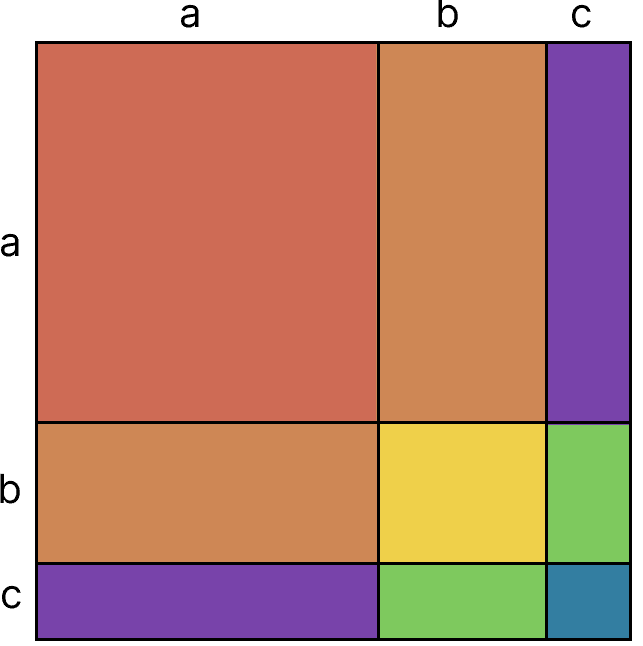
| a | b | c | |
|---|---|---|---|
| a | a2 | ab | ac |
| b | ab | b2 | bc |
| c | ac | bc | c2 |
Adding the areas of all 9 regions:
⇒ (a + b + c)2 = a2 + ab + ac + ab + b2 + bc + ac + bc + c2
= a2 + b2 + c2 + 2ab + 2bc + 2ca.
Hence, the geometrical model confirms the identity (a + b + c)2 = a2 + b2 + c2 + 2ab + 2bc + 2ca.
Find the following squares using one of the above identities. Determine which of these identities will make these calculations easier.
1172
Answer
Writing 117 as (120 – 3) and using (a – b)2 = a2 – 2ab + b2:
⇒ (117)2
= (120 - 3)2
= (120)2 - 2(120)(3) + (3)2
= 14400 - 720 + 9
= 13689.
Hence, (117)2 = 13689.
Find the following squares using one of the above identities. Determine which of these identities will make these calculations easier.
782
Answer
Writing 78 as (80 – 2) and using (a – b)2 = a2 – 2ab + b2:
⇒ (78)2
= (80 - 2)2
= (80)2 - 2(80)(2) + (2)2
= 6400 - 320 + 4
= 6084.
Hence, (78)2 = 6084.
Find the following squares using one of the above identities. Determine which of these identities will make these calculations easier.
1982
Answer
Writing 198 as (200 – 2) and using (a – b)2 = a2 – 2ab + b2:
⇒ (198)2
= (200 - 2)2
= (200)2 - 2(200)(2) + (2)2
= 40000 - 800 + 4
= 39204.
Hence, (198)2 = 39204.
Find the following squares using one of the above identities. Determine which of these identities will make these calculations easier.
2142
Answer
Writing 214 as (200 + 14) and using (a + b)2 = a2 + 2ab + b2:
⇒ (214)2
= (200 + 14)2
= (200)2 + 2(200)(14) + (14)2
= 40000 + 5600 + 196
= 45796.
Hence, (214)2 = 45796.
Find the following squares using one of the above identities. Determine which of these identities will make these calculations easier.
11042
Answer
Writing 1104 as (1100 + 4) and using (a + b)2 = a2 + 2ab + b2:
⇒ (1104)2
= (1100 + 4)2
= (1100)2 + 2(1100)(4) + (4)2
= 1210000 + 8800 + 16
= 1218816.
Hence, (1104)2 = 1218816.
Find the following squares using one of the above identities. Determine which of these identities will make these calculations easier.
11202
Answer
Writing 1120 as (1000 + 100 + 20) and using (a + b + c)2 = a2 + b2 + c2 + 2ab + 2bc + 2ca:
⇒ (1120)2
= (1000 + 100 + 20)2
= (1000)2 + (100)2 + (20)2 + 2(1000)(100) + 2(100)(20) + 2(1000)(20)
= 1000000 + 10000 + 400 + 200000 + 4000 + 40000
= 1254400.
Hence, (1120)2 = 1254400.
Factor using suitable identities:
16y2 – 24y + 9
Answer
Rewriting the expression in the form a2 – 2ab + b2:
⇒ 16y2 - 24y + 9
= (4y)2 - 2(4y)(3) + (3)2
= (4y - 3)2.
Hence, 16y2 – 24y + 9 = (4y – 3)2.
Factor using suitable identities:
Answer
Rewriting the expression in the form a2 + 2ab + b2:
Hence, .
Factor using suitable identities:
Answer
Rewriting the expression in the form a2 + b2 + c2 + 2ab + 2bc + 2ca:
Hence, .
Factor using suitable identities:
Answer
Rewriting the expression in the form a2 – 2ab + b2:
Hence, .
Factor using suitable identities:
9a2 + 4b2 + c2 – 12ab + 6ac – 4bc
Answer
Rewriting the expression in the form A2 + B2 + C2 + 2AB + 2BC + 2CA, with A = 3a, B = –2b, C = c:
⇒ 9a2 + 4b2 + c2 - 12ab + 6ac - 4bc
= (3a)2 + (-2b)2 + (c)2 + 2(3a)(-2b) + 2(-2b)(c) + 2(3a)(c)
= (3a - 2b + c)2.
Hence, 9a2 + 4b2 + c2 – 12ab + 6ac – 4bc = (3a – 2b + c)2.
Expand the following using the identity (a + b + c)2 = a2 + b2 + c2 + 2ab + 2bc + 2ca:
(p + 3q + 7r)2
Answer
Using the identity (a + b + c)2 = a2 + b2 + c2 + 2ab + 2bc + 2ca, with a = p, b = 3q, c = 7r:
⇒ (p + 3q + 7r)2 = p2 + (3q)2 + (7r)2 + 2(p)(3q) + 2(3q)(7r) + 2(p)(7r)
= p2 + 9q2 + 49r2 + 6pq + 42qr + 14pr.
Hence, (p + 3q + 7r)2 = p2 + 9q2 + 49r2 + 6pq + 42qr + 14pr.
Expand the following using the identity (a + b + c)2 = a2 + b2 + c2 + 2ab + 2bc + 2ca:
(3x – 2y + 4z)2
Answer
Using the identity (a + b + c)2 = a2 + b2 + c2 + 2ab + 2bc + 2ca, with a = 3x, b = –2y, c = 4z:
⇒ (3x - 2y + 4z)2 = (3x)2 + (-2y)2 + (4z)2 + 2(3x)(-2y) + 2(-2y)(4z) + 2(3x)(4z)
= 9x2 + 4y2 + 16z2 - 12xy - 16yz + 24xz.
Hence, (3x – 2y + 4z)2 = 9x2 + 4y2 + 16z2 – 12xy – 16yz + 24xz.
Is this an identity?
(a + b – c)2 + (a – b + c)2 + (a – b – c)2 = 2a2 + 2b2 + 2c2.
Answer
Expanding the L.H.S. using the identity (x + y + z)2 = x2 + y2 + z2 + 2xy + 2yz + 2zx:
⇒ (a + b - c)2 = a2 + b2 + c2 + 2ab - 2bc - 2ac.
⇒ (a - b + c)2 = a2 + b2 + c2 - 2ab - 2bc + 2ac.
⇒ (a - b - c)2 = a2 + b2 + c2 - 2ab + 2bc - 2ac.
Adding these three expressions:
⇒ (a + b - c)2 + (a - b + c)2 + (a - b - c)2
= 3a2 + 3b2 + 3c2 + (2ab - 2ab - 2ab) + (-2bc - 2bc + 2bc) + (-2ac + 2ac - 2ac)
= 3a2 + 3b2 + 3c2 - 2ab - 2bc - 2ac.
Since L.H.S. = 3a2 + 3b2 + 3c2 – 2ab – 2bc – 2ac ≠ 2a2 + 2b2 + 2c2 = R.H.S., the given equation is not true for all values of a, b, c.
To verify, let a = 1, b = 1, c = 1:
⇒ L.H.S. = (1 + 1 - 1)2 + (1 - 1 + 1)2 + (1 - 1 - 1)2 = 1 + 1 + 1 = 3.
⇒ R.H.S. = 2(1)2 + 2(1)2 + 2(1)2 = 6.
Since L.H.S. ≠ R.H.S., the given equation is not an identity.
Hence, (a + b – c)2 + (a – b + c)2 + (a – b – c)2 = 2a2 + 2b2 + 2c2 is not an identity.
Try to evaluate the following using a suitable identity:
(i) 352
(ii) 652
(iii) 852
(iv) 1052
Do you observe any interesting pattern?
Answer
Using the identity a2 = (a + b)(a – b) + b2, with b = 5:
(i) 352:
⇒ 352 = (35 + 5)(35 - 5) + 52
= 40 × 30 + 25
= 1200 + 25
= 1225.
(ii) 652:
⇒ 652 = (65 + 5)(65 - 5) + 52
= 70 × 60 + 25
= 4200 + 25
= 4225.
(iii) 852:
⇒ 852 = (85 + 5)(85 - 5) + 52
= 90 × 80 + 25
= 7200 + 25
= 7225.
(iv) 1052:
⇒ 1052 = (105 + 5)(105 - 5) + 52
= 110 × 100 + 25
= 11000 + 25
= 11025.
Pattern observed: For any number ending in 5, say (10n + 5), the square is:
⇒ (10n + 5)2 = n(n + 1) × 100 + 25.
So the square always ends in 25 and the digits before 25 are the product n(n + 1), where n is the digit(s) before the 5.
- 352: n = 3, so n(n + 1) = 3 × 4 = 12, giving 1225.
- 652: n = 6, so n(n + 1) = 6 × 7 = 42, giving 4225.
- 852: n = 8, so n(n + 1) = 8 × 9 = 72, giving 7225.
- 1052: n = 10, so n(n + 1) = 10 × 11 = 110, giving 11025.
Hence, the square of a number ending in 5 always ends in 25, and the digits before 25 are n(n + 1), where n is the digit(s) before the 5.
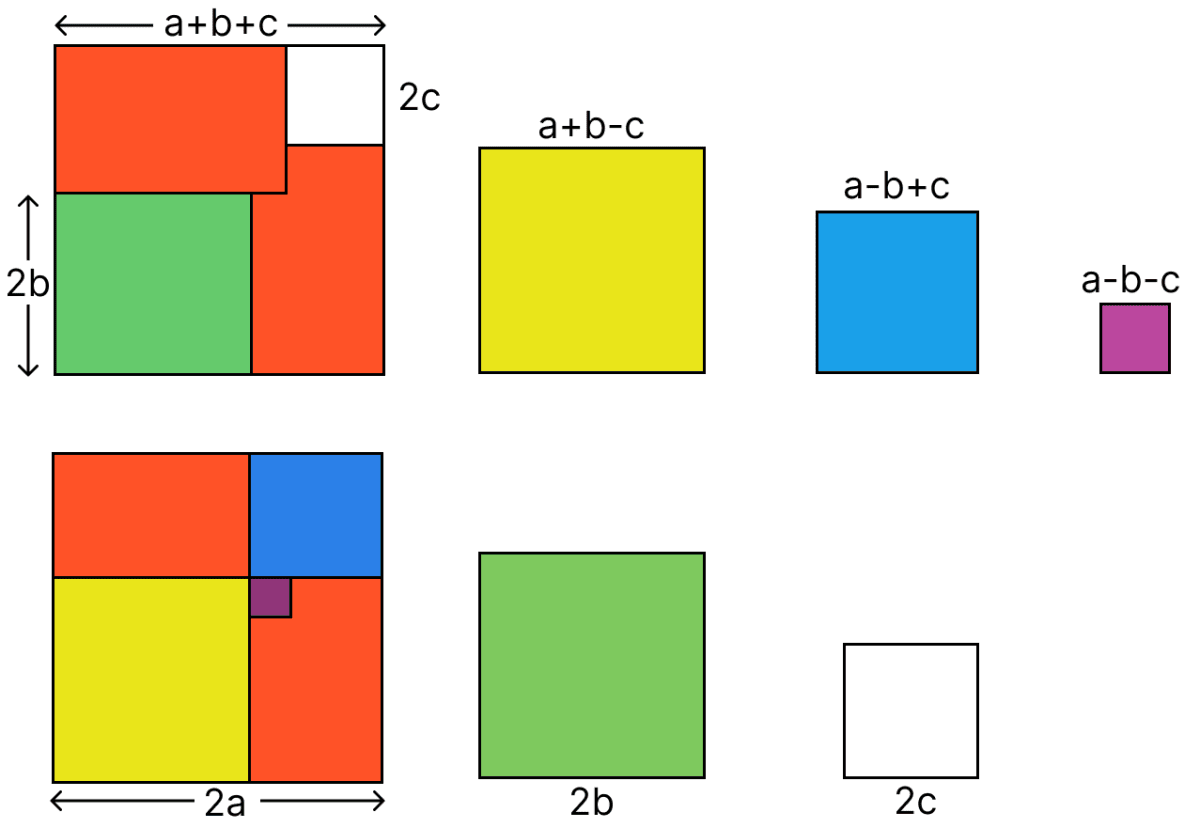
Observe the two rows of figures below. They represent an algebraic identity. Try to identify it.
Answer
The top row of the figure consists of four squares with sides (a + b + c), (a + b – c), (a – b + c) and (a – b – c) respectively. The bottom row consists of three squares with sides 2a, 2b and 2c respectively.
The sum of the areas of the squares in the top row equals the sum of the areas of the squares in the bottom row:
⇒ (a + b + c)2 + (a + b - c)2 + (a - b + c)2 + (a - b - c)2 = (2a)2 + (2b)2 + (2c)2.
Let us verify by expanding the left side:
⇒ (a + b + c)2 = a2 + b2 + c2 + 2ab + 2bc + 2ac.
⇒ (a + b - c)2 = a2 + b2 + c2 + 2ab - 2bc - 2ac.
⇒ (a - b + c)2 = a2 + b2 + c2 - 2ab - 2bc + 2ac.
⇒ (a - b - c)2 = a2 + b2 + c2 - 2ab + 2bc - 2ac.
Adding them:
⇒ Sum = 4a2 + 4b2 + 4c2
= (2a)2 + (2b)2 + (2c)2.
Hence, the identity represented is (a + b + c)2 + (a + b – c)2 + (a – b + c)2 + (a – b – c)2 = 4(a2 + b2 + c2).
Suppose 7x is split as 2x + 5x; can a similar rectangular arrangement be formed? Consider other possibilities and check.
Answer
For the expression x2 + 7x + 12, we need two numbers a and b such that a + b = 7 (the coefficient of x) and ab = 12 (the constant term).
Let us check the splits of 7x:
2x + 5x: Here a = 2 and b = 5. Then a + b = 7 but ab = 10 ≠ 12. So a rectangular arrangement cannot be formed.
1x + 6x: Here a = 1 and b = 6. Then a + b = 7 but ab = 6 ≠ 12. So this also does not work.
3x + 4x: Here a = 3 and b = 4. Then a + b = 7 and ab = 12. So this is the only split that forms a valid rectangular arrangement.
Hence, only the split 7x = 3x + 4x allows a rectangular arrangement to be formed for x2 + 7x + 12, because both a + b = 7 and ab = 12 must be satisfied simultaneously.
Figure out the product of x + 2 and x + 3 using algebra tiles.
Answer
To find the product (x + 2)(x + 3) using algebra tiles, we represent x + 2 as an x-tile and 2 unit tiles, and x + 3 as an x-tile and 3 unit tiles.
The product forms a rectangle with length (x + 3) and breadth (x + 2). This rectangle contains:
- 1 x2-tile (representing x2)
- 3 x-tiles along the length (representing 3x)
- 2 x-tiles along the breadth (representing 2x)
- 6 unit tiles arranged in a 2 × 3 array (representing 6)
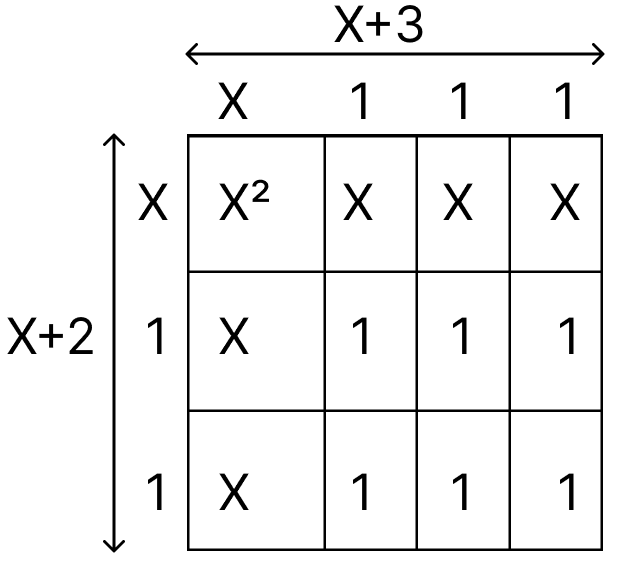
Total area:
⇒ (x + 2)(x + 3) = x2 + 3x + 2x + 6
= x2 + 5x + 6.
Hence, (x + 2)(x + 3) = x2 + 5x + 6.
Lay out algebra tiles for x2 + 11x + 30 in such a way that you will see its factors.
Answer
To factor x2 + 11x + 30, we need to find two numbers a and b such that a + b = 11 and ab = 30.
Considering factor pairs of 30: (1, 30), (2, 15), (3, 10), (5, 6).
The pair (5, 6) satisfies both conditions: 5 + 6 = 11 and 5 × 6 = 30 .
So we split 11x as 5x + 6x. The algebra tiles arrangement consists of:
- 1 x2-tile
- 5 x-tiles arranged along one side of the x2-tile
- 6 x-tiles arranged along the other side of the x2-tile
- 30 unit tiles arranged in a 5 × 6 array
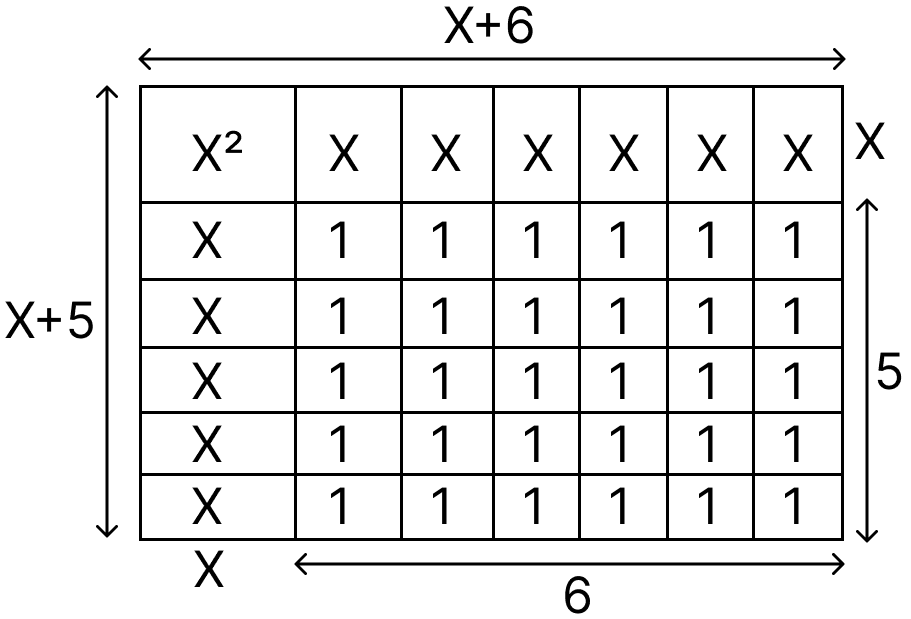
This forms a rectangle of dimensions (x + 5) and (x + 6):
⇒ x2 + 11x + 30 = x2 + 5x + 6x + 30
= x(x + 6) + 5(x + 6)
= (x + 5)(x + 6).
Hence, x2 + 11x + 30 = (x + 5)(x + 6).
We have seen that (x + 3)(x + 4) = x2 + 7x + 12.
Also (x + 6)(x + 7) = x2 + 13x + 42.
Generalise the pattern to get an expression for (x + a)(x + b).
Answer
Observing the two given identities:
- In (x + 3)(x + 4) = x2 + 7x + 12: here 7 = 3 + 4 and 12 = 3 × 4.
- In (x + 6)(x + 7) = x2 + 13x + 42: here 13 = 6 + 7 and 42 = 6 × 7.
Generalising for (x + a)(x + b) using the distributive property:
⇒ (x + a)(x + b) = x(x + b) + a(x + b)
= x2 + bx + ax + ab
= x2 + (a + b)x + ab.
Hence, (x + a)(x + b) = x2 + (a + b)x + ab.
Fill in the blanks to complete the following identity:
s2 – 11s + 24 = ( ............... ) ( ............... )
Answer
For s2 – 11s + 24, we need numbers a and b such that a + b = –11 and ab = 24.
Choosing a = –3 and b = –8: a + b = –11 and ab = 24 .
⇒ s2 - 11s + 24 = s2 - 3s - 8s + 24
= s(s - 3) - 8(s - 3)
= (s - 3)(s - 8).
Hence, s2 – 11s + 24 = (s – 3)(s – 8).
Fill in the blanks to complete the following identity:
( ............... ) (x + 1) = (3x2 – 4x – 7)
Answer
Dividing 3x2 – 4x – 7 by (x + 1):
We need to factor 3x2 – 4x – 7. We need two numbers whose product is 3 × (–7) = –21 and whose sum is –4. The numbers are –7 and 3.
⇒ 3x2 - 4x - 7 = 3x2 - 7x + 3x - 7
= x(3x - 7) + 1(3x - 7)
= (3x - 7)(x + 1).
Hence, (3x – 7)(x + 1) = 3x2 – 4x – 7.
Fill in the blanks to complete the following identity:
10x2 – 11x – 6 = (2x – ............... ) ( ............... + 2)
Answer
For 10x2 – 11x – 6, we need two numbers whose product is 10 × (–6) = –60 and whose sum is –11. The numbers are –15 and 4.
⇒ 10x2 - 11x - 6 = 10x2 - 15x + 4x - 6
= 5x(2x - 3) + 2(2x - 3)
= (2x - 3)(5x + 2).
Hence, 10x2 – 11x – 6 = (2x – 3)(5x + 2).
Fill in the blanks to complete the following identity:
6x2 + 7x + 2 = ( ............... ) ( ............... )
Answer
For 6x2 + 7x + 2, we need two numbers whose product is 6 × 2 = 12 and whose sum is 7. The numbers are 3 and 4.
⇒ 6x2 + 7x + 2 = 6x2 + 3x + 4x + 2
= 3x(2x + 1) + 2(2x + 1)
= (2x + 1)(3x + 2).
Hence, 6x2 + 7x + 2 = (2x + 1)(3x + 2).
Select and use the identity that will help you to find the following products without multiplying directly:
(41)2
Answer
Writing 41 as (40 + 1) and using (a + b)2 = a2 + 2ab + b2:
⇒ (41)2 = (40 + 1)2 = (40)2 + 2(40)(1) + (1)2
= 1600 + 80 + 1
= 1681.
Hence, (41)2 = 1681.
Select and use the identity that will help you to find the following products without multiplying directly:
(27)2
Answer
Writing 27 as (30 – 3) and using (a – b)2 = a2 – 2ab + b2:
⇒ (27)2 = (30 - 3)2 = (30)2 - 2(30)(3) + (3)2
= 900 - 180 + 9
= 729.
Hence, (27)2 = 729.
Select and use the identity that will help you to find the following products without multiplying directly:
(23 × 17)
Answer
Writing 23 as (20 + 3) and 17 as (20 – 3), and using (a + b)(a – b) = a2 – b2:
⇒ 23 × 17 = (20 + 3)(20 - 3) = (20)2 - (3)2
= 400 - 9
= 391.
Hence, 23 × 17 = 391.
Select and use the identity that will help you to find the following products without multiplying directly:
(135)2
Answer
Writing 135 as (100 + 30 + 5) and using (a + b + c)2 = a2 + b2 + c2 + 2ab + 2bc + 2ca:
⇒ (135)2 = (100 + 30 + 5)2
= (100)2 + (30)2 + (5)2 + 2(100)(30) + 2(30)(5) + 2(100)(5)
= 10000 + 900 + 25 + 6000 + 300 + 1000
= 18225.
Hence, (135)2 = 18225.
Select and use the identity that will help you to find the following products without multiplying directly:
(97)2
Answer
Writing 97 as (100 – 3) and using (a – b)2 = a2 – 2ab + b2:
⇒ (97)2 = (100 - 3)2 = (100)2 - 2(100)(3) + (3)2
= 10000 - 600 + 9
= 9409.
Hence, (97)2 = 9409.
Select and use the identity that will help you to find the following products without multiplying directly:
(18 × 29)
Answer
Writing 18 as (23 – 5) and 29 as (23 + 6), and using (x + a)(x + b) = x2 + (a + b)x + ab, with x = 23, a = –5, b = 6:
⇒ 18 × 29 = (23 - 5)(23 + 6)
= (23)2 + (-5 + 6)(23) + (-5)(6)
= 529 + 23 - 30
= 522.
Hence, 18 × 29 = 522.
Select and use the identity that will help you to find the following products without multiplying directly:
(34 × 43)
Answer
Writing 34 as (40 – 6) and 43 as (40 + 3), and using (x + a)(x + b) = x2 + (a + b)x + ab, with x = 40, a = –6, b = 3:
⇒ 34 × 43 = (40 - 6)(40 + 3)
= (40)2 + (-6 + 3)(40) + (-6)(3)
= 1600 - 120 - 18
= 1462.
Hence, 34 × 43 = 1462.
Select and use the identity that will help you to find the following products without multiplying directly:
(205)2
Answer
Writing 205 as (200 + 5) and using (a + b)2 = a2 + 2ab + b2:
⇒ (205)2 = (200 + 5)2 = (200)2 + 2(200)(5) + (5)2
= 40000 + 2000 + 25
= 42025.
Hence, (205)2 = 42025.
Factor the following:
9a2 + b2 + 4c2 – 6ab + 12ac – 4bc
Answer
Rewriting the expression in the form A2 + B2 + C2 + 2AB + 2BC + 2CA, with A = 3a, B = –b, C = 2c:
⇒ 9a2 + b2 + 4c2 - 6ab + 12ac - 4bc
= (3a)2 + (-b)2 + (2c)2 + 2(3a)(-b) + 2(-b)(2c) + 2(3a)(2c)
= (3a - b + 2c)2.
Hence, 9a2 + b2 + 4c2 – 6ab + 12ac – 4bc = (3a – b + 2c)2.
Factor the following:
16s2 + 25t2 – 40st
Answer
Rewriting the expression in the form a2 – 2ab + b2:
⇒ 16s2 + 25t2 - 40st = (4s)2 - 2(4s)(5t) + (5t)2
= (4s - 5t)2.
Hence, 16s2 + 25t2 – 40st = (4s – 5t)2.
Factor the following:
r2 – r – 42
Answer
For r2 – r – 42, we need two numbers whose sum is –1 and whose product is –42. The numbers are –7 and 6.
⇒ r2 - r - 42 = r2 - 7r + 6r - 42
= r(r - 7) + 6(r - 7)
= (r - 7)(r + 6).
Hence, r2 – r – 42 = (r – 7)(r + 6).
Factor the following:
49g2 + 14gh + h2
Answer
Rewriting the expression in the form a2 + 2ab + b2:
⇒ 49g2 + 14gh + h2 = (7g)2 + 2(7g)(h) + h2
= (7g + h)2.
Hence, 49g2 + 14gh + h2 = (7g + h)2.
Factor the following:
64u2 + 121v2 + 4w2 – 176uv – 32uw + 44vw
Answer
Rewriting the expression in the form A2 + B2 + C2 + 2AB + 2BC + 2CA, with A = 8u, B = –11v, C = –2w:
⇒ 64u2 + 121v2 + 4w2 - 176uv - 32uw + 44vw
= (8u)2 + (-11v)2 + (-2w)2 + 2(8u)(-11v) + 2(-11v)(-2w) + 2(8u)(-2w)
= (8u - 11v - 2w)2.
Hence, 64u2 + 121v2 + 4w2 – 176uv – 32uw + 44vw = (8u – 11v – 2w)2.
James and Reshma were talking about algebraic identities they learnt in school.
James: (a – b)2 (a + b) = (a2 – 2ab + b2)(a + b)
Reshma: I have a different idea. (a – b)2 (a + b) = (a – b) [(a – b) (a + b)] = (a – b)(a2 – b2)
I will find this product to get the answer.
According to you, who is correct and why?
Try to combine more such identities and find new results.
Answer
Let us evaluate both methods.
James's method:
⇒ (a - b)2 (a + b) = (a2 - 2ab + b2)(a + b)
= a3 + a2b - 2a2b - 2ab2 + ab2 + b3
= a3 - a2b - ab2 + b3.
Reshma's method:
⇒ (a - b)2 (a + b) = (a - b)[(a - b)(a + b)]
= (a - b)(a2 - b2)
= a3 - ab2 - a2b + b3
= a3 - a2b - ab2 + b3.
Both methods give the same answer: a3 – a2b – ab2 + b3.
Both are correct. They are simply two different approaches that lead to the same simplified expression. Reshma's approach is more elegant as it uses the identity (a – b)(a + b) = a2 – b2 to reduce the steps.
By combining identities, we can derive new ones. For example:
⇒ (a + b)2 (a - b) = (a + b)[(a + b)(a - b)]
= (a + b)(a2 - b2)
= a3 - ab2 + a2b - b3
= a3 + a2b - ab2 - b3.
Hence, both James and Reshma are correct as they arrive at the same expression a3 – a2b – ab2 + b3, although by different methods.
We already know that x2 – y2 = (x – y)(x + y).
Further, we have verified that x3 – y3 = (x – y)(x2 + xy + y2).
Observe that x – y is a common factor of x2 – y2 and x3 – y3.
Do you think x – y is also a factor of x4 – y4 ?
Note that x4 – y4 = (x2)2 – (y2)2 = (x2 – y2) (x2 + y2).
Can you see how x – y is a factor of x4 – y4 ?
How about x5 – y5? Does this also have x – y as a factor?
Answer
For x4 – y4:
⇒ x4 – y4 = (x2)2 – (y2)2 = (x2 – y2)(x2 + y2)
= (x – y)(x + y)(x2 + y2).
So yes, (x – y) is a factor of x4 – y4.
For x5 – y5:
By direct expansion, we can show that:
⇒ x5 – y5 = (x – y)(x4 + x3y + x2y2 + xy3 + y4).
Let us verify by multiplying:
⇒ (x – y)(x4 + x3y + x2y2 + xy3 + y4)
= x5 + x4y + x3y2 + x2y3 + xy4 – x4y – x3y2 – x2y3 – xy4 – y5
= x5 – y5.
So yes, (x – y) is a factor of x5 – y5.
In general, xn – yn = (x – y)(xn–1 + xn–2y + … + xyn–2 + yn–1) for every natural number n.
Hence, (x – y) is a factor of xn – yn for every natural number n, including x4 – y4 and x5 – y5.
Try to simplify the following rational expression:
Answer
Factoring the numerator:
⇒ 36s2 - 12st + t2
= (6s)2 - 2(6s)(t) + t2
= (6s - t)2.
Factoring the denominator:
For t2 + 2ts – 48s2, we need two terms (in terms of s) whose sum is 2s and whose product is –48s2. The terms are 8s and –6s.
⇒ t2 + 2ts - 48s2 = t2 + 8ts - 6ts - 48s2
= t(t + 8s) - 6s(t + 8s)
= (t + 8s)(t - 6s).
So:
Simplifying further, since (6s – t) = –(t – 6s):
Hence, .
Simplify the following rational expression assuming that the expression in the denominator is not equal to zero:
Answer
Factoring the numerator:
⇒ 3p2 - 3pq - 18q2 = 3(p2 - pq - 6q2)
= 3(p2 - 3pq + 2pq - 6q2)
= 3[p(p - 3q) + 2q(p - 3q)]
= 3(p - 3q)(p + 2q).
Factoring the denominator:
⇒ p2 + 3pq - 10q2 = p2 + 5pq - 2pq - 10q2
= p(p + 5q) - 2q(p + 5q)
= (p + 5q)(p - 2q).
So:
Hence, .
Simplify the following rational expression assuming that the expression in the denominator is not equal to zero:
Answer
Factoring the numerator using (a – b)3 = a3 – 3a2b + 3ab2 – b3:
⇒ n3 - 3n2m + 3nm2 - m3 = (n - m)3.
Factoring the denominator:
⇒ 5m2 - 10mn + 5n2 = 5(m2 - 2mn + n2)
= 5(m - n)2 = 5(n - m)2.
So:
Hence, .
Simplify the following rational expression assuming that the expression in the denominator is not equal to zero:
Answer
Factoring the numerator using the identity a3 + b3 + c3 – 3abc = (a + b + c)(a2 + b2 + c2 – ab – bc – ca), with a = w, b = –v, c = x:
⇒ w3 + (-v)3 + x3 - 3(w)(-v)(x)
= w3 - v3 + x3 + 3wvx.
So:
⇒ w3 - v3 + x3 + 3wvx
= (w - v + x)(w2 + v2 + x2 + wv + vx - wx).
Factoring the denominator:
⇒ w2 + v2 + x2 - 2wv - 2vx + 2wx
= w2 + (-v)2 + x2 + 2(w)(-v) + 2(-v)(x) + 2(w)(x)
= (w - v + x)2.
So:
Hence, .
Simplify the following rational expression assuming that the expression in the denominator is not equal to zero:
Answer
Factoring the numerator:
⇒ 4y2 - 20yz + 25z2
= (2y)2 - 2(2y)(5z) + (5z)2
= (2y - 5z)2.
Factoring the denominator:
⇒ 25z2 - 4y2 = (5z)2 - (2y)2
= (5z - 2y)(5z + 2y).
Since (5z – 2y) = –(2y – 5z):
Hence, .
Simplify the following rational expression assuming that the expression in the denominator is not equal to zero:
Answer
Factoring each quadratic:
⇒ x2 + x - 6 = x2 + 3x - 2x - 6 = (x + 3)(x - 2).
⇒ x2 - 7x + 12 = x2 - 3x - 4x + 12 = (x - 3)(x - 4).
⇒ x2 - 6x + 8 = x2 - 2x - 4x + 8 = (x - 2)(x - 4).
⇒ x2 - 9 = (x - 3)(x + 3).
So:
Hence, .
Simplify the following rational expression assuming that the expression in the denominator is not equal to zero:
Answer
Factoring the numerator:
⇒ p4 - 16 = (p2)2 - (4)2 = (p2 - 4)(p2 + 4)
= (p - 2)(p + 2)(p2 + 4).
Factoring the denominator:
⇒ p2 - 4p + 4 = (p - 2)2.
So:
Hence, .
Use suitable identities to find the following products:
(–3x + 4)2
Answer
Using the identity (a + b)2 = a2 + 2ab + b2, with a = –3x and b = 4:
⇒ (-3x + 4)2 = (-3x)2 + 2(-3x)(4) + (4)2
= 9x2 - 24x + 16.
Hence, (–3x + 4)2 = 9x2 – 24x + 16.
Use suitable identities to find the following products:
(2s + 7) (2s – 7)
Answer
Using the identity (a + b)(a – b) = a2 – b2, with a = 2s and b = 7:
⇒ (2s + 7)(2s - 7) = (2s)2 - (7)2
= 4s2 - 49.
Hence, (2s + 7)(2s – 7) = 4s2 – 49.
Use suitable identities to find the following products:
Answer
Using the identity (a + b)(a – b) = a2 – b2, with a = p2 and :
Hence, .
Use suitable identities to find the following products:
(2n + 7) (2n – 7)
Answer
Using the identity (a + b)(a – b) = a2 – b2, with a = 2n and b = 7:
⇒ (2n + 7)(2n - 7) = (2n)2 - (7)2
= 4n2 - 49.
Hence, (2n + 7)(2n – 7) = 4n2 – 49.
Use suitable identities to find the following products:
(s – 2t) (s2 + 2st + 4t2)
Answer
Using the identity (a – b)(a2 + ab + b2) = a3 – b3, with a = s and b = 2t:
⇒ (s - 2t)(s2 + 2st + 4t2) = (s - 2t)[s2 + s(2t) + (2t)2]
= s3 - (2t)3
= s3 - 8t3.
Hence, (s – 2t)(s2 + 2st + 4t2) = s3 – 8t3.
Use suitable identities to find the following products:
Answer
Using the identity (a – b)2 = a2 – 2ab + b2, with and b = 4r:
Hence, .
Use suitable identities to find the following products:
(–3m + 4k – l)2
Answer
Using the identity (a + b + c)2 = a2 + b2 + c2 + 2ab + 2bc + 2ca, with a = –3m, b = 4k, c = –l:
⇒ (-3m + 4k - l)2 = (-3m)2 + (4k)2 + (-l)2 + 2(-3m)(4k) + 2(4k)(-l) + 2(-3m)(-l)
= 9m2 + 16k2 + l2 - 24mk - 8kl + 6ml.
Hence, (–3m + 4k – l)2 = 9m2 + 16k2 + l2 – 24mk – 8kl + 6ml.
Use suitable identities to find the following products:
Answer
Using the identity (a – b)3 = a3 – 3a2b + 3ab2 – b3, with a = x and :
Hence, .
Use suitable identities to find the following products:
Answer
Using the identity (a – b)3 = a3 – 3a2b + 3ab2 – b3, with and :
Hence, .
Find the values using suitable identities:
17 × 21
Answer
Writing 17 as (19 – 2) and 21 as (19 + 2), and using (a + b)(a – b) = a2 – b2:
⇒ 17 × 21 = (19 - 2)(19 + 2) = (19)2 - (2)2
= 361 - 4
= 357.
Hence, 17 × 21 = 357.
Find the values using suitable identities:
104 × 96
Answer
Writing 104 as (100 + 4) and 96 as (100 – 4), and using (a + b)(a – b) = a2 – b2:
⇒ 104 × 96 = (100 + 4)(100 - 4) = (100)2 - (4)2
= 10000 - 16
= 9984.
Hence, 104 × 96 = 9984.
Find the values using suitable identities:
24 × 16
Answer
Writing 24 as (20 + 4) and 16 as (20 – 4), and using (a + b)(a – b) = a2 – b2:
⇒ 24 × 16 = (20 + 4)(20 - 4) = (20)2 - (4)2
= 400 - 16
= 384.
Hence, 24 × 16 = 384.
Find the values using suitable identities:
1473
Answer
Writing 147 as (150 – 3) and using (a – b)3 = a3 – 3a2b + 3ab2 – b3:
⇒ (147)3 = (150 - 3)3
= (150)3 - 3(150)2(3) + 3(150)(3)2 - (3)3
= 3375000 - 202500 + 4050 - 27
= 3176523.
Hence, (147)3 = 3176523.
Find the values using suitable identities:
1993
Answer
Writing 199 as (200 – 1) and using (a – b)3 = a3 – 3a2b + 3ab2 – b3:
⇒ (199)3 = (200 - 1)3
= (200)3 - 3(200)2(1) + 3(200)(1)2 - (1)3
= 8000000 - 120000 + 600 - 1
= 7880599.
Hence, (199)3 = 7880599.
Find the values using suitable identities:
1273
Answer
Writing 127 as (130 – 3) and using (a – b)3 = a3 – 3a2b + 3ab2 – b3:
⇒ (127)3 = (130 - 3)3
= (130)3 - 3(130)2(3) + 3(130)(3)2 - (3)3
= 2197000 - 152100 + 3510 - 27
= 2048383.
Hence, (127)3 = 2048383.
Find the values using suitable identities:
(–107)3
Answer
Writing 107 as (100 + 7) and using (a + b)3 = a3 + 3a2b + 3ab2 + b3:
⇒ (107)3 = (100 + 7)3
= (100)3 + 3(100)2(7) + 3(100)(7)2 + (7)3
= 1000000 + 210000 + 14700 + 343
= 1225043.
So:
⇒ (-107)3 = -(107)3 = -1225043.
Hence, (–107)3 = –1225043.
Find the values using suitable identities:
(–299)3
Answer
Writing 299 as (300 – 1) and using (a – b)3 = a3 – 3a2b + 3ab2 – b3:
⇒ (299)3 = (300 - 1)3
= (300)3 - 3(300)2(1) + 3(300)(1)2 - (1)3
= 27000000 - 270000 + 900 - 1
= 26730899.
So:
⇒ (-299)3 = -(299)3 = -26730899.
Hence, (–299)3 = –26730899.
Factor the following algebraic expressions:
Answer
Rewriting the expression in the form a2 + 2ab + b2:
Hence, .
Factor the following algebraic expressions:
Answer
Using the identity a2 – b2 = (a + b)(a – b):
Hence, .
Factor the following algebraic expressions:
Answer
Using the identity a3 – b3 = (a – b)(a2 + ab + b2), with a = 3b and :
Hence, .
Factor the following algebraic expressions:
Answer
We need two numbers a and b such that and .
Choosing and : and .
Hence, .
Factor the following algebraic expressions:
Answer
Rewriting the expression in the form a3 – 3a2b + 3ab2 – b3, with a = 3u and :
Hence, .
Factor the following algebraic expressions:
Answer
Using the identity a3 + b3 = (a + b)(a2 – ab + b2), with a = 4y and :
Hence, .
Factor the following algebraic expressions:
p3 + 27q3 + r3 – 9pqr
Answer
Using the identity a3 + b3 + c3 – 3abc = (a + b + c)(a2 + b2 + c2 – ab – bc – ca), with a = p, b = 3q, c = r:
⇒ p3 + 27q3 + r3 - 9pqr = p3 + (3q)3 + r3 - 3(p)(3q)(r)
= (p + 3q + r)[p2 + (3q)2 + r2 - p(3q) - (3q)(r) - p(r)]
= (p + 3q + r)(p2 + 9q2 + r2 - 3pq - 3qr - pr).
Hence, p3 + 27q3 + r3 – 9pqr = (p + 3q + r)(p2 + 9q2 + r2 – 3pq – 3qr – pr).
Factor the following algebraic expressions:
9m2 – 12m + 4
Answer
Rewriting the expression in the form a2 – 2ab + b2:
⇒ 9m2 - 12m + 4 = (3m)2 - 2(3m)(2) + (2)2
= (3m - 2)2.
Hence, 9m2 – 12m + 4 = (3m – 2)2.
Factor the following algebraic expressions:
Answer
Multiplying and dividing by 3:
Now rewriting using the identity a3 + b3 + c3 – 3abc = (a + b + c)(a2 + b2 + c2 – ab – bc – ca), with a = 3x, b = –2y, c = z:
⇒ 27x3 - 8y3 + z3 + 18xyz = (3x)3 + (-2y)3 + z3 - 3(3x)(-2y)(z)
= (3x - 2y + z)[(3x)2 + (-2y)2 + z2 - (3x)(-2y) - (-2y)(z) - (3x)(z)]
= (3x - 2y + z)(9x2 + 4y2 + z2 + 6xy + 2yz - 3xz).
So:
Hence, .
Factor the following algebraic expressions:
4x2 + 9y2 + 36z2 + 12xy + 36yz + 24xz
Answer
Rewriting the expression in the form a2 + b2 + c2 + 2ab + 2bc + 2ca, with a = 2x, b = 3y, c = 6z:
⇒ 4x2 + 9y2 + 36z2 + 12xy + 36yz + 24xz
= (2x)2 + (3y)2 + (6z)2 + 2(2x)(3y) + 2(3y)(6z) + 2(2x)(6z)
= (2x + 3y + 6z)2.
Hence, 4x2 + 9y2 + 36z2 + 12xz + 36yz + 24xy = (2x + 3y + 6z)2.
Factor the following algebraic expressions:
Answer
Rewriting the expression in the form a3 – 3a2b + 3ab2 – b3, with a = 3u and :
Hence, .
Simplify the following:
Answer
Factoring the numerator:
⇒ 4x2 + 4x + 1 = (2x)2 + 2(2x)(1) + (1)2
= (2x + 1)2.
Factoring the denominator:
⇒ 4x2 - 1 = (2x)2 - (1)2
= (2x - 1)(2x + 1).
So:
Hence, .
Simplify the following:
Answer
Factoring the numerator:
⇒ 9(3a3 - 24b3) = 9 × 3(a3 - 8b3)
= 27[(a)3 - (2b)3]
= 27(a - 2b)(a2 + 2ab + 4b2).
Factoring the denominator:
⇒ 9a2 - 36b2 = 9(a2 - 4b2)
= 9(a - 2b)(a + 2b).
So:
Hence, .
Simplify the following:
Answer
Factoring the numerator using a3 + b3 = (a + b)(a2 – ab + b2):
⇒ s3 + 125t3 = (s)3 + (5t)3
= (s + 5t)(s2 - 5st + 25t2).
Factoring the denominator:
We need two terms (in t) whose sum is –2t and whose product is –35t2. The terms are –7t and 5t.
⇒ s2 - 2st - 35t2 = s2 - 7st + 5st - 35t2
= s(s - 7t) + 5t(s - 7t)
= (s - 7t)(s + 5t).
So:
Hence, .
Find possible expressions for the length and breadth of each of the following rectangles whose areas are given by the following expressions in square units.
25a2 – 30ab + 9b2
Answer
Factoring the expression using a2 – 2ab + b2 = (a – b)2:
⇒ 25a2 - 30ab + 9b2 = (5a)2 - 2(5a)(3b) + (3b)2
= (5a - 3b)2
= (5a - 3b)(5a - 3b).
Hence, possible length = (5a – 3b) units and breadth = (5a – 3b) units.
Find possible expressions for the length and breadth of each of the following rectangles whose areas are given by the following expressions in square units.
36s2 – 49t2
Answer
Factoring the expression using a2 – b2 = (a + b)(a – b):
⇒ 36s2 - 49t2 = (6s)2 - (7t)2
= (6s + 7t)(6s - 7t).
Hence, possible length = (6s + 7t) units and breadth = (6s – 7t) units.
Find possible expressions for the length, breadth, and heights of each of the following cuboids whose volumes are given by the following expressions in cubic units.
6a2 – 24b2
Answer
Factoring the expression:
⇒ 6a2 - 24b2 = 6(a2 - 4b2)
= 6[(a)2 - (2b)2]
= 6(a - 2b)(a + 2b).
Hence, possible length = 6 units, breadth = (a – 2b) units and height = (a + 2b) units.
Find possible expressions for the length, breadth, and heights of each of the following cuboids whose volumes are given by the following expressions in cubic units.
3ps2 – 15ps + 12p
Answer
Factoring the expression:
⇒ 3ps2 - 15ps + 12p = 3p(s2 - 5s + 4)
= 3p(s2 - 4s - s + 4)
= 3p[s(s - 4) - 1(s - 4)]
= 3p(s - 1)(s - 4).
Hence, possible length = 3p units, breadth = (s – 1) units and height = (s – 4) units.
The village playground is shaped as a square of side 40 metres. A path of width s metres is created around the playground for people to walk. Find an expression for the area of the path in terms of s.
Answer
The playground is a square of side 40 metres. A path of width s metres is created around it, so the outer figure (playground + path) is a square of side (40 + 2s) metres.
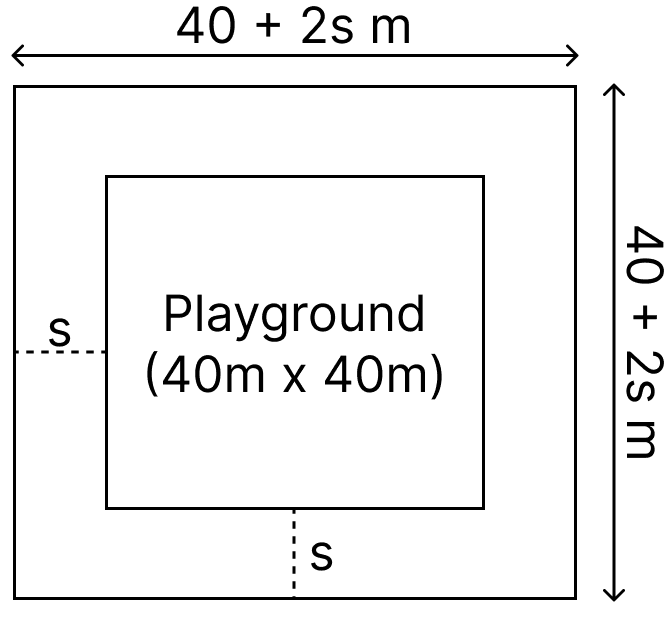
Area of the path = (Area of outer square) – (Area of the playground)
⇒ Area of path = (40 + 2s)2 - (40)2.
Using (a + b)2 = a2 + 2ab + b2:
⇒ (40 + 2s)2 = (40)2 + 2(40)(2s) + (2s)2
= 1600 + 160s + 4s2.
So:
⇒ Area of path = 1600 + 160s + 4s2 - 1600
= 4s2 + 160s
= 4s(s + 40) square metres.
Hence, the area of the path is 4s(s + 40) square metres or (4s2 + 160s) square metres.
If a number plus its reciprocal equals , find the number.
Answer
Let the number be x. Then its reciprocal is .
According to the question:
Multiplying both sides by 3x:
⇒ 3x2 + 3 = 10x
⇒ 3x2 - 10x + 3 = 0.
Splitting the middle term: we need two numbers whose product is 3 × 3 = 9 and whose sum is –10. The numbers are –1 and –9.
⇒ 3x2 - 9x - x + 3 = 0
⇒ 3x(x - 3) - 1(x - 3) = 0
⇒ (3x - 1)(x - 3) = 0.
So 3x – 1 = 0 or x – 3 = 0, which gives or x = 3.
Hence, the number is 3 or .
A rectangular pool has area 2x2 + 7x + 3 square hastas. If its width is 2x + 1 hastas, find its length. Hasta was a unit used to measure length.
Answer
Length of the pool = .
Factoring the area:
For 2x2 + 7x + 3, we need two numbers whose product is 2 × 3 = 6 and whose sum is 7. The numbers are 6 and 1.
⇒ 2x2 + 7x + 3 = 2x2 + 6x + x + 3
= 2x(x + 3) + 1(x + 3)
= (2x + 1)(x + 3).
So:
Hence, the length of the pool is (x + 3) hastas.
If both x – 2 and are factors of px2 + 5x + r, show that p = r.
Answer
Let f(x) = px2 + 5x + r.
Since (x – 2) is a factor of f(x), by the Factor Theorem, f(2) = 0:
p(2)2 + 5(2) + r = 0
⇒ 4p + 10 + r = 0
⇒ 4p + r = -10 ...(1)
Since is a factor of f(x), by the Factor Theorem, :
Multiplying throughout by 4:
p + 10 + 4r = 0
p + 4r = -10 ...(2)
From equations (1) and (2):
⇒ 4p + r = p + 4r
⇒ 4p - p = 4r - r
⇒ 3p = 3r
⇒ p = r.
Hence, proved that p = r.
If a + b + c = 5 and ab + bc + ca = 10, then prove that a3 + b3 + c3 – 3abc = – 25.
Answer
Given: a + b + c = 5 and ab + bc + ca = 10.
To prove: a3 + b3 + c3 – 3abc = –25.
Using the identity (a + b + c)2 = a2 + b2 + c2 + 2(ab + bc + ca):
⇒ (5)2 = a2 + b2 + c2 + 2(10)
⇒ 25 = a2 + b2 + c2 + 20
⇒ a2 + b2 + c2 = 5.
Using the identity a3 + b3 + c3 – 3abc = (a + b + c)(a2 + b2 + c2 – ab – bc – ca):
⇒ a3 + b3 + c3 - 3abc = (5)[(a2 + b2 + c2) - (ab + bc + ca)]
= 5(5 - 10)
= 5 × (-5)
= -25.
Hence, proved that a3 + b3 + c3 – 3abc = –25.
By factoring the expression, check that n3 – n is always divisible by 6 for all natural numbers n. Give reasons.
Answer
Factoring the expression n3 – n:
⇒ n3 - n = n(n2 - 1)
= n(n - 1)(n + 1)
= (n - 1) × n × (n + 1).
This is the product of three consecutive integers (n – 1), n and (n + 1).
Reasoning:
- Among any three consecutive integers, at least one is divisible by 2 (since every alternate integer is even).
- Among any three consecutive integers, exactly one is divisible by 3.
Therefore, the product (n – 1) × n × (n + 1) is divisible by both 2 and 3. Since 2 and 3 are co-prime, the product is divisible by 2 × 3 = 6.
Hence, n3 – n is always divisible by 6 for all natural numbers n.
Find the value of
(i) x3 + y3 – 12xy + 64, when x + y = – 4
Answer
Given: x + y = –4, which means x + y + 4 = 0.
Rewriting the expression:
⇒ x3 + y3 - 12xy + 64 = x3 + y3 + 43 - 3(x)(y)(4)
= x3 + y3 + 43 - 3xy(4).
Using the identity a3 + b3 + c3 – 3abc = (a + b + c)(a2 + b2 + c2 – ab – bc – ca), with a = x, b = y, c = 4:
⇒ x3 + y3 + 43 - 3xy(4) = (x + y + 4)(x2 + y2 + 16 - xy - 4y - 4x).
Substituting x + y + 4 = 0:
⇒ x3 + y3 - 12xy + 64 = (0)(x2 + y2 + 16 - xy - 4y - 4x)
= 0.
Hence, x3 + y3 – 12xy + 64 = 0, when x + y = –4.
(ii) x3 – 8y3 – 36xy – 216, when x = 2y + 6
Answer
Given: x = 2y + 6, which means x – 2y – 6 = 0, or x + (–2y) + (–6) = 0.
Rewriting the expression:
⇒ x3 - 8y3 - 36xy - 216 = x3 + (-2y)3 + (-6)3 - 3(x)(-2y)(-6).
Verifying: 3(x)(–2y)(–6) = 36xy, and the identity needs subtraction of 3abc, so:
⇒ x3 + (-2y)3 + (-6)3 - 3(x)(-2y)(-6) = x3 - 8y3 - 216 - 36xy.
Using the identity a3 + b3 + c3 – 3abc = (a + b + c)(a2 + b2 + c2 – ab – bc – ca), with a = x, b = –2y, c = –6:
⇒ x3 - 8y3 - 36xy - 216 = (x - 2y - 6)[x2 + 4y2 + 36 + 2xy - 12y + 6x].
Substituting x – 2y – 6 = 0:
⇒ x3 - 8y3 - 36xy - 216 = (0)[x2 + 4y2 + 36 + 2xy - 12y + 6x]
= 0.
Hence, x3 – 8y3 – 36xy – 216 = 0, when x = 2y + 6.