
Jamuna has a circular piece of paper. She is trying to locate its centre. Amina gives her a suggestion. She follows the instructions and is thrilled to find that it works. Can you guess what Amina told her?
Answer
Amina told her to fold the circular paper in half so that the boundaries overlap, and then unfold it; then fold it in half again in a different direction and unfold.
Each fold creates a crease which is a diameter of the circle (since every line of reflection symmetry of a circle passes through its centre).
The two diameters intersect at exactly one point — the centre of the circle.
What are the rotational symmetries of a square? How many lines of reflection symmetry does it have? What about a regular pentagon? A regular hexagon?
Answer
Square:
Rotational symmetries — rotations of 90°, 180°, 270° and 360° map the square onto itself, so it has 4 rotational symmetries.
Lines of reflection symmetry — the two diagonals and the two perpendicular bisectors of opposite sides, giving 4 lines of reflection symmetry.
Regular pentagon:
Rotational symmetries — rotations of 72°, 144°, 216°, 288° and 360°, giving 5 rotational symmetries.
Lines of reflection symmetry — one line through each vertex and the midpoint of the opposite side, giving 5 lines of reflection symmetry.
Regular hexagon:
Rotational symmetries — rotations of 60°, 120°, 180°, 240°, 300° and 360°, giving 6 rotational symmetries.
Lines of reflection symmetry — three lines joining opposite vertices and three lines joining midpoints of opposite sides, giving 6 lines of reflection symmetry.
What is the length of the longest chord in a circle of radius 5 units? Is there a smallest chord?
Answer
The longest chord in a circle is the chord that passes through the centre, which is the diameter of the circle.
Length of longest chord = 2 × radius = 2 × 5 = 10 units.
There is no smallest chord. As we move the chord farther away from the centre, its length keeps decreasing. The chord can be made arbitrarily short (approaching a single point), but cannot have length 0 (since a single point is not a chord).
The locus of points at a given distance from a given point is a circle. What can we say about the locus of points equidistant from two given points?
Answer
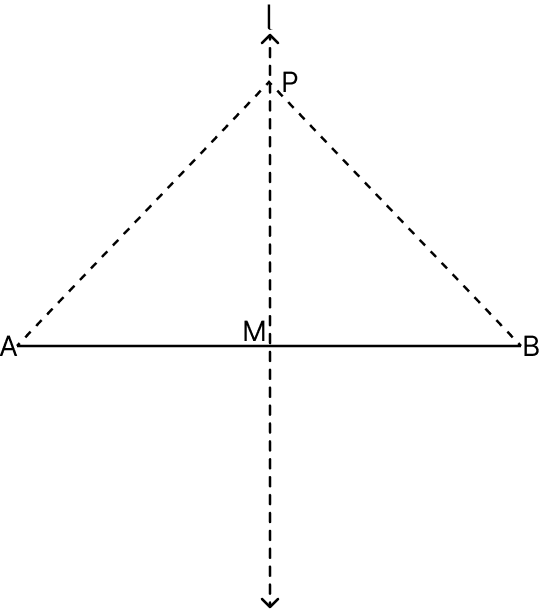
The locus of points equidistant from two given points A and B is the perpendicular bisector of the line segment AB.
Reasoning:
Let M be the midpoint of AB and let l be the line through M perpendicular to AB. Take any point P on l.
In △PMA and △PMB:
PM = PM [Common side]
∠PMA = ∠PMB = 90° [l is perpendicular to AB]
AM = BM [M is the midpoint of AB]
△PMA ≅ △PMB [By SAS condition of congruence]
So PA = PB. Hence every point on the perpendicular bisector is equidistant from A and B.
Conversely, any point equidistant from A and B must lie on this perpendicular bisector. Thus, the locus is the perpendicular bisector of AB.
How many circles pass through two points on a plane?
Answer
Every point on the perpendicular bisector of the segment joining the two points is equidistant from them and can be the centre of a circle passing through both. Since the perpendicular bisector contains infinitely many points, there are infinitely many such circles.
Infinitely many circles pass through two given points on a plane.
Are there circles of all possible radii passing through A and B? What is the radius of the smallest circle passing through A and B? What is the radius of the largest circle passing through A and B?
Answer
No, circles of all possible radii do not pass through A and B. The radius must be at least half the length of AB.
Smallest circle: The smallest circle through A and B is the one with AB as a diameter. The midpoint of AB is the centre, and its radius is .
Largest circle: There is no largest circle. As the centre of the circle moves farther along the perpendicular bisector of AB, the radius grows without bound.
As you move away from segment AB along its perpendicular bisector, do the radii of the circles containing A and B increase or decrease?
Answer
If O is a point on the perpendicular bisector at distance d from the midpoint M of AB, then
radius = OA =
As d increases, the radius also increases.
∴ As we move away from the segment AB along its perpendicular bisector, the radii of the circles increase.
As you go along the perpendicular bisector, will the circle drawn from that point through A and B appear more curved or less curved?
Answer
The circle will appear less curved as we move along the perpendicular bisector away from AB.
This is because the radius of the circle keeps increasing, and circles of larger radius have smaller curvature (they look "flatter" near any given point). A very large circle looks almost like a straight line over a short distance.
You are given two points A and B on a plane. How many squares can you draw on the same plane with A and B on the boundary? How many squares can you draw on the plane with A and B as the corners of the square?
Answer
Squares with A and B on the boundary:
There are infinitely many such squares. A and B can lie on the same side (anywhere on it) or on different sides, in many possible orientations and sizes.
Squares with A and B as corners of the square:
Three squares can be drawn.
(i) Treating AB as a side of the square, one square can be drawn on each side of line AB — giving 2 squares.
(ii) Treating AB as a diagonal of the square, exactly 1 square can be drawn (since a diagonal of a square uniquely determines the square).
Total = 2 + 1 = 3 squares.
Draw ΔABC with AB = 5 cm, ∠A = 70° and ∠B = 60°. Draw the circumcircle of ΔABC. Is the centre inside or outside the triangle?
Answer
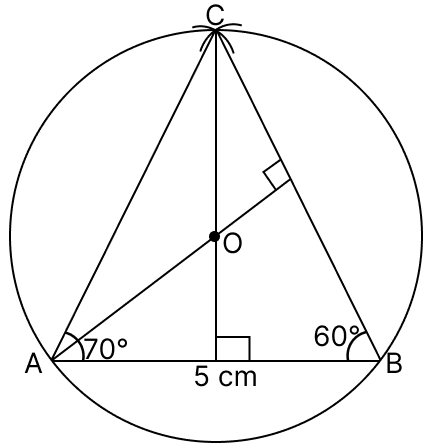
Steps of construction:
(i) Draw AB = 5 cm.
(ii) At A, construct an angle of 70°, and at B, construct an angle of 60°. Let the two rays meet at C.
(iii) Draw perpendicular bisectors of AB and BC. They meet at point O, the circumcentre.
(iv) With O as centre and OA as radius, draw the circumcircle of ΔABC.
The third angle of the triangle is ∠C = 180° − (70° + 60°) = 50°.
Since all the three angles (70°, 60°, 50°) are less than 90°, the triangle is acute-angled.
The circumcentre lies inside the triangle.
Draw ΔABC with AB = 5 cm, ∠A = 100°, AC = 4 cm. Draw the circumcircle of ΔABC. Is the centre inside or outside the triangle?
Answer
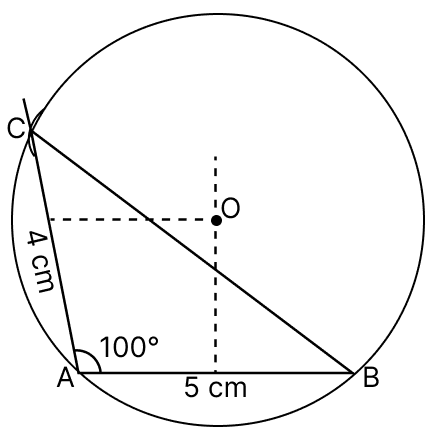
Steps of construction:
(i) Draw AB = 5 cm.
(ii) At A, construct an angle of 100°.
(iii) Along this ray, mark point C such that AC = 4 cm. Join BC.
(iv) Draw perpendicular bisectors of AB and AC. They meet at point O, the circumcentre.
(v) With O as centre and OA as radius, draw the circumcircle of ΔABC.
Since ∠A = 100° > 90°, the triangle is obtuse-angled.
The circumcentre lies outside the triangle.
Draw ΔABC, with AB = 6 cm, BC = 7 cm and CA = 7 cm. Draw the circumcircle of ΔABC. Let the circumcentre be O. Measure OA, OB, OC.
Answer
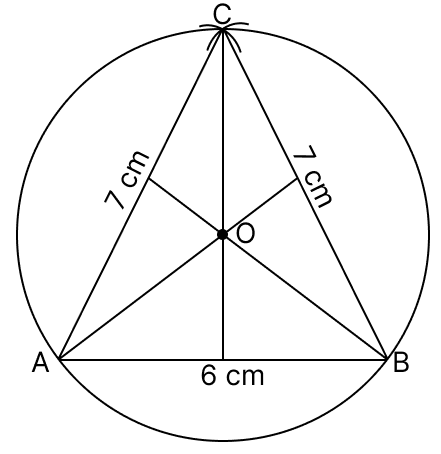
Steps of construction:
(i) Draw AB = 6 cm.
(ii) With A as centre and radius 7 cm, draw an arc.
(iii) With B as centre and radius 7 cm, draw another arc, cutting the previous arc at C.
(iv) Join AC and BC.
(v) Draw perpendicular bisectors of AB and BC. They meet at O, the circumcentre.
(vi) With O as centre and OA as radius, draw the circumcircle.
This is an isosceles triangle.
The circumcentre O is found by drawing the perpendicular bisectors of the sides.
When we measure the distance from O to any vertex using a ruler in the constructed figure, we get approximately:
OA ≈ 3.9 cm
∴ OA = OB = OC ≈ 3.9 cm
What is the least possible radius of a circle through two points A and B?
Answer
The least possible radius of a circle through two points A and B is half the length of segment AB, i.e., .
This corresponds to the smallest such circle, in which AB is a diameter and the midpoint of AB is the centre. Any circle through A and B with a smaller radius would have a diameter shorter than AB, which is impossible since AB is a chord and no chord can be longer than the diameter.
A, B and C are three collinear points. Can you find a point P such that PA = PB = PC ? What can you say about the perpendicular bisectors of AB and BC? Draw and check. Can you show that for three collinear points A, B and C, the perpendicular bisector of AB and BC are parallel? Is it possible for a circle to pass through collinear points? Can you draw a line that cuts a given circle in three distinct points?
Answer
No, there is no point P such that PA = PB = PC when A, B, C are collinear.
About the perpendicular bisectors of AB and BC:
The perpendicular bisector of AB is perpendicular to line AB at the midpoint of AB. The perpendicular bisector of BC is perpendicular to line BC at the midpoint of BC.
Since A, B and C are collinear, lines AB and BC are the same line. Both perpendicular bisectors are perpendicular to this same line, so they are parallel to each other (and distinct, because they pass through different midpoints).
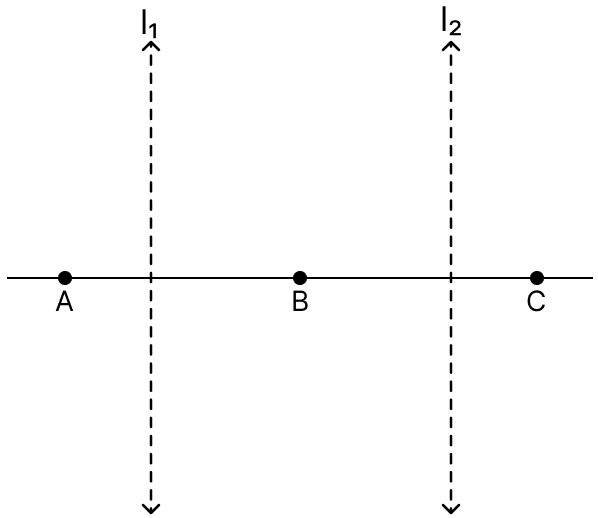
Two parallel lines never meet. So there is no common point lying on both perpendicular bisectors, hence no point P equidistant from A, B and C.
Can a circle pass through collinear points?
No. If a circle were to pass through A, B and C, its centre would have to be equidistant from all three (each being a radius). But no such point exists when A, B, C are collinear, so a circle cannot pass through three collinear points.
Can a line cut a circle in three distinct points?
No. A straight line cuts a circle in at most 2 points. If a line cut a circle in three distinct points, those three points would be collinear and would lie on the same circle — which we just saw is impossible. So no line can cut a circle in three distinct points.
The circumcircle of a given ΔABC is drawn. Can there be other triangles congruent to ΔABC that share the same circumcircle?
Answer
Yes, there can be infinitely many triangles congruent to ΔABC that share the same circumcircle.
If we rotate ΔABC about the centre O of the circumcircle by any angle, the three vertices A, B, C will move to new positions A', B', C' on the same circle (since rotation about the centre keeps points on the circle).
The new triangle ΔA'B'C' has all sides and angles equal to those of ΔABC, and is therefore congruent to it. Similarly, ΔABC can be reflected across any diameter to obtain another congruent triangle on the same circle.
Hence, infinitely many such congruent triangles exist on the same circumcircle.
Show that the triangle formed by a chord and the centre of the circle is isosceles.
Answer
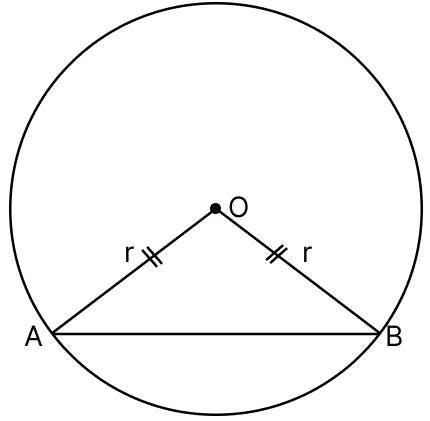
Let O be the centre of a circle and let AB be any chord of the circle. Consider △OAB.
OA = OB [Both are radii of the same circle]
Since two sides of △OAB are equal, the triangle is isosceles.
Hence, the triangle formed by a chord and the centre of the circle is isosceles.
Hence proved.
Show that if two such isosceles triangles (occurring in the previous question) have equal base length, they are congruent to each other.
Answer
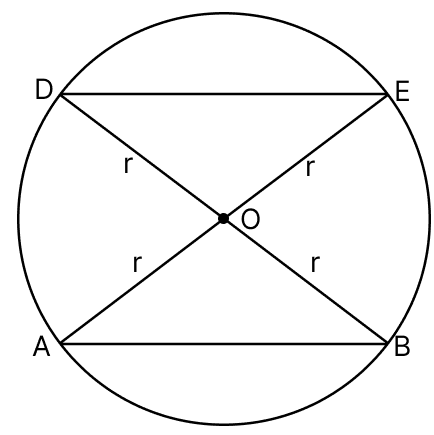
Let AB and DE be two chords of a circle with centre O such that AB = DE.
Consider the two isosceles triangles △OAB and △ODE.
In △OAB and △ODE:
OA = OD [Both are radii of the same circle]
OB = OE [Both are radii of the same circle]
AB = DE [Given, equal base lengths]
△OAB ≅ △ODE [By SSS condition of congruence]
Hence proved.
Can you explain why the converse to Theorem 4 is true, i.e., why does the perpendicular from the centre of a circle to a chord of the circle bisect the chord?
(Hint: Use Fig. 5.12. You are told that ∠CMA = ∠CMB = 90°. You need to show that AM = BM.)
Answer
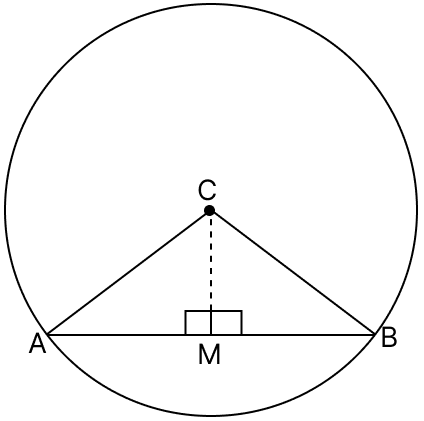
Let C be the centre of the circle and AB be a chord. Let M be the foot of the perpendicular from C to AB, so that ∠CMA = ∠CMB = 90°. We need to show that AM = BM.
In △CMA and △CMB:
CA = CB [Radii of the same circle, acting as hypotenuse]
∠CMA = ∠CMB = 90° [Given]
CM = CM [Common side]
△CMA ≅ △CMB [By RHS condition of congruence]
∴ AM = BM [Corresponding Parts of Congruent Triangles]
Hence, the perpendicular from the centre of a circle to a chord bisects the chord.
Hence proved.
An isosceles triangle ABC is inscribed in a circle, with AB = AC. Show that the altitude from A to BC passes through the centre of the circle.
Answer
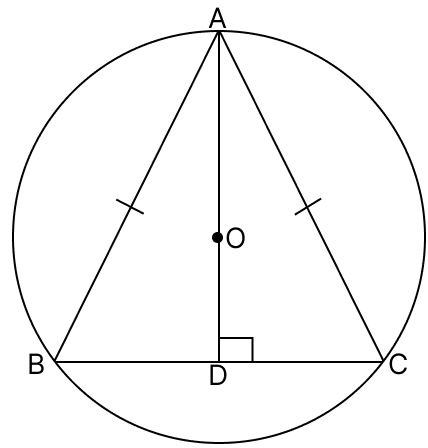
Let O be the centre of the circle. Let AD be the altitude from A to BC, where D lies on BC and AD ⊥ BC.
In △ABD and △ACD:
AB = AC [Given]
∠ADB = ∠ADC = 90° [AD is the altitude]
AD = AD [Common side]
△ABD ≅ △ACD [By RHS condition of congruence]
So, BD = CD [Corresponding Parts of Congruent Triangles]
This means AD is the perpendicular bisector of chord BC.
By Theorem 5, the perpendicular from the centre of a circle to a chord bisects the chord. Conversely, the perpendicular bisector of a chord passes through the centre.
Hence, the perpendicular bisector of BC passes through the centre O.
Since AD is the perpendicular bisector of BC, AD passes through O.
Therefore, the altitude from A to BC passes through the centre of the circle.
Hence proved.
Two parallel chords of lengths 6 cm and 8 cm are on opposite sides of the centre of a circle. If the radius of the circle is 5 cm, find the distance between the midpoints of the chords.
Answer
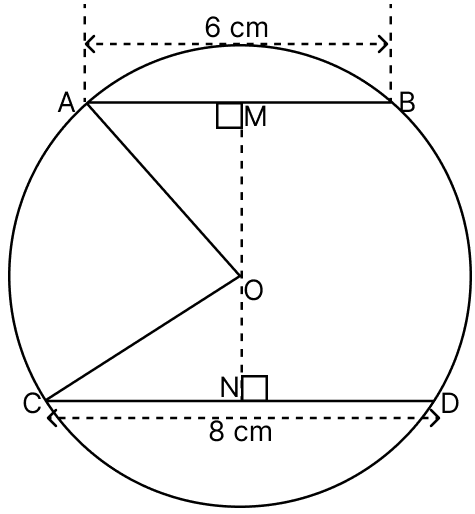
Let O be the centre of the circle, and let AB and CD be the two parallel chords with AB = 6 cm and CD = 8 cm on opposite sides of O.
Let M be the midpoint of AB and N be the midpoint of CD. Then,
OM ⊥ AB and ON ⊥ CD [∵ Line joining the centre to the midpoint of a chord is perpendicular to the chord]
Distance from O to chord AB:
AM = = 3 cm
In right-angled △OMA, by the Baudhāyana–Pythagoras theorem:
OM2 = OA2 − AM2
OM2 = 52 − 32
OM2 = 25 − 9
OM2 = 16
⇒ OM = = 4 cm
Distance from O to chord CD:
CN = = 4 cm
In right-angled △ONC, by the Baudhāyana–Pythagoras theorem:
ON2 = OC2 − CN2
ON2 = 52 − 42
ON2 = 25 − 16
ON2 = 9
⇒ ON = = 3 cm
Since the chords lie on opposite sides of the centre, M, O and N are collinear with O between M and N.
Distance between the midpoints = MN = OM + ON = 4 + 3 = 7 cm
The distance between the midpoints of the chords MN = 7 cm
Use the Baudhāyana–Pythagoras theorem to show why Theorem 6 must be true.
Answer
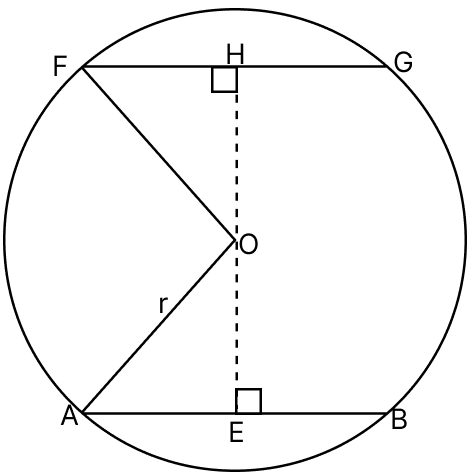
Theorem 6: Chords of a circle having the same length are all at the same distance from the centre of the circle.
Let O be the centre of a circle with radius r. Let AB and FG be two chords of equal length, i.e., AB = FG. Let E and H be the midpoints of AB and FG respectively.
OE ⊥ AB and OH ⊥ FG [∵ Line joining the centre to the midpoint of a chord is perpendicular to the chord]
In right-angled △OEA, by the Baudhāyana–Pythagoras theorem:
OA2 = OE2 + EA2
⇒ OE2 = OA2 − EA2
⇒ OE2 = r2 −
In right-angled △OHF, by the Baudhāyana–Pythagoras theorem:
OF2 = OH2 + HF2
⇒ OH2 = OF2 − HF2
⇒ OH2 = r2 −
Since AB = FG, we have , and so:
OE2 = OH2
⇒ OE = OH
So the perpendicular distances from O to the two chords are equal.
Hence, chords of equal length are equidistant from the centre.
Hence proved.
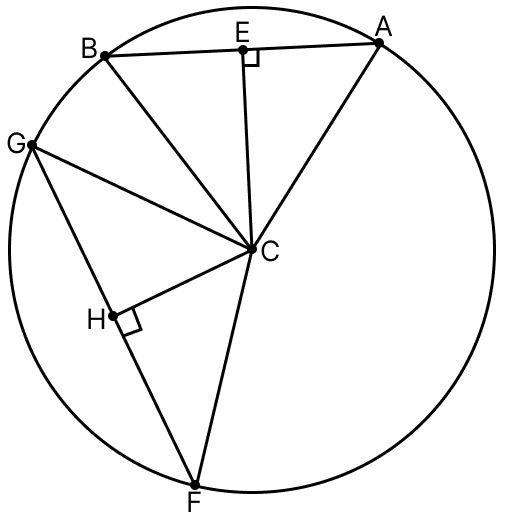
Consider Fig. 5.15. If CE is perpendicular to AB, CH is perpendicular to GH, and CE = CH, show that AB = GF.
Answer
In Fig. 5.15, C is the centre of the circle. CE ⊥ AB and CH ⊥ GF, with CE = CH.
CE is the perpendicular from the centre to chord AB, so E is the midpoint of AB.
∴ AE = EB = [∵ Perpendicular from centre to chord bisects the chord]
Similarly, H is the midpoint of GF, i.e., GH = HF =
In △CEA and △CHG:
∠CEA = ∠CHG = 90° [Given]
CA = CG [Radii of the same circle, acting as hypotenuse]
CE = CH [Given]
△CEA ≅ △CHG [By RHS condition of congruence]
So, AE = GH [Corresponding Parts of Congruent Triangles]
⇒
⇒ AB = GF
Hence proved.
Solve the previous question using the Baudhāyana–Pythagoras theorem.
Answer
In Fig. 5.15, C is the centre of the circle. CE ⊥ AB and CH ⊥ GF, with CE = CH.
E is the midpoint of AB and H is the midpoint of GF. So:
AE = and GH = [∵ Perpendicular from centre to chord bisects the chord]
In right-angled △CEA, by the Baudhāyana–Pythagoras theorem:
CA2 = CE2 + EA2
⇒ EA2 = CA2 − CE2
In right-angled △CHG, by the Baudhāyana–Pythagoras theorem:
CG2 = CH2 + HG2
⇒ HG2 = CG2 − CH2
Since CA = CG (radii of the same circle) and CE = CH (given), we have:
EA2 = HG2
⇒ EA = HG
⇒
⇒ AB = GF
Hence proved.
Find the length of the chord of a circle where the radius is 7 cm and perpendicular distance is 6 cm.
Answer
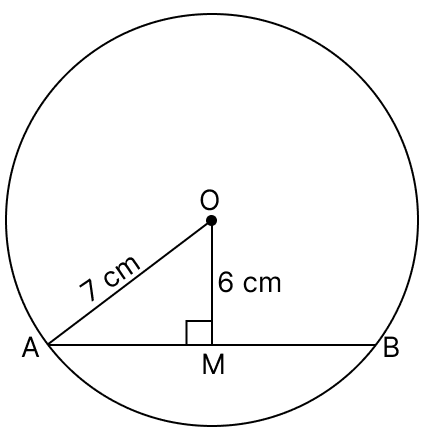
Let O be the centre of the circle and AB be the chord. Let M be the foot of the perpendicular from O to AB, so that OM = 6 cm and OA = 7 cm (radius).
M is the midpoint of AB, so AM = . [∵ Perpendicular from centre to chord bisects the chord]
In right-angled △OMA, by the Baudhāyana–Pythagoras theorem:
OA2 = OM2 + AM2
⇒ AM2 = OA2 − OM2
⇒ AM2 = 72 − 62
⇒ AM2 = 49 − 36
⇒ AM2 = 13
⇒ AM = cm
chord AB = 2 × AM = cm
∴ Length of chord AB = cm
Explain why the following statement is true: If the perpendicular distance of a chord from the centre is d and the radius is r, then the chord length is .
Answer
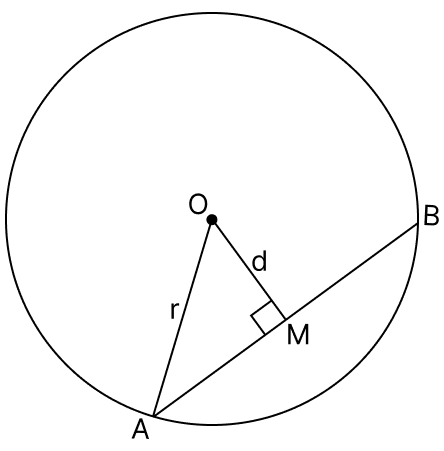
Let O be the centre of a circle of radius r and let AB be a chord at perpendicular distance d from O. Let M be the foot of the perpendicular from O to AB. Then OM = d and OA = r.
∴ AM = [∵ Perpendicular from centre to chord bisects the chord]
In right-angled △OMA, by the Baudhāyana–Pythagoras theorem:
OA2 = OM2 + AM2
⇒ AM2 = OA2 − OM2
⇒ AM2 = r2 − d2
⇒ AM =
Hence, the length of the chord:
AB = 2 × AM =
Hence proved.
In a circle, if the distance of chord AB from the centre is twice the distance of another chord CD from the centre, then can we conclude that CD = 2 AB? Give reasons for your answer.
Answer
No, we cannot conclude that CD = 2 AB.
Let the radius of the circle be r, and let the distance of CD from the centre be d. Then the distance of AB from the centre is 2d.
Using the formula for chord length:
AB =
CD =
The ratio
This ratio depends on the values of r and d, and is generally not equal to 2.
Example: Take r = 5 cm and d = 1 cm. Then the distance of AB is 2 cm.
AB = ≈ 9.17 cm
CD = ≈ 9.80 cm
Here CD is only slightly more than AB, not twice AB.
Hence, the relationship between distance from centre and chord length is not linear, so CD ≠ 2 AB in general.
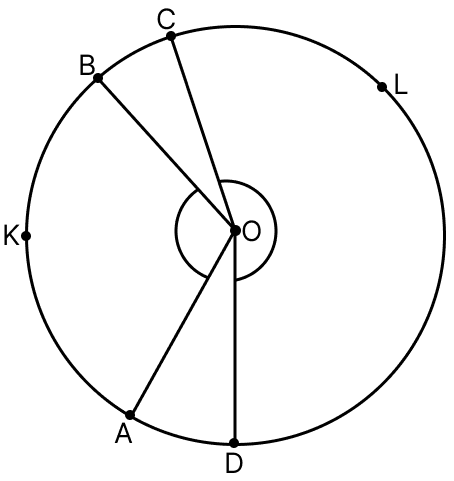
A circle with centre O is drawn, and A, B, C, D are points on the circle (see Fig. 5.19). Measure the angles subtended by arc AKB and arc CLD at the centre O. If the angle at the centre is less than 180°, it is a minor arc. If the angle at the centre is greater than 180°, it is a major arc. State whether arcs AKB and CLD are minor arcs or major arcs.
Answer
For arc AKB, the angle subtended at the centre is ∠AOB. From Fig. 5.19, this angle is less than 180°.
∴ Arc AKB is a minor arc.
For arc CLD, the angle subtended at the centre is the angle swept from OC to OD through L. From Fig. 5.19, this angle is also less than 180°.
∴ Arc CLD is also a minor arc.
Hence, both arc AKB and arc CLD are minor arcs.
In a circle with centre O, the central angle AOB is 60°. If the radius of the circle is 12 cm, what is the length of the chord AB?
Answer
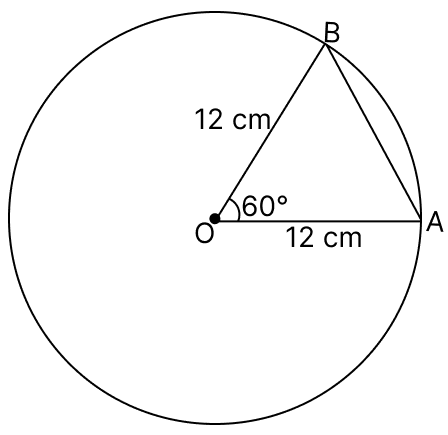
In △OAB:
OA = OB = 12 cm [Both are radii of the same circle]
Since two sides are equal, △OAB is isosceles, so ∠OAB = ∠OBA.
By the angle sum property of a triangle:
∠OAB + ∠OBA + ∠AOB = 180°
⇒ 2∠OAB + 60° = 180°
⇒ 2∠OAB = 180° - 60°
⇒ 2∠OAB = 120°
⇒ ∠OAB =
⇒ ∠OAB = 60°
Hence, ∠OAB = ∠OBA = ∠AOB = 60°, so △OAB is equilateral.
Therefore, all sides are equal:
AB = OA = OB = 12 cm
Let A and B be two points on a circle with centre O.
(i) Are there points X, Y on the circle, on the same side of AB, such that ∠AXB is different from ∠AYB?
(ii) Is it true that if ∠AXB = ∠AYB, then X and Y lie on the same side of the circle?
(iii) If ∠AXB = ∠AYB, and X and Y do not lie on the circle, does the circle through A, B and X also pass through Y?
Answer
(i) No.
If X and Y are on the circle and on the same side of AB, then they lie on the same segment of the circle. Angles in the same segment are equal.
∴ ∠AXB = ∠AYB.
Hence, there are no such points X and Y for which ∠AXB is different from ∠AYB.
(ii) Not necessarily.
If X and Y are on opposite sides of AB, then ∠AXB and ∠AYB are supplementary. They can still be equal in the special case when both angles are 90°, for example, when AB is a diameter.
Hence, ∠AXB = ∠AYB does not always imply that X and Y lie on the same side of AB.
(iii) Not necessarily.
If X and Y lie on the same side of AB and ∠AXB = ∠AYB, then by Theorem 10 (Concyclicity), the points A, B, X and Y are concyclic. In that case, the circle through A, B and X also passes through Y.
However, if X and Y are not on the same side of AB, equal angles alone do not guarantee this.
Thus, the result is true when X and Y lie on the same side of AB.
Find x in Fig. 5.26.
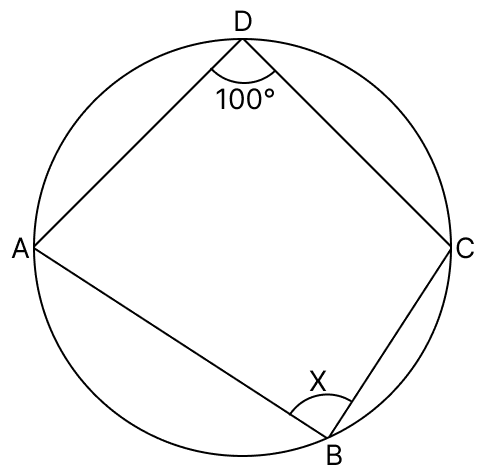
Answer
In the figure, ABCD is a cyclic quadrilateral with ∠D = 100° and ∠B = x.
By Theorem 11, the sum of opposite angles of a cyclic quadrilateral is 180°.
∠B + ∠D = 180°
⇒ x + 100° = 180°
⇒ x = 180° − 100°
⇒ x = 80°
A cyclic quadrilateral has angles measuring ∠A = 80°, ∠B = 110°, ∠C = 100°, and ∠D = 70°. Can such a quadrilateral be drawn? Explain why or why not.
Answer
Yes, such a cyclic quadrilateral can be drawn.
For a cyclic quadrilateral, the sum of each pair of opposite angles must be 180°.
Here,
∠A + ∠C = 80° + 100° = 180°
and
∠B + ∠D = 110° + 70° = 180°.
Since both pairs of opposite angles are supplementary, the given angle measures satisfy the condition for a cyclic quadrilateral.
Hence, such a cyclic quadrilateral can be drawn.
In a circle, a chord is 5 cm away from the centre. If the radius of the circle is 13 cm, what is the length of the chord?
Answer
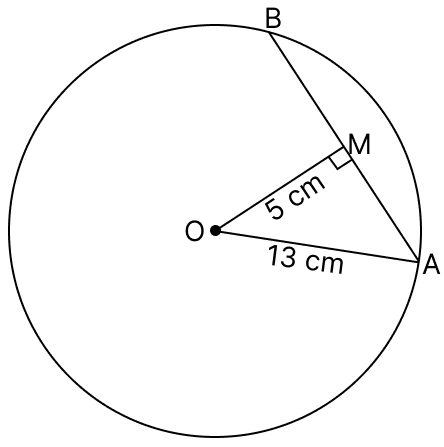
Let O be the centre of the circle and AB be the chord. Let M be the foot of the perpendicular from O to AB. Then OM = 5 cm and OA = 13 cm.
M is the midpoint of AB. [∵ Perpendicular from centre to chord bisects the chord]
In right-angled △OMA, by the Baudhāyana–Pythagoras theorem:
AM2 = OA2 − OM2
⇒ AM2 = 132 − 52
⇒ AM2 = 169 − 25
⇒ AM2 = 144
⇒ AM = = 12 cm
chord AB = 2 × AM = 2 × 12 = 24 cm
∴ Length of the chord AB = 24 cm.
An arc of a circle subtends an angle of 70° at the centre. What is the measure of the angle subtended by the arc at a point on the circle?
Answer
By Theorem 9, the angle subtended by an arc at the centre is double the angle subtended by the arc at any point on the circle outside the arc.
Angle at the centre = 2 × Angle at a point on the circle
⇒ 70° = 2 × Angle at a point on the circle
⇒ Angle at a point on the circle =
∴ Angle at a point on the circle = 35°
The diameter of a circle is 26 cm. A chord of length 24 cm is drawn in the circle. Find the distance from the centre of the circle to the chord.
Answer
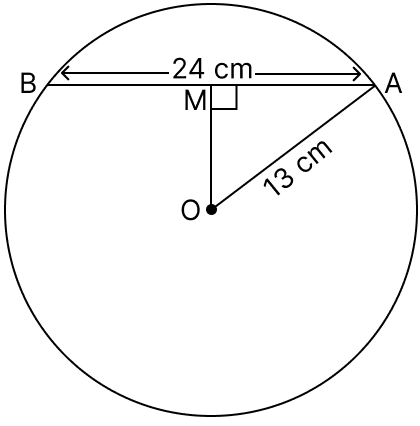
Radius of the circle = = 13 cm
Let O be the centre of the circle and AB be the chord with AB = 24 cm. Let M be the foot of the perpendicular from O to AB.
M is the midpoint of AB. [∵ Perpendicular from centre to chord bisects the chord]
AM = = 12 cm
In right-angled △OMA, by the Baudhāyana–Pythagoras theorem:
OM2 = OA2 − AM2
⇒ OM2 = 132 − 122
⇒ OM2 = 169 − 144
⇒ OM2 = 25
⇒ OM = = 5 cm
∴ The distance from the centre of the circle to the chord is 5 cm.
A circle has a radius of 15 cm. A chord is drawn. The distance from the centre of the circle to the chord is 9 cm. What is the length of the chord?
Answer
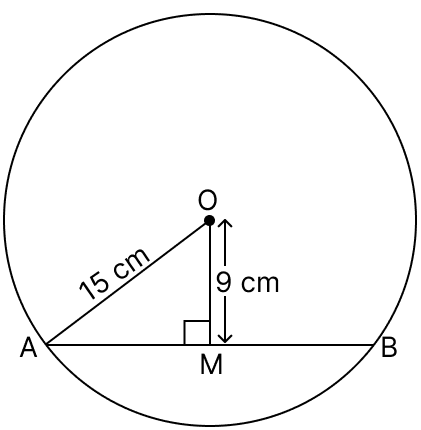
Let O be the centre of the circle, AB be the chord, and M the foot of the perpendicular from O to AB. Then OA = 15 cm and OM = 9 cm.
M is the midpoint of AB [∵ Perpendicular from centre to chord bisects the chord]
In right-angled △OMA, by the Baudhāyana–Pythagoras theorem:
AM2 = OA2 − OM2
⇒ AM2 = 152 − 92
⇒ AM2 = 225 − 81
⇒ AM2 = 144
⇒ AM = = 12 cm
chord AB = 2 × AM = 2 × 12 = 24 cm
∴ Length of the chord AB = 24 cm.
Prove that the perpendicular bisector of a chord passes through the centre of the circle.
Answer
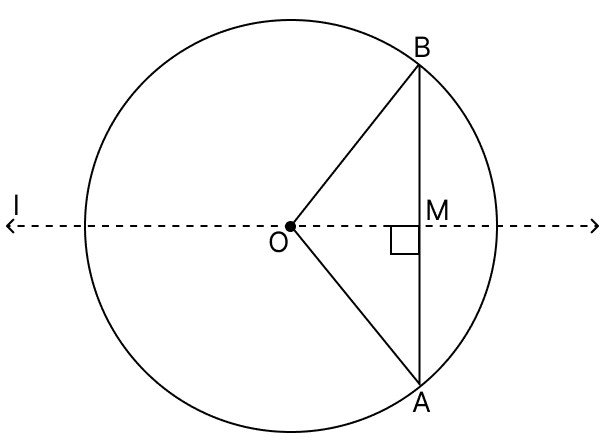
Let O be the centre of the circle and AB be a chord. Let l be the perpendicular bisector of AB. We need to show that O lies on l.
Since OA and OB are radii of the same circle:
OA = OB
So O is equidistant from A and B.
From the result on perpendicular bisectors (locus property), the locus of points equidistant from A and B is the perpendicular bisector of AB.
Since O is equidistant from A and B, O must lie on the perpendicular bisector of AB.
Hence, the perpendicular bisector of a chord passes through the centre of the circle.
Hence proved.
The diameter of a circle is AB. Point C is on the circumference. What is the measure of the ∠ACB? Explain your reasoning.
Answer
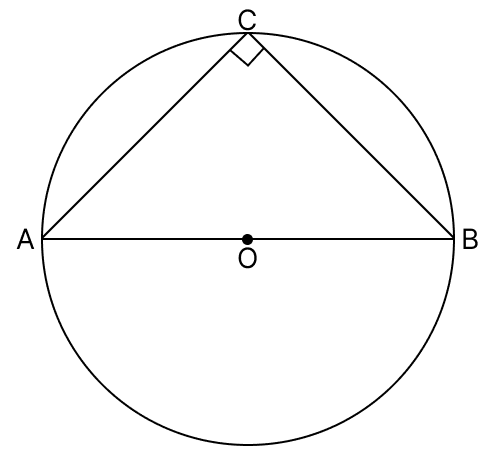
∠ACB = 90°
Reasoning:
The diameter AB subtends a straight angle (180°) at the centre.
By Theorem 9, the angle subtended by an arc at the centre is double the angle subtended by the arc at any point on the circle outside the arc.
So the angle subtended by the diameter AB at point C on the circle:
∠ACB = × ∠AOB = × 180° = 90°
This is the corollary that says: The angle in a semicircle is 90°.
Hence, the measure of the ∠ACB = 90°.
ABCD is a cyclic quadrilateral inscribed in a circle. If ∠A measures 75°, what is the measure of ∠C? If ∠B measures 110°, what is the measure of ∠D?
Answer
By Theorem 11, the sum of opposite angles of a cyclic quadrilateral is 180°.
Finding ∠C:
∠A + ∠C = 180°
⇒ 75° + ∠C = 180°
⇒ ∠C = 180° - 75°
⇒ ∠C = 105°
Finding ∠D:
∠B + ∠D = 180°
⇒ 110° + ∠D = 180°
⇒ ∠D = 180° - 110°
⇒ ∠D = 70°
∴ ∠C = 105°, ∠D = 70°
Quadrilateral PQRS is inscribed in a circle. If ∠P = (2x + 10)° and ∠R = (3x − 20)°, find the value of x and the measures of ∠P and ∠R.
Answer
PQRS is a cyclic quadrilateral. ∠P and ∠R are opposite angles.
By Theorem 11, the sum of opposite angles of a cyclic quadrilateral is 180°.
∠P + ∠R = 180°
⇒ (2x + 10)° + (3x − 20)° = 180°
⇒ 5x° − 10° = 180°
⇒ 5x° = 190°
⇒ x = 38
Finding ∠P:
∠P = (2x + 10)° = (2 × 38 + 10)° = (76 + 10)° = 86°
Finding ∠R:
∠R = (3x − 20)° = (3 × 38 − 20)° = (114 − 20)° = 94°
Verification: ∠P + ∠R = 86° + 94° = 180°
x = 38, ∠P = 86°, ∠R = 94°
The distance of a chord of length 16 cm from the centre of a circle is 6 cm. Find the radius of the circle.
Answer
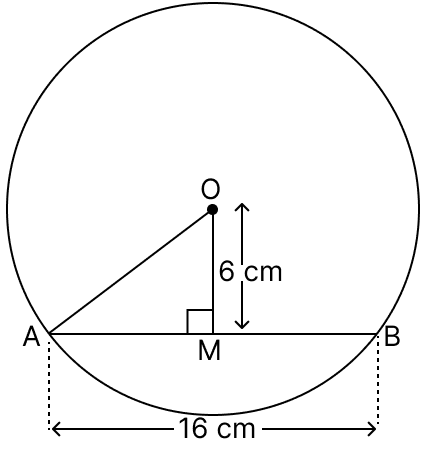
Let O be the centre of the circle, AB be the chord with AB = 16 cm, and M be the foot of the perpendicular from O to AB. So OM = 6 cm.
M is the midpoint of AB [∵ Perpendicular from centre to chord bisects the chord]
AM = = 8 cm
In right-angled △OMA, by the Baudhāyana–Pythagoras theorem:
OA2 = OM2 + AM2
⇒ OA2 = 62 + 82
⇒ OA2 = 36 + 64
⇒ OA2 = 100
⇒ OA = = 10 cm
Hence, the radius of the circle is 10 cm.
A cyclic quadrilateral has sides 5, 5, 12, 12 units. Find its area.
Answer
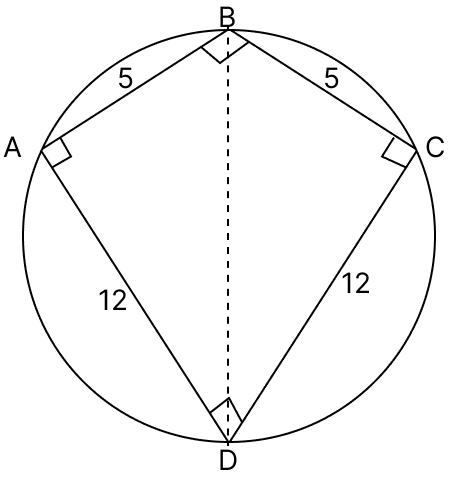
Let the cyclic quadrilateral be ABCD with AB = BC = 5 units and CD = DA = 12 units (a kite-shaped quadrilateral).
In a cyclic kite, the two pairs of equal sides meet at vertices B and D. The other two vertices A and C have angles which are equal (since the kite is symmetric about diagonal BD) and which are also opposite each other in the cyclic quadrilateral.
By Theorem 11, the sum of two opposite angles of a cyclic quadrilateral is 180°:
∠A + ∠C = 180°.
∠A + ∠A = 180° [∠A = ∠C]
⇒ 2∠A = 180°
⇒ ∠A =
⇒ ∠A = 90°
∴ ∠C = 90°
Thus, △BAD and △BCD are right-angled at A and C respectively.
Now diagonal BD divides the quadrilateral into two right-angled triangles: △BAD (right-angled at A) and △BCD (right-angled at C).
Area of △BAD:
Area = × AB × AD
= × 5 × 12
= 30 sq units
Area of △BCD:
Area = × BC × CD
= × 5 × 12
= 30 sq units
Total area of the quadrilateral = 30 sq units + 30 sq units = 60 sq units
Consider a cyclic quadrilateral. Without drawing its circumcircle, how can we find out whether the centre of the circumcircle lies inside the quadrilateral or outside? What is the best way of finding out?
Answer
The best way is to locate the circumcentre directly, without drawing the circumcircle.
Take any two sides of the cyclic quadrilateral, say AB and BC. Draw the perpendicular bisectors of AB and BC. Since the quadrilateral is cyclic, these perpendicular bisectors meet at the centre O of the circumcircle.
Now observe the position of O with respect to the quadrilateral:
if O lies inside the boundary of the quadrilateral, the centre of the circumcircle is inside the quadrilateral;
if O lies outside the boundary of the quadrilateral, the centre of the circumcircle is outside the quadrilateral;
if O lies on a side or diagonal, the centre lies on the boundary/interior line accordingly.
Thus, draw the perpendicular bisectors of any two sides and check the position of their point of intersection.
When two chords intersect, each of them is divided into two line segments. Show that if the intersecting chords are of equal length, then the line segments of one chord are equal to the corresponding line segments of the other chord.
Answer
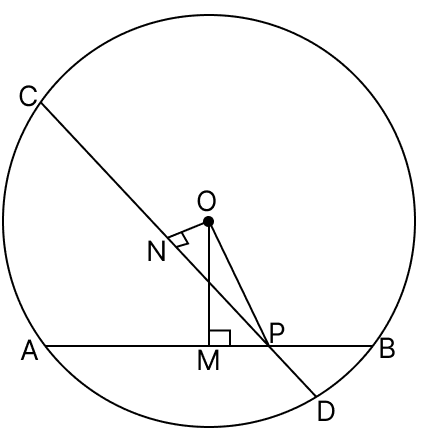
Let AB and CD be two equal chords of a circle with centre O, intersecting at P. Let M and N be the midpoints of AB and CD respectively.
OM ⊥ AB and ON ⊥ CD [∵ The line joining the centre to the midpoint of a chord is perpendicular to the chord]
Since AB = CD, equal chords are equidistant from the centre.
∴ OM = ON
In right-angled △OMP and △ONP:
OM = ON [Proved above]
OP = OP [Common side]
∠OMP = ∠ONP = 90° [OM ⊥ AB and ON ⊥ CD]
∴ △OMP ≅ △ONP [By RHS condition of congruence]
So, MP = NP.
Also, M and N are the midpoints of equal chords AB and CD. Hence,
AM = BM = CN = DN
Therefore, each chord is divided into one segment of length and one segment of length . Since and , the larger segment of one chord is equal to the larger segment of the other chord, and the smaller segment of one chord is equal to the smaller segment of the other chord.
Hence, the corresponding line segments of the two equal intersecting chords are equal.
Hence proved.
Draw a circle in which a chord of 6 cm length stands at a distance of 3 cm from the centre.
(Hint: Is it a circumcircle of a suitable triangle?)
Answer
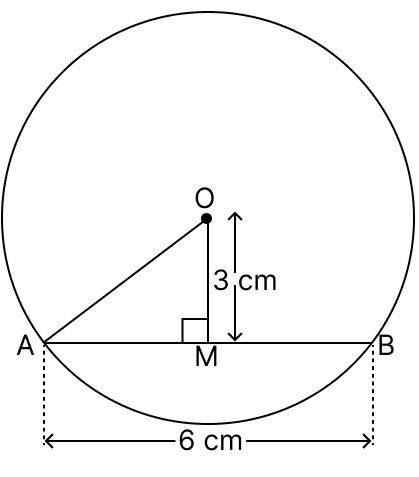
Finding the radius of the circle:
Let O be the centre of the circle and AB be the chord with AB = 6 cm. Let M be the foot of the perpendicular from O to AB, so OM = 3 cm and AM = = 3 cm.
In right-angled △OMA, by the Baudhāyana–Pythagoras theorem:
OA2 = OM2 + AM2
OA2 = 32 + 32
OA2 = 9 + 9
OA2 = 18
⇒ OA = cm ≈ 4.24 cm
Suitable triangle:
Such a circle is the circumcircle of a right-angled isosceles triangle with legs of 6 cm each. The hypotenuse of this triangle has length cm, which serves as the diameter, giving radius cm.
Steps of construction:
(i) Draw a right-angled isosceles triangle ABC, right-angled at A, with AB = AC = 6 cm.
(ii) Find the midpoint O of the hypotenuse BC. (This is the circumcentre, since the circumcentre of a right triangle is the midpoint of the hypotenuse.)
(iii) With O as centre and OA as radius, draw the circle. This circle passes through A, B and C.
The chord AB (of length 6 cm) stands at distance OM = 3 cm from the centre, as required.
Show that rectangle is the only parallelogram that can be inscribed in a circle.
Answer
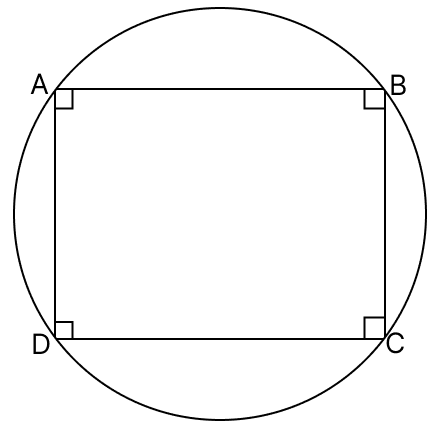
Let ABCD be a parallelogram inscribed in a circle.
Property of a parallelogram: Opposite angles are equal.
⇒ ∠A = ∠C and ∠B = ∠D ... (1)
Property of a cyclic quadrilateral (Theorem 11): Sum of opposite angles is 180°.
⇒ ∠A + ∠C = 180° ... (2)
From (1) and (2):
∠A + ∠A = 180°
⇒ 2∠A = 180°
⇒ ∠A =
⇒ ∠A = 90°
Similarly, ∠C = ∠A = 90°.
Also, ∠B + ∠D = 180° (cyclic property)
∠B = ∠D (parallelogram),
∴ ∠B = ∠D = 90°.
So all four angles of the parallelogram are 90°, which means the parallelogram is a rectangle.
Hence, the only parallelogram that can be inscribed in a circle is a rectangle.
Hence proved.
Show that if a rectangle is inscribed in a circle, then the point of intersection of its diagonals must lie at the centre of the circle.
Answer
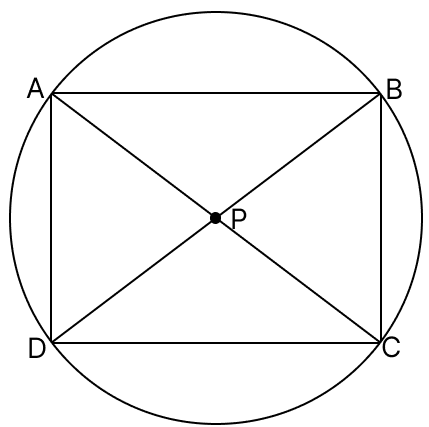
Let ABCD be a rectangle inscribed in a circle, and let P be the point of intersection of its diagonals AC and BD.
Property 1: The diagonals of a rectangle bisect each other.
⇒ AP = PC and BP = PD
Property 2: The diagonals of a rectangle are equal.
⇒ AC = BD
⇒
⇒ AP = BP = CP = DP
So P is equidistant from all four vertices A, B, C, D.
The centre of the circle is the unique point equidistant from all points on the circle. Since A, B, C, D all lie on the circle, the centre is equidistant from them.
Hence the centre coincides with P.
Therefore, the point of intersection of the diagonals lies at the centre of the circle.
Hence proved.
Consider all chords of a circle of a fixed length. What is the shape formed by the midpoints of all these chords?
Answer
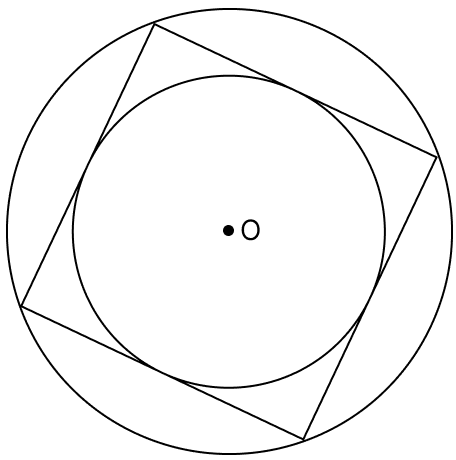
The midpoints of all chords of a fixed length form a circle concentric with the original circle.
Reasoning:
By Theorem 6, all chords of a circle having the same length lie at the same perpendicular distance from the centre.
By Theorem 5, the perpendicular from the centre to a chord meets the chord at its midpoint.
So, the midpoint of each such chord lies at the same fixed distance d from the centre, where:
d =
(r being the radius of the given circle and L being the fixed length of the chord).
Hence, all such midpoints lie on a circle with the same centre as the original circle and with radius d.
The shape is a circle, concentric with the original circle.
In a circle with centre O, chords AB and AC are congruent. Explain why this statement is true: "The centre of the circle lies on the angle bisector of ∠BAC".
Answer
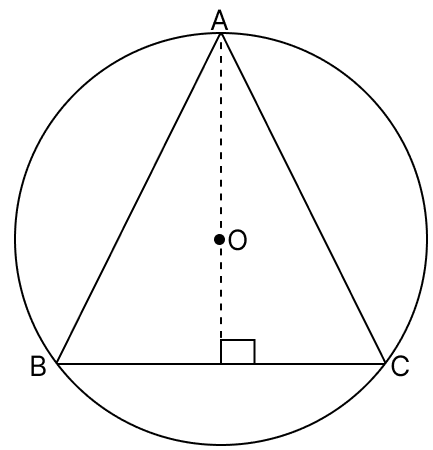
Given AB and AC are congruent chords of a circle with centre O. Consider triangle ABC. Since AB = AC, △ABC is an isosceles triangle.
Property of an isosceles triangle: The perpendicular bisector of the base, the median to the base, the altitude to the base and the angle bisector of the vertex angle all coincide.
So the angle bisector of ∠BAC is the same as the perpendicular bisector of BC.
Property of perpendicular bisector of a chord: The perpendicular bisector of a chord (here BC) passes through the centre of the circle (proved in Q5 of End-of-Chapter exercises).
Hence, the perpendicular bisector of BC passes through O.
Since the perpendicular bisector of BC coincides with the angle bisector of ∠BAC, the centre O lies on the angle bisector of ∠BAC.
Hence, the centre of the circle lies on the angle bisector of ∠BAC.
Two parallel chords of lengths 10 cm and 24 cm are on the same side of the centre of a circle. The distance between the chords is 7 cm. Find the radius of the circle.
Answer
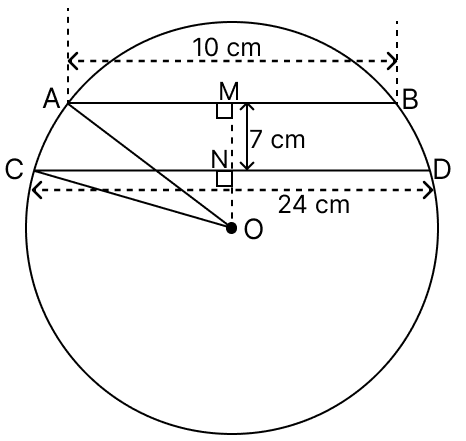
Let O be the centre of the circle. Let AB and CD be the two parallel chords with AB = 10 cm and CD = 24 cm, both on the same side of O.
By Theorem 4, line joining the centre to the midpoint of a chord is perpendicular to the chord
Let M and N be the midpoints of AB and CD respectively, so OM ⊥ AB and ON ⊥ CD
By Theorem 8, since the longer chord lies closer to the centre, ON < OM. Let ON = y cm and OM = x cm.
Since both chords are on the same side of O and parallel:
x − y = 7 ... (i)
AM = = 5 cm and CN = = 12 cm
Let r be the radius of the circle. In right-angled △OMA and △ONC, by the Baudhāyana–Pythagoras theorem:
r2 = OM2 + AM2
r2 = x2 + 25 ... (ii)
r2 = ON2 + CN2
r2 = y2 + 144 ... (iii)
Equating (ii) and (iii):
x2 + 25 = y2 + 144
⇒ x2 − y2 = 119
⇒ (x − y)(x + y) = 119
⇒ 7(x + y) = 119 [Using (i)]
⇒ x + y = 17 ... (iv)
Solving (i) and (iv):
x - y + x + y = 7 + 17
2x = 24
⇒ x =
⇒ x = 12, so y = 5.
From (ii): r2 = 122 + 25
= 144 + 25
= 169
⇒ r = = 13 cm
Hence, the radius of the circle is 13 cm.
A regular hexagon is inscribed in a circle of radius r. Find the length of the sides of the hexagon and the distance of each side from the centre of the circle.
Answer
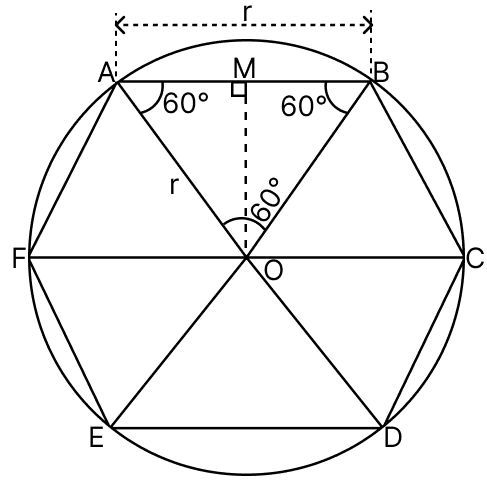
Let the regular hexagon be ABCDEF inscribed in a circle with centre O and radius r.
Joining the centre O to each vertex divides the hexagon into 6 congruent triangles. Each triangle (say △OAB) has:
OA = OB = r [Both are radii of the circle]
∠AOB = = 60° [The 6 central angles divide a complete rotation equally]
In △OAB:
OA = OB ⇒ ∠OAB = ∠OBA
By the angle sum property:
∠OAB + ∠OBA + ∠AOB = 180°
⇒ 2∠OAB + 60° = 180°
⇒ 2∠OAB = 180° - 60°
⇒ 2∠OAB = 120°
⇒ ∠OAB =
⇒ ∠OAB = 60°
So all three angles of △OAB are 60°, making it equilateral.
⇒ Side of hexagon AB = OA = r
Distance of each side from the centre:
By Theorem 4, line joining the centre to the midpoint of a chord is perpendicular to the chord
Let M be the midpoint of AB. Then OM is the perpendicular distance from O to AB.
AM =
In right-angled △OMA, by the Baudhāyana–Pythagoras theorem:
OM2 = OA2 − AM2
OM2 = r2 −
OM2 =
⇒ OM =
Hence, the side length of the hexagon is r and the distance of each side from the centre is .
A quadrilateral MNOP is inscribed in a circle. If MN is a diameter, what can you say about ∠MOP and ∠MNP? Explain your reasoning.
Answer
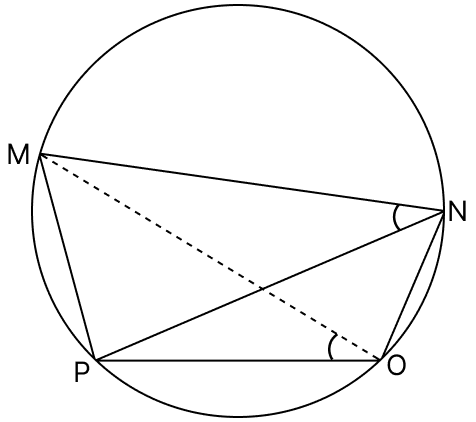
In cyclic quadrilateral MNOP, MN is a diameter, and the vertices are in order M, N, O, P on the circle.
Consider chord MP. Both N and O lie on the same arc of MP (the arc going from M to P through N and O).
By Theorem 9, the angles in the same arc segment are all equal:
So, we can conclude that two angles are equal.
∴ ∠MOP = ∠MNP
This is because both ∠MOP and ∠MNP are the angles subtended by the chord MP at points O and N respectively, and both these points lie on the same side of MP. Such angles in the same segment are always equal.
Let ABCD be a cyclic quadrilateral. Explain why the exterior angle at any vertex is equal to the interior opposite angle (e.g., ∠ADE = ∠ABC, where E is a point on the extension of side CD).
Answer
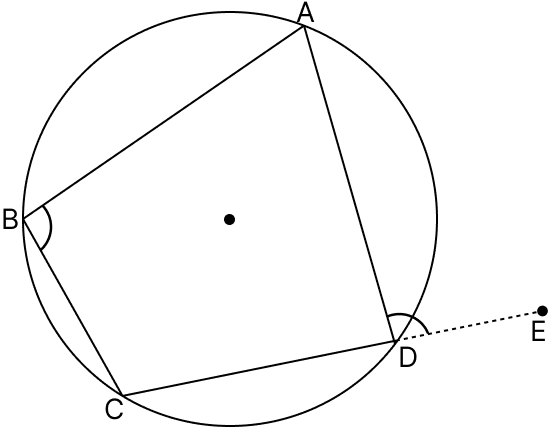
Let ABCD be a cyclic quadrilateral. Extend side CD beyond D to a point E so that C, D, E are collinear (with D between C and E). The exterior angle at vertex D is the angle ∠ADE, between side DA and the extension DE.
By the linear pair axiom, since CDE is a straight line:
∠ADC + ∠ADE = 180° ... (i)
By Theorem 11, in cyclic quadrilateral ABCD, the sum of opposite angles is 180°:
∠ADC + ∠ABC = 180° ... (ii)
From (i) and (ii):
∠ADE = ∠ABC
That is, the exterior angle at D equals the interior opposite angle ∠ABC.
Hence, the exterior angle at any vertex of a cyclic quadrilateral is equal to the interior opposite angle.
Hence proved.
"There is no chord of a circle that is longer than its diameter." How do you justify this statement?
Answer
By Theorem 8, "given two unequal chords, the longer chord is closer to the centre." The chord closest to the centre is the one that passes through the centre itself — its perpendicular distance from the centre is 0. Such a chord is the diameter.
So the diameter is the longest possible chord. Any other chord lies at some positive distance from the centre and is therefore shorter than the diameter.
Alternative justification using the Baudhāyana–Pythagoras theorem:
For a chord at perpendicular distance d from the centre of a circle of radius r:
Chord length =
This length is maximised when d = 0 (chord passes through centre), giving:
Maximum chord length = = diameter
For any other chord, d > 0, so the chord length is strictly less than 2r.
Hence, there is no chord of a circle that is longer than its diameter.
Let A be any point within a given circle with centre O. Show that the shortest chord of the circle that passes through point A is the one that is perpendicular to OA.
Answer
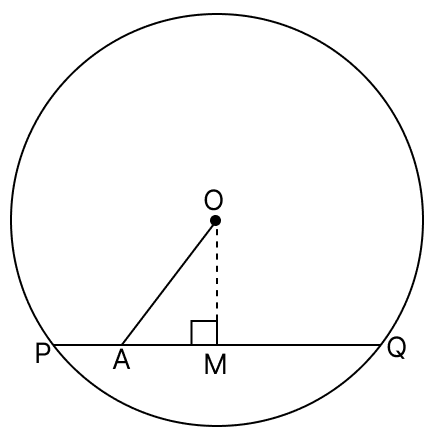
Let A be a point inside a circle with centre O and radius r, with A not coinciding with O. Consider any chord PQ passing through A. Let M be the foot of the perpendicular from O to PQ.
M is the midpoint of PQ [∵ Perpendicular from centre to chord bisects the chord]
By the chord-length formula (Q2 of Exercise Set 5.5):
PQ =
To minimise the chord length PQ, we must maximise OM (the distance from the centre to the chord).
Consider △OMA (right-angled at M, since OM ⊥ chord PQ). The side OA is the hypotenuse of this triangle.
OM ≤ OA [In a right triangle, a leg is at most the hypotenuse]
Equality OM = OA holds when M coincides with A, i.e., when the foot of the perpendicular from O to the chord is at A itself. This happens exactly when the chord PQ is perpendicular to OA at A.
So OM is maximum when the chord is perpendicular to OA. At this maximum, OM = OA, and the chord length becomes:
PQmin =
For any other chord through A, OM < OA, giving a larger chord length.
Hence, the shortest chord through A is the one perpendicular to OA.
Hence proved.
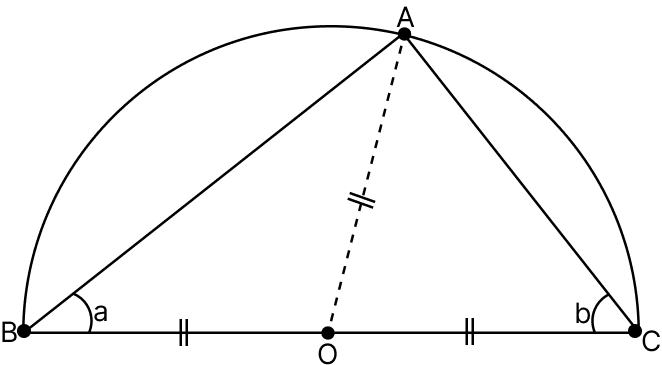
How would you use the following figure to justify the statement that the angle in a semicircle is 90°?
Answer
In the figure below, there is a semicircle with diameter (let endpoints be the two ends of the horizontal segment) passing through O. Point A is on the semicircle, and the dashed line from O to A indicates the radius OA. The equal hash marks on the two halves of the diameter show that they are equal (each equal to the radius), and the angles at the two ends of the diameter are labelled a and b.
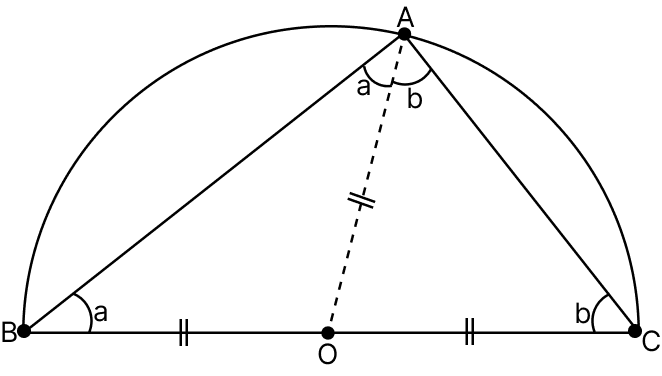
Let the diameter be BC, with O as the midpoint (centre of the circle). A is a point on the semicircle. Then OA, OB and OC are all radii of the circle, so:
OA = OB = OC
Step 1: △OAB is isosceles (since OA = OB), so the base angles are equal:
∠OAB = ∠OBA = a
Step 2: △OAC is isosceles (since OA = OC), so the base angles are equal:
∠OAC = ∠OCA = b
Step 3: The angle ∠BAC at vertex A is the sum:
∠BAC = ∠OAB + ∠OAC
∠BAC = a + b
Step 4: Apply the angle sum property in △ABC:
∠BAC + ∠ABC + ∠ACB = 180°
⇒ (a + b) + a + b = 180°
⇒ 2(a + b) = 180°
⇒ a + b =
⇒ a + b = 90°
⇒ ∠BAC = a + b = 90°
Hence, the angle in a semicircle is 90°.
In a circle, two chords CC' and DD' are drawn perpendicular to a diameter AB. Prove that the segment MM' joining the midpoints of the chords CD and C' D' is perpendicular to AB.
Answer
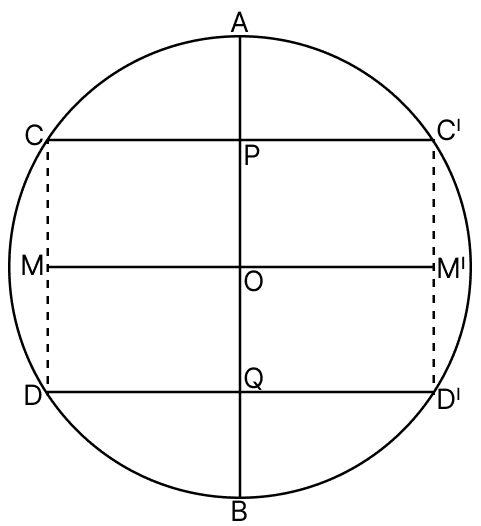
Let O be the centre of the circle, AB be a diameter, and CC' and DD' be two chords, both perpendicular to AB.
Let CC' meet AB at point P, and let DD' meet AB at point Q.
Since CC' ⊥ AB, and AB passes through the centre O, OP (part of AB) is the perpendicular from O to chord CC'.
P is the midpoint of CC' [∵ Perpendicular from centre to chord bisects the chord]
⇒ PC = PC'
This means C and C' are equidistant from line AB, and they lie on opposite sides of AB. So C' is the reflection of C across AB.
Similarly, Q is the midpoint of DD', and D' is the reflection of D across AB.
Consider the segment CD. Under reflection across AB:
C maps to C'
D maps to D'
So segment CD maps to segment C'D'.
The midpoint M of CD therefore maps to the midpoint M' of C'D' under this reflection.
Now, if a point M maps to M' under reflection across a line AB, then AB is the perpendicular bisector of the segment MM'. In particular:
MM' ⊥ AB
Hence proved.
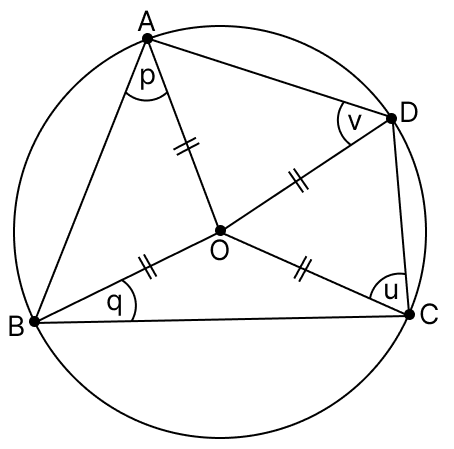
How would you use the following figure to justify the statement that the sum of the opposite angles of a cyclic quadrilateral is 180°?
Answer
In the above figure, ABCD is a cyclic quadrilateral with centre O inside it. The lines OA, OB, OC, OD are drawn (each being a radius of the circle). The hash marks indicate the four pairs of equal radii. The base angles of the four isosceles triangles are labelled p (in △OAB at A), q (in △OBC at B), u (in △OCD at C), v (in △ODA at D).
Since each of OA, OB, OC, OD is a radius:
OA = OB = OC = OD
Step 1: △OAB is isosceles (OA = OB), so ∠OAB = ∠OBA = p.
Step 2: △OBC is isosceles (OB = OC), so ∠OBC = ∠OCB = q.
Step 3: △OCD is isosceles (OC = OD), so ∠OCD = ∠ODC = u.
Step 4: △ODA is isosceles (OD = OA), so ∠ODA = ∠OAD = v.
Step 5: Express the angles of the quadrilateral:
∠A = ∠DAB = ∠OAD + ∠OAB = v + p
∠B = ∠ABC = ∠OBA + ∠OBC = p + q
∠C = ∠BCD = ∠OCB + ∠OCD = q + u
∠D = ∠CDA = ∠ODC + ∠ODA = u + v
Step 6: Sum of all angles of quadrilateral ABCD = 360°.
(v + p) + (p + q) + (q + u) + (u + v) = 360°
⇒ 2(p + q + u + v) = 360°
⇒ p + q + u + v =
⇒ p + q + u + v = 180°
Step 7: Find opposite angle sums:
∠A + ∠C = (v + p) + (q + u)
= p + q + u + v
= 180°
∠B + ∠D = (p + q) + (u + v)
= p + q + u + v
= 180°
Hence, the sum of the opposite angles of a cyclic quadrilateral is 180°.