
Is it possible to construct a quadrilateral with sides 5 cm, 6 cm, 7 cm, 8 cm and one of the diagonal 15 cm.
Yes
No
Nothing can be said
Answer
A quadrilateral with a diagonal forms two triangles. Let the diagonal be 15 cm.
Consider one triangle with sides 5 cm, 6 cm, and 15 cm.
Consider the other triangle with sides 7 cm, 8 cm, and 15 cm.
The Triangle Inequality Theorem states that the sum of the lengths of any two sides of a triangle must be greater than the length of the third side.
Check if the sum of any two sides is greater than the third side for the triangle with sides 5 cm, 6 cm, and 15 cm.
Sum of 5 cm and 6 cm: 5 + 6 = 11.
Compare to the third side: 11 < 15.
Sum of 6 cm and 11 cm: 6 + 11 = 17.
Compare to the third side: 17 > 5.
Sum of 5 cm and 11 cm: 5 + 11 = 16.
Compare to the third side: 16 > 6.
Since 11 < 15, the Triangle Inequality Theorem is violated for the first triangle.
Therefore, a triangle with sides 5 cm, 6 cm, and 15 cm cannot be formed.
Thus, the quadrilateral cannot be constructed.
Hence, option 2 is the correct option.
In a regular hexagon, leading diagonal of it, is twice of its side.
Yes
No
Nothing can be said
Answer
A regular hexagon has six equal sides and six equal interior angles, each measuring 120 degrees.
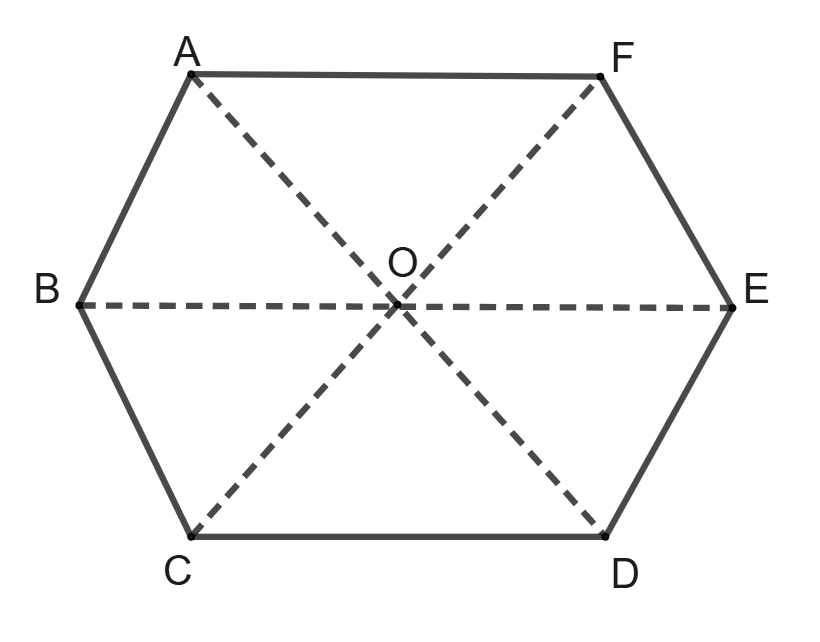
We know that,
Each regular hexagon can be divided into six equilateral triangles, with each side equal to the side of hexagon.
Let ABCDEF be a regular hexagon with O as the center and side of length x units.
From figure,
CF (Diagonal) = CO + OF = x + x = 2x.
Thus leading diagonal is twice the side of regular hexagon.
Hence, option 1 is the correct option.
Statement 1: For a quadrilateral ABCD; if AB = BC = CD = DA = 8 cm, then it is possible to construct this quadrilateral.
Statement 2: It is only possible to construct this quadrilateral if each of its diagonals is greater than 8 cm.
Both the statements are true.
Both the statements are false.
Statement 1 is true, and statement 2 is false.
Statement 1 is false, and statement 2 is true.
Answer
In a quadrilateral ABCD; AB = BC = CD = DA = 8 cm
This is true, such a quadrilateral can exist. When all four sides are equal, the quadrilateral can be a rhombus or a square.
So, statement 1 is true.
It is not necessary that the diagonal length must be greater than the side length.
So, it is not definitely true that length of each of diagonals is greater than 8 cm.
So, statement 2 is false.
∴ Statement 1 is true, and statement 2 is false.
Hence, option 3 is the correct option.
Assertion (A): A parallelogram can be constructed if the measures of its diagonals and one side are given.
Reason (R): It is possible to construct this parallelogram as the diagonals bisect each other.
A is true, but R is false.
A is false, but R is true.
Both A and R are true, and R is the correct reason for A.
Both A and R are true, and R is the incorrect reason for A.
Answer
In a parallelogram, a fundamental property is that the diagonals bisect each other — i.e. each diagonal is split into two equal segments at their intersection.
Since, one side is known and diagonals are known we can create triangles, and thus completely constructing the parallelogram.
∴ Both A and R are true, and R is the correct reason for A.
Hence, option 3 is the correct option.
Construct a quadrilateral ABCD with AB = 7 cm, BC = CD = 5 cm and ∠ABC = ∠BCD = 90°.
Answer
Steps of construction :
Draw a line segment BC = 5 cm.
Draw BX ⊥ BC and CY ⊥ BC.
From BX, cut BA = 7 cm.
From CY, cut CD = 5 cm.
Join AD.
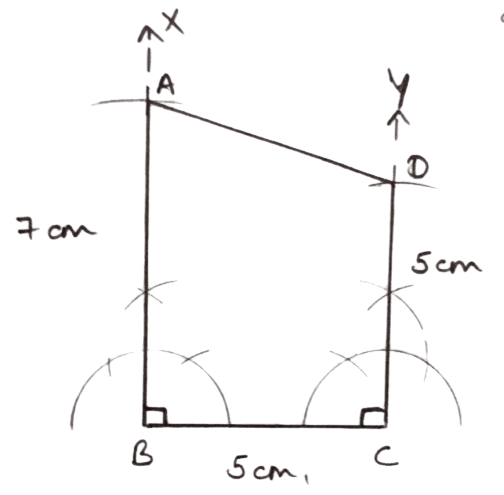
Hence, ABCD is the required quadrilateral.
Construct a trapezium ABCD in which AD // BC, AB = CD = 3.6 cm, BC = 5 cm and AD = 4.5 cm.
Answer
Steps of construction :
Draw a line segment BC = 5 cm.
From BC, cut BE = AD = 4.5 cm.
Draw triangle DEC, such that DE = AB = 3.6 cm and CD = 3.6 cm.
Taking B and D as centers and radii 3.6 cm and 4.5 cm respectively, draw arcs cutting each other at A.
Join AB and AD.
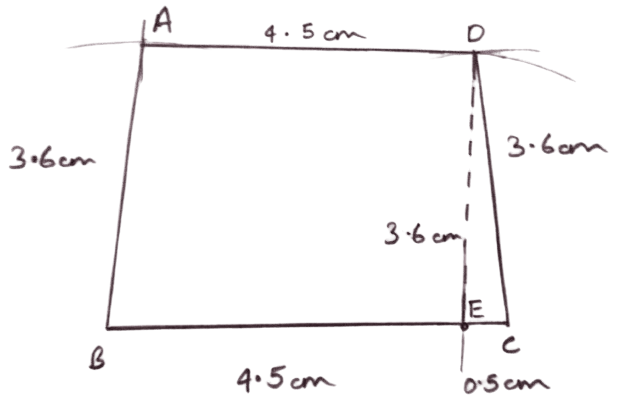
Hence, ABCD is the required trapezium.
Using ruler and compasses, construct a rectangle ABCD, with AB = 5 cm and AD = 3.6 cm.
Answer
Steps of construction :
Draw a line segment AB = 5 cm.
Draw AX ⊥ AB and BY ⊥ AB.
With B as center and radius equal to 3.6 cm draw arc cutting BY at C.
With A as center and radius equal to 3.6 cm draw arc cutting AX at D.
Join CD.

Hence, ABCD is the required rectangle.
Using ruler and compasses only, construct the quadrilateral ABCD, having given AB = 5 cm, BC = 2.5 cm, CD = 6 cm, angle BAD = 90° and the diagonal AC = 5.5 cm.
Answer
Steps of construction :
Draw a line segment AB = 5 cm.
Draw AX ⊥ AB.
With A and B as center and radii equal to 5.5 cm and 2.5 cm respectively draw arcs cutting each other at C. Join AC and BC.
With C as center and radius equal to 6 cm draw arc cutting AX at D.
Join AD and CD.

Hence, ABCD is the required quadrilateral.
Using ruler and compasses only, construct a trapezium ABCD, in which the parallel sides AB and DC are 3.3 cm apart; AB = 4.5 cm, angle A = 120°, BC = 4.2 cm and angle B is obtuse.
Answer
Steps of construction :
Draw a line segment AB = 4.5 cm.
Draw ∠BAS = 120° and AE ⊥ AB.
From AE, cut AX = 3.3 cm.
Through X, draw a line PQ parallel to AB and cutting AS at D.
With B as center and radius equal to 4.2 cm draw an arc cutting PQ on C.
Join BC and CD.
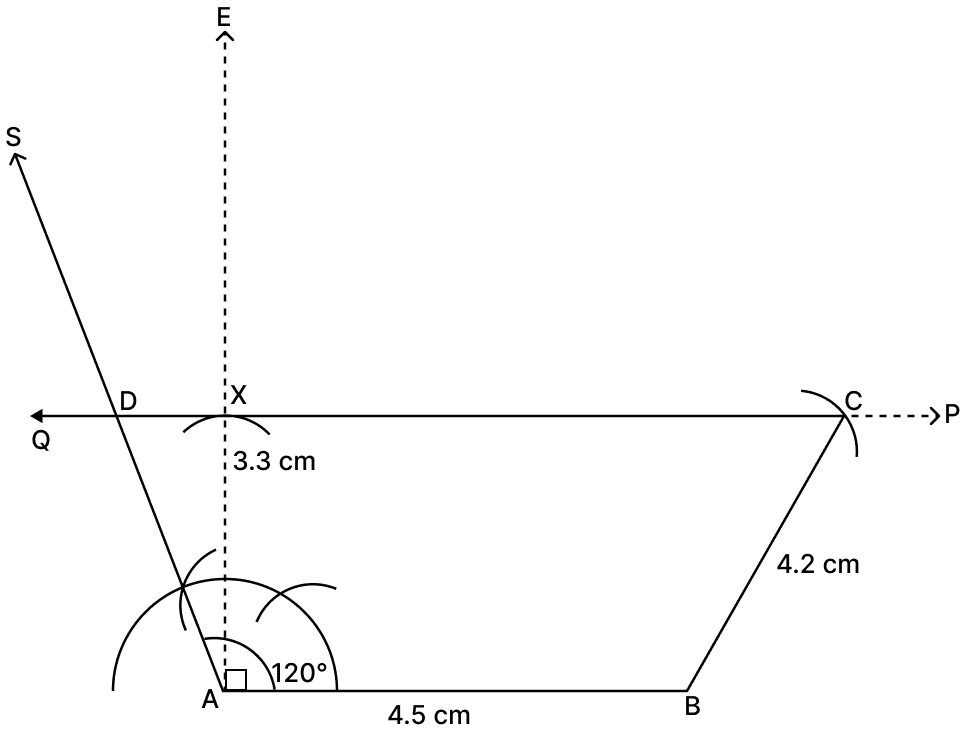
Hence, ABCD is the required trapezium.
Using ruler and compasses only, construct the quadrilateral ABCD, having given AB = 5 cm, BC = 2.5 cm, CD = 6 cm, ∠BAD = 90° and diagonal BD = 5.5 cm.
Answer
Steps of construction :
Draw a line segment AB = 5 cm.
Draw AX ⊥ AB.
With B as center and radius equal to 5.5 cm draw an arc cutting AX at D. Join BD.
With D and B as center and radii equal to 6 cm and 2.5 cm respectively draw arcs cutting each other at C.
Join DC and BC.

Hence, ABCD is the required quadrilateral.
Using ruler and compasses only, construct a parallelogram ABCD using the following data :
AB = 6 cm, AD = 3 cm and ∠DAB = 45°. If the bisector of ∠DAB meets DC at P, prove that ∠APB is a right angle.
Answer
Steps of construction :
Draw a line segment AB = 6 cm.
With A as center draw a line AX such that ∠BAX = 45°.
From AX, cut AD = 3 cm.
With B and D as center and radii equal to 3 cm and 6 cm draw arc cutting each other at point C.
Join BC and CD.
Draw AY, the angular bisector of angle A intersecting CD at point P.
Join BP. Measure ∠APB.
On measuring ∠APB = 90°.

Hence, ABCD is the required parallelogram.
The perpendicular distances between the pair of opposite sides of a parallelogram, are 3 cm and 4 cm, and one of its angles measures 60°. Using ruler and compasses only, construct the parallelogram.
Answer
Steps of construction :
Draw a straight line PQ, take a point A on it.
At A, construct ∠QAF = 60°.
At A, draw AE ⊥ PQ, from AE cut off AN = 3 cm.
Through N draw a straight line parallel to PQ to meet AF at D.
At A, draw AG ⊥ AD, from AG cut off AM = 4 cm.
Through M, draw a straight line parallel to AD to meet AQ at B and ND at C.
Join AB, BC, CD and DA.
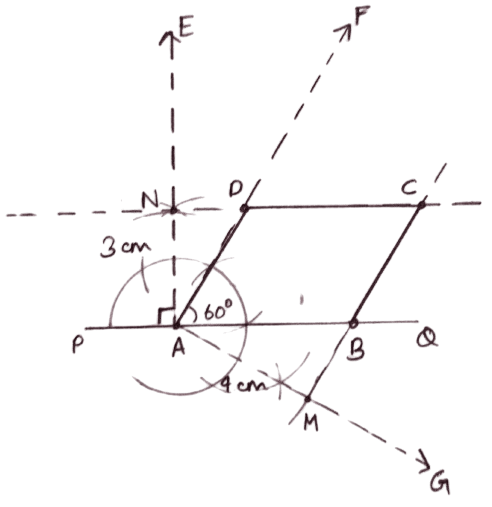
Hence, ABCD is the required parallelogram.
Draw parallelogram ABCD with the following data :
AB = 6 cm, AD = 5 cm and ∠DAB = 45°.
Let AC and DB meet in O and let E be the mid-point of BC. Join OE. Prove that :
(i) OE // AB
(ii) OE = AB
Answer
In parallelogram,
Opposite sides are equal.
∴ BC = AD = 5.0 cm and CD = AB = 6.0 cm
Steps of construction :
Draw a line segment AB = 6.0 cm.
Draw AP, such that ∠A = 45°.
With A as center and radius equal to 5 cm draw an arc cutting AP at D.
With B and D as centers and radii 5.0 cm and 6.0 cm respectively, draw arcs cutting each other at C.
Join BC and CD.
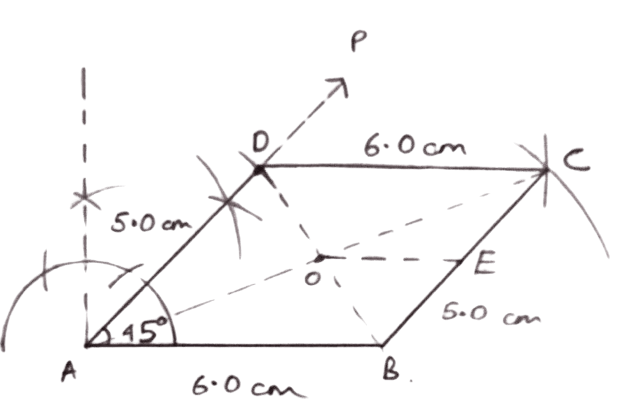
Hence, ABCD is the required parallelogram.
(i) In △ ABC,
O is the mid-point of AC (As diagonals of || gm bisect each other).
E is the mid-point of BC (Given).
By mid-point theorem,
If a line segment joins the mid-point of any two sides of a triangle, then the line segment is said to be parallel to the remaining third side and its measure will be half of the third side.
⇒ OE // AB.
Hence, proved that OE // AB.
(ii) In △ ABC,
O is the mid-point of AC (As diagonals of || gm bisect each other).
E is the mid-point of BC (Given).
By mid-point theorem,
If a line segment joins the mid-point of any two sides of a triangle, then the line segment is said to be parallel to the remaining third side and its measure will be half of the third side.
⇒ OE = .
Hence, proved that OE = .
Using ruler and compasses only, construct a rectangle each of whose diagonals measure 6 cm and the diagonals intersect at an angle of 45°.
Answer
Steps of construction :
Draw a line segment AC = 6 cm.
Bisect AC at O.
At O, draw a ray XY making an angle of 45° at O.
From XY, cut off OB = OD = = 3 cm each.
Join AB, BC, CD and DA.
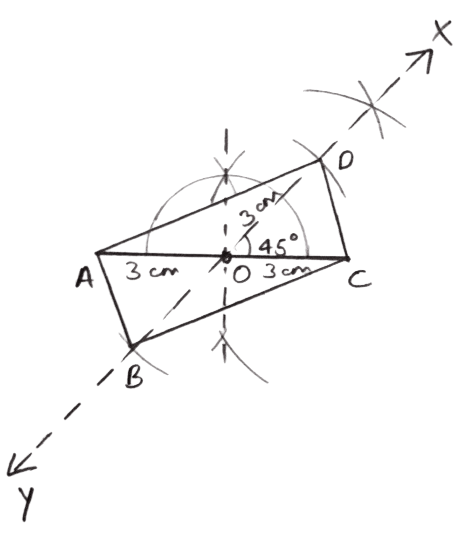
Hence, ABCD is the required rectangle.