
A quadrilateral can be constructed, if its :
three sides and one angle are known
four sides and one angle are known
two sides and two angles are known
four sides are known
Answer
A quadrilateral can be constructed if its four sides and one angle are known.
Hence, Option 2 is the correct option.
A parallelogram can be constructed, if its :
all the four sides are known
opposite sides are known
opposite angles are known
two adjacent sides and contained angle are known
Answer
A parallelogram can be constructed if its two adjacent sides and contained angle are known.
Hence, Option 4 is the correct option.
A parallelogram can be constructed, if its :
both the diagonals and included angle are given
both the diagonals and one angle are given
both the diagonals are given
one side and one diagonal are given
Answer
A parallelogram can be constructed if its both the diagonals and included angle are given.
Hence, Option 1 is the correct option.
A trapezium can be constructed, if its :
parallel sides are given
non-parallel sides are given
both the non-parallel sides and both the parallel sides are given
four sides are given
Answer
A trapezium can be constructed if its both the non-parallel sides and both the parallel sides are given.
Hence, Option 3 is the correct option.
A rhombus can be constructed, if its :
one side is given
one side and one diagonal are given
one of the diagonals is given
opposite angles are given
Answer
A rhombus can be constructed if its one side and one diagonal are given.
Hence, Option 2 is the correct option.
Construct a quadrilateral ABCD, when :
AB = 3.2 cm, BC = 5.2 cm, CD = 6.2 cm, DA = 4.2 cm and BD = 5.2 cm.
Answer
Steps of construction :
Draw a line segment BC = 5.2 cm.
With B and C as center and radii equal to 5.2 cm and 6.2 cm respectively draw arcs cutting each other at D.
Join BD and CD.
With B and D as center and radii equal to 3.2 cm and 4.2 cm respectively draw arcs cutting each other at A.
Join AB and AD.
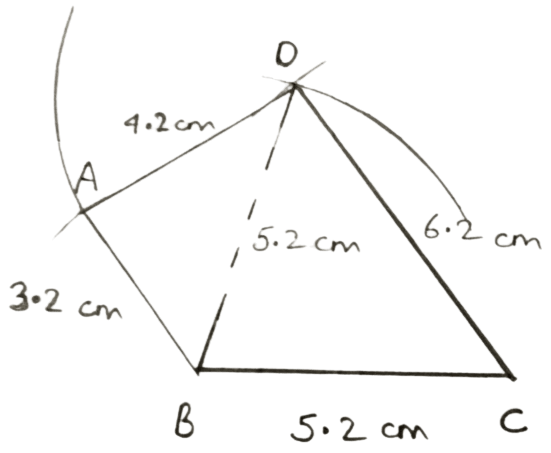
Hence, ABCD is the required quadrilateral.
AB = 7.2 cm, BC = 5.8 cm, CD = 6.3 cm, AD = 4.3 cm and angle A = 75°.
Answer
Steps of construction :
Draw a line segment AB = 7.2 cm.
Through A, draw AX such that ∠A = 75°.
From AX, cut AD = 4.3 cm.
With B and D as centers and radii 5.8 cm and 6.3 cm respectively, draw arcs cutting each other at C.
Join BC and CD.
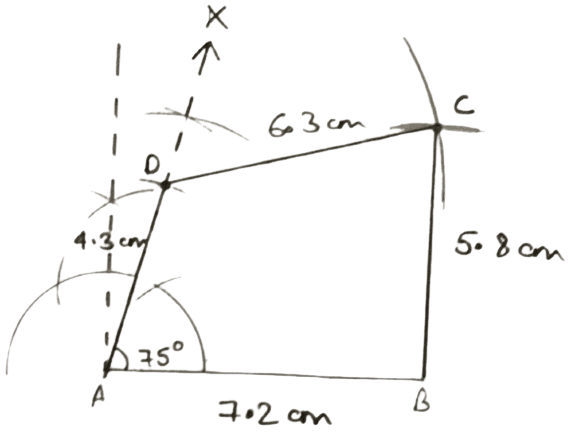
Hence, ABCD is the required quadrilateral.
Angle A = 90°, AB = 4.6 cm, BD = 6.4 cm, AC = 6.0 cm and CD = 4.2 cm.
Answer
Steps of construction :
Draw a line segment AB = 4.6 cm.
Through A, draw AP such that ∠A = 90°.
With B as center and radius 6.4 cm draw an arc cutting AP at D. Join AD and BD.
With D and A as centers and radii 4.2 cm and 6.0 cm respectively, draw arcs cutting each other at C.
Join DC, BC and AC.
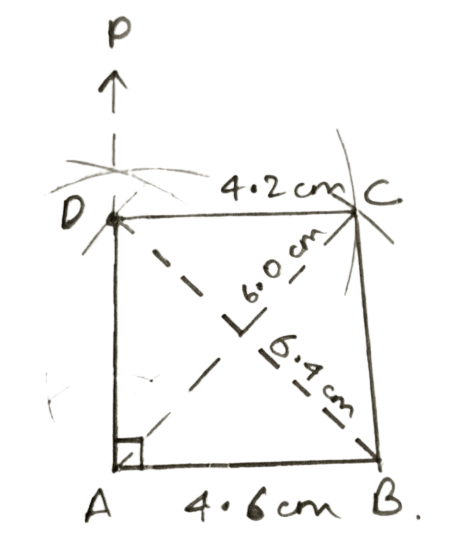
Hence, ABCD is the required quadrilateral.
AB = 3.8 cm, AC = 4.8 cm, AD = 2.8 cm, angle A = 105° and angle B = 60°.
Answer
Steps of construction :
Draw a line segment AB = 3.8 cm.
Through A, draw AX such that ∠A = 105°.
Through B, draw BY such that ∠B = 60°.
From AX, cut AD = 2.8 cm.
With A as center and radius 4.8 cm draw an arc cutting BY at C. Join BC and CD.
Join AC.
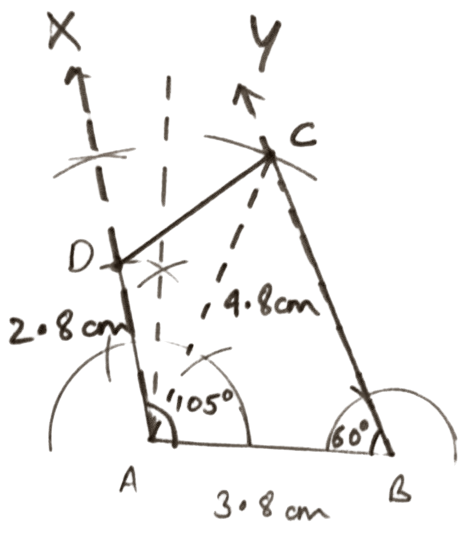
Hence, ABCD is the required quadrilateral.
BC = 7.5 cm, AC = 5.8 cm, AD = 3.6 cm, CD = 4.2 cm and angle A = 120°.
Answer
Steps of construction :
Draw a line segment AD = 3.6 cm.
Through A, draw AP such that ∠A = 120°.
With D and A as centers and radii 4.2 cm and 5.8 cm respectively, draw arcs cutting each other at C. Join AC and CD.
With C as center and radius 7.5 cm draw an arc cutting AP at B.
Join AB and BC.
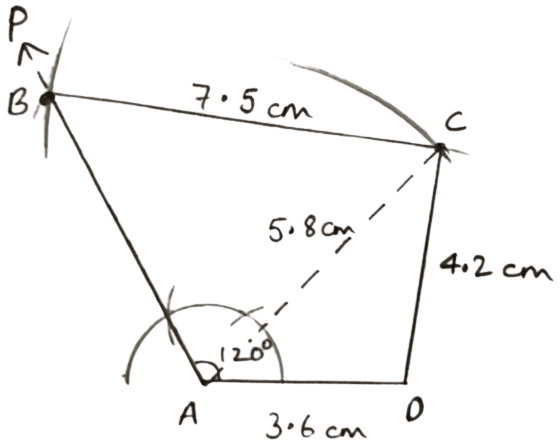
Hence, ABCD is the required quadrilateral.
AD = AB = 4 cm, BC = 2.8 cm, CD = 2.5 cm and angle BAD = 45°.
Answer
Steps of construction :
Draw a line segment AD = 4 cm.
Draw AP, such that ∠A = 45°.
With A as center and radius equal to 4 cm draw an arc cutting AP at B.
With B and D as centers and radii 2.8 cm and 2.5 cm respectively, draw arcs cutting each other at C.
Join BC and CD.
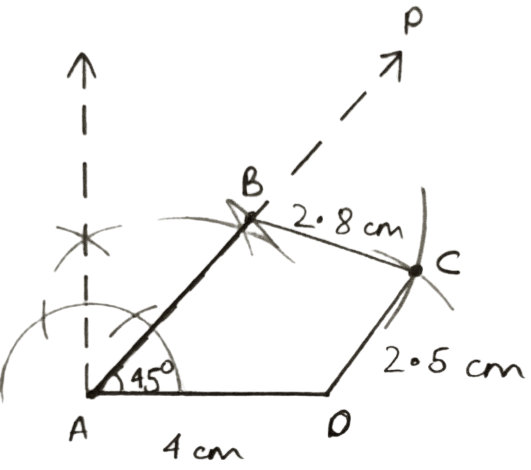
Hence, ABCD is the required quadrilateral.
AB = 6.3 cm, BC = CD = 4.2 cm and ∠ABC = ∠BCD = 90°.
Answer
Steps of construction :
Draw a line segment AB = 6.3 cm.
Draw BP, such that ∠ABP = 90°.
With B as center and radius equal to 4.2 cm draw an arc cutting BP at C. Join BC.
With C as center, draw a line CD, such that ∠BCD = 90°.
Join AD.
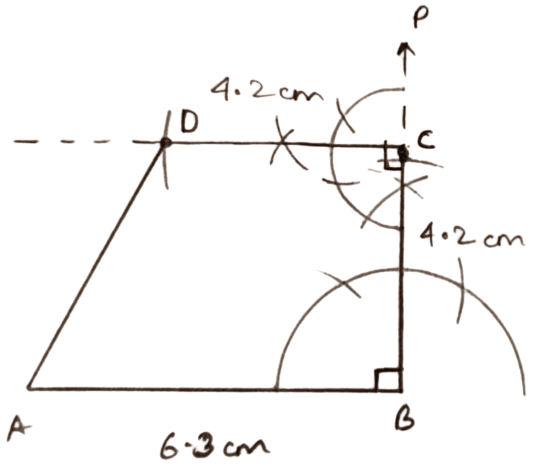
Hence, ABCD is the required quadrilateral.
Construct a parallelogram ABCD, when :
AB = 4.4 cm, AD = 6.2 cm and AC = 4.8 cm.
Answer
In parallelogram,
Opposite sides are equal.
∴ CD = AB = 4.4 cm and BC = AD = 6.2 cm
Steps of construction :
Draw a line segment AD = 6.2 cm.
With A and D as centers and radii 4.8 cm and 4.4 cm respectively, draw arcs cutting each other at C. Join AC and CD.
With A and C as centers and radii 4.4 cm and 6.2 cm respectively, draw arcs cutting each other at B.
Join AB and BC.
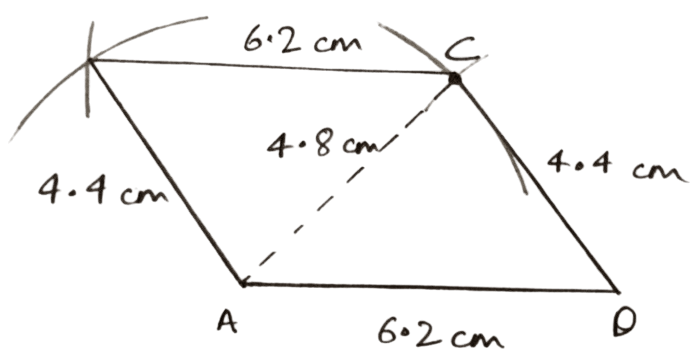
Hence, ABCD is the required parallelogram.
Diagonal AC = 6.4 cm, diagonal BD = 8.2 cm and angle between the diagonals = 60°.
Answer
Steps of construction :
Draw a line segment AC = 6.4 cm and locate its mid-point O.
Draw line BOD such that ∠DOC = 60° and OB = OD = cm = 4.1 cm.
Join AB, BC, CD and DA.
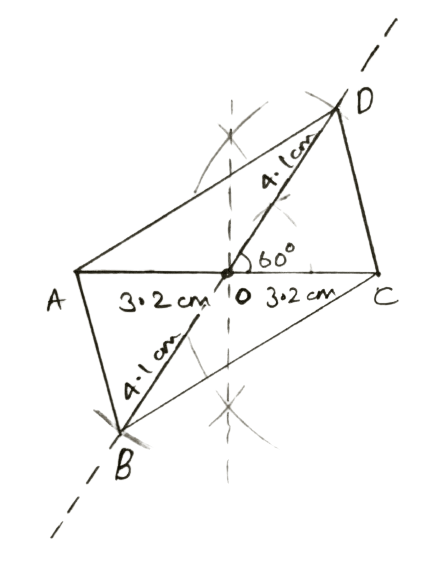
Hence, ABCD is the required parallelogram.
AB = 5.8 cm, diagonal AC = 8.2 cm and diagonal BD = 6.2 cm.
Answer
Steps of construction :
Draw a line segment AB = 5.8 cm
Since diagonals of a parallelogram bisect each other; construct triangle OBC, such that :
OB = = 3.1 cm
OA = = 4.1 cm
Produce BO upto D, such that OD = OB = 3.1 cm and produce AO upto C, such that OC = OA = 4.1 cm.
Join BC, CD and AD.
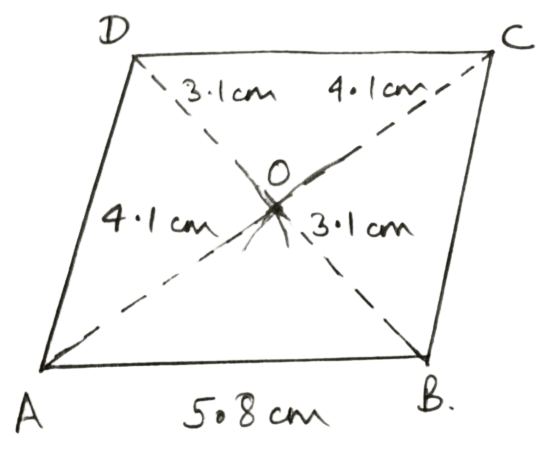
Hence, ABCD is the required parallelogram.
AB = 6.0 cm, AD = 5.0 cm and ∠A = 45°.
Answer
In parallelogram,
Opposite sides are equal.
∴ BC = AD = 5.0 cm and CD = AB = 6.0 cm
Steps of construction :
Draw a line segment AB = 6.0 cm.
Draw AP, such that ∠A = 45°.
With A as center and radius equal to 5 cm draw an arc cutting AP at D.
With B and D as centers and radii 5.0 cm and 6.0 cm respectively, draw arcs cutting each other at C.
Join BC and CD.
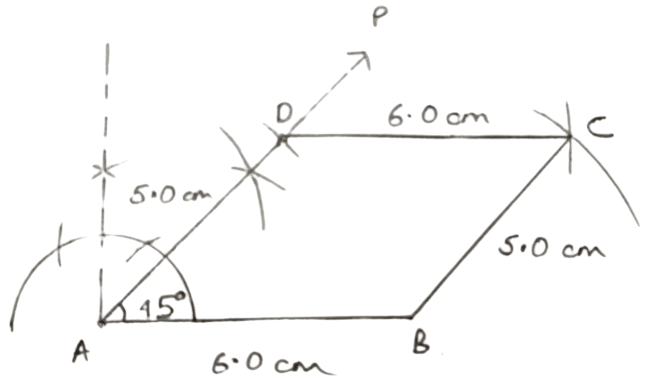
Hence, ABCD is the required parallelogram.
Base AB = 6.5 cm, BC = 4 cm and the altitude corresponding to AB = 3.1 cm.
Answer
Steps of construction :
Draw a line segment AB = 6.5 cm.
At B, draw BP ⊥ AB.
From BP, cut BE = 3.1 cm.
Through E draw a perpendicular to BP to get QR parallel to AB.
With B as center and radius = 4 cm, draw an arc that cuts QR at C.
With A as center and radius = AD = 4 cm, draw an arc that cuts QR at D.
Join AD, BC and CD.
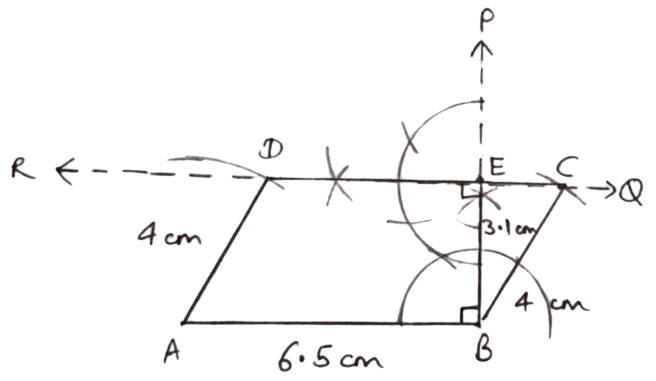
Hence, ABCD is the required parallelogram.
AB = 4.5 cm, ∠B = 120° and the distance between AB and DC = 3.0 cm.
Answer
Steps of construction :
Draw a line segment AB = 4.5 cm.
At B, draw BP ⊥ AB.
From BP, cut BE = 3 cm.
Through E draw a perpendicular to BP to get QR parallel to AB.
Draw BY, such that ∠B = 120°.
Let BY intersect QR at C.
With A as center and radius = BC, draw an arc cutting QR at D.
Join AD, BC and CD.
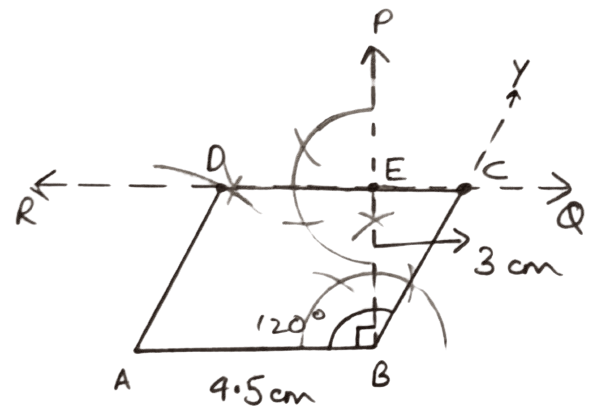
Hence, ABCD is the required parallelogram.
Base BC = 5.6 cm, diagonal BD = 6.5 cm and altitude = 3.2 cm.
Answer
Steps of construction :
Draw a line segment BC = 5.6 cm.
At C, draw CX ⊥ BC.
From CX, cut CY = 3.2 cm.
Through Y draw a straight line PQ parallel to BC.
With B as center and radius 6.5 cm draw an arc to meet PQ at D.
With D as center and radius 5.6 cm draw an arc to meet PQ at A.
Join AB, BD, AD and CD.
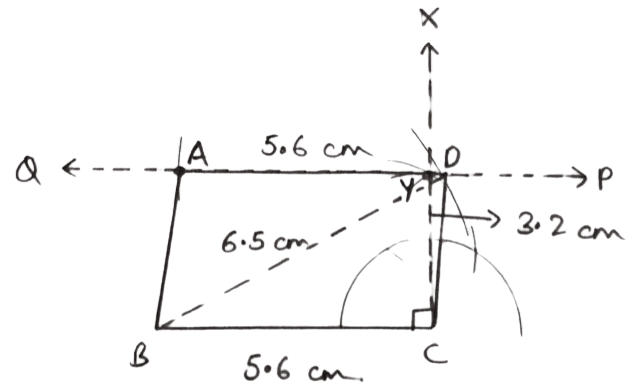
Hence, ABCD is the required parallelogram.
Construct a rectangle ABCD, when :
Its sides are 6.0 cm and 7.2 cm.
Answer
Steps of construction :
Let adjacent side AB = 6.0 cm and BC = 7.2 cm.
Draw a line segment BC = 7.2 cm.
Draw BX ⊥ BC and CY ⊥ BC.
With B as center and radius equal to 6 cm draw arc cutting BX at A.
With C as center and radius equal to 6 cm draw arc cutting CY at D.
Join AD.
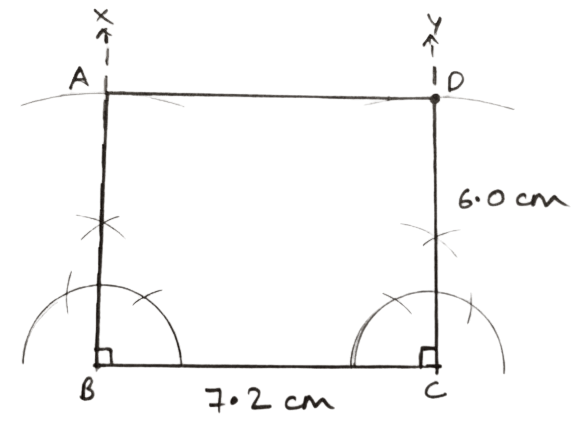
Hence, ABCD is the required rectangle.
One side = 4 cm and one diagonal is 5 cm. Measure the length of other side.
Answer
In rectangle ABCD,
Let side AB = 4 cm and AC = 5 cm.
Steps of construction :
Draw a line segment AB = 4 cm.
Draw BX ⊥ AB.
With A as center and radius equal to 5 cm draw an arc cutting BX at C.
Join AC and BC. Measure BC.
With C and A as center and radii 4 cm and BC respectively draw arcs cutting each other at D.
Join AD and CD.
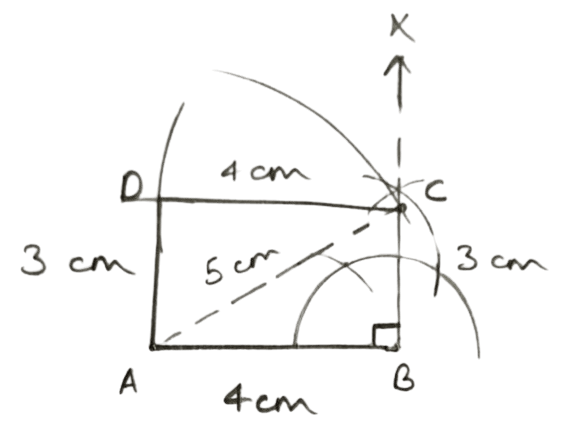
Hence, ABCD is the required rectangle.
One diagonal = 6.0 cm and the acute angle between the diagonals = 45°.
Answer
Steps of construction :
Draw a line segment AC = 6 cm.
Mark mid-point of AC as O.
From point O draw QR, at an angle of 45°.
With O as center and radius equal to 3 cm cut off OB and OD from QR.
Join BC, CD, AD and AB.
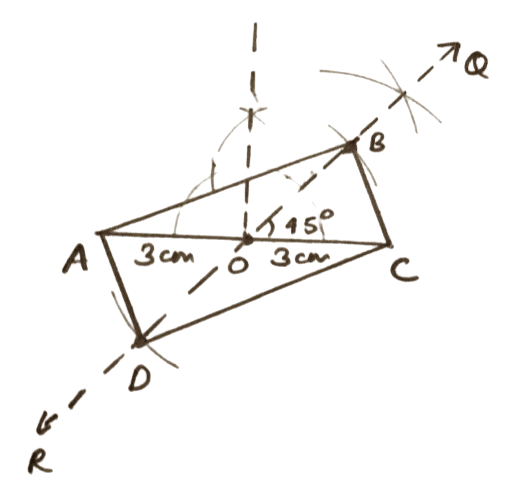
Hence, ABCD is the required rectangle.
Area = 24 cm2 and base = 4.8 cm.
Answer
We know that,
⇒ Area of rectangle = Base × Height
⇒ 24 = 4.8 × Height
⇒ Height = = 5 cm.
Steps of construction :
Let adjacent sides AB = 4.8 cm and BC = 5 cm.
Draw a line segment AB = 4.8 cm.
Draw AX ⊥ AB and BY ⊥ AB.
With A as center and radius equal to 5 cm draw arc cutting AX at D.
With B as center and radius equal to 5 cm draw arc cutting BY at C.
Join CD.
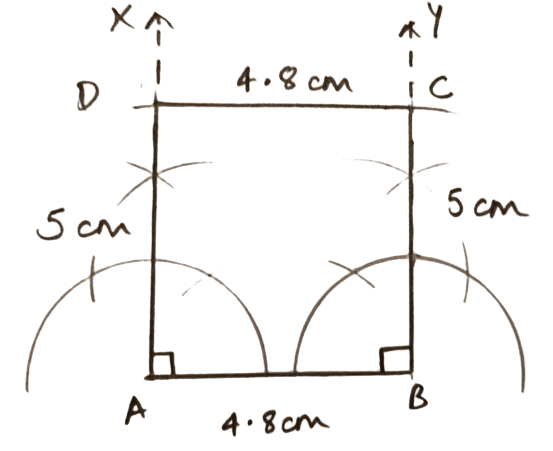
Hence, ABCD is the required rectangle.
Area = 36 cm2 and height = 4.5 cm.
Answer
We know that,
⇒ Area of rectangle = Base × Height
⇒ 36 = Base × 4.5
⇒ Base = = 8 cm.
Steps of construction :
Let adjacent sides AB = 4.5 cm and BC = 8 cm.
Draw a line segment BC = 8 cm.
Draw BX ⊥ BC and CY ⊥ BC.
With B as center and radius equal to 4.5 cm draw arc cutting BX at A.
With C as center and radius equal to 4.5 cm draw arc cutting CY at D.
Join AD.
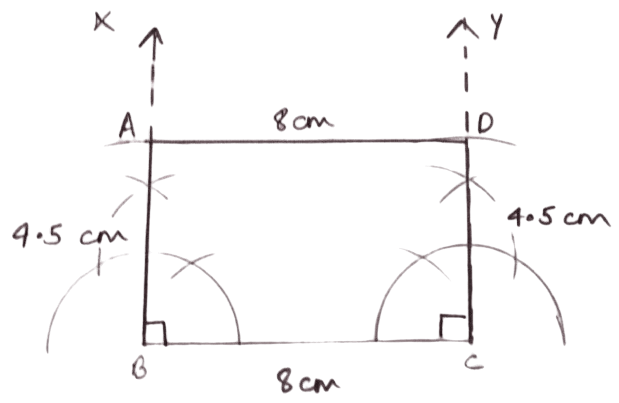
Hence, ABCD is the required rectangle.
Construct a trapezium ABCD, when :
AB = 4.8 cm, BC = 6.8 cm, CD = 5.4 cm, angle B = 60° and AD // BC.
Answer
Steps of construction :
Draw a line segment BC = 6.8 cm.
Draw BX, such that ∠XBC = 60°.
From BX, cut BA = 4.8 cm.
From point A draw QR || BC.
With C as center and radius equal to 5.4 cm draw an arc cutting QR at D.
Join CD and AD.
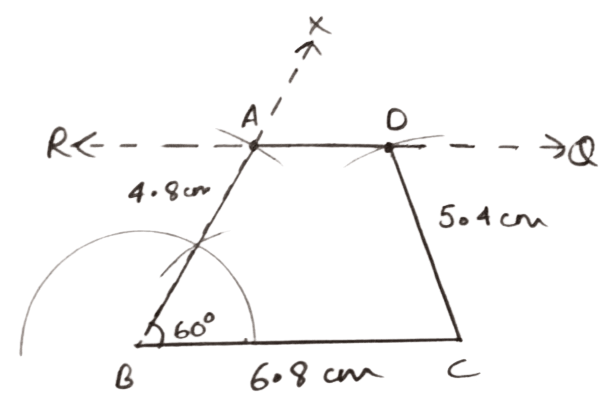
Hence, ABCD is the required trapezium.
AB = CD = 3.2 cm, BC = 6.0 cm, AD = 4.4 cm and AD // BC.
Answer
Steps of construction :
Draw a line segment BC = 6 cm.
From BC, cut BE = AD = 4.4 cm.
Draw triangle DEC, such that DE = AB = 3.2 cm and CD = 3.2 cm.
Taking B and D as centers and radii 3.2 cm and 4.4 cm respectively, draw arcs cutting each other at A.
Join AB and AD.
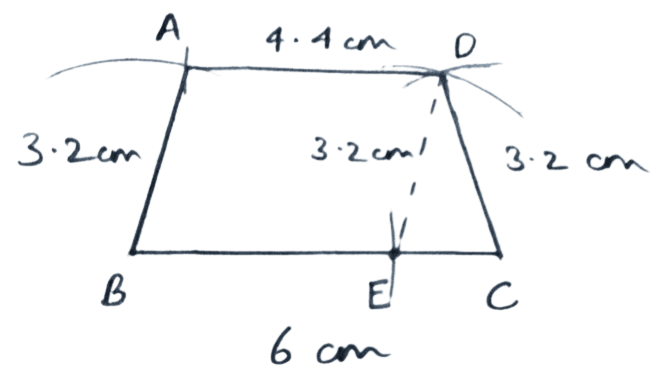
Hence, ABCD is the required trapezium.
Construct a rhombus ABCD, when :
Its one side = 6 cm and ∠A = 60°.
Answer
We know that,
Sum of consecutive angles of rhombus = 180°.
∴ ∠A + ∠B = 180°
⇒ 60° + ∠B = 180°
⇒ ∠B = 180° - 60° = 120°.
Steps of construction :
Draw a line segment AB = 6 cm.
At A, construct ∠BAP = 60°.
From AP, cut off AD = 6 cm.
Through D, draw XY parallel to AB.
At B, construct ∠ABQ = 120°, intersecting XY at C.
Join CD.
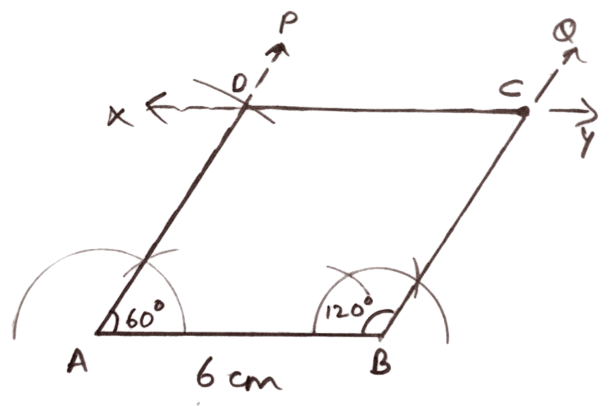
Hence, ABCD is the required rhombus.
One side = 5.4 cm and one diagonal is 7.0 cm.
Answer
Steps of construction :
Draw a line segment AC = 7 cm.
With A as center and radius equal to 5.4 cm, we draw an arc extending on both sides of AC.
With C as center and radius equal to 5.4 cm, we draw an arc extending on both sides of AC to the cut first arc at B and D.
Join AB, BC, CD and DA.
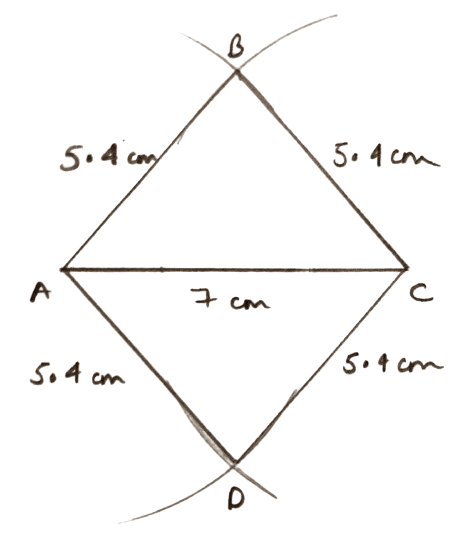
Hence, ABCD is the required rhombus.
Diagonal AC = 6.3 cm and diagonal BD = 5.8 cm
Answer
Steps of construction :
Draw a line segment AC = 6.3 cm
Draw perpendicular bisector of AC, which cuts AC at O.
From perpendicular bisector cut OD and OB such that,
OD = OB = = 2.9 cm.
- Join AB, BC, CD and DA.
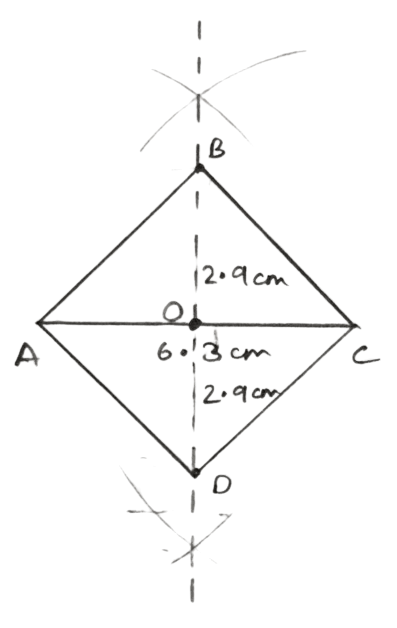
Hence, ABCD is the required rhombus.
One side = 5.0 cm and height = 2.6 cm.
Answer
Steps of construction :
Draw a line segment AB = 5 cm.
At B, draw BP ⊥ AB.
From BP, cut BE = 2.6 cm.
Through E, draw QR, perpendicular to BP, such that QR || AB.
With A and B as centers and radii 5 cm draw arcs cutting QR at D and C.
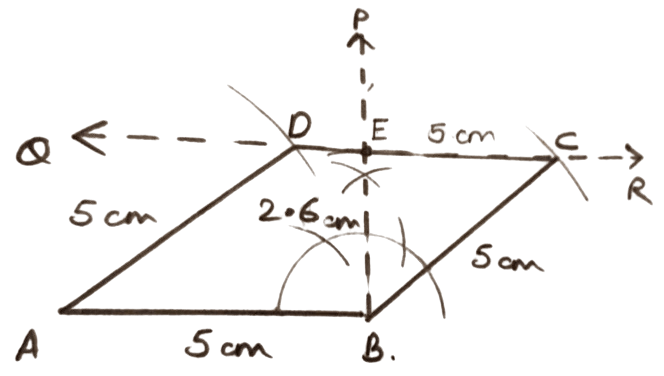
Hence, ABCD is the required rhombus.
∠A = 60° and height = 3.0 cm.
Answer
Steps of construction :
Draw a line segment AP.
Draw a line AF such that ∠A = 60°.
Take a point S on AP, at S draw a perpendicular SE of length 3 cm such that it cuts AF at D.
Through D draw a line QR || AP.
With A as center and radius equal to AD draw an arc cutting AP at B.
With B and D as centers and radii equal to AD draw arcs cutting each other at C.
Join BC and CD.
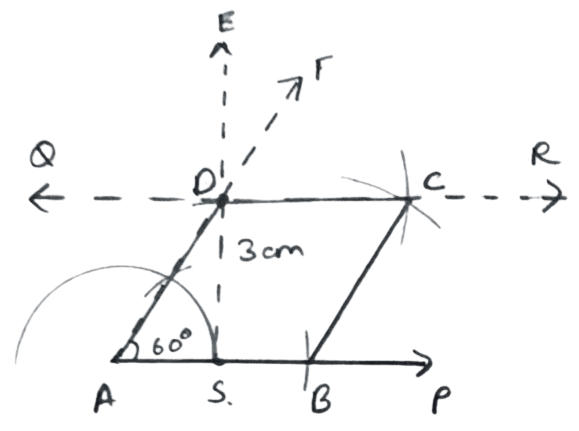
Hence, ABCD is the required rhombus.
Diagonal AC = 6.0 cm and height = 3.5 cm.
Answer
Steps of construction :
Draw a line segment AP.
Draw PX ⊥ AP.
From PX, cut PZ = 3.5 cm.
Through Z, draw EF || AP.
With A as center and radius equal to 6 cm draw an arc cutting EF at C.
Draw QR, perpendicular bisector of AC meeting AP at B.
Join BC.
With A and C as center and radius equal to BC in both cases draw arcs cutting each other at D.
Join AD and CD.
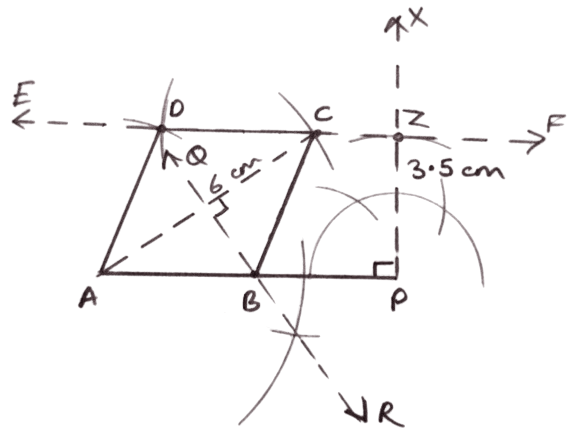
Hence, ABCD is the required rhombus.
Construct a square ABCD, when :
One side = 4.5 cm.
Answer
Steps of construction :
Draw a line segment AB = 4.5 cm.
Draw AP ⊥ AB.
From AP cut off AD = 4.5 cm.
With B as a center and radius 4.5 cm draw an arc.
With D as center and radius 4.5 cm draw another arc cutting the former arc at C.
Join BC and CD.
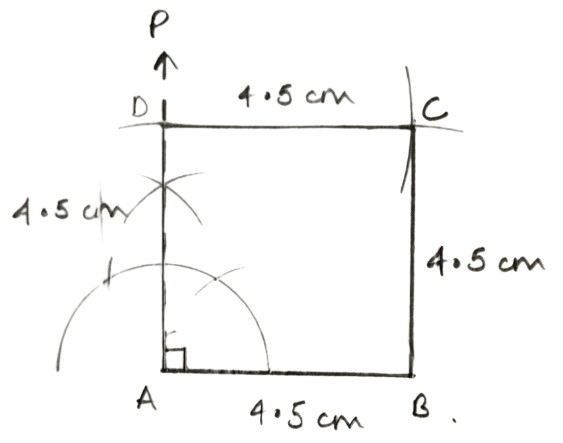
Hence, ABCD is the required square.
One diagonal = 5.4 cm.
Answer
Steps of construction :
Draw AC = 5.4 cm.
Draw XY, the perpendicular bisector of AC, meeting AC at O.
With O as center and radius equal to = 2.7 cm, draw an arc cutting XY at B and D.
Join AB, BC, CD, and DA.
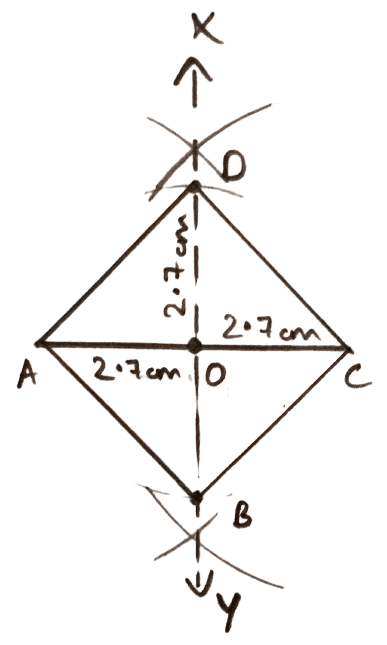
Hence, ABCD is the required square.
Perimeter = 24 cm.
Answer
We know that,
Perimeter of square = 4 × side
⇒ 24 = 4 × side
⇒ Side = = 6 cm.
Steps of construction :
Draw a line segment AB = 6 cm.
Draw AP ⊥ AB.
From AP cut off AD = 6 cm.
With B as a center and radius 6 cm draw an arc.
With D as center and radius 6 cm draw another arc cutting the former arc at C.
Join BC and CD.
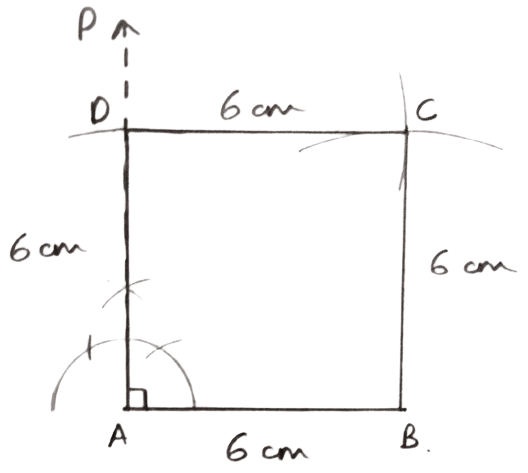
Hence, ABCD is the required square.
Construct a rhombus, having given one side = 4.8 cm and one angle = 75°.
Answer
Steps of construction :
Draw a line segment AB = 4.8 cm.
At A draw AX such that ∠BAX = 75°.
With A as center and radius equal to 4.8 cm draw an arc cutting AX at D.
Using the same radius taking D and B as centers cut off arcs, which will intersect at C.
Join CD and BC.

Hence, ABCD is the required rhombus.
Construct a regular hexagon of side
(i) 2.5 cm
(ii) 3.2 cm
Answer
(i) Steps of construction :
Draw a circle of radius 2.5 cm.
Taking any point A on the circumference of the circle as centre, draw arcs of same radii which cut the circumference at B and F.
With B and F as centers, again draw two arcs of same radii (2.5 cm) which cut the circumference at C and E respectively.
With C or E as center, draw one more arc of the same radius which cuts the circumference at point D.
Join AB, BC, CD, DE, EF and FA.

Hence, ABCDEF is the required regular hexagon.
(ii) Steps of construction :
Draw a circle of radius 3.2 cm.
Taking any point A on the circumference of the circle as centre, draw arcs of same radii which cut the circumference at B and F.
With B and F as centers, again draw two arcs of same radii (3.2 cm) which cut the circumference at C and E respectively.
With C or E as center, draw one more arc of the same radius which cuts the circumference at point D.
Join AB, BC, CD, DE, EF and FA.
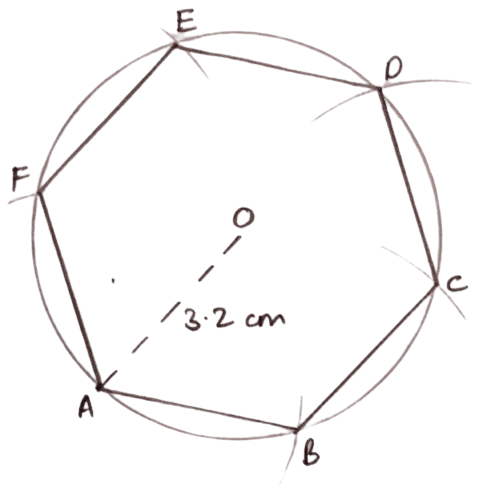
Hence, ABCDEF is the required regular hexagon.