
Insert a rational number and an irrational number between 5 and 6.
Answer
Since, 5 and 6 are positive rational numbers and 5 x 6 = 30 is not a perfect square, therefore :
(i) A rational number between 5 and 6 =
= = 5.5
∴ Rational number between 5 and 6 = 5.5.
(ii) An irrational number between 5 and 6 =
=
∴ Irrational number between 5 and 6 = .
Insert two rational numbers and two irrational numbers between and .
Answer
Since, square of = 3 and square of = 8.
(i) Choose any two rational numbers between 3 and 8 each of which is a perfect square.
The square roots of such numbers will be requires rational numbers.
Let the numbers be 4 and 5.76, where = 2 and = 2.4
∴ Required rational numbers are 2 and 2.4.
(ii) Now, choose any two rational numbers between 3 and 8 each of which is not a perfect square. The square root of such numbers will be the required irrational numbers.
Let the numbers be 5 and 6.
∴ and are the required irrational numbers.
Insert three irrational numbers between 5 and 7.
Answer
Since, 5 = and 7 = .
∴ Each of , , is an irrational number between 5 and 7.
State which of following real numbers are :
-8, 0, , , , , 4.28, π, 3, , 0.075
(i) rational
(ii) irrational
(iii) positive integers
(iv) negative integers
(v) neither positive nor negative.
Answer
(i) rational : -8, 0, , 4.28, 3, , 0.075
Reason : All numbers that can be expressed in the form , q ≠ 0 and p, q are integers are called rational numbers.
(ii) irrational : , , , π
Reason : Numbers that cannot be expressed in the form are called irrational numbers.
(iii) positive integers : 3
Reason :Positive integers are whole numbers greater than 0, excluding fractions and decimals.
(iv) negative integers : -8
Reason :Negative integers are whole numbers less than 0, excluding fractions and decimals.
(v) neither positive nor negative : 0
Reason :The number 0 is neutral and does not fall under positive or negative categories.
Examine whether the following numbers are rational or irrational :
(i)
(ii)
(iii)
(iv)
(v)
Answer
(i)
Since, 14 is rational, is irrational and we know that the sum of a rational and an irrational number is always irrational.
∴ (14 - ) is an irrational number.
Hence, is an irrational number.
(ii)
∴ 42 is a rational number.
Hence, is a rational number.
(iii)
Since, 30 is rational, is irrational and we know that the sum of a rational and an irrational number is always irrational.
∴ (30 + ) is an irrational number.
Hence, is an irrational number.
(iv)
∴ -6 is a rational number.
Hence, is a rational number.
(v)
∴ 30 is a rational number.
Hence, is a rational number.
Write the least (smallest) rationalising factor of :
(i)
(ii)
(iii)
(iv)
(v)
Answer
(i)
And, = 6, which is a rational number.
Hence, the least (smallest) rationalising factor of .
(ii)
And, , which is a rational number.
Hence, the least (smallest) rationalising factor of .
(iii)
And, , which is a rational number.
Hence, the least (smallest) rationalising factor of .
(iv) = 1, which is a rational number.
Hence, the least (smallest) rationalising factor of .
(v) , which is a rational number.
Hence, the least (smallest) rationalising factor of .
Rationalise the denominator and simplify :
Answer
Since, the denominator = , its rationalizing factor = .
Hence, .
Rationalise the denominator and simplify :
Answer
Since, the denominator = , its rationalizing factor = .
Hence, .
Rationalise the denominator and simplify :
Answer
Since, the denominator = , its rationalizing factor = .
Hence, .
Rationalise the denominator and simplify :
Answer
Since, the denominator = , its rationalizing factor = .
Hence, .
Rationalise the denominator and simplify :
Answer
Since, the denominator = , its rationalizing factor = .
Hence, .
Rationalise the denominator and simplify :
Answer
Since, the denominator = , its rationalizing factor = .
Hence, .
Simplify :
Answer
Hence, .
Simplify :
Answer
Hence, .
Simplify :
Answer
Hence, .
Simplify :
Answer
Hence, .
Find the value of m and n: if:
Answer
Given :
⇒
Hence, m = and n = .
Find the value of m and n: if:
Answer
Given :
⇒
Hence, m = 11 and n = -6.
By rationalising the denominator of each of the following; find, in each case, the value correct to two significant figures :
(i)
(ii)
(iii)
Answer
(i) Since, the denominator = , its rationalizing factor = .
Hence, = 0.63.
(ii) Since, the denominator = , its rationalizing factor = .
Hence, = 0.27.
(iii) Since, the denominator = , its rationalizing factor = .
Hence, = 5.12.
Calculate the compound interest on ₹ 18,000 at 10% per annum in two years.
Answer
For the first year:
P = ₹ 18,000, R = 10 %, T = 1 year
Amount at the end of first year = P + I
= ₹ 18,000 + 1,800
= ₹ 19,800
For the second year:
P = ₹ 19,800, R = 10 %, T = 1 year
Amount at the end of second year = P + I
= ₹ 19,800 + 1,980
= ₹ 21,780
Compound Interest = Final amount - Initial Principal
= ₹ 21,780 - ₹ 18,000
= ₹ 3,780
Hence, the compound interest at the end of second year = ₹ 3,780.
Manoj invests ₹ 12,000 for 3 years at 10% per annum. Calculate the amount and the compound interest that Manoj will get at the end of 3 years.
Answer
For the first year:
P = ₹ 12,000, R = 10 %, T = 1 year
Amount at the end of first year = P + I
= ₹ 12,000 + 1,200
= ₹ 13,200
For the second year:
P = ₹ 13200, R = 10 %, T = 1 year
Amount at the end of second year = P + I
= ₹ 13,200 + 1,320
= ₹ 14,520
For the third year:
P = ₹ 14,520, R = 10 %, T = 1 year
Amount at the end of third year = P + I
= ₹ 14,520 + 1,452
= ₹ 15,972
Compound Interest = Final amount - Initial Principal
= ₹ 15,972 - ₹ 12,000
= ₹ 3,972
Hence, at the end of the third year, the amount is ₹15,972, and the compound interest is ₹3,972.
A sum of ₹ 1,536; put at compound interest, amounts to ₹ 1,632 in one year. How much would it amount to in the second year ?
Answer
Given, Principal = ₹ 1,536, Amount = ₹ 1,632, T = 1 year
Interest = Amount - Principal
= ₹ 1,632 - ₹ 1,536
= ₹ 96
For second year:
P = ₹ 1,632, T = 1 year, R = 6.25 %
Amount at the end of second year = P + I
= ₹ 1,632 + 102
= ₹ 1,734
Hence, the amount at the end of second year = ₹ 1,734.
Calculate the compound interest for the second year on ₹ 12,000 invested for 3 years at 10% per year. Also, find the sum due at the end of the third year.
Answer
For the first year:
P = ₹ 12,000, R = 10 %, T = 1 year
Amount at the end of first year = P + I
= ₹ 12,000 + 1,200
= ₹ 13,200
For the second year:
P = ₹ 13,200, R = 10 %, T = 1 year
Amount at the end of second year = P + I
= ₹ 13,200 + 1,320
= ₹ 14,520
For the third year:
P = ₹ 14,520, R = 10 %, T = 1 year
Amount at the end of third year = P + I
= ₹ 14,520 + 1,452
= ₹ 15,972
Hence, the compound interest for the second year = ₹ 1,320 and the sum due at the end of the third year = ₹ 15,972.
A certain sum, at compound interest, becomes ₹ 7,396 in 2 years and ₹ 7,950.70 in 3 years. Find the rate of interest.
Answer
Let the rate of interest be R %.
Amount for 2 years = ₹ 7,396
Amount for 3 years = ₹ 7,950.70
Interest for 3rd year = Amount for third year - Amount for second year
= ₹ 7,950.70 - ₹ 7,396
= ₹ 554.70
For the third year:
P = ₹ 7,396, R = R %, T = 1 year, I = ₹ 554.70
Hence, the rate of interest = 7.5 %.
The value of a car is depreciating at 5% per year and is ₹ 3,15,875 after 2 years. What was its original price ?
Answer
Let the original cost of the car = ₹ 100
∴ Depreciation during 1st year = 5 % of ₹ 100 = = ₹ 5
Value of the car at the beginning of 2nd year = ₹ 100 - ₹ 5 = ₹ 95
∴ Depreciation during 2nd year = 5 % of ₹ 95 = = ₹ 4.75
Value of the car at the 2nd year = ₹ 95 - ₹ 4.75 = ₹ 90.25
Now, final value of car = ₹ 90.25, original cost = ₹ 100
⇒ When the value of car during the 2nd year = ₹ 3,15,875
Original cost = = 3,50,000
Hence, the value of car = ₹ 3,50,000.
A sum of money is lent at 8% per annum compound interest. If the interest for the second year exceeds that for the first year by ₹ 32, find the sum of money.
Answer
Let the sum (principal) = ₹ 100
For the first year :
P = ₹ 100, R = 8 %, T = 1 year
Amount at the end of first year = P + I
= ₹ 100 + 8
= ₹ 108
For the second year :
P = ₹ 108, R = 8 %, T = 1 year
Difference between the C.I. for the first year and the C.I. for the second year = ₹ 8.64 - 8 = ₹ 0.64
Now, when the difference of interest = ₹ 0.64 , sum = ₹ 100
And, when the difference of interest = ₹ 32 , sum = ₹
= ₹ 5,000
Hence, the sum of money = ₹ 5,000.
A man invests ₹ 7,000 for three years, at a certain rate of interest, compounded annually. At the end of one year it amounts to ₹ 7,980.
Calculate :
(i) the rate of interest per annum.
(ii) the interest accrued in the second year.
(iii) the amount at the end of the third year.
Answer
(i) Let R be the rate of interest.
For the first year :
P = ₹ 7,000, R = R %, T = 1 year, A = ₹ 7,980
Amount at the end of first year = P + I
⇒ 7,980 = ₹ 7,000 + I
⇒ I = 980
Hence, the rate of interest p.a. = 14 %.
(ii) For the second year :
P = ₹ 7,980, R = 14 %, T = 1 year
Hence, the interest accrued in the second year = ₹ 1,117.2.
(iii) Principal for third year = P + I
= ₹ 7,980 + ₹ 1,117.2
= ₹ 9,097.2
P = ₹ 9,097.2, R = 14 %, T = 1 year
Amount for the third year = P + I
= ₹ 9,097.2 + ₹ 1,273.60
= ₹ 10,370.80
Hence, the amount at the end of the third year = ₹ 10,370.80.
₹ 8,000 were invested at 5% per annum C.I compounded annually. Find :
(i) the amount at the end of the second year.
(ii) the interest for the third year.
Answer
(i) For the first year :
P = ₹ 8,000, R = 5 %, T = 1 year
Amount at the end of first year = P + I
= ₹ 8,000 + 400
= ₹ 8,400
For the second year :
P = ₹ 8,400, R = 5 %, T = 1 year
Amount at the end of second year = P + I
= ₹ 8,400 + 420
= ₹ 8,820
Hence, the amount at the end of the second year = ₹ 8,820.
(ii) For the third year :
P = ₹ 8,820, R = 5 %, T = 1 year
Hence, the interest for the third year = ₹ 441.
Simple interest on a certain sum of money at 9% is ₹ 450 in 2 years. Find the compound interest, on the same sum, at the same rate for 1 year, if the interest is reckoned half yearly.
Answer
Given, R = 9 %, S.I. = ₹ 450, T = 2 years
Let P be the principal amount.
For 1st year :
P = ₹ 2,500, R = 9 % , T = year
A = P + I
= ₹ 2,500 + 112.5
= ₹ 2,612.5
For 2nd year :
P = ₹ 2,612.5, R = 9 %, T = year
A = P + I
= ₹ 2,612.5 + 117.56
= ₹ 2,730.06
Compound Interest = Final amount - Initial principal
= ₹ 2,730.06 - 2,500
= ₹ 230.06
Hence, the compound interest = ₹ 230.06.
Find the difference between simple interest and compound interest on ₹ 4,000 for two years at 10% per annum.
Answer
P = ₹ 4,000, R = 10 %, T = 2 years
C.I. = P - P
= 4,000 x - 4,000
= 4,000 x - 4,000
= 4,000 x - 4,000
= 4,000 x 1.21 - 4,000
= 4,840 - 4,000
= 840
The Difference between C.I. and S.I. = ₹ 840 - 800 = ₹ 40
Hence, the difference between simple interest and compound interest = ₹ 40.
Simple interest on a certain sum of money for 3 years at 5% per annum is ₹ 600. Find the amount due and compound interest on this sum at the same rate after 3 years, the interest being reckoned annually.
Answer
Let P be the sum of money.
R = 5 %, T = 3 years, I = ₹ 600
For compound interest,
P = ₹ 4,000, R = 5 %, n = 3 years
A = P
= 4,000 x
= 4,000 x
= 4,000 x
= 4,000 x 1.157625
= 4,630.5
Compound Interest = Amount - Principal
= 4,630.5 - 4,000
= 630.5
Hence, the amount = ₹ 4,630.5 and compound interest = ₹ 630.5.
On what sum of money will the difference between simple interest and compound interest for 2 years at 5% per annum be equal to ₹ 50 ?
Answer
Let P be the sum of money.
R = 5 %, T = 2 years
C.I. = P - P
= P x - P
= P x - P
= P x - P
= 1.1025P - P
= 0.1025P
The difference between S.I. and C.I. = C.I. - S.I. = 50
⇒ 50 = 0.1025P - 0.1P
⇒ 50 = 0.0025P
⇒ P =
⇒ P =
⇒ P = 20,000
Hence, the sum of money = ₹ 20,000.
The difference between compound and simple interest on a sum of money deposited for 2 years at 5% per annum is ₹ 12. Find the sum of money.
Answer
Let P be the sum of money.
R = 5 %, T = 2 years
C.I. = P - P
= P x - P
= P x - P
= P x - P
= 1.1025P - P
= 0.1025P
Now, difference between S.I. and C.I. = C.I. - S.I. = 50
⇒ 12 = 0.1025P - 0.1P
⇒ 12 = 0.0025P
⇒ P =
⇒ P =
⇒ P = 4,800
Hence, the sum of money = ₹ 4,800.
A man invests ₹ 3,000 for three years at compound interest. After one year, the money amounts to ₹ 3,240. Find the rate of interest and the amount (to the nearest rupee) due at the end of 3 years.
Answer
Let R be the rate of interest.
For the first year:
P = ₹ 3,000, R = R %, T = 1 years, A = ₹ 3,240
Compound Interest = Amount - Principal
= ₹ 3,240 - ₹ 3,000
= ₹ 240
P = ₹ 3,000, R = 8 %, T = 3 years
Amount in 3 years = P
= 3,000 x
= 3,000 x
= 3,000 x
= 3,000 x 1.259
= 3,779
Hence, the rate of interest = 8 % and the amount = ₹ 3,779.
A sum of ₹ 40,000 was lent for one year at 16% per annum. If the same sum is lent for the same time and at the same rate percent but compounded half-yearly, how much more will the interest be ?
Answer
For compound annually:
P = ₹ 40,000, R = 16 %, T = 1 year
C.I. = P - P
= 40,000 x - 40,000
= 40,000 x - 40,000
= 40,000 x - 40,000
= 46,400 - 40,000
= ₹ 6,400
For compound half-yearly:
P = ₹ 40,000, R = % = 8 %, T = 1 x 2 = 2 years
C.I. = P - P
= 40,000 x - 40,000
= 40,000 x - 40,000
= 40,000 x - 40,000
= 40,000 x 1.1664 - 40,000
= 46,656 - 40,000
= ₹ 6,656
Difference between the compound interest = 6,656 - 6,400
= ₹ 256
Hence, the compound interest is ₹ 256 more when compounded half-yearly.
Find the amount on ₹ 36,000 after 2 years, compounded annually, the rate of interest being 10% for the first year and 12% for the second year.
Answer
P = ₹ 36,000, R1 = 10 %, R2 = 12 %, T = 2 year
A = P
= ₹ 36,000
= ₹ 36,000
= ₹ 36,000 x 1.1 x 1.12
= ₹ 44,352
Hence, the amount at the end of second year = ₹ 44,352.
Find, to the nearest rupee, the amount and the compound interest on ₹ 9,000 for years at 8% per annum, the interest being compounded half-yearly.
Answer
The interest being compounded half-yearly
P = ₹ 9,000, R = % = 4 %, T = = 3 years
A = P
= 9,000 x
= 9,000 x
= 9,000 x
= 9,000 x 1.12
= 10,123.77 ≈ 10,124
Compound Interest = Amount - Principal
= 10,123.77 - 9,000
= 1,123.77 ≈ 1,124
Hence, the amount = ₹ 10,124 and the compound interest = ₹ 1,124.
The difference between the compound interest and the simple interest accrued on an amount of ₹ 18,000 in 2 years is ₹ 405. Find the rate of interest per annum.
Answer
Let the rate of interest per year = R %
P = ₹ 18,000, R = R %, T = 2 years
S.I. =
S.I. in 2 years =
= ₹ 360R
And, C.I. in 2 years = A - P
= 18,000 - 18,000
Given, C.I. - S.I. = ₹ 405
⇒ 18,000 - 18,000 - 360R = 405
⇒ 18,000 - 18,000 - 360R = 405
⇒ - 18,000 - 360R = 405
⇒ + 360R - 360R = 405
⇒ = 405
⇒
⇒
⇒
⇒
⇒ R = 15 %
Hence, the rate of interest = 15 %.
The cost of a car, purchased 2 years ago, depreciates at the rate of 20% per year. If its present value is ₹ 3,15,600; find :
(i) its value after 2 years.
(ii) its value, when it was purchased 2 years ago.
Answer
(i) The present value of the car = ₹ 3,15,600
Depreciation during the 1st year = 20 % of ₹ 3,15,600 = = ₹ 63,120
Value of the car at the beginning of 2nd year = ₹ 3,15,600 - ₹ 63,120 = ₹ 2,52,480
Depreciation during the 2nd year = 20 % of ₹ 2,52,480 = = ₹ 50,496
Value of the car after the 2nd year = ₹ 2,52,480 - ₹ 50,496 = ₹ 2,01,984
Hence, the value of the car after 2 years = ₹ 2,01,984.
(ii) Let the original cost of the car = ₹ 100
Depreciation during the 1st year = 20 % of ₹ 100 = = ₹ 20
Value of the car at the beginning of the 2nd year = ₹ 100 - ₹ 20 = ₹ 80
Depreciation during the 2nd year = 20 % of ₹ 80 = = ₹ 16
Value of the car after 2 years = ₹ 80 - ₹ 16 = ₹ 64
Now, the final value of the car = ₹ 64, original cost = ₹ 100
⇒ The total value of the car = ₹ 3,15,600
Original cost = = ₹ 4,93,125
Hence, the value of the car when purchased = ₹ 4,93,125.
If ; find :
(i)
(ii)
Answer
(i) Given,
Squaring both sides, we get
Hence, = 2.
(ii)
Squaring both sides, we get
Hence, = 2.
If ; find : .
Answer
Given,
Squaring both sides, we get
Now,
Hence, = 20.
If a + b = 4 and ab = 3; find
Answer
Given, a + b = 4 and ab = 3.
We need to find the value of:
Putting the value of (a + b) and ab,
Hence, .
If , find the values of :
(i)
(ii)
(iii)
Answer
(i) Given,
Subtracting 2 from both sides, we get
Hence, .
(ii) Given,
Adding 2 on both sides, we get
Hence, .
(iii) Given,
Hence, .
If ; find .
Answer
Given:
Squaring both sides, we get
Now,
Hence, .
If a + b = 7 and ab = 6, find .
Answer
Given, a + b = 7 and ab = 6.
We need to find the value of (a - b),
Substituting the value of (a + b) and ab, we get:
We need to find the value of, = (a - b)(a + b)
= 5 x 7 or (-5) x 7
= 35 or -35
Hence, = 35 or -35.
If and ab = 6, find :
(i) a + b
(ii) a - b
(iii)
(iv)
Answer
(i) Given, and ab = 6
We need to find the value of (a + b),
Substituting the value of and ab,
Hence, a + b = 5 or -5.
(ii) We need to find the value of (a - b),
Substituting the value of and ab,
Hence, a - b = 1 or -1.
(iii) = (a - b)(a + b)
Using (i) and (ii),
When (a - b) = 1 and (a + b) = 5
⇒ = 1 x 5
= 5
When (a - b) = -1 and (a + b) = 5
⇒ = -1 x 5
= -5
When (a - b) = 1 and (a + b) = -5
⇒ = 1 x (-5)
= -5
When (a - b) = -1 and (a + b) = -5
⇒ = (-1) x (-5)
= 5
Hence, = 5 or -5.
(iv)
From (i) and (ii),
a - b = 1 or -1
⇒ (a - b)2 = 12 or (-1)2
⇒ (a - b)2 = 1
And, a + b = 5 or -5
⇒ (a + b)2 = 52 or (-5)2
⇒ (a + b)2 = 25
So,
Hence, = 73.
If , find the value of .
Answer
Given,
Squaring both sides, we get:
Hence, = 11.
If , find :
(i)
(ii)
(iii)
(iv)
Answer
(i) Given,
Hence, = 5.
(ii) From equation (i),
Squaring both sides, we get:
Adding 2 on both sides, we get:
Hence, .
(iii) We can write,
From (i) and (ii),
=
Hence, .
(iv)
From equation (A), .
Hence, .
If x - y = 7 and find :
(i) xy
(ii)
Answer
(i) Given, x - y = 7 and
Using the formula :
Substituting the values, we get:
Hence, the value of xy = -10.
(ii) (x - y) = 7
Squaring both sides, we get:
From equation (i),
Hence, .
Factorise :
Answer
Hence, = (b + c - a)(b + c + a).
Factorise :
Answer
Hence, = (a - b + c)(a + b - c).
Factorise :
Answer
Hence, .
Factorise :
Answer
Hence, .
Factorise :
Answer
Hence, .
Factorise :
Answer
Hence, .
Factorise :
Answer
Hence, .
Factorise :
Answer
Hence, .
Factorise :
Answer
Hence, .
Factorise :
Answer
Hence, .
Factorise :
Answer
Hence, .
Factorise :
Answer
Hence, .
Factorise :
Answer
Hence, .
Factorise :
Answer
Hence, .
Factorise :
Answer
Hence, .
Factorise :
Answer
Hence, .
Factorise :
Answer
Hence,.
Factorise :
Answer
Hence,
Factorise :
Answer
Hence, .
Factorise :
Answer
Hence, .
Factorise :
Answer
Let t = (3x - 2y).
Hence, .
Factorise :
Answer
Hence, .
Factorise :
Answer
Let t = (2x - y).
Hence, .
Factorise :
Answer
Hence, .
Factorise :
Answer
Hence, .
Factorise :
Answer
Hence,.
Solve :
3x-5y+1=0
2x-y+3=0
Answer
3x - 5y = -1 ............... (1)
2x - y = -3 ............... (2)
Multiply 2 in the first equation and 3 in the second equation, then subtract both equations.
(3x - 5y = -1) x 2
(2x - y = -3) x 3
⇒ y = -
⇒ y = - 1
Substituting the value of y in equation (1), we get:
⇒ 3x - 5 (-1) = -1
⇒ 3x + 5 = -1
⇒ 3x = -1 - 5
⇒ 3x = -6
⇒ x = -
⇒ y = - 2
Hence, the value of x = -2 and y = -1.
Solve :
3x + 2y = 14
-x + 4y = 7
Answer
3x + 2y = 14 ............... (1)
-x + 4y = 7 ............... (2)
Multiply 1 in the first equation and 3 in the second equation, then add both equations.
(3x + 2y = 14) x 1
(-x + 4y = 7) x 3
⇒ y =
⇒ y = 2.5
Substituting the value of y in equation (1), we get:
⇒ 3x + 2 2.5 = 14
⇒ 3x + 5 = 14
⇒ 3x = 14 - 5
⇒ 3x = 9
⇒ x =
⇒ x = 3
Hence, the value of x = 3 and y = 2.5.
Solve :
2x + 7y = 11
5x + = 25
Answer
2x + 7y = 11 ............... (1)
5x + = 25 ............... (2)
Multiply 5 in the first equation and 2 in the second equation, then subtract both equations.
(2x + 7y = 11) x 5
(5x + = 25) x 2
⇒ 10x + 35y = 55
10x + 35y = 50
This means there is no pair of values for x and y that satisfies both equations.
Hence, there is no solution for x and y.
Solve :
8x + 13y - 29 = 0
12x - 7y - 17 = 0
Answer
8x + 13y - 29 = 0 ............... (1)
12x - 7y - 17 = 0 ............... (2)
Multiply 3 in the first equation and 2 in the second equation, then subtract both equations.
⇒ (8x + 13y = 29) x 3
(12x - 7y = 17) x 2
⇒ y =
⇒ y = 1
Substituting the value of y in equation (1), we get:
⇒ 8x + 13 1 = 29
⇒ 8x + 13 = 29
⇒ 8x = 29 - 13
⇒ 8x = 16
⇒ x =
⇒ x = 2
Hence, the value of x = 2 and y = 1.
Solve :
12x + 15y + 18 = 0
18x - 7y + 86 = 0
Answer
12x + 15y + 18 = 0 ............... (1)
18x - 7y + 86 = 0 ............... (2)
Multiply 3 in the first equation and 2 in the second equation, then subtract both equations.
(12x + 15y = -18) x 3
(18x - 7y = -86) x 2
⇒ y =
⇒ y = 2
Substituting the value of y in equation (1), we get:
⇒ 12x + 15 2 = -18
⇒ 12x + 30 = -18
⇒ 12x = -18 - 30
⇒ 12x = -48
⇒ x = -
⇒ x = -4
Hence, the value of x = -4 and y = 2.
Solve :
3(2x + y) = 7xy
3(x + 3y) = 11xy; x ≠ 0, y ≠ 0
Answer
6x + 3y = 7xy
3x + 9y = 11xy
Multiply 1 in the first equation and 2 in the second equation, then subtract both equations.
(6x + 3y = 7xy) x 1
(3x + 9y = 11xy) x 2
⇒ x =
⇒ x = 1
Substituting the value of x in equation (1), we get:
⇒ 6x + 3y = 7xy
⇒ 6 1 + 3y = 7 1 y
⇒ 6 + 3y = 7y
⇒ 6 = 7y - 3y
⇒ 4y = 6
⇒ y =
⇒ y =
Hence, the value of x = 1 and y = .
Solve : and .
Hence, find 'm' for which y = mx - 4.
Answer
Lets take = u and = v. The given equation becomes,
2u + v = ⇒ 12u + 4v = 1
And, 3u + 2v = 0
Multiply second equation by 4 and subtract from first equation, we get
(3u + 2v = 0) x 4
⇒ v = -
Substituting the value of v in equation (2), we get:
⇒ 3u + 2 = 0
⇒ 3u - = 0
⇒ 3u =
⇒ u =
So, x = = 6 and y = = -4
Substituting the value of x and y in y = mx - 4, we get:
⇒ -4 = m 6 - 4
⇒ -4 + 4 = 6m
⇒ 0 = 6m
⇒ m =
⇒ m = 0
Hence, the value of x = 6 , y = -4 and m = 0.
Solve : and .
Hence, find the value of 'k', if y = kx - 2.
Answer
Lets take = u, we get
4x + 6u = 15
6x - 8u = 14
Multiply first equation by 3 and second equation by 2, then subtract both equations.
(4x + 6u = 15) x 3
(6x - 8u = 14) x 2
⇒ u =
⇒ u =
Substituting the value of u in first equation, we get:
⇒ 4x + 6 = 15
⇒ 4x + 3 = 15
⇒ 4x = 15 - 3
⇒ 4x = 12
⇒ x =
⇒ x = 3
So, y = = 2
Now, put the value of x and y in y = kx - 2,
⇒ 2 = k 3 - 2
⇒ 2 + 2 = k 3
⇒ k 3 = 4
⇒ k =
Hence, the value of x = 3 , y = 2 and k = .
Solve :
3(2u + v) = 7 uv
3(u + 3v) = 11 uv
Answer
6u + 3v = 7uv
3u + 9v = 11uv
Multiply second equation by 2 and subtract from first equation, we get
(3u + 9v = 11uv) x 2
⇒ u =
⇒ u = 1
Substituting the value of u in first equation, we get:
⇒ 6 x 1 + 3v = 7 x 1 x v
⇒ 6 + 3v = 7v
⇒ 7v - 3v = 6
⇒ 4v = 6
⇒ v =
⇒ v =
Hence, the value of u = 1 and v = .
Solve :
and
Answer
Let = u and = v.
The given equations are :
3u + 2v = 2
9u - 4v = 1
Multiply the first equation by 3 and subtract the second equation from it.
⇒ (3u + 2v = 2) x 3
⇒ v =
⇒ v =
Substituting the value of v in first equation, we get:
⇒ 3u + 2 = 2
⇒ 3u + 1 = 2
⇒ 3u = 2 - 1
⇒ 3u = 1
⇒ u =
So, x + y = = 3 and x - y = = 2
⇒ x + y = 3
And, x - y = 2
Adding both the equations, we get:
⇒ x =
Substituting the value of x in first equation, we get:
⇒ + y = 3
⇒ y = 3 -
⇒ y =
⇒ y =
Hence, the value of x = and y = .
Solve :
217x + 131y = 913
131x + 217y = 827
Answer
On adding both equations, we get:
⇒ 348x + 348y = 1740
⇒ 348(x + y) = 1740
⇒ x + y =
⇒ x + y = 5 ..................(1)
On subtracting both equations, we get:
⇒ 86x - 86y = 86
⇒ 86(x - y) = 86
⇒ x - y =
⇒ x - y = 1 ..................(2)
On adding equations (1) and (2), we get:
⇒ x =
⇒ x = 3
Substituting the value of x in equation (1), we get:
⇒ 3 + y = 5
⇒ y = 5 - 3
⇒ y = 2
Hence, the value of x = 3 and y = 2.
Use method of cross-multiplication to solve :
(i) 2x + y = 8 and 3x - 2y = 5
(ii) x + 4y = 3 and 2x + 9y = 5
Answer
(i) Given, equations :
⇒ 2x + y = 8 and 3x - 2y = 5
⇒ 2x + y - 8 = 0 ...............(1)
⇒ 3x - 2y - 5 = 0 ...............(2)
If the two equations are a1x + b1y + c1 = 0 and a2x + b2y + c2 = 0.
By cross-multiplication method :
Now substitute the values, we get:
⇒
⇒
⇒
⇒ x = and y =
⇒ x = 3 and y = 2
Hence, the value of x = 3 and y = 2.
(ii) Given, equations :
⇒ x + 4y = 3 and 2x + 9y = 5
⇒ x + 4y - 3 = 0 ...............(1)
⇒ 2x + 9y - 5 = 0 ...............(2)
If the two equation are a1x + b1y + c1 = 0 and a2x + b2y + c2 = 0.
By using the method of cross - multiplication
Now substitute the values, we get:
⇒
⇒
⇒
⇒ x = and y =
⇒ x = 7 and y = -1
Hence, the value of x = 7 and y = -1.
Seven times a two digit number is equal to four times the number obtained by reversing the order of digits. Find the number, if the difference between its digits is 3.
Answer
Let the digit at tens place be x and the digit at unit place be y.
Number = 10x + y
Number on reversing the digits = 10y + x
And, the difference between the digits = x - y or y - x
Given:
⇒ 7(10x + y) = 4(10y + x)
⇒ 70x + 7y = 40y + 4x
⇒ 70x - 4x = 40y - 7y
⇒ 66x = 33y
⇒
⇒ y = 2x ............... (1)
x - y = 3 ............... (2)
Or
y - x = 3 ............... (3)
On solving equations (1) and (2), we get:
x - 2x = 3
x = -3
y = 2 * (-3) = -6
Number = 10x + y = 10 * (-3) + (-6) = -30 - 6 = -36
This case gives a result where the digits are negative (-3 and -6), which is not possible for a two-digit number.
On solving equations (1) and (3), we get:
2x - x = 3
x = 3
y = 2 * (3) = 6
Number = 10x + y = 10 * (3) + (6) = 30 + 6 = 36
Hence, the number = 36.
A and B each have a certain number of mangoes. A says to B, "If you give 30 of your mangoes, I will have twice as many as left with you". B replies, "If you give me 10, I will have thrice as many as left with you". How many mangoes does each have ?
Answer
Let A has x number of mangoes and B has y number of mangoes.
In 1st case (if B gives 30 mangoes to A):
⇒ x + 30 = 2(y - 30)
⇒ x + 30 = 2y - 60
⇒ x = 2y - 60 - 30
⇒ x = 2y - 90 ...............(1)
In 2nd case (if A gives 10 mangoes to B):
y + 10 = 3(x - 10)
⇒ y + 10 = 3x - 30
⇒ y = 3x - 30 - 10
⇒ y = 3x - 40 ...............(2)
On solving equations (1) and (2), we get :
⇒ y = 3(2y - 90) - 40
⇒ y = 6y - 270 - 40
⇒ y = 6y - 310
⇒ 6y - y = 310
⇒ 5y = 310
⇒ y =
⇒ y = 62
From equation (1),
⇒ x = 2 x 62 - 90
⇒ x = 124 - 90
⇒ x = 34
Hence, A has 34 mangoes and B has 62 mangoes.
A man rowing at the rate of 5 km an hour in still water takes thrice as much time in going 40 km up the river as in going 40 km down. Find the rate at which the river flows.
Answer
Let the rate of flow of the river be x km/h.
The man's speed in still water = 5 km/h.
The effective speeds of the man while rowing upstream and downstream are:
Upstream speed = (5 - x) km/h
Downstream speed = (5 + x) km/h
The time taken to row 40 km upstream:
tup =
The time taken to row 40 km downstream:
tdown =
It is given that the time taken upstream is three times the time taken downstream:
⇒ tup = 3tdown
Hence, the rate at which the river flows = 2.5 km/h.
If 1 is added to each of the two certain numbers; their ratio is 1 : 2 and if 5 is subtracted from each of the two numbers, their ratio becomes 5 : 11. Find the numbers.
Answer
Let x and y be two numbers.
Given:
Cross multiplying both sides,
⇒ (x + 1) 2 = (y + 1) 1
⇒ 2x + 2 = y + 1
⇒ y = 2x + 2 - 1
⇒ y = 2x + 1 ...................(1)
Given:
Cross multiplying both sides,
⇒ (x - 5) 11 = (y - 5) 5
⇒ 11x - 55 = 5y - 25
⇒ 5y = 11x - 55 + 25
⇒ 5y = 11x - 30
On solving equations (1) and (2), we get :
⇒ 5 (2x + 1) = 11x - 30
⇒ 10x + 5 = 11x - 30
⇒ 11x - 10x = 5 + 30
⇒ x = 35
From equation (1),
⇒ y = 2 35 + 1
= 70 + 1
= 71
Hence, the two numbers are 35 and 71.
The area of a rectangle increases by 200 sq. m, if the length is increased by 8 m and the breadth by 3 m. The area increases by 255 sq. m, if the length is increased by 3 m and breadth by 8 m. Find the length and the breadth of the rectangle.
Answer
Let 'l' be the length of the rectangle and 'b' be the breadth of the rectangle.
Area of the rectangle = length x breadth = lb
When the length is increased by 8m and breadth by 3 m, area is increases by 200 sq.m,
⇒ (l + 8)(b + 3) = lb + 200
⇒ l(b + 3) + 8(b + 3) = lb + 200
⇒ lb + 3l + 8b + 24 = lb + 200
⇒ 3l + 8b + 24 = 200
⇒ 3l + 8b = 200 - 24
⇒ 3l + 8b = 176.................(1)
When the length is increased by 3m and breadth by 8m, area is increases by 255 sq.m,
⇒ (l + 3)(b + 8) = lb + 255
⇒ l(b + 8) + 3(b + 8) = lb + 255
⇒ lb + 8l + 3b + 24 = lb + 255
⇒ 8l + 3b + 24 = 255
⇒ 8l + 3b = 255 - 24
⇒ 8l + 3b = 231 ...............(2)
Solving the equation (1) and (2), we get
⇒ (3l + 8b = 176) x 8
(8l + 3b = 231) x 3
⇒ b =
⇒ b = 13
From equation (1), we get:
⇒ 3l + 8 x 13 = 176
⇒ 3l + 104 = 176
⇒ 3l = 176 - 104
⇒ 3l = 72
⇒ l =
⇒ l = 24
Hence, the length of the rectangle = 24 m and the breadth of the rectangle = 13 m.
If ; find the value of x .
Answer
Hence, the value of x = .
If and ; find the values of x and y .
Answer
On solving equations (1) and (2), we get:
⇒ (3x + 2y = 5) x 4
(4x - 3y = 1) x 3
⇒ y =
⇒ y = 1
Substituting the value of y in equation (1), we get:
⇒ 3x + 2 1 = 5
⇒ 3x + 2 = 5
⇒ 3x = 5 - 2
⇒ 3x = 3
⇒ x =
⇒ x = 1
Hence, the value of x = 1 and y = 1.
Given = ; find the value of x .
Answer
Hence, the value of x = .
Evaluate:
Answer
Hence, .
Evaluate:
Answer
Hence, .
If and ; prove that .
Answer
Let
⇒ , ,
⇒ , ,
Substitute the values of x, y and z in ,
Hence, .
Evaluate:
Answer
Hence, .
Evaluate:
Answer
Hence, .
If , find a.
Answer
Hence, the value of a = 5.
Solve for x and y, if :
and
Answer
Multiply equation (1) by 2 and equation (2) by 3, then subtract equation (2) from equation (1).
= 3x - 2y = 8
(x + 4y = 12) x 3 = 3x + 12y = 36
⇒ y =
⇒ y = 2
Substituting the value of y in equation (1), we get:
⇒ 3x - 2 2 = 8
⇒ 3x - 4 = 8
⇒ 3x = 8 + 4
⇒ 3x = 12
⇒ x =
⇒ x = 4
Hence, the value of x = 4 and y = 2.
If a = -1 and b = 2, find :
(i)
(ii)
(iii)
(iv)
Answer
(i)
Substituting the values a = -1 and b = 2,
Hence, .
(ii)
Substituting the values a = -1 and b = 2,
Hence, .
(iii)
Substituting the values a = -1 and b = 2,
Hence, .
(iv)
Substituting the values a = -1 and b = 2,
Hence, .
Find the value of : log3 27
Answer
Let log3 27 = x.
∴ 3x = 27
⇒ 3x = 33
⇒ x = 3
Hence, log3 27 = 3.
Find the value of : log5 625
Answer
Let log5 625 = x.
∴ 5x = 625
⇒ 5x = 54
⇒ x = 4
Hence, log5 625 = 4.
Find the value of : log2 0.125
Answer
Let log2 0.125 = x.
∴ 2x = 0.125
⇒ 2x =
⇒ 2x =
⇒ 2x = 8-1
⇒ 2x = (23)-1
⇒ 2x = 2-3
⇒ x = -3
Hence, log2 0.125 = -3.
Find the value of : log5 0.2
Answer
Let log5 0.2 = x.
∴ 5x = 0.2
⇒ 5x =
⇒ 5x =
⇒ 5x = 5-1
⇒ x = -1
Hence, log2 0.125 = -1.
Find the value of : log0.2 5
Answer
Let log0.2 5 = x.
∴ (0.2)x = 5
⇒
⇒
⇒ 5-x = 5
⇒ x = -1
Hence, log0.2 5 = -1.
Find the value of : log10 0.001
Answer
Let log10 0.001 = x.
∴ (10)x = 0.001
⇒ 10x =
⇒ 10x = 10-3
⇒ x = -3
Hence, log0.2 5 = -3.
If log 4 = 0.602 and log 27 = 1.431; find :
(i) log 8
(ii) log 12
Answer
Given, log 4 = 0.602
⇒ log = 0.602
⇒ 2log 2 = 0.602
⇒ log 2 =
⇒ log 2 = 0.301
And, log 27 = 1.431
⇒ log = 1.431
⇒ 3log 3 = 1.431
⇒ log 3 =
⇒ log 3 = 0.477
(i) log 8
= log
= 3 x log 2
= 3 x 0.301 (∵ Using log 2 = 0.301)
= 0.903
Hence, the value of log 8 = 0.903.
(ii) log 12
= log
= log 4 + log 3
= 0.602 + 0.477 (∵ Using log 4 = 0.602 and log 3 = 0.477)
= 1.079
Hence, the value of log 12 = 1.079.
Express in terms of log 2 and log 3 :
(i) log
(ii) log
Answer
(i) log
= log - log 27
= log - log
= log - 3log 3
= log - 3log 3
= log 2 - 3log 3
Hence, the value of log log 2 - 3log 3.
(ii) log
= log + log
= log + log
= log + log
= log + log + log
= log + log + log
= log 2 + log 3 + log 3
= log 2 + log 3
= log 2 + log 3
= log 2 + log 3
Hence, the value of log log 2 + log 3.
Simplify :
log - 2log + log
Answer
log - 2log + log
= (log 75 - log 16) - 2(log 5 - log 9) + (log 32 - log 243)
= log 75 - log 16 - 2log 5 + 2log 9 + log 32 - log 243
= log (3 x 25) - log - 2log 5 + 2log + log - log
= log 3 + log - 4log 2 - 2log 5 + 4log 3 + 5log 2 - 5log 3
= log 3 + 2log 5 - 4log 2 - 2log 5 + 4log 3 + 5log 2 - 5log 3
= (1 + 4 - 5)log 3 + (5 - 4)log 2 + (2 - 2)log 5
= 1 x log 2
= log 2
Hence, the value of log log + log = log 2.
Simplify :
2 log - log + 3 log
Answer
2 log - log + 3 log
= 2 (log 15 - log 8) - (log 25 - log 162) + 3 (log 4 - log 9)
= 2 log 15 - 2 log 8 - log 25 + log 162 + 3 log 4 - 3 log 9
= 2 log (3 x 5) - 2 log - log + log (81 x 2) + 3 log - 3 log
= 2 log 3 + 2 log 5 - 6 log 2 - 2 log 5 + log + log 2 + 6 log 2 - 6 log 3
= 2 log 3 + 2 log 5 - 6 log 2 - 2 log 5 + 4 log 3 + log 2 + 6 log 2 - 6 log 3
= (2 + 4 - 6)log 3 + (2 - 2)log 5 + (-6 + 1 + 6)log 2
= log 2
Hence, the value of 2 log - log + 3 log = log 2.
Let log x = 2m - 3n and log y = 3n - 2m. Find the value of log in terms of m and n.
Answer
Given: log x = 2m - 3n and log y = 3n - 2m
[∵ Using nlog a = log ]
⇒ log = 3 log x = 3(2m - 3n)
= 6m - 9n
⇒ log = 2 log y = 2(3n - 2m)
= 6n - 4m
Now, log = log - log
= 3log x - 2log y
= (6m - 9n) - (6n - 4m)
= 6m - 9n - 6n + 4m
= 6m + 4m - 9n - 6n
= 10m - 15n
Hence, the value of log = 10m - 15n.
Find x, if :
2 + log x = log 45 - log 2 + log 16 - 2 log 3.
Answer
Given: 2 + log x = log 45 - log 2 + log 16 - 2 log 3
⇒ log + log x = log (9 x 5) - log 2 + log - 2 log 3
⇒ log + log x = log 9 + log 5 - log 2 + 4 log 2 - 2 log 3
⇒ log + log x = log + log 5 + 3 log 2 - 2 log 3
⇒ log + log x = 2 log 3 + log 5 + 3 log 2 - 2 log 3
⇒ log + log x = log 5 + 3 log 2
⇒ log x = log 5 + 3 log 2 - log
⇒ log x = log 5 + 3 log 2 - log
⇒ log x = log 5 + 3 log 2 - (log + log )
⇒ log x = log 5 + 3 log 2 - 2log 5 - 2log 2
⇒ log x = log 2 - log5
⇒ log x = log
⇒ x =
⇒ x = 0.40
Hence, the value of x = 0.40.
If and ; find the value of :
(i)
(ii)
Answer
Given: and = 2 log
(i)
=
= (log 5 - log 7) + (log 7 - log 9) + 2(log 3 - log )
= log 5 - log 7 + log 7 - log 9 + 2log 3 - 2log
= log 5 - log 9 + log - log
= log 5 - log 9 + log 9 - log 5
= 0
Hence, the value of l + m + n = 0.
(ii)
From (i), we know l + m + n = 0,
⇒ = 1
Hence, the value of .
Given log10 x = 2a and log10 y = .
(i) Write 10a in terms of x .
(ii) Write 102b+1 in terms of y .
(iii) If log10 P = 3a - 2b, express P in terms of x and y.
Answer
(i) Given: log10 x = 2a
⇒ = x
⇒ = x
⇒
Hence, the value of .
(ii) Given, log10 y =
⇒ = y
Squaring both sides, we get:
⇒
Again squaring both sides, we get:
⇒
Multiplying both sides by 10,
⇒
⇒
Hence, the value of .
(iii) Given: log10 P = 3a - 2b
⇒ P =
⇒ P =
⇒ P =
⇒ P =
⇒ P =
Hence, the value of P = .
If a = 1 + log 2 - log 5, b = 2 log 3, c = log P - log 5 and a + b = 2c, find the value of P.
Answer
Given: a = 1 + log 2 - log 5, b = 2 log 3, c = log P - log 5
Now, a + b = 2c
⇒ (1 + log 2 - log 5) + 2 log 3 = 2 x (log P - log 5)
⇒ (log 10 + log 2 - log 5) + 2 log 3 = 2log P - 2log 5
⇒ log (2 x 5) + log 2 - log 5 + 2 log 3 = 2log P - 2log 5
⇒ log 2 + log 5 + log 2 - log 5 + 2 log 3 = 2log P - 2log 5
⇒ 2log P = 2log 2 + 2 log 3 + 2log 5
⇒ log P = log 2 + log 3 + log 5
⇒ log P = log (2 x 3 x 5)
⇒ log P = log 30
⇒ P = 30
Hence, the value of P = 30.
Find the numerical value of x from the diagram given below.

Answer

In Δ ABC, such that AB = BC. And BC = BD. AB is extended till point E such that ∠EBD = 75°.
Let ∠BAC = x°.
If two sides of a triangle are equal, then two opposite angles are always equal.
∠BAC = ∠BCA = x° (∴ AB = BC)
Sum of all angles in triangle ABC is 180°.
⇒ ∠BAC + ∠BCA + ∠CBA = 180°
⇒ x° + x° + ∠CBA = 180°
⇒ 2x° + ∠CBA = 180°
⇒ ∠CBA = 180° - 2x°
Similarly, in Δ BDC,
Let ∠CBD = θ
If two sides of a triangle are equal, then two opposite angles are always equal.
∠CBD = ∠CDB = θ (∴ DB = BC)
Sum of all angles in triangle BDC is 180°.
⇒ ∠CBD + ∠CDB + ∠DCB = 180°
⇒ θ + θ + ∠DCB = 180°
⇒ 2θ + ∠DCB = 180°
⇒ ∠DCB = 180° - 2θ
∠DCB and ∠BCA form linear angle.
⇒ 180° - 2θ + x = 180°
⇒ - 2θ + x = 0
⇒ 2θ = x
∠EBD, ∠DBC and ∠CBA form linear angle.
⇒ ∠EBD + ∠DBC + ∠CBA = 180°
⇒ 75° + θ + 180° - 2x° = 180°
(∵ Substituting x = 2θ)
⇒ 75° + θ + 180° - 2(2θ) = 180°
⇒ 75° + θ - 4θ = 0
⇒ 75° - 3θ = 0
⇒ 3θ = 75°
⇒ θ =
⇒ θ = 25°
So, x = 2θ = 2 x 25° = 50°
Hence, the value of x = 50°.
In △PQR; PQ = PR. A is a point in PQ and B is a point in PR, so that QR = RA = AB = BP.
(i) Show that: ∠P : ∠R = 1 : 3
(ii) Find the value of ∠Q.
Answer

Δ PQR such that PQ = PR. A and B are the two points on PQ and PR, so that QR = RA = AB = BP.
(i) In Δ PQR,
PQ = PR
If two sides of a triangle are equal, then two opposite angles are always equal.
So, ∠Q = ∠R
Similarly, in Δ PAB,
AB = PB
So, ∠BAP = ∠BPA
⇒ ∠BAP = ∠P
Using exterior angle property,
⇒ ∠ABR = ∠P + ∠BAP
= ∠P + ∠P
= 2∠P
In Δ ABR,
AB = AR
So, ∠ABR = ∠ARB = 2 ∠P
Sum of all angles in a triangle ABR is 180°.
⇒ ∠ABR + ∠ARB + ∠RAB = 180°
⇒ 2∠P + 2∠P + ∠RAB = 180°
⇒ 4∠P + ∠RAB = 180°
⇒ ∠RAB = 180° - 4∠P
Sum of angles on a straight line = 180°
⇒ ∠PAB + ∠BAR + ∠RAQ = 180°
⇒ ∠P + 180° - 4∠P + ∠RAQ = 180°
⇒ - 3∠P + ∠RAQ = 0
⇒ ∠RAQ = 3∠P
In Δ ARQ,
AR = QR
So, ∠RQA = ∠QAR = 3∠P
And, we already proved, ∠Q = ∠R
So, ∠R = 3∠P
⇒
Hence, ∠P : ∠R = 1 : 3.
(ii) From (i), ∠P : ∠R = 1 : 3
Let ∠P be x and ∠R be 3x.
As we know ∠R = ∠Q = 3x.
In Δ PQR, sum of all angles is 180°.
∠P + ∠R + ∠Q = 180°
⇒ x + 3x + 3x = 180°
⇒ 7x = 180°
⇒ x =
⇒ x = 25
So, ∠Q = 3x = 3 x
=
= 77
Hence, the value of ∠Q = 77 .
The given figure shows a right triangle right angled at B.
If ∠BCA = 2∠BAC, show that AC = 2BC.

Answer
Given: ∠BCA = 2∠BAC
To prove: AC = 2BC
Proof: In Δ ABC, sum of all angles is 180°.
⇒ ∠BCA + ∠BAC + ∠ABC = 180°
⇒ 2∠BAC + ∠BAC + 90° = 180°
⇒ 3∠BAC = 180° - 90°
⇒ 3∠BAC = 90°
⇒ ∠BAC =
⇒ ∠BAC = 30°
⇒ ∠BCA = 2 x 30°
= 60°
Using the trigonometry ratio,
sin 30° =
⇒
⇒ BC = AC
Hence, AC = 2BC.
In △ABC, AB = AC and D is a point in side BC such that AD bisects angle BAC.
Show that AD is perpendicular bisector of side BC.
Answer

Given: ABC is a triangle such that D is a point on side BC and ∠BAD = ∠ CDA.
To prove: AD ⊥ bisector of BC.
Proof: In Δ ABD and Δ ACD,
∠BAD = ∠CAD (Given)
AD = AD (Common Side)
AB = AC (Given)
Thus, by SAS congruency criteria,
Δ ABD ≅ Δ ACD
By corresponding parts of congruent triangles,
BD = CD and ∠ADB = ∠ADC
As ∠ADB and ∠ADC form linear pair.
⇒ ∠ADB + ∠ADC = 180°
⇒ ∠ADB + ∠ADB = 180°
⇒ 2∠ADB = 180°
⇒ ∠ADB =
⇒ ∠ADB = 90° = ∠ADC
This proves AD is perpendicular to BC.
Since AD is perpendicular to BC and BD = DC, AD is the perpendicular bisector of BC.
In the given figure, BC = CE and ∠1 = ∠2.
Prove that : △GCB ≡ △DCE.

Answer
Given: BC = CE and ∠1 = ∠2.
To prove: △GCB ≡ △DCE.
Proof: ∠1 + ∠GBC = 180°
∠2 + ∠DEC = 180°
From the above two equations,
⇒ ∠1 + ∠GBC = ∠2 + ∠DEC
∵ ∠1 = ∠2
Hence, ∠GBC = ∠DEC.
In △ GBC and △ DEC,
∠GBC = ∠DEC (Proved above)
BC = CE (Given)
∠GCB = ∠DCE (Vertically opposite angles)
By ASA congruency criteria,
△GCB ≅ △DCE
Hence, △GCB ≅ △DCE.
The given figure shows two isosceles triangles ABC and DBC with common base BC. AD is extended to intersect BC at point P. Show that :
(i) △ABD ≡ △ACD.
(ii) △ABP ≡ △ACP.
(iii) AP bisects ∠BDC.
(iv) AP is perpendicular bisector of BC.

Answer
Given: ABC and DBC with common base BC. AD is extended to intersect BC at point P.
(i) To prove: △ABD ≡ △ACD.
Proof: In △ABD and △ACD,
AB = AC (△ABC is an isosceles)
AD = AD (Common side)
BD = DC (△BDC is an isosceles)
By SSS congruency criterion,
Hence, △ABD ≅ △ACD.
(ii) To prove: △ABP ≡ △ACP.
Proof: From (i), △ABD ≅ △ACD
By corresponding parts of congruent triangles,
∠BAD = ∠CAD
i.e., ∠BAP = ∠PAC
In △ABP and △ACP,
AB = AC (△ABC is an isosceles)
AP = AP (Common side)
∠BAP = ∠PAC (proved above)
By SAS congruency criterion,
Hence, △ABP ≅ △ACP.
(iii) To prove: AP bisects ∠BDC.
Proof: From (ii), △ABP ≅ △ACP
By corresponding parts of congruent triangles,
⇒ BP = PC
In △BDP and △CDP,
DP = DP (common side)
BP = PC (proved above)
BD = DC (△BDC is an isosceles)
By SSS congruency criterion,
Hence, △BDP ≅ △CDP.
By corresponding parts of congruent triangles,
∠BDP = ∠CDP
Hence, AP bisects ∠BDC.
(iv) To prove: AP is perpendicular bisector of BC.
Proof: We know that ∠APB and ∠APC form linear pair.
⇒ ∠APB + ∠APC = 180°
Also, ∠APB = ∠APC
∵ ∠APB = ∠APC = = 90°
BP = PC and ∠APB = ∠APC = 90°
Hence, AP is perpendicular bisector of BC.
Two sides AB and BC and median AD of triangle ABC are respectively equal to sides PQ and QR and median PN of △PQR. Show that :
(i) △ABD ≡ △PQN.
(ii) △ABC ≡ △PQR.
Answer

(i) Given: △ ABC and △ PQR in which AB = PQ, BC = QR and AD = PN.
To prove: △ABD ≡ △PQN.
Proof: Since, AD and PN are median of triangles ABC and PQR respectively,
⇒ BC = QR (Median divides opposite sides in two equal parts)
So, BD = QN .................(1)
Now, in △ ABD and △ PQN,
AB = PQ (Given)
BD = QN (From equation (1))
AD = PN (Given)
By SSS congruency criterion,
Hence, △ABD ≅ △PQN.
(ii) To prove: △ABC ≡ △PQR.
Poof: From △ABD ≅ △PQN,
By corresponding parts of congruent triangles,
∠ABC = ∠PQR
Now, in △ ABC and △ PQR,
AB = PQ (Given)
∠ABC = ∠PQR
BC = QR (Given)
By SAS congruency criterion,
Hence, △ABC ≅ △PQR.
The given figure shows PQ = PR and ∠Q = ∠R
Prove that: △PQS ≡ △PRT.

Answer
Given: PQ = PR and ∠Q = ∠R
To prove: △PQS ≡ △PRT.
Proof: In △PQS and △PRT,
PQ = PR (Given)
∠Q = ∠R (Given)
∠QPS = ∠RPT (Common Angle)
By, ASA congruency criterion,
△PQS ≅ △PRT
Hence, △PQS ≅ △PRT.
In the following figure, AB = AC and AD = AE.

If ∠B = 50° ∠D = 66° and ∠GAC = 18°, find the measure of angles DAE, BAF and AGF.
Answer
Given, AB = AC and AD = AE.
In Δ ADE,
AD = AE
Hence, ∠ADE = ∠AED = 66° (Isosceles triangle property)
As we know that sum of all angles in triangle ADE = 180°.
⇒ ∠ADE + ∠AED + ∠DAE = 180°
⇒ 66° + 66° + ∠DAE = 180°
⇒ 132° + ∠DAE = 180°
⇒ ∠DAE = 180° - 132°
⇒ ∠DAE = 48°
In Δ ABC,
AB = AC
Hence, ∠ABC = ∠ACB = 50° (Isosceles triangle property)
As we know that sum of all angles in triangle ABC = 180°.
⇒ ∠ABC + ∠ACB + ∠BAC = 180°
⇒ 50° + 50° + ∠BAC = 180°
⇒ 100° + ∠BAC = 180°
⇒ ∠BAC = 180° - 100°
⇒ ∠BAC = 80°
As, ∠BAF + ∠FAG + ∠GAC = 80°
⇒ ∠BAF + 48° + 18° = 80°
⇒ ∠BAF + 66° = 80°
⇒ ∠BAF = 80° - 66°
⇒ ∠BAF = 14°
Now, using exterior angle property,
⇒ ∠AGF = ∠GAC + ∠GCA
= 18° + 50°
= 68°
Hence, the angles DAE = 48°, BAF = 14° and AGF = 68°.
In △ABC, AB = BC, AD ⊥ BC and CE ⊥ AB. Prove that AD = CE.
Answer

Given: In △ABC, AB = BC, AD ⊥ BC and CE ⊥ AB.
To prove: AD = CE
Proof: In △ ABD and △ CBE,
AB = BC (Given)
∠ADB = ∠CEB (Both are 90°)
∠ABD = ∠CBE (Common angle)
By ASA congruency criterion,
△ ABD ≅ △ CBE
By corresponding parts of congruent triangles
Hence, AD = CE.
Use the informations given in the following figure to find the values of x and y.

Answer

In △ ABC and △ ACD,
AB = AD (Given)
BC = CD (Given)
AC = AC (Common side)
Using SSS congruency criterion,
△ ABC ≅ △ ACD
By corresponding parts of congruent triangles,
∠BCA = ∠DCA
Hence, y + 10° = 2y - 25°
⇒ 2y - y = 25° + 10°
⇒ y = 35°
Similarly, by corresponding parts of congruent triangles,
∠BAC = ∠DAC
Hence, 3x - 10° = 2x + 5°
⇒ 3x - 2x = 5° + 10°
⇒ x = 15°
Hence, the value of x = 15° and y = 35°.
If the bisector of an angle of a triangle bisects the opposite side, show that the triangle is isosceles.
Answer

Given: ABC is a triangle and D is an angle bisector such that BD = DC.
To prove: ABC is an isosceles triangle.
Proof: BD = DC and ∠BAD = ∠CAD
Consider Δ ABD and Δ ADC,
AD = AD (Common)
∠BAD = ∠CAD (Given)
BD = DC (Given)
By SAS congruency criterion,
Δ ABD ≅ Δ ADC
By corresponding parts of congruent triangles,
AB = AC
Hence, Δ ABC is isosceles triangle.
Hence, if the bisector of an angle of a triangle bisects the opposite side, the triangle is isosceles.
The given figure shows a △ABC in which AB = AC and BP = CQ.
Prove that :
(i) △ABQ ≡ △ACP.
(ii) △APQ is isosceles.

Answer
(i) Given: BP = CQ and AB = AC
To Prove: △ABQ ≡ △ACP.
Proof: BP = CQ
⇒ BP + PQ = CQ + PQ
⇒ BQ = CP
In △ABQ and △ACP,
AB = AC (Given)
BQ = CP (Proved above)
∠ABQ = ∠ACP (Isosceles triangle property)
By SAS congruency criterion,
Hence, △ABQ ≅ △ACP.
(ii) To prove: △APQ is isosceles.
Proof: From (i), △ABQ ≅ △ACP
By corresponding parts of congruent triangles,
AP = AQ
Thus, △APQ has two equal sides AP = AQ, making it an isosceles triangle.
Hence, △APQ is an isosceles triangle.
Use the given figure to find the angle x.

Answer

In △ ADB,
AD = DB
According to isosceles triangle property,
∠DAB = ∠DBA = 36°
Using exterior angle property,
⇒ ∠DAB + ∠DBA = ∠BDC
⇒ ∠BDC = 36° + 36°
⇒ ∠BDC = 72°
In △ BDC,
DB = CB
According to isosceles triangle property,
∠BDC = ∠BCD = 72°
Sum of all angles in triangle BDC is 180°.
⇒ ∠BDC + ∠BCD + ∠CBD = 180°
⇒ 72° + 72° + ∠CBD = 180°
⇒ 144° + ∠CBD = 180°
⇒ ∠CBD = 180° - 144°
⇒ ∠CBD = 36°
Hence, the value of x = 36°.
In a triangle ABC, AB = AC and ∠A = 36°. If the internal bisector of angle C meets AB at D, prove that AD = BC.
Answer

Given: In a triangle ABC, AB = AC and ∠A = 36°. The internal bisector of angle C meets AB at D.
To prove: AD = BC
Proof: Since AB = AC, Δ ABC is an isosceles triangle.
⇒ ∠B = ∠C
Sum of all angles of the triangle is 180°.
⇒ ∠A + ∠B + ∠C = 180°
⇒ 36° + ∠B + ∠B = 180°
⇒ 36° + 2∠B = 180°
⇒ 2∠B = 180° - 36°
⇒ 2∠B = 144°
⇒ ∠B =
⇒ ∠B = ∠C = 72°
Since CD is the angle bisector of ∠C,
⇒ ∠ACD = ∠BCD = x ∠C
= x 72°
= 36°
In Δ ACD and Δ ABC,
∠DAC = ∠DCA = 36°
AB = AC (Given)
∠CAB = ∠CAD (common angle)
⇒ AD = CD ...............(1)
By ASA criterion,
Δ ACD ≅ Δ ABC
By CPCT, AD = CD.
In Δ DCB, sum of all angles of the triangle is 180°.
⇒ ∠DCB + ∠DBC + ∠CDB = 180°
⇒ 36° + 72° + ∠CDB = 180°
⇒ 108° + ∠CDB = 180°
⇒ ∠CDB = 180° - 108°
⇒ ∠CDB = 72°
As, ∠CDB = ∠CBD = 72°
⇒ CB = CD ..............(2)
From (1) and (2), we get:
AD = BC
Hence, AD = BC.
In a triangle ABC, ∠A = x°, ∠B = (3x - 2)° and ∠C = y°. Also, ∠C - ∠B = 9°. Find all the three angles of the △ABC.
Answer
Given: In Δ ABC, ∠A = x°, ∠B = (3x - 2)°, ∠C = y° and ∠C - ∠B = 9°.
⇒ y° - (3x - 2)° = 9°
⇒ y° - 3x° + 2° = 9°
⇒ y° - 3x° = 9° - 2°
⇒ y° - 3x° = 7°
⇒ y° = 7° + 3x°................(1)
We know that sum of all angles of the triangle is 180°.
⇒ ∠A + ∠B + ∠C = 180°
⇒ x° + (3x - 2)° + y° = 180°
⇒ x° + 3x° - 2° + y° = 180°
⇒ 4x° + y° = 180° + 2°
⇒ 4x° + y° = 182° ...............(2)
Substituting the value of y° from equation (1) in equation (2), we get:
⇒ 4x° + 7° + 3x° = 182°
⇒ 7x° = 182° - 7°
⇒ 7x° = 175°
⇒ x° =
⇒ x° = 25°
∠A = x° = 25°
Substituting the value of x° in equation (1),
y° = 7° + 3x°
⇒ y° = 7° + 3 25°
⇒ y° = 7° + 75°
⇒ y° = 82°
∠C = y° = 82°
∠B = (3x - 2)° = (3 25 - 2)°
= (75 - 2)° = 73°
Hence, the value of ∠A = 25°, ∠B = 73° and ∠C = 82°
In the given figure, PR > PQ
Prove that : AR > AQ.

Answer
Given: PR > PQ
To prove : AR > AQ.
Proof : PR > PQ (Given)
As we know that angle opposite to greater side is always greater.
⇒ ∠PAR > ∠PAQ
In Δ QAP,
Sum of all angles of the triangle is 180°.
⇒ ∠PAQ + ∠APQ + ∠AQP = 180° .............(1)
Similarly, in Δ RAP,
Sum of all angles of the triangle is 180°.
⇒ ∠PAR + ∠APR + ∠ARP = 180° .............(2)
From (1) and (2),
⇒ ∠PAR + ∠APR + ∠ARP = ∠PAQ + ∠APQ + ∠AQP
⇒ ∠PAR + 90° + ∠ARP = ∠PAQ + 90° + ∠AQP
⇒ ∠PAR + ∠ARP = ∠PAQ + ∠AQP
As we know ∠PAR > ∠PAQ,
So, ∠AQP > ∠ARP
And, side opposite to greater angle is always greater.
Hence, AR > AQ.
Using the informations given in the adjoining figure, write the sides of △BOC in ascending order of length.

Answer
Since BAD is a straight line,
⇒ ∠BAC + ∠CAD = 180°
⇒ ∠BAC + 135° = 180°
⇒ ∠BAC = 180° - 135° = 45°
From the figure,
∠BCO = ∠OCA = x (assume)
Since BCE is a straight line,
⇒ ∠BCO + ∠OCA + ∠ACE = 180°
⇒ x + x + 95° = 180°
⇒ 2x + 95° = 180°
⇒ 2x = 180° - 95° = 85°
⇒ x = = 42.5°
∠BCA = 2x = 85°
From the figure,
∠ABO = ∠OBC = y (assume)
∠CBA = 2y
In Δ ABC, sum of all angles of the triangle is 180°.
⇒ ∠A + ∠B + ∠C = 180°
⇒ 45° + 2y + 85° = 180°
⇒ 130° + 2y = 180°
⇒ 2y = 180° - 130°
⇒ 2y = 50°
⇒ y =
⇒ y = 25°
In Δ BOC, sum of all angles of the triangle is 180°.
⇒ ∠OBC + ∠OCB + ∠BOC = 180°
⇒ 25° + 42.5° + ∠BOC = 180°
⇒ 67.5° + ∠BOC = 180°
⇒ ∠BOC = 180° - 67.5°
⇒ ∠BOC = 112.5°
Now, in triangle OBC,
∠BOC > ∠OCB > ∠OBC
Side opposite to greater angle is greater.
Hence, OC < OB < BC.
Two sides of a triangle are 12 cm and 7 cm; find the range for the length of its third side.
Answer
According to the triangle inequality theorem, sum of the lengths of any two sides of a triangle is always greater than the third side.
Two sides of the triangle are 12 cm and 7 cm. Let c be the third side of triangle.
⇒ 12 + 7 > c
⇒ 19 > c
And, 12 + c > 7
⇒ c > -5 (side cannot be negative)
And, 7 + c > 12
⇒ c > 5
5 < c < 19 cm
Hence, the range for the length of the third side is between 5 cm and 19 cm.
In the given figure, AB > AC and D is any point on BC.
Prove that : AB > AD.

Answer
Given: AB > AC and D is point on BC.
To prove: AB > AD.
Proof: AB > AC
⇒ ∠ACB > ∠ABC
⇒ ∠ACD > ∠ABC [∵ From fig, ∠ACB and ∠ACD is the same angle]
In ΔADC,
∠ADB = ∠ACD + ∠DAC [∵ Ext ∠= Sum of two opp. interior ∠s]
⇒ ∠ADB > ∠ACD
⇒ ∠ADB > ∠ACD > ∠ABC [∵ ∠ACD > ∠ABC]
⇒ ∠ADB > ∠ABC
⇒ AB > AD [∵ Side opposite to greater angle is always greater]
Hence, proved that AB > AD.
In quadrilateral ABCD, side DC is largest. Show that AB + AD > DC - BC.
Answer

Given: ABCD is a quadrilateral such that DC is the largest side.
To prove: AB + AD > DC - BC
Construction: Join diagonal AC.
Proof: According to the triangle inequality property, the sum of the lengths of any two sides of a triangle must be greater than the length of the third side.
In Δ ABC,
⇒ AB + BC > AC ...............(1)
Similarly, in Δ ADC,
⇒ AD + AC > DC ...............(2)
Adding equation (1) and (2), we get:
⇒ AB + BC + AD + AC > AC + DC
⇒ AB + BC + AD > DC
⇒ AB + AD > DC - BC
Hence, proved AB + AD > DC - BC.
P is the mid-point of the hypotenuse AB of the right-angled triangle ABC. Prove that : AB = 2 CP.
Answer
Given: In Δ ABC, ∠C = 90° and P is mid point of AB.
To prove: AB = 2 CP
Construction: Draw line segment PK parallel to BC, which meets AC at point K.

Proof: Since, PK ∥ BC and AC is traversal,
⇒ ∠AKP = ∠ACB = 90° = ∠PKC
Also, as P is mid-point of AB and KP is parallel to CB; PK bisects side AC i.e., AK = KC.
Now, in Δ APK and Δ CPK,
KP = KP (Common)
∠PKA = ∠PKC (both are 90°)
AK = KC (Since, KP ∥ BC and P is mid point of AB)
By SAS congruency criterion,
Δ APK ≅ Δ CPK
By corresponding parts of congruent triangles,
PA = PC
As we know that P is mid point of AB.
⇒ PA = AB
So, PA = PC = AB
Hence, AB = 2 CP.
In the figure given below, AF = DF and AB // FE // DC.

Prove that :
(i)
(ii) AB + CD = 2 EF
Answer
(i) Given: AF = DF and AB // FE // DC.
To prove:
Proof: In Δ FDP and Δ ADB,
∠ADB = ∠FDP (Common angle)
∠DAB = ∠DFP (corresponding angles since AB // FE)
∠DBA = ∠DPF (corresponding angles since AB // FE)
By AAA similarity rule,
Δ FDP ~ Δ ADB
So,
As it is given that AF = FD,
FD = AD
So,
Hence, .
(ii) To prove: AB + CD = 2 EF
Proof: From (i),
⇒ 2FP = AB ......................(1)
In Δ BEP and Δ DCB,
∠DBC = ∠PAE (Common angle)
∠BPE = ∠BDC (corresponding angles since AB // FE)
∠BEP = ∠BCD (corresponding angles since AB // FE)
By AAA similarity rule,
Δ BEP ~ Δ DCB
So,
As it is given that AF = DF and AB // FE // DC, so BE = EC
BE = BC
So,
⇒ 2EP = DC ......................(2)
Adding equation (1) and (2), we get
⇒ 2FP + 2EP = AB + DC
⇒ 2(FP + EP) = AB + DC
⇒ 2FE = AB + DC
Hence, AB + CD = 2 EF .
In △ABC, AB = AC. D, E and F are mid-points of the sides BC, CA and AB respectively. Show that :
(i) AD is perpendicular to FE.
(ii) AD and FE bisect each other.
Answer

(i) Given: In △ABC, AB = AC. D, E and F are mid-points of the sides BC, CA and AB.
To prove: AD is perpendicular to FE.
Construction: Draw line AD which meets BC at D and join F and E. M is the intersection point of AD and FE. Join ED and FD.
Proof: In △ABC,
AB = AC
⇒ AB = AC
⇒ AF = AE ..................(1)
E is mid point of AC and F is mid point of AB. By mid-point theorem,
EF ∥ BC and EF = BC
or, EF ∥ BD and EF = BD
Similarly, E is mid point of AC and D is mid point of BC. By mid-point theorem,
ED ∥ AB and ED = AB
or, ED ∥ AF and ED = AF
D is mid point of BC and F is mid point of AB. By mid-point theorem,
DF ∥ AC and DF = AC
or, DF ∥ AE and DF = AE
From the midpoint theorem, the quadrilateral AEDF has opposite sides equal and parallel, thus it forms a parallelogram.
Since AE = AF, this parallelogram is a rhombus because all sides are equal.
In a rhombus, the diagonals bisect each other at right angles (90°).
Therefore, AD and EF bisect each other at 90°.
Hence, AD is perpendicular to FE.
(ii) Since AEDF is a rhombus (as shown in part (i)), we know that the diagonals of a rhombus bisect each other.
Thus, AD and FE bisect each other at their point of intersection(M).
Hence, AD and FE bisect each other.
ABC is a triangle right angled at C and M is mid-point of hypotenuse AB. Line drawn through M and parallel to BC intersects AC at D. Show that :
(i) D is mid-point of AC.
(ii) MD is perpendicular to AC.
(iii) CM = MA = AB
Answer
(i) Given:ABC is a triangle right angled at C and M is mid-point of hypotenuse AB. DM is drawn parallel to the side BC.
To prove: D is mid-point of AC, i.e., AD = DC.
Construction: Draw BF parallel to DC which meets DM produced at F.

Proof: As DF ∥ CB and DC ∥ FB. So, CBFD is a parallelogram.
⇒ BF = DC (opposite sides of a parallelogram are equal.)
In △ ADM and △ BFM,
AM = MB (M is mid-point of AB)
∠AMD = ∠BMF (Vertically opposite angles)
∠MAD = ∠MBF (Alternate angles)
Using ASA congruency criterion,
△ ADM ≅ △ BFM
By corresponding parts of congruent triangles,
⇒ AD = FB
⇒ AD = DC (As FB = DC)
Hence, D is mid-point of AC.
(ii) Since DM ∥ BC and AC is traversal, we can use the consecutive angles between parallel lines.
⇒ ∠MDC + ∠DCB = 180° (Linear pair of angles)
⇒ ∠MDC + 90° = 180°
⇒ ∠MDC = 180° - 90°
⇒ ∠MDC = 90°
Hence, MD is perpendicular to AC.
(iii) As proved above,
∠ADM = ∠MDC = 90°
Also, D is mid-point of AC and DM is parallel to CB; DM bisects side AC, i.e., AD = DC.
In △ AMD and △ CMD.
AD = CD (Proved above)
∠ADM = ∠CDM (Both are 90°)
DM = DM (Common)
By SAS congruency criterion,
△ AMD ≅ △ CMD
By corresponding parts of congruent triangles,
CM = AM = AB
Hence, CM = MA = AB.
In the following figure, l // m // n. If OC = OD = 5 cm, OA = 8cm and OE = 10 cm, find OB and OF.

Answer
In Δ OAC and Δ OBD,
∠AOC = ∠DOB (Vertically opposite angles)
∠OCA = ∠ODB (Alternate angles of parallel lines)
∠OAC = ∠OBD (Alternate angles of parallel lines)
By AAA rule,
Δ OAC ~ Δ OBD
Thus,
⇒
⇒
⇒ OB = 8 cm
Similarly, in Δ OEC and Δ OFD,
∠EOC = ∠DOF (Vertically opposite angles)
∠OCE = ∠ODF (Alternate angles of parallel lines)
∠OEC = ∠OFD (Alternate angles of parallel lines)
By AAA rule,
Δ OEC ~ Δ OFD
Thus,
⇒
⇒
⇒ OF = 10 cm
Hence, OB = 8 cm and OF = 10 cm.
In trapezium ABCD, AB // DC. M is mid-point of AD and N is mid-point of BC.
(i) If AB = 8 cm and DC = 11 cm, find MN.
(ii) If AB = 5.7 cm and MN = 6.2 cm, find DC.
Answer
(i) Given: ABCD is a trapezium where AB // DC. M is mid-point of AD and N is mid-point of BC.
Construction: Draw diagonal BD which intersect MN at Q.

In triangle BDC, N is mid-point of BC and CD ∥ QN (as CD ∥ MN)
By the converse of mid-point theorem,
∴ Q is mid-point of BD.
⇒ QN = DC
Similarly, QM = AB
Adding above two equation,
⇒ QN + QM = (AB + DC)
⇒ MN = (AB + DC)
= (11 + 8)
= x 19
= 9.5 cm
Hence, the value of MN = 9.5 cm.
(ii) MN = (AB + DC)
⇒ 6.2 = (5.7 + DC)
⇒ 6.2 x 2 = 5.7 + DC
⇒ 12.4 = 5.7 + DC
⇒ DC = 12.4 - 5.7
⇒ DC = 6.7
Hence, the value of DC = 6.7 cm.
In the following figure, straight lines l, m and n are parallel to each other and G is the mid-point of CD. Find :
(i) BG, if AD = 12 cm
(ii) CF, if GE = 4.6 cm
(iii) AB, if BC = 4.8 cm
(iv) ED, if FD = 8.8 cm

Answer
(i) Given: The straight line l, m and n are parallel to each other.
G is the mid point of CD.
In Δ ACD,
G is the mid point of CD and BG ∥ AD as m ∥ n.
⇒ BG = AD (Converse of midpoint theorem)
= x 12
= 6 cm
Hence, the value of BG = 6 cm.
(ii) In Δ CDF,
G is the mid point of CD and GE ∥ CF as m ∥ l.
⇒ GE = CF (Converse of midpoint theorem)
⇒ 4.6 = x CF
⇒ CF = 4.6 x 2
⇒ CF = 9.2
Hence, the value of CF = 9.2 cm.
(iii) In Δ ACD,
G is the mid point of CD and BG ∥ AD as m ∥ n.
⇒ B is the mid point of AC (Converse of midpoint theorem)
⇒ AB = BC
⇒ AB = 4.8 cm
Hence, the value of AB = 4.8 cm.
(iv) In Δ CDF,
E is the mid point of FD and CF ∥ GE as m ∥ l.
⇒ ED = FD (Converse of midpoint theorem)
= x 8.8
= 4.4
Hence, the value of ED = 4.4 cm.
A right triangle has hypotenuse of length p cm and one side of length q cm. If p - q = 1, find the length of the third side of the triangle.
Answer
In a right angled triangle, using Pythagoras theorem,
Hypotenuse2 = (One side)2 + (Other side)2
⇒ p2 = q2 + (Another side)2
Let the third side be x.
⇒ x2 = p2 - q2
⇒ x2 = (p - q)(p + q)
⇒ x2 = 1 x (p + q)
⇒ x2 = p + q
⇒ x =
Hence, the length of the third side of the triangle = cm.
In a quadrilateral ABCD, ∠B = ∠D = 90°. Prove that : 2AC2 - BC2 = AB2 + AD2 + DC2.
Answer
Given: ABCD is a quadrilateral where ∠B = ∠D = 90°
To prove: 2AC2 - BC2 = AB2 + AD2 + DC2
Construction: Join diagonal AC.

Proof: In Δ ABC, using Pythagoras theorem,
Hypotenuse2 = Base2 + Height2
⇒ AC2 = AB2 + BC2 ...............(1)
And, similarly in Δ ADC, using Pythagoras theorem
⇒ AC2 = AD2 + CD2 ...............(2)
Adding (1) and (2), we get
⇒ AC2 + AC2 = AB2 + BC2 + AD2 + CD2
⇒ 2AC2 = AB2 + BC2 + AD2 + CD2
⇒ 2AC2 - BC2 = AB2 + AD2 + CD2
Hence, 2AC2 - BC2 = AB2 + AD2 + CD2.
ABC is an equilateral triangle. P is a point on BC such that BP : PC = 2 : 1. Prove that : 9AP2 = 7AB2
Answer
Given: In an equilateral triangle ABC, P is a point on side BC such that the ratio BP:PC = 2:1.
To Prove: 9AP2 = 7AB2
Construction: Draw equilateral triangle ABC. Join AP and draw AM perpendicular to BC.

Proof: Let each side of equilateral triangle ABC be 3x.
AB = BC = CA = 3x
BP = 2x and PC = x
BC = BP + PC = 2x + x = 3x
Since AM ⊥ BC and the perpendicular from a vertex in an equilateral triangle bisects opposite side, so, M is the mid-point of BC.
BM = MC = BC =
MC = MP + PC
⇒ = MP + x
⇒ MP = - x
⇒ MP =
⇒ MP =
In Δ AMP,
AP2 = PM2 + AM2
⇒ AM2 = AP2 - PM2 ................(1)
From Δ ABM,
AB2 = BM2 + AM2
= + AM2
Using equation (1), we get
⇒ AB2 = + (AP2 - MP2)
= + AP2 -
= + AP2 -
= + AP2
= + AP2
= 2x2 + AP2
⇒ AB2 = 2x2 + AP2
⇒ AB2 - 2x2 = AP2
Multiplying both side with 9, we get
⇒ 9AB2 - 9(2x2) = 9AP2
⇒ 9AB2 - 2(9x2) = 9AP2
⇒ 9AB2 - 2(3x)2 = 9AP2
⇒ 9AB2 - 2(AB)2 = 9AP2
⇒ 9AB2 - 2AB2 = 9AP2
⇒ 7AB2 = 9AP2
Hence, 9AP2 = 7AB2.
In the following figure, ∠ABC = 90°, AB = (x + 8) cm, BC = (x + 1) cm and AC = (x + 15) cm. Find the lengths of the sides of the triangle.

Answer
In Δ ABC using Pythagoras theorem,
Hypotenuse2 = Base2 + Height2
⇒ AC2 = AB2 + BC2
⇒ (x + 15)2 = (x + 8)2 + (x + 1)2
⇒ x2 + 225 + 30x = x2 + 64 + 16x + x2 + 1 + 2x
⇒ x2 + 225 + 30x = 2x2 + 65 + 18x
⇒ 2x2 + 65 + 18x - x2 - 225 - 30x = 0
⇒ x2 - 12x - 160 = 0
⇒ x2 - 20x + 8x - 160 = 0
⇒ x(x - 20) + 8(x - 20) = 0
⇒ (x - 20)(x + 8) = 0
⇒ x = 20 or -8
Length cannot be negative. So, x = 20.
AB = (x + 8) cm = (20 + 8) cm = 28 cm
BC = (x + 1) cm = (20 + 1) cm = 21 cm
AC = (x + 15) cm = (20 + 15) cm = 35 cm
Hence, the lengths of sides of the triangle are AB = 28 cm, BC = 21 cm and AC = 35 cm.
In triangle ABC, ∠B = 90° and D is the mid-point of side BC. Prove that : AC2 = AD2 + 3CD2.
Answer

Given: ABC is a triangle such that ∠ABC = 90°. D is the mid-point of BC.
To prove: AC2 = AD2 + 3CD2
Proof: In Δ ABD, using Pythagoras theorem,
Hypotenuse2 = Base2 + Height2
⇒ AD2 = AB2 + BD2 .............(1)
Similarly, in Δ ABC,
⇒ AC2 = AB2 + BC2
⇒ AC2 = AB2 + (BD + DC)2
⇒ AC2 = AB2 + BD2 + DC2 + 2 x BD x DC
As D is the midpoint of BC, BD = DC.
⇒ AC2 = AB2 + BD2 + CD2 + 2 x CD x CD
⇒ AC2 = AB2 + BD2 + CD2 + 2CD2
⇒ AC2 = AB2 + BD2 + 3CD2
Using equation (1), we get
⇒ AC2 = AD2 + 3CD2
Hence, AC2 = AD2 + 3CD2.
In triangle ABC, ∠ABC = 90°, AB = 2a + 1 and BC = 2a2 + 2a. Find AC in terms of 'a'. If a = 8, find the lengths of the sides of the triangle.
Answer
Given: In triangle ABC, ∠ABC = 90°, AB = 2a + 1 and BC = 2a2 + 2a
In Δ ABC, using Pythagoras theorem,
Hypotenuse2 = Base2 + Height2
AC2 = AB2 + BC2
= (2a + 1)2 + (2a2 + 2a)2
= 4a2 + 1 + 4a + 4a4 + 4a2 + 8a3
= 4a4 + 8a3+ 8a2 + 4a + 1
⇒ AC =
⇒ AC =
⇒ AC = 2a2 + 2a + 1
When a = 8,
AB = (2a + 1) = (2 x 8 + 1) = 16 + 1 = 17
BC = (2a2 + 2a) = (2 x 82 + 2 x 8) = 128 + 16 = 144
AC = 2a2 + 2a + 1 = 2 (8)2 + 2 x 8 + 1 = 128 + 16 + 1 = 145
Hence, AC = 2a2 + 2a + 1 and the length of AB = 17, BC = 144 and AC = 145.
In a right angled triangle, five times the square on the hypotenuse is equal to four times the sum of the squares on the medians drawn from the acute angles. Prove it.
Answer

Given: ABC is a right-angled triangle at B and AD and CE are the medians drawn from the acute angles.
To prove: 5AC2 = 4(AD2 + CE2)
Proof: Let the lengths of AB and BC be x and y, respectively.
In Δ ABC, using Pythagoras theorem,
AC2 = AB2 + BC2
⇒ AC2 = x2 + y2
⇒ AC =
In Δ ABD, using Pythagoras theorem,
AD2 = AB2 + BD2
⇒ AD2 = x2 +
⇒ AD2 = x2 + ...............(1)
In Δ BCE, using Pythagoras theorem,
EC2 = EB2 + BC2
⇒ EC2 = + y2
⇒ EC2 = + y2 ...............(2)
Adding equation (1) and (2), we get
⇒ EC2 + AD2 = + y2 + x2 +
⇒ EC2 + AD2 =
⇒ EC2 + AD2 =
⇒ EC2 + AD2 =
⇒ EC2 + AD2 = 5 ()
⇒ 4(EC2 + AD2) = 5(x2 + y2)
⇒ 4(EC2 + AD2) = 5AC2
Hence, five times the square on the hypotenuse is equal to four times the sum of the squares on the medians drawn from the acute angles.
In an equilateral triangle ABC, BE is perpendicular to side CA. Prove that :
AB2 + BC2 + CA2 = 4BE2
Answer

Given: ABC is an equilateral triangle and BE ⊥ AC.
To prove: AB2 + BC2 + CA2 = 4BE2
Proof: Since △ABC is equilateral, we know that: AB = BC = CA.
Since BE ⊥ AC and the perpendicular from a vertex in an equilateral triangle bisects opposite side, so, E is the mid-point of AC.
AE = EC = =
In Δ BEC, using Pythagoras theorem,
BC2 = BE2 + CE2
⇒ BC2 = BE2 + 2
⇒ BE2 = BC2 -
⇒ BE2 =
⇒ BE2 =
⇒ 4BE2 = 3BC2
Since AB = BC = CA, we have:
⇒ AC2 = AB2 = BC2
⇒ 4BE2 = AC2 + AB2 + BC2
Hence, AB2 + BC2 + CA2 = 4BE2.
In a quadrilateral ABCD, AD2 = AC2 - DC2
Show that ∠D = 90°.
Answer
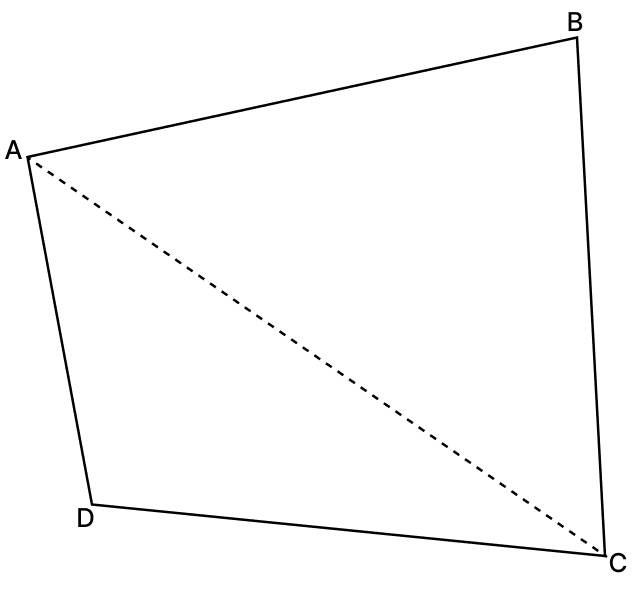
ABCD is a quadrilateral, join diagonal AC.
Given,
AD2 = AC2 - DC2
⇒ AD2 + DC2 = AC2
In △ADC:
AD and DC are two sides
AC is the longest side
By applying converse of pythagoras theorem,
If in a triangle,
(side 1)2 + (side 2)2 = (longest side)2
then the triangle is right-angled.
∴ Triangle ADC is a right-angled at D.
So, ∠D = 90°
Hence proved that ∠D = 90°.
The ratio between the number of sides of two regular polygons is 3 : 4 and ratio between the sum of their interior angles is 2 : 3. Find the number of sides in each polygon.
Answer
Let the number of sides of two regular polygons be 3a and 4a.
Sum of interior angles of regular polygons = (n - 2) x 180°
⇒ 3[(3a - 2) x 180°] = 2[(4a - 2) x 180°]
⇒ (9a - 6) x 180° = (8a - 4) x 180°
⇒ 9a - 6 = 8a - 4
⇒ 9a - 8a = 6 - 4
⇒ a = 2
Thus, the number of sides of the polygons are 3a = 3 x 2 = 6 and 4a = 4 x 2 = 8.
Hence, the number of sides in the two polygons are 6 and 8.
If the difference between an interior angle of a regular polygon of (n + 1) sides and an interior angle of a regular polygon of n sides is 4°; find the value of n.
Also, state the difference between their exterior angles.
Answer
An interior angle of (n + 1) sided regular polygon =
An interior angle of n sided regular polygon =
Since, number of sides cannot be negative, n = 9.
Exterior angle, when n = 9 = = 40°
Exterior angle, when (n + 1) = 10 = = 36°
Difference between their exterior angles = 40° - 36° = 4°
Hence, number of sides, n = 9 and difference between their exterior angles = 4°.
In a quadrilateral ABCD; angles A, B, C and D are in the ratio 3 : 2 : 1 : 4. Prove that AD is parallel to BC.
Answer
Given: ABCD is the quadrilateral such that angles A, B, C and D are in the ratio 3 : 2 : 1 : 4.
To prove: AD is parallel to BC.
Proof: Let the angles of the quadrilateral ABCD be 3a, 2a, 1a and 4a, respectively.
The sum of the angles in any quadrilateral is 360°. Therefore,
3a + 2a + 1a + 4a = 360°
10a = 360°
a = 36°
∠A = 3a = 3 x 36° = 108°
∠B = 2a = 2 x 36° = 72°
∠C = a = 1 x 36° = 36°
∠D = 4a = 4 x 36° = 144°
The sum of consecutive interior angles is:
⇒ ∠A + ∠B = 108° + 72° = 180°
⇒ ∠C + ∠D = 36° + 144° = 180°
Since the consecutive interior angles add up to 180°, lines AD and BC are parallel.
Hence, AD is parallel to BC.
In a quadrilateral ABCD, AB = CD and ∠B = ∠C. Prove that:
(i) AC = DB,
(ii) AD is parallel to BC.
Answer
(i) Given: In a quadrilateral ABCD, AB = CD and ∠B = ∠C.
To prove: AC = DB
Construction: Join diagonals AC and BD.

Proof: Consider the triangles ABC and DBC,
AB = CD (Given)
∠ABC = ∠BCD (Given)
BC = BC (Common Side)
Using SAS congruency criterion,
Δ ABC ≅ Δ DBC
By corresponding parts of congruent triangles,
Hence, AC = BD.
(ii) To prove: AD is parallel to BC.
Proof: Consider the triangles ABD and ADC,
AB = CD (Given)
AC = DB (Proved above)
DA = DA (Common Side)
Using SSS congruency criterion,
Δ ABD ≅ Δ ADC
By corresponding parts of congruent triangles,
∠A = ∠D
As we know that sum of all angles of quadrilateral is 360°.
⇒ ∠A + ∠B + ∠C + ∠D = 360°
⇒ ∠D + ∠B + ∠B + ∠D = 360° [∠A = ∠D and ∠B = ∠C]
⇒ 2∠D + 2∠B = 360°
⇒ ∠D + ∠B =
⇒ ∠D + ∠B = 180°
Since, opposite angles formed between the transversal AC are supplementary.
Hence, AD is parallel to BC.
In the diagram below; P and Q are midpoints of sides BC and AD respectively of the parallelogram ABCD. If side AB = diagonal BD; prove that the quadrilateral BPDQ is a rectangle.

Answer
Given: ABCD is a parallelogram. P and Q are midpoints of sides BC and AD, respectively.
AB = BD
In a parallelogram, opposite sides are equal and parallel. Thus, AB = CD and AD = BC.
Since P and Q are midpoints, by the Midpoint Theorem,
PQ || AB and PQ = AB.
Similarly, BP = QD.
In Δ QBD and Δ DPB,
BD = BD (Common)
QD = BP (midpoint property, QD = AD = BC = BP)
∠PBD = ∠QDB (alternate interior angles, since PQ || AB)
Using SAS congruency criterion,
Δ QBD ≅ Δ DPB
Therefore, by corresponding parts of congruent triangles,
QB = DP
In quadrilateral BPDQ,
QD = BP
QB = DP
Thus, opposite sides of BPDQ are equal.
In Δ QAB and Δ DQB,
AQ = QD (Q is mid-point of AD)
AB = BD (Given)
QB = QB (Common side)
Using SSS congruency criterion,
Δ QAB ≅ Δ DQB
Therefore, by corresponding parts of congruent triangles,
∠AQB = ∠DQB
⇒ ∠AQB + ∠DQB = 180° (Linear pair of angles)
⇒ ∠AQB + ∠AQB = 180°
⇒ 2∠AQB = 180°
⇒ ∠AQB =
⇒ ∠AQB = ∠DQB = 90°
Thus, BPDQ has opposite sides equal and two adjacent angles 90°. Since one angle of a parallelogram is 90°, all angles are 90°.
Since BPDQ has opposite sides equal and all angles 90°, it is a rectangle.
Hence, the quadrilateral BPDQ is a rectangle.
ABCD is a parallelogram. If AB = 2AD and P is the mid-point of CD; prove that : ∠APB = 90°.
Answer

Given: ABCD is a parallelogram. AB = 2AD and P is the mid point of CD.
To prove: ∠APB = 90°
Proof: Since ABCD is a parallelogram, the opposite sides of the parallelogram are equal.
⇒ AB = DC and AD = BC
AB = 2AD ⇒ AD = AB and BC = AB ...............(1)
Since P is the mid-point of CD and AB = DC, we have:
DP = PC = DC = AB ...............(2)
From equations (1) and (2), we conclude that AD = DP. In Δ APD, since two sides are equal, the angles opposite these sides are equal:
∠APD = ∠DAP ..................(3)
Since, AB ∥ DC and AP is a transversal, the alternate interior angles are equal:
∠APD = ∠PAB ...............(4)
From equation (3) and (4), we get:
⇒ ∠DAP = ∠PAB
Let ∠DAP = ∠PAB = ∠A ...............(5)
Similarly, from equations (1) and (2), BC = PC. In Δ BPC, since two sides are equal, the angles opposite to equal sides are equal:
∠CPB = ∠PBC ................(6)
Since AB ∥ Dc and BP is a transversal, the alternate interior angles are equal:
∠CPB = ∠PBA ...............(7)
From equations (6) and (7), we get:
⇒ ∠PBC = ∠PBA
Let ∠PBC = ∠PBA = ∠B ...............(8)
In a parallelogram, adjacent angles are supplementary:
∠A + ∠B = 180°
⇒ ∠A + ∠B = 180°
⇒ ∠A + ∠B = 90°
In Δ APB, sum of all angles is 180°.
⇒ ∠APB + ∠ABP + ∠BAP = 180°
⇒ ∠APB + ∠B + ∠A = 180°
⇒ ∠APB + 90° = 180°
⇒ ∠APB = 180° - 90°
⇒ ∠APB = 90°
Hence, ∠APB = 90°
Construct a parallelogram ABCD in which diagonal AC = 6.3 cm; diagonal BD = 7cm and the acute angles between the diagonals is 45°.
Answer
Steps of construction :
Draw a line AC = 6.3 cm and locate its mid point O.
Draw line BOD such that ∠BOC = 45° and OB = OD = BD = x 7 cm = 3.5 cm
Join AB, BC, CD and DA.

Hence, ABCD is the required parallelogram.
Construct a rhombus whose diagonals are 4.7 cm and 5.4 cm.
Answer
Steps of construction:
Draw AC = 4.7 cm.
Draw perpendicular bisector to AC which cuts AC at O.
From this perpendicular, cut OD and OB such that, OD = OB = x BD = x 5.4 cm = 2.7 cm.
Join AB, BC, CD and DA.

Hence, ABCD is the required rhombus.
In a parallelogram ABCD, P is a point on side AD such that 3AP = AD and Q is a point on BC such that 3CQ = BC. Prove that : AQCP is a parallelogram.
Answer

Given: ABCD is a parallelogram.
AD = BC (Opposite sides of a parallelogram are equal)
⇒ 3AP = 3CQ
⇒ AP = CQ
AD ∥ CB (Opposite sides of a parallelogram are parallel)
⇒ AP ∥ CQ
Opposite sides AP and CQ are parallel and equal.
Hence, AQCP is a parallelogram.
The following figure shows a parallelogram ABCD.
Use the given informations to find the values of x, y and z.

Answer
Opposite sides of a parallelogram are equal.
⇒ AB = CD
⇒ (3x - 1) = (2x + 2)
⇒ 3x - 2x = 2 + 1
⇒ x = 3 cm
Sum of two consecutive angles of a parallelogram is 180°.
⇒ ∠A + ∠B = 180°
⇒ (50° + z) + 102° = 180°
⇒ 50° + z + 102° = 180°
⇒ 152° + z = 180°
⇒ z = 180° - 152°
⇒ z = 28°
AB ∥ CD and AC is transversal line,
⇒ ∠BAC = ∠ACD
⇒ ∠BAC = ∠ACD = 28°
Now, ∠ACD and ∠y forms a linear pair.
⇒ ∠ACD + ∠y = 180°
⇒ 28° + ∠y = 180°
⇒ ∠y = 180° - 28°
⇒ ∠y = 152°
Hence, the value of x = 3 cm, y = 152° and z = 28°.
The angles of a quadrilateral are equal. Prove that the quadrilateral is a rectangle.
Answer
Let ∠A = ∠B = ∠C = ∠D = x°
Sum of all angles in a quadrilateral is 360°.
⇒ ∠A + ∠B + ∠C + ∠D = 360°
⇒ x° + x° + x° + x° = 360°
⇒ 4x° = 360°
⇒ x° =
⇒ x° = 90°
Since, all angles of the quadrilateral are 90°, it follows that the quadrilateral is a rectangle.
Hence, the quadrilateral is a rectangle.
The given figures shows a kite-shaped figure whose diagonals intersect each other at point O. If ∠ABO = 25° and ∠OCD = 40°; find
(i) ∠ABC
(ii) ∠ADC
(iii) ∠BAD

Answer
Given: ABCD is a kite, so, AD = DC and AB = BC. The diagonals of the kite intersect at point O.
∠ABO = 25° and ∠OCD = 40°
(i) In triangle AOB, we know that the diagonals of the kite are perpendicular to each other at point O.
⇒ ∠AOB = 90°
Sum of all angles in triangle is 180°.
⇒ ∠AOB + ∠ABO + ∠BAO = 180°
⇒ 90° + 25° + ∠BAO = 180°
⇒ 115° + ∠BAO = 180°
⇒ ∠BAO = 180° - 115°
⇒ ∠BAO = 65°
Since AB = AC (because ABCD is a kite), we have:
⇒ ∠BCO = ∠BAO = 65°
In triangle ABC, the sum of the angles is 180°.
⇒ ∠ABC + ∠BCA + ∠BAC = 180°
⇒ ∠ABC + 65° + 65° = 180°
⇒ ∠ABC + 130° = 180°
⇒ ∠ABC = 180° - 130°
⇒ ∠ABC = 50°
Hence, ∠ABC = 50°.
(ii) In triangle ADC, we know that AD = DC (because ABCD is a kite), so the angles opposite these equal sides are equal.
⇒ ∠DAC = ∠ACD
We are given that ∠OCD = 40° and since the diagonals bisect the angles at C, we have:
∠ACD = ∠OCD = 40°
Now, using the sum of angles in triangle ADC:
⇒ ∠DAC + ∠ACD + ∠ADC = 180°
⇒ 40° + 40° + ∠ADC = 180°
⇒ 80° + ∠ADC = 180°
⇒ ∠ADC = 180° - 80°
⇒ ∠ADC = 100°
Hence, ∠ADC = 100°.
(iii) In triangle BAD,
∠BAD = ∠BAO + ∠OAD
From earlier, we found: ∠BAO = 65°
Since AD = DC (because ABCD is a kite), the angle bisector of ∠ADC divides it into two equal parts:
∠OAD = ∠ACD = 40°
∠BAD = 65° + 40° = 105°
Hence, ∠BAD = 105°.
Prove that the bisectors of any two adjacent angles of a parallelogram are at right angle.
Answer

Given: ABCD is a parallelogram. AO is the angle bisector of ∠DAB and BO is the angle bisector of ∠ABC.
To prove: ∠AOB = 90°
Proof: AB ∥ CD and AD ∥ BC
Sum of corresponding interior angles is 180°.
⇒ ∠DAB + ∠ABC = 180°
⇒ ∠DAB + ∠ABC = x 180°
⇒ ∠OAB + ∠OBA = 90° ...........(1)
In Δ AOB, sum of all angles in triangle is 180°.
⇒ ∠OAB + ∠OBA + ∠BOA = 180°
⇒ 90° + ∠BOA = 180°
⇒ ∠BOA = 180° - 90°
⇒ ∠BOA = 90°
Hence, the bisectors of any two adjacent angles of a parallelogram are at right angle.
Two opposite angles of a parallelogram are (6x - 17)° and (x + 63)°. Find each angle of the parallelogram.
Answer
In a parallelogram, opposite angles are equal.
⇒ (6x - 17)° = (x + 63)°
⇒ 5x° = 80°
⇒ x° =
⇒ x° = 16°
Then, first angle = (6x - 17)°
= (6 16 - 17)°
= (96 - 17)°
= 79°
Second angle = 180° - 79° = 101°
In a parallelogram, consecutive angles are supplementary, meaning their sum is 180°. So, the other pair of opposite angles is:
180° - 79° = 101°
Hence, the four angles of the parallelogram are 79°, 101°, 79° and 101°.
If the diagonals of a rectangle intersect each other at right angle, the rectangle is a square.
Answer

Given: ABCD is a rectangle such that diagonals BD and AC intersect at O.
To prove: The given rectangle is a square. (AB = BC = CD = AD)
Proof: ∠AOB = 90°, ∠AOD = 90°
Since, opposite sides of rectangle are equal.
∴ AB = DC and AD = BC
In Δ AOB and Δ AOD,
AO = AO (Common Side)
∠AOB = ∠AOD (Both are 90°)
OB = OD (Diagonals bisect each other)
Using SAS congruency criterion,
Δ AOB ≅ Δ AOD
By corresponding parts of congruent triangles,
AD = AB
As we know, AB = DC and AD = BC,
⇒ AB = BC = CD = DA
Since, all sides are equal and diagonals intersect at right angles.
Hence, the rectangle is a square.
M and N are the points of trisection of the diagonal BD of a parallelogram ABCD. Prove that CN is parallel to AM .
Answer

Given: ABCD is a parallelogram, with BD as its diagonal. M and N are points on BD such that BM = MN = ND.
To proof: CN is parallel to AM.
Construction: Join diagonal AC.
Proof: We know that diagonals of a parallelogram bisects each other.
⇒ OA = OC and OD = OB
Subtracting BM from both sides,
⇒ OB - BM = OD - BM
⇒ OB - BM = OD - DN
⇒ OM = ON
Similarly, because OA = OC and the diagonals bisect each other, we see that AM and CN are parallel and equal in length.
The opposite sides AM and CN, as well as AN and CM, are parallel and equal. Hence, AMCN forms a parallelogram.
Hence, CN is parallel to AM.
Find the angles of the parallelogram ABCD, if :
(i) ∠A : ∠B = 2 : 7
(ii) ∠C = ∠D
Answer

(i) Given: ABCD is a parallelogram.
Let ∠A = 2a and ∠B = 7a.
In a parallelogram, the sum of adjacent angles is 180°.
⇒ ∠A + ∠B = 180°
⇒ 2a + 7a = 180°
⇒ 9a = 180°
⇒ a =
⇒ a = 20°
∠A = 2a = 2 x 20° = 40°
∠B = 7a = 7 x 20° = 140°
In a parallelogram, opposite angles are equal, so:
∠C = ∠A = 40°
∠D = ∠B = 140°
Hence, the angles of the parallelogram are 40°, 140°, 40° and 140°.
(ii)

∠C : ∠D = 2 : 3
Let ∠C = 2a and ∠D = 3a.
In a parallelogram, the sum of adjacent angles is 180°.
⇒ ∠C + ∠D = 180°
⇒ 2a + 3a = 180°
⇒ 5a = 180°
⇒ a =
⇒ a = 36°
∠A = 2a = 2 x 36° = 72°
∠B = 7a = 5 x 36° = 108°
In a parallelogram, opposite angles are equal, so:
∠A = ∠C = 72°
∠B = ∠D = 108°
Hence, the angles of the parallelogram are 72°, 108°, 72° and 108°.
Construct a quadrilateral ABCD with ∠B = ∠C = 75°, BC = 6 cm, AB = 4.8 cm and CD = 5 cm.
Answer
Steps of construction:
Draw AB = 4.8 cm.
Construct angle MBA = 75° and then from MB cut BC = 6 cm.
Draw CP such that ∠C = 75°.
With C as center and radius = 5 cm draw an arc cutting CP at D.
Join A and D.

Hence, ABCD is the required quadrilateral.
Construct a parallelogram ABCD with diagonals 6.3 cm and 5.6 cm. And, acute angle between the diagonals is 45°.
Answer
Let parallelogram ABCD has diagonal AC = 6.3 cm, diagonal BD = 4.8 cm and the acute angle between the diagonals = 45°.
Steps of construction :
Draw a line AC = 6.3 cm and locate its mid point O.
Draw line BOD such that ∠DOC = 45° and OB = OD = BD = x 5.6 cm = 2.8 cm
Join AB, BC, CD and DA.

Hence, ABCD is the required parallelogram.
Construct a square ABCD with AC = 6.2 cm.
Answer
Steps of construction:
Draw AC = 6.2 cm.
Draw perpendicular bisector to AC which cuts AC at O.
From this perpendicular, cut OD and OB such that OD = OB = BD = BD = x 6.2 cm = 3.1 cm
Join AB, BC, CD and DA.

Hence, ABCD is the required square.
Construct a rhombus ABCD, such that each of its side is 4.8 cm and ∠A = 120°.
Answer
We know that,
Sum of consecutive angles of rhombus = 180°
⇒ ∠A + ∠B = 180°
⇒ 120° + ∠B = 180°
⇒ ∠B = 180° - 120°
⇒ ∠B = 60°
Steps of construction:
Draw a line segment AB = 4.8 cm.
At A, construct an angle ∠XAB = 120°.
From XA, cut off AD = 4.8 cm.
Through D, draw DY parallel to AB.
At B, construct an angle ∠ZBA = 60°, intersecting XY at C.
Join C and D.

Hence, ABCD is the required rhombus.
Construct a trapezium ABCD in which AB is parallel to DC, AB = 6.4 cm, ∠A = 60° and ∠B = 75°.
Answer
Steps of construction:
Draw a line AB = 6.4 cm.
With A as center, construct an angle of 60° such that ∠YAB = 60°.
With B as center, construct an angle of 75° using a protector such that ∠XBA = 75°.
Make a straight line MN which is parallel to AB.
The line cut the line XB at C and YA at D.
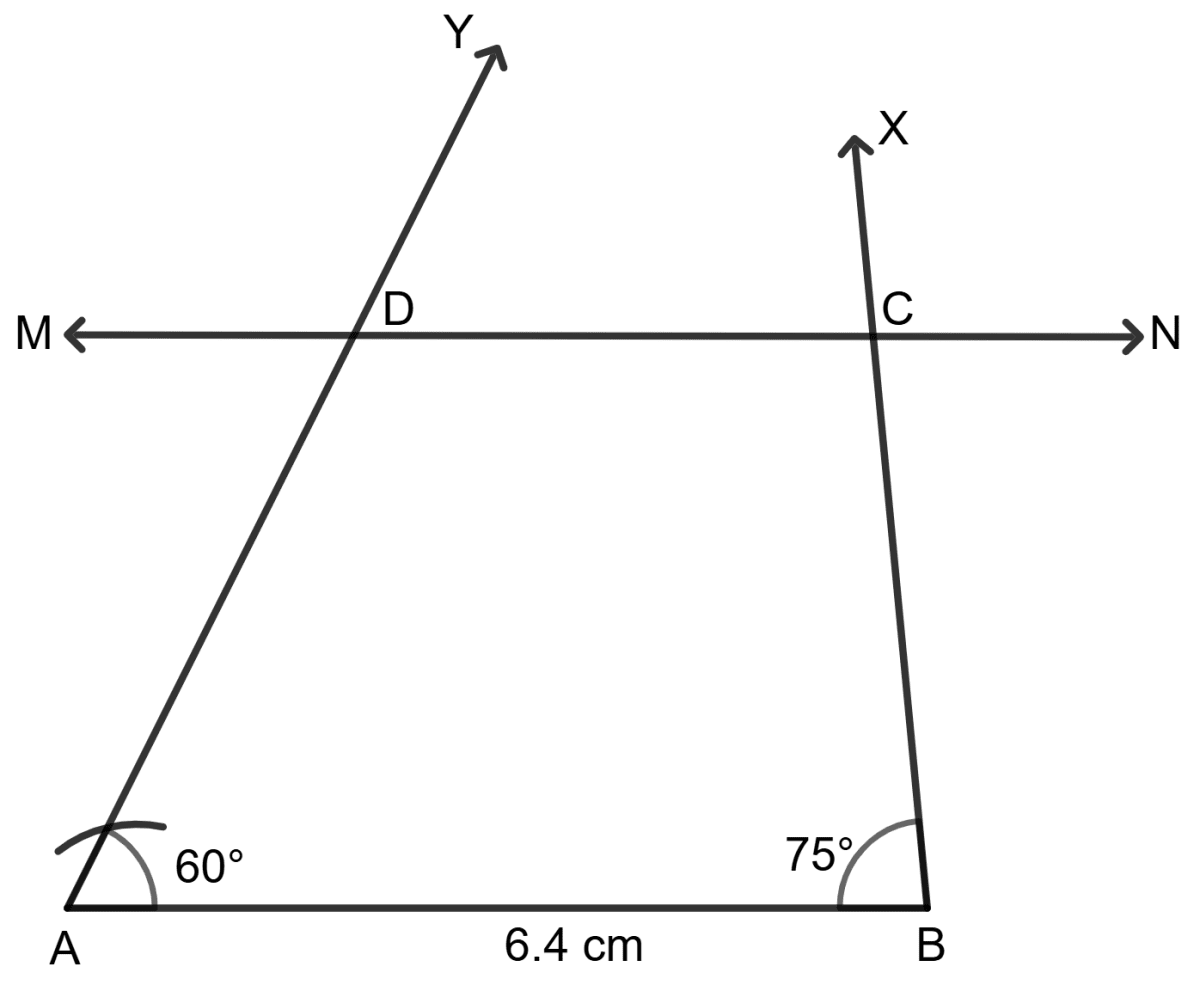
Hence, ABCD is required trapezium.
D, E and F are the mid-points of the sides BC, CA and AB respectively of triangle ABC. Prove that :
(i) BDEF is a parallelogram.
(ii) area of BDEF is half the area of △ABC.
Answer
(i) Given: ABC is a triangle. D, E and F are the mid-points of the sides BC, CA and AB respectively.
To prove: BDEF is a parallelogram.
Construction: Join DE, EF and FD.

Proof: D, E and F are mid-points of sides BC, AC and AB respectively. Using mid-point theorem,
So, DE ∥ BA and DE = BA
⇒ DE ∥ BF and DE = BF
And, EF ∥ BC and EF = BC
⇒ EF ∥ BD and EF = BD.
Hence, BDEF is a parallelogram.
(ii) To prove: Ar.(∥gm BDEF) = Ar.(Δ ABC)
Proof: From (i), BDEF is a parallelogram.
D, E and F are mid-points of sides BC, AC and AB respectively. Using mid-point theorem,
So, FD ∥ AC and FD = AC
⇒ FD ∥ EC and FD = EC
And, EF ∥ BC and EF = BC
⇒ EF ∥ DC and EF = DC
Hence, DCEF is a parallelogram.
And, DE ∥ BA and DE = BA
⇒ DE ∥ AF and DE = AF
And, DF ∥ AC and DF = AC
⇒ DF ∥ AE and DF = AE
Hence, AFDE is a parallelogram.
That means, AFDE, DCEF and BDEF all are parallelograms.
Now, DF is a diagonal of parallelogram BDEF.
Therefore, Ar.(Δ BDF) = Ar.(Δ DEF) ................(1)
DE is a diagonal of parallelogram DCEF.
So, Ar.(Δ DCE) = Ar.(Δ DEF) ................(2)
FE is a diagonal of parallelogram AFDE.
So, Ar.(Δ AFE) = Ar.(Δ DEF) ................(3)
From (1), (2) and (3), we have
Ar.(Δ BDF) = Ar.(Δ DCE) = Ar.(Δ AFE) = Ar.(Δ DEF)
But, Ar.(Δ BDF) + Ar.(Δ DCE) + Ar.(Δ AFE) + Ar.(Δ DEF) = Ar.(Δ ABC)
So, 4 x Ar.(Δ DEF) = Ar.(Δ ABC)
⇒ Ar.(Δ DEF) = Ar.(Δ ABC)
We know that the diagonal of a parallelogram divides it into two triangles of equal areas.
⇒ Ar.(∥gm BDEF) = 2Ar.(Δ DEF)
⇒ Ar.(∥gm BDEF) = 2 x Ar.(Δ ABC)
⇒ Ar.(∥gm BDEF) = Ar.(Δ ABC)
Hence, area of BDEF is half the area of △ABC.
Given a parallelogram ABCD where X and Y are the mid-points of the sides BC and CD respectively. Prove that :
ar (△ AXY) = ar (//gm ABCD)
Answer

Given: ABCD is a parallelogram where X and Y are the mid-points of the sides BC and CD respectively.
To prove: ar (△ AXY) = x ar (//gm ABCD)
Construction: Join BD and AC. Join AY, AX and XY.
Proof: We know that the diagonal of a parallelogram divides it into two triangles of equal areas.
Ar.(Δ ACD) = Ar.(Δ ABC) = Ar.(Δ BCD) = Ar.(Δ ABD) = Ar.(∥gm ABCD)
In Δ ACD, Y is the mid-point of DC. So, AY is the median.
Median of a triangle divides it into two triangles of equal areas.
∴ Ar.(Δ AYD) = Ar.(Δ ADC)
= Ar.(//gm ABCD)
= Ar.(//gm ABCD)
In Δ BCD, X and Y are the mid-points of sides BC and CD respectively.
⇒ CY = CD
⇒ XY = BD
So, sides of Δ CXY are half of the sides of the Δ CBD.
Ar.(Δ CXY) = Ar.(Δ CBD)
= Ar.(//gm ABCD)
= Ar.(//gm ABCD)
Now, area of Δ AXY = area of //gm ABCD - [area of Δ ADY + area of Δ ABX + area of Δ CXY]
= Ar.(//gm ABCD) - [ Ar.(//gm ABCD) + Ar.(//gm ABCD) + Ar.(//gm ABCD)]
= Ar.(//gm ABCD) - Ar.(//gm ABCD)
= Ar.(//gm ABCD) - Ar.(//gm ABCD)
= Ar.(//gm ABCD)
= Ar.(//gm ABCD)
Hence, ar (△AXY) = x ar (//gm ABCD).
ABCD is a parallelogram of area 162 sq. cm. P is a point on AB such that AP : PB = 1 : 2. Calculate :
(i) the area of △APD
(ii) the ratio PA : DC.
Answer

(i) Given: ABCD is a parallelogram and P is a point on AB such that AP : PB = 1 : 2.
DB is the diagonal and in a parallelogram, a diagonal divides it into two congruent triangles.
Ar.(//gm ABCD) = Ar.(△ ADB) = Ar.(△ BDC)
⇒ Ar.(△ ADB) = x 162
= 81 sq. cm
P is divides the line AB in the ratio 1 : 2. So, Ar.(△ APD) :Ar.(△ ADB) = 1:3.
Ar.(△ APD) = x Ar.(△ ADB)
= x 81 sq. cm
= 27 sq. cm
Hence, the area of △APD = 27 sq. cm.
(ii) Let AP = x and PB = 2x
AB = AP + PB (From the figure)
= x + 2x
= 3x
∴
As we know that AB = CD,
∴
Hence, the ratio PA : DC = 1 : 3.
Find the area of the figure formed by joining the mid-points of the adjacent sides of a rhombus with diagonals 12 cm and 16 cm.
Answer

Given: ABCD is a rhombus with diagonals 12 cm and 16 cm.
Construction: Join the midpoints of AB, BC, CD and DA of the rhombus ABCD and name them M, N, O and P, respectively, to form the quadrilateral MNOP.
Join the line PN.
To Prove: MNOP is a parallelogram.
Proof: The midpoint theorem states that the line segment joining the midpoints of two sides of a quadrilateral is parallel to the opposite side and half of its length.
Since M and N are midpoints of AB and BC, by midpoint theorem:
MN ∥ AC and MN = AC .................(1)
Similarly, P and O are midpoints of AD and DC. By the midpoint theorem:
PO ∥ AC and PO = AC .....................(2)
From equations (1) and (2), we get:
MN ∥ AC and MN = PO
Now, M and P are midpoints of AB and AD. By the midpoint theorem:
MP ∥ BD and MP = BD .................(3)
Similarly, N and O are midpoints of BC and DC. By the midpoint theorem:
NO ∥ BD and NO = BD .....................(4)
From equations (3) and (4), we get:
MP ∥ NO and MP = NO
Thus, quadrilateral MNOP is a parallelogram.
If a triangle and a parallelogram are on the same base and between the same parallels, the area of the triangle is equal to one-half area of the parallelogram.
Ar(Δ MNP) = Ar(∥gm ABNP) .................(5)
Ar(Δ PON) = Ar(∥gm PNCD) .................(6)
Then area of rhombus ABCD = x d1 x d2
= x (12 x 16) cm2
= 96 cm2
Since the parallelogram MNOP consists of two such halves:
Ar(MNOP) = (Ar(ABCD))
= x 96
= 48 cm2
Hence, the area of the figure formed = 48 cm2.
In trapezium ABCD, side AB is parallel to side DC. Diagonals AC and BD intersect at point P. Prove that triangles APD and BPC are equal in area.
Answer

Given: ABCD be the trapezium with side AB is parallel to side DC. P is the intersection point of diagonals AC and BD.
To prove: Triangles APD and BPC are equal in area.
Proof: If two triangles lie on the same base and are between the same parallels, their areas are equal.
In the trapezium ABCD, the triangles Δ ACD and Δ BCD share the same base CD and are between the same parallels AB ∥ DC.
Thus, their areas are equal:
Ar.(Δ ACD) = Ar.(Δ BCD)
The diagonals AC and BD intersect at P, dividing the trapezium into smaller triangles. Subtract the area of △DPC, which is common to both △ACD and △BCD, from both sides:
⇒ Ar.(Δ ACD) - Ar.(Δ DPC) = Ar.(Δ BCD) - Ar.(Δ DPC)
⇒ Ar.(Δ APD) = Ar.(Δ BCP)
Hence, the triangles Δ APD and Δ BPC are equal in area.
P is the mid-point of diagonal AC of quadrilateral ABCD. Prove that the quadrilaterals ABPD and CBPD are equal in area.
Answer
Given: ABCD is a quadrilateral with diagonal AC and P is its mid-point of AC (AP = PC).
To Prove: Area of quadrilateral ABPD = Area of quadrilateral CBPD
Construction: Join PB and DP.

Proof: In Δ ABC, P is the midpoint of AC.
The line segment BP is median. A median divides a triangle into two triangles of equal area.
∴ Ar.(Δ ABP) = Ar.(Δ BCP) ................(1)
Similarly, in Δ ADC, P is the midpoint of AC.
The line segment DP is median. A median divides a triangle into two triangles of equal area.
∴ Ar.(Δ ADP) = Ar.(Δ DCP) .................(2)
Adding equations (1) and (2),
⇒ Ar.(Δ ABP) + Ar.(Δ ADP) = Ar.(Δ BCP) + Ar.(Δ DCP)
⇒ Area of quadrilateral ABPD = Area of quadrilateral CBPD
Hence, the quadrilaterals ABPD and CBPD are equal in area.
In triangle ABC, D is mid-point of AB and P is any point on BC. If CQ parallel to PD meets AB at Q, prove that:
2 x area (△ BPQ) = area (△ ABC)
Answer

Given: ABC is a triangle. D is the mid point of AB (BD = DA). P is any point on BC. CQ ∥ PD meets AB at Q.
To Prove: 2 x Ar.ea (△ BPQ) = Ar.ea (△ ABC)
Construction: Join PQ and CD.
Proof: In Δ ABC, D is the mid point of AB.
The line CD is median and a median divides a triangle into two triangles of equal area.
⇒ Ar.(Δ ACD) = Ar.(Δ BCD) = Ar.(Δ ABC)
Ar.(Δ BCD) = Ar.(Δ BPD) + Ar.(Δ DPC)
⇒ Ar.(Δ BPD) + Ar.(Δ DPC) = Ar.(Δ ABC) ................(1)
Since CQ ∥ PD and Q lies on AB, the triangles Δ DPQ and Δ DPC have same base (DP) and are between the same parallels (CQ ∥ PD).
∴ Ar.(Δ DPQ) = Ar.(Δ DPC) ................(2)
So, equation (1) becomes,
⇒ Ar.(Δ BPD) + Ar.(Δ DPQ) = Ar.(Δ ABC)
⇒ Ar.(Δ BPQ) = Ar.(Δ ABC)
Hence, 2 x area (△ BPQ) = area (△ ABC).
In △ ABC, D is a point on side AB and E is a point on AC. If DE is parallel to BC, and BE and CD intersect each other at point O; prove that :
(i) area (△ ACD) = area (△ ABE)
(ii) area (△ OBD) = area (△ OCE)
Answer

(i) Given: ABC is a triangle. D is any point on AB and E is a point on AC. DE is parallel to BC, and BE and CD intersect each other at point O.
To prove: area (△ ACD) = area (△ ABE)
Proof: We know that if two triangles are on the same base and between the same parallels, then the area of the triangles is always equal.
∴ Ar.(Δ BDE) = Ar.(Δ DEC)
Add the area of Ar.(△ADE) in both sides,
⇒ Ar.(Δ ADE) + Ar.(Δ BDE) = Ar.(Δ ADE) + Ar.(Δ DEC)
⇒ Ar.(Δ AED) = Ar.(Δ ACD)
Hence, area (△ ACD) = area (△ ABE)
(ii) To prove: area (△ OBD) = area (△ OCE)
Proof: We know that if two triangles are on the same base and between the same parallels, then the area of the triangles is always equal.
∴ Ar.(Δ BCD) = Ar.(Δ BCE)
The diagonals BE and DC intersect at O, dividing the trapezium into smaller triangles. Subtract the area of △EOD, which is common to both △BCD and △BCE, from both sides:
⇒ Ar.(Δ BCD) - Ar.(Δ BOC) = Ar.(Δ BCE) - Ar.(Δ BOC)
⇒ Ar.(Δ BOD) = Ar.(Δ EOC)
Hence, area (△ OBD) = area (△ OCE)
A chord of length 16 cm is drawn in a circle of diameter 20 cm. Calculate its distance from the centre of the circle.
Answer
Given: Length of the chord AC = 16 cm.
Diameter of the circle = 20 cm.
Radius of the circle r = = 10 cm.
To prove: Distance of the chord from the center of the circle = OB.
Construction: Draw OB ⊥ AC, where O is the center of the circle. Join OA.

Proof:
B is the midpoint of AC, as OB is perpendicular to the chord AC.
AB = AC
= x 16 cm
= 8 cm
In Δ OAB, ∠B = 90°
Using Pythagoras theorem,
∴ OA2 = OB2 + AB2
⇒ (10)2 = OB2 + (8)2
⇒ 100 = OB2 + 64
⇒ OB2 = 100 - 64
⇒ OB2 = 36
⇒ OB =
⇒ OB = 6 cm
Hence, the distance of the chord from the center of the circle is 6 cm.
In the given figure, the diameter CD of a circle with centre O is perpendicular to the chord AB.

If AB = 8 cm and CM = 2 cm, find the radius of the circle.
Answer
Given: Diameter CD of the circle is perpendicular to the chord AB. AB = 8 cm and CM = 2 cm. O is the center of the circle. r is the radius of the circle.
To prove: Radius of the circle (r).
Construction: Join OA.

Proof: Since CD is perpendicular to AB, it bisects the chord.
Thus AM = MB = = 4 cm.
OM = r - CM = r - 2 cm
In Δ OAM, ∠M = 90°
Using Pythagoras theorem,
∴ OA2 = OM2 + AM2
⇒ r2 = (r - 2)2 + 42
⇒ r2 = r2 + 4 - 4r + 16
⇒ 0 = 16 + 4 - 4r
⇒ 4r = 20
⇒ r =
⇒ r = 5 cm
Hence, the radius of the circle = 5 cm.
Two chords AB and CD of lengths 24 cm and 10 cm respectively of a circle are parallel. If the chords lie on the same side of the centre and distance between them is 7 cm, find the length of a diameter of the circle.
Answer
Given: AB and CD are two parallel chords of a circle on the same side of the center.
AB = 24 cm and CD = 10 cm.
Distance between the chords = MN = 7 cm.
Let the radius of the circle be r.
Let the perpendicular distance from the center O to chord AB be OM = x.
Therefore, ON = x + 7.
To Prove: The length of the diameter of the circle.
Construction: Join OA and OC.

Proof:
AM = AB
= x 24
= 12 cm
In Δ OAM, ∠M = 90°
Using Pythagoras theorem,
∴ OA2 = OM2 + AM2
⇒ r2 = x2 + 122
⇒ r2 = x2 + 144 ..................(1)
CN = CD
= x 10
= 5 cm
In Δ OCN, ∠N = 90°
Using Pythagoras theorem,
∴ OC2 = ON2 + CN2
⇒ r2 = (x + 7)2 + 52
⇒ r2 = x2 + 49 + 14x + 25
⇒ r2 = x2 + 14x + 74
Using equation (1), we get
⇒ x2 + 144 = x2 + 14x + 74
⇒ 144 = 14x + 74
⇒ 14x = 144 - 74
⇒ 14x = 70
⇒ x =
⇒ x = 5
Putting the value of x in equation (1), we get
⇒ r2 = (5)2 + 144
⇒ r2 = 25 + 144
⇒ r2 = 169
⇒ r =
⇒ r = 13
Diameter = 2r = 2 x 13 cm
= 26 cm
Hence, the diameter of the circle = 26cm.
Two chords AB and AC of a circle are equal. Prove that the centre of the circle lies on the bisector of angle BAC.
Answer
Given: Two chords AB and AC of a circle are equal.
The bisector of angle ∠BAC intersects chord BC at point P.
To Prove: The center of the circle lies on the bisector of ∠BAC.
Construction: Join BC.

Proof:
In Δ APB and Δ APC,
AB = AC (Given)
∠BAP = ∠CAP (Given)
AP = AP (Common Side)
By using ASA congruency criterion,
Δ APB ≅ Δ APC
By corresponding parts of congruent triangles,
BP = CP and ∠APB = ∠APC
∠APB and ∠APC form a linear pair(they lie on the straight line BC).
⇒ ∠APB + ∠APC = 180°
⇒ ∠APB + ∠APB = 180°
⇒ 2∠APB = 180°
⇒ ∠APB =
⇒ ∠APB = 90°
Therefore, AP is the perpendicular to chord BC.
The perpendicular bisector of a chord passes through the center of the circle.
Hence, the centre of the circle lies on the bisector of ∠BAC.
In the given figure, arc APB : arc BQC = 2 : 3 and ∠AOC = 150°. Find :
(i) ∠AOB
(ii) ∠BOC
(iii) ∠OBA
(iv) ∠OCB
(v) ∠ABC

Answer
Given: arc APB : arc BQC = 2 : 3 and ∠AOC = 150°.
If two arcs of a circle is divided into a certain ratio, the angles subtended by the parts of the arc at the center of the circle will also be in the same ratio.
∠AOB : ∠BOC = 2 : 3
Let ∠AOB be 2x and ∠BOC be 3x.
As we know, ∠AOB + ∠BOC = ∠AOC
⇒ ∠AOB + ∠BOC = 150°
⇒ 2x + 3x = 150°
⇒ 5x = 150°
⇒ x =
⇒ x = 30°
(i) ∠AOB = 2x
= 2 30°
= 60°
Hence, ∠AOB = 60°.
(ii) ∠BOC = 3x
= 3 30°
= 90°
Hence, ∠BOC = 90°.
(iii) OA = OB (Radii of same circle), triangle OBA is an isosceles triangle and thus:
∠OBA = ∠OAB
The sum of the angles in triangle OBA is 180°.
⇒ ∠OAB + ∠OBA + ∠AOB = 180°
⇒ ∠OBA + ∠OBA + 60° = 180°
⇒ 2∠OBA + 60° = 180°
⇒ 2∠OBA = 180° - 60°
⇒ ∠OBA =
⇒ ∠OBA = 60°
Hence, ∠OBA = 60°.
(iv) OB = OC (Radii of same circle), triangle OCA is an isosceles triangle and thus:
∠OBC = ∠OCB
The sum of the angles in triangle OCB is 180°.
⇒ ∠OCB + ∠OBC + ∠COB = 180°
⇒ ∠OCB + ∠OCB + 90° = 180°
⇒ 2∠OCB + 90° = 180°
⇒ 2∠OCB = 180° - 90°
⇒ 2∠OCB = 90°
⇒ ∠OCB =
⇒ ∠OCB = 45°
Hence, ∠OCB = 45°.
(v) ∠ABO = 60° and ∠OCB = ∠OBC = 45°
∠ABC = ∠ABO + ∠OBC
= 60° + 45°
= 105°
Hence, ∠ABC = 105°.
In given figure, AB is a side of a regular pentagon and BC is the side of a regular hexagon. Find :
(i) ∠AOB
(ii) ∠OBC

Answer
(i) Given: AB is a side of a regular pentagon and BC is the side of a regular hexagon.
Angle subtended by each side of the pentagon at the center of the circle = = 72°
Thus, ∠AOB = 72°
Hence, ∠AOB = 72°.
(ii) Angle subtended by each side of the hexagon at the center of the circle = = 60°
Thus, ∠BOC = 60°
OC = OB (radii of the same circle). So, Δ BOC is an isosceles triangle.
⇒ ∠OBC = ∠OCB
The sum of the angles in triangle BOC is 180°.
⇒ ∠OBC + ∠OCB + ∠COB = 180°
⇒ ∠OBC + ∠OBC + 60° = 180°
⇒ 2∠OBC + 60° = 180°
⇒ 2∠OBC = 180° - 60°
⇒ 2∠OBC = 120°
⇒ ∠OBC =
⇒ ∠OBC = 60°
Hence, ∠OBC = 60°.
The cost of 250 articles is given below :
| Cost (in ₹) | No. of articles |
|---|---|
| less than 20 | 22 |
| less than 30 | 40 |
| less than 40 | 75 |
| less than 50 | 190 |
| less than 60 | 228 |
| less than 70 | 250 |
Construct a frequency distribution table for the data given above. Also, answer the following :
(i) how many articles cost from ₹ 30 to less than ₹ 50 ?
(ii) how many articles have cost at most ₹ 40?
(iii) how many articles have cost at least ₹ 50?
Answer
The frequency table for the given distribution is :
| Cost (in ₹) | Cumulative frequency | No. of articles |
|---|---|---|
| 10 - 20 | 22 | 22 |
| 20 - 30 | 40 | (40 - 22) = 18 |
| 30 - 40 | 75 | (75 - 40) = 35 |
| 40 - 50 | 190 | (190 - 75) = 115 |
| 50 - 60 | 228 | (228 - 190) = 38 |
| 60 - 70 | 250 | (250 - 228) = 22 |
(i) From the table,
Number of articles between 30 - 40 = 35
Number of articles between 40 - 50 = 115
Total articles = 115 + 35 = 150
Hence, 150 articles cost from ₹ 30 to less than ₹ 50.
(ii) Number of articles have cost less than ₹ 40 = 22 + 18 + 35 = 75
Hence, 75 articles have cost at most ₹ 40.
(iii) From the table,
Number of articles between 50 - 60 = 38
Number of articles between 60 - 70 = 22
Total articles = 38 + 22 = 60
Hence, 60 articles have cost at least ₹ 50.
The class marks of a distribution are 62, 67, 72, 77, 82 and 87. Find the class-size and class-limits.
Answer
Class marks are 62, 67, 72, 77, 82 and 87.
Class size = 67 - 62 = 5
Half of class size = = 2.5
Class interval for first class mark = (62 - 2.5) - (62 + 2.5)
= 59.5 - 64.5
Class interval for second class mark = (67 - 2.5) - (67 + 2.5)
= 64.5 - 69.5
Class interval for third class mark = (72 - 2.5) - (72 + 2.5)
= 69.5 - 74.5
Class interval for fourth class mark = (77 - 2.5) - (77 + 2.5)
= 74.5 - 79.5
Class interval for fifth class mark = (82 - 2.5) - (82 + 2.5)
= 79.5 - 84.5
Class interval for sixth class mark = (87 - 2.5) - (87 + 2.5)
= 84.5 - 89.5
Hence, the class-size = 5 and class-limits = 59.5 - 64.5, 64.5 - 69.5, 69.5 - 74.5, 74.5 - 79.5, 79.5 - 84.5 and 84.5 - 89.5.
By taking classes 30 - 40, 40 - 50, 50 - 60, ..............., construct a frequency table for the following data :
| 65 | 34 | 74 | 49 | 52 | 35 |
| 71 | 55 | 61 | 40 | 56 | 38 |
| 52 | 56 | 52 | 33 | 60 | 35 |
| 49 | 37 | 53 | 50 | 44 | 30 |
| 62 | 50 | 47 | 45 | 47 | 50 |
| 63 | 61 | 54 | 58 | 47 | 64 |
| 37 | 38 | 44 | 42 | 47 | 55 |
| 70 | 33 | 75 | 49 | 47 | 30 |
| 60 | 69 |
Also, construct a combined histogram and frequency polygon for the distribution.
Answer
The frequency table for the given distribution is :
| Classes | Tally marks | Frequency |
|---|---|---|
| 30 - 40 | 11 | |
| 40 - 50 | 13 | |
| 50 - 60 | 13 | |
| 60 - 70 | 9 | |
| 70 - 80 | IIII | 4 |
Steps:
1. Draw a histogram.
- On the x-axis, mark the class intervals: 30-40, 40-50, 50-60, 60-70 and 70-80.
- On the y-axis, mark the frequency values.
- Construct rectangles with class-intervals as bases and the corresponding frequencies as heights.
- Since the scale on x-axis starts at 30, a kink (break) or a zig-zag curve is shown near the origin to indicate that the graph is drawn to scale beginning at 30 and not at the origin itself.
2. Mark the mid-points at the top of each rectangle of the histogram drawn.
- 30−40 → 35
- 40−50 → 45
- 50−60 → 55
- 60−70 → 65
- 70−80 → 75
3. Also, mark the mid-point of the immediately lower class-interval ( in the given example, the immediately lower class-interval is 20-30) and mid-point of the immediately higher class-interval (in the given example the immediate upper class-interval is 80-90).
4. Join the consecutive mid-points marked by straight lines to obtain the required frequency polygon.
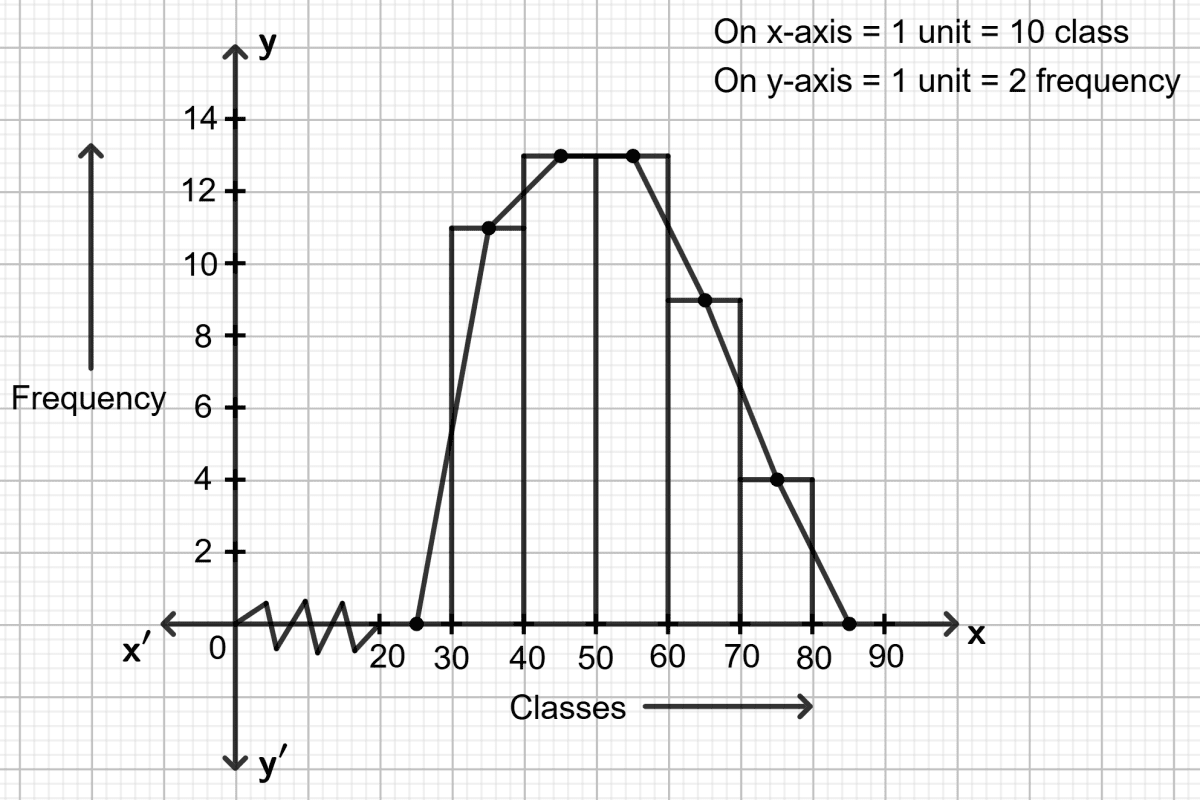
State, which of the following variables are continuous and which are discrete :
(i) marks scored in a test.
(i1) daily temperature of a city.
(iii) sizes of shoes.
(iv) distance covered by a train.
(v) time.
Answer
(i) Marks scored in a test is a discrete variable.
Reason: Marks scored in a test are countable and can only take specific values, with no values between them.
(ii) Daily temperature of a city is a continuous variable.
Reason: Temperature is measured and can take any value within a range, without gaps between possible values.
(iii) Sizes of shoes is a discrete variable.
Reason: Shoe sizes are countable and generally represented by specific numbers (e.g., 8, 8.5, 9, etc.), with no values in between.
(iv) Distance covered by a train is a continuous variable.
Reason: Distance can take any value within a range and can be measured to any degree of precision, without gaps between values.
(v) Time is a continuous variable.
Reason: Time is measured and can take any value within a range (e.g., 2.5 seconds, 2.55 seconds, etc.), and there are no distinct gaps between possible values.
The table, given below, shows the frequency distribution of the weekly wages of the employees of a company :
| Weekly Wages (in ₹) | Number of employees |
|---|---|
| 800 - 899 | 22 |
| 900 - 999 | 27 |
| 1000 - 1099 | 23 |
| 1100 - 1199 | 18 |
| 1200 - 1299 | 15 |
Find :
(i) the lower limit of the fourth class.
(ii) the upper limit of the fifth class.
(iii) the class boundaries of the second class.
(iv) the class mark of the first class.
(v) the class size of the third class.
(vi) cumulative frequency of the fourth class.
Answer
(i) The fourth class is 1100 - 1199.
Hence, lower limit of the fourth class is 1100.
(ii) The fifth class is 1200 - 1299.
Hence, the upper limit of the fifth class is 1299.
(iii) The second class is 900 - 999.
The adjustment factor =
Lower boundary = 900 - 0.5 = 899.5
Upper boundary = 900 + 0.5 = 999.5
Hence, the class boundaries of the second class are 899.5-999.5.
(iv) The first class is 800 - 899.
Class mark =
=
=
= 849.5
Hence, the class mark of the first class = 849.5.
(v) The third class is 1000 - 1099.
The adjustment factor =
The actual lower limit = 1000 - 0.5 = 999.5
The actual upper limit = 1099 + 0.5 = 1099.5
Class size = Actual upper limit - Actual lower limit
= 1099.5 - 999.5
= 100
Hence,the class size of the third class = 100.
(vi) Cumulative frequency up to the fourth class = 22 + 27 + 23 + 18 = 90
Hence, cumulative frequency of the fourth class = 90.
Find the mean of :
(i) 5, 15, 20, 8 and 12.
(ii) 28, 24, 37, 42, 56, 59, 67, 28, 15 and 32.
Answer
(i) 5, 15, 20, 8 and 12.
Hence, mean = 12.
(ii) 28, 24, 37, 42, 56, 59, 67, 28, 15 and 32.
Hence, mean = 38.8.
(a) Find the mean of the following data :
18, 33, 30, 21 and 13.
Also, find the sum of deviations of this data from the mean.
(b) If 150 is the mean of 200 observations and 100 is the mean of some 300 other observations, find the mean of the combination.
Answer
(a)
Sum of deviations = (18 - 23) + (33 - 23) + (30 - 23) + (21 - 23) + (13 - 23)
= (-5) + 10 + 7 + (-2) + (-10)
= 0
Hence, mean = 23 and sum of deviation = 0.
(b) Mean of 200 observation = 150
Mean =
⇒ 150 =
⇒ Sum of all observations = 150 x 200
⇒ Sum of all observations = 30,000
Mean of 300 observations = 100
⇒ 100 =
⇒ Sum of all observations = 100 x 300
⇒ Sum of all observations = 30,000
Mean of combined observations =
=
= 120
Hence, the mean of the combination = 120.
The mean of a certain number of observations is 35. What is the new value of the mean if each observation is :
(i) increased by 7.
(ii) decreased by 5.
(iii) multiplied by 2.
(iv) divided by 5.
(v) increased by 20%.
(vi) decreased by 30%.
Answer
(i) If the same number is added to each value in a dataset, the mean will also increase by that same number.
Mean of a certain number of observations = 35
When each number is increased by 7.
New mean = 35 + 7 = 42
Hence, the mean = 42.
(ii) If the same number is subtracted from each value in a dataset, the mean will also decrease by that same number.
Mean of a certain number of observations = 35
When each number is decreased by 5.
New mean = 35 - 5 = 30
Hence, the mean = 30.
(iii) If each value in the dataset is multiplied by the same number, the mean will also be multiplied by that same number.
Mean of a certain number of observations = 35
When each number is multiplied by 2.
New mean = 35 x 2 = 70
Hence, the mean = 70.
(iv) If each value in the dataset is divided by the same number, the mean will also be divided by that same number.
Mean of a certain number of observations = 35
When each number is divide by 5.
New mean = 35 ÷ 5 = 7
Hence, the mean = 7.
(v) If each value in the dataset is increased by 20%, the mean will also increase by 20%.
Mean of a certain number of observations = 35
When each number is increased by 20%.
New mean = 35 x (100 + 20)%
= 35 x
= 42
Hence, the mean = 42.
(vi) If each value in the dataset is decreased by 30%, the mean will also decrease by 30%.
Mean of a certain number of observations = 35
When each number is decreased by 30%.
New mean = 35 x (100 - 30)%
= 35 x
= 24.5
Hence, the mean = 24.5.
Find the median of 17, 26, 60, 45, 33, 32, 29, 34 and 56. If 26 is replaced by 62, what will be the new median ?
Answer
On arranging the given set of data in ascending order of magnitude, we get: 17, 26, 29, 32, 33, 34, 45, 56 and 60.
Number of observations, n = 9 (odd)
Median =
=
=
= 5th term
Thus, Median = 33
Now, replacing 26 with 62, the new set of numbers is : 17, 62, 60, 45, 33, 32, 29, 34 and 56.
On arranging these new numbers in ascending order, we get: 17, 29, 32, 33, 34, 45, 56, 60 and 62.
Number of observations, n = 9 (odd)
Median =
=
=
= 5th term
Thus, Median = 34
Hence, the original median is 33 and the new median after replacing 26 with 62 is 34.
The following data have been arranged in ascending order of magnitude.
63, 66, 69, x, x + 2, 76, 89 and 103.
If the median of the given data is 71, find the value of x.
Answer
n = 8
Median =
Median =
=
=
=
=
=
= x + 1
⇒ x + 1 = 71
⇒ x = 71 - 1
⇒ x = 70
Hence, the value of x is 70.
(a) An isosceles right-angled triangle has area 200 cm2. What is the length of its hypotenuse?
(b) The perimeter of a triangle is 540 m and its sides are in the ratio 12 : 25 : 17. Find the area of the triangle.
(c) Find the area of triangle whose sides are 5 cm, 12 cm and 13 cm. Also, find the length of its altitude corresponding to the longest side.
Answer
(a) In an isosceles right-angled triangle, the two perpendicular sides (base and height) are of equal length. The area is given by:
Area =
Let the base of the triangle be x. Since it is an isosceles right-angled triangle, the height is also x.
Area =
⇒ 200 =
⇒ 200 2 =
⇒ = 400
⇒
⇒ = 20
Now, using the Pythagoras Theorem, the hypotenuse h is given by:
h2 = base2 + height2
⇒ h2 = (20)2 + (20)2
⇒ h2 = 400 + 400
⇒ h2 = 800
⇒ h =
⇒ h = 20
Hence, the length of the hypotenuse is 20 cm.
(b) The given ratio of sides is 12 : 25 : 17.
Let the sides of the triangle be 12x, 25x and 17x.
The perimeter of the triangle = Sum of all sides
⇒ 540 m = 12x + 25x + 17x
⇒ 540 m = 54x
⇒ x = m
⇒ x = 10 m
So, the actual lengths of the sides are:
12x = 12 10 = 120 m
25x = 25 10 = 250 m
17x = 17 10 = 170m
Using Heron's formula, semi-perimeter (s),
The area of the triangle,
Hence, the area of the triangle is 9,000 m2.
(c) Using Heron's formula,
The area of the triangle,
Area of the triangle = x base x altitude
Let the altitude corresponding to the longest side (13 cm) be h.
⇒ x 13 x h = 30
⇒ 13 x h = 30 x 2
⇒ 13 x h = 60
⇒ h =
⇒ h = 4.61 cm
Hence, area of the triangle is 30 cm2 and the altitude is 4.61 cm.
(a) The diagonals of a rhombus are 24 cm and 10 cm. Calculate its area and perimeter.
(b) The diagonals of a field in the form of a quadrilateral are 106 m and 80 m and intersect each other at right angles. Find the cost of cultivating the field at the rate of ₹ 25.50 per 100 m2.
Answer
(a)

Let ABCD be the rhombus with diagonals AC and BD measuring 24 cm and 10 cm, respectively. We know that the diagonals of a rhombus bisect each other at right angles.
Area of rhombus = x (Product of diagonals)
= x 24 x 10
= x 240
= 120 cm2
Applying the Pythagorean theorem in Δ ADE:
AD2 = AE2 + DE2
= 122 + 52
= 144 + 25
= 169
AD =
= 13 cm
Perimeter of the rhombus = 4 x side
= 4 x 13
= 52 cm
Hence, the area of the rhombus is 120 cm2 and the perimeter is 52 cm.
(b) When the diagonals of a quadrilateral intersect at right angles, the area can be found using the formula:
Area of the quadrilateral = x d1 x d2
= x 106 x 80
= x 8480
= 4240 m2
Given that the cost of cultivation is ₹ 25.50 per 100 m2.
=
= ₹ 1081.20
Hence, the total cost of cultivation is ₹ 1081.20.
If the difference between the two sides of a right-angled triangle is 2 cm and the area of the triangle is 24 cm2; find the perimeter of the triangle.
Answer

ABC is a right angled triangle with a right angle at B.
The difference between the two perpendicular sides is 2 cm.
The area of the triangle is 24 cm2.
Let the lengths of BC and AB be a and b, respectively.
From the given condition:
a - b = 2
∴ b = a - 2
Area of triangle = x base x height
⇒ x BC x AB = 24
⇒ x a x (a - 2) = 24
⇒ a x (a - 2) = 24 x 2
⇒ a2 - 2a = 48
⇒ a2 - 2a - 48 = 0
⇒ a2 - 8a + 6a - 48 = 0
⇒ a(a - 8) + 6(a - 8) = 0
⇒ (a - 8)(a + 6) = 0
⇒ a = 8 or -6
Since length cannot be negative, a = 8 cm.
Now, substituting a = 8 in b = a - 2:
b = 8 - 2 = 6 cm
By using Pythagoras theorem,
Hypotenuse2 = Base2 + Height2
⇒ AC2 = BC2 + AB2
= 82 + 62
= 64 + 36
= 100
⇒ AC =
= 10 cm
Perimeter of the triangle = Sum of all sides of the triangle
= AC + BC + AB
= 10 + 8 + 6 cm
= 24 cm
Hence, the perimeter of the triangle is 24 cm.
Calculate the area of quadrilateral ABCD in which ∠A = 90°, AB = 16 cm, AD = 12 cm and BC = CD = 12.5 cm.
Answer

Given: ∠A = 90°, AB = 16 cm, AD = 12 cm and BC = CD = 12.5 cm
Join BD to divide quadrilateral ABCD into two triangles: Δ ABD and Δ BCD.
Since ∠A = 90°, Δ ABD is a right-angled triangle at A.
Area of right angled triangle = x base x height
= x 16 x 12
= x 192
= 96 cm2
Using Pythagoras theorem,
Hypotenuse2 = Base2 + Height2
⇒ BD2 = AB2 + AD2
= 162 + 122
= 256 + 144
= 400
⇒ BD = = 20 cm
Δ BCD is isosceles, with BC = CD = 12.5 cm and base BD = 20 cm.
s (semi-perimeter) =
Substituting BC = a = 12.5 cm, CD = b = 12.5 cm, BD = c = 20 cm:
s =
=
= 22.5 cm
Area of triangle =
Area of quadrilateral ABCD = Area of Δ ABD + Area of Δ ABD
= 96 cm2 + 75 cm2
= 171 cm2
Hence, the area of quadrilateral ABCD = 171 cm2.
In the given figure, ∠ABC = 90° = ∠DEC, AC = 15 cm and AB = 9 cm. If the area of the quadrilateral ABCD is 72 cm2; find the length of DE.

Answer
ABC is a right angle triangle. Using Pythagoras theorem,
⇒ AC2 = AB2 + BC2
⇒ BC2 = AC2 - AB2
= 152 - 92
= 225 - 81
= 144
⇒ BC =
= 12
As we know that area of triangle = x base x height
Area of quadrilateral ABCD = Area of Δ ABC + Area of Δ BCD
⇒ 72 = x AB x BC + x BC x DE
⇒ 72 = x 9 x 12 + x 12 x DE
⇒ 72 = 9 x 6 + 6 x DE
⇒ 72 = 54 + 6 x DE
⇒ 6DE = 72 - 54
⇒ 6DE = 18
⇒ DE =
⇒ DE = 3 cm
Hence, the value of DE = 3 cm.
How many square tiles of side 40 cm will be required to pave a footpath which is 2 m wide and surrounds a rectangular plot 80 m by 44 m ?
Answer
Area of rectangular plot = l x b
= 80 x 44
= 3520 m2
Since the footpath is 2 m wide, it extends 2 m on all sides, increasing both the length and breadth by 4 m in total.
New length = 80 + 4 = 84 m
New breadth = 44 + 4 = 48 m
Area of the outer rectangle = 84 x 48
= 4032 m2
Area of footpath = Area of the outer rectangle - Area of the rectangular plot
= 4032 - 3520
= 512 m2
Since each tile is 40 cm × 40 cm, we first convert the side length into meters:
40 cm = = 0.4 m
Area of one tile = (0.4)2
= 0.16 m2
Number of tiles =
=
= 3200
Hence, the number of tiles required is 3200.
The cost of papering four walls of a room at ₹ 14 per square metre is ₹ 3,150. The height of the room is 5 metres. Find the length and the breadth of the room, if they are in the ratio 4 : 1.
Answer
The length and the breadth of the room are in the ratio 4 : 1.
Let the length of the room be 4a and breadth of the room be a.
Area of the walls = 2(l + b) x h
= 2(4a + a) x 5
= 10 x 5a
= 50a square metres
The cost of papering the four walls = Area of the walls x 14
⇒ 50a x 14 = 3,150
⇒ 50a =
⇒ 50a = 225
⇒ a =
⇒ a = 4.5
So, the length of the room = 4a = 4 x 4.5 = 18 m
And breadth of the room = 1a = 1 x 4.5 = 4.5 m
Hence, the length of the room is 18 m and the breadth of the room is 4.5 m.
A circle is inscribed in a square of side 14 cm. Find the area enclosed between the square and the circle.
Answer
Area of square = side2
= 142
= 196 cm2
Since the circle is inscribed in the square, its diameter is equal to the side length of the square, which is 14 cm. The radius (r) is half of the diameter:
r = = 7 cm
Area of circle = πr2
= π x 72
= x 49
= 154 cm2
Area enclosed between the square and the circle = Area of square - Area of circle
= 196 cm2 - 154 cm2
= 42 cm2
Hence, the area enclosed between the square and the circle is 42 cm2.
The ratio between the diameters of two circles is 3 : 5. Find the ratio between their :
(i) radii
(ii) circumferences
(iii) areas
Answer
(i) The ratio between the diameters of two circles = 3 : 5
Let the diameter of the 1st circle be 3a and that diameter of the 2nd circle be 5a.
Radius of the circle =
Radius of 1st circle =
Radius of 2nd circle =
Now, the ratio of their radii:
=
=
=
Hence, the ratio of the radii is 3:5.
(ii) The circumference of a circle = 2πr
Circumference of 1st circle = 2π x
Circumference of 1st circle = 2π x
Now, the ratio of their circumferences:
=
=
=
Hence, the ratio of the circumferences is 3:5.
(iii) Area of the circle = πr2
Area of 1st circle = π x = π x
Area of 2nd circle = π x = π x
Now, the ratio of their areas:
=
=
=
Hence, the ratio of the areas is 9:25.
Find the ratio between the area of the shaded and the unshaded portions of the following figure :

Answer
Let r be the radius of the given circle.
Let l and b be the length and breadth of the rectangle.
l = r + 2r = 3r
b = 2r
Area of rectangle = l x b
= 3r x 2r
= 6r2
Area of shaded portion = Area of circle + Area of semicircle
= πr2 + πr2
= πr2
= r2
= r2
= r2
Area of the unshaded portion = Area of rectangle - Area of shaded portion
= 6r2 - r2
= r2 - r2
= r2
The ratio between the area of the shaded and the unshaded portions
Hence, the ratio between the area of the shaded and the unshaded portions = 11:3.
Calculate the area of a triangle whose sides are 13 cm, 5 cm and 12 cm. Hence, calculate the altitude corresponding to the longest side of this triangle. Leave your answer as a fraction.
Answer
The sides of the triangle are 13 cm, 5 cm and 12 cm.
Area of triangle =
where, s =
Substituting a = 13 cm, b = 5 cm, c = 12 cm:
s =
=
= 15
Area of the triangle:
Let the height be h and base = 13 cm.
Area of triangle = x base x height
⇒ 30 = x 13 x h
⇒ h =
⇒ h =
⇒ h =
⇒ h =
Hence, the altitude corresponding to the longest side of the triangle is cm.
Find the area of a triangle whose perimeter is 22 cm, one side is 9 cm and the difference of other two sides is 3 cm.
Answer
Perimeter of triangle = 22 cm
One side = 9 cm
Difference between other two sides = 3 cm
Let the unknown sides be a and b, where a > b.
⇒ a - b = 3 ...........(1)
⇒ a + b = 22 - 9 = 13 ...........(2)
Adding equations (1) and (2), we get
Substituting a = 8 in equation (2):
8 + b = 13
b = 13 - 8 = 5
So, the three sides of the triangle are 9 cm, 8 cm, and 5 cm.
Area of triangle =
where, s =
s =
=
= 11
Area of the triangle:
Hence, the area of triangle = 6 cm2.
The base of an isosceles triangle is 24 cm and its area is 60 cm2. Find its perimeter.
Answer
The base of an isosceles triangle = 24 cm
Area of the triangle = 60 cm2.
Let the height of the triangle be a.
Area of triangle = x base x height
⇒ 60 = x 24 x a
⇒ 60 = 12 x a
⇒ a =
⇒ a = 5
Since, the triangle is isosceles, the height divides the base into two equal halves. Then applying Pythagoras theorem,
Hypotenuse2 = Base2 + Height2
= + 52
= 122 + 52
= 144 + 25
= 169
⇒ Other side =
= 13
Perimeter of triangle = sum of all sides
= 24 + 13 + 13
= 50 cm
The area of a circular ring enclosed between two concentric circles is 286 cm2. Find the radii of the two circles, given that their difference is 7 cm.
Answer
Given: The area of a circular ring = 286 cm2
The difference in radii of the two circles = 7 cm
Let the radius of the larger circle = R cm
Let the radius of the smaller circle = r cm
Thus, we are given: R - r = 7 ...................(1)
The area of the ring is given by the difference between the areas of the two circles:
⇒ πR2 - πr2 = 286
⇒ π(R2 - r2) = 286
⇒ (R2 - r2) = 286
⇒ R2 - r2 =
⇒ (R - r)(R + r) =
⇒ (R - r)(R + r) = 91
⇒ 7 x (R + r) = 91
⇒ R + r =
⇒ R + r = 13 ...................(2)
Adding both equations (1) and (2), we get:
Substituting in equation (1), we get
⇒ 10 - r = 7
⇒ 10 - 7 = r
⇒ r = 3
Hence, the radii of the two concentric circles are 10 cm and 3 cm.
(a) Six cubes, each with 12 cm edge, are joined end to end. Find the surface area of the resulting cuboid.
(b) The diagonal of a cube is cm. Find its surface area and volume.
(c) The areas of three adjacent faces of a cuboid are x, y and z. If the volume is V; prove that : V2 = xyz.
Answer
(a) Each cube has an edge length of 12 cm. When 6 cubes are joined end to end in a straight line, the resulting cuboid has:
Length = 6 x 12 = 72 cm
Breadth = 12 cm
Height = 12 cm
The surface area of a cuboid = 2(lb + bh + hl)
= 2(72 x 12 + 12 x 12 + 12 x 72)
= 2 x (864 + 144 + 864)
= 2 x 1872
= 3744 cm2
Hence, the surface area of the resulting cuboid = 3744 cm2.
(b) Let the side length of the cube be a.
The formula for the diagonal of a cube is:
Diagonal = a
⇒ = a
⇒ a = 16 cm
Surface area of the cube = 6 x side2
= 6 x (16)2
= 6 x 256
= 1536 cm2
Volume of the cube = side3
= (16)3
= 4096 cm3
Hence, the surface area of the cube = 1536 cm2 and its volume = 4096 cm3.
(c) Given that the areas of three adjacent faces of a cuboid are x, y, and z, we define:
⇒ x = lb, y = bh and z = lh
We also know that the volume of a cuboid = l x b x h
Squaring both sides:
⇒ V2 = (lbh)2
⇒ V2 = l2 b2 h2
⇒ V2 = (lb) (bh) (hl)
⇒ V2 = x y z
⇒ V2 = xyz
Hence, proved V2 = xyz.
Water flows into a tank, 150 metres long and 100 metres broad, through a pipe whose cross-section is 2 dm by 1.5 dm at the speed of 15 km per hour. In what time, will the water be 3 metres deep ?
Answer
Dimensions of the tank :
Length = 150 m
Breadth = 100 m
Required depth = 3 m
Dimensions of the pipe cross-section:
Width = 2 dm = 0.2 m
Height = 1.5 dm = 0.15 m
Speed of water flow = 15 km/h = 15000 m/h
Volume of the tank = l x b x h
= 150 x 100 x 3
= 45000 m3
The volume of water flowing per hour is given by:
Flow Rate = Cross-sectional area x Speed
Cross-sectional area of the pipe = l x b
= 0.2 x 0.15 m2
= 0.03 m2
Water flow per hour = 0.03 x 15000
= 450 m3/ h
Time =
=
= 100 hrs
Hence, the tank will be filled in 100 hours.
A cylindrical bucket holds 44.372 litre of water. The water is emptied into a rectangular tank 66 cm long and 28 cm wide. Find the height of the water level in the tank.
Answer
Volume of cylindrical bucket = 44.372 litres
1 liter = 0.001 m3
Volume of bucket in cubic meters = 44.372 x 0.001 m3 = 0.044372 m3
Dimensions of the rectangular tank:
Length = 66 cm = 0.66 m
Breadth = 28 cm = 0.28 m
Volume of the tank = l x b x h
⇒ 0.044372 = 0.66 x 0.28 x h
⇒ 0.044372 = 0.1848 x h
⇒ h =
⇒ h = 0.24 m
⇒ h ≈ 24 cm
Hence, the water level in the tank rises by 24 cm.
The area of cross-section of a pipe is 10.4 cm2 and water is running through it at the rate of 54 km/h. If the pipe is always 60% full, find the volume of water, in litres, that flows through the pipe in 5 minutes.
Answer
The area of cross-section of a pipe = 10.4 cm2
Speed of water flow = 54 km/h
= cm/min
= 90000 cm/min
Since the pipe is 60% full, the effective velocity of water is = x 90000 cm/min
= 54000 cm/min
Volume per minute = Cross-sectional area x Effective speed
= 10.4 x 54000 cm3/ min
= 561600 cm3/ min
Volume in 5 min = 561600 x 5
= 2808000 cm3
=
= 2808 litre
Hence, the volume of water that flows through the pipe in 5 minutes = 2808 litre.
Length of a room is twice its height and its breadth is times its height. The cost of white washing the walls at the rate of ₹ 32 per sq. m is ₹ 3,584. Find the cost of tiling the floor of the room at ₹ 135 per sq. m.
Answer
Let h be the height of the room.
Length = 2h
Breadth = h = h
The total surface area of 4 walls of the room = 2 x (length + breadth) x height
= 2 x (2h + h) x h
= 2 x h x h
= 2 x h x h
= 7 h2
Cost of whitewashing walls = ₹ 32 per sq. m
Total cost of whitewashing = ₹ 3,584
⇒ Rate x surface area = total cost
⇒ 32 x 7h2 = 3584
⇒ 224 h2 = 3584
⇒ h2 =
⇒ h2 = 16
⇒ h =
⇒ h = 4 m
Length = 2h = 4 x 2 m = 8 m
Breadth = h = x 4m = 6 m
Floor area = l x b
= 8 x 6
= 48 m2
Cost of tiling = ₹ 135 per sq. m
Total cost of tiling = 48 x ₹ 135
= ₹ 6480
Hence, the cost of tiling the floor = ₹ 6480.
The square on the diagonal of a cube has an area of 192 cm2. Calculate :
(i) the side of the cube.
(ii) the total surface area of the cube.
Answer
(i) Let a be the side of the cube.
The diagonal of the cube forms a square whose area is given:
Diagonal of cube = a
Since the square has an area of 192 cm2,
⇒ (a )2 = 192
⇒ a2 x 3 = 192
⇒ a2 =
⇒ a2 = 64
⇒ a =
⇒ a ≈ 8 cm
Hence, the side of the cube = 8 cm.
(ii) The total surface area of cube = 6a2
= 6 x 82
= 6 x 64
= 384 cm2
Hence, the total surface area of the cube = 384 cm2.
The volume of a cubical solid is 10368 cm3. If its dimensions are in the ratio 3 : 2 : 1, find the cost of polishing its total surface at the rate of ₹ 2.50 per m2.
Answer
Volume of cuboid = 10368 cm3
Ratio of dimensions = 3 : 2 : 1
Let the dimensions be 3k, 2k, 1k.
Volume of cuboid = l x b x h
⇒ 10368 = 3k x 2k x k
⇒ 10368 = 6k3
⇒ k3 =
⇒ k3 = 1728
⇒ k =
⇒ k = 12
So, the dimensions are:
Length = 3k = 3 x 12 = 36 cm
Breadth = 2k = 2 x 12 = 24 cm
Height = k = 12 cm
The total surface area of a cuboid = 2(lb + bh + hl)
= 2(36 x 24 + 24 x 12 + 12 x 36)
= 2(864 + 288 + 432)
= 2 x 1584
= 3168 cm2
= 0.3168 m2
Rate of polishing = ₹ 2.50 per m2
Total cost = Surface area x Rate
= 0.3168 x 2.50
= ₹ 0.7920
Hence, the cost of polishing the total surface area = ₹ 0.7920.
Squares, each of side 6 cm are cut off from the four corners of a sheet of tin measuring 42 cm by 30 cm. The remaining portion of the tin sheet is made into an open box by folding up the flaps. Find the capacity of the box formed.
Answer
Dimensions of the tin sheet = 42 cm x 30 cm
Side of the square cut from each corner = 6 cm
After cutting out the squares, the new dimensions of the box will be:
length = 42 - 6 - 6 = 42 - 12 = 30 cm
breadth = 30 - 6 - 6 = 30 - 12 = 18 cm
height = 6 cm
The capacity (volume) of the box is given by:
Volume = l x b x h
= 30 x 18 x 6
= 3240 cm3
Hence, the capacity of the box = 3240 cm3.
If cos A = 0.5 and cos B = ; find the value of : .
Answer
cos A = 0.5
cos A = =
⇒ cos A = cos 60°
⇒ A = 60°
cos B =
⇒ cos B = cos 45°
⇒ B = 45°
Now, find the value of
Hence, the value of .
If 3 cos A = 4 sin A: find the value of :
4 cos2 A - 3 sin2 A + 2
Answer
Given: 3 cos A = 4 sin A
⇒
⇒ tan A =
⇒
Let the perpendicular be 3k and base be 4k.
Using Pythagoras theorem, we get
Hypotenuse2 = Perpendicular2 + Base2
= (3k)2 + (4k)2
= 9k2 + 16k2
= 25k2
⇒ Hypotenuse =
= 5k
sin A = = =
cos A = = =
Now the value of 4 cos2 A - 3 sin2 A + 2
Hence, the value of 4 cos2 A - 3 sin2 A + 2 = .
If 4 cos2 A - 3 = 0 and 0° ≤ A ≤ 90°; find:
(i) angle A
(ii) cos 3 A
(iii) tan2 A + cos2 A
Answer
(i) 4 cos2 A - 3 = 0
⇒ 4 cos2 A = 3
⇒ cos2 A =
⇒ cos A =
⇒ cos A =
⇒ cos A = cos 30°
⇒ A = 30°
Hence, the value of angle A = 30°.
(ii) cos 3A
= cos (3 x 30°)
= cos 90°
= 0
Hence, the value of cos 3A = 0.
(iii)
Hence, the value of tan2 A + cos2 A = .
If 2 cos (A - B) = 2 sin (A + B) = ; find the values of acute angles A and B.
Answer
Given: 2 cos (A - B) = 2 sin (A + B) =
⇒ 2 cos (A - B) =
⇒ cos (A - B) =
⇒ cos (A - B) = cos 30°
⇒ A - B = 30° ......................(1)
And, 2 sin (A + B) =
⇒ sin (A + B) =
⇒ sin (A + B) = sin 60°
⇒ A + B = 60° ......................(2)
Add equations (1) and (2), we get
Putting the value of A in equation (1), we get
⇒ 45° - B = 30°
⇒ B = 45° - 30°
⇒ B = 15°
Hence, the value of A = 45° and B = 15°.
(i) If cos A = ; find the value of :
(ii) If (2cos 2A - 1) (tan3A - 1) = 0; find all possible values of angle A.
Answer
(i) Given: cos A =
⇒
Let base be 9a and hypotenuse be 41a.
Using Pythagoras theorem,
Hypotenuse2 = Base2 + Perpendicular2
⇒ (41a)2 = (9a)2 + Perpendicular2
⇒ 1681a2 = 81a2 + Perpendicular2
⇒ Perpendicular2 = 1681a2 - 81a2
⇒ Perpendicular2 = 1600a2
⇒ Perpendicular =
⇒ Perpendicular = 40a
sin A =
=
=
⇒ (sin A)2 =
⇒ sin2 A =
And, cot A =
=
=
⇒ (cot A)2 =
⇒ cot2 A =
Now, the value of
Hence, the value of .
(ii) Given: (2cos 2A - 1) (tan3A - 1) = 0
⇒ (2cos 2A - 1) = 0 or (tan3A - 1) = 0
⇒ 2cos 2A = 1 or tan3A = 1
⇒ cos 2A = or tan3A = tan 45°
⇒ cos 2A = cos 60° or tan3A = tan 45°
⇒ 2A = 60° or 3A = 45°
⇒ A =
⇒ A = 30° or A = 15°
Hence, the value of A = 30° or 15°.
If tan A = 1 and tan B = ; evaluate:
(i) cos A cos B - sin A sin B.
(ii) sin A cos B + cos A sin B.
Answer
Given: tan A = 1 and tan B =
⇒ tan A = tan 45° and tan B = tan 60°
⇒ A = 45° and B = 60°
(i) cos A cos B - sin A sin B
= cos 45° cos 60° - sin 45° sin 60°
Hence, the value of cos A cos B - sin A sin B = .
(ii) sin A cos B + cos A sin B
= sin 45° cos 60° + cos 45° sin 60°
Hence, the value of sin A cos B - cos A sin B = .
Find the value of angle A, if :
(i) sin 2A = 1
(ii) 2 sin 2A = 1
(iii) 2 sin A = 1
Answer
(i) sin 2A = 1
⇒ sin 2A = sin 90°
⇒ 2A = 90°
⇒ A =
⇒ A = 45°
Hence, the value of A = 45°.
(ii) 2 sin 2A = 1
⇒ sin 2A =
⇒ sin 2A = sin 30°
⇒ 2A = 30°
⇒ A =
⇒ A = 15°
Hence, the value of A = 15°.
(iii) 2 sin A = 1
⇒ sin A =
⇒ sin A = sin 30°
⇒ A = 30°
Hence, the value of A = 30°.
Using the given figure, find the value of angle A, if :
(i) x = y
(ii) x = y
(iii) x = y

Answer
(i) Given: x = y
tan A =
=
=
= 1
⇒ tan A = tan 45°
⇒ A = 45°
Hence, the value of A = 45°.
(ii) Given: x = y
tan A =
=
=
=
= tan 60°
⇒ tan A = tan 60°
⇒ A = 60°
Hence, the value of A = 60°.
(iii) Given: x = y
tan A =
=
=
=
= tan 30°
⇒ tan A = tan 30°
⇒ A = 30°
Hence, the value of A = 30°.
Find 'x' in each of the following
(i)

(ii)

(iii)

Answer
(i) The formula for tan A =
⇒ tan 30° =
⇒ x = 69.28 m
Hence, the value of x = 69.28 m.
(ii) The formula for tan A =
⇒ tan 45° =
⇒ 40 = x
Hence, the value of x = 40 m.
(iii) The formula for cos A =
⇒ cos x =
⇒ cos x =
⇒ cos x = cos 60°
⇒ x = 60°
Hence, the value of x = 60°.
In the figures given below, find AB :
(i)

(ii)

(iii)

Answer
(i)

In Δ BCD,
tan 45° =
⇒ 1 =
⇒ 1 =
⇒ BC = 80 m
In Δ ADC,
tan 30° =
⇒
⇒
⇒ AC = 80 m
Now, AB = AC - BC
= 80 - 80 m
= 80( - 1) m
= 80(1.732 - 1) m
= 80 x 0.73 m
= 58.56 m
Hence, the value of AB = 58.56 m.
(ii)

Given: CD = AC = 40 m
In Δ ABC,
sin 60° =
⇒
⇒
⇒ AB = 40 m = 20 m = 34.64 m
Hence, the value of AB = 34.64 m.
(iii) Given: AB = BD
⇒ ∠ ADB = ∠ DAB (angles corresponding to the equals sides are always equal)
In triangle ABD, sum of all angles of triangle is 180°.
⇒ ∠ ADB + ∠ DAB + ∠ ABD = 180°
⇒ 30° + 30° + ∠ ABD = 180°
⇒ 60° + ∠ ABD = 180°
⇒ ∠ ABD = 180° - 60° = 120°
And, ∠ ABD = ∠ BDC + ∠ BCD (exterior angle property)
⇒ 120° = ∠ BDC + 90°
⇒ ∠ BDC = 120° - 90° = 30°
In Δ DBC,
cos 30° =
⇒
⇒
⇒ BD =
⇒ BD = = 23.1m
From the figure, BD = AB = 23.1 m
Hence, the value of AB = 23.1 m.
In the given figure, ∠B = 90° and ∠ADB = x°. Find :
(i) sin ∠CAB
(ii) cos2 C° + sin2 C°
(iii) tan x° - cos x° + 3 sin x°

Answer
(i) In triangle CAB, using Pythagoras theorem,
Hypotenuse2 = Base2 + Height2
⇒ AC2 = AB2 + BC2
⇒ 202 = 122 + BC2
⇒ 400 = 144 + BC2
⇒ BC2 = 400 - 144
⇒ BC2 = 256
⇒ BC =
⇒ BC = 16
sin ∠CAB =
sin ∠CAB =
Hence, sin ∠CAB =
(ii) cos2 C° + sin2 C°
=
=
=
=
= (Using Pythagoras theorem)
= 1
Hence, cos2 C° + sin2 C° = 1.
(iii) In triangle ABD, using Pythagoras theorem,
Hypotenuse2 = Base2 + Height2
⇒ AD2 = AB2 + BD2
⇒ 152 = 122 + BD2
⇒ 225 = 144 + BD2
⇒ BD2 = 225 - 144
⇒ BD2 = 81
⇒ BD =
⇒ BD = 9
Now, tan x° - cos x° + 3 sin x°
=
=
=
=
=
=
=
Hence, tan x° - cos x° + 3 sin x° = .
Evaluate : tan 25° tan 65° - cot 25° cot 65°.
Answer
= tan 25° tan 65° - cot 25° cot 65°
= tan (90° - 65°) tan 65° - cot (90° - 65°) cot 65°
= cot 65° tan 65° - tan 65° cot 65°
= 1 - 1
= 0
Hence, the value of tan 25° tan 65° - cot 25° cot 65° = 0.
Evaluate :
Answer
Hence, the value of .
In △ ABC, ∠B = 90°, evaluate : cosec A cos C - sin A sec C.
Answer
In triangle ABC, sum of all angles is 180°.
∠A + ∠B + ∠C = 180°
⇒ ∠A + 90° + ∠C = 180°
⇒ ∠A + ∠C = 180° - 90°
⇒ ∠A + ∠C = 90°
⇒ ∠C = 90° - ∠A
Given: cosec A cos C - sin A sec C
Hence, the value of cosec A cos C - sin A sec C = 0.
For △ ABC, prove that :
Answer
In any triangle △ ABC, the sum of all the angles is 180°.
⇒ A + B + C = 180°
⇒ A + C = 180° - B
Dividing both sides by 2:
⇒
⇒
⇒
sec = sec
sec = cosec
Hence, proved .
Name the independent and the dependent variables in each of the following equations:
(i) y = 2x + 5
(ii) x = 8 - 2y
(iii) x =
(iv) y = -5x - 8.
Answer
(i) y = 2x + 5
In the above equation, the value of y depends on the value of x, so y is said to be dependent variable and x is said to be independent variable.
Hence, x = independent variable and y = dependent variable.
(ii) x = 8 - 2y
In the above equation, the value of x depends on the value of y, so x is said to be dependent variable and y is said to be independent variable.
Hence, y = independent variable and x = dependent variable.
(iii) x =
In the above equation, the value of x depends on the value of y, so x is said to be dependent variable and y is said to be independent variable.
Hence, y = independent variable and x = dependent variable.
(iv) y = -5x - 8.
In the above equation, the value of y depends on the value of x, so y is said to be dependent variable and x is said to be independent variable.
Hence, x = independent variable and y = dependent variable.
For each equation, given below, find the slope and the y-intercept :
(i) 3x + 2y + 4 = 0
(ii) x - 3y - 8 = 0
(iii) x + y + 4 = 0
(iv) x = 3y + 2
(v) y = 5 - 4x
(vi) 2y + 5 = 0
Answer
(i) 3x + 2y + 4 = 0
⇒ 2y = - 3x - 4
⇒ y =
⇒ y =
⇒ y =
∴ Slope = coefficient of x =
And, y-intercept = constant term = -2
Hence, slope = and y-intercept = -2.
(ii) x - 3y - 8 = 0
⇒ 3y = x - 8
⇒ y =
⇒ y =
∴ Slope = coefficient of x =
And, y-intercept = constant term =
Hence, slope = and y-intercept = .
(iii) x + y + 4 = 0
⇒ y = -x - 4
∴ Slope = coefficient of x = -1
And, y-intercept = constant term = -4
Hence, slope = -1 and y-intercept = -4.
(iv) x = 3y + 2
⇒ 3y = x - 2
⇒ y =
⇒ y =
∴ Slope = coefficient of x =
And, y-intercept = constant term =
Hence, slope = and y-intercept = .
(v) y = 5 - 4x
⇒ y = -4x + 5
∴ Slope = coefficient of x = -4
And, y-intercept = constant term = 5
Hence, slope = -4 and y-intercept = 5.
(vi) 2y + 5 = 0
⇒ 2y = -5
⇒ y =
⇒ y = 0 +
∴ Slope = coefficient of x = 0
And, y-intercept = constant term =
Hence, slope = 0 and y-intercept = .
Find the equations of the lines, whose :
(i) slope = - 4 and y-intercept = 2
(ii) slope = 0 and y-intercept = -5
(iii) slope = 3 and y-intercept = 4
(iv) slope = 1 and y-intercept = -5.
Answer
(i) slope = - 4 ⇒ m = -4
y-intercept = 2 ⇒ c = 2
Equation is : y = mx + c, where m is slope and c is y-intercept.
⇒ y = (-4)x + 2
⇒ y = -4x + 2
Hence, the equation of line is y = -4x + 2.
(ii) slope = 0 ⇒ m = 0
y-intercept = -5 ⇒ c = -5
Equation is : y = mx + c, where m is slope and c is y-intercept.
⇒ y = 0 x - 5
⇒ y = - 5
⇒ y + 5 = 0
Hence, the equation of line is y + 5 = 0.
(iii) slope = 3 ⇒ m = 3
y-intercept = 4 ⇒ c = 4
Equation is : y = mx + c, where m is slope and c is y-intercept.
⇒ y = 3x + 4
Hence, the equation of line is y = 3x + 4.
(iv) slope = 1 ⇒ m = 1
y-intercept = -5 ⇒ c = -5
Equation is : y = mx + c, where m is slope and c is y-intercept.
⇒ y = x - 5
Hence, the equation of line is y = x - 5.
Solve, graphically :
2x - 3y = 7
5x + y = 9
Answer
First equation: 2x - 3y = 7
Step 1:
Give at least three suitable values to the variable x and find the corresponding values of y.
Let x = -1, then 2 (-1) - 3y = 7 ⇒ y = -3
Let x = 0, then 2 0 - 3y = 7 ⇒ y = -2.3
Let x = 2, then 2 2 - 3y = 7 ⇒ y = -1
Step 2:
Make a table (as given below) for the different pairs of the values of x and y:
| x | -1 | 0 | 2 |
|---|---|---|---|
| y | -3 | -2.3 | -1 |
Step 3:
Plot the points, from the table, on a graph paper and then draw a straight line passing through the points plotted on the graph.
Second equation: 5x + y = 9
Step 1:
Give at least three suitable values to the variable x and find the corresponding values of y.
Let x = 0, then 5 0 + y = 9 ⇒ y = 9
Let x = 1, then 5 1 + y = 9 ⇒ y = 4
Let x = 2, then 5 2 + y = 9 ⇒ y = -1
Step 2:
Make a table (as given below) for the different pairs of the values of x and y:
| x | 0 | 1 | 2 |
|---|---|---|---|
| y | 9 | 4 | -1 |
Step 3:
Plot the points, from the table, on a graph paper and then draw a straight line passing through the points plotted on the graph.
On the same graph paper, draw the graph for each given equation.
Both the straight lines drawn meet at point P. As it is clear from the graph, co-ordinates of the common point are (2, -1).
Solution of the given equations is : x = 2 and y = -1.

Solve, graphically :
15x - 8y = 29
17x + 12y = 75
Answer
First equation: 15x - 8y = 29
Step 1:
Give at least three suitable values to the variable x and find the corresponding values of y.
Let x = 0, then 15 0 - 8y = 29 ⇒ y = -3.6
Let x = 1, then 15 1 - 8y = 29 ⇒ y = -1.7
Let x = 3, then 15 3 - 8y = 29 ⇒ y = 2
Step 2:
Make a table (as given below) for the different pairs of the values of x and y:
| x | 0 | 1 | 3 |
|---|---|---|---|
| y | -3.6 | -1.7 | 2 |
Step 3:
Plot the points, from the table, on a graph paper and then draw a straight line passing through the points plotted on the graph.
Second equation: 17x + 12y = 75
Step 1:
Give at least three suitable values to the variable x and find the corresponding values of y.
Let x = 0, then 17 0 + 12y = 75 ⇒ y = 6.2
Let x = 2, then 17 2 + 12y = 75 ⇒ y = 3.4
Let x = 3, then 17 3 + 12y = 75 ⇒ y = 2
Step 2:
Make a table (as given below) for the different pairs of the values of x and y:
| x | 0 | 2 | 3 |
|---|---|---|---|
| y | 6.2 | 3.4 | 2 |
Step 3:
Plot the points, from the table, on a graph paper and then draw a straight line passing through the points plotted on the graph.
On the same graph paper, draw the graph for each given equation.
Both the straight lines drawn meet at point P. As it is clear from the graph, co-ordinates of the common point are (3, 2).
Solution of the given equations is : x = 3 and y = 2.

Draw the graph of straight line y = -2x + 3. Use your graph to find :
(i) the intercept on y-axis
(ii) the area between the line and co-ordinate axes.
Answer
Given equation: y = -2x + 3
Step 1:
Give at least three suitable values to the variable x and find the corresponding values of y.
Let x = 0, then y = -2 0 + 3 ⇒ y = 3
Let x = 1, then y = -2 1 + 3 ⇒ y = 1
Let x = 2, then y = -2 2 + 3 ⇒ y = -1
Step 2:
Make a table (as given below) for the different pairs of the values of x and y:
| x | 0 | 1 | 2 |
|---|---|---|---|
| y | 3 | 1 | -1 |
Step 3:
Plot the points, from the table, on a graph paper and then draw a straight line passing through the points plotted on the graph.

(i) The y-intercept is the value of y when x = 0, which is 3.
Hence, the intercept on y-axis is 3.
(ii) The triangle formed by the line and coordinate axes has the following vertices:
A(0, 3), B(0, 0), C(1.5, 0)
Area of triangle ABC = x BC x AB
= x 1.5 x 3
= 2.25 sq. units
Hence, the area between the line and co-ordinate axes = 2.25 sq. units.
Find graphically the vertices of the triangle whose sides have the equations 2y - x = 8, 5y - x = 14 and y - 2x = 1. Take 1 cm = 1 unit on both the axes.
Answer
First equation: 2y - x = 8
Step 1:
Give at least three suitable values to the variable x and find the corresponding values of y.
Let x = -2, then 2y - (-2) = 8 ⇒ y = 3
Let x = 0, then 2y - 0 = 8 ⇒ y = 4
Let x = 2, then 2y - 2 = 8 ⇒ y = 5
Step 2:
Make a table (as given below) for the different pairs of the values of x and y:
| x | -2 | 0 | 2 |
|---|---|---|---|
| y | 3 | 4 | 5 |
Step 3:
Plot the points, from the table, on a graph paper and then draw a straight line passing through the points plotted on the graph.
Second equation: 5y - x = 14
Step 1:
Give at least three suitable values to the variable x and find the corresponding values of y.
Let x = -4, then 5y - (-4) = 14 ⇒ y = 2
Let x = -1, then 5y - (-1) = 14 ⇒ y = 2.6
Let x = 1, then 5y - 1 = 14 ⇒ y = 3
Step 2:
Make a table (as given below) for the different pairs of the values of x and y:
| x | -4 | -1 | 1 |
|---|---|---|---|
| y | 2 | 2.6 | 3 |
Step 3:
Plot the points, from the table, on a graph paper and then draw a straight line passing through the points plotted on the graph.
Third equation: y - 2x = 1
Step 1:
Give at least three suitable values to the variable x and find the corresponding values of y.
Let x = -2, then y - 2 (-2) = 1 ⇒ y = -3
Let x = 0, then y - 2 0 = 1 ⇒ y = 1
Let x = 2, then y - 2 2 = 1 ⇒ y = 5
Step 2:
Make a table (as given below) for the different pairs of the values of x and y:
| x | -2 | 0 | 2 |
|---|---|---|---|
| y | -3 | 1 | 5 |
Step 3:
Plot the points, from the table, on a graph paper and then draw a straight line passing through the points plotted on the graph.

The vertices of triangle ABC are A(-4, 2), B(1, 3) and C(2, 5).
Draw the graph of the straight line whose table is given below.
| x | -1 | 1 | .... | 0 | 3 |
| y | -3 | .... | -7 | -1 | 5 |
(i) Write down the linear relation between x and y.
(ii) Use the graph to find the missing numbers.
Answer
Plot the given points (-1, -3), (0, -1) and (3, 5) on a graph paper.
Draw a straight line passing through these points.

(i) Let the linear relation between the variable x and y be y = mx + c.
Since, the graph passes through the point (-1, -3); substitute x = -1 and y = -3 in y = mx + c.
This gives -3 = -1m + c ...............(1)
Again, the graph passes through the point (0, -1); substitute x = 0 and y = -1 in y = mx + c
This gives -1 = 0m + c
⇒ c = -1 ...............(2)
Substituting the value of c in (1),
⇒ -3 = -1m + (-1)
⇒ -m = -3 + 1
⇒ -m = -2
⇒ m = 2
∴ Required relation is : y = mx + c i.e. y = 2x - 1
Hence, the equation y = 2x - 1.
(ii) Through x = 1, draw a vertical line which meets the graph at a point, say A. Through A, draw a horizontal line which meets the y-axis at y = 1.
∴ when x = 1, y = 1.
Through y = -7, draw a horizontal line which meets the graph at a point, say B. Through B, draw a vertical line which meets the x-axis at x = -3.
∴ when y = -7, x = -3.
Hence, the points are (1, 1) and (-3, -7).
On the same graph paper, draw the straight lines represented by equations:
x = 5, x + 5 = 0, y + 3 = 0 and y = 3.
Also, find the area and perimeter of the rectangle formed by the intersection of these lines.
Answer
First equation: x = 5
This is a vertical line parallel to the y-axis and intersects the x-axis at ( x = 5 ).
Second equation: x + 5 = 0
x = -5
This is a vertical line parallel to the y-axis and intersects the x-axis at ( x = -5 ).
Third equation: y + 3 = 0
y = -3
This is a horizontal line parallel to the x-axis and intersects the y-axis at ( y = -3 ).
Fourth equation: y = 3
This is a horizontal line parallel to the x-axis and intersects the y-axis at ( y = 3 ).

The intersection points of these lines will form the vertices of the rectangle:
A = (-5, 3)
B = (5, 3)
C = (5, -3)
D = (-5, -3)
Distance between AB = 10 units, BC = 6 units, CD = 10 units and DA = 6 units.
Perimeter of rectangle = AB + BC + CD + DA
= 10 + 6 + 10 + 6 = 32 units.
Area of rectangle = length x breadth = AB x CD
= 10 x 6 = 60 sq. units
Hence, area of rectangle = 60 sq. units and perimeter = 32 units.
On a graph paper, mark the points A(-1, -1) and B(2, 5). Draw a straight line passing through A and B. If points (m, 4) and (0.5, n) lie on this line, use graphical method of finding the values of m and n.
Answer
Plot the given points A(-1, -1) and B(2, 5) on a graph paper.
Draw a straight line AB passing through these points.

Since, point (m, 4) lies on the straight line drawn, through y = 4 draw a horizontal line which meets the straight line AB at point P. Through P, draw a vertical line which meets the x-axis at point 1.5.
∴ m = 1.5
Also, as (0.5, n) lies on the straight line drawn, through x = 0.5, draw a vertical line which meets the straight line at point Q. Through point Q, draw a horizontal line which meets the y-axis at point 2.
∴ n = 2
Hence, m = 1.5 and n = 2.
A triangle is formed by the straight lines x + 2y - 3 = 0, 3x - 2y + 7 = 0 and y + 1 = 0. Find graphically :
(i) the co-ordinates of the vertices of the triangle.
(ii) the area of the triangle.
Answer
First equation: x + 2y - 3 = 0
Step 1:
Give at least three suitable values to the variable x and find the corresponding values of y.
Let x = -1, then (-1) + 2y - 3 = 0 ⇒ y = 2
Let x = 0, then 0 + 2y - 3 = 0 ⇒ y = 1.5
Let x = 1, then 1 + 2y - 3 = 0 ⇒ y = 1
Step 2:
Make a table (as given below) for the different pairs of the values of x and y:
| x | -1 | 0 | 1 |
|---|---|---|---|
| y | 2 | 1.5 | 1 |
Step 3:
Plot the points, from the table, on a graph paper and then draw a straight line passing through the points plotted on the graph.
Second equation: 3x - 2y + 7 = 0
Step 1:
Give at least three suitable values to the variable x and find the corresponding values of y.
Let x = -1, then 3 (-1) - 2y + 7 = 0 ⇒ y = 2
Let x = 0, then 3 0 - 2y + 7 = 0 ⇒ y = 3.5
Let x = 1, then 3 1 - 2y + 7 = 0 ⇒ y = 5
Step 2:
Make a table (as given below) for the different pairs of the values of x and y:
| x | -1 | 0 | 1 |
|---|---|---|---|
| y | 2 | 3.5 | 5 |
Step 3:
Plot the points, from the table, on a graph paper and then draw a straight line passing through the points plotted on the graph.
Third equation: y + 1 = 0
That is, y = - 1, x = 0
Draw a straight line parallel to x-axis with y = -1.

(i) From the graph, the vertices of triangle ABC are A(-1, 2), B(5, -1) and C(-3, -1).
(ii) Area of triangle = x base x height
= x BC x AD
= x 8 x 3 = 4 x 3 = 12 sq. units.
Hence, area of the triangle = 12 sq. units.
Find the distance between the points (2, -5) and (7, 7).
Answer
Distance between 2 points (x1, y1) and (x2, y2) =
Distance between (2,-5) and (7, 7) =
Hence, the distance between the points (2,-5) and (7, 7) = 13 units.
If A = (x, -7), B = (2, 5) and AB = 13 units, find x.
Answer
Distance between 2 points (x1, y1) and (x2, y2) =
Distance between A = (x, -7) and B = (2, 5) =
Hence, the value of x = 7 or -3.
A is a point on x-axis, B = (5, -4) and AB = 5 units, find the co-ordinates of A.
Answer
Let the point A be (a, 0).
AB = 5 units
Distance between 2 points (x1, y1) and (x2, y2) =
Distance between A = (a, 0) and B = (5, -4) =
Hence, the co-ordinates of point A = (8, 0) or (2, 0).
Show that A(0, 0), B(5, 5) and C(-5, 5) are vertices of a right angled isosceles triangle.
Answer
Distance between 2 points (x1, y1) and (x2, y2) =
Distance between A(0, 0) and B(5, 5) =
Distance between B(5, 5) and C(-5, 5) =
Distance between A(0, 0) and C(-5, 5) =
Using pythagoras theorem,
BC2 = AB2 + AC2
⇒ 100 = 50 + 50
⇒ 100 = 100
BC2 = AB2 + AC2 ⇒ the triangle is right-angled triangle.
And, AB = AC ⇒ the triangle is an isosceles.
Hence, the triangle ABC is an isosceles right-angled triangle.
Show that the points A(6, 4), B(9, 7) and C(11, 9) are collinear.
Answer
Distance between 2 points (x1, y1) and (x2, y2) =
Distance between A(6, 4) and B(9, 7) =
Distance between B(9, 7) and C(11, 9) =
Distance between A(6, 4) and C(11, 9) =
⇒ AB + BC = = AC
Hence, the points A(6, 4), B(9, 7) and C(11, 9) are collinear.
What point on y-axis is equidistant from the points (7, 6) and (-3, 4) ?
Answer
Let the point on the y-axis be (0, a).
Distance between 2 points (x1, y1) and (x2, y2) =
Distance of the point (0, a) from the points (7, 6) and (-3, 4) is equal.
Hence, the point on y-axis that is equidistant from (7, 6) and (-3, 4) is (0, 15).
Calculate the distance between A(7, 3) and B on the x-axis whose abscissa is 11.
Answer
The coordinate of point B on the x-axis whose abscissa is 11, are (11, 0).
Distance between 2 points (x1, y1) and (x2, y2) =
Distance between A(7, 3) and B(11, 0) =
Hence, the distance between A(7, 3) and B on the x-axis, whose abscissa is 11, is 5 units.
A is a point on the y-axis whose ordinate is 5 and B = (-3, 1). Find AB.
Answer
The coordinates of point A on the y-axis, whose ordinate is 5, are (0, 5).
Distance between 2 points (x1, y1) and (x2, y2) =
Distance between A(0, 5) and B(-3, 1) =
Hence, the distance between A(0, 5) and B(-3, 1) is 5 units.
Show that the point (2, 2) is equidistant from the points (-1, -2) and (-3, 2).
Answer
Distance between 2 points (x1, y1) and (x2, y2) =
Distance between (2, 2) and (-1, -2) =
Distance between (2, 2) and (-3, 2) =
Hence, the point (2, 2) is equidistant from the points (-1, -2) and (-3, 2).
The distance between the points (1, 3) and (x, 7) is 5, find x.
Answer
Distance between 2 points (x1, y1) and (x2, y2) =
Distance between (1, 3) and (x, 7) =
Hence, the value of x is 4 or -2.