
The median of a triangle divides it into two:
triangles of equal area
congruent triangles
right triangles
isosceles triangles
Answer
We know that,
A median of a triangle divides it into two triangles of equal area.
Hence, option 1 is the correct option.
The area of given parallelogram is:
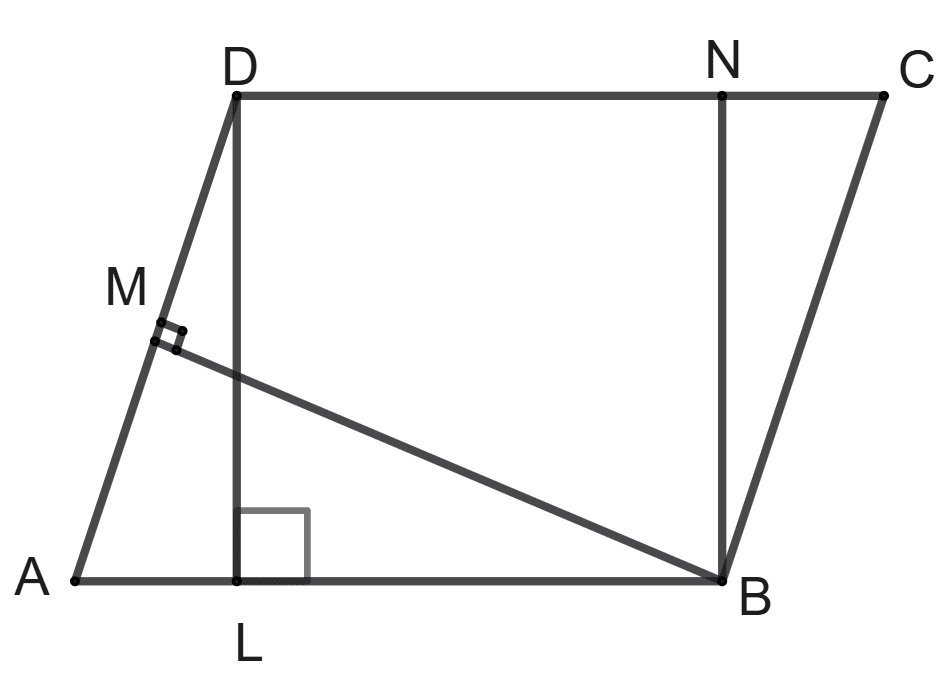
AB x BM
BC x BN
DC x DL
AD x DL
Answer
Since the opposite sides of a parallelogram are parallel and equal to each other.
∴ AB ∥ DC and AD ∥ BC
∴ AB = DC and AD = BC
Area of parallelogram = base x height = AB x DL = DC x DL.
Hence, option 3 is the correct option.
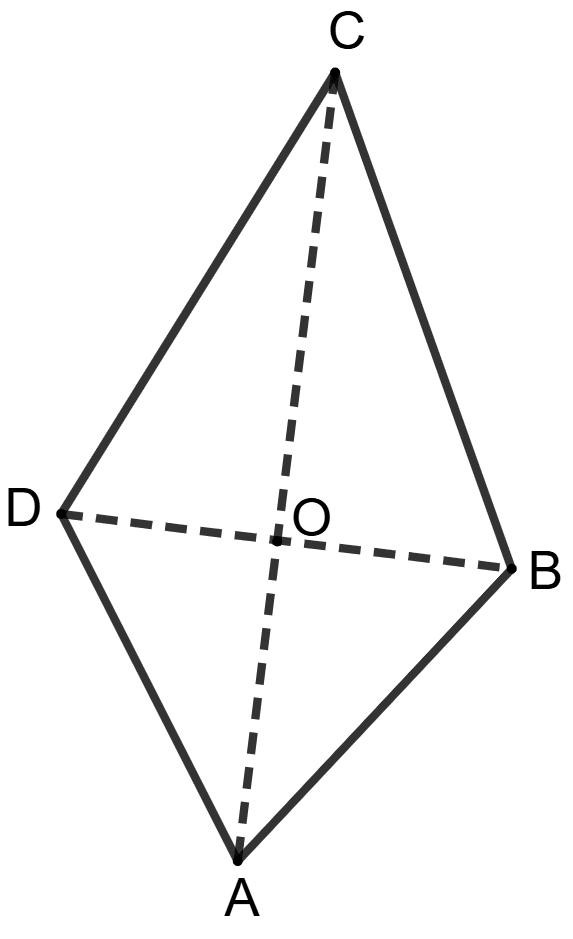
ABCD is a quadrilateral whose diagonals intersect each other at point O. The diagonal AC bisects diagonal BD. Then area of quadrilateral ABCD is :
2 x area of ΔABD
2 x area of ΔBCD
4 x area of ΔAOB
2 x area of ΔABC
Answer
ABCD is a quadrilateral. Diagonals AC and BD intersect at point O. Diagonal AC bisects diagonal BD.
Since AC bisects BD at O. O is the midpoint of BD.
Using the property, a median of a triangle divides it into two triangles of equal area.
⇒ AO is a median of ΔABD and CO is a median of ΔCBD.
⇒ Area of (ΔAOD) = Area of (ΔAOB) as AO is a median to BD in ΔABD.
⇒ Area of (ΔCOD) = Area of (ΔCOB) as CO is a median to BD in ΔCBD.
As we know that Area of quadrilateral ABCD = Area of (ΔABD) + Area of (ΔBCD)
⇒ Area of quadrilateral ABCD = [Area of (ΔAOD) + Area of (ΔAOB)] + [Area of (ΔCOD) + Area of (ΔCOB)]
⇒ Area of quadrilateral ABCD = [Area of (ΔAOB) + Area of (ΔAOB)] + [Area of (ΔCOB) + Area of (ΔCOB)]
⇒ Area of quadrilateral ABCD = 2Area of (ΔAOB) + 2Area of (ΔCOB)
⇒ Area of quadrilateral ABCD = 2[Area of (ΔAOB) + Area of (ΔCOB)]
⇒ Area of quadrilateral ABCD = 2 x Area of (ΔABC).
Hence, option 4 is the correct option.
Two parallelogram ABCD and ABEF are equal in area, they lie between the same parallel lines:
Yes
No
Nothing can be said
Answer
While it is a known geometric theorem that parallelograms on the same base and between the same parallels are equal in area, the converse is not strictly true in the way this question is phrased.
In above case both parallelograms share the base AB. However, simply having the same area and the same base does not automatically mean they must lie between the same parallels unless it is specified that they are on the same side of the base.
Thus, nothing can be said.
Hence, option 3 is the correct option.
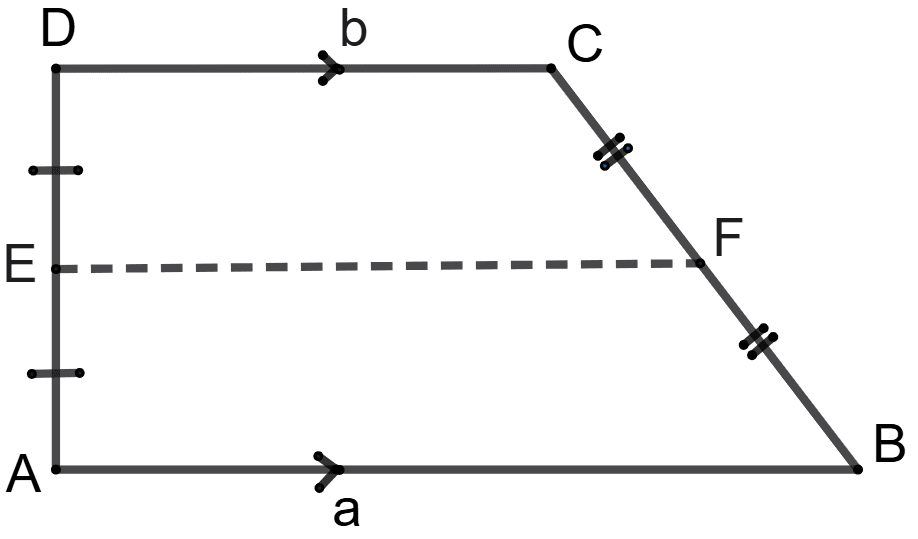
ABCD is a trapezium with parallel sides AB = a cm and DC = b cm. E and F are the mid-points of the non-parallel sides. The ratio of ar.(ABFE) and ar.(EFCD) is:
a : b
(3a + b) : (a + 3b)
(a + 3b) : (3a + b)
(2a + b) : (3a + b)
Answer
We know that,
The line segment connecting the midpoints of the non-parallel sides of a trapezium is parallel to the parallel sides and its length is half the sum of the lengths of the parallel sides.
AB || EF || DC
EF =
By formula,
Area of trapezium = × Sum of parallel sides × Distance between them
From figure,
E is the mid-point of AD, so AE = ED = x (let)
Area of trapezium ABFE = × (AB + EF) × AE .......(1)
Area of trapezium EFCD = × (EF + CD) × DE .......(2)
Dividing equation (1) from (2), we get :
Area of trapezium ABFE : Area of trapezium EFCD = (3a + b) : (3b + a).
Hence, option 2 is the correct option.
Statement 1: ABCD is a quadrilateral whose diagonal AC divides it into two parts, equal in area.
Statement 2: It is not necessary that the quadrilateral ABCD is a rectangle or a parallelogram or rhombus.
Both the statements are true.
Both the statements are false.
Statement 1 is true, and statement 2 is false.
Statement 1 is false, and statement 2 is true.
Answer
Let ABCD be a quadrilateral such that each diagonal divides it into triangles of equal areas, then
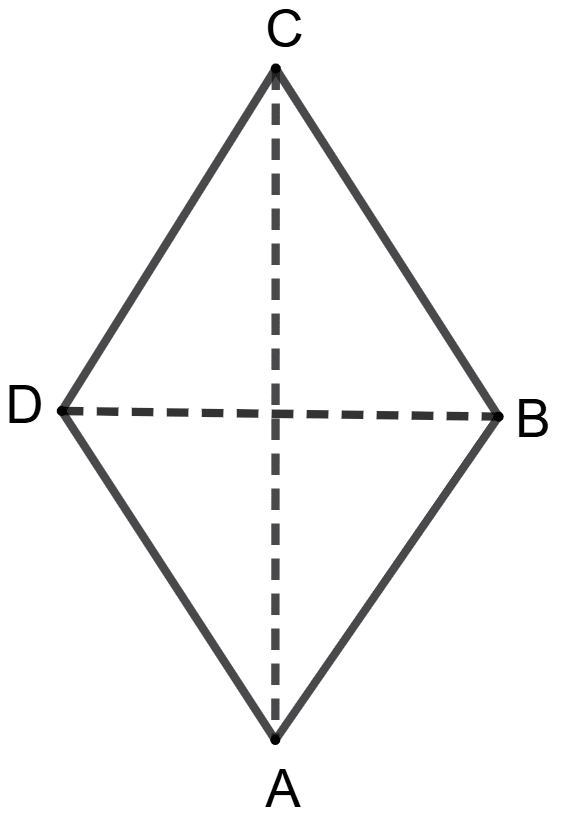
Area of △ABC = Area of ABCD, ...................(1)
Area of △ADC = Area of ABCD, ...................(2)
From (1) and (2) we get,
Area of △ABC = Area of △ADC.
So, statement 1 is true.
The condition that a diagonal divides a quadrilateral into two parts of equal area does not restrict the quadrilateral to be a rectangle, parallelogram, or rhombus.
∴ Statement 2 is true.
∴ Both the statements are true.
Hence, option 1 is the correct option.
Assertion (A): PQRS a parallelogram whose area is 180 cm2 and A is any point on the diagonal PR. The area of triangle ASR = 45 cm2.
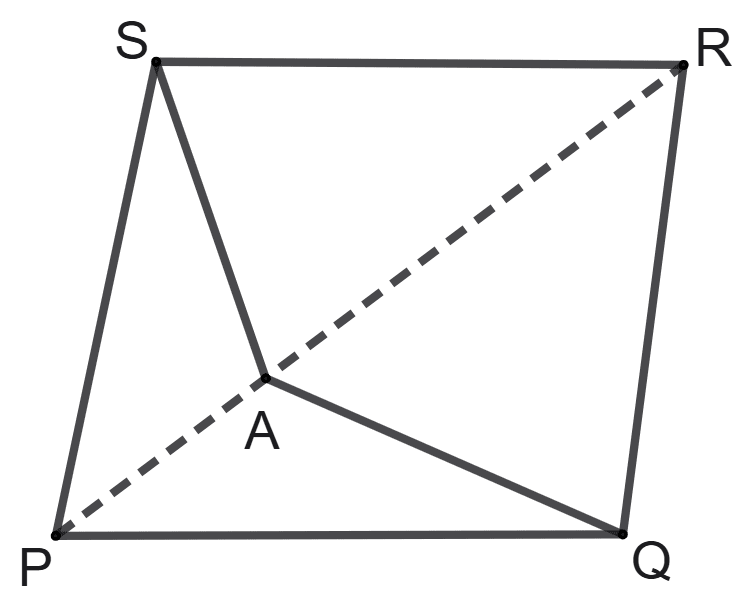
Reason (R): A is not the mid-point of diagonal PR.
A is true, but R is false.
A is false, but R is true.
Both A and R are true, and R is the correct reason for A.
Both A and R are true, and R is the incorrect reason for A.
Answer
Given,
Area of parallelogram PQRS = 180 cm2.
We know that,
Diagonal of a parallelogram divides it into two triangles of equal area.
So, area of ΔPRS = = 90 cm2
Now, A is any point on PR.
So, area of ΔASR < area of ΔPRS.
i.e., area of ΔASR < 90 cm2.
But the area of triangle ASR = 45 cm2 is not necessarily true based solely on the fact that A is any point on PR.
∴ Assertion (A) is false.
From figure,
A does not lies on the diagonal QS.
Since, diagonals of || gm bisect each other.
Thus, A is not the mid-point of diagonal PR.
∴ Reason (R) is true.
∴ A is false, but R is true.
Hence, option 2 is the correct option.
Assertion (A): ABCD is a square. E is mid-point of side AB and F is mid-point of side DC. If DA = 16 cm, the area of triangle COF is 32 cm2.
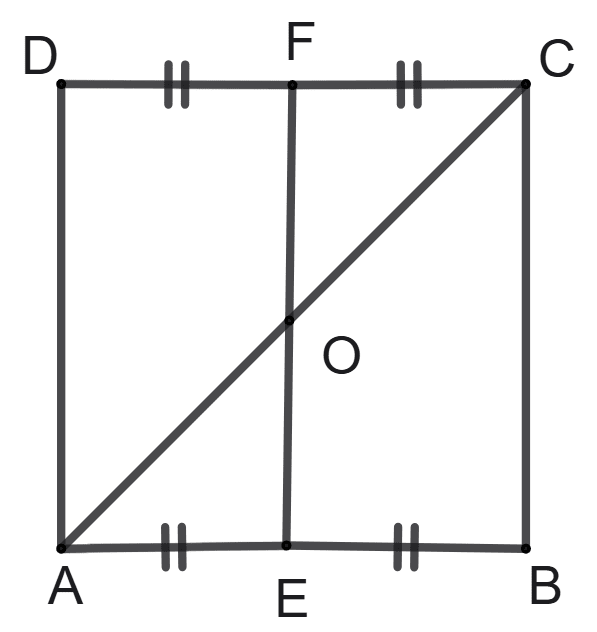
Reason (R): EF is ⊥ to DC and OF = DA = 8 cm.
Area of COF = x CF x OF
A is true, but R is false.
A is false, but R is true.
Both A and R are true, and R is the correct reason for A.
Both A and R are true, and R is the incorrect reason for A.
Answer
Given, ABCD is a square. DA = 16 cm.
∴ AB = BC = CD = DA = 16 cm
F is mid-point of DC.
CF = x DC = x 16 = 8 cm.
If EF is ⊥ to DC, then OF is perpendicular to DC.
Area of ΔCOF = x base x height
= x CF x OF
= x 8 x 8
= 4 x 8
= 32 cm2.
∴ Both A and R are true, and R is the correct reason for A.
Hence, option 3 is the correct option.
ABCD and BCFE are parallelograms. If area of triangle EBC = 480 cm2, AB = 30 cm and BC = 40 cm; Calculate :
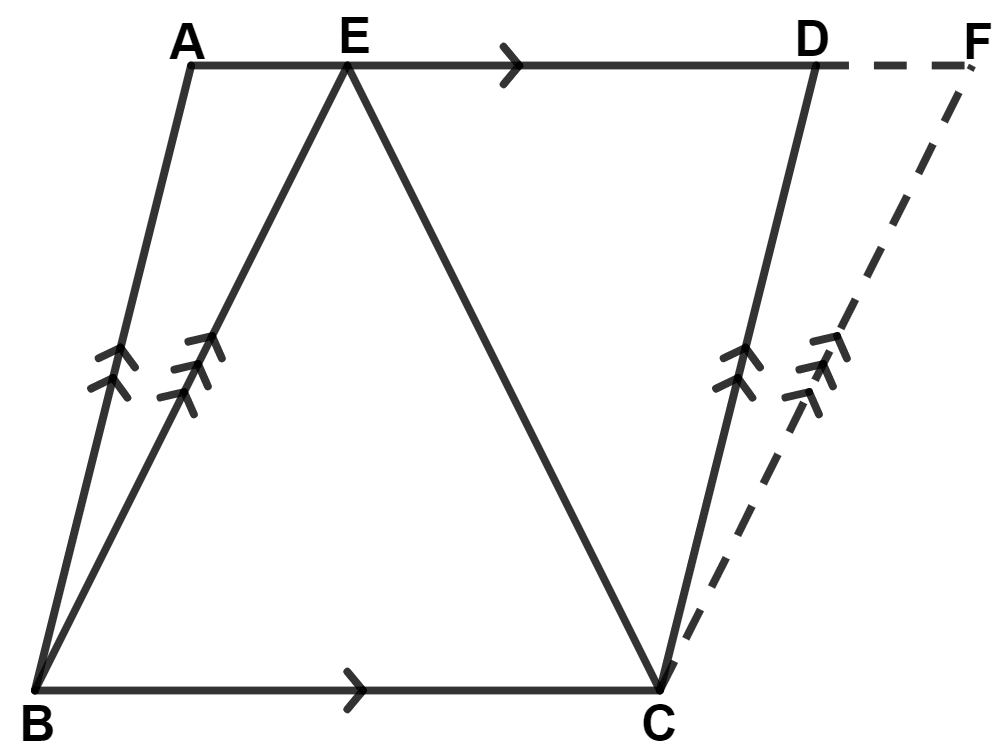
(i) area of parallelogram ABCD;
(ii) area of the parallelogram BCFE;
(iii) length of altitude from A on CD;
(iv) area of triangle ECF.
Answer
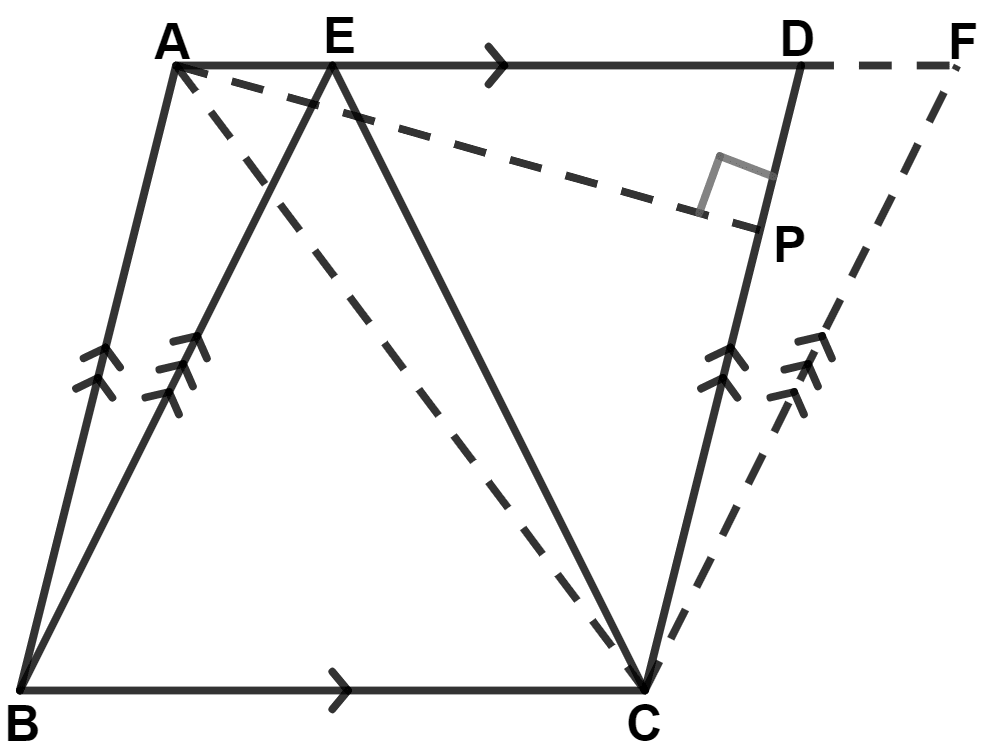
(i) We know that,
The area of a triangle is half that of a parallelogram on the same base and between the same parallels.
From figure,
△ EBC and || gm ABCD lie on same base BC and between same parallel lines AD and BC.
∴ Area of △ EBC = Area of || gm ABCD
⇒ 480 = Area of || gm ABCD
⇒ Area of || gm ABCD = 2 × 480 = 960 cm2.
Hence, area of || gm ABCD = 960 cm2.
(ii) We know that,
Parallelograms on equal bases and between the same parallels are equal in area.
From figure,
Parallelogram ABCD and BCFE lie on same base BC and between same parallel lines AF and BC.
∴ Area of || gm BCFE = Area of || ABCD = 960 cm2.
Hence, area of || gm BCFE = 960 cm2.
(iii) We know that,
The area of a triangle is half that of a parallelogram on the same base and between the same parallels.
From figure,
△ ACD and || gm ABCD lie on same base AD and between same parallel lines AD and BC.
∴ Area of △ ACD = Area of || gm ABCD
⇒ Area of △ ACD = = 480 cm2.
Since, opposite sides of parallelogram are equal.
∴ CD = AB = 30 cm.
By formula,
⇒ Area of triangle = × base × height
⇒ Area of triangle ACD =
⇒ 480 =
⇒ AP = = 32 cm.
Hence, length of altitude from A on CD = 32 cm.
(iv) We know that,
The area of a triangle is half that of a parallelogram on the same base and between the same parallels.
From figure,
△ EFC and || gm BCFE lie on same base EF and between same parallel lines EF and BC.
∴ Area of △ EFC = Area of || gm BCFE
⇒ Area of △ EFC = = 480 cm2.
Hence, area of triangle ECF = 480 cm2.
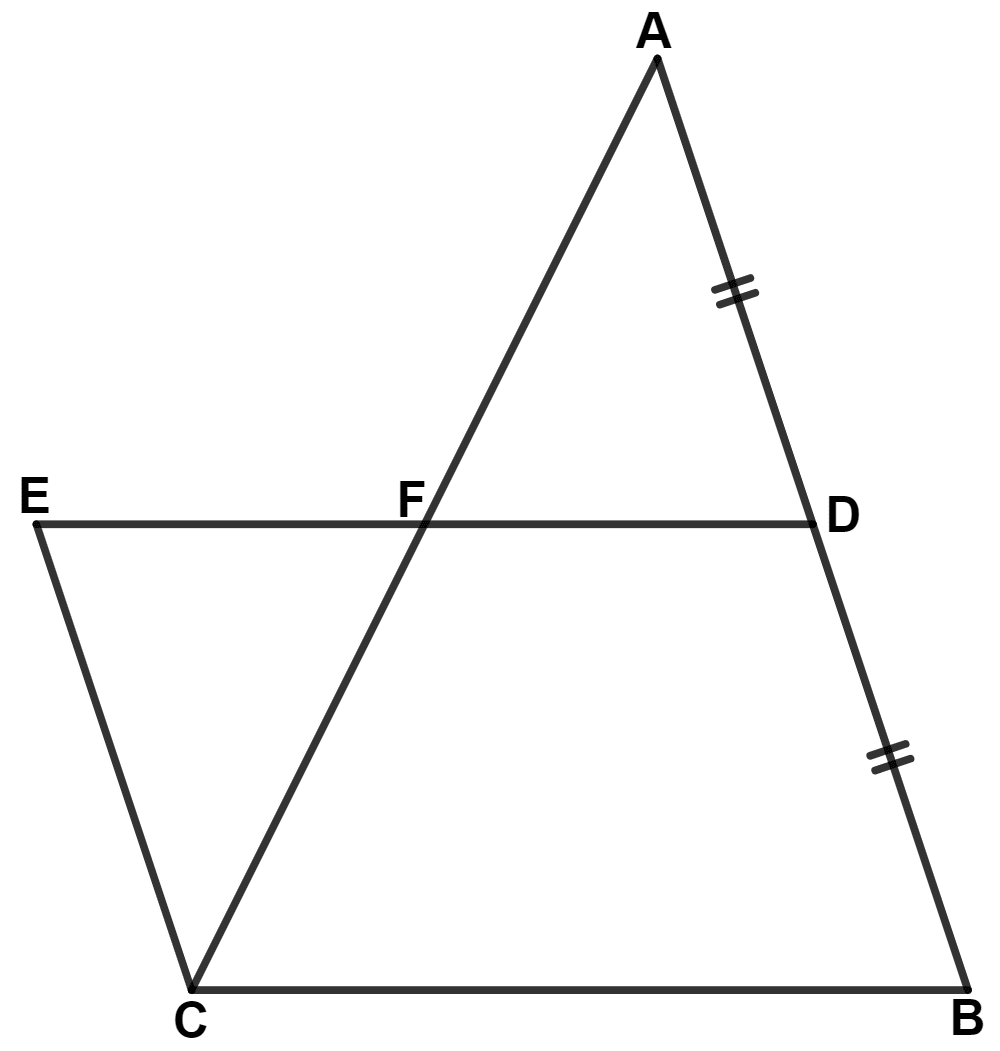
In the given figure, D is mid-point of side AB of △ ABC and BDEC is a parallelogram.
Prove that :
Area of △ ABC = Area of // gm BDEC.
Answer
Given,
⇒ AD = DB ........(1)
⇒ EC = DB (Opposite side of parallelogram are equal) ........(2)
From equation (1) and (2), we get :
⇒ AD = EC
In △ EFC and △AFD,
⇒ ∠EFC = ∠AFD (Vertically opposite angles are equal)
⇒ AD = EC (Proved above)
⇒ ∠ECF = ∠FAD (Alternate angles are equal)
∴ △ EFC ≅ △ AFD (By A.A.S. axiom)
We know that,
Area of congruent triangles are equal.
∴ Area of △ EFC = Area of △ AFD
Adding area of quadrilateral CBDF on both sides of above equation, we get:
⇒ Area of △ EFC + Area of quad.CBDF = Area of △ AFD + Area of quad. CBDF
⇒ Area of || gm BDEC = Area of △ ABC.
Hence, proved that area of △ ABC = area of // gm BDEC.
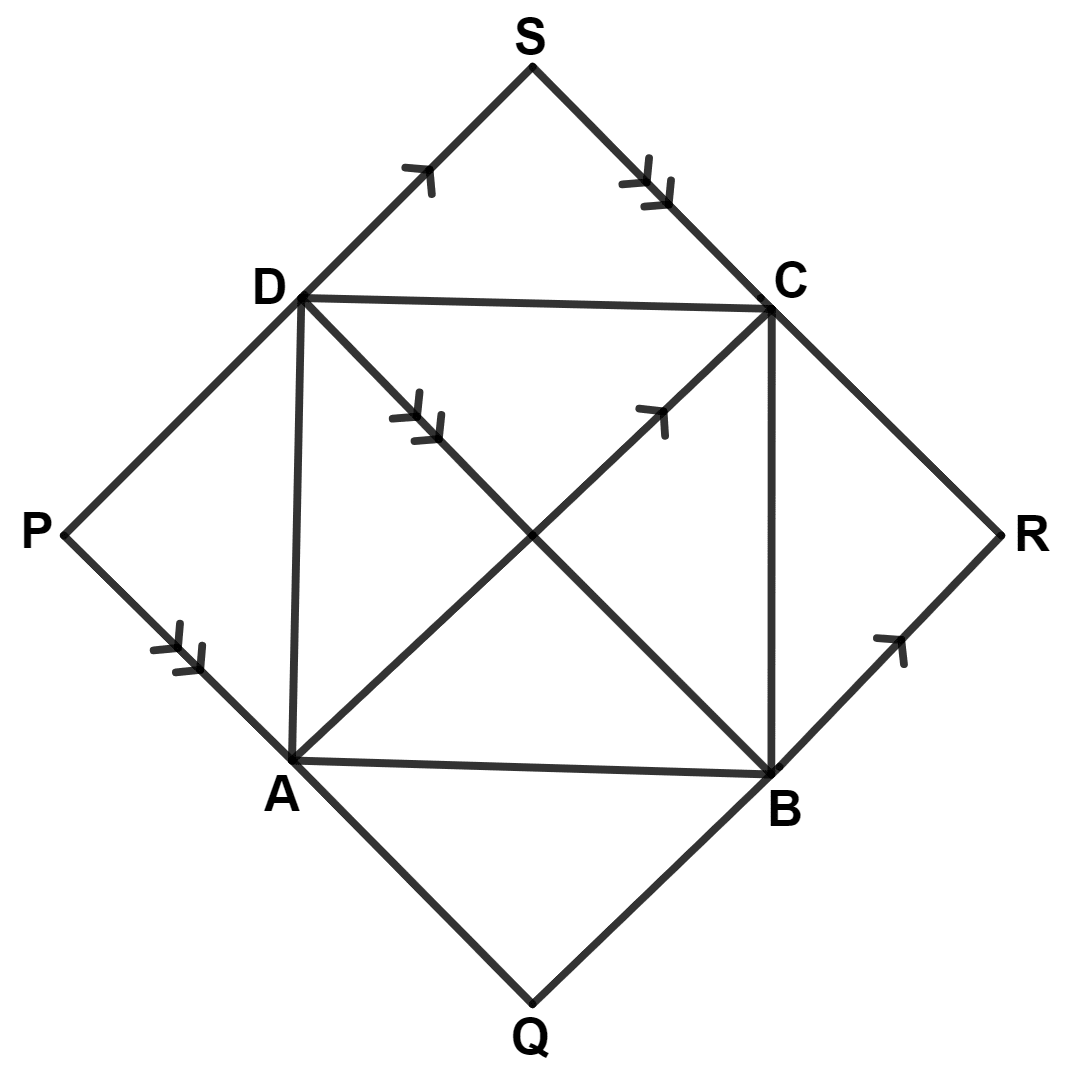
In the following figure, AC // PS // QR and PQ // DB // SR.
Prove that :
Area of quadrilateral PQRS = 2 × Area of quad.ABCD.
Answer
From figure,
PQRS is a parallelogram.
Given,
AC // PS // QR and PQ // DB // SR.
∴ AQRC and APSC are also parallelograms.
We know that,
The area of a triangle is half that of a parallelogram on the same base and between the same parallels.
From figure,
△ ABC and || gm AQRC lie on same base AC and between same parallel lines AC and QR.
∴ Area of △ ABC = Area of || gm AQRC ............(1)
△ ADC and || gm ACSP lie on same base AC and between same parallel lines AC and PS.
∴ Area of △ ADC = Area of || gm ACSP ............(2)
Adding equations (1) and (2), we get :
⇒ Area of △ ABC + Area of △ ADC = Area of || gm AQRC + Area of || gm ACSP
⇒ Area of quadrilateral ABCD = (Area of || gm AQRC + Area of || gm ACSP)
⇒ Area of quadrilateral ABCD = Area of || PQRS
⇒ Area of || gm PQRS = 2 × Area of quadrilateral ABCD.
Hence, proved that area of quadrilateral PQRS = 2 × area of quad. ABCD.
ABCD is a trapezium with AB // DC. A line parallel to AC intersects AB at point M and BC at point N. Prove that :
area of △ ADM = area of △ ACN.
Answer
We know that,
Area of triangles on the same base and between same parallel lines are equal.
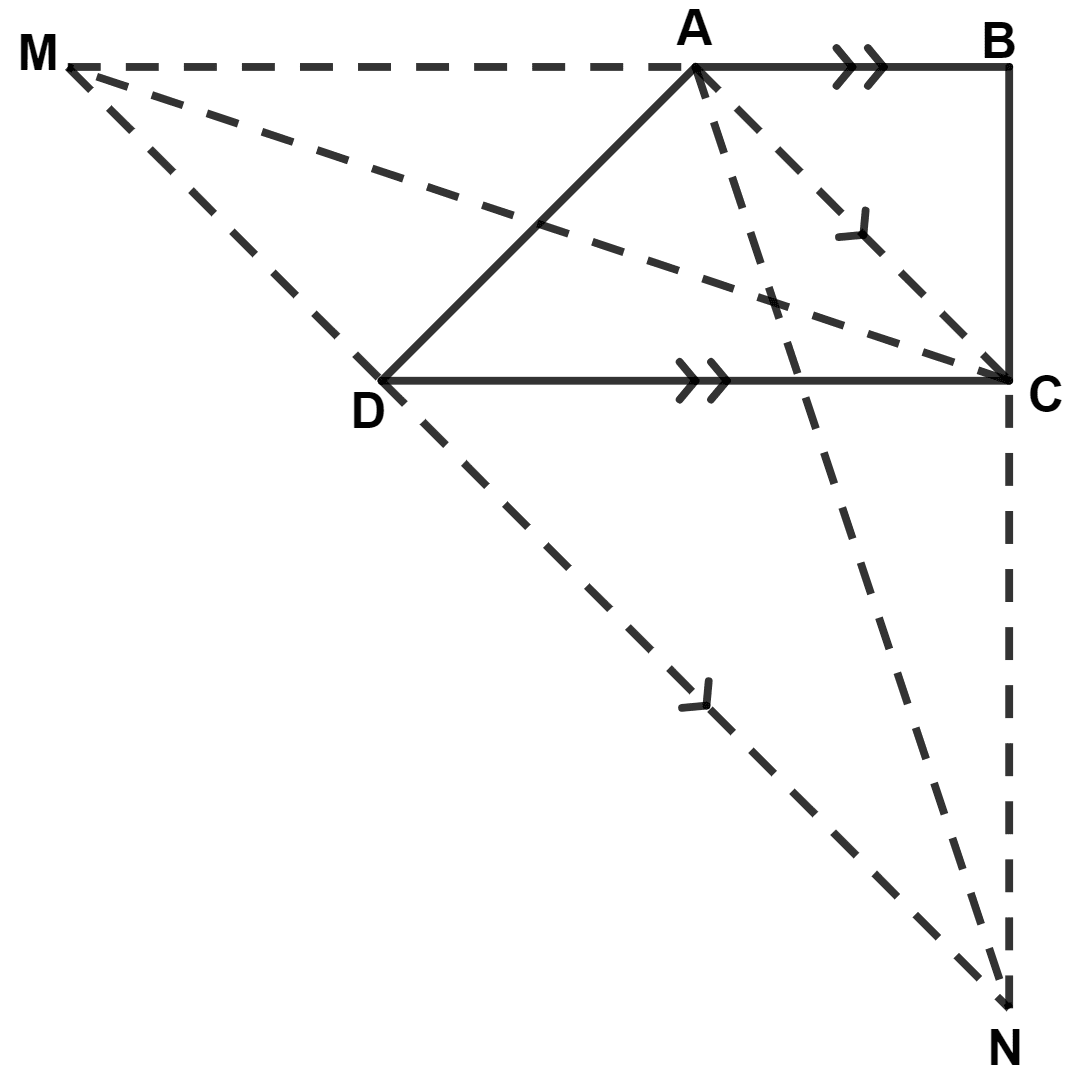
From figure,
△ ADM and △ AMC lie on same base AM and between same parallel lines MB and DC.
∴ Area of △ ADM = Area of △ AMC ...........(1)
△ AMC and △ ACN lie on same base AC and between same parallel lines MN and AC.
∴ Area of △ AMC = Area of △ ACN ...........(2)
From equation (1) and (2), we get :
⇒ Area of △ ADM = Area of △ ACN.
Hence, proved that Area of △ ADM = Area of △ ACN.
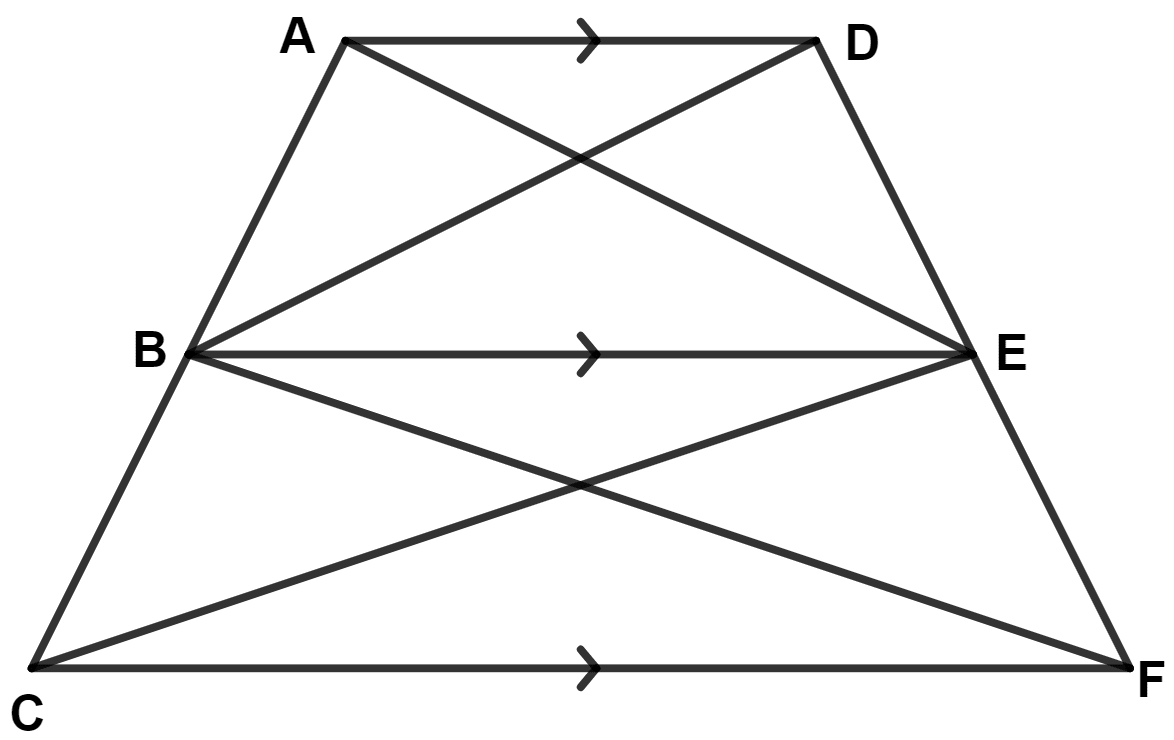
In the given figure, AD // BE // CF. Prove that :
area (△ AEC) = area (△ DBF)
Answer
We know that,
Area of triangles on the same base and between the same parallels lines are equal.
From figure,
△ BDE and △ ABE lie on same base BE and between same parallel lines AD and BE.
∴ Area of △ ABE = Area of △ BDE ...........(1)
△ BEC and △ BEF lie on same base BE and between same parallel lines CF and BE.
∴ Area of △ BEC = Area of △ BEF ............(2)
Adding equations (1) and (2), we get :
⇒ Area of △ ABE + Area of △ BEC = Area of △ BDE + Area of △ BEF
⇒ Area of △ AEC = Area of △ DBF.
Hence, proved that area (△ AEC) = area (△ DBF).
In the given figure, ABCD is a parallelogram. BC is produced to point X. Prove that :
area (△ ABX) = area (quad.ACXD)
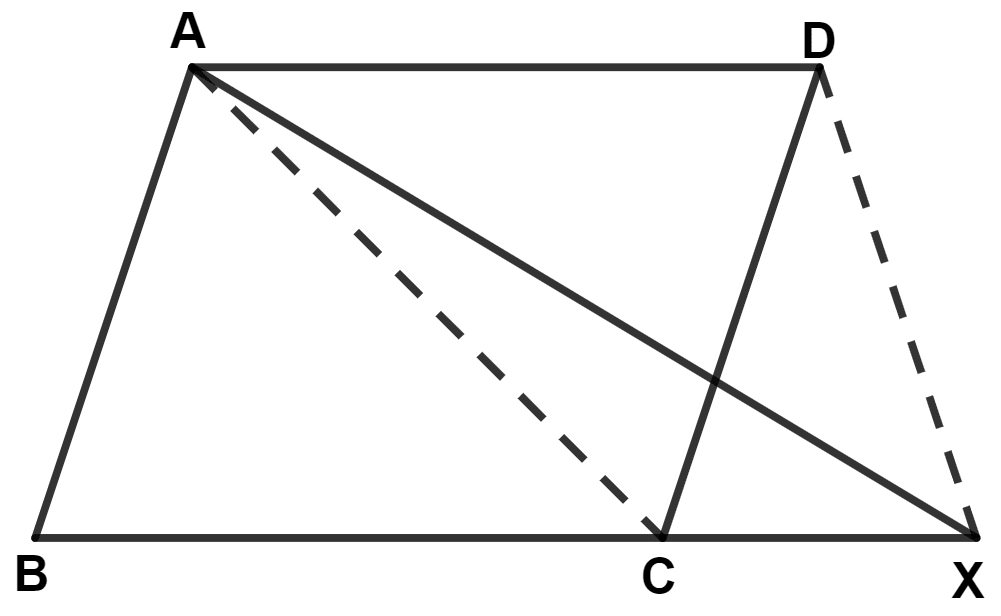
Answer
Since, ABCD is a parallelogram.
∴ AD // BC (Opposite sides of parallelogram are parallel)
We know that,
Area of triangles on the same base and between the same parallels lines are equal.
△ ABC and △ ADC lie on same base AC and between same parallel lines AD and BC.
∴ Area of △ ABC = Area of △ ACD ........(1)
△ ACX and △ CXD lie on same base CX and between same parallel lines AD and BX.
∴ Area of △ ACX = Area of △ CXD ........(2)
From figure,
⇒ Area of △ ABX = Area of △ ABC + Area of △ ACX
⇒ Area of △ ABX = Area of △ ACD + Area of △ CXD [From equation (1) and (2)]
⇒ Area of △ ABX = Area of quadrilateral ACXD.
Hence, proved that area (△ ABX) = area (quad.ACXD).
The given figure shows parallelograms ABCD and APQR. Show that these parallelograms are equal in area.
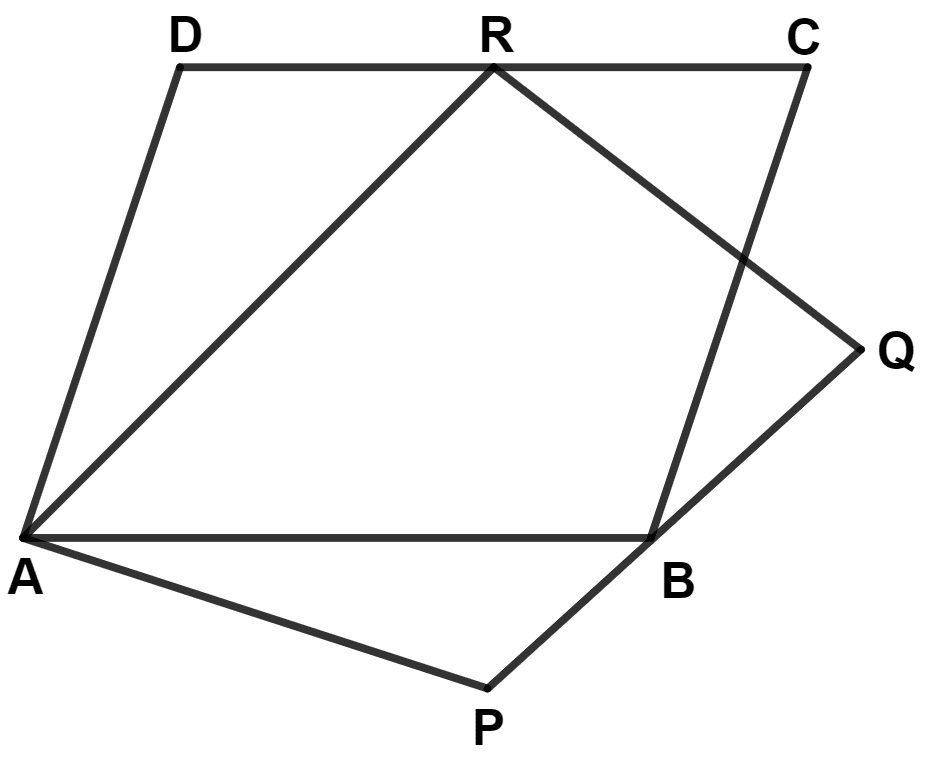
Answer
We know that,
Opposite sides of || gm are equal and parallel.
∴ AB || DC and AR || PQ.
We know that,
The area of triangle is half that of a parallelogram on the same base and between the same parallels.
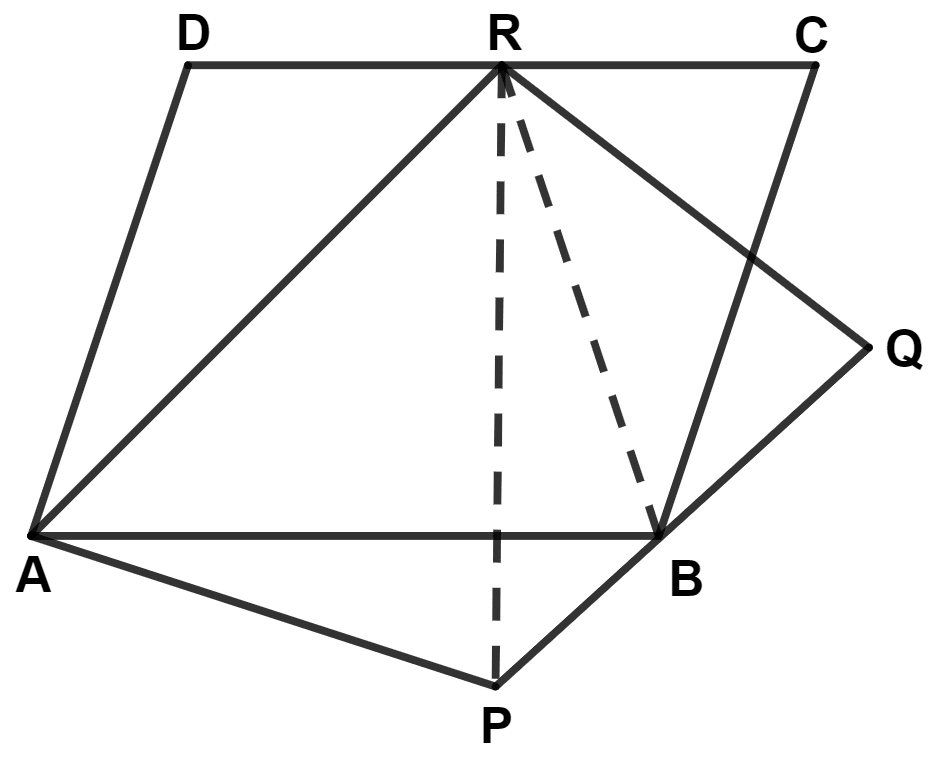
From figure,
|| gm ABCD and △ ABR lies on same base AB and between same parallel lines AB and DC.
∴ Area of △ ABR = Area of || gm ABCD
⇒ Area of || gm ABCD = 2 Area of △ ABR .......(1)
We know that,
Area of triangles on the same base and between the same parallels lines are equal.
△ ABR and △ APR lie on same base AR and between same parallel lines AR and PQ.
∴ Area of △ ABR = Area of △ APR ........(2)
From equations (1) and (2), we get :
⇒ Area of || gm ABCD = 2 Area of △ APR .........(3)
Also, || gm APQR and △ APR lies on same base AR and between same parallel lines AR and PQ.
∴ Area of △ APR = Area of || gm APQR .......(4)
Using value of area of △ APR from equation (4) in (3), we get :
⇒ Area of || gm ABCD = Area of || gm APQR
⇒ Area of || gm ABCD = Area of || gm APQR.
Hence, proved that the parallelograms ABCD and APQR are equal in area.
ABCD is a parallelogram in which BC is produced to E such that CE = BC and AE intersects CD at F. If ar.(△ DFB) = 30 cm2; find the area of parallelogram.
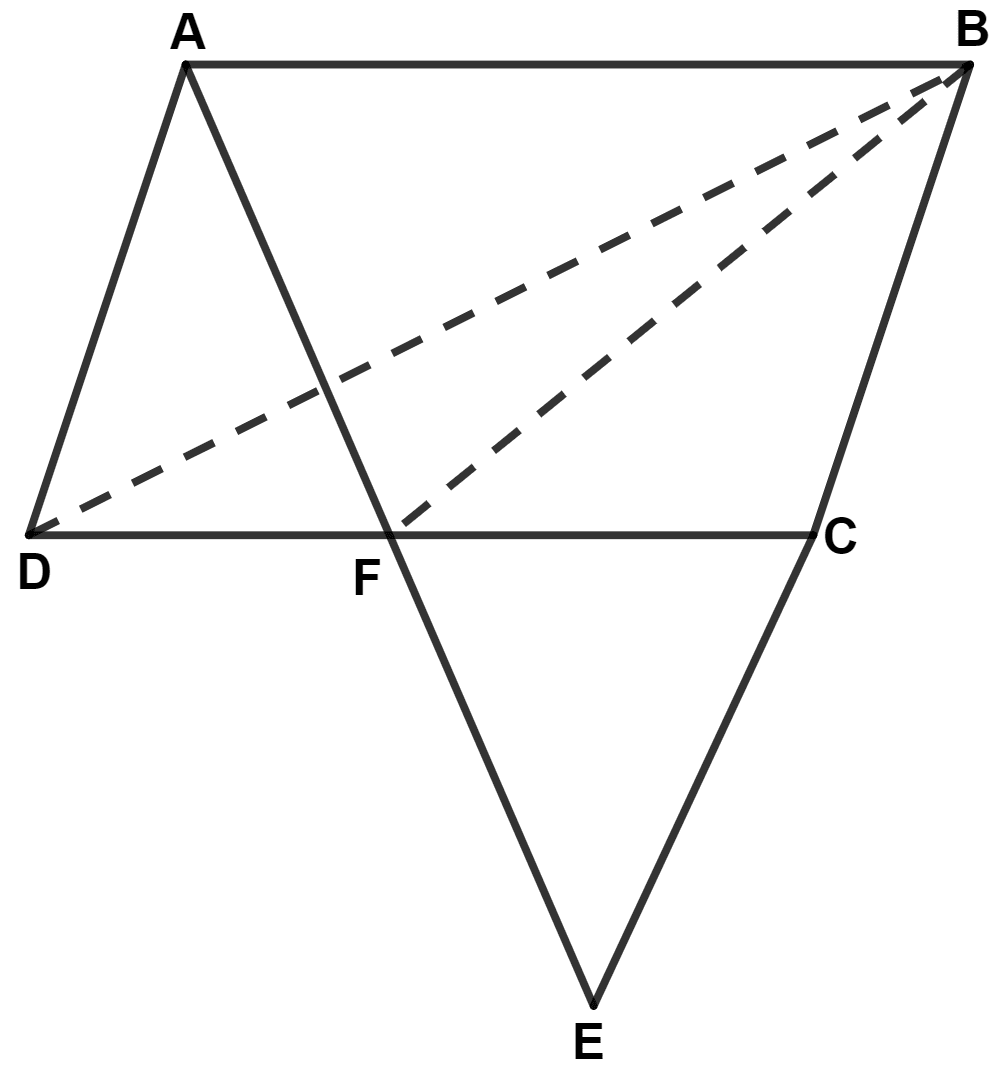
Answer
We know that,
Area of triangles on the same base and between the same parallel lines are equal.
△ ADF and △ DFB lie on same base DF and between same parallel lines AB and DC.
∴ Area of △ ADF = Area of △ DFB = 30 cm2
By converse of mid-point theorem,
If a line is drawn through the midpoint of one side of a triangle, and parallel to the other side, it bisects the third side.
In △ ABE,
C is the mid-point of BE and CF || AB.
∴ F is the mid-point of AE. (By converse of mid-point theorem)
∴ EF = AF.
In △ ADF and △ EFC,
⇒ ∠AFD = ∠EFC (Vertically opposite angles are equal)
⇒ EF = AF (Proved above)
⇒ ∠DAF = ∠CEF (Alternate interior angles are equal)
∴ △ ADF ≅ △ EFC (By A.S.A. axiom)
We know that,
Area of congruent triangles are equal.
∴ Area of △ EFC = Area of △ ADF = 30 cm2.
In △ BFE,
Since, C is the mid-point of BE.
∴ CF is the mid-point of median of triangle.
We know that,
Median of triangle divides it into two triangles of equal areas.
∴ Area of △ BFC = Area of △ EFC = 30 cm2.
From figure,
⇒ Area of △ BDC = Area of △ BDF + Area of △ BFC
⇒ Area of △ BDC = 30 + 30 = 60 cm2.
We know that,
The area of triangle is half that of a parallelogram on the same base and between the same parallels.
From figure,
|| gm ABCD and △ BDC lies on same base DC and between same parallel lines AB and DC.
∴ Area of △ BDC = Area of || gm ABCD
⇒ Area of || gm ABCD = 2 × Area of △ BDC
⇒ Area of || gm ABCD = 2 × 60 = 120 cm2.
Hence, area of || gm ABCD = 120 cm2.
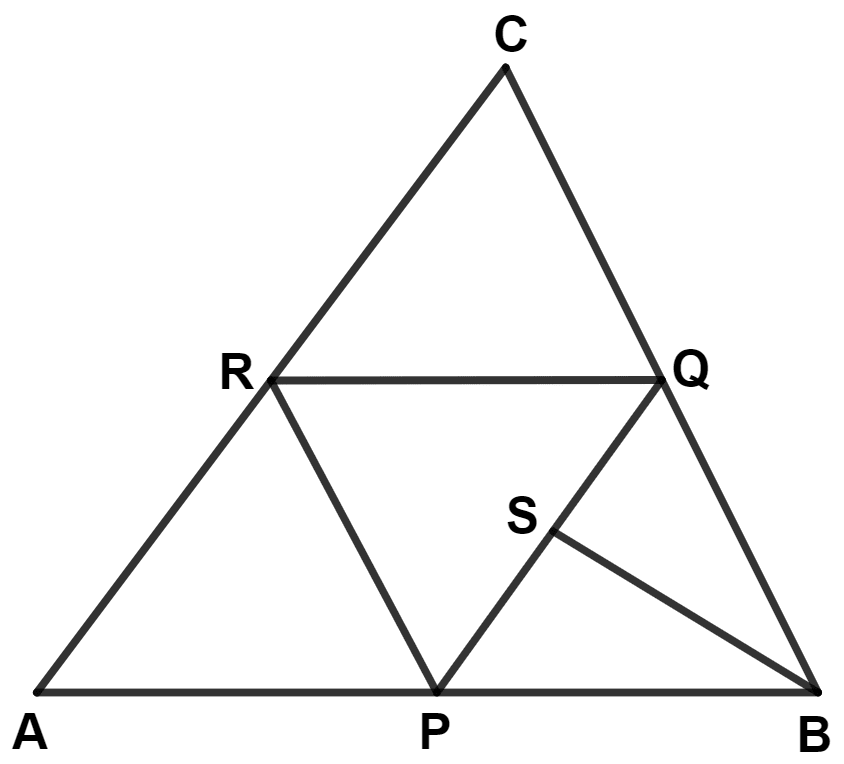
The following figure shows a triangle ABC in which P, Q and R are mid-points of sides AB, BC and CA respectively. S is mid-point of PQ. Prove that :
ar.(△ ABC) = 8 × ar.(△ QSB)
Answer
In △ ABC,
R and Q are mid-points of AC and BC respectively.
∴ RQ || AB (By mid-point theorem)
We know that,
Area of triangles on the same base and between the same parallel lines are equal.
△ PBQ and △ PAR lie on same base (AP = BP) and between same parallel lines RQ and AB.
∴ Area of △ PBQ = Area of △ APR ...............(1)
P and R are mid-points of AB and AC respectively.
∴ PR || BC (By mid-point theorem)
∴ PR || BQ
∴ PBQR is a parallelogram.
PQ is the diagonal.
⇒ Area of △ PBQ = Area of △ PQR (Diagonal of parallelogram divides it into two triangles of equal areas.) .........(2)
From equation (1) and (2), we get :
⇒ Area of △ PBQ = Area of △ PQR = Area of △ APR ........(3)
P and Q are mid-points of AB and BC respectively.
∴ PQ || AC (By mid-point theorem)
∴ PQ || RC
∴ PQCR is a parallelogram.
RQ is the diagonal.
⇒ Area of △ PQR = Area of △ RQC (Diagonal of parallelogram divides it into two triangles of equal areas.) .........(4)
From equation (3) and (4), we get :
⇒ Area of △ PBQ = Area of △ PQR = Area of △ APR = Area of △ RQC = x (let).
From figure,
⇒ Area of △ PBQ + Area of △ PQR + Area of △ APR + Area of △ RQC = Area of △ ABC
⇒ x + x + x + x = Area of △ ABC
⇒ 4x = Area of △ ABC
⇒ x = Area of △ ABC
⇒ Area of △ PBQ = Area of △ ABC ........(5)
In △ PBQ,
S is the mid-point of PQ and BS is median.
⇒ Area of △ QSB = Area of △ PSB (Median divides triangle into two triangles of equal area)
⇒ Area of △ QSB = Area of △ PBQ
⇒ Area of △ PBQ = 2 Area of △ QSB ..........(6)
Substituting value of area of △ PBQ from equation (6) in (5), we get :
⇒ 2 Area of △ QSB = Area of △ ABC
⇒ Area of △ QSB = Area of △ ABC.
Hence, proved that area of △ QSB = area of △ ABC.
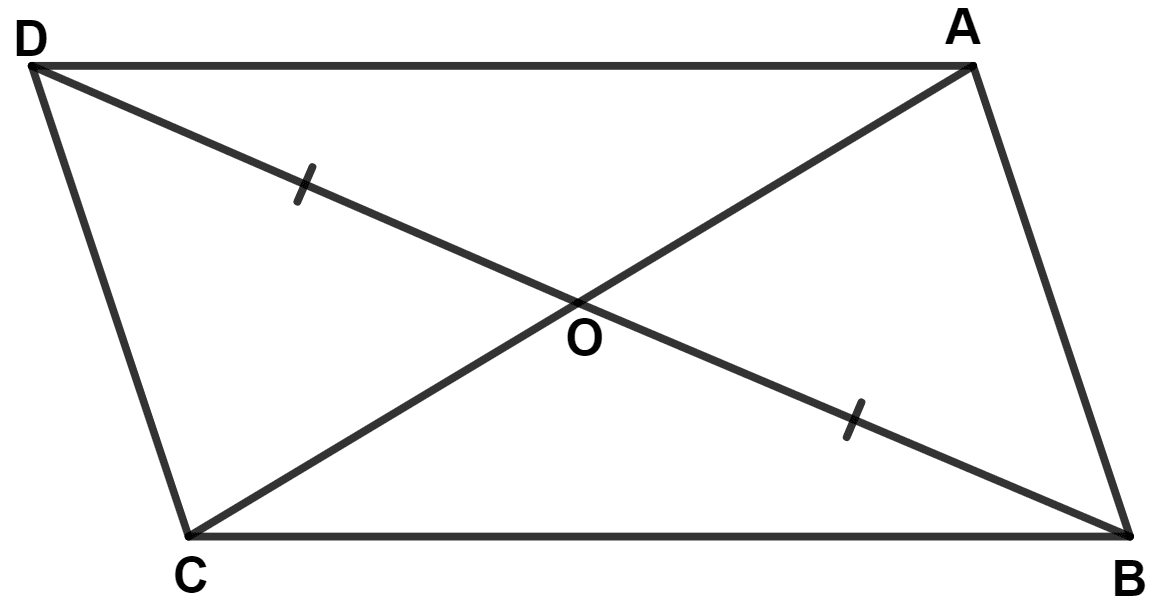
In the given figure, the diagonals AC and BD intersect at point O. If OB = OD and AB // DC, prove that :
(i) Area of (△ DOC) = Area of (△ AOB)
(ii) Area of (△ DCB) = Area of (△ ACB)
(iii) ABCD is a parallelogram.
Answer
(i) In △ DOC and △ AOB,
⇒ ∠DOC = ∠AOB (Vertically opposite angles are equal)
⇒ OD = OB (Given)
⇒ ∠DCO = ∠OAB (Alternate angles are equal)
∴ △ DOC ≅ △ AOB (By A.A.S. axiom)
We know that,
Area of congruent triangles are equal.
∴ Area of (△ DOC) = Area of (△ AOB).
Hence, proved that area of (△ DOC) = area of (△ AOB).
(ii) From part (i),
⇒ Area of (△ DOC) = Area of (△ AOB)
⇒ Area of (△ DOC) + Area of (△ BOC) = Area of (△ AOB) + Area of (△ BOC)
⇒ Area of (△ DCB) = Area of (△ ACB).
Hence, proved that area of (△ DCB) = area of (△ ACB).
(iii) We know that,
Area of triangles on same base and between same parallel lines are equal.
Triangles DCB and ACB lie on same base BC and are equal in area.
∴ They lie between same parallel lines.
∴ AD // BC
Also,
AB // DC (Given)
Since, both pairs of opposite sides are parallel,
∴ ABCD is a parallelogram.
Hence, proved that ABCD is a parallelogram.
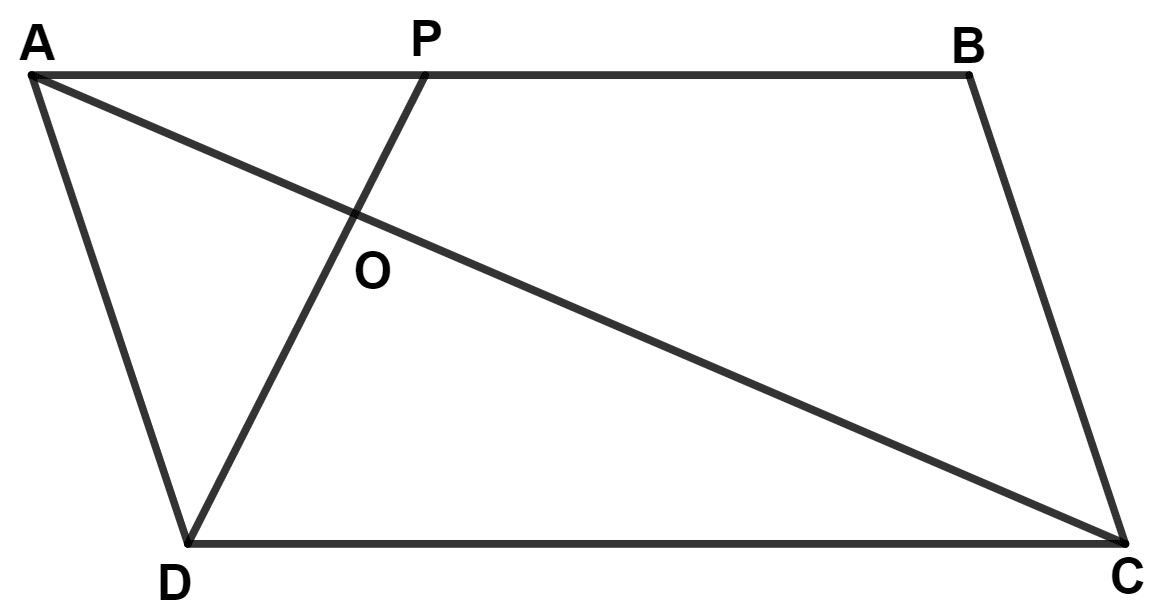
The given figure shows a parallelogram ABCD with area 324 sq.cm. P is a point in AB such that AP : PB = 1 : 2. Find the area of △ APD.
Answer
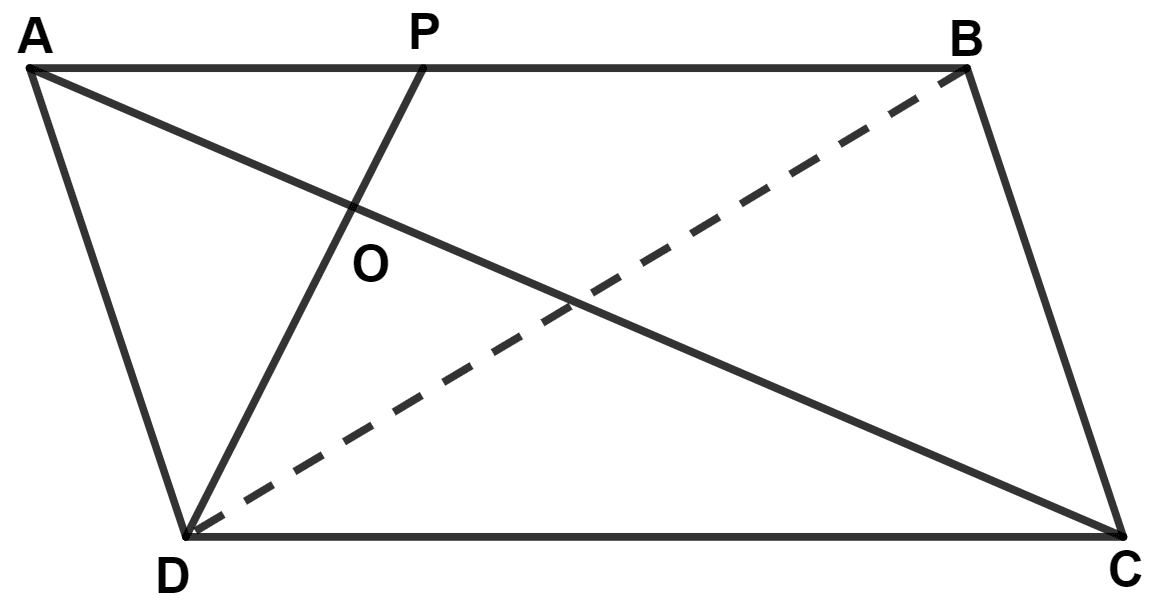
Join BD.
We know that,
Ratio of the area of triangles with same vertex and bases along the same line is equal to the ratio of their respective bases.
We know that,
The area of triangle is half that of a parallelogram on the same base and between the same parallels.
△ ABD and || gm ABCD lie on same base AB and between same parallel lines AB and DC.
∴ Area of △ ABD = Area of || gm ABCD = = 162 cm2.
From figure,
⇒ Area of △ ABD = Area of △ APD + Area of △ BPD
⇒ 162 = Area of △ APD + 2 Area of △ APD
⇒ 3 Area of △ APD = 162
⇒ Area of △ APD = = 54 cm2.
Hence, area of △ APD = 54 cm2.
In △ ABC, E and F are mid-points of sides AB and AC respectively. If BF and CE intersect each other at point O, prove that the △ OBC and quadrilateral AEOF are equal in area.
Answer
By mid-point theorem,
The line segment in a triangle joining the midpoint of any two sides of the triangle is said to be parallel to its third side and is also half of the length of the third side.
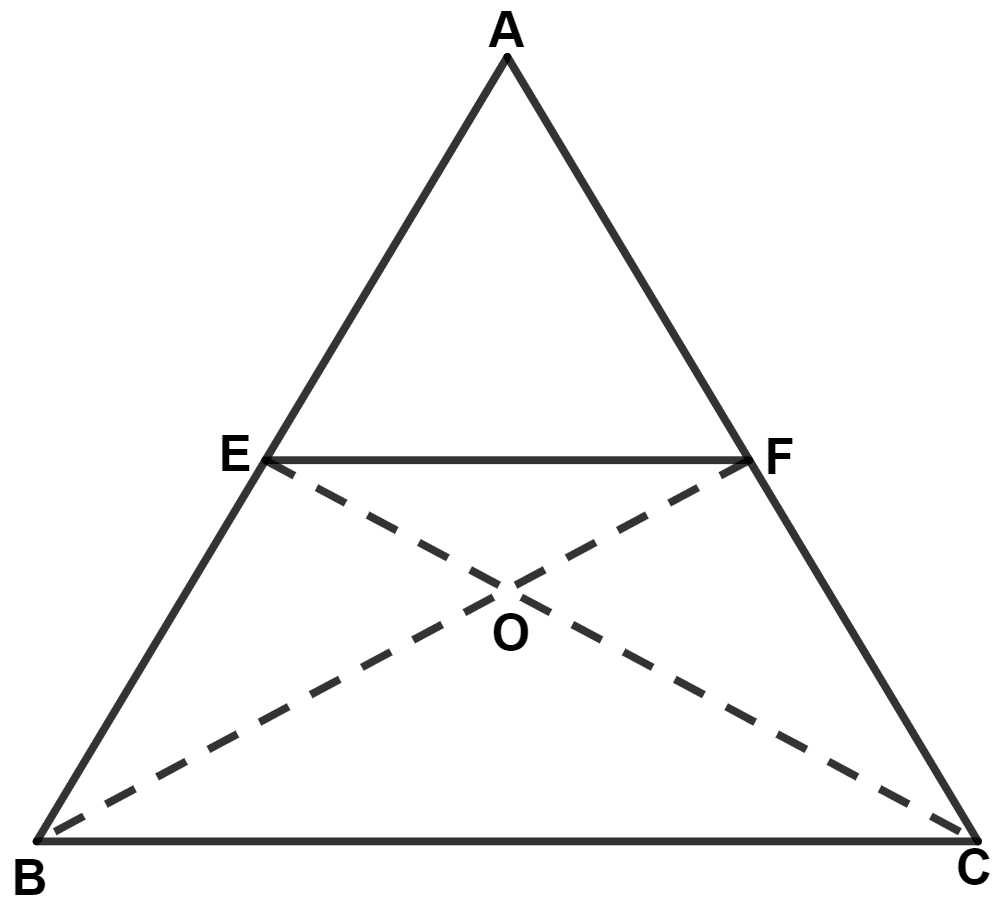
In △ ABC,
Since, E and F are mid-points of sides AB and AC respectively.
∴ EF || BC.
We know that,
The areas of two triangles lying on same base and between same parallel lines are equal.
From figure,
△ BEF and △ CEF lie on same base EF and between same parallel lines EF and BC.
∴ Area of △ BEF = Area of △ CEF
⇒ Area of △ BEF - Area of △ EOF = Area of △ CEF - Area of △ EOF
⇒ Area of △ BOE = Area of △ COF .......(1)
Since, F is the mid-point of AC.
∴ BF is the median of triangle.
We know that,
Median of triangle divides the triangle into two triangles of equal area.
∴ Area of △ ABF = Area of △ CBF
⇒ Area of △ ABF - Area of △ BOE = Area of △ CBF - Area of △ BOE
⇒ Area of △ ABF - Area of △ BOE = Area of △ CBF - Area of △ COF [From equation (1)]
⇒ Area of quadrilateral AEOF = Area of △ OBC.
Hence, proved that △ OBC and quadrilateral AEOF are equal in area.
In parallelogram ABCD, P is mid-point of AB. CP and BD intersect each other at point O. If area of △ POB = 40 cm2 and OP : OC = 1 : 2, find :
(i) Areas of △ BOC and △ PBC
(ii) Areas of △ ABC and parallelogram ABCD.
Answer
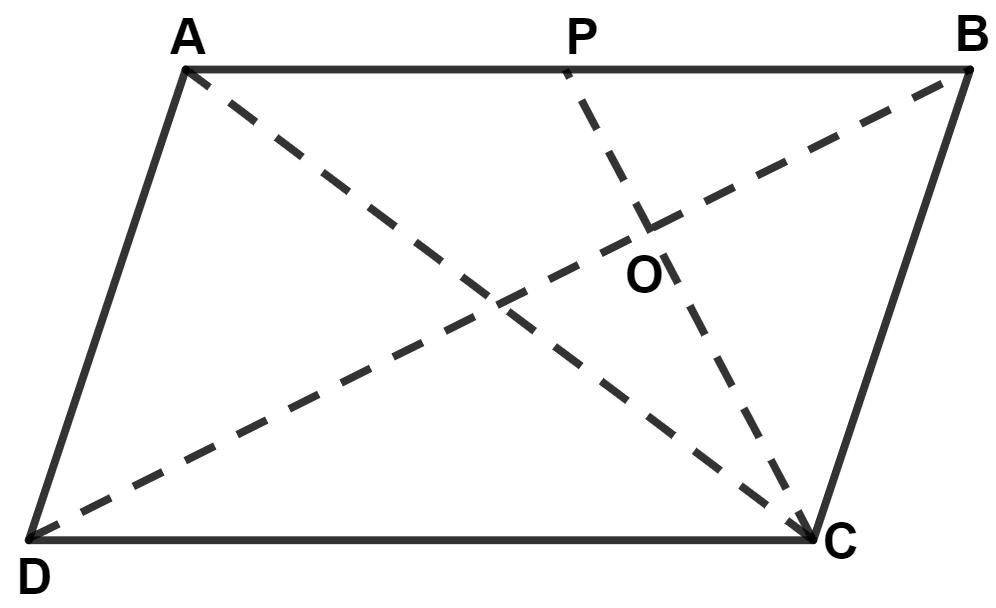
(i) Given,
OP : OC = 1 : 2
We know that,
Ratio of the area of triangles with same vertex and bases along the same line is equal to the ratio of their respective bases.
From figure,
Area of △ PBC = Area of △ BOC + Area of △ POB = 80 + 40 = 120 cm2.
Hence, area of △ BOC = 80 cm2 and area of △ PBC = 120 cm2.
(ii) Given,
P is the mid-point of AB.
∴ CP is the median of △ ABC.
We know that,
Median of triangle divides it into two triangles of equal area.
∴ Area of △ APC = Area of △ PBC = 120 cm2.
From figure,
⇒ Area of △ ABC = Area of △ APC + Area of △ BPC = 120 + 120 = 240 cm2.
We know that,
The area of triangle is half that of a parallelogram on the same base and between the same parallels.
Since, △ ABC and || gm ABCD lies on same base AB and between same parallel lines AB and DC.
∴ Area of △ ABC = Area of || gm ABCD
⇒ Area of || gm ABCD = 2 Area of △ ABC = 2 × 240 = 480 cm2.
Hence, area of △ ABC = 240 cm2 and || gm ABCD = 480 cm2.
The medians of a triangle ABC intersect each other at point G. If one of its medians is AD, prove that :
(i) Area (△ ABD) = 3 × Area (△ BGD)
(ii) Area (△ ACD) = 3 × Area (△ CGD)
(iii) Area (△ BGC) = × Area (△ ABC)
Answer
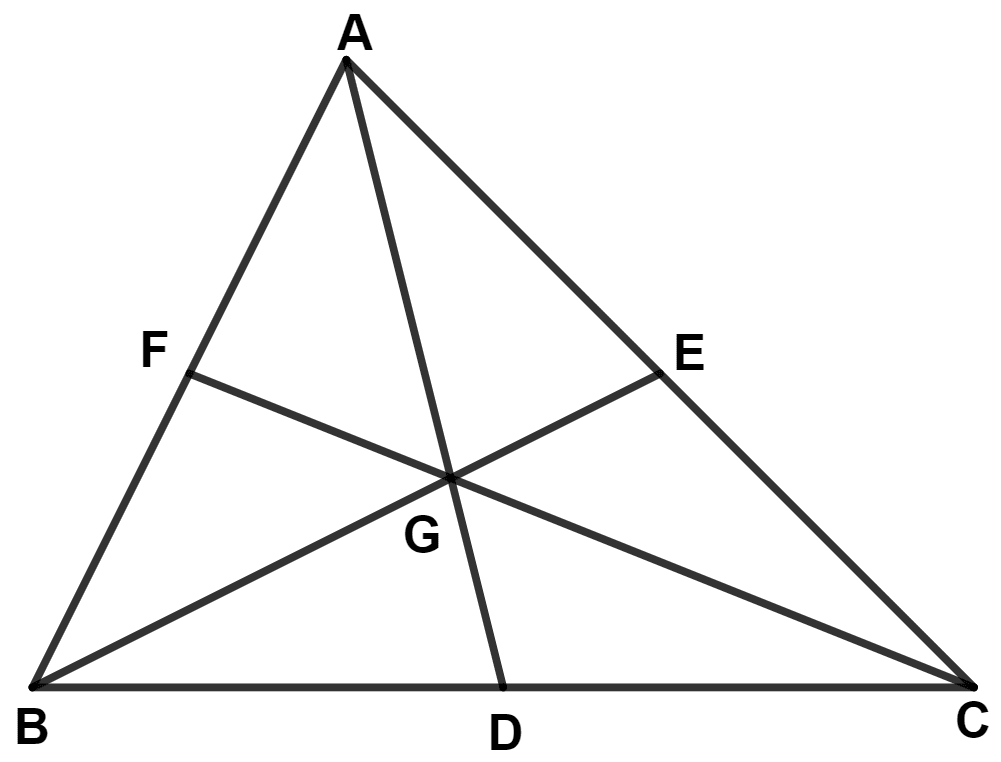
(i) Given,
Medians of a triangle ABC intersect each other at point G.
We know that,
Medians intersect at centroid, also the centroid divides medians in the ratio 2 : 1.
∴ AG : GD = 2 : 1.
We know that,
Ratio of the area of triangles with same vertex and bases along the same line is equal to the ratio of their respective bases.
From figure,
⇒ Area of △ ABD = Area of △ AGB + Area of △ BGD
⇒ Area of △ ABD = 2 Area of △ BGD + Area of △ BGD
⇒ Area of △ ABD = 3 Area of △ BGD.
Hence, proved that area of △ ABD = 3 area of △ BGD.
(ii) We know,
AG : GD = 2 : 1
Ratio of the area of triangles with same vertex and bases along the same line is equal to the ratio of their respective bases.
From figure,
⇒ Area of △ ACD = Area of △ AGC + Area of △ CGD
⇒ Area of △ ACD = 2 Area of △ CGD + Area of △ CGD
⇒ Area of △ ACD = 3 Area of △ CGD.
Hence, proved that area of △ ACD = 3 area of △ CGD.
(iii) From part (i),
⇒ Area of △ ABD = 3 Area of △ BGD ........(1)
From part (ii),
⇒ Area of △ ACD = 3 Area of △ CGD ..........(2)
Adding equations (1) and (2), we get :
⇒ Area of △ ABD + Area of △ ACD = 3 Area of △ BGD + 3 Area of △ CGD
⇒ Area of △ ABC = 3(Area of △ BGD + Area of △ CGD)
⇒ Area of △ ABC = 3 Area of △ BGC
⇒ Area of △ BGC = Area of △ BGC
Hence, proved that area of △ BGC = area of △ BGC.
The perimeter of a triangle ABC is 37 cm and the ratio between the lengths of its altitudes be 6 : 5 : 4. Find the lengths of its sides.
Answer
Let the sides be x cm, y cm and (37 - x - y) cm. Also, the length of altitudes be 6a, 5a and 4a cm.
By formula,
Area of triangle = base × height
Area of triangle ABC =
Solving L.H.S. of the equation :
Solving L.H.S. of the equation :
Substituting value of x from equation (1) in above equation, we get :
Substituting value of y in equation (1), we get :
Sides : x = 10 cm, y = 12 cm, (37 - x - y) = (37 - 10 - 12) = 15 cm.
Hence, sides of triangle ABC are 10 cm, 12 cm and 15 cm.
In parallelogram ABCD, E is a point in AB and DE meets diagonal AC at point F. If DF : FE = 5 : 3 and area of △ ADF is 60 cm2; find :
(i) area of △ ADE
(ii) if AE : EB = 4 : 5, find the area of △ ADB.
(iii) also, find area of parallelogram ABCD.
Answer
We know that,
Ratio of the area of triangles with same vertex and bases along the same line is equal to the ratio of their respective bases.
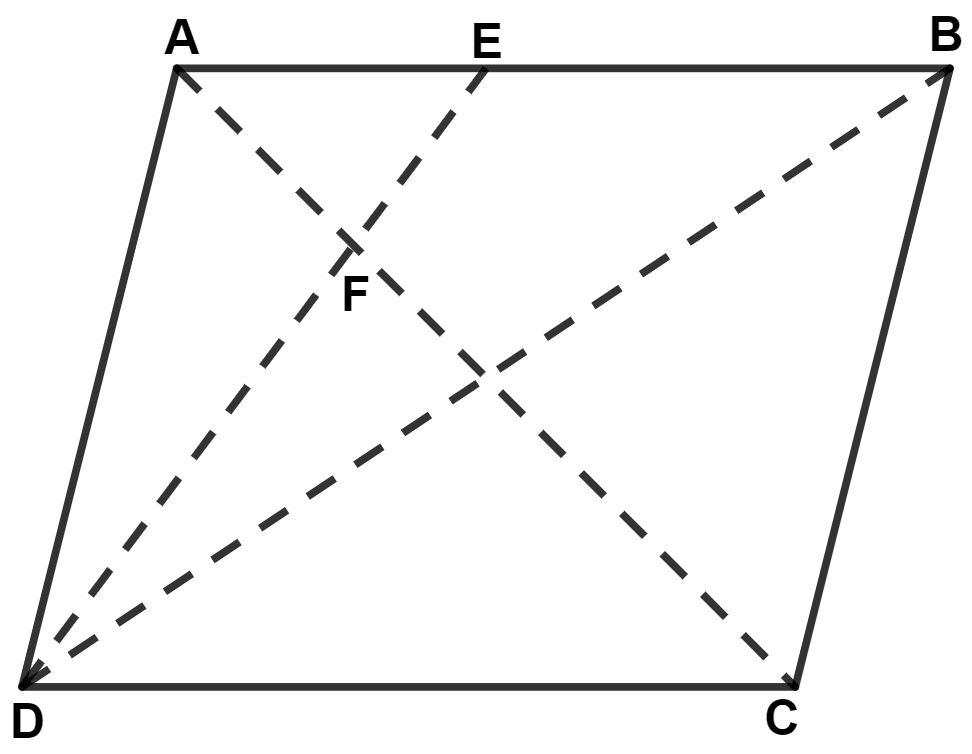
(i) △ ADF and △ AFE have same vertex A and their bases are on the same straight line DE.
From figure,
Area of △ ADE = Area of △ ADF + Area of △ AFE = 60 + 36 = 96 cm2.
Hence, area of △ ADE = 96 cm2.
(ii) △ ADE and △ EDB have same vertex D and their bases are on the same straight line AB.
From figure,
Area of △ ADB = Area of △ ADE + Area of △ EDB = 96 + 120 = 216 cm2.
Hence, area of △ ADB = 216 cm2.
(iii) We know that,
Diagonal of a parallelogram divides it into two triangles of equal area.
Area of parallelogram ABCD = 2 × Area of △ ADB = 2 × 216 = 432 cm2.
Hence, area of || gm ABCD = 432 cm2.
In the following figure, BD is parallel to CA, E is mid-point of CA and BD = CA.
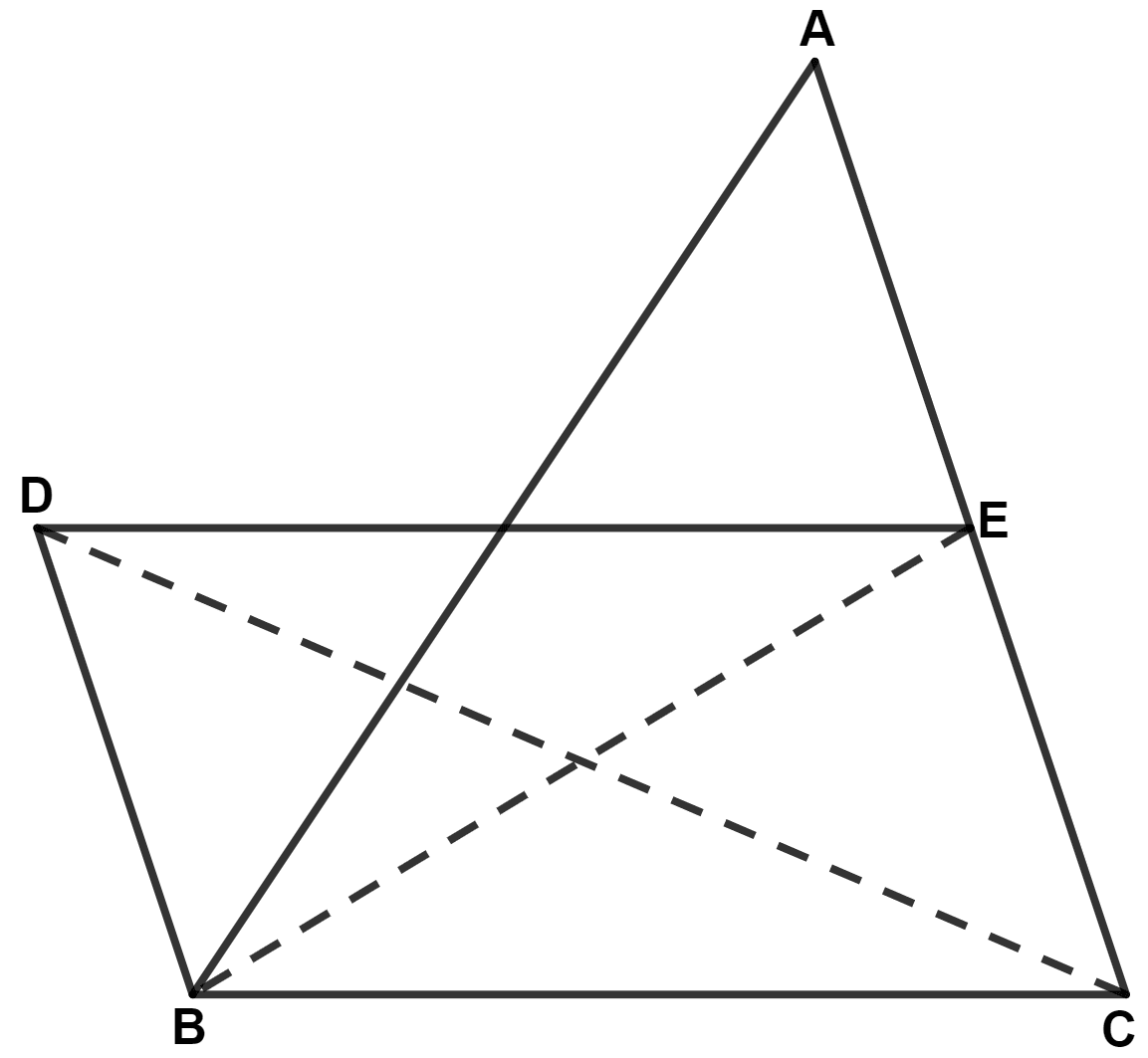
Prove that : ar.(△ ABC) = 2 × ar.(△ DBC)
Answer
Since,
⇒ BD || CA
∴ BD || CE
Also,
BD = CE.
Since, BD = CE and BD || CE,
∴ BCED is a parallelogram.
We know that,
The area of triangle on same base and between the same parallels are equal in area.
△ DBC and △ EBC lie on the same base BC and between same parallel lines BC and ED.
∴ Area of △ DBC = Area of △ EBC ............(1)
In △ ABC,
E is the mid-point of AC.
∴ BE is the median of triangle.
∴ Area of △ EBC = Area of △ ABE ..........(2)
From figure,
⇒ Area of △ ABC = Area of △ EBC + Area of △ ABE
⇒ Area of △ ABC = Area of △ EBC + Area of △ EBC [From equation (2)]
⇒ Area of △ ABC = 2 Area of △ EBC
⇒ Area of △ ABC = 2 Area of △ DBC. [From equation (1)]
Hence, proved that area of △ ABC = 2 area of △ DBC.
In the following figure, OAB is a triangle and AB // DC.
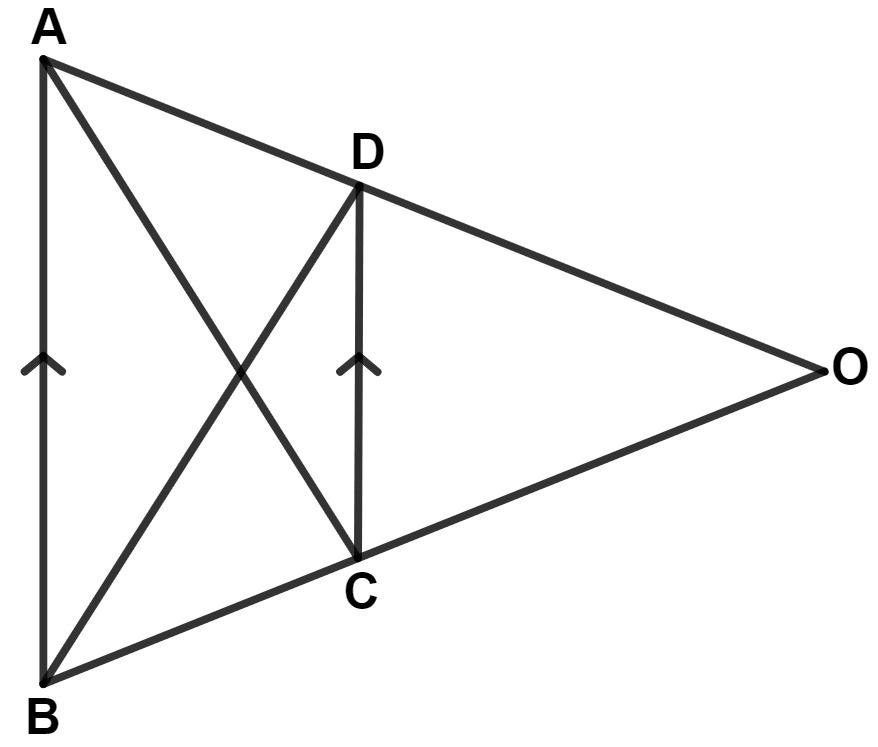
If the area of △ CAD = 140 cm2 and the area of △ ODC = 172 cm2, find
(i) the area of △ DBC
(ii) the area of △ OAC
(iii) the area of △ ODB
Answer
(i) We know that,
The area of triangles on the same base and between the same parallel lines are equal.
Since, △ DBC and △ CAD have same base CD and between the same parallel lines BA and CD.
∴ Area of △ DBC = Area of △ CAD = 140 cm2.
Hence, area of △ DBC = 140 cm2.
(ii) From figure,
⇒ Area of △ OAC = Area of △ CAD + Area of △ ODC
⇒ Area of △ OAC = 140 + 172 = 312 cm2.
Hence, area of △ OAC = 312 cm2.
(iii) From figure,
⇒ Area of △ ODB = Area of △ DBC + Area of △ ODC
⇒ Area of △ ODB = 140 + 172 = 312 cm2.
Hence, area of △ ODB = 312 cm2.
E, F, G and H are the mid-points of the sides of a parallelogram ABCD. Show that area of quadrilateral EFGH is half of the area of parallelogram ABCD.
Answer
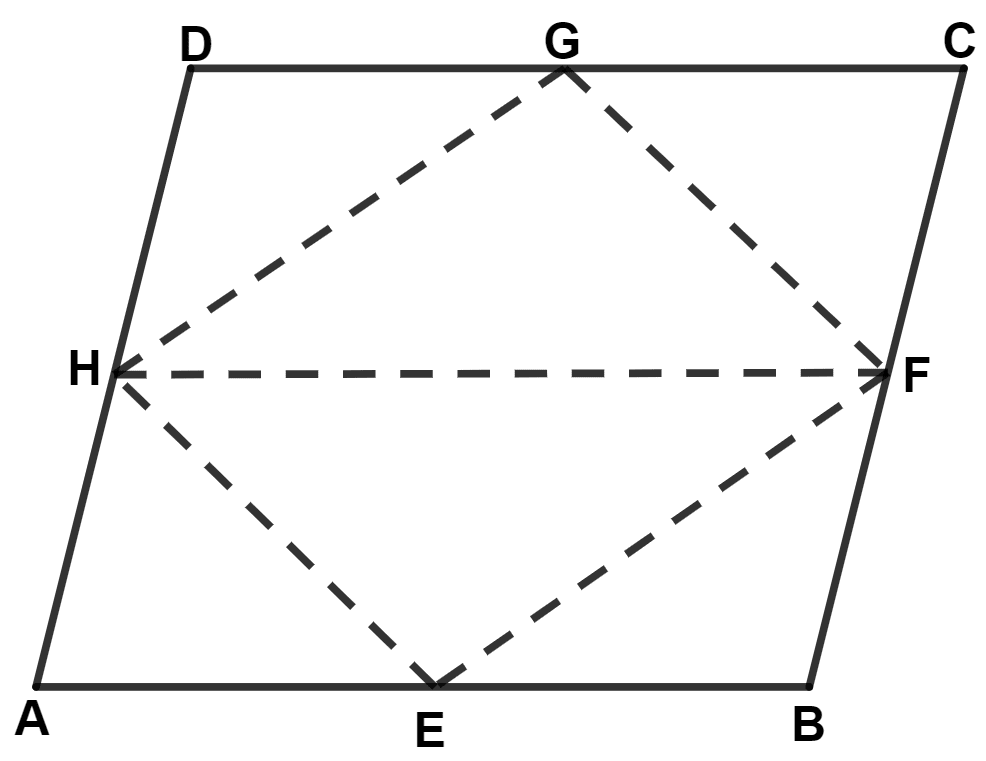
Since, H and F are mid-points of AD and BC respectively.
∴ AH = and BF =
Since, ABCD is a parallelogram.
∴ AD = BC and AD || BC (Opposite sides of parallelogram are equal)
⇒ and AD || BC
⇒ AH = BF and AH || BF.
Since, one pair of opposite sides are equal and parallel.
∴ ABFH is a || gm.
We know that,
The area of a triangle is half that of a parallelogram on the same base and between the same parallels.
Since, || gm ABFH and triangle HEF are on the same base FH and between the same parallel lines HF and AB.
∴ Area of △ HEF = Area of || gm ABFH ..........(1)
Since, || gm HFCD and triangle HGF are on the same base FH and between the same parallel lines HF and DC.
∴ Area of △ HGF = Area of || gm HFCD ..........(2)
Adding equations (1) and (2), we get :
⇒ Area of △ HEF + Area of △ FGH = Area of || gm ABFH + Area of || gm HFCD
⇒ Area of quadrilateral EFGH = (Area of || gm ABFH + Area of || gm HFCD)
⇒ Area of quadrilateral EFGH = Area of || gm ABCD.
Hence, proved that area of quadrilateral EFGH is half of the area of parallelogram ABCD.