If △ ABC ≅ △ PQR, then
AC = PR
AC = PQ
BC = PR
BC = PQ
Answer
Since,
△ ABC ≅ △ PQR
We know that,
Corresponding parts of congruent triangles are equal.
∴ AC = PR (By C.P.C.T.C.)
Hence, Option 1 is the correct option.
Which of the following will hold true for the given figure :
AD = DC
CD = CB
∠ACD ≠ ∠ACB
∠B ≠ ∠D
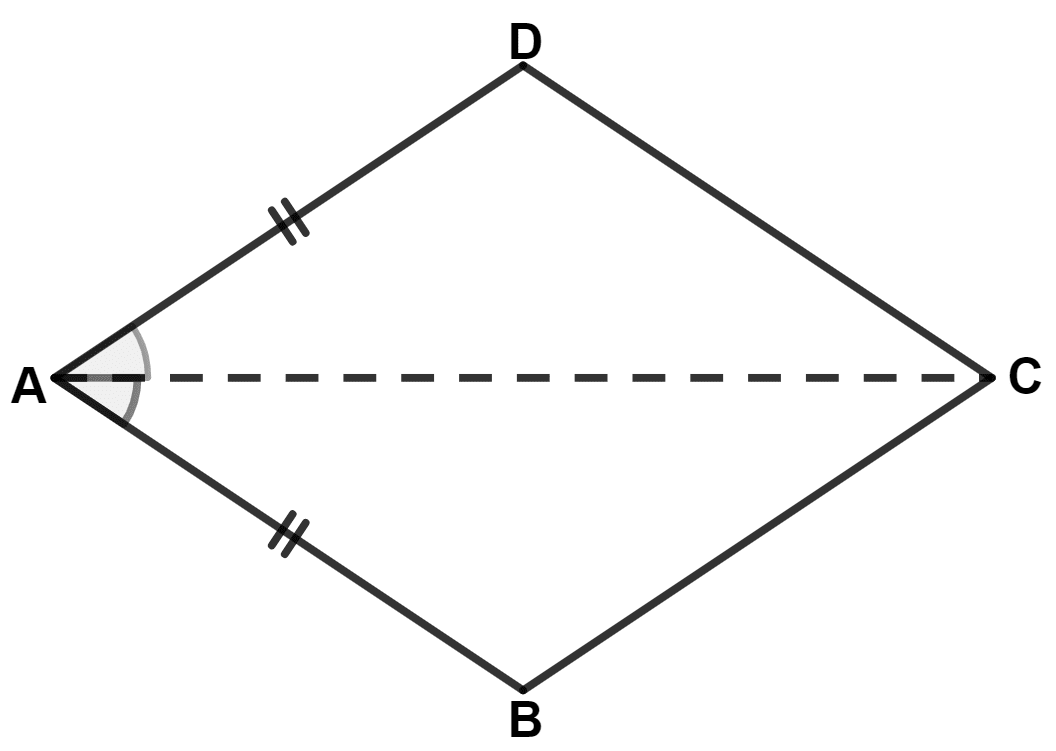
Answer
From figure,
In △ ADC and △ ABC,
⇒ ∠DAC = ∠BAC (Given)
⇒ AD = AB (Given)
⇒ AC = AC (Common side)
∴ △ ADC ≅ △ ABC (By S.A.S. axiom)
We know that,
Corresponding parts of congruent triangles are equal.
∴ CD = CB (By C.P.C.T.C.)
Hence, Option 2 is the correct option.
In the given figure, AM is the perpendicular bisector of BC. Then :
AB = AM
AC = BM
AB ≠ AC
AM bisects ∠BAC
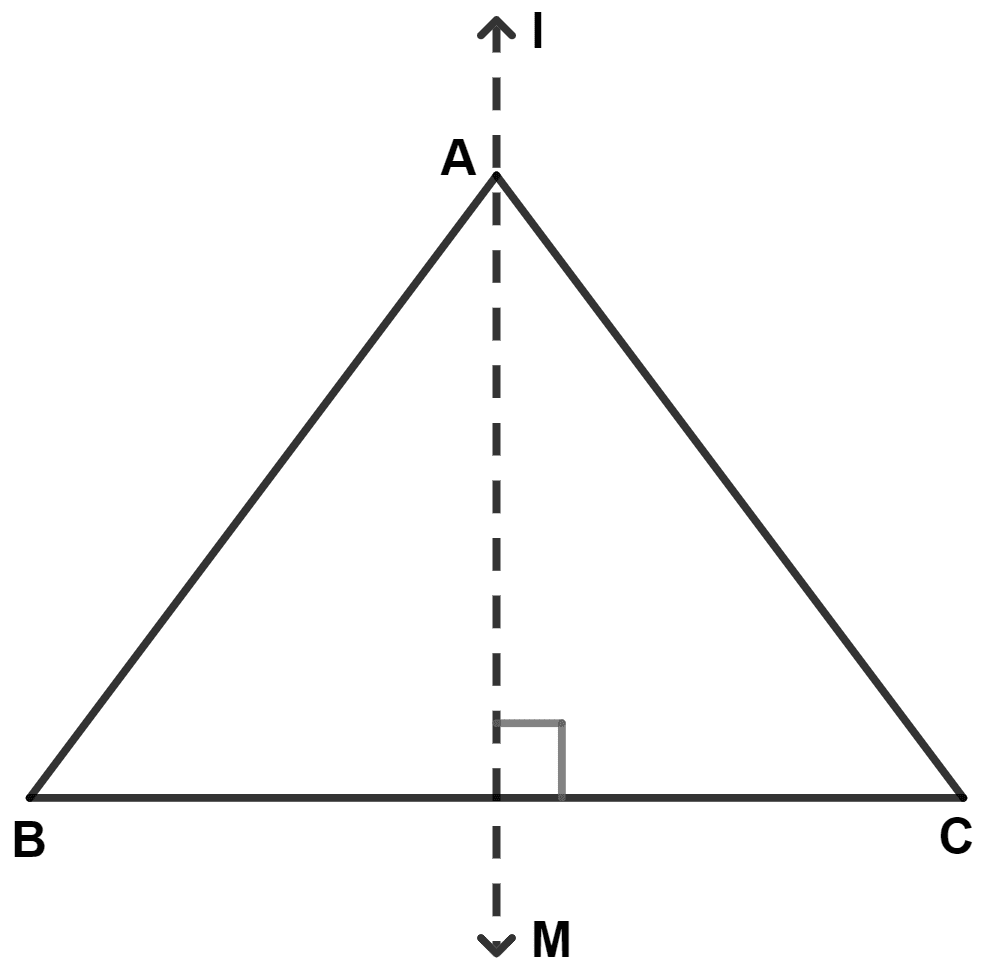
Answer
From figure,
In △ ABM and △ ACM,
⇒ ∠AMB = ∠AMC (Both equal to 90°)
⇒ BM = MC (Since, AM is perpendicular bisector of BC)
⇒ AM = AM (Common side)
∴ △ ABM ≅ △ ACM (By S.A.S. axiom)
We know that,
Corresponding parts of congruent triangles are equal.
∴ ∠BAM = ∠CAM (By C.P.C.T.C.)
∴ AM bisects ∠BAC.
Hence, Option 4 is the correct option.
Which of the following is true for the given figure:
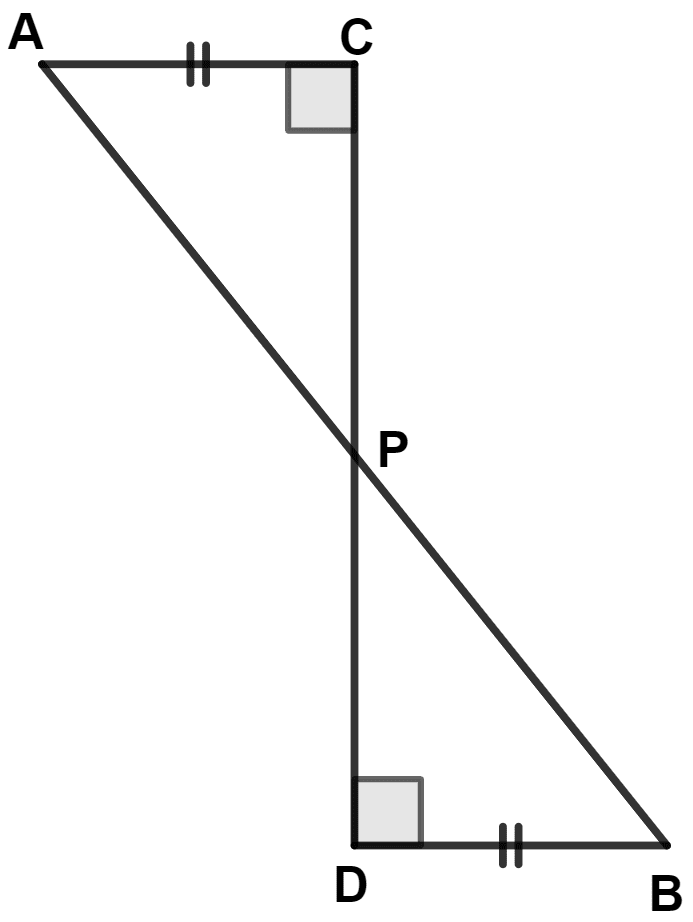
ΔAPC ≅ ΔBPD
CP = DP
AB and CD bisect each other
all of the above are true.
Answer
In ΔAPC and ΔBPD,
⇒ ∠ACP = ∠BDP (Both are 90°)
⇒ ∠APC = ∠BPD (Vertically opposite angles are equal)
⇒ AC = BD (Given)
∴ ΔAPC ≅ ΔBPD (By AAS congruency criterion)
By C.P.C.T.,
⇒ CP = DP and AP = BP
Thus, AB and CD bisect each other.
∴ All the options are correct.
Hence, option 4 is the correct option.
In the following figure, ∠BAD = ∠EAC, BD = EC and ∠B = ∠E, then :
△ ABD ≇ △ AEC
△ ABC ≅ △ AED
△ ABC ≇ △ AED
△ ABD ≅ △ ADE
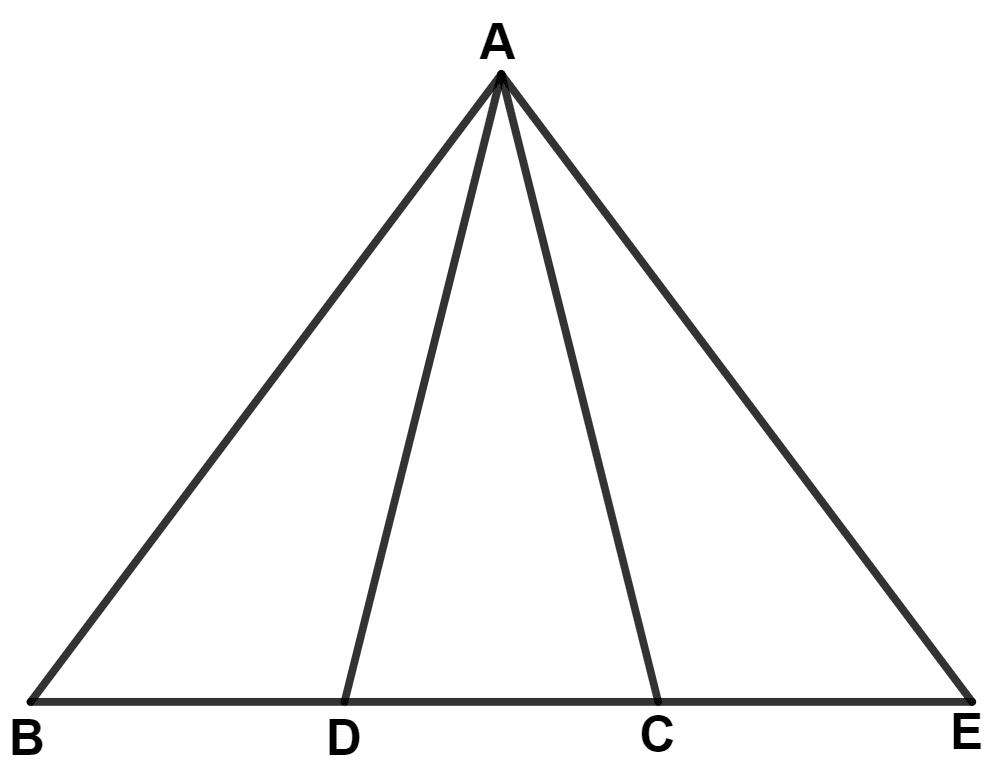
Answer
Given,
BD = EC = x (let)
∠B = ∠E
We know that,
Sides opposite to equal angles are equal.
∴ AE = AB
From figure,
BC = BD + DC = x + DC .......(1)
DE = DC + CE = DC + x .......(2)
From equations (1) and (2), we get :
BC = DE
In △ ABC and △ AED,
⇒ BC = DE (Proved above)
⇒ AB = AE (Proved above)
⇒ ∠B = ∠E (Given)
∴ △ ABC ≅ △ AED (By S.A.S. axiom)
Hence, Option 2 is the correct option.
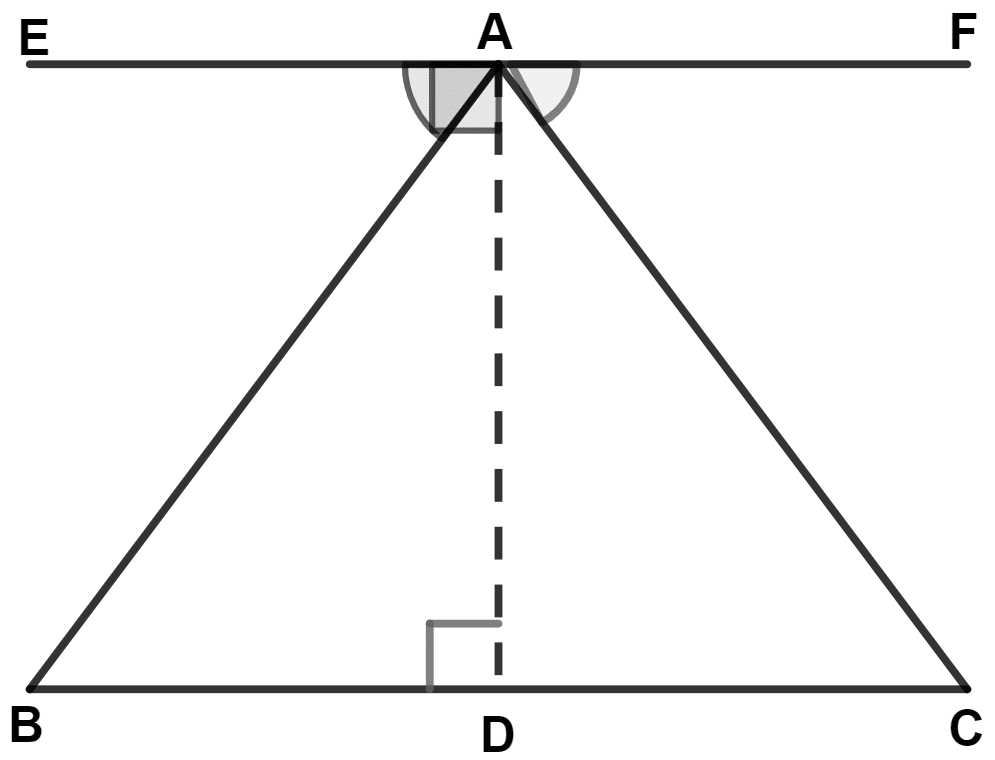
Which of the following is true for the given figure :
△ ABD ≅ △ ACD
angle BAD ≠ angle CAD
△ ABD ≇ △ ACD
∠EAB = ∠BAD
Answer
From figure,
⇒ ∠EAD = ∠FAD = 90°
⇒ ∠EAB = ∠FAC = x (let)
⇒ ∠BAD = ∠EAD - ∠EAB = 90° - x
⇒ ∠CAD = ∠FAD - ∠FAC = 90° - x.
∴ ∠BAD = ∠CAD.
In △ ABD and △ ACD,
⇒ AD = AD (Common side)
⇒ ∠ADB = ∠ADC (Both equal to 90°)
⇒ ∠BAD = ∠CAD (Proved above)
∴ △ ABD ≅ △ ACD (By A.S.A. axiom)
Hence, Option 1 is the correct option.
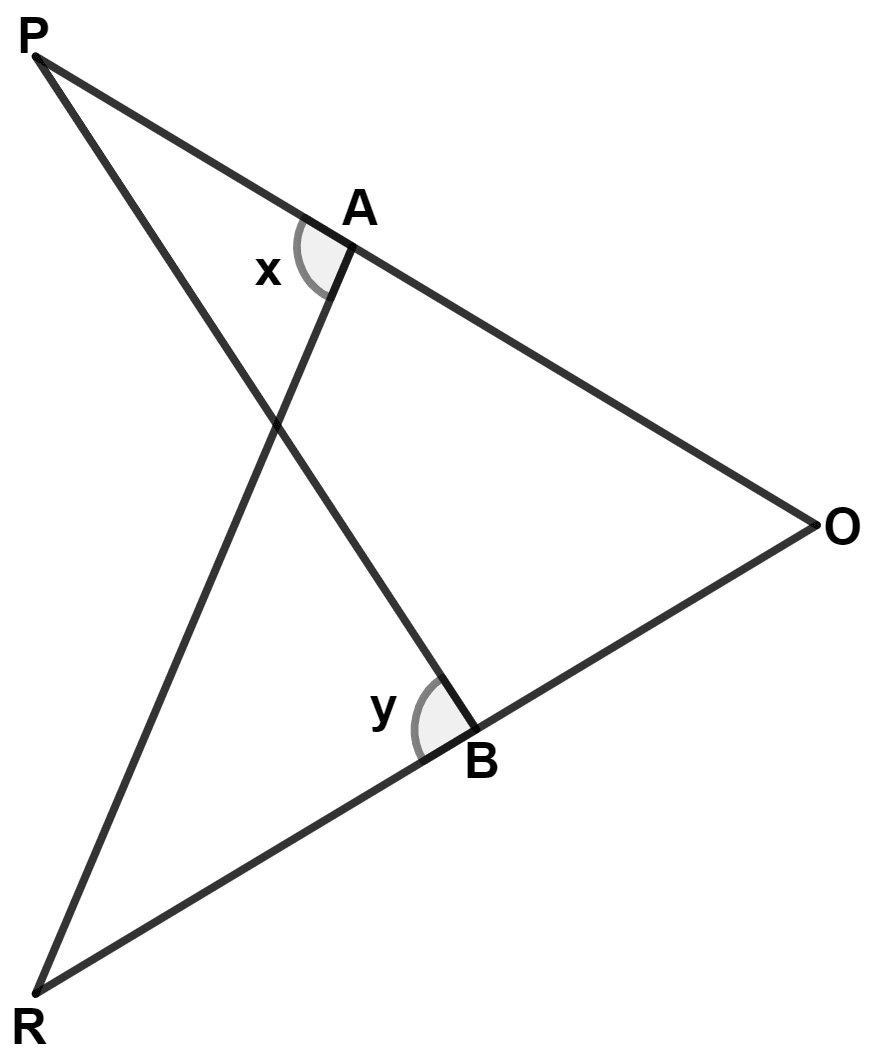
In the given figure, ∠x = ∠y and PO = RO, then :
RB = AO
BO = PA
BP = AR
RB = OB
Answer
From figure,
OP is a straight line.
∴ ∠OAR + x = 180°
⇒ ∠OAR = 180° - x
OR is a straight line.
∴ ∠PBO + y = 180°
⇒ ∠PBO = 180° - y
Since, ∠x = ∠y
∴ ∠OAR = ∠PBO
In △ PBO and △ OAR,
⇒ PO = RO (Given)
⇒ ∠PBO = ∠OAR (Proved above)
⇒ ∠O = ∠O (Common angle)
∴ △ PBO ≅ △ OAR (By A.A.S. axiom)
We know that,
Corresponding parts of congruent triangles are equal.
∴ BP = AR.
Hence, Option 3 is the correct option.
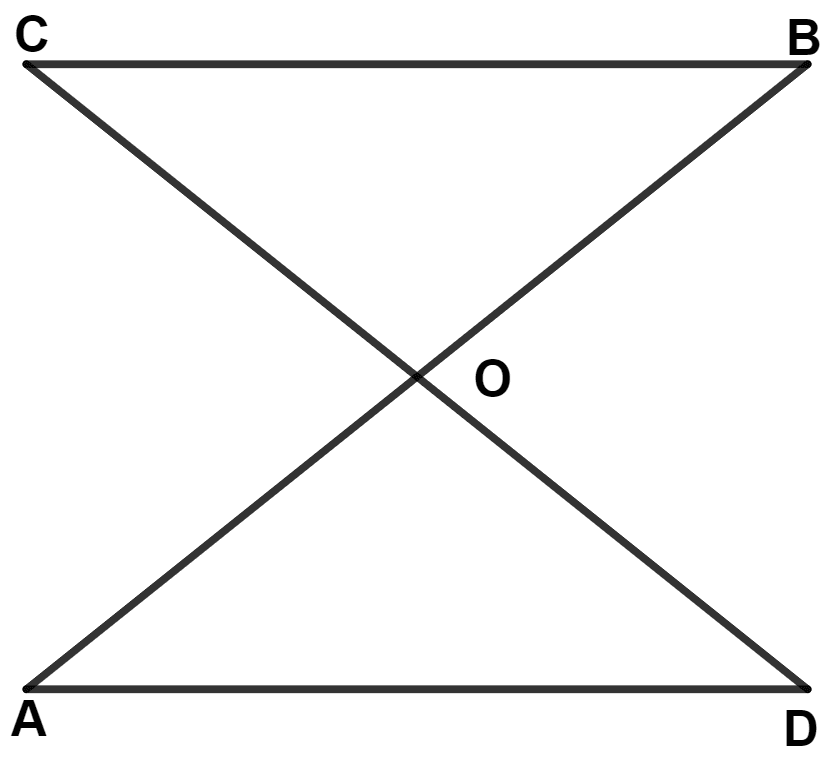
In the given figure, BC // DA and BC = DA, then :
AB and CD bisect each other
AB ≠ CD
OA = OC
OA = OD
Answer
In △ BOC and △ DOA,
⇒ ∠DOA = ∠BOC (Vertically opposite angles are equal)
⇒ ∠OAD = ∠OBC (Alternate angles are equal)
⇒ ∠ODA = ∠OCB (Alternate angles are equal)
∴ △ BOC ≅ △ DOA (By A.A.A. axiom)
We know that,
Corresponding parts of congruent triangles are equal.
∴ OD = OC and OA = OB.
∴ AB and CD bisect each other.
Hence, Option 1 is the correct option.
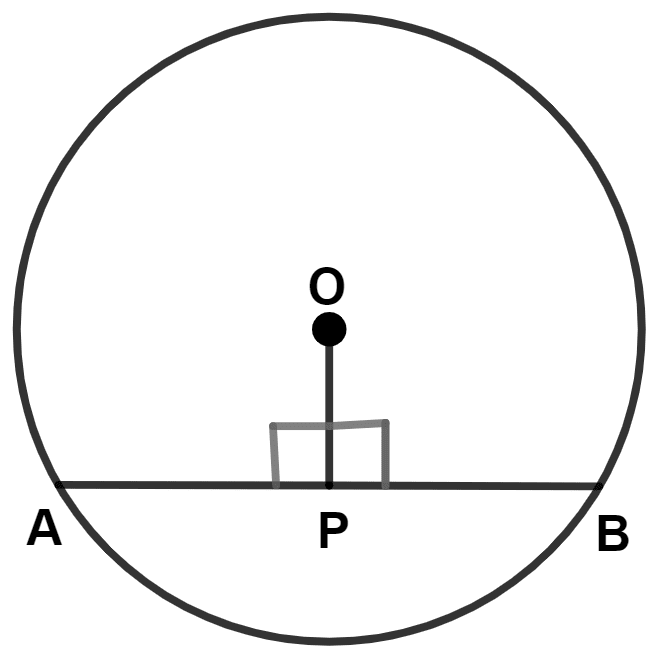
The following figure shows a circle with center O. If OP is perpendicular to AB, prove that AP = BP.
Answer
Join OA and OB.
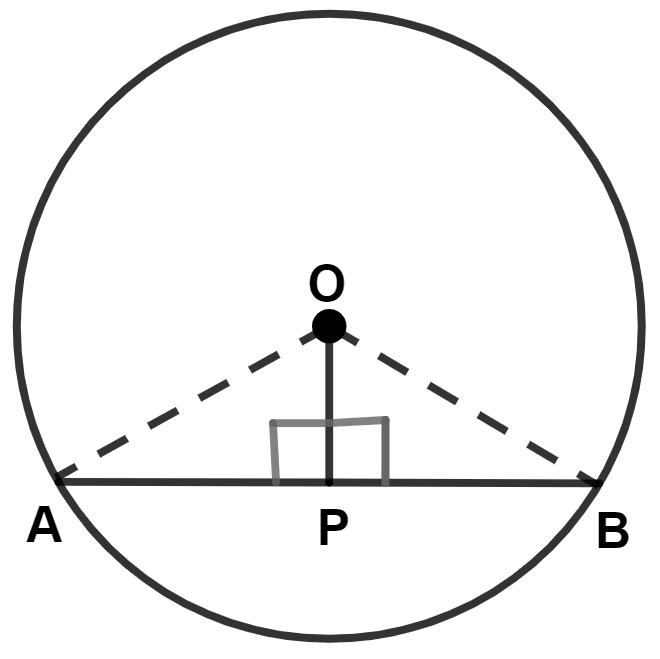
In △ OAP and △ OBP,
⇒ OP = OP (Common side)
⇒ OA = OB (Radius of same circle)
⇒ ∠OPA = ∠OPB (Both equal to 90°)
∴ △ OAP ≅ △ OBP (By R.H.S. axiom)
We know that,
Corresponding parts of congruent triangles are equal.
∴ AP = BP.
Hence, proved that AP = BP.
In a triangle ABC, D is mid-point of BC; AD is produced upto E, so that DE = AD. Prove that :
(i) △ ABD and △ ECD are congruent.
(ii) AB = EC
(iii) AB is parallel to EC.
Answer
△ ABC with AD produced upto E is shown in the figure below:
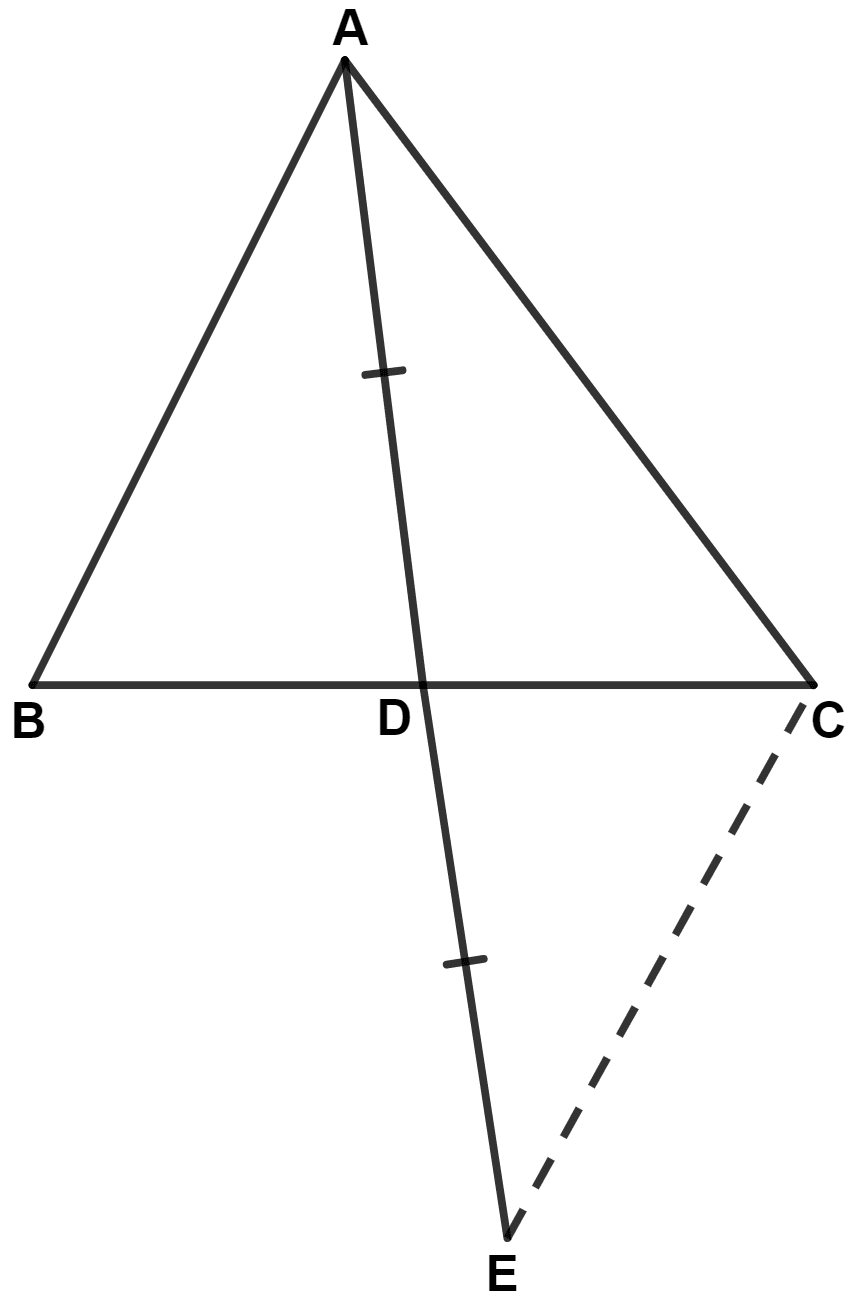
(i) In △ ABD and △ ECD,
⇒ AD = DE (Given)
⇒ BD = DC (As D is the mid-point of BC)
⇒ ∠ADB = ∠CDE (Vertically opposite angles are equal)
∴ △ ABD ≅ △ ECD (By S.A.S. axiom)
Hence, proved that △ ABD ≅ △ ECD.
(ii) Since,
△ ABD ≅ △ ECD (Proved above)
We know that,
Corresponding parts of congruent triangles are equal.
∴ AB = EC.
Hence, proved that AB = EC.
(iii) From figure,
∠ABD = ∠DCE (By C.P.C.T.C.)
Since, these are alternate angles and are also equal,
thus, it can be said, AB and EC are parallel with AE as transversal.
Hence, proved that AB is parallel to EC.
From the given diagram, in which ABCD is a parallelogram, ABL is a line segment and E is mid point of BC.
Prove that :
(i) △ DCE ≅ △ LBE
(ii) AB = BL
(iii) AL = 2DC
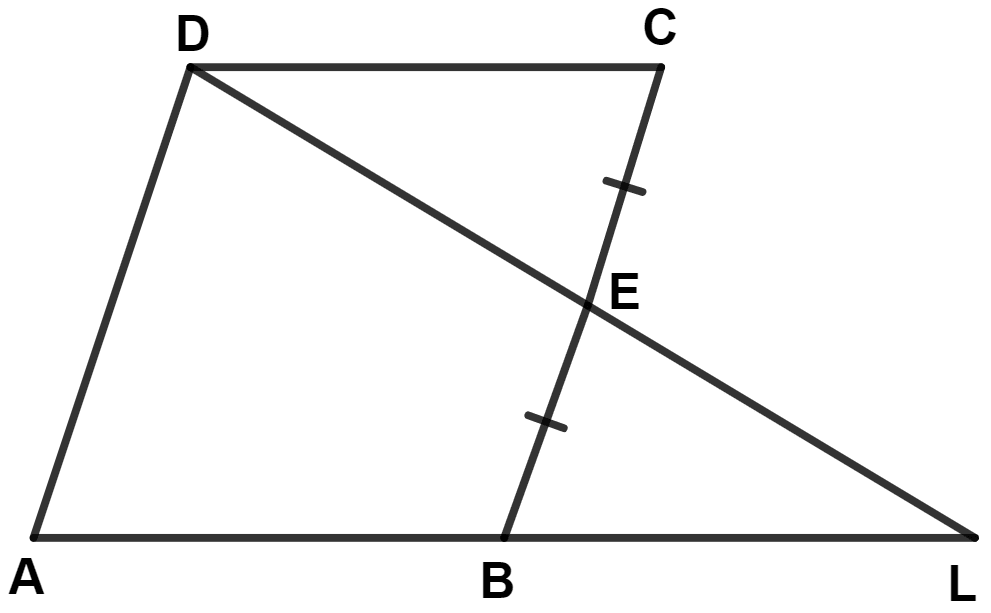
Answer
(i) In parallelogram ABCD,
AB || CD
Since, ABL is a straight line.
∴ BL || CD
In △ LBE and △ DCE,
⇒ BE = CE (Given)
⇒ ∠BEL = ∠CED (Vertically opposite angles are equal)
⇒ ∠CDE = ∠ELB (Alternate angles are equal)
∴ △ LBE ≅ △ DCE (By A.A.S. axiom)
Hence, proved that △ LBE ≅ △ DCE.
(ii) We know that,
Opposite sides of parallelogram are equal.
∴ AB = CD .......(1)
Since, △ LBE ≅ △ DCE
We know that,
Corresponding parts of congruent triangles are equal.
∴ DC = BL .......(2)
From equation (1) and (2), we get :
AB = BL.
Hence, proved that AB = BL.
(iii) Given,
⇒ AB = CD
⇒ AL - BL = CD
⇒ AL - CD = CD (Using Eq 2)
⇒ AL = CD + CD
⇒ AL = 2CD.
Hence, proved that AL = 2CD.
On the sides AB and AC of triangle ABC, equilateral triangles ABD and ACE are drawn. Prove that :
(i) ∠CAD = ∠BAE
(ii) CD = BE.
Answer
△ ABC with equilateral triangles ABD and ACE drawn on its sides AB and AC, respectively are is shown below:
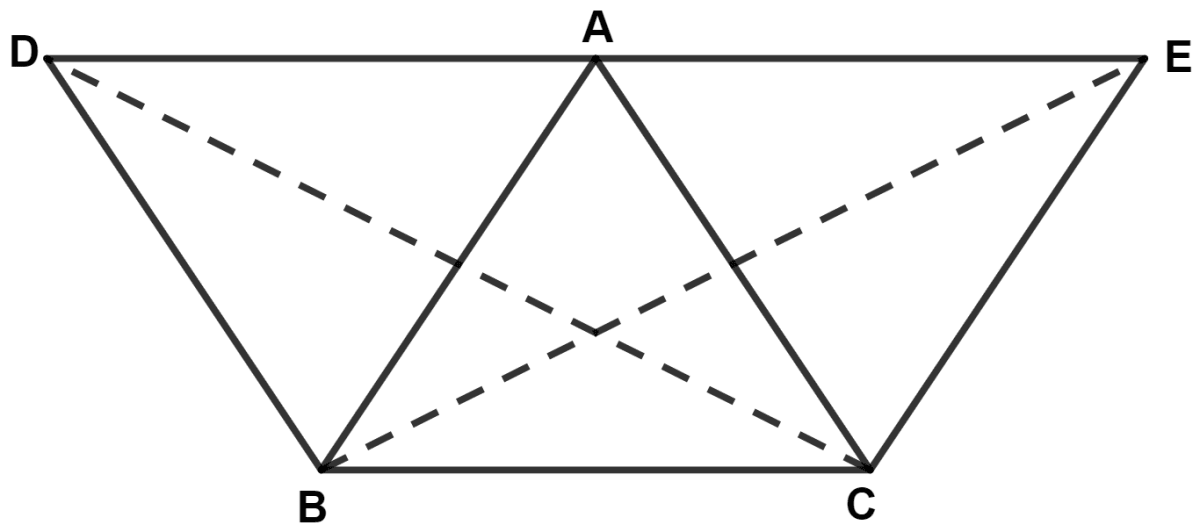
(i) Since, ABD and ACE are equilateral triangles.
∴ ∠BAD = ∠CAE (Both equal to 60°)
Adding ∠CAB on both sides we get :
⇒ ∠BAD + ∠CAB = ∠CAE + ∠CAB
⇒ ∠CAD = ∠BAE.
Hence, proved that ∠CAD = ∠BAE.
(ii) In △ CAD and △ BAE,
⇒ AC = AE (△ ACE is equilateral triangle)
⇒ ∠CAD = ∠BAE (Proved above)
⇒ AD = AB (△ ABD is equilateral triangle)
∴ △ CAD ≅ △ BAE (By S.A.S. axiom)
We know that,
Corresponding parts of congruent triangles are equal.
∴ CD = BE.
Hence, proved that CD = BE.
A line segment AB is bisected at point P and through point P another line segment PQ, which is perpendicular to AB, is drawn. Show that : QA = QB.
Answer
In △ QAP and △ QBP,
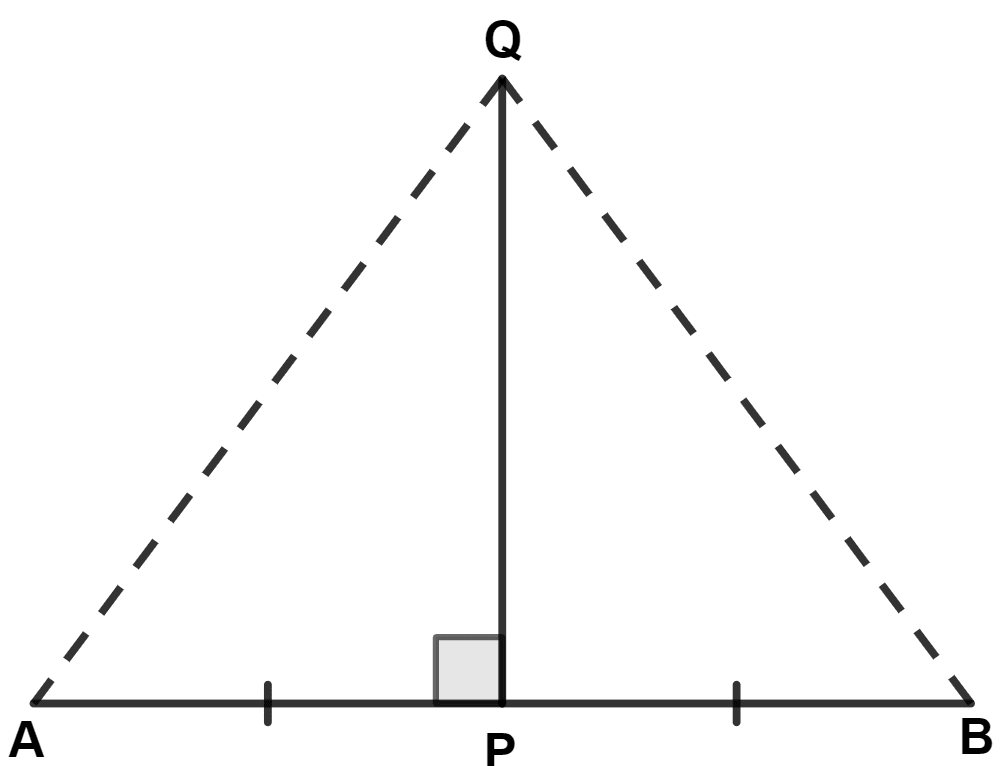
⇒ QP = QP (Common side)
⇒ ∠QPA = ∠QPB (Both equal to 90°)
⇒ AP = PB (Since, AB is bisected at point P)
∴ △ QAP ≅ △ QBP (By S.A.S. axiom)
We know that,
Corresponding parts of congruent triangles are equal.
∴ QA = QB.
Hence, proved that QA = QB.
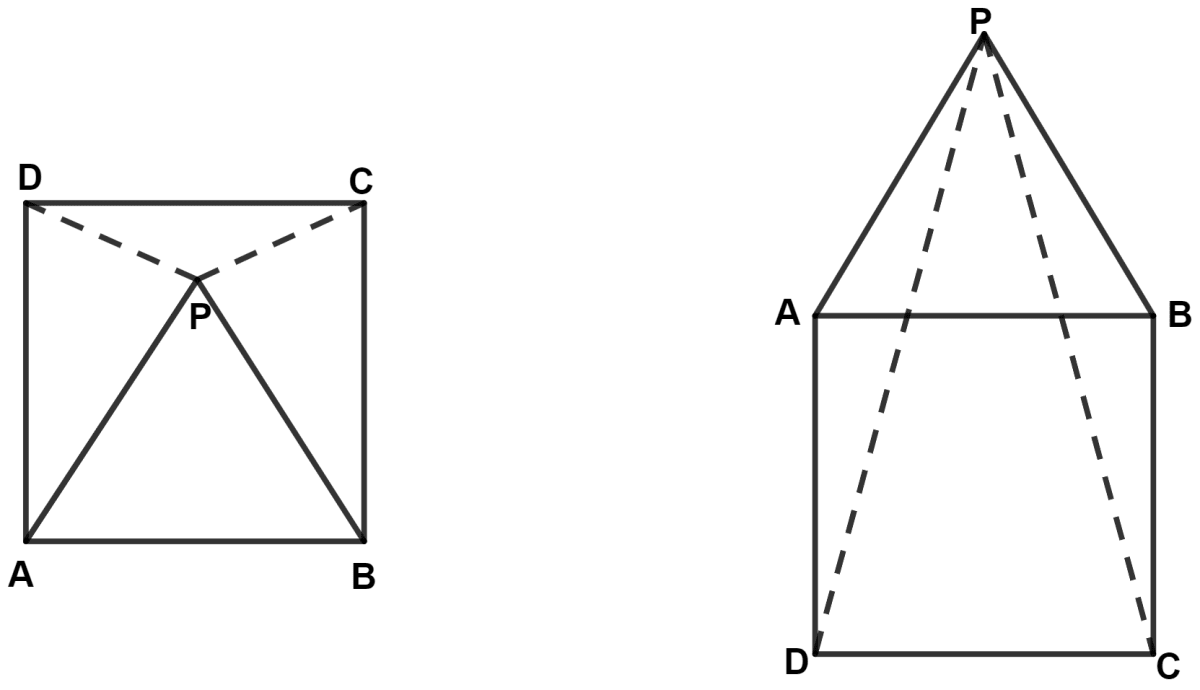
In the following diagrams, ABCD is a square and APB is an equilateral triangle. In each case,
(i) Prove that : △ APD ≅ △ BPC
(ii) Find the angles of △ DPC.
Answer
For 1st case :
(i) We know that,
Each interior angle in a square is 90° and in an equilateral triangle is 60°.
From figure,
⇒ ∠DAP = ∠DAB - ∠PAB = 90° - 60° = 30°.
⇒ ∠CBP = ∠CBA - ∠PBA = 90° - 60° = 30°.
In △ APD and △ BPC,
⇒ ∠DAP = ∠CBP (Proved above)
⇒ AP = PB (Since, APB is an equilateral triangle)
⇒ AD = BC (Since, ABCD is a square)
∴ △ APD ≅ △ BPC (By S.A.S. axiom)
Hence, proved that △ APD ≅ △ BPC.
(ii) We know that,
⇒ AP = AB (Since, APB is an equilateral triangle)
⇒ AB = AD (Since, ABCD is a square)
∴ AP = AD
Thus, APD is an isosceles triangle.
We know that,
Angles opposite to equal sides are equal.
∴ ∠APD = ∠ADP = x (let)
In △ APD,
By angle sum property of triangle,
⇒ ∠APD + ∠ADP + ∠DAP = 180°
⇒ x + x + 30° = 180°
⇒ 2x + 30° = 180°
⇒ 2x = 180° - 30°
⇒ 2x = 150°
⇒ x = = 75°
⇒ ∠APD = ∠ADP = 75°.
From figure,
⇒ ∠ADC = 90° (Interior angle of a square is 90°)
⇒ ∠CDP = ∠ADC - ∠ADP = 90° - 75° = 15°.
Since, △ APD ≅ △ BPC,
⇒ DP = PC (By C.P.C.T.C.)
∴ DPC is an isosceles triangle.
⇒ ∠CDP = ∠DCP = 15° (Angles opposite to equal sides are equal)
In △ DCP,
By angle sum property of triangle,
⇒ ∠DCP + ∠CDP + ∠DPC = 180°
⇒ 15° + 15° + ∠DPC = 180°
⇒ 30° + ∠DPC = 180°
⇒ ∠DPC = 180° - 30° = 150°.
Hence, ∠CDP = ∠DCP = 15° and ∠DPC = 150°.
For 2nd case :
(i) We know that,
Each interior angle in a square is 90° and each interior angle in an equilateral triangle is 60°.
From figure,
⇒ ∠DAP = ∠DAB + ∠BAP
⇒ ∠DAP = 90° + 60° = 150°.
⇒ ∠CBP = ∠CBA + ∠ABP
⇒ ∠CBP = 90° + 60° = 150°.
In △ APD and △ BPC,
⇒ ∠DAP = ∠CBP (Both equal to 150°)
⇒ AP = PB (Since, APB is an equilateral triangle)
⇒ AD = BC (Since, ABCD is a square)
∴ △ APD ≅ △ BPC (By S.A.S. axiom)
(ii) ABCD is a square.
∴ AB = AD = DC = BC
APB is an equilateral triangle.
∴ AP = PB = AB
So, we get :
AP = AD and PB = BC
∴ △ APD and △ BPC are isosceles triangle.
We know that,
Angles opposite to equal sides are equal sides are equal.
∴ ∠APD = ∠ADP = x (let) and ∠BPC = ∠BCP = y (let)
In △ APD,
By angle sum property of triangle,
⇒ ∠APD + ∠ADP + ∠DAP = 180°
⇒ x + x + 150° = 180°
⇒ 2x + 150° = 180°
⇒ 2x = 180° - 150°
⇒ 2x = 30°
⇒ x = = 15°.
In △ BPC,
By angle sum property of triangle,
⇒ ∠BPC + ∠BCP + ∠PBC = 180°
⇒ y + y + 150° = 180°
⇒ 2y + 150° = 180°
⇒ 2y = 180° - 150°
⇒ 2y = 30°
⇒ y = = 15°.
From figure,
⇒ ∠PDC = ∠ADC - ∠ADP = 90° - 15° = 75°.
⇒ ∠PCD = ∠BCD - ∠BCP = 90° - 15° = 75°.
In △ DPC,
By angle sum property of triangle,
⇒ ∠DPC + ∠PDC + ∠PCD = 180°
⇒ ∠DPC + 75° + 75° = 180°
⇒ ∠DPC + 150° = 180°
⇒ ∠DPC = 180° - 150° = 30°.
Hence, ∠DPC = 30° and ∠PDC = ∠PCD = 75°.
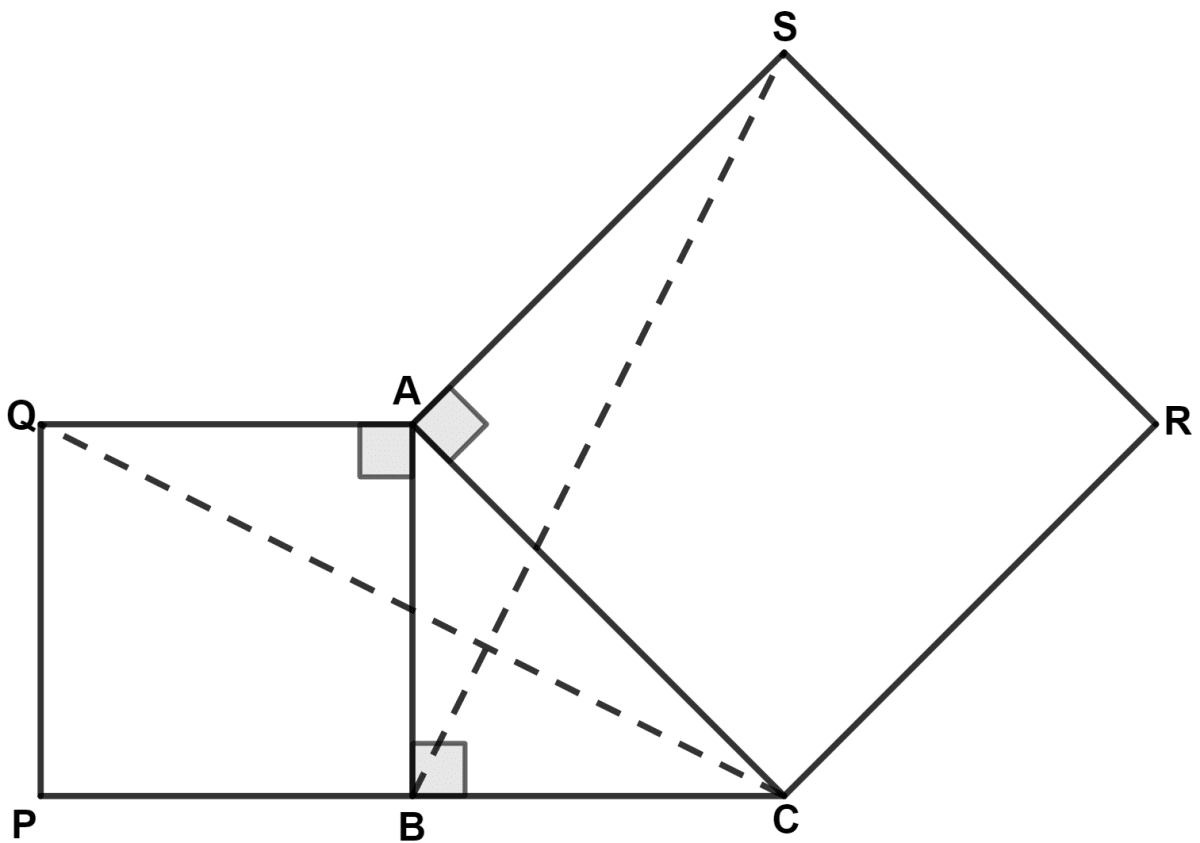
In the figure, given below, triangle ABC is right-angled at B. ABPQ and ACRS are squares. Prove that :
(i) △ ACQ and △ ASB are congruent.
(ii) CQ = BS.
Answer
From figure,
⇒ ∠QAC = ∠QAB + ∠BAC = 90° + ∠BAC.
⇒ ∠BAS = ∠CAS + ∠BAC = 90° + ∠BAC.
∴ ∠QAC = ∠BAS.
In △ QAC and △ BAS,
⇒ QA = AB (Since, ABPQ is a square)
⇒ ∠QAC = ∠BAS (Proved above)
⇒ AC = AS (Since, ACRS is a square)
∴ △ QAC ≅ △ BAS (By S.A.S. axiom)
Hence, proved that △ ACQ and △ ASB are congruent.
(ii) Since, △ QAC ≅ △ BAS
We know that,
Corresponding parts of congruent triangles are equal.
∴ CQ = BS.
Hence, proved that CQ = BS.
In a △ ABC, BD is the median to the side AC, BD is produced to E such that BD = DE. Prove that : AE is parallel to BC.
Answer
△ ABC with BD as median to the side AC and BD is produced to E such that BD = DE is shown below:
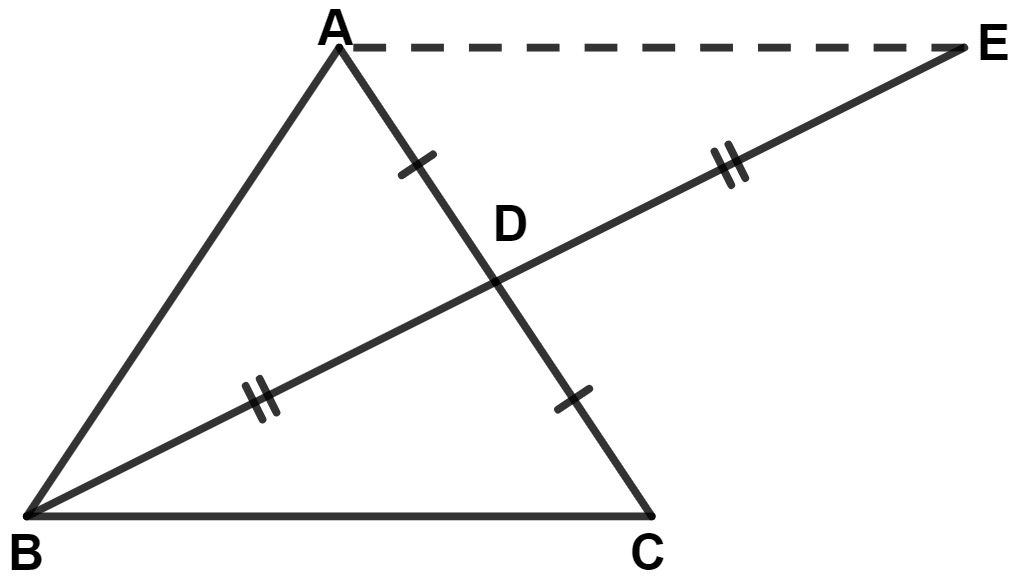
In △ ADE and △ BDC,
⇒ ∠ADE = ∠BDC (Vertically opposite angles are equal)
⇒ AD = DC (As BD is median to side AC)
⇒ BD = DE (Given)
∴ △ ADE ≅ △ BDC (By S.A.S. axiom).
We know that,
Corresponding parts of congruent triangles are equal.
∴ ∠EAD = ∠DCB
The above angles are alternate angles, since they are equal,
∴ AE || BC.
Hence, proved that AE is parallel to BC.
ABCD is a parallelogram. The sides AB and AD are produced to E and F respectively such that AB = BE and AD = DF. Prove that :
△ BEC ≅ △ DCF
Answer
Parallelogram ABCD with sides AB and AD are produced to E and F, respectively are is shown below:
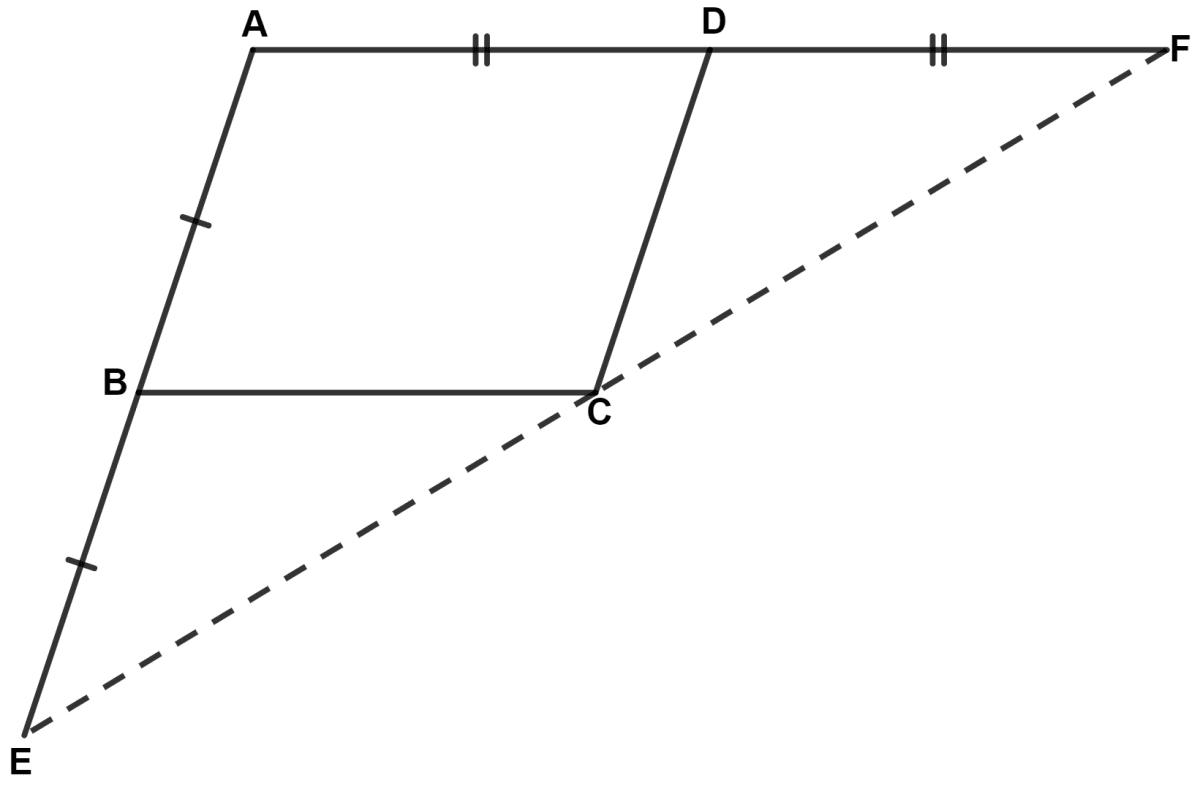
Given,
AD = DF ..........(1)
AB = BE ..........(2)
We know that,
Opposite sides of parallelogram are equal.
∴ AD = BC ........(3)
and,
AB = CD ..........(4)
From equations (1) and (3), we get :
⇒ BC = DF
From equations (2) and (4), we get :
⇒ BE = CD
We know that,
Opposite angles of a parallelogram are equal.
∴ ∠ABC = ∠ADC = x (let)
From figure,
Since, AE is a straight line.
⇒ ∠CBE + ∠ABC = 180°
⇒ ∠CBE + x = 180°
⇒ ∠CBE = 180° - x.
Since, AF is a straight line.
⇒ ∠CDF + ∠ADC = 180°
⇒ ∠CDF + x = 180°
⇒ ∠CDF = 180° - x.
In △ BEC and △ DCF,
⇒ BE = CD (Proved above)
⇒ BC = DF (Proved above)
⇒ ∠CBE = ∠CDF (Both equal to 180° - x)
∴ △ BEC ≅ △ DCF (By S.A.S. axiom).
In the following figure, ABC is an equilateral triangle in which QP is parallel to AC. Side AC is produced upto point R so that CR = BP.
Prove that QR bisects PC.

Answer
Given,
∆ ABC is an equilateral triangle.
∴ ∠ABC = ∠BCA = ∠CAB = 60° (Each interior angle of equilateral triangle equals to 60°.)
From figure,
⇒ ∠BPQ = ∠BCA = 60° (Corresponding angles are equal)
⇒ ∠BQP = ∠BAC = 60° (Corresponding angles)
In ∆BPQ,
By angle sum property of triangle,
⇒ ∠BQP + ∠BPQ + ∠QBP = 180°
⇒ 60° + 60° + ∠QBP = 180°
⇒ 120° + ∠QBP = 180°
⇒ ∠QBP = 180° - 120° = 60°.
Since, all the interior angles = 60°.
∴ △ BPQ is an equilateral triangle i.e., BP = PQ = BQ.
Given,
BP = CR
Since, BP = PQ.
∴ PQ = CR.
In △ MPQ and △ MCR,
⇒ ∠PQM = ∠MRC (Alternate interior angles are equal)
⇒ ∠PMQ = ∠CMR (Vertically opposite angles are equal)
⇒ PQ = CR (Proved above)
∴ ∆ MPQ ≅ ∆ MCR (By A.A.S. axiom)
We know that,
Corresponding parts of congruent triangles are equal.
∴ MP = MC
Thus, QR bisects PC.
Hence, proved that QR bisects PC.
PQRS is a parallelogram. L and M are points on PQ and SR respectively such that PL = MR. Show that LM and QS bisect each other.
Answer
Parallelogram PQRS is shown in the figure below:
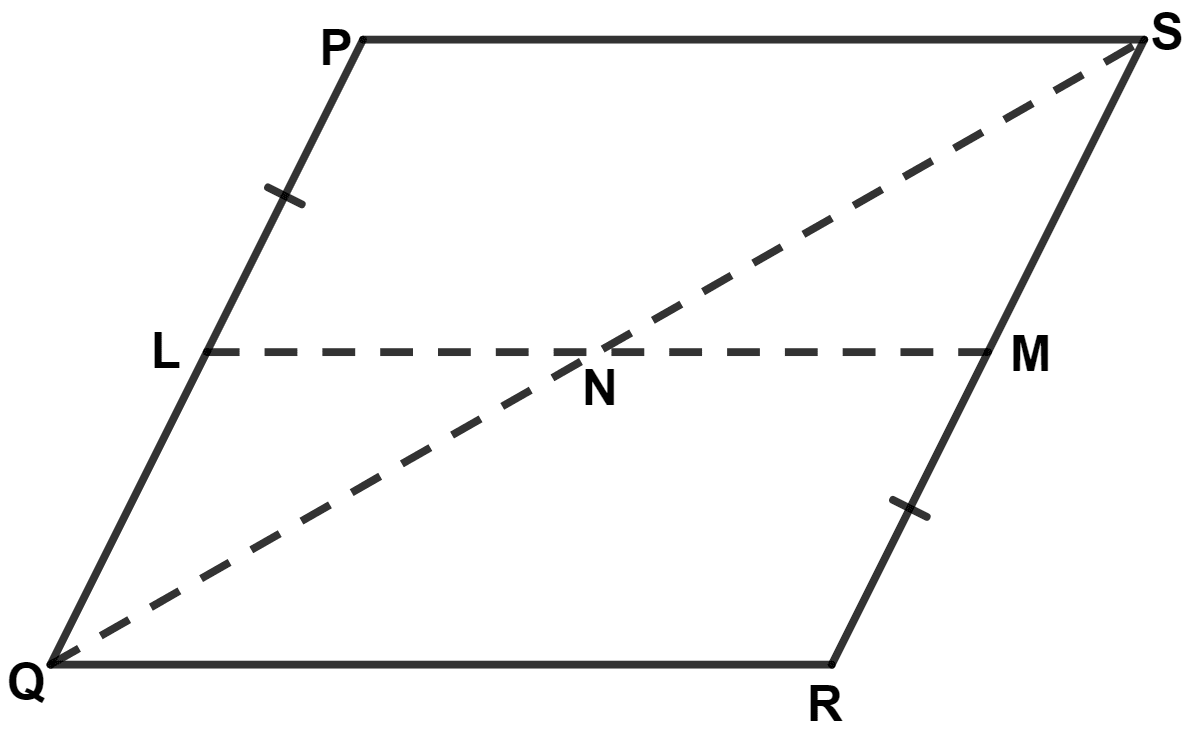
We know that,
Opposite angles of a parallelogram are equal.
∠Q = ∠S = x (let).
Diagonals of a parallelogram bisect the interior angles.
∴ QS bisects interior angles Q and S.
∴ ∠LQN = and ∠NSM = .
∴ ∠LQN = ∠NSM.
We know that,
Opposite sides of a parallelogram are equal.
∴ PQ = SR = a (let)
Given,
⇒ PL = MR = b (let)
From figure,
⇒ LQ = PQ - PL = a - b
⇒ MS = SR - MR = a - b
∴ LQ = MS.
In △ LNQ and △ MNS,
⇒ ∠LNQ = ∠MNS (Vertically opposite angles are equal)
⇒ LQ = MS (Proved above)
⇒ ∠LQN = ∠NSM (Proved above)
∴ △ LNQ ≅ △ MNS (By A.A.S. axiom).
We know that,
Corresponding parts of congruent triangles are equal.
∴ QN = NS and LN = NM.
Hence, proved that LM and QS bisect each other at point of intersection.
In the given figure, AB = PQ, BC = QR and median AM = median PN, then :
AC ≠ PR
BM ≠ QN
△ ABM ≅ △ PQN
△ ABC ≅ △ PQR

Answer
Given,
AM and PN are medians of triangle ABC and PQR.
∴ BM = MC and QN = NR.
BC = QR (Given)
⇒
⇒ BM = QN.
In △ ABM and △ PQN,
⇒ AB = PQ (Given)
⇒ AM = PN (Given)
⇒ BM = QN (Proved above)
∴ △ ABM ≅ △ PQN (By S.S.S. axiom)
We know that,
Corresponding parts of congruent triangles are equal.
∴ ∠AMB = ∠PNQ (By C.P.C.T.C.)
⇒ 180° - ∠AMB = 180° - ∠PNQ
⇒ ∠AMC = ∠PNR
Given,
⇒ BC = QR
⇒
⇒ MC = NR.
In △ AMC and △ PNR,
⇒ AM = PN (Given)
⇒ ∠AMC = ∠PNR (Proved above)
⇒ MC = NR (Proved above)
∴ △ AMC ≅ △ PNR (By S.A.S. axiom)
∴ AC = PR (By C.P.C.T.C.)
In △ ABC and △ PQR,
⇒ AB = PQ (Given)
⇒ BC = QR (Given)
⇒ AC = PR (Proved above)
∴ △ ABC ≅ △ PQR (By S.S.S. axiom)
Hence, Option 4 is the correct option.
In triangles ABC and DEF, AB = DE and AC = EF, then to make these two triangles congruent, we must have :

BC = DF
∠A = ∠E
any of (1) and (2)
none of (1) and (2)
Answer
Given,
In triangle ABC and DEF,
AB = DE (Given)
AC = EF (Given)
According to option 1 :
BC = DF
In such case all three sides are equal.
Then both the triangles will be congruent by S.S.S. axiom.
According to option 2 :
∠A = ∠E
In such case two sides and the included angle will be equal.
Then both the triangles will be congruent by S.A.S. axiom.
Hence, option 3 is the correct option.
In quadrilateral ABCD, AB = AC and BD = CD, then AD bisects :
angle ADC
angle BAD
angle BAC
angle ABC

Answer
In △ BAD and △ CAD,
⇒ AB = AC (Given)
⇒ AD = AD (Common side)
⇒ BD = CD (Given)
∴ △ BAD ≅ △ CAD (By S.S.S. axiom)
We know that,
Corresponding parts of congruent triangles are equal.
∴ ∠BAD = ∠CAD.
∴ AD bisects ∠BAC.
Hence, Option 3 is the correct option.
The given figure shows a circle with center O. P is mid-point of chord AB. Show that OP is perpendicular to AB.

Answer
Join OA and OB.

In △ OAP and △ OBP,
⇒ OP = OP (Common side)
⇒ OA = OB (Radius of same circle)
⇒ AP = PB (Since, P is mid-point of chord AB)
∴ △ OAP ≅ △ OBP (By S.S.S. axiom)
We know that,
Corresponding parts of congruent triangles are equal.
∴ ∠OPA = ∠OPB = x (let)
Since, AB is a straight line.
∴ ∠OPA + ∠OPB = 180°
⇒ x + x = 180°
⇒ 2x = 180°
⇒ x = = 90°.
Hence, proved that OP is perpendicular to chord AB.
A triangle ABC has ∠B = ∠C. Prove that :
(i) the perpendiculars from the mid-point of BC to AB and AC are equal.
(ii) the perpendicular from B and C to the opposite sides are equal.
Answer
△ ABC is shown in the figure below:

(i) From figure,
In △ BDE and △ CDF,
⇒ BD = CD (As D is the mid-point of BC)
⇒ ∠B = ∠C (Given)
⇒ ∠DEB = ∠CFD (Both equal to 90°)
∴ △ BDE ≅ △ CDF (By A.A.S. axiom)
We know that,
Corresponding parts of congruent triangles are equal.
∴ DE = DF.
Hence, proved that the perpendiculars from the mid-point of BC to AB and AC are equal.
(ii) Let perpendiculars from B and C touch sides AC and AB at point H and G respectively.
In triangle ABC,
⇒ ∠B = ∠C
⇒ AC = AB (Sides opposite to equal angles in a triangle are equal)
From figure,
In △ ABH and △ ACG,
⇒ ∠AHB = ∠AGC (Both equal to 90°)
⇒ ∠BAH = ∠CAG (Common angle)
⇒ AB = AC (Proved above)
∴ △ ABH ≅ △ ACG (By A.A.S. axiom)
We know that,
Corresponding parts of congruent triangles are equal.
∴ BH = GC.
Hence, proved that the perpendicular from B and C to the opposite sides are equal.
In the adjoining figure, QX and RX are the bisectors of the angles Q and R respectively of the triangle PQR. If XS ⊥ QR and XT ⊥ PQ; prove that :
(i) △ XTQ ≅ △ XSQ
(ii) PX bisects angle P.

Answer
(i) In △ XTQ and △ XSQ,
⇒ ∠XSQ = ∠XTQ (Both equal to 90°)
⇒ XQ = XQ (Common side)
⇒ ∠XQT = ∠XQS (Since, XQ is the bisector of ∠Q)
∴ △ XTQ ≅ △ XSQ (By A.A.S. axiom)
Hence, proved that △ XTQ ≅ △ XSQ.
(ii) Draw a perpendicular from X on PR i.e. XU.

In △ XSR and △ XUR,
⇒ ∠XSR = ∠XUR (Both are equal to 90°)
⇒ ∠XRS = ∠XRU (As XR is bisector of ∠R)
⇒ XR = XR (Common side)
∴ △ XSR ≅ △ XUR (By A.A.S. axiom)
We know that,
Corresponding parts of congruent triangle are equal.
∴ XU = XS ......(1)
As, △ XTQ ≅ △ XSQ
∴ XS = XT ......(2)
In △ XUP and △ XTP,
From (1) and (2) we get,
⇒ XU = XT
⇒ XP = XP (Common)
⇒ ∠XTP = ∠XUP (Both are equal to 90°)
∴ △XUP ≅ △XTP by RHS axiom.
We know that,
Corresponding parts of congruent triangle are equal.
∴ ∠XPU = ∠XPT
Hence, proved that PX is bisector of ∠P.
In the following figures, the sides AB and BC and the median AD of the triangle ABC are respectively equal to the sides PQ and QR and median PS of the triangle PQR. Prove that △ ABC and △ PQR are congruent.

Answer
Given,
BC = QR = x (let)
AD and PS are median of triangle ABC and PQR.
∴ BD =
and
QS = .
In △ ABD and △ PQS,
⇒ AB = PQ (Given)
⇒ AD = PS (Given)
⇒ BD = QS (Proved above)
∴ △ ABD ≅ △ PQS (By S.S.S. axiom).
We know that,
Corresponding parts of congruent triangle are equal.
∴ ∠B = ∠Q.
In △ ABC and △ PQR,
⇒ AB = PQ (Given)
⇒ BC = QR (Given)
⇒ ∠B = ∠Q (Proved above)
∴ △ ABC ≅ △ PQR (By S.A.S. axiom).
Hence, proved that △ ABC ≅ △ PQR.
In the following figure, OA = OC and AB = BC. Prove that :
(i) ∠AOB = 90°
(ii) △ AOD ≅ △ COD
(iii) AD = CD

Answer
(i) In △ AOB and △ COB,
⇒ OA = OC (Given)
⇒ AB = BC (Given)
⇒ OB = OB (Common side)
∴ △ AOB ≅ △ COB (By S.S.S. axiom).
We know that,
Corresponding parts of congruent triangles are equal.
∴ ∠AOB = ∠COB = x (let)
From figure,
AC is a straight line.
∴ ∠AOB + ∠COB = 180°
⇒ x + x = 180°
⇒ 2x = 180°
⇒ x = = 90°.
∴ ∠AOB = 90°.
Hence, proved that ∠AOB = 90°.
(ii) We know that,
Vertically opposite angles are equal.
∴ ∠AOD = ∠COB = 90° and ∠COD = ∠AOB = 90°.
In △ AOD and △ COD,
⇒ OA = OC (Given)
⇒ ∠AOD = ∠COD (Both equal to 90°)
⇒ OD = OD (Common side)
∴ △ AOD ≅ △ COD (By S.A.S. axiom).
Hence, proved that △ AOD ≅ △ COD.
(iii) Since, △ AOD ≅ △ COD.
We know that,
Corresponding parts of congruent triangles are equal.
∴ AD = CD
Hence, proved that AD = CD.
The following figure shows a triangle ABC in which AB = AC. M is a point on AB and N is a point on AC such that BM = CN. Prove that :
(i) AM = AN
(ii) △ AMC ≅ △ ANB
(iii) BN = CM
(iv) △ BMC ≅ △ CNB

Answer
(i) Given,
AB = AC = x (let) and BM = CN = y (let)
From figure,
⇒ AM = AB - BM = x - y
⇒ AN = AC - CN = x - y
∴ AM = AN.
Hence, proved that AM = AN.
(ii) In △ AMC and △ ANB,
⇒ AM = AN (Proved above)
⇒ ∠MAC = ∠NAB (Common angle)
⇒ AC = AB (Given)
∴ △ AMC ≅ △ ANB (By S.A.S. axiom).
Hence, proved that △ AMC ≅ △ ANB.
(iii) We know that,
Corresponding parts of congruent triangles are equal.
Since,
△ AMC ≅ △ ANB
∴ CM = BN.
Hence, proved that BN = CM.
(iv) We know that,
Angles opposite to equal sides are equal.
Since,
AB = AC
∴ ∠C = ∠B.
In △ BMC and △ CNB,
⇒ BM = CN (Given)
⇒ BC = BC (Common side)
⇒ ∠B = ∠C (Proved above)
∴ △ BMC ≅ △ CNB (By S.A.S. axiom).
Hence, proved that △ BMC ≅ △ CNB.
In a triangle ABC, AB = BC, AD is perpendicular to side BC and CE is perpendicular to side AB. Prove that : AD = CE.
Answer
△ ABC is shown below:

In △ ABD and △ CBE,
⇒ ∠B = ∠B (Common angle)
⇒ ∠ADB = ∠CEB (Both equal to 90°)
⇒ AB = BC (Given)
∴ △ ABD ≅ △ CBE (By A.A.S. axiom).
We know that,
Corresponding parts of congruent triangles are equal.
∴ AD = CE
Hence, proved that AD = CE.
In triangles ABC and PQR, ∠A = ∠Q and ∠B = ∠R. In order to make these triangles congruent, we must have AB equal to:

PQ
PR
QR
none of these
Answer
Given in triangles ABC and PQR,
⇒ ∠A = ∠Q,
⇒ ∠B = ∠R,
So, AB should be equal to QR. That will make, △ABC ≅ △QRP by A.S.A. axiom.
Hence, option 3 is the correct option.
If two sides and an angle of one triangle are equal to two sides and an angle of the other triangle, then the triangle must be congruent
no
yes
can't say
Answer
Given, statement "If two sides and an angle of one triangle are equal to two sides and an angle of another triangle, then the two triangles must be congruent."
The statement cannot be necessarily true as the angles must be included angles.
Hence, option 3 is the correct option.
If BA = DE, AC = DF and BF = EC, then the triangles ABC and DEF are congruent by axiom.

ASA
AAS
RHS
SSS
Answer
Given, BF = EC
Adding FC both sides, we get
⇒ BF + FC = EC + FC
⇒ BC = EF ...........................(1)
Now,
⇒ BA = DE (Given)
⇒ AC = DF (Given)
⇒ BC = EF (From equation (1))
∴ ΔABC ≅ ΔDEF (By SSS congruency criterion)
Hence, option 4 is the correct option.
If BM = DM then AM = CM :

yes
no
can't say
none of these
Answer
Given, BM = DM
⇒ M bisects line BD.
AB is parallel to CD.
In ΔABM and ΔCDM,
⇒ BM = DM
⇒ ∠MBA = ∠MDC (Alternate angles are equal)
⇒ ∠MAB = ∠MCD (Alternate angles are equal)
∴ ΔABM ≅ ΔCDM (By AAS congruency criterion)
By C.P.C.T.
⇒ AM = CM
Hence, option 1 is the correct option.
Statement 1: ∠A = ∠Q and ∠B = ∠R, then to get the triangles, congruent, we must have AB = PR.

Statement 2: The given Δs will be congruent, if AB = QR.
Both the statements are true.
Both the statements are false.
Statement 1 is true, and statement 2 is false.
Statement 1 is false, and statement 2 is true.
Answer
Given in triangles ABC and PQR,
⇒ ∠A = ∠Q,
⇒ ∠B = ∠R,
To get △ABC ≅ △QRP, there should be one more condition.
In order to get triangles congruent any two sides can be equal not necessarily AB = PR, it can also be AB = QR.
∴ Statement 1 is false, and statement 2 is true.
Hence, option 4 is the correct option.
Statement 1: MM' is a plane mirror and A is an object, then I is an image of object A.

∴ OA = OI
Statement 2: ΔAOC ≅ ΔIOC by ASA. And, so CI = CA.
Both the statements are true.
Both the statements are false.
Statement 1 is true, and statement 2 is false.
Statement 1 is false, and statement 2 is true.
Answer
Given, MM' is a plane mirror and A is an object, then I is an image of object A.
The image I of object A is located at the same distance behind the mirror as the object is in front of it, i.e. OA = OI.
So, statement 1 is true.
In ΔAOC and ΔIOC,
⇒ OA = OI (Proved above)
⇒ ∠AOC = ∠IOC (Both equal to 90°)
⇒ OC = OC (Common)
∴ ΔAOC ≅ ΔIOC (By ASA congruency criterion)
By C.P.C.T.C.,
⇒ CI = CA
So, statement 2 is true.
∴ Both the statements are true.
Hence, option 1 is the correct option.
Statement 1: If two angles and a side of one triangle are equal to two angles and a side of some another triangle, the triangles are congruent.
Statement 2: The two triangle will be congruent, if corresponding sides of the two triangles are equal.
Both the statements are true.
Both the statements are false.
Statement 1 is true, and statement 2 is false.
Statement 1 is false, and statement 2 is true.
Answer
Given, statement "If two sides and an angle of one triangle are equal to two sides and an angle of another triangle, then the two triangles must be congruent."
The above statement is true and the triangles can be congruent by two axioms A.A.S. or A.S.A.
So, statement 1 is true.
Two triangles are congruent (by S.S.S. axiom) when all corresponding sides are equal in length, and all corresponding angles are equal in measure.
So, statement 2 is true.
Hence, option 1 is the correct option.
Assertion (A): If PQ = PR, ΔPQS ≅ ΔPRT

Reason (R): PQ = PR, ∠P = ∠P and ∠Q = ∠R
A is true, but R is false.
A is false, but R is true.
Both A and R are true and R is the correct reason for A.
Both A and R are true and R is the incorrect reason for A.
Answer
In ΔPQS and ΔPRT,
⇒ ∠QPS = ∠RPT (Common)
⇒ ∠PQS = ∠PRT (Given)
⇒ PQ = PR (Given)
∴ ΔPQS ≅ ΔPRT (By ASA congruency criterion)
∴ Both A and R are true, and R is the correct reason for A.
Hence, option 3 is the correct option.
Assertion (A): ΔABD ≅ ΔACE

Reason (R): ∠ADE + ∠ADB = ∠AEC + ∠AED
But AD = AE
⇒ ∠ADE = ∠AED
∴ ∠ADB = ∠AEC
⇒ ∠ABD ≅ ∠AEC
A is true, but R is false.
A is false, but R is true.
Both A and R are true and R is the correct reason for A.
Both A and R are true and R is the incorrect reason for A.
Answer
In ΔADE,
⇒ AD = AE (Given)
⇒ ∠ADE = ∠AED = x ..................(1) [Angles opposite to equal sides of the triangle are also equal]
As we know ∠ADE, ∠ADB and ∠AEC, ∠AED forms linear pairs.
So, ∠ADE + ∠ADB = ∠AEC + ∠AED
Using equation (1), we get
⇒ x + ∠ADB = ∠AEC + x
⇒ ∠ADB = ∠AEC
So, reason (R) is true.
In ΔABD and ΔACE,
⇒ ∠ADB = ∠AEC (Proved above)
⇒ AD = AE (Given)
⇒ BD = EC (Given)
∴ ΔABD ≅ ΔACE (By SAS congruency criterion)
∴ Both A and R are true, and R is the correct reason for A.
Hence, option 3 is the correct option.
Which of the following pairs of triangles are congruent ? In each case, state the condition of congruency :
(a) In △ ABC and △ DEF, AB = DE, BC = EF and ∠B = ∠E.
(b) In △ ABC and △ DEF, ∠B = ∠E = 90°; AC = DF and BC = EF.
(c) In △ ABC and △ QRP, AB = QR, ∠B = ∠R and ∠C = ∠P.
(d) In △ ABC and △ PQR, AB = PQ, AC = PR and BC = QR.
(e) In △ ABC and △ PQR, BC = QR, ∠A = 90°, ∠C = ∠R = 40° and ∠Q = 50°.
Answer
(a) Given,
In △ ABC and △ DEF,
⇒ AB = DE
⇒ BC = EF
⇒ ∠B = ∠E
∴ △ ABC ≅ △ DEF (By S.A.S. axiom)
Hence, △ ABC and △ DEF are congruent by S.A.S. axiom.
(b) Given,
In △ ABC and △ DEF,
⇒ AC = DF
⇒ BC = EF
⇒ ∠B = ∠E (Both equal to 90°)
∴ △ ABC ≅ △ DEF (By R.H.S. axiom)
Hence, △ ABC and △ DEF are congruent by R.H.S. axiom.
(c) Given,
In △ ABC and △ QRP,
⇒ AB = QR
⇒ ∠B = ∠R
⇒ ∠C = ∠P
∴ △ ABC ≅ △ QRP (By A.A.S. or A.S.A. axiom)
Hence, △ ABC and △ DEF are congruent by A.A.S. or A.S.A. axiom.
(d) Given,
In △ ABC and △ PQR,
⇒ AB = PQ
⇒ AC = PR
⇒ BC = QR
∴ △ ABC ≅ △ PQR (By S.S.S. axiom)
Hence, △ ABC and △ PQR are congruent by S.S.S. axiom.
(e) In △ ABC,
⇒ ∠A + ∠B + ∠C = 180°
⇒ 90° + ∠B + 40° = 180°
⇒ ∠B + 130° = 180°
⇒ ∠B = 180° - 130° = 50°.
In △ ABC and △ PQR,
⇒ BC = QR (Given)
⇒ ∠B = ∠Q (Both equal to 50°)
⇒ ∠C = ∠R (Both equal to 40°)
∴ △ ABC ≅ △ PQR (By A.S.A. axiom)
Hence, △ ABC and △ PQR are congruent by A.S.A. axiom.
In quadrilateral ABCD, AB = AD and CB = CD. Prove that AC is perpendicular bisector of BD.
Answer

In △ ABC and △ ADC,
⇒ AB = AD (Given)
⇒ BC = CD (Given)
⇒ AC = AC (Common side)
∴ △ ABC ≅ △ ADC (By S.S.S. axiom)
We know that,
Corresponding parts of congruent triangle are equal.
⇒ ∠BAC = ∠DAC
⇒ ∠BAO = ∠DAO
In △ AOB and △ AOD,
⇒ AB = AD (Given)
⇒ AO = AO (Common side)
⇒ ∠BAO = ∠DAO (Proved above)
∴ △ AOB ≅ △ AOD (By S.A.S. axiom)
We know that,
Corresponding parts of congruent triangle are equal.
⇒ ∠BOA = ∠DOA .......(1)
⇒ OB = OD
From figure,
⇒ ∠BOA + ∠DOA = 180° (Linear pair)
⇒ ∠BOA + ∠BOA = 180° [From equation (1)]
⇒ 2∠BOA = 180°
⇒ ∠BOA = = 90°.
∴ AC is perpendicular bisector of BD.
Hence, proved that AC is perpendicular bisector of BD.
In the given figure : AB // FD, AC // GE and BD = CE; prove that :
(i) BG = DF
(ii) CF = EG.

Answer
Given,
⇒ BD = CE
Adding DE on both sides, we get :
⇒ BD + DE = CE + DE
⇒ BE = DC.
In △ BGE and △ DFC,
⇒ BE = DC (Proved above)
⇒ ∠GBE = ∠FDC (Corresponding angles are equal)
⇒ ∠GEB = ∠FCD (Corresponding angles are equal)
∴ ∆ BGE ≅ ∆ DFC (By A.S.A. axiom)
We know that,
Corresponding parts of congruent triangles are equal.
∴ BG = DF and CF = EG.
Hence, proved that BG = DF and CF = EG.
In a triangle ABC, AB = AC. Show that the altitude AD is median also.
Answer
△ ABC is shown below:

In △ ABD and △ ACD,
⇒ AB = AC (Given)
⇒ ∠ADB = ∠ADC (Both equal to 90°)
⇒ AD = AD (Common side)
∴ ∆ ABD ≅ ∆ ACD (By R.H.S. axiom)
We know that,
Corresponding parts of congruent triangles are equal.
∴ BD = CD.
Hence, proved that altitude AD is median also.
In the following figure, BL = CM. Prove that AD is a median of triangle ABC.

Answer
In △ BLD and △ CMD,
⇒ BL = CM (Given)
⇒ ∠BLD = ∠CMD (Both equal to 90°)
⇒ ∠BDL = ∠CDM (Vertically opposite angles are equal)
∴ ∆ BLD ≅ ∆ CMD (By A.A.S. axiom)
We know that,
Corresponding parts of congruent triangles are equal.
∴ BD = CD.
Thus, we can say that :
AD bisects BC in two equal halves.
Hence, proved that AD is a median of triangle ABC.
In the following figure, AB = AC and AD is perpendicular to BC. BE bisects angle B and EF is perpendicular to AB. Prove that :
(i) BD = CD
(ii) ED = EF

Answer
(i) In △ ABD and △ ACD,
⇒ AD = AD (Common side)
⇒ AB = AC (Given)
⇒ ∠ADB = ∠ADC (Since, AD is perpendicular to BC)
∴ ∆ ABD ≅ ∆ ACD (By R.H.S. axiom)
We know that,
Corresponding parts of congruent triangles are equal.
∴ BD = CD.
Hence, proved that BD = CD.
(ii) In △ EBD and △ EBF,
⇒ EB = EB (Common side)
⇒ ∠EBF = ∠EBD (Since, BE bisects angle B)
⇒ ∠EFB = ∠EDB (Both equal to 90°)
∴ ∆ EBD ≅ ∆ EBF (By A.A.S. axiom)
We know that,
Corresponding parts of congruent triangles are equal.
∴ ED = EF.
Hence, proved that ED = EF.
AD and BC are equal perpendiculars to a line segment AB. If AD and BC are on different sides of AB prove that CD bisects AB.
Answer
Let CD intersect AB at point O.

In △ AOD and △ BOC,
⇒ ∠DAO = ∠CBO (Both equal to 90°)
⇒ ∠DOA = ∠COB (Vertically opposite angles are equal)
⇒ AD = BC (Given)
∴ ∆ AOD ≅ ∆ BOC (By A.A.S. axiom)
We know that,
Corresponding parts of congruent triangles are equal.
∴ AO = OB.
Hence, proved that CD bisects AB.
In △ ABC, AB = AC and the bisectors of angles B and C intersect at point O. Prove that :
(i) BO = CO
(ii) AO bisects angle BAC.
Answer
(i) In Δ ABC,

AB = AC (Given)
⇒ ∠B = ∠C [Angles opposite to equal sides are equal]
Also OB and OC are bisectors of angles B and C.
⇒ ∠OBC = ∠OCB
∴ OB = OC [Sides opposite to equal angles are equal]
Hence, proved that BO = CO.
(ii) In Δ AOB and Δ AOC,
⇒ OA = OA (Common side)
⇒ AB = AC (Given)
⇒ OB = OC (Proved above)
∴ Δ AOB ≅ Δ AOC (By S.S.S. axiom)
We know that,
Corresponding parts of congruent triangles are equal.
∴ ∠OAB = ∠OAC
Hence, proved that OA is bisector ∠A.
In the following figure, AB = EF, BC = DE and ∠B = ∠E = 90°. Prove that AD = FC.

Answer
Given,
⇒ BC = DE
Adding CD on both sides, we get :
⇒ BC + CD = DE + CD
⇒ BD = CE.
In △ ABD and △ FEC,
⇒ ∠ABD = ∠FEC (Both equal to 90°)
⇒ AB = EF (Given)
⇒ BD = CE (Proved above)
∴ ∆ ABD ≅ ∆ FEC (By S.A.S. axiom)
We know that,
Corresponding parts of congruent triangles are equal.
∴ AD = FC.
Hence, proved that AD = FC.
A point O is taken inside a rhombus ABCD such that its distances from the vertices B and D are equal. Show that AOC is a straight line.
Answer
Rhombus ABCD with point O taken inside having equal distances from the vertices B and D is shown below:

In △ AOB and △ AOD,
⇒ AO = AO (Common side)
⇒ AB = AD (All sides of rhombus are equal)
⇒ OB = OD (O is equidistant from vertices B and D)
∴ ∆ AOB ≅ ∆ AOD (By S.S.S. axiom)
We know that,
Corresponding parts of congruent triangles are equal.
∴ ∠AOB = ∠AOD = x (let)
Since, BOD is a straight line.
∴ ∠AOB + ∠AOD = 180°
⇒ x + x = 180°
⇒ 2x = 180°
⇒ x = = 90°
∴ ∠AOB = ∠AOD = 90°.
From figure,
∠BOC = ∠AOD = 90° (Vertically opposite angles are equal).
Since,
∠AOB + ∠BOC = 90° + 90° = 180°.
Thus, it can be said that points A, O and C lie on a straight line.
Hence, proved that AOC is a straight line.