
Which of the following were significant causes of the Reformation?
(i) Renaissance
(ii) Corrupt practices in the Church
(iii) Politicisation of the Church
- Only I
- Only I and II
- Only II and III
- I, II, and III
Answer
I, II, and III
Reason — The Renaissance encouraged critical thinking and questioning of the Church, the interest of the Church in political matters showed its politicisation, and evil/corrupt practices in the Church created widespread dissatisfaction. All these were significant causes of the Reformation.
What was Simony?
- Sale of property
- Sale of clerical offices to the highest bidder
- Corruption
- Evil clergy
Answer
Sale of clerical offices to the highest bidder
Reason — Simony was the corrupt practice in which clerical offices in the Church were no longer given to deserving men but were sold for money to the highest bidder.
What were Indulgences, Absolutions and dispensations?
- Letters of crime
- Certificates to commit evil
- Pardon certificates sold by the Church
- Merit certificates
Answer
Pardon certificates sold by the Church
Reason — Indulgences, Absolutions and Dispensations were various kinds of pardon-certificates sold by the Church to people for the remission of sins.
Who revolted against the sale of Indulgences and sparked off the Reformation?
- Martin Luther
- Guptil
- Zwingli
- Pope Leo X
Answer
Martin Luther
Reason — Martin Luther, a German reformer, revolted against the sale of Indulgences and launched a severe movement against the abuses of the Church, which became the immediate cause of the Reformation.
Which of the following statements is true about the Society of Jesus?
(i) It was founded by Ignatius Loyola, a Spanish noble.
(ii) It focused exclusively on missionary work within Europe.
(iii) It helped spread Catholicism in Europe, India, China, Africa, and the Americas.
(iv) It gained recognition and support from the Pope.
- Only (i) and (ii)
- Only (i), (iii), and (iv)
- Only (ii) and (iv)
- (i), (ii), (iii), and (iv)
Answer
Only (i), (iii), and (iv)
Reason — The Society of Jesus was founded by Ignatius Loyola, a Spanish noble, with the Pope's approval, and it spread Catholicism across Europe, India, China, Africa and the Americas. Thus (i), (iii) and (iv) are true, while (ii) is false as its missionary work was not confined to Europe.
Who considered himself as a 'God on Earth'?
- Christians
- Pope
- Kings
- Clergymen
Answer
Pope
Reason — The Pope considered himself as God’s representative on Earth and claimed authority even over kings, including the power to enthrone and dethrone them.
Which of the following was not an impact of Reformation?
- Reduction in power and prestige of papacy
- Rise of nationalism
- Strengthening of absolute monarchies
- Rise in influence and prestige of catholic churches all over Europe
Answer
Rise in influence and prestige of catholic churches all over Europe
Reason — The Reformation reduced the power and prestige of the Papacy and weakened the authority of the Roman Catholic Church. Therefore, an increase in the influence and prestige of Catholic churches all over Europe was not an impact of the Reformation.
Identify the chief causes of the Reformation.
P : The Renaissance prepared the ground for Reformation
Q : Evil practices in the church angered the masses and they revolted against it
R : Counter-Reformation led to Reformation
S : Discovery of trade routes led to Reformation
- P and Q
- Q and R
- R and S
- P and S
Answer
P and Q
Reason — The Renaissance prepared the ground for the Reformation (P) and the evil practices in the Church angered the masses into revolt (Q), so both were chief causes. The Counter-Reformation was a result of, not a cause of, the Reformation, and the discovery of trade routes was unrelated to it.
Read the two statements given below about Martin Luther's contribution to the Reformation Movement. Select the correct relationship between (A) and (B).
(A) : The credit for starting Reformation in Germany goes to Martin Luther.
(B) : Luther wrote down his objections against the sale of 'Indulgences' in Latin, in the form of 'Ninety-Five Theses' and nailed them on the door of the church at Wittenburg.
- (B) contradicts (A)
- (B) is the reason for (A)
- (A) is true but (B) is false
- (A) and (B) are independent of each other
Answer
(B) is the reason for (A)
Explanation — The credit for starting the Reformation in Germany goes to Martin Luther because he wrote his objections against the sale of Indulgences in the form of the 'Ninety-Five Theses' and nailed them on the church door at Wittenberg, thereby launching the movement. Thus (B) is the reason for (A).
With reference to the picture given below, answer the following question:
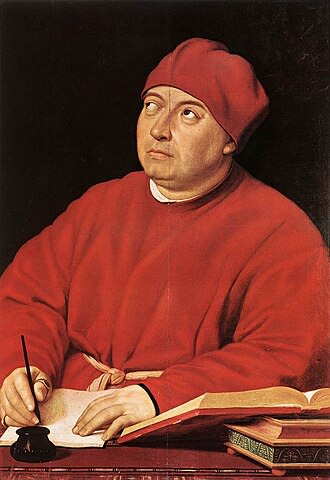
Why did the Pope excommunicate Martin Luther?
- Martin Luther burned the Pope's Edict.
- Martin Luther publicly criticized and abused the Pope.
- Martin Luther's teachings and protests against the corrupt practices of the Church angered the Pope.
- Martin Luther was excommunicated because he was from Germany.
Answer
Martin Luther's teachings and protests against the corrupt practices of the Church angered the Pope.
Reason — The New Teachings of Luther and his protests against the corrupt practices of the Church endangered the authority of Pope Leo X, who therefore excommunicated him.
Consider the two statements given below and select the option that shows the correct relationship between (A) and (R).
Assertion (A): Martin Luther revolted against the corrupt practices of church.
Reason (R): His 'Ninety-five Theses' initiated the revolt against corrupt practices in church.
- Both (A) and (R) are true, and (R) is the correct explanation of (A)
- Both (A) and (R) are true, but (R) is not the correct explanation of (A)
- (A) is true but (R) is false
- (A) is false but (R) is true.
Answer
Both (A) and (R) are true, and (R) is the correct explanation of (A)
Explanation — Martin Luther revolted against the Church's corrupt practices—such as the selling of indulgences, because his Ninety-five Theses' served as the catalyst that sparked his revolt against the Church's corruption.
What is meant by Reformation?
Answer
The Reformation was a great religious movement in the 16th century against the abuses and evil practices of the Roman Catholic Church.
What were the two main divisions of Christianity that resulted from the Reformation?
Answer
The Reformation divided Christianity into Roman Catholics, who remained loyal to the Pope, and Protestants, who broke away to establish their own religious practices and beliefs.
Which Pope excommunicated Martin Luther?
Answer
Pope Leo X excommunicated Martin Luther because his new teachings endangered the authority of the Pope.
Mention any two evil practices prevalent in the Medieval Church.
Answer
Two evil practices prevalent in the Medieval Church were Simony and Pluralism.
What document did Martin Luther write to protest Church practices?
Answer
Martin Luther wrote 'Ninety-Five Theses' to protest against Church practices like Indulgences.
Who were the Protestants?
Answer
The Protestants were the ones who were not loyal to the Pope and broke away to establish their own religious practices and beliefs.
Why were people dissatisfied with the Catholic Church?
Answer
The people were dissatisfied with the Catholic Church because of several reasons like corruption, immoral practices, heavy financial burden, and the Pope's interference in political affairs.
Read the following excerpt and answer the question that follows:
"This triggered reforms within the Roman Catholic Church, generally referred to as the Catholic Reformation or Counter Reformation. But Reformation was not merely a religious movement."
(Source: https://egyankosh.ac.in/bitstream/123456789/12890/1/Unit-7.pdf)
Who started the Counter Reformation Movement?
Answer
The Counter Reformation Movement was started within the Catholic Church during the 16th and 17th centuries, in response to the Protestant Reformation Movement.
Name two leaders of the Protestant Movement.
Answer
Two leaders of the Protestant Movement were Martin Luther (in Germany) and Ulrich Zwingli (in Switzerland).
How did the heavy financial burden of the Church lead to Reformation?
Answer
The Church spent vast sums on grandiose cathedrals and other architectural projects, particularly in Rome, while also increasing the financial burden on the lower classes. Besides realising taxes the Popes began to adopt other means to collect funds. The burden fell on the peasants, labourers and the middle class. They all began to oppose the Church because of its heavy financial burden, leading to Reformation.
In which way was Renaissance the cause of Reformation?
Answer
The Renaissance caused the Reformation by encouraging a spirit of enquiry and developing a critical attitude. It promoted original and independent thinking, particularly on scientific lines. This led people to question the authority of the Pope, criticize corrupt practices and rituals within the Church, and challenge the immoral lives of the clergy. Additionally, the translation of the Bible into local languages allowed many Christians to study it themselves, which further encouraged them to question the Pope's role as a means of salvation.
What do you mean by Counter-Reformation?
Answer
Counter-Reformation was the reform movement launched by the Roman Catholic Church during the 16th and 17th centuries to revive its authority and check the spread of Protestantism.
Why did the common masses begin to oppose the Church?
Answer
The common masses began to oppose the Church due to its corrupt practices and abuses. As the Popes and clergymen became more ambitious and led luxurious lives, they engaged in practices like Simony (selling church offices) and Pluralism (holding multiple church positions). Clergymen acted like feudal lords, exploiting the people. The Pope also demanded Annates (payment of a clergyman's first year's income) and sold indulgences, absolutions, and dispensations to promise salvation in exchange for money. Furthermore, the clergymen often broke their vows of celibacy and poverty, treating religion as a commercial business. These corrupt practices deeply angered the masses, leading to their revolt against the Church.
Read the following excerpt and answer the questions that follow:
"In 1517, Martin Luther nailed his Ninety Five Thesis on the church door in Wittenburg and directly challenged the sale of indulgence. His actions immediately attracted the attention of all Europe. Engels described Luther's revolt against the Roman Catholic Church as 'Luther's lightning struck home'."
(Source: https://egyankosh.ac.in/bitstream/123456789/72251/1/Unit-9.pdf)
(a) Why did Martin Luther revolt against the Catholic Church?
(b) Why did Martin Luther object to the sale of indulgences by Tetzel in Wittenberg?
Answer
(a) Martin Luther went to Rome in 1512 CE on an official mission, and was stunned to see that the Pope had adopted the lifestyle of an Italian prince, living luxuriously. The corrupt practices of the Church and immoral life of the clergymen led him to revolt against the Catholic Church.
(b) Tetzel was sent by Pope Julius II to sell 'Indulgences' in Wittenberg to collect funds in order to rebuild St. Peter's Church at Rome. The people were told that if they bought the 'Indulgences' by paying heavy amounts to the Church they would be absolved of their sins and saved from the fire of hell. Luther, on the other hand, thought that 'Indulgences' were wrong and if men are sorry for their sins and have faith in God, He will forgive them.
Hence, Luther wrote down his objections against the sale of 'Indulgences' in Latin, in the form of 95 statements known as 'Ninety-Five Theses' and nailed them on the door of the church at Wittenberg.
What was the role of new learning in the Reformation?
Answer
The role of new learning in the Reformation was significant. The Renaissance encouraged a spirit of enquiry and critical thinking, which led people to question the authority of the Pope. This shift in attitude allowed individuals to criticize the corrupt and immoral practices of the clergymen. As a result, many Christians began to study the Bible themselves after it was translated into their own languages, leading them to question the Pope's role as a means of salvation. The new learning also exposed the ignorance and superstitions of the clergy, with figures like Erasmus raising their voices against the Church's abuses, paving the way for the Reformation.
Read the following excerpt and answer the questions that follow:
"Some of the outcome, and much of the enforcement, of the Council of Trent was in the hands of newly established religious orders, above all the Society of Jesus, the Jesuits, founded in 1534 by St. Ignatius of Loyola and officially established by the papacy in 1540."
(Source: https://www.britannica.com/event/Counter-Reformation)
(a) What were the main objectives of the Society of Jesus, and who founded it?
(b) Describe the contributions of St. Francis Xavier to the Jesuit missionary efforts.
(c) How did the Jesuits influence the global spread of Catholicism?
Answer
(a) The Society of Jesus was founded by Ignatius Loyola, a Spanish nobleman, with the approval of the Pope. Its chief objective was to spread Catholicism through missionary work in Europe, India, China, Africa and the Americas.
(b) St. Francis Xavier travelled extensively to spread Christianity, reaching China, Japan, India and other parts of Asia. In India, he worked tirelessly in Goa until his death in 1552. His mortal remains are enshrined in the Church of Bom Jesus in Old Goa.
(c) The Jesuits quickly gained recognition for their missionary work and effectively spread Catholicism across Europe, India, China, Africa, and the Americas. Their dedication and selfless service played a crucial role in restoring the prestige and influence of the Roman Catholic Church.
With reference to the genesis and growth of Protestantism, answer the following questions:
(a) Define Protestantism and explain its key beliefs.
(b) What was the Schmalkaldic League, and why was it formed?
(c) When was the Peace of Augsburg concluded, and what were its key effects on the religious landscape of Germany?
(d) How did Protestantism bring about changes in the religious field?
Answer
(a) Protestantism was the branch of Christianity that emerged during the Reformation against the corrupt practices of the Roman Catholic Church. It rejected the authority of the Pope, abolished many Church dogmas and monasteries, allowed priests to marry, and spread to many parts of Europe.
Its key beliefs were -
- Salvation is attained through faith in Jesus Christ, not by Church rituals or Indulgences.
- The Bible is the supreme authority for Christian doctrine, and individuals should be able to read and interpret it.
- Protestants rejected the hierarchical authority of the Pope and clergy, advocating for a more direct relationship between individuals and God.
- Protestantism led to the abolition of monasteries, many Church dogmas, and the introduction of reforms, such as allowing priests to marry.
(b) When the Holy Roman Emperor threatened the followers of Luther to come back to the fold of the Roman Catholic Church, Luther and some of the German princes formed a league known as the 'SchmalKaldic League' to face the Emperor. The evil war and struggle between the two continued until they concluded the Peace of Augsburg in 1555.
(c) The Peace of Augsburg was concluded in 1555. By this Lutheranism was recognised as another legal form of Christianity and the ruler of each state in Germany was given the right to determine whether his state was to be a Roman Catholic or a Lutheran.
(d) The northern states of Germany embraced Lutheranism. Lutheranism, or Protestantism, led to the abolition of monasteries, many Church dogmas, and the introduction of reforms, such as allowing priests to marry. Gradually, Lutheranism or Protestantism began to spread to other European countries as well.
The Reformation movement in the 16th century arose from several factors that challenged the authority and practices of the Church. With reference to this, answer the following questions:
(a) How did the Renaissance encourage critical thinking and questioning of the Church's authority?
(b) Discuss the corrupt practices within the Church, such as Simony and the sale of indulgences, and explain how they led to widespread discontent.
(c) How did Martin Luther's challenge to the Pope's authority spark widespread reform and contribute to the Reformation movement?
Answer
(a) The Renaissance encouraged a spirit of enquiry, developed a critical attitude of mind and broadened the mental outlook of man. It encouraged original and independent thinking on scientific lines. The people now began to question the authority of the Pope and criticize the corrupt practices and rituals and the immoral life of the clergymen. Many devoted Christians began to study the Bible themselves as it was now translated into their own languages. They now questioned the authority of the Pope as a means of salvation. They were simply shocked at the ignorance and superstitions of the clergymen. Learned individuals, such as Erasmus, raised their voices against the abuses that had infiltrated into the Church.
(b) During the Middle Ages and leading up to the Renaissance, the Roman Catholic Church became deeply involved in various corrupt practices like the Simony and the sale of indulgences.
Simony was the practice of sale of clerical offices for money and not giving them to the deserving men.
Indulgences were sold by the Pope as pardon-certificates to save the people from sins, crimes and fire to hell.
The clergymen and the Pope both extorted money from the common masses in the name of religion, and the clergymen did not keep the vow of celibacy, poverty and services to mankind. Religion had become a commercial business. These corrupt practices led to widespread discontent and eventually sparked the Reformation.
(c) Martin Luther, a German reformer, revolted against the sale of the Indulgences, raised a strong voice and launched a severe movement against the abuses of the church and the authority of the Pope.
- Ninety-Five Theses — Luther criticized the sale of indulgences and the Pope's authority over salvation, arguing that faith alone, not money, could save people. This directly challenged the Church’s practices and power.
- Luther rejected the idea that the Pope had the power to forgive sins or grant salvation.
- Bible Translation — Luther translated the Bible into German, making it accessible to the masses and encouraging personal interpretation, further diminishing the Church's control over religious knowledge.
- Formation of SchmalKaldic League — Luther and some of the German princes formed a league known as the 'SchmalKaldic League' to face the Holy Roman Emperor. The evil war and struggle between the two resulted in the Peace of Augsburg in 1555.
- Due to his efforts, Lutheranism was recognised as another legal form of Christianity and the ruler of each state in Germany was given the right to determine whether his state was to be a Roman Catholic or a Lutheran.