
In the figure given below, AD ⊥ BC, AB = 25 cm, AC = 17 cm and AD = 15 cm. Find the length of BC.

Answer
By pythagoras theorem,
In right angle triangle ADB,
⇒ AB2 = AD2 + BD2
⇒ 252 = 152 + BD2
⇒ 625 = 225 + BD2
⇒ BD2 = 625 - 225 = 400
⇒ BD = = 20 cm
In right angle triangle ADC,
⇒ AC2 = AD2 + DC2
⇒ 172 = 152 + DC2
⇒ 289 = 225 + DC2
⇒ DC2 = 289 - 225 = 64
⇒ DC = = 8 cm
From figure,
⇒ BC = BD + DC = 20 + 8 = 28 cm.
Hence, BC = 28 cm.
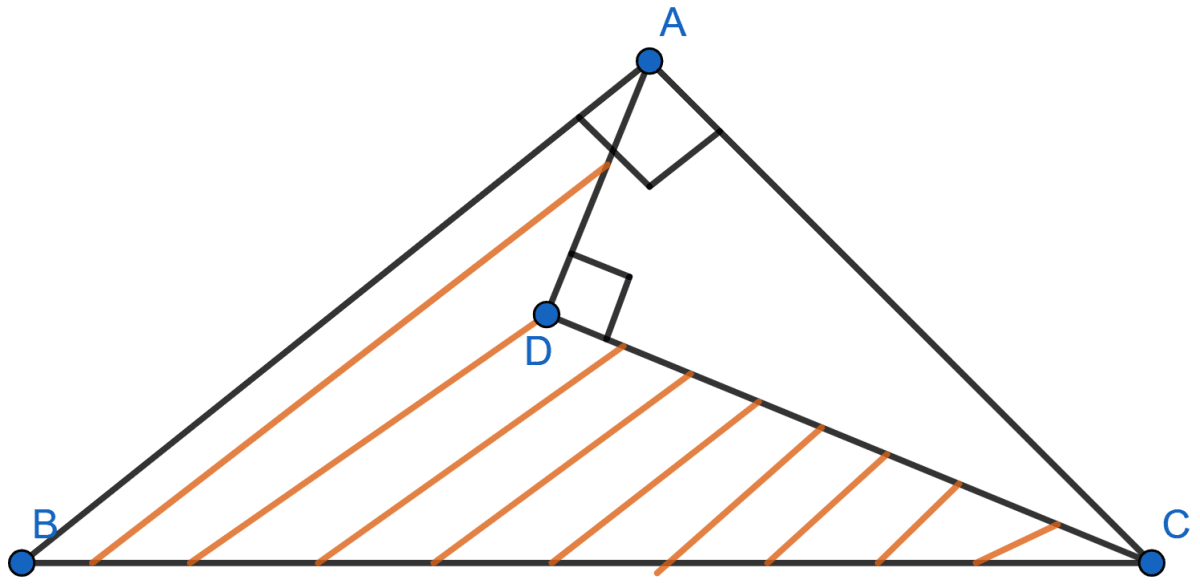
In the figure given below, ∠BAC = 90°, ADC = 90°, AD = 6 cm, CD = 8 cm and BC = 26 cm. Find
(i) AC
(ii) AB
(iii) area of the shaded region.
Answer
(i) By pythagoras theorem,
In right angle triangle ADC,
⇒ AC2 = AD2 + DC2
⇒ AC2 = 62 + 82
⇒ AC2 = 36 + 64
⇒ AC2 = 100
⇒ AC = = 10 cm.
Hence, AC = 10 cm.
(ii) By pythagoras theorem,
In right angle triangle ABC,
⇒ BC2 = AB2 + AC2
⇒ 262 = AB2 + 102
⇒ AB2 = 676 - 100
⇒ AB2 = 576
⇒ AB = = 24 cm.
Hence, AB = 24 cm.
(iii) Area of shaded region = Area of △ABC - Area of △ADC
Hence, area of shaded region = 96 cm2.
In figure given below, triangle ABC is right angled at B. Given that AB = 9 cm, AC = 15 cm and D, E are mid-points of the sides AB and AC respectively, calculate (i) the length of BC (ii) the area of △ADE.

Answer
(i) In right angle triangle ABC,
By pythagoras theorem,
⇒ AC2 = AB2 + BC2
⇒ 152 = 92 + BC2
⇒ BC2 = 225 - 81
⇒ BC2 = 144
⇒ BC = = 12 cm.
Hence, BC = 12 cm.
(ii) Given, D and E are midpoints of AB and AC.
∴ By mid-point theorem,
DE = = 6 cm.
Area of △ADE = = 13.5 cm2
Hence, area of △ADE = 13.5 cm2.
If in △ABC, AB > AC and AD ⊥ BC, prove that AB2 - AC2 = BD2 - CD2.
Answer
From figure,
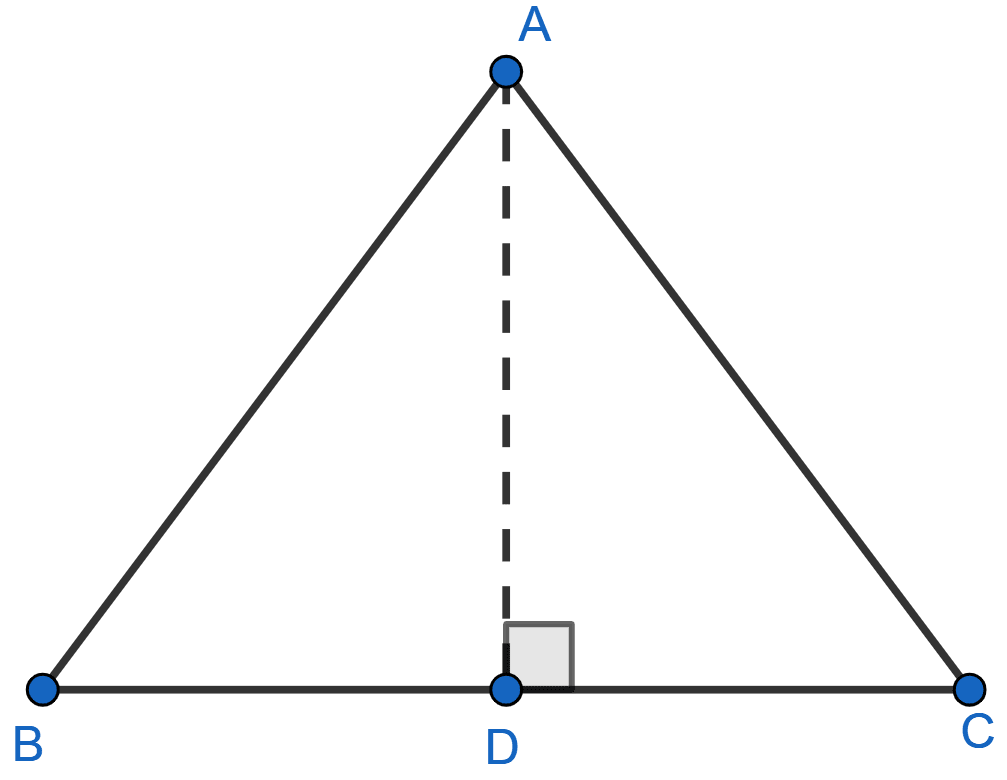
In right angle △ADB,
By pythagoras theorem we get,
AB2 = AD2 + BD2 ........(i)
In right angle △ADC,
By pythagoras theorem we get,
AC2 = AD2 + CD2 ........(ii)
Subtracting (ii) from (i),
AB2 - AC2 = AD2 + BD2 - (AD2 + CD2)
AB2 - AC2 = BD2 - CD2.
Hence, proved that AB2 - AC2 = BD2 - CD2.
In a right angled triangle ABC, right angled at C, P and Q are the points on the sides CA and CB respectively which divide these sides in the ratio 2 : 1. Prove that
(i) 9AQ2 = 9AC2 + 4BC2
(ii) 9BP2 = 9BC2 + 4AC2
(iii) 9(AQ2 + BP2) = 13AB2
Answer
(i) In right angle triangle ACQ,
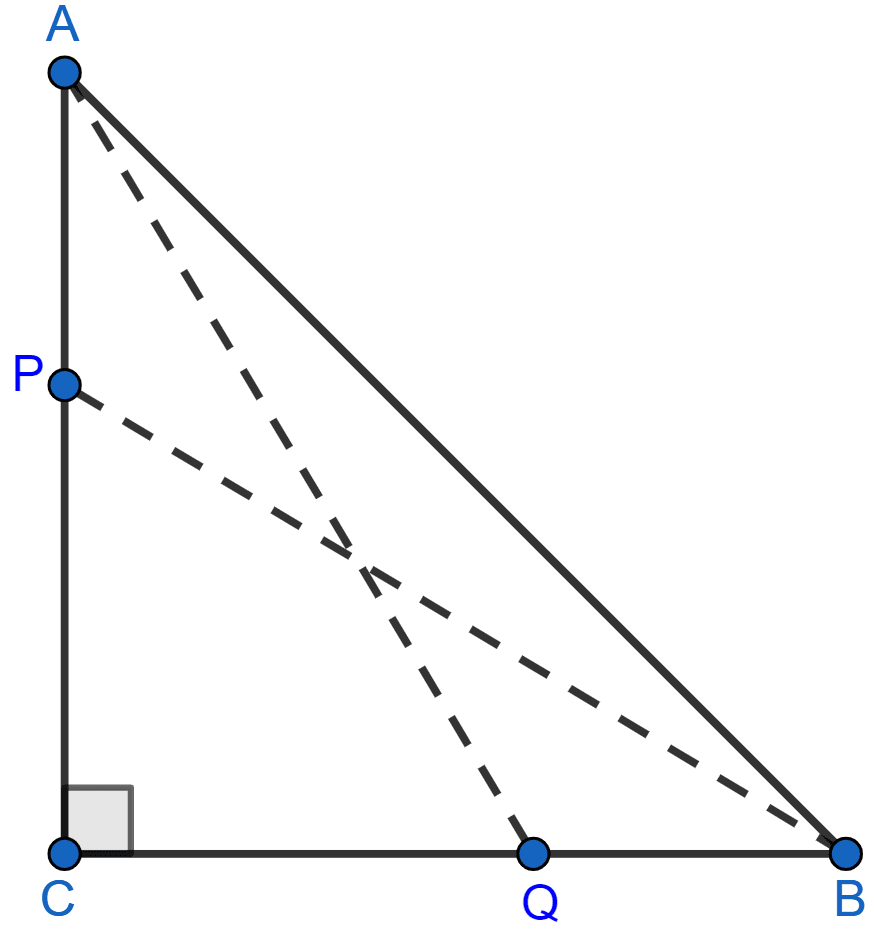
By pythagoras theorem we get,
⇒ AQ2 = AC2 + CQ2
Multiplying both sides by 9 we get,
⇒ 9AQ2 = 9AC2 + 9CQ2
⇒ 9AQ2 = 9AC2 + (3CQ)2 .......(i)
Given, BQ : CQ = 1 : 2
Substituting above value in (i) we get,
⇒ 9AQ2 = 9AC2 + (2BC)2
⇒ 9AQ2 = 9AC2 + 4BC2.
Hence, proved that 9AQ2 = 9AC2 + 4BC2.
(ii) In right angle triangle BPC,
By pythagoras theorem we get,
⇒ BP2 = BC2 + CP2
Multiplying both sides by 9 we get,
⇒ 9BP2 = 9BC2 + 9CP2
⇒ 9BP2 = 9BC2 + (3CP)2 .......(ii)
Given, AP : PC = 1 : 2
Substituting above value in (ii) we get,
⇒ 9BP2 = 9BC2 + (2AC)2
⇒ 9BP2 = 9BC2 + 4AC2.
Hence, proved that 9BP2 = 9BC2 + 4AC2.
(iii) In right angle triangle ABC,
By pythagoras theorem we get,
⇒ AB2 = AC2 + BC2 ......(iii)
Adding resultants from part (i) and (ii) we get,
9AQ2 + 9BP2 = 9AC2 + 4BC2 + 9BC2 + 4AC2
9(AQ2 + BP2) = 13AC2 + 13BC2
9(AQ2 + BP2) = 13(AC2 + BC2)
9(AQ2 + BP2) = 13AB2 [From (iii)].
Hence, proved that 9(AQ2 + BP2) = 13AB2.
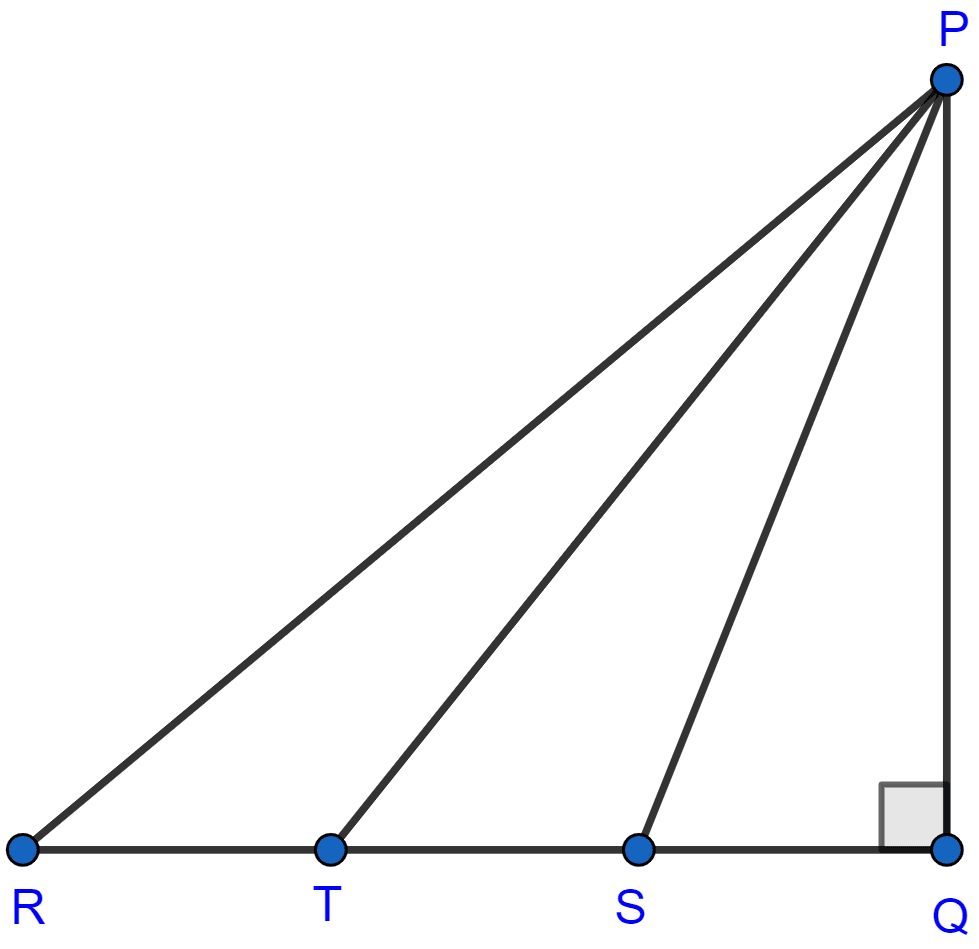
In the adjoining figure, △PQR is right angled at Q and points S and T trisect side QR. Prove that
8PT2 = 3PR2 + 5PS2.
Answer
Let RT = TS = SQ = x
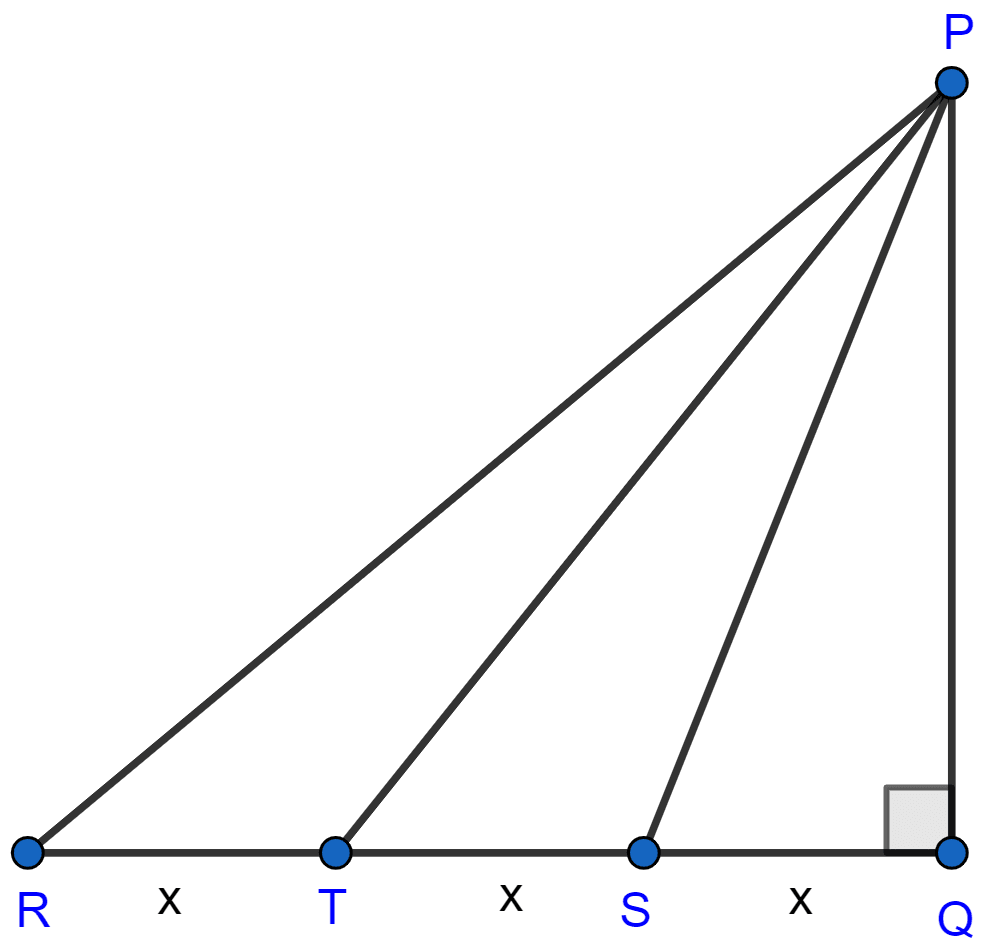
In right angle triangle PQR,
By pythagoras theorem we get,
⇒ PR2 = QR2 + PQ2
⇒ PR2 = (3x)2 + PQ2
⇒ PR2 = 9x2 + PQ2
Multiplying above equation by 3 we get,
⇒ 3PR2 = 27x2 + 3PQ2 .......(i)
In right angle triangle PTQ,
By pythagoras theorem we get,
⇒ PT2 = QT2 + PQ2
⇒ PT2 = (2x)2 + PQ2
⇒ PT2 = 4x2 + PQ2
Multiplying above equation by 8 we get,
⇒ 8PT2 = 32x2 + 8PQ2 .......(ii)
In right angle triangle PSQ,
By pythagoras theorem we get,
⇒ PS2 = SQ2 + PQ2
⇒ PS2 = (x)2 + PQ2
⇒ PS2 = x2 + PQ2
Multiplying above equation by 5 we get,
⇒ 5PS2 = 5x2 + 5PQ2 .......(iii)
Adding (i) and (iii) we get,
⇒ 3PR2 + 5PS2 = 27x2 + 5x2 + 3PQ2 + 5PQ2
⇒ 3PR2 + 5PS2 = 32x2 + 8PQ2
From (ii) we get,
⇒ 3PR2 + 5PS2 = 8PT2.
Hence, proved that 8PT2 = 3PR2 + 5PS2.
In a quadrilateral ABCD, ∠B = 90°. If AD2 = AB2 + BC2 + CD2, Prove that ∠ACD = 90°.
Answer
In right angle triangle ABC,

By pythagoras theorem,
AC2 = AB2 + BC2 .......(i)
Given,
AD2 = AB2 + BC2 + CD2
Putting value of AB2 + BC2 from eqn (i) we get,
AD2 = AC2 + CD2
∴ △ACD is a right angled triangle.
In △ACD,
∠ACD = 90° i.e. angle opposite to hypotenuse = 90° (By converse of pythagoras theorem.)
Hence, proved that ∠ACD = 90°.
In the adjoining figure, find the length of AD in terms of b and c.
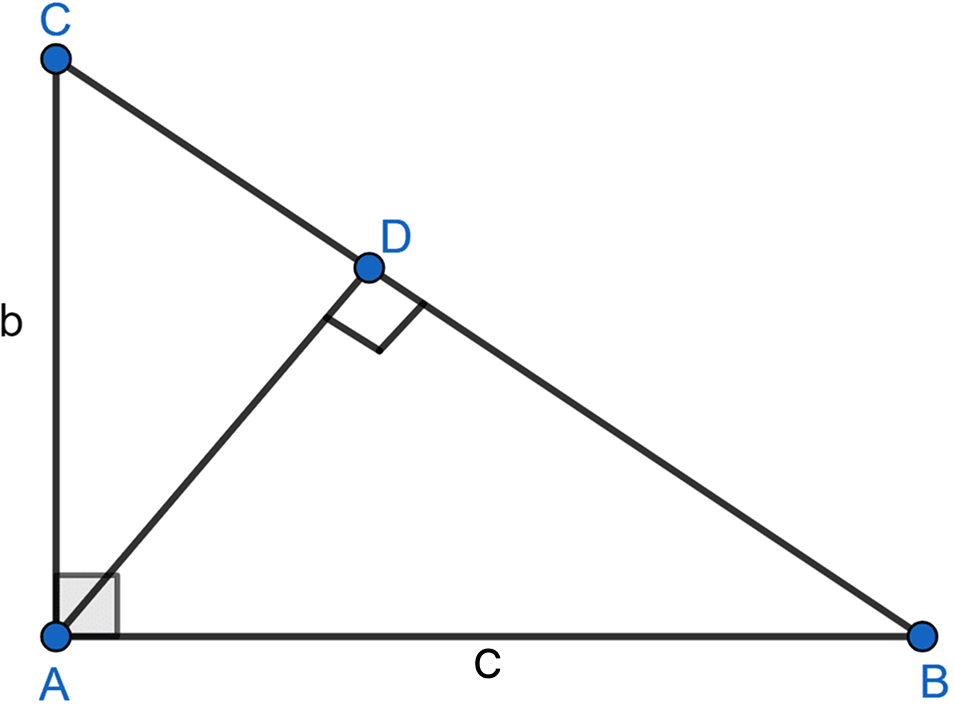
Answer
In right angle triangle ABC,
By pythagoras theorem,
BC2 = AB2 + AC2
BC2 = c2 + b2
BC = .
From figure,
Area of △ABC = Area of △ABD + Area of △ADC
⇒ x AB x AC = x AD x BD + x AD x CD
⇒ (AB.AC) = (AD.BD + AD.CD)
⇒ AB.AC = AD.BD + AD.CD
⇒ AB.AC = AD(BD + CD)
⇒ AB.AC = AD.BC [∵ BD + CD = BC]
⇒ AD =
Putting values of AB, AC and BC in above equation we get,
AD =
Hence, AD = .
ABCD is a square, F is mid-point of AB and BE is one third of BC. If area of △FBE is 108 cm2, find the length of AC.
Answer
Let x cm be the side of each square.

Since, F is midpoint of AB so, FB = cm
BE is one third of BC, BE = .
Given, area of △FBE is 108 cm2
Length of diagonal of square = Side = cm.
Hence, length of diagonal of square = cm.
In a triangle ABC, AB = AC and D is a point on side AC such that BC2 = AC × CD.
Prove that BD = BC.
Answer
Draw BE ⊥ AC.

In right triangle BEC,
By pythagoras theorem,
⇒ BC2 = BE2 + EC2
⇒ BC2 = BE2 + (AC - AE)2
⇒ BC2 = BE2 + AC2 + AE2 - 2AC.AE .........(i)
In right triangle ABE,
By pythagoras theorem,
⇒ AB2 = BE2 + AE2.........(ii)
Substituting value of BE2 + AE2 from (ii) in (i) we get,
⇒ BC2 = AB2 + AC2 - 2AC.CE
⇒ BC2 = AC2 + AC2 - 2AC.AE [∵ AB = AC]
⇒ BC2 = 2AC2 - 2AC.AE
⇒ BC2 = 2AC(AC - AE)
⇒ BC2 = 2AC × EC .........(iii)
Given, BC2 = AC × CD ..........(iv)
Comparing (iii) and (iv) we get,
⇒ 2AC × EC = AC × CD
⇒ 2EC = CD or EC =
So, we can say that ED = EC as E is mid-point of CD.
In △BDE and △BCE,
BE = BE (Common)
ED = EC
∠BED = ∠BEC = 90°
△BDE ≅ △BCE by SAS axiom of congruency.
We know that corresponding parts of congruent triangle are equal.
∴ BD = BC.
Hence, proved that BD = BC.