
If two angles of a quadrilateral are 40° and 110° and the other two are in the ratio 3 : 4, find these angles.
Answer
Sum of angles of quadrilateral = 360°.
Let other two angles be 3x and 4x.
∴ 3x + 4x + 40° + 110° = 360°
⇒ 7x + 150° = 360°
⇒ 7x = 360° - 150°
⇒ 7x = 210°
⇒ x =
⇒ x = 30°
⇒ 3x = 3(30°) = 90° and 4x = 4(30°) = 120°.
Hence, other two angles are 90° and 120°.
If the angles of a quadrilateral, taken in order, are in the ratio 1 : 2 : 3 : 4, prove that it is a trapezium.
Answer
Let a trapezium be ABCD.
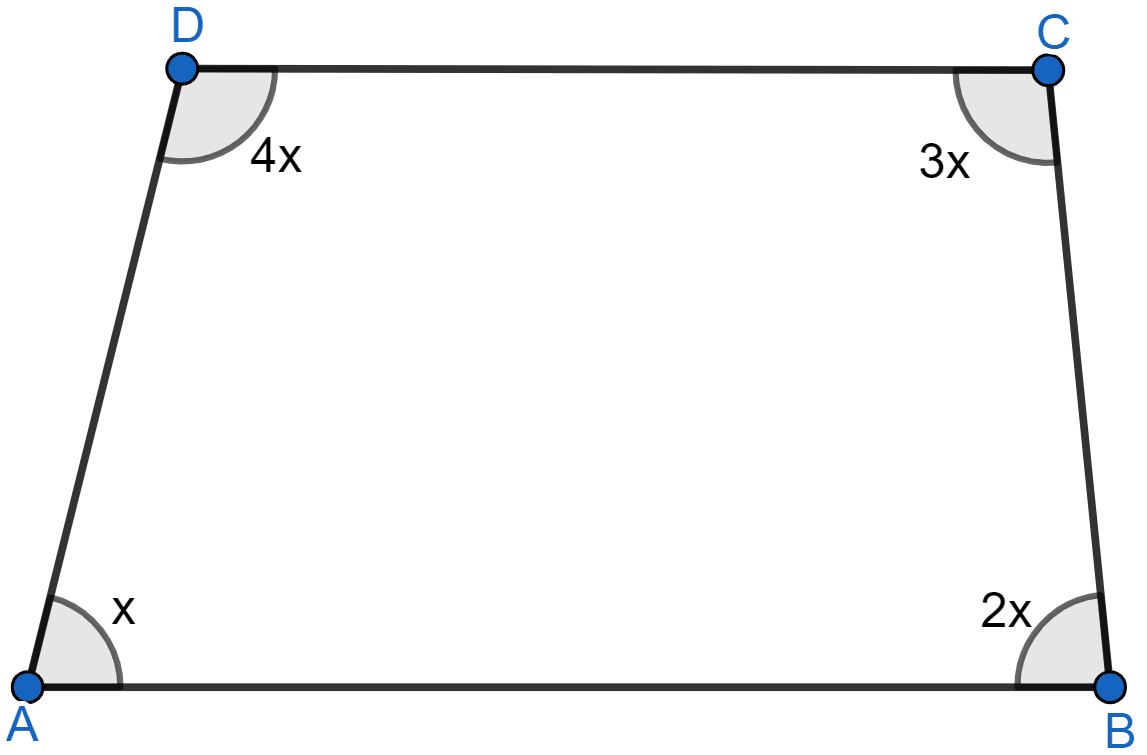
Let angles be x, 2x, 3x and 4x taken in order.
Sum of angles of quadrilateral = 360°.
∴ x + 2x + 3x + 4x = 360°
⇒ 10x = 360°
⇒ x =
⇒ x = 36°.
⇒ ∠A = x = 36°,
⇒ ∠B = 2x = 2(36°) = 72°
⇒ ∠C = 3x = 3(36°) = 108°
⇒ ∠D = 2x = 4(36°) = 144°.
From figure,
∠A and ∠D are co-interior angles and their sum = 180° (36° + 144°).
Sum of co-interior angles = 180°, which means AB and CD are parallel.
Also,
Opposite angles sum i.e.
∠A + ∠C = 36° + 108° = 144°,
∠B + ∠D = 72° + 144° = 216°.
Since, the sum of opposite angles ≠ 180° (Property of trapezium).
Hence, proved that ABCD is a trapezium.
If an angle of a parallelogram is two-thirds of its adjacent angle, find the angles of the parallelogram.
Answer
Let a parallelogram be ABCD.
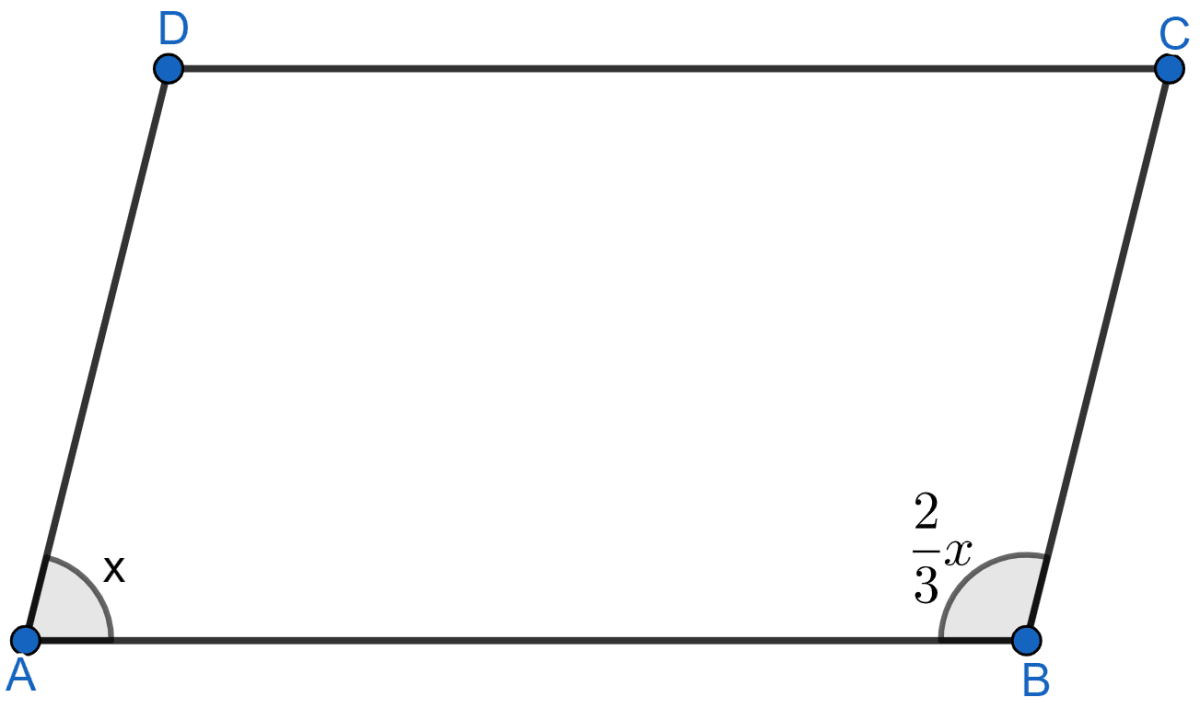
Let ∠A = x and so adjacent angle (∠B) =
As AD || BC, sum of co-int ∠s = 180°,
Opposite angles of a parallelogram are equal.
∴ ∠C = ∠A = 108° and ∠D = ∠B = 72°
Hence, angles of parallelogram are 108°, 72°, 108° and 72°.
In the figure (1) given below, ABCD is a parallelogram in which ∠DAB = 70°, ∠DBC = 80°. Calculate angles CDB and ADB.
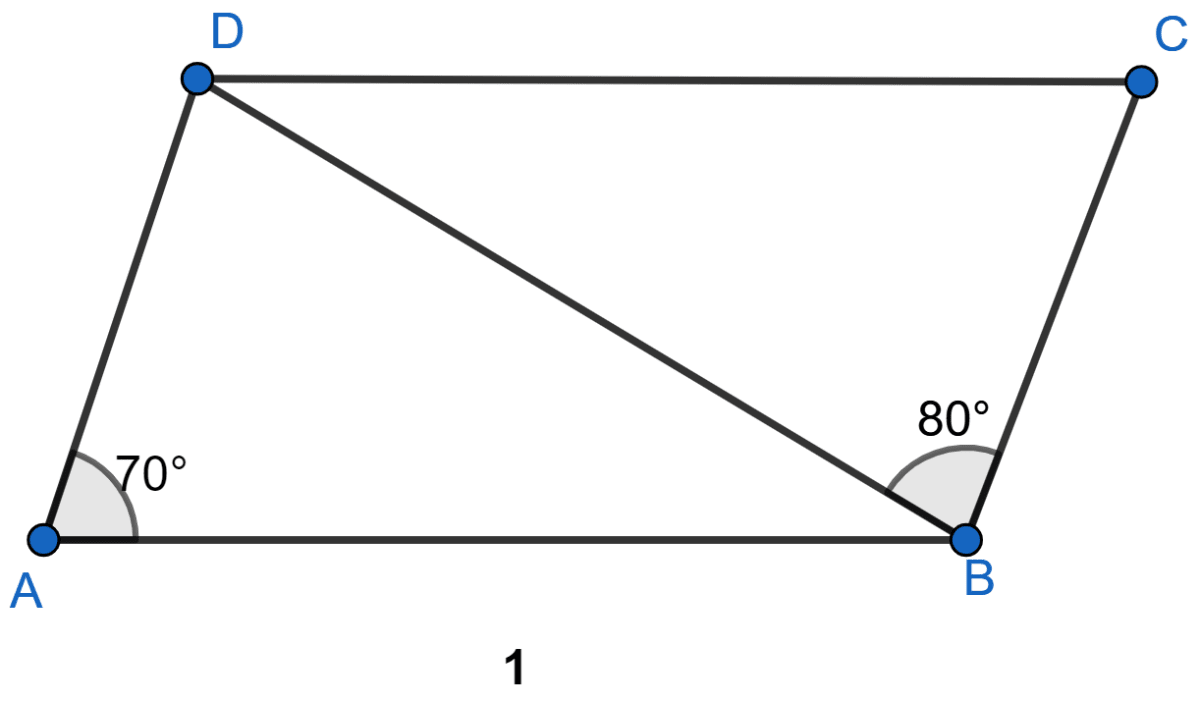
Answer
As AD || BC, sum of co-int ∠s = 180°.
∠A + ∠B = 180°
∠B = 180° - ∠A = 180° - 70° = 110°.
From figure,
⇒ ∠B = ∠DBA + ∠DBC
⇒ 110° = ∠DBA + 80°
⇒ ∠DBA = 110° - 80° = 30°.
Sum of angles of a triangle = 180°
In △DAB,
⇒ ∠DAB + ∠DBA + ∠ADB = 180°
⇒ 70° + 30° + ∠ADB = 180°
⇒ ∠ADB = 180° - 100° = 80°.
Since, opposite angles of a parallelogram are equal,
∴ ∠C = ∠A = 70°.
In △DBC,
⇒ ∠DBC + ∠BCD + ∠CDB = 180°
⇒ 80° + 70° + ∠CDB = 180°
⇒ ∠CDB = 180° - 150° = 30°.
Hence, ∠ADB = 80° and ∠CDB = 30°.
In figure (2) given below, ABCD is a parallelogram. Find the angles of △AOD.
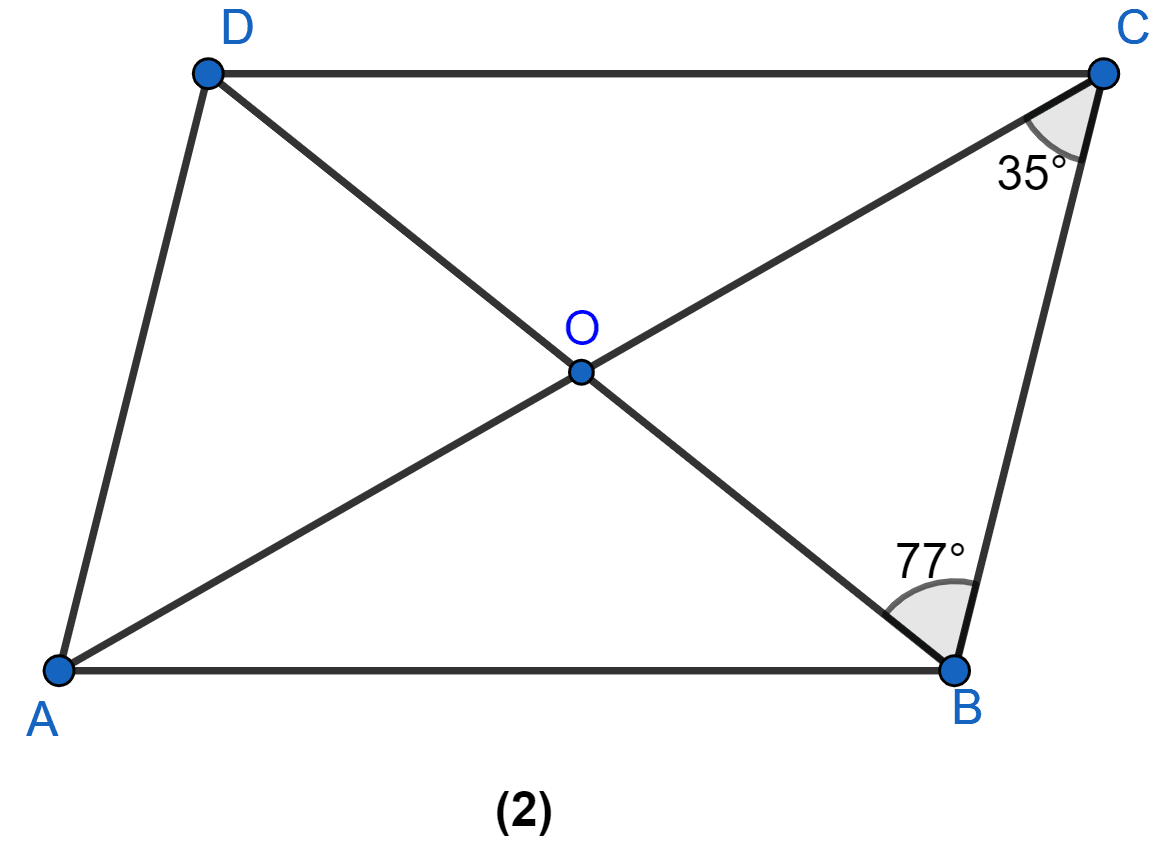
Answer
Sum of angles of a triangle = 180°
In △BOC,
⇒ ∠BOC + ∠OCB + ∠CBO = 180°
⇒ ∠BOC + 35° + 77° = 180°
⇒ ∠BOC = 180° - 35° - 77° = 68°.
From figure,
∠AOD = ∠BOC = 68° (Vertically opposite angles are equal)
∠OAD = ∠OCB = 35° (Alternate angles are equal)
∠ADO = ∠CBO = 77° (Alternate angles are equal)
Hence, ∠AOD = 68°, ∠OAD = 35°, ∠ADO = 77°.
In figure (3) given below, ABCD is a rhombus. Find the value of x.

Answer
As AD || BC, sum of co-int ∠s = 180°.
∠A + ∠B = 180°
∠B = 180° - ∠A = 180° - 72° = 108°.
The diagonals of rhombus bisect the angles.
⇒ x = 54.
Hence, x = 54.
In figure (1) given below, ABCD is a parallelogram with perimeter 40. Find the values of x and y.

Answer
In parallelogram opposite sides are equal.
∴ BC = AD = 2x and
AB = CD
⇒ 3x = 2y + 2
⇒ 2y = 3x - 2
⇒ y = ........(i)
Given, perimeter = 40.
⇒ AB + BC + CD + AD = 40
⇒ 3x + 2x + 2y + 2 + 2x = 40
⇒ 3x + 2x + + 2 + 2x = 40
⇒ 3x + 2x + 3x - 2 + 2 + 2x = 40
⇒ 10x = 40
⇒ x = 4.
⇒ y = .
Hence, x = 4 and y = 5.
In figure (2) given below, ABCD is a parallelogram. Find the values of x and y.
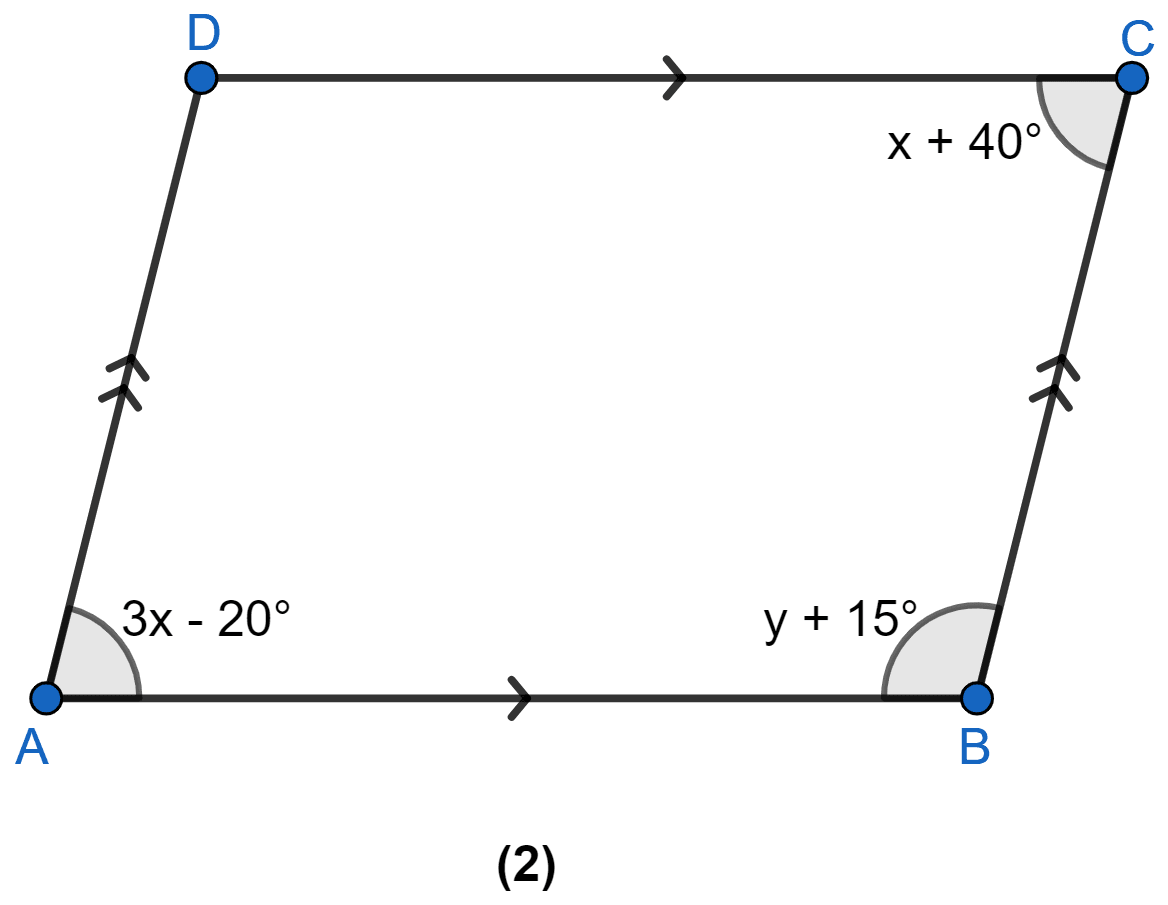
Answer
In parallelogram,
Opposite angles are equal
∴ ∠A = ∠C
⇒ 3x - 20° = x + 40°
⇒ 3x - x = 40° + 20°
⇒ 2x = 60°
⇒ x = 30°.
As AD || BC, sum of co-int ∠s = 180°.
⇒ ∠A + ∠B = 180°
⇒ 3x - 20° + y + 15° = 180°
⇒ 3(30°) - 20° + y + 15° = 180°
⇒ 90° - 20° + y + 15° = 180°
⇒ 85° + y = 180°
⇒ y = 95°.
Hence, x = 30° and y = 95°.
In figure (3) given below, ABCD is a rhombus. Find x and y.

Answer
Sides of rhombus are equal.
∴ AB = AD
⇒ 4x - 4 = 3x + 2
⇒ 4x - 3x = 2 + 4
⇒ x = 6.
AB = 3x + 2 = 3(6) + 2 = 20.
In △ABD,
AB = AD
so, ∠D = ∠B (Angles opposite to equal sides are equal in isosceles triangle)
Let angle be ∠D = ∠B = a
So,
⇒ ∠A + ∠D + ∠B = 180°
⇒ 60° + a + a = 180°
⇒ 2a = 180° - 60°
⇒ 2a = 120°
⇒ a = 60°.
Hence, △ABD is an equilateral triangle, so all sides are equal.
⇒ BD = AB
⇒ y - 1 = 20
⇒ y = 21.
Hence x = 6 and y = 21.
The diagonals AC and BD of a rectangle ABCD intersect each other at P. If ∠ABD = 50°, find ∠DPC.
Answer
The diagonals of a rectangle are equal and bisect each other.

∴ AP = BP
From figure,
In △ABP,
AP = BP
⇒ ∠PAB = ∠ABP = 50° (Angles opposite to equal sides are equal in isosceles triangle)
⇒ ∠PAB + ∠ABP + ∠APB = 180°
⇒ 50° + 50° + ∠APB = 180°
⇒ ∠APB = 180° - 100° = 80°.
⇒ ∠DPC = ∠APB = 80° (Vertically opposite angles are equal).
Hence, ∠DPC = 80°.
In figure (1) given below, equilateral triangle EBC surmounts square square ABCD. Find angle BED represented by x.
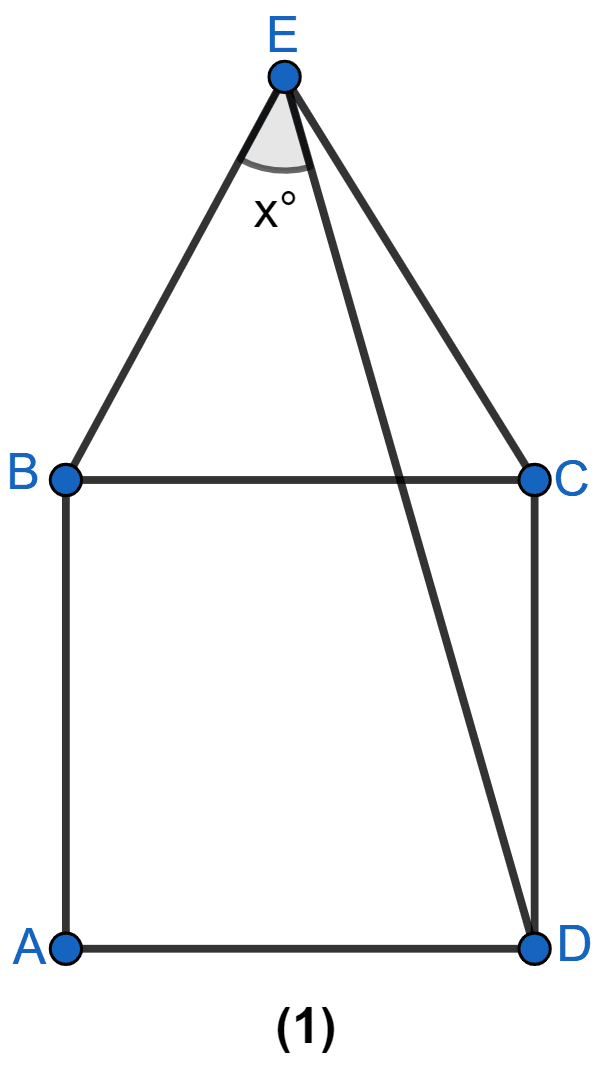
Answer
△EBC is an equilateral triangle, so all sides are equal.
EB = BC = EC ........(i)
In square all sides are equal
AD = CD = BC = AB ........(ii)
From (i) and (ii) we get,
BC = EC = CD
⇒ EC = CD.
In △ECD,
EC = CD
⇒ ∠DEC = ∠CDE = a (let) (Angles opposite to equal sides are equal in isosceles triangle)
⇒ ∠C = ∠ECB + ∠BCD
∠ECB = 60° (As each angle of a equilateral triangle = 60°)
∠BCD = 90° (As each angle of a square = 90°)
⇒ ∠C = 60° + 90° = 150°.
⇒ ∠DEC + ∠CDE + ∠C = 180
⇒ a + a + 150° = 180°
⇒ 2a = 180° - 150°
⇒ 2a = 30°
⇒ a = 15°.
From figure,
x° = ∠BEC - ∠DEC = 60° - 15° = 45°.
Hence, x = 45.
In Figure (2) given below, ABCD is a rectangle and diagonals intersect at O. AC is produced to E. If ∠ECD = 146°, find the angles of △AOB.
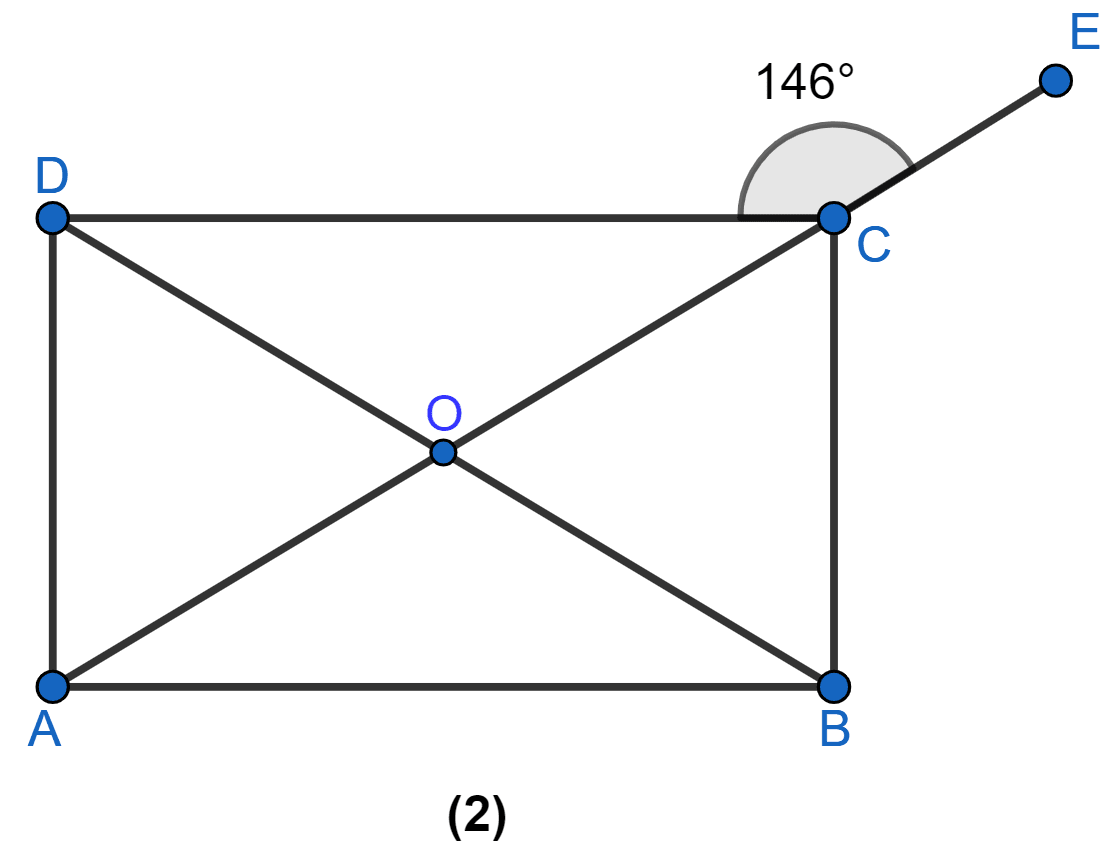
Answer
From figure,
∠OCD = 180° - 146° = 34° (As AE is a straight line).
The diagonals of a rectangle are equal and bisect each other.
∴ OC = OD
From figure,
In △OCD,
OC = OD
⇒ ∠ODC = ∠OCD = 34° (Angles opposite to equal sides are equal in isosceles triangle)
⇒ ∠ODC + ∠OCD + ∠DOC = 180°
⇒ 34° + 34° + ∠DOC = 180°
⇒ ∠DOC = 180° - 68° = 112°.
In △AOB,
⇒ ∠AOB = ∠DOC = 112° (Vertically opposite angles are equal).
⇒ ∠OAB = ∠OCD = 34°
⇒ ∠OBA = ∠ODC = 34°
Hence, ∠AOB = 112°, ∠OAB = 34° and ∠OBA = 34°.
In figure (3) given below, ABCD is a rhombus and diagonals intersect at O. If ∠OAB : ∠OBA = 3 : 2, find the angles of the △AOD.
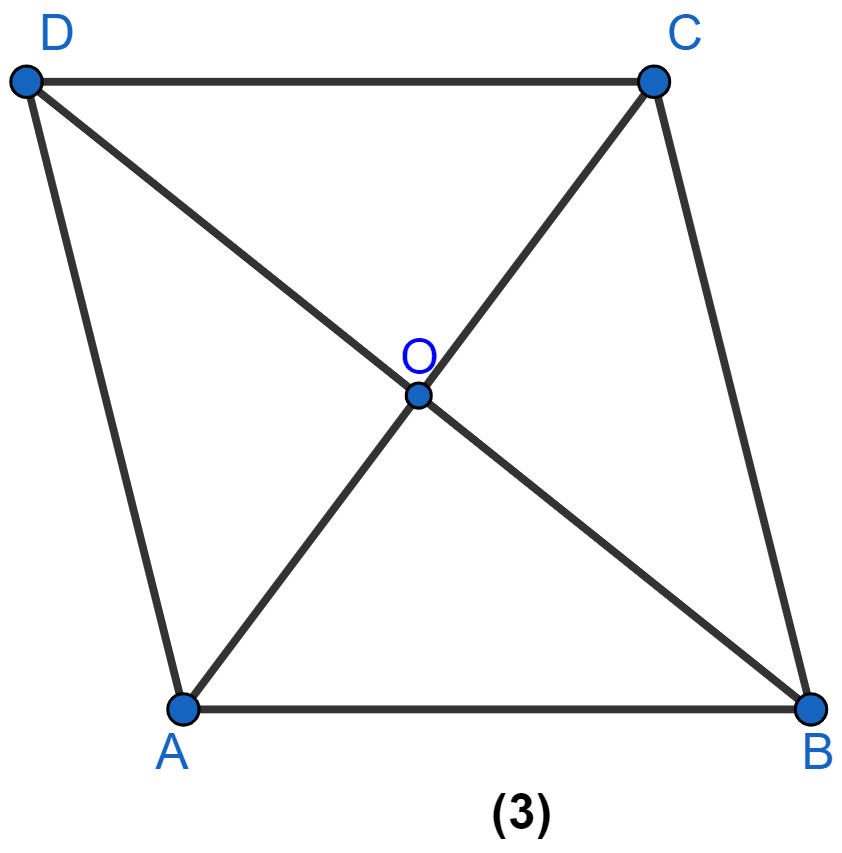
Answer
Let ∠OAB = 3x and ∠OBA = 2x.
The diagonals of rhombus are perpendicular to each other.
∴ ∠AOB = 90°
In △AOB,
⇒ ∠AOB + ∠OAB + ∠OBA = 180°
⇒ 90° + 3x + 2x = 180°
⇒ 5x = 90°
⇒ x =
⇒ x = 18°.
∠OAB = 3x = 3(18°) = 54°.
∠OBA = 2x = 2(18°) = 36°.
Since, diagonals of rhombus bisect vertex angles.
∴ ∠OAD = ∠OAB = 54°,
∠AOD = 90° (The diagonals of rhombus are perpendicular to each other.)
In △AOD,
⇒ ∠AOD + ∠OAD + ∠ODA = 180°
⇒ 90° + 54° + ∠ODA = 180°
⇒ ∠ODA + 144° = 180°
⇒ ∠ODA = 180° - 144°
⇒ ∠ODA = 36°.
Hence, ∠ODA = 36°, ∠OAD = 54°, ∠AOD = 90°.
In figure (1) given below, ABCD is a trapezium. Find the values of x and y.

Answer
Sum of adjacent co-interior angles of a trapezium = 180° (As AB || DC)
∴ ∠A + ∠D = 180°
⇒ x + 20° + 2x + 10° = 180°
⇒ 3x + 30° = 180°
⇒ 3x = 150°
⇒ x =
⇒ x = 50°.
∴ ∠B + ∠C = 180°
⇒ 92° + y = 180°
⇒ y = 180° - 92° = 88°.
Hence, x = 50° and y = 88°.
In figure (2) given below, ABCD is an isosceles trapezium. Find the values of x and y.

Answer
Sum of adjacent co-interior angles of a trapezium = 180° (As AB || DC)
∴ ∠A + ∠D = 180°
⇒ 2x + 3x = 180°
⇒ 5x = 180°
⇒ x =
⇒ x = 36°.
Opposite angles sum of a isosceles trapezium = 180°
∴ ∠A + ∠C = 180°
⇒ 2x + y = 180°
⇒ 2(36°) + y = 180°
⇒ 72° + y = 180°
⇒ y = 108°.
Hence, x = 36° and y = 108°.
In figure (3) given below, ABCD is a kite and diagonals intersect at O. If ∠DAB = 112° and ∠DCB = 64°, find ∠ODC and ∠OBA.
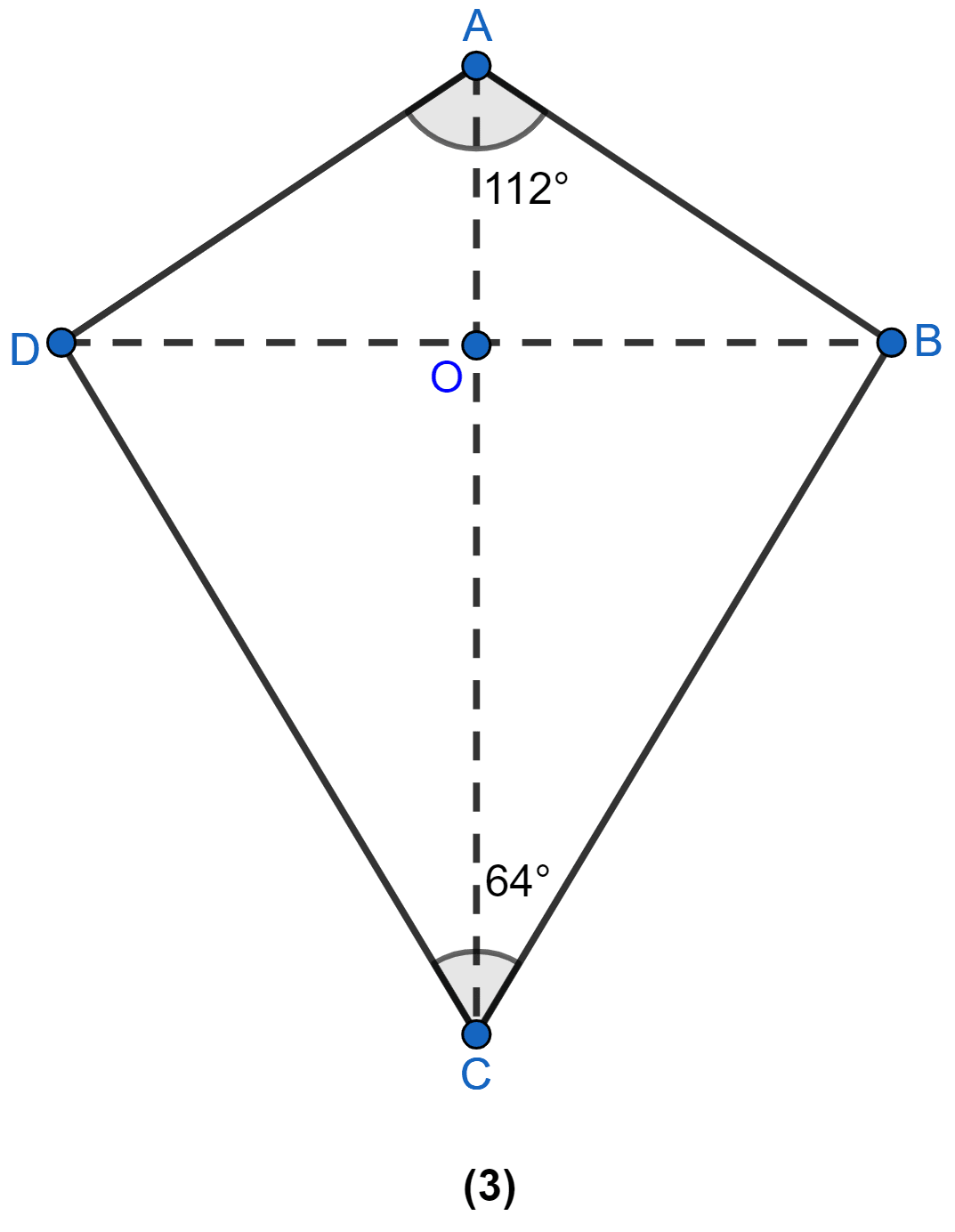
Answer
Diagonals of a kite bisect the vertex angles.
∴ ∠OCD = = 32° and ∠OAB = = 56°
Diagonals of a kite are perpendicular to each other.
∴ ∠DOC = 90°
⇒ ∠OCD + ∠DOC + ∠ODC = 180°
⇒ 32° + 90° + ∠ODC = 180°
⇒ ∠ODC = 58°.
Diagonals of a kite are perpendicular to each other.
∴ ∠AOB = 90°
⇒ ∠AOB + ∠OAB + ∠OBA = 180°
⇒ 90° + 56° + ∠OBA = 180°
⇒ ∠OBA = 180° - 146° = 34°.
Hence, ∠OBA = 34° and ∠ODC = 58°.
Prove that each angle of a rectangle is 90°.
Answer
We know that opposite sides of a rectangle are equal.
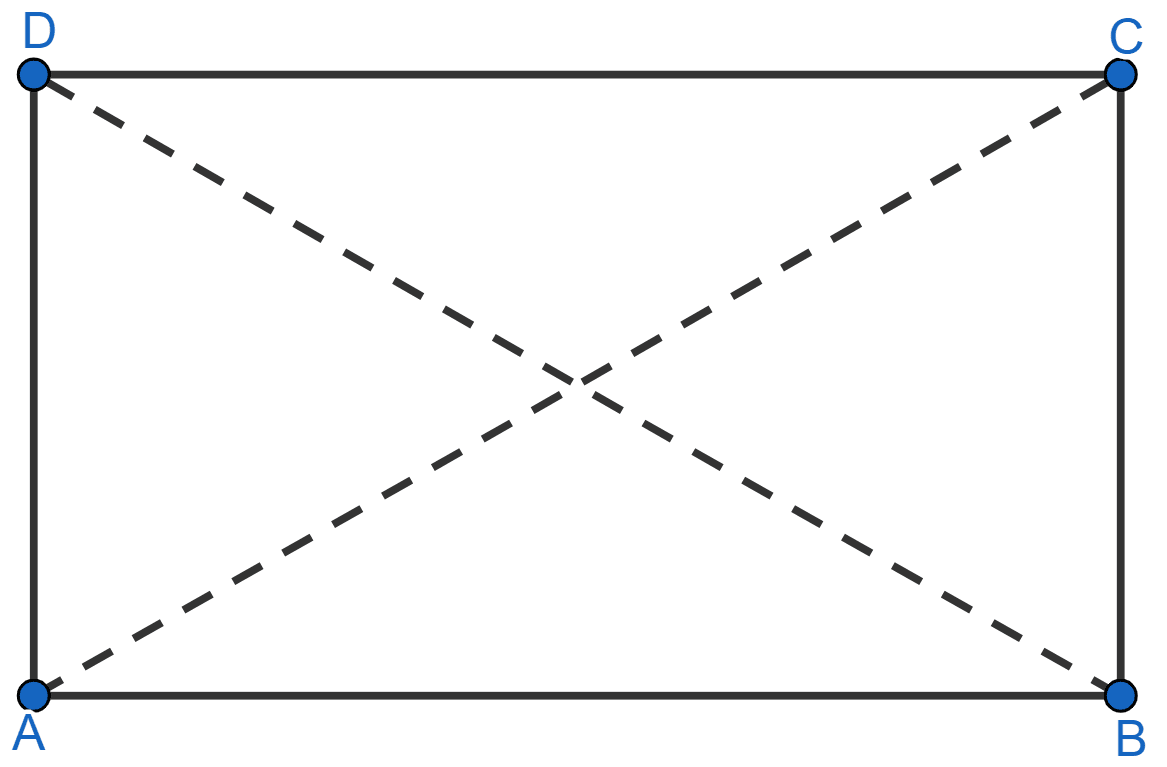
∴ AD = BC and AB = CD
Also, the diagonals of rectangle are equal.
∴ AC = BD
Now, consider ΔADC and ΔBCD
⇒ AD = BC
⇒ AC = BD
⇒ DC = DC [Common]
∴ ΔADC ≅ ΔBCD by SSS congruency rule.
∴ ∠ ADC = ∠BCD = x (let) [By C.P.C.T.]
But, adjacent sides of a parallelogram are supplementary. [∵ rectangle is a parallelogram].
∴ ∠ADC + ∠BCD = 180°
⇒ x + x = 180°
⇒ 2x = 180°
⇒ x = 90°
⇒ ∠ADC = ∠BCD = 90°.
Since, opposite angles of a parallelogram are also equal.
∴ ∠DAB = ∠BCD = 90° and ∠ABC = ∠ADC = 90°.
Hence, proved that each angle of a rectangle is 90°.
If the angle of a quadrilateral are equal, prove that it is a rectangle.
Answer
Suppose there is a quadrilateral ABCD.
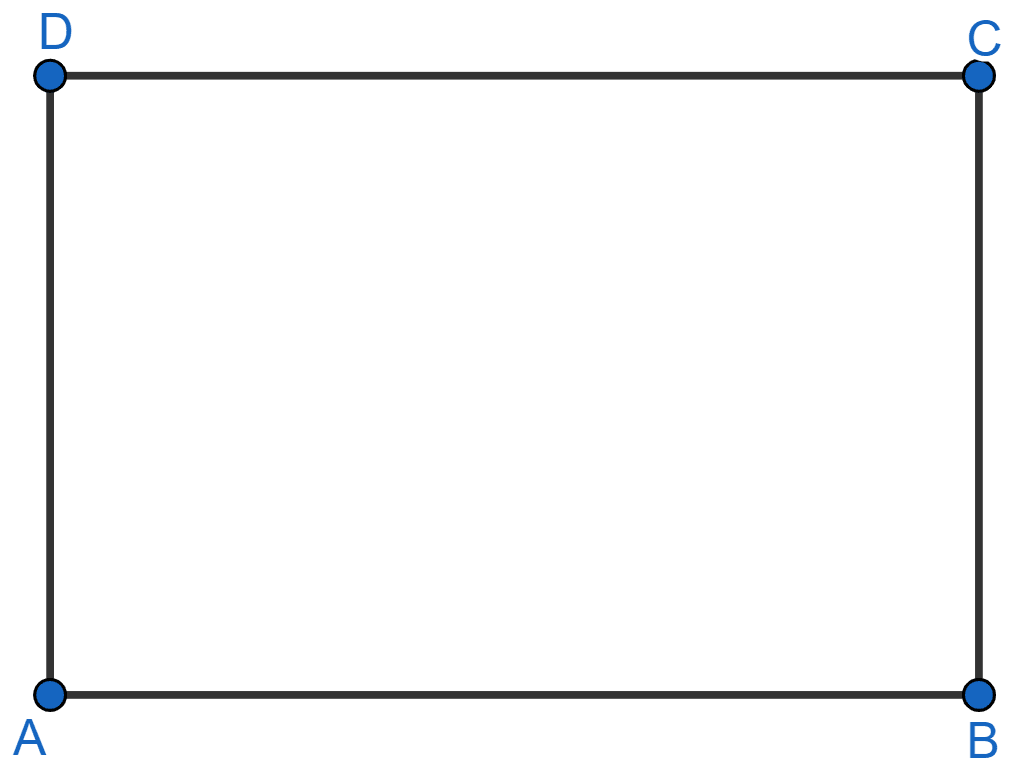
Let ∠A = ∠B = ∠C = ∠D = x
So, ∠A = ∠C and ∠B = ∠D (Opposite angles are equal)
∴ ABCD is a parallelogram.
Since, sum of angles in a quadrilateral = 360°
⇒ ∠A + ∠B + ∠C + ∠D = 360°
⇒ x + x + x + x = 360°
⇒ 4x = 360°
x =
⇒ x = 90°.
∴ ∠A = ∠B = ∠C = ∠D = 90°.
Since, each angle = 90°,
Hence, proved that ABCD is a rectangle.
If the diagonals of a rhombus are equal, prove that it is a square.
Answer
From figure,
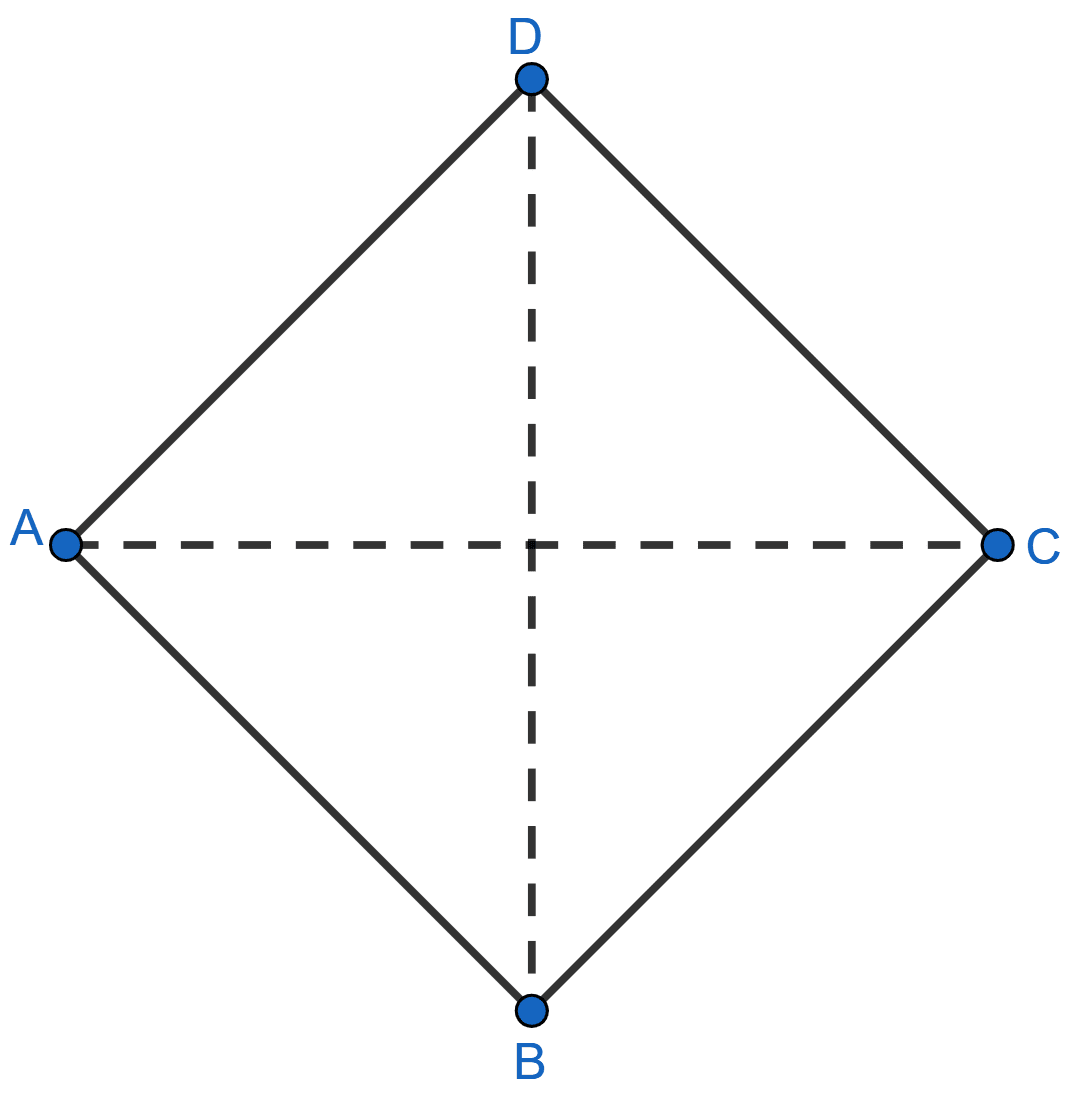
In △ABC and △BCD,
AB = DC (All sides of rhombus are equal)
BC = BC (Common sides)
AC = BD (Given diagonals are equal)
∴ △ABC ≅ △BCD (By SSS rule of congruency)
∠ABC = ∠BCD = x (let) (By C.P.C.T.)
∠ABC + ∠DCB = 180° [∵ AB || DC, sum of co-int ∠s = 180°]
⇒ x + x = 180°
⇒ 2x = 180°
x =
⇒ x = 90°.
∴ ∠ABC = ∠DCB = 90°.
Hence, proved that ABCD is a square.
Prove that every diagonal of a rhombus bisects the angles at the vertices.
Answer
From figure,
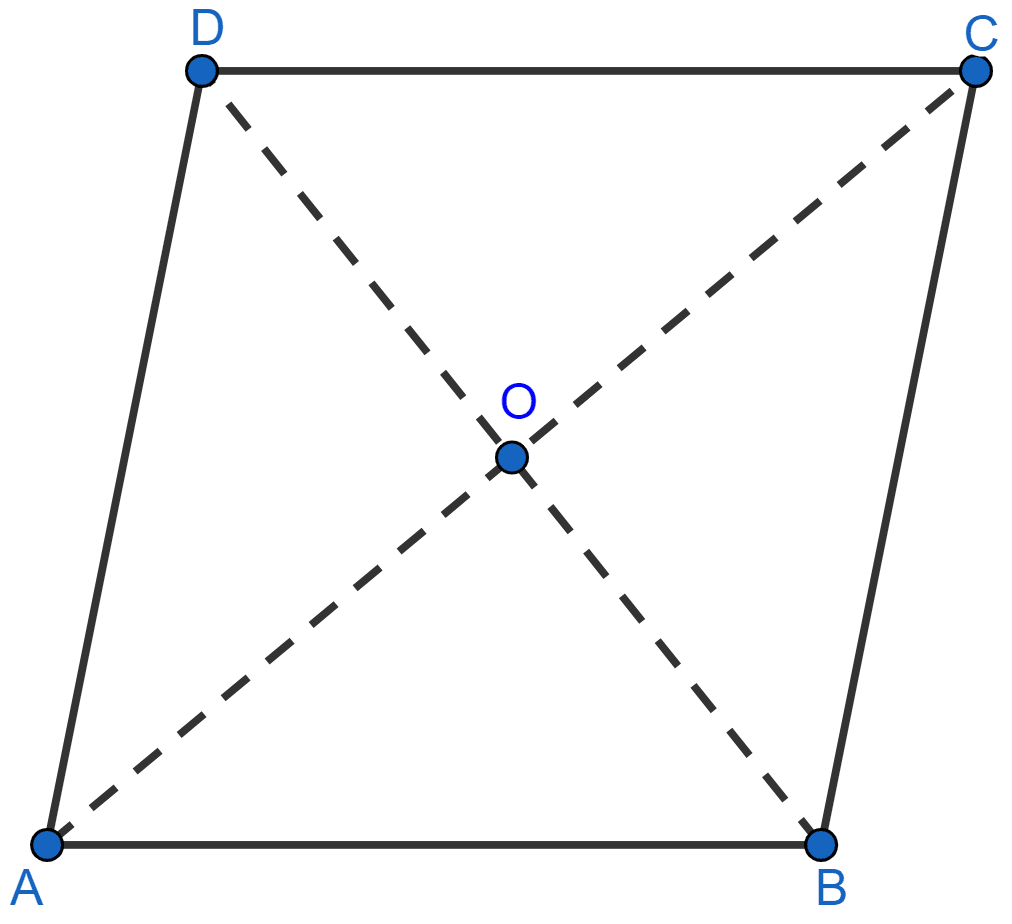
In △AOD and △COD,
AD = CD (All sides of rhombus are equal)
DO = OD (Common sides)
AO = OC (Diagonals of rhombus bisect each other)
∴ △AOD ≅ △COD (By SSS rule of congruency)
∴ ∠ADO = ∠CDO (By C.P.C.T.)
∴ BD bisects ∠D.
In △AOB and △COB,
AB = BC (All sides of rhombus are equal)
BO = OB (Common sides)
AO = OC (Diagonals of rhombus bisect each other)
∴ △AOB ≅ △COB (By SSS rule of congruency)
∴ ∠ABO = ∠CBO (By C.P.C.T.)
∴ BD bisects ∠B.
In △AOB and △AOD,
AB = AD (All sides of rhombus are equal)
AO = OA (Common sides)
OD = OB (Diagonals of rhombus bisect each other)
∴ △AOB ≅ △AOD (By SSS rule of congruency)
∴ ∠OAD = ∠OAB (By C.P.C.T.)
∴ AC bisects ∠A.
In △BOC and △DOC,
BC = CD (All sides of rhombus are equal)
OC = CO (Common sides)
OD = OB (Diagonals of rhombus bisect each other)
∴ △BOC ≅ △DOC (By SSS rule of congruency)
∴ ∠OCD = ∠OCB (By C.P.C.T.)
∴ AC bisects ∠C.
Hence, proved that every diagonal of a rhombus bisects the angles at the vertices.
ABCD is a parallelogram. If the diagonal AC bisects ∠A, then prove that :
(i) AC bisects ∠C
(ii) ABCD is a rhombus
(iii) AC ⊥ BD
Answer
Parallelogram ABCD is shown in the figure below:

(i) Given,
AC bisects ∠A,
∴ ∠CAB = ∠CAD = x (let) .......(i)
AB || CD (As opposite sides of parallelogram are parallel)
⇒ ∠DCA = ∠CAB (Alternate angles are equal)
∴ ∠DCA = x .......(ii)
and,
⇒ ∠BCA = ∠CAD (Alternate angles are equal)
∴ ∠BCA = x .......(iii)
From (i), (ii) and (iii) we get,
∠CAB = ∠CAD = ∠DCA = ∠BCA .......(iv)
Thus, ∠DCA = ∠BCA
Hence, proved that AC bisects ∠C.
(ii) From equation (iv) we get,
∠CAD = ∠DCA
∴ In △ADC,
DA = DC (Sides opposite to equal angles are equal)
However, DA = BC and AB = CD (opposite sides of a parallelogram are equal)
Thus, AB = BC = CD = DA
As ABCD is a parallelogram in which all sides are equal, therefore ABCD is a rhombus.
Hence, proved that ABCD is a rhombus.
(iii) In △OAB and △OCB,
OA = OC (Diagonals of a parallelogram bisect each other)
OB = OB (Common Side)
AB = BC (Sides of Rhombus)
∴ △OAB ≅ △OCB (SSS rule of congruency)
∴ ∠AOB = ∠BOC (c.p.c.t)
But ∠AOB + ∠BOC = 180°
⇒ ∠AOB + ∠AOB = 180°
⇒ ∠AOB =
⇒ ∠AOB = 90°
∴ AC ⊥ BD
Hence, proved that AC ⊥ BD.
Prove that bisectors of any two adjacent angles of a parallelogram are at right angles.
Answer
Let AC be bisector of ∠A and BD be bisector of ∠B and they meet at point M.
From figure,
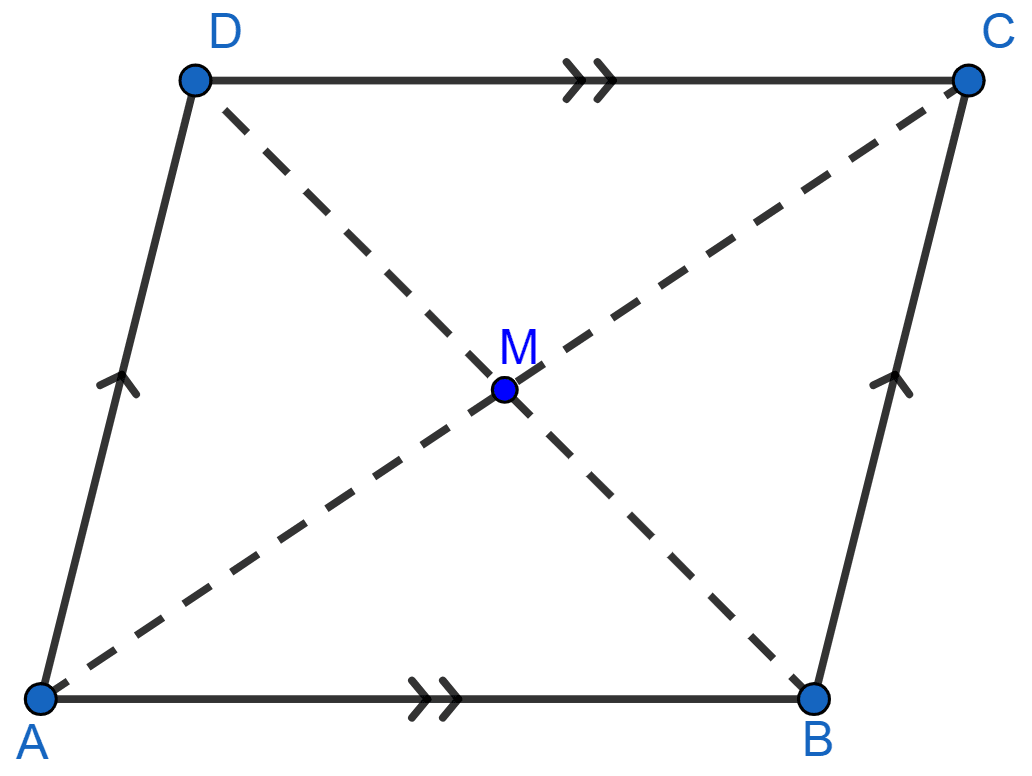
⇒ ∠A + ∠B = 180° (As AD || BC, sum of co-int ∠s = 180°)
⇒
⇒
∴ ∠MAB + ∠MBA = 90° .......(i)
In △MAB,
⇒ ∠MAB + ∠MBA + ∠AMB = 180° (Sum of angles of triangle = 180°)
⇒ 90° + ∠AMB = 180° (from i)
⇒ ∠AMB = 180° - 90°
⇒ ∠AMB = 90°.
Hence, proved that bisectors of any two adjacent angles of a parallelogram are at right angles.
Prove that bisectors of any two opposite angles of a parallelogram are parallel.
Answer
Let the parallelogram be ABCD as shown in the figure below:
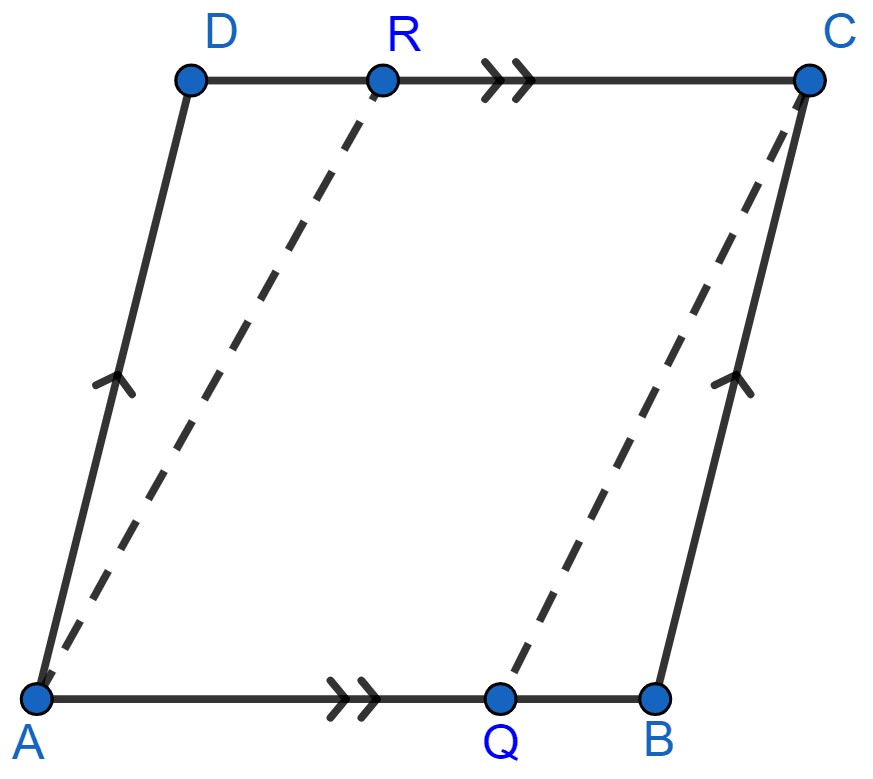
In parallelogram ABCD we have,
∠A = ∠C (Opposite angles are equal)
so,
∠DAR = ∠QCB (As AR bisects ∠A and QC bisects ∠C and ∠A = ∠C)
In △ADR and △CBQ,
⇒ ∠DAR = ∠QCB (Proved above)
⇒ AD = BC (Opposite sides of a || gm)
⇒ ∠D = ∠B (Opposite angles of a || gm)
Hence, △ADR ≅ △CBQ by ASA axiom.
∴ ∠DRA = ∠BQC (By C.P.C.T.) .......(i)
Also,
∠RAQ = ∠DRA (Alternate angles are equal) .........(ii)
From (i) and (ii) we get,
∠RAQ = ∠BQC (These are also corresponding angles)
Since, corresponding angles are equal, we can say that
AR || QC.
Hence, proved that bisectors of any two opposite angles of a parallelogram are parallel.
If the diagonals of a quadrilateral are equal and bisect each other at right angles, then prove that it is a square.
Answer
Since, diagonals bisect each other at 90°
∴ ∠AOB = ∠COD = ∠BOC = AOD = 90°.
From figure,

Considering △OAB and △ODC we have,
⇒ OA = OC (As diagonals bisect each other)
⇒ OB = OD (As diagonals bisect each other)
⇒ ∠AOB = ∠COD (Vertically opposite angles are equal)
Hence, △OAB ≅ △ODC by SAS axiom.
AB = CD (By C.P.C.T.) .........(i)
∴ ∠OAB = ∠OCD (By C.P.C.T.)
The above angles are alternate angles.
Hence, we can say that AB || CD.
In △AOB,
OA = OB (As both diagonals are equal and bisect each other)
so,
⇒ ∠OBA = ∠OAB = x (let) (Angles opposite to equal sides are equal in isosceles triangle)
⇒ ∠OBA + ∠OAB + ∠AOB = 180°
⇒ x + x + 90° = 180°
⇒ 2x = 180° - 90°
⇒ 2x = 90°
⇒ x =
⇒ x = 45°
Considering △OAD and △OBC we have,
⇒ OA = OC (As diagonals bisect each other)
⇒ OB = OD (As diagonals bisect each other)
⇒ ∠AOD = ∠COB (Vertically opposite angles are equal)
Hence, △OAD ≅ △OBC by SAS axiom.
AD = BC (By C.P.C.T.) .........(ii)
∠OAD = ∠OCB (By C.P.C.T.)
Hence, we can say that AD || BC.
Considering △AOB and △AOD we have,
⇒ AO = AO (Common sides)
⇒ OB = OD (As diagonals bisect each other)
⇒ ∠AOD = ∠AOB (Both equal to 90°)
Hence, △AOB ≅ △AOD by SAS axiom.
AB = AD (By C.P.C.T.) .........(iii)
From (i), (ii) and (iii) we get,
AB = BC = CD = AD.
In △AOD,
OA = OD (As both diagonals are equal and bisect each other)
so,
⇒ ∠OAD = ∠ODA = a (let) (Angles opposite to equal sides are equal in isosceles triangle)
⇒ ∠OAD + ∠ODA + ∠AOD = 180°
⇒ a + a + 90° = 180°
⇒ 2a = 180° - 90°
⇒ 2a = 90°
⇒ a =
⇒ a = 45°.
∠A = ∠OAB + OAD = 45° + 45° = 90°.
Thus, AB ⊥ AD.
Since, AD || BC so, AB ⊥ BC.
Since, AB || CD and AB ⊥ AD,
∴ CD ⊥ AD.
Since, alternate sides are perpendicular and all sides are equal.
Hence, proved that if the diagonals of a quadrilateral are equal and bisect each other at right angles, then it is a square
If ABCD is a parallelogram in which diagonal AC bisects ∠A, then prove that ABCD is a rhombus.
Answer
Parallelogram ABCD is shown in the figure below:
Given,
AC bisects ∠A,
∴ ∠CAB = ∠CAD = x (let) ....................(1)
AB || CD (As opposite sides of parallelogram are parallel)
⇒ ∠DCA = ∠CAB (Alternate angles are equal)
∴ ∠DCA = x ....................(2)
and,
⇒ ∠BCA = ∠CAD (Alternate angles are equal)
∴ ∠BCA = x ....................(3)
From (1), (2) and (3) we get,
⇒ ∠CAB = ∠CAD = ∠DCA = ∠BCA ....................(4)
⇒ ∠CAD = ∠DCA
∴ In △ADC,
⇒ ∠CAD = ∠DCA
⇒ DA = DC (Sides opposite to equal angles in a triangle are equal) .........(5)
We know that,
Opposite sides of a parallelogram are equal.
AB = CD and BC = DA ...........(6)
From equation (5) and (6),
AB = BC = CD = DA
As ABCD is a parallelogram in which all sides are equal, therefore ABCD is a rhombus.
Hence, proved that ABCD is a rhombus.
If ABCD is a rectangle in which the diagonal BD bisects ∠B, then show that ABCD is a square.
Answer
Since, BD bisects ∠B.
∴ ∠1 = ∠2

Since, ∠B = 90°.
∠1 = ∠2 = 45°
∠4 = ∠1 = 45° (Alternate angles are equal)
∠3 = ∠2 = 45° (Alternate angles are equal)
In △ABD,
AB = AD (As sides opposite to equal angles are equal) .........(i)
In △CBD,
BC = CD (As sides opposite to equal angles are equal) ..........(ii)
and AD = BC, AB = CD (As opposite sides of rectangle are equal) .......(iii)
From (i), (ii) and (iii) we get,
AB = BC = CD = AD.
Since, all sides are equal and alternate sides are perpendicular to each other.
Hence, proved that ABCD is a square.
Show that if the diagonals of a quadrilateral are equal and bisect each other at right angles, then it is a square.
Answer
Since, diagonals bisect each other at 90°
∴ ∠AOB = ∠COD = BOC = AOD = 90°.
From figure,
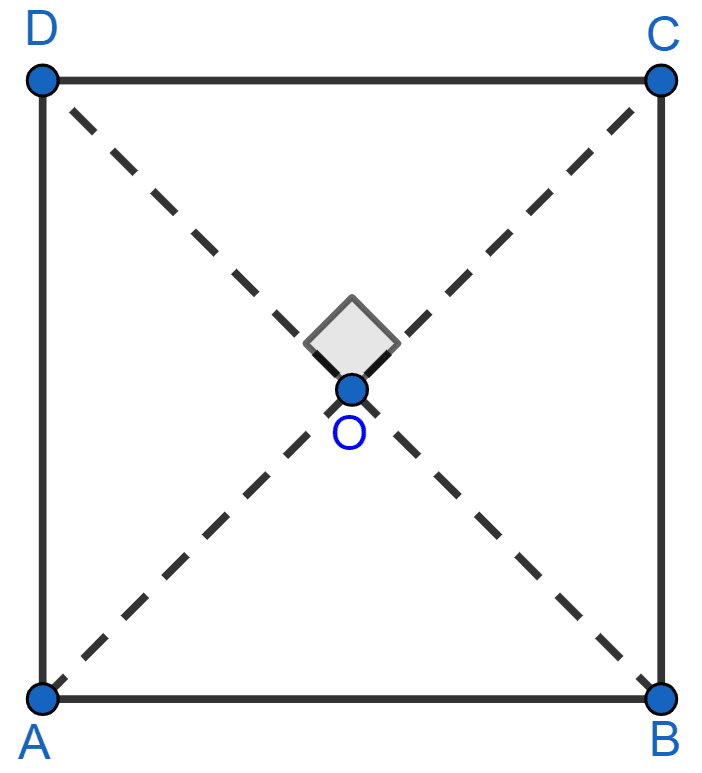
Considering △OAB and △ODC we have,
⇒ OA = OC (As diagonals bisect each other)
⇒ OB = OD (As diagonals bisect each other)
⇒ ∠AOB = ∠COD (Vertically opposite angles are equal)
Hence, △OAB ≅ △ODC by SAS axiom.
AB = CD (By C.P.C.T.) .........(i)
∴ ∠OAB = ∠OCD (By C.P.C.T.)
The above angles are alternate angles.
Hence, we can say that AB || CD.
In △AOB,
OA = OB (As both diagonals are equal and bisect each other)
so,
⇒ ∠OBA = ∠OAB = x (let) (Angles opposite to equal sides are equal in isosceles triangle)
⇒ ∠OBA + ∠OAB + ∠AOB = 180°
⇒ x + x + 90° = 180°
⇒ 2x = 180° - 90°
⇒ 2x = 90°
⇒ x =
⇒ x = 45°.
Considering △OAD and △OBC we have,
⇒ OA = OC (As diagonals bisect each other)
⇒ OB = OD (As diagonals bisect each other)
⇒ ∠AOD = ∠COB (Vertically opposite angles are equal)
Hence, △OAD ≅ △OBC by SAS axiom.
AD = BC (By C.P.C.T.) .........(ii)
∠OAD = ∠OCB (By C.P.C.T.)
Hence, we can say that AD || BC.
Considering △AOB and △AOD we have,
⇒ AO = AO (Common side)
⇒ OB = OD (As diagonals bisect each other)
⇒ ∠AOD = ∠AOB (Both equal to 90°)
Hence, △AOB ≅ △AOD by SAS axiom.
AB = AD (By C.P.C.T.) .........(iii)
From (i), (ii) and (iii) we get,
AB = BC = CD = AD.
In △AOD,
OA = OD (As both diagonals are equal and bisect each other)
so,
⇒ ∠OAD = ∠ODA = a (let) (Angles opposite to equal side are equal in isosceles triangle)
⇒ ∠OAD + ∠ODA + ∠AOD = 180°
⇒ a + a + 90° = 180°
⇒ 2a = 180° - 90°
⇒ 2a = 90°
⇒ a =
⇒ a = 45°.
∠A = ∠OAB + ∠OAD = 45° + 45° = 90°.
Thus, AB ⊥ AD.
Since, AD || BC so, AB ⊥ BC.
Since, AB || CD and AB ⊥ AD,
∴ CD ⊥ AD.
Since, alternate sides are perpendicular and all sides are equal.
Hence, proved that if the diagonals of a quadrilateral are equal and bisect each other at right angles, then it is a square
P and Q are points on opposite sides AD and BC of a parallelogram ABCD such that PQ passes through the point of intersection O of its diagonals AC and BD. Show that PQ is bisected at O.
Answer
Parallelogram ABCD is shown in the figure below:

Considering △OAP and △OCQ we have,
⇒ ∠OAP = ∠OCQ (Alternate angles are equal)
⇒ OA = OC (As diagonals bisect each other)
⇒ ∠AOP = ∠COQ (Vertically opposite angles)
Hence, △OAP ≅ △OCQ by ASA axiom.
OP = OQ (By C.P.C.T.)
Hence, proved that PQ is bisected at O.
In figure (1) given below, ABCD is a parallelogram and X is mid-point of BC. The line AX produced meets DC produced at Q. The parallelogram ABPQ is completed. Prove that
(i) the triangles ABX and QCX are congruent.
(ii) DC = CQ = QP

Answer
(i) Considering △ABX and △QCX we have,
⇒ ∠XAB = ∠XQC (Alternate angles are equal)
⇒ XB = XC (As X is mid-point of BC)
⇒ ∠AXB = ∠CXQ (Vertically opposite angles are equal)
Hence, △ABX ≅ △QCX by ASA axiom.
(ii) Since, △ABX ≅ △QCX
∴ AB = CQ (By C.P.C.T.) ..........(i)
AB = CD and AB = QP (Opposite sides of parallelogram are equal) .........(ii)
From (i) and (ii) we get,
⇒ AB = DC = CQ = QP
⇒ DC = CQ = QP
Hence, proved that DC = CQ = QP.
In figure (2) given below, points P and Q have been taken on opposite sides AB and CD respectively of a parallelogram ABCD such that AP = CQ. Show that AC and PQ bisect each other.

Answer
Considering △AOP and △COQ we have,
⇒ ∠OAP = ∠OCQ (Alternate angles are equal)
⇒ AP = QC (Given)
⇒ ∠AOP = ∠COQ (Vertically opposite angles are equal)
Hence, △AOP ≅ △COQ by ASA axiom.
∴ AO = OC and OP = OQ (By C.P.C.T.)
Hence, proved that AC and PQ bisect each other at point O.
ABCD is a square. A is joined to a point P on BC and D is joined to a point Q on AB. If AP = DQ, prove that AP and DQ are perpendicular to each other.
Answer
Square ABCD is shown in the figure below:

Considering △ABP and △ADQ we have,
⇒ ∠ABP = ∠DAQ = 90°
⇒ AP = DQ (Given)
⇒ AB = AD (Sides of square are equal)
Hence, △ABP ≅ △ADQ by RHS axiom.
⇒ ∠BAP = ∠ADQ (By C.P.C.T.) ........(i)
⇒ ∠BAD = 90° (Each angle of square = 90°)
⇒ ∠BAP + ∠PAD = 90°
Substituting value of ∠ADQ from (i) we get,
⇒ ∠ADQ + ∠PAD = 90° .........(ii)
From figure,
∠ADQ = ∠ADM
∠PAD = ∠MAD
Substituting above values in (ii) we get,
⇒ ∠ADM + ∠MAD = 90° .......(iii)
In △AMD,
⇒ ∠ADM + ∠MAD + ∠AMD = 180°
⇒ 90° + ∠AMD = 180° (From iii)
⇒ ∠AMD = 90°
∴ AP ⊥ DQ.
Hence, proved that AP ⊥ DQ.
If P and Q are points of trisection of the diagonal BD of a parallelogram ABCD, prove that CQ || AP.
Answer
Since, AB || CD (Opposite sides of parallelogram are parallel) and BD is transversal.
From figure,
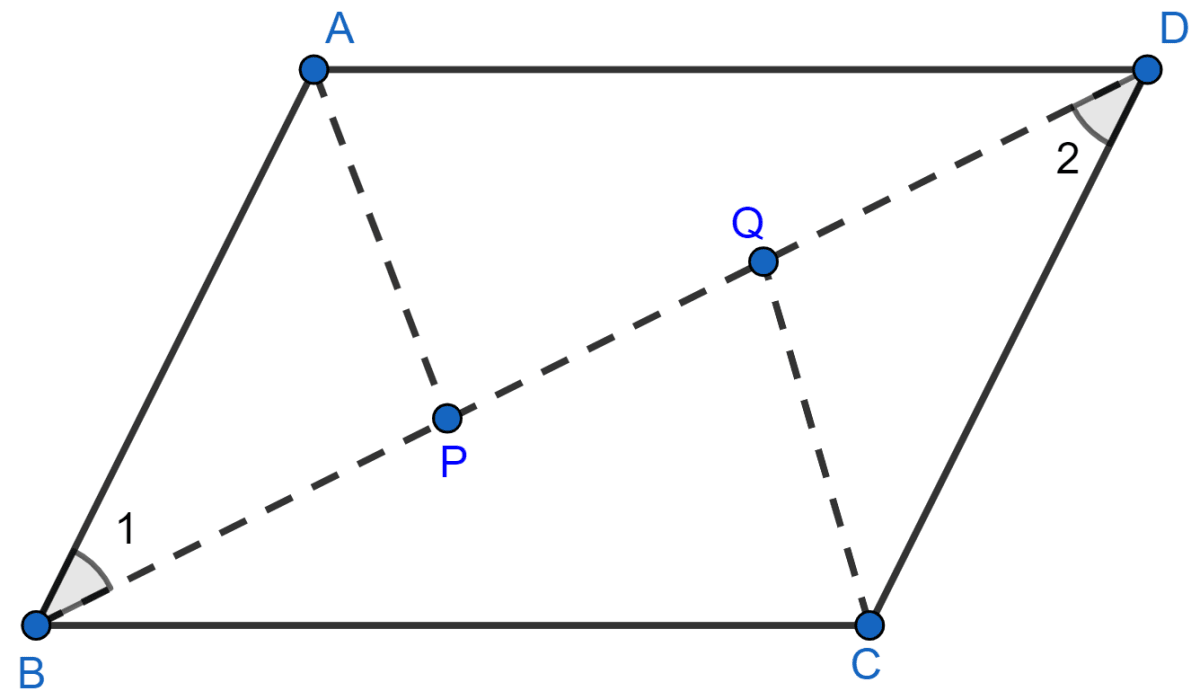
∠ABP = ∠CDQ (Alternate angles are equal)
BP = QD (As P and Q are points of trisection of the diagonal BD)
AB = CD (Opposite sides of parallelogram are equal)
Hence, △ABP ≅ △CDQ by SAS axiom.
∴ ∠APB = ∠CQD .......(By C.P.C.T.)
Multiplying both sides by -1
-∠APB = -∠CQD
Adding 180° on both sides,
⇒ 180° - ∠APB = 180° -∠CQD
⇒ ∠APQ = ∠CQP
The above angles are alternate angles and since they are equal we can say,
AP || CQ.
Hence, proved that AP || CQ.
A transversal cuts two parallel lines at A and B. The two interior angles at A are bisected and so are the two interior angles at B; the four bisectors form a quadrilateral ACBD. Prove that
(i) ACBD is a rectangle.
(ii) CD is parallel to the original parallel lines.
Answer
From figure,
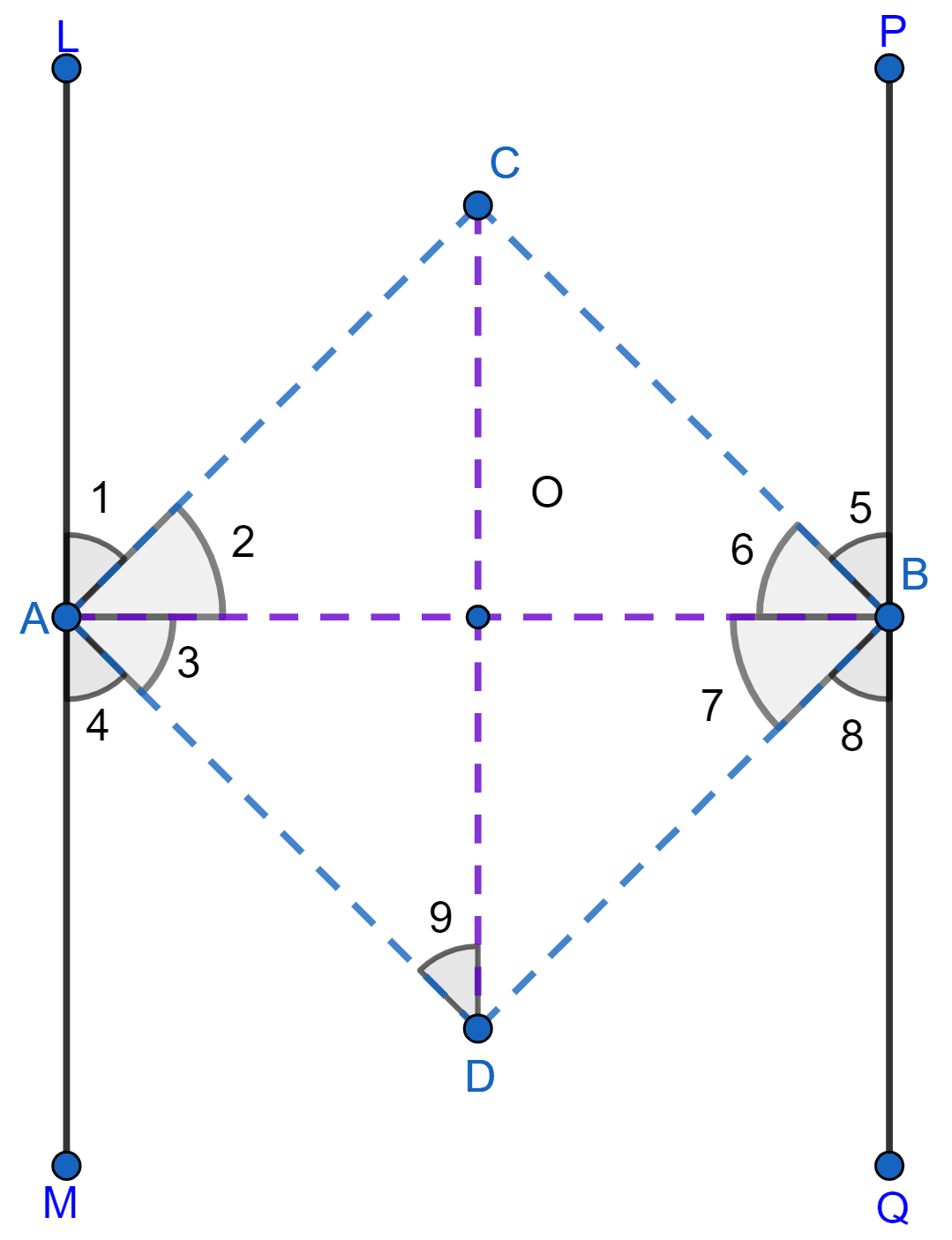
LM || PQ and AB is transversal.
AC, AD, BC and BD are bisectors of ∠LAB, ∠BAM, ∠PBA and ∠ABQ respectively.
So,
∠1 = ∠2, ∠3 = ∠4, ∠5 = ∠6 and ∠7 = ∠8.
(i) ∠LAB + ∠BAM = 180° (As LAM is a straight line)
(∠LAB + ∠BAM) = x 180°
∠2 + ∠3 = 90° [Since, AC and AD are bisector of ∠LAB and ∠BAM]
∠CAD = 90°
∠A = 90°.
∠PBA + ∠QBA = 180° (As PBQ is a straight line)
(∠PBA + ∠QBA) = x 180°
∠6 + ∠7 = 90° [Since, BC and BD are bisector of ∠PBA and ∠QBA]
∠CBD = 90°
∠B = 90°.
∠LAB + ∠ABP = 180° (LM || PQ, sum of co-interior angles is 180°)
(∠LAB + ∠ABP) = x 180°
∠2 + ∠6 = 90° [Since, AC and BC are bisector of ∠LAB and ∠PBA]
In △ABC,
⇒ ∠2 + ∠6 + ∠C = 180°
⇒ 90° + ∠C = 180°
⇒ ∠C = 90°.
∠MAB + ∠ABQ = 180° (LM || PQ, sum of co-interior angles is 180°)
(∠MAB + ∠ABQ) = x 180°
∠3 + ∠7 = 90° [Since, AD and BD are bisector of ∠MAB and ∠ABQ]
In △ABD,
⇒ ∠3 + ∠7 + ∠D = 180°
⇒ 90° + ∠D = 180°
⇒ ∠D = 90°.
From figure,
∠BAM = ∠ABP (Alternate angles are equal)
∠3 = ∠6
∠LAB = ∠ABQ (Alternate angles are equal)
∠2 = ∠7
In △ABC and △ABD,
∠3 = ∠6 (Proved above)
∠2 = ∠7 (Proved above)
AB = AB (Common)
Hence, △ABC ≅ △ABD by ASA axiom.
∴ AD = BC and AC = BD (By C.P.C.T.)
Since, ∠A = ∠B = ∠C = ∠D = 90° and AD = BC, AC = BD.
Hence, proved that ACBD is a rectangle.
(ii) In △OAD,
OA = OD (Diagonals of rectangle bisect each other)
∠3 = ∠9 (Angles opposite to equal side are equal)
Since, ∠3 = 4,
∠9 = ∠4
Since, ∠9 and ∠4 are alternate angles and since they are equal we can say that,
⇒ OD || LM
⇒ CD || LM
Since, LM || PQ and CD || LM
⇒ CD || PQ.
Hence, proved that CD is parallel to the original parallel lines.
In parallelogram ABCD, the bisector of ∠A meets DC in E and AB = 2AD. Prove that
(i) BE bisects ∠B
(ii) ∠AEB = a right angle.
Answer
Parallelogram ABCD is shown in the figure below:

(i) AB = CD (Opposite sides of parallelogram are equal)
AD = BC (Opposite sides of parallelogram are equal)
From figure,
⇒ ∠1 = ∠2 (AE bisects ∠A)
⇒ ∠1 = ∠5 (Alternate angles are equal)
⇒ ∠2 = ∠5
⇒ AD = DE (As sides opposite to equal angles are equal)
Since, AB = 2AD and CD = AB
⇒ CD = 2AD
⇒ 2AD = DE + EC
⇒ 2AD = AD + EC
⇒ EC = AD.
Since, EC = AD and BC = AD
⇒ ∠6 = ∠4 (As angles opposite to equal sides are equal)
⇒ ∠6 = ∠3 (Alternate angles are equal)
∴ ∠3 = ∠4.
Since, ∠3 = ∠4, hence proved that BE bisects ∠B.
(ii) Let ∠1 = x and ∠3 = y.
∴ ∠2 = x and ∠4 = y
Since, AD || BC, sum of co-interior angles = 180
⇒ ∠A + ∠B = 180°
⇒ ∠1 + ∠2 + ∠3 + ∠4 = 180°
⇒ x + x + y + y = 180°
⇒ 2x + 2y = 180°
⇒ x + y = 90° ..........(1)
In △AEB,
⇒ ∠1 + ∠3 + ∠AEB = 180°
⇒ x + y + ∠AEB = 180°
⇒ 90° + ∠AEB = 180° (From i)
⇒ ∠AEB = 90°.
Hence, proved that ∠AEB = 90°.
ABCD is a parallelogram, bisectors of angles A and B meet at E which lies on DC. Prove that AB = 2AD.
Answer
ABCD is a parallelogram in which bisector of ∠A and ∠B meets DC at E.
To prove: AB = 2AD
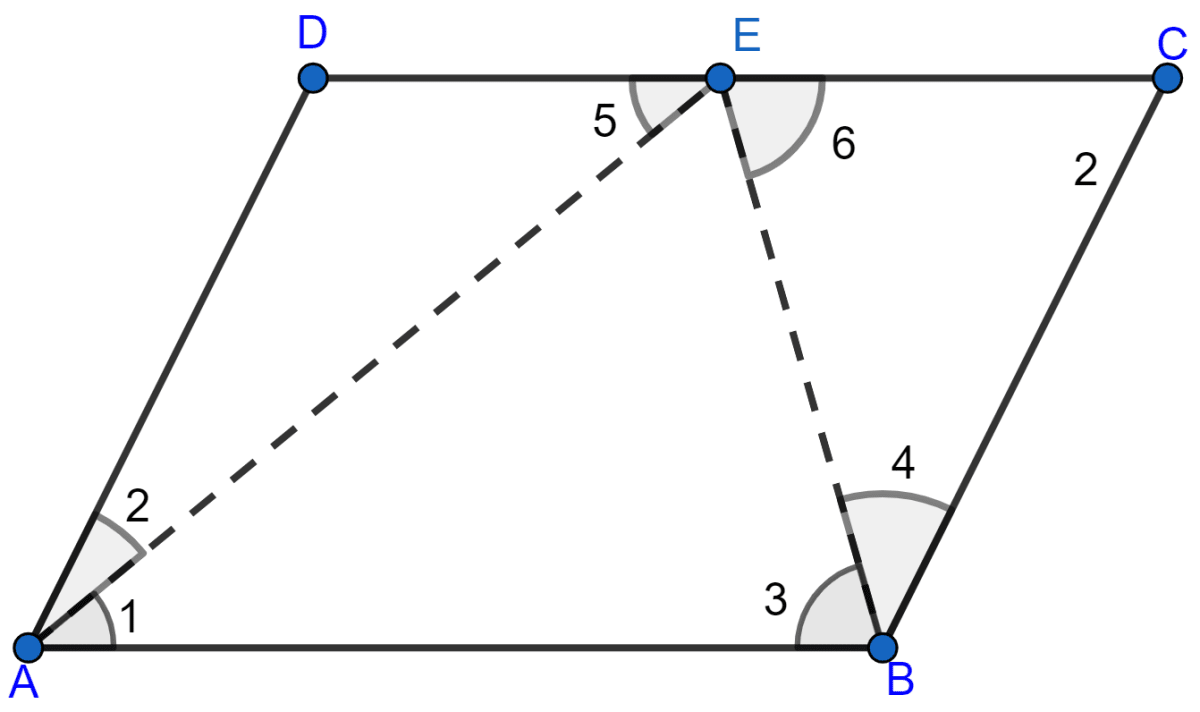
Since, AE and BE are bisector of ∠A and ∠B
∠1 = ∠2 and ∠3 = ∠4
In parallelogram ABCD, we have
AB || DC
∠1 = ∠5 [Alternate angles are equal, AE is transversal]
Thus,
∠2 = ∠5 … (i)
∴ DE = AD [∵ Sides opposite to equal angles in ∆AED]
∠3 = ∠6 [Alternate angles]
∠3 = ∠4 [Since, BE is bisector of ∠B (given)]
Thus, ∠4 = ∠6 … (ii)
∴ BC = EC [∵ Sides opposite to equal angles in ∆BCE]
AD = BC [Opposite sides of || gm are equal]
AD = DE = EC
AB = DC [Opposite sides of a || gm are equal]
⇒ AB = DE + EC
⇒ AB = AD + AD
⇒ AB = 2AD
Hence, proved that AB = 2AD.
ABCD is a square and the diagonals intersect at O. If P is a point on AB such that AO = AP, prove that 3∠POB = ∠AOP.
Answer
In square ABCD, AC is a diagonal.

So, ∠CAB = 45° (As diagonals bisect vertex angle)
∠OAP = 45°
In ∆AOP,
∠OAP = 45°
AO = AP [Given]
∠AOP = ∠APO = x (let) [Angles opposite to equal sides are equal]
Now,
∠AOP + ∠APO + ∠OAP = 180° [Angles sum property of a triangle]
∠AOP + ∠AOP + 45° = 180°
2x = 180° – 45°
x =
∠AOB = 90° [Diagonals of a square bisect at right angles]
So, ∠AOP + ∠POB = 90°
+ ∠POB = 90°
∠POB = 90° –
=
3∠POB = = ∠AOP.
Hence, proved that 3∠POB = ∠AOP.
ABCD is a square. E, F, G and H are points on the sides AB, BC, CD and DA respectively such that AE = BF = CG = DH. Prove that EFGH is a square.
Answer
Given, AE = BF = CG = DH
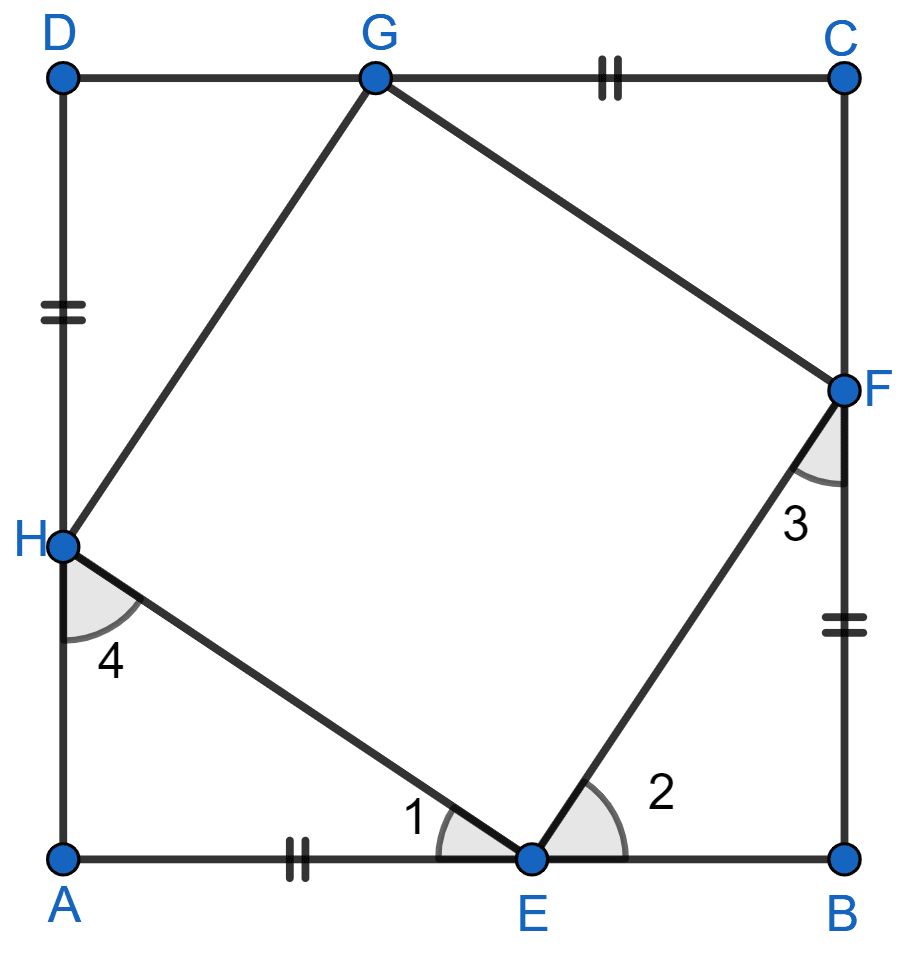
Since, ABCD is a square and AB = BC = CD = AD.
So,
⇒ AB - AE = BC - BF = CD - CG = AD - DH
⇒ EB = FC = GD = AH
Now, in ∆AEH and ∆BFE
⇒ AE = BF [Given]
⇒ AH = EB [Proved]
⇒ ∠A = ∠B [Each 90°]
So, ∆AEH ≅ ∆BFE by S.A.S axiom of congruency
Then, by C.P.C.T we have
⇒ EH = EF and ∠4 = ∠2
In ∆AEH,
⇒ ∠1 + ∠4 + ∠HAE = 180°
⇒ ∠1 + ∠4 + 90° = 180°
⇒ ∠1 + ∠4 = 90°
⇒ ∠1 + ∠2 = 90° [Since, ∠4 = ∠2]
From figure,
⇒ ∠1 + ∠HEF + ∠2 = 180°
⇒ ∠HEF + 90° = 180°
⇒ ∠HEF = ∠E = 90°.
In ∆DGH and ∆CGF
⇒ DH = GC [Given]
⇒ GD = FC [Proved]
⇒ ∠D = ∠C [Each 90°]
So, ∆DGH ≅ ∆CGF by S.A.S axiom of congruency
Then, by C.P.C.T we have
GH = FG
In ∆DGH and ∆AEH
⇒ DH = AE [Given]
⇒ GD = HA [Proved]
⇒ ∠D = ∠A [Each 90°]
So, ∆DGH ≅ ∆AEH by S.A.S axiom of congruency
Then, by C.P.C.T we have
GH = HE
Thus, EF = FG = GH = HE, therefore EFGH is a Rhombus.
∵ One angle of rhombus EFGH is 90° (∠HEF = 90°),
∴ EFGH is a square.
Hence, proved that EFGH is a square.
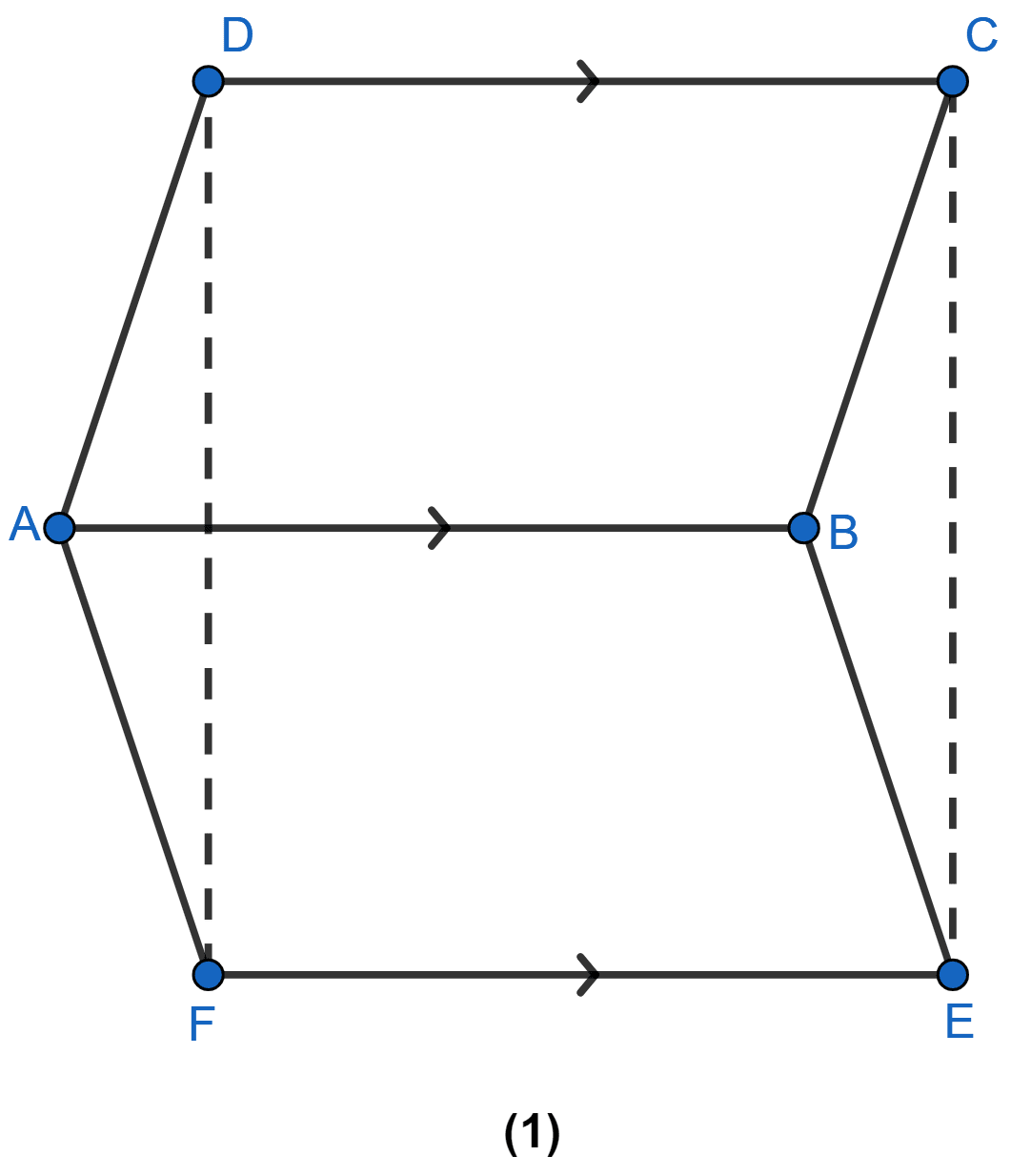
In the figure (1) given below, ABCD and ABEF are parallelograms. Prove that
(i) CDFE is a parallelogram.
(ii) FD = EC
(iii) △AFD ≅ △BEC.
Answer
(i) DC || AB and DC = AB [∵ ABCD is a || gm] .......... (1)
FE || AB and FE = AB [∵ ABEF is a || gm] ...........(2)
∴ DC || FE and DC = FE [From (1) and (2)]
Hence, proved that CDFE is a || gm.
(ii) Since, CDEF is a || gm.
So, FD = EC (As opposite sides of a || gm are equal)
Hence, proved that FD = EC.
(iii) In ∆AFD and ∆BEC, we have
AD = BC [Opposite sides of || gm ABCD are equal]
AF = BE [Opposite sides of || gm ABEF are equal]
FD = CE [Opposite sides of || gm CDFE are equal]
Hence, ∆AFD ≅ ∆BEC by S.S.S axiom of congruency
Hence, proved that ∆AFD ≅ ∆BEC.
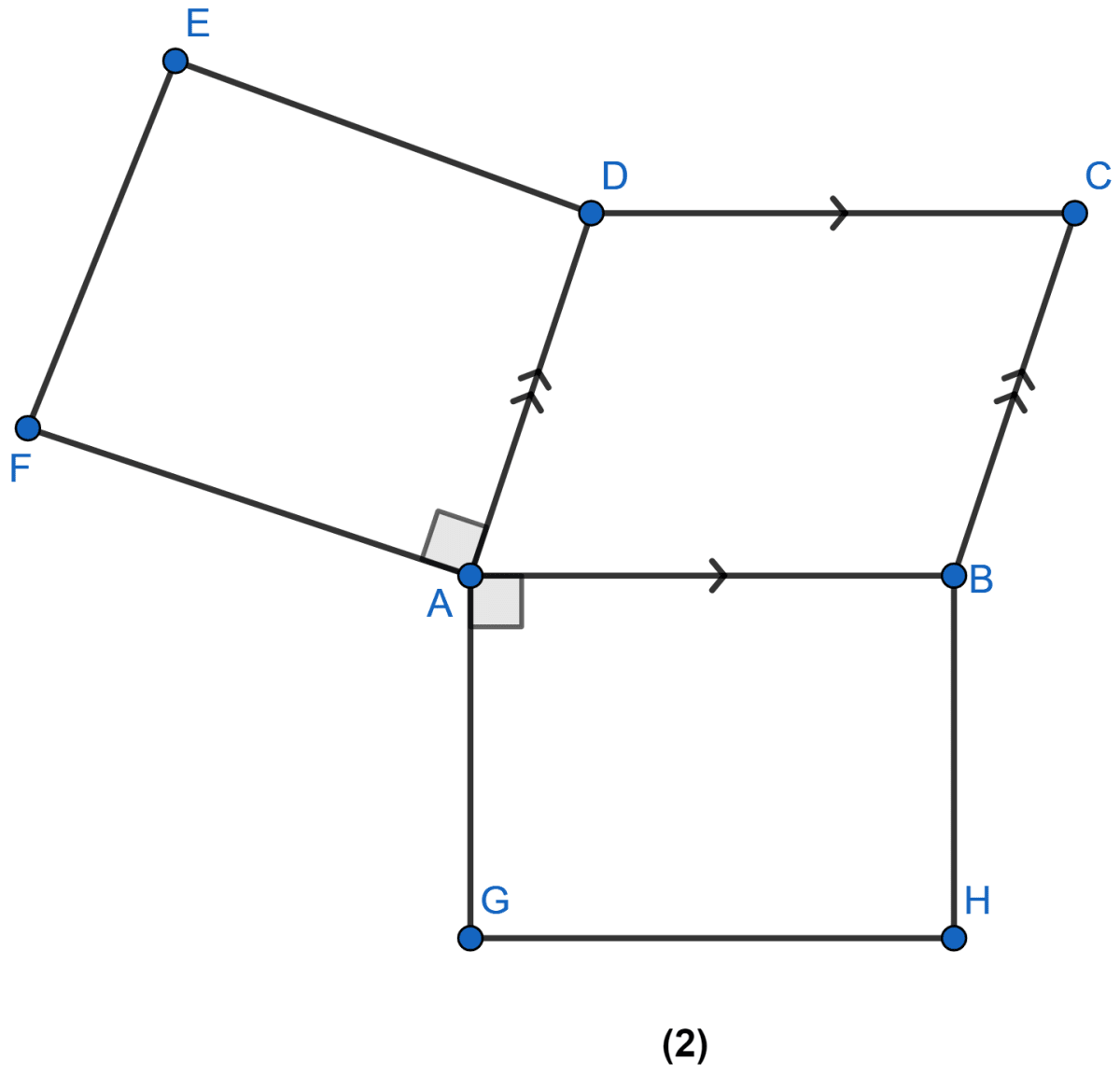
In the figure (2) given below, ABCD is a parallelogram, ADEF and AGHB are two squares. Prove that FG = AC.
Answer
From figure,
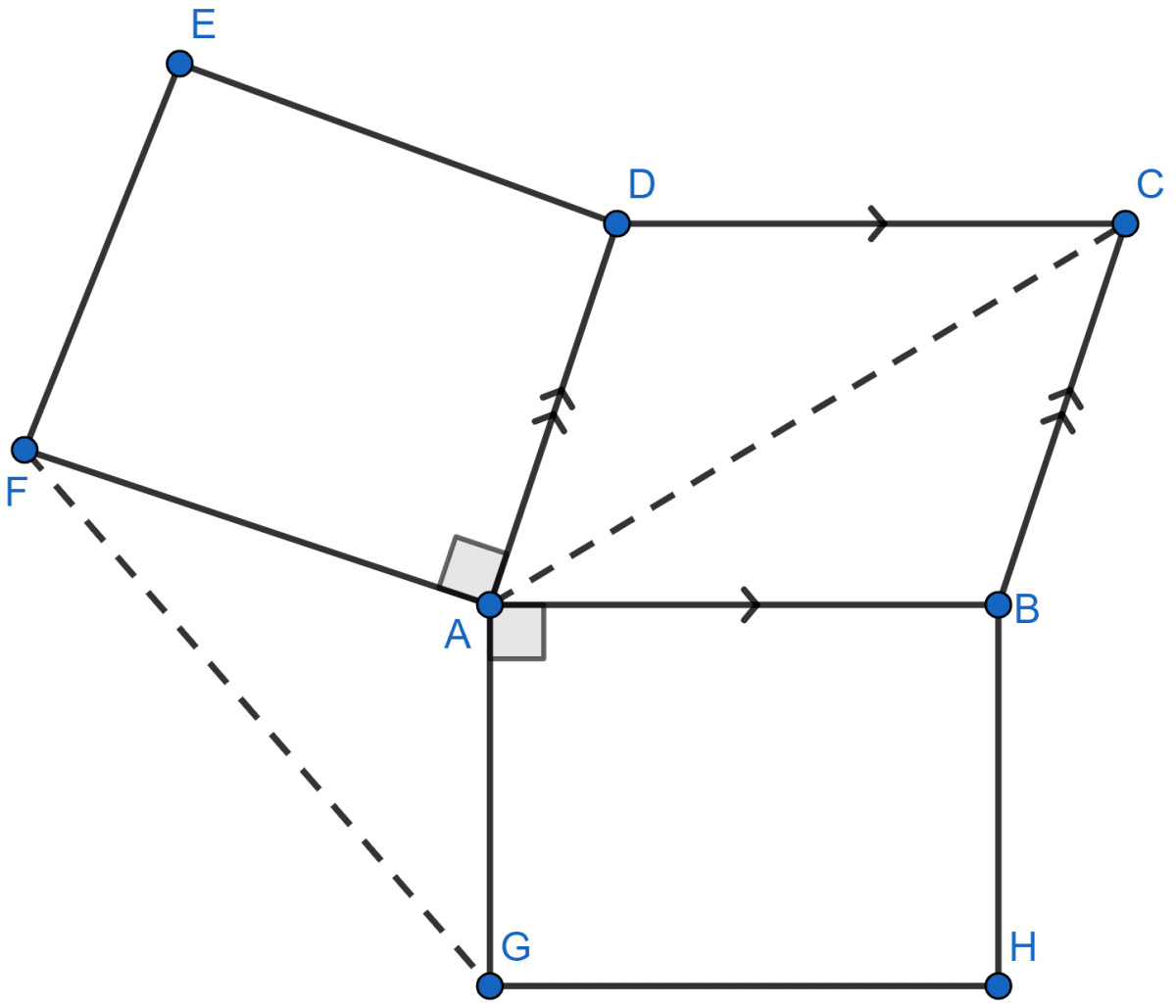
⇒ ∠FAG + ∠GAB + ∠BAD + ∠FAD = 360° [∵ At a point total angle is 360°]
⇒ ∠FAG + 90° + 90° + ∠BAD = 360°
⇒ ∠FAG = 360 – 90° – 90° – ∠BAD
⇒ ∠FAG = 180° – ∠BAD .........(i)
⇒ ∠ABC + ∠BAD = 180° [Sum of Adjacent angle in || gm is equal to 180°]
⇒ ∠ABC = 180° – ∠BAD .........(ii)
⇒ ∠FAG = ∠ABC [From (i) and (ii)]
In || gm ABCD,
AB = CD and AD = BC.
Since, ADEF is a square,
so, AD = DE = EF = FA.
So, BC = FA.
In ∆AFG and ∆ABC, we have
⇒ AF = BC [Proved above]
⇒ AG = AB (∵ AGBH is a square)
⇒ ∠FAG = ∠ABC [Proved above]
So, ∆AFG ≅ ∆ABC by S.A.S axiom of congruency
∴ FG = AC. [By C.P.C.T]
Hence, proved that FG = AC.
ABCD is a rhombus in which ∠A = 60°. Find the ratio AC : BD.
Answer
Rhombus ABCD is shown in the figure below:
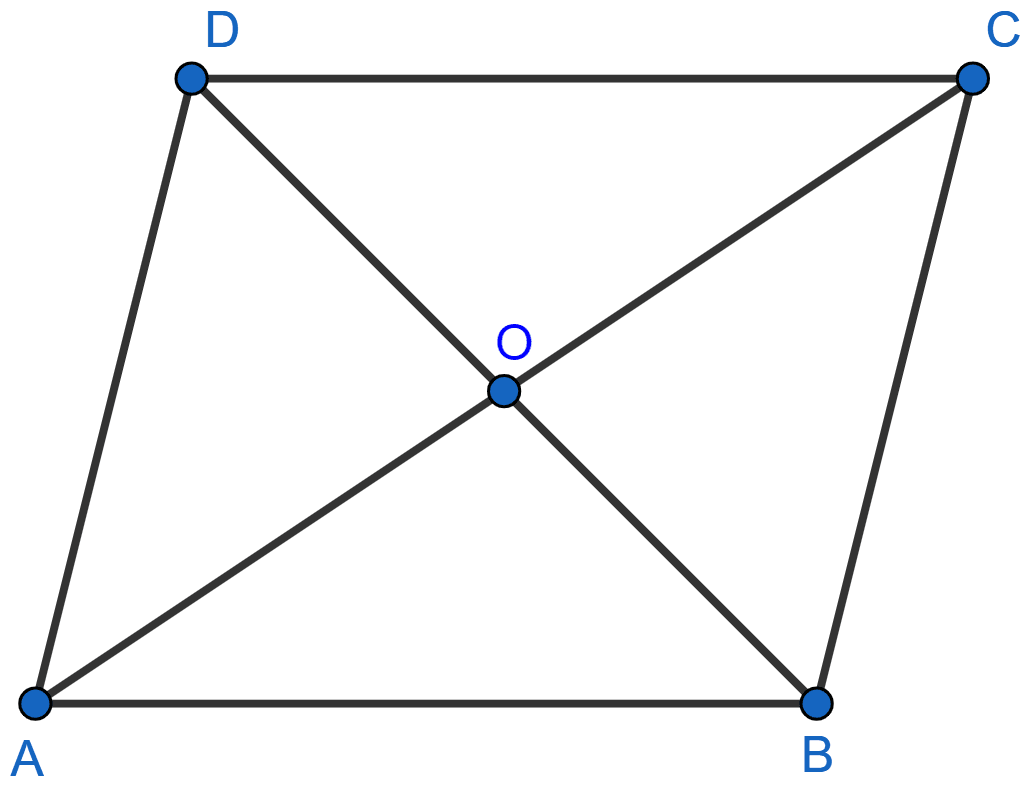
In △ABD,
⇒ AB = AD (Sides of rhombus are equal.)
⇒ ∠B = ∠D = x (let) (∵ angles opposite to equal sides are equal)
⇒ ∠A + ∠B + ∠D = 180°
⇒ 60° + x + x = 180°
⇒ 2x = 180° - 60°
⇒ 2x = 120°
⇒ x = 60°.
∴ ABD is an equilateral triangle.
So, BD = AB = AD = a (let)
Since, diagonals of rhombus bisect each other,
OB =
In right angled triangle AOB,
AB2 = AO2 + OB2
a2 = AO2 +
AO2 = a2 -
AO =
AC = 2AO =
AC : BD = .
Hence, AC : BD = .