
ABCD is a rhombus with P, Q and R as mid-points of AB, BC and CD respectively. Prove that PQ ⊥ QR.
Answer
Join AC and BD.
Diagonals of rhombus intersect at right angle.
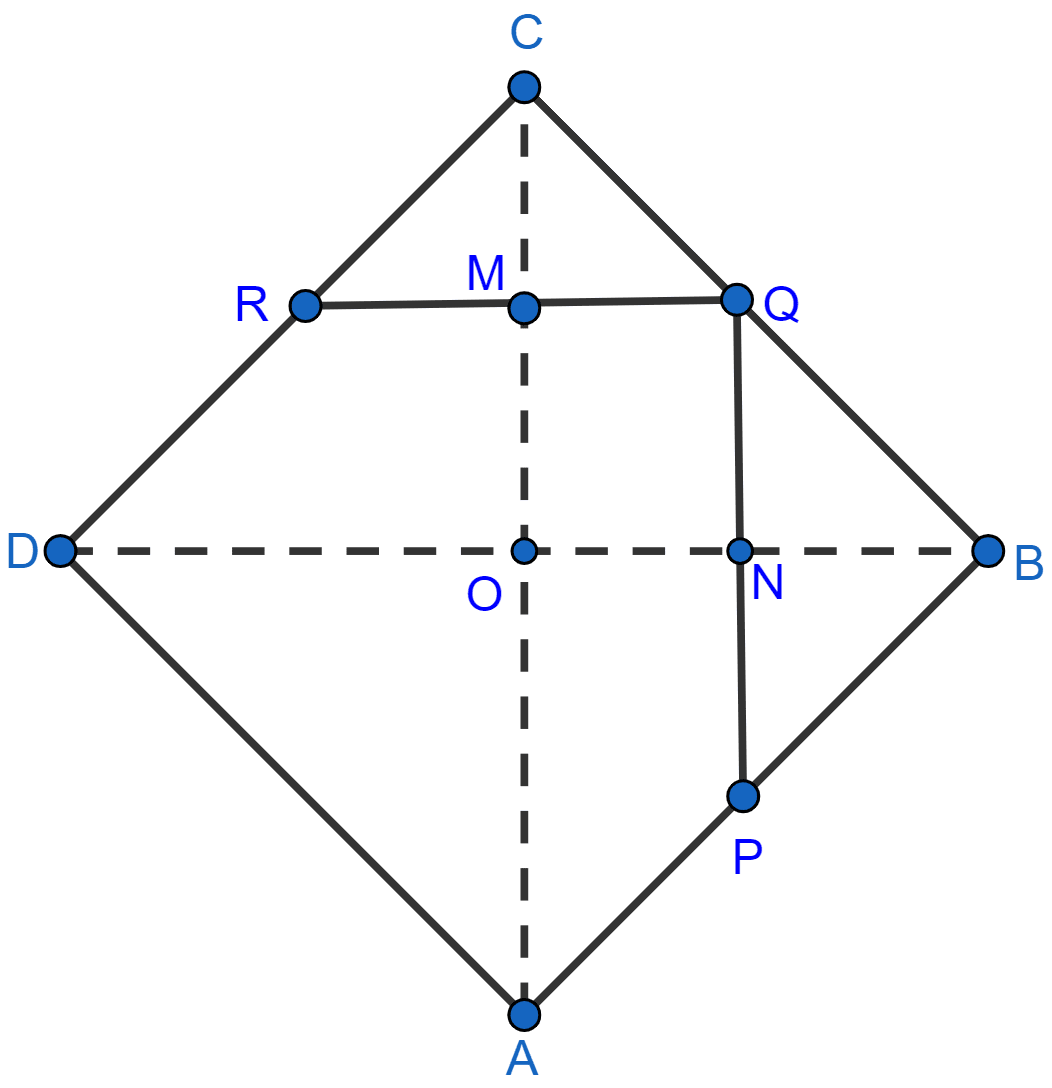
∠MON = 90°
In △BCD,
Q and R are mid-points of BC and CD.
RQ || DB and RQ = DB
RQ || DB ⇒ MQ || ON
From figure,
∠MON + ∠MQN = 180° (Sum of alternate angles of quadrilateral = 180°)
∠MQN = 180° - 90° = 90°
∴ PQ ⊥ QR.
Hence, proved that PQ ⊥ QR.
The diagonals of a quadrilateral ABCD are perpendicular. Show that the quadrilateral formed by joining the mid-points of its adjacent sides is a rectangle.
Answer
From figure,
ABCD is a quadrilateral in which diagonals AC and BD are perpendicular to each other. P, Q, R and S are mid-points of AB, BC, CD and DA.
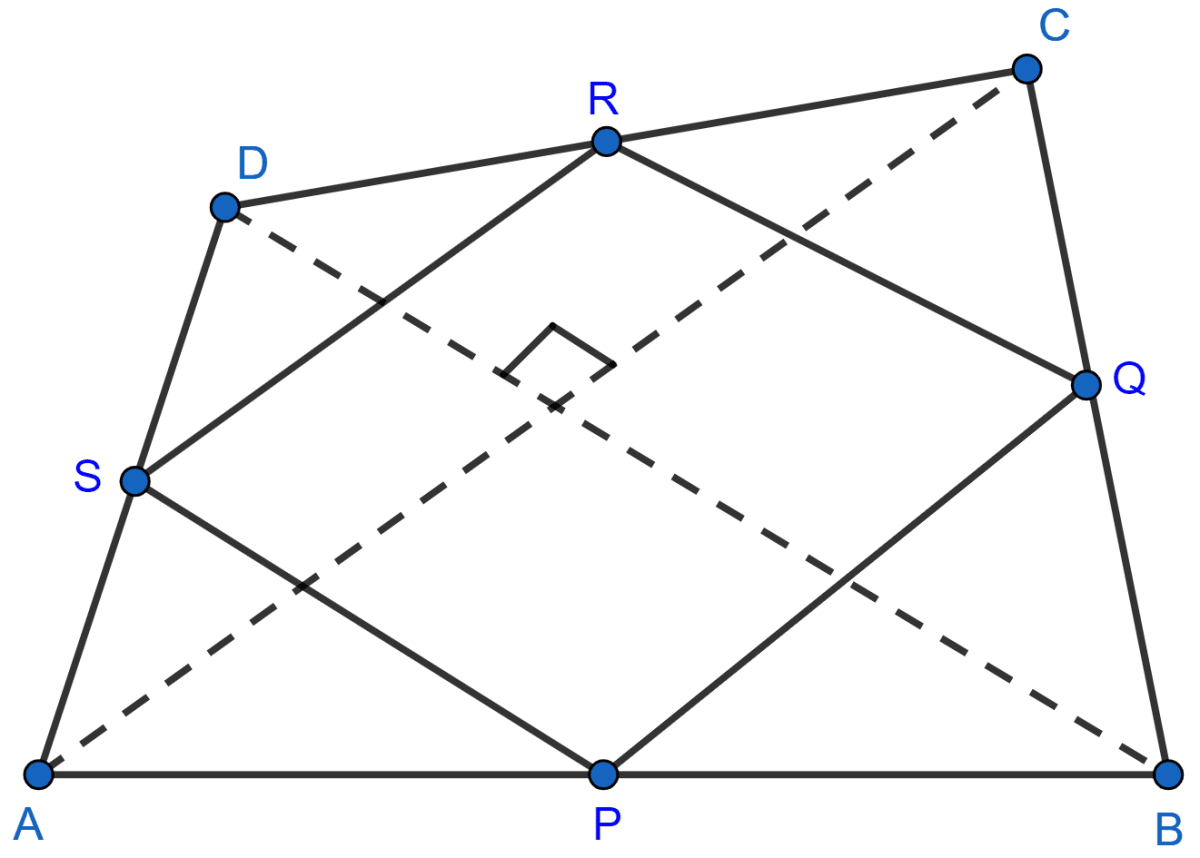
In △ABC,
P and Q are mid-points of AB and BC respectively,
PQ || AC and PQ = AC .......(1) (By mid-point theorem)
In △ADC,
S and R are mid-points of AD and DC respectively,
SR || AC and SR = AC .........(2) (By mid-point theorem)
Using eqn. 1 and 2 we get,
PQ || SR and PQ = SR.
So, PQRS is a parallelogram.
In △ABD,
S and P are mid-points of AD and AB respectively,
SP || BD and SP = BD .........(3) (By mid-point theorem)
Given,
AC and BD intersect at right angles,
From 3 we get,
SP || BD.
∴ SP ⊥ AC
From 2 we get,
SR || AC
∴ SP ⊥ SR i.e. ∠RSP = 90°.
∴ PQRS is a rectangle.
Hence, proved that the quadrilateral formed by joining the mid-points of its adjacent sides is a rectangle.
If D, E and F are mid-points of the sides BC, CA and AB respectively of a △ABC, prove that AD and FE bisect each other.
Answer
△ABC with D, E and F as mid-points of the sides BC, CA and AB is shown below:
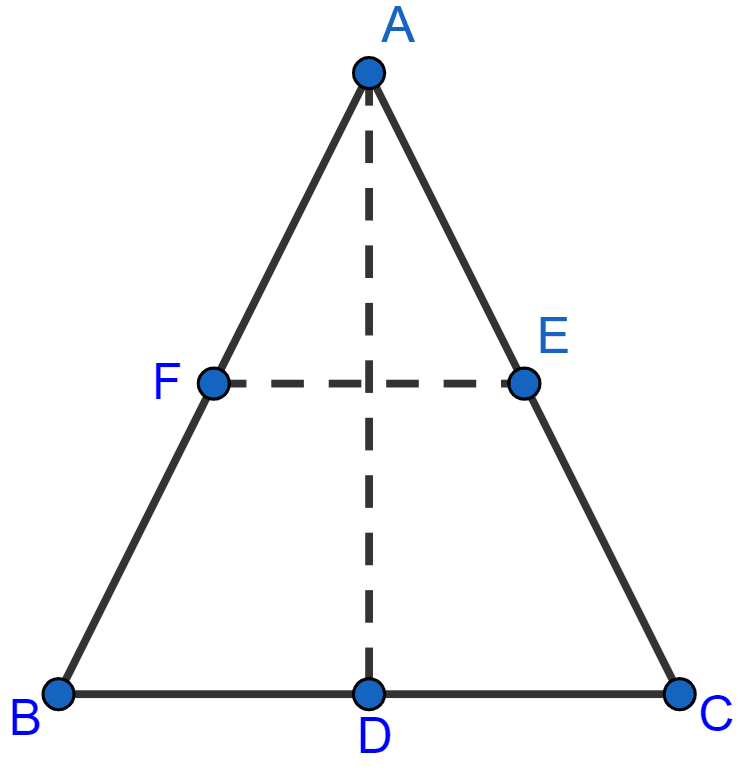
D and E are midpoints of BC and CA respectively,
DE = AB and DE || AB or DE || AF .......(1)
Since,
F is midpoint of AB,
AF = AB
∴ AF = DE .......(2)
F and D are midpoints of AB and BC respectively,
FD = AC and FD || AC or FD || AE .......(3)
Since,
E is midpoint of AC,
AE = AC
∴ FD = AE .......(4)
From 1, 2, 3 and 4 we get,
DE || AF, AF = DE and FD || AE, FD = AE.
Hence, AEDF is a parallelogram.
∴ AD and EF bisect each other.
Hence, AD and EF bisect each other.
In △ABC, D and E are mid-points of the sides AB and AC respectively. Through E, a straight line is drawn parallel to AB to meet BC at F. Prove that BDEF is a parallelogram. If AB = 8 cm and BC = 9 cm, find the perimeter of the parallelogram BDEF.
Answer
Since, D and E are mid-points of AB and AC respectively,
DE || BC or DE || BF and DE = BC ......(By midpoint theorem) .....(i)

Given, through E, a straight line is drawn parallel to AB to meet BC at F.
F will be mid-point of BC (By converse of mid-point theorem).
Since, F is midpoint of BC,
∴ BF = BC .....(ii)
From (i) and (ii) we get,
DE = BF and DE || BF.
Since, F and E are mid-points of BC and AC respectively,
FE || AB or FE || BD and FE = AB ......(By midpoint theorem) .....(iii)
Since, D is midpoint of AB,
∴ BD = AB .....(iv)
From (iii) and (iv) we get,
BD = FE and BD || FE.
Since, DE = BF, DE || BF and BD = FE, BD || FE
Hence, proved that BDEF is a parallelogram.
Perimeter of BDEF = BD + DE + FE + BF = BD + DE + BD + FE = 2(BD + FE).
BD = AB = = 4 cm.
FE = BC = = 4.5 cm.
Perimeter of BDEF = 2(BD + FE) = 2(4 + 4.5) = 2 × 8.5 = 17 cm.
Hence, perimeter of BDEF = 17 cm.
In the adjoining figure, ABCD is a parallelogram and E is mid-point of AD. DL || EB meets AB produced at F. Prove that B is mid-point of AF and EB = LF.
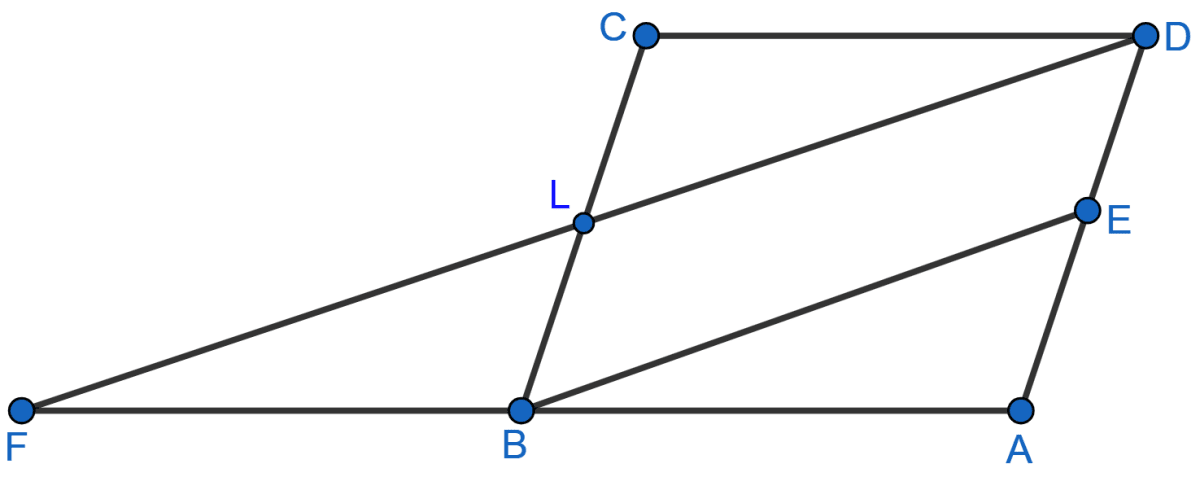
Answer
Given, DL || EB.
Since, DL || BE we can say that,
⇒ BE || DF
In △AFD,
E is midpoint of AD and BE is parallel to DF,
∴ B is midpoint of AF (By converse of midpoint theorem).
In BEDL,
LD || BE and BL || DE
∴ BEDL is a parallelogram.
Since, BEDL is a parallelogram opposite sides are equal.
Let LD = BE = x.
E is midpoint of AD and B is the midpoint of AF
By midpoint theorem,
BE = FD
FD = 2BE = 2x.
LF = FD - LD = 2x - x = x.
Since, LF = BE = x.
Hence, proved that B is midpoint of AF and EB = LF.
In the adjoining figure, ABCD is a parallelogram. If P and Q are mid-points of sides CD and BC respectively. Show that CR = AC.

Answer
In parallelogram, diagonals bisect each other.
∴ AO = OC = AC ......(i)
In △BCD,
P and Q are midpoints of CD and BC,
PQ || BD (By midpoint theorem)
Since, PQ || BD
∴ QR || BO
In △BCO,
Q is midpoint of BC and QR || BO
∴ R is midpoint of OC
CR = OC
Substituting value of OC from (i) in above equation,
CR = OC = AC = AC.
Hence, proved that CR = AC.