
In a △ABC, AB = 3 cm, BC = 4 cm and CA = 5 cm. If D and E are mid-points of AB and BC respectively, then the length of DE is
1.5 cm
2 cm
2.5 cm
3.5 cm
Answer
Since, D is midpoint of AB and E is midpoint of BC,
DE || AC and DE = AC = x 5 = 2.5 cm

Hence, Option 3 is the correct option.
In the adjoining figure, ABCD is a rectangle in which AB = 6 cm and AD = 8 cm. If P and Q are mid-points of the sides BC and CD respectively, then the length of PQ is
7 cm
5 cm
4 cm
3 cm

Answer
Length of diagonal (BD) of ABCD = = 10 cm.
In △BCD,
P is midpoint of BC and Q is midpoint of CD.
PQ || BD and PQ = BD = x 10 = 5 cm.
Hence, Option 2 is the correct option.
D and E are mid-points of the sides AB and AC of △ABC and O is any point on the side BC. O is joined to A. If P and Q are mid-points of OB and OC respectively, then DEQP is
a square
a rectangle
a rhombus
a parallelogram
Answer
In △ABC,

D and E are respective midpoints of AB and AC.
∴ DE || (BC or PQ) ......(1)
Again in △ABO,
D and P are respective midpoints of AB and BO.
∴ DP || AO ........(2)
In △ACO,
E and Q are respective midpoints of AC and CO.
∴ EQ || AO ........(3)
From 2 and 3 we get,
DP || EQ .......(4)
From 1 and 4 we get,
DE || PQ and DP || EQ
∴ DEQP is a parallelogram.
Hence, Option 4 is the correct option.
The quadrilateral formed by joining the mid-points of the sides of a quadrilateral PQRS, taken in order, is a rectangle if
PQRS is a parallelogram
PQRS is a rectangle
the diagonals of PQRS are perpendicular to each other
the diagonals of PQRS are equal.
Answer
Let ABCD be a quadrilateral with P, Q, R and S as mid-points of AB, BC, CD and DA respectively.
Let PR ⊥ QS.

In △QRP,
A and B are midpoints of PQ and QR respectively.
∴ AB || PR and AB = (By midpoint theorem) ........(1)
Similarly in △PRS,
D and C are midpoints of PS and RS respectively.
∴ DC || PR and DC = (By midpoint theorem) ........(2)
In △PQS,
D and A are midpoints of PS and PQ respectively.
∴ DA || QS and DA = (By midpoint theorem).........(3)
Similarly in △QRS,
B and C are midpoints of QR and SR respectively.
∴ BC || QS and BC = (By midpoint theorem).........(4)
From 1 and 2 we get,
AB = DC and AB || DC
From 3 and 4 we get,
DA = BC and DA || BC
Hence, proved that ABCD is a parallelogram.
Since, DA || QS and PR ⊥ QS
∴ DA ⊥ PR.
Since, DC || PR and PR ⊥ QS
∴ DC ⊥ QS.
In OMDN,
∠OMD = ∠SMC (Vertically opposite angle are equal)
In quadrilateral sum of angles = 360°
∠O + ∠M + ∠N + ∠D = 360°
90° + 90° + 90° + ∠D = 360°
∠D = 360° - 270° = 90°.
In parallelogram sum of alternate angles = 180°.
∠D + ∠B = 180°
90° + ∠B = 180°
∠B = 90°
Since, opposite sides are equal and adjacent sides are perpendicular to each other.
Hence, ABCD is a rectangle.
The quadrilateral formed by joining the mid-points of the sides of a quadrilateral ABCD, taken in order, is a rectangle if the diagonals of PQRS are perpendicular to each other.
Hence, Option 3 is the correct option.
The quadrilateral formed by joining the mid-points of the sides of a quadrilateral ABCD, taken in order is a rhombus if
ABCD is a parallelogram
ABCD is a rhombus
the diagonals of ABCD are equal
the diagonals of ABCD are perpendicular to each other.
Answer
Let ABCD be a quadrilateral with P, Q, R and S as mid-points of AB, BC, CD and DA respectively.
Let diagonals be of equal length i.e. AC = BD = x

In △BCA,
P and Q are midpoints of AB and BC respectively.
∴ PQ || AC and PQ = AC = x (By midpoint theorem) ........(1)
Similarly in △ACD,
S and R are midpoints of AD and CD respectively.
∴ SR || AC and SR = AC = x (By midpoint theorem) ........(2)
In △ABD,
S and P are midpoints of AD and AB respectively.
∴ SP || BD and SP = BD = x (By midpoint theorem).........(3)
Similarly in △BCD,
Q and R are midpoints of BC and CD respectively.
∴ QR || BD and QR = BD = x (By midpoint theorem).........(4)
From 1, 2, 3 and 4 we get,
PQ = SR = SP = QR.
Hence, proved that PQRS is a rhombus.
∴ The quadrilateral formed by joining the mid-points of the sides of a quadrilateral ABCD, taken in order is a rhombus if the diagonals of ABCD are equal.
Hence, Option 3 is the correct option.
The figure formed by joining the mid-points of the sides of a quadrilateral ABCD, taken in order, is a square only if
ABCD is a rhombus
diagonals of ABCD are equal
diagonals of ABCD are perpendicular to each other
diagonals of ABCD are equal and perpendicular to each other.
Answer
Let ABCD be a quadrilateral with P, Q, R and S as mid-points of AB, BC, CD and DA respectively.
Let diagonals be of equal length i.e. AC = BD = x and AC ⊥ BD.
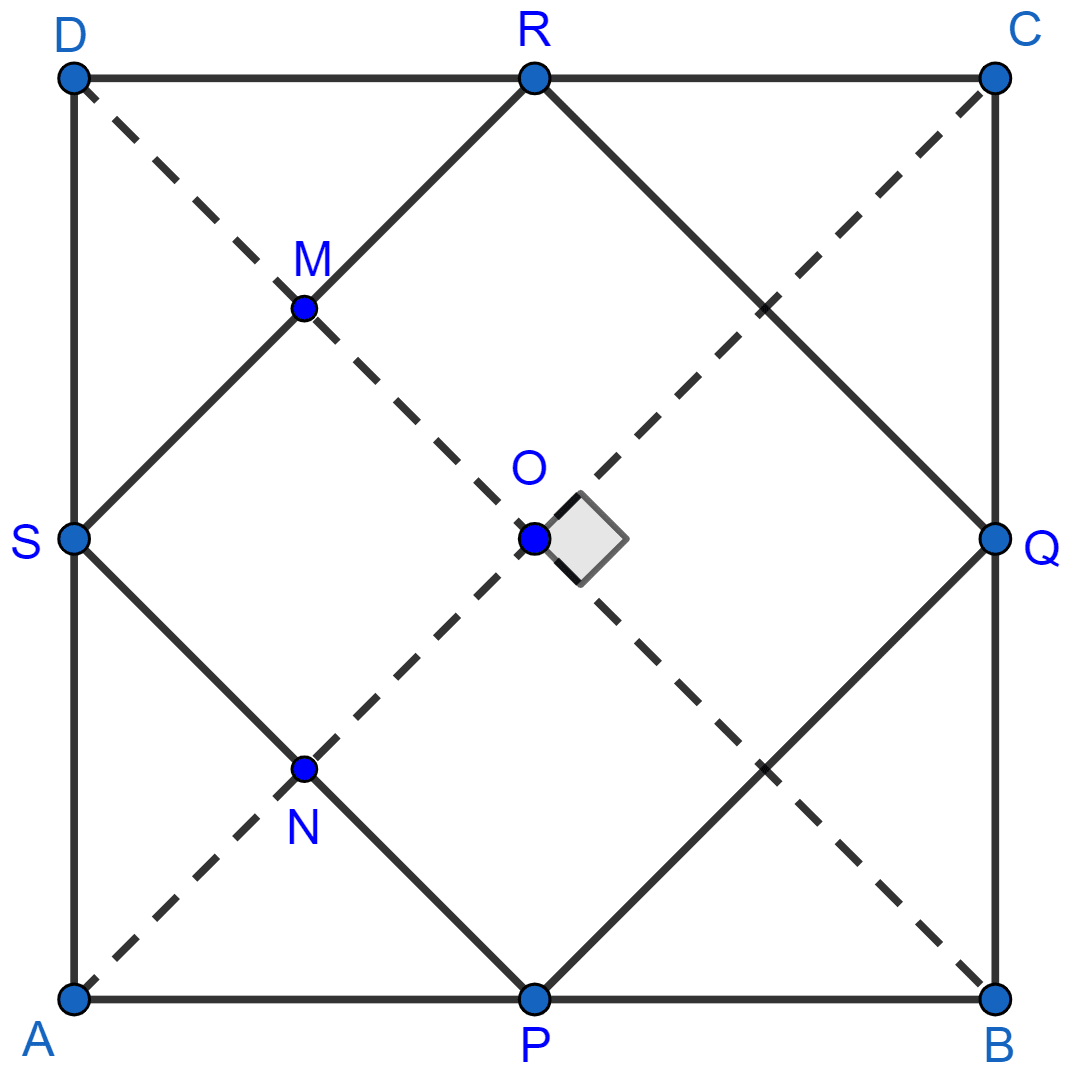
In △BCA,
P and Q are midpoints of AB and BC respectively.
∴ PQ || AC and PQ = (By midpoint theorem) ........(1)
Similarly in △ACD,
S and R are midpoints of AD and CD respectively.
∴ SR || AC and SR = (By midpoint theorem) ........(2)
In △ABD,
S and P are midpoints of AD and AB respectively.
∴ SP || BD and SP = (By midpoint theorem).........(3)
Similarly in △BCD,
Q and R are midpoints of BC and CD respectively.
∴ QR || BD and QR = (By midpoint theorem).........(4)
From 1, 2, 3 and 4 we get,
PQ = SR = SP = QR.
Hence, proved that PQRS is a rhombus.
Since, SP || BD and AC ⊥ BD
∴ SP ⊥ AC.
Since, SR || AC and AC ⊥ BD
∴ SR ⊥ BD.
In OMSN,
∠OMS = ∠DMR (Vertically opposite angle are equal)
In quadrilateral sum of angles = 360°
∠O + ∠M + ∠N + ∠S = 360°
90° + 90° + 90° + ∠S = 360°
∠S = 360° - 270° = 90°.
Since, in rhombus adjacent angles sum = 180°
∠S + ∠R = 180°
90° + ∠R = 180°
∠R = 90°.
∠Q + ∠R = 180°
90° + ∠Q = 180°
∠Q = 90°.
∠S + ∠P = 180°
90° + ∠P = 180°
∠P = 90°.
Since, PQ = QR = RS = SP and ∠P = ∠Q = ∠R = ∠S = 90°
Hence, proved that PQRS is a square.
The figure formed by joining the mid-points of the sides of a quadrilateral ABCD, taken in order, is a square only if diagonals of ABCD are equal and perpendicular to each other.
Hence, Option 4 is the correct option.
Consider the following two statements:
Statement 1: The line segment joining the mid-points of any two sides of a triangle is parallel to the third side and is equal to half of it.
Statement 2: The line through the mid-point of one side of a triangle and parallel to another side bisects the third side.
Which of the following is valid?
Both the statements are true.
Both the statements are false.
Statement 1 is true, and Statement 2 is false.
Statement 1 is false, and Statement 2 is true.
Answer
According to statement 1 :
The line segment joining the mid-points of any two sides of a triangle is parallel to the third side and is equal to half of it.
This statement describes mid-point theorem.
∴ Statement 1 is true.
According to statement 2 :
The line through the mid-point of one side of a triangle and parallel to another side bisects the third side.
This statement describes the converse of mid-point theorem.
∴ Statement 2 is true.
Hence, option 1 is the correct option.