
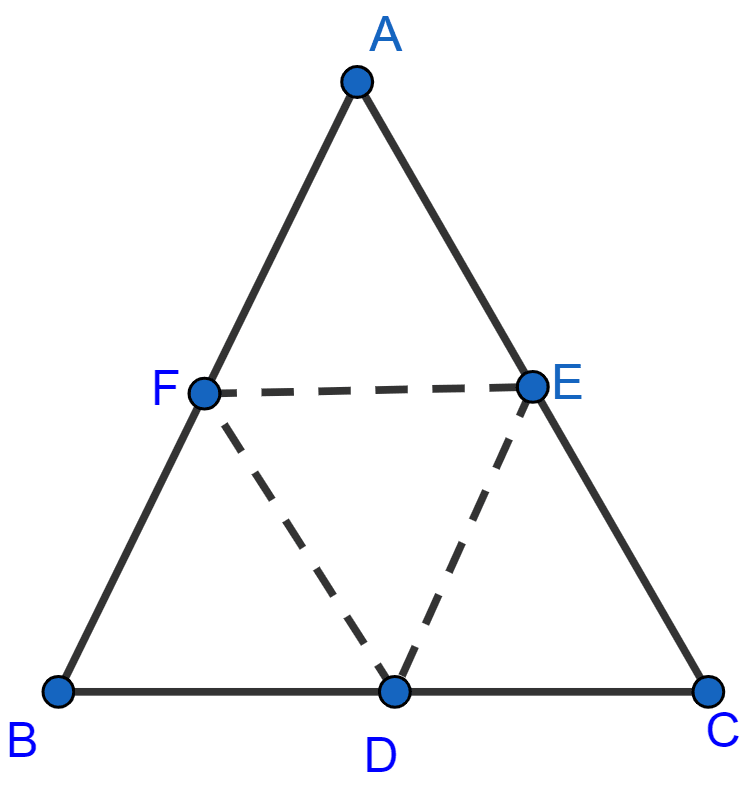
In the figure given below, D, E and F are mid-points of the sides BC, CA and AB respectively of △ ABC. If AB = 6 cm, BC = 4.8 cm and CA = 5.6 cm, find the perimeter of
(i) the trapezium of FBCE
(ii) the triangle DEF.
Answer
(i) Since F is midpoint of AB and E is midpoint of AC,
∴ FE is parallel to BC and FE = BC = = 2.4 cm (By midpoint theorem)
FB = AB = = 3 cm
EC = AC = = 2.8 cm.
Perimeter of trapezium FBCE = FE + EC + BC + FB = 2.4 + 2.8 + 4.8 + 3 = 13 cm.
Hence, perimeter of trapezium FBCE = 13 cm.
(ii) Since F is midpoint of AB and E is midpoint of AC,
∴ FE is parallel to BC and FE = BC = = 2.4 cm (By midpoint theorem)
Since F is midpoint of AB and D is midpoint of BC,
∴ FD is parallel to AC and FD = AC = = 2.8 cm (By midpoint theorem)
Since E is midpoint of AC and D is midpoint of BC,
∴ ED is parallel to AB and ED = AB = = 3 cm (By midpoint theorem)
Perimeter of △DEF = FE + FD + ED = 2.4 + 2.8 + 3 = 8.2 cm
Hence, perimeter of △DEF = 8.2 cm.
In the figure given below, D and E are mid-points of the sides AB and AC respectively. If BC = 5.6 cm and ∠B = 72°, compute
(i) DE
(ii) ∠ADE

Answer
(i) Since, D and E are mid-points of the sides AB and AC respectively,
∴ DE is parallel to BC and DE = = 2.8 cm. (By midpoint theorem)
Hence, DE = 2.8 cm.
(ii) Since, DE is parallel to BC.
∴ ∠ABC = ∠ADE (Corresponding angles)
⇒ ∠ADE = 72°.
Hence, ∠ADE = 72°.
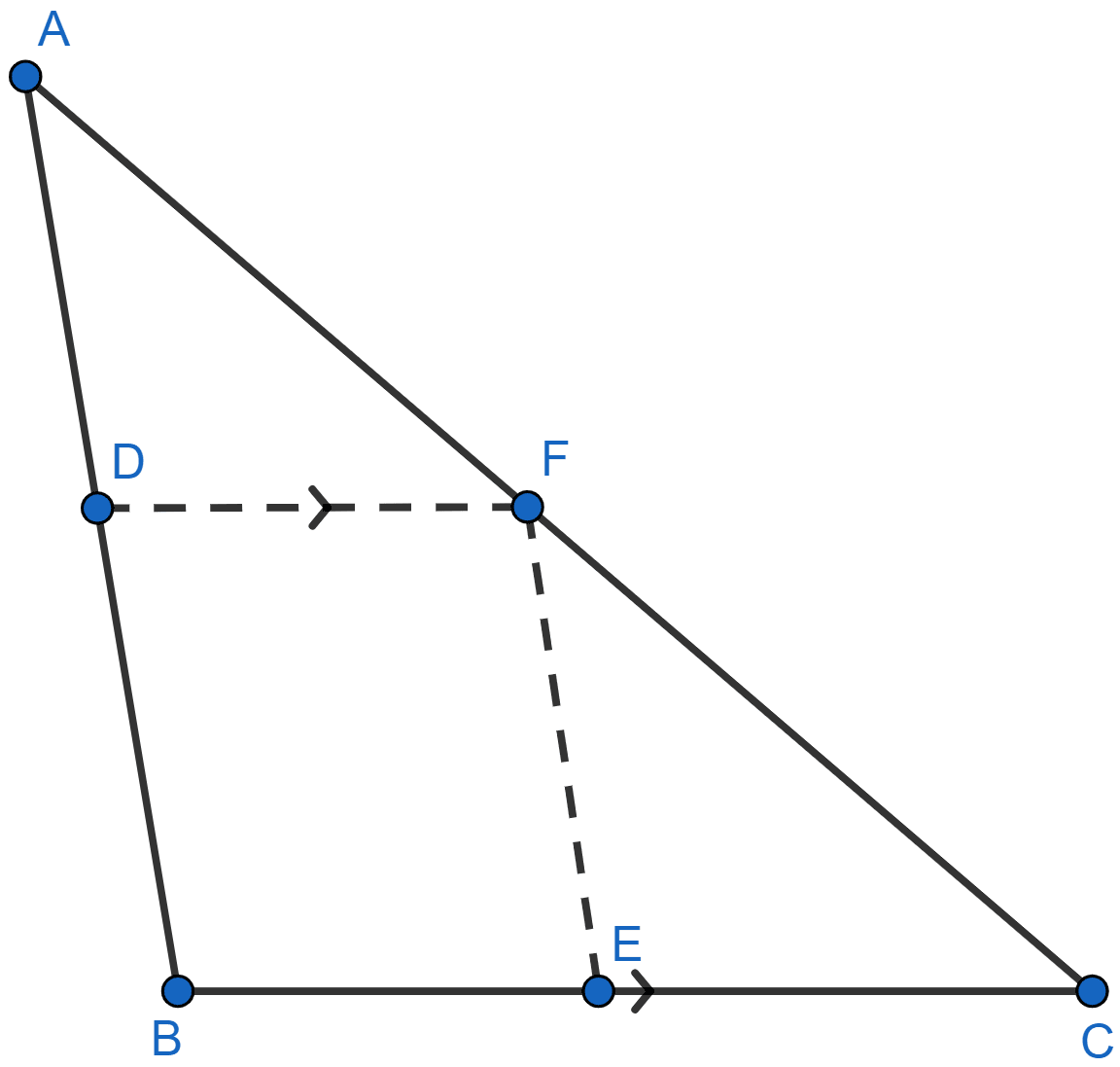
In the figure given below, D and E are mid-points of AB, BC respectively and DF || BC. Prove that DBEF is a parallelogram. Calculate AC if AF = 2.6 cm.
Answer
In △ABC,
D is the midpoint of AB and DF || BC
∴ F is the midpoint of AC (By converse of mid-point theorem)
F and E are midpoints of AC and BC respectively
∴ EF || AB ⇒ EF || DB .....(1)
From figure,
⇒ DF || BE ......(2)
Using 1 and 2,
⇒ EF || DB and DF || BE
Hence, proved that DBEF is a parallelogram.
F is the midpoint of AC we get,
AC = 2 × AF = 2 × 2.6 = 5.2 cm
Hence, AC = 5.2 cm
Prove that four triangles formed by joining in pairs, the mid-points of the sides of a triangle are congruent to each other.
Answer
From figure,
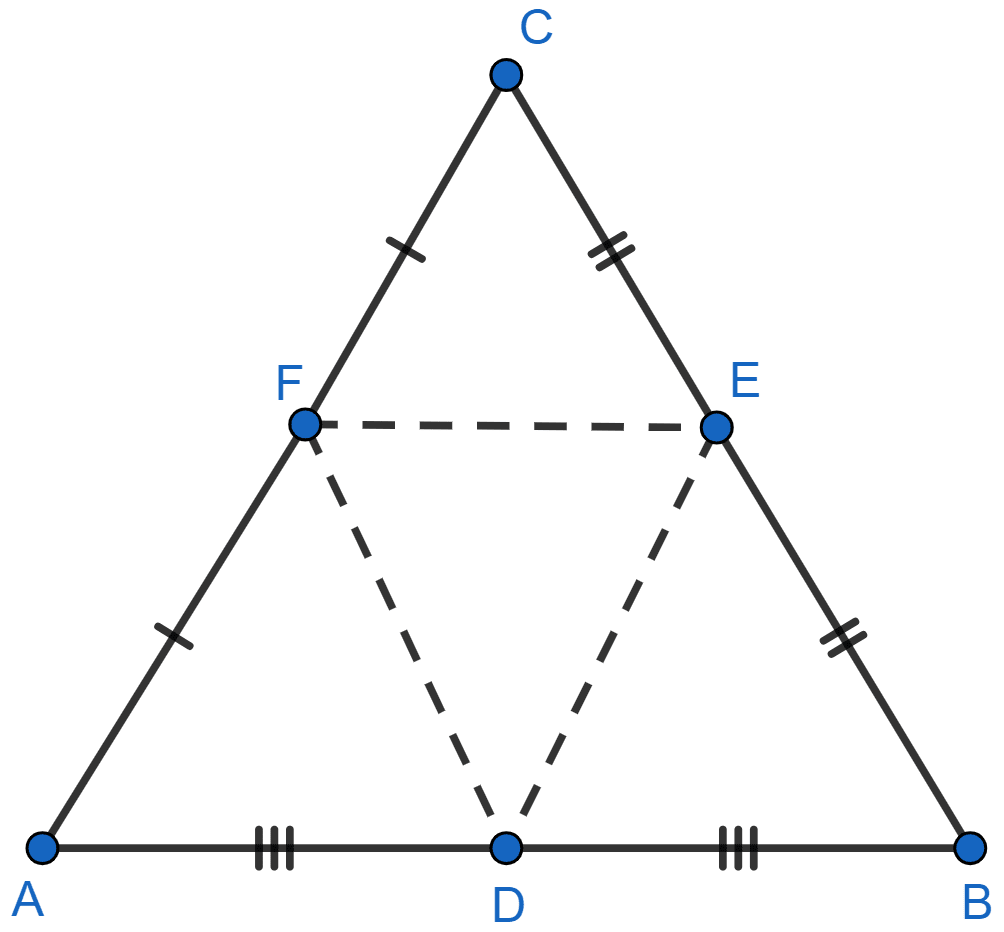
In △ABC,
D, E and F are mid-points of AB, BC and CA respectively.
Now join DE, EF and FD.
To prove :
△ADF ≅ △DBE ≅ △ECF ≅ △DEF
In △ABC,
D and E are midpoints of AB and BC
∴ DE || AC or,
DE || FC .......(i)
or DE || AF .........(ii)
D and F are midpoints of AB and AC
∴ DF || BC or,
DF || EC .......(iii)
or DF || BE ........(iv)
F and E are midpoints of AC and BC
∴ FE || AB or,
FE || AD .......(v)
or FE || DB (vi)
From (i) and (iii) we get,
DE || FC and DF || EC.
∴ DECF is a parallelogram.
We know that,
Diagonal FE divides the parallelogram DECF in two congruent triangles DEF and CEF.
∴ △DEF ≅ △ECF .......(1)
From (ii) and (v) we get,
DE || AF and FE || AD.
∴ ADEF is a parallelogram.
We know that,
Diagonal FD divides the parallelogram in two congruent triangles DEF and AFD.
∴ △DEF ≅ △AFD .......(2)
From (iv) and (vi) we get,
DF || BE and FE || DB.
∴ DBEF is a parallelogram.
We know that,
Diagonal DE divides the parallelogram in two congruent triangles DEF and DBE.
∴ △DEF ≅ △DBE .......(3)
Using equations 1, 2 and 3 we get,
△ADF ≅ △DBE ≅ △ECF ≅ △DEF.
Hence, proved that four triangles formed by joining in pairs, the mid-points of the sides of a triangle are congruent to each other.
If D, E and F are mid-points of the sides AB, BC and CA respectively of an isosceles triangle, ABC, prove that △DEF is also isosceles.
Answer
It is given that,
ABC is an isosceles triangle. Let AB = AC = x.

D, E and F are mid-points of the sides AB, BC and CA respectively.
Join D, E and F.
D and E are midpoints of AB and BC
∴ DE || AC and DE = AC = . (By midpoint theorem) ......(i)
F and E are midpoints of AC and BC
∴ FE || AB and FE = AB = . (By midpoint theorem) ......(ii)
From (i) and (ii) we get, DE = FE.
Hence, proved that △DEF is an isosceles triangle.
The diagonals AC and BD of a parallelogram ABCD intersect at O. If P is the mid-point of AD, prove that
(i) PO || AB
(ii) PO = CD.
Answer
(i) Given,
ABCD is a parallelogram in which diagonals AC and BD intersect each other at O, P is the midpoint of AD.
Join OP.

In parallelogram, diagonals bisect each other,
∴ BO = OD.
Here, O is the mid-point of BD.
In △ABD,
P and O are midpoints of AD and BD respectively,
PO || AB and PO = AB (By midpoint theorem) ......(i)
Hence, proved that PO || AB.
(ii) ABCD is a parallelogram.
∴ AB = CD .......(ii)
Using both (i) and (ii) we get,
PO = AB = CD.
Hence, proved that PO = CD.
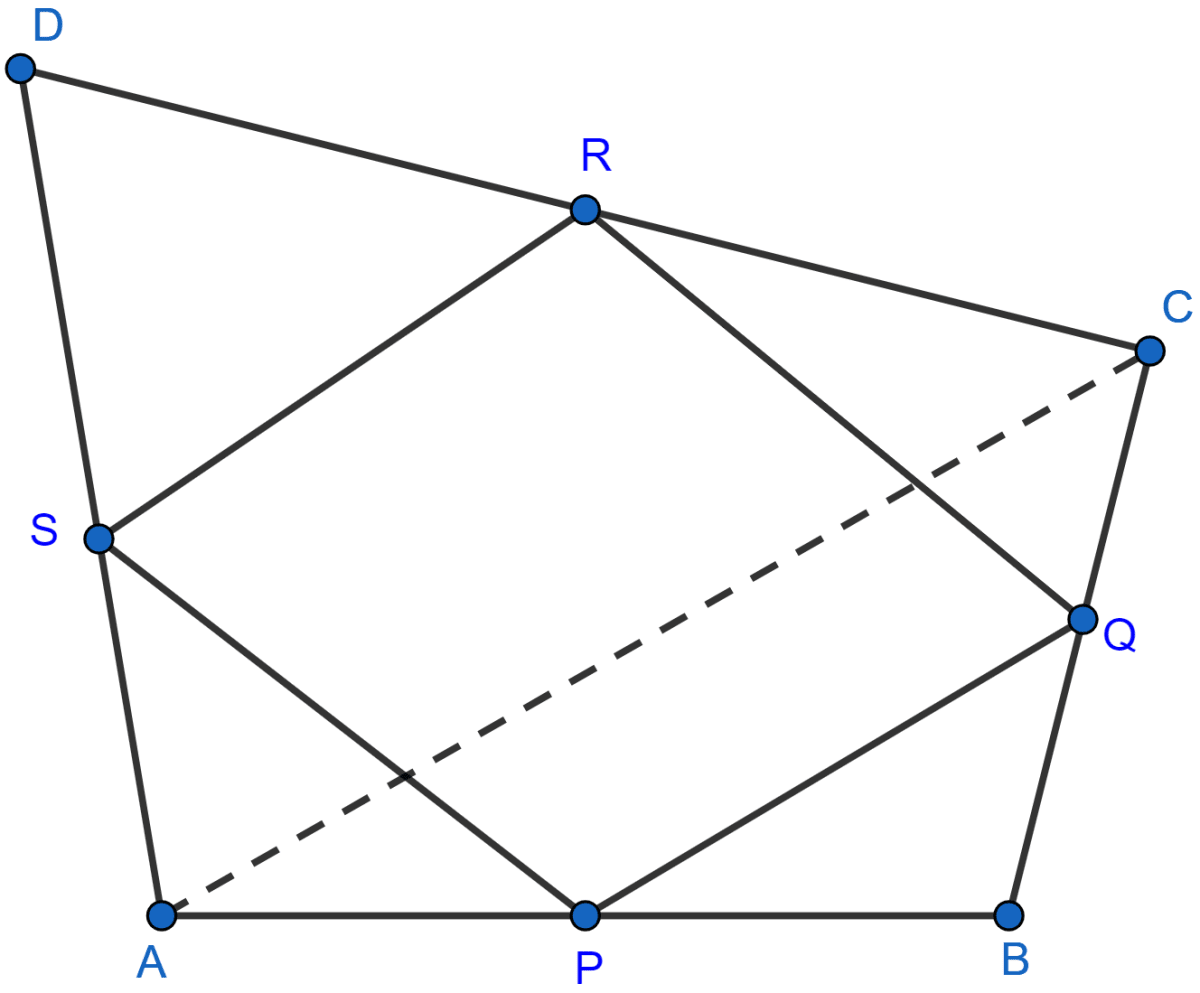
In the adjoining figure, ABCD is a quadrilateral in which P, Q, R and S are midpoints of AB, BC, CD and DA respectively. AC is its diagonal. Show that
(i) SR || AC and SR = AC
(ii) PQ = SR
(iii) PQRS is a parallelogram.
Answer
(i) In △ADC,
S and R are midpoints of AD and DC respectively,
∴ SR || AC and SR = AC (By mid-point theorem) .....(i)
Hence, proved that SR || AC and SR = AC (By mid-point theorem).
(ii) In △ABC,
P and Q are midpoints of AB and BC,
PQ || AC and PQ = AC .......(ii)
Using (i) and (ii) we get,
PQ = SR and PQ || SR.
Hence, proved that PQ = SR.
(iii) Since, PQ = SR and PQ || SR.
Hence, proved that PQRS is a parallelogram.
Show that the quadrilateral formed by joining the mid-points of the adjacent sides of a square, is also a square.
Answer
Let ABCD be a square in which E, F, G and H are midpoints of AB, BC, CD and DA respectively.
Join EF, FG, GH and HE.
Join AC and BD.
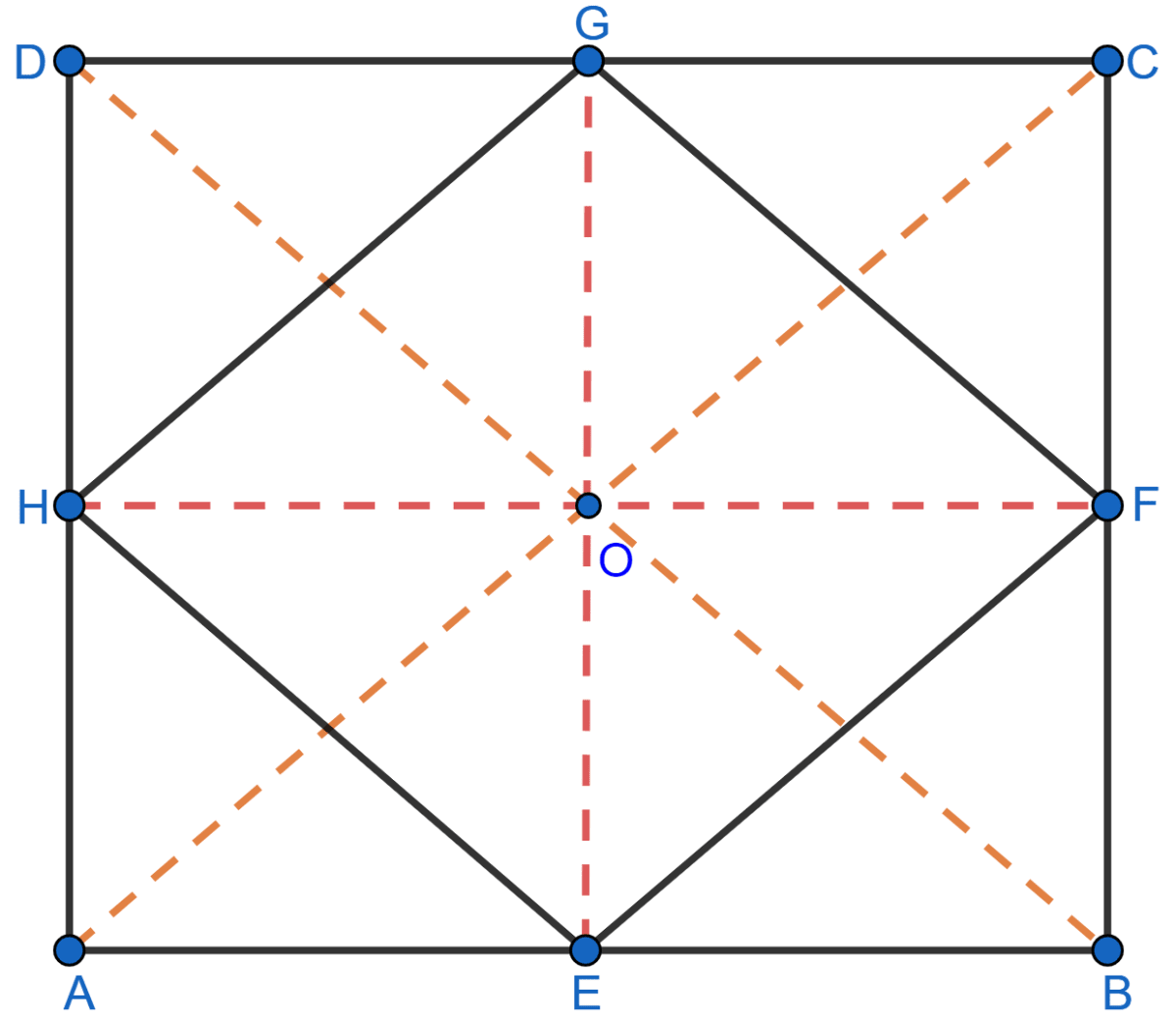
In △ACD,
G and H are mid-points of CD and AD respectively,
∴ GH || AC and GH = AC .......(i)
In △ABC,
E and F are mid-points of AB and BC respectively,
∴ EF || AC and EF = AC .......(ii)
Using (i) and (ii) we get,
EF || GH and EF = GH = AC ........(1)
In △ABD,
E and H are mid-points of AB and AD respectively,
∴ EH || BD and EH = BD .......(iii)
In △BCD,
G and F are mid-points of CD and BC respectively,
∴ FG || BD and FG = BD .......(iv)
Using (iii) and (iv) we get,
EH || FG and EH = FG = BD ........(2)
We know that diagonals of square are equal,
AC = BD
Dividing both sides by 2 we get,
Substituting above value in 1 and 2 we get,
EF = GH = EH = FG .........(v)
∴ EFGH is a parallelogram.
In △GOH and △GOF,
OH = OF as diagonals of parallelogram bisect each other.
OG = OG (Common)
GH = GF (From (v))
∴ △GOH ≅ △GOF (SSS axiom of congruency)
∠GOH = ∠GOF (c.p.c.t.c.)
From figure,
⇒ ∠GOH + ∠GOF = 180°
⇒ ∠GOH + ∠GOH = 180°
⇒ 2∠GOH = 180°
⇒ ∠GOH = 90°.
So, the diagonals of EFGH bisect and are perpendicular to each other.
∴ EFGH is a square.
Hence, proved that quadrilateral formed by joining the mid-points of the adjacent sides of a square, is also a square.
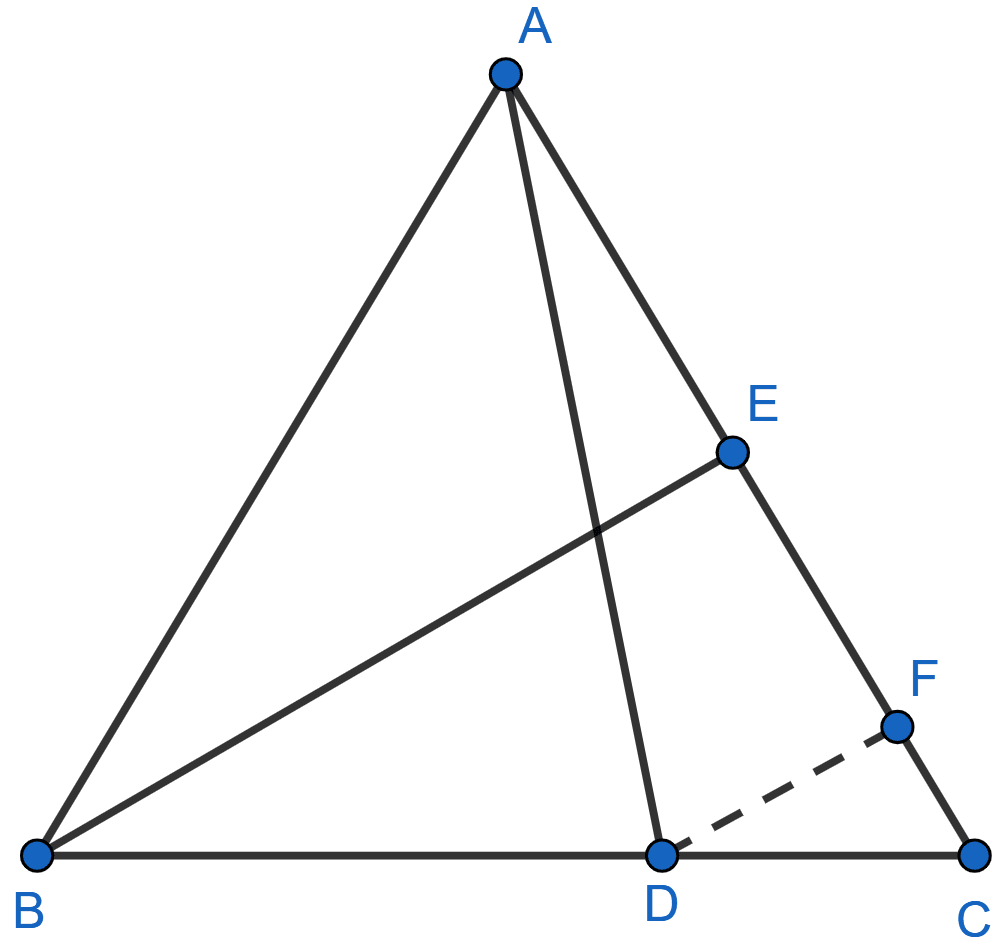
In the adjoining figure, AD and BE are medians of △ABC. If DF || BE, prove that CF =
Answer
In △BCE,
D is the midpoint of BC (As AD is median)
DF || BE
∴ F is the midpoint of CE (By converse of mid-point theorem).
⇒ CF = .......(i)
Given,
BE is median
∴ CE =
Substituting value of CE in (i) we get,
Hence, proved that
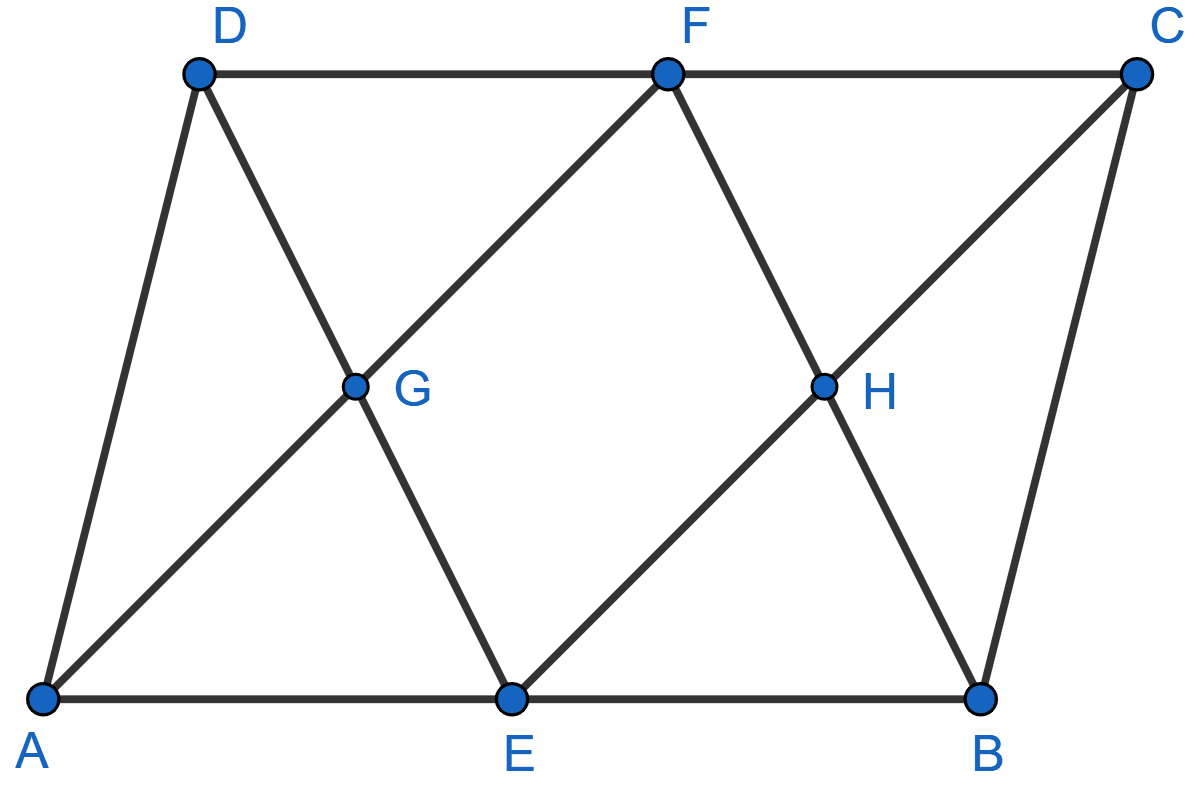
In the adjoining figure, ABCD is a parallelogram. E and F are mid-points of the sides AB and CD respectively. The straight lines AF and BF meet the straight lines ED and EC in points G and H respectively. Prove that
(i) △HEB ≅ △HCF
(ii) GEHF is a parallelogram.
Answer
(i) We know that,
ABCD is a parallelogram,
∴ FC || BE
∠CEB = ∠FCE (Alternate angles)
⇒ ∠HEB = ∠FCH .......(1)
∠EBF = ∠CFB (Alternate angles)
⇒ ∠EBH = ∠CFH .......(2)
Here E and F are mid-points of AB and CD
BE = AB ........(3)
CF = CD ........(4)
We know that ABCD is a parallelogram,
AB = CD
Now dividing both sides by
AB = CD
Using equations 3 and 4 we get,
BE = CF .......(5)
In △HEB and △HCF,
∠HEB = ∠FCH (Using eqn. i)
∠EBH = ∠CFH (Using eqn. ii)
BE = CF (Using eqn. v)
∴ △HEB ≅ △HCF (By ASA axiom of congruency)
Hence, proved that △HEB ≅ △HCF.
(ii) AB = CD (As ABCD is a parallelogram)
Hence, AE = CF (As E and F are mid-points of the sides AB and CD respectively)
As, AB || CF we can say that,
AE || CF
Since, AE = CF and AE || CF
∴ AECF is a parallelogram.
∴ AF || EC
From figure we get,
GF || EH ........(1)
AB = CD (As ABCD is a parallelogram)
Hence, DF = EB (As E and F are mid-points of the sides AB and CD respectively) and DF || EB.
Since, DF = EB and DF || EB
∴ DEBF is a parallelogram.
∴ DE || FB
From figure we get,
GE || FH ........(2)
From 1 and 2 we get,
GF || EH and GE || FH.
∴ GEHF is a parallelogram.
Hence, proved that GEHF is a parallelogram.
ABC is an isosceles triangle with AB = AC. D, E and F are mid-points of the sides BC, AB and AC respectively. Prove that line segment AD is perpendicular to EF and is bisected by it.
Answer
From figure,
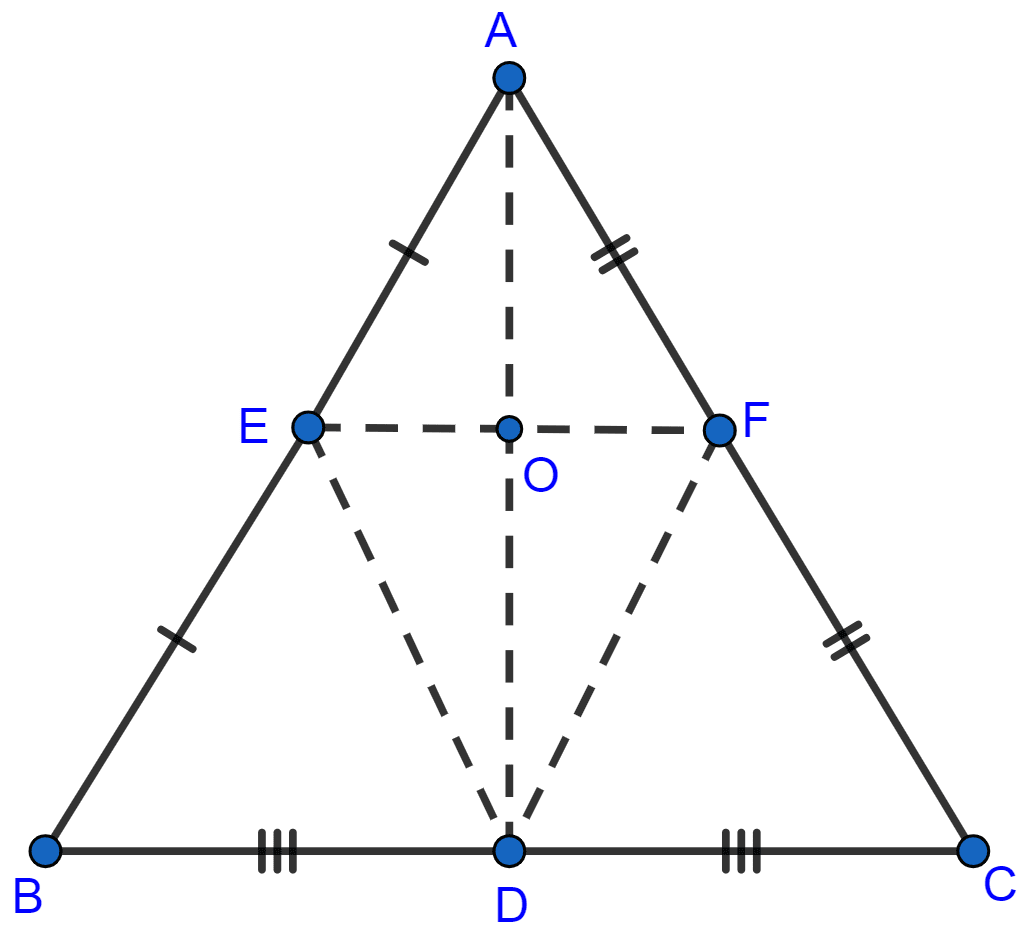
In △ABD and △ACD,
△ABC is an isosceles triangle
∴ ∠ABD = ∠ACD
Here D is the mid-point of BC
BD = CD
It is given that AB = AC
∴ △ABD ≅ △ACD (By SAS axiom of congruency)
⇒ ∠ADB = ∠ADC (By c.p.c.t.c)
From figure,
⇒ ∠ADB + ∠ADC = 180°
⇒ ∠ADB + ∠ADB = 180°
⇒ 2∠ADB = 180°
⇒ ∠ADB = 90°.
So, AD is perpendicular to BC.
D and E are mid-points of BC and AB,
By midpoint theorem,
DE || AC or,
DE || AF .......(i)
D and F are mid-points of BC and AC,
By midpoint theorem,
DF || AB or,
DF || AE .......(ii)
Using (i) and (ii) we get,
AEDF is a parallelogram.
Diagonals of parallelogram bisect each other
AD and EF bisect each other.
Since, E and F are mid-points of AB and AC,
By midpoint theorem,
EF || BC
Since, AD is perpendicular to BC and EF || BC.
∴ AD ⊥ EF.
Hence, proved that line segment AD is perpendicular to EF and is bisected by it.
In the quadrilateral given below, AB || DC, E and F are mid-points of AD and BD respectively. Prove that
(i) G is the mid-point of BC
(ii) EG = (AB + DC).
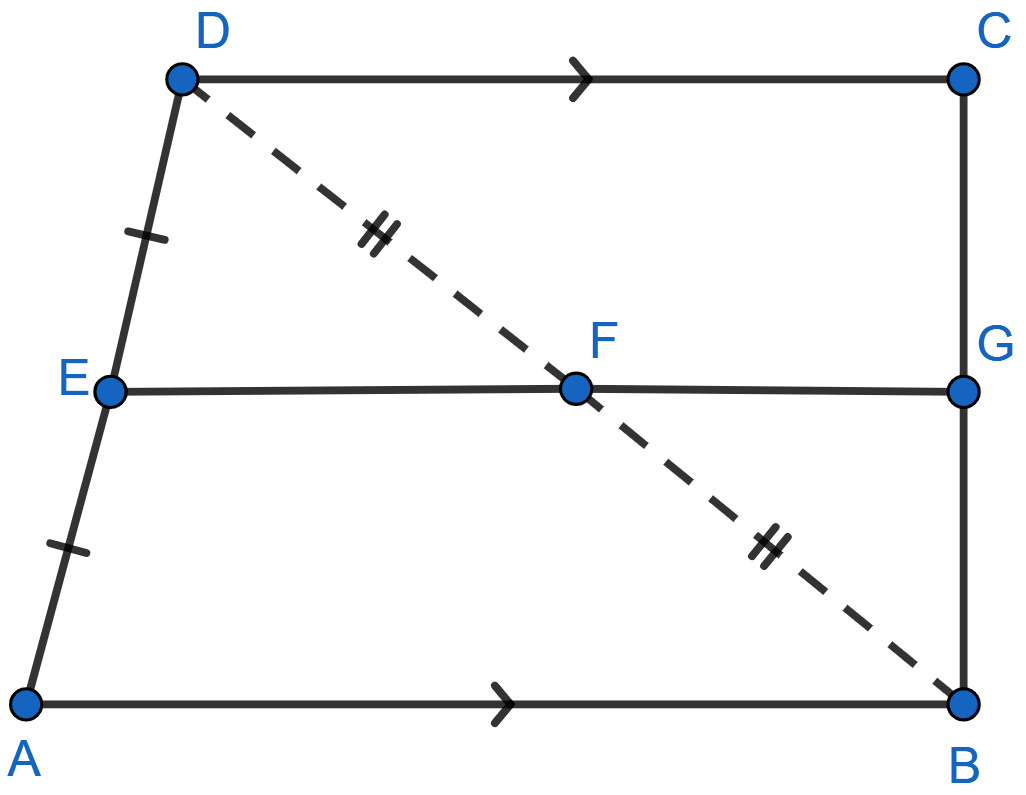
Answer
(i) In △ABD,
E is mid-point of AD and F is mid-point of BD,
∴ EF || AB and EF = AB .......(1)
Given,
AB || CD
Since, EF || AB and AB || CD
⇒ EF || CD
⇒ EG || CD.
Since, EG || CD we can say,
In △BCD,
⇒ FG || CD
Given, F is midpoint of BD and FG || CD
∴ G is the midpoint of BC. (By converse of mid-point theorem)
Hence, proved that G is the midpoint of BC.
(ii) In △BCD,
F and G are midpoint of BD and BC respectively,
FG = CD ..........(2)
Adding eqn. (1) from part (i) and eqn (2) we get,
EF + FG = AB + CD
EG = (AB + CD).
Hence, proved that EG = (AB + CD).
In the quadrilateral given below, AB || DC || EG. If E is mid-point of AD, prove that
(i) G is midpoint of BC
(ii) 2EG = AB + CD
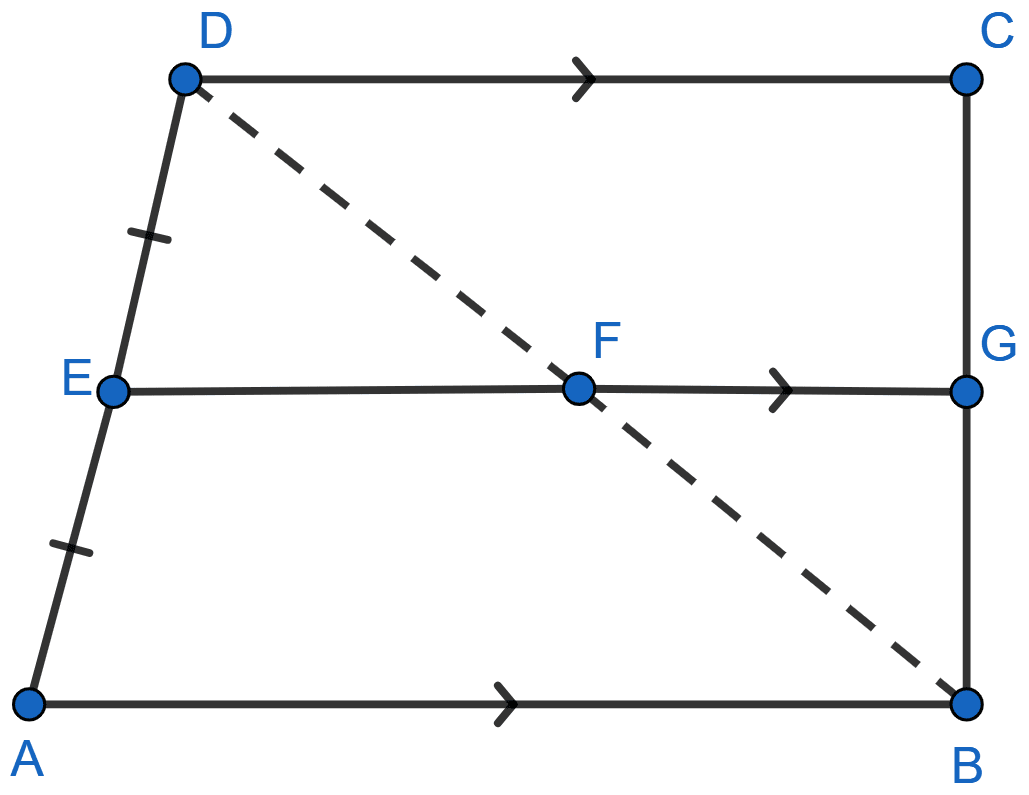
Answer
(i) Given,
EG || AB, we can say that
⇒ EF || AB
In △DAB,
E is midpoint of AD and EF || AB
∴ F is midpoint of BD (By converse of mid-point theorem).
EF = AB .......(1)
Given,
EG || DC we can say that,
FG || DC
In △BCD,
F is midpoint of BD and FG || DC
∴ G is midpoint of BC (By converse of mid-point theorem).
Hence, proved that G is midpoint of BC.
(ii) In △BCD,
F is midpoint of BD and G is midpoint of BC
∴ FG = DC .......(2)
Adding eqn. 1 from part (i) and eqn. 2 we get,
EF + FG = AB + DC
EG = (AB + CD)
2EG = AB + CD.
Hence, proved that 2EG = AB + CD.
In the quadrilateral given below, AB || DC. E and F are mid-points of non-parallel sides AD and BC respectively. Calculate :
(i) EF if AB = 6 cm and DC = 4 cm
(ii) AB if DC = 8 cm and EF = 9 cm.
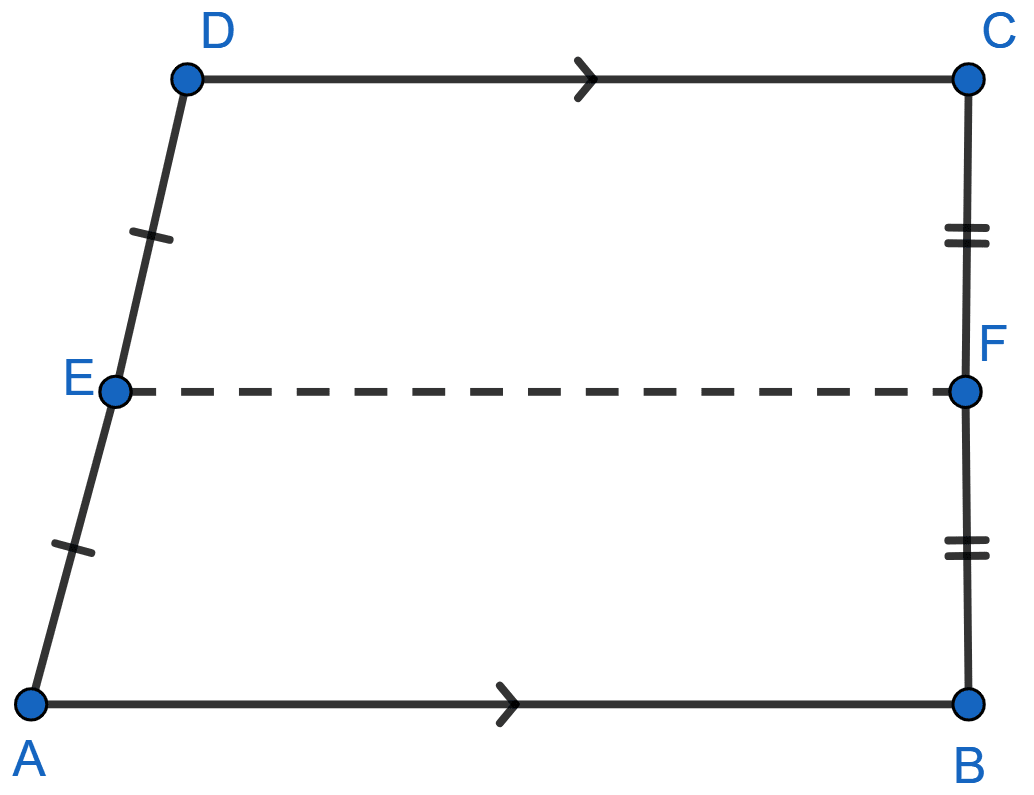
Answer
ABCD is a trapezium in which AB || DC and E, F are mid-points of AD and BC respectively.
Join CE and produce it to meet BA produced at G.
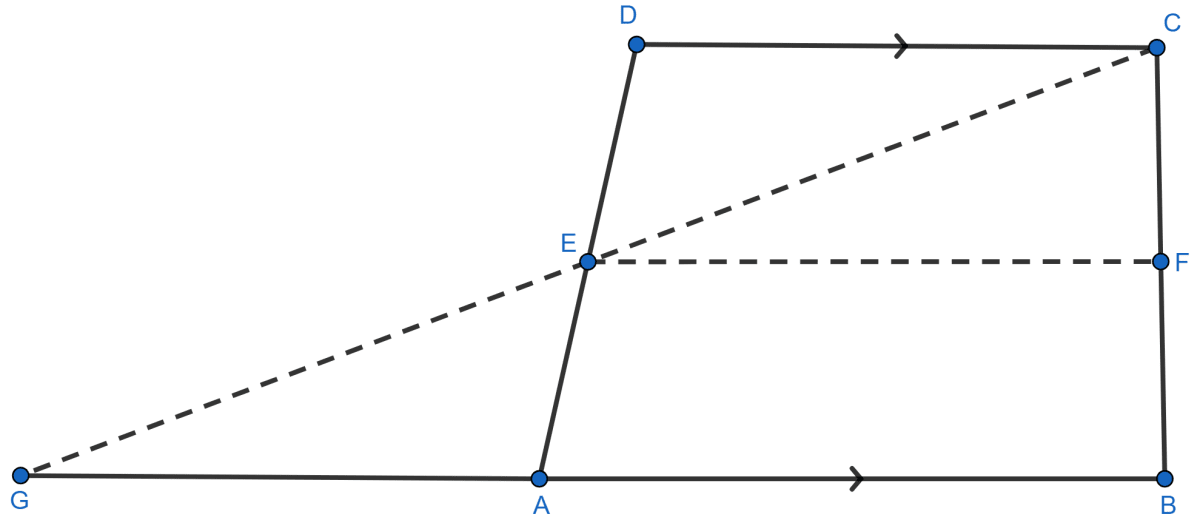
In △EDC and △EAG,
ED = EA (∵ E is mid-point of AD)
∠CED = ∠ GEA (Vertically opposite ∠s)
∠ECD = ∠EGA (Alternate ∠s)
∴ △EDC ≅ △EAG
⇒ CD = GA and EC = EG (c.p.c.t.)
In △CGB,
E is mid-point of CG
F is mid-point of BC
∴ By mid-point theorem, EF || AB and EF = GB.
But GB = GA + AB = CD + AB
∴ EF = (AB + CD) .....(1)
(i) Given,
AB = 6 cm and DC = 4 cm,
Putting these values in eq (1) we get,
EF = (6 + 4)
= x 10
= 5 cm
Hence, EF = 5 cm.
(ii) Given,
DC = 8 cm and EF = 9 cm
Putting these values in eq (1) we get,
9 = (AB + 8)
⇒ 18 = AB + 8
⇒ AB = 18 - 8 = 10 cm
Hence, AB = 10 cm.
In the quadrilateral given below, AD = BC, P, Q, R and S are mid-points of AB, BD, CD and AC respectively. Prove that PQRS is a rhombus.

Answer
It is given that,
In △ABD,
P and Q are mid-points of AB and BD,
PQ || AD and PQ = AD = BC .......(i)
In △ACD,
R and S are mid-points of CD and AC,
RS || AD and RS = AD = BC .......(ii)
In △BCD,
R and Q are mid-points of CD and BD,
RQ || BC and RQ = BC .......(iii)
In △ABC,
P and S are mid-points of AB and AC,
PS || BC and PS = BC .......(iv)
From (i) and (ii) we get,
PQ || RS
From (iii) and (iv) we get,
RQ || PS
From (i), (ii), (iii) and (iv) we get,
PQ = RS = PS = RQ.
Since, all sides are equal and opposite sides are parallel.
Hence, proved that PQRS is a rhombus.
In the figure given below, ABCD is a kite in which BC = CD, AB = AD. E, F, G are mid-points of CD, BC and AB respectively. Prove that :
(i) ∠EFG = 90°
(ii) The line drawn through G and parallel to FE bisects DA.

Answer
Construction,
Join AC and BD
AC and BD intersect at O.
Join EF and FG.

(i) We know that,
Diagonals of a kite intersect at right angles.
∠MON = 90° .......(i)
In △BCD,
E and F are mid-points of CD and BC,
EF || DB and EF = DB ......(ii)
Since, EF || DB we can say that,
MF || ON.
As sum of opposite angles of a quadrilateral = 180°
∠MON + ∠MFN = 180°
90° + ∠MFN = 180°
∠MFN = 90°.
From figure,
∠EFG = ∠MFN = 90°.
Hence, proved that ∠EFG = 90°.
(ii) From part (i) we get,
FE || BD
Here line through G (GH) is parallel to FE.
∴ GH || FE
or GH || BD.
In △ABD,
GH || BD and G is midpoint of AB,
∴ H is mid-point of AD (By converse of mid-point theorem).
Hence, proved that the line drawn through G and parallel to FE bisects DA.
In the adjoining figure, the lines l, m and n are parallel to each other, and G is mid-point of CD. Calculate :
(i) BG if AD = 6 cm
(ii) CF if GE = 2.3 cm
(iii) AB if BC = 2.4 cm
(iv) ED if FD = 4.4 cm
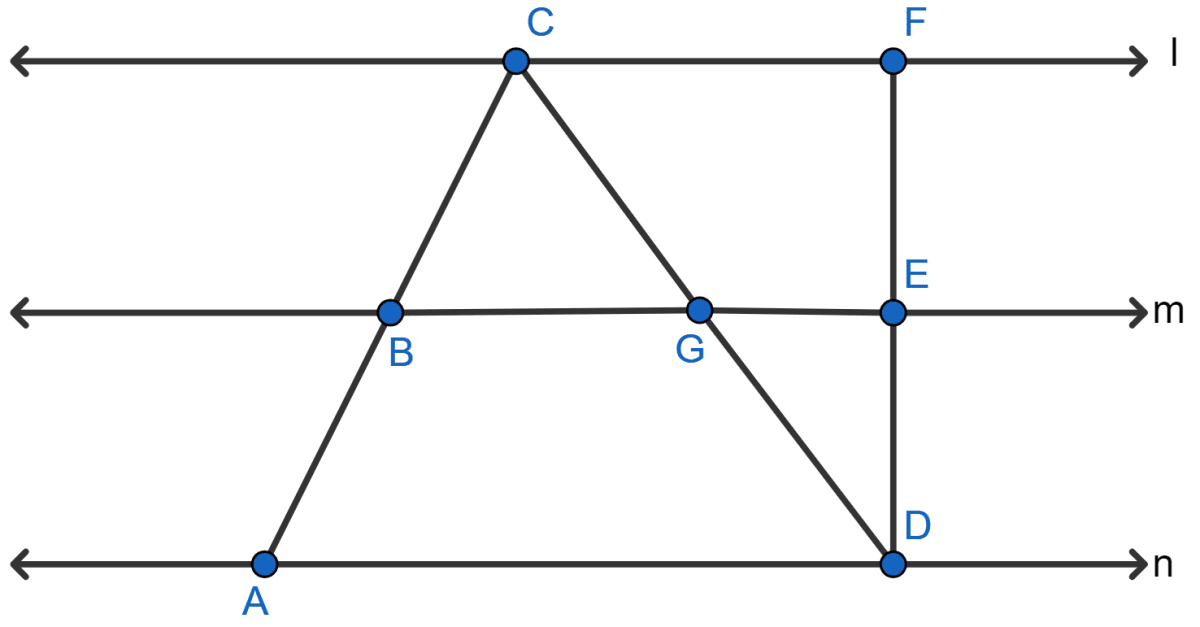
Answer
(i) In △ACD,
G is mid-point of CD and BG is parallel to AD,
∴ B is mid-point of AC (By converse of mid-point theorem).
By mid-point theorem,
BG = AD = x 6 = 3 cm.
Hence, BG = 3 cm.
(ii) In △CDF,
G is mid-point of CD and GE || CF
∴ E is mid-point of FD (By converse of mid-point theorem).
By mid-point theorem,
GE = CF
CF = 2GE
CF = 2(2.3) = 4.6 cm
Hence, CF = 4.6 cm.
(iii) From part (i)
B is mid-point of AC,
∴ AB = BC
Hence, AB = 2.4 cm
(iv) From part (ii),
E is mid-point of FD,
∴ ED = FD = x 4.4 = 2.2 cm
Hence, ED = 2.2 cm