
In triangles ABC and DEF, ∠A = ∠D, ∠B = ∠E and AB = EF. Will the two triangles be congruent? Give reasons for your answer.
Answer
Given,
In triangles ABC and DEF, ∠A = ∠D, ∠B = ∠E and AB = EF.
The two triangles will not be congruent as AB and EF are not corresponding sides.
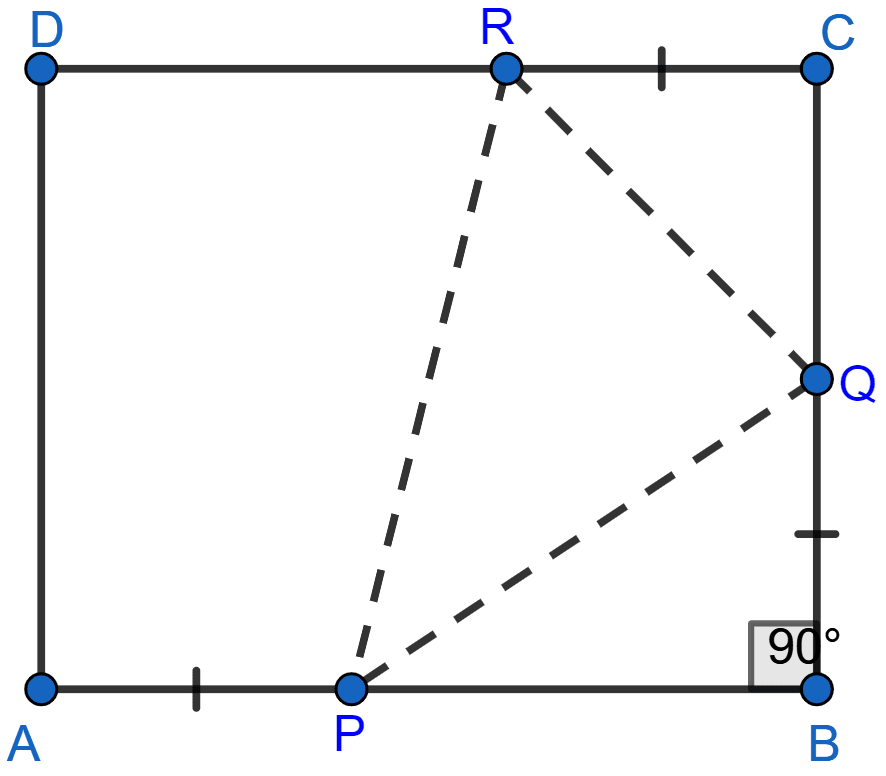
In the adjoining figure, ABCD is a square. P, Q and R are points on the sides AB, BC and CD respectively such that AP = BQ = CR and ∠PQR = 90°. Prove that
(a) △PBQ ≅ △QCR
(b) PQ = QR
(c) ∠PRQ = 45°
Answer
(a) Given, ABCD is a square.
∴ AB = BC.
Given, AP = BQ.
∴ AB - AP = BC - BQ .......(i)
In △PBQ and △QCR,
BQ = CR (Given)
From (i) we get,
PB = QC
∠PBQ = ∠QCR (Both are equal to 90°, as each angle in square = 90°.)
Hence, proved △PBQ ≅ △QCR by SAS axiom.
(b) We know that corresponding parts of congruent triangles are equal.
∴ PQ = QR.
Hence, proved that PQ = QR.
(c) Considering △PQR.
We know PQ = QR and ∠Q = 90°.
Hence, △PQR is an isosceles triangle with ∠P = ∠R = x.
Sum of angles of triangle = 180°.
⇒ ∠P + ∠Q + ∠R = 180°
⇒ x + 90° + x = 180°
⇒ 2x = 90°
⇒ x = 45°.
Hence, proved that ∠PRQ = 45°.
In the adjoining figure, OA ⊥ OD, OC ⊥ OB, OD = OA and OB = OC. Prove that AB = CD.

Answer
From figure,
∠AOD = ∠COB (Each 90°)
Adding ∠AOC to both sides,
⇒ ∠AOD + ∠AOC = ∠AOC + ∠COB
⇒ ∠COD = ∠AOB.
Now, in △AOB and △DOC
OA = OD (Given)
OB = OC (Given)
∠AOB = ∠COD (Proved)
∴ △AOB ≅ △DOC (SAS axiom)
We know that corresponding parts of congruent triangles are equal.
∴ AB = CD.
Hence, proved that AB = CD.
In the adjoining figure, PQ || BA and RS || CA. If BP = RC, prove that:
(i) △BSR ≅ △PQC
(ii) BS = PQ
(iii) RS = CQ.

Answer
Given, BP = RC
⇒ BR - PR = PC - PR
⇒ BR = PC.
Now, in △BSR and △PQC,
∠B = ∠P (Corresponding angles)
∠R = ∠C (Corresponding angles)
BR = PC (Proved)
Hence, proved △BSR ≅ △PQC by ASA axiom.
(ii) We know that corresponding parts of congruent triangles are equal.
∴ BS = PQ.
(iii) We know that corresponding parts of congruent triangles are equal.
∴ RS = CQ.
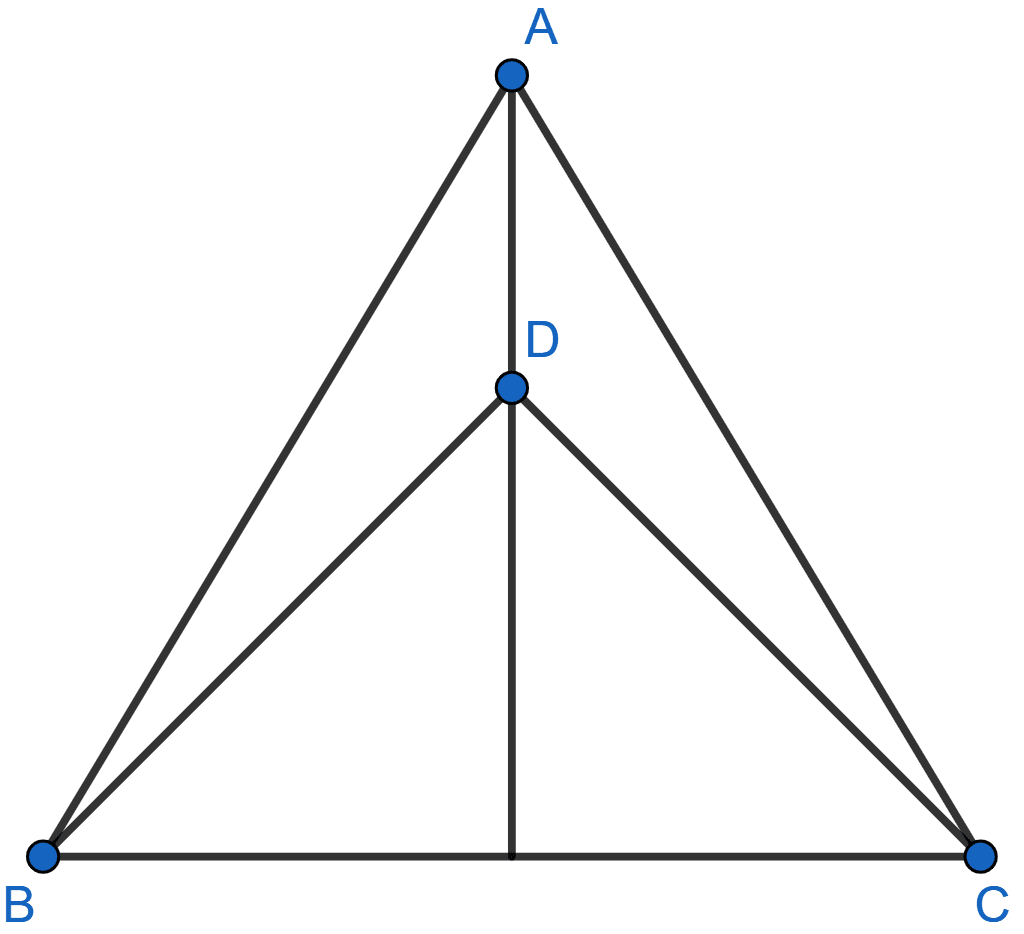
In the adjoining figure, AB = AC, D is a point in the interior of △ABC such that ∠DBC = ∠DCB. Prove that AD bisects ∠BAC of △ABC.
Answer
Given, AB = AC.
∴ ∠ABC = ∠ACB (As angles opposite to equal sides of isosceles triangle are equal.)
Given, ∠DBC = ∠DCB
∴ DB = DC. (Sides opposite to equal angles are equal.)
In △ABD and △ACD,
AB = AC (Given)
DB = DC (Proved)
AD = AD (Common)
Thus, △ABD ≅ △ACD by SSS axiom.
We know that corresponding parts of congruent triangle are equal.
∴ ∠BAD = ∠CAD.
Hence, proved that AD bisects ∠BAC.
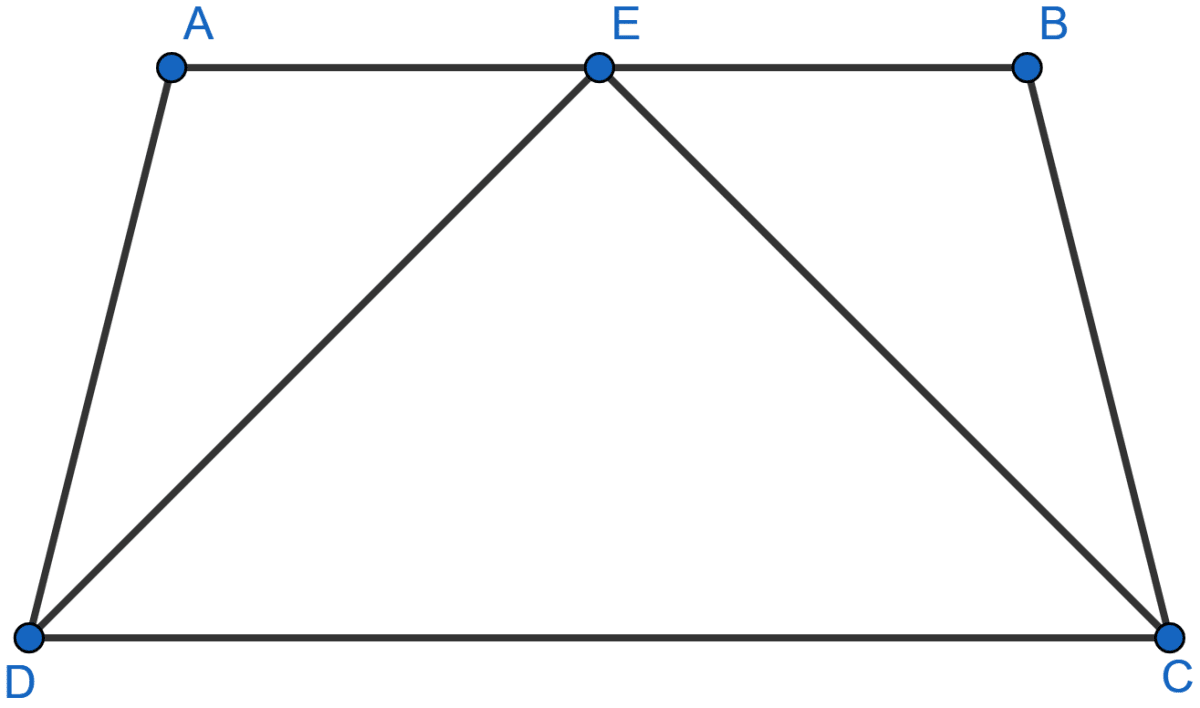
In the adjoining figure, AB || DC. CE and DE bisects ∠BCD and ∠ADC respectively. Prove that AB = AD + BC.
Answer
Given,
DE bisects ∠D.
∴ ∠EDA = ∠EDC = .
AB || CD and DE cuts these parallel lines.
∠DEA = ∠EDC = .
In △ADE,
∠ADE = ∠DEA = .
Hence, AD = AE.
Given,
CE bisects ∠C.
∴ ∠ECB = ∠ECD = .
AB || CD and CE cuts these parallel lines.
∠CEB = ∠ECD = .
In △BCE,
∠BEC = ∠BCE =
Hence, BE = BC.
⇒ AB = AE + BE = AD + BC
⇒ AB = AD + BC.
Hence, proved that AB = AD + BC.
In △ABC, D is a point on BC such that AD is the bisector of ∠BAC. CE is drawn parallel to DA to meet BD produced at E. Prove that △CAE is isosceles.
Answer
From figure,
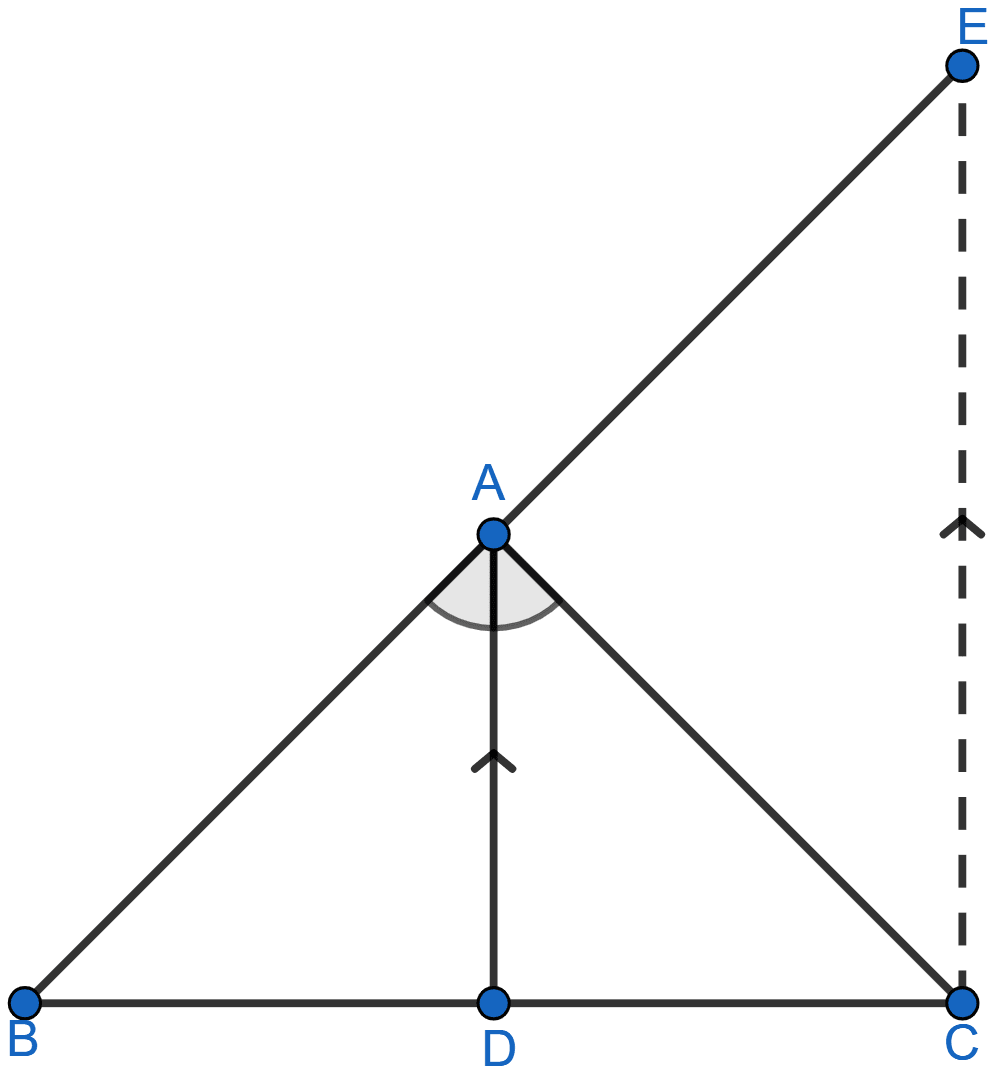
∠DAC= ∠ACE (Alternate angles)
∠BAD = ∠CEA (Corresponding angles)
But, ∠BAD = ∠DAC (as AD is bisector of ∠BAC)
∴ ∠ACE = ∠CEA
AE = AC (Sides opposite to equal angles are equal.)
∴ △CAE is isosceles triangle.
Hence, proved that △CAE is isosceles triangle.
In the adjoining figure, ABC is a right angled triangle at B. ADEC and BCFG are squares. Prove that AF = BE.

Answer
Given, ADEC and BCFG are squares.
Considering △BCE and FCA we get,
From figure,
∠BCE = ∠BCA + 90
∠ACF = ∠BCA + 90
∠BCE = ∠ACF
AC = CE (Sides of squares are equal)
BC = CF (Sides of squares are equal)
△BCE ≅ △FCA (By SAS axiom).
We know that corresponding parts of congruent triangles are equal.
∴ AF = BE.
Hence, proved that AF = BE.
In the adjoining figure, TR = TS, ∠1 = 2∠2 and ∠4 = 2∠3. Prove that RB = SA.

Answer
∠1 = ∠4 (Vertically opposite angles)
⇒ 2∠2 = 2∠3
⇒ ∠2 = ∠3.
TS = TR (Given)
⇒ ∠TRS = ∠TSR (As angle opposite to equal side are equal)
⇒ ∠TRS - ∠2 = ∠TSR - ∠3
⇒ ∠ARB = ∠BSA.
∠RTB = ∠STA (Common angle)
△RBT ≅ △SAT (By ASA axiom.)
We know that corresponding sides of congruent triangles are equal.
∴ RB = SA.
Hence, proved that RB = SA.
In the figure (1) given below, find the value of x.

Answer
From figure,

∠ABD = ∠BAD = 36° (As angles opposite to equal sides are equal.)
∠BDA = 180° - (36° + 36°) = 180° - 72° = 108°.
From figure,
∠BDA + ∠ADC = 180°
108° + ∠ADC = 180°
∠ADC = 72°.
In △ADC,
As AD = AC,
∴ ∠ADC = ∠ACD = 72° (As angles opposite to equal sides are equal.)
∠ADC + ∠ACD + ∠DAC = 180°
72° + 72° + ∠DAC = 180°
∠DAC = 180° - 144° = 36°.
From figure,
∠BAD + ∠DAC + x = 180°
36° + 36° + x = 180°
72° + x = 180°
x = 108°.
Hence, x = 108°.
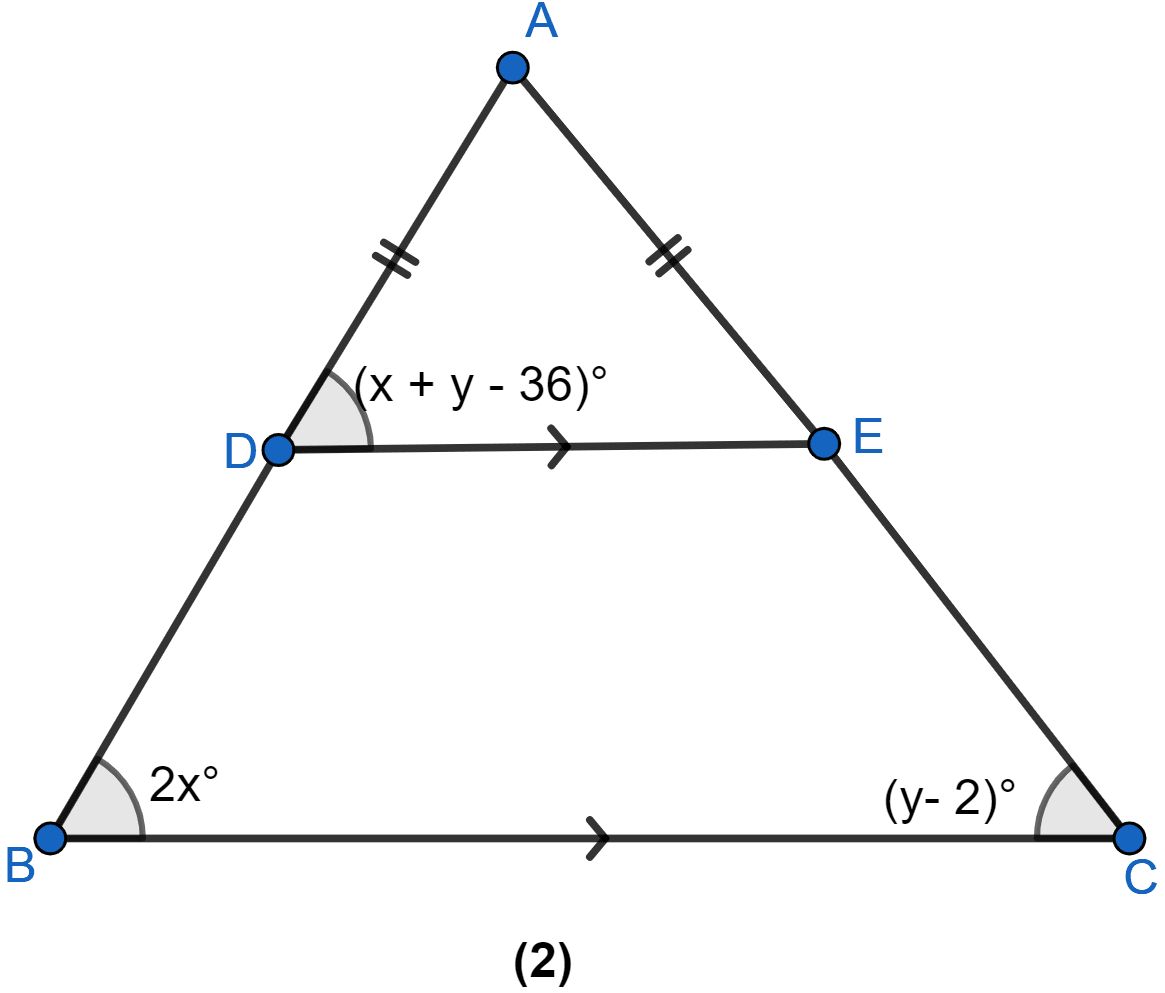
In the figure (2) given below, AB = AC and DE || BC. Calculate
(i) x
(ii) y
(iii) ∠BAC
Answer
(i) Since, AB = AC
∠ABC = ∠ACB
⇒ 2x° = (y - 2)°
⇒ y° = 2x° + 2° .......(i)
From figure,
∠ADE = ∠ABC (Corresponding angles)
⇒ x° + y° - 36° = 2x°
⇒ y° - 36° = x°
Substituting value of y from (i) in above equation,
⇒ 2x° + 2° - 36° = x°
⇒ 2x° - x° = 34°
⇒ x° = 34°
⇒ x = 34.
Hence, x = 34.
(ii) Substituting value of x in (i),
⇒ y° = 2(34)° + 2°
⇒ y° = 68° + 2° = 70°.
⇒ y = 70.
Hence, y = 70.
(iii) From figure,
∠BAC = 180° - (2x° + y° - 2°)
= 180° - (2 × 34° + 70° - 2°)
= 180° - (68° + 68°)
= 180° - 136° = 44°.
Hence, ∠BAC = 44°.
In the figure (3) given below, calculate the size of each lettered angle.

Answer
From figure,

∠AEB = ∠DEC = 80° (Vertically opposite angles are equal).
In △AEB,
⇒ x + 54° + 80° = 180°
⇒ x + 134° = 180°
⇒ x = 46°.
AB = BC
⇒ ∠BAC = ∠ACB (As angles opposite to equal sides are equal.)
∴ ∠ACB = 54°
In △ABC,
∠ABC + ∠ACB + ∠BAC = 180°
⇒ (x + y)° + 54° + 54° = 180°
⇒ y° + 46° + 108° = 180°
⇒ y = 180° - 154° = 26°.
From figure,
∠ECD = ∠BAE = 54° (Alternate angles)
∠BCA + ∠ECD + z = 180°
54° + 54° + z = 180°
108° + z = 180°
z = 72°.
Hence, x = 46°, y = 26° and z = 72°.
In the figure (1) given below, AD = BD = DC and ∠ACD = 35°. Show that
(i) AC > DC
(ii) AB > AD.

Answer
From figure,
∠DAC = ∠ACD = 35° (As angles opposite to equal sides are equal.)
∠ADC = 180° - (35° + 35°) = 180° - 70° = 110°.
Since, ∠ADC > ∠DAC
∴ AC > DC (Side opposite to greater angle is greater.)
Hence, proved that AC > DC.
(ii) From figure,
∠ADB = 180° - ∠ADC = 180° - 110° = 70°.
Considering △ABD,
AD = BD.
∴ ∠BAD = ∠ABD = a.
⇒ a + a + ∠ADB = 180°
⇒ 2a + 70° = 180°
⇒ 2a = 110°
⇒ a = 55°.
Since, ∠ADB > ∠ABD
∴ AB > AD. (Side opposite to greater angle is greater.)
Hence, proved that AB > AD.
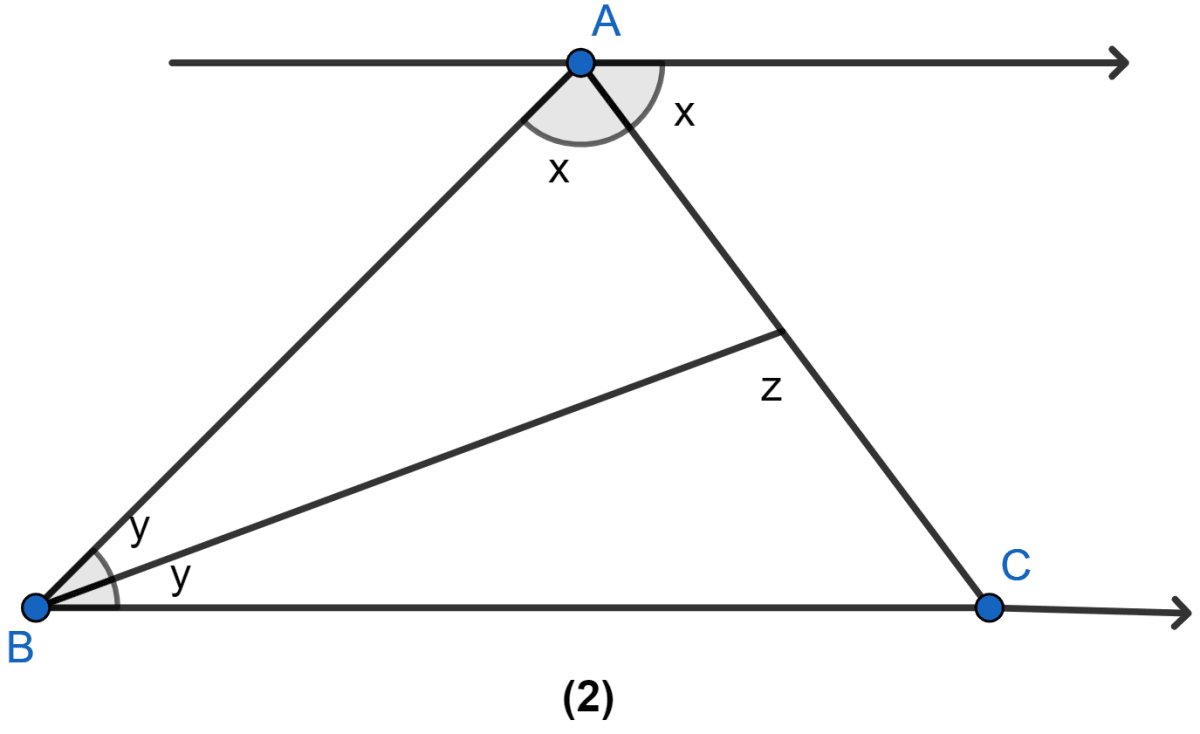
In the figure (2) given below, prove that
(i) x + y = 90°
(ii) z = 90°
(iii) AB = BC.
Answer
(i) From figure,
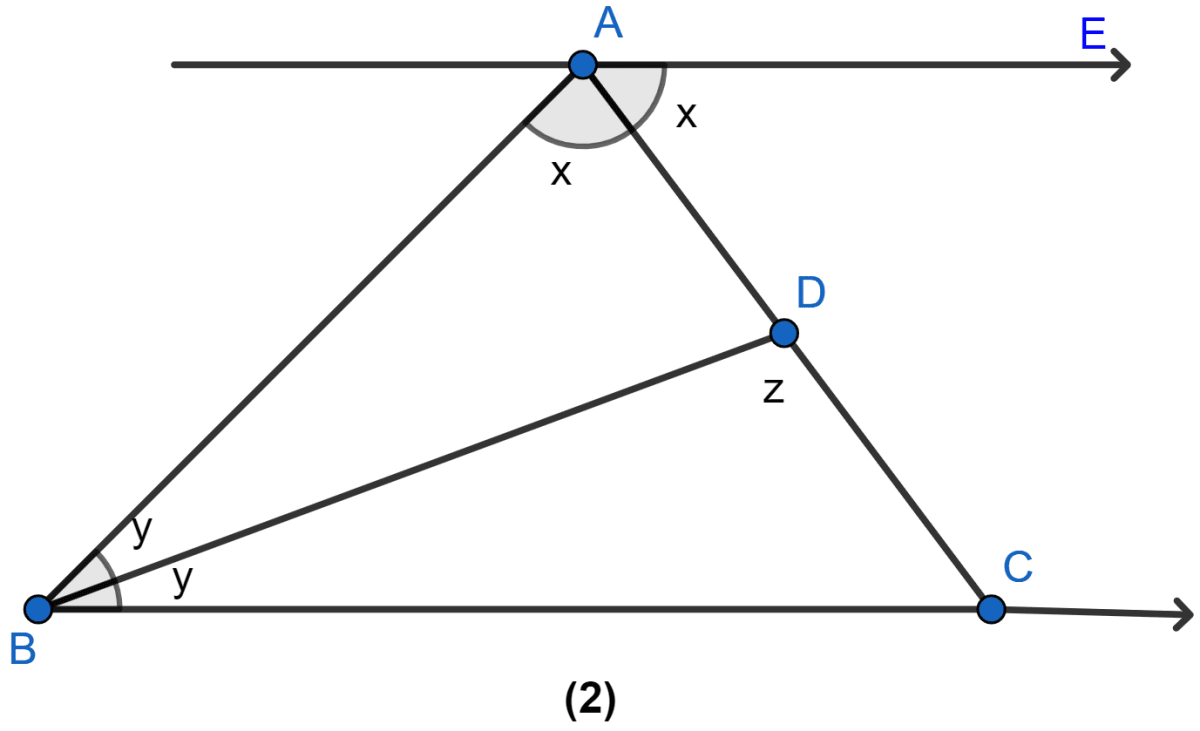
∠ACB = x (Alternate angles)
In △ABC,
⇒ x + (y + y) + ∠ACB = 180°
⇒ x + 2y + x = 180°
⇒ 2x + 2y = 180°
⇒ x + y = 90°.
Hence, proved that x + y = 90°.
(ii) Now in △BCD,
⇒ y + z + ∠BCD = 180° (Sum of all angles in a triangle is 180°)
⇒ y + z + x = 180°
⇒ 90° + z = 180° [∵ x + y = 90°]
⇒ z = 90°.
Hence, proved that z = 90°.
(iii) In △ABC,
∠ACB = ∠BAC = x
∴ AB = BC (As sides opposite to equal angles are equal.)
Hence, proved that AB = BC.
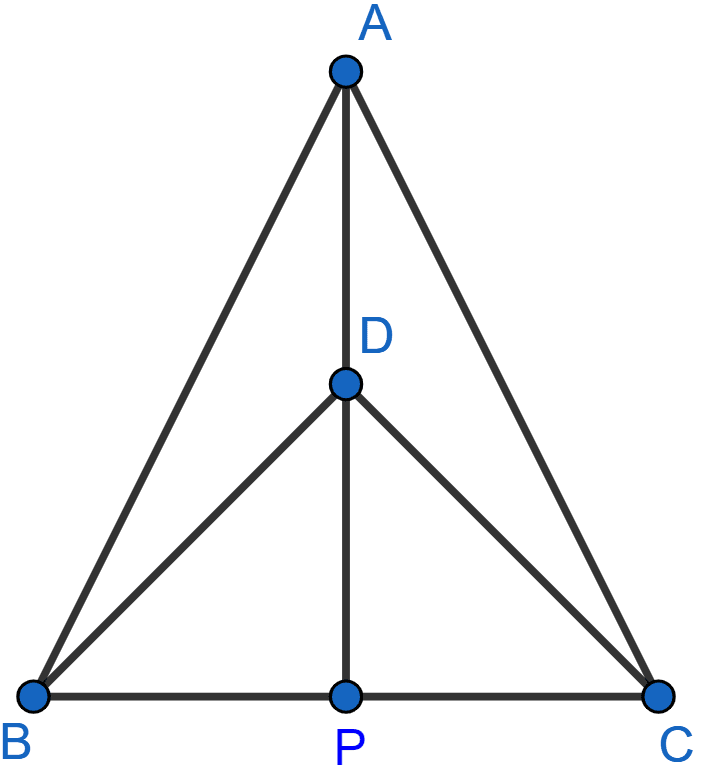
In the adjoining figure, ABC and DBC are two isosceles triangles on the same base BC and vertices A and D are on the same side of BC. If AD is extended to intersect BC at P, show that
(i) △ABD ≅ △ACD
(ii) △ABP ≅ △ACP
(iii) AP bisects ∠A as well as ∠D
(iv) AP is the perpendicular bisector of BC.
Answer
(i) AB = AC (as ABC is an isosceles triangle on base BC)
DB = DC (as DBC is an isosceles triangle on base BC)
AD = AD (Common)
∴ △ABD ≅ △ACD by SSS axiom.
Hence, proved that △ABD ≅ △ACD.
(ii) AB = AC (as ABC is an isosceles triangle on base BC)
AP = AP (Common)
∠ABP = ∠ACP (As angles opposite to equal sides are equal.)
∴ △ABP ≅ △ACP by AAS axiom.
Hence, proved that △ABP ≅ △ACP.
(iii) We know that,
△ABP ≅ △ACP.
As corresponding parts of congruent triangle are equal.
∴ ∠BAP = ∠CAP ......(i)
also ∠APB = ∠APC.
△DPB ≅ △DPC (By SAS axiom)
As corresponding parts of congruent triangle are equal.
∴ ∠BDP = ∠CDP ......(ii)
From (i) and (ii) we can say that AP bisects ∠A as well as ∠D.
Hence, proved that AP bisects ∠A as well as ∠D.
(iv) Since, ∠BPA = ∠CPA.
From figure,
∠BPA + ∠CPA = 180°
2∠BPA = 180°
∠BPA = 90°.
Hence, proved that AP is the perpendicular bisector of BC.
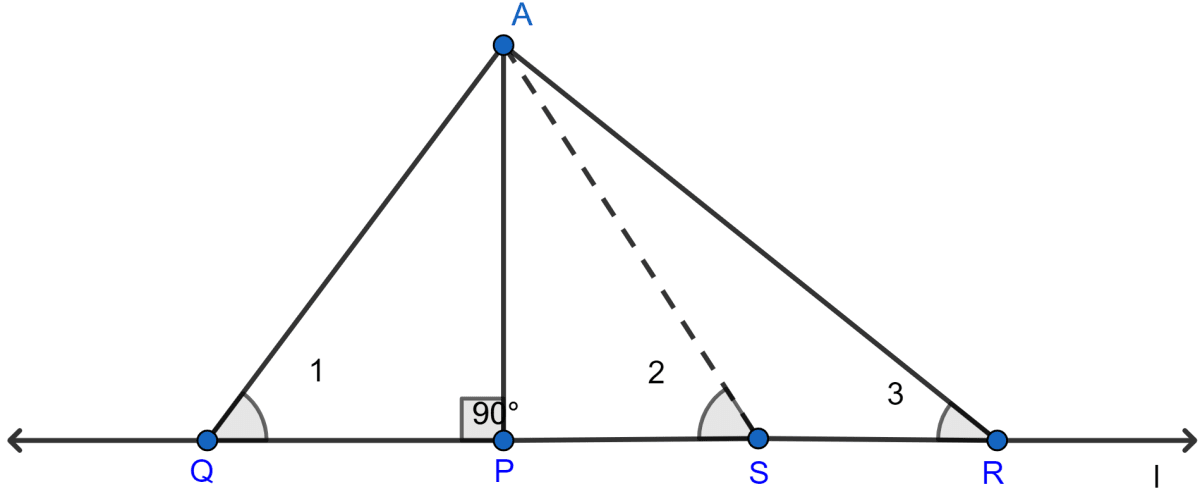
In the adjoining figure, AP ⊥ l and PR > PQ. Show that AR > AQ.
Answer
Take a point S on PR such that PS = PQ.
Join A and S. Mark angles as shown.
PQ = PS
AP = AP (Common)
∠APQ = ∠APS (Both are equal to 90°)
△APQ ≅ △APS (By SAS axiom)
We know that corresponding parts of congruent triangles are equal.
∠1 = ∠2.
In △ARS,
∠2 > ∠3 (As exterior angle is greater than each interior opposite angle.)
∴ ∠1 > ∠3
⇒ AR > AQ (As side opposite to greater angle is greater.)
Hence, proved that AR > AQ.
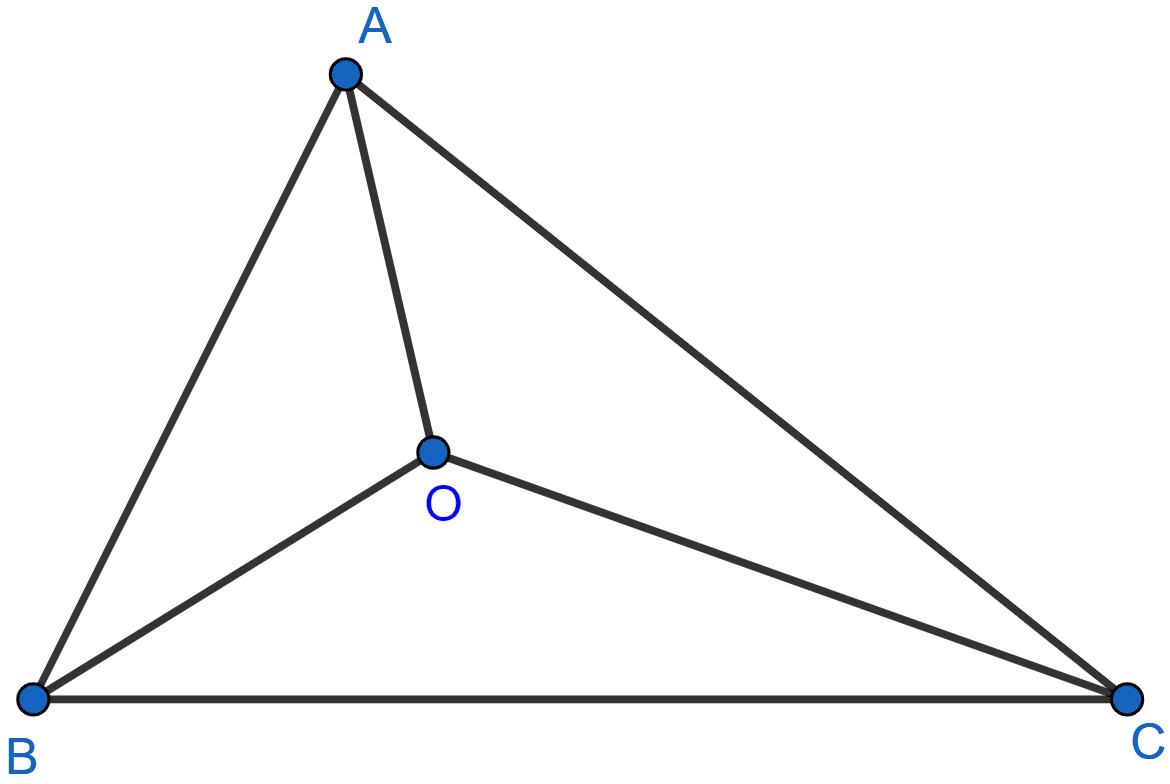
If O is any point in the interior of a triangle ABC, show that OA + OB + OC > (AB + BC + CA).
Answer
In △OBC, OB + OC > BC ......(i) (As sum of any two sides of triangle > third side)
Similarly OC + OA > CA .......(ii)
and, OA + OB > AB .......(iii)
On adding (i), (ii) and (iii), we get
⇒ OB + OC + OC + OA + OA + OB > BC + CA + AB
⇒ 2(OA + OB + OC) > AB + BC + CA
⇒ OA + OB + OC > (AB + BC + CA).
Hence, proved that OA + OB + OC > (AB + BC + CA).