
Assertion (A): If two triangles are congruent to each other then the ratio of corresponding side is 1 : 1.
Reason (R): Two triangles are congruent if and only if they have same shape and size.
Assertion (A) is true, Reason (R) is false.
Assertion (A) is false, Reason (R) is true.
Both Assertion (A) and Reason (R) are true, and Reason (R) is the correct reason for Assertion (A).
Both Assertion (A) and Reason (R) are true, but Reason (R) is not the correct reason (or explanation) for Assertion (A).
Answer
The reason states, two triangles are congruent if and only if they have same shape and size.
This statement is the precise definition of congruent triangles. Congruence means that one triangle can be perfectly superimposed on the other, covering it exactly.
∴ Reason (R) is true.
If corresponding sides are equal, for example, if side AB of the first triangle corresponds to side DE of the second triangle, and they are equal in length (AB = DE), then their ratio is = 1. This applies to all pairs of corresponding sides.
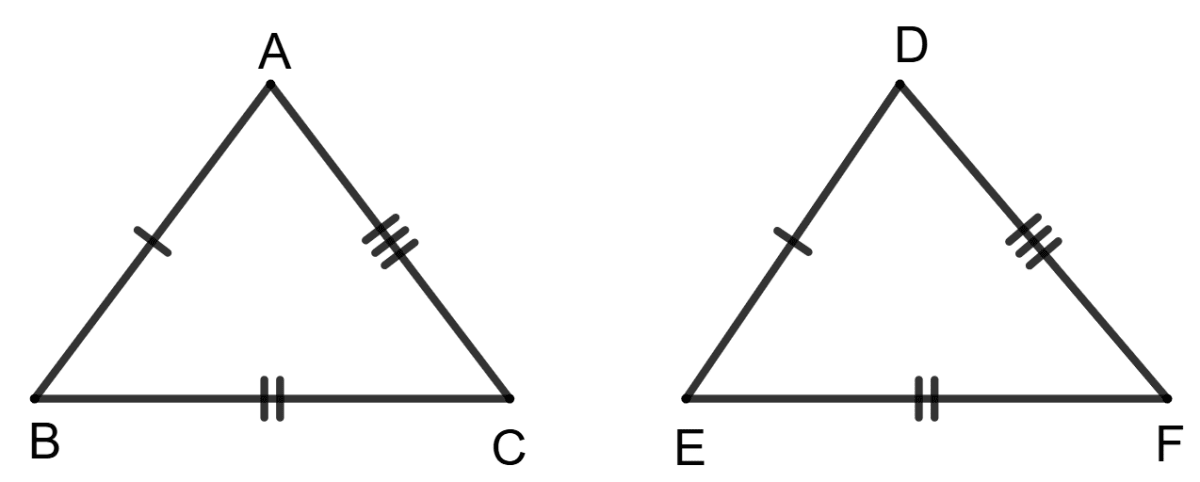
Therefore, the ratio of corresponding sides is indeed 1 : 1.
∴ Assertion (A) is true.
∴ Both Assertion (A) and Reason (R) are true, and Reason (R) is the correct reason (or explanation) for Assertion (A).
Hence, option 3 is the correct option.
Assertion (A): In the adjoining figure, Δ ABC ≅ Δ PQR.
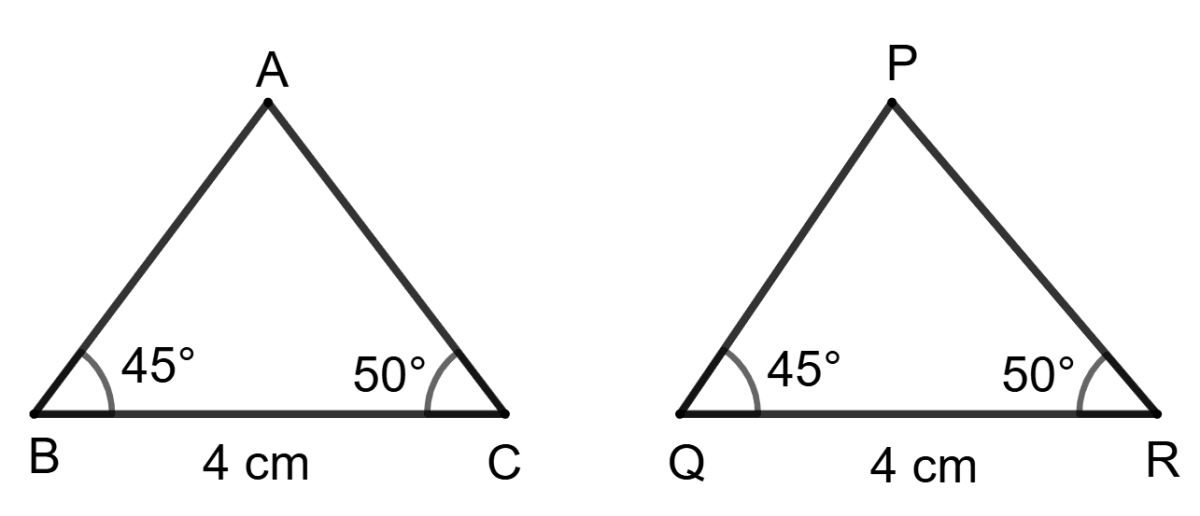
Reason (R): Two triangles are congruent if two angles and included side of One triangle are equal to two angles and the included side of other triangle.
Assertion (A) is true, Reason (R) is false.
Assertion (A) is false, Reason (R) is true.
Both Assertion (A) and Reason (R) are true, and Reason (R) is the correct reason for Assertion (A).
Both Assertion (A) and Reason (R) are true, but Reason (R) is not the correct reason (or explanation) for Assertion (A).
Answer
The ASA (Angle-Side-Angle) Congruence rule states that if two angles and the included side (the side between those two angles) of one triangle are equal to the corresponding two angles and the included side of another triangle, then the two triangles are congruent.
∴ Reason (R) is true.
In △ABC and △PQR,
⇒ ∠B = ∠Q (Both equal to 45°)
⇒ BC = QR
⇒ ∠C = ∠R (Both equal to 50°)
∴ △ABC ≅ △PQR (By A.S.A. axiom)
∴ Assertion (A) is true.
∴ Both Assertion (A) and Reason (R) are true, and Reason (R) is the correct reason (or explanation) for Assertion (A).
Hence, option 3 is the correct option.
Assertion (A): Two triangles are congruent to each other by RHS rule of congruency. The base of the one triangle is 6 cm and the height is 4 cm. The sum of area of two triangle is 24 cm2.
Reason (R): Two triangles are congruent if they have same shape and size. Congruent triangles have equal area.
Assertion (A) is true, Reason (R) is false.
Assertion (A) is false, Reason (R) is true.
Both Assertion (A) and Reason (R) are true, and Reason (R) is the correct reason for Assertion (A).
Both Assertion (A) and Reason (R) are true, but Reason (R) is not the correct reason (or explanation) for Assertion (A).
Answer
Congruent figures are identical in every respect, meaning they have the same shape and occupy the same amount of space.
If two triangles have the same shape and size (i.e., they are congruent), then they must necessarily cover the same amount of space, meaning they have equal areas.
∴ Reason (R) is true.
Area of one triangle = x base x height
= x 6 x 4
= 3 x 4
= 12 cm2.
If two triangles are congruent, their areas must be equal.
So, the area of the second triangle is also 12 cm2.
The sum of the areas is 12 cm2 + 12 cm2 = 24 cm2.
∴ Assertion (A) is true.
∴ Both Assertion (A) and Reason (R) are true, and Reason (R) is the correct reason (or explanation) for Assertion (A).
Hence, option 3 is the correct option.
Assertion (A): If ΔABC ≅ ΔPQR and AB = 4 units, then AB2 + PQ2 = 32.
Reason (R): When two triangles are congruent to each other, then their corresponding responding sides are equal in length.
Assertion (A) is true, Reason (R) is false.
Assertion (A) is false, Reason (R) is true.
Both Assertion (A) and Reason (R) are true, and Reason (R) is the correct reason for Assertion (A).
Both Assertion (A) and Reason (R) are true, but Reason (R) is not the correct reason (or explanation) for Assertion (A).
Answer
When two triangles are congruent to each other, then their corresponding sides are equal in length.
It is a fundamental property of congruent triangles, better known as C.P.C.T.C.
∴ Reason (R) is true.
△ABC ≅ △PQR, this means triangle ABC is congruent to triangle PQR.
So, corresponding sides are equal.
This means AB corresponds to PQ, BC corresponds to QR, and AC corresponds to PR.
Therefore, AB = PQ.
Given AB = 4 units: Since AB = PQ, it implies PQ = 4 units.
AB2 + PQ2 = 42 + 42
= 16 + 16
= 32.
∴ Assertion (A) is true.
∴ Both Assertion (A) and Reason (R) are true, and Reason (R) is the correct reason (or explanation) for Assertion (A).
Hence, option 3 is the correct option.
Assertion (A): Δ ABC ≅ Δ PQR
If 2AB = 3BC = 4CA = 12 cm, then the sum of perimeter of both triangle is 26 cm.
Reason (R): If two triangles are congruent to each other, then their corresponding sides are equal in length.
Assertion (A) is true, Reason (R) is false.
Assertion (A) is false, Reason (R) is true.
Both Assertion (A) and Reason (R) are true, and Reason (R) is the correct reason for Assertion (A).
Both Assertion (A) and Reason (R) are true, but Reason (R) is not the correct reason (or explanation) for Assertion (A).
Answer
When two triangles are congruent to each other, then their corresponding sides are equal in length.
It is a fundamental property of congruent triangles, better known as C.P.C.T.C.
∴ Reason (R) is true.
Given,
△ABC ≅ △PQR.
If 2AB = 3BC = 4CA = 12 cm.
For side AB, 2AB = 12 cm ⇒ AB = = 6 cm,
For side BC, 3BC = 12 cm ⇒ BC = = 4 cm,
For side CA, 4CA = 12 cm ⇒ CA = = 3 cm.
Perimeter of △ABC = AB + BC + CA = 6 cm + 4 cm + 3 cm = 13 cm.
Since, △ABC ≅ △PQR their perimeters are equal.
Perimeter of △PQR = Perimeter of △ABC = 13 cm.
The sum of the perimeters of both triangles = Perimeter of △ABC + Perimeter of △PQR = 13 cm + 13 cm = 26 cm.
∴ Assertion (A) is true.
∴ Both Assertion (A) and Reason (R) are true, and Reason (R) is the correct reason (or explanation) for Assertion (A).
Hence, option 3 is the correct option.