
Which of the following is not a criterion for congruency of triangles?
SAS
ASA
SSA
SSS
Answer
SSA is not a criterion for congruency of triangles.
Hence, Option 3 is the correct answer.
In the adjoining figure, AB = FC, EF = BD and ∠AFE = ∠CBD. Then the rule by which △AFE ≅ △CBD is
SAS
ASA
SSS
AAS

Answer
In △AFE and △CBD,
Given,
⇒ AB = CF
⇒ AB + BF = CF + BF
⇒ AF = BC.
BD = EF (Given)
∠AFE = ∠CBD (Given).
Hence, △AFE ≅ △CBD by SAS axiom.
Hence, Option 1 is the correct answer.
In the adjoining figure, AB ⊥ BE and FE ⊥ BE. If AB = FE and BC = DE, then
△ABD ≅ △EFC
△ABD ≅ △FEC
△ABD ≅ △ECF
△ABD ≅ △CEF

Answer
In △ABD and △FEC,
Given,
⇒ BC = ED
⇒ BC + CD = ED + CD
⇒ BD = EC.
AB = FE (Given)
∠ABD = ∠FEC (Both are equal to 90°)
Hence, △ABD ≅ △FEC by SAS axiom.
Hence, Option 2 is the correct answer.
In the adjoining figure, AB = AC and AD is median of △ABC, then ∠ADC is equal to
60°
120°
90°
75°

Answer
In △ADB and △ADC,
Given,
AB = AC (Given)
BD = DC (Given)
AD = AD (Common)
Hence, △ADB ≅ △ADC by SSS axiom.
We know that corresponding parts of congruent triangle are equal.
∴ ∠ADB = ∠ADC = x.
From figure,
⇒ ∠ADB + ∠ADC = 180°
⇒ x + x = 180°
⇒ 2x = 180°
⇒ x = 90°
∴ ∠ADC = 90°.
Hence, Option 3 is the correct option.
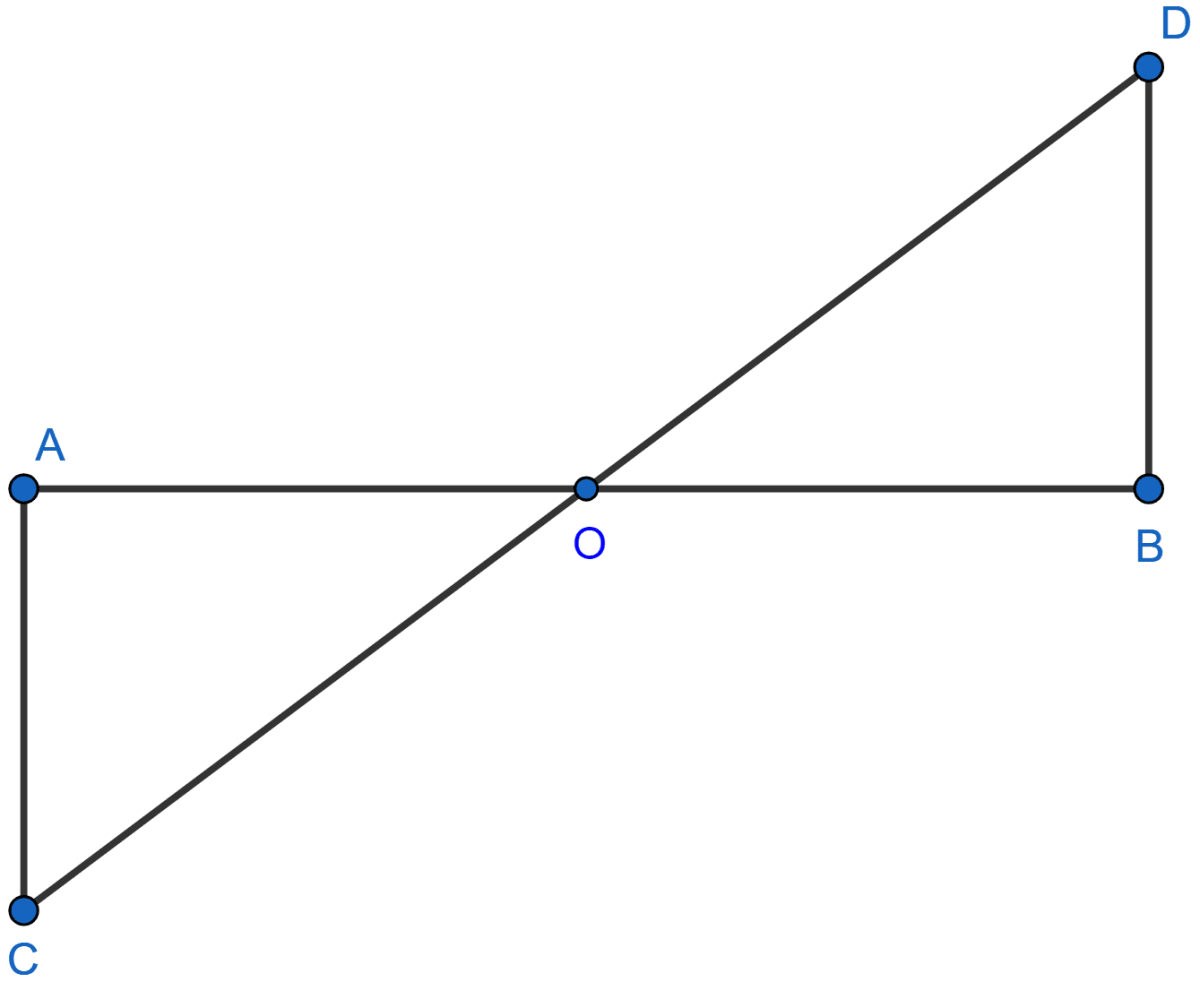
In the adjoining figure, O is the mid-point of AB. If ∠ACO = ∠BDO, then ∠OAC is equal to
∠OCA
∠ODB
∠OBD
∠BOD
Answer
In △AOC and △BOD,
AO = OB (As O is the mid-point of AB.)
∠ACO = ∠BDO (Given)
∠AOC = ∠BOD (Vertically opposite angles)
Hence, △AOC ≅ △BOD by AAS axiom.
We know that corresponding parts of congruent triangles are equal.
∴ ∠OAC = ∠OBD.
Hence, Option 3 is the correct answer.
In the adjoining figure, AC = BD. If ∠CAB = ∠DBA, then ∠ACB is equal to
∠BAD
∠ABC
∠ABD
∠BDA

Answer
In △CAB and △DBA,
AC = DB (Given)
AB = AB (Common)
∠CAB = ∠DBA (Given)
Hence, △CAB ≅ △DBA by SAS axiom.
We know that corresponding parts of congruent triangles are equal.
∴ ∠ACB = ∠BDA.
Hence, Option 4 is the correct answer.
In the adjoining figure, ABCD is a quadrilateral in which BN and DM are drawn perpendiculars to AC such that BN = DM. If OB = 4 cm, then BD is
6 cm
8 cm
10 cm
12 cm

Answer
∠MOD = ∠NOB (Vertically opposite angles)
∠DMO = ∠BNO (Each = 90°)
BN = DM (Given)
Hence, △MOD ≅ △NOB by AAS axiom.
We know that corresponding parts of congruent triangles are equal.
OD = OB = 4 cm.
BD = OB + OD = 4 + 4 = 8 cm.
Hence, Option 2 is the correct option.
In △ABC, AB = AC and ∠B = 50°. Then ∠C is equal to
40°
50°
80°
130°
Answer
Since in △ABC, AB = AC.
∴ ∠B = ∠C = 50°. (As angles opposite to equal sides in isosceles triangle are equal.)
Hence, Option 2 is the correct option.
In △ABC, BC = AB and ∠B = 80°. Then ∠A is equal to
80°
40°
50°
100°
Answer
Since in △ABC, BC = AB.
∴ ∠A = ∠C. (As angles opposite to equal sides in isosceles triangle are equal.)
Let ∠A = ∠C = x.
Sum of angles of triangle = 180°.
∠A + ∠B + ∠C = 180°
x + 80° + x = 180°
2x = 100°
x = 50°
∠A = 50°.
Hence, Option 3 is the correct option.
In △PQR, ∠R = ∠P, QR = 4 cm and PR = 5 cm. Then the length of PQ is
4 cm
5 cm
2 cm
2.5 cm
Answer
Since, ∠R = ∠P.
∴ PQ = QR = 4 cm.
Hence, Option 1 is the correct option.
In △ABC and △PQR, AB = AC, ∠C = ∠P and ∠B = ∠Q. The two triangles are
isosceles but not congruent
isosceles and congruent
congruent but isosceles
neither congruent nor isosceles
Answer
Given AB = AC hence ABC is isosceles.
∴ ∠B = ∠C
∠B = ∠P = ∠Q.
Since, ∠P = ∠Q so, PR = QR, hence PQR is isosceles.
Hence, Option 1 is the correct option.
Two sides of a triangle are of lengths 5 cm and 1.5 cm. The length of the third side of the triangle can not be
3.6 cm
4.1 cm
3.8 cm
3.4 cm
Answer
Given two sides are 5 cm and 1.5 cm then third side must be greater than the difference of two sides.
5 - 1.5 = 3.5 cm
Hence, third side must be greater than 3.5 cm.
Hence, Option 4 is the correct option.
If a, b, c are lengths of the sides of a triangle then,
a - b > c
c > a + b
c = a + b
c < a + b
Answer
We know that in a triangle, the sum of any two sides of a triangle is greater then the third side.
∴ c < a + b.
Hence, Option 4 is the correct option.
It is not possible to construct a triangle when the lengths of its sides are
6 cm, 7 cm, 8 cm
4 cm, 6 cm, 6 cm
5.3 cm, 2.2 cm, 3.1 cm
9.3 cm, 5.2 cm, 7.4 cm
Answer
We know that in a triangle, the sum of any two sides of a triangle is greater than the third side.
But, when sides are 5.3 cm, 2.2 cm, 3.1 cm.
2.2 + 3.1 = 5.3 cm.
Here, sum of two sides is equal to third side.
Hence, construction of triangle with sides 5.3 cm, 2.2 cm, 3.1 cm is not possible.
Hence, Option 3 is the correct option.
In △PQR, if ∠R > ∠Q, then
QR > PR
PQ > PR
PQ < PR
QR < PR
Answer
Given, ∠R > ∠Q
∴ PQ > PR (As side opposite to greater angle is greater.)
Hence, Option 2 is the correct option.
If triangle PQR is right angled at Q, then
PR = PQ
PR < PQ
PR < QR
PR > PQ
Answer
Since, PQR is a right angled triangle at Q.
So, PR is hypotenuse and hypotenuse is > perpendicular and base.
∴ PR > PQ.
Hence, Option 4 is the correct option.
If triangle ABC is obtuse angled and ∠C is obtuse, then
AB > BC
AB = BC
AB < BC
AC > AB
Answer
If ∠C is obtuse then ∠A will be acute,
∴ AB > BC (As side opposite to greater angle is greater.)
Hence, Option 1 is the correct option.
If the lengths of two sides of an isosceles triangle are 4 cm and 10 cm, then the length of the third side is
4 cm
10 cm
7 cm
14 cm
Answer
The length of third side can either be 4 cm or 10 cm.
If the third side is 4 cm then the sides are,
4, 4, 10.
Here, 4 + 4 = 8 < 10.
Since, the sum of two sides of a triangle must be greater than third side hence, these sides are not possible.
Hence, the length of third side is 10 cm.
Hence, Option 2 is the correct option.
Consider the following two statements :
Statement 1: If two angles and one side of a triangle is equal to two angles and one side of an other triangle then the two triangles are congruent.
Statement 2: The angle opposite to equal sides of an isosceles triangle are equal.
Which of the following is valid?
Both the statements are true.
Both the statements are false.
Statement 1 is true, and Statement 2 is false.
Statement 1 is false, and Statement 2 is true.
Answer
Given, according to statement 1 :
If two angles and one side of a triangle is equal to two angles and one side of an other triangle then the two triangles are congruent.
The above statement is true and the triangles are congruent by two axioms A.A.S. or A.S.A. axiom.
∴ Statement 1 is true.
In an isosceles triangle, the angles opposite to equal sides are equal.
∴ Statement 2 is true.
∴ Both statements are true.
Hence, option 1 is the correct option.