
In △PQR, ∠P = 70° and ∠R = 30°. Which side of this triangle is longest? Give reason for your answer.
Answer
We know that,
Sum of angles of triangle = 180°.
∴ ∠P + ∠Q + ∠R = 180°
⇒ 70° + ∠Q + 30° = 180°
⇒ ∠Q + 100° = 180°
⇒ ∠Q = 80°.
We know that side opposite to the greatest angle is greatest side.
∴ PR is the greatest side, which is opposite to ∠Q.
Hence, PR is the greatest side because ∠Q = 80° and side opposite to the greatest angle is greatest side.
Show that in a right angled triangle, the hypotenuse is the longest side.
Answer
In △ABC,

∠B = 90°
∠A and ∠C are acute angles i.e. less that 90°.
∴ ∠B is the greatest angle.
∴ ∠B > ∠A and ∠B > ∠C
⇒ AC > BC and AC > AB.
Hence, proved that hypotenuse is the longest side in a right angled triangle.
PQR is a right angle triangle at Q and PQ : QR = 3 : 2. Which is the least angle?
Answer

Given,
PQR is a right angle triangle at Q and PQ : QR = 3 : 2.
PQ = 3x and QR = 2x.
Thus, QR is the smallest side and the angle opposite to the smallest side is smallest angle.
∴ ∠P is the least angle.
Hence, ∠P is the least angle.
In △ABC, AB = 8 cm, BC = 5.6 cm and CA = 6.5 cm. Which is
(i) the greatest angle?
(ii) the smallest angle?
Answer

(i) In △ABC,
AB is the greatest side, the greatest side has greatest angle opposite to it.
∴ ∠C is the greatest angle.
Hence, ∠C is the greatest angle.
(ii) In △ABC,
BC is the smallest side, the smallest side has smallest angle opposite to it.
∴ ∠A is the smallest angle.
Hence, ∠A is the smallest angle.
In a △ABC, ∠A = 50°, ∠B = 60°. Arrange the sides of the triangle in ascending order.
Answer
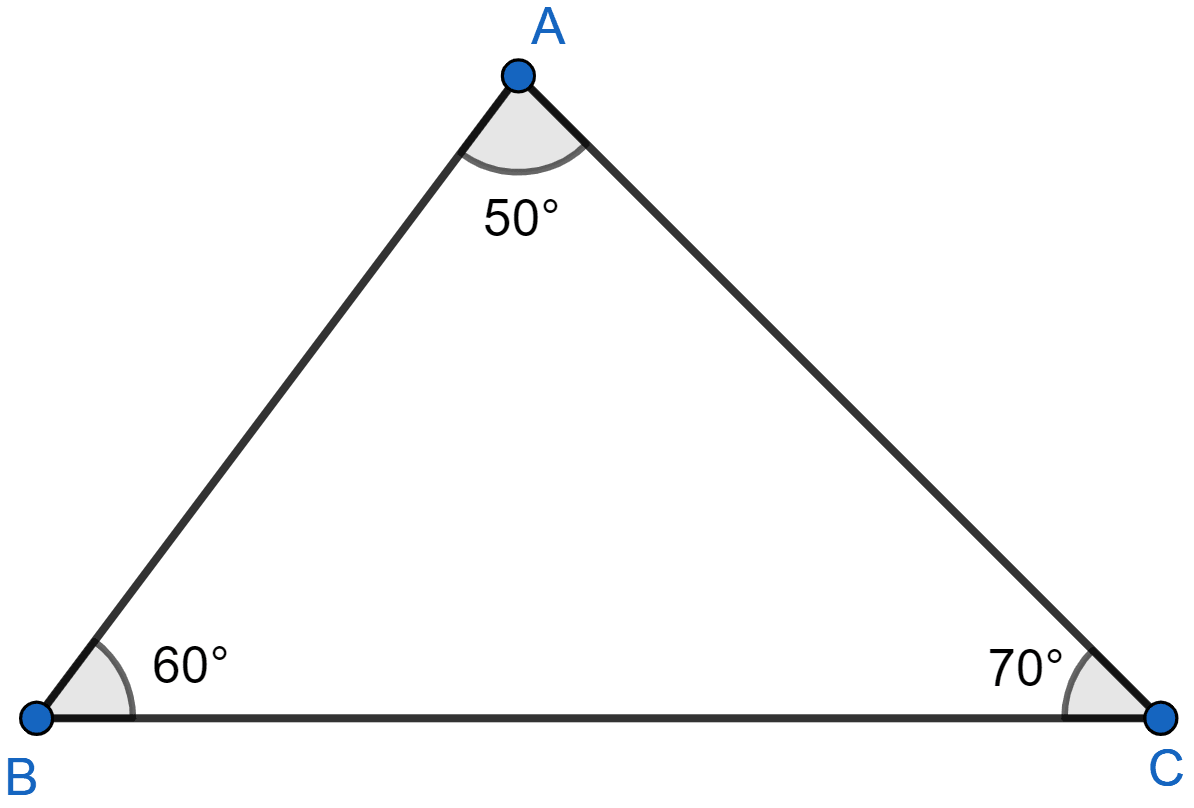
Sum of angles of triangle = 180°.
⇒ ∠A + ∠B + ∠C = 180°
⇒ 50° + 60° + ∠C = 180°
⇒ 110° + ∠C = 180°
⇒ ∠C = 70°.
So we get,
∠C > ∠B > ∠A.
We know that side opposite to greatest angle is greatest.
∴ AB > CA > BC or BC < CA < AB.
Hence, sides of the triangle in ascending order are BC < CA < AB.
In figure given alongside, ∠B = 30°, ∠C = 40° and the bisector of ∠A meets BC at D. Show that
(i) BD > AD
(ii) DC > AD
(iii) AC > DC
(iv) AB > BD.

Answer
In △ABC,
∠B = 30° and ∠C = 40°
∠BAC = 180° - (30° + 40°) = 180° - 70° = 110°.
As, AD is bisector of ∠A,
∴ ∠BAD = ∠CAD = .
(i) Now in △ABD,
∠BAD > ∠B
∴ BD > AD.
Hence, proved that BD > AD.
(ii) Now in △ACD,
∠CAD > ∠C
∴ DC > AD.
Hence, proved that DC > AD.
(iii) Now in △ACD,
∠ADC = 180° - (40° + 55°) = 180° - 95° = 85°.
In △ACD,
∠ADC > ∠CAD
∴ AC > DC.
Hence, proved that AC > DC.
(iv) In △ADB,
∠ADB = 180° - ∠ADC = 180° - 85° = 95°.
Thus, ∠ADB > ∠BAD
∴ AB > BD.
Hence, proved that AB > BD.
In the adjoining figure, AD bisects ∠A. Arrange AB, BD and DC in the descending order of their lengths.

Answer
∠A = 180° - 60° - 40° = 80°.
Since, AD bisects ∠A,
∠BAD = ∠DAC = = 40°.
∴ ∠ADB = ∠DAC + ∠C (As exterior angle is equal to sum of two opposite interior angles.)
∠ADB = 40° + 40° = 80°.
∴ In △ABD,
∠BAD < ∠ABD < ∠ADB
⇒ BD < AD < AB (side opp. to smaller angle is smaller) .......(i)
Also in △ADC, ∠DAC = 40° = ∠C ⇒ AD = DC .......(ii)
∴ BD < DC < AB or AB > DC > BD.
Hence, sides in descending order are AB > DC > BD.
In the figure (1) given below, prove that (i) CF > AF (ii) DC > DF.

Answer
(i) In △ABC,
⇒ ∠A + ∠B + ∠C = 180°
⇒ 60° + 65° + ∠C = 180°
⇒ ∠C = 180° - 125° = 55°.
In △BEC,
⇒ ∠B + ∠E + ∠C = 180°
⇒ 65° + 90° + ∠C = 180°
⇒ ∠C = 180° - 155° = 25°.
In △DFC,
⇒ ∠D + ∠C + ∠F = 180°
⇒ 90° + 25° + ∠F = 180°
⇒ ∠F = 180° - 115° = 65°.
From figure,
∠AFE = ∠DFC = 65° (Vertically opposite angles are equal.)
An exterior angle is equal to the sum of two opposite interior angles.
⇒ ∠AFE = ∠FAC + ∠FCA
⇒ 65° = ∠FAC + 30°
⇒ ∠FAC = 65° - 30° = 35°.
In △AFC,
∠FAC = 35°
∠FCA = 30°
∴ ∠FAC > ∠FCA
∴ CF > AF (As side opposite to greater angle is greater.)
Hence, proved that CF > AF.
(ii) In △DFC,
∠DFC = 65°
∠DCF = 25°
∴ ∠DFC > ∠DCF
∴ DC > DF (As side opposite to greater angle is greater.)
Hence, proved that DC > DF.
In the figure (2) given below, AB = AC. Prove that AB > CD.

Answer
Since, AB = AC.
∴ ∠ABC = ∠ACB = 70° (As angles opposite to equal sides of an isosceles triangle are equal.)
From figure,
⇒ ∠ACB + ∠ACD = 180°
⇒ 70° + ∠ACD = 180°
⇒ ∠ACD = 110°.
In △ACD,
⇒ ∠CAD + ∠ADC + ∠ACD = 180°
⇒ ∠CAD + 40° + 110° = 180°
⇒ ∠CAD + 150° = 180°
⇒ ∠CAD = 30°.
In △ACD,
∠ADC = 40°
∠CAD = 30°
∴ ∠ADC > ∠CAD
∴ AC > CD (As side opposite to greater angle is greater.)
Since, AB = AC,
∴ AB > CD.
Hence, proved that AB > CD.
In the figure (3) given below, AC = CD. Prove that BC < CD.

Answer
From figure,
⇒ ∠ACB + ∠ACD = 180°
⇒ 70° + ∠ACD = 180°
⇒ ∠ACD = 110°.
In △ACD,
AC = CD
∴ ∠CAD = ∠CDA (As angles opposite to equal sides are equal.)
Let ∠CAD = ∠CDA = x.
In △ACD,
⇒ ∠CAD + ∠CDA + ∠ACD = 180°
⇒ x + x + 110° = 180°
⇒ 2x + 110° = 180°
⇒ 2x = 70°
⇒ x = 35°.
⇒ ∠CAD = 35°.
From figure,
⇒ ∠CAD + ∠CAB = 70°
⇒ 35° + ∠CAB = 70°
⇒ ∠CAB = 35°
In △ABC,
⇒ ∠ABC + ∠ACB + ∠BAC = 180°
⇒ ∠ABC + 70° + 35° = 180°
⇒ ∠ABC + 105° = 180°
⇒ ∠ABC = 75°.
In △ABC,
∠ABC > ∠BAC
⇒ AC > BC (As side opposite to greater angle is greater)
∵ AC = CD
∴ CD > BC or BC < CD.
Hence, proved that BC < CD.
In the figure (i) given below, ∠B < ∠A and ∠C < ∠D. Show that AD < BC.

Answer
Given,
∠B < ∠A
∴ AO < BO (As side opposite to smaller angle is smaller.) ......(i)
∠C < ∠D
∴ OD < OC (As side opposite to smaller angle is smaller.) .......(ii)
From (i) and (ii) it can be concluded,
⇒ AO + OD < BO + OC
⇒ AD < BC.
Hence, proved that AD < BC.
In the figure (ii) given below, D is any point on the side BC of △ABC. If AB > AC, show that AB > AD.
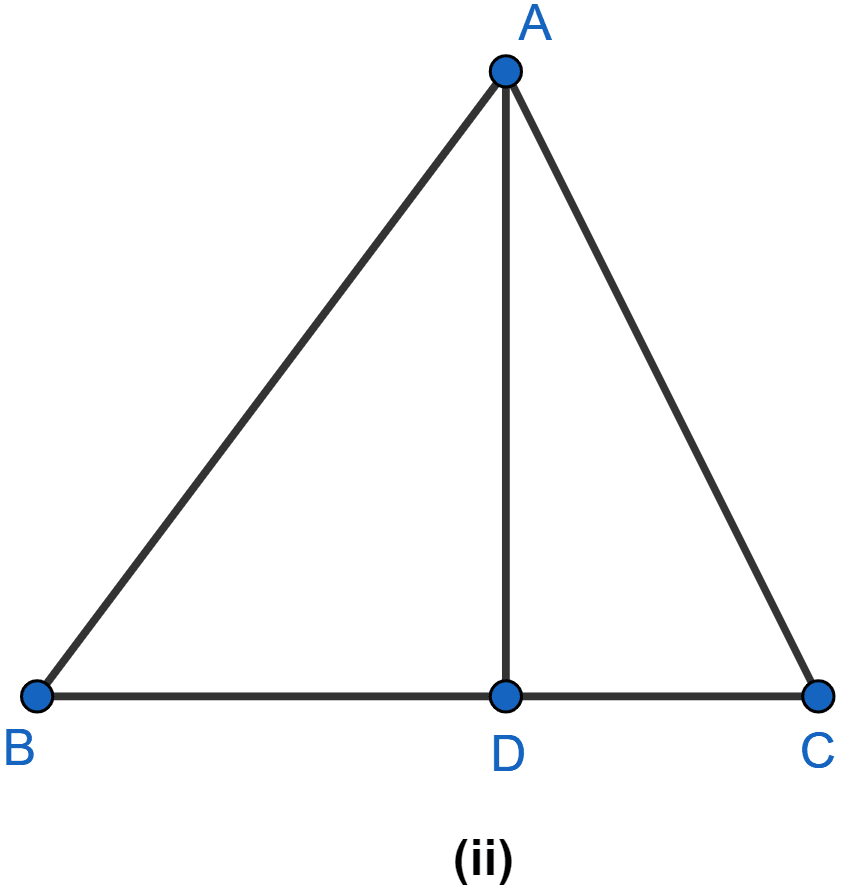
Answer
Given,
AB > AC
∴ ∠ACB > ∠ABC (As angle opposite to greater side is greater.)
From figure,
∠ADB = ∠ACB + ∠DAC (As exterior angle is equal to sum of two opposite interior angles.)
⇒ ∠ADB > ∠ACB
⇒ ∠ADB > ∠ABC [∵ ∠ACB > ∠ABC]
∴ AB > AD (As side opposite to greater angle is greater.)
Hence, proved that AB > AD.
Is it possible to construct a triangle with lengths of its sides as 4 cm, 3 cm and 7 cm? Give reason for your answer.
Answer
We know that sum of any two sides is greater than the third side.
Here,
4 cm + 3 cm = 7 cm, which is equal to third side.
Hence, construction of triangle with sides 4 cm, 3 cm and 7 cm is not possible.
Is it possible to construct a triangle with lengths of its sides as 9 cm, 7 cm and 17 cm? Give reason for your answer.
Answer
We know that sum of any two sides is greater than the third side.
Here,
9 cm + 7 cm = 16 cm, which is less than third side (i.e. 17 cm).
Hence, construction of triangle with sides 9 cm, 7 cm and 17 cm is not possible.
Is it possible to construct a triangle with lengths of its sides as 8 cm, 7 cm and 4 cm? Give reason for your answer.
Answer
Here,
⇒ 8 cm + 7 cm = 15 cm, which is 15 cm > 4cm,
⇒ 7 cm + 4 cm = 11 cm, which is 11 cm > 8 cm,
⇒ 8 cm + 4 cm = 12 cm, which is 12 cm > 7 cm.
We know that sum of any two sides is greater than the third side.
Hence, construction of triangle with sides 8 cm, 7 cm and 4 cm is possible.