
ABC is a right angled triangle in which ∠A = 90° and AB = AC. Find ∠B and ∠C.
Answer
Given,
AB = AC.

We know that angles opposite to equal sides of an isosceles triangle are equal.
∴ ∠B = ∠C = x°.
Sum of angles of triangle = 180°.
⇒ ∠A + ∠B + ∠C = 180°
⇒ 90° + x° + x° = 180°
⇒ 90° + 2x° = 180°
⇒ 2x° = 90°
⇒ x° = 45°.
Hence, ∠B = ∠C = 45°.
Show that the angles of an equilateral triangle are 60° each.
Answer
In equilateral triangle all sides are equal.
AB = BC = CA
∴ ∠C = ∠A = ∠B = x° (Angles opposite to equal sides are equal).
Sum of angles of triangle = 180°
∠A + ∠B + ∠C = 180°
x° + x° + x° = 180°
3x° = 180°
x = 60°.
Hence, proved that angles of an equilateral triangle are 60° each.
Show that every equiangular triangle is equilateral.
Answer
Let ABC be a triangle with, ∠A = ∠B = ∠C.
Considering, ∠A = ∠B
We get, BC = AC (Sides opposite to equal angles are equal.)
Considering, ∠B = ∠C
We get, AB = BC (Sides opposite to equal angles are equal.)
∴ AB = BC = AC.
Hence, proved that every equiangular triangle is equilateral.
In the following figure, find the value of x:

Answer
Since, △ABC is an isosceles triangle with AB = AC.
∴ ∠B = ∠C = y°
Sum of angles of triangle = 180°.
⇒ 50° + y° + y° = 180°
⇒ 50° + 2y° = 180°
⇒ 2y° = 180° - 50° = 130°.
⇒ y° = 65°.
From figure,
⇒ x° + y° = 180°
⇒ x° + 65° = 180°
⇒ x° = 180° - 65° = 115°.
Hence, x = 115°.
In the following figure, find the value of x:

Answer
From figure,
△PRS is an isosceles triangle with PR = SR.
∴ ∠S = ∠RPS = 30°.
∠QPS = ∠QPR + ∠RPS = 52° + 30° = 82°.
Since, sum of angles of triangle = 180°.
Considering △PQS we get,
⇒ ∠P + ∠Q + ∠S = 180°
⇒ 82° + x° + 30° = 180°
⇒ x° + 112° = 180°
⇒ x° = 180° - 112° = 68°.
Hence, x = 68°.
In the following figure, find the value of x:

Answer
△BDC is an isosceles triangle with BD = DC,
∴ ∠DBC = ∠DCB = 27°.
We know that,
An exterior angle is equal to the sum of two opposite interior angles,
Ext. ∠ADC = ∠DBC + ∠DCB = 27° + 27° = 54°.
△ADC is an isosceles triangle with AC = DC,
∴ ∠DAC = ∠ADC = 54°.
Since, sum of angles of triangle = 180°.
Considering △ADC we get,
⇒ ∠DAC + ∠ADC + ∠DCA = 180°
⇒ 54° + 54° + x = 180°
⇒ x + 108° = 180°
⇒ x = 180° - 108° = 72°.
Hence, x = 72°.
In the following figure, find the value of x:

Answer
△ABD is an isosceles triangle with BD = AD,
∴ ∠DBA = ∠BAD = 48°.
We know that,
An exterior angle is equal to the sum of two opposite interior angles,
Ext. ∠ADC = ∠BAD + ∠DBA = 48° + 48° = 96°.
△ADC is an isosceles triangle with AD = DC,
∴ ∠DAC = ∠DCA = x°.
Since, sum of angles of triangle = 180°.
Considering △ADC we get,
⇒ ∠DAC + ∠ADC + ∠DCA = 180°
⇒ x° + 96° + x° = 180°
⇒ 2x° + 96° = 180°
⇒ 2x° = 180° - 96° = 84°
⇒ x° = 42°
Hence, x = 42°.
In the following figure, find the value of x:

Answer
From figure,
∠ACD = 180° - 130° = 50°.
In △ADC, AD = CD.
∴ ∠DAC = ∠ACD = 50°.
∠ADC = 180° - (∠CAD + ∠DCA) = 180° - (50° + 50°) = 80°.
From figure,
∠ADB + ∠ADC = 180°
∠ADB = 180° - ∠ADC = 180° - 80° = 100°.
In △ADB,
∠DBA = ∠DAB = x° (As angles opposite to equal sides are equal)
∠DBA + ∠DAB + ∠ADB = 180°
x° + x° + 100° = 180°
2x° = 80°
x° = 40°
Hence, x = 40°.
In the following figure, find the value of x:

Answer
In △ADC,
DC = CA (Given)
∴ ∠ADC = ∠CAD = a.
∠ADC + ∠DCA + ∠CAD = 180°
⇒ a + 56° + a = 180°
⇒ 2a = 180° - 56°
⇒ 2a = 124°
⇒ a = 62°.
In △ABD,
AD = BD (Given)
∴ ∠ABD = ∠DAB = (x - a)°
In △ABD,
∠ABD + ∠BDA + ∠DAB = 180°
⇒ (x - a)° + (180 - a)° + (x - a)° = 180°
⇒ 2x° - 3a° + 180° = 180°
⇒ 2x° - 3(62°) = 0
⇒ 2x° - 186° = 0
⇒ 2x° = 186°
⇒ x° = 93°
⇒ x = 93.
Hence, x = 93.
In the figure (1) given below, AB = AD, BC = DC. Find ∠ABC.

Answer
Join BD.

In △ABD,
AB = AD
∴ ∠ABD = ∠ADB = a.
∠ABD + ∠ADB + ∠DAB = 180°
a + a + 54 = 180°
2a + 54° = 180°
2a = 126°
a = 63°.
In △BCD,
BC = CD
∴ ∠CDB = ∠DBC = b.
∠CDB + ∠DBC + ∠BCD = 180°
b + b + 116° = 180°
2b + 116° = 180°
2b = 64°
b = 32°.
From figure,
∠ABC = a + b = 63 + 32 = 95°.
Hence, ∠ABC = 95°.
In the figure (2) given below, BC = CD. Find ∠ACB.
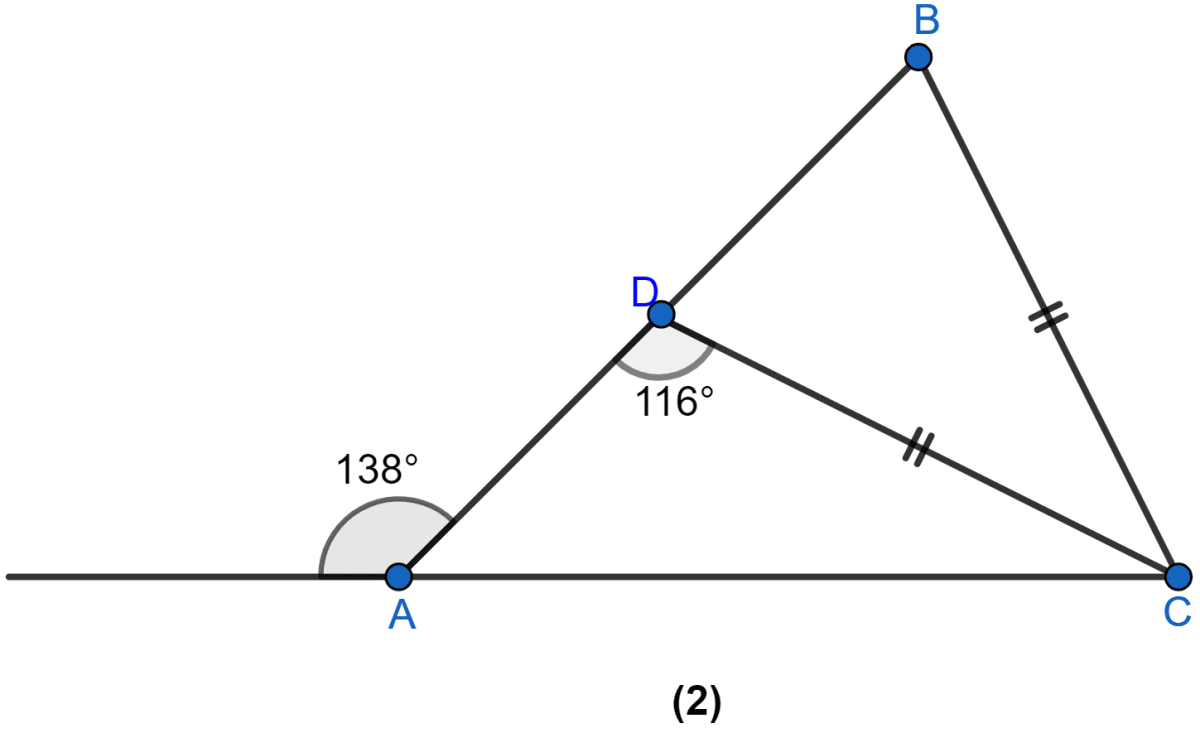
Answer
From figure,
∠DAC = 180° - 138° = 42°.
∠BDC = 180° - ∠ADC = 180° - 116° = 64°.
In △BCD,
∠CBD = ∠BDC = 64°.
∠DCB = 180° - (∠CBD + ∠BDC) = 180° - (64° + 64°)
= 180° - 128° = 52°.
In △ADC,
∠DCA = 180° - (∠CAD + ∠ADC) = 180° - (42° + 116°)
= 180° - 158° = 22°.
From figure,
∠ACB = ∠DCB + ∠DCA = 52° + 22° = 74°.
Hence, ∠ACB = 74°.
In the figure (3) given below, AB || CD and CA = CE. If ∠ACE = 74° and ∠BAE = 15°, find the values of x and y.
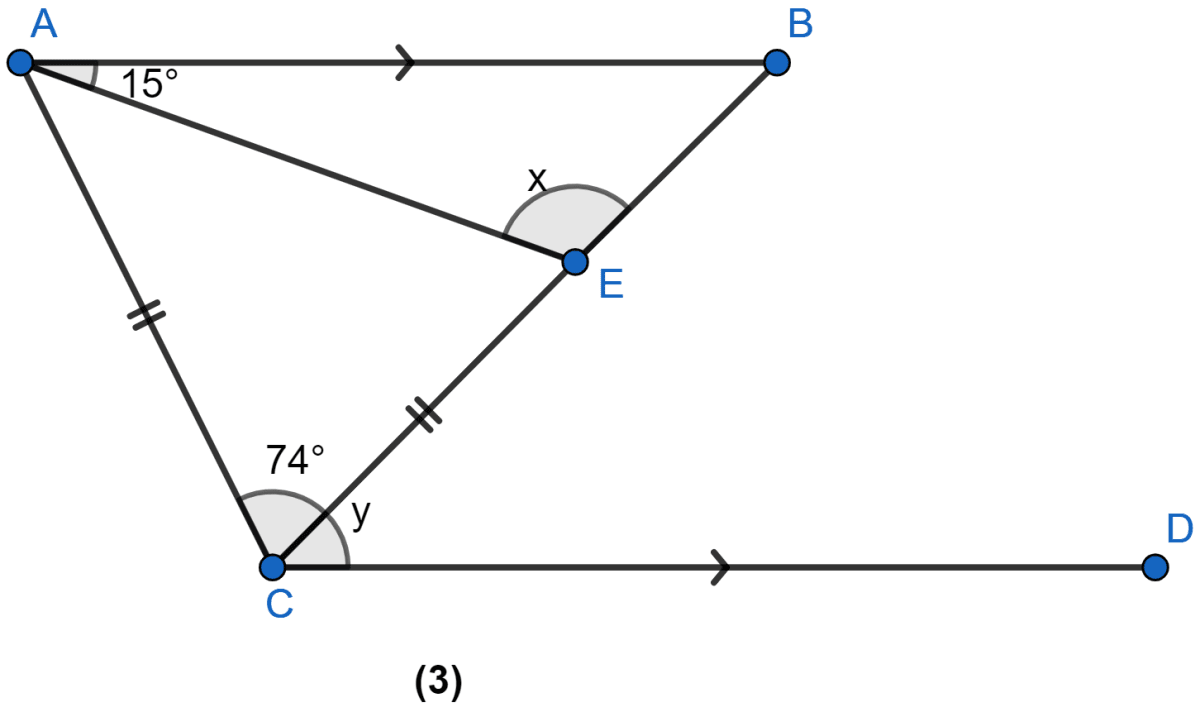
Answer
From figure,
∠CAE = ∠CEA = a (Angles opposite to equal side are equal.)
In △ACE
⇒ ∠CAE + ∠CEA + ∠ACE = 180°
⇒ a + a + 74° = 180°
⇒ 2a = 106°
⇒ a = 53°.
From figure,
∠CEA + ∠AEB = 180°
a + x = 180°
53° + x = 180°
x = 180° - 53° = 127°.
In △AEB,
⇒ ∠EAB + ∠AEB + ∠ABE = 180°
⇒ 15 + 127° + ∠ABE = 180°
⇒ 142° + ∠ABE = 180°
⇒ ∠ABE = 180° - 142° = 38°.
From figure,
y = ∠ABE (Alternate angles)
∴ y = 38°.
Hence, x = 127° and y = 38°.
In △ABC, AB = AC, ∠A = (5x + 20)° and each of the base angle is th of ∠A. Find the measure of ∠A.
Answer
Given, each of the base angle is th of ∠A.
∴ Each base angle = × (5x + 20) = (2x + 8)°

In △ABC,
∠A + ∠B + ∠C = 180°
(5x + 20)° + (2x + 8)° + (2x + 8)° = 180°
9x° + 36° = 180°
9x° = 144°
x° = 16°.
(5x + 20)° = 5(16°) + 20° = 80° + 20° = 100°.
Hence, ∠A = 100°.
In the figure (1) given below, ABC is an equilateral triangle. Base BC is produced to E, such that BC = CE. Calculate ∠ACE and ∠AEC.

Answer
Since, ABC is an equilateral triangle, ∠A = ∠B = ∠C = 60°.
From figure,
∠ACB + ∠ACE = 180°
60° + ∠ACE = 180°
∠ACE = 120°.
From figure,
∠AEC = ∠CAE (As angles opposite to equal sides are equal)
Let ∠AEC = ∠CAE = y.
From figure,
∠AEC + ∠CAE + ∠ACE = 180°
y + y + 120° = 180°
2y = 60°
y = 30°.
Hence, ∠ACE = 120° and ∠AEC = 30°.
In the figure (2) given below, prove that ∠BAD : ∠ADB = 3 : 1.

Answer
From figure,
∠ADC = ∠CAD (As angles opposite to equal sides of triangle are equal) ......(i)
From figure,
∠BAD = ∠BAC + ∠CAD = ∠BAC + ∠ADC = ∠BAC + ∠ADB .......(ii)
From △ABC,
∠BAC = ∠ACB (As angles opposite to equal sides of triangle are equal) ......(iii)
∠ACB = 180 - (∠ACD) = 180 - [180 - (∠CAD + ∠ADC)] = ∠CAD + ∠ADC ........(iv)
From figure,
∠ADC = ∠ADB
∴ ∠CAD = ∠ADB
From (iv)
∠ACB = ∠CAD + ∠ADC = ∠ADB + ∠ADB = 2∠ADB.
From (iii) we get,
∠BAC = ∠ACB = 2∠ADB.
Substituting value of ∠BAC in (ii) we get,
∠BAD = ∠BAC + ∠ADB = 2∠ADB + ∠ADB = 3∠ADB.
Hence, ∠BAD : ∠ADB = 3∠ADB : ∠ADB = 3 : 1.
Hence, proved that ∠BAD : ∠ADB = 3 : 1.
In the figure (3) given below, AB || CD. Find the values of x, y and z.
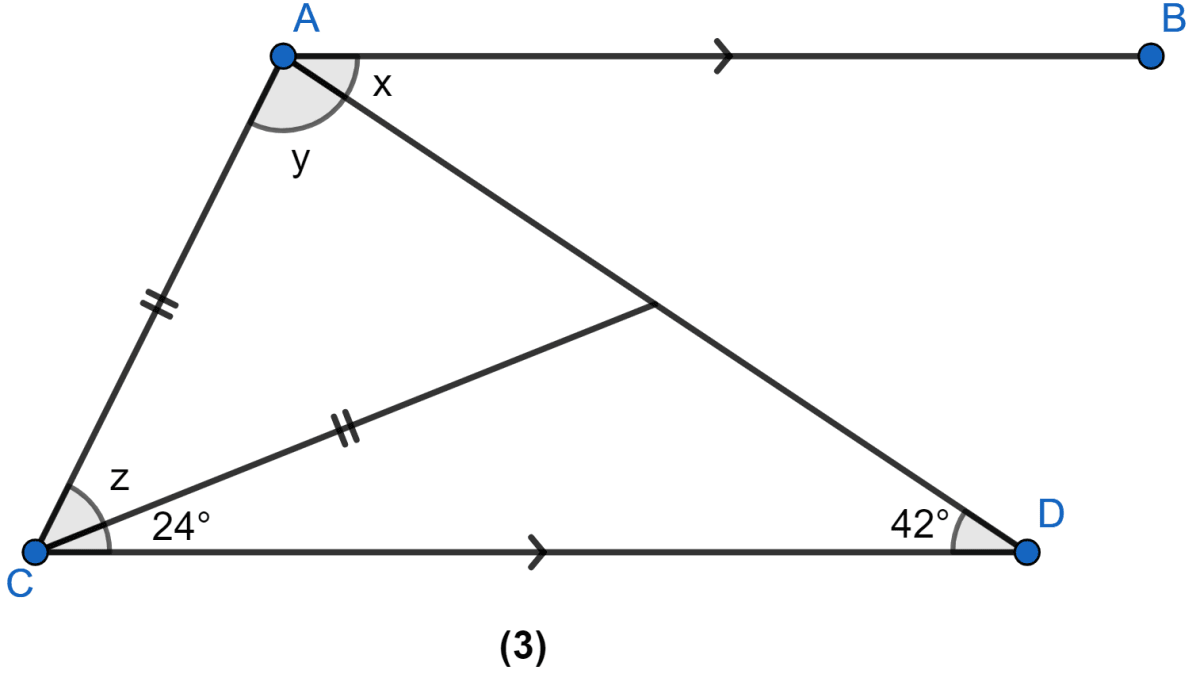
Answer
Add Answer fig
From figure,
∠BAD = ∠ADC (Alternate angles)
∴ x = 42°
In △CED,
⇒ 24° + ∠CED + 42° = 180°
⇒ ∠CED + 66° = 180°
⇒ ∠CED = 114°.
From figure,
⇒ ∠CEA + ∠CED = 180°
⇒ ∠CEA + 114° = 180°
⇒ ∠CEA = 66°.
In △CEA,
⇒ y = ∠CEA = 66° (As angles opposite to equal sides are equal)
In △CEA,
⇒ z + y + ∠CEA = 180°
⇒ z + 66° + 66° = 180°
⇒ z + 132° = 180°
⇒ z = 48°.
Hence, x = 42°, y = 66° and z = 48°.
In the adjoining figure, D is the midpoint of BC, DE and DF are perpendiculars to AB and AC respectively such that DE = DF. Prove that ABC is an isosceles triangle.
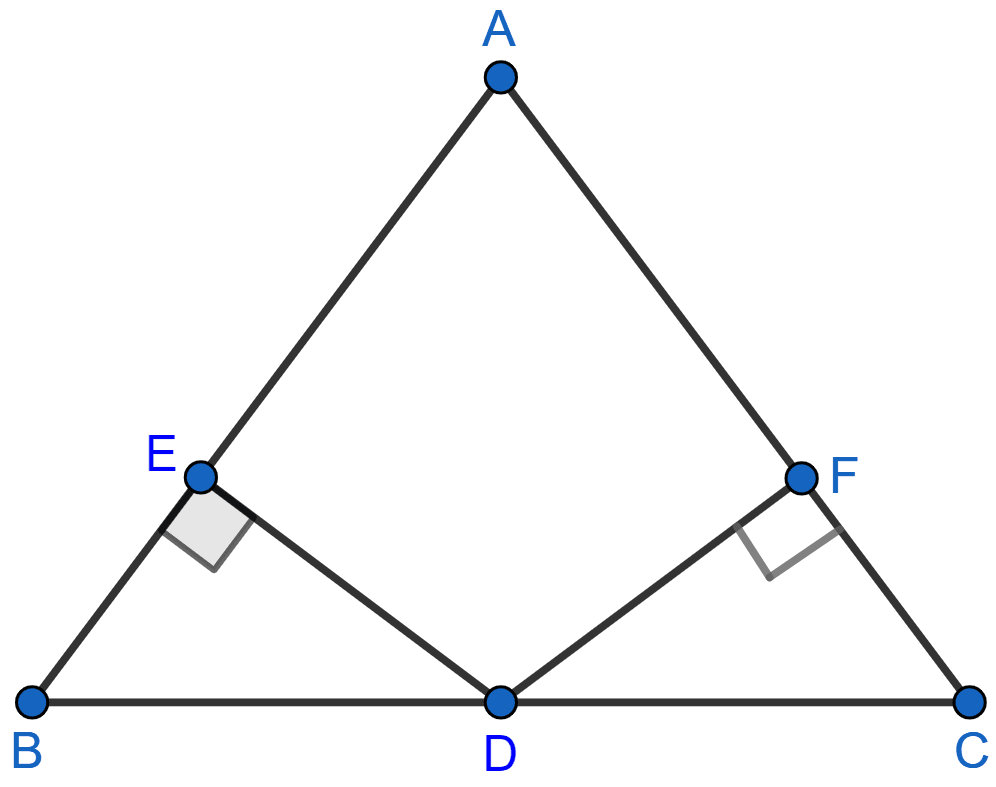
Answer
In △BED and △CFD,
∠BED = ∠CFD (Both are equal to 90°)
DE = DF (Given)
BD = DC (As D is the mid-point of BC.)
∴ △BED ≅ △CFD by RHS axiom.
We know that corresponding parts of congruent triangles are equal,
∴ ∠B = ∠C ⇒ AC = AB.
Hence, proved that ABC is an isosceles triangle.
In the adjoining figure, AD, BE and CF are altitudes of △ABC. If AD = BE = CF, prove that ABC is an equilateral triangle.
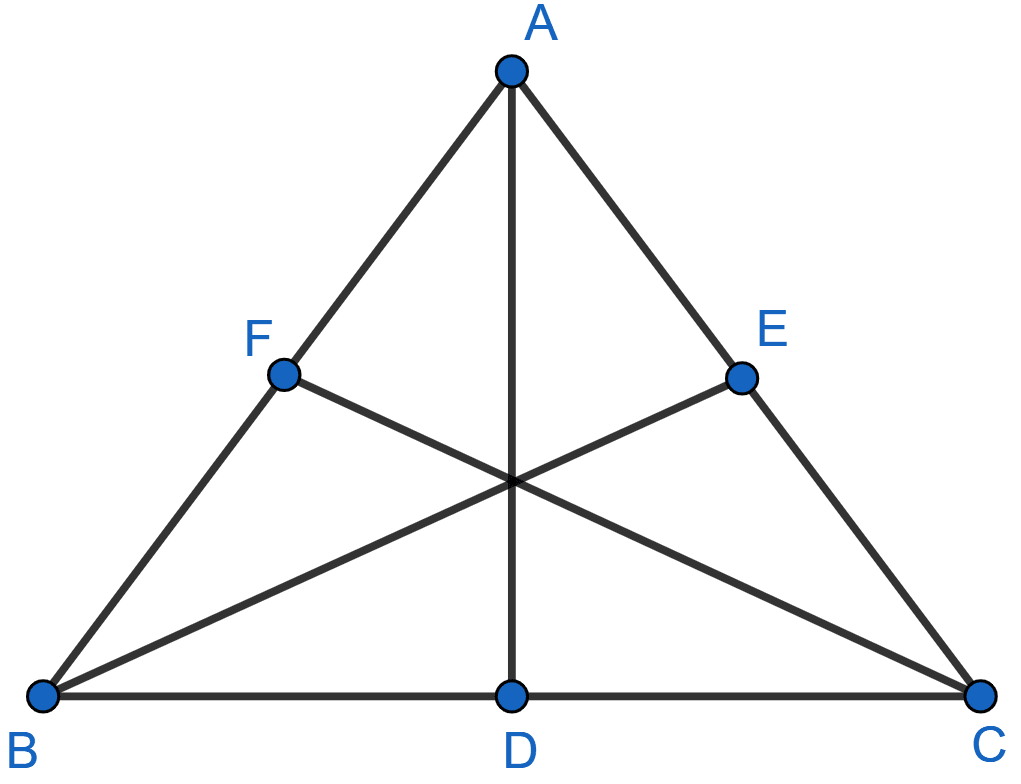
Answer
AD, BE and CF are altitudes of △ABC and
AD = BE = CF
Considering △BEC and △BFC,
Hypotenuse BC = BC (Common)
Side BE = CF (Given)
As altitudes are perpendicular to the sides,
∠CFB = ∠CEB = 90°
Hence, △BEC ≅ △BFC by RHS axiom.
We know that corresponding parts of congruent triangle are equal,
∴ ∠C = ∠B
⇒ AB = AC (Sides opposite to equal angles) .........(i)
Considering △CFA and △ADC,
AD = CF (Given)
∠ADC = ∠CFA = 90° (As altitudes are perpendicular to sides)
AC = AC (Common)
Hence, △CFA ≅ △ADC by RHS axiom.
We know that corresponding parts of congruent triangle are equal,
∴ ∠A = ∠C
⇒ AB = BC (Sides opposite to equal angles) .........(ii)
From (i) and (ii)
AB = BC = AC
△ABC is an equilateral triangle.
Hence, proved that △ABC is an equilateral triangle.
In a triangle ABC, AB = AC, D and E are points on the sides AB and AC respectively such that BD = CE. Show that:
(i) △DBC ≅ △ECB
(ii) ∠DCB = ∠EBC
(iii) OB = OC, where O is the point of intersection of BE and CD.
Answer
(i) From figure,
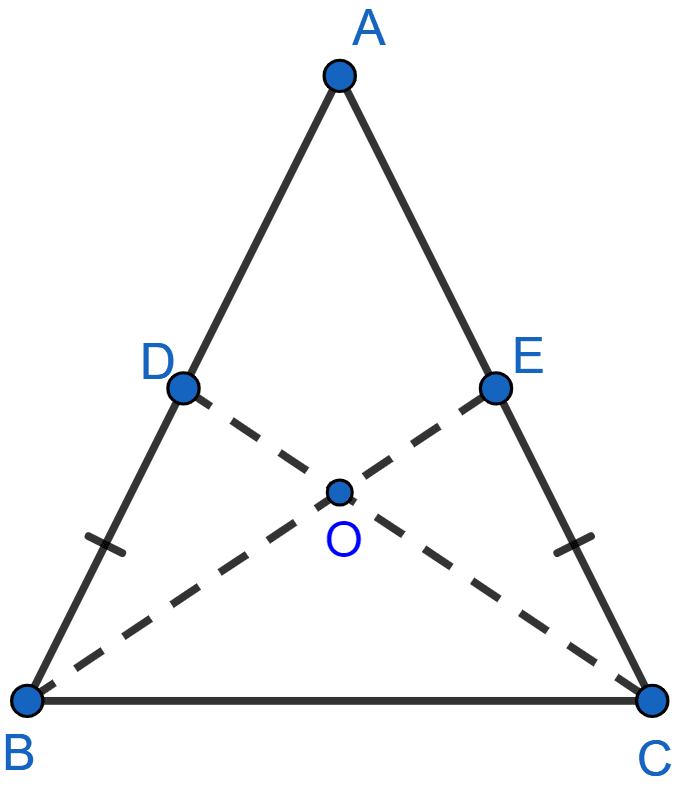
BD = CE (Given)
BC = BC (Common)
∠DBC = ∠ECB (as AB = AC).
∴ △DBC ≅ △ECB by SAS axiom.
Hence, proved △DBC ≅ △ECB.
(ii) We know that corresponding parts of congruent triangle are equal.
∴ ∠DCB = ∠EBC.
Hence, proved that ∠DCB = ∠EBC.
(iii) As △DBC ≅ △ECB,
∠BDO = ∠CEO (By c.p.c.t.)
∠DOB = ∠EOC (Vertically opposite angles)
BD = CE (Given)
Hence, △BOD ≅ △EOC by ASA axiom.
We know that corresponding parts of congruent triangles are equal.
∴ OB = OC.
Hence, proved that OB = OC.
ABC is an isosceles triangle in which AB = AC. P is any point in the interior of △ABC such that ∠ABP = ∠ACP. Prove that
(a) BP = CP
(b) AP bisects ∠BAC.
Answer
Below figure shows the isosceles triangle ABC with the points marked:
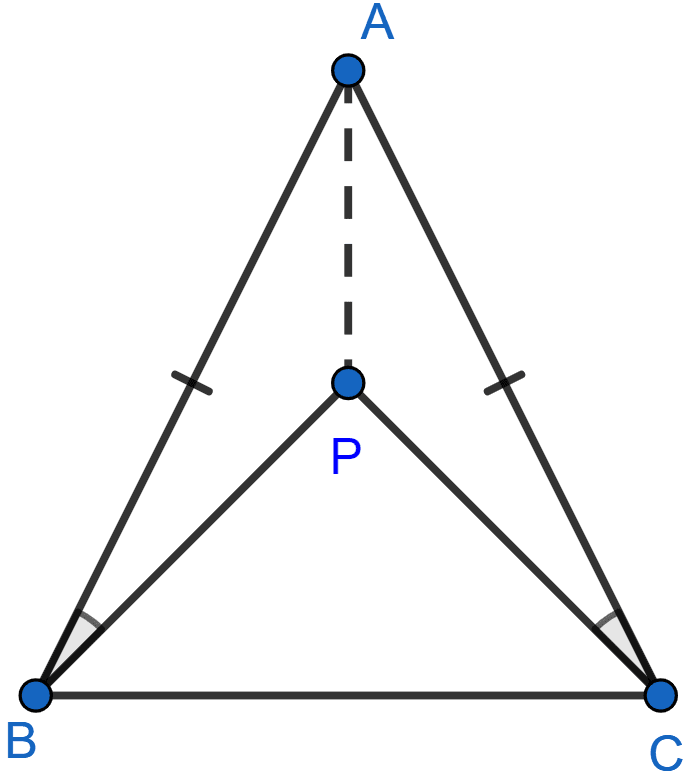
(a) Given,
AB = AC
∴ ∠B = ∠C ........(i)
Given, ∠ABP = ∠ACP ........(ii)
Subtracting (ii) from (i) we get,
∠B - ∠ABP = ∠C - ∠ACP
∠PBC = ∠PCB.
∴ BP = CP (As sides opposite to equal angles are equal)
Hence, proved that BP = CP.
(b) We know that,
BP = CP (Proved)
AB = AC (Given)
∠ABP = ∠ACP (Given)
Hence, △ABP ≅ △ACP by SAS axiom.
∠PAB = ∠PAC (Corresponding angles of congruent triangles are equal.)
Thus AP, bisects ∠BAC.
Hence, proved that AP bisects ∠BAC.
ΔPQR is an isosceles triangle such that PQ = QR. If S is a point on QR produced such that PR = RS and ∠QPS = 63°, find ∠PSQ.
Answer
ΔPQR is an isosceles triangle such that PQ = QR.
S is a point on QR produced such that PR = RS.
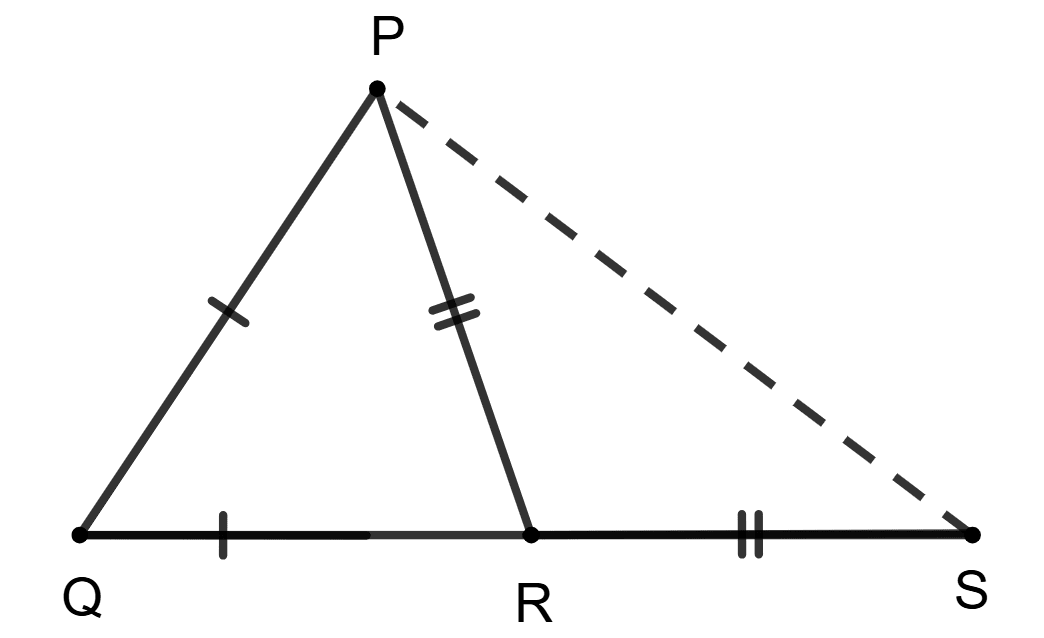
As we know that in an isosceles triangle, angles opposite to equal sides are equal.
In ΔPQR,
⇒ ∠QPR = ∠QRP = x° (let)....................(1)
In ΔPRS,
⇒ ∠PSR = ∠SPR = y° (let)....................(2)
Given,
⇒ ∠QPS = 63°
From figure,
⇒ ∠QPR + ∠SPR = 63°
⇒ x° + y° = 63° ..................(3)
We know that,
The exterior angle of a triangle is equal to the sum of the two opposite interior angles.
The angle ∠PRQ (which is x) is an exterior angle to △PRS at vertex R.
⇒ ∠PRQ = ∠SPR + ∠PSR.
⇒ x° = y° + y°
⇒ x° = 2y°
Substituting the above value of x in equation (1), we get :
⇒ 2y° + y° = 63°
⇒ 3y° = 63°
⇒ y° =
⇒ y° = 21°
⇒ ∠PSR = ∠SPR = 21°.
From figure,
⇒ ∠PSQ = ∠PSR = 21°
Hence, ∠PSQ = 21°.
In the adjoining figure, D and E are points on the side BC of △ABC such that BD = EC and AD = AE. Show that △ABD ≅ △ACE.

Answer
Given, AD = AE.
∴ ∠ADE = ∠AED (As angles opposite to equal sides are equal.)
⇒ 180 - ∠ADE = 180 - ∠AED
⇒ ∠ADB = ∠AEC.
BD = EC (Given)
∴ △ABD ≅ △ACE by SAS axiom.
Hence, proved that △ABD ≅ △ACE.
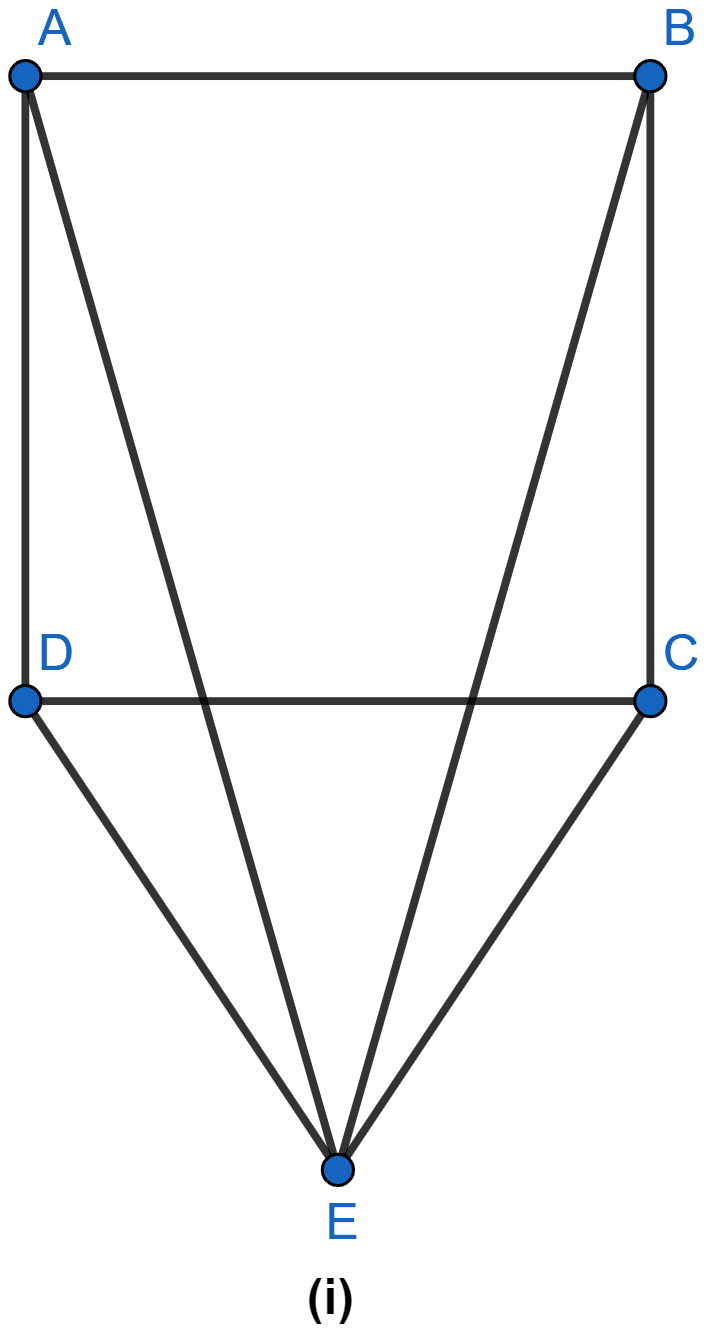
In the figure (i) given below, CDE is an equilateral triangle formed on a side CD of a square ABCD. Show that △ADE ≅ △BCE and hence, AEB is an isosceles triangle.
Answer
From figure,
∠ADE = ∠ADC + ∠CDE = 90° + 60° = 150°.
Similarly,
∠BCE = ∠BCD + ∠DCE = 90° + 60° = 150°.
⇒ ∠ADE = ∠BCE.
AD = BC (As sides of squares are equal)
DE = EC (As CDE is an equilateral triangle.)
∴ △ADE ≅ △BCE by SAS axiom.
We know that corresponding parts of congruent triangles are equal.
∴ AE = BE.
Hence, proved that AE = BE i.e. AEB is an isosceles triangle.
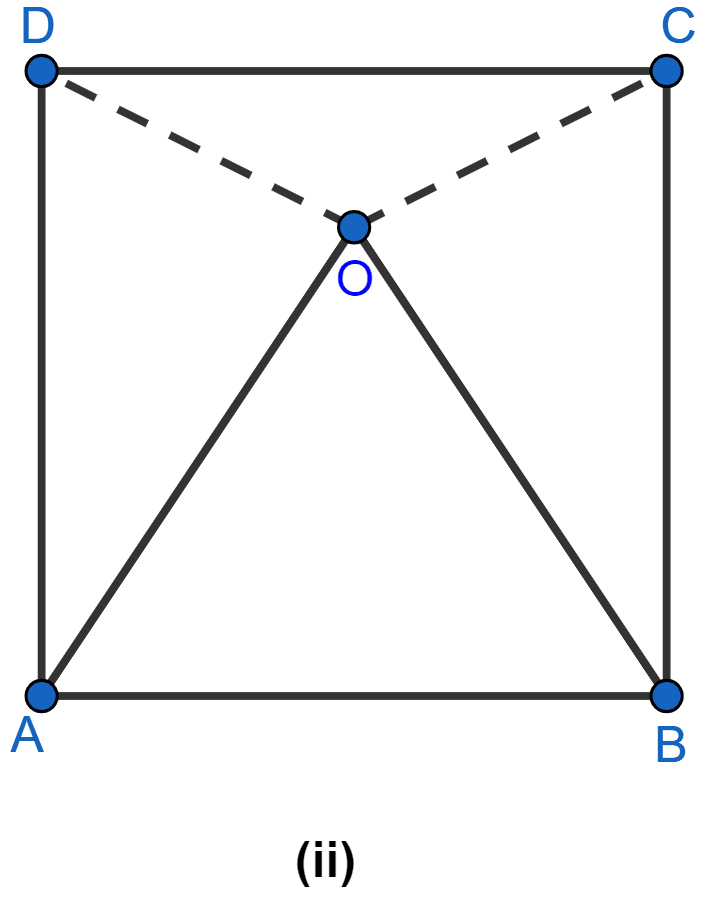
In the figure (ii) given below, O is the point in the interior of a square ABCD such that OAB is an equilateral triangle. Show that OCD is an isosceles triangle.
Answer
∠OAD = ∠DAB - ∠OAB = 90° - 60° = 30°.
Similarly,
∠OBC = ∠CBA - ∠OBA = 90° - 60° = 30°.
⇒ ∠OAD = ∠OBC.
AD = BC (As sides of squares are equal).
OA = OB (As OAB is equilateral triangle).
∴ △OAD ≅ △OBC by SAS axiom.
We know that corresponding parts of congruent triangles are equal.
∴ OD = OC.
Hence, proved that OD = OC i.e. OCD is an isosceles triangle.
In the adjoining figure, ABC is a right triangle with AB = AC. Bisector of ∠A meets BC at D. Prove that BC = 2AD.

Answer
In △ABC, ∠A = 90° and AB = AC.
⇒ ∠B = ∠C (As angles opposite to equal sides are equal)
We know,
∠A + ∠B + ∠C = 180°
90° + ∠B + ∠B = 180°
2∠B = 90°
∠B = 45° .
As AD is bisector of ∠A, ∠BAD = ∠CAD = 45°.
AD = AD (Common)
∠ACD = ∠ABD = 45°
Hence, △ABD ≅ △ACD by AAS axiom.
We know that corresponding parts of congruent triangles are equal.
∴ BD = CD .........(i)
In △ABD, ∠BAD = ∠ABD (each = 45°)
⇒ AD = BD (As sides opposite to equal angles are equal) ........(ii)
∴ BC = BD + CD
= BD + BD (Using (i))
∴ BC = 2BD
Using (ii),
BC = 2AD.
Hence, proved that BC = 2AD.