
In triangles ABC and PQR, ∠A = ∠Q and ∠B = ∠R. Which side of △PQR should be equal to side AB of △ABC so that the two triangles are congruent? Give reason for your answer.
Answer
Given in triangles ABC and PQR,
∠A = ∠Q,
∠B = ∠R,
So, AB should be equal to QR. That will make, △ABC ≅ △QRP by ASA axiom.
Hence, AB = QR for △ABC ≅ △QRP by ASA axiom.
In triangles ABC and PQR, ∠A = ∠Q and ∠B = ∠R. Which side of △PQR should be equal to side BC of △ABC so that the two triangles are congruent? Give reason for your answer.
Answer
Given in triangles ABC and PQR,
∠A = ∠Q,
∠B = ∠R,
So BC should be equal to RP. That will make, △ABC ≅ △QRP by AAS axiom.
Hence, BC = RP for △ABC ≅ △QRP by AAS axiom.
"If two angles and a side of one triangle are equal to two angles and a side of another triangle, then the two triangles must be congruent". Is the statement true? Why?
Answer
"If two angles and a side of one triangle are equal to two angles and a side of another triangle, then the two triangles must be congruent".
The above statement is not true because the sides must be corresponding sides.
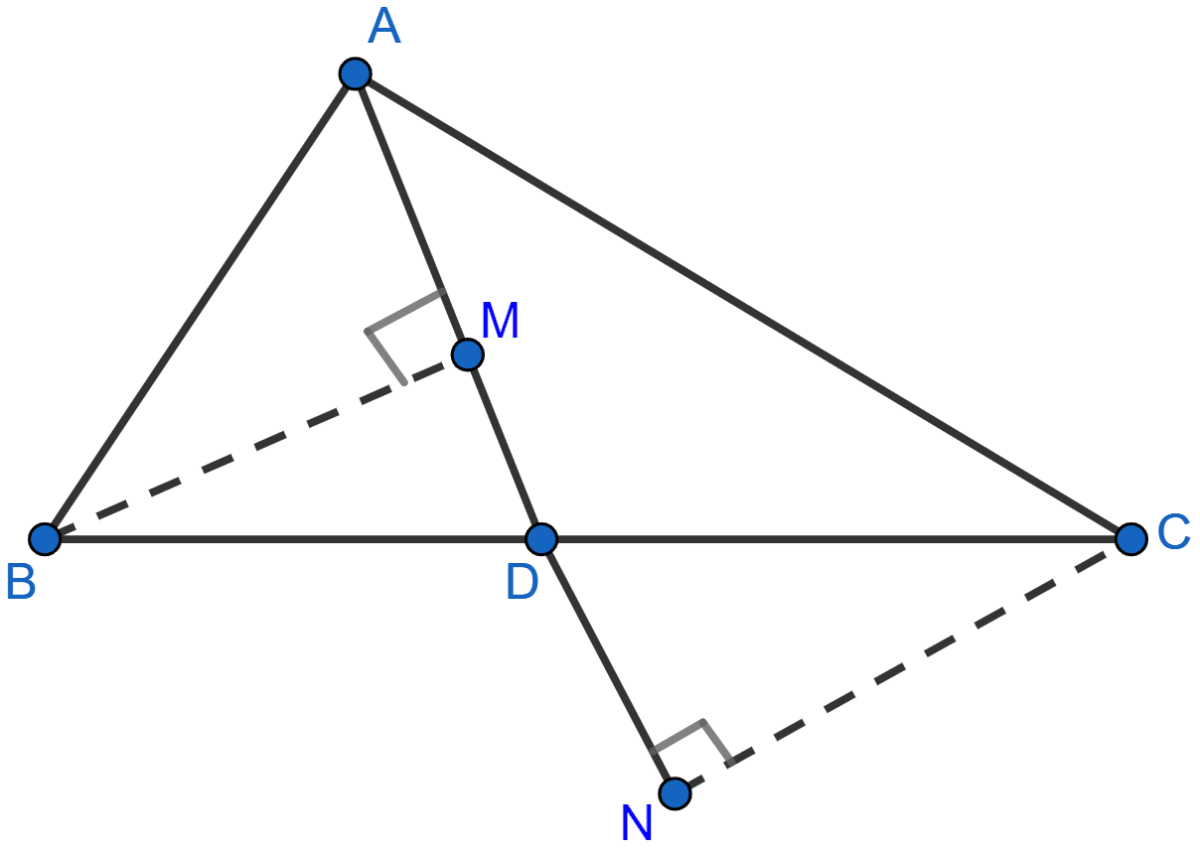
In the adjoining figure, AD is median of △ABC, BM and CN are perpendiculars drawn from B and C respectively on AD and AD produced. Prove that BM = CN.
Answer
In △BMD and △CND,
BD = CD (As AD divides BC in two halves).
∠BMD = ∠CND (Both are equal to 90°)
∠BDM = ∠CDN (Vertically opposite angles)
∴ △BMD ≅ △CND by AAS axiom.
We know that corresponding sides of congruent triangles are equal.
∴ BM = CN.
Hence, proved that BM = CN.
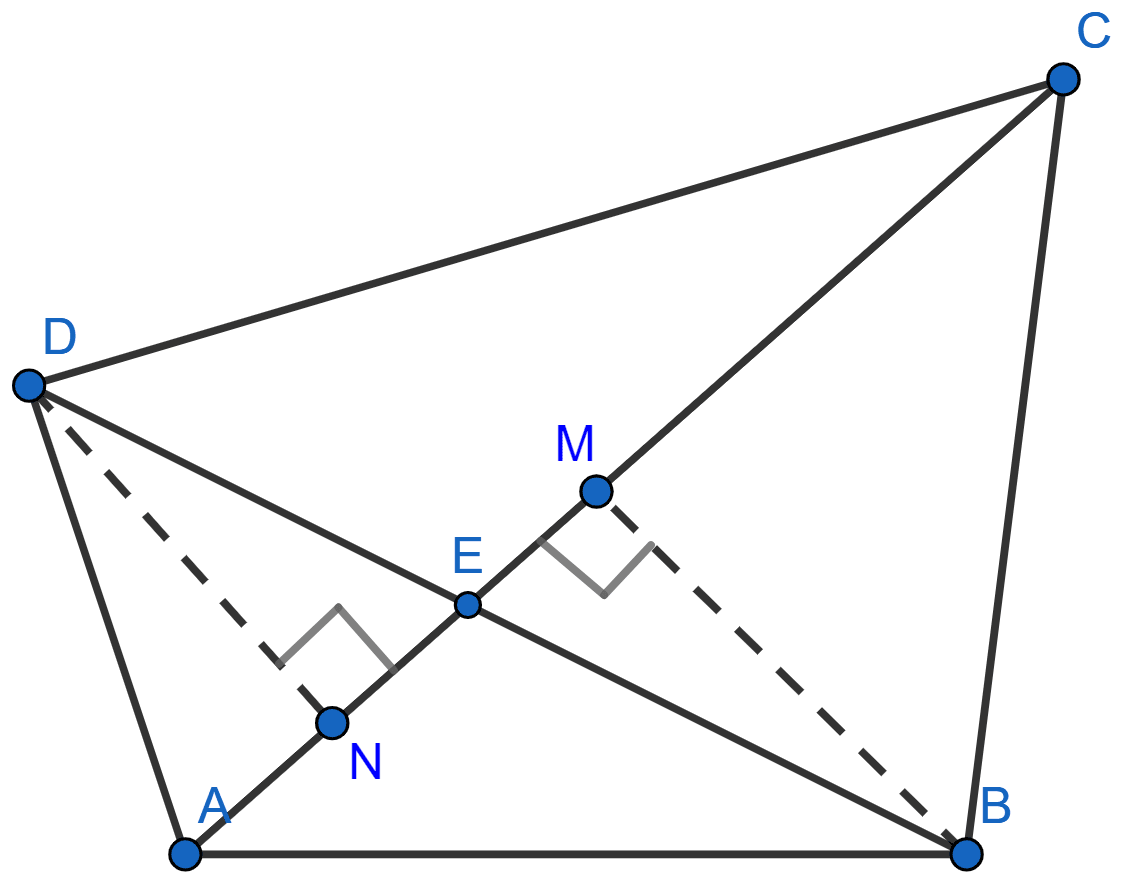
In the adjoining figure, BM and DN are perpendiculars to the line segment AC. If BM = DN, prove that AC bisects BD.
Answer
In △BEM and △DEN,
BM = DN (Given).
∠BME = ∠DNE (Both are equal to 90°)
∠BEM = ∠DEN (Vertically opposite angles)
∴ △BEM ≅ △DEN by AAS axiom.
We know that corresponding parts of congruent triangles are equal.
∴ DE = BE.
Since, DE = BE it means that AC bisects BD at E.
Hence, proved that AC bisects BD.
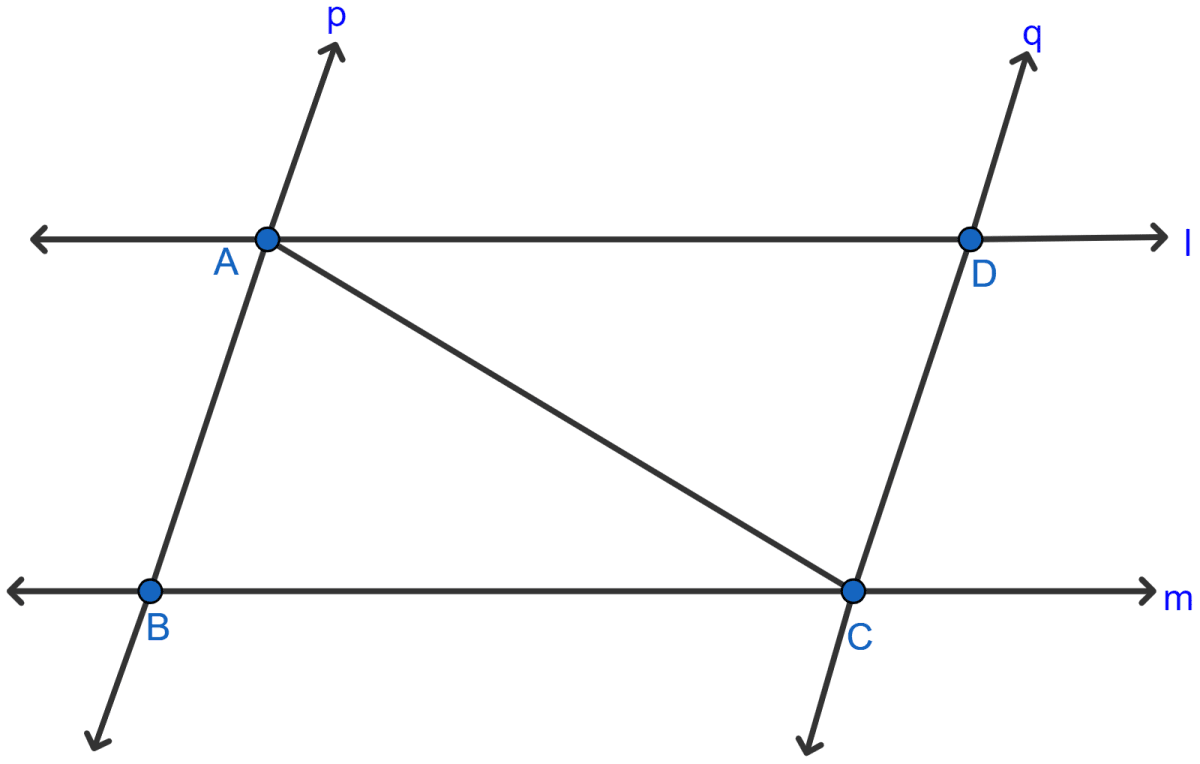
In the adjoining figure, l and m are two parallel lines intersected by another pair of parallel lines p and q. Show that △ABC ≅ △CDA.
Answer
In △ABC and △CDA,
AC = AC (Common).
∠ACB = ∠CAD (Alternate angles)
∠BAC = ∠ACD (Alternate angles)
Hence, proved that △ABC ≅ △CDA by ASA axiom.
In the adjoining figure, two lines AB and CD intersect each other at the point O such that BC || DA and BC = DA. Show that O is the mid-point of both the line segments AB and CD.

Answer
In △BOC and △DOA,
BC = DA (Given).
∠CBO = ∠DAO (Alternate angles)
∠BOC = ∠DOA (Vertically opposite angles)
∴ △BOC ≅ △DOA by ASA axiom.
We know that corresponding parts of congruent triangles are equal.
∴ BO = AO and CO = DO.
Hence, proved that O is the mid-point of AB and CD.
In the adjoining figure, ∠BCD = ∠ADC and ∠BCA = ∠ADB. Show that
(i) △ACD ≅ △BDC
(ii) BC = AD
(iii) ∠A = ∠B

Answer
(i) In △ACD and △BDC,
Given,
∠BCD = ∠ADC
∠BCA = ∠ADB
∴ ∠BCD + ∠BCA = ∠ADC + ∠ADB
⇒ ∠ACD = ∠BDC
CD = CD (Common).
∠ADC = ∠BCD (Given)
Hence, proved that △ACD ≅ △BDC by ASA axiom.
(ii) We know that, △ACD ≅ △BDC.
We know that corresponding sides of congruent triangles are equal.
∴ BC = AD.
Hence, proved that BC = AD.
(iii) We know that, △ACD ≅ △BDC.
We know that corresponding angles of congruent triangles are equal.
∴ ∠A = ∠B.
Hence, proved that ∠A = ∠B.
In the adjoining figure, ∠ABC = ∠ACB, D and E are points on the sides AC and AB respectively such that BE = CD. Prove that
(i) △EBC ≅ △DCB
(ii) △OEB ≅ △ODC
(iii) OB = OC.

Answer
(i) Given, ∠ABC = ∠ACB.
∴ ∠EBC = ∠DCB.
In △EBC and △DCB,
∠EBC = ∠DCB (Proved)
BE = CD (Given)
BC = BC (Common)
Hence, proved △EBC ≅ △DCB by SAS axiom.
(ii) We know that, △EBC ≅ △DCB.
Subtracting common △OBC from both sides we get,
⇒ △EBC - △OBC ≅ △DCB - △OBC
⇒ △OEB ≅ △ODC
Hence, proved that △OEB ≅ △ODC.
(iii) We know that,
△OEB ≅ △ODC
We know that corresponding angles of congruent triangles are equal.
∴ OB = OC.
Hence, proved that OB = OC.
ABC is an isosceles triangle with AB = AC. Draw AP ⊥ BC to show that ∠B = ∠C.
Answer

In △APB and △APC,
AB = AC (Given).
∠APB = ∠APC (Both are equal to 90°)
AP = AP (Common)
∴ △APB ≅ △APC by RHS axiom.
We know that corresponding angles of congruent triangles are equal.
∴ ∠B = ∠C.
Hence, proved that ∠B = ∠C.
In the adjoining figure, BA ⊥ AC, DE ⊥ DF such that BA = DE and BF = EC. Show that △ABC ≅ △DEF.

Answer
In △ABC and △DEF,
BF = EC (Given)
⇒ BF + FC = EC + FC
∴ BC = FE.
BA = DE (Given)
∠BAC = ∠EDF (Both are equal to 90°)
∴ △ABC ≅ △DEF (By RHS axiom)
Hence, proved that △ABC ≅ △DEF.
ABCD is a rectangle. X and Y are points on sides AD and BC respectively such that AY = BX. Prove that BY = AX and ∠BAY = ∠ABX.
Answer

In △ABY and △ABX,
AB = AB (Common)
∠XAB = ∠YBA (Each angle in rectangle is equal to 90°)
AY = BX (Given)
∴ △ABY ≅ △ABX (By RHS axiom)
We know that corresponding parts of congruent triangles are equal.
∴ BY = AX and ∠BAY = ∠ABX.
Hence, proved that BY = AX and ∠BAY = ∠ABX.
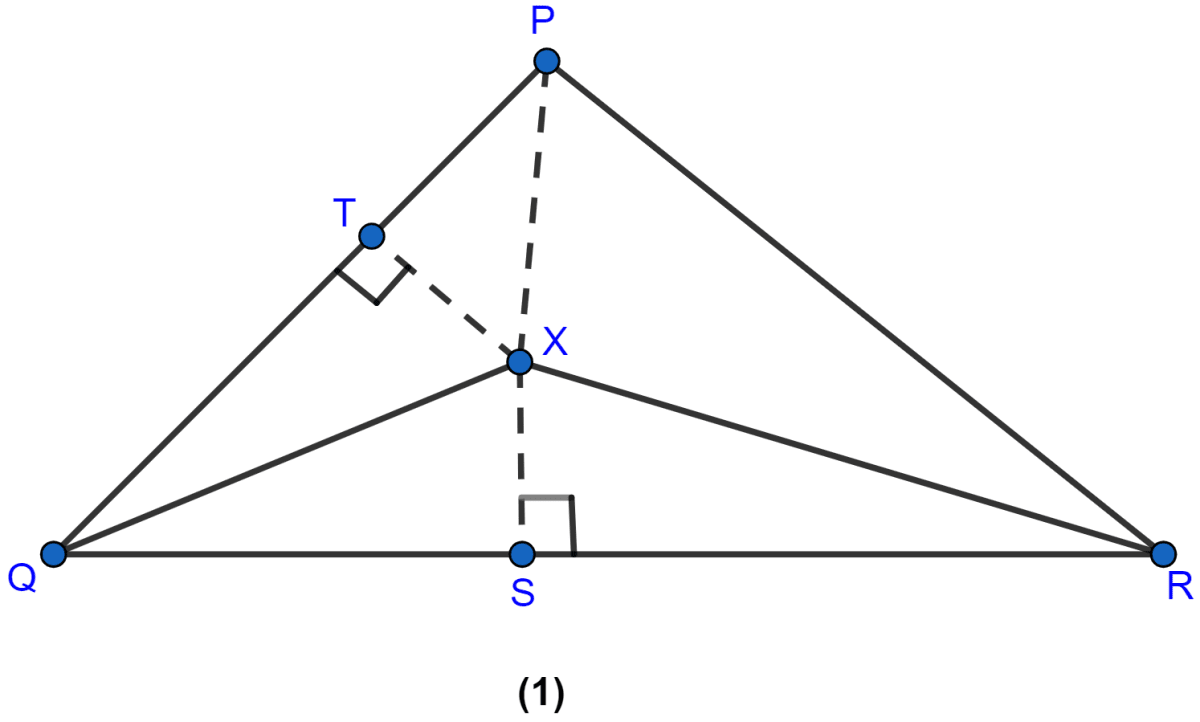
In the figure (1) given below, QX, RX are bisectors of angles PQR and PRQ respectively of △PQR. If XS ⊥ QR and XT ⊥ PQ, prove that
(i) △XTQ ≅ △XSQ
(ii) PX bisects the angle P.
Answer
(i) Given, QX is the bisector of ∠PQR
∴ ∠PQX = ∠XQS
From figure,
∠XTQ = ∠XSQ (Both are equal to 90°)
XQ = XQ
Hence, △XTQ ≅ △XSQ by ASA axiom.
Hence, proved that △XTQ ≅ △XSQ.
(ii) Draw a perpendicular from X on PR i.e. XU.
In △XSR and △XUR,
∠XSR = ∠XUR (Both are equal to 90°)
∠XRS = ∠XRU (As XR is bisector)
XR = XR (Common)
Hence, △XSR ≅ △XUR by AAS axiom.
We know that corresponding parts of congruent triangle are equal.
∴ XU = XS ........(i)
As, △XTQ ≅ △XSQ
∴ XS = XT .......(ii)
In △XUP and △XTP,
From (i) and (ii) we get,
XU = XT
XP = XP (Common)
∠XTP = ∠XUP (Both are equal to 90°)
Hence, △XUP ≅ △XTP by SAS axiom.
We know that corresponding parts of congruent triangle are equal.
∴ ∠XPU = ∠XPT
Hence, proved that PX is bisector of ∠P.
In the figure (2) given below, AB || DC and ∠C = ∠D. Prove that
(i) AD = BC
(ii) AC = BD.

Answer
(i) Draw AE ⊥ CD, BF ⊥ CD.

Considering △ADE and △BCF we get,
∠ADE = ∠BCF (Given)
∠AED = ∠BFC = 90°
AE = BF (Distance between parallel lines are equal)
Hence, △ADE ≅ △BCF by AAS axiom.
We know that corresponding parts of congruent triangles are equal.
∴ AD = BC.
Hence, proved that AD = BC.
(ii) Join AC, BD.
Considering △ACD and △BDC we get,
∠ADC = ∠BCD (Given)
AD = BC (Proved)
DC = DC (Common)
Hence, △ACD ≅ △BDC by SAS axiom.
We know that corresponding parts of congruent triangles are equal.
∴ AC = BD.
Hence, proved that AC = BD.
In the figure (3) given below, BA || DF and CA || EG and BD = EC. Prove that
(i) BG = DF
(ii) EG = CF.

Answer
Given,
BD = EC
BD + DE = DE + EC
BE = DC.
Considering △BGE and △DFC,
∠GBE = ∠FDC (Corresponding angles)
∠GEB = ∠FCD (Corresponding angles)
BE = DC (Proved).
∴ △BGE ≅ △DFC by ASA axiom..
We know that corresponding parts of congruent triangles are equal.
∴ BG = DF.
Hence, proved that BG = DF.
(ii) We know,
△BGE ≅ △DFC.
We know that corresponding parts of congruent triangles are equal.
∴ EG = CF.
Hence, proved that EG = CF.
In the following figure, find the values of x and y.

Answer

In △ABC and △CDE,
∠ACB = ∠DCE (Vertically opposite angles)
∠BAC = ∠CED (Given)
BC = CD (Given)
∴ △ABC ≅ △CDE (By AAS axiom)
We know that corresponding parts of congruent triangles are equal.
∴ DE = AB
⇒ 2y + 3 = 25
⇒ 2y = 22
⇒ y = 11.
Given, BC = CD
⇒ 3x - 7 = 32
⇒ 3x = 32 + 7
⇒ 3x = 39
⇒ x = 13.
Hence, x = 13 and y = 11.
In the following figure, find the values of x and y.
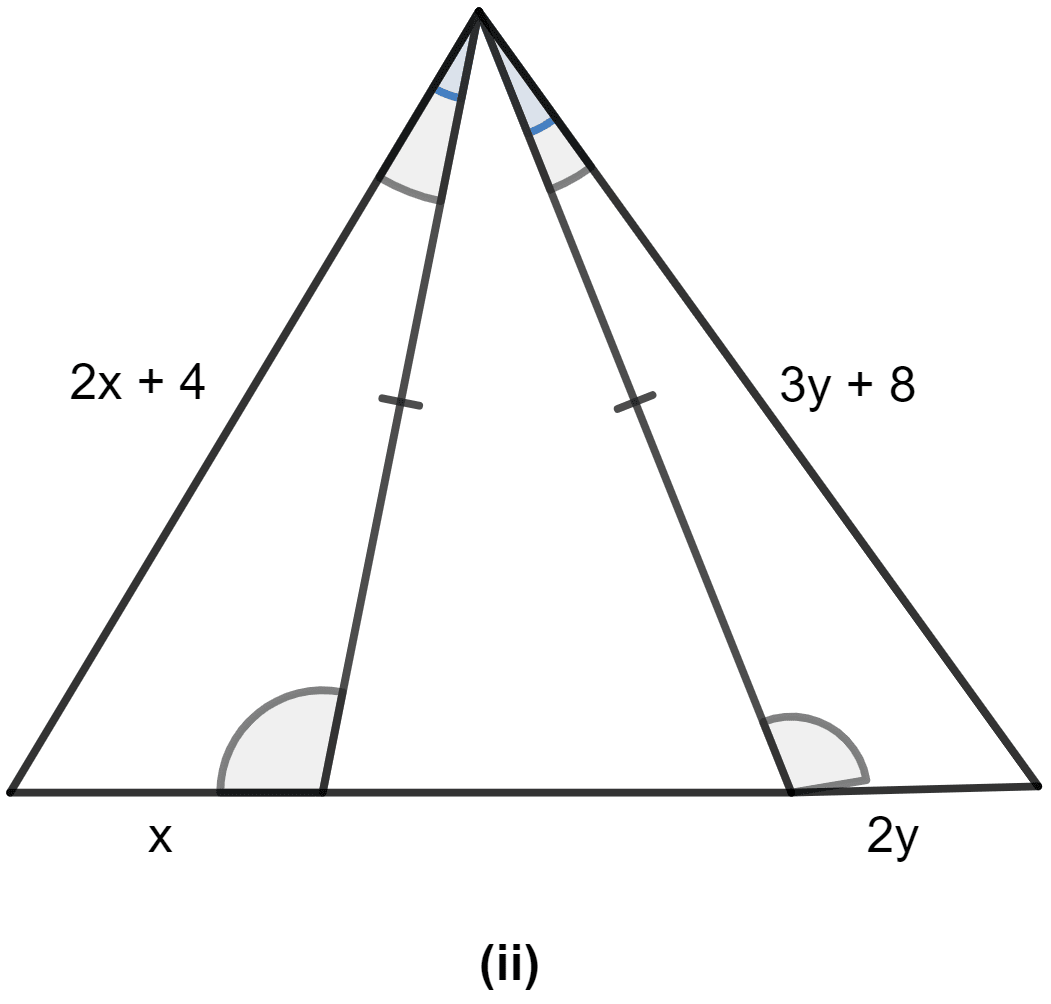
Answer
In △ABC and △ADE,
∠BAC = ∠DAE (Given)
∠BCA = ∠EDA (Given)
AC = AD (Given)
∴ △ABC ≅ △ADE (By ASA axiom)
We know that corresponding parts of congruent triangles are equal.
∴ BC = DE
⇒ x = 2y ......(i)
∴ AB = AE
⇒ 2x + 4 = 3y + 8
Substituting value of x from (i) in above equation we get,
⇒ 2(2y) + 4 = 3y + 8
⇒ 4y + 4 = 3y + 8
⇒ 4y - 3y = 8 - 4
⇒ y = 4.
∴ x = 2y = 2(4) = 8.
Hence, x = 8 and y = 4.