
In the adjoining figure, ABCD is a parallelogram. CB is produced to E such that BE = BC. Prove that AEBD is a parallelogram.

Answer
In ∆AEB and ∆BDC
EB = BC [Given]
∠ABE = ∠DCB [Corresponding angles]
AB = DC [Opposite sides of || gm ABCD are equal]
Thus, ∆AEB ≅ ∆BDC by S.A.S axiom
So, by C.P.C.T
BD = AE
In || gm ABCD,
BC = AD (As opposite sides of || gm are equal)
Given,
BC = BE
∴ AD = BE.
Since, opposite sides of quadrilateral AEBD are equal (i.e., BD = AE and AD = BE)
Hence, proved that AEBD is a parallelogram.
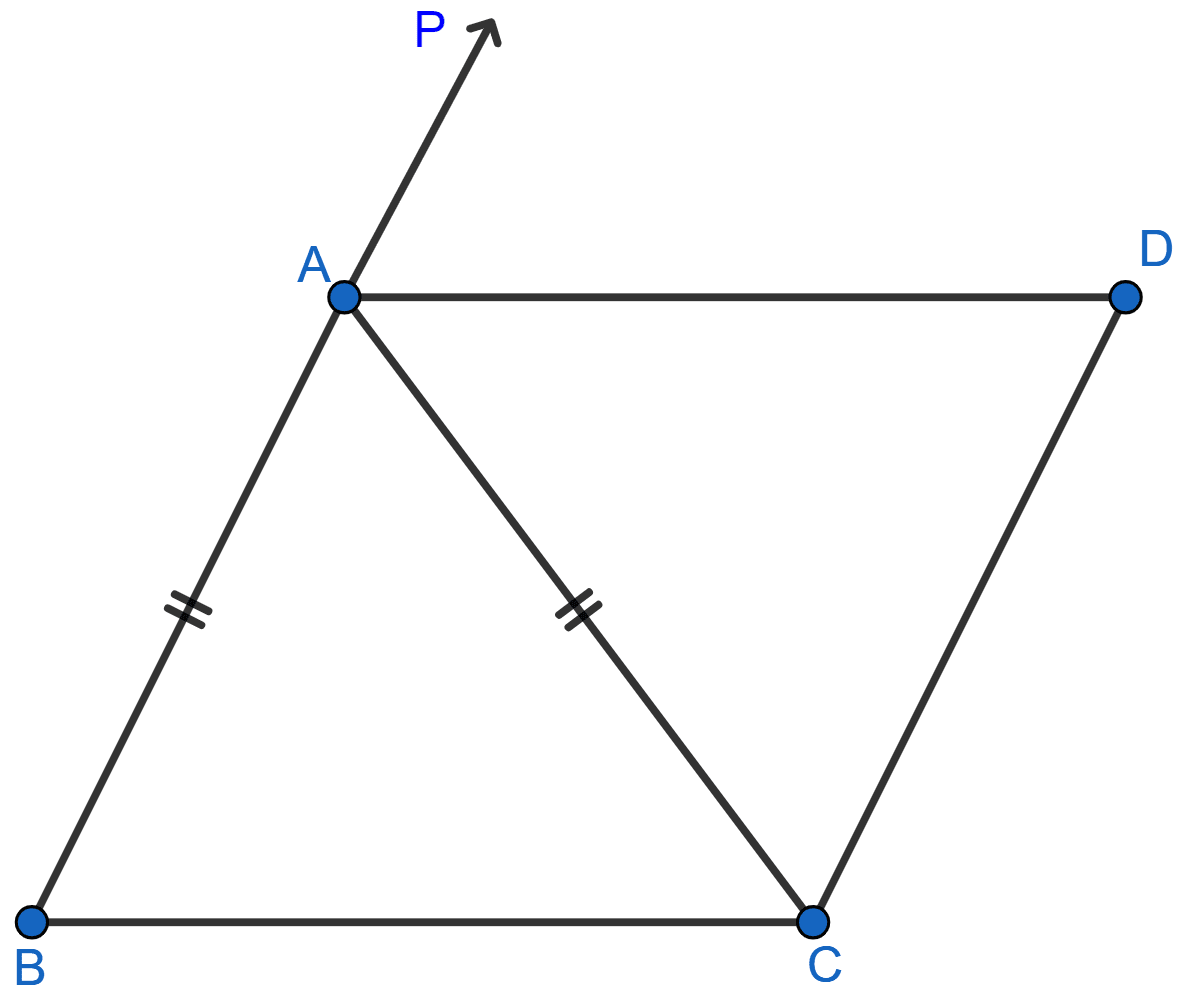
In the adjoining figure, ABC is an isosceles triangle in which AB = AC. AD bisects exterior angle PAC and CD || BA. Show that
(i) ∠DAC = ∠BCA
(ii) ABCD is a parallelogram.
Answer
(i) In ∆ABC
AB = AC [Given]
∠C = ∠B [Angles opposite to equal sides are equal]
Since, ext. ∠PAC = ∠B + ∠C (Exterior angle is equal to the sum of opposite interior angles)
= ∠C + ∠C
= 2∠C
= 2∠BCA
Since AD bisects ext. ∠PAC, ∠PAC = 2∠DAC
⇒ 2∠DAC = 2∠BCA
⇒ ∠DAC = ∠BCA
Hence, proved that ∠DAC = ∠BCA.
(ii) Since, ∠DAC and ∠BCA are alternate angles and AC is transversal.
It proves that AD || BC.
Since, AD || BC and CD || BA.
Hence, proved that ABCD is a || gm.
Prove that the quadrilateral obtained by joining the mid-points of an isosceles trapezium is a rhombus.
Answer
P, Q, R and S are the mid-points of the sides AB, BC, CD and DA respectively.
Join AC and BD.
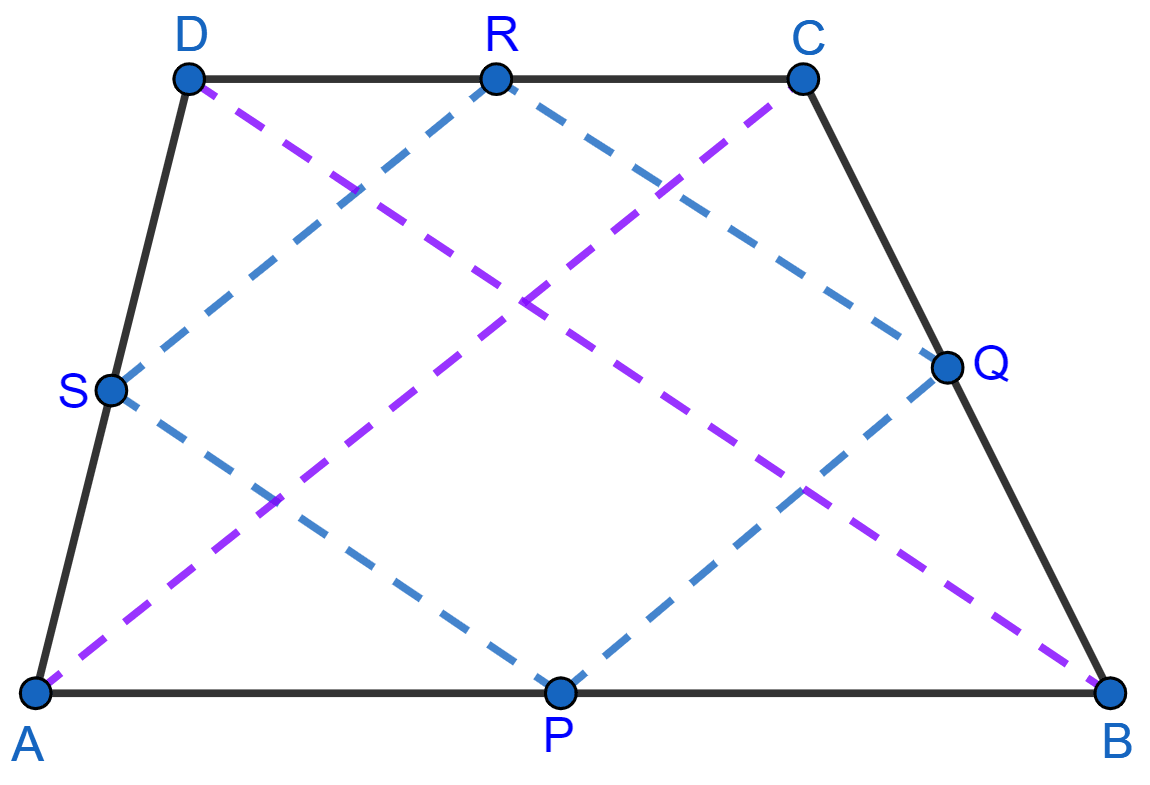
Since, ABCD is an isosceles trapezium
Its diagonals are equal.
AC = BD = x (let)
Now, in ∆ABC
P and Q are the mid-points of AB and BC
So, PQ || AC and PQ = AC = x (By midpoint theorem) … (i)
Similarly, in ∆ADC
S and R mid-point of AD and CD
So, SR || AC and SR = AC = x (By midpoint theorem) … (ii)
From (i) and (ii), we have
PQ || SR and PQ = SR = .......(iii)
In ∆CBD,
R and Q are the mid-points of CD and BC
So, QR || BD and QR = BD = x (By midpoint theorem) … (iv)
Similarly, in ∆ABD
S and P mid-point of AD and AB
So, SP || BD and SP = BD = x (By midpoint theorem) … (v)
From (iv) and (v), we have
QR || SP and QR = SP = .......(vi)
From (iii) and (vi) we get,
PQ = QR = SR = SP and QR || SP, PQ || SR.
So, sides of PQRS are equal and opposite sides are parallel.
Hence, proved that PQRS is a rhombus.
Find the size of each lettered angle in the following figure.
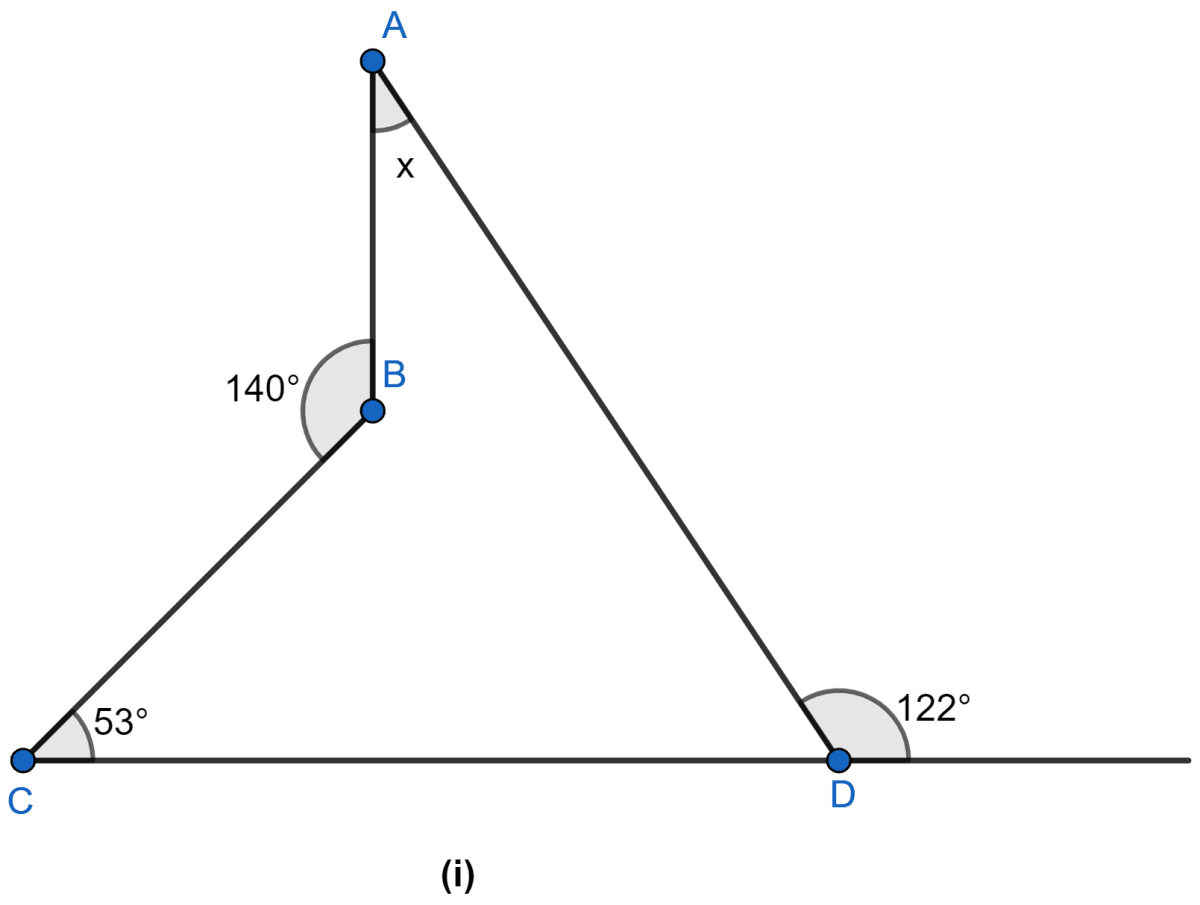
Answer
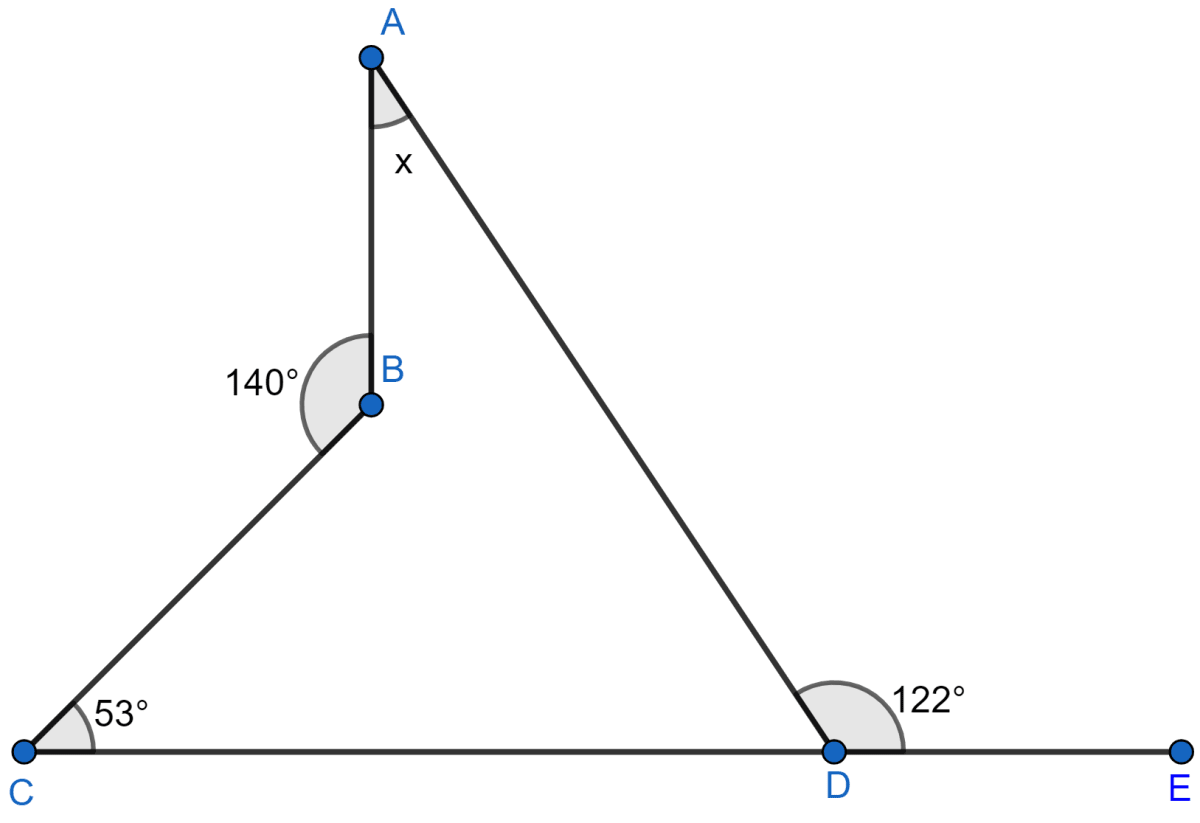
As CDE is a straight line
∠ADE + ∠ADC = 180°
122° + ∠ADC = 180°
∠ADC = 180° – 122° = 58° … (i)
Internal ∠ABC = 360° – 140° = 220° … (ii)
Now, in quadrilateral ABCD we have
⇒ ∠ADC + ∠BCD + ∠BAD + ∠ABC = 360° (As sum of all angles in a quadrilateral is 360°.)
⇒ 58° + 53° + x + 220° = 360° [Using (i) and (ii)]
⇒ 331° + x = 360°
⇒ x = 360° – 331°
⇒ x = 29°
Hence, x = 29°
Find the size of each lettered angle in the following figure.

Answer
As CD || BA [Given]

We can write ED || BA
⇒ ∠ECB = ∠CBA [Alternate angles are equal]
⇒ ∠CBA = 75°
Since, ABCD is a parallelogram, we have
⇒ ∠DAB + ∠CBA = 180° (AD || BC, sum of co-int ∠s = 180°)
⇒ (x + 66°) + 75° = 180°
⇒ x + 141° = 180°
⇒ x = 180° – 141°
⇒ x = 39° … (i)
Now, in ∆AMB
⇒ x + 30° + ∠AMB = 180° [Angles sum property of a triangle]
39° + 30° + ∠AMB = 180° [From (i)]
69° + ∠AMB + 180°
∠AMB = 180° – 69° = 111°
Since, ∠AMB = y [Vertically opposite angles are equal]
⇒ y = 111°
Hence, x = 39° and y = 111°
Find the size of each lettered angle in the following figure.

Answer
In △ADC,
AD = CD (Given)
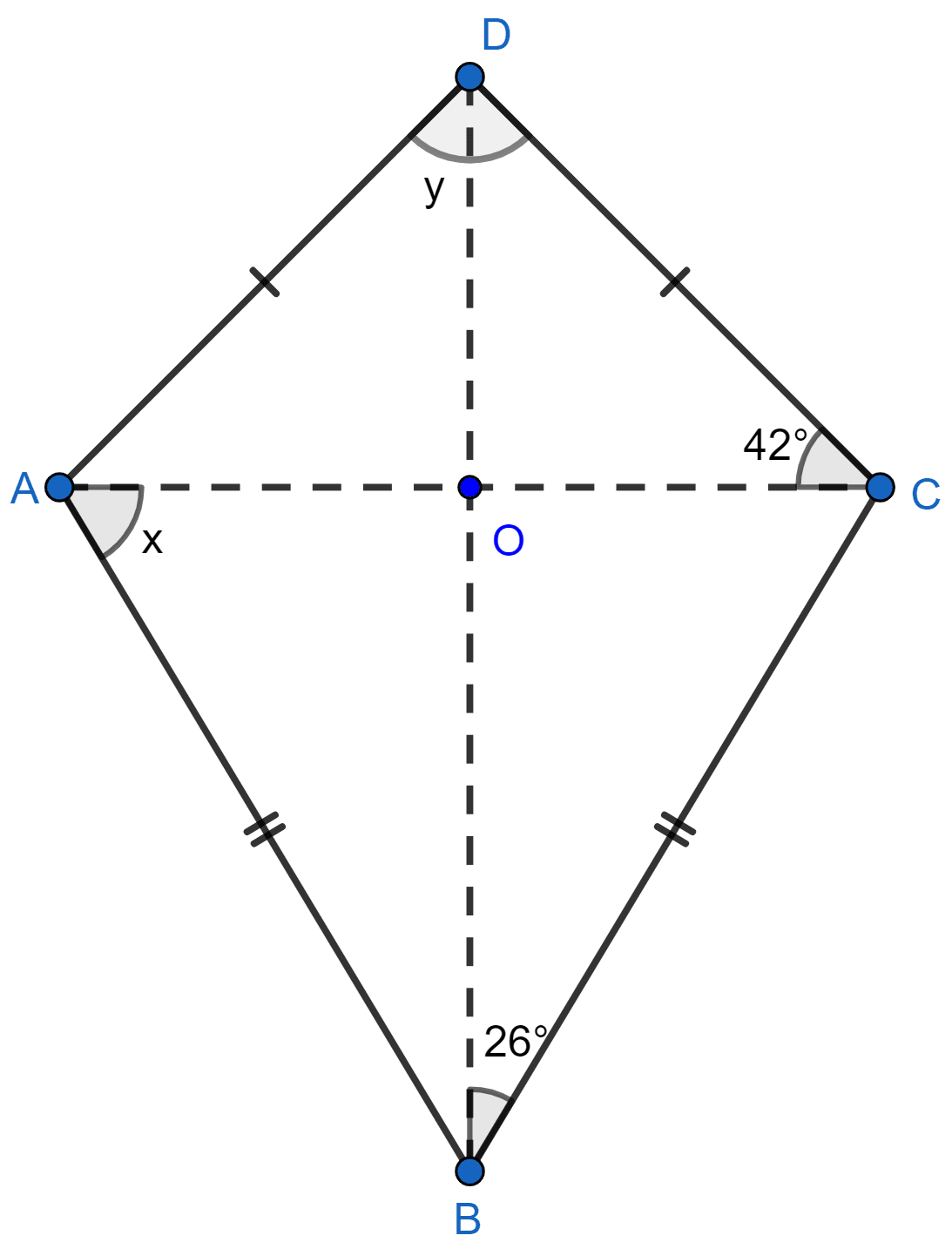
∠DAC = ∠DCA = 42° (Opposite angles of equal sides are equal).
⇒ ∠DAC + ∠DCA + ∠ADC = 180°
⇒ 42° + 42° + y = 180°
⇒ y + 84° = 180°
⇒ y = 96°
In △AOB and △COB,
AO = OC (Diagonals bisect each other)
AB = BC (Given)
∠AOB = ∠COB = 90° (Diagonals are perpendicular to each other)
Hence, △AOB ≅ △COB by RHS congruence rule.
By C.P.C.T. we get,
⇒ ∠ABO = ∠CBO = 26°
In △AOB,
⇒ ∠AOB + ∠ABO + ∠OAB = 180° (Sum of angles of triangle = 180°)
⇒ 90° + 26° + x = 180°
⇒ 116° + x = 180°
⇒ x = 180° - 116° = 64°
Hence, x = 64° and y = 96°.
Find the size of each lettered angle in the following figure:

Answer
Here, AB || CD and BC || AD
So, ABCD is a || gm
y = ∠ABC (As opposite angles of || gm are equal)
y = 2∠ABD (As diagonals bisect vertex angle so BD bisects ∠ABC)
y = 2 x 53° = 106°
Also, y + ∠DAB = 180° (DC || AB, sum of co-int ∠s = 180°)
∠DAB = 180° – 106° = 74°.
Thus, x = ∠DAB [As AC bisects ∠DAB]
⇒ x = x 74° = 37°
and ∠DAC = x = 37°
Also, z = ∠DAC = 37° [Alternate angles are equal]
Hence, x = 37°, y = 106° and z = 37°.
Find the size of each lettered angle in the following figure:

Answer
As ED is a straight line, we have
⇒ 60° + ∠AED = 180° [Linear pair]
⇒ ∠AED = 180° - 60° = 120°
Also, as CD is a straight line
⇒ 50° + ∠BCD = 180° [Linear pair]
⇒ ∠BCD = 180° – 50°
⇒ ∠BCD = 130°
In pentagon ABCDE, we have
⇒ ∠A + ∠B + ∠AED + ∠BCD + x = 540° [Sum of interior angles of pentagon is 540°]
⇒ 90° + 90° + 120° + 130° + x = 540°
⇒ 430° + x = 540°
⇒ x = 540° - 430°
⇒ x = 110°
Hence, value of x = 110°.
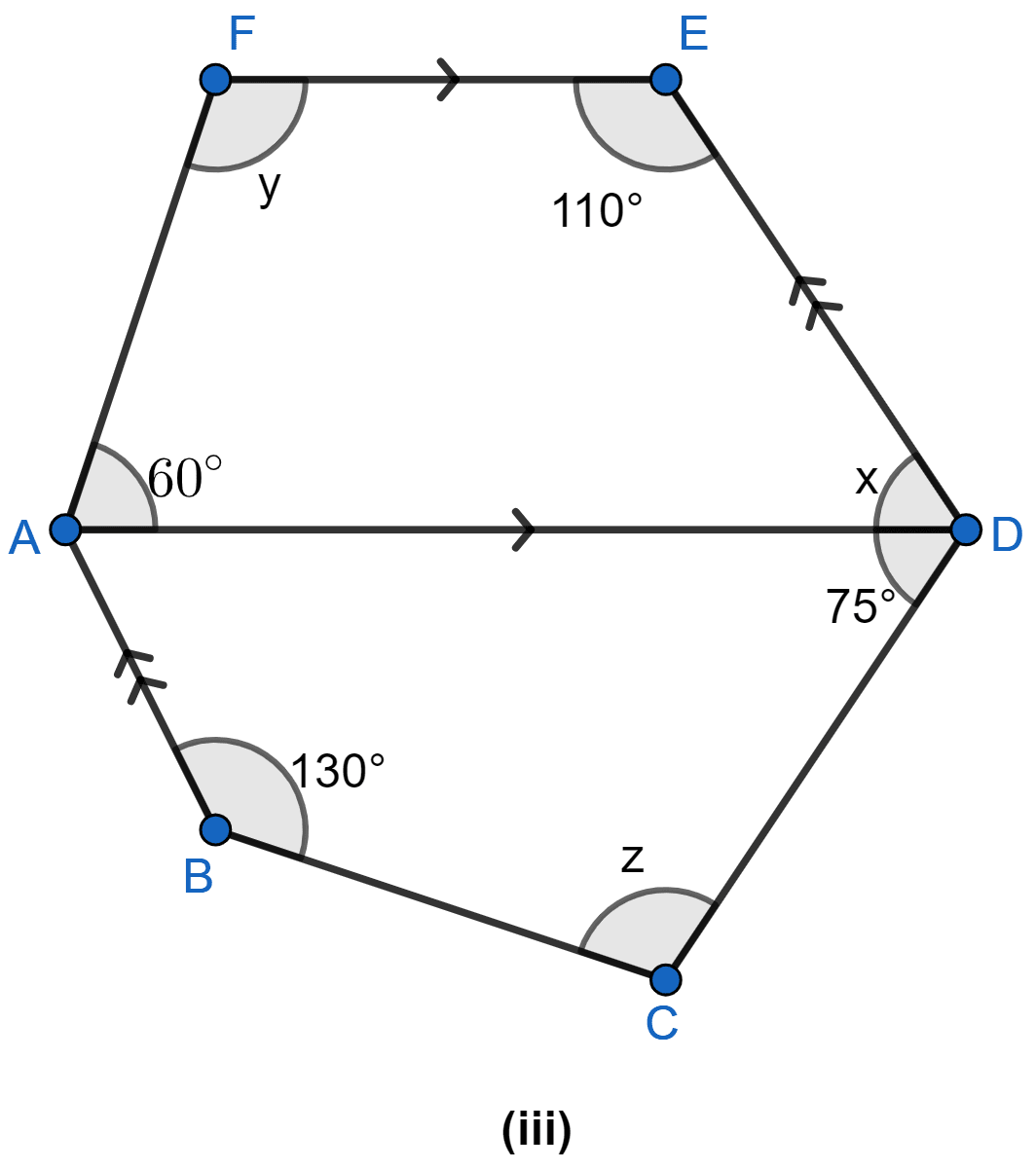
Find the size of each lettered angle in the following figure:
Answer
In given figure, AD || FE [Given]
⇒ 60° + y = 180° and x + 110° = 180° (∵ Sum of adjacent interior angle in trapezium = 180°)
⇒ y = 180° – 60° and x = 180° – 110°
⇒ y = 120° and x = 70°
Since, AB || DE [Given]
∠BAD = ∠ADE = 70° (Alternate angles are equal)
In quadrilateral ABCD,
⇒ ∠BAD + 75° + z + 130° = 360° (∵ Sum of angles of a quadrilateral = 360°)
⇒ 70° + 75° + z + 130° = 360°
⇒ 275° + z = 360°
⇒ z = 360° – 275° = 85°.
Hence, x = 70°, y = 120° and z = 85°.
In the adjoining figure, ABCD is a rhombus and DCFE is a square. If ∠ABC = 56°, find
(i) ∠DAG
(ii) ∠FEG
(iii) ∠GAC
(iv) ∠AGC.

Answer
(i) We know that,
Each angle of a square = 90°.

As ABCD is a rhombus so, AB = BC = DC = AD .......(i)
Also, CD = ED = FC = EF (As CDEF is a square) … (ii)
From (i) and (ii), we have
AB = BC = DC = AD = EF = FC = ED … (iii)
∠ABC = 56° [Given]
⇒ ∠ADC = ∠ABC = 56° [Opposite angle in rhombus are equal]
From figure,
⇒ ∠EDA = ∠EDC + ∠ADC = 90° + 56° = 146°
In ∆ADE,
⇒ DE = AD [From (iii)]
⇒ ∠DEA = ∠DAE [Equal sides have equal opposite angles]
From figure,
⇒ ∠DEA = ∠DAE = ∠DAG
⇒ ∠DAE + ∠DEA + ∠EDA = 180°
⇒ ∠DAG + ∠DAG + ∠EDA = 180°
⇒ 2∠DAG + 146° = 180°
⇒ 2∠DAG = 180° - 146° = 34°
⇒ ∠DAG =
⇒ ∠DAG = 17°.
Hence, ∠DAG = 17°.
(ii) Also,
⇒ ∠DEG = 17°
⇒ ∠FEG = ∠E – ∠DEG
= 90° – 17°
= 73°
Hence, ∠FEG = 73°.
(iii) In rhombus ABCD,
⇒ ∠A + ∠B = 180° (As AD || BC, the sum of co-interior angles = 180°.)
⇒ ∠A = 180° - ∠B = 180° - 56° = 124°
⇒ ∠DAC = [∵ Diagonal AC bisects ∠A]
⇒ ∠DAC = 62°
⇒ ∠GAC = ∠DAC – ∠DAG
= 62° – 17° = 45°.
Hence, ∠GAC = 45°.
(iv) In ∆EDG,
⇒ ∠D + ∠DEG + ∠DGE = 180° [Angles sum property of a triangle]
⇒ 90° + 17° + ∠DGE = 180°
⇒ ∠DGE = 180° – 107° = 73°
Thus, ∠AGC = ∠DGE [Vertically opposite angles are equal]
⇒ ∠AGC = 73°.
Hence, ∠AGC = 73°.
If one angle of a rhombus is 60° and the length of a side is 8 cm, find the lengths of its diagonals.
Answer
Each side of rhombus ABCD is 8 cm.
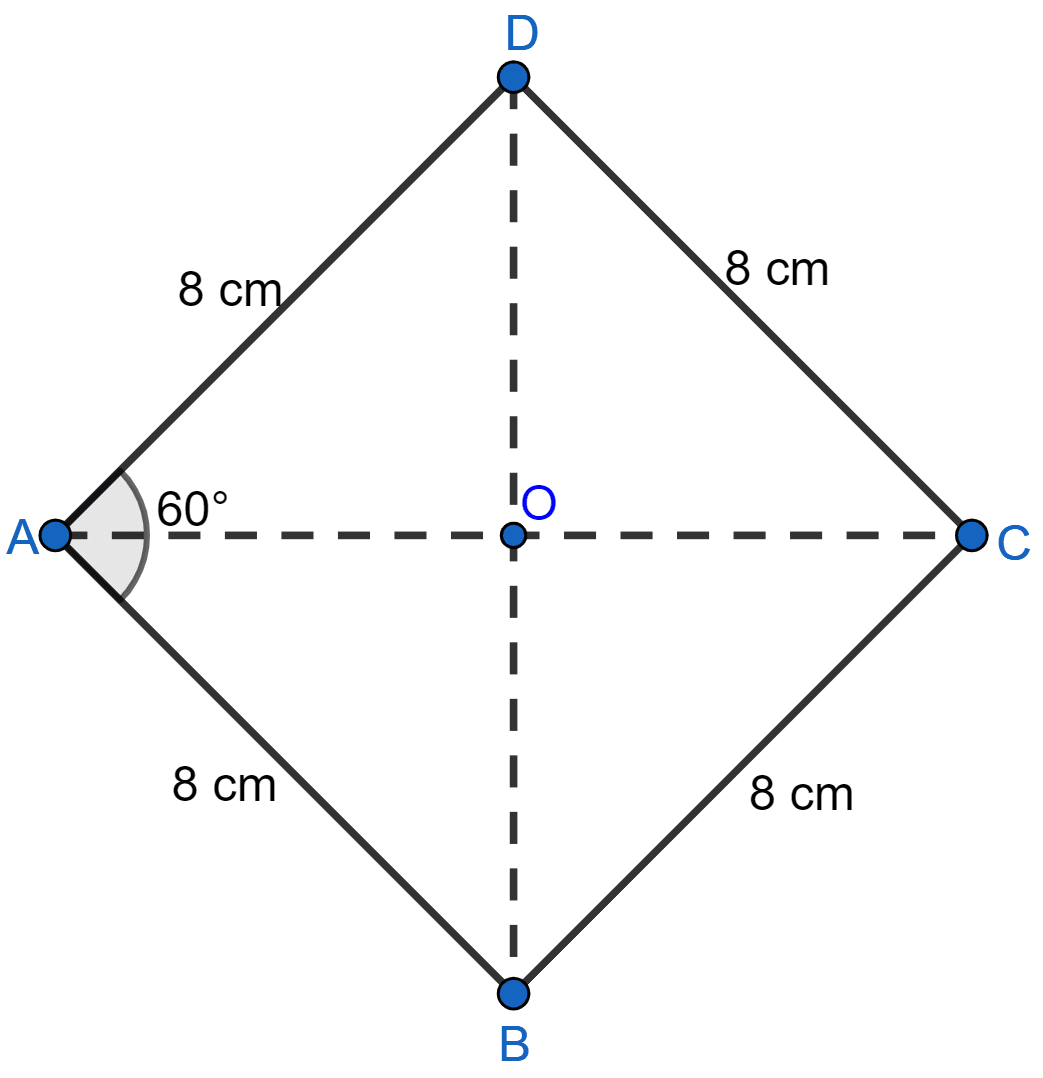
So, AB = BC = CD = DA = 8 cm.
Let ∠A = 60°.
In ∆ABD,
AB = AD
∠ADB = ∠ABD = x (let) (Angles opposite to equal sides are equal.)
⇒ ∠ADB + ∠ABD + ∠DAB = 180°
⇒ x + x + 60° = 180°
⇒ 2x + 60° = 180°
⇒ 2x = 180° - 60°
⇒ 2x = 120°
⇒ x =
⇒ x = 60°.
Since, all angles = 60°. Hence, △ABD is an equilateral triangle.
So, BD = 8 cm.
As we know, the diagonals of a rhombus bisect each other at right angles
AO = OC, BO = OD = 4cm and ∠AOB = 90°
Now, in right ∆AOB
By Pythagoras theorem,
⇒ AB2 = AO2 + OB2
⇒ 82 = AO2 + 42
⇒ 64 = AO2 + 16
⇒ AO2 = 64 – 16 = 48
⇒ AO = cm.
But, AC = 2AO
⇒ AC = cm.
Hence, length of diagonals = 8 cm and cm.
Using ruler and compasses only, construct a parallelogram ABCD with AB = 5 cm, AD = 2.5 cm and ∠BAD = 45°. If the bisector of ∠BAD meets DC at E, prove that ∠AEB is a right angle.
Answer
Steps of construction:
- Draw AB = 5.0 cm.
- At A, construct ∠BAP = 45°.
- With A as centre and radius 2.5 cm cut the line AP at D.
- With D as centre and radius 5.0 cm, draw an arc.
- With B as center and radius 2.5 cm, draw an arc to meet the previous arc at C.
- Join BC and CD. Then, ABCD is the required parallelogram
Draw the bisector of ∠BAD, which cuts DC at E and join EB.
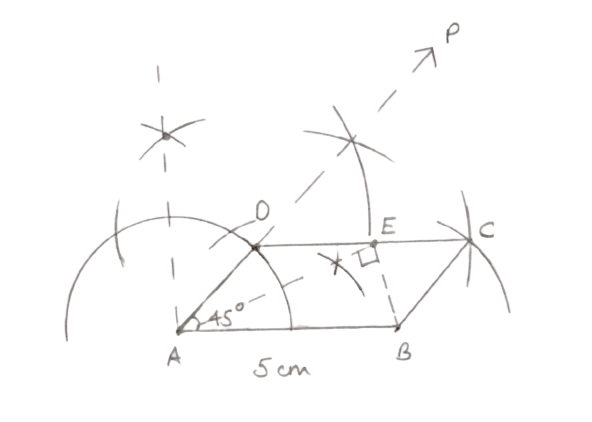
On measuring ∠AEB, it is equal to 90°.
Hence, proved that ∠AEB is a right angle.