
Prove that the line segment joining the mid-points of a pair of opposite sides of a parallelogram divides it into two equal parallelograms.
Answer
Let us consider ABCD be a parallelogram in which E and F are mid-points of AB and CD. Join EF.
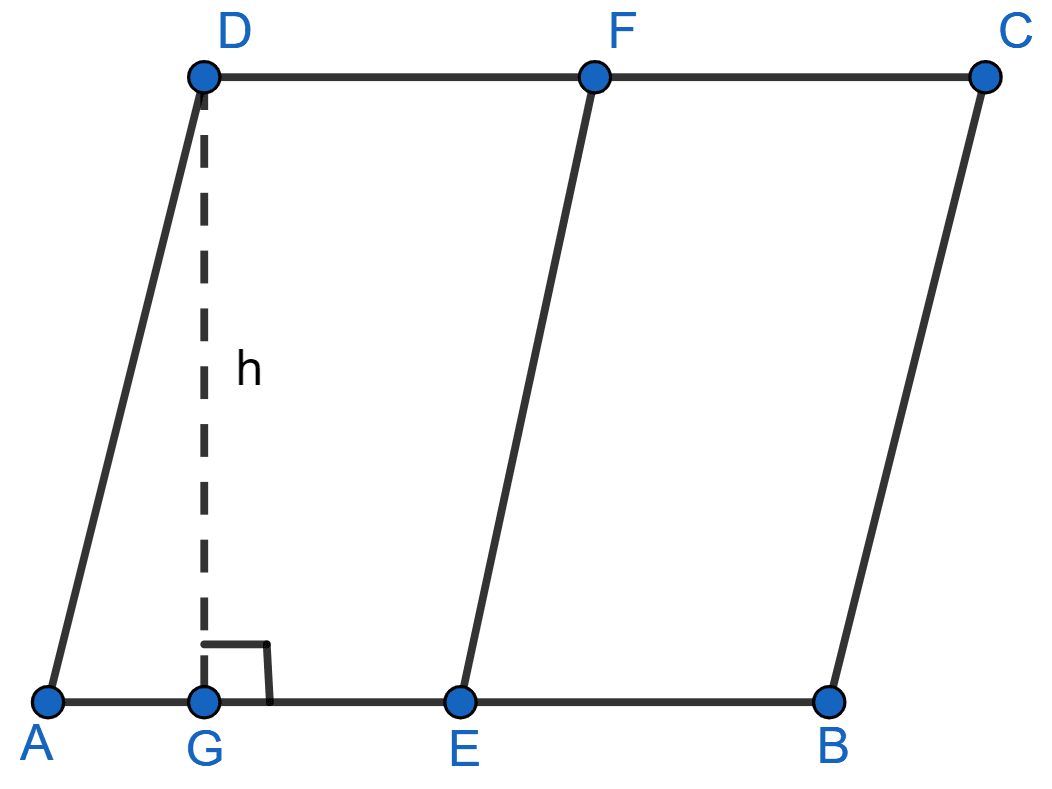
Let us construct DG ⊥ AB and let DG = h, where h is the altitude on side AB.
Area of ||gm ABCD = base × height = AB × h
Area of ||gm AEFD = AE × h = × h .......(i) [Since E is the mid-point of AB]
Area of ||gm EBCF = EB × h = × h .......(ii) [Since E is the mid-point of AB]
From (i) and (ii)
Area of ||gm AEFD = Area of ||gm EBCF.
Hence proved, that the line segment joining the mid-points of a pair of opposite sides of a parallelogram divides it into two equal parallelograms.
Prove that the diagonals of a parallelogram divide it into four triangles of equal area.
Answer
Let us consider a parallelogram ABCD, the diagonals AC and BD cut at point O.

In parallelogram ABCD, the diagonals bisect each other.
AO = OC
In ∆ACD, O is the mid-point of AC.
∴ OD is the median.
Area of ∆AOD = Area of ∆COD ....... (i) [Median of ∆ divides it into two triangles of equal areas.]
Similarly, in ∆ABC
O is the mid-point of AC.
∴ OB is the median.
Area of ∆AOB = Area of ∆COB ....... (ii) [Median of ∆ divides it into two triangles of equal areas.]
In ∆ADB,
O is the mid-point of BD.
∴ OA is the median.
Area of ∆AOD = Area of ∆AOB ....... (iii)
From (i), (ii) and (iii) we get,
Area of ∆AOB = ∆COB = ∆COD = ∆AOD
Hence proved, that the diagonals of a parallelogram divide it into four triangles of equal area.
In figure (1) given below, AD is the median of ∆ABC and P is any point on AD. Prove that
(i) Area of ∆PBD = area of ∆PDC.
(ii) Area of ∆ABP = area of ∆ACP.
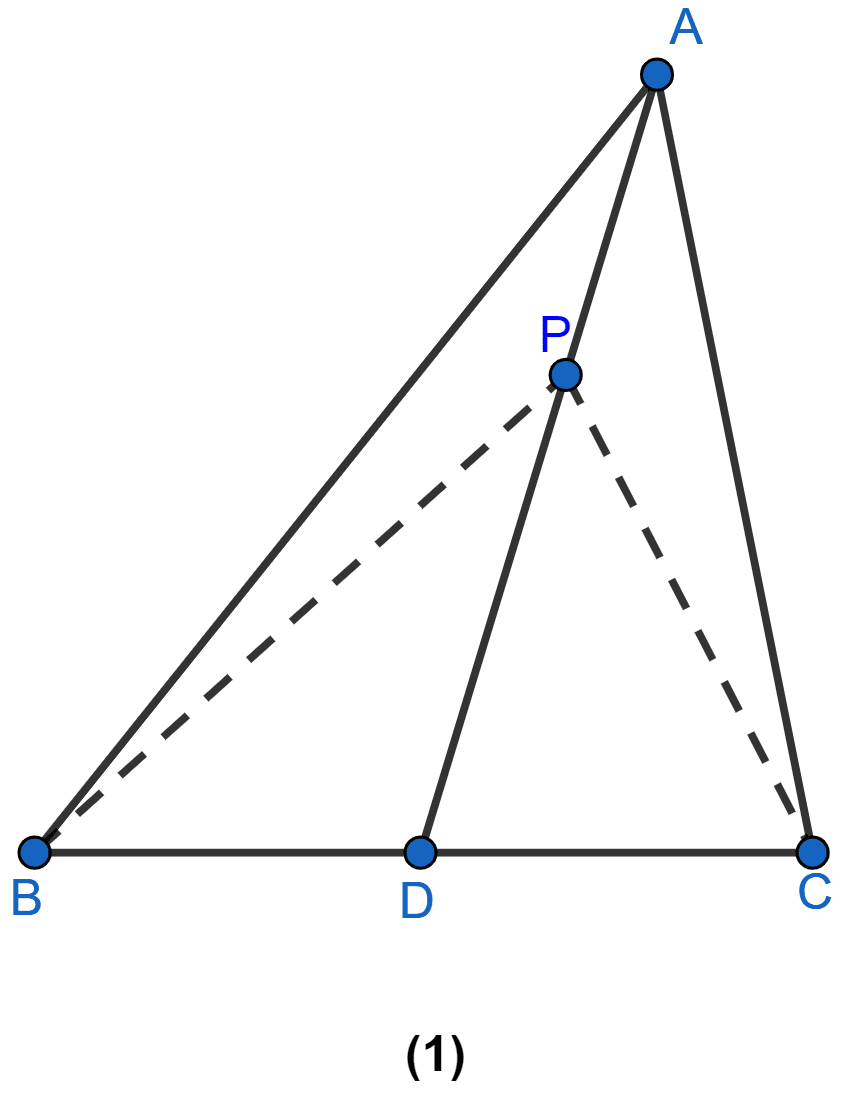
Answer
(i) In ∆ABC,
Area of ∆ABD = Area of ∆ADC [AD is the median] ......(1)
Since, PD is a straight line and base of ∆ABC and ∆PBC,
So PD is median of ∆PBC,
∴ Area of ∆PBD = Area of ∆PDC ........(2)
Hence, proved that Area of ∆PBD = Area of ∆PDC.
(ii) Subtracting eq. 1 from 2 we get,
⇒ Area of ∆ABD - Area of ∆PBD = Area of ∆ADC - Area of ∆PDC
⇒ Area of ∆ABP = Area of ∆ACP.
Hence proved that Area of ∆ABP = Area of ∆ACP.
In the figure (2) given below, DE || BC. Prove that
(i) area of ∆ACD = area of ∆ABE
(ii) area of ∆OBD = area of ∆OCE.

Answer
(i) We know that,
Triangles on the same base and between the same parallel lines are equal in area.
∆BCD and ∆BCE are on the same base BC and between the same || lines DE and BC.
⇒ Area of ∆BCD = Area of ∆BCE
Subtracting area of ∆BCD and ∆BCE from area of ∆ABC
⇒ Area of ∆ABC - Area of ∆BCD = Area of ∆ABC - Area of ∆BCE
⇒ Area of ∆ACD = Area of ∆ABE.
Hence proved, that Area of ∆ACD = Area of ∆ABE.
(ii) We know that,
⇒ Area of ∆BCD = Area of ∆BCE
Subtracting area of ∆OBC from above equation we get,
⇒ Area of ∆BCD - Area of ∆OBC = Area of ∆BCE - Area of ∆OBC
⇒ Area of ∆OBD = Area of ∆OCE.
Hence proved, that Area of ∆OBD = Area of ∆OCE.
In figure (1) given below, ABCD is a parallelogram and P is any point in BC. Prove that, Area of ∆ABP + area of ∆DPC = Area of ∆APD.
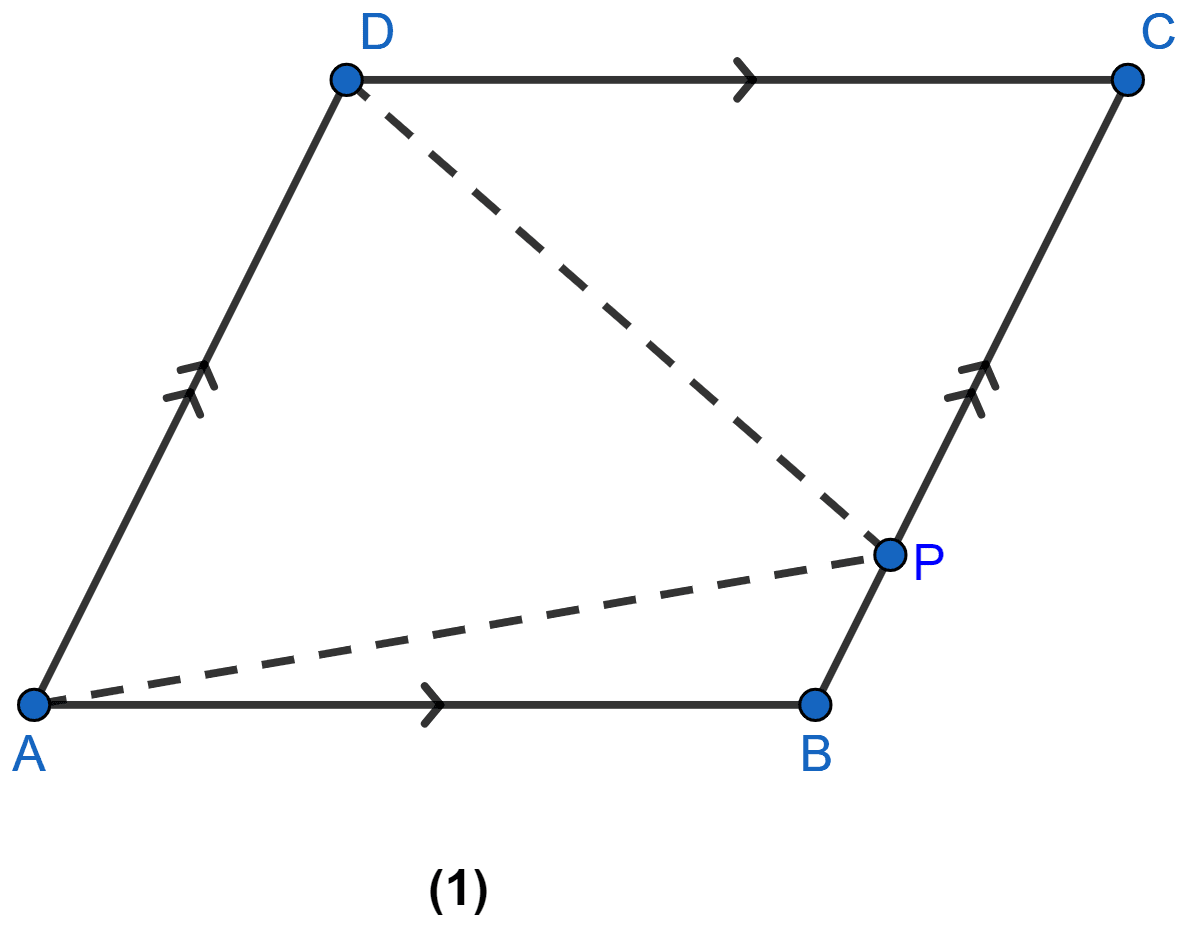
Answer
We know that,
Area of a triangle is half that of a parallelogram on the same base and between the same parallel lines.
∆APD and || gm ABCD are on the same base AD and between the same || lines AD and BC,
∴ Area of ∆APD = Area of || gm ABCD .......(i)
From figure,
Area of ||gm ABCD = Area of ∆APD + Area of ∆ABP + Area of ∆DPC
Dividing the above equation by 2 we get,
From (i),
Hence, proved that Area of ∆APD = Area of ∆ABP + Area of ∆DPC.
In the figure (2) given below, O is any point inside a parallelogram ABCD. Prove that
(i) area of ∆OAB + area of ∆OCD = area of || gm ABCD.
(ii) area of ∆OBC + area of ∆OAD = area of || gm ABCD.

Answer
(i) Draw a line PQ || to AB and CD from point O.

AB || PQ and AP || BQ (Since, AD || BC)
ABQP is a || gm
Similarly,
PD || CQ and PQ || DC
PQCD is a || gm
Now, ∆OAB and || gm ABQP are on the same base AB and between same || lines AB and PQ
Area of ∆OAB = Area of ||gm ABQP .....(1)
Similarly, ∆OCD and || gm PQCD are on the same base CD and between same || lines CD and PQ
Area of ∆OCD = Area of || gm PQCD ..... (2)
Now by adding (1) and (2),
Area of ∆OAB + Area of ∆OCD = Area of || gm ABQP + Area of || gm PQCD
= [Area of || gm ABQP + Area of || gm PQCD]
= Area of || gm ABCD
Hence, proved that Area of ∆OAB + Area of ∆OCD = Area of || gm ABCD.
(ii) From figure,
⇒ Area of ∆OAB + Area of ∆OBC + Area of ∆OCD + Area of ∆OAD = Area of || gm ABCD
⇒ Area of ∆OAB + Area of ∆OCD + Area of ∆OBC + Area of ∆OAD = Area of || gm ABCD
⇒ Area of || gm ABCD + Area of ∆OBC + Area of ∆OAD = Area of || gm ABCD
⇒ Area of ∆OBC + Area of ∆OAD = Area of || gm ABCD - Area of || gm ABCD
⇒ Area of ∆OBC + Area of ∆OAD = Area of || gm ABCD.
Hence, proved that Area of ∆OBC + Area of ∆OAD = Area of || gm ABCD.
If E, F, G and H are mid-points of the sides AB, BC, CD and DA, respectively of a parallelogram ABCD, prove that area of the quad. EFGH = area of || gm ABCD.
Answer
Parallelogram ABCD with E, F, G and H as mid-points of the sides AB, BC, CD and DA, respectively is shown below:
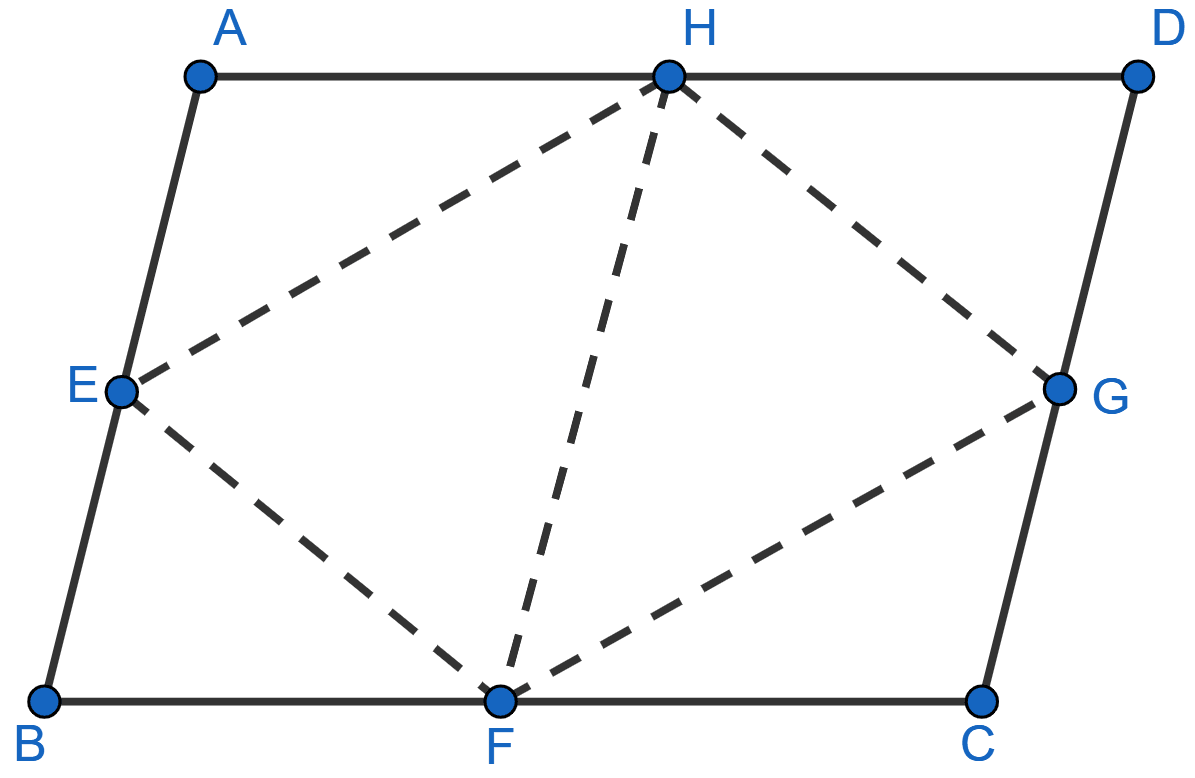
AH = AD (As H is the mid-point of AD)
BF = BC (As F is the mid-point of BC)
So, AH = BF and AH || BF (As AD || BC).
So, ABFH is a || gm.
Since, || gm ABFH and △EFH are on same base FH and between same parallel lines AB and FH so,
area of △EFH = area of || gm ABFH .......(i)
Similarly,
HD = AD (As H is the mid-point of AD)
FC = BC (As F is the mid-point of BC)
So, HD = FC and HD || FC (As AD || BC).
So, HFCD is a || gm.
Since, || gm HFCD and △HFG are on same base HF and between same parallel lines HF and DC so,
area of △HFG = area of || gm HFCD .......(ii)
Adding (i) and (ii) we get,
area of △EFH + area of △HFG = area of || gm ABFH + area of || gm HFCD
area of quad. EFGH = (area of || gm ABFH + area of || gm HFCD)
= (area of || gm ABCD).
Hence, proved that area of the quad. EFGH = area of || gm ABCD.
In figure (1) given below, ABCD is a parallelogram. P, Q are any two points on the sides AB and BC respectively. Prove that
area of ∆CPD = area of ∆AQD.
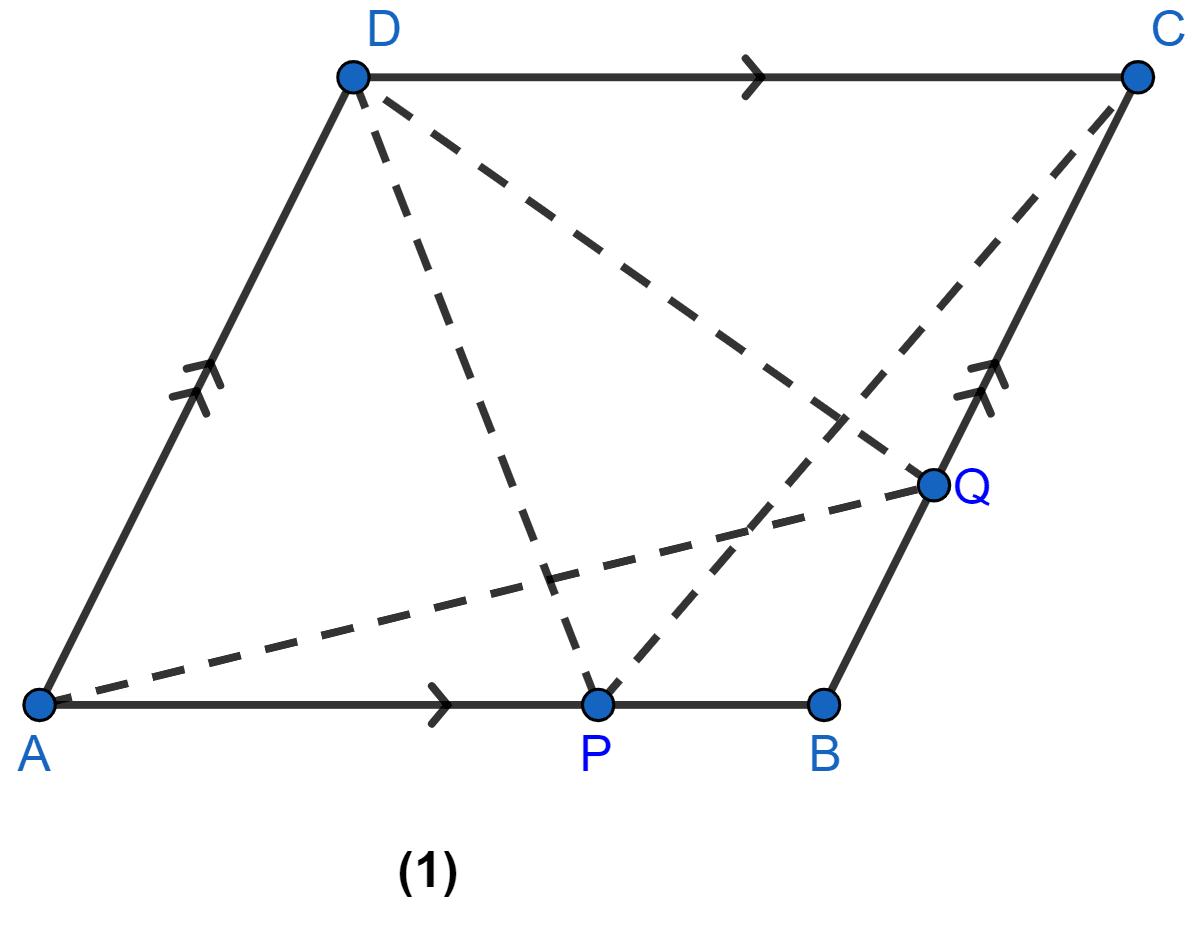
Answer
∆CPD and || gm ABCD are on the same base CD and between the same parallel lines AB and CD.
Area of ∆CPD = Area of ||gm ABCD .......(i)
∆AQD and || gm ABCD are on the same base AD and between the same parallel lines AD and BC.
Area of ∆AQD = Area of ||gm ABCD .......(ii)
From (i) and (ii)
Area of ∆CPD = Area of ∆AQD
Hence, proved that area of ∆CPD = area of ∆AQD.
In the figure (2) given below, PQRS and ABRS are parallelograms, and X is any point on the side BR. Show that
area of ∆AXS = area of || gm PQRS.

Answer
From figure,
Since, PB is a straight line and PQ || SR so,
PB || SR.
|| gm PQRS and ABRS are on the same base SR and between the same parallel lines PB and SR.
So, Area of ||gm PQRS = Area of ||gm ABRS .........(i)
∆AXS and || gm ABRS are on the same base AS and between the same parallel lines AS and BR.
So, Area of ∆AXS = Area of ||gm ABRS
= area of ||gm PQRS [From (i)]
Hence, proved that Area of ∆AXS = Area of || gm PQRS.
D, E and F are mid-points of the sides BC, CA and AB respectively of a ∆ABC. Prove that
(i) FDCE is a parallelogram
(ii) area of ∆DEF = area of ∆ABC
(iii) area of || gm FDCE = area of ∆ABC
Answer
∆ABC with D, E and F as mid-points of the sides BC, CA and AB, respectively is shown below:

(i) F and E are midpoints of AB and AC respectively.
So, by mid-point theorem,
FE || BC and FE = BC .........(1)
Also, D is the mid-point of BC
CD = BC ........ (2)
From (1) and (2),
FE || BC and FE = CD
Since, FE || BC so,
FE || CD and FE = CD ......... (3)
Similarly,
D and F are the midpoints of BC and AB.
So, by mid-point theorem,
DF || AC and DF = AC .........(4)
Also, E is the mid-point of AC
EC = AC ........ (5)
From (4) and (5),
DF || AC and DF = EC
Since, DF || AC so,
DF || EC and DF = EC ......... (6)
From 3 and 6,
FE || CD, FE = CD, DF || EC and DF = EC.
Since, opposite sides of FDCE are parallel and equal.
Hence proved FDCE is a parallelogram.
(ii) Since,
BD = CD (As D is mid-point of BC), FE = CD (Proved above) and FE || CD
So, BD = FE and BD || FE.
Hence, BDEF is a || gm.
Since,
FD = EC (Proved above) and AE = EC (As E is mid-point of AC) and FD || EC.
So, FD = AE and FD || AE.
Hence, AFDE is a || gm.
We know that, FDCE is a parallelogram and DE is a diagonal of || gm FDCE.
So, area of ∆DEF = area of ∆DEC (As diagonal divides || gm into two triangles with equal area) ........(1)
We know that, BDEF is a parallelogram and FD is a diagonal of || gm BDEF.
So, area of ∆DEF = area of ∆FBD (As diagonal divides || gm into two triangles with equal area) ........(2)
We know that, AFDE is a parallelogram and FE is a diagonal of || gm AFDE.
So, area of ∆DEF = area of ∆AFE (As diagonal divides || gm into two triangles with equal area) ........(3)
From 1, 2 and 3 we get,
area of ∆DEF = area of ∆DEC = area of ∆FBD = area of ∆AFE .........(4)
From figure,
area of ∆ABC = area of ∆DEF + area of ∆DEC + area of ∆FBD + area of ∆AFE
= area of ∆DEF + area of ∆DEF + area of ∆DEF + area of ∆DEF (From 4)
= 4 x area of ∆DEF.
∴ area of ∆ABC = 4 x area of ∆DEF
⇒ area of ∆DEF = area of ∆ABC
Hence, proved that area of ∆DEF = area of ∆ABC.
(iii) From figure,
Area of || gm FDCE = Area of ∆DEF + Area of ∆DEC
= Area of ∆DEF + Area of ∆DEF (From part (ii) eqn. 4)
= 2 area of ∆DEF
= area of ∆ABC [As area of ∆DEF = area of ∆ABC]
= area of ∆ABC.
Hence, proved that area of || gm FDCE = area of ∆ABC.
In the adjoining figure, D, E and F are midpoints of the sides BC, CA and AB respectively of ∆ABC. Prove that BCEF is a trapezium and area of the trap. BCEF = area of ∆ABC.

Answer
We know that D and E are the mid-points of BC and CA, respectively.
By mid-point theorem,
DE || AB and DE = AB = BF (As F is mid-point of AB)
From figure,
BF || DE and BF = DE.
Hence, BDEF is a || gm.
Similarly,
F and E are the mid-points of AB and CA.
By mid-point theorem,
EF || BC and EF = BC = DC (As D is mid-point of BC)
From figure,
EF || DC and EF = DC.
Hence, EFDC is a || gm.
Since, FE || BC and FB, EC are not parallel.
Hence, EFBC is a trapezium.
F and D are the mid-points of AB and BC.
By mid-point theorem,
FD || AC and FD = AC = AE (As E is mid-point of AC)
From figure,
FD || AE and FD = AE.
Hence, AFDE is a || gm.
We know that a diagonal divides a || gm in two triangles of equal area.
In || gm BDEF, FD is the diagonal,
∴ area of △DEF = area of △BDF .........(i)
In || gm EFDC, DE is the diagonal,
∴ area of △DEF = area of △EDC .........(ii)
In || gm AFDE, FE is the diagonal,
∴ area of △DEF = area of △AFE .........(iii)
From (i), (ii) and (iii) we get,
area of △DEF = area of △BDF = area of △EDC = area of △AFE .......(iv)
From figure,
area of △ABC = area of △DEF + area of △BDF + area of △EDC + area of △AFE
= area of △DEF + area of △DEF + area of △DEF + area of △DEF
= 4 x area of △DEF
∴ area of △ABC = 4 x area of △DEF
⇒ area of △DEF = area of △ABC ......(v)
From figure,
area of trapezium BCEF = area of △DEF + area of △BDF + area of △EDC
= area of △DEF + area of △DEF + area of △DEF
= 3 x area of △DEF
∴ area of trapezium BCEF = 3 x area of △DEF
⇒ area of △DEF = x area of trapezium BCEF .......(vi)
From (v) and (vi) we get,
⇒ area of △ABC = area of trapezium BCEF
⇒ area of trapezium BCEF = area of △ABC.
Hence, proved that area of trapezium BCEF = area of △ABC.
In figure (1) given below, point D divides the side BC of ∆ABC in the ratio m : n. Prove that area of ∆ABD : area of ∆ADC = m : n.
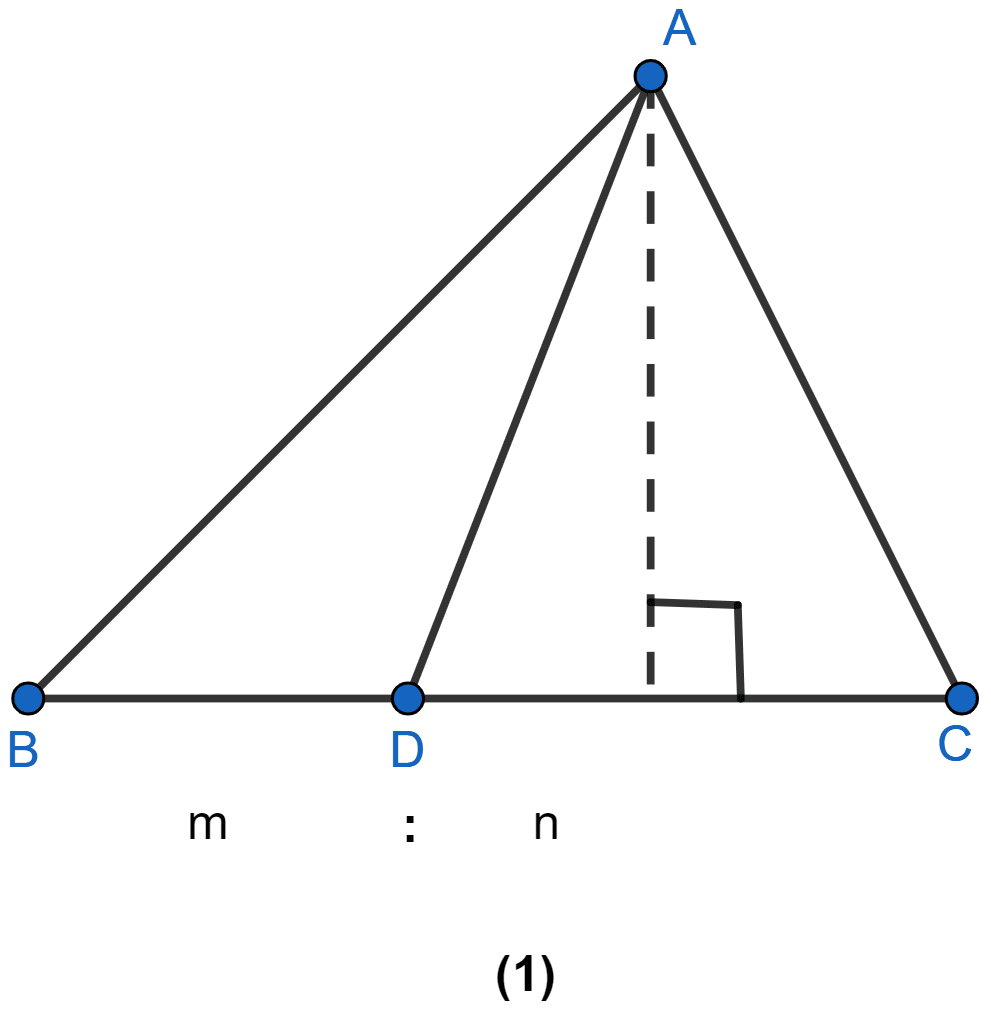
Answer
From fig (1)
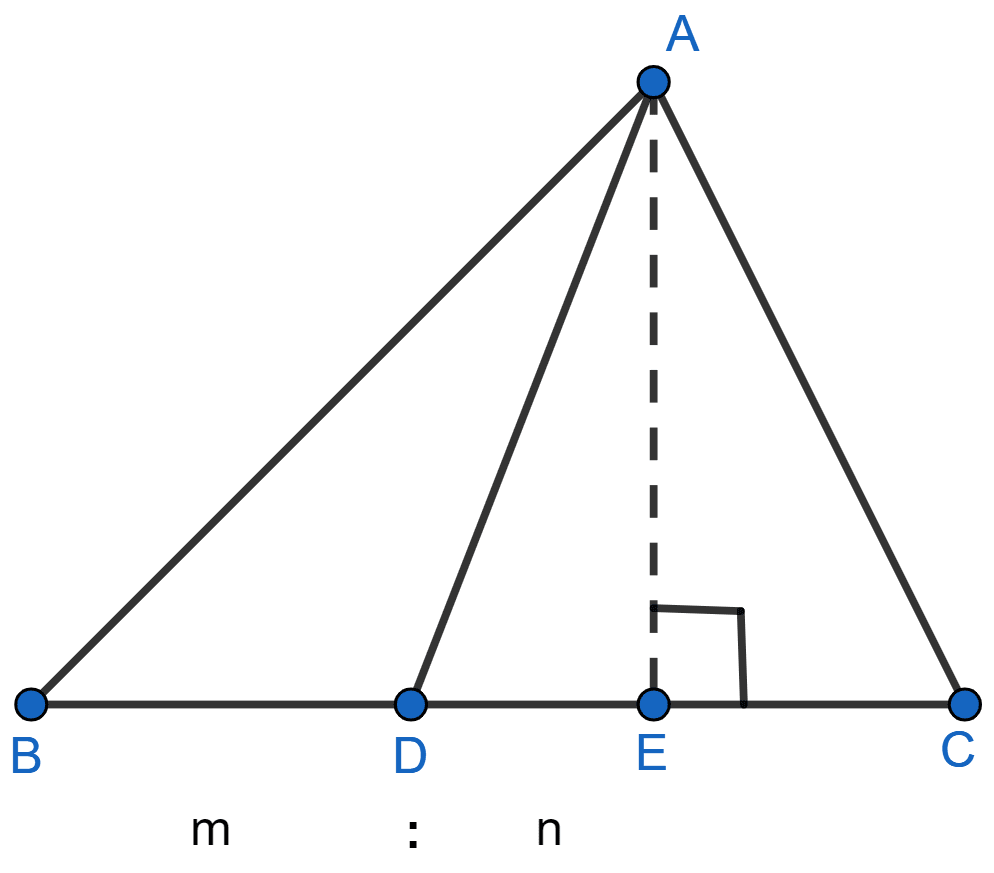
In ∆ABC, point D divides the side BC in the ratio m : n.
BD : DC = m : n
area of ∆ABD = × base × height
= × BD × AE ........ (i)
area of ∆ADC = × DC × AE ...... (ii)
Dividing (i) by (ii)
Hence, proved that area of ∆ABD : area of ∆ADC = m : n.
In the figure (2) given below, P is a point on the side BC of ∆ABC such that PC = 2BP, and Q is a point on AP such that QA = 5PQ, find area of ∆AQC : area of ∆ABC.
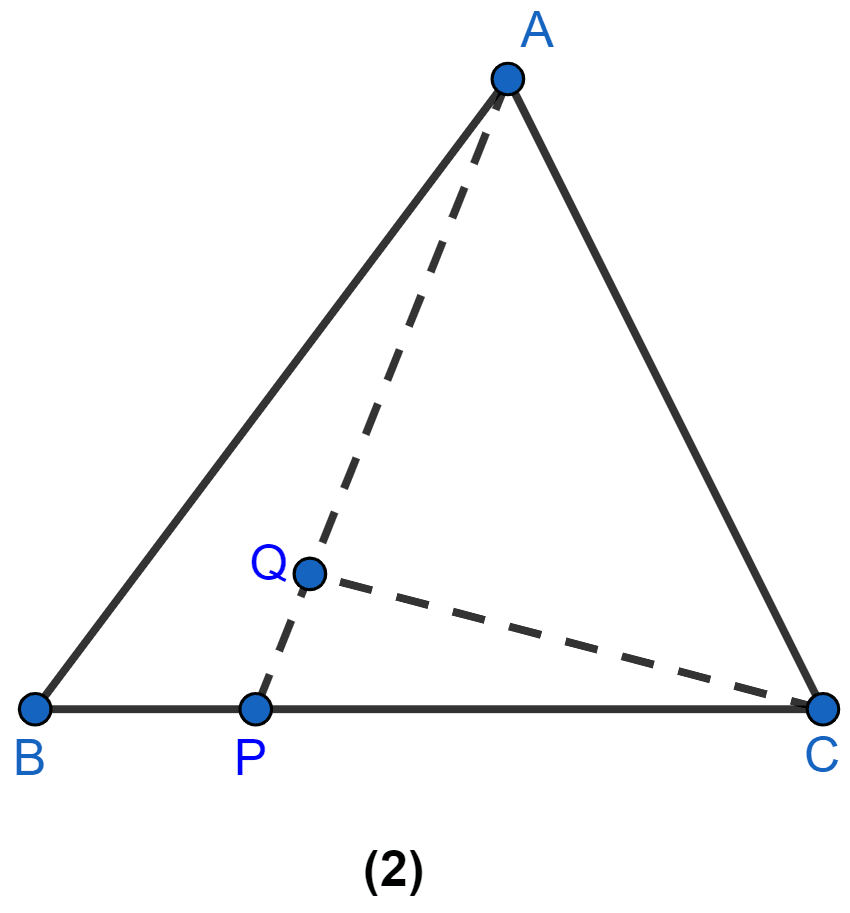
Answer
Given, PC = 2BP
From figure,
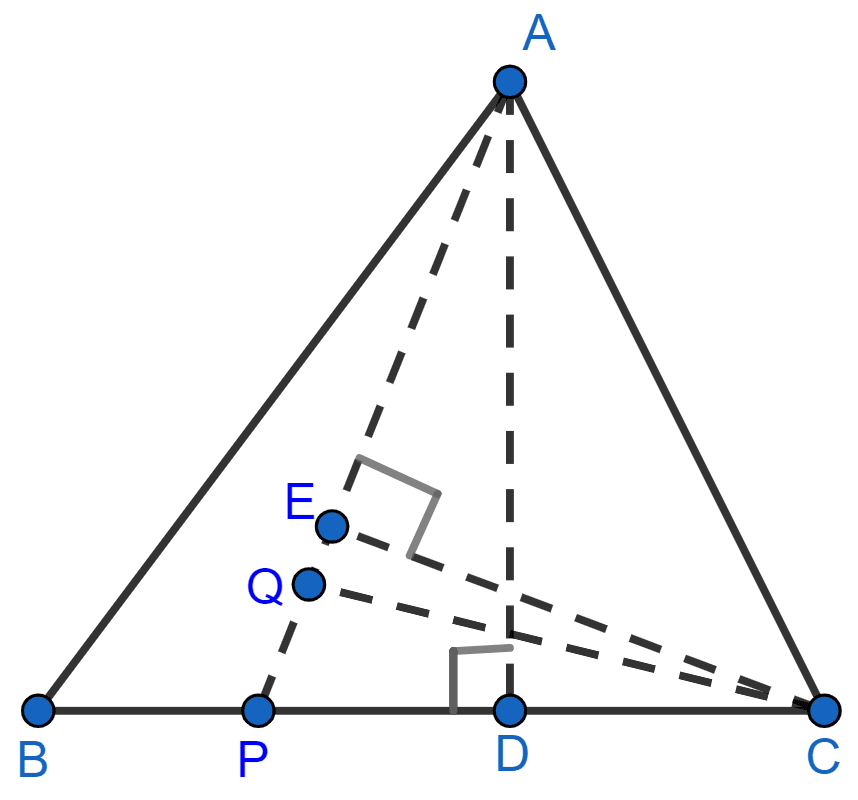
BC = BP + PC = BP + 2BP = 3BP.
PC = BC
Let AD be the altitude.
Area of △ABC = × BC × AD ......(i)
Area of △APC = × PC × AD
= ........(ii)
Dividing (ii) by (i) we get,
Given,
QA = 5PQ
From figure,
AP = AQ + QP = 5PQ + PQ = 6PQ.
.
AQ =
Let CE be the altitude.
Area of △AQC = × AQ × CE ......(iv)
Area of △APC = × AP × CE .......(v)
Dividing (iv) by (v) we get,
∴ area of △AQC : area of △ABC = 5 : 9.
Hence, area of △AQC : area of △ABC = 5 : 9.
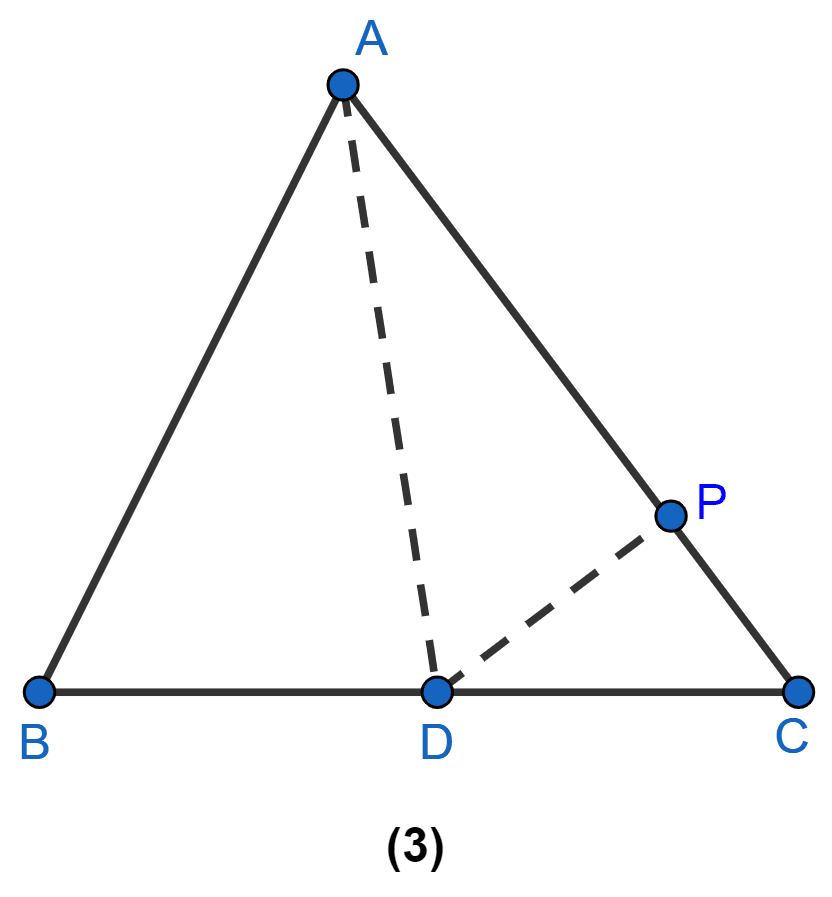
In the figure (3) given below, AD is a median of △ABC and P is a point in AC such that area of △ADP : area of △ABD = 2 : 3. Find
(i) AP : PC
(ii) area of △PDC : area of △ABC
Answer
(i) From figure,
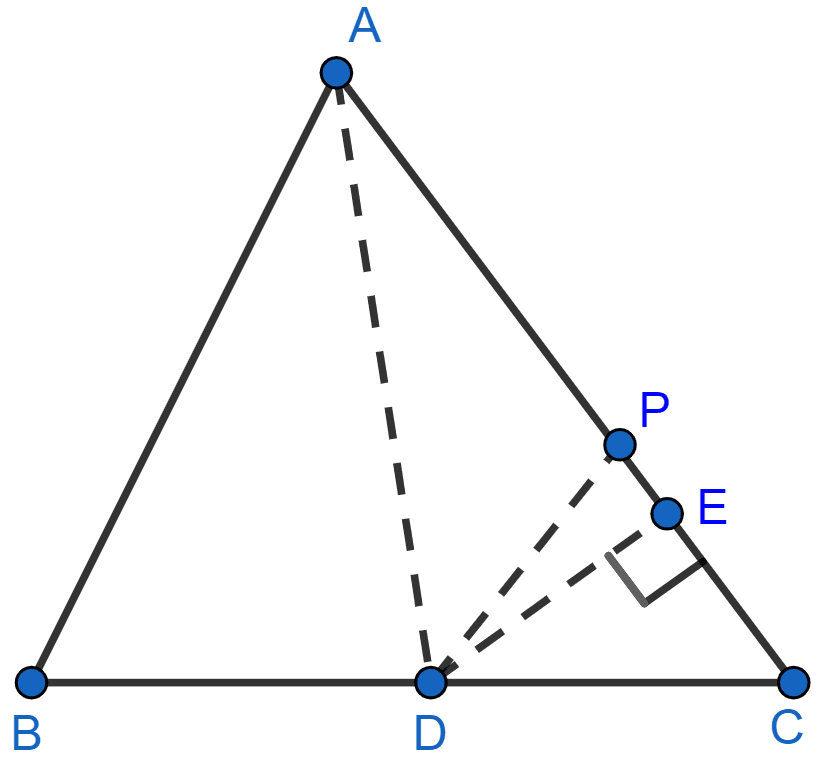
Let DE be altitude on base AC.
Median divides a triangle into two triangles of equal area.
AD is the median of ∆ABC,
Area of ∆ABD = Area of ∆ADC = Area of ∆ABC .......(1)
It is given that,
⇒ area of ∆ADP : area of ∆ABD = 2 : 3
⇒ area of ∆ADP : area of ∆ADC = 2 : 3
Let AP = 2x and AC = 3x.
From figure,
PC = AC - AP = 3x - 2x = x.
Hence, AP : PC = 2 : 1
(ii) We know that,
PC : AC = x : 3x = 1 : 3
So,
Since, AD is median of ∆ABC so,
area of ∆ADC = area of ∆ABC
Substituting above value in 1 we get,
Hence, proved that area of △PDC : area of △ABC = 1 : 6.
In figure (1) given below, area of parallelogram ABCD is 29 cm2. Calculate the height of parallelogram ABEF if AB = 5.8 cm.

Answer
||gm ABCD and ||gm ABEF are on same base (AB) and between the same parallel lines AB and DE, so their areas are equal.
Area of ||gm ABEF = Area of ||gm ABCD = 29 cm2.
Area of ||gm ABEF = base × height
⇒ 29 = AB × height
⇒ 29 = 5.8 × height
⇒ Height =
= 5 cm.
The height of parallelogram ABEF is 5 cm.
In figure (2) given below, area of ∆ABD is 24 sq. units. If AB = 8 units, find the height of △ABC.

Answer
Given,
Area of ∆ABD = 24 sq. units
As ∆ABD and ∆ABC lie on same base AB and between same parallel lines AB and CD so,
Area of ∆ABC = Area of ∆ABD = 24 sq. units.
⇒ × AB × height = 24
⇒ × 8 × height = 24
⇒ 4 × height = 24
⇒ Height =
⇒ Height = 6 units.
Hence, height of ∆ABC = 6 units.
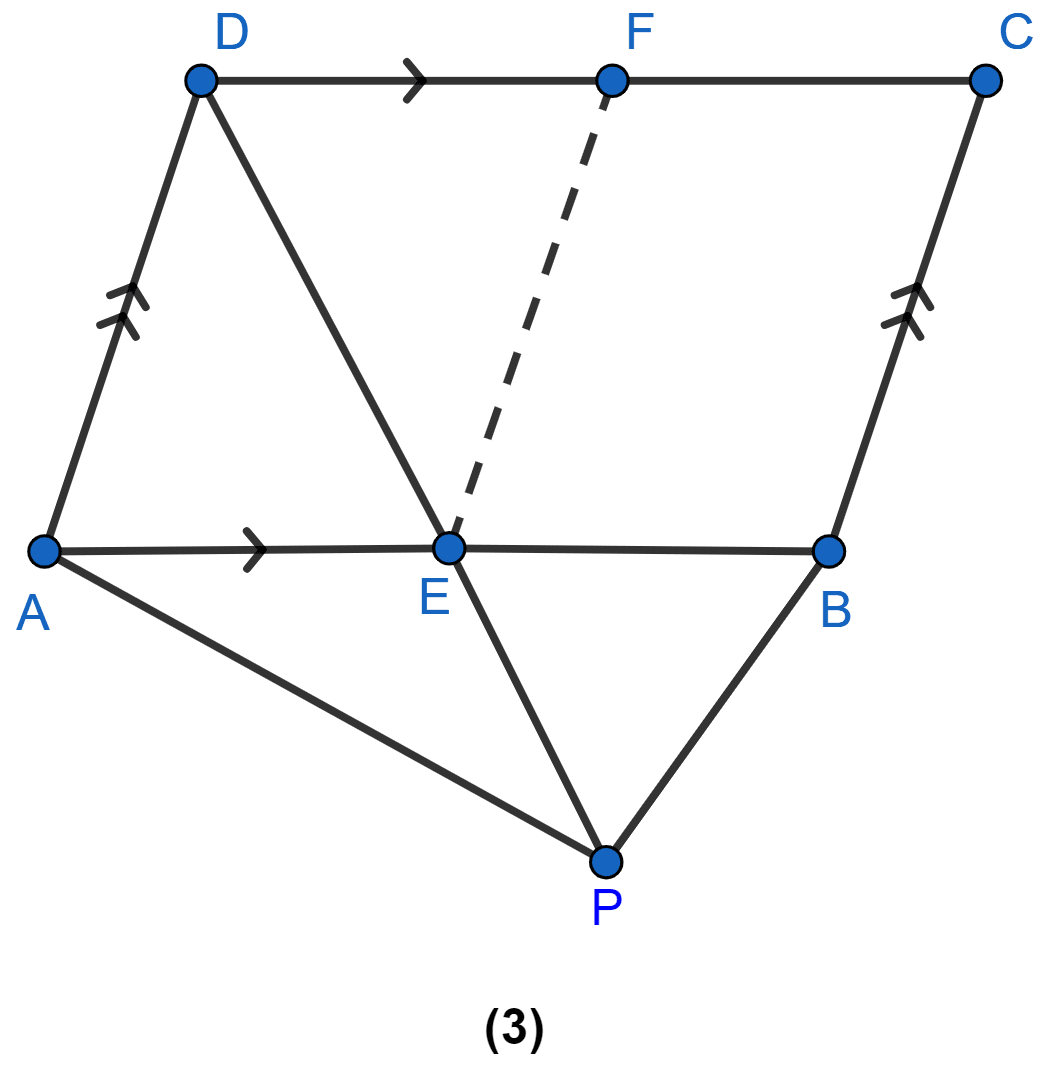
In figure (3) given below, E and F are midpoints of sides AB and CD, respectively, of parallelogram ABCD. If the area of parallelogram ABCD is 36 cm2,
(i) state the area of ∆APD.
(ii) Name the parallelogram whose area is equal to the area of ∆APD.
Answer
Join the diagonals AC and BD as shown below:
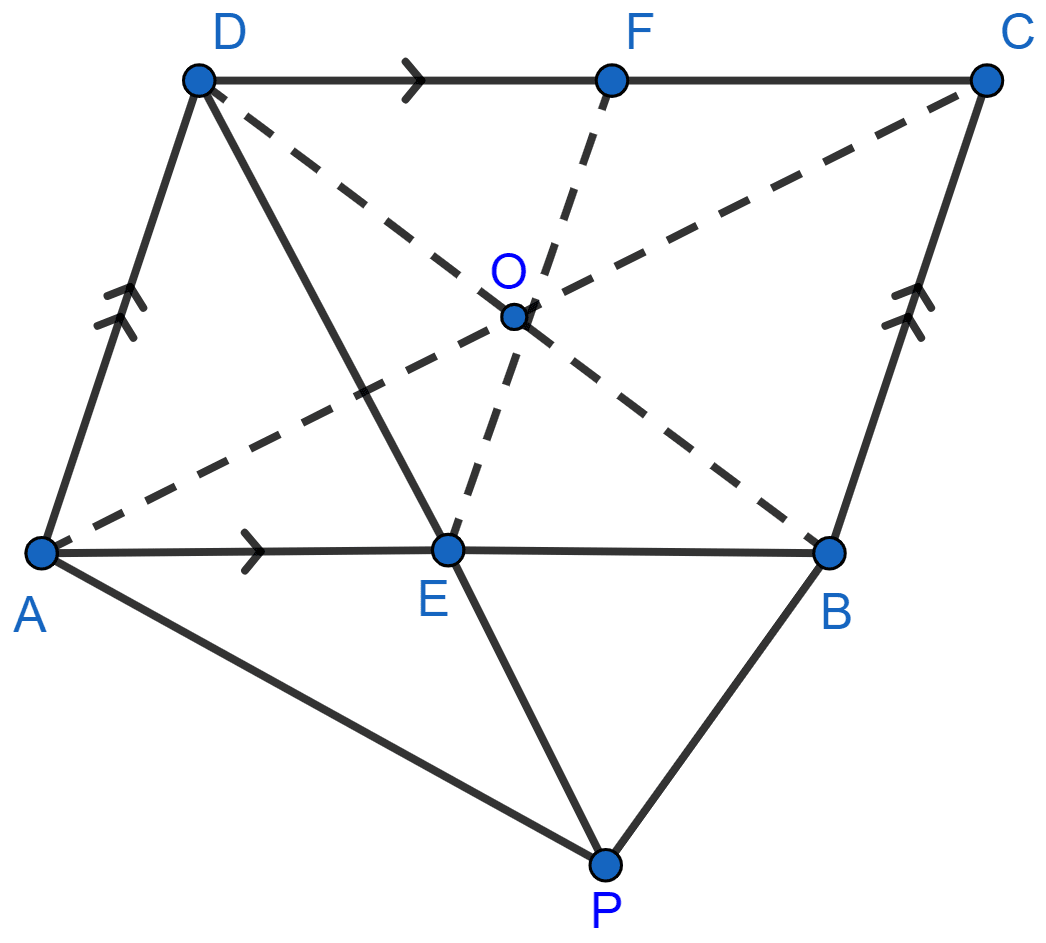
(i) ∆APD and || gm ABCD are on the same base AD and between the same parallel lines AD and BC.
Area of ∆APD = Area of ||gm ABCD
= × 36
= 18 cm2.
Hence, area of ∆APD = 18 cm2.
(ii) Let diagonals AC and BD meet at point O.
In ∆ABC,
Since, O is mid-point of AC (as diagonals bisect each other) and E is mid-point of AB so by mid-point theorem,
EO || BC
∴ EF || BC.
Since, BC || AD so,
⇒ EF || AD.
AB || DC (ABCD is a parallelogram)
⇒ AE || DF
Since, EF || AD and AE || DF.
∴ AEFD is a parallelogram.
EF bisects the parallelogram ABCD in two equal halves as E and F are mid-points of AB and CD and EF || BC || AD.
∴ Area of || gm AEFD = Area of || gm ABCD = × 36 = 18 cm2.
∴ Area of ∆APD = Area of || gm AEFD.
Hence, AEFD is the required parallelogram which has area equal to the area of ∆APD.
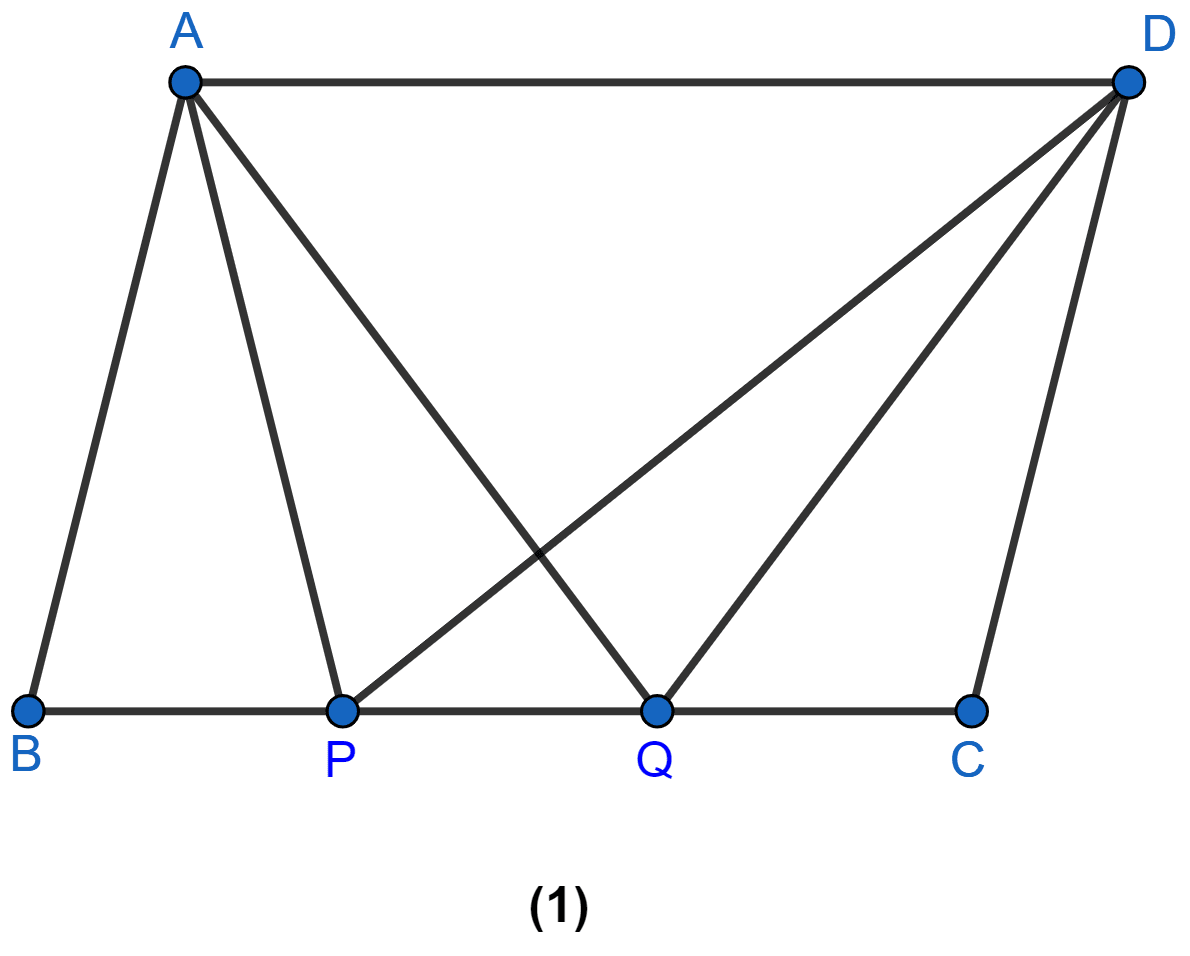
In figure (1) given below, ABCD is a parallelogram. Points P and Q on BC trisect BC into three equal parts. Prove that :
area of ∆APQ = area of ∆DPQ = (area of ||gm ABCD)
Answer
Construct: Through P and Q, draw PR and QS parallel to AB and CD.
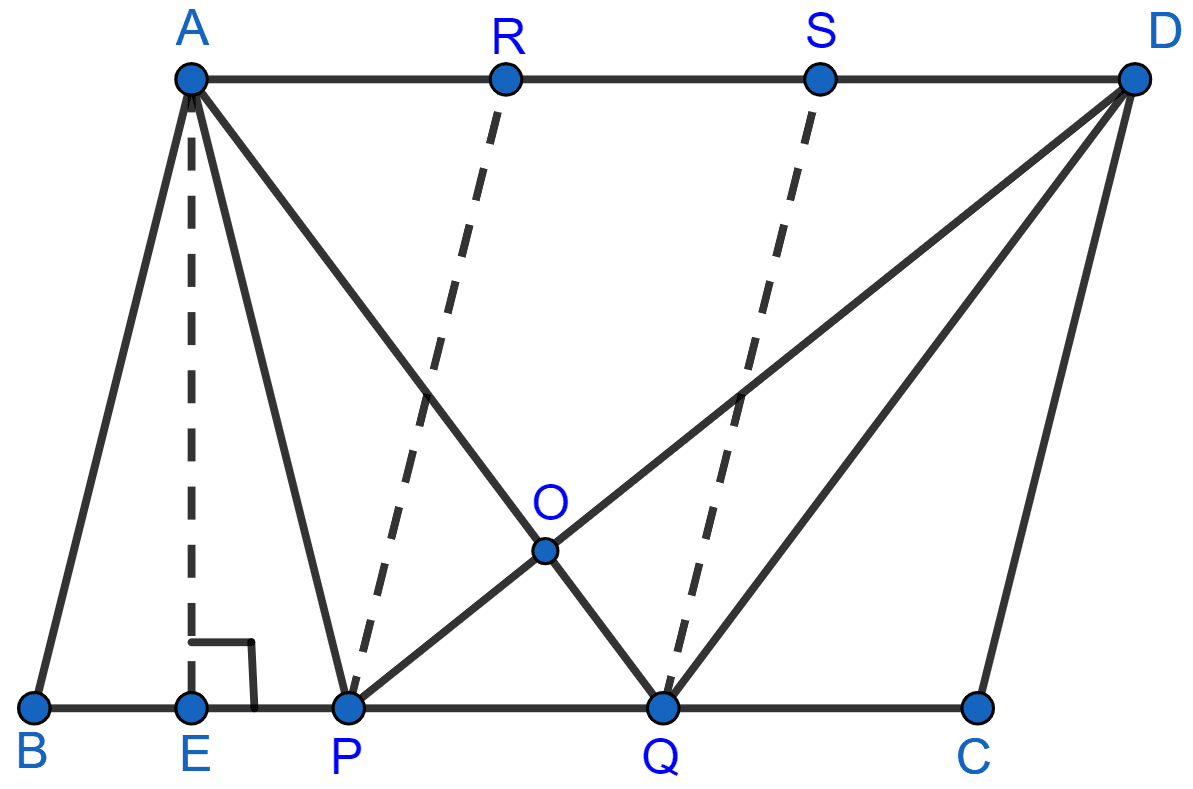
Area of ∆APD = Area of ∆AQD [Since ∆APD and ∆AQD lie on the same base AD and between the same parallel lines AD and BC]
Area of ∆APD – Area of ∆AOD = Area of ∆AQD – Area of ∆AOD [On subtracting ar ∆AOD on both sides]
Area of ∆APO = Area of ∆OQD ....... (i)
Area of ∆APO + Area of ∆OPQ = Area of ∆OQD + Area of ∆OPQ [On adding area of ∆OPQ on both sides]
Area of ∆APQ = Area of ∆DPQ ....... (ii)
We know that, ∆APQ and ||gm PQSR are on the same base PQ and between the same parallel lines PQ and AD.
Area of ∆APQ = Area of ||gm PQRS ....... (iii)
From figure,
Height of || gm ABCD = Height of || PQRS = AE
Since, P and Q trisect BC so,
⇒ PQ =
⇒ BC = 3PQ.
Substituting above value in (iii) we get,
⇒ Area of ∆APQ = Area of ||gm ABCD = Area of ||gm ABCD.
⇒ Area of ∆APQ = Area of ||gm ABCD ........(iv)
From (ii) and (iv) we get,
area of ∆APQ = area of ∆DPQ = (area of ||gm ABCD).
Hence, proved that area of ∆APQ = area of ∆DPQ = (area of ||gm ABCD).
In figure (2) given below, DE is drawn parallel to the diagonal AC of the quadrilateral ABCD to meet BC produced at point E. Prove that area of quad. ABCD = area of ∆ABE.

Answer
We know that, ∆ACE and ∆ADC are on the same base AC and between the same parallel lines AC and DE.
Area of ∆ACE = Area of ∆ADC
Now, adding ar (∆ABC) on both sides, we get
⇒ Area of ∆ACE + Area of ∆ABC = Area of ∆ADC + Area of ∆ABC
⇒ Area of ∆ABE = Area of quad. ABCD
Hence, proved that area of quad. ABCD = area of ∆ABE.
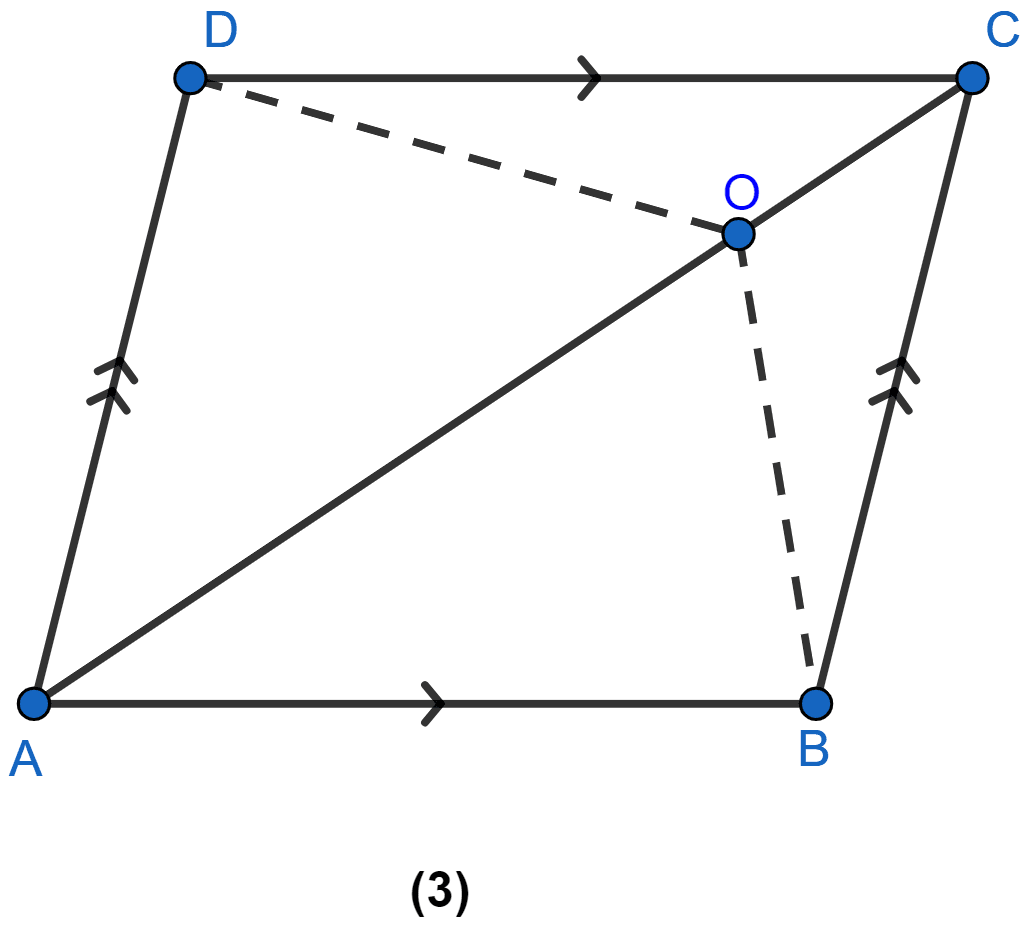
In the figure (3) given below, ABCD is a parallelogram. O is any point on the diagonal AC of the parallelogram. Show that the area of ∆AOB is equal to the area of ∆AOD.
Answer
Join BD, which meets AC at P.
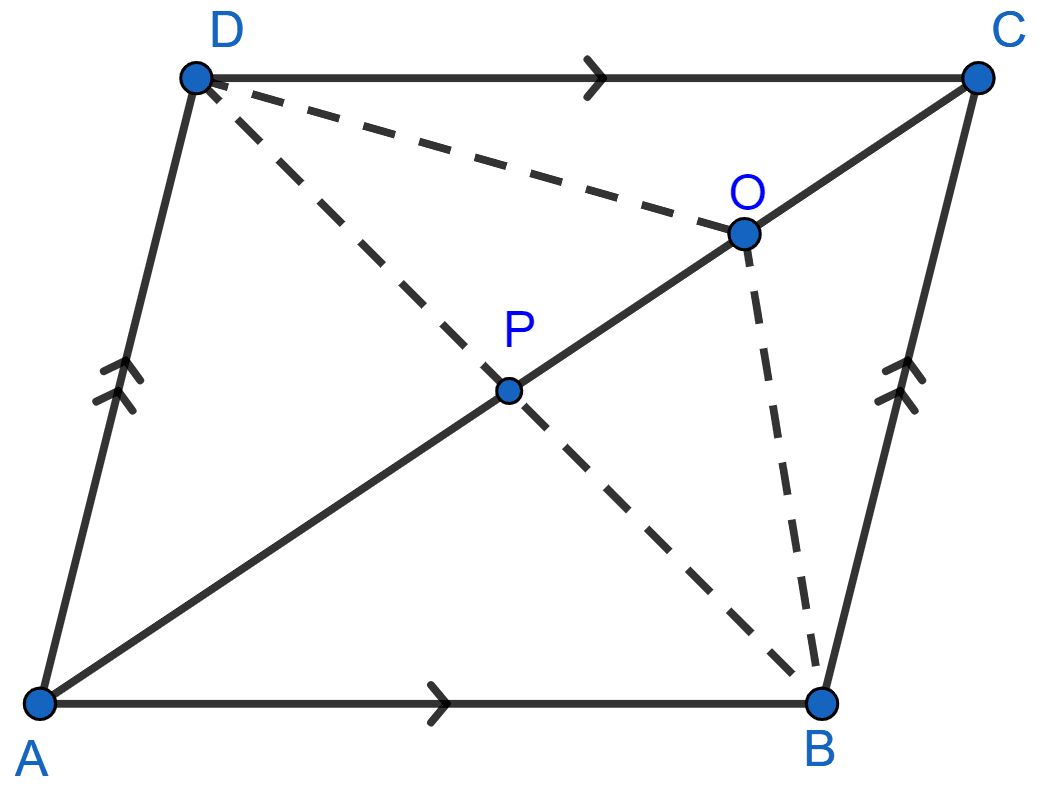
In ∆ABD, AP is the median (As P is mid-point of BD because diagonals of || gm bisect each other).
Since, median of triangle divides it into two triangles of equal area.
∴ Area of ∆ABP = Area of ∆ADP .......(i)
Similarly,
PO is median of ∆BOD,
∴ Area of ∆BOP = Area of ∆POD .......(ii)
Now, adding (i) and (ii), and we get
⇒ Area of ∆ABP + Area of ∆BOP = Area of ∆ADP + Area of ∆POD
⇒ Area of ∆AOB = Area of ∆AOD.
Hence, proved that area of ∆AOB = area of ∆AOD.
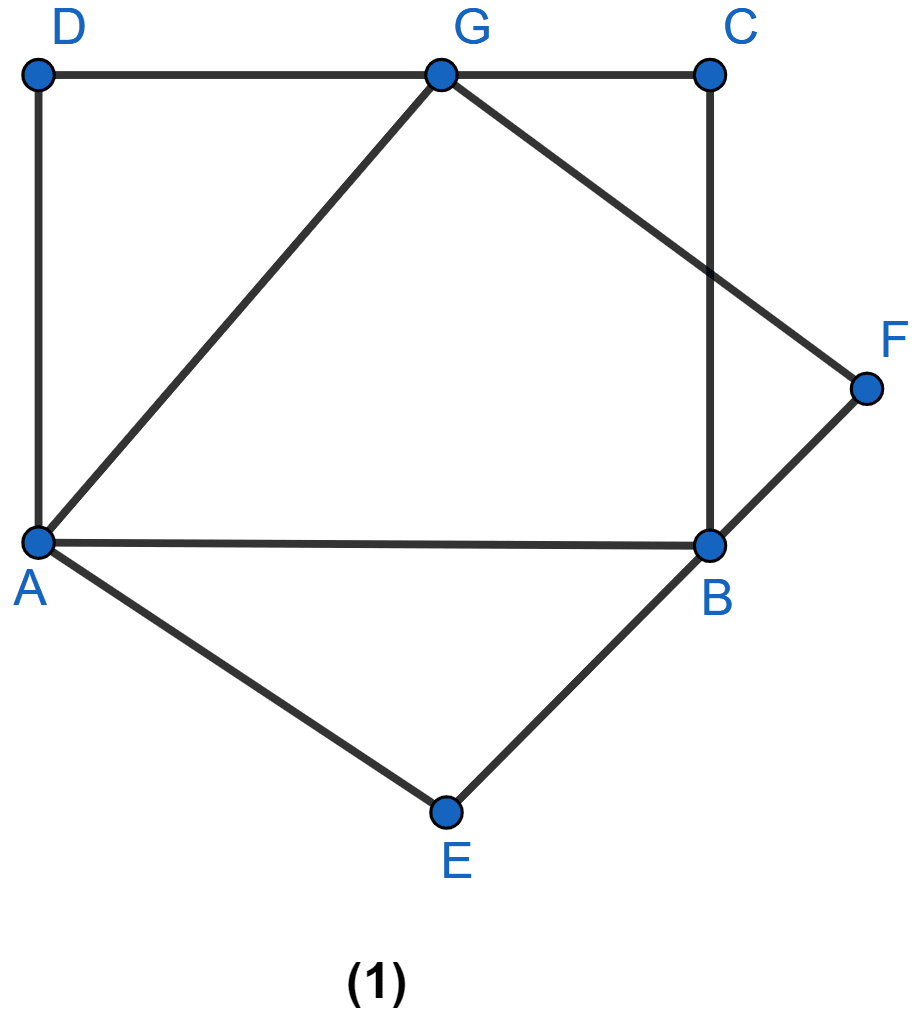
In the figure (1) given, ABCD and AEFG are two parallelograms. Prove that area of || gm ABCD = area of || gm AEFG.
Answer
(a) Join BG.
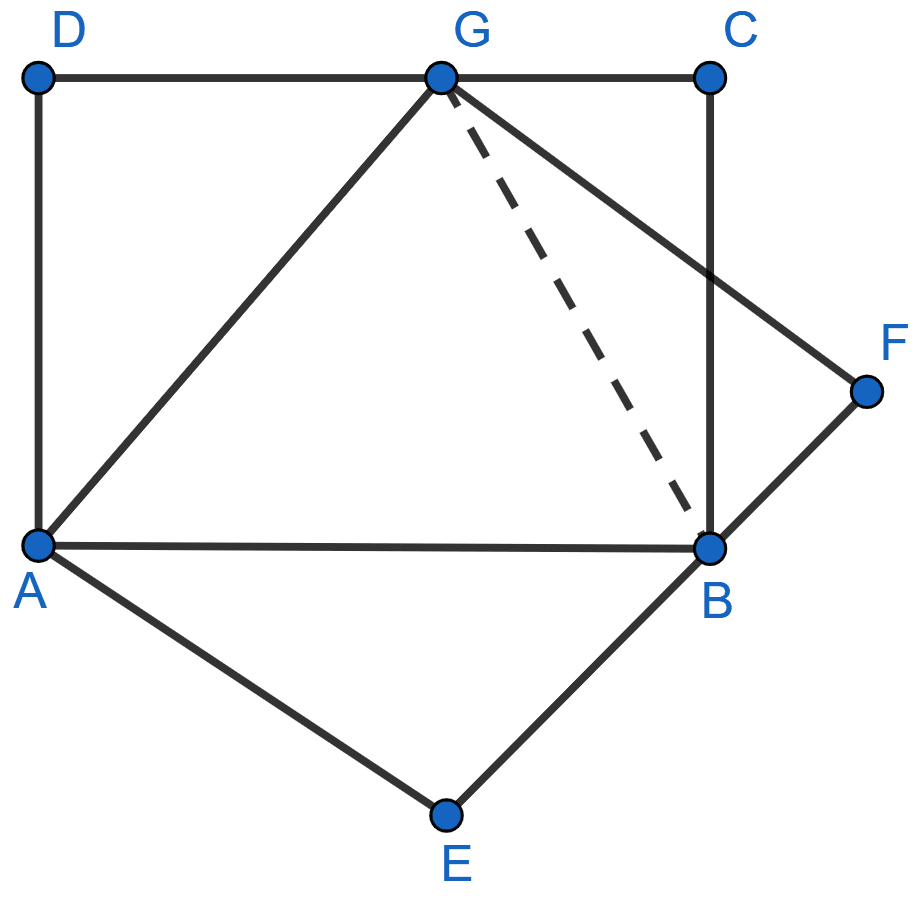
We know that,
Since, ∆ABG and || gm ABCD lie on same base AB and between same parallel lines AB and CD.
Area of ∆ABG = Area of ||gm ABCD ......(i)
Since, ∆ABG and || gm AEFG lie on same base AG and between same parallel lines AG and EF.
Area of ∆ABG = Area of ||gm AEFG ......(ii)
From (i) and (ii) we get,
Area of || gm ABCD = Area of || gm AEFG
⇒ Area of || gm ABCD = Area of || gm AEFG
Hence, proved that area of || gm ABCD = area of || gm AEFG.
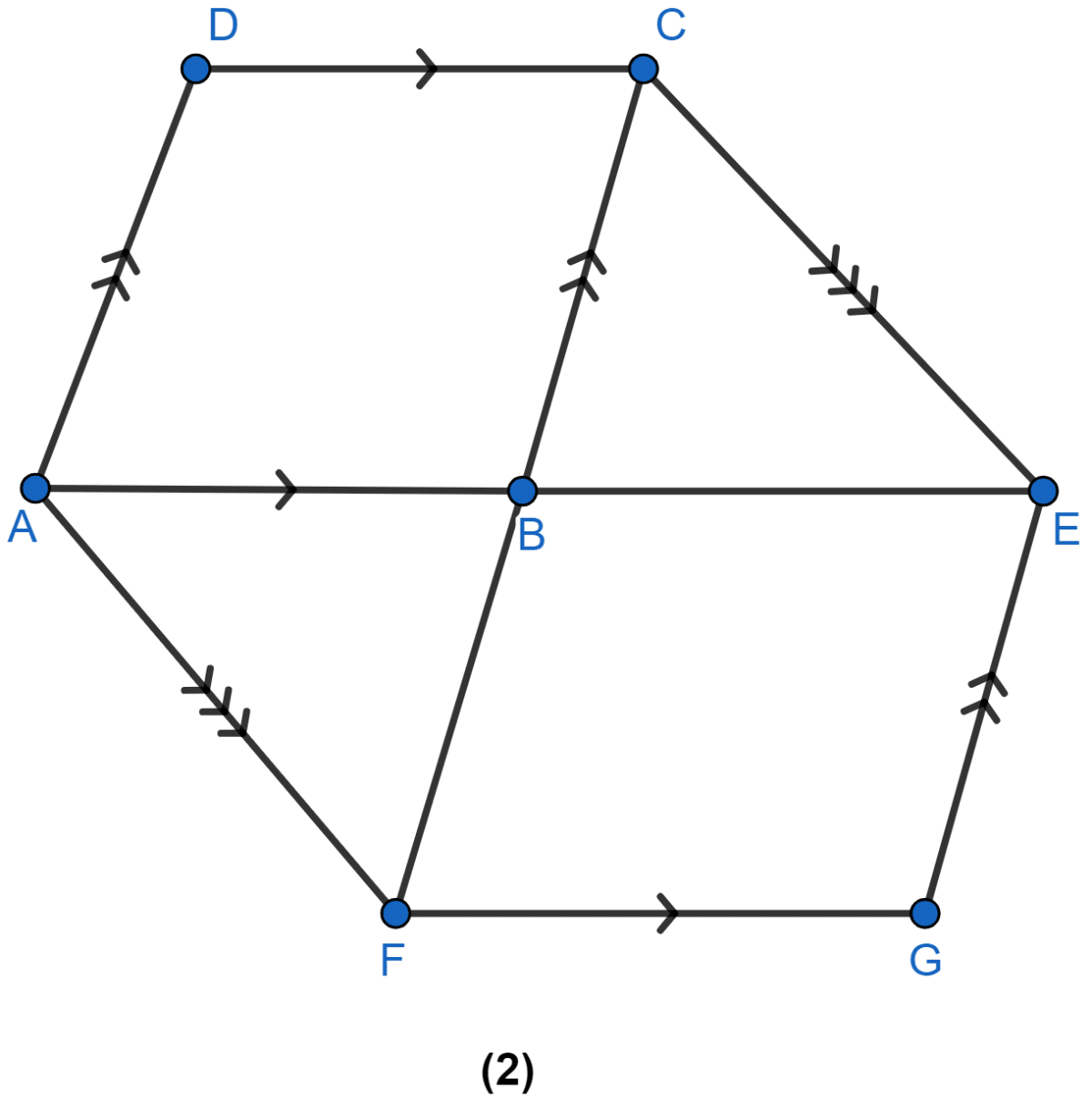
In figure (2) given below, the side AB of the parallelogram ABCD is produced to E. A straight line through A is drawn parallel to CE to meet CB produced at F and parallelogram BFGE is completed. Prove that
area of || gm BFGE = area of || gm ABCD.
Answer
Join AC and EF.
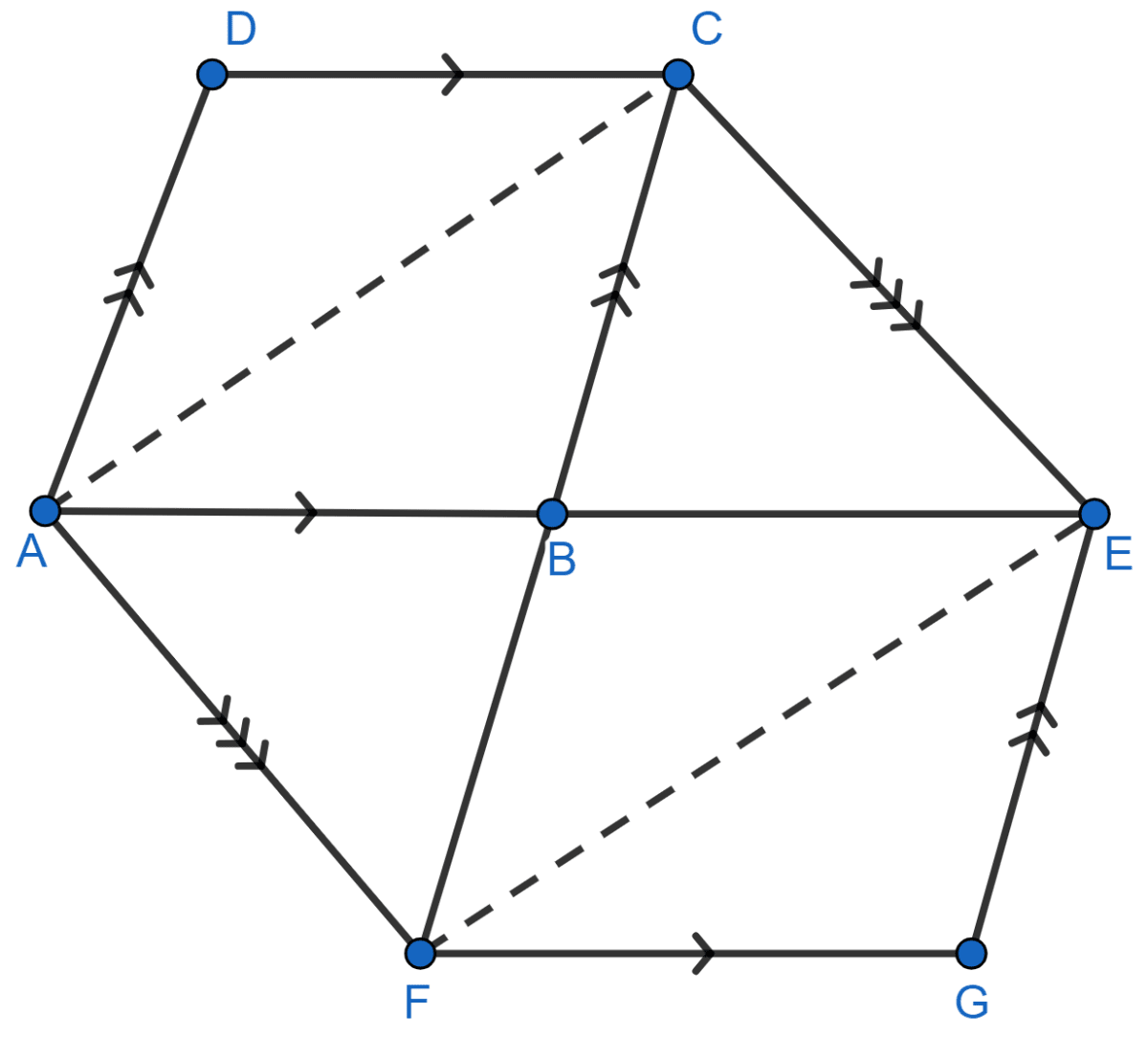
Since, ∆AFC and ∆AFE lie on same base AF and between same parallel lines AF and CE so,
area of ∆AFC = area of ∆AFE
Now, subtract area of ∆ABF on both sides,
area of (∆AFC - ∆ABF) = area of (∆AFE – ∆ABF)
area of ∆ABC = area of ∆BEF
2 area of ∆ABC = 2 area of ∆BEF .......(i)
From figure,
As || gm ABCD and ∆ABC lie on same base AB and between same parallel lines AB and DC.
Area of ∆ABC = Area of || gm ABCD
Area of || ABCD = 2 Area of ∆ABC .........(ii)
As || gm BFGE and ∆BEF lie on same base BE and between same parallel lines FG and BE.
Area of ∆BEF = Area of || gm BFGE
Area of || BFGE = 2 Area of ∆BEF .........(iii)
Substituting value from (ii) and (iii) in (i) we get,
Area of || ABCD = Area of || BFGE.
Hence, proved that area of || ABCD = area of || BFGE.
In figure (3) given below, AB || DC || EF, AD || BE and DE || AF. Prove that the area of DEFH is equal to the area of ABCD.
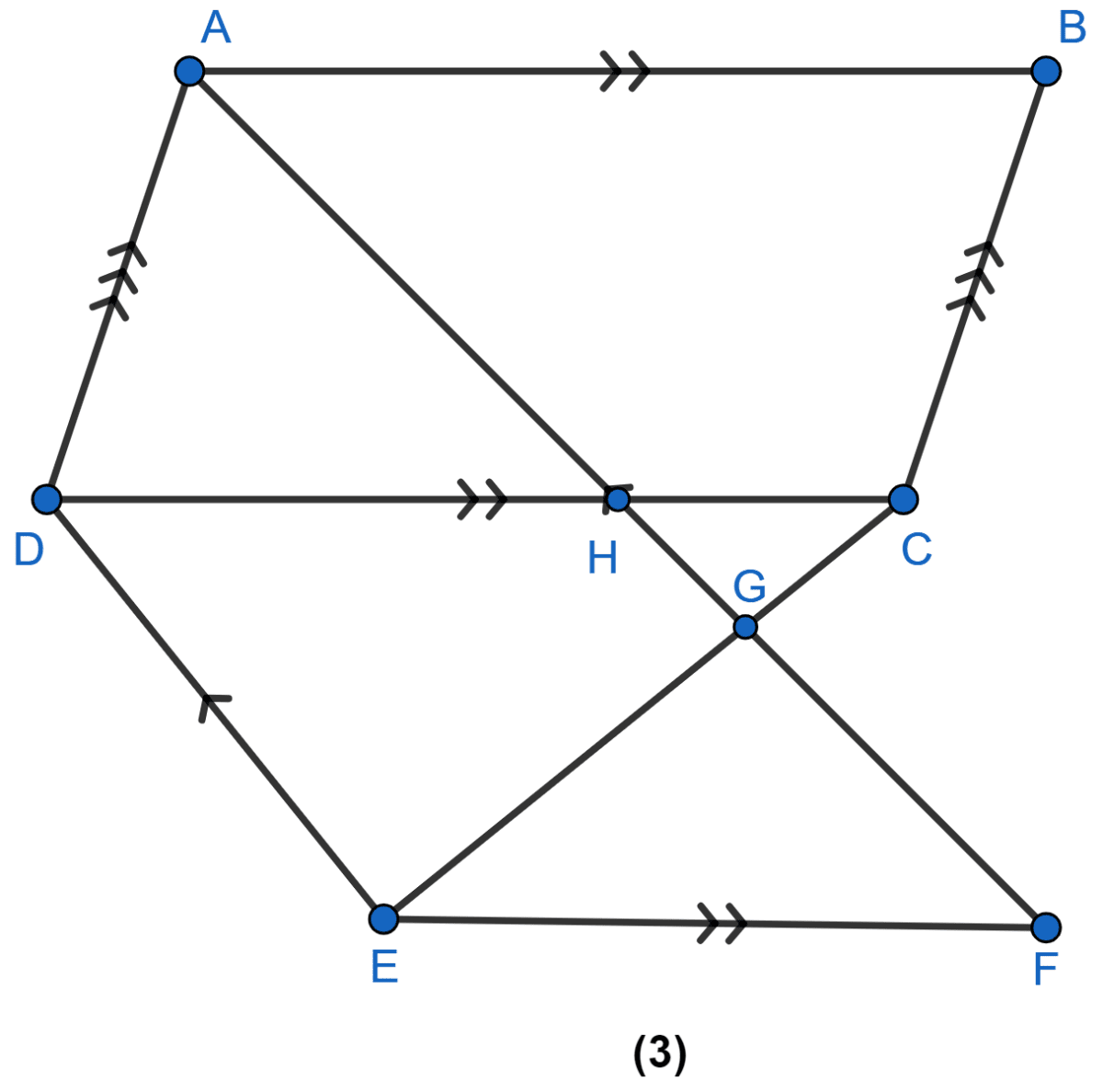
Answer
We know that,
AD || BE ⇒ AD || EG
ED || FA ⇒ ED || GA
Since, opposite sides are parallel.
Hence, ADEG is a parallelogram.
Since || gm ABCD and || gm ADEG lie on same base AD and between same parallel lines AD and EB,
area of || gm ABCD = area of ||gm ADEG ....... (i)
We know that,
ED || FA ⇒ DE || FH
DH || EF
Since, opposite sides are parallel.
Hence, DEFH is a parallelogram.
Since || gm DEFH and || gm ADEG lie on same base DE and between same parallel lines DE and FA,
area of ||gm DEFH = area of ||gm ADEG ....... (ii)
From (i) and (ii) we get,
⇒ area of ||gm ABCD = area of ||gm DEFH
Hence, proved that area of ||gm ABCD = area of ||gm DEFH.
Any point D is taken on the side BC of a ∆ABC and AD is produced to E such that AD = DE, prove that area of ∆BCE = area of ∆ABC.
Answer
∆ABC with point D on the side BC and AD produced to E such that AD = DE is shown below:
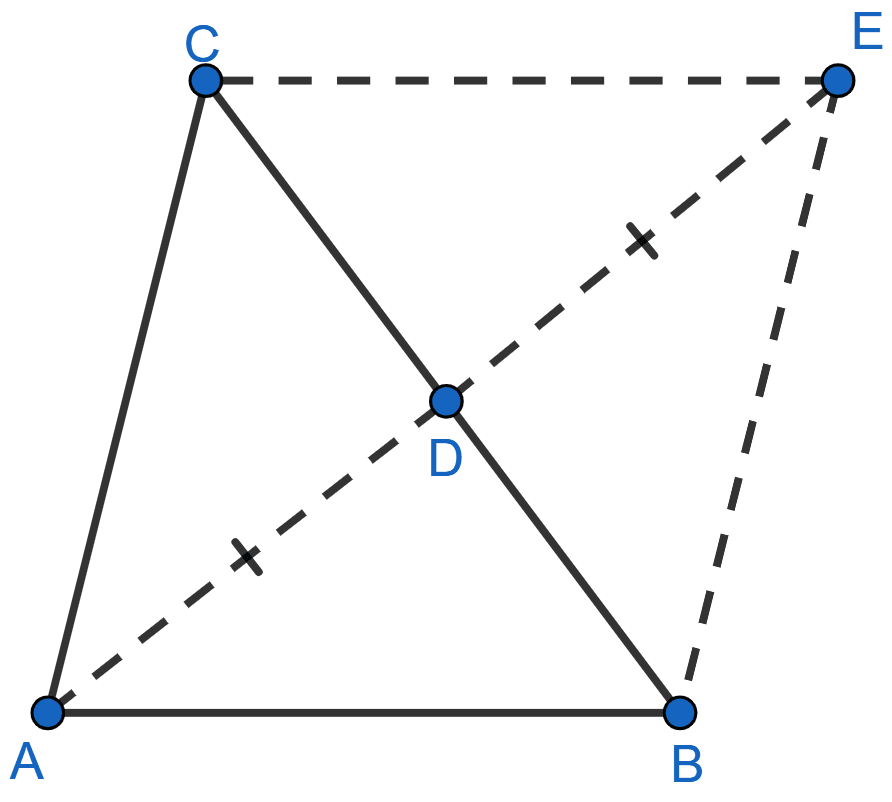
In ∆ABE, it is given that AD = DE.
∴ BD is the median of ∆ABE
⇒ area of ∆ABD = area of ∆BED ........ (i)
Similarly,
In ∆ACE, it is given that AD = AE
∴ CD is the median of ∆ACE
⇒ area of ∆ACD = area of ∆CED ........ (ii)
By adding (i) and (ii), we get
⇒ area of ∆ABD + area of ∆ACD = area of ∆BED + area of ∆CED
⇒ area of ∆ABC = area of ∆BCE.
Hence, proved that area of ∆ABC = area of ∆BCE.
ABCD is a rectangle and P is the mid-point of AB. DP is produced to meet CB at Q. Prove that the area of rectangle ABCD = area of ∆DQC.
Answer
In ∆APD and ∆PQB,
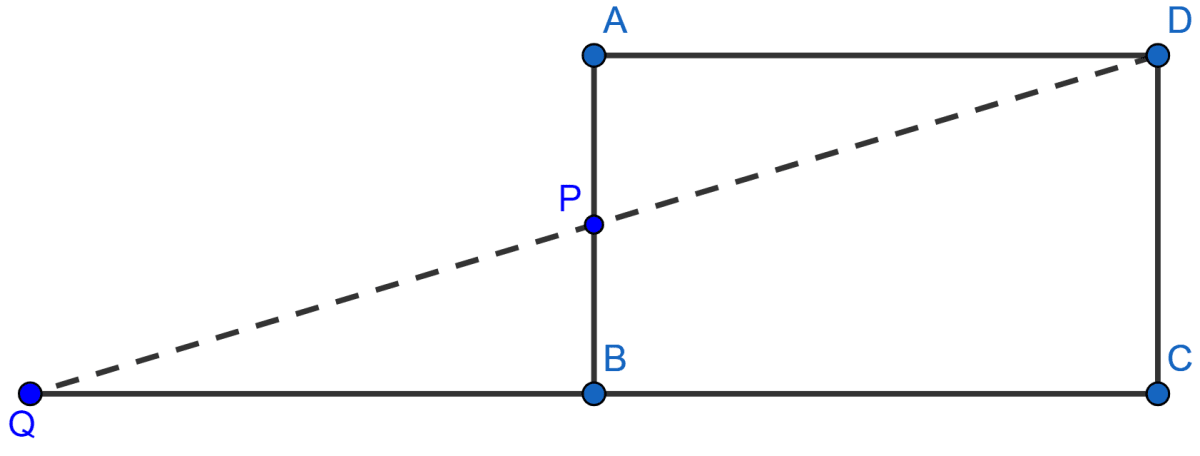
AP = BP [Since P is the mid-point of AB]
∠DAP = ∠QBP [each angle is 90° as ABCD is a rectangle]
∠APD = ∠BPQ [Vertically opposite angles are equal]
So, ∆APD ≅ ∆PQB [By using ASA axiom]
So, area of ∆APD = area of ∆PQB .......(i) (As both triangles are congruent.)
From figure,
area of rectangle ABCD = area of ∆APD + area of quad. PBCD
= area of ∆PQB + area of quad. PBCD ......(From i)
= area of ∆DQC.
Hence, proved that area of rectangle ABCD = area of ∆DQC..
In figure (1) given below, the perimeter of the parallelogram is 42 cm. Calculate the lengths of the sides of the parallelogram.
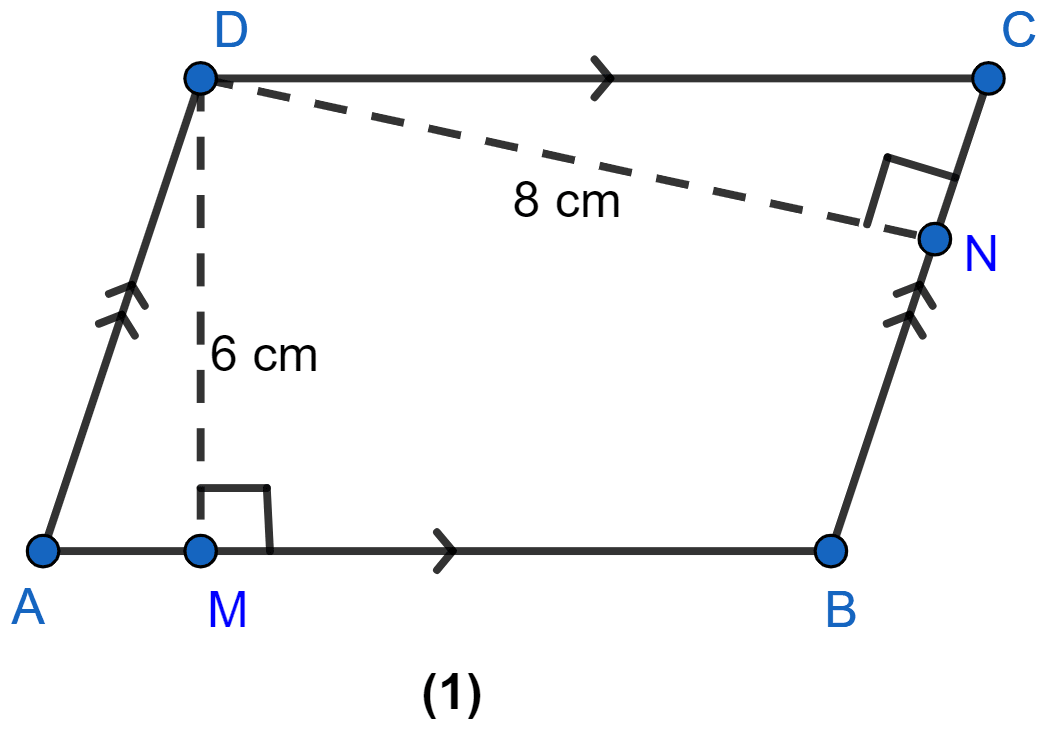
Answer
Let AB = p
Since, opposite sides of || gm are equal.
Perimeter of || gm ABCD = 2(AB + BC)
⇒ 42 = 2(p + BC)
⇒ p + BC =
⇒ p + BC = 21
⇒ BC = 21 – P
area of ||gm ABCD = base × height = AB × DM = p × 6 = 6p .......(i)
Also, area of ||gm ABCD = BC × DN
= (21 – p) × 8
= 8(21 – p) ............ (ii)
From (i) and (ii), we get
⇒ 6p = 8(21 – p)
⇒ 6p = 168 – 8p
⇒ 6p + 8p = 168
⇒ 14p = 168
⇒ p = = 12 cm.
⇒ 21 - p = 21 - 12 = 9 cm.
Hence, the sides of ||gm are AB = 12 cm and BC = 9 cm.
In the figure (2) given below, the perimeter of ∆ABC is 37 cm. If the lengths of the altitudes AM, BN and CL are 5x, 6x, and 4x respectively, calculate the lengths of the sides of ∆ABC.
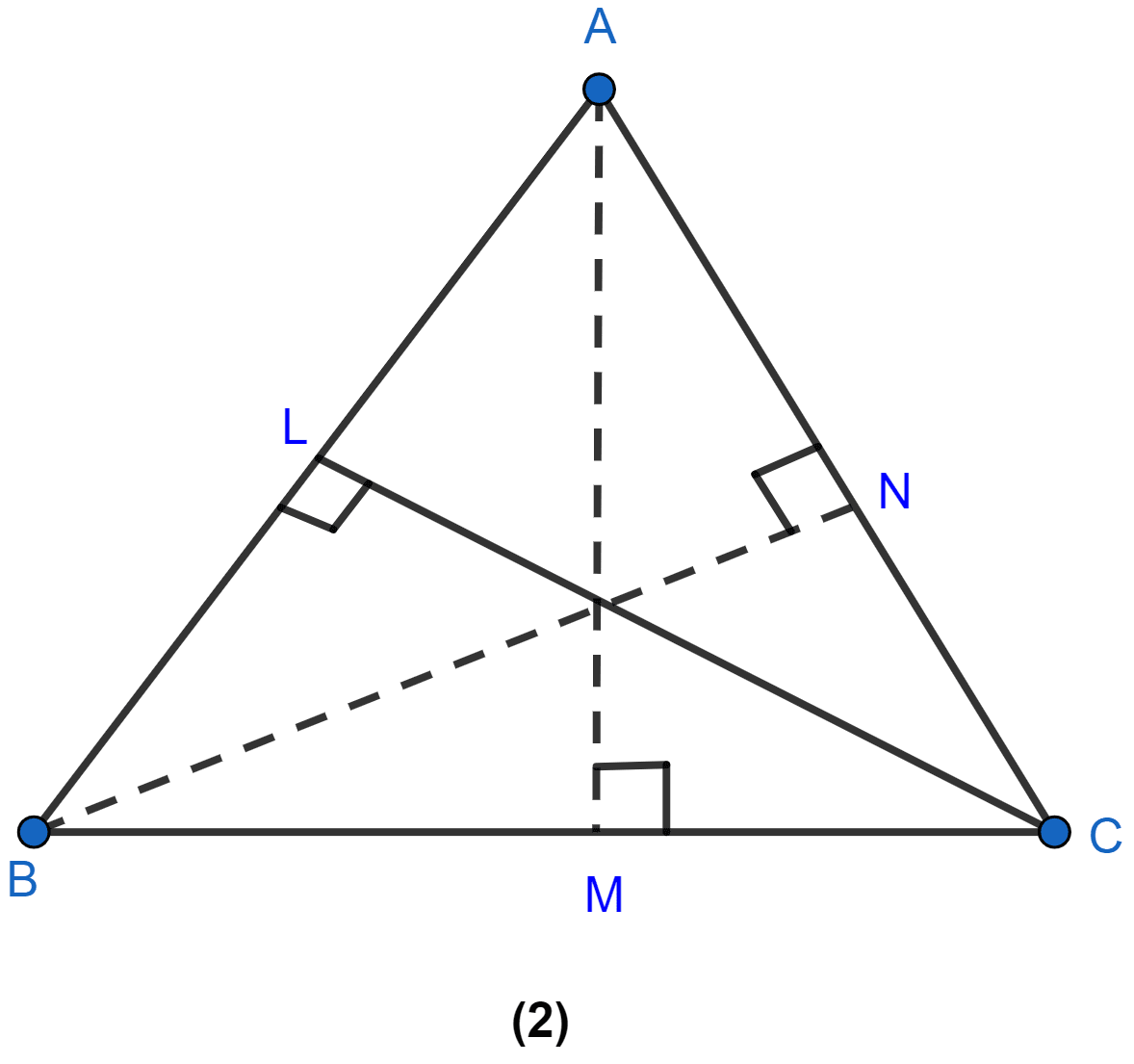
Answer
Let us consider BC = p, CA = q.
From figure,
Perimeter of ∆ABC = AB + BC + CA
⇒ 37 = AB + p + q
⇒ AB = 37 – (p + q)
Area of ∆ABC = × base × height
= × BC × AM
= × p ×
∴ Area of ∆ABC = × p × .........(i)
Also,
Area of ∆ABC = × CA × BN
= × q ×
∴ Area of ∆ABC = × q × .........(ii)
Also,
Area of ∆ABC = × AB × CL
= × (37 - p - q) ×
∴ Area of ∆ABC = × (37 - p - q) × .........(iii)
From equation (i) and (ii) we get,
From equation (ii) and (iii) we get,
⇒ CA = q = 10 cm.
⇒ BC = p = cm.
⇒ AB = (37 - p - q) = (37 - 12 - 10) = 15 cm.
Hence, AB = 15 cm, BC = 12 cm and CA = 10 cm.
In the figure(3) given below, ABCD is a parallelogram. P is a point on DC such that area of ∆DAP = 25 cm2 and the area of ∆BCP = 15 cm2. Find
(i) area of || gm ABCD
(ii) DP : PC.
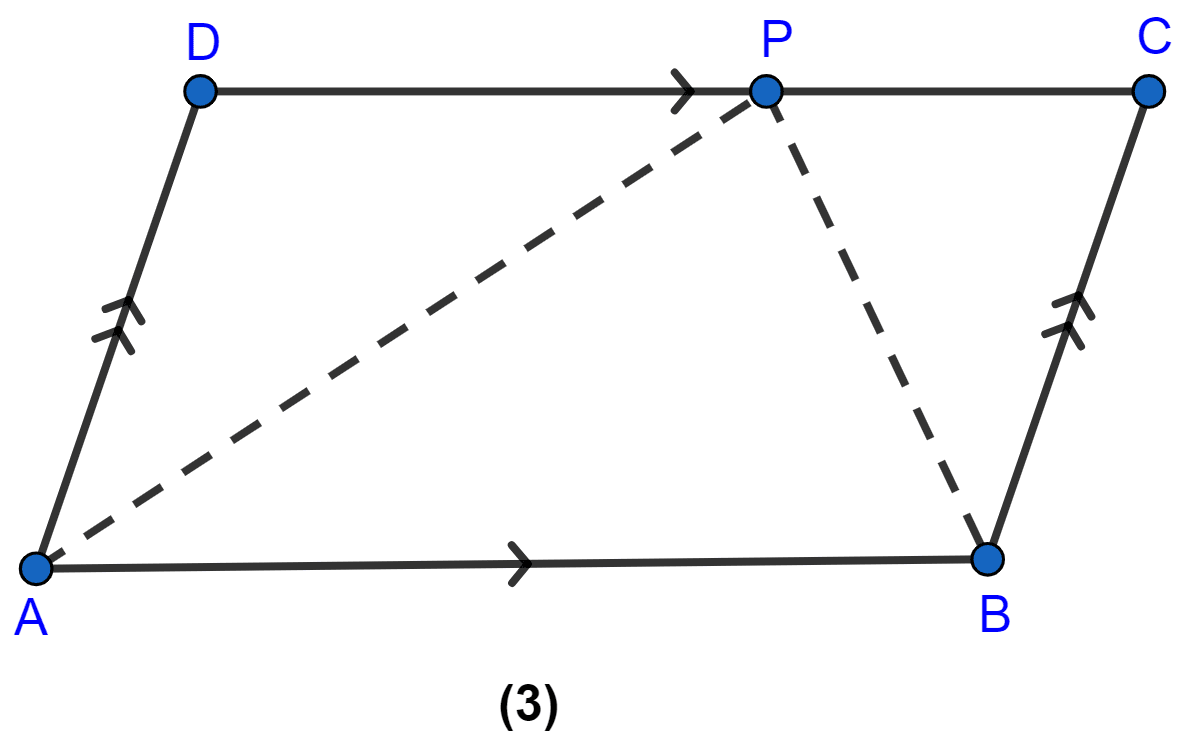
Answer
(i) Since,
∆APB and || gm ABCD have same base AB and are between same parallel lines AB and DC. So,
area of ∆APB = area of ||gm ABCD
From figure,
⇒ area of ||gm ABCD = area of (∆DAP + ∆BCP)
⇒ area of ||gm ABCD = 25 + 15 = 40
⇒ area of ||gm ABCD = 2 × 40 = 80 cm2.
Hence, area of ||gm ABCD = 80 cm2.
(ii) From figure,
∆DAP and ∆BCP are on the same base CD and between the same parallel lines CD and AB.
Hence, DP : PC = 5 : 3.
In the adjoining figure, E is the midpoint of the side AB of a triangle ABC and EBCF is a parallelogram. If the area of ∆ ABC is 25 sq. units, find the area of || gm EBCF.
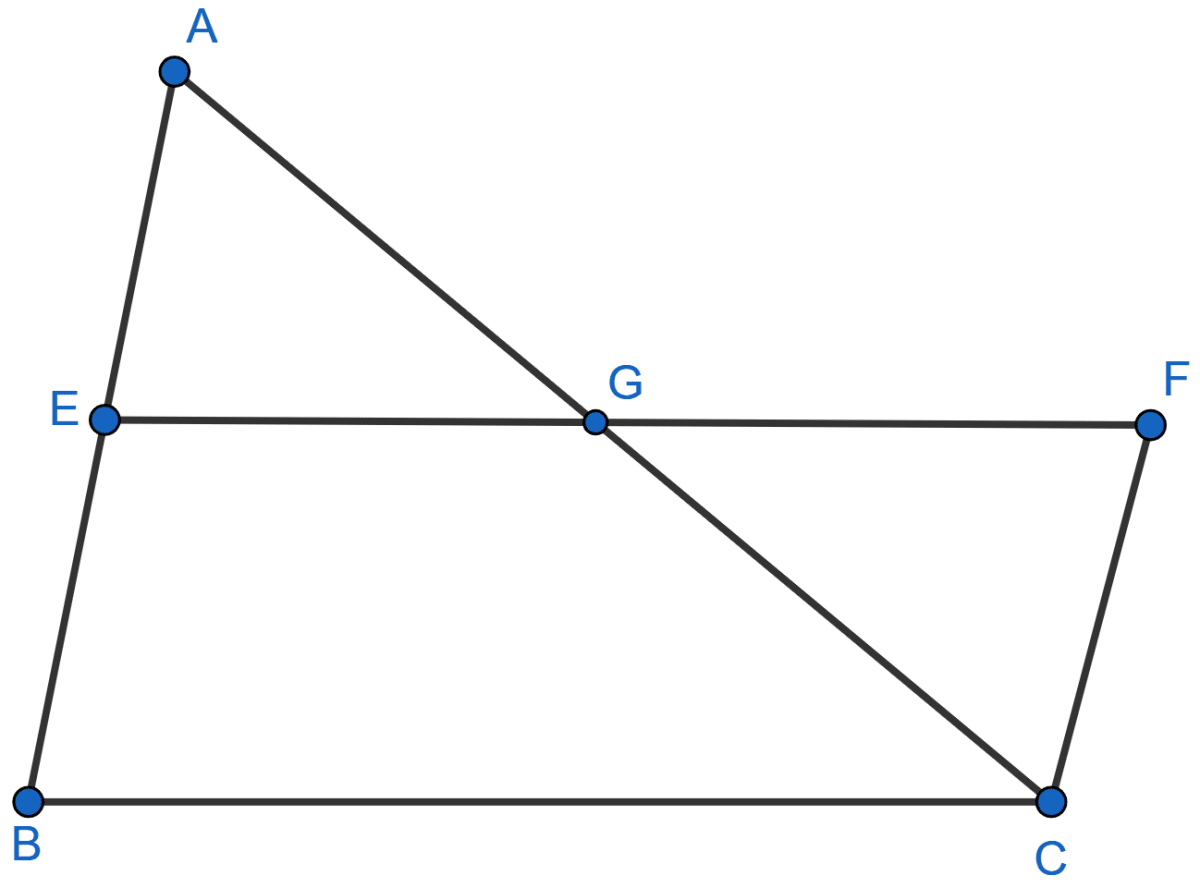
Answer
In △ABC,
As E is mid-point of AB and EF || BC so,
G is mid-point of AC (By mid-point theorem)
∴ AG = GC.
In ∆AEG and ∆CFG,
∠EAG = ∠GCF (Alternate angles are equal)
∠EGA = ∠CGF (Vertically opposite angles are equal)
AG = GC (Proved above)
Hence, ∆AEG ≅ ∆CFG (By ASA axiom)
∴ area of ∆AEG = area of ∆CFG ..........(i)
From figure,
area of || gm EBCF = area of quad. BCGE + area of ∆CFG
= area of quad. BCGE + area of ∆AEG ........(from i)
= area of ∆ABC = 25 sq. units.
Hence, area of ||gm EBCF = 25 sq. units.
In the figure (1) given below, BC || AE and CD || BE. Prove that
area of ∆ABC= area of ∆EBD.
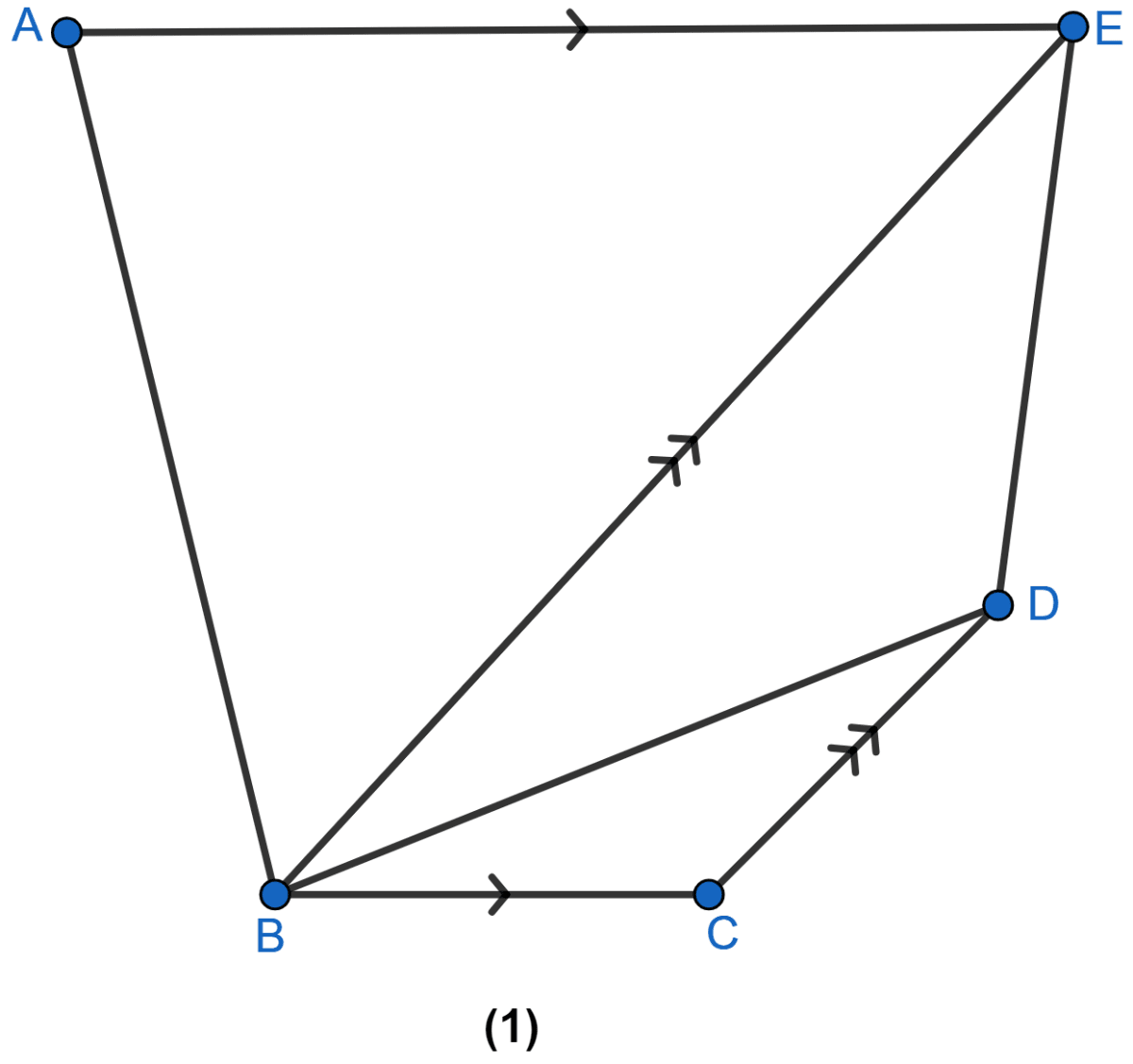
Answer
Join CE and AC.
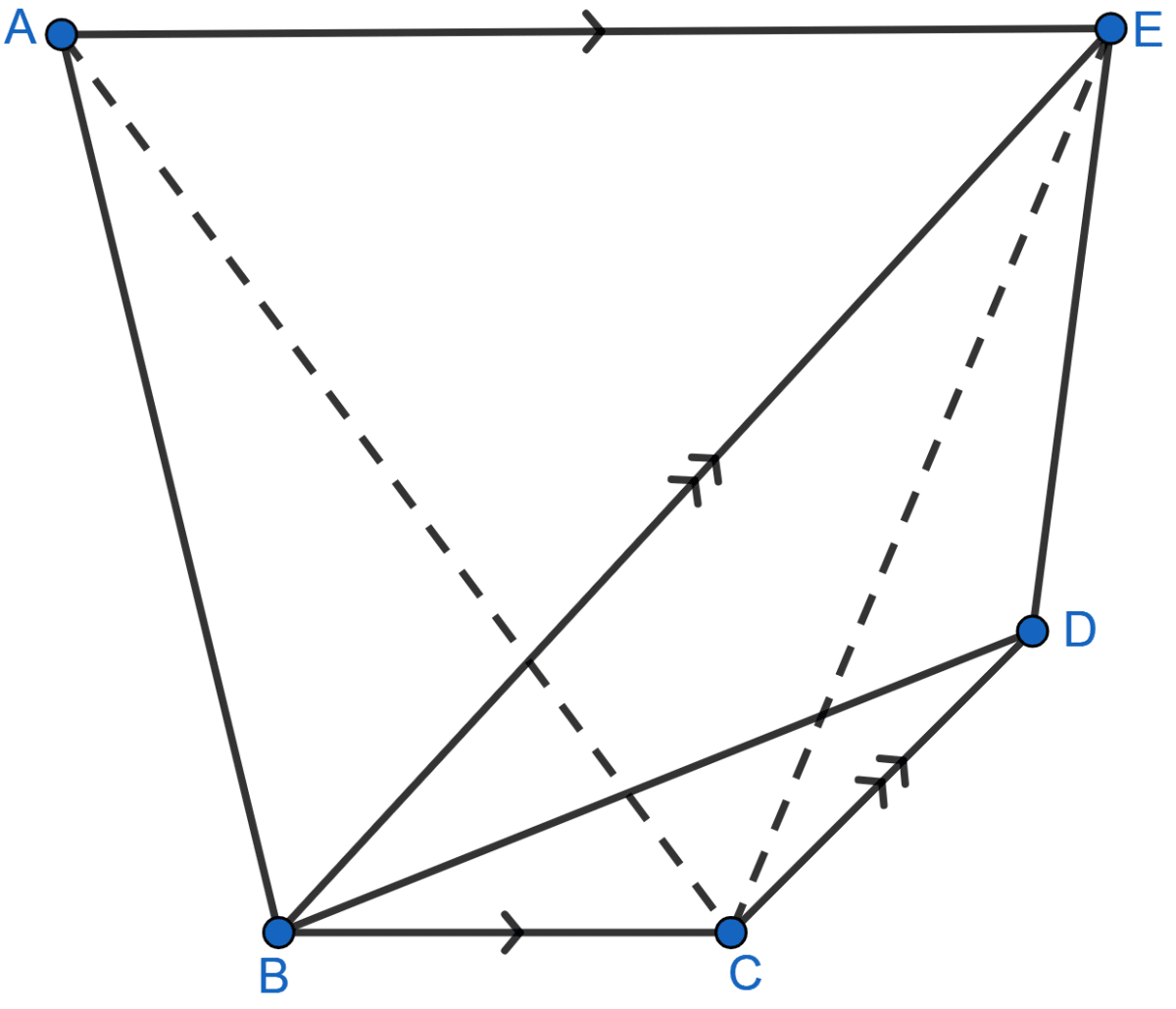
From figure,
∆ABC and ∆EBC lie on same base BC and between same parallel lines BC and AE.
∴ area of ∆ABC = area of ∆EBC ....... (i)
From figure,
∆EBC and ∆EBD lie on same base BE and between same parallel lines CD and BE.
∴ area of ∆EBC = area of ∆EBD ....... (ii)
From (i) and (ii), we get
area of ∆ABC = area of ∆EBD.
Hence, proved that area of ∆ABC = area of ∆EBD.
In figure (2) given below, ABC is a right-angled triangle at A. AGFB is a square on the side AB and BCDE is a square on the hypotenuse BC. If AN ⊥ ED, prove that
(i) ∆BCF ≅ ∆ABE.
(ii) area of square ABFG = area of rectangle BENM.
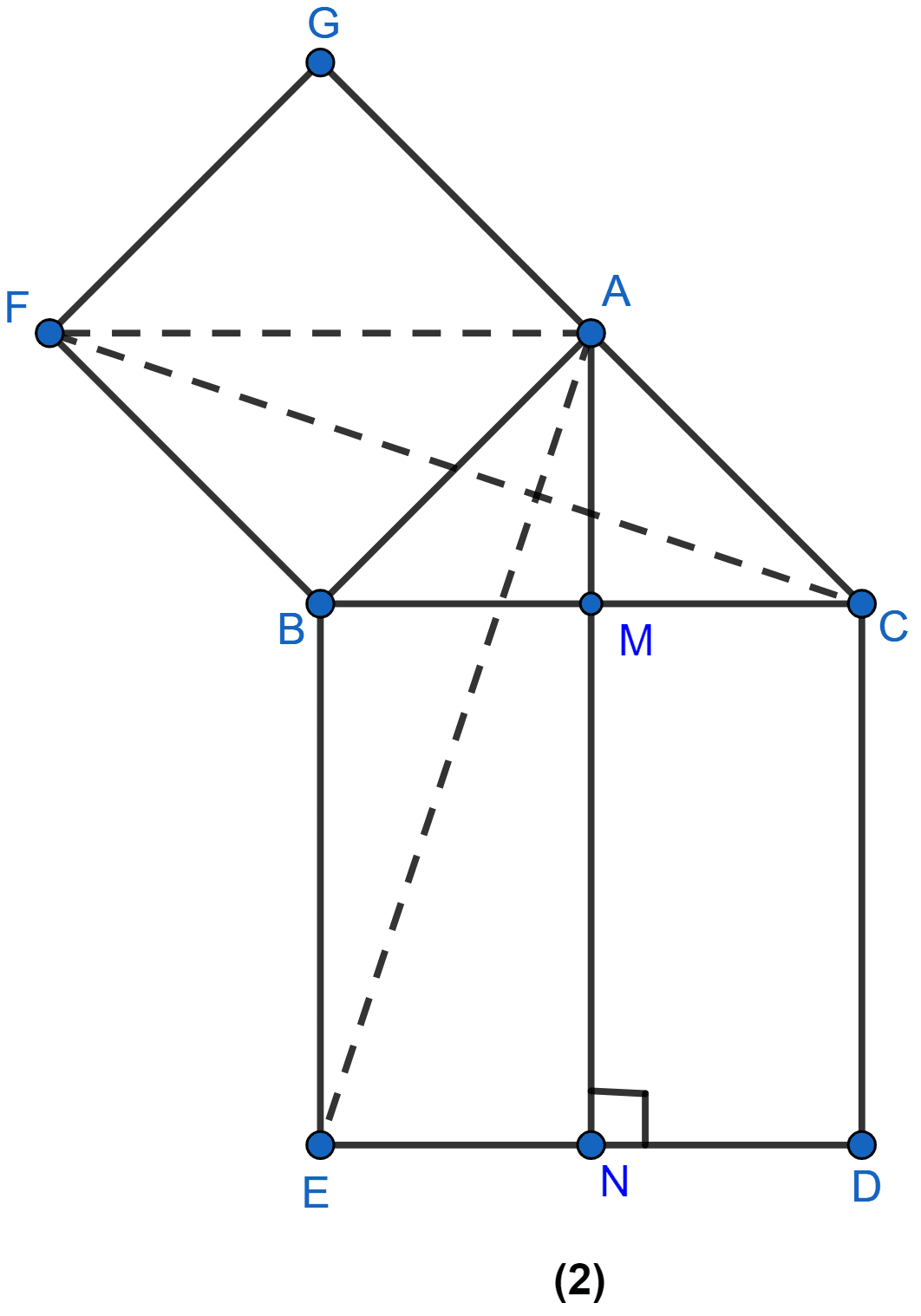
Answer
(i) From figure,
⇒ ∠FBC = ∠FBA + ∠ABC
∠FBA = 90° (As each angle of a square = 90°)
⇒ ∠FBC = 90° + ∠ABC ....... (1)
Also,
⇒ ∠ABE = ∠CBE + ∠ABC
∠CBE = 90° (As each angle of a square = 90°)
⇒ ∠ABE = 90° + ∠ABC .......(2)
From (1) and (2), we get
∠FBC = ∠ABE ........ (3)
Now, in ∆BCF and ∆ABE
BF = AB (As FBAG is a square)
∠FBC = ∠ABE (Proved above)
BC = BE (As BCDE is a square)
By using the SAS axiom rule of congruency,
∴ ∆BCF ≅ ∆ ABE.
Hence, proved that ∆BCF ≅ ∆ ABE.
(ii) We know that,
∆BCF ≅ ∆ABE
So, area of ∆BCF = area of ∆ABE ...... (4)
Since, ∆BCF and square AGFB have same base FB and are between same parallel lines FB and GC.
area of ∆BCF = area of square AGFB ........(5)
∆ABE and rectangle BENM are on same base BE and are between same parallel lines BE and AN.
area of ∆ABE = area of rectangle BENM ....... (6)
From (4), (5) and (6)
⇒ area of square AGFB = area of rectangle BENM
⇒ area of square AGFB = area of rectangle BENM
Hence, proved that area of square AGFB = area of rectangle BENM.