KnowledgeBoat Logo
|
OPEN IN APP

Chapter 17

Trigonometrical Ratios of Standard Angles

Class - 9 ML Aggarwal Understanding ICSE Mathematics


Exercise 17.1

Question 1

Find the values of :

(i) 7 sin 30° cos 60°

(ii) 3 sin2 45° + 2 cos2 60°

(iii) cos2 45° + sin2 60° + sin2 30°

(iv) cos 90° + cos2 45° sin 30° tan 45°.

Answer

(i) 7 sin 30° cos 60°

=7×12×12=74.= 7 \times \dfrac{1}{2} \times \dfrac{1}{2} \\[1em] = \dfrac{7}{4}.

Hence, 7 sin 30° cos 60° = 74\dfrac{7}{4}.

(ii) 3 sin2 45° + 2 cos2 60°

=3×(12)2+2×(12)2=3×12+2×14=32+12=42=2.= 3 \times \Big(\dfrac{1}{\sqrt{2}}\Big)^2 + 2 \times \Big(\dfrac{1}{2}\Big)^2 \\[1em] = 3 \times \dfrac{1}{2} + 2 \times \dfrac{1}{4} \\[1em] = \dfrac{3}{2} + \dfrac{1}{2} \\[1em] = \dfrac{4}{2} \\[1em] = 2.

Hence, 3 sin2 45° + 2 cos2 60° = 2.

(iii) cos2 45° + sin2 60° + sin2 30°

=(12)2+(32)2+(12)2=12+34+14=2+3+14=64=32.= \Big(\dfrac{1}{\sqrt{2}}\Big)^2 + \Big(\dfrac{\sqrt{3}}{2}\Big)^2 + \Big(\dfrac{1}{2}\Big)^2 \\[1em] = \dfrac{1}{2} + \dfrac{3}{4} + \dfrac{1}{4} \\[1em] = \dfrac{2 + 3 + 1}{4} \\[1em] = \dfrac{6}{4} \\[1em] = \dfrac{3}{2}.

Hence, cos2 45° + sin2 60° + sin2 30° = 32\dfrac{3}{2}.

(iv) cos 90° + cos2 45° sin 30° tan 45°

=0+(12)2×12×1=0+12×12=14.= 0 + \Big(\dfrac{1}{\sqrt{2}}\Big)^2 \times \dfrac{1}{2} \times 1 \\[1em] = 0 + \dfrac{1}{2} \times \dfrac{1}{2} \\[1em] = \dfrac{1}{4}.

Hence, cos 90° + cos2 45° sin 30° tan 45° = 14\dfrac{1}{4}.

Question 2

Find the values of

(i) sin245°+cos245°tan260°\dfrac{\text{sin}^2 45° + \text{cos}^2 45°}{\text{tan}^2 60°}

(ii) sin 30° - sin 90° + 2 cos 0°tan 30° × tan 60°\dfrac{\text{sin 30° - sin 90° + 2 cos 0°}}{\text{tan 30° × tan 60°}}

(iii) 43tan230°+sin260°3 cos260°+34tan260°2tan245°\dfrac{4}{3} \text{tan}^2 30° + \text{sin}^2 60° - \text{3 cos}^2 60° + \dfrac{3}{4}\text{tan}^2 60° - 2\text{tan}^2 45°.

Answer

(i) Solving,

sin245°+cos245°tan260°[sin2 θ+cos2 θ=1],1(3)213\Rightarrow \dfrac{\text{sin}^2 45° + \text{cos}^2 45°}{\text{tan}^2 60°} \\[1em] [\because \text{sin}^2 \text{ θ} + \text{cos}^2 \text{ θ} = 1], \\[1em] \Rightarrow \dfrac{1}{(\sqrt{3})^2} \\[1em] \Rightarrow \dfrac{1}{3}

Hence, sin245°+cos245°tan260°=13\dfrac{\text{sin}^2 45° + \text{cos}^2 45°}{\text{tan}^2 60°} = \dfrac{1}{3}.

(ii) Solving,

sin 30° - sin 90° + 2 cos 0°tan 30° × tan 60°121+2×113×312+42132.\Rightarrow \dfrac{\text{sin 30° - sin 90° + 2 cos 0°}}{\text{tan 30° × tan 60°}} \\[1em] \Rightarrow \dfrac{\dfrac{1}{2} - 1 + 2 \times 1}{\dfrac{1}{\sqrt{3}} \times \sqrt{3}} \\[1em] \Rightarrow \dfrac{\dfrac{1 - 2 + 4}{2}}{1} \\[1em] \Rightarrow \dfrac{3}{2}.

Hence, sin 30° - sin 90° + 2 cos 0°tan 30° × tan 60°=32\dfrac{\text{sin 30° - sin 90° + 2 cos 0°}}{\text{tan 30° × tan 60°}} = \dfrac{3}{2}.

(iii) Solving,

43tan230°+sin260°3 cos260°+34tan260°2tan245°43×(13)2+(32)23×(12)2+34×(3)22×(1)243×13+3434+34×3249+94216+8172362536.\Rightarrow\dfrac{4}{3} \text{tan}^2 30° + \text{sin}^2 60° - \text{3 cos}^2 60° + \dfrac{3}{4}\text{tan}^2 60° - 2\text{tan}^2 45° \\[1em] \Rightarrow \dfrac{4}{3} \times \Big(\dfrac{1}{\sqrt{3}}\Big)^2 + \Big(\dfrac{\sqrt{3}}{2}\Big)^2 - 3 \times \Big(\dfrac{1}{2}\Big)^2 + \dfrac{3}{4} \times (\sqrt{3})^2 - 2 \times (1)^2 \\[1em] \Rightarrow \dfrac{4}{3} \times \dfrac{1}{3} + \dfrac{3}{4} - \dfrac{3}{4} + \dfrac{3}{4} \times 3 - 2 \\[1em] \Rightarrow \dfrac{4}{9} + \dfrac{9}{4} - 2 \\[1em] \Rightarrow \dfrac{16 + 81 - 72}{36} \\[1em] \Rightarrow \dfrac{25}{36}.

Hence, 43tan230°+sin260°3 cos260°+34tan260°2tan245°=2536\dfrac{4}{3} \text{tan}^2 30° + \text{sin}^2 60° - \text{3 cos}^2 60° + \dfrac{3}{4}\text{tan}^2 60° - 2\text{tan}^2 45° = \dfrac{25}{36}.

Question 3

Find the values of

(i) sin 60°cos245°3 tan 30° + 5 cos 90°\dfrac{\text{sin 60°}}{\text{cos}^2 45°} - 3\text{ tan 30° + 5 cos 90°}

(ii) 22 cos 45° cos 60°+23 sin 30° tan 60° - cos 0°2\sqrt{2}\text{ cos 45° cos 60°} + 2\sqrt{3} \text{ sin 30° tan 60° - cos 0°}

(iii) 45tan260°2sin230°34tan230°\dfrac{4}{5}\text{tan}^2 60° - \dfrac{2}{\text{sin}^2 30°} - \dfrac{3}{4}\text{tan}^2 30°

Answer

(i) Solving,

32(12)23×13+5×0321232323330.\Rightarrow \dfrac{\dfrac{\sqrt{3}}{2}}{\Big(\dfrac{1}{\sqrt{2}}\Big)^2} - 3 \times \dfrac{1}{\sqrt{3}} + 5 \times 0 \\[1em] \Rightarrow \dfrac{\dfrac{\sqrt{3}}{2}}{\dfrac{1}{2}} - \sqrt{3} \\[1em] \Rightarrow \dfrac{2\sqrt{3}}{2} - \sqrt{3} \\[1em] \Rightarrow \sqrt{3} - \sqrt{3} \\[1em] \Rightarrow 0.

Hence, sin 60°cos245°3 tan 30° + 5 cos 90°=0.\dfrac{\text{sin 60°}}{\text{cos}^2 45°} - 3\text{ tan 30° + 5 cos 90°} = 0.

(ii) Solving,

22 cos 45° cos 60°+23 sin 30° tan 60° - cos 0°22×12×12+2×3×12×311+3×311+313.\Rightarrow 2\sqrt{2}\text{ cos 45° cos 60°} + 2\sqrt{3} \text{ sin 30° tan 60° - cos 0°} \\[1em] \Rightarrow 2\sqrt{2} \times \dfrac{1}{\sqrt{2}} \times \dfrac{1}{2} + 2 \times \sqrt{3} \times \dfrac{1}{2} \times \sqrt{3} - 1 \\[1em] \Rightarrow 1 + \sqrt{3} \times \sqrt{3} - 1 \\[1em] \Rightarrow 1 + 3 - 1 \\[1em] \Rightarrow 3.

Hence, 22 cos 45° cos 60°+23 sin 30° tan 60° - cos 0°=3.2\sqrt{2}\text{ cos 45° cos 60°} + 2\sqrt{3} \text{ sin 30° tan 60° - cos 0°} = 3.

(iii) Solving,

45tan260°2sin230°34tan230°45×(3)22(12)234×(13)245×32×(2)234×13125814481605201172051720.\Rightarrow \dfrac{4}{5}\text{tan}^2 60° - \dfrac{2}{\text{sin}^2 30°} - \dfrac{3}{4}\text{tan}^2 30° \\[1em] \Rightarrow \dfrac{4}{5} \times (\sqrt{3})^2 - \dfrac{2}{\Big(\dfrac{1}{2}\Big)^2} - \dfrac{3}{4} \times \Big(\dfrac{1}{\sqrt{3}}\Big)^2 \\[1em] \Rightarrow \dfrac{4}{5} \times 3 - 2 \times (2)^2 - \dfrac{3}{4} \times \dfrac{1}{3} \\[1em] \Rightarrow \dfrac{12}{5} - 8 - \dfrac{1}{4} \\[1em] \Rightarrow \dfrac{48 - 160 - 5}{20} \\[1em] \Rightarrow -\dfrac{117}{20}\\[1em] \Rightarrow -5\dfrac{17}{20}.

Hence, 45tan260°2sin230°34tan230°=51720\dfrac{4}{5}\text{tan}^2 60° - \dfrac{2}{\text{sin}^2 30°} - \dfrac{3}{4}\text{tan}^2 30° = -5\dfrac{17}{20}.

Question 4

Prove that

(i) cos2 30° + sin 30° + tan2 45° = 2142\dfrac{1}{4}

(ii) 4(sin4 30° + cos4 60°) - 3(cos2 45° - sin2 90°) = 2

(iii) cos 60° = cos2 30° - sin2 30°.

Answer

(i) Solving,

L.H.S. of the equation : cos2 30° + sin 30° + tan2 45° = 2142\dfrac{1}{4}.

(32)2+12+(1)234+12+13+2+4494214.\Rightarrow \Big(\dfrac{\sqrt{3}}{2}\Big)^2 + \dfrac{1}{2} + (1)^2 \\[1em] \Rightarrow \dfrac{3}{4} + \dfrac{1}{2} + 1 \\[1em] \Rightarrow \dfrac{3 + 2 + 4}{4} \\[1em] \Rightarrow \dfrac{9}{4} \\[1em] \Rightarrow 2\dfrac{1}{4}.

Since, L.H.S. = R.H.S.

Hence, proved that cos2 30° + sin 30° + tan2 45° = 2142\dfrac{1}{4}.

(ii) Solving,

L.H.S. of the equation : 4(sin4 30° + cos4 60°) - 3(cos2 45° - sin2 90°) = 2

4[(12)4+(12)4]3[(12)2(1)2]4[116+116]3[121]4×2163×1212+32422.\Rightarrow 4\Big[\Big(\dfrac{1}{2}\Big)^4 + \Big(\dfrac{1}{2}\Big)^4\Big] - 3\Big[\Big(\dfrac{1}{\sqrt{2}}\Big)^2 - (1)^2\Big] \\[1em] \Rightarrow 4\Big[\dfrac{1}{16} + \dfrac{1}{16}\Big] - 3\Big[\dfrac{1}{2} - 1\Big] \\[1em] \Rightarrow 4 \times \dfrac{2}{16} - 3 \times -\dfrac{1}{2} \\[1em] \Rightarrow \dfrac{1}{2} + \dfrac{3}{2} \\[1em] \Rightarrow \dfrac{4}{2} \\[1em] \Rightarrow 2.

Since, L.H.S. = R.H.S.

Hence, proved that 4(sin4 30° + cos4 60°) - 3(cos2 45° - sin2 90°) = 2.

(iii) Solving,

R.H.S. of the equation : cos 60° = cos2 30° - sin2 30°.

(32)2(12)234142412cos 60°.\Rightarrow \Big(\dfrac{\sqrt{3}}{2}\Big)^2 - \Big(\dfrac{1}{2}\Big)^2 \\[1em] \Rightarrow \dfrac{3}{4} - \dfrac{1}{4} \\[1em] \Rightarrow \dfrac{2}{4} \\[1em] \Rightarrow \dfrac{1}{2} \\[1em] \Rightarrow \text{cos 60°}.

Since, L.H.S. = R.H.S.

Hence, proved that cos 60° = cos2 30° - sin2 30°.

Question 5(i)

If x = 30°, verify that tan 2x = 2 tan x1 - tan2x\dfrac{\text{2 tan x}}{\text{1 - tan}^2 x}.

Answer

To verify,

tan 2x = 2 tan x1 - tan2x\dfrac{\text{2 tan x}}{\text{1 - tan}^2 x}.

Substituting value of x in L.H.S. of the above equation,

⇒ tan 2x = tan 2(30°) = tan 60° = 3\sqrt{3}.

Substituting value of x in R.H.S. of the equation.

2 tan x1 - tan2x2×tan 30°1tan230°2×131(13)22311323232×32×33.\Rightarrow \dfrac{\text{2 tan x}}{\text{1 - tan}^2 x} \\[1em] \Rightarrow \dfrac{2 \times \text{tan 30°}}{1 - \text{tan}^2 30°} \\[1em] \Rightarrow \dfrac{2 \times \dfrac{1}{\sqrt{3}}}{1 - \Big(\dfrac{1}{\sqrt{3}}\Big)^2} \\[1em] \Rightarrow \dfrac{\dfrac{2}{\sqrt{3}}}{1 - \dfrac{1}{3}} \\[1em] \Rightarrow \dfrac{\dfrac{2}{\sqrt{3}}}{\dfrac{2}{3}} \\[1em] \Rightarrow \dfrac{2 \times 3}{2 \times \sqrt{3}} \\[1em] \Rightarrow \sqrt{3}.

Since, L.H.S. = R.H.S.

Hence, proved that tan 2x = 2 tan x1 - tan2x\dfrac{\text{2 tan x}}{\text{1 - tan}^2 x}.

Question 5(ii)

If x = 15°, verify that 4 sin 2x cos 4x sin 6x = 1.

Answer

To verify,

4 sin 2x cos 4x sin 6x = 1

Substituting value of x in L.H.S. of the above equation.

⇒ 4 sin 2(15°) cos 4(15°) sin 6(15°)

⇒ 4 sin 30° cos 60° sin 90°

4×12×12×14 \times \dfrac{1}{2} \times \dfrac{1}{2} \times 1

⇒ 1.

Since, L.H.S. = R.H.S.

Hence, proved that 4 sin 2x cos 4x sin 6x = 1.

Question 6

Find the values of

(i) 1cos230°1sin230°\sqrt{\dfrac{1 - \text{cos}^2 30°}{1 - \text{sin}^2 30°}}

(ii) sin 45° cos 45° cos 60°sin 60° cos 30° tan 45°\dfrac{\text{sin 45° cos 45° cos 60°}}{\text{sin 60° cos 30° tan 45°}}

Answer

(i) Solving,

1cos230°1sin230°1(32)21(12)213411414341×43×413.\Rightarrow \sqrt{\dfrac{1 - \text{cos}^2 30°}{1 - \text{sin}^2 30°}} \\[1em] \Rightarrow \sqrt{\dfrac{1 - \Big(\dfrac{\sqrt{3}}{2}\Big)^2}{1 - \Big(\dfrac{1}{2}\Big)^2}} \\[1em] \Rightarrow \sqrt{\dfrac{1 - \dfrac{3}{4}}{1 - \dfrac{1}{4}}} \\[1em] \Rightarrow \sqrt{\dfrac{\dfrac{1}{4}}{\dfrac{3}{4}}} \\[1em] \Rightarrow \sqrt{\dfrac{1 \times 4}{3 \times 4}} \\[1em] \Rightarrow \dfrac{1}{\sqrt{3}}.

Hence, 1cos230°1sin230°=13\sqrt{\dfrac{1 - \text{cos}^2 30°}{1 - \text{sin}^2 30°}} = \dfrac{1}{\sqrt{3}}.

(ii) Solving,

sin 45° cos 45° cos 60°sin 60° cos 30° tan 45°12×12×1232×32×1143413.\Rightarrow \dfrac{\text{sin 45° cos 45° cos 60°}}{\text{sin 60° cos 30° tan 45°}} \\[1em] \Rightarrow \dfrac{\dfrac{1}{\sqrt{2}} \times \dfrac{1}{\sqrt{2}} \times \dfrac{1}{2}}{\dfrac{\sqrt{3}}{2} \times \dfrac{\sqrt{3}}{2} \times 1} \\[1em] \Rightarrow \dfrac{\dfrac{1}{4}}{\dfrac{3}{4}} \\[1em] \Rightarrow \dfrac{1}{3}.

Hence, sin 45° cos 45° cos 60°sin 60° cos 30° tan 45°=13.\dfrac{\text{sin 45° cos 45° cos 60°}}{\text{sin 60° cos 30° tan 45°}} = \dfrac{1}{3}.

Question 7

If θ = 30°, verify that

(i) sin 2θ = 2 sin θ cos θ

(ii) cos 2θ = 2 cos2 θ - 1

(iii) sin 3θ = 3 sin θ - 4 sin3 θ

(iv) cos 3θ = 4 cos3 θ - 3 cos θ

Answer

(i) To verify,

sin 2θ = 2 sin θ cos θ

Substituting value of θ in L.H.S. of the equation we get :

⇒ sin 2θ = sin 2(30°) = sin 60° = 32\dfrac{\sqrt{3}}{2}.

Substituting value of θ in R.H.S. of the equation we get :

⇒ 2 sin θ cos θ = 2 sin 30° cos 30° = 2×12×32=322 \times \dfrac{1}{2} \times \dfrac{\sqrt{3}}{2} = \dfrac{\sqrt{3}}{2}.

Since, L.H.S. = R.H.S.

Hence, proved that sin 2θ = 2 sin θ cos θ.

(ii) To verify,

cos 2θ = 2 cos2 θ - 1

Substituting value of θ in L.H.S. of the equation we get :

⇒ cos 2θ = cos 2(30°) = cos 60° = 12\dfrac{1}{2}.

Substituting value of θ in R.H.S. of the equation we get :

⇒ 2cos2 θ - 1 = 2cos2 30° - 1

= 2×(32)212 \times \Big(\dfrac{\sqrt{3}}{2}\Big)^2 - 1

= 2×341=321=122 \times \dfrac{3}{4} - 1 = \dfrac{3}{2} - 1 = \dfrac{1}{2}.

Since, L.H.S. = R.H.S.

Hence, proved that cos 2θ = 2cos2 θ - 1.

(iii) To verify,

sin 3θ = 3 sin θ - 4 sin3 θ

Substituting value of θ in L.H.S. of the equation we get :

⇒ sin 3θ = sin 3(30°) = sin 90° = 1.

Substituting value of θ in R.H.S. of the equation we get :

⇒ 3 sin θ - 4 sin3 θ = 3 sin 30° - 4 sin3 30°

= 3×124×(12)33 \times \dfrac{1}{2} - 4 \times \Big(\dfrac{1}{2}\Big)^3

= 3248\dfrac{3}{2} - \dfrac{4}{8}

= 1248=88\dfrac{12 - 4}{8} = \dfrac{8}{8} = 1.

Since, L.H.S. = R.H.S.

Hence, proved that sin 3θ = 3 sin θ - 4 sin3 θ.

(iv) Given,

Equation : cos 3θ = 4 cos3θ - 3 cos θ

Substituting θ = 30°, in L.H.S. of the given equation, we get :

⇒ cos 3θ = cos 3(30°) = cos 90° = 0.

Substituting θ = 30°, in R.H.S. of the given equation, we get :

⇒ 4 cos3θ - 3 cos θ = 4 cos3 30° - 3 cos 30°

=4×(32)33×32=4×338332=332332=0.= 4 \times \Big(\dfrac{\sqrt{3}}{2}\Big)^3 - 3 \times \dfrac{\sqrt{3}}{2}\\[1em] = 4 \times \dfrac{3\sqrt{3}}{8} - \dfrac{3\sqrt{3}}{2} \\[1em] = \dfrac{3\sqrt{3}}{2} - \dfrac{3\sqrt{3}}{2} \\[1em] = 0.

Since, L.H.S. = R.H.S.

Hence, proved that cos 3θ = 4 cos3θ - 3 cos θ.

Question 8

If θ = 30°, find the ratio 2 sin θ : sin 2θ.

Answer

Substituting, θ = 30° in 2 sin θ : sin 2θ we get,

⇒ 2 sin 30° : sin 2(30°)

⇒ 2 sin 30° : sin 60°

2×1232\dfrac{2 \times \dfrac{1}{2}}{\dfrac{\sqrt{3}}{2}}

132\dfrac{1}{\dfrac{\sqrt{3}}{2}}

23=2:3\dfrac{2}{\sqrt{3}} = 2 : \sqrt{3}.

Hence, 2 sin θ : sin 2θ = 23=2:3\dfrac{2}{\sqrt{3}} = 2 : \sqrt{3}.

Question 9

By, means of an example, show that sin(A + B) ≠ sin A + sin B.

Answer

Let A = 30° and B = 60°.

Substituting values in sin(A + B) we get :

⇒ sin(A + B) = sin(30° + 60°) = sin 90° = 1.

Substituting values in sin A + sin B we get :

⇒ sin A + sin B = sin 30° + sin 60°

= 12+32\dfrac{1}{2} + \dfrac{\sqrt{3}}{2}

= 1+32\dfrac{1 + \sqrt{3}}{2}.

As, LHS ≠ RHS

Hence, proved that sin(A + B) ≠ sin A + sin B.

Question 10

If A = 60° and B = 30°, verify that

(i) sin(A + B) = sin A cos B + cos A sin B

(ii) cos(A + B) = cos A cos B - sin A sin B

(iii) sin(A - B) = sin A cos B - cos A sin B

(iv) tan(A - B) = tan A - tan B1 + tan A tan B.\dfrac{\text{tan A - tan B}}{\text{1 + tan A tan B}}.

Answer

(i) To verify,

sin(A + B) = sin A cos B + cos A sin B

Substituting values in L.H.S. of the above equation :

sin(A + B) = sin(60° + 30°) = sin 90° = 1.

Substituting values in R.H.S. of the equation :

sin A cos B + cos A sin B = sin 60° cos 30° + cos 60° sin 30°

=32×32+12×12=34+14=44=1.= \dfrac{\sqrt{3}}{2} \times \dfrac{\sqrt{3}}{2} + \dfrac{1}{2} \times \dfrac{1}{2} \\[1em] = \dfrac{3}{4} + \dfrac{1}{4} \\[1em] = \dfrac{4}{4} = 1.

Since, L.H.S. = R.H.S.

Hence, proved that sin(A + B) = sin A cos B + cos A sin B.

(ii) To verify,

cos(A + B) = cos A cos B - sin A sin B

Substituting values in L.H.S. of equation :

cos(A + B) = cos(60° + 30°) = cos 90° = 0.

Substituting values in R.H.S. of equation :

cos A cos B - sin A sin B = cos 60° cos 30° - sin 60° sin 30°

=12×3232×12=3434=0.= \dfrac{1}{2} \times \dfrac{\sqrt{3}}{2} - \dfrac{\sqrt{3}}{2} \times \dfrac{1}{2} \\[1em] = \dfrac{\sqrt{3}}{4} - \dfrac{\sqrt{3}}{4} \\[1em] = 0.

Since, L.H.S. = R.H.S.

Hence, proved that cos(A + B) = cos A cos B - sin A sin B.

(iii) To verify,

sin(A - B) = sin A cos B - cos A sin B

Substituting values in L.H.S. of equation :

sin(A - B) = sin(60° - 30°) = sin 30° = 12\dfrac{1}{2}.

Substituting values in R.H.S. of equation :

sin A cos B - cos A sin B = sin 60° cos 30° - cos 60° sin 30°

=32×3212×12=3414=24=12.= \dfrac{\sqrt{3}}{2} \times \dfrac{\sqrt{3}}{2} - \dfrac{1}{2} \times \dfrac{1}{2} \\[1em] = \dfrac{3}{4} - \dfrac{1}{4} \\[1em] = \dfrac{2}{4} = \dfrac{1}{2}.

Since, L.H.S. = R.H.S.

Hence, proved that sin(A - B) = sin A cos B - cos A sin B.

(iv) To verify,

tan (A - B) = tan A - tan B1+ tan A tan B\dfrac{\text{tan A - tan B}}{1 + \text{ tan A tan B}}.

Substituting values in L.H.S. of equation :

tan (A - B) = tan (60° - 30°) = tan 30° = 13\dfrac{1}{\sqrt{3}}.

Substituting values in R.H.S. of equation :

tan A - tan B1+ tan A tan B=tan 60° - tan 30°1+tan 60° tan 30°=3131+3×13=3131+1=232=13.\dfrac{\text{tan A - tan B}}{1 + \text{ tan A tan B}} = \dfrac{\text{tan 60° - tan 30°}}{1 + \text{tan 60° tan 30°}} \\[1em] = \dfrac{\sqrt{3} - \dfrac{1}{\sqrt{3}}}{1 + \sqrt{3} \times \dfrac{1}{\sqrt{3}}} \\[1em] = \dfrac{\dfrac{3 - 1}{\sqrt{3}}}{1 + 1} \\[1em] = \dfrac{\dfrac{2}{\sqrt{3}}}{2} \\[1em] = \dfrac{1}{\sqrt{3}}.

Since, L.H.S. = R.H.S.

Hence, proved that tan (A - B) = tan A - tan B1+ tan A tan B\dfrac{\text{tan A - tan B}}{1 + \text{ tan A tan B}}.

Question 11(i)

If 2θ is an acute angle and 2 sin 2θ = 3\sqrt{3}, find the value of θ.

Answer

Given,

⇒ 2 sin 2θ = 3\sqrt{3}

⇒ sin 2θ = 32\dfrac{\sqrt{3}}{2}

⇒ sin 2θ = sin 60°

⇒ 2θ = 60°

⇒ θ = 30°.

Hence, θ = 30°.

Question 11(ii)

If 20° + x is an acute angle and cos(20° + x) = sin 60°, then find the value of x.

Answer

We know that,

sin 60° = 32\dfrac{\sqrt{3}}{2} = cos 30°.

Given,

⇒ cos(20° + x) = sin 60°

⇒ cos(20° + x) = cos 30°

⇒ (20° + x) = 30°

⇒ x = 10°.

Hence, x = 10°.

Question 11(iii)

If 3 sin2 θ = 2142\dfrac{1}{4} and θ is less than 90°, find the value of θ.

Answer

Given,

3sin2 θ=94sin2 θ=34sin θ=±32.\Rightarrow 3\text{sin}^2 \text{ θ} = \dfrac{9}{4} \\[1em] \Rightarrow \text{sin}^2 \text{ θ} = \dfrac{3}{4} \\[1em] \Rightarrow \text{sin} \text{ θ} = \pm \dfrac{\sqrt{3}}{2}.

Since, θ is an acute angle.

∴ sin θ = 32.\dfrac{\sqrt{3}}{2}.

⇒ sin θ = sin 60°

⇒ θ = 60°.

Hence, θ = 60°.

Question 12

If θ is an acute angle and sin θ = cos θ, find the value of θ and hence, find the value of 2 tan2 θ + sin2 θ - 1.

Answer

Given,

sin θ = cos θ

⇒ tan θ = 1

⇒ tan θ = tan 45°

⇒ θ = 45°.

Substituting value in 2 tan2 θ + sin2 θ - 1 we get :

⇒ 2 tan2 45° + sin2 45° - 1

⇒ 2(1)2 + (12)21\Big(\dfrac{1}{\sqrt{2}}\Big)^2 -1

⇒ 2 + 12\dfrac{1}{2} - 1

1121\dfrac{1}{2}.

Hence, 2 tan2 θ + sin2 θ - 1 = 1121\dfrac{1}{2}.

Question 13

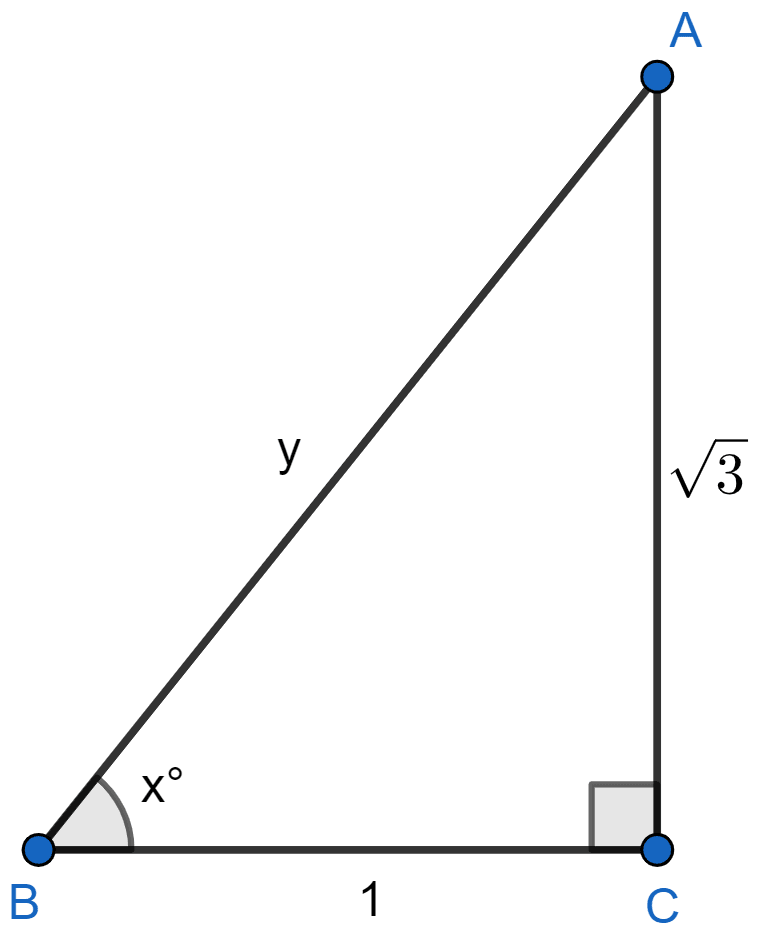
From the adjoining figure, find

(i) tan x°

(ii) x

(iii) cos x°

(iv) Without using Pythagoras theorem, find y.

From the figure, find tan x° cos x°. Trigonometrical Ratios of Standard Angles, ML Aggarwal Understanding Mathematics Solutions ICSE Class 9.

Answer

(i) By formula,

tan x° = PerpendicularBase=ABBC=3\dfrac{\text{Perpendicular}}{\text{Base}} = \dfrac{AB}{BC} = \sqrt{3}.

Hence, tan x° = 3\sqrt{3}.

(ii) tan x° = 3\sqrt{3}

⇒ tan x° = tan 60°

⇒ x = 60.

Hence, x = 60.

(iii) Substituting value of x in cos x°, we get :

⇒ cos x° = cos 60°

⇒ cos x° = 12\dfrac{1}{2}.

Hence, cos x° = 12\dfrac{1}{2}.

(iv) Substituting value of x in sin x°, we get :

⇒ sin x° = sin 60° = 32\dfrac{\sqrt{3}}{2}.

By formula,

sin x°=PerpendicularHypotenuse32=ABAC32=3yy=2.\Rightarrow \text{sin x}\degree = \dfrac{\text{Perpendicular}}{\text{Hypotenuse}} \\[1em] \Rightarrow \dfrac{\sqrt{3}}{2} = \dfrac{AB}{AC} \\[1em] \Rightarrow \dfrac{\sqrt{3}}{2} = \dfrac{\sqrt{3}}{y} \\[1em] \Rightarrow y = 2.

Hence, y = 2.

Question 14

If 3θ is an acute angle, solve the following equations for θ :

(i) 2 sin 3θ = 3\sqrt{3}

(ii) tan 3θ = 1.

Answer

(i) Given,

⇒ 2 sin 3θ = 3\sqrt{3}

⇒ sin 3θ = 32\dfrac{\sqrt{3}}{2}

⇒ sin 3θ = sin 60°

⇒ 3θ = 60°

⇒ θ = 60°3\dfrac{60\degree}{3}

⇒ θ = 20°.

Hence, θ = 20°.

(ii) Given,

⇒ tan 3θ = 1

⇒ tan 3θ = tan 45°

⇒ 3θ = 45°

⇒ θ = 45°3\dfrac{45\degree}{3}

⇒ θ = 15°.

Hence, θ = 15°.

Question 15

If tan 3x = sin 45° cos 45° + sin 30°, find the value of x.

Answer

Given,

tan 3x = sin 45° cos 45° + sin 30°tan 3x=12×12+12tan 3x=12+12tan 3x=1tan 3x = tan 45°3x=45°x=45°3x=15°.\Rightarrow \text{tan 3x = sin 45° cos 45° + sin 30°} \\[1em] \Rightarrow \text{tan 3x} = \dfrac{1}{\sqrt{2}} \times \dfrac{1}{\sqrt{2}} + \dfrac{1}{2} \\[1em] \Rightarrow \text{tan 3x} = \dfrac{1}{2} + \dfrac{1}{2} \\[1em] \Rightarrow \text{tan 3x} = 1 \\[1em] \Rightarrow \text{tan 3x = tan 45°} \\[1em] \Rightarrow 3x = 45° \\[1em] \Rightarrow x = \dfrac{45\degree}{3} \\[1em] \Rightarrow x = 15°.

Hence, x = 15°.

Question 16

If 4 cos2 x° - 1 = 0 and 0 ≤ x ≤ 90, find

(i) x

(ii) sin2 x° + cos2

(iii) cos2 x° - sin2 x°.

Answer

(i) Given,

4 cos2x°1=04 cos2x°=1cos2x°=14cos x°=14cos x°=±12\Rightarrow \text{4 cos}^2 x° - 1 = 0 \\[1em] \Rightarrow \text{4 cos}^2 x° = 1 \\[1em] \Rightarrow \text{cos}^2 x° = \dfrac{1}{4} \\[1em] \Rightarrow \text{cos x°} = \sqrt{\dfrac{1}{4}} \\[1em] \Rightarrow \text{cos x°} = \pm \dfrac{1}{2}

Since, x is an acute angle.

cos x°=12\therefore \text{cos x°} = \dfrac{1}{2}.

⇒ cos x° = cos 60°

⇒ x = 60.

Hence, x = 60.

(ii) Substituting value of x in sin2 x° + cos2 x° we get :

sin2x°+cos2x°=sin260°+cos260°=(32)2+(12)2=34+14=44=1.\text{sin}^2 x° + \text{cos}^2 x° = \text{sin}^2 60° + \text{cos}^2 60° \\[1em] = \Big(\dfrac{\sqrt{3}}{2}\Big)^2 + \Big(\dfrac{1}{2}\Big)^2 \\[1em] = \dfrac{3}{4} + \dfrac{1}{4} \\[1em] = \dfrac{4}{4} \\[1em] = 1.

Hence, sin2 x° + cos2 x° = 1.

(iii) Substituting value of x in cos2 x° - sin2 x° we get :

cos2x°sin2x°=cos260°sin260°=(12)2(32)2=1434=24=12.\text{cos}^2 x° - \text{sin}^2 x° = \text{cos}^2 60° - \text{sin}^2 60° \\[1em] = \Big(\dfrac{1}{2}\Big)^2 - \Big(\dfrac{\sqrt{3}}{2}\Big)^2 \\[1em] = \dfrac{1}{4} - \dfrac{3}{4} \\[1em] = -\dfrac{2}{4} \\[1em] = -\dfrac{1}{2}.

Hence, cos2 x° - sin2 x° = 12-\dfrac{1}{2}.

Question 17(i)

If sec θ = cosec θ and 0° ≤ θ ≤ 90°, find the value of θ.

Answer

Given,

sec θ = cosec θ1cos θ=1sin θsin θcos θ=1tan θ=1tan θ = tan 45°θ=45°.\Rightarrow \text{sec θ = cosec θ} \\[1em] \Rightarrow \dfrac{1}{\text{cos θ}} = \dfrac{1}{\text{sin θ}} \\[1em] \Rightarrow \dfrac{\text{sin θ}}{\text{cos θ}} = 1 \\[1em] \Rightarrow \text{tan θ} = 1 \\[1em] \Rightarrow \text{tan θ = tan 45°} \\[1em] \Rightarrow \text{θ} = 45°.

Hence, θ = 45°.

Question 17(ii)

If tan θ = cot θ and 0° ≤ θ ≤ 90°, find the value of θ.

Answer

Given,

As, θ is in the range of 0° ≤ θ ≤ 90°.

tan θ = cot θ [Only when θ = 45°].

Hence, θ = 45°.

Question 18

If sin 3x = 1 and 0° ≤ 3x ≤ 90°, find the values of

(i) sin x

(ii) cos 2x

(iii) tan2 x - sec2 x.

Answer

Given,

⇒ sin 3x = 1

⇒ sin 3x = sin 90°

⇒ 3x = 90°

⇒ x = 903\dfrac{90}{3}

⇒ x = 30°.

(i) Substituting value of x in sin x, we get :

⇒ sin x = sin 30° = 12\dfrac{1}{2}.

Hence, sin x = 12\dfrac{1}{2}.

(ii) Substituting value of x in cos 2x, we get :

⇒ cos 2x = cos 60° = 12\dfrac{1}{2}.

Hence, cos x = 12\dfrac{1}{2}.

(iii) Substituting value of x in tan2 x - sec2 x, we get :

tan2xsec2x=tan260°sec260°=(3)2(2)2=34=1.\Rightarrow \text{tan}^2 x - \text{sec}^2 x = \text{tan}^2 60° - \text{sec}^2 60° \\[1em] = (\sqrt{3})^2 - (2)^2 \\[1em] = 3 - 4 \\[1em] = -1.

Hence, tan2 x - sec2 x = -1.

Question 19

If 3 tan2 θ - 1 = 0, find cos 2θ, given that θ is acute.

Answer

Given,

⇒ 3 tan2 θ - 1 = 0

⇒ tan2 θ = 13\dfrac{1}{3}

⇒ tan θ = 13\sqrt{\dfrac{1}{3}}

⇒ tan θ = ±13\pm \dfrac{1}{\sqrt{3}}

As, θ is acute.

∴ tan θ = 13\dfrac{1}{\sqrt{3}}

⇒ tan θ = tan 30°

⇒ θ = 30°.

cos 2θ = cos 60° = 12\dfrac{1}{2}

Hence, cos 2θ = 12\dfrac{1}{2}.

Question 20

If sin x + cos y = 1, x = 30° and y is acute angle, find the value of y.

Answer

Given,

⇒ sin x + cos y = 1

⇒ sin 30° + cos y = 1

12\dfrac{1}{2} + cos y = 1

⇒ cos y = 1 - 12\dfrac{1}{2}

⇒ cos y = 12\dfrac{1}{2}

⇒ cos y = cos 60°.

Hence, y = 60°.

Question 21

If sin(A + B) = 32\dfrac{\sqrt{3}}{2} = cos(A - B), 0° < A + B ≤ 90° (A > B), find the values of A and B.

Answer

Given,

⇒ sin(A + B) = 32\dfrac{\sqrt{3}}{2}

⇒ sin(A + B) = sin 60°

⇒ A + B = 60° ..........(1)

Also,

⇒ cos(A - B) = 32\dfrac{\sqrt{3}}{2}

⇒ cos(A - B) = cos 30°

⇒ A - B = 30° ..........(2)

Adding, (1) and (2), we get :

⇒ (A + B) + (A - B) = 60° + 30°

⇒ A + A + B - B = 90°

⇒ 2A = 90°

⇒ A = 45°.

Substituting value of A in (1), we get :

⇒ A + B = 60°

⇒ 45° + B = 60°

⇒ B = 60° - 45°

⇒ B = 15°.

Hence, A = 45° and B = 15°.

Question 22

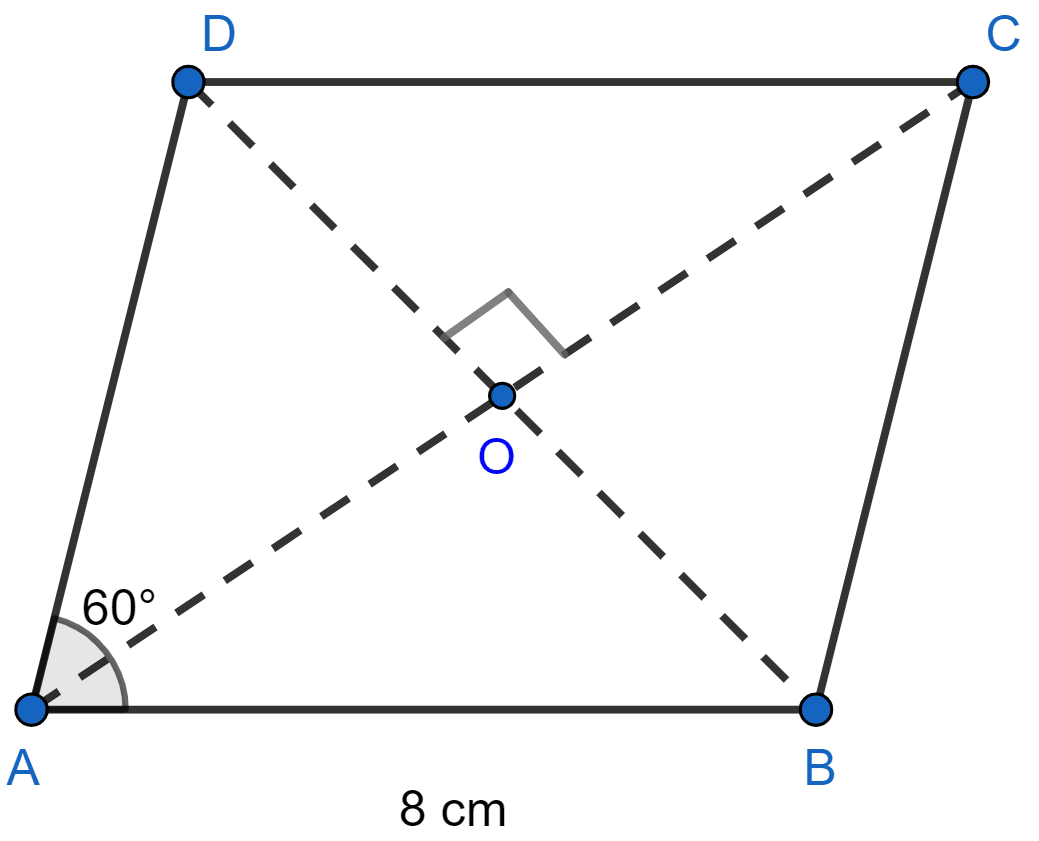
If the length of each side of a rhombus is 8 cm and its one angle is 60°, then find the lengths of the diagonals of the rhombus.

Answer

We know that the diagonals of a rhombus bisect the opposite angles and are perpendicular to each other.

If the length of each side of a rhombus is 8 cm and its one angle is 60°, then find the lengths of the diagonals of the rhombus. Trigonometrical Ratios of Standard Angles, ML Aggarwal Understanding Mathematics Solutions ICSE Class 9.

∴ ∠OAB = 60°2\dfrac{60°}{2} = 30°.

In right ∠AOB,

⇒ sin 30° = PerpendicularHypotenuse=OBAB\dfrac{\text{Perpendicular}}{\text{Hypotenuse}} = \dfrac{OB}{AB}

12=OBAB\dfrac{1}{2} = \dfrac{OB}{AB}

⇒ OB = AB2\dfrac{AB}{2}

⇒ OB = 82\dfrac{8}{2} = 4 cm.

As diagonals of rhombus bisect each other.

∴ BD = 2 OB = 2 × 4 = 8 cm.

cos 30° = BaseHypotenuse=OAAB\dfrac{\text{Base}}{\text{Hypotenuse}} = \dfrac{OA}{AB}

32=OAAB\dfrac{\sqrt{3}}{2} = \dfrac{OA}{AB}

⇒ OA = AB32\dfrac{AB\sqrt{3}}{2}

⇒ OA = 832=43\dfrac{8\sqrt{3}}{2} = 4\sqrt{3}.

As diagonals of rhombus bisect each other.

∴ AC = 2 OA = 2×43=832 \times 4\sqrt{3} = 8\sqrt{3}.

Hence, the length of the diagonals of the rhombus are 8 cm and 838\sqrt{3} cm.

Question 23

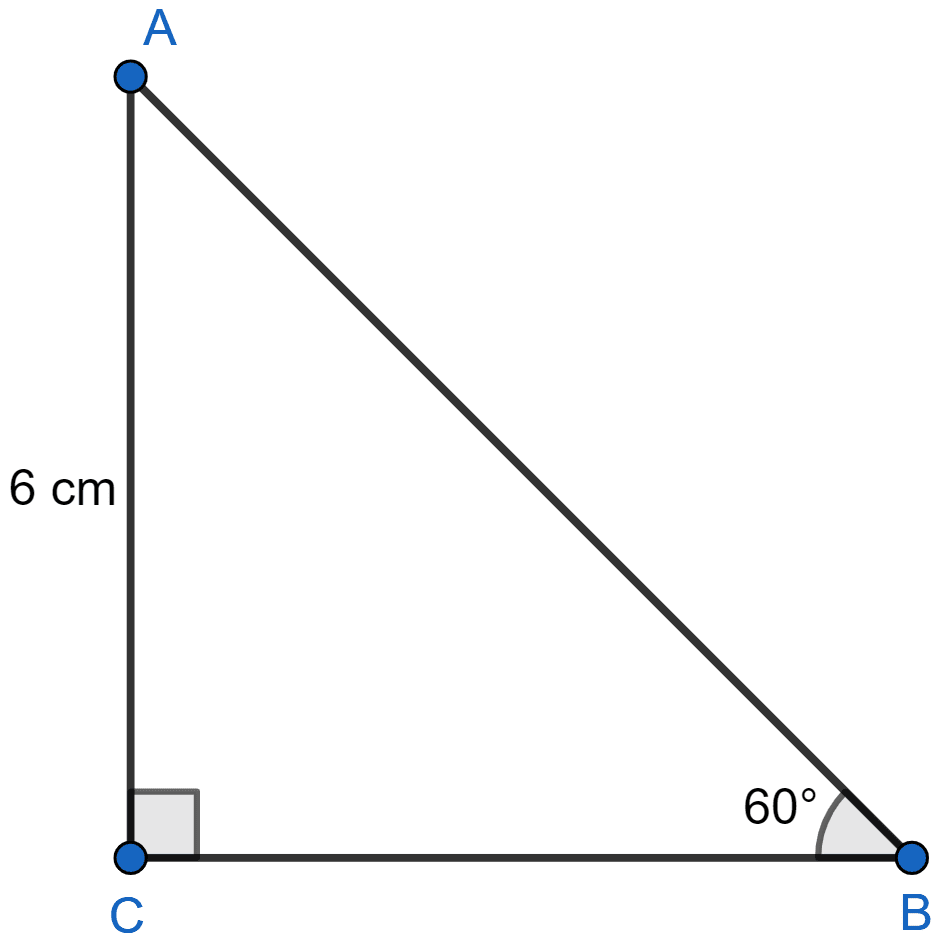
In the right-angled triangle ABC, ∠C = 90° and ∠B = 60°. If AC = 6 cm, find the lengths of the sides BC and AB.

Answer

From figure,

In the right-angled triangle ABC, ∠C = 90° and ∠B = 60°. If AC = 6 cm, find the lengths of the sides BC and AB. Trigonometrical Ratios of Standard Angles, ML Aggarwal Understanding Mathematics Solutions ICSE Class 9.

sin 60°=PerpendicularHypotenuse32=ACAB32=6ABAB=123AB=123×33AB=1233AB=43 cm.tan 60°=PerpendicularBase3=ACBC3=6BCBC=63=23.\text{sin 60°} = \dfrac{\text{Perpendicular}}{\text{Hypotenuse}} \\[1em] \Rightarrow \dfrac{\sqrt{3}}{2} = \dfrac{AC}{AB} \\[1em] \Rightarrow \dfrac{\sqrt{3}}{2} = \dfrac{6}{AB} \\[1em] \Rightarrow AB = \dfrac{12}{\sqrt{3}} \\[1em] \Rightarrow AB = \dfrac{12}{\sqrt{3}} \times \dfrac{\sqrt{3}}{\sqrt{3}} \\[1em] \Rightarrow AB = \dfrac{12\sqrt{3}}{3} \\[1em] \Rightarrow AB = 4\sqrt{3} \text{ cm}. \\[1em] \text{tan 60°} = \dfrac{\text{Perpendicular}}{\text{Base}} \\[1em] \Rightarrow \sqrt{3} = \dfrac{AC}{BC} \\[1em] \Rightarrow \sqrt{3} = \dfrac{6}{BC} \\[1em] \Rightarrow BC = \dfrac{6}{\sqrt{3}} = 2\sqrt{3}.

Hence, AB = 434\sqrt{3} cm and BC = 232\sqrt{3} cm.

Question 24

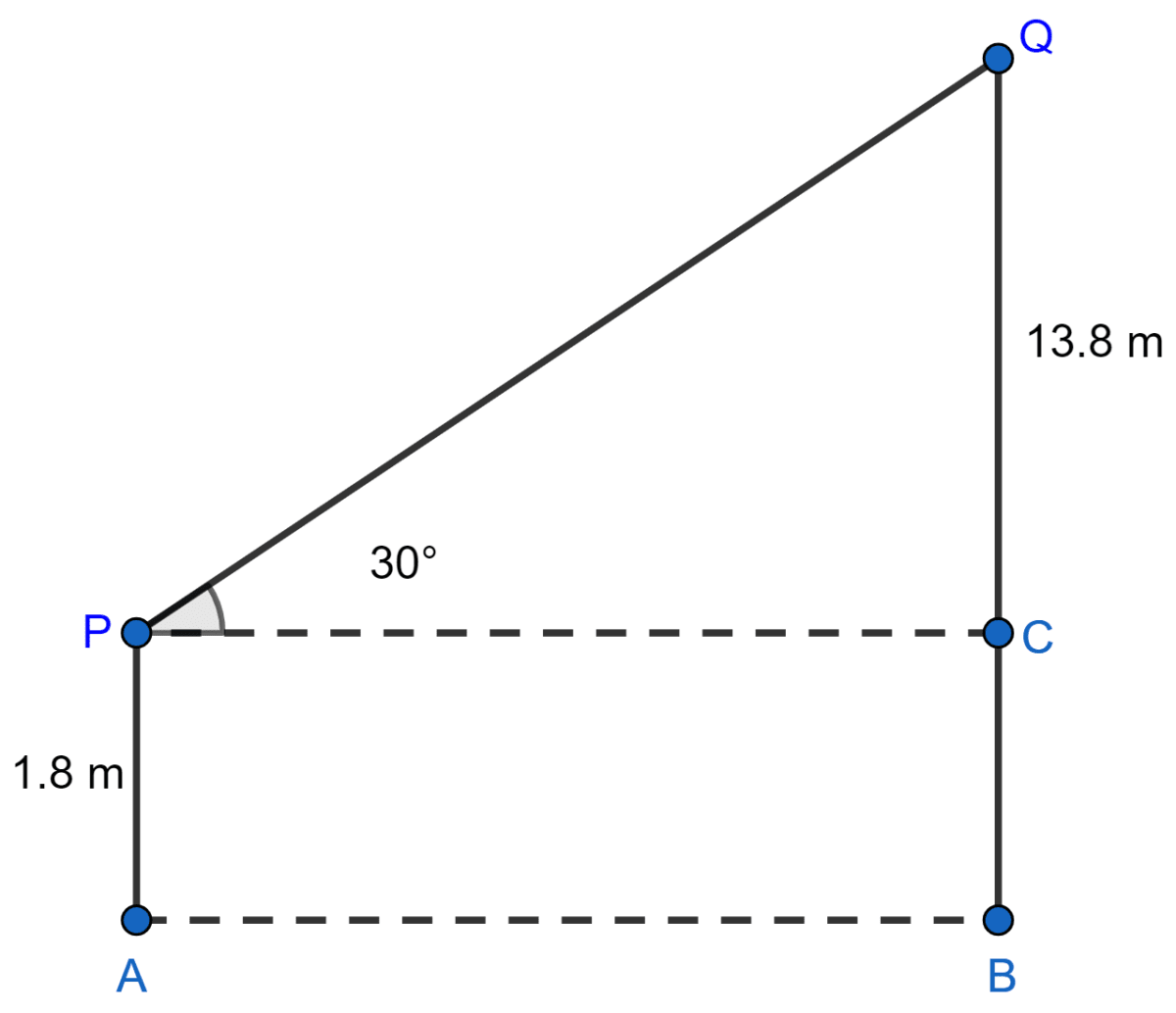
In the adjoining figure, AP is a man of height 1.8 m and BQ is a building 13.8 m high. If the man sees the top of the building by focussing his binoculars at an angle of 30° to the horizontal, find the distance of the man from the building.

In the figure, AP is a man of height 1.8 m and BQ is a building 13.8 m high. If the man sees the top of the building by focussing his binoculars at an angle of 30° to the horizontal, find the distance of the man from the building. Trigonometrical Ratios of Standard Angles, ML Aggarwal Understanding Mathematics Solutions ICSE Class 9.

Answer

Let AB = d meters, then PC = d meters.

From right-angled △PCQ,

tan 30° = CQPC\dfrac{CQ}{PC}

13=BQBCd\dfrac{1}{\sqrt{3}} = \dfrac{BQ - BC}{d}

From figure,

BC = AP = 1.8 m

13=13.81.8d\dfrac{1}{\sqrt{3}} = \dfrac{13.8 - 1.8}{d}

13=12d\dfrac{1}{\sqrt{3}} = \dfrac{12}{d}

⇒ d = 12312\sqrt{3} meters.

Hence, distance of man from building is 12312\sqrt{3} meters.

Question 25

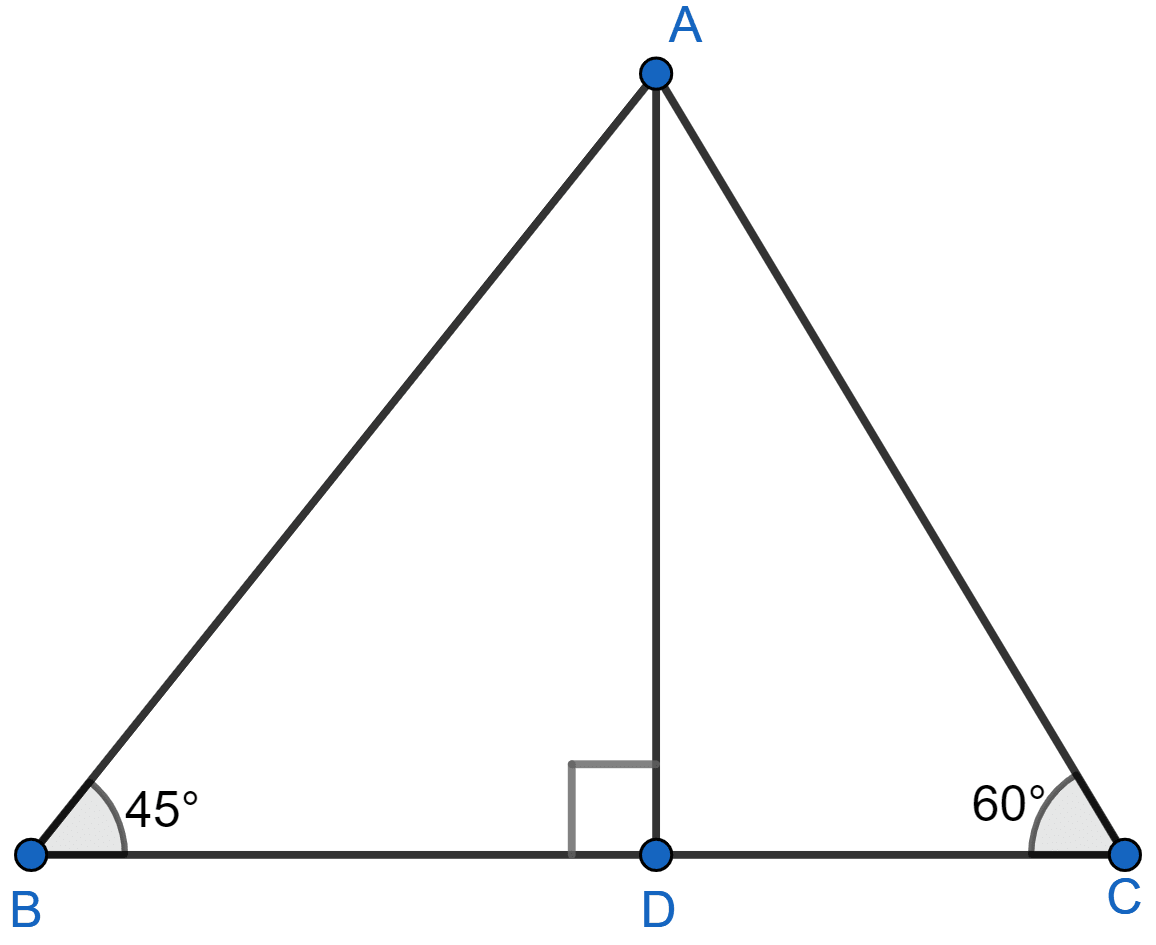
In the adjoining figure, ABC is a triangle in which ∠B = 45° and ∠C = 60°. If AD ⊥ BC and BC = 8m, find the length of the altitude AD.

In the figure, ABC is a triangle in which ∠B = 45° and ∠C = 60°. If AD ⊥ BC and BC = 8m, find the length of the altitude AD. Trigonometrical Ratios of Standard Angles, ML Aggarwal Understanding Mathematics Solutions ICSE Class 9.

Answer

In △ABD,

⇒ tan 45° = ADBD\dfrac{AD}{BD}

⇒ 1 = ADBD\dfrac{AD}{BD}

⇒ BD = AD.

In △ADC,

⇒ tan 60° = ADDC\dfrac{AD}{DC}

3=ADDC\sqrt{3} = \dfrac{AD}{DC}

⇒ DC = AD3\dfrac{AD}{\sqrt{3}}

From figure,

BC = BD + DC

8=AD+AD38=3AD+AD3AD(3+1)3=8AD=833+1\Rightarrow 8 = AD + \dfrac{AD}{\sqrt{3}} \\[1em] \Rightarrow 8 = \dfrac{\sqrt{3}AD + AD}{\sqrt{3}} \\[1em] \Rightarrow \dfrac{AD(\sqrt{3} + 1)}{\sqrt{3}} = 8 \\[1em] \Rightarrow AD = \dfrac{8\sqrt{3}}{\sqrt{3} + 1}

Multiplying numerator and denominator by (31)(\sqrt{3} - 1)

AD=833+1×3131AD=8(33)(3)2(1)2 [a2b2=(a+b)(ab)]AD=8(33)31AD=8(33)2AD=4(33) m\Rightarrow AD = \dfrac{8\sqrt{3}}{\sqrt{3} + 1} \times \dfrac{\sqrt{3} - 1}{\sqrt{3} - 1} \\[1em] \Rightarrow AD = \dfrac{8(3 - \sqrt{3})}{(\sqrt{3})^2 - (1)^2} \space [\because a^2 - b^2 = (a+b)(a-b)] \\[1em] \Rightarrow AD = \dfrac{8(3 - \sqrt{3})}{3 - 1} \\[1em] \Rightarrow AD = \dfrac{8(3 - \sqrt{3})}{2}\\[1em] \Rightarrow AD = 4(3 - \sqrt{3}) \text{ m}

Hence, AD = 4(33)4(3 - \sqrt{3}) m.

Exercise 17.2

Question 1(i)

Without using trigonometric tables, evaluate the following:

cos 18°sin 72°\dfrac{\text{cos 18°}}{\text{sin 72°}}

Answer

(i) Solving,

cos 18°sin 72°cos 18°sin (90° - 18°)As, sin (90 - θ) = cos θcos 18°cos 18°1.\Rightarrow \dfrac{\text{cos 18°}}{\text{sin 72°}} \\[1em] \Rightarrow \dfrac{\text{cos 18°}}{\text{sin (90° - 18°)}} \\[1em] \text{As, sin (90 - θ) = cos θ} \\[1em] \Rightarrow \dfrac{\text{cos 18°}}{\text{cos 18°}} \\[1em] \Rightarrow 1.

Hence, cos 18°sin 72°\dfrac{\text{cos 18°}}{\text{sin 72°}} = 1.

Question 1(ii)

Without using trigonometric tables, evaluate the following:

tan 41°cot 49°\dfrac{\text{tan 41°}}{\text{cot 49°}}

Answer

(ii) Solving,

tan 41°cot 49°tan (90° - 49°)cot 49°As, tan (90 - θ) = cot θcot 49°cot 49°1.\Rightarrow \dfrac{\text{tan 41°}}{\text{cot 49°}} \\[1em] \Rightarrow \dfrac{\text{tan (90° - 49°)}}{\text{cot 49°}} \\[1em] \text{As, tan (90 - θ) = cot θ} \\[1em] \Rightarrow \dfrac{\text{cot 49°}}{\text{cot 49°}} \\[1em] \Rightarrow 1.

Hence, tan 41°cot 49°=1\dfrac{\text{tan 41°}}{\text{cot 49°}} = 1.

Question 1(iii)

Without using trigonometric tables, evaluate the following:

cosec 17°30sec 72° 30\dfrac{\text{cosec 17°30}'}{\text{sec 72° 30}'}.

Answer

Solving,

cosec 17° 30sec 72° 30cosec (90° - 72° 30)sec 72° 30As, cosec (90 - θ) = sec θsec 72° 30sec 72° 301.\Rightarrow \dfrac{\text{cosec 17° 30}'}{\text{sec 72° 30}'} \\[1em] \Rightarrow \dfrac{\text{cosec (90° - 72° 30}')}{\text{sec 72° 30}'} \\[1em] \text{As, cosec (90 - θ) = sec θ} \\[1em] \Rightarrow \dfrac{\text{sec 72° 30}'}{\text{sec 72° 30}'} \\[1em] \Rightarrow 1.

Hence, cosec 17° 30sec 72° 30=1\dfrac{\text{cosec 17° 30}'}{\text{sec 72° 30}'} = 1.

Question 2(i)

Without using trigonometric tables, evaluate the following:

cot 40°tan 50°12(cos 35°sin 55°)\dfrac{\text{cot 40°}}{\text{tan 50°}} - \dfrac{1}{2}\Big(\dfrac{\text{cos 35°}}{\text{sin 55°}}\Big)

Answer

Solving,

cot 40°tan 50°12(cos 35°sin 55°)cot 40°tan (90° - 40°)12(cos 35°sin (90° - 35°))As, tan (90 - θ) = cot θ and sin (90 - θ) = cos θcot 40°cot 40°12(cos 35°cos 35°)11212.\Rightarrow \dfrac{\text{cot 40°}}{\text{tan 50°}} - \dfrac{1}{2}\Big(\dfrac{\text{cos 35°}}{\text{sin 55°}}\Big) \\[1em] \Rightarrow \dfrac{\text{cot 40°}}{\text{tan (90° - 40°)}} - \dfrac{1}{2}\Big(\dfrac{\text{cos 35°}}{\text{sin (90° - 35°)}}\Big) \\[1em] \text{As, tan (90 - θ) = cot θ and sin (90 - θ) = cos θ} \\[1em] \Rightarrow \dfrac{\text{cot 40°}}{\text{cot 40°}} - \dfrac{1}{2}\Big(\dfrac{\text{cos 35°}}{\text{cos 35°}}\Big) \\[1em] \Rightarrow 1 - \dfrac{1}{2} \\[1em] \Rightarrow \dfrac{1}{2}.

Hence, cot 40°tan 50°12(cos 35°sin 55°)=12\dfrac{\text{cot 40°}}{\text{tan 50°}} - \dfrac{1}{2}\Big(\dfrac{\text{cos 35°}}{\text{sin 55°}}\Big) = \dfrac{1}{2}.

Question 2(ii)

Without using trigonometric tables, evaluate the following:

(sin 49°cos 41°)2+(cos 41°sin 49°)2\Big(\dfrac{\text{sin 49°}}{\text{cos 41°}}\Big)^2 + \Big(\dfrac{\text{cos 41°}}{\text{sin 49°}}\Big)^2

Answer

Solving,

(sin 49°cos 41°)2+(cos 41°sin 49°)2(sin (90° - 41°)cos 41°)2+(cos 41°sin (90° - 41°))2As, sin (90 - θ) = cos θ(cos 41°cos 41°)2+(cos 41°cos 41°)212+121+12.\Rightarrow \Big(\dfrac{\text{sin 49°}}{\text{cos 41°}}\Big)^2 + \Big(\dfrac{\text{cos 41°}}{\text{sin 49°}}\Big)^2 \\[1em] \Rightarrow \Big(\dfrac{\text{sin (90° - 41°)}}{\text{cos 41°}}\Big)^2 + \Big(\dfrac{\text{cos 41°}}{\text{sin (90° - 41°)}}\Big)^2 \\[1em] \text{As, sin (90 - θ) = cos θ} \\[1em] \Rightarrow \Big(\dfrac{\text{cos 41°}}{\text{cos 41°}}\Big)^2 + \Big(\dfrac{\text{cos 41°}}{\text{cos 41°}}\Big)^2 \\[1em] \Rightarrow 1^2 + 1^2 \\[1em] \Rightarrow 1 + 1 \\[1em] \Rightarrow 2.

Hence, (sin 49°cos 41°)2+(cos 41°sin 49°)2=2.\Big(\dfrac{\text{sin 49°}}{\text{cos 41°}}\Big)^2 + \Big(\dfrac{\text{cos 41°}}{\text{sin 49°}}\Big)^2 = 2.

Question 2(iii)

Without using trigonometric tables, evaluate the following:

sin 72°cos 18°sec 32°cosec 58°\dfrac{\text{sin 72°}}{\text{cos 18°}} - \dfrac{\text{sec 32°}}{\text{cosec 58°}}

Answer

Solving,

sin 72°cos 18°sec 32°cosec 58°sin (90° - 18°)cos 18°sec 32°cosec (90° - 32°)As, cosec (90 - θ) = sec θ and sin (90 - θ) = cos θcos 18°cos 18°sec 32°sec 32°110.\Rightarrow \dfrac{\text{sin 72°}}{\text{cos 18°}} - \dfrac{\text{sec 32°}}{\text{cosec 58°}} \\[1em] \Rightarrow \dfrac{\text{sin (90° - 18°)}}{\text{cos 18°}} - \dfrac{\text{sec 32°}}{\text{cosec (90° - 32°)}} \\[1em] \text{As, cosec (90 - θ) = sec θ and sin (90 - θ) = cos θ} \\[1em] \Rightarrow \dfrac{\text{cos 18°}}{\text{cos 18°}} - \dfrac{\text{sec 32°}}{\text{sec 32°}} \\[1em] \Rightarrow 1 - 1 \\[1em] \Rightarrow 0.

Hence, sin 72°cos 18°sec 32°cosec 58°=0.\dfrac{\text{sin 72°}}{\text{cos 18°}} - \dfrac{\text{sec 32°}}{\text{cosec 58°}} = 0.

Question 2(iv)

Without using trigonometric tables, evaluate the following:

cos 75°sin 15°+sin 12°cos 78°cos 18°sin 72°\dfrac{\text{cos 75°}}{\text{sin 15°}} + \dfrac{\text{sin 12°}}{\text{cos 78°}} - \dfrac{\text{cos 18°}}{\text{sin 72°}}

Answer

Solving,

cos 75°sin 15°+sin 12°cos 78°cos 18°sin 72°cos 75°sin (90° - 75°)+sin (90° - 78°)cos 78°cos 18°sin (90° - 18°)As, sin (90 - θ) = cos θcos 75°cos 75°+cos 78°cos 78°cos 18°cos 18°1+111.\Rightarrow \dfrac{\text{cos 75°}}{\text{sin 15°}} + \dfrac{\text{sin 12°}}{\text{cos 78°}} - \dfrac{\text{cos 18°}}{\text{sin 72°}} \\[1em] \Rightarrow \dfrac{\text{cos 75°}}{\text{sin (90° - 75°)}} + \dfrac{\text{sin (90° - 78°)}}{\text{cos 78°}} - \dfrac{\text{cos 18°}}{\text{sin (90° - 18°)}} \\[1em] \text{As, sin (90 - θ) = cos θ} \\[1em] \Rightarrow \dfrac{\text{cos 75°}}{\text{cos 75°}} + \dfrac{\text{cos 78°}}{\text{cos 78°}} - \dfrac{\text{cos 18°}}{\text{cos 18°}} \\[1em] \Rightarrow 1 + 1 - 1 \\[1em] \Rightarrow 1.

Hence, cos 75°sin 15°+sin 12°cos 78°cos 18°sin 72°=1.\dfrac{\text{cos 75°}}{\text{sin 15°}} + \dfrac{\text{sin 12°}}{\text{cos 78°}} - \dfrac{\text{cos 18°}}{\text{sin 72°}} = 1.

Question 2(v)

Without using trigonometric tables, evaluate the following:

sin 25°sec 65°+cos 25°cosec 65°\dfrac{\text{sin 25°}}{\text{sec 65°}} + \dfrac{\text{cos 25°}}{\text{cosec 65°}}.

Answer

Solving,

sin 25°sec 65°+cos 25°cosec 65°sin 25°1cos 65°+cos 25°1sin 65°sin 25°.cos 65° + cos 25°.sin 65°sin 25°. cos(90° - 25°) + cos 25°. sin(90° - 25°)As, sin (90 - θ) = cos θ and cos (90 - θ) = sin θsin 25°. sin 25° + cos 25°. cos 25°sin225°+cos225°1.\Rightarrow \dfrac{\text{sin 25°}}{\text{sec 65°}} + \dfrac{\text{cos 25°}}{\text{cosec 65°}} \\[1em] \Rightarrow \dfrac{\text{sin 25°}}{\dfrac{1}{\text{cos 65°}}} + \dfrac{\text{cos 25°}}{\dfrac{1}{\text{sin 65°}}} \\[1em] \Rightarrow \text{sin 25°.cos 65° + cos 25°.sin 65°} \\[1em] \Rightarrow \text{sin 25°. cos(90° - 25°) + cos 25°. sin(90° - 25°)} \\[1em] \text{As, sin (90 - θ) = cos θ and cos (90 - θ) = sin θ} \\[1em] \Rightarrow \text{sin 25°. sin 25° + cos 25°. cos 25°} \\[1em] \Rightarrow \text{sin}^2 25° + \text{cos}^2 25° \\[1em] \Rightarrow 1.

Hence, sin 25°sec 65°+cos 25°cosec 65°=1\dfrac{\text{sin 25°}}{\text{sec 65°}} + \dfrac{\text{cos 25°}}{\text{cosec 65°}} = 1.

Question 3(i)

Without using trigonometric tables, evaluate the following:

sin 62° - cos 28°

Answer

Solving,

⇒ sin 62° - cos 28°

⇒ sin (90° - 28°) - cos 28°

⇒ cos 28° - cos 28° [As, sin (90 - θ) = cos θ]

⇒ 0.

Hence, sin 62° - cos 28° = 0.

Question 3(ii)

Without using trigonometric tables, evaluate the following:

cosec 35° - sec 55°

Answer

Solving,

⇒ cosec 35° - sec 55°

⇒ cosec (90° - 55°) - sec 55°

⇒ sec 55° - sec 55° [As, cosec (90 - θ) = sec θ]

⇒ 0.

Hence, cosec 35° - sec 55° = 0.

Question 4(i)

Without using trigonometric tables, evaluate the following:

cos2 26° + cos 64° sin 26° + tan 36°cot 54°\dfrac{\text{tan 36°}}{\text{cot 54°}}

Answer

Solving,

cos226°+cos 64° sin 26°+tan 36°cot 54°cos226°+cos (90° - 26°) sin 26°+tan (90° - 54°)cot 54°As, cos (90 - θ) = sin θ and tan (90 - θ) = cot θcos226°+sin226°+cot 54°cot 54°As, sin2θ+cos2θ=11+12.\Rightarrow \text{cos}^2 26° + \text{cos 64° sin 26°} + \dfrac{\text{tan 36°}}{\text{cot 54°}} \\[1em] \Rightarrow \text{cos}^2 26° + \text{cos (90° - 26°) sin 26°} + \dfrac{\text{tan (90° - 54°)}}{\text{cot 54°}} \\[1em] \text{As, cos (90 - θ) = sin θ and tan (90 - θ) = cot θ} \\[1em] \Rightarrow \text{cos}^2 26° + \text{sin}^2 26° + \dfrac{\text{cot 54°}}{\text{cot 54°}} \\[1em] \text{As, sin}^2 θ + \text{cos}^2 θ = 1 \\[1em] \Rightarrow 1 + 1 \\[1em] \Rightarrow 2.

Hence, cos2 26° + cos 64° sin 26° + tan 36°cot 54°\dfrac{\text{tan 36°}}{\text{cot 54°}} = 2.

Question 4(ii)

Without using trigonometric tables, evaluate the following:

sec 17°cosec 73°+tan 68°cot 22°\dfrac{\text{sec 17°}}{\text{\text{cosec 73°}}} + \dfrac{\text{tan 68°}}{\text{cot 22°}} + cos2 44° + cos2 46°.

Answer

Solving,

sec 17°cosec (90° - 17°)+tan (90° - 22°)cot 22°+cos244°+cos2(90°44°)sec 17°sec 17°+cot 22°cot 22°+cos244°+sin244°1+1+13.\Rightarrow \dfrac{\text{sec 17°}}{\text{cosec (90° - 17°)}} + \dfrac{\text{tan (90° - 22°)}}{\text{cot 22°}} + \text{cos}^2 44° + \text{cos}^2 (90° - 44°) \\[1em] \Rightarrow \dfrac{\text{sec 17°}}{\text{sec 17°}} + \dfrac{\text{cot 22°}}{\text{cot 22°}} + \text{cos}^2 44° + \text{sin}^2 44° \\[1em] \Rightarrow 1 + 1 + 1 \\[1em] \Rightarrow 3.

Hence, sec 17°cosec 73°+tan 68°cot 22°\dfrac{\text{sec 17°}}{\text{\text{cosec 73°}}} + \dfrac{\text{tan 68°}}{\text{cot 22°}} + cos2 44° + cos2 46° = 3.

Question 5(i)

Without using trigonometric tables, evaluate the following:

cos 65°sin 25°+cos 32°sin 58°sin 28° sec 62° + cosec230°\dfrac{\text{cos 65°}}{\text{sin 25°}} + \dfrac{\text{cos 32°}}{\text{sin 58°}} - \text{sin 28° sec 62° + cosec}^2 30°

Answer

Solving,

cos 65°sin (90° - 65°)+cos 32°sin (90° - 32°)sin 28°×1cos 62°+1sin230°cos 65°cos 65°+cos 32°cos 32°sin 28°×1cos 62°+1sin230°1+1sin 28°×1cos(90°28°)+1(12)22sin 28°sin 28°+421+45.\Rightarrow \dfrac{\text{cos 65°}}{\text{sin (90° - 65°)}} + \dfrac{\text{cos 32°}}{\text{sin (90° - 32°)}} - \text{sin 28°} \times \dfrac{1}{\text{cos 62°}} + \dfrac{1}{\text{sin}^2 30°} \\[1em] \Rightarrow \dfrac{\text{cos 65°}}{\text{cos 65°}} + \dfrac{\text{cos 32°}}{\text{cos 32°}} - \text{sin 28°} \times \dfrac{1}{\text{cos 62°}} + \dfrac{1}{\text{sin}^2 30°} \\[1em] \Rightarrow 1 + 1 - \text{sin 28°} \times \dfrac{1}{cos(90° - 28°)} + \dfrac{1}{\Big(\dfrac{1}{2}\Big)^2} \\[1em] \Rightarrow 2 - \dfrac{\text{sin 28°}}{\text{sin 28°}} + 4 \\[1em] \Rightarrow 2 - 1 + 4 \\[1em] \Rightarrow 5.

Hence, cos 65°sin 25°+cos 32°sin 58°sin 28° sec 62° + cosec230°\dfrac{\text{cos 65°}}{\text{sin 25°}} + \dfrac{\text{cos 32°}}{\text{sin 58°}} - \text{sin 28° sec 62° + cosec}^2 30° = 5.

Question 5(ii)

Without using trigonometric tables, evaluate the following:

sec 29°cosec 61°+2 cot 8° cot 17° cot 45° cot 73° cot 82°3 (sin238°+sin252°)\dfrac{\text{sec 29°}}{\text{cosec 61°}} + \text{2 cot 8° cot 17° cot 45° cot 73° cot 82°} - \text{3 (sin}^2 38° + \text{sin}^2 52°).

Answer

Solving,

sec 29°cosec 61°+2 cot 8° cot 17° cot 45° cot 73° cot 82°3 (sin238°+sin252°)sec 29°cosec (90° - 29°)+2 cot (90° - 82°) cot (90° - 73°) cot 45° cot 73° cot 82°3 (sin238°+sin2(90°38°))As, cosec(90° - θ) = sec θ, cot(90° - θ) = tan θsec 29°sec 29°+2 tan 82° tan 73° cot 45°×1tan 73°×1tan 82°3 (sin238°+cos238°)As, sin2θ+cos2θ=11+2 cot 45°31+230.\Rightarrow \dfrac{\text{sec 29°}}{\text{cosec 61°}} + \text{2 cot 8° cot 17° cot 45° cot 73° cot 82°} - \text{3 (sin}^2 38° + \text{sin}^2 52°) \\[1em] \Rightarrow \dfrac{\text{sec 29°}}{\text{cosec (90° - 29°)}} + \text{2 cot (90° - 82°) cot (90° - 73°) cot 45° cot 73° cot 82°} - \text{3 (sin}^2 38° + \text{sin}^2 (90° - 38°)) \\[1em] \text{As, cosec(90° - θ) = sec θ, cot(90° - θ) = tan θ} \\[1em] \Rightarrow \dfrac{\text{sec 29°}}{\text{sec 29°}} + \text{2 tan 82° tan 73° cot 45°} \times \dfrac{1}{\text{tan 73°}} \times \dfrac{1}{\text{tan 82°}} - \text{3 (sin}^2 38° + \text{cos}^2 38°) \\[1em] \text{As, sin}^2 θ + \text{cos}^2 θ = 1 \\[1em] \Rightarrow 1 + \text{2 cot 45°} - 3 \\[1em] \Rightarrow 1 + 2 - 3 \\[1em] \Rightarrow 0.

Hence, sec 29°cosec 61°+2 cot 8° cot 17° cot 45° cot 73° cot 82°3 (sin238°+sin252°)\dfrac{\text{sec 29°}}{\text{cosec 61°}} + \text{2 cot 8° cot 17° cot 45° cot 73° cot 82°} - \text{3 (sin}^2 38° + \text{sin}^2 52°) = 0.

Question 6(i)

Express the following in terms of trigonometric ratios of angles between 0° to 45° :

tan 81° + cos 72°

Answer

Solving,

⇒ tan 81° + cos 72°

⇒ tan (90° - 9°) + cos (90° - 18°)

As, tan(90° - θ) = cot θ, cos(90° - θ) = sin θ

⇒ cot 9° + sin 18°.

Hence, tan 81° + cos 72° = cot 9° + sin 18°.

Question 6(ii)

Express the following in terms of trigonometric ratios of angles between 0° to 45° :

cot 49° + cosec 87°.

Answer

Solving,

⇒ cot 49° + cosec 87°

⇒ cot (90° - 41°) + cosec (90° - 3°)

As, cot(90° - θ) = tan θ, cosec(90° - θ) = sec θ

⇒ tan 41° + sec 3°.

Hence, cot 49° + cosec 87° = tan 41° + sec 3°.

Question 7(i)

Without using trigonometric tables, prove that:

sin2 28° - cos2 62° = 0

Answer

To prove,

sin2 28° - cos2 62° = 0.

Solving, L.H.S. of the equation.

sin2 28° - cos2 62°

= sin2 28° - cos2 (90° - 28°)

= sin2 28° - sin2 28°

= 0.

Since, L.H.S. = R.H.S.

Hence, proved that sin2 28° - cos2 62° = 0.

Question 7(ii)

Without using trigonometric tables, prove that:

cos2 25° + cos2 65° = 1

Answer

To prove,

cos2 25° + cos2 65° = 1.

Solving, L.H.S. of the equation.

cos2 25° + cos2 65°

= cos2 25° + cos2 (90° - 25°)

As, cos (90° - θ) = sin θ

= cos2 25° + sin2 25°

= 1 [∵ cos2 θ + sin2 θ = 1]

Since, L.H.S. = R.H.S.

Hence, proved that cos2 25° + cos2 65° = 1.

Question 7(iii)

Without using trigonometric tables, prove that:

cosec2 67° - tan2 23° = 1

Answer

To prove,

cosec2 67° - tan2 23° = 1

Solving L.H.S. of the equation,

cosec267°tan223°1sin267°tan2(90°67°)1sin267°cot267°1sin267°cos267°sin267°1 - cos267°sin267°sin267°sin267° [ 1 - cos2 θ=sin2 θ]1.\phantom{\Rightarrow} \text{cosec}^2 67° - \text{tan}^2 23° \\[1em] \Rightarrow \dfrac{1}{\text{sin}^2 67°} - \text{tan}^2 (90° - 67°) \\[1em] \Rightarrow \dfrac{1}{\text{sin}^2 67°} - \text{cot}^2 67° \\[1em] \Rightarrow \dfrac{1}{\text{sin}^2 67°} - \dfrac{\text{cos}^2 67°}{\text{sin}^2 67°} \\[1em] \Rightarrow \dfrac{\text{1 - cos}^2 67°}{\text{sin}^2 67°} \\[1em] \Rightarrow \dfrac{\text{sin}^2 67°}{\text{sin}^2 67°} \space [\because \text{ 1 - cos}^2 \text{ θ} = \text{sin}^2 \text{ θ}] \\[1em] \Rightarrow 1.

Since, L.H.S. = R.H.S.

Hence, proved that cosec2 67° - tan2 23° = 1.

Question 7(iv)

Without using trigonometric tables, prove that:

sec2 22° - cot2 68° = 1

Answer

To prove,

sec2 22° - cot2 68° = 1

Solving, L.H.S. of the equation we get :

sec2 22° - cot2 68°

⇒ sec2 22° - cot2 (90° - 22°)

We know that,

cot (90 - θ) = tan θ

⇒ sec2 22° - tan2 22°

1cos222°sin222°cos222°1 - sin222°cos222°As, 1 - sin2θ=cos2θcos222°cos222°1.\Rightarrow \dfrac{1}{\text{cos}^2 22°} - \dfrac{\text{sin}^2 22°}{\text{cos}^2 22°} \\[1em] \Rightarrow \dfrac{\text{1 - sin}^2 22°}{\text{cos}^2 22°} \\[1em] \text{As, 1 - sin}^2 θ = \text{cos}^2 θ \\[1em] \Rightarrow \dfrac{\text{cos}^2 22°}{\text{cos}^2 22°} \\[1em] \Rightarrow 1.

Since, L.H.S. = R.H.S.

Hence, proved that sec2 22° - cot2 68° = 1.

Question 8(i)

Without using trigonometric tables, prove that:

sin 63° cos 27° + cos 63° sin 27° = 1

Answer

To prove,

sin 63° cos 27° + cos 63° sin 27° = 1

Solving, L.H.S. of the equation we get,

⇒ sin (90° - 27°) cos 27° + cos (90° - 27°) sin 27°

We know that,

sin (90 - θ) = cos θ and cos (90 - θ) = sin θ

⇒ cos 27° cos 27° + sin 27° sin 27°

⇒ cos2 27° + sin2 27°

⇒ 1.

Since, L.H.S. = R.H.S.

Hence, proved that sin 63° cos 27° + cos 63° sin 27° = 1.

Question 8(ii)

Without using trigonometric tables, prove that:

sec 31° sin 59° + cos 31° cosec 59° = 2.

Answer

To prove,

sec 31° sin 59° + cos 31° cosec 59° = 2

Solving, L.H.S. of the equation we get,

⇒ sec 31° sin 59° + cos 31° cosec 59

1cos 31°×sin (90° - 31°)+cos (90° - 59°)×1sin 59°As, sin (90 - θ) = cos θ and cos (90 - θ) = sin θ1cos 31°×cos 31°+sin 59°×1sin 59°1+12.\Rightarrow \dfrac{1}{\text{cos 31°}} \times \text{sin (90° - 31°)} + \text{cos (90° - 59°)} \times \dfrac{1}{\text{sin 59°}} \\[1em] \text{As, sin (90 - θ) = cos θ and cos (90 - θ) = sin θ} \\[1em] \Rightarrow \dfrac{1}{\text{cos 31°}} \times \text{cos 31°} + \text{sin 59°} \times \dfrac{1}{\text{sin 59°}} \\[1em] \Rightarrow 1 + 1 \\[1em] \Rightarrow 2.

Since, L.H.S. = R.H.S.

Hence, proved that sec 31° sin 59° + cos 31° cosec 59° = 2.

Question 9(i)

Without using trigonometric tables, prove that:

sec 70° sin 20° - cos 20° cosec 70° = 0

Answer

To prove,

sec 70° sin 20° - cos 20° cosec 70° = 0

Solving L.H.S. of the equation we get :

sec 70° sin 20° - cos 20° cosec 70°1cos 70°×sin (90° - 70°)cos (90° - 70°)×1sin 70°As, sin (90 - θ) = cos θ and cos (90 - θ) = sin θ1cos 70°×cos 70°sin 70°×1sin 70°110.\Rightarrow \text{sec 70° sin 20° - cos 20° cosec 70°} \\[1em] \Rightarrow \dfrac{1}{\text{cos 70°}} \times \text{sin (90° - 70°)} - \text{cos (90° - 70°)} \times \dfrac{1}{\text{sin 70°}} \\[1em] \text{As, sin (90 - θ) = cos θ and cos (90 - θ) = sin θ} \\[1em] \Rightarrow \dfrac{1}{\text{cos 70°}} \times \text{cos 70°} - \text{sin 70°} \times \dfrac{1}{\text{sin 70°}} \\[1em] \Rightarrow 1 - 1 \\[1em] \Rightarrow 0.

Since, L.H.S. = R.H.S.

Hence, proved that sec 70° sin 20° - cos 20° cosec 70° = 0.

Question 9(ii)

Without using trigonometric tables, prove that:

sin2 20° + sin2 70° - tan2 45° = 0.

Answer

To prove,

sin2 20° + sin2 70° - tan2 45° = 0.

Solving, L.H.S. of the equation we get :

sin2 20° + sin2 70° - tan2 45°

We know that,

sin (90 - θ) = cos θ

and

sin2 θ + cos2 θ = 1.

⇒ sin2 20° + sin2 (90° - 20°) - (1)2

⇒ sin2 20° + cos2 20° - 1

⇒ 1 - 1

⇒ 0.

Since, L.H.S. = R.H.S.

Hence, proved that sin2 20° + sin2 70° - tan2 45° = 0.

Question 10(i)

Without using trigonometric tables, prove that:

cot 54°tan 36°+tan 20°cot 70°2=0\dfrac{\text{cot 54°}}{\text{tan 36°}} + \dfrac{\text{tan 20°}}{\text{cot 70°}} - 2 = 0

Answer

To prove,

cot 54°tan 36°+tan 20°cot 70°2=0\dfrac{\text{cot 54°}}{\text{tan 36°}} + \dfrac{\text{tan 20°}}{\text{cot 70°}} - 2 = 0.

Solving, L.H.S. of the equation we get :

cot 54°tan 36°+tan 20°cot 70°2cot (90° - 36°)tan 36°+tan 20°cot (90° - 20°)2tan 36°tan 36°+tan 20°tan 20°21+120.\Rightarrow \dfrac{\text{cot 54°}}{\text{tan 36°}} + \dfrac{\text{tan 20°}}{\text{cot 70°}} - 2 \\[1em] \Rightarrow \dfrac{\text{cot (90° - 36°)}}{\text{tan 36°}} + \dfrac{\text{tan 20°}}{\text{cot (90° - 20°)}} - 2 \\[1em] \Rightarrow \dfrac{\text{tan 36°}}{\text{tan 36°}} + \dfrac{\text{tan 20°}}{\text{tan 20°}} - 2 \\[1em] \Rightarrow 1 + 1 - 2 \\[1em] \Rightarrow 0.

Since, L.H.S. = R.H.S.

Hence, proved that cot 54°tan 36°+tan 20°cot 70°2=0\dfrac{\text{cot 54°}}{\text{tan 36°}} + \dfrac{\text{tan 20°}}{\text{cot 70°}} - 2 = 0.

Question 10(ii)

Without using trigonometric tables, prove that:

sin 50°cos 40°+cosec 40°sec 50°4 cos 50° cosec 40° + 2=0\dfrac{\text{sin 50°}}{\text{cos 40°}} + \dfrac{\text{cosec 40°}}{\text{sec 50°}} - \text{4 cos 50° cosec 40° + 2} = 0.

Answer

To prove,

sin 50°cos 40°+cosec 40°sec 50°4 cos 50° cosec 40° + 2=0\dfrac{\text{sin 50°}}{\text{cos 40°}} + \dfrac{\text{cosec 40°}}{\text{sec 50°}} - \text{4 cos 50° cosec 40° + 2} = 0.

Solving, L.H.S. of the equation we get :

sin 50°cos 40°+cosec 40°sec 50°4 cos 50° cosec 40° + 2=0.sin (90° - 40°)cos 40°+cosec (90° - 50°)sec 50°4 cos 50° cosec (90° - 50°) + 2=0\phantom{\Rightarrow} \dfrac{\text{sin 50°}}{\text{cos 40°}} + \dfrac{\text{cosec 40°}}{\text{sec 50°}} - \text{4 cos 50° cosec 40° + 2} = 0. \\[1em] \Rightarrow \dfrac{\text{sin (90° - 40°)}}{\text{cos 40°}} + \dfrac{\text{cosec (90° - 50°)}}{\text{sec 50°}} - \text{4 cos 50° cosec (90° - 50°) + 2} = 0 \\[1em]

We know that,

sin (90 - θ) = cos θ

and

cosec (90 - θ) = sec θ

cos 40°cos 40°+sec 50°sec 50°4 cos 50° sec 50°+21+14×cos 50°×1cos 50°+224+20.\Rightarrow \dfrac{\text{cos 40°}}{\text{cos 40°}} + \dfrac{\text{sec 50°}}{\text{sec 50°}} - \text{4 cos 50° sec 50°} + 2 \\[1em] \Rightarrow 1 + 1 - 4 \times \text{cos 50°} \times \dfrac{1}{\text{cos 50°}} + 2 \\[1em] \Rightarrow 2 - 4 + 2 \\[1em] \Rightarrow 0.

Since, L.H.S. = R.H.S.

Hence, proved that sin 50°cos 40°+cosec 40°sec 50°4 cos 50° cosec 40° + 2=0\dfrac{\text{sin 50°}}{\text{cos 40°}} + \dfrac{\text{cosec 40°}}{\text{sec 50°}} - \text{4 cos 50° cosec 40° + 2} = 0.

Question 11(i)

Without using trigonometric tables, prove that:

cos 70°sin 20°+cos 59°sin 31°8 sin230°=0\dfrac{\text{cos 70°}}{\text{sin 20°}} + \dfrac{\text{cos 59°}}{\text{sin 31°}} - 8\text{ sin}^2 30° = 0

Answer

To prove,

cos 70°sin 20°+cos 59°sin 31°8 sin230°=0\dfrac{\text{cos 70°}}{\text{sin 20°}} + \dfrac{\text{cos 59°}}{\text{sin 31°}} - 8\text{ sin}^2 30° = 0

Solving, L.H.S. of the equation we get :

cos 70°sin 20°+cos 59°sin 31°8 sin230°cos (90° - 20°)sin 20°+cos (90° - 31°)sin 31°8 sin230°As, cos (90 - θ) = sin θsin 20°sin 20°+sin 31°sin 31°8×(12)21+120.\Rightarrow \dfrac{\text{cos 70°}}{\text{sin 20°}} + \dfrac{\text{cos 59°}}{\text{sin 31°}} - 8\text{ sin}^2 30° \\[1em] \Rightarrow \dfrac{\text{cos (90° - 20°)}}{\text{sin 20°}} + \dfrac{\text{cos (90° - 31°)}}{\text{sin 31°}} - 8\text{ sin}^2 30° \\[1em] \text{As, cos (90 - θ) = sin θ} \\[1em] \Rightarrow \dfrac{\text{sin 20°}}{\text{sin 20°}} + \dfrac{\text{sin 31°}}{\text{sin 31°}} - 8 \times \Big(\dfrac{1}{2}\Big)^2 \\[1em] \Rightarrow 1 + 1 - 2 \\[1em] \Rightarrow 0.

Since, L.H.S. = R.H.S.

Hence, proved that cos 70°sin 20°+cos 59°sin 31°8 sin230°=0\dfrac{\text{cos 70°}}{\text{sin 20°}} + \dfrac{\text{cos 59°}}{\text{sin 31°}} - 8\text{ sin}^2 30° = 0.

Question 11(ii)

Without using trigonometric tables, prove that:

cos 80°sin 10°+cos 59° cosec 31°=2\dfrac{\text{cos 80°}}{\text{sin 10°}} + \text{cos 59° cosec 31°} = 2

Answer

To prove,

cos 80°sin 10°+cos 59° cosec 31°=2\dfrac{\text{cos 80°}}{\text{sin 10°}} + \text{cos 59° cosec 31°} = 2.

Solving, L.H.S. of the equation we get :

cos 80°sin 10°+cos 59° cosec 31°cos 80°sin (90° - 80°)+cos 59° cosec (90° - 59°)As, sin (90 - θ) = cos θ and cosec (90 - θ) = sec θ cos 80°cos 80°+cos 59° sec 59°1+cos 59°×1cos 59°1+12.\phantom{\Rightarrow} \dfrac{\text{cos 80°}}{\text{sin 10°}} + \text{cos 59° cosec 31°} \\[1em] \Rightarrow \dfrac{\text{cos 80°}}{\text{sin (90° - 80°)}} + \text{cos 59° cosec (90° - 59°)} \\[1em] \text{As, sin (90 - θ) = cos θ and cosec (90 - θ) = sec θ } \\[1em] \Rightarrow \dfrac{\text{cos 80°}}{\text{cos 80°}} + \text{cos 59° sec 59°} \\[1em] \Rightarrow 1 + \text{cos 59°} \times \dfrac{1}{\text{cos 59°}} \\[1em] \Rightarrow 1 + 1 \\[1em] \Rightarrow 2.

Since, L.H.S. = R.H.S.

Hence, proved that cos 80°sin 10°+cos 59° cosec 31°=2\dfrac{\text{cos 80°}}{\text{sin 10°}} + \text{cos 59° cosec 31°} = 2.

Question 12(i)

Without using trigonometric tables, evaluate :

2(tan 35°cot 55°)2+(cot 55°tan 35°)3(sec 40°cosec 50°)2\Big(\dfrac{\text{tan 35°}}{\text{cot 55°}}\Big)^2 + \Big(\dfrac{\text{cot 55°}}{\text{tan 35°}}\Big) - 3\Big(\dfrac{\text{sec 40°}}{\text{cosec 50°}}\Big)

Answer

Solving,

2(tan 35°cot 55°)2+(cot 55°tan 35°)3(sec 40°cosec 50°)2(tan 35°cot (90° - 35°))2+(cot (90° - 35°)tan 35°)3(sec (90° - 50°)cosec 50°)As, cot (90 - θ) = tan θ and sec (90 - θ) = cosec θ2(tan 35°tan 35°)2+(tan 35°tan 35°)3(cosec 50°cosec 50°)2(1)2+13330.2\Big(\dfrac{\text{tan 35°}}{\text{cot 55°}}\Big)^2 + \Big(\dfrac{\text{cot 55°}}{\text{tan 35°}}\Big) - 3\Big(\dfrac{\text{sec 40°}}{\text{cosec 50°}}\Big)\\[1em] \Rightarrow 2\Big(\dfrac{\text{tan 35°}}{\text{cot (90° - 35°)}}\Big)^2 + \Big(\dfrac{\text{cot (90° - 35°)}}{\text{tan 35°}}\Big) - 3\Big(\dfrac{\text{sec (90° - 50°)}}{\text{cosec 50°}}\Big)\\[1em] \text{As, cot (90 - θ) = tan θ and sec (90 - θ) = cosec θ} \\[1em] \Rightarrow 2\Big(\dfrac{\text{tan 35°}}{\text{tan 35°}}\Big)^2 + \Big(\dfrac{\text{tan 35°}}{\text{tan 35°}}\Big) - 3\Big(\dfrac{\text{cosec 50°}}{\text{cosec 50°}}\Big)\\[1em] \Rightarrow 2(1)^2 + 1 - 3 \\[1em] \Rightarrow 3 - 3 \\[1em] \Rightarrow 0.

Hence, 2(tan 35°cot 55°)2+(cot 55°tan 35°)3(sec 40°cosec 50°)=02\Big(\dfrac{\text{tan 35°}}{\text{cot 55°}}\Big)^2 + \Big(\dfrac{\text{cot 55°}}{\text{tan 35°}}\Big) - 3\Big(\dfrac{\text{sec 40°}}{\text{cosec 50°}}\Big) = 0

Question 12(ii)

Without using trigonometric tables, evaluate :

(sin 35° cos 55° + cos 35° sin 55°cosec210°tan280°).\Big(\dfrac{\text{sin 35° cos 55° + cos 35° sin 55°}}{\text{cosec}^2 10° - \text{tan}^2 80°}\Big).

Answer

Solving,

(sin 35° cos 55° + cos 35° sin 55°cosec2 10°tan2 80°)(sin 35° cos (90° - 35°) + cos 35° sin (90° - 35°)cosec2 (90°80°)tan2 80°)As, sin (90 - θ) = cos θ, cos (90 - θ) = sin θ and cosec (90 - θ) = sec θ(sin 35° sin 35° + cos 35° cos 35°sec2 80°tan2 80°)(sin2 35°+cos2 35°sec2 80°tan2 80°)As, sin2θ+cos2θ=1 and sec2θtan2θ=1111.\Rightarrow \Big(\dfrac{\text{sin 35° cos 55° + cos 35° sin 55°}}{\text{cosec}^2 \space 10° - \text{tan}^2 \space 80°}\Big) \\[1em] \Rightarrow \Big(\dfrac{\text{sin 35° cos (90° - 35°) + cos 35° sin (90° - 35°)}}{\text{cosec}^2 \space (90° - 80°) - \text{tan}^2 \space 80°}\Big) \\[1em] \text{As, sin (90 - θ) = cos θ, cos (90 - θ) = sin θ and cosec (90 - θ) = sec θ} \\[1em] \Rightarrow \Big(\dfrac{\text{sin 35° sin 35° + cos 35° cos 35°}}{\text{sec}^2 \space 80° - \text{tan}^2 \space 80°}\Big) \\[1em] \Rightarrow \Big(\dfrac{\text{sin}^2 \space 35° + \text{cos}^2 \space 35°}{\text{sec}^2 \space 80° - \text{tan}^2 \space 80°}\Big) \\[1em] \text{As, sin}^2 θ + \text{cos}^2 θ = 1 \text{ and } \text{sec}^2 θ - \text{tan}^2 θ = 1 \\[1em] \Rightarrow \dfrac{1}{1} \\[1em] \Rightarrow 1.

Hence, (sin 35° cos 55° + cos 35° sin 55°cosec2 10°tan2 80°)\Big(\dfrac{\text{sin 35° cos 55° + cos 35° sin 55°}}{\text{cosec}^2 \space 10° - \text{tan}^2 \space 80°}\Big) = 1.

Question 12(iii)

Without using trigonometric tables, evaluate :

sin2 34° + sin2 56° + 2 tan 18° tan 72° - cot2 30°.

Answer

Solving,

⇒ sin2 34° + sin2 56° + 2 tan 18° tan 72° - cot2 30°

⇒ sin2 34° + sin2 (90° - 34°) + 2 tan (90° - 72°) tan 72° - cot2 30°

We know that,

sin (90° - θ) = cos θ, cos (90° - θ) = sin θ and tan (90° - θ) = cot θ

⇒ sin2 34° + cos2 34° + 2 cot 72° tan 72° - cot2 30°

As,

cot θ. tan θ = 1 and sin2 θ + cos2 θ = 1.

⇒ 1 + 2 - (3)2(\sqrt{3})^2

⇒ 3 - 3

⇒ 0.

Hence, sin2 34° + sin2 56° + 2 tan 18° tan 72° - cot2 30 = 0.

Question 13(i)

Prove the following :

cos θsin (90° - θ)+sin θcos (90° - θ)=2\dfrac{\text{cos θ}}{\text{sin (90° - θ)}} + \dfrac{\text{sin θ}}{\text{cos (90° - θ)}} = 2

Answer

To prove,

cos θsin (90° - θ)+sin θcos (90° - θ)=2\dfrac{\text{cos θ}}{\text{sin (90° - θ)}} + \dfrac{\text{sin θ}}{\text{cos (90° - θ)}} = 2

We know that,

sin (90 - θ) = cos θ and cos (90 - θ) = sin θ

Solving L.H.S. of the equation, we get :

cos θcos θ+sin θsin θ1+12.\Rightarrow \dfrac{\text{cos θ}}{\text{cos θ}} + \dfrac{\text{sin θ}}{\text{sin θ}} \\[1em] \Rightarrow 1 + 1 \\[1em] \Rightarrow 2.

Since, L.H.S. = R.H.S.

Hence, proved that cos θsin (90° - θ)+sin θcos (90° - θ)=2\dfrac{\text{cos θ}}{\text{sin (90° - θ)}} + \dfrac{\text{sin θ}}{\text{cos (90° - θ)}} = 2.

Question 13(ii)

Prove the following :

cos θ sin (90° - θ) + sin θ cos (90° - θ) = 1

Answer

To prove,

cos θ sin (90° - θ) + sin θ cos (90° - θ) = 1.

We know that,

sin (90 - θ) = cos θ and cos (90 - θ) = sin θ

Solving L.H.S. of the equation, we get :

⇒ cos θ cos θ + sin θ sin θ

⇒ cos2 θ + sin2 θ

⇒ 1.

Since, L.H.S. = R.H.S.

Hence, proved that cos θ sin (90° - θ) + sin θ cos (90° - θ) = 1.

Question 13(iii)

Prove the following :

tan θtan (90° - θ)+sin (90° - θ)cos θ=sec2 θ\dfrac{\text{tan θ}}{\text{\text{tan (90° - θ)}}} + \dfrac{\text{sin (90° - θ)}}{\text{cos θ}} = \text{sec}^2 \text{ θ}

Answer

To prove,

tan θtan (90° - θ)+sin (90° - θ)cos θ=sec2 θ.\dfrac{\text{tan θ}}{\text{\text{tan (90° - θ)}}} + \dfrac{\text{sin (90° - θ)}}{\text{cos θ}} = \text{sec}^2 \text{ θ}.

We know that,

sin (90 - θ) = cos θ and tan (90 - θ) = cot θ

Solving L.H.S. of the equation, we get :

tan θcot θ+cos θcos θtan θ1tan θ+1tan2 θ+1sec2 θ.\Rightarrow \dfrac{\text{tan θ}}{\text{\text{cot θ}}} + \dfrac{\text{cos θ}}{\text{cos θ}} \\[1em] \Rightarrow \dfrac{\text{tan θ}}{\dfrac{1}{\text{tan θ}}} + 1 \\[1em] \Rightarrow \text{tan}^2 \text{ θ} + 1 \\[1em] \Rightarrow \text{sec}^2 \text{ θ}.

Since, L.H.S. = R.H.S.

Hence, proved that tan θtan (90° - θ)+sin (90° - θ)cos θ=sec2 θ.\dfrac{\text{tan θ}}{\text{\text{tan (90° - θ)}}} + \dfrac{\text{sin (90° - θ)}}{\text{cos θ}} = \text{sec}^2 \text{ θ}.

Question 14(i)

Prove the following :

cos (90° - A) sin (90° - A)tan(90° A)=1cos2 A\dfrac{\text{cos (90° - A) sin (90° - A)}}{\text{tan} (90° - \text{ A})} = 1 - \text{cos}^ 2 \text{ A}

Answer

We know that,

cos (90 - θ) = sin θ, tan (90 - θ) = cot θ and sin (90 - θ) = cos θ.

Solving L.H.S. of the equation, we get :

sin A cos Acot Asin A cos Acos Asin Asin2 A1cos2 A.\Rightarrow \dfrac{\text{sin A cos A}}{\text{cot A}} \\[1em] \Rightarrow \dfrac{\text{sin A cos A}}{\dfrac{\text{cos A}}{\text{sin A}}} \\[1em] \Rightarrow \text{sin}^2 \text{ A} \\[1em] \Rightarrow 1 - \text{cos}^2 \text{ A}.

Since, L.H.S. = R.H.S.

Hence, proved that cos (90° - A) sin (90° - A)tan(90° A)=1cos2 A\dfrac{\text{cos (90° - A) sin (90° - A)}}{\text{tan} (90° - \text{ A})} = 1 - \text{cos}^ 2 \text{ A}.

Question 14(ii)

Prove the following :

sin (90° - A)cosec (90° - A)+cos (90° - A)sec (90° - A)\dfrac{\text{sin (90° - A)}}{\text{cosec (90° - A)}} + \dfrac{\text{cos (90° - A)}}{\text{sec (90° - A)}} = 1

Answer

We know that,

cos (90 - θ) = sin θ, sec (90 - θ) = cosec θ, sin (90 - θ) = cos θ and cosec (90 - θ) = sec θ.

Solving L.H.S. of the equation, we get :

cos Asec A+sin Acosec Acos A1cos A+sin A1sin Acos2A+sin2A1.\Rightarrow \dfrac{\text{cos A}}{\text{sec A}} + \dfrac{\text{sin A}}{\text{cosec A}} \\[1em] \Rightarrow \dfrac{\text{cos A}}{\dfrac{1}{\text{cos A}}} + \dfrac{\text{sin A}}{\dfrac{1}{\text{sin A}}} \\[1em] \Rightarrow \text{cos}^2 A + \text{sin}^2 A \\[1em] \Rightarrow 1.

Since, L.H.S. = R.H.S.

Hence, proved that sin (90° - A)cosec (90° - A)+cos (90° - A)sec (90° - A)\dfrac{\text{sin (90° - A)}}{\text{cosec (90° - A)}} + \dfrac{\text{cos (90° - A)}}{\text{sec (90° - A)}} = 1.

Question 15(i)

Simplify the following :

cos θsin (90° - θ)+cos (90° - θ)sec (90° - θ)3 tan230°\dfrac{\text{cos θ}}{\text{sin (90° - θ)}} + \dfrac{\text{\text{cos (90° - θ)}}}{\text{sec (90° - θ)}} - \text{3 tan}^2 30°

Answer

We know that,

sin (90° - θ) = cos θ, cos (90° - θ) = sin θ and sec (90° - θ) = cosec θ.

Substituting values in equation, we get :

cos θsin (90° - θ)+cos (90° - θ)sec (90° - θ)3 tan230°cos θcos θ+sin θcosec θ3 tan230°1+sin θ1sin θ3×(13)2=1+sin2θ3×13=11+sin2θ=sin2θ.\Rightarrow \dfrac{\text{cos θ}}{\text{sin (90° - θ)}} + \dfrac{\text{\text{cos (90° - θ)}}}{\text{sec (90° - θ)}} - \text{3 tan}^2 30° \\[1em] \Rightarrow \dfrac{\text{cos θ}}{\text{cos θ}} + \dfrac{\text{\text{sin θ}}}{\text{cosec θ}} - \text{3 tan}^2 30° \\[1em] \Rightarrow 1 + \dfrac{\text{sin θ}}{\dfrac{1}{\text{sin θ}}} -3 \times \Big(\dfrac{1}{\sqrt{3}}\Big)^2 \\[1em] = 1 + \text{sin}^2 θ - 3 \times \dfrac{1}{3} \\[1em] = 1 - 1 + \text{sin}^2 θ\\[1em] = \text{sin}^2 θ.

Hence, cos θsin (90° - θ)+cos (90° - θ)sec (90° - θ)3 tan230°\dfrac{\text{cos θ}}{\text{sin (90° - θ)}} + \dfrac{\text{\text{cos (90° - θ)}}}{\text{sec (90° - θ)}} - \text{3 tan}^2 30° = sin2 θ.

Question 15(ii)

Simplify the following :

cosec (90° - θ) sin (90° - θ) cot(90° - θ)cos (90° - θ) sec (90° - θ) tan θ+cot θtan (90° - θ).\dfrac{\text{cosec (90° - θ) sin (90° - θ) cot(90° - θ)}}{\text{cos (90° - θ) sec (90° - θ) tan θ}} + \dfrac{\text{cot θ}}{\text{tan (90° - θ)}}.

Answer

We know that,

sin (90° - θ) = cos θ
cos (90° - θ) = sin θ
sec (90° - θ) = cosec θ
cosec (90° - θ) = cot θ
cot (90° - θ) = tan θ.

Substituting values in equation, we get :

cosec (90° - θ) sin (90° - θ) cot(90° - θ)cos (90° - θ) sec (90° - θ) tan θ+cot θtan (90° - θ)sec θ cos θ tan θsin θ cosec θ tan θ+cot θcot θ1cos θ×cos θ×tan θsin θ×1sin θ×tan θ+11+12.\Rightarrow \dfrac{\text{cosec (90° - θ) sin (90° - θ) cot(90° - θ)}}{\text{cos (90° - θ) sec (90° - θ) tan θ}} + \dfrac{\text{cot θ}}{\text{tan (90° - θ)}} \\[1em] \Rightarrow \dfrac{\text{sec θ cos θ tan θ}}{\text{sin θ cosec θ tan θ}} + \dfrac{\text{cot θ}}{\text{cot θ}} \\[1em] \Rightarrow \dfrac{\dfrac{1}{\text{cos θ}} \times \text{cos θ} \times \text{tan θ}}{\text{sin θ} \times \dfrac{1}{\text{sin θ}} \times \text{tan θ}} + 1 \\[1em] \Rightarrow 1 + 1 \\[1em] \Rightarrow 2.

Hence, cosec (90° - θ) sin (90° - θ) cot(90° - θ)cos (90° - θ) sec (90° - θ) tan θ+cot θtan (90° - θ)\dfrac{\text{cosec (90° - θ) sin (90° - θ) cot(90° - θ)}}{\text{cos (90° - θ) sec (90° - θ) tan θ}} + \dfrac{\text{cot θ}}{\text{tan (90° - θ)}} = 2.

Question 16

Show that :

cos2(45°+θ)+cos2(45°θ)tan (60° + θ) tan (30° - θ)=1\dfrac{\text{cos}^2 (45° + θ) + \text{cos}^2 (45° - θ)}{\text{tan (60° + θ) \text{tan (30° - θ)}}} = 1

Answer

Solving, L.H.S. of the equation, we get :

cos2(45°+θ)+cos2(45°θ)tan (60° + θ) tan (30° - θ)cos2(45°+θ)+sin2[90°(45°θ)]tan (60° + θ) cot [90° - (30° - θ)]cos2(45°+θ)+sin2(45°+θ)tan (60° + θ) cot (60° + θ)As, cos2 A + sin2A=1 and tan A. cot A=1111.\Rightarrow \dfrac{\text{cos}^2 (45° + θ) + \text{cos}^2 (45° - θ)}{\text{tan (60° + θ) \text{tan (30° - θ)}}} \\[1em] \Rightarrow \dfrac{\text{cos}^2 (45° + θ) + \text{sin}^2 [90° - (45° - θ)]}{\text{tan (60° + θ) \text{cot [90° - (30° - θ)]}}} \\[1em] \Rightarrow \dfrac{\text{cos}^2 (45° + θ) + \text{sin}^2 (45° + θ)}{\text{tan (60° + θ) \text{cot (60° + θ)}}} \\[1em] \text{As, cos}^2 \text{ A + sin}^2 A = 1 \text{ and tan A. cot A} = 1 \\[1em] \Rightarrow \dfrac{1}{1} \\[1em] \Rightarrow 1.

Since, L.H.S. = R.H.S.

Hence, proved that cos2(45°+θ)+cos2(45°θ)tan (60° + θ) tan (30° - θ)=1\dfrac{\text{cos}^2 (45° + θ) + \text{cos}^2 (45° - θ)}{\text{tan (60° + θ) \text{tan (30° - θ)}}} = 1.

Question 17(i)

Find the value of A if

sin 3A = cos (A - 6°), where 3A and A - 6° are acute angles.

Answer

Given,

sin 3A = cos (A - 6°)

⇒ sin 3A = sin [90° - (A - 6°)]

⇒ 3A = 90° - (A - 6°)

⇒ 3A = 96° - A

⇒ 4A = 96°

⇒ A = 96°4\dfrac{96°}{4}

⇒ A = 24°.

Hence, A = 24°.

Question 17(ii)

Find the value of A if

tan 2A = cot (A - 18°), where 2A and A - 18° are acute angles.

Answer

Given,

tan 2A = cot (A - 18°)

⇒ tan 2A = tan [90° - (A - 18°)]

⇒ 2A = 90° - (A - 18°)

⇒ 2A = 90° - A + 18°

⇒ 2A = 108° - A

⇒ 3A = 108°

⇒ 3A = 108°3\dfrac{108°}{3}

⇒ A = 36°

Hence, A = 36°.

Question 17(iii)

Find the value of A if

If sec 2A = cosec (A - 27°) where 2A is an acute angle, find the measure of ∠A.

Answer

Given,

sec 2A = cosec (A - 27°)

⇒ sec 2A = sec [90° - (A - 27°)]

⇒ 2A = 90° - (A - 27°)

⇒ 2A = 90° - A + 27°

⇒ 2A = 117° - A

⇒ 3A = 117°

⇒ A = 117°3\dfrac{117°}{3}

⇒ A = 39°.

Hence, A = 39°.

Question 18(i)

Find the value of θ (0° < θ < 90°) if :

cos 63° sec (90° - θ) = 1

Answer

Given,

cos 63° sec (90° - θ) = 1

We know that,

cos A sec A = 1

∴ 90° - θ = 63°

⇒ θ = 90° - 63°

⇒ θ = 27°.

Hence, θ = 27°.

Question 18(ii)

Find the value of θ (0° < θ < 90°) if :

tan 35° cot (90° - θ) = 1.

Answer

Given,

tan 35° cot (90° - θ) = 1

We know that,

tan A cot A = 1

∴ 90° - θ = 35°

⇒ θ = 90° - 35°

⇒ θ = 55°.

Hence, θ = 55°.

Question 19

If A, B and C are the interior angles of a △ABC, show that :

(i) cos A+B2\dfrac{A + B}{2} = sin C2\dfrac{C}{2}

(ii) tan C+A2\dfrac{C + A}{2} = cot B2\dfrac{B}{2}

Answer

(i) Given,

A, B and C are the interior angles of a △ABC.

∴ A + B + C = 180°

A+B+C2=90°\dfrac{A + B + C}{2} = 90°

A+B2=90°C2\dfrac{A + B}{2} = 90° - \dfrac{C}{2}

To prove,

cos A+B2\dfrac{A + B}{2} = sin C2\dfrac{C}{2}

Substituting value of A+B2\dfrac{A + B}{2} in L.H.S. of the equation we get :

=cos (A+B2)=cos (90°C2)=sin C2 [cos (90 - θ)=sin θ]\phantom{=} \text{cos } \Big(\dfrac{A + B}{2}\Big) \\[1em] = \text{cos } \Big(90\degree - \dfrac{C}{2}\Big) \\[1em] = \text{sin } \dfrac{C}{2} \space [\because \text{cos (90 - θ)} = \text{sin θ}]

Since, L.H.S. = R.H.S.

Hence, proved that cos A+B2\dfrac{A + B}{2} = sin C2\dfrac{C}{2}.

(ii) Given,

A, B and C are the interior angles of a △ABC.

∴ A + B + C = 180°

A+B+C2=90°\dfrac{A + B + C}{2} = 90°

A+C2=90°B2\dfrac{A + C}{2} = 90° - \dfrac{B}{2}

To prove,

tan C+A2\dfrac{C + A}{2} = cot B2\dfrac{B}{2}

Substituting value of C+A2\dfrac{C + A}{2} in L.H.S. of equation we get :

=tan (C+A2)=tan (90°B2)=cot B2 [tan (90 - θ)=cot θ]\phantom{=} \text{tan } \Big(\dfrac{C + A}{2}\Big) \\[1em] = \text{tan } \Big(90\degree - \dfrac{B}{2}\Big) \\[1em] = \text{cot } \dfrac{B}{2} \space [\because \text{tan (90 - θ)} = \text{cot θ}]

Since, L.H.S. = R.H.S.

Hence, proved that tan C+A2\dfrac{C + A}{2} = cot B2\dfrac{B}{2}.

Multiple Choice Questions

Question 1

The value of tan 30°cot 60°\dfrac{\text{tan 30°}}{\text{cot 60°}} is

  1. 12\dfrac{1}{\sqrt{2}}

  2. 13\dfrac{1}{\sqrt{3}}

  3. 3\sqrt{3}

  4. 1

Answer

Solving,

13131.\Rightarrow \dfrac{\dfrac{1}{\sqrt{3}}}{\dfrac{1}{\sqrt{3}}} \\[1em] \Rightarrow 1.

Hence, Option 4 is the correct option.

Question 2

The value of (sin 45° + cos 45°) is

  1. 12\dfrac{1}{\sqrt{2}}

  2. 2\sqrt{2}

  3. 32\dfrac{\sqrt{3}}{2}

  4. 1

Answer

Solving,

sin 45° + cos 45°=12+12=22=2.\text{sin 45° + cos 45°} = \dfrac{1}{\sqrt{2}} + \dfrac{1}{\sqrt{2}} \\[1em] = \dfrac{2}{\sqrt{2}} \\[1em] = \sqrt{2}.

Hence, Option 2 is the correct option.

Question 3

The value of tan2 30° - 4 sin2 45° is

  1. 1

  2. 73\dfrac{7}{3}

  3. 53-\dfrac{5}{3}

  4. 113-\dfrac{11}{3}

Answer

Solving,

tan230°4sin245°=(13)24×(12)2=134×12=132=163=53.\Rightarrow \text{tan}^2 30° - 4\text{sin}^2 45° = \Big(\dfrac{1}{\sqrt{3}}\Big)^2 - 4 \times \Big(\dfrac{1}{\sqrt{2}}\Big)^2 \\[1em] = \dfrac{1}{3} - 4 \times \dfrac{1}{2} \\[1em] = \dfrac{1}{3} - 2 \\[1em] = \dfrac{1 - 6}{3} \\[1em] = -\dfrac{5}{3}.

Hence, Option 3 is the correct option.

Question 4

If A = 30°, then the value of 2 sin A cos A is

  1. 12\dfrac{1}{\sqrt{2}}

  2. 32\dfrac{\sqrt{3}}{2}

  3. 12\dfrac{1}{2}

  4. 1

Answer

Solving,

2 sin A cos A=2 sin 30° cos 30°=2×12×32=32.\Rightarrow \text{2 sin A cos A} = \text{2 sin 30° cos 30°} \\[1em] = 2 \times \dfrac{1}{2} \times \dfrac{\sqrt{3}}{2} \\[1em] = \dfrac{\sqrt{3}}{{2}}.

Hence, Option 2 is the correct option.

Question 5

The value of (sin 30° + cos 30°) - (sin 60° + cos 60°) is

  1. -1

  2. 0

  3. 1

  4. 2

Answer

Solving,

(sin 30° + cos 30°) - (sin 60° + cos 60°)=(12+32)(32+12)=12+323212=0.\text{(sin 30° + cos 30°) - (sin 60° + cos 60°)} = \Big(\dfrac{1}{2} + \dfrac{\sqrt{3}}{{2}}\Big) - \Big(\dfrac{\sqrt{3}}{2} + \dfrac{1}{2}\Big) \\[1em] = \dfrac{1}{2} + \dfrac{\sqrt{3}}{2} - \dfrac{\sqrt{3}}{2} - \dfrac{1}{2} \\[1em] = 0.

Hence, Option 2 is the correct option.

Question 6

The value of 3\sqrt{3} cosec 60° - sec 60° is

  1. 0

  2. 1

  3. 2

  4. -1

Answer

Solving,

3 cosec 60° - sec 60°=3×232=22=0.\Rightarrow \sqrt{3}\text{ cosec 60° - sec 60°} = \sqrt{3} \times \dfrac{2}{\sqrt{3}} - 2 \\[1em] = 2 - 2 \\[1em] = 0.

Hence, Option 1 is the correct option.

Question 7

The value of 1sin 30°3cos 30°\dfrac{1}{\text{sin 30°}} - \dfrac{\sqrt{3}}{\text{cos 30°}} is

  1. 2

  2. 1

  3. 12\dfrac{1}{2}

  4. 0

Answer

Solving,

1sin 30°3cos 30°=112332=22=0.\Rightarrow \dfrac{1}{\text{sin 30°}} - \dfrac{\sqrt{3}}{\text{cos 30°}} = \dfrac{1}{\dfrac{1}{2}} - \dfrac{\sqrt{3}}{\dfrac{\sqrt{3}}{2}} \\[1em] = 2 - 2 \\[1em] = 0.

Hence, Option 4 is the correct option.

Question 8

If tan A = 3\sqrt{3}, then the value of cosec A is

  1. 12\dfrac{1}{2}

  2. 2

  3. 23\dfrac{2}{\sqrt{3}}

  4. 32\dfrac{\sqrt{3}}{2}

Answer

Given,

⇒ tan A = 3\sqrt{3}

⇒ tan A = tan 60°

⇒ A = 60°.

⇒ cosec A = cosec 60° = 23\dfrac{2}{\sqrt{3}}.

Hence, Option 3 is the correct option.

Question 9

If sec θ. sin θ = 0, then the value of cos θ is

  1. 0

  2. 12\dfrac{1}{\sqrt{2}}

  3. 12\dfrac{1}{2}

  4. 1

Answer

Given,

sec θ. sin θ = 01cos θ×sin θ=0tan θ=0θ=0°.\Rightarrow \text{sec θ. sin θ = 0} \\[1em] \Rightarrow \dfrac{1}{\text{cos θ}} \times \text{sin θ} = 0 \\[1em] \Rightarrow \text{tan θ} = 0 \\[1em] \Rightarrow θ = 0°.

⇒ cos θ = cos 0° = 1.

Hence, Option 4 is the correct option.

Question 10

If sin α = 12,\dfrac{1}{2}, then the value of 3 cos α - 4 cos3 α is

  1. -1

  2. 0

  3. 1

  4. 2

Answer

Given,

⇒ sin α = 12\dfrac{1}{2}

⇒ sin α = sin 30°

⇒ α = 30°.

3 cos α - 4 cos3α=3 cos 30° - 4 cos330°=3×324×(32)3=3324×338=332332=0.\text{3 cos α - 4 cos}^3 α = 3\text{ cos 30° - 4 cos}^3 30° \\[1em] = 3 \times \dfrac{\sqrt{3}}{2} - 4 \times \Big(\dfrac{\sqrt{3}}{2}\Big)^3 \\[1em] = \dfrac{3\sqrt{3}}{2} - 4 \times \dfrac{3\sqrt{3}}{8} \\[1em] = \dfrac{3\sqrt{3}}{2} - \dfrac{3\sqrt{3}}{2} \\[1em] = 0.

Hence, Option 2 is the correct option.

Question 11

The value of 1 - tan245°1 + tan245°\dfrac{\text{1 - tan}^2 45°}{\text{1 + tan}^2 45°} is equal to

  1. tan 60°

  2. tan 30°

  3. sin 45°

  4. tan 0°

Answer

Solving,

1 - tan245°1 + tan245°=111+1=0=tan 0°.\Rightarrow \dfrac{\text{1 - tan}^2 45°}{\text{1 + tan}^2 45°} = \dfrac{1 - 1}{1 + 1} \\[1em] = 0 \\[1em] = \text{tan 0°}.

Hence, Option 4 is the correct option.

Question 12

If sin α = 12\dfrac{1}{2} and cos β = 12\dfrac{1}{2}, then the value of (α + β) is

  1. 30°

  2. 60°

  3. 90°

Answer

Given,

⇒ sin α = 12\dfrac{1}{2}

⇒ sin α = sin 30°

⇒ α = 30°.

Also,

⇒ cos β = 12\dfrac{1}{2}

⇒ cos β = cos 60°

⇒ β = 60°.

(α + β) = 30° + 60° = 90°.

Hence, Option 4 is the correct option.

Question 13

If △ABC is right angled at C, then the value of cos (A + B) is

  1. 0

  2. 1

  3. 12\dfrac{1}{2}

  4. 32\dfrac{\sqrt{3}}{2}

Answer

In △ABC,

⇒ ∠A + ∠B + ∠C = 180°

⇒ ∠A + ∠B + 90° = 180°

⇒ ∠A + ∠B = 90°.

⇒ cos (A + B) = cos 90° = 0.

Hence, Option 1 is the correct option.

Question 14

In the adjoining figure, ABC is a right triangle right angled at B. If AB = 10 cm and ∠C = 30°, then the length of the side BC is

  1. 103\dfrac{10}{\sqrt{3}} cm

  2. 10310\sqrt{3} cm

  3. 20 cm

  4. 5 cm

In the figure, ABC is a right triangle right angled at B. If AB = 10 cm and ∠C = 30°, then the length of the side BC is? Trigonometrical Ratios of Standard Angles, ML Aggarwal Understanding Mathematics Solutions ICSE Class 9.

Answer

By formula,

tan C = PerpendicularBase\dfrac{\text{Perpendicular}}{\text{Base}}

tan 30°=ABBC13=10BCBC=103 cm.\Rightarrow \text{tan 30°} = \dfrac{AB}{BC} \\[1em] \Rightarrow \dfrac{1}{\sqrt{3}} = \dfrac{10}{BC} \\[1em] \Rightarrow BC = 10\sqrt{3} \text{ cm}.

Hence, Option 2 is the correct option.

Question 15

In the adjoining figure, PQR is a right triangle right angled at Q. If PQ = 4 cm and PR = 8 cm then ∠P is equal to

  1. 60°

  2. 45°

  3. 30°

  4. 15°

In the figure, PQR is a right triangle right angled at Q. If PQ = 4 cm and PR = 8 cm then ∠P is equal to? Trigonometrical Ratios of Standard Angles, ML Aggarwal Understanding Mathematics Solutions ICSE Class 9.

Answer

By formula,

cos P = BaseHypotenuse\dfrac{\text{Base}}{\text{Hypotenuse}}

cos P=PQPRcos P=48cos P=12cos P=cos 60°P=60°.\Rightarrow \text{cos P} = \dfrac{PQ}{PR} \\[1em] \Rightarrow \text{cos P} = \dfrac{4}{8} \\[1em] \Rightarrow \text{cos P} = \dfrac{1}{2} \\[1em] \Rightarrow \text{cos P} = \text{cos 60°} \\[1em] \Rightarrow P = 60°.

Hence, Option 1 is the correct option.

Question 16

Consider the following two statements.

Statement 1: sin 18° - cos 72° = 0.

Statement 2: sin θ = cos (90° - θ).

Which of the following is valid?

  1. Both the statements are true.

  2. Both the statements are false.

  3. Statement 1 is true, and Statement 2 is false.

  4. Statement 1 is false, and Statement 2 is true.

Answer

Given,

sin 18° - cos 72° = 0

Solving L.H.S.,

⇒ sin (90° - 72°) - cos 72°

⇒ cos 72° - cos 72°

⇒ 0.

Since, L.H.S. = R.H.S. = 0.

∴ Statement 1 is true.

The statement sin θ = cos (90° - θ) is true.

This is a fundamental trigonometric identity, often referred to as the cofunction identity.

∴ Statement 2 is true.

∴ Both the statements are true.

Hence, option 1 is correct option.

Assertion Reason Type Questions

Question 1

Assertion (A): tan 30° + sec 30° = cot 30°.

Reason (R): sec θ = cosec θcot θ\dfrac{\text{cosec θ}}{\text{cot θ}}

  1. Assertion (A) is true, Reason (R) is false.

  2. Assertion (A) is false, Reason (R) is true.

  3. Both Assertion (A) and Reason (R) are true, and Reason (R) is the correct reason for Assertion (A).

  4. Both Assertion (A) and Reason (R) are true, but Reason (R) is not the correct reason (or explanation) for Assertion (A).

Answer

Given, tan 30° + sec 30° = cot 30°.

Solving, L.H.S.

⇒ tan 30° + sec 30°

13+231+23333\Rightarrow \dfrac{1}{\sqrt{3}} + \dfrac{2}{\sqrt{3}}\\[1em] \Rightarrow \dfrac{1 + 2}{\sqrt{3}}\\[1em] \Rightarrow \dfrac{3}{\sqrt{3}}\\[1em] \Rightarrow \sqrt{3}

Solving, R.H.S. = cot 30° = 3\sqrt{3}

Since, L.H.S. = R.H.S.

∴ Assertion (A) is true.

According to reason (R) : sec θ = cosec θcot θ\dfrac{\text{cosec θ}}{\text{cot θ}}

Solving R.H.S.,

cosec θcot θ1sin θcos θsin θsin θsin θ×cos θ1cos θsec θ.\Rightarrow \dfrac{\text{cosec θ}}{\text{cot θ}}\\[1em] \Rightarrow \dfrac{\dfrac{1}{\text{sin θ}}}{\dfrac{\text{cos θ}}{\text{sin θ}}}\\[1em] \Rightarrow \dfrac{\text{sin θ}}{\text{sin θ} \times \text{cos θ}}\\[1em] \Rightarrow \dfrac{1}{\text{cos θ}}\\[1em] \Rightarrow \text{sec θ}.

∴ Reason (R) is true.

∴ Both Assertion (A) and Reason (R) are true, but Reason (R) is not the correct reason (or explanation) for Assertion (A).

Hence, option 4 is the correct option.

Question 2

Assertion (A): If 0° < A + B ≤ 90°, A > B and cos (A + B) = 12\dfrac{1}{2} = sin (A - B), then we can say that A = 45° and B = 15°.

Reason (R): sin 60° = cos 60°.

  1. Assertion (A) is true, Reason (R) is false.

  2. Assertion (A) is false, Reason (R) is true.

  3. Both Assertion (A) and Reason (R) are true, and Reason (R) is the correct reason for Assertion (A).

  4. Both Assertion (A) and Reason (R) are true, but Reason (R) is not the correct reason (or explanation) for Assertion (A).

Answer

Given, cos (A + B) = 12\dfrac{1}{2}

Since 0° < A + B ≤ 90°, the angle whose cosine = 12\dfrac{1}{2} is 60°.

So, A + B = 60° ....................(1)

sin (A - B) = 12\dfrac{1}{2}

Since A > B, A - B will be positive. The angle whose sine = 12\dfrac{1}{2} is 30°.

So, A - B = 30° ....................(2)

Adding equations (1) and (2), we get :

⇒ (A + B) + (A - B) = 60° + 30°

⇒ A + B + A - B = 90°

⇒ 2A = 90°

⇒ A = 90°2\dfrac{90°}{2}

⇒ A = 45°

Substituting the value of A in equation (1), we get :

⇒ 45° + B = 60°

⇒ B = 60° - 45°

⇒ B = 15°.

∴ Assertion (A) is true.

sin 60° = 32\dfrac{\sqrt{3}}{2}

cos 60° = 12\dfrac{1}{2}

As sin 60° ≠ cos 60°

∴ Reason (R) is false.

∴ Assertion (A) is true, Reason (R) is false.

Hence, option 1 is the correct option.

Question 3

Assertion (A): If ΔABC is equilateral, then cos A + cos B + cos C = sin A + sin B + sin C.

Reason (R): In isosceles right angled triangle ABC, cos A + cos C = sin A + sin C.

  1. Assertion (A) is true, Reason (R) is false.

  2. Assertion (A) is false, Reason (R) is true.

  3. Both Assertion (A) and Reason (R) are true, and Reason (R) is the correct reason for Assertion (A).

  4. Both Assertion (A) and Reason (R) are true, but Reason (R) is not the correct reason (or explanation) for Assertion (A).

Answer

According to assertion, if ΔABC is equilateral, then cos A + cos B + cos C = sin A + sin B + sin C.

In an equilateral triangle, all three angles are equal to 60°. So, A = B = C = 60°.

Taking L.H.S.,

⇒ cos A + cos B + cos C

⇒ cos 60° + cos 60° + cos 60°

12+12+12\dfrac{1}{2} + \dfrac{1}{2} + \dfrac{1}{2}

32\dfrac{3}{2}

Taking R.H.S.,

⇒ sin A + sin B + sin C

⇒ sin 60° + sin 60° + sin 60°

32+32+32\dfrac{\sqrt{3}}{2} + \dfrac{\sqrt{3}}{2} + \dfrac{\sqrt{3}}{2}

332\dfrac{3\sqrt{3}}{2}

As L.H.S. ≠ R.H.S.

∴ Assertion (A) is false.

According to reason, in isosceles right angled triangle ABC, cos A + cos C = sin A + sin C.

An isosceles right-angled triangle has angles 45°, 45°, and 90°. In triangle ABC, the right angle is at B, so ∠B = 90°. Then the two equal angles are A = 45° and C = 45°.

Taking L.H.S.,

⇒ cos A + cos C

⇒ cos 45° + cos 45°

12+12\dfrac{1}{\sqrt{2}} + \dfrac{1}{\sqrt{2}}

22=2\dfrac{2}{\sqrt{2}} = \sqrt{2}

Taking R.H.S.,

⇒ sin A + sin C

⇒ sin 45° + sin 45°

12+12\dfrac{1}{\sqrt{2}} + \dfrac{1}{\sqrt{2}}

22=2\dfrac{2}{\sqrt{2}} = \sqrt{2}

As L.H.S. = R.H.S.

∴ Reason (R) is true.

∴ Assertion (A) is false, Reason (R) is true.

Hence, option 2 is the correct option.

Chapter Test

Question 1(i)

Find the values of :

sin2 60° - cos2 45° + 3 tan2 30°

Answer

Solving,

(32)2(12)2+3(13)23412+3×13324+114+11+4454114.\Rightarrow \Big(\dfrac{\sqrt{3}}{2}\Big)^2 - \Big(\dfrac{1}{\sqrt{2}}\Big)^2 + 3 \Big(\dfrac{1}{\sqrt{3}}\Big)^2 \\[1em] \Rightarrow \dfrac{3}{4} - \dfrac{1}{2} + 3 \times \dfrac{1}{3} \\[1em] \Rightarrow \dfrac{3 - 2}{4} + 1 \\[1em] \Rightarrow \dfrac{1}{4} + 1 \\[1em] \Rightarrow \dfrac{1 + 4}{4} \\[1em] \Rightarrow \dfrac{5}{4} \\[1em] \Rightarrow 1\dfrac{1}{4}.

Hence, sin2 60° - cos2 45° + 3 tan2 30° = 1141\dfrac{1}{4}.

Question 1(ii)

Find the values of :

2 cos245°+3 tan230°3cos 30° + sin 30°\dfrac{\text{2 cos}^2 45° + \text{3 tan}^2 30°}{\sqrt{3}\text{cos 30° + \text{sin 30°}}}

Answer

Solving,

2 cos245°+3 tan230°3cos 30° + sin 30°2×(12)2+3×(13)23×32+122×12+3×1332+121+1422×24441.\Rightarrow \dfrac{\text{2 cos}^2 45° + \text{3 tan}^2 30°}{\sqrt{3}\text{cos 30° + \text{sin 30°}}} \\[1em] \Rightarrow \dfrac{2 \times \Big(\dfrac{1}{\sqrt{2}}\Big)^2 + 3 \times \Big(\dfrac{1}{\sqrt{3}}\Big)^2}{\sqrt{3} \times \dfrac{\sqrt{3}}{2} + \dfrac{1}{2}} \\[1em] \Rightarrow \dfrac{2 \times \dfrac{1}{2} + 3 \times \dfrac{1}{3}}{\dfrac{3}{2} + \dfrac{1}{2}} \\[1em] \Rightarrow \dfrac{1 + 1}{\dfrac{4}{2}} \\[1em] \Rightarrow 2 \times \dfrac{2}{4} \\[1em] \Rightarrow \dfrac{4}{4} \\[1em] \Rightarrow 1.

Hence, 2 cos245°+3 tan230°3cos 30° + sin 30°\dfrac{\text{2 cos}^2 45° + \text{3 tan}^2 30°}{\sqrt{3}\text{cos 30° + \text{sin 30°}}} = 1.

Question 1(iii)

Find the values of :

sec 30° tan 60° + sin 45° cosec 45° + cos 30° cot 60°

Answer

Solving,

sec 30° tan 60° + sin 45° cosec 45° + cos 30° cot 60°23×3+sin 45°×1sin 45°+32×132+1+124+2+1272312.\Rightarrow \text{sec 30° tan 60° + sin 45° cosec 45° + cos 30° cot 60°} \\[1em] \Rightarrow \dfrac{2}{\sqrt{3}} \times \sqrt{3} + \text{sin 45°} \times \dfrac{1}{\text{sin 45°}} + \dfrac{\sqrt{3}}{2} \times \dfrac{1}{\sqrt{3}} \\[1em] \Rightarrow 2 + 1 + \dfrac{1}{2} \\[1em] \Rightarrow \dfrac{4 + 2 + 1}{2} \\[1em] \Rightarrow \dfrac{7}{2} \\[1em] \Rightarrow 3\dfrac{1}{2}.

Hence, sec 30° tan 60° + sin 45° cosec 45° + cos 30° cot 60° = 312.3\dfrac{1}{2}.

Question 2

Taking A = 30°, verify that

(i) cos4 A - sin4 A = cos 2A

(ii) 4 cos A cos (60° - A) cos (60° + A) = cos 3A.

Answer

(i) To verify,

cos4 A - sin4 A = cos 2A

Substituting value of A in L.H.S. of the above equation, we get :

cos4 Asin4 Acos4 30°sin4 30°(32)4(12)491611681612.\Rightarrow \text{cos}^4 \space A - \text{sin}^4 \space A \\[1em] \Rightarrow \text{cos}^4 \space 30° - \text{sin}^4 \space 30° \\[1em] \Rightarrow \Big(\dfrac{\sqrt{3}}{2}\Big)^4 - \Big(\dfrac{1}{2}\Big)^4 \\[1em] \Rightarrow \dfrac{9}{16} - \dfrac{1}{16} \\[1em] \Rightarrow \dfrac{8}{16} \\[1em] \Rightarrow \dfrac{1}{2}.

Substituting value of A in R.H.S. of the above equation, we get :

⇒ cos 2A = cos 2(30°) = cos 60° = 12\dfrac{1}{2}.

Since, L.H.S. = R.H.S.

Hence, proved that cos4 A - sin4 A = cos 2A.

(ii) To verify,

4 cos A cos (60° - A) cos (60° + A) = cos 3A.

Substituting value of A in L.H.S. of the above equation, we get :

4 cos 30° cos (60° - 30°) cos (60° + 30°)4 cos 30° cos 30° cos 90°4×32×32×00.\Rightarrow \text{4 cos 30° cos (60° - 30°) cos (60° + 30°)} \\[1em] \Rightarrow \text{4 cos 30° cos 30° cos 90°} \\[1em] \Rightarrow 4 \times \dfrac{\sqrt{3}}{2} \times \dfrac{\sqrt{3}}{2} \times 0 \\[1em] \Rightarrow 0.

Substituting value of A in R.H.S. of the above equation, we get :

cos 3(30°)=cos 90°=0.\Rightarrow \text{cos 3(30°)} = \text{cos 90°} = 0.

Since, L.H.S. = R.H.S.

Hence, proved that 4 cos A cos (60° - A) cos (60° + A) = cos 3A

Question 3

If A = 45° and B = 30°, verify that sin Acos A + sin A sin B=23\dfrac{\text{sin A}}{\text{cos A + sin A sin B}} = \dfrac{2}{3}.

Answer

To verify,

sin Acos A + sin A sin B=23\dfrac{\text{sin A}}{\text{cos A + sin A sin B}} = \dfrac{2}{3}.

Substituting value of A and B in L.H.S. of the equation, we get :

sin 45°cos 45° + sin 45° sin 30°1212+12×121212(1+12)1212(2+12)13223.\Rightarrow \dfrac{\text{sin 45°}}{\text{cos 45° + sin 45° sin 30°}} \\[1em] \Rightarrow \dfrac{\dfrac{1}{\sqrt{2}}}{\dfrac{1}{\sqrt{2}} + \dfrac{1}{\sqrt{2}} \times \dfrac{1}{2}} \\[1em] \Rightarrow \dfrac{\dfrac{1}{\sqrt{2}}}{\dfrac{1}{\sqrt{2}}\Big(1 + \dfrac{1}{2}\Big)} \\[1em] \Rightarrow \dfrac{\bcancel{\dfrac{1}{\sqrt{2}}}}{\bcancel{\dfrac{1}{\sqrt{2}}}\Big(\dfrac{2 + 1}{2}\Big)} \\[1em] \Rightarrow \dfrac{1}{\dfrac{3}{2}} \\[1em] \Rightarrow \dfrac{2}{3}.

Since, L.H.S. = R.H.S.

Hence, proved that sin Acos A + sin A sin B=23\dfrac{\text{sin A}}{\text{cos A + sin A sin B}} = \dfrac{2}{3}.

Question 4

Taking A = 60° and B = 30°, verify that

(i) sin(A + B)cos A cos B=tan A + tan B\dfrac{\text{sin(A + B)}}{\text{cos A cos B}} = \text{tan A + tan B}

(ii) sin(A - B)sin A sin B=cot B - cot A\dfrac{\text{sin(A - B)}}{\text{sin A sin B}} = \text{cot B - cot A}

Answer

(i) To verify,

sin(A + B)cos A cos B=tan A + tan B\dfrac{\text{sin(A + B)}}{\text{cos A cos B}} = \text{tan A + tan B}.

Substituting value of A and B in L.H.S. of the equation, we get :

sin(A + B)cos A cos Bsin(60° + 30°)cos 60° cos 30°sin 90°12×3213443.\Rightarrow \dfrac{\text{sin(A + B)}}{\text{cos A cos B}} \\[1em] \Rightarrow \dfrac{\text{sin(60° + 30°)}}{\text{cos 60° cos 30°}} \\[1em] \Rightarrow \dfrac{\text{sin 90°}}{\dfrac{1}{2} \times \dfrac{\sqrt{3}}{2}} \\[1em] \Rightarrow \dfrac{1}{\dfrac{\sqrt{3}}{4}} \\[1em] \Rightarrow \dfrac{4}{\sqrt{3}}.

Substituting value of A and B in R.H.S. of the equation, we get :

tan A + tan Btan 60° + tan 30°3+133+1343.\Rightarrow \text{tan A + tan B} \\[1em] \Rightarrow \text{tan 60° + tan 30°} \\[1em] \Rightarrow \sqrt{3} + \dfrac{1}{\sqrt{3}} \\[1em] \Rightarrow \dfrac{3 + 1}{\sqrt{3}} \\[1em] \Rightarrow \dfrac{4}{\sqrt{3}}.

Since, L.H.S. = R.H.S.

Hence, proved that sin(A + B)cos A cos B=tan A + tan B\dfrac{\text{sin(A + B)}}{\text{cos A cos B}} = \text{tan A + tan B}.

(ii) To verify,

sin(A - B)sin A sin B=cot B - cot A\dfrac{\text{sin(A - B)}}{\text{sin A sin B}} = \text{cot B - cot A}

Substituting value of A and B in L.H.S. of the equation, we get :

sin(A - B)sin A sin Bsin(60° - 30°)sin 60° sin 30°sin 30°sin 60° sin 30°1232×12123442323.\Rightarrow \dfrac{\text{sin(A - B)}}{\text{sin A sin B}} \\[1em] \Rightarrow \dfrac{\text{sin(60° - 30°)}}{\text{sin 60° sin 30°}} \\[1em] \Rightarrow \dfrac{\text{sin 30°}}{\text{sin 60° sin 30°}} \\[1em] \Rightarrow \dfrac{\dfrac{1}{2}}{\dfrac{\sqrt{3}}{2} \times \dfrac{1}{2}} \\[1em] \Rightarrow \dfrac{\dfrac{1}{2}}{\dfrac{\sqrt{3}}{4}} \\[1em] \Rightarrow \dfrac{4}{2\sqrt{3}} \\[1em] \Rightarrow \dfrac{2}{\sqrt{3}}.

Substituting value of A and B in R.H.S. of the equation, we get :

⇒ cot B - cot A

⇒ cot 30° - cot 60°

313=313\sqrt{3} - \dfrac{1}{\sqrt{3}} = \dfrac{3 - 1}{\sqrt{3}}

23\dfrac{2}{\sqrt{3}}.

Since, L.H.S. = R.H.S.

Hence, proved that sin(A - B)sin A sin B=cot B - cot A\dfrac{\text{sin(A - B)}}{\text{sin A sin B}} = \text{cot B - cot A}.

Question 5

If 2\sqrt{2} tan 2θ = 6\sqrt{6} and 0° < 2θ < 90°, find the value of

sin θ + 3\sqrt{3} cos θ - 2 tan2 θ.

Answer

Given,

2\phantom{\Rightarrow}\sqrt{2} tan 2θ = 6\sqrt{6}

⇒ tan 2θ = 62\dfrac{\sqrt{6}}{\sqrt{2}}

⇒ tan 2θ = 3\sqrt{3}

⇒ tan 2θ = tan 60°

⇒ 2θ = 60°

⇒ θ = 60°2\dfrac{60°}{2}

⇒ θ = 30°.

Substituting value of θ in sin θ + 3\sqrt{3} cos θ - 2 tan2 θ, we get :

⇒ sin 30° + 3\sqrt{3} cos 30° - 2 tan2 30°

12+3×322×(13)212+32233+9468643.\Rightarrow \dfrac{1}{2} + \sqrt{3} \times \dfrac{\sqrt{3}}{2} - 2 \times \Big(\dfrac{1}{\sqrt{3}}\Big)^2 \\[1em] \Rightarrow \dfrac{1}{2} + \dfrac{3}{2} - \dfrac{2}{3} \\[1em] \Rightarrow \dfrac{3 + 9 - 4}{6} \\[1em] \Rightarrow \dfrac{8}{6} \\[1em] \Rightarrow \dfrac{4}{3}.

Hence, sin θ + 3\sqrt{3} cos θ - 2 tan2 θ = 43.\dfrac{4}{3}.

Question 6

If 3θ is an acute angle, solve the following equation for θ :

(cosec 3θ - 2)(cot 2θ - 1) = 0.

Answer

Given,

⇒ (cosec 3θ – 2)(cot 2θ – 1) = 0

⇒ cosec 3θ – 2 = 0 or cot 2θ – 1 = 0

⇒ cosec 3θ = 2 or cot 2θ = 1

⇒ cosec 3θ = cosec 30° or cot 2θ = cot 45°

⇒ 3θ = 30° or 2θ = 45°

⇒ θ = 30°3\dfrac{30°}{3} or θ = 45°2\dfrac{45°}{2}

⇒ θ = 10° or θ = 2212°22\dfrac{1}{2}°

Hence, θ = 10° or θ = 2212°22\dfrac{1}{2}°.

Question 7

If tan (A + B) = 3\sqrt{3}, tan (A - B) = 1 and A, B (B < A) are acute angles, find the values of A and B.

Answer

Given,

⇒ tan (A + B) = 3\sqrt{3}

⇒ tan (A + B) = tan 60°

⇒ A + B = 60° ..........(1)

⇒ tan (A - B) = 1

⇒ tan (A - B) = tan 45°

⇒ A - B = 45° ..........(2)

Adding (1) and (2) we get :

⇒ A + B + A - B = 60° + 45°

⇒ 2A = 105°

⇒ A = 1052\dfrac{105}{2}

⇒ A = 5212°52\dfrac{1}{2}\degree

Substituting value of A in (2) we get :

1052\dfrac{105}{2} - B = 45°

⇒ B = 1052\dfrac{105}{2} - 45°

⇒ B = 105902\dfrac{105 - 90}{2}

⇒ B = 152\dfrac{15}{2}

⇒ B = 712°7\dfrac{1}{2}\degree

Hence, A = 5212°52\dfrac{1}{2}\degree and B = 712°7\dfrac{1}{2}\degree

Question 8(i)

Without using trigonometrical tables, evaluate the following :

sin2 28° + sin2 62° - tan2 45°

Answer

Solving,

⇒ sin2 28° + sin2 62° - tan2 45°

⇒ sin2 28° + sin2 (90° - 28°) - tan2 45°

⇒ sin2 28° + cos2 28° - 1 [∵ sin (90 - θ) = cos θ]

⇒ 1 - 1 [∵ sin2 θ + cos2 θ]

⇒ 0.

Hence, sin2 28° + sin2 62° - tan2 45° = 0.

Question 8(ii)

Without using trigonometrical tables, evaluate the following :

2 cos 27°sin 63°+tan 27°cot 63°+cos 0°\dfrac{\text{2 cos 27°}}{\text{sin 63°}} + \dfrac{\text{tan 27°}}{\text{cot 63°}} + \text{cos 0°}

Answer

Solving,

2 cos 27°sin 63°+tan 27°cot 63°+cos 0°2 cos 27°sin (90° - 27°)+tan 27°cot (90° - 27°)+12 cos 27°cos 27°+tan 27°tan 27°+12+1+14.\Rightarrow \dfrac{\text{2 cos 27°}}{\text{sin 63°}} + \dfrac{\text{tan 27°}}{\text{cot 63°}} + \text{cos 0°} \\[1em] \Rightarrow \dfrac{\text{2 cos 27°}}{\text{sin (90° - 27°)}} + \dfrac{\text{tan 27°}}{\text{cot (90° - 27°)}} + 1 \\[1em] \Rightarrow \dfrac{\text{2 cos 27°}}{\text{cos 27°}} + \dfrac{\text{tan 27°}}{\text{tan 27°}} + 1 \\[1em] \Rightarrow 2 + 1 + 1 \\[1em] \Rightarrow 4.

Hence, 2 cos 27°sin 63°+tan 27°cot 63°+cos 0°\dfrac{\text{2 cos 27°}}{\text{sin 63°}} + \dfrac{\text{tan 27°}}{\text{cot 63°}} + \text{cos 0°} = 4.

Question 8(iii)

Without using trigonometrical tables, evaluate the following :

cos 18° sin 72° + sin 18° cos 72°

Answer

Solving,

⇒ cos 18° sin 72° + sin 18° cos 72°

[As, sin (90 - θ) = cos θ and cos (90 - θ) = sin θ]

⇒ cos 18° sin (90° - 18°) + sin 18° cos (90° - 18°)

⇒ cos 18° cos 18° + sin 18° sin 18°

⇒ sin2 18° + cos2 18°

⇒ 1.

Hence, cos 18° sin 72° + sin 18° cos 72° = 1.

Question 8(iv)

Without using trigonometrical tables, evaluate the following :

5 sin 50° sec 40°- 3 cos 59° cosec 31°

Answer

Solving,

⇒ 5 sin 50° sec 40°- 3 cos 59° cosec 31°

⇒ 5 sin 50° sec (90° - 50°) - 3 cos 59° cosec (90° - 59°)

[As, sec (90 - θ) = cosec θ and cosec (90 - θ) = sec θ]

⇒ 5 sin 50° cosec 50° - 3 cos 59° sec 59°

5 sin 50°×1sin 50°3 cos 59°×1cos 59°\text{5 sin 50°} \times \dfrac{1}{\text{sin 50°}} - \text{3 cos 59°} \times \dfrac{1}{\text{cos 59°}}

⇒ 5 - 3

⇒ 2.

Hence, 5 sin 50° sec 40°- 3 cos 59° cosec 31° = 2.

Question 9

Prove that :

cos (90° - θ) sec (90° - θ) tan θcosec (90 - θ) sin (90 - θ) cot (90 - θ)+tan (90 - θ)cot θ=2.\dfrac{\text{cos (90° - θ) sec (90° - θ) tan θ}}{\text{cosec (90 - θ) sin (90 - θ) cot (90 - θ)}} + \dfrac{\text{tan (90 - θ)}}{\text{cot θ}} = 2.

Answer

Solving L.H.S. of above equation,

cos (90° - θ) sec (90° - θ) tan θcosec (90 - θ) sin (90 - θ) cot (90 - θ)+tan (90 - θ)cot θsin θ. cosec θ. tan θsec θ. cos θ. tan θ+cot θcot θsin θ ×1sin θ× tan θ1cos θ×. cos θ. tan θ+cot θcot θ1+12.\Rightarrow \dfrac{\text{cos (90° - θ) sec (90° - θ) tan θ}}{\text{cosec (90 - θ) sin (90 - θ) cot (90 - θ)}} + \dfrac{\text{tan (90 - θ)}}{\text{cot θ}} \\[1em] \Rightarrow \dfrac{\text{sin θ. cosec θ. tan θ}}{\text{sec θ. cos θ. tan θ}} + \dfrac{\text{cot θ}}{\text{cot θ}} \\[1em] \Rightarrow \dfrac{\text{sin θ } \times \dfrac{1}{\text{sin θ}}\times \text{ tan θ}}{\dfrac{1}{\text{cos θ}} \times \text{. cos θ. tan θ}} + \dfrac{\text{cot θ}}{\text{cot θ}} \\[1em] \Rightarrow 1 + 1 \\[1em] \Rightarrow 2.

Since, L.H.S. = R.H.S.

Hence, proved that cos (90° - θ) sec (90° - θ) tan θcosec (90 - θ) sin (90 - θ) cot (90 - θ)+tan (90 - θ)cot θ=2.\dfrac{\text{cos (90° - θ) sec (90° - θ) tan θ}}{\text{cosec (90 - θ) sin (90 - θ) cot (90 - θ)}} + \dfrac{\text{tan (90 - θ)}}{\text{cot θ}} = 2.

Question 10

When 0° < A < 90°, solve the following equations :

(i) sin 3A = cos 2A

(ii) tan 5A = cot A

Answer

(i) Given,

⇒ sin 3A = cos 2A

⇒ sin 3A = sin (90° - 2A)

⇒ 3A = 90° - 2A

⇒ 5A = 90°

⇒ A = 905\dfrac{90}{5}

⇒ A = 18°.

Hence, A = 18°.

(ii) Given,

⇒ tan 5A = cot A

⇒ tan 5A = tan (90° - A)

⇒ 5A = 90° - A

⇒ 6A = 90°

⇒ A = 906\dfrac{90}{6}

⇒ A = 15°.

Hence, A = 15°.

Question 11

Find the value of θ if

(i) sin (θ + 36°) = cos θ, where θ and θ + 36° are acute angles.

(ii) sec 4θ = cosec (θ - 20°), where 4θ and θ - 20° are acute angles.

Answer

(i) Given,

⇒ sin (θ + 36°) = cos θ

⇒ sin (θ + 36°) = sin (90° - θ)

⇒ θ + 36° = 90° - θ

⇒ 2θ = 90° - 36°

⇒ 2θ = 54°

⇒ θ = 542\dfrac{54}{2}

⇒ θ = 27°.

Hence, θ = 27°.

(ii) Given,

⇒ sec 4θ = cosec (θ - 20°)

⇒ sec 4θ = sec [90° - (θ - 20°)]

⇒ 4θ = [90° - (θ - 20°)]

⇒ 4θ = 110° - θ

⇒ 5θ = 110°

⇒ θ = 1105\dfrac{110}{5}

⇒ θ = 22°.

Hence, θ = 22°.

Question 12

In the adjoining figure, ABC is right-angled triangle at B and ABD is right angled triangle at A. If BD ⊥ AC and BC = 232\sqrt{3} cm, find the length of AD.

In the adjoining figure, ABC is right-angled triangle at B and ABD is right angled triangle at A. If BD ⊥ AC and BC = 2√3 cm, find the length of AD. Trigonometrical Ratios of Standard Angles, ML Aggarwal Understanding Mathematics Solutions ICSE Class 9.

Answer

In △ABC,

tan 30° = PerpendicularBase\dfrac{\text{Perpendicular}}{\text{Base}}

13=BCAB13=23ABAB=6 cm.\Rightarrow \dfrac{1}{\sqrt{3}} = \dfrac{BC}{AB} \\[1em] \Rightarrow \dfrac{1}{\sqrt{3}} = \dfrac{2\sqrt{3}}{AB} \\[1em] \Rightarrow AB = 6 \text{ cm}.

In △ABE,

90° = 30° + ∠ABE [As, exterior angle is equal to sum of two opposite interior angles]

∠ABE = 90° - 30° = 60°.

From figure,

∠ABD = ∠ABE = 60°

In △ABD,

tan ∠ABD = tan 60° = PerpendicularBase\dfrac{\text{Perpendicular}}{\text{Base}}

3=ADABAD=AB3AD=63 cm.\Rightarrow \sqrt{3} = \dfrac{AD}{AB} \\[1em] \Rightarrow AD = AB\sqrt{3} \\[1em] \Rightarrow AD = 6\sqrt{3} \text{ cm}.

Hence, AD = 636\sqrt{3} cm.

PrevNext