
Find the coordinates of points whose
(i) abscissa is 3 and ordinate -4.
(ii) abscissa is and ordinate 5.
(iii) whose abscissa is and ordinate .
(iv) whose ordinate is 5 and abscissa is -2.
(v) whose abscissa is -2 and lies on x-axis.
(vi) whose ordinate is and lies on y-axis.
Answer
We know that,
Abscissa is the x-coordinate and ordinate is the y-coordinate of a point.
(i) The coordinate of the point whose abscissa is 3 and ordinate is -4 is (3, -4).
(ii) The coordinate of the point whose abscissa is and ordinate is 5 is .
(iii) The coordinate of the point whose whose abscissa is and ordinate is .
(iv) The coordinate of the point whose ordinate is 5 and abscissa is -2 is (-2, 5).
(v) Since, point lies on x-axis. So, ordinate of point will be = 0.
The coordinate of the point whose abscissa is -2 and lies on x-axis is (-2,0).
(vi) Since, point lies on y-axis. So, abscissa of point will be = 0.
The coordinate of the point whose ordinate is and lies on y-axis is .
In which quadrant or on which axis each of the following points lie?
(-3, 5), (4, -1) (2, 0), (2, 2), (-3, -6)
Answer
From figure,

(-3, 5) lies in second quadrant.
(4, -1) lies in fourth quadrant.
(2, 0) lies on x-axis.
(2, 2) lies in first quadrant.
(-3, -6) lies in third quadrant.
Which of the following points lie on (i) x-axis? (ii) y-axis?
A(0, 2), B(5, 6), C(23, 0), D(0, 23), E(0, -4), F(-6, 0), G (,0).
Answer
Given points are A (0, 2), B (5, 6), C (23, 0), D (0, 23), E (0, -4), F (-6, 0), G (,0)
(i) If y-coordinate of a point is zero, then the point lies on x-axis.
Hence, C(23, 0), F(-6, 0) and G(, 0) lies on x-axis.
(ii) If x-coordinate of a point is zero, then the point lies on y-axis.
Hence, A(0, 2), D(0, 23) and E(0, -4) lies on y-axis.
Plot the following points on the graph paper :
A(3, 4), B(-3, 1), C(1, -2), D(-2, -3), E(0, 5), F(5, 0), G(0, -3), H(-3, 0).
Answer
The points are shown in the below graph:

Write the co-ordinates of the points A, B, C, D, E, F, G and H shown in the adjacent figure.

Answer
From figure,
The co-ordinates of the points are:
| Point | Co-ordinates |
|---|---|
| A | (2, 2) |
| B | (-3, 0) |
| C | (-2, -4) |
| D | (3, -1) |
| E | (-4, 4) |
| F | (0, -2) |
| G | (2, -3) |
| H | (0, 3) |
In which quadrants are the points A, B, C and D of problem 5 located ?
Answer
In point A(2, 2), both x and y coordinates are positive. So it lies in the first quadrant.
In point B(-3, 0), y-coordinate is zero. So it lies on x-axis.
In point C(-2, -4), both x and y coordinates are negative. So it lies in the third quadrant.
In point D(3, -1), x coordinate is positive and y coordinate is negative. So it lies in the fourth quadrant.
Plot the following points on the same graph paper :
Answer
The points are shown on the graph below:

Plot the following points on the same graph paper.
Answer
The points are shown on the graph below:

Plot the following points and check whether they are collinear or not :
(i) (1, 3), (-1, -1) and (-2, -3)
(ii) (1, 2), (2, -1) and (-1, 4)
(iii) (0, 1), (2, -2) and .
Answer
(i)

Points (1, 3), (-1, -1) and (-2, -3) lie on a straight line, so they are collinear.
(ii)

Points (1, 2), (2, -1) and (-1, 4) do not lie on a line. So they are non-collinear.
(iii)

Points (0, 1), (2, -2) and lie on a straight line, so they are collinear.
Plot the point P(-3, 4). Draw PM and PN perpendiculars to x-axis and y-axis respectively. State the co-ordinates of the points M and N.
Answer
The points are shown on the graph below:

Steps of construction :
Plot point P(-3, 4) on graph.
Draw PM and PN which are perpendiculars to x-axis and y-axis respectively.
From figure,
Coordinates of point M = (-3, 0) and N = (0, 4).
Plot the points A(1, 2), B(-4, 2), C(-4, -1) and D (1, -1). What kind of quadrilateral is ABCD? Also find the area of the quadrilateral ABCD.
Answer
The points are shown on the graph below:

Steps of construction :
Plot the points A (1, 2), B (-4, 2), C (-4, -1) and D (1, -1) on graph.
Join AB, BC, CD and AD.
From graph,
ABCD is a rectangle.
1 block = 1 unit
AB = 5 units, AD = 3 units
Area of rectangle ABCD = length × breadth
= AB × AD
= 5 × 3
= 15 sq. units.
Hence, ABCD is a rectangle and its area = 15 sq. units.
Plot the points (0, 2), (3, 0), (0, -2) and (-3, 0) on a graph paper. Join these points (in order). Name the figure so obtained and find the area of the figure obtained.
Answer
The points are shown on the graph below:

Steps of construction :
Plot the points A(0, 2), B(3, 0), C(0, -2) and D(-3,0) on graph.
Join AB, BC, CD and DA. ABCD is a rhombus.
Join BD and AC.
BD and AC are the diagonals of the rhombus.
Area of a rhombus = × d1 × d2
From graph,
1 block = 1 unit.
AC = 4 units
BD = 6 units.
Area of rhombus ABCD = × BD × AC
= × 6 × 4
= 12 sq. units.
Hence, figure obtained form graph is a rhombus with area = 12 sq. units.
Three vertices of a square are A(2, 3), B (-3, 3) and C (-3, -2). Plot these points on a graph paper and hence use it to find the co-ordinates of the fourth vertex. Also find the area of the square.
Answer
The points are shown on the graph below:

Steps of construction :
Plot points A(2, 3), B(-3, 3) and C(-3, -2) on graph.
Measure AB.
Mark point D such that it is at a distance AB from points A and C.
Join AB, BC, CD and DA.
On measuring,
AB = 5 units [As, 1 block = 1 unit]
Area of the square = side × side
Area of the square ABCD = AB × AB
= 5 × 5 = 25 sq. units.
Hence, the coordinates of D = (2, -2) and area of the square is 25 sq. units.
Write the co-ordinates of the vertices of a rectangle which is 6 units long and 4 units wide if the rectangle is in the first quadrant, its longer side lies on the x-axis and one vertex is at the origin.
Answer
The points are shown on the graph below:

Given,
The rectangle which is 6 units long and 4 units wide is shown in the graph.
Rectangle is in the first quadrant.
Longer side lies on x-axis and one vertex is at origin A(0, 0).
Steps of construction :
Mark point A(0, 0).
At a distance of 6 units on x-axis mark point B(6, 0).
From B draw a line segment parallel to y-axis and mark point C on it at distance of 4 units.
From C draw a line segment parallel to x-axis and mark point D on it at distance of 6 units.
Join DA.
Hence, coordinates of the rectangle are A(0, 0), B(6, 0), C(6, 4) and D(0, 4).
In the adjoining figure, ABCD is a rectangle with length 6 units and breadth 3 units. If O is the mid-point of AB, find the coordinates of A, B, C and D.

Answer
Given,
Length = 6 units.
Breadth = 3 units
AB = 6 units.
As, 1 block = 1 unit
From graph,

A = (-3, 0)
B = (3, 0)
C = (3, 3)
D = (-3, 3).
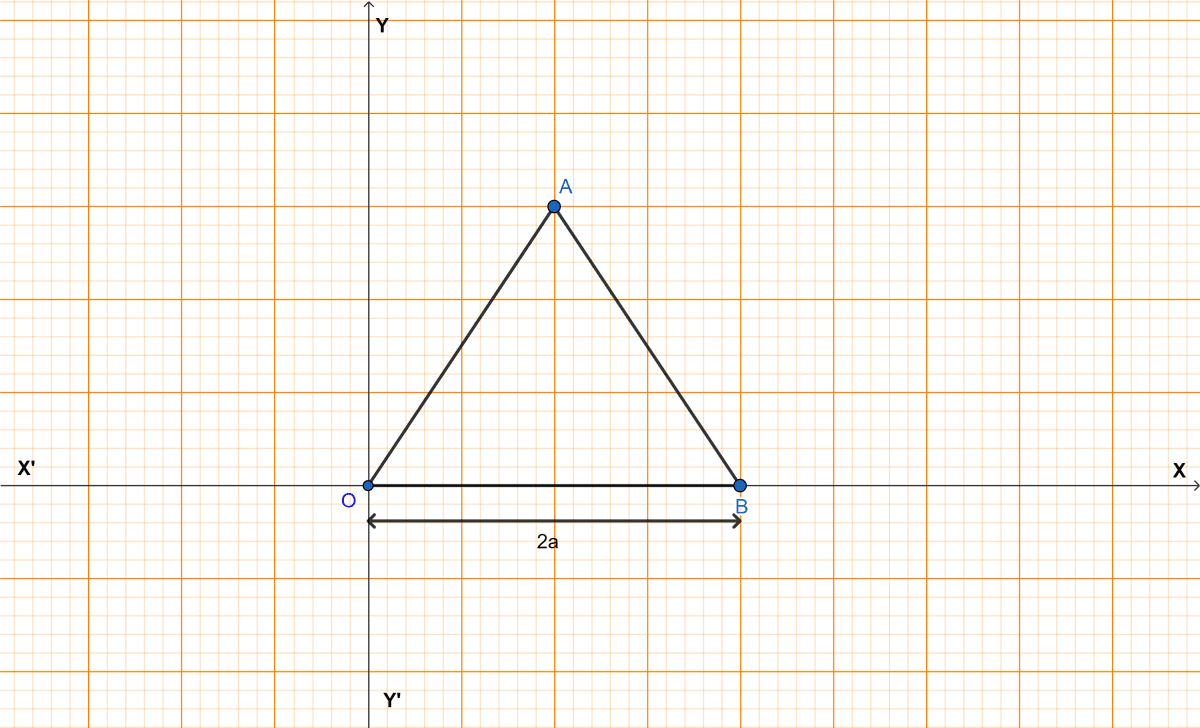
The adjoining figure shows an equilateral triangle OAB with each side = 2a units. Find the coordinates of the vertices.
Answer
Given equilateral triangle OAB.
OA = OB = AB = 2a units.
Draw AD ⊥ OB.
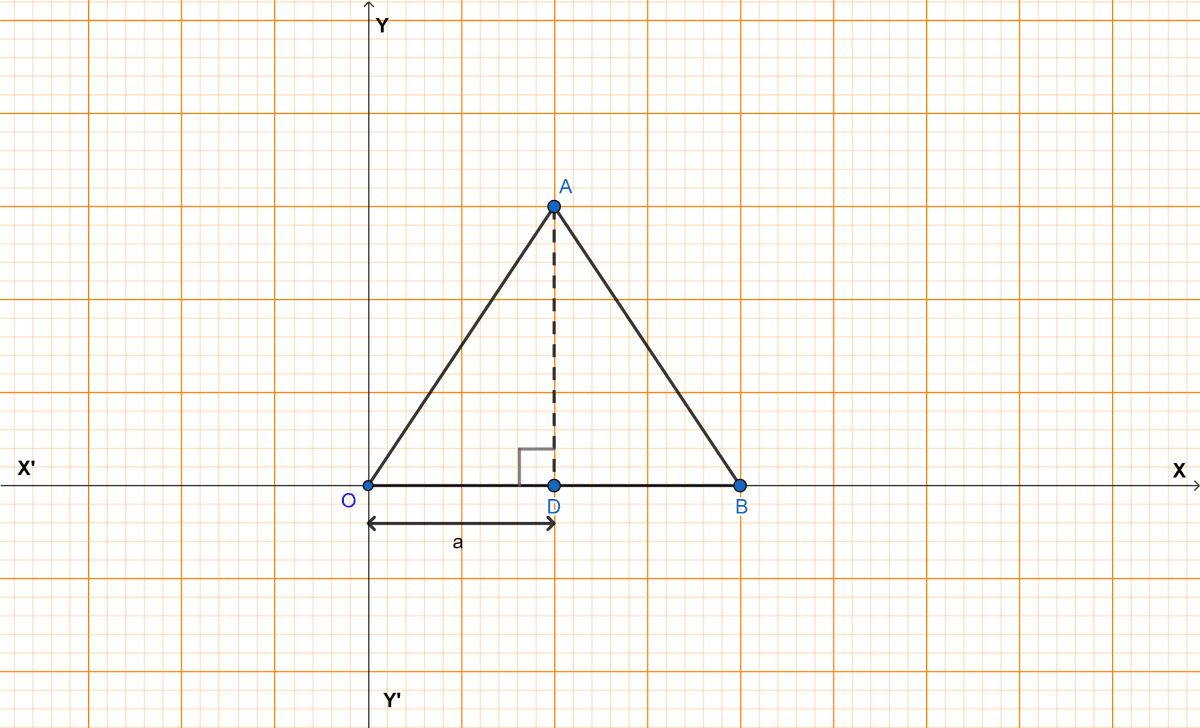
In an equilateral triangle, a perpendicular drawn from one of the vertices to the opposite side bisects the side.
∴ OD = x OB = x 2a = a.
In right angle triangle OAD,
⇒ OA2 = OD2 + AD2
⇒ (2a)2 = a2 + AD2
⇒ 4a2 = a2 + AD2
⇒ AD2 = 4a2 - a2
⇒ AD2 = 3a2
⇒ AD = units.
⇒ AD = a units.
From graph,
Co-ordinates of O = (0, 0)
Co-ordinates of B = (2a, 0)
As, OD = a units and AD = a units.
Co-ordinates of A = (a, a).
Hence, co-ordinates of O = (0, 0), B = (2a, 0) and A = (a, a).
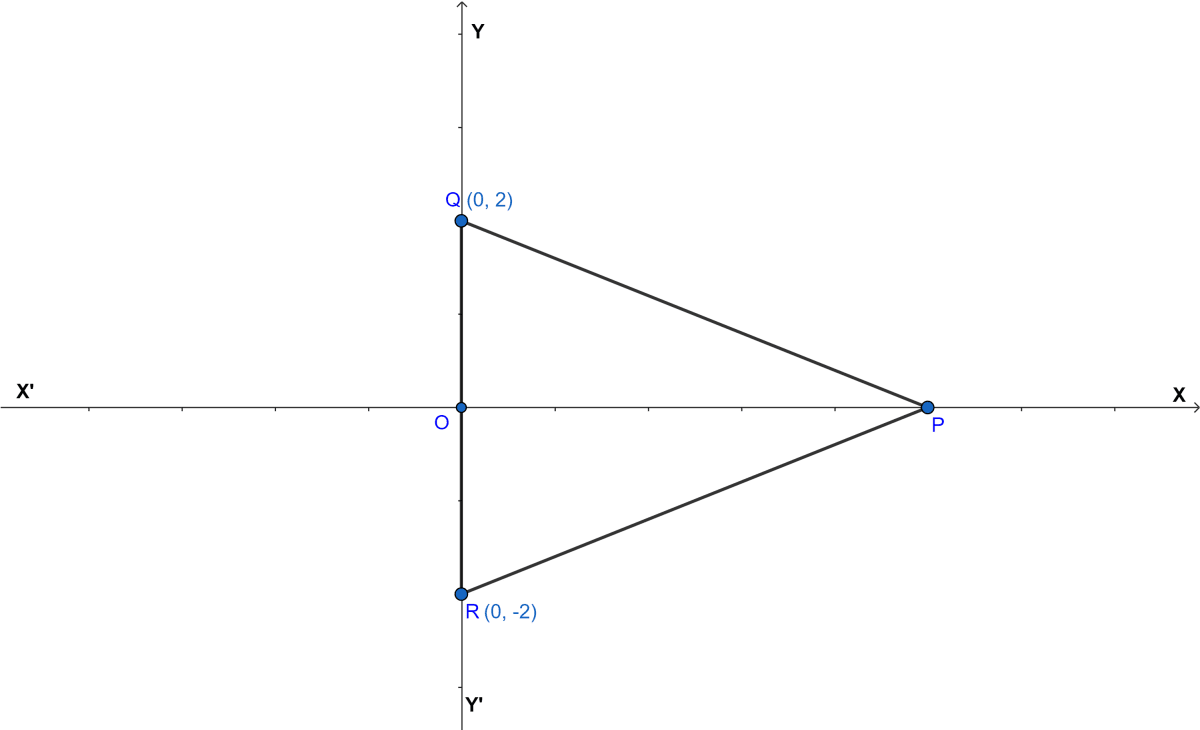
In the given figure, △PQR is equilateral. If the coordinates of the points Q and R are (0, 2) and (0, -2) respectively, find the coordinates of the point P.
Answer
Given, PQR is an equilateral triangle in which Q(0, 2) and R(0, -2) and O = (0, 0).
Let (x, 0) be the coordinates of P. [As, P lies on x axis, so y-coordinate is zero.]
By distance formula,
PQ = PR = QR = 4.
OQ = 2
In right angle triangle POQ,
⇒ PQ2 = OP2 + OQ2 [By pythagoras theorem]
⇒ 42 = OP2 + 22
⇒ 16 = OP2 + 4
⇒ OP2 = 16 - 4
⇒ OP2 = 12
⇒ OP = .
Since, P lies on x-axis and OP = .
Hence, the coordinates of P are (, 0).