KnowledgeBoat Logo
|
OPEN IN APP

Chapter 17

Trigonometrical Ratios of Standard Angles — Chapter Test

Class - 9 ML Aggarwal Understanding ICSE Mathematics


Chapter Test

Question 1(i)

Find the values of :

sin2 60° - cos2 45° + 3 tan2 30°

Answer

Solving,

(32)2(12)2+3(13)23412+3×13324+114+11+4454114.\Rightarrow \Big(\dfrac{\sqrt{3}}{2}\Big)^2 - \Big(\dfrac{1}{\sqrt{2}}\Big)^2 + 3 \Big(\dfrac{1}{\sqrt{3}}\Big)^2 \\[1em] \Rightarrow \dfrac{3}{4} - \dfrac{1}{2} + 3 \times \dfrac{1}{3} \\[1em] \Rightarrow \dfrac{3 - 2}{4} + 1 \\[1em] \Rightarrow \dfrac{1}{4} + 1 \\[1em] \Rightarrow \dfrac{1 + 4}{4} \\[1em] \Rightarrow \dfrac{5}{4} \\[1em] \Rightarrow 1\dfrac{1}{4}.

Hence, sin2 60° - cos2 45° + 3 tan2 30° = 1141\dfrac{1}{4}.

Question 1(ii)

Find the values of :

2 cos245°+3 tan230°3cos 30° + sin 30°\dfrac{\text{2 cos}^2 45° + \text{3 tan}^2 30°}{\sqrt{3}\text{cos 30° + \text{sin 30°}}}

Answer

Solving,

2 cos245°+3 tan230°3cos 30° + sin 30°2×(12)2+3×(13)23×32+122×12+3×1332+121+1422×24441.\Rightarrow \dfrac{\text{2 cos}^2 45° + \text{3 tan}^2 30°}{\sqrt{3}\text{cos 30° + \text{sin 30°}}} \\[1em] \Rightarrow \dfrac{2 \times \Big(\dfrac{1}{\sqrt{2}}\Big)^2 + 3 \times \Big(\dfrac{1}{\sqrt{3}}\Big)^2}{\sqrt{3} \times \dfrac{\sqrt{3}}{2} + \dfrac{1}{2}} \\[1em] \Rightarrow \dfrac{2 \times \dfrac{1}{2} + 3 \times \dfrac{1}{3}}{\dfrac{3}{2} + \dfrac{1}{2}} \\[1em] \Rightarrow \dfrac{1 + 1}{\dfrac{4}{2}} \\[1em] \Rightarrow 2 \times \dfrac{2}{4} \\[1em] \Rightarrow \dfrac{4}{4} \\[1em] \Rightarrow 1.

Hence, 2 cos245°+3 tan230°3cos 30° + sin 30°\dfrac{\text{2 cos}^2 45° + \text{3 tan}^2 30°}{\sqrt{3}\text{cos 30° + \text{sin 30°}}} = 1.

Question 1(iii)

Find the values of :

sec 30° tan 60° + sin 45° cosec 45° + cos 30° cot 60°

Answer

Solving,

sec 30° tan 60° + sin 45° cosec 45° + cos 30° cot 60°23×3+sin 45°×1sin 45°+32×132+1+124+2+1272312.\Rightarrow \text{sec 30° tan 60° + sin 45° cosec 45° + cos 30° cot 60°} \\[1em] \Rightarrow \dfrac{2}{\sqrt{3}} \times \sqrt{3} + \text{sin 45°} \times \dfrac{1}{\text{sin 45°}} + \dfrac{\sqrt{3}}{2} \times \dfrac{1}{\sqrt{3}} \\[1em] \Rightarrow 2 + 1 + \dfrac{1}{2} \\[1em] \Rightarrow \dfrac{4 + 2 + 1}{2} \\[1em] \Rightarrow \dfrac{7}{2} \\[1em] \Rightarrow 3\dfrac{1}{2}.

Hence, sec 30° tan 60° + sin 45° cosec 45° + cos 30° cot 60° = 312.3\dfrac{1}{2}.

Question 2

Taking A = 30°, verify that

(i) cos4 A - sin4 A = cos 2A

(ii) 4 cos A cos (60° - A) cos (60° + A) = cos 3A.

Answer

(i) To verify,

cos4 A - sin4 A = cos 2A

Substituting value of A in L.H.S. of the above equation, we get :

cos4 Asin4 Acos4 30°sin4 30°(32)4(12)491611681612.\Rightarrow \text{cos}^4 \space A - \text{sin}^4 \space A \\[1em] \Rightarrow \text{cos}^4 \space 30° - \text{sin}^4 \space 30° \\[1em] \Rightarrow \Big(\dfrac{\sqrt{3}}{2}\Big)^4 - \Big(\dfrac{1}{2}\Big)^4 \\[1em] \Rightarrow \dfrac{9}{16} - \dfrac{1}{16} \\[1em] \Rightarrow \dfrac{8}{16} \\[1em] \Rightarrow \dfrac{1}{2}.

Substituting value of A in R.H.S. of the above equation, we get :

⇒ cos 2A = cos 2(30°) = cos 60° = 12\dfrac{1}{2}.

Since, L.H.S. = R.H.S.

Hence, proved that cos4 A - sin4 A = cos 2A.

(ii) To verify,

4 cos A cos (60° - A) cos (60° + A) = cos 3A.

Substituting value of A in L.H.S. of the above equation, we get :

4 cos 30° cos (60° - 30°) cos (60° + 30°)4 cos 30° cos 30° cos 90°4×32×32×00.\Rightarrow \text{4 cos 30° cos (60° - 30°) cos (60° + 30°)} \\[1em] \Rightarrow \text{4 cos 30° cos 30° cos 90°} \\[1em] \Rightarrow 4 \times \dfrac{\sqrt{3}}{2} \times \dfrac{\sqrt{3}}{2} \times 0 \\[1em] \Rightarrow 0.

Substituting value of A in R.H.S. of the above equation, we get :

cos 3(30°)=cos 90°=0.\Rightarrow \text{cos 3(30°)} = \text{cos 90°} = 0.

Since, L.H.S. = R.H.S.

Hence, proved that 4 cos A cos (60° - A) cos (60° + A) = cos 3A

Question 3

If A = 45° and B = 30°, verify that sin Acos A + sin A sin B=23\dfrac{\text{sin A}}{\text{cos A + sin A sin B}} = \dfrac{2}{3}.

Answer

To verify,

sin Acos A + sin A sin B=23\dfrac{\text{sin A}}{\text{cos A + sin A sin B}} = \dfrac{2}{3}.

Substituting value of A and B in L.H.S. of the equation, we get :

sin 45°cos 45° + sin 45° sin 30°1212+12×121212(1+12)1212(2+12)13223.\Rightarrow \dfrac{\text{sin 45°}}{\text{cos 45° + sin 45° sin 30°}} \\[1em] \Rightarrow \dfrac{\dfrac{1}{\sqrt{2}}}{\dfrac{1}{\sqrt{2}} + \dfrac{1}{\sqrt{2}} \times \dfrac{1}{2}} \\[1em] \Rightarrow \dfrac{\dfrac{1}{\sqrt{2}}}{\dfrac{1}{\sqrt{2}}\Big(1 + \dfrac{1}{2}\Big)} \\[1em] \Rightarrow \dfrac{\bcancel{\dfrac{1}{\sqrt{2}}}}{\bcancel{\dfrac{1}{\sqrt{2}}}\Big(\dfrac{2 + 1}{2}\Big)} \\[1em] \Rightarrow \dfrac{1}{\dfrac{3}{2}} \\[1em] \Rightarrow \dfrac{2}{3}.

Since, L.H.S. = R.H.S.

Hence, proved that sin Acos A + sin A sin B=23\dfrac{\text{sin A}}{\text{cos A + sin A sin B}} = \dfrac{2}{3}.

Question 4

Taking A = 60° and B = 30°, verify that

(i) sin(A + B)cos A cos B=tan A + tan B\dfrac{\text{sin(A + B)}}{\text{cos A cos B}} = \text{tan A + tan B}

(ii) sin(A - B)sin A sin B=cot B - cot A\dfrac{\text{sin(A - B)}}{\text{sin A sin B}} = \text{cot B - cot A}

Answer

(i) To verify,

sin(A + B)cos A cos B=tan A + tan B\dfrac{\text{sin(A + B)}}{\text{cos A cos B}} = \text{tan A + tan B}.

Substituting value of A and B in L.H.S. of the equation, we get :

sin(A + B)cos A cos Bsin(60° + 30°)cos 60° cos 30°sin 90°12×3213443.\Rightarrow \dfrac{\text{sin(A + B)}}{\text{cos A cos B}} \\[1em] \Rightarrow \dfrac{\text{sin(60° + 30°)}}{\text{cos 60° cos 30°}} \\[1em] \Rightarrow \dfrac{\text{sin 90°}}{\dfrac{1}{2} \times \dfrac{\sqrt{3}}{2}} \\[1em] \Rightarrow \dfrac{1}{\dfrac{\sqrt{3}}{4}} \\[1em] \Rightarrow \dfrac{4}{\sqrt{3}}.

Substituting value of A and B in R.H.S. of the equation, we get :

tan A + tan Btan 60° + tan 30°3+133+1343.\Rightarrow \text{tan A + tan B} \\[1em] \Rightarrow \text{tan 60° + tan 30°} \\[1em] \Rightarrow \sqrt{3} + \dfrac{1}{\sqrt{3}} \\[1em] \Rightarrow \dfrac{3 + 1}{\sqrt{3}} \\[1em] \Rightarrow \dfrac{4}{\sqrt{3}}.

Since, L.H.S. = R.H.S.

Hence, proved that sin(A + B)cos A cos B=tan A + tan B\dfrac{\text{sin(A + B)}}{\text{cos A cos B}} = \text{tan A + tan B}.

(ii) To verify,

sin(A - B)sin A sin B=cot B - cot A\dfrac{\text{sin(A - B)}}{\text{sin A sin B}} = \text{cot B - cot A}

Substituting value of A and B in L.H.S. of the equation, we get :

sin(A - B)sin A sin Bsin(60° - 30°)sin 60° sin 30°sin 30°sin 60° sin 30°1232×12123442323.\Rightarrow \dfrac{\text{sin(A - B)}}{\text{sin A sin B}} \\[1em] \Rightarrow \dfrac{\text{sin(60° - 30°)}}{\text{sin 60° sin 30°}} \\[1em] \Rightarrow \dfrac{\text{sin 30°}}{\text{sin 60° sin 30°}} \\[1em] \Rightarrow \dfrac{\dfrac{1}{2}}{\dfrac{\sqrt{3}}{2} \times \dfrac{1}{2}} \\[1em] \Rightarrow \dfrac{\dfrac{1}{2}}{\dfrac{\sqrt{3}}{4}} \\[1em] \Rightarrow \dfrac{4}{2\sqrt{3}} \\[1em] \Rightarrow \dfrac{2}{\sqrt{3}}.

Substituting value of A and B in R.H.S. of the equation, we get :

⇒ cot B - cot A

⇒ cot 30° - cot 60°

313=313\sqrt{3} - \dfrac{1}{\sqrt{3}} = \dfrac{3 - 1}{\sqrt{3}}

23\dfrac{2}{\sqrt{3}}.

Since, L.H.S. = R.H.S.

Hence, proved that sin(A - B)sin A sin B=cot B - cot A\dfrac{\text{sin(A - B)}}{\text{sin A sin B}} = \text{cot B - cot A}.

Question 5

If 2\sqrt{2} tan 2θ = 6\sqrt{6} and 0° < 2θ < 90°, find the value of

sin θ + 3\sqrt{3} cos θ - 2 tan2 θ.

Answer

Given,

2\phantom{\Rightarrow}\sqrt{2} tan 2θ = 6\sqrt{6}

⇒ tan 2θ = 62\dfrac{\sqrt{6}}{\sqrt{2}}

⇒ tan 2θ = 3\sqrt{3}

⇒ tan 2θ = tan 60°

⇒ 2θ = 60°

⇒ θ = 60°2\dfrac{60°}{2}

⇒ θ = 30°.

Substituting value of θ in sin θ + 3\sqrt{3} cos θ - 2 tan2 θ, we get :

⇒ sin 30° + 3\sqrt{3} cos 30° - 2 tan2 30°

12+3×322×(13)212+32233+9468643.\Rightarrow \dfrac{1}{2} + \sqrt{3} \times \dfrac{\sqrt{3}}{2} - 2 \times \Big(\dfrac{1}{\sqrt{3}}\Big)^2 \\[1em] \Rightarrow \dfrac{1}{2} + \dfrac{3}{2} - \dfrac{2}{3} \\[1em] \Rightarrow \dfrac{3 + 9 - 4}{6} \\[1em] \Rightarrow \dfrac{8}{6} \\[1em] \Rightarrow \dfrac{4}{3}.

Hence, sin θ + 3\sqrt{3} cos θ - 2 tan2 θ = 43.\dfrac{4}{3}.

Question 6

If 3θ is an acute angle, solve the following equation for θ :

(cosec 3θ - 2)(cot 2θ - 1) = 0.

Answer

Given,

⇒ (cosec 3θ – 2)(cot 2θ – 1) = 0

⇒ cosec 3θ – 2 = 0 or cot 2θ – 1 = 0

⇒ cosec 3θ = 2 or cot 2θ = 1

⇒ cosec 3θ = cosec 30° or cot 2θ = cot 45°

⇒ 3θ = 30° or 2θ = 45°

⇒ θ = 30°3\dfrac{30°}{3} or θ = 45°2\dfrac{45°}{2}

⇒ θ = 10° or θ = 2212°22\dfrac{1}{2}°

Hence, θ = 10° or θ = 2212°22\dfrac{1}{2}°.

Question 7

If tan (A + B) = 3\sqrt{3}, tan (A - B) = 1 and A, B (B < A) are acute angles, find the values of A and B.

Answer

Given,

⇒ tan (A + B) = 3\sqrt{3}

⇒ tan (A + B) = tan 60°

⇒ A + B = 60° ..........(1)

⇒ tan (A - B) = 1

⇒ tan (A - B) = tan 45°

⇒ A - B = 45° ..........(2)

Adding (1) and (2) we get :

⇒ A + B + A - B = 60° + 45°

⇒ 2A = 105°

⇒ A = 1052\dfrac{105}{2}

⇒ A = 5212°52\dfrac{1}{2}\degree

Substituting value of A in (2) we get :

1052\dfrac{105}{2} - B = 45°

⇒ B = 1052\dfrac{105}{2} - 45°

⇒ B = 105902\dfrac{105 - 90}{2}

⇒ B = 152\dfrac{15}{2}

⇒ B = 712°7\dfrac{1}{2}\degree

Hence, A = 5212°52\dfrac{1}{2}\degree and B = 712°7\dfrac{1}{2}\degree

Question 8(i)

Without using trigonometrical tables, evaluate the following :

sin2 28° + sin2 62° - tan2 45°

Answer

Solving,

⇒ sin2 28° + sin2 62° - tan2 45°

⇒ sin2 28° + sin2 (90° - 28°) - tan2 45°

⇒ sin2 28° + cos2 28° - 1 [∵ sin (90 - θ) = cos θ]

⇒ 1 - 1 [∵ sin2 θ + cos2 θ]

⇒ 0.

Hence, sin2 28° + sin2 62° - tan2 45° = 0.

Question 8(ii)

Without using trigonometrical tables, evaluate the following :

2 cos 27°sin 63°+tan 27°cot 63°+cos 0°\dfrac{\text{2 cos 27°}}{\text{sin 63°}} + \dfrac{\text{tan 27°}}{\text{cot 63°}} + \text{cos 0°}

Answer

Solving,

2 cos 27°sin 63°+tan 27°cot 63°+cos 0°2 cos 27°sin (90° - 27°)+tan 27°cot (90° - 27°)+12 cos 27°cos 27°+tan 27°tan 27°+12+1+14.\Rightarrow \dfrac{\text{2 cos 27°}}{\text{sin 63°}} + \dfrac{\text{tan 27°}}{\text{cot 63°}} + \text{cos 0°} \\[1em] \Rightarrow \dfrac{\text{2 cos 27°}}{\text{sin (90° - 27°)}} + \dfrac{\text{tan 27°}}{\text{cot (90° - 27°)}} + 1 \\[1em] \Rightarrow \dfrac{\text{2 cos 27°}}{\text{cos 27°}} + \dfrac{\text{tan 27°}}{\text{tan 27°}} + 1 \\[1em] \Rightarrow 2 + 1 + 1 \\[1em] \Rightarrow 4.

Hence, 2 cos 27°sin 63°+tan 27°cot 63°+cos 0°\dfrac{\text{2 cos 27°}}{\text{sin 63°}} + \dfrac{\text{tan 27°}}{\text{cot 63°}} + \text{cos 0°} = 4.

Question 8(iii)

Without using trigonometrical tables, evaluate the following :

cos 18° sin 72° + sin 18° cos 72°

Answer

Solving,

⇒ cos 18° sin 72° + sin 18° cos 72°

[As, sin (90 - θ) = cos θ and cos (90 - θ) = sin θ]

⇒ cos 18° sin (90° - 18°) + sin 18° cos (90° - 18°)

⇒ cos 18° cos 18° + sin 18° sin 18°

⇒ sin2 18° + cos2 18°

⇒ 1.

Hence, cos 18° sin 72° + sin 18° cos 72° = 1.

Question 8(iv)

Without using trigonometrical tables, evaluate the following :

5 sin 50° sec 40°- 3 cos 59° cosec 31°

Answer

Solving,

⇒ 5 sin 50° sec 40°- 3 cos 59° cosec 31°

⇒ 5 sin 50° sec (90° - 50°) - 3 cos 59° cosec (90° - 59°)

[As, sec (90 - θ) = cosec θ and cosec (90 - θ) = sec θ]

⇒ 5 sin 50° cosec 50° - 3 cos 59° sec 59°

5 sin 50°×1sin 50°3 cos 59°×1cos 59°\text{5 sin 50°} \times \dfrac{1}{\text{sin 50°}} - \text{3 cos 59°} \times \dfrac{1}{\text{cos 59°}}

⇒ 5 - 3

⇒ 2.

Hence, 5 sin 50° sec 40°- 3 cos 59° cosec 31° = 2.

Question 9

Prove that :

cos (90° - θ) sec (90° - θ) tan θcosec (90 - θ) sin (90 - θ) cot (90 - θ)+tan (90 - θ)cot θ=2.\dfrac{\text{cos (90° - θ) sec (90° - θ) tan θ}}{\text{cosec (90 - θ) sin (90 - θ) cot (90 - θ)}} + \dfrac{\text{tan (90 - θ)}}{\text{cot θ}} = 2.

Answer

Solving L.H.S. of above equation,

cos (90° - θ) sec (90° - θ) tan θcosec (90 - θ) sin (90 - θ) cot (90 - θ)+tan (90 - θ)cot θsin θ. cosec θ. tan θsec θ. cos θ. tan θ+cot θcot θsin θ ×1sin θ× tan θ1cos θ×. cos θ. tan θ+cot θcot θ1+12.\Rightarrow \dfrac{\text{cos (90° - θ) sec (90° - θ) tan θ}}{\text{cosec (90 - θ) sin (90 - θ) cot (90 - θ)}} + \dfrac{\text{tan (90 - θ)}}{\text{cot θ}} \\[1em] \Rightarrow \dfrac{\text{sin θ. cosec θ. tan θ}}{\text{sec θ. cos θ. tan θ}} + \dfrac{\text{cot θ}}{\text{cot θ}} \\[1em] \Rightarrow \dfrac{\text{sin θ } \times \dfrac{1}{\text{sin θ}}\times \text{ tan θ}}{\dfrac{1}{\text{cos θ}} \times \text{. cos θ. tan θ}} + \dfrac{\text{cot θ}}{\text{cot θ}} \\[1em] \Rightarrow 1 + 1 \\[1em] \Rightarrow 2.

Since, L.H.S. = R.H.S.

Hence, proved that cos (90° - θ) sec (90° - θ) tan θcosec (90 - θ) sin (90 - θ) cot (90 - θ)+tan (90 - θ)cot θ=2.\dfrac{\text{cos (90° - θ) sec (90° - θ) tan θ}}{\text{cosec (90 - θ) sin (90 - θ) cot (90 - θ)}} + \dfrac{\text{tan (90 - θ)}}{\text{cot θ}} = 2.

Question 10

When 0° < A < 90°, solve the following equations :

(i) sin 3A = cos 2A

(ii) tan 5A = cot A

Answer

(i) Given,

⇒ sin 3A = cos 2A

⇒ sin 3A = sin (90° - 2A)

⇒ 3A = 90° - 2A

⇒ 5A = 90°

⇒ A = 905\dfrac{90}{5}

⇒ A = 18°.

Hence, A = 18°.

(ii) Given,

⇒ tan 5A = cot A

⇒ tan 5A = tan (90° - A)

⇒ 5A = 90° - A

⇒ 6A = 90°

⇒ A = 906\dfrac{90}{6}

⇒ A = 15°.

Hence, A = 15°.

Question 11

Find the value of θ if

(i) sin (θ + 36°) = cos θ, where θ and θ + 36° are acute angles.

(ii) sec 4θ = cosec (θ - 20°), where 4θ and θ - 20° are acute angles.

Answer

(i) Given,

⇒ sin (θ + 36°) = cos θ

⇒ sin (θ + 36°) = sin (90° - θ)

⇒ θ + 36° = 90° - θ

⇒ 2θ = 90° - 36°

⇒ 2θ = 54°

⇒ θ = 542\dfrac{54}{2}

⇒ θ = 27°.

Hence, θ = 27°.

(ii) Given,

⇒ sec 4θ = cosec (θ - 20°)

⇒ sec 4θ = sec [90° - (θ - 20°)]

⇒ 4θ = [90° - (θ - 20°)]

⇒ 4θ = 110° - θ

⇒ 5θ = 110°

⇒ θ = 1105\dfrac{110}{5}

⇒ θ = 22°.

Hence, θ = 22°.

Question 12

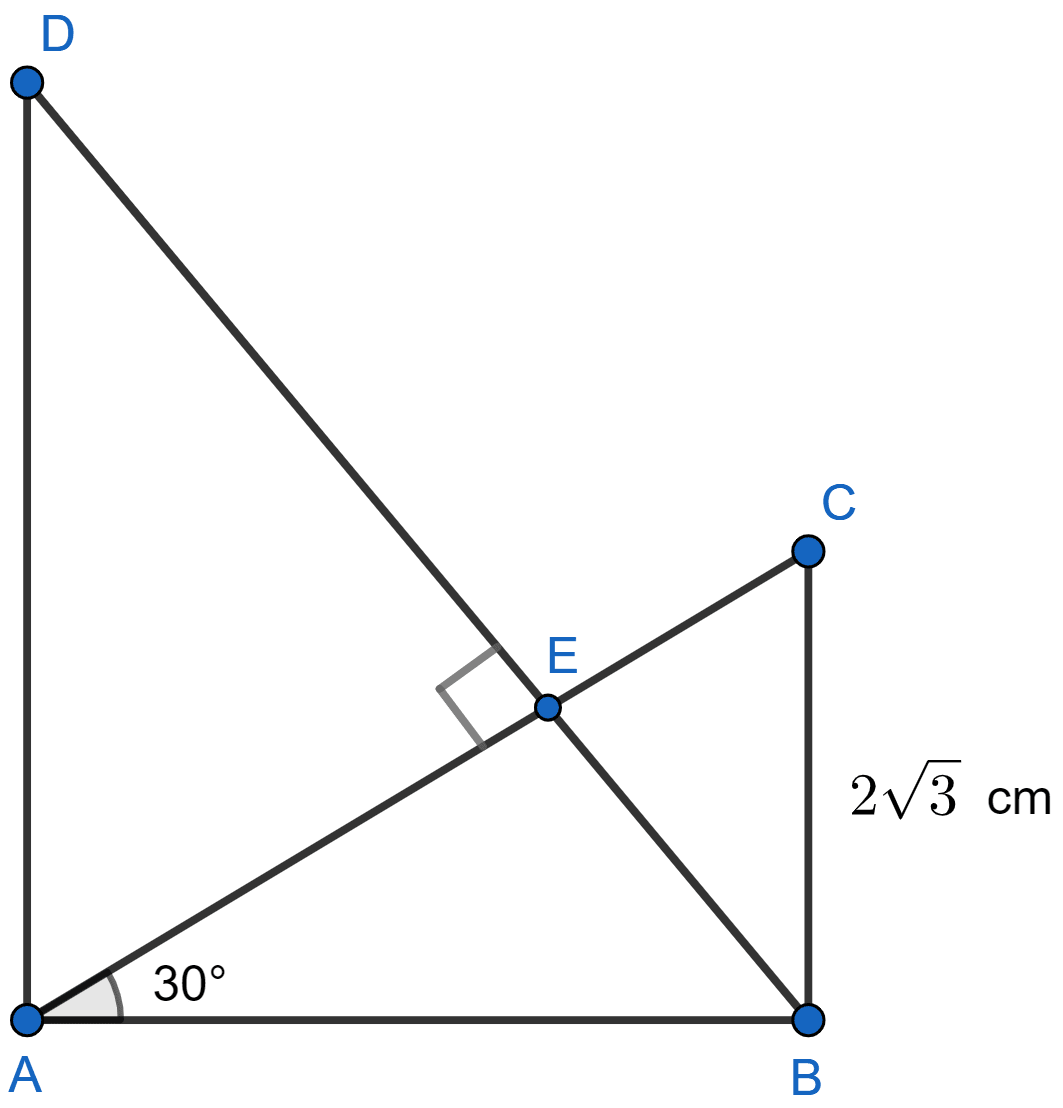
In the adjoining figure, ABC is right-angled triangle at B and ABD is right angled triangle at A. If BD ⊥ AC and BC = 232\sqrt{3} cm, find the length of AD.

In the adjoining figure, ABC is right-angled triangle at B and ABD is right angled triangle at A. If BD ⊥ AC and BC = 2√3 cm, find the length of AD. Trigonometrical Ratios of Standard Angles, ML Aggarwal Understanding Mathematics Solutions ICSE Class 9.

Answer

In △ABC,

tan 30° = PerpendicularBase\dfrac{\text{Perpendicular}}{\text{Base}}

13=BCAB13=23ABAB=6 cm.\Rightarrow \dfrac{1}{\sqrt{3}} = \dfrac{BC}{AB} \\[1em] \Rightarrow \dfrac{1}{\sqrt{3}} = \dfrac{2\sqrt{3}}{AB} \\[1em] \Rightarrow AB = 6 \text{ cm}.

In △ABE,

90° = 30° + ∠ABE [As, exterior angle is equal to sum of two opposite interior angles]

∠ABE = 90° - 30° = 60°.

From figure,

∠ABD = ∠ABE = 60°

In △ABD,

tan ∠ABD = tan 60° = PerpendicularBase\dfrac{\text{Perpendicular}}{\text{Base}}

3=ADABAD=AB3AD=63 cm.\Rightarrow \sqrt{3} = \dfrac{AD}{AB} \\[1em] \Rightarrow AD = AB\sqrt{3} \\[1em] \Rightarrow AD = 6\sqrt{3} \text{ cm}.

Hence, AD = 636\sqrt{3} cm.

PrevNext