
In the adjoining figure, a chord PQ of a circle with center O and radius 15 cm is bisected at M by a diameter AB. If OM = 9 cm, find the lengths of :
(i) PQ
(ii) AP
(iii) BP.
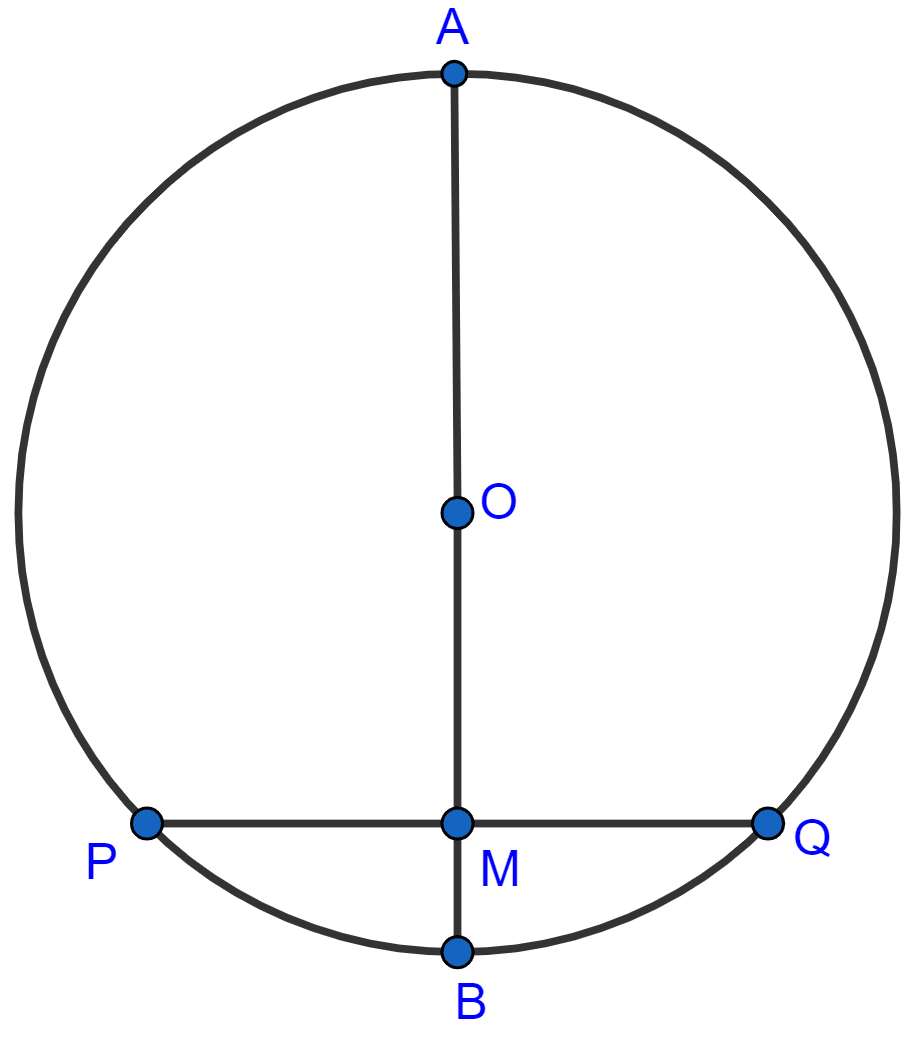
Answer
(i) Given,
AB bisects PQ.
∴ OM bisects PQ.
Since, the straight line drawn from the centre of a circle to bisect a chord, which is not a diameter, is perpendicular to the chord,
∴ OM ⊥ PQ.
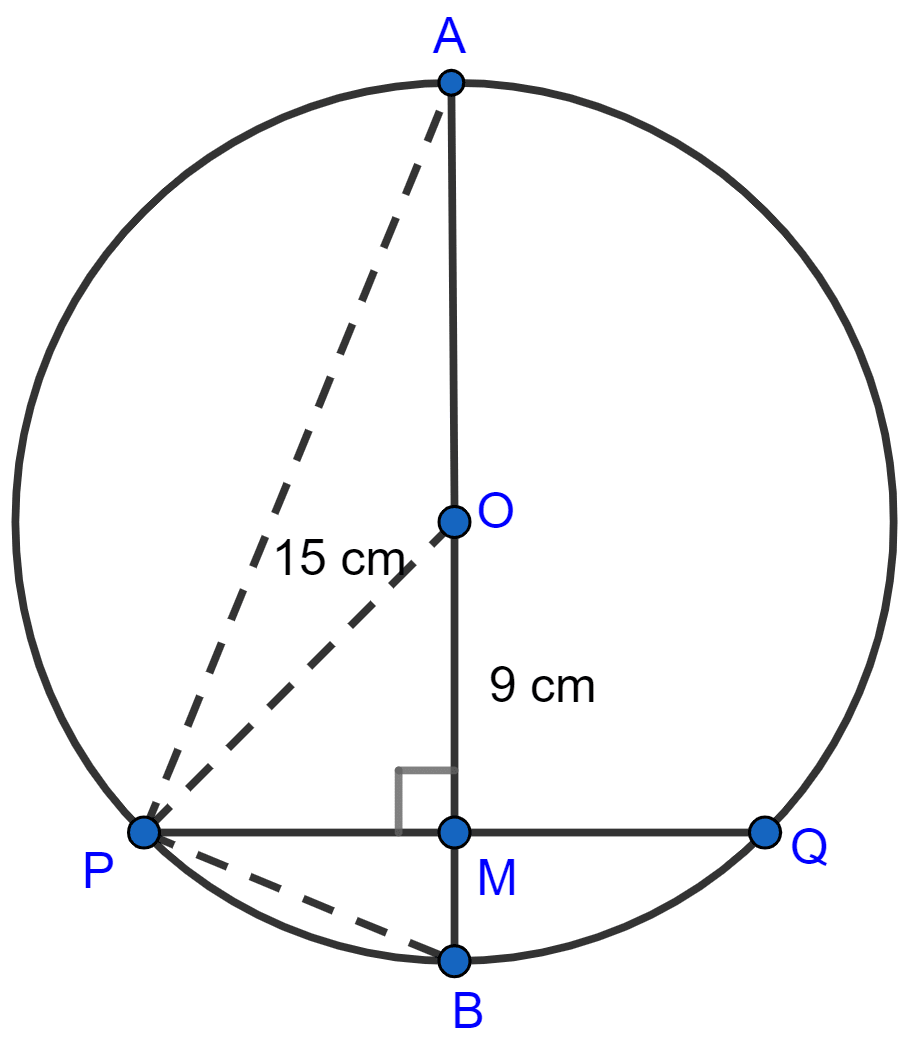
In right △OMP,
⇒ OP2 = OM2 + PM2 (By pythagoras theorem)
⇒ 152 = 92 + PM2
⇒ PM2 = 152 - 92
⇒ PM2 = 225 - 81
⇒ PM2 = 144
⇒ PM = = 12 cm.
PQ = 2PM = 24 cm.
Hence, PQ = 24 cm.
(ii) From figure,
AM = AO + OM = 15 + 9 = 24 cm.
In right △APM,
⇒ AP2 = AM2 + PM2 (By pythagoras theorem)
⇒ AP2 = 242 + 122
⇒ AP2 = 576 + 144
⇒ AP2 = 720
⇒ AP = = cm.
Hence, AP = cm.
(iii) From figure,
MB = OB - OM = 15 - 9 = 6 cm.
In right △MPB,
⇒ BP2 = PM2 + MB2 (By pythagoras theorem)
⇒ BP2 = 122 + 62
⇒ BP2 = 144 + 36
⇒ BP2 = 180
⇒ BP = = cm.
Hence, BP = cm.
The radii of two concentric circles are 17 cm and 10 cm; a line PQRS cuts the larger circle at P and S and the smaller circle at Q and R. If QR = 12 cm, calculate PQ.
Answer
Draw OM ⊥ QR.

In right △OQM,
⇒ OQ2 = OM2 + QM2
⇒ 102 = OM2 + 62
⇒ OM2 = 100 - 36
⇒ OM2 = 64
⇒ OM = = 8 cm.
In right △POM,
⇒ PO2 = OM2 + PM2
⇒ 172 = 82 + PM2
⇒ PM2 = 289 - 64
⇒ PM2 = 225
⇒ PM = = 15 cm.
From figure,
PQ = PM - QM = 15 - 6 = 9 cm.
Hence, PQ = 9 cm.
A chord of length 48 cm is at a distance of 10 cm from the centre of a circle. If another chord of length 20 cm is drawn in the same circle, find its distance from the center of the circle.
Answer
From figure,
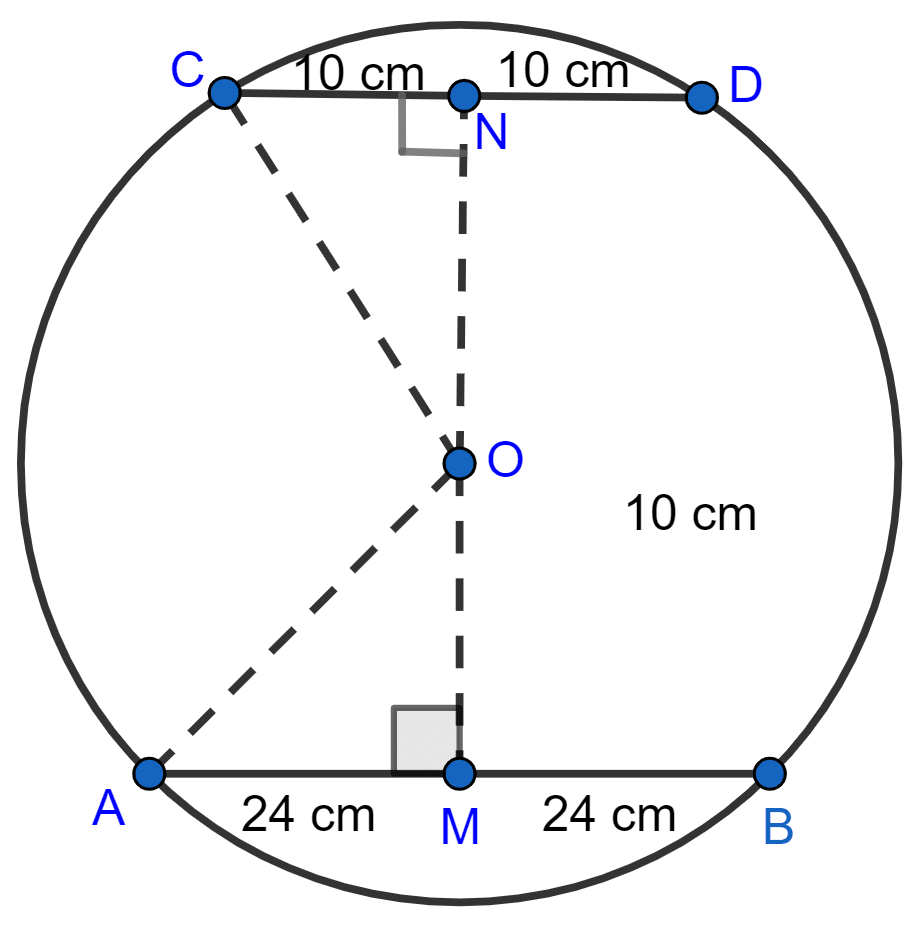
Since, OM ⊥ AB, it bisects it. (As perpendicular from center to chord bisects it)
∴ AM = MB = = 24 cm.
In right △AOM,
⇒ AO2 = OM2 + AM2 (By pythagoras theorem)
⇒ AO2 = 102 + 242
⇒ AO2 = 100 + 576
⇒ AO2 = 676
⇒ AO = = 26 cm.
Radius = 26 cm.
Since, ON ⊥ CD, it bisects it. (As perpendicular from center to chord bisects it)
∴ CN = ND = = 10 cm.
In right △CNO,
⇒ OC2 = ON2 + NC2 (By pythagoras theorem)
⇒ 262 = ON2 + 102
⇒ ON2 = 676 - 100
⇒ ON2 = 576
⇒ ON = = 24 cm.
Hence, the chord of length 20 cm is at a distance of 24 cm from the centre.
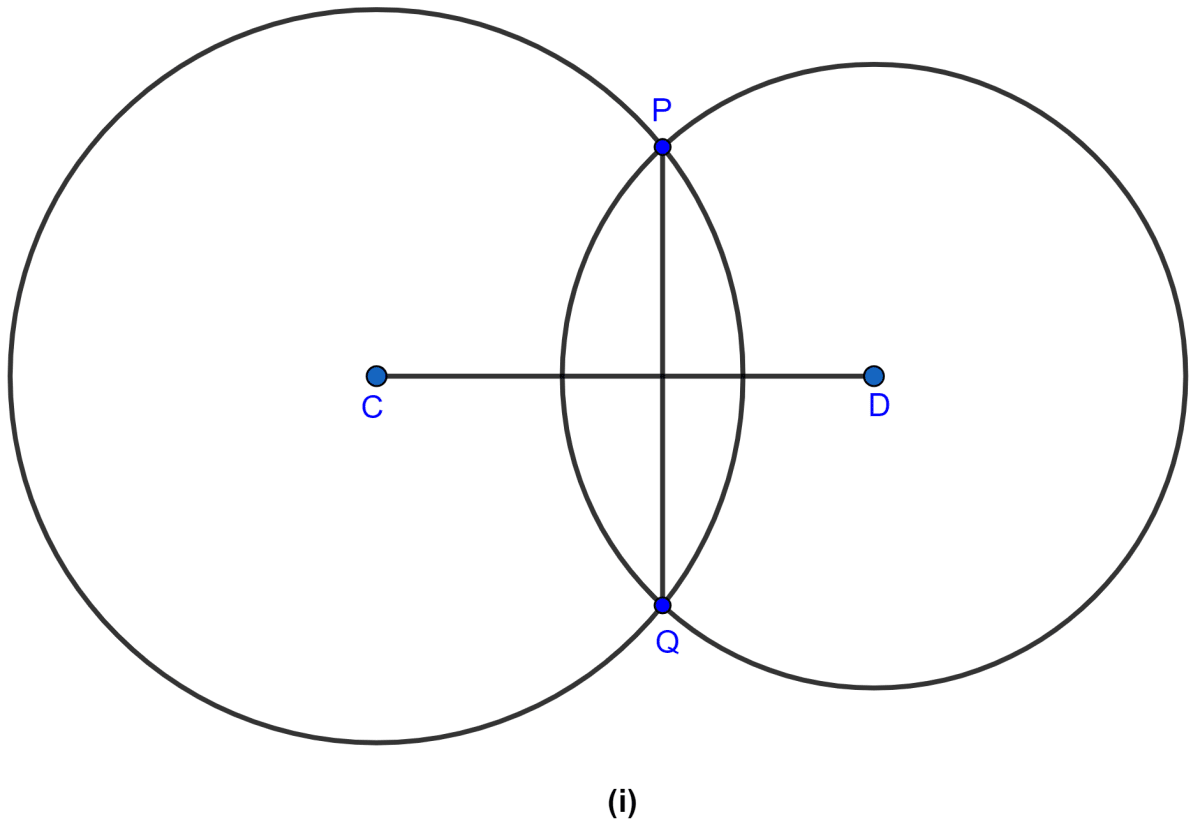
In the figure (i) given below, two circles with centers C, D intersect in points P, Q. If length of common chord is 6 cm and CP = 5 cm, DP = 4 cm, calculate the distance CD correct to two decimal places.
Answer
From figure,
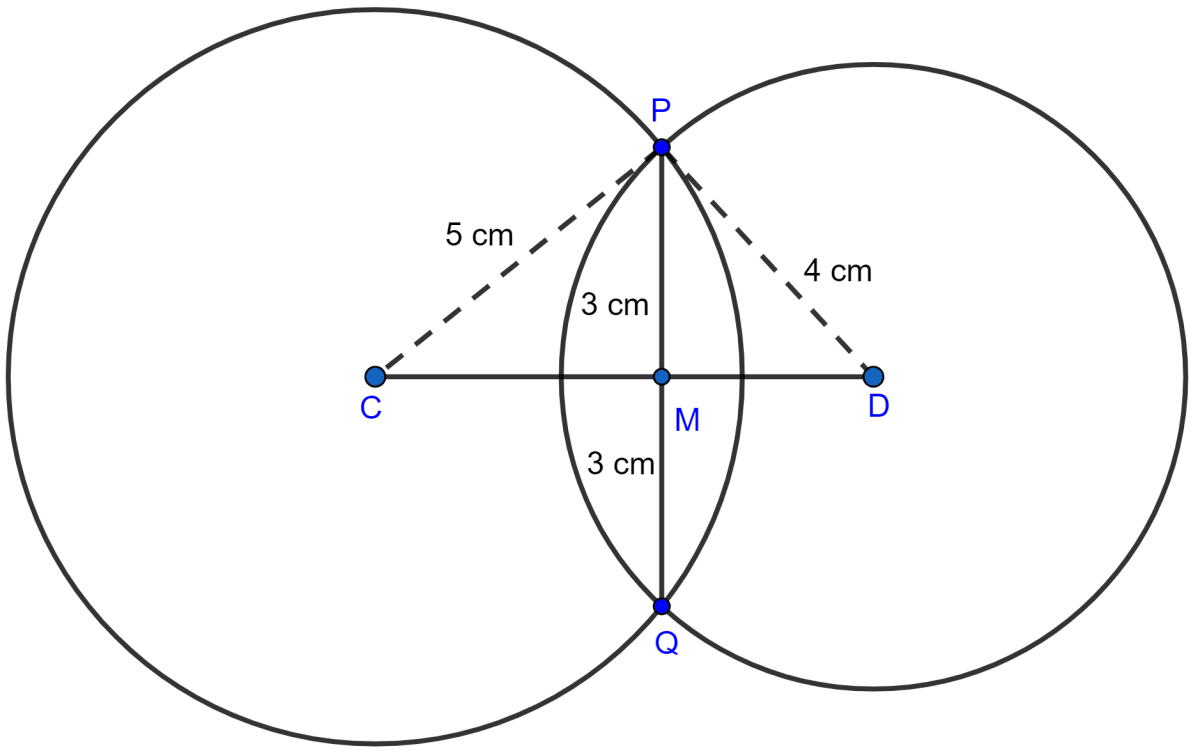
PM = MQ = = 3 cm.
In right △CMP,
⇒ CP2 = CM2 + PM2 (By pythagoras theorem)
⇒ 52 = CM2 + 32
⇒ CM2 = 25 - 9
⇒ CM2 = 16
⇒ CM = = 4 cm.
In right △DMP,
⇒ DP2 = DM2 + PM2 (By pythagoras theorem)
⇒ 42 = DM2 + 32
⇒ DM2 = 16 - 9
⇒ DM2 = 7
⇒ DM = = 2.65 cm.
CD = CM + MD = 4 + 2.65 = 6.65 cm.
Hence, CD = 6.65 cm.
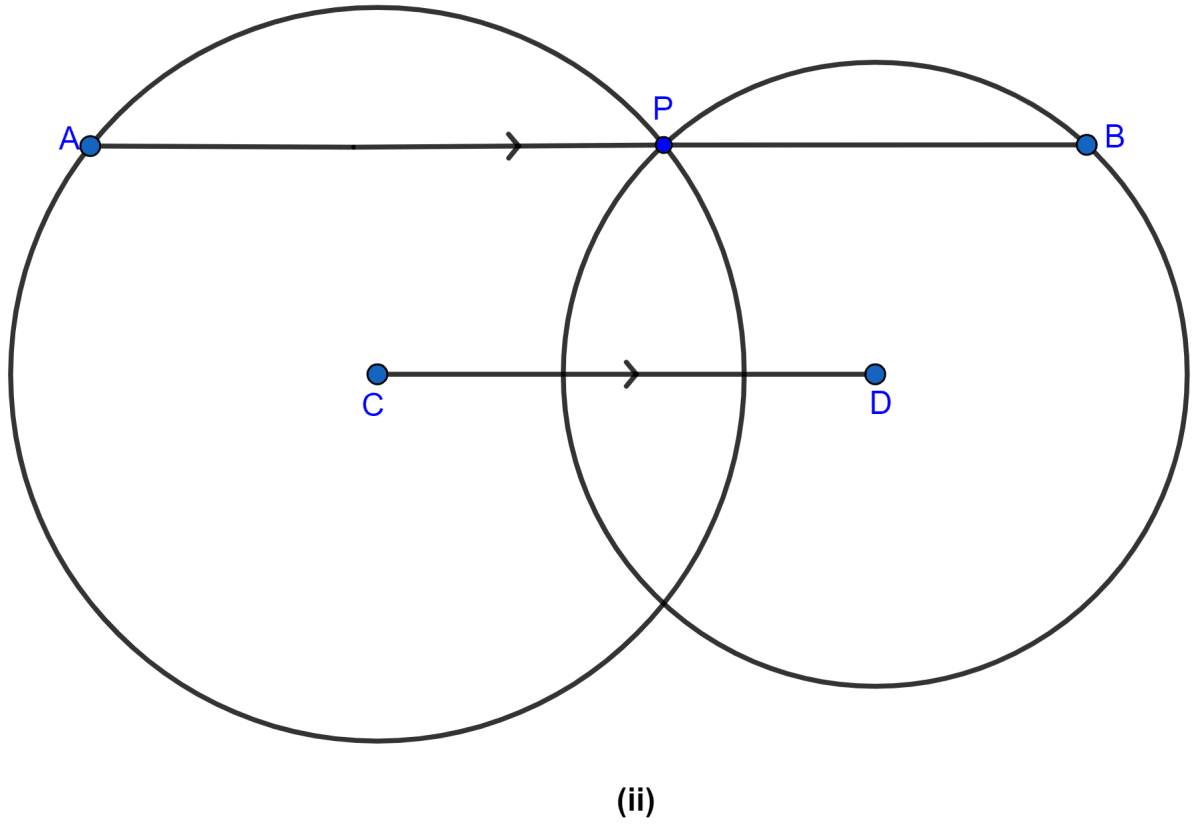
In the figure (ii) given below, P is a point of intersection of two circles with centers C and D. If the st. line APB is parallel to CD, prove that AB = 2CD.
Answer
From C, D draw CM, DN perpendiculars to AB.
From figure,
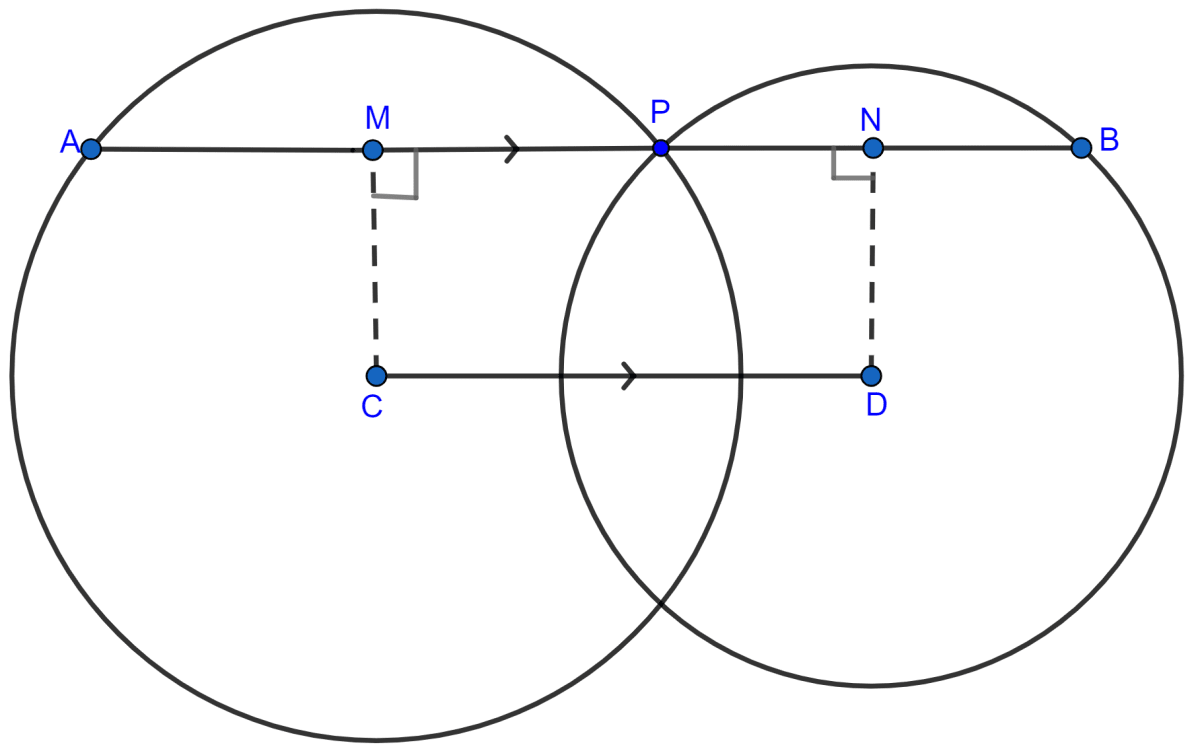
MCDN is a rectangle.
∴ MN = CD (Opposite sides of rectangle are equal).
Since, the perpendicular to a chord from the centre of the circle bisects the chord,
∴ MP = AP and NP = PB
From figure,
MN = MP + PN
= AP + PB
= (AP + PB)
= AB
∴ CD = AB [∵ MN = CD]
⇒ AB = 2CD
Hence, proved that AB = 2CD.
In the figure (i) given below, C and D are centers of two intersecting circles. The line APQB is perpendicular to the line of centers CD. Prove that
(i) AP = QB
(ii) AQ = BP.

Answer
Let M be the point of intersection of line CD and line APQB.

(i) Since, the perpendicular to a chord from the centre of the circle bisects the chord,
∴ In circle with center D,
PM = MQ .........(1)
and
In circle with center C,
AM = MB .........(2)
Subtracting equation (1) from (2),
⇒ AM - PM = MB - MQ
⇒ AP = QB
Hence, proved that AP = QB.
(ii) Let AP = QB = x.
From figure,
AQ = AB - QB = AB - x
BP = AB - AP = AB - x.
∴ AQ = BP.
Hence, proved that AQ = BP.
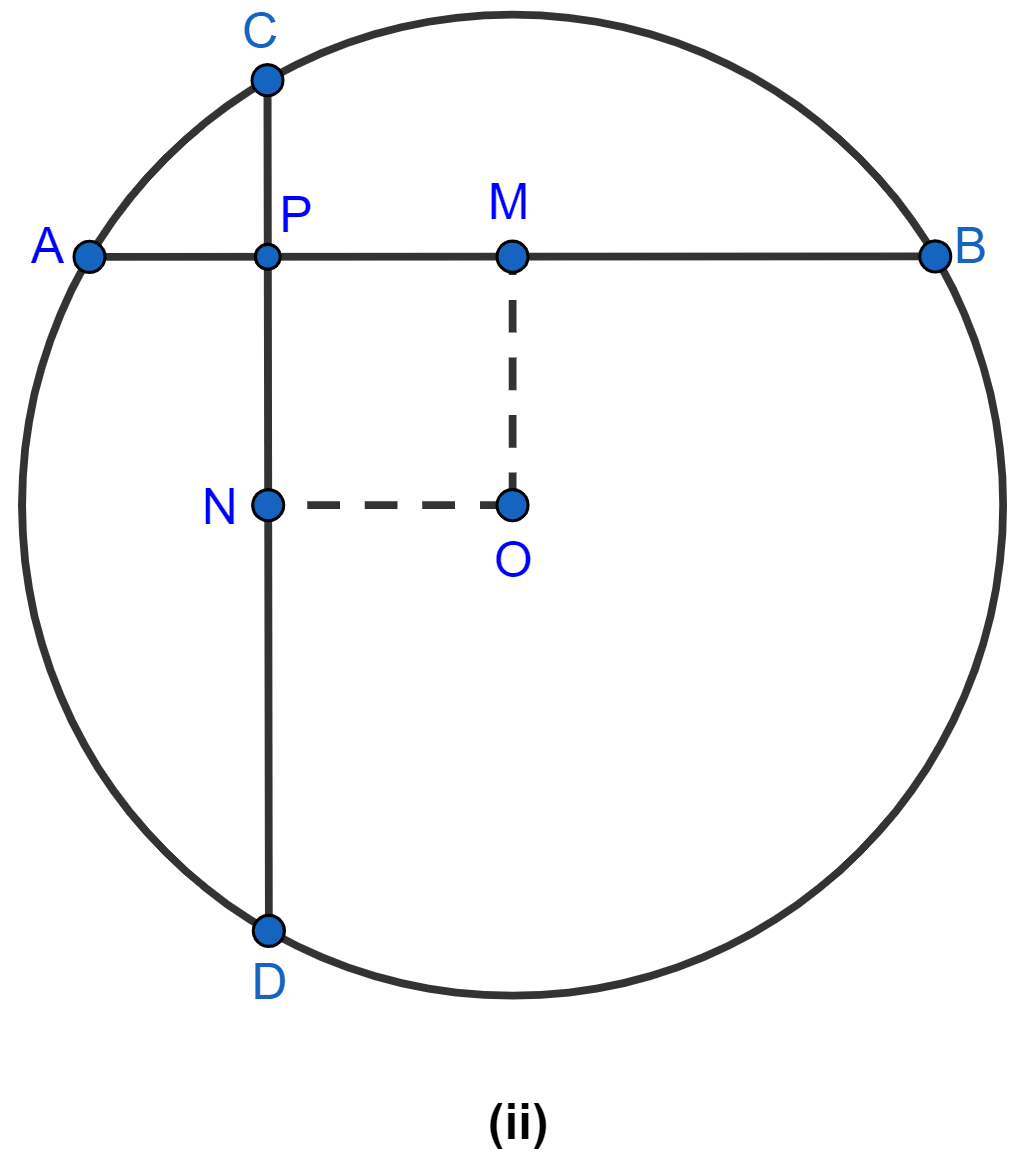
In the figure (ii) given below, two equal chords AB and CD of a circle with center O intersect at right angles at P. If M and N are mid-points of the chords AB and CD respectively, prove that NOMP is a square.
Answer
In NOMP,
∠P = 90° (As chords intersect at right angles)
∠M = ∠N = 90° (Straight lines from center bisecting the chord are perpendicular to it.)
∠O = 360° - (∠M + ∠N + ∠P)
= 360° - (90° + 90° + 90°)
= 90°
Since, equal chords are equidistant from center,
∴ OM = ON.
Since, all angles = 90° and all sides are equal.
Hence, NOMP is a square.
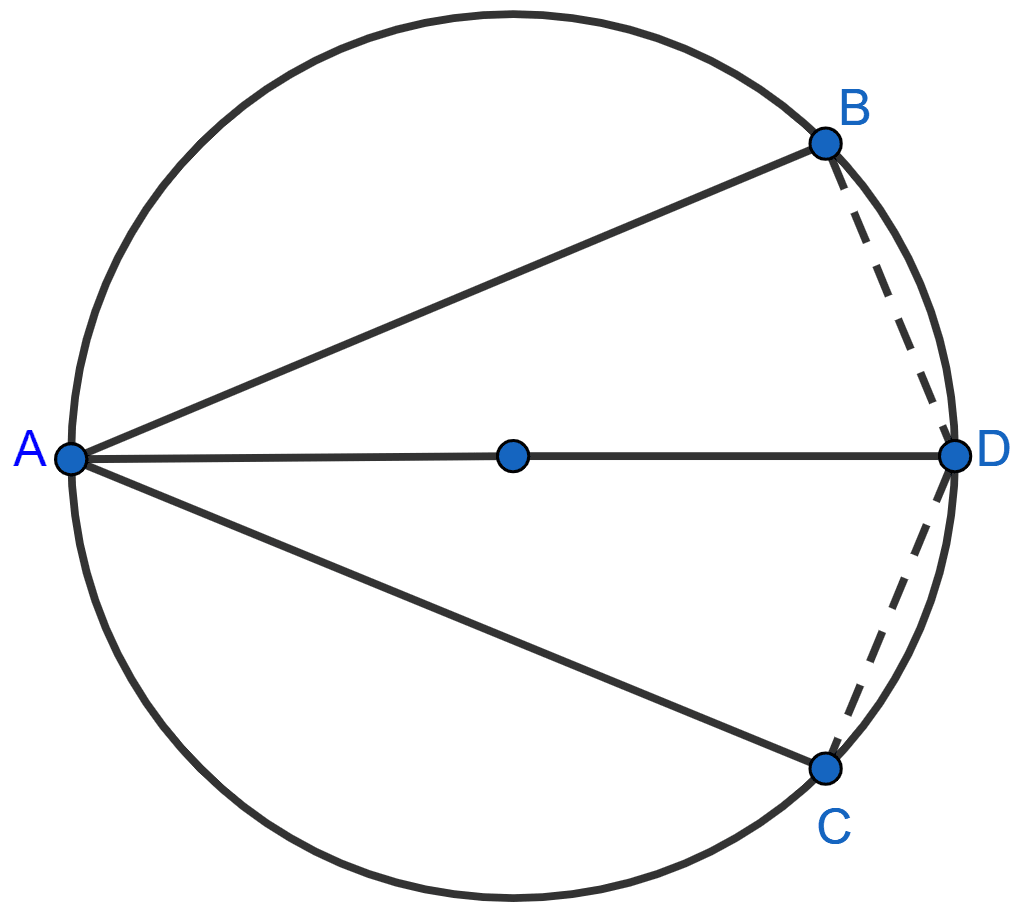
In the adjoining figure, AD is diameter of a circle. If the chord AB and AC are equidistant from its center O, prove that AD bisects ∠BAC and ∠BDC.
Answer
As chords AB and AC are equidistant from the center, so AB = AC. [∵ equal chords are equidistant from center]
Since, angle in a semicircle = 90°.
∠B = ∠C
In △ABD and △ACD,
∠B = ∠C (Both equal to 90°)
AD = AD (Common)
AB = AC (Proved above)
∴ △ABD ≅ △ACD (By R.H.S. congruence rule).
∴ ∠BAD = ∠CAD and ∠BDA = ∠CDA (By C.P.C.T.)
Hence, proved that AD bisects ∠BAC and ∠BDC.