
In the figure (1) given below, ABCD is a rectangle (not drawn to scale) with side AB = 4 cm and AD = 6 cm. Find
(i) the area of parallelogram DEFC
(ii) area of △EFG.

Answer
(i) We know that,
A parallelogram and a rectangle on the same base and between the same parallel lines are equal in area.
From figure,
rectangle ABCD and parallelogram DEFC are on the same base DC and between same parallel lines DG and AF.
Hence, area of || gm DEFC = area of rectangle ABCD
= AB × AD
= 4 × 6
= 24 cm2.
Hence, area of || gm DEFC = 24 cm2.
(ii) We know that,
Area of a triangle is half that of a parallelogram on the same base and between the same parallel lines.
Since, triangle GEF and || gm DEFC are on same base EF and between same parallel lines DG and AF so,
area of △EFG = area of || gm DEFC
= cm2.
Hence, area of △EFG = 12 cm2.
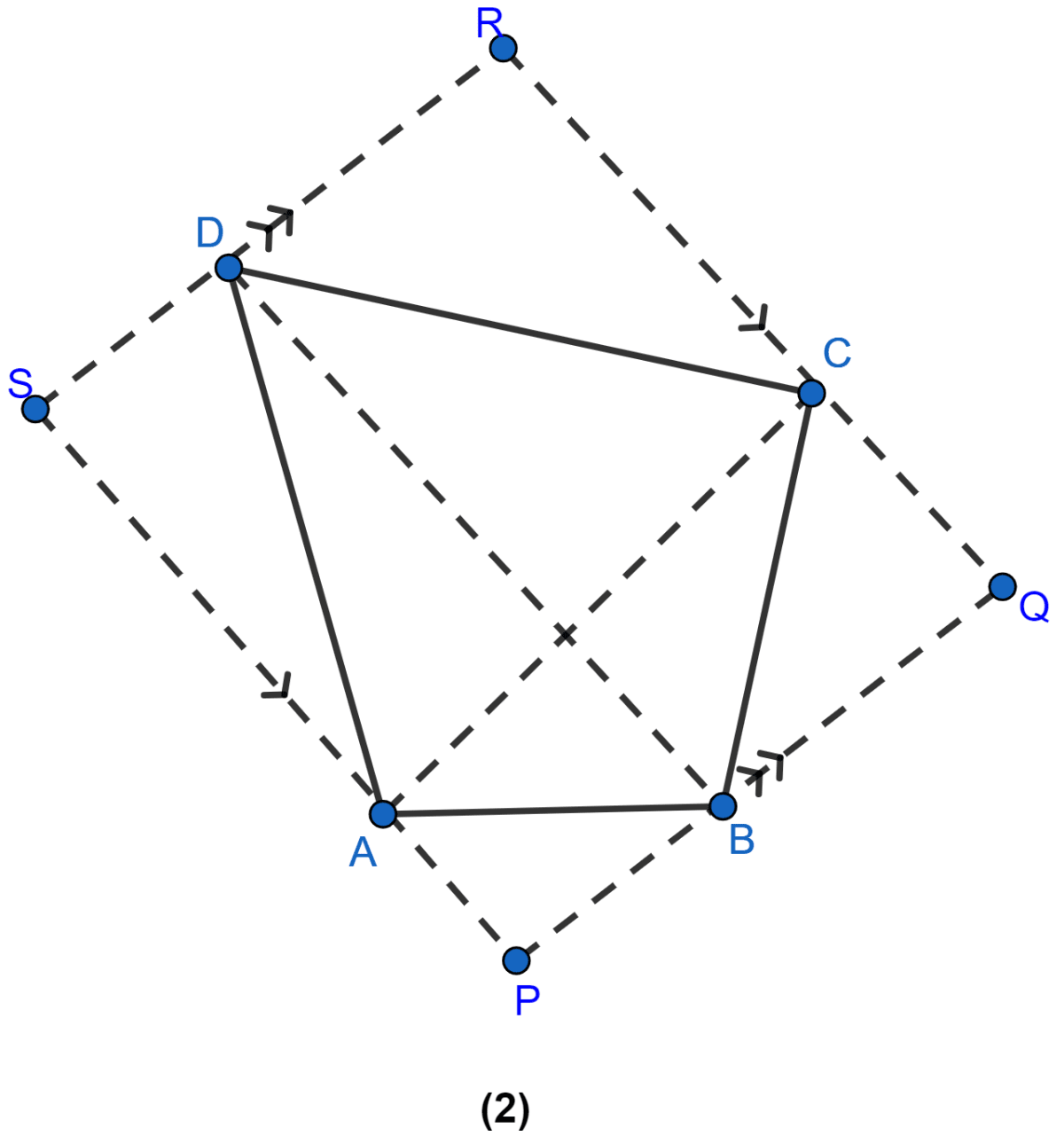
In the figure (2) given below, PQRS is a parallelogram formed by drawing lines parallel to the diagonals of a quadrilateral ABCD through its corners. Prove that area of || gm PQRS = 2 × area of quad. ABCD.
Answer
From figure,
Area of ∆ACD = Area of || gm ACRS [As both are on same base AC and between the same parallel lines AC and SR]
⇒ Area of || gm ACRS = 2 Area of ∆ACD .......(i)
Similarly,
Area of ∆ABC = Area of || gm ∆APQC [As both are on same base AC and between the same parallel lines AC and PQ]
⇒ Area of || gm APQC = 2 Area of ∆ABC .......(ii)
Adding (i) and (ii),
⇒ Area of || gm ACRS + Area of || gm APQC = 2 Area of ∆ACD + 2 Area of ∆ABC
⇒ Area of || gm PQRS = 2[Area of ∆ACD + Area of ∆ ABC]
⇒ Area of || gm PQRS = 2(Area of quad. ABCD)
Hence, proved that area of || gm PQRS = 2 x area of quad. ABCD.
In the parallelogram ABCD, P is a point on the side AB and Q is a point on the side BC. Prove that
(i) area of ∆CPD = area of ∆AQD
(ii) area of ∆ADQ = area of ∆APD + area of ∆CPB.
Answer
Parallelogram ABCD with point P on the side AB and Q on the side BC is shown below:

∆CPD and || gm ABCD are on the same base CD and between the same parallels lines AB and CD.
∴ Area of ∆CPD = Area of || gm ABCD ......(1)
∆AQD and || gm ABCD are on the same base AD and between the same parallel lines AD and BC,
∴ Area of ∆AQD = Area of || gm ABCD .......(2)
From (1) and (2),
Area of ∆CPD = Area of ∆AQD.
Hence, proved that area of ∆CPD = area of ∆AQD.
(ii) From part (i) we get,
Area of ∆CPD = Area of || gm ABCD
∴ Area of || gm ABCD - Area of ∆CPD = Area of || gm ABCD ........(3)
From figure,
Area of || gm ABCD - Area of ∆CPD = Area of ∆APD + Area of ∆CPB .........(4)
From (3) and (4) we get,
⇒ Area of ∆APD + Area of ∆CPB = Area of || gm ABCD
Since,
Area of ∆ADQ = Area of || gm ABCD (From eq 2)
⇒ Area of ∆APD + Area of ∆CPB = Area of ∆ADQ.
Hence, proved that area of ∆ADQ = area of ∆APD + area of ∆CPB.
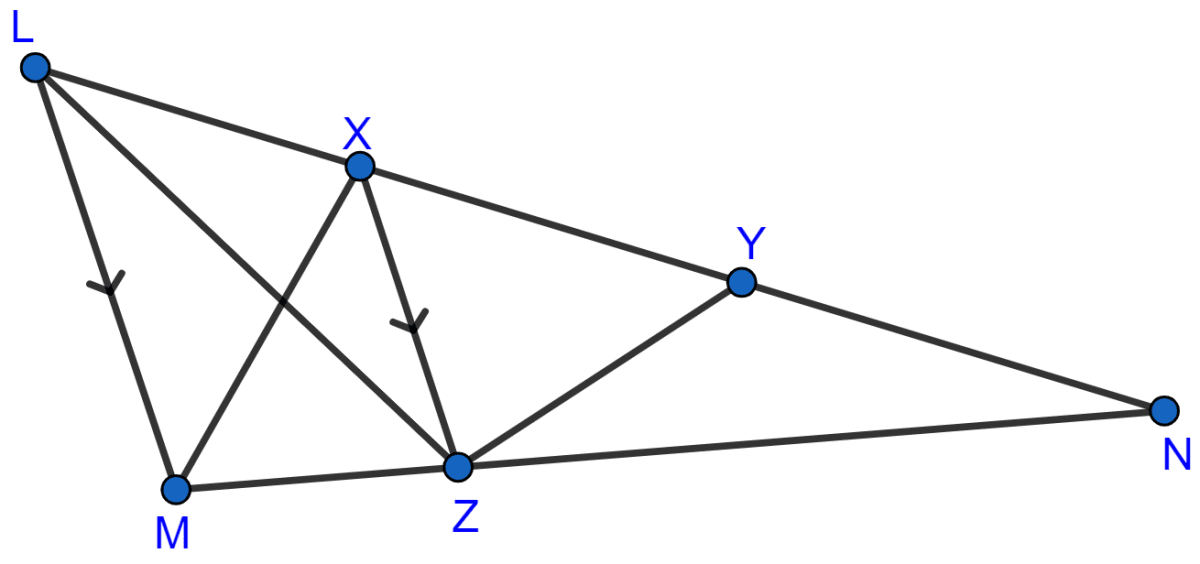
In the adjoining figure, X and Y are points on the side LN of triangle LMN. Through X, a line is drawn parallel to LM to meet MN at Z. Prove that area of ∆LZY = area of quad. MZYX.
Answer
From figure,
∆LZX and ∆MZX are on the same base XZ and between the same parallel lines LM and XZ.
∴ Area of ∆LZX = Area of ∆MZX
Adding area ∆XZY to both sides of the above equation we get,
⇒ area of ∆LZX + area ∆XZY = area ∆MZX + area ∆XZY
From figure,
∆LZX + ∆XZY = ∆LZY and ∆MZX + ∆XZY = MZYX.
∴ Area of ∆LZY = Area of quadrilateral MZYX.
Hence, proved that area of ∆LZY = area of quadrilateral MZYX.
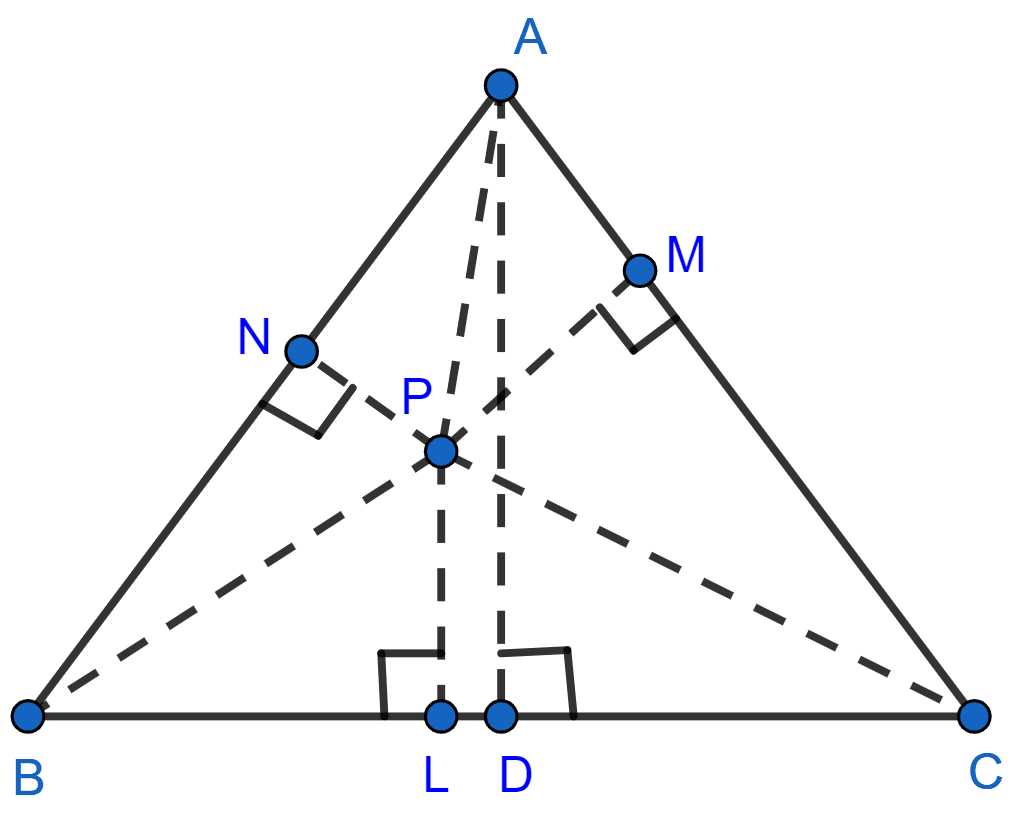
Perpendiculars are drawn from a point within an equilateral triangle to the three sides. Prove that the sum of the three perpendiculars is equal to the altitude of the triangle.
Answer
Since, ABC is an equilateral triangle. Let each side be x cm.
PN, PM, and PL are perpendicular on side AB, AC and BC respectively. AD is any altitude from point A on side BC.
Join PA, PB and PC.
Area of ∆ABC = × Base × Altitude
= ........(1)
Area of ∆APB = × AB × NP ........(2)
Area of ∆APC = × AC × MP ........(3)
Area of ∆BPC = × BC × LP ........(4)
Adding (2), (3) and (4)
⇒ Area of (∆APB + ∆APC + ∆BPC) = × (AB × NP + AC × MP + BC × LP)
From figure,
∴ Area of ∆ABC = [NP + MP + LP] .......(5)
From (1) and (5),
× AD = × (NP + LP + MP)
⇒ AD = NP + LP + MP.
Hence, proved that the sum of three perpendiculars is equal to the altitude of the triangle.
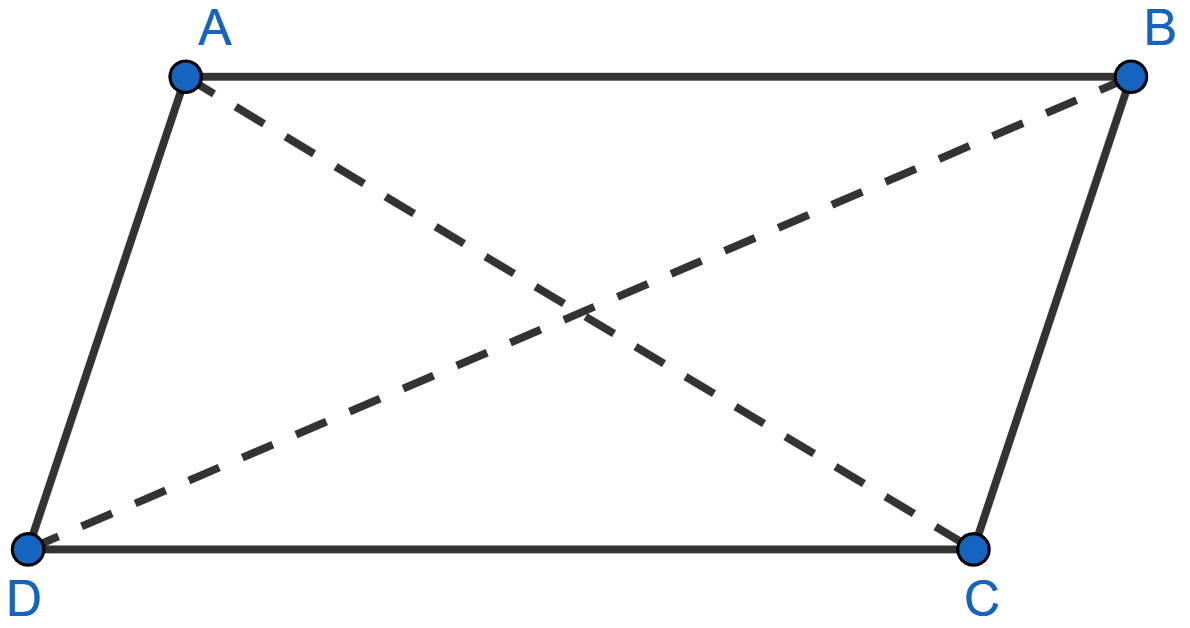
If each diagonal of a quadrilateral divides it into two triangles of equal areas, then prove that the quadrilateral is a parallelogram.
Answer
Let ABCD be a quadrilateral such that each diagonal divides it into triangles of equal areas, then
area of △ABC = Area of ABCD, .......(1)
area of △ABD = Area of ABCD, ......(2)
area of △BCD = Area of ABCD, .......(3)
We know that,
Triangles on the same base and having equal areas lie between the same parallel lines.
From (1) and (2) we get,
Area of △ABC = Area of △ABD.
Since, △ABC and △ABD lie on same base AB and have equal area.
So, AB || CD.
From (1) and (3) we get,
∴ Area of △ABC = Area of △BCD.
Since, △ABC and △BCD lie on same base BC and have equal area.
So, BC || AD.
Since, AB || CD and BC || AD.
Hence, proved ABCD is a parallelogram.
In the adjoining figure, ABCD is a parallelogram in which BC is produced to E such that CE = BC. AE intersects CD at F. If area of ∆DFB = 3 cm2, find the area of parallelogram ABCD.

Answer
From figure,

BE is a straight line.
Since, BC || AD,
∴ CE || AD.
Hence, ACED is a parallelogram.
Diagonals AE and DC of || ACED bisect each other, so F is mid-point of DC.
So, BF is median of △BDC.
Since, median divides triangle into two triangles with equal areas.
∴ area of △BFC = area of △DFB = 3 cm2.
area of △BDC = area of △BFC + area of △DFB = 6 cm2.
From figure,
⇒ area of △BDC = area of || gm ABCD (As || gm ABCD and △BDC lie on same base CD and between same parallel lines AB and CD.)
⇒ 6 = area of || gm ABCD
⇒ area of || gm ABCD = 12 cm2.
Hence, area of || gm ABCD = 12 cm2.
In the adjoining figure, ABCD is a square. E and F are mid-points of sides BC and CD respectively. If R is mid-point of EF, prove that:
area of ∆AER = area of ∆AFR

Answer
In ∆ABE and ∆ADF,
AB = AD (Sides of a square)
∠B = ∠D (Each angle of a square = 90°)
BE = DF (E is mid-point of BC and F is mid-point of DC)
∴ ∆ABE ≅ ∆ADF (SAS axiom)
∴ AE = AF (c.p.c.t.)
Again in ∆AER and ∆AFR
AE = AF (Proved above)
AR = AR (Common)
ER = FR (R is mid-point of EF)
∴ ∆AER ≅ ∆AFR (SSS axiom)
∴ Area of ∆AER = Area of ∆AFR
Hence, proved that area of ∆AER = area of ∆AFR.
In the adjoining figure, X and Y are mid-points of the sides AC and AB respectively of ∆ABC. QP || BC and CYQ and BXP are straight lines. Prove that area of ∆ABP = area of ∆ACQ.
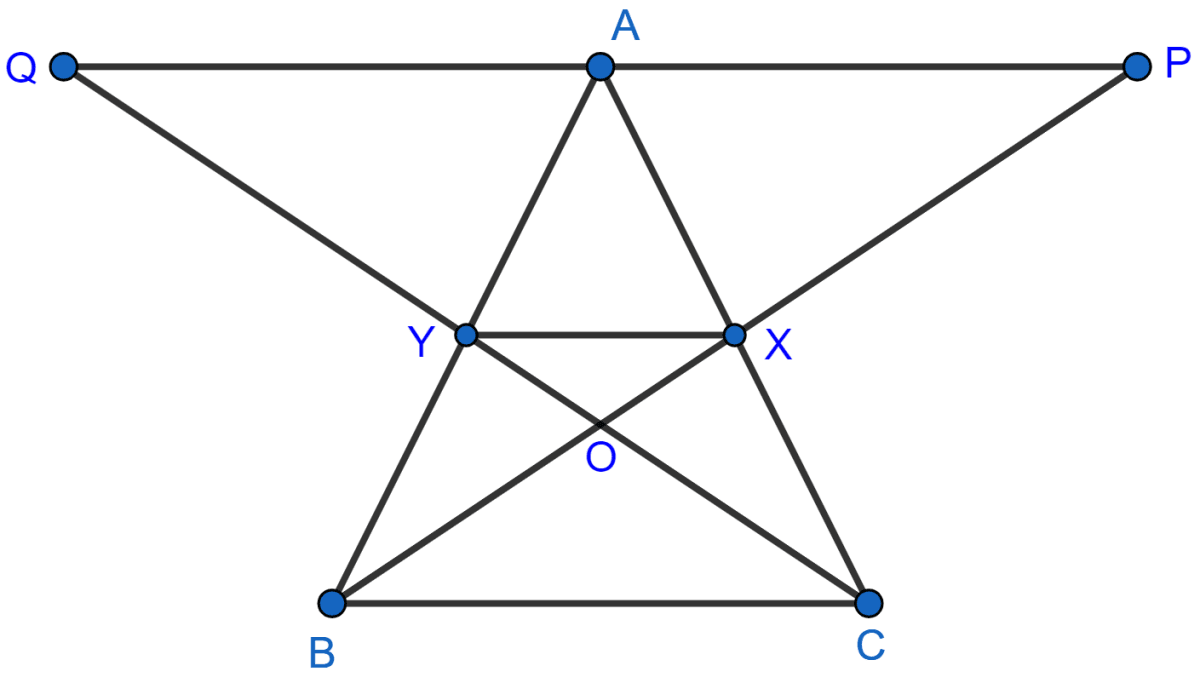
Answer
X and Y are the mid-points of sides AC and AB respectively.
Since, X and Y are midpoints of AC and AB respectively.
In ∆ABC,
XY || BC (By midpoint theorem).
Given, QP || BC
∴ QP || BC || XY
In ∆BAP, Y is mid of AB and XY || AP
∴ X is mid-point of BP (Converse of mid-point theorem)
∴ XY = AP .......(1)
Similarly we can prove in ∆AQC
X is mid-point of AC and XY is parallel to QA
∴ Y is mid-point of QC (Converse of mid-point theorem)
XY = QA .......(2)
From (1) and (2),
⇒
⇒ QA = AP.
Thus, ∆ABP and ∆ACQ are on the equal bases (QA = AP) and between the same parallel lines BC and QP
∴ Area of ∆ABP = Area of ∆ACQ.
Hence, proved that Area of ∆ABP = Area of ∆ACQ.