
In a △ABC, if AB = cm, BC = 6 cm and AC = 12 cm, then ∠B is
120°
90°
60°
45°
Answer
Here greatest length is 12 cm and other lengths are 6 cm, cm.

Note that 122 = 144 and 62 + = 36 + 108 = 144.
Thus, 122 = 62 + .
Hence, ABC is right triangle with hypotenuse = AC = 12 cm.
So, angle opposite to AC i.e. ∠B = 90°.
Hence, Option 2 is the correct option.
If the sides of a rectangular plot are 15 m and 8 m, then the length of its diagonal is
17 m
23 m
21 m
17 cm
Answer
As sides of rectangle are perpendicular to each other so △ABC is a right angle triangle.

In right angle triangle ABC,
⇒ AC2 = AB2 + BC2
⇒ AC2 = 82 + 152
⇒ AC2 = 64 + 225
⇒ AC2 = 289
⇒ AC = = 17 m.
Hence, Option 1 is the correct option.
The lengths of the diagonals of a rhombus are 16 cm and 12 cm. The length of the side of rhombus is
9 cm
10 cm
8 cm
20 cm
Answer
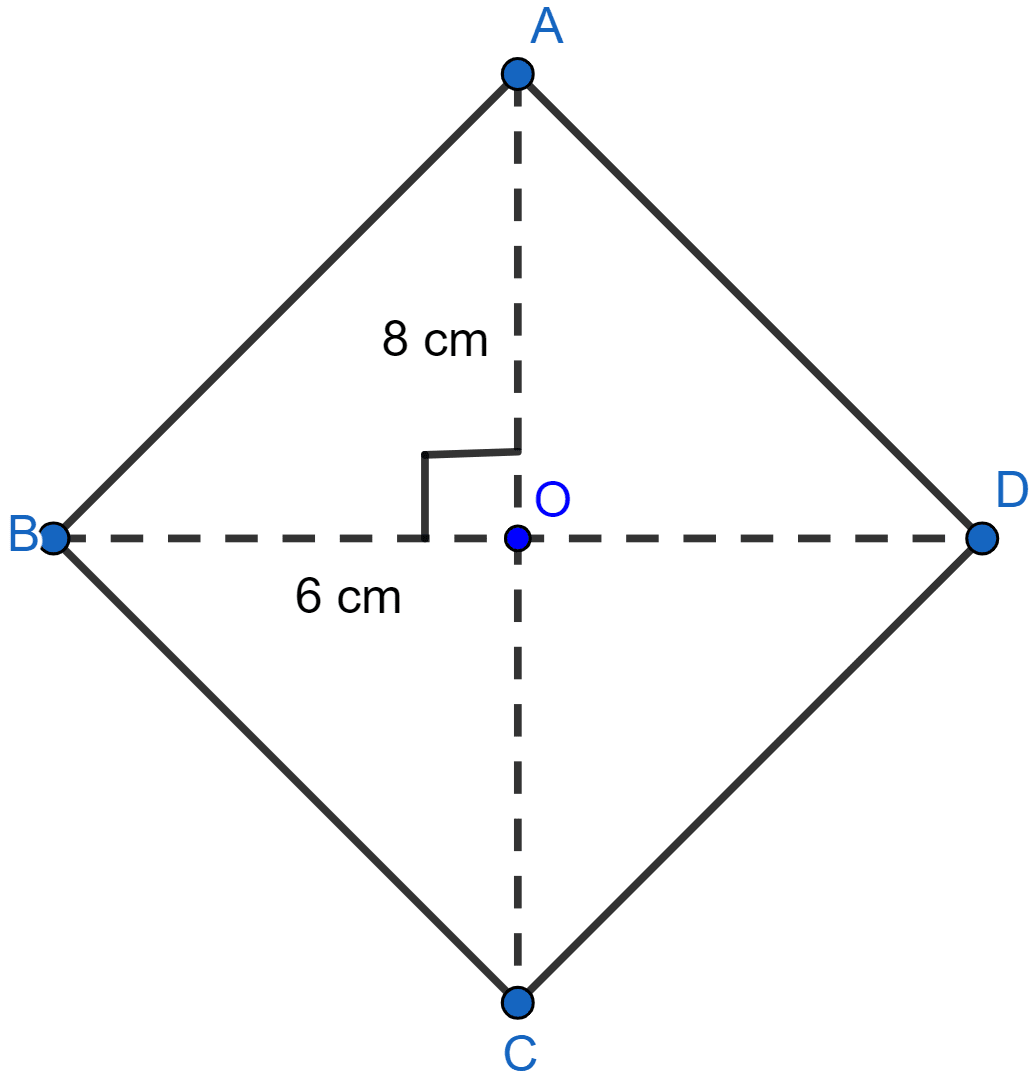
Let AC = 16 cm and BD = 12 cm.
We know that,
Diagonals of rhombus are perpendicular and bisect each other,
OB = = 6 cm and AO = AC = 8 cm.
In right triangle AOB,
By pythagoras theorem we get,
⇒ AB2 = AO2 + OB2
⇒ AB2 = 82 + 62
⇒ AB2 = 64 + 36
⇒ AB2 = 100
⇒ AB = = 10 cm.
Hence, Option 2 is the correct option.
If a side of a rhombus is 10 cm and one of the diagonals is 16 cm, then the length of the other diagonal is
6 cm
12 cm
20 cm
12 cm
Answer
Let AC = 16 cm.

We know that,
Diagonals of rhombus are perpendicular and bisect each other,
AO = AC = 8 cm.
In right triangle AOB,
By pythagoras theorem we get,
⇒ AB2 = AO2 + OB2
⇒ 102 = 82 + OB2
⇒ 100 = 64 + OB2
⇒ OB2 = 100 - 64 = 36
⇒ OB = = 6 cm.
BD = 2OB = 12 cm.
Hence, Option 2 is the correct option.
If a ladder 10 m long reaches a window 8 m above the ground, then the distance of the foot of the ladder from the base of the wall is
18 m
8 m
6 m
4 m
Answer
Let AB be the ladder and B be the point of window.

In right triangle ACB,
By pythagoras theorem,
⇒ AB2 = AC2 + BC2
⇒ 102 = AC2 + 82
⇒ AC2 = 100 - 64
⇒ AC2 = 36
⇒ AC = = 6 m.
Hence, Option 3 is the correct option.
A girl walks 200 m towards East and then she walks 150 m towards North. The distance of the girl from starting point is
350 m
250 m
300 m
225 m
Answer
Let A be starting point and B is the end point.

In right triangle ACB,
By pythagoras theorem we get,
AB2 = AC2 + CB2
AB2 = (200)2 + (150)2
AB2 = 40000 + 22500
AB2 = 62500
AB = = 250 m.
Hence, Option 2 is the correct option.
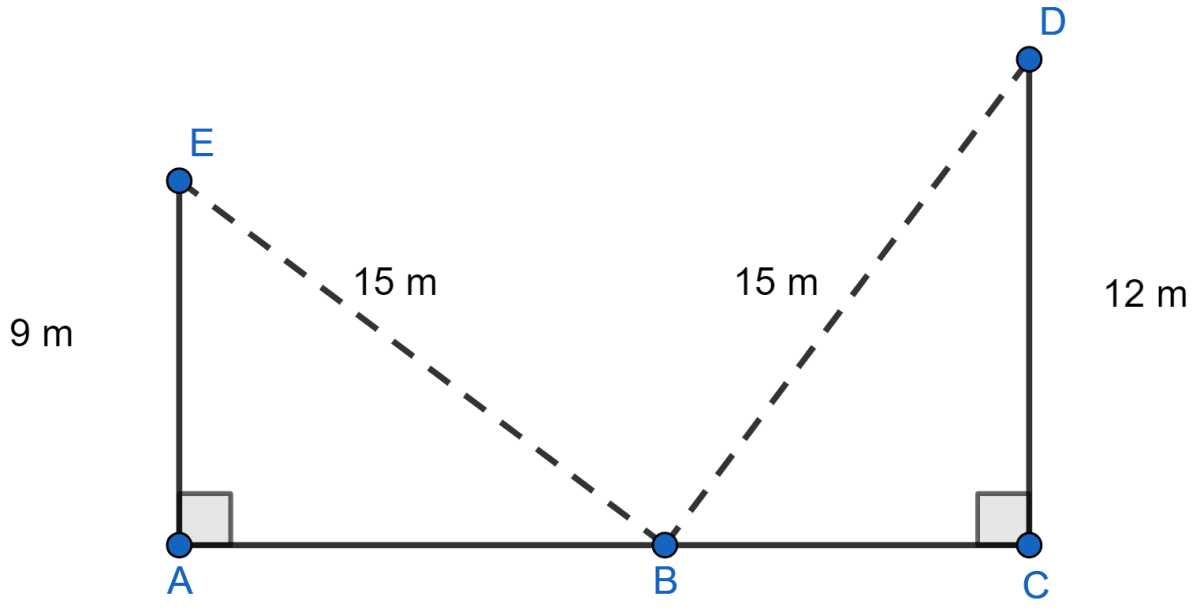
A ladder reaches a window 12 m above the ground on one side of the street. Keeping its foot at the same point, the ladder is turned to the other side of the street to reach a window 9 m high. If the length of the ladder is 15 m, then the width of the street is
30 m
24 m
21 m
18 m
Answer
In right triangle AEB,
By pythagoras theorem we get,
⇒ EB2 = EA2 + AB2
⇒ 152 = 92 + AB2
⇒ 225 = 81 + AB2
⇒ AB2 = 144
⇒ AB = = 12 m
In right triangle BCD,
By pythagoras theorem we get,
⇒ BD2 = BC2 + CD2
⇒ 152 = BC2 + 122
⇒ 225 = BC2 + 144
⇒ 225 - 144 = BC2
⇒ BC2 = 81
⇒ BC = = 9 m
⇒ AC = AB + BC = 12 + 9 = 21 m.
Hence, Option 3 is the correct option.
Consider the following two statements:
Statement 1: The area of a square whose diagonal is 6 cm is 36 cm2.
Statement 2: A diagonal of a square divides it into two right angled isosceles triangle.
Which of the following is valid?
Both the statements are true.
Both the statements are false.
Statement 1 is true, and Statement 2 is false.
Statement 1 is false, and Statement 2 is true.
Answer
Let's consider a square ABCD with diagonal AC.
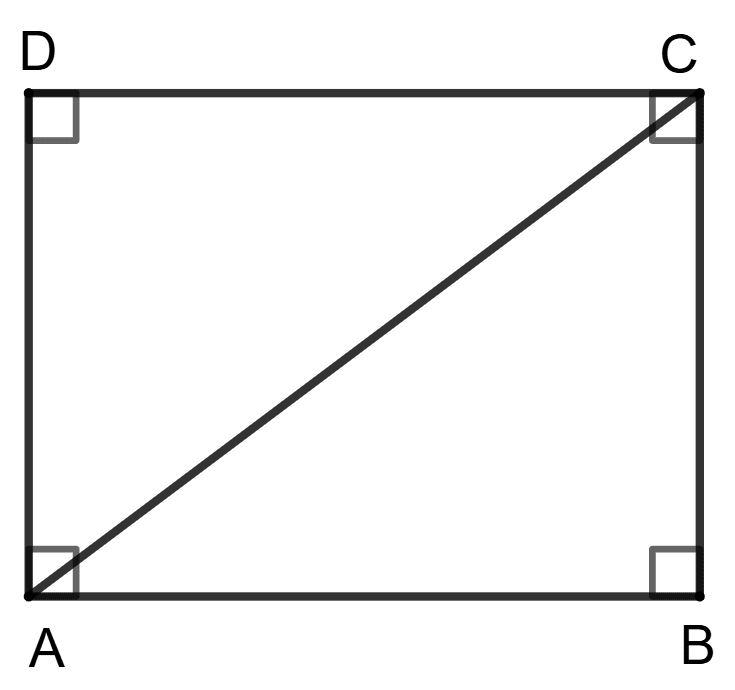
A square is a quadrilateral with four right angles.
Therefore, ∠A = ∠B = ∠C = ∠D = 90°.
AC divides the square into two triangles: △ABC and △ADC.
Both these triangles contain a right angle (at B and D respectively). Thus, they are right-angled triangles.
A square has all four sides equal in length. So, AB = BC = CD = DA.
In △ABC, the two sides AB and BC are equal (sides of the square).
In △ADC, the two sides AD and CD are equal (sides of the square).
Thus, AC divides the square into two right angled isosceles triangles.
∴ Statement 2 is true.
In triangle ABC,
By the Pythagorean theorem:
⇒ AC2 = AB2 + BC2
Let length of each side of square be a cm and length of diagonal equal to 6 cm (given).
⇒ 62 = a2 + a2
⇒ 36 = 2a2
⇒ a2 = = 18 cm2
As we know that area of square = a2
Thus, area = 18 cm2.
∴ Statement 1 is false.
∴ Statement 1 is false, and Statement 2 is true.
Hence, option 4 is the correct option.