Locate 10 \sqrt{10} 10 17 \sqrt{17} 17
Answer
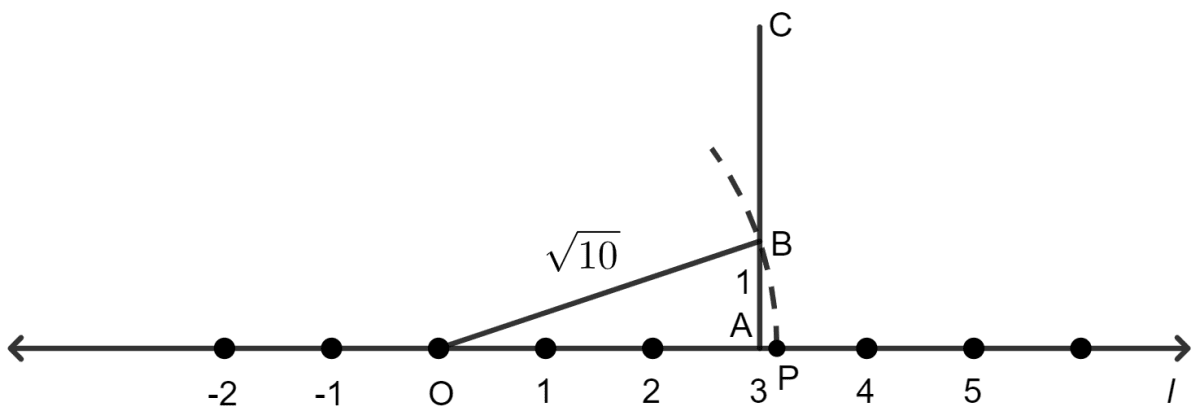
Locating 10 \sqrt{10} 10
Representing 10 as the sum of squares of two natural numbers:
10 = 9 + 1 = 32 + 12
Let l be the number line. If point O represents number 0 and point A represents number 3, then draw a line segment OA = 3 units.
At A, draw AC ⟂ OA. From AC, cut off AB = 1 unit.
We observe that OAB is a right angled triangle at A. By Pythagoras theorem, we get:
O B 2 = O A 2 + A B 2 ⇒ O B 2 = 3 2 + 1 2 ⇒ O B 2 = 9 + 1 ⇒ O B 2 = 10 ⇒ O B = 10 units OB^2 = OA^2 + AB^2 \\[0.5em] \Rightarrow OB^2 = 3^2 + 1^2 \\[0.5em] \Rightarrow OB^2 = 9 + 1 \\[0.5em] \Rightarrow OB^2 = 10 \\[0.5em] \Rightarrow OB = \sqrt{10} \text{ units} \\[0.5em] O B 2 = O A 2 + A B 2 ⇒ O B 2 = 3 2 + 1 2 ⇒ O B 2 = 9 + 1 ⇒ O B 2 = 10 ⇒ OB = 10 units
With O as centre and radius = OB, we draw an arc of a circle to meet the number line l at point P.
As OP = OB = 10 \sqrt{10} 10 10 \sqrt{10} 10
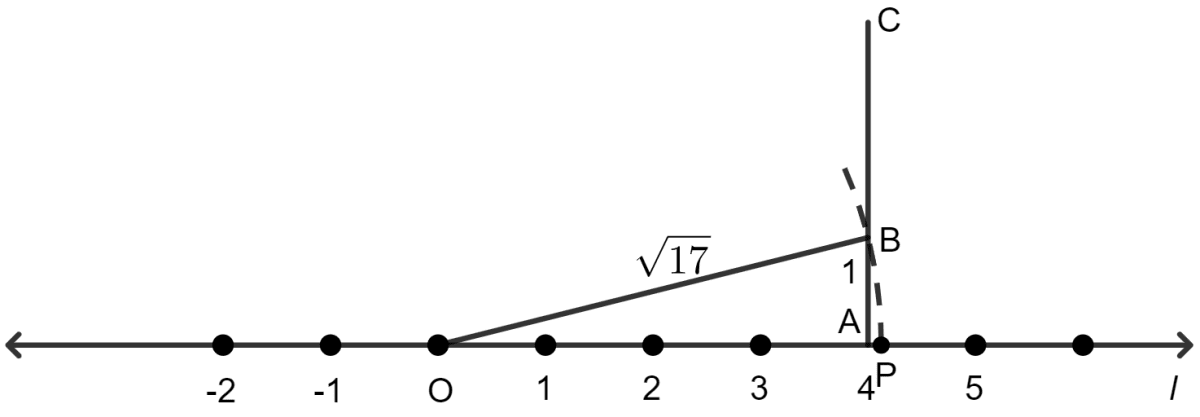
Locating 17 \sqrt{17} 17
Representing 17 as the sum of squares of two natural numbers:
17 = 16 + 1 = 42 + 12
Let l be the number line. If point O represents number 0 and point A represents number 4, then draw a line segment OA = 4 units.
At A, draw AC ⟂ OA. From AC, cut off AB = 1 unit.
We observe that OAB is a right angled triangle at A. By Pythagoras theorem, we get:
O B 2 = O A 2 + A B 2 ⇒ O B 2 = 4 2 + 1 2 ⇒ O B 2 = 16 + 1 ⇒ O B 2 = 17 ⇒ O B = 17 units OB^2 = OA^2 + AB^2 \\[0.5em] \Rightarrow OB^2 = 4^2 + 1^2 \\[0.5em] \Rightarrow OB^2 = 16 + 1 \\[0.5em] \Rightarrow OB^2 = 17 \\[0.5em] \Rightarrow OB = \sqrt{17} \text{units} \\[0.5em] O B 2 = O A 2 + A B 2 ⇒ O B 2 = 4 2 + 1 2 ⇒ O B 2 = 16 + 1 ⇒ O B 2 = 17 ⇒ OB = 17 units
With O as centre and radius = OB, we draw an arc of a circle to meet the number line l at point P.
As OP = OB = 17 \sqrt{17} 17 17 \sqrt{17} 17
Write the decimal expansion of each of the following numbers and say what kind of decimal expansion each has:
(i) 36 100 (ii) 4 1 8 (iii) 2 9 (iv) 2 11 (v) 3 13 (vi) 329 400 \begin{matrix} \text{(i)} & \dfrac{36}{100} \\[1.5em] \text{(ii)} & 4\dfrac{1}{8} \\[1.5em] \text{(iii)} & \dfrac{2}{9} \\[1.5em] \text{(iv)} & \dfrac{2}{11} \\[1.5em] \text{(v)} & \dfrac{3}{13} \\[1.5em] \text{(vi)} & \dfrac{329}{400} \\[1.5em] \end{matrix} (i) (ii) (iii) (iv) (v) (vi) 100 36 4 8 1 9 2 11 2 13 3 400 329
Answer
(i) 36 100 \text{(i) } \dfrac{36}{100} (i) 100 36
∴ 36 100 = 0.36 \therefore \dfrac{36}{100} = 0.36 ∴ 100 36 = 0.36
Remainder becomes zero.
Decimal expansion of 36 100 \bold{\dfrac{36}{100}} 100 36
(ii) 4 1 8 \text{(ii) } 4\dfrac{1}{8} (ii) 4 8 1
∴ 4 1 8 = 4.125 \therefore 4\dfrac{1}{8} = 4.125 ∴ 4 8 1 = 4.125
Remainder becomes zero.
Decimal expansion of 4 1 8 \bold{4\dfrac{1}{8}} 4 8 1
(iii) 2 9 \text{(iii) } \dfrac{2}{9} (iii) 9 2
∴ 2 9 = 0.2222..... = 0. 2 ‾ \therefore \dfrac{2}{9} = 0.2222..... = 0.\overline{2} ∴ 9 2 = 0.2222..... = 0. 2
Remainder is repeating.
Decimal expansion of 2 9 \bold{\dfrac{2}{9}} 9 2
(iv) 2 11 \text{(iv) } \dfrac{2}{11} (iv) 11 2
∴ 2 11 = 0.1818..... = 0. 18 ‾ \therefore \dfrac{2}{11} = 0.1818..... = 0.\overline{18} ∴ 11 2 = 0.1818..... = 0. 18
Remainder is repeating.
Decimal expansion of 2 11 \bold{\dfrac{2}{11}} 11 2
(v) 3 13 \text{(v) } \dfrac{3}{13} (v) 13 3
∴ 3 13 = 0.2307692307..... = 0. 230769 ‾ \therefore \dfrac{3}{13} = 0.2307692307..... = 0.\overline{230769} ∴ 13 3 = 0.2307692307..... = 0. 230769
Remainder is repeating.
Decimal expansion of 3 13 \bold{\dfrac{3}{13}} 13 3
(vi) 329 400 \text{(vi) } \dfrac{329}{400} (vi) 400 329
∴ 329 400 = 0.8225 \therefore \dfrac{329}{400} = 0.8225 ∴ 400 329 = 0.8225
Remainder becomes zero.
Decimal expansion of 329 400 \bold{\dfrac{329}{400}} 400 329
Without actually performing the long division, state whether the following rational numbers will have a terminating decimal expansion or a non-terminating repeating decimal expansion:
(i) 13 3125 (ii) 17 8 (iii) 23 75 (iv) 6 15 (v) 1258 625 (vi) 77 210 \begin{matrix} \text{(i)} & \dfrac{13}{3125} \\[1.5em] \text{(ii)} & \dfrac{17}{8} \\[1.5em] \text{(iii)} & \dfrac{23}{75} \\[1.5em] \text{(iv)} & \dfrac{6}{15} \\[1.5em] \text{(v)} & \dfrac{1258}{625} \\[1.5em] \text{(vi)} & \dfrac{77}{210} \\[1.5em] \end{matrix} (i) (ii) (iii) (iv) (v) (vi) 3125 13 8 17 75 23 15 6 625 1258 210 77
Answer
(i) 13 3125 \text{(i) } \dfrac{13}{3125} (i) 3125 13
The given number 13 3125 \dfrac{13}{3125} 3125 13
Prime factorization of denominator 3125:
5 3125 5 625 5 125 5 25 5 5 1 \begin{array}{l|l} 5 & 3125 \\ \hline 5 & 625 \\ \hline 5 & 125 \\ \hline 5 & 25 \\ \hline 5 & 5 \\ \hline & 1 \end{array} 5 5 5 5 5 3125 625 125 25 5 1
3125 = 5 x 5 x 5 x 5 x 5 x 15 x 15 0 x 55 [∵ 20 = 1]
Denominator is of the form 2m x 5n , where m, n are non-negative integers.
∴ The given number 13 3125 \dfrac{13}{3125} 3125 13
(ii) 17 8 \text{(ii) } \dfrac{17}{8} (ii) 8 17
The given number 17 8 \dfrac{17}{8} 8 17
Prime factorization of denominator 8:
2 8 2 4 2 2 1 \begin{array}{l|l} 2 & 8 \\ \hline 2 & 4 \\ \hline 2 & 2 \\ \hline & 1 \end{array} 2 2 2 8 4 2 1
8 = 2 x 2 x 2 x 13 x 13 x 50 [∵ 50 = 1]
Denominator is of the form 2m x 5n , where m, n are non-negative integers.
∴ The given number 17 8 \dfrac{17}{8} 8 17
(iii) 23 75 \text{(iii) } \dfrac{23}{75} (iii) 75 23
The given number 23 75 \dfrac{23}{75} 75 23
Prime factorization of denominator 75:
3 75 5 25 5 5 1 \begin{array}{l|l} 3 & 75 \\ \hline 5 & 25 \\ \hline 5 & 5 \\ \hline & 1 \end{array} 3 5 5 75 25 5 1
75 = 3 x 5 x 5 x 12 x 12 x 20 [∵ 20 = 1]
Denominator has a prime factor 3 other than 2 or 5.
∴ The given number 23 75 \dfrac{23}{75} 75 23
(iv) 6 15 \text{(iv) } \dfrac{6}{15} (iv) 15 6
Both numerator and denominator contain common factor 3. Reducing the number to its lowest form:
6 15 = 3 × 2 3 × 5 = 2 5 \dfrac{6}{15} = \dfrac{\cancel{3} \times 2}{\cancel{3} \times 5} \\[0.5em] = \dfrac{2}{5} 15 6 = 3 × 5 3 × 2 = 5 2
The Denominator 5 = 20 x 51
Denominator is of the form 2m x 5n , where m, n are non-negative integers.
∴ The given number 6 15 \dfrac{6}{15} 15 6
(v) 1258 625 \text{(v) } \dfrac{1258}{625} (v) 625 1258
The given number 1258 625 \dfrac{1258}{625} 625 1258
Prime factorization of denominator 625:
5 625 5 125 5 25 5 5 1 \begin{array}{l|l} 5 & 625 \\ \hline 5 & 125 \\ \hline 5 & 25 \\ \hline 5 & 5 \\ \hline & 1 \end{array} 5 5 5 5 625 125 25 5 1
625 = 5 x 5 x 5 x 5 x 14 x 14 0 x 54 [∵ 20 = 1]
Denominator is of the form 2m x 5n , where m, n are non-negative integers.
∴ The given number 1258 625 \dfrac{1258}{625} 625 1258
(vi) 77 210 \text{(vi) } \dfrac{77}{210} (vi) 210 77
Both numerator and denominator contain common factor 7. Reducing the number to its lowest form:
77 210 = 7 × 11 7 × 30 = 11 30 \dfrac{77}{210} = \dfrac{\cancel{7} \times 11}{\cancel{7} \times 30} \\[0.5em] = \dfrac{11}{30} 210 77 = 7 × 30 7 × 11 = 30 11
Prime factorization of denominator 30:
2 30 3 15 5 5 1 \begin{array}{l|l} 2 & 30 \\ \hline 3 & 15 \\ \hline 5 & 5 \\ \hline & 1 \end{array} 2 3 5 30 15 5 1
30 = 2 x 3 x 5
Denominator has a prime factor 3 other than 2 or 5.
∴ The given number 77 210 \dfrac{77}{210} 210 77
Without actually performing the long division, find if 987 10500 \dfrac{987}{10500} 10500 987
Answer
GCD of numerator and denominator is 21. Reducing the number to its lowest form:
987 10500 = 21 × 47 21 × 500 = 47 500 \dfrac{987}{10500} = \dfrac{\cancel{21} \times 47}{\cancel{21} \times 500} \\[0.5em] = \dfrac{47}{500} 10500 987 = 21 × 500 21 × 47 = 500 47
Prime factorization of denominator 500:
2 500 2 250 5 125 5 25 5 5 1 \begin{array}{l|l} 2 & 500 \\ \hline 2 & 250 \\ \hline 5 & 125 \\ \hline 5 & 25 \\ \hline 5 & 5 \\ \hline & 1 \end{array} 2 2 5 5 5 500 250 125 25 5 1
500 = 2 x 2 x 5 x 5 x 5 = 22 x 53
Denominator is of the form 2m x 5n , where m, n are non-negative integers.
∴ The given number 987 10500 \dfrac{987}{10500} 10500 987
Write the decimal expansions of the following numbers which have terminating decimal expansions:
(i) 17 8 (ii) 13 3125 (iii) 7 80 (iv) 6 15 (v) 2 2 × 7 5 4 (vi) 237 1500 \begin{matrix} \text{(i)} & \dfrac{17}{8} \\[1.5em] \text{(ii)} & \dfrac{13}{3125} \\[1.5em] \text{(iii)} & \dfrac{7}{80} \\[1.5em] \text{(iv)} & \dfrac{6}{15} \\[1.5em] \text{(v)} & \dfrac{2^2 \times 7}{5^4} \\[1.5em] \text{(vi)} & \dfrac{237}{1500} \\[1.5em] \end{matrix} (i) (ii) (iii) (iv) (v) (vi) 8 17 3125 13 80 7 15 6 5 4 2 2 × 7 1500 237
Answer
(i) 17 8 \text{(i) } \dfrac{17}{8} (i) 8 17
The given number 17 8 \dfrac{17}{8} 8 17
Prime factorization of denominator 8:
2 8 2 4 2 2 1 \begin{array}{l|l} 2 & 8 \\ \hline 2 & 4 \\ \hline 2 & 2 \\ \hline & 1 \end{array} 2 2 2 8 4 2 1
8 = 2 x 2 x 2 x 13 x 50 [∵ 50 = 1]
17 8 = 17 2 3 = 17 × 5 3 2 3 × 5 3 = 17 × 125 ( 2 × 5 ) 3 = 2125 10 3 = 2.125 ∴ 17 8 = 2.125 \dfrac{17}{8} = \dfrac{17}{2^3} \\[0.5em] = \dfrac{17 \times 5^3}{2^3 \times 5^3} \\[0.5em] = \dfrac{17 \times 125}{(2 \times 5)^3} \\[0.5em] = \dfrac{2125}{10^3} \\[0.5em] = 2.125 \\[0.5em] \bold{\therefore \dfrac{17}{8} = 2.125} 8 17 = 2 3 17 = 2 3 × 5 3 17 × 5 3 = ( 2 × 5 ) 3 17 × 125 = 1 0 3 2125 = 2.125 ∴ 8 17 = 2.125
(ii) 13 3125 \text{(ii) } \dfrac{13}{3125} (ii) 3125 13
The given number 13 3125 \dfrac{13}{3125} 3125 13
Prime factorization of denominator 3125:
5 3125 5 625 5 125 5 25 5 5 1 \begin{array}{l|l} 5 & 3125 \\ \hline 5 & 625 \\ \hline 5 & 125 \\ \hline 5 & 25 \\ \hline 5 & 5 \\ \hline & 1 \end{array} 5 5 5 5 5 3125 625 125 25 5 1
3125 = 5 x 5 x 5 x 5 x 5 x 15 x 15 0 x 55 [∵ 20 = 1]
13 3125 = 13 5 5 = 13 × 2 5 2 5 × 5 5 = 13 × 32 ( 2 × 5 ) 5 = 416 10 5 = 0.00416 ∴ 13 3125 = 0.00416 \dfrac{13}{3125} = \dfrac{13}{5^5} \\[0.5em] = \dfrac{13 \times 2^5}{2^5 \times 5^5} \\[0.5em] = \dfrac{13 \times 32}{(2 \times 5)^5} \\[0.5em] = \dfrac{416}{10^5} \\[0.5em] = 0.00416 \\[0.5em] \bold{\therefore \dfrac{13}{3125} = 0.00416} 3125 13 = 5 5 13 = 2 5 × 5 5 13 × 2 5 = ( 2 × 5 ) 5 13 × 32 = 1 0 5 416 = 0.00416 ∴ 3125 13 = 0.00416
(iii) 7 80 \text{(iii) } \dfrac{7}{80} (iii) 80 7
The given number 7 80 \dfrac{7}{80} 80 7
Prime factorization of denominator 80:
2 80 2 40 2 20 2 10 5 5 1 \begin{array}{l|l} 2 & 80 \\ \hline 2 & 40 \\ \hline 2 & 20 \\ \hline 2 & 10 \\ \hline 5 & 5 \\ \hline & 1 \end{array} 2 2 2 2 5 80 40 20 10 5 1
80 = 2 x 2 x 2 x 2 x 54 x 54 x 51
7 80 = 7 2 4 × 5 1 = 7 × 5 3 2 4 × 5 1 × 5 3 = 7 × 125 2 4 × 5 4 = 7 × 125 ( 2 × 5 ) 4 = 875 10 4 = 0.0875 ∴ 7 80 = 0.0875 \dfrac{7}{80} = \dfrac{7}{2^4 \times 5^1} \\[0.5em] = \dfrac{7 \times 5^3}{2^4 \times 5^1 \times 5^3} \\[0.5em] = \dfrac{7 \times 125}{2^4 \times 5^4} \\[0.5em] = \dfrac{7 \times 125}{(2 \times 5)^4} \\[0.5em] = \dfrac{875}{10^4} \\[0.5em] = 0.0875 \\[0.5em] \bold{\therefore \dfrac{7}{80} = 0.0875} 80 7 = 2 4 × 5 1 7 = 2 4 × 5 1 × 5 3 7 × 5 3 = 2 4 × 5 4 7 × 125 = ( 2 × 5 ) 4 7 × 125 = 1 0 4 875 = 0.0875 ∴ 80 7 = 0.0875
(iv) 6 15 \text{(iv) } \dfrac{6}{15} (iv) 15 6
GCD of numerator and denominator is 3. Reducing the number to its lowest form:
6 15 = 3 × 2 3 × 5 = 2 5 \dfrac{6}{15} = \dfrac{\cancel{3} \times 2}{\cancel{3} \times 5} \\[0.5em] = \dfrac{2}{5} 15 6 = 3 × 5 3 × 2 = 5 2
6 15 = 2 5 = 2 × 2 2 × 5 = 4 10 = 0.4 ∴ 6 15 = 0.4 \dfrac{6}{15} = \dfrac{2}{5} \\[0.5em] = \dfrac{2 \times 2}{2 \times 5} \\[0.5em] = \dfrac{4}{10} \\[0.5em] = 0.4 \\[0.5em] \bold{\therefore \dfrac{6}{15} = 0.4} 15 6 = 5 2 = 2 × 5 2 × 2 = 10 4 = 0.4 ∴ 15 6 = 0.4
(v) 2 2 × 7 5 4 \text{(v) } \dfrac{2^2 \times 7}{5^4} (v) 5 4 2 2 × 7
2 2 × 7 5 4 = 2 2 × 7 × 2 4 5 4 × 2 4 = 4 × 7 × 16 ( 2 × 5 ) 4 = 448 10 4 = 0.0448 ∴ 2 2 × 7 5 4 = 0.0448 \dfrac{2^2 \times 7}{5^4} = \dfrac{2^2 \times 7 \times 2^4}{5^4 \times 2^4} \\[0.5em] = \dfrac{4 \times 7 \times 16}{(2 \times 5)^4} \\[0.5em] = \dfrac{448}{10^4} \\[0.5em] = 0.0448 \\[0.5em] \bold{\therefore \dfrac{2^2 \times 7}{5^4} = 0.0448} 5 4 2 2 × 7 = 5 4 × 2 4 2 2 × 7 × 2 4 = ( 2 × 5 ) 4 4 × 7 × 16 = 1 0 4 448 = 0.0448 ∴ 5 4 2 2 × 7 = 0.0448
(vi) 237 1500 \text{(vi) } \dfrac{237}{1500} (vi) 1500 237
GCD of numerator and denominator is 3. Reducing the number to its lowest form:
237 1500 = 3 × 79 3 × 500 = 79 500 \dfrac{237}{1500} = \dfrac{\cancel{3} \times 79}{\cancel{3} \times 500} \\[0.5em] = \dfrac{79}{500} 1500 237 = 3 × 500 3 × 79 = 500 79
237 1500 = 79 500 = 79 × 2 500 × 2 = 158 10 3 = 0.158 ∴ 237 1500 = 0.158 \dfrac{237}{1500} = \dfrac{79}{500} \\[0.5em] = \dfrac{79 \times 2}{500 \times 2} \\[0.5em] = \dfrac{158}{10^3} \\[0.5em] = 0.158 \\[0.5em] \bold{\therefore \dfrac{237}{1500} = 0.158} 1500 237 = 500 79 = 500 × 2 79 × 2 = 1 0 3 158 = 0.158 ∴ 1500 237 = 0.158
Write the denominator of the rational number 257 5000 \dfrac{257}{5000} 5000 257 m × 5n where m, n are non-negative integers. Hence, write its decimal expansion without actual division.
Answer
The given number 257 5000 \dfrac{257}{5000} 5000 257
Prime factorization of denominator 5000:
2 5000 2 2500 2 1250 5 625 5 125 5 25 5 5 1 \begin{array}{l|l} 2 & 5000 \\ \hline 2 & 2500 \\ \hline 2 & 1250 \\ \hline 5 & 625 \\ \hline 5 & 125 \\ \hline 5 & 25 \\ \hline 5 & 5 \\ \hline & 1 \end{array} 2 2 2 5 5 5 5 5000 2500 1250 625 125 25 5 1
5000 = 2 x 2 x 2 x 5 x 5 x 5 x 53 x 54
Hence, denominator of rational number 257 5000 \dfrac{257}{5000} 5000 257 m × 5n is 23 x 54 where m = 3 and n = 4.
257 5000 = 257 2 3 × 5 4 = 257 × 2 2 3 × 5 4 × 2 = 514 2 4 × 5 4 = 514 ( 2 × 5 ) 4 = 514 10 4 = 0.0514 ∴ 257 5000 = 0.0514 \dfrac{257}{5000} = \dfrac{257}{2^3 \times 5^4} \\[0.5em] = \dfrac{257 \times 2}{2^3 \times 5^4 \times 2} \\[0.5em] = \dfrac{514}{2^4 \times 5^4} \\[0.5em] = \dfrac{514}{(2 \times 5)^4} \\[0.5em] = \dfrac{514}{10^4} \\[0.5em] = 0.0514 \\[0.5em] \bold{\therefore \dfrac{257}{5000} = 0.0514} 5000 257 = 2 3 × 5 4 257 = 2 3 × 5 4 × 2 257 × 2 = 2 4 × 5 4 514 = ( 2 × 5 ) 4 514 = 1 0 4 514 = 0.0514 ∴ 5000 257 = 0.0514
Write the decimal expansion of 1 7 \dfrac{1}{7} 7 1 2 7 \dfrac{2}{7} 7 2 3 7 \dfrac{3}{7} 7 3 4 7 \dfrac{4}{7} 7 4 5 7 \dfrac{5}{7} 7 5 6 7 \dfrac{6}{7} 7 6
Answer
The fraction : 1 7 \dfrac{1}{7} 7 1
Decimal expansion of 1 7 \dfrac{1}{7} 7 1 0. 142857 ‾ \bold{0.\overline{142857}} 0. 142857
Since, it is recurring
2 7 = 2 × 1 7 = 2 × 0. 142857 ‾ = 0. 285714 ‾ \dfrac{2}{7}=2\times\dfrac{1}{7}=2\times0.\overline{142857}=\bold{0.\overline{285714}} 7 2 = 2 × 7 1 = 2 × 0. 142857 = 0. 285714
3 7 = 3 × 1 7 = 3 × 0. 142857 ‾ = 0. 428571 ‾ \dfrac{3}{7}=3\times\dfrac{1}{7}=3\times0.\overline{142857}=\bold{0.\overline{428571}} 7 3 = 3 × 7 1 = 3 × 0. 142857 = 0. 428571
4 7 = 4 × 1 7 = 4 × 0. 142857 ‾ = 0. 571428 ‾ \dfrac{4}{7}=4\times\dfrac{1}{7}=4\times0.\overline{142857}=\bold{0.\overline{571428}} 7 4 = 4 × 7 1 = 4 × 0. 142857 = 0. 571428
5 7 = 5 × 1 7 = 5 × 0. 142857 ‾ = 0. 714285 ‾ \dfrac{5}{7}=5\times\dfrac{1}{7}=5\times0.\overline{142857}=\bold{0.\overline{714285}} 7 5 = 5 × 7 1 = 5 × 0. 142857 = 0. 714285
6 7 = 6 × 1 7 = 6 × 0. 142857 ‾ = 0. 857142 ‾ \dfrac{6}{7}=6\times\dfrac{1}{7}=6\times0.\overline{142857}=\bold{0.\overline{857142}} 7 6 = 6 × 7 1 = 6 × 0. 142857 = 0. 857142
Express the following numbers in the form p q \dfrac{p}{q} q p
(i) 0. 3 ‾ (ii) 5. 2 ‾ (iii) 0.404040... (iv) 0.4 7 ‾ (v) 0.1 34 ‾ (vi) 0. 001 ‾ \begin{matrix} \text{(i)} & 0.\overline{3} \\[1.5em] \text{(ii)} & 5.\overline{2} \\[1.5em] \text{(iii)} & 0.404040... \\[1.5em] \text{(iv)} & 0.4\overline{7} \\[1.5em] \text{(v)} & 0.1\overline{34} \\[1.5em] \text{(vi)} & 0.\overline{001} \\[1.5em] \end{matrix} (i) (ii) (iii) (iv) (v) (vi) 0. 3 5. 2 0.404040... 0.4 7 0.1 34 0. 001
Answer
(i) Let x = 0. 3 ‾ 0.\overline{3} 0. 3 ....(i) \qquad \text{....(i)} ....(i)
As there is one repeating digit after decimal point,
So multiplying both sides of (i) by 10
we get,
10x = 3.3333.......(ii) \qquad \text{....(ii)} ....(ii)
Subtracting (i) from (ii), we get
9x = 3
x = 3 9 \dfrac{3}{9} 9 3 1 3 \bold{\dfrac{1}{3}} 3 1
which is in the form of p q \dfrac{p}{q} q p
(ii) Let x = 5. 2 ‾ 5.\overline{2} 5. 2 ....(i) \qquad \text{....(i)} ....(i)
As there is one repeating digit after decimal point,
So multiplying both sides of (i) by 10
we get,
10x = 52.2222.......(ii) \qquad \text{....(ii)} ....(ii)
Subtracting (i) from (ii), we get
9x = 47
x = 47 9 \bold{\dfrac{47}{9}} 9 47
Which is in the form of p q \dfrac{p}{q} q p
(iii) Let x = 0. 40 ‾ 0.\overline{40} 0. 40 ....(i) \qquad \text{....(i)} ....(i)
As there are two repeating digit after decimal point,
So multiplying both sides of (i) by 100
we get,
100x = 40.4040.......(ii) \qquad \text{....(ii)} ....(ii)
Subtracting (i) from (ii), we get
99x = 40
x = 40 99 \bold{\dfrac{40}{99}} 99 40
Which is in the form of p q \dfrac{p}{q} q p
(iv) Let x = 0.4 7 ‾ 0.4\overline{7} 0.4 7 ....(i) \qquad \text{....(i)} ....(i)
As there is one repeating digit after decimal point ,
So multiplying both sides of (i) by 10
we get,
10x=4.7777.......(ii) \qquad \text{....(ii)} ....(ii)
Multiply by 100 on both sides
100x=47.77777.........(iii) \qquad \text{....(iii)} ....(iii)
subtracting (ii) from (iii), we get
100x-10x=47.7777.. -4.777...
90x= 43
x = 43 90 \bold{\dfrac{43}{90}} 90 43
Which is in the form of p q \dfrac{p}{q} q p
(v) Let x = 0.1 34 ‾ 0.1\overline{34} 0.1 34 ....(i) \qquad \text{....(i)} ....(i)
So multiplying both sides of (i) by 10
we get,
10x=1.343434.......(ii) \qquad \text{....(ii)} ....(ii)
Again multiply by 100 on both sides ,
1000x =134.3434.........(iii) \qquad \text{....(iii)} ....(iii)
Subtracting (ii) from (iii), we get
1000x - 10x = 134.3434... - 1.3434...
990x = 133
x = 133 990 \bold{\dfrac{133}{990}} 990 133
which is in the form of p q \dfrac{p}{q} q p
(vi) Let x = 0. 001 ‾ 0.\overline{001} 0. 001 ....(i) \qquad \text{....(i)} ....(i)
So multiplying both sides of (i) by 1000,
we get,
1000x = 1.001001.......(ii) \qquad \text{....(ii)} ....(ii)
Subtracting (i) from (ii), we get
1000x - x = 1.001001... - 0.001001...
999x = 1
x = 1 999 \bold{\dfrac{1}{999}} 999 1
which is in the form of p q \dfrac{p}{q} q p
Classify the following numbers as rational or irrational:
(i) 23 (ii) 225 (iii) 0.3796 (iv) 7.478478... (v) 1.101001000100001... (vi) 345.0 456 ‾ \begin{matrix} \text{(i)} & \sqrt{23} \\[1.5em] \text{(ii)} & \sqrt{225} \\[1.5em] \text{(iii)} & 0.3796 \\[1.5em] \text{(iv)} & 7.478478... \\[1.5em] \text{(v)} & 1.101001000100001... \\[1.5em] \text{(vi)} & 345.0\overline{456} \\[1.5em] \end{matrix} (i) (ii) (iii) (iv) (v) (vi) 23 225 0.3796 7.478478... 1.101001000100001... 345.0 456
Answer
Rational numbers are in the form c, q ≠ 0, and p and q are integers.
(i) 23 \bold{\sqrt{23}} 23 p q \dfrac{p}{q} q p
(ii) 225 \sqrt{225} 225 15 × 15 \sqrt{15×15} 15 × 15 15 1 \dfrac{15}{1} 1 15
As it can be written in the form p q \dfrac{p}{q} q p
∴ 225 \bold{\sqrt{225}} 225 .
(iii) 0.3796 = 3796 1000 \dfrac{3796}{1000} 1000 3796
Since, the decimal expansion is terminating decimal.
∴ 0.3796 is a rational number .
(iv) 7.478478
Let x = 7.478478 ....(i) \text{....(i)} ....(i)
Since there is three repeating digit after decimal point,
Multiplying both sides by 1000, we get
1000x = 7478.478478... ....(ii) \text{....(ii)} ....(ii)
Subtracting (i) from (ii) we get,
999x = 7471
x = 7471 999 \bold{\dfrac{7471}{999}} 999 7471
∴ It is non terminating , repeating rational number .
(v) 1.101001000100001...
Since number of 0's are increasing between two consecutive terms as we move further , So it is non terminating, non repeating decimal.
∴ 1.101001000100001... is an irrational number .
(vi) 345.0 456 ‾ 345.0\overline{456} 345.0 456
345.0 456 ‾ 345.0\overline{456} 345.0 456
Let x = 345.0456456...
Multiply both sides by 10, we get
10x = 3450.456456.. ....(i) \text{....(i)} ....(i)
Since, after decimal there are three repeating digit:
Multiply both sides by 1000, we get
10000x = 3450456.456456... ....(ii) \text{....(ii)} ....(ii)
Subtracting (i) from (ii) ,
9990x = 3447006
x = 3447006 9990 \bold{\dfrac{3447006}{9990}} 9990 3447006
since, it is non-terminating , repeating decimal.
∴ 345.0 456 ‾ \bold{345.0\overline{456}} 345.0 456
The following real numbers have decimal expansions as given below. In each case, state whether they are rational or not. If they are rational and expressed in the form p q \dfrac{p}{q} q p
(i) 37.09158 (ii) 423. 04567 ‾ (iii) 8.9010010001... (iv) 2.3476817681... \begin{matrix} \text{(i)} & 37.09158 \\[1.5em] \text{(ii)} & 423.\overline{04567}\\[1.5em] \text{(iii)} & 8.9010010001... \\[1.5em] \text{(iv)} & 2.3476817681... \\[1.5em] \end{matrix} (i) (ii) (iii) (iv) 37.09158 423. 04567 8.9010010001... 2.3476817681...
Answer
(i) 37.07158
This can be written as 37.09158 = 3709158 100000 \dfrac{3709158}{100000} 100000 3709158
Since , it is terminating decimal
It is Rational number and the prime factors of its denominator q will be 2 or 5 or both .
(ii) 423. 04567 ‾ 423.\overline{04567} 423. 04567
since it has non-terminating recurring decimal,
423. 04567 ‾ 423.\overline{04567} 423. 04567
It is a rational number which is non-terminating and repeating. Its denominator q will have prime factors other than 2 or 5 .
(iii) 8.9010010001...
Since, it is non-terminating non-repeating decimal number
∴ It is not a Rational number .
(iv) 2.3476817681... = 2.34 7681 ‾ 2.34\overline{7681} 2.34 7681
Since, it is a non-terminating repeating decimal number,
∴ It is a Rational number and its denominator q will have prime factors other than 2 or 5.
Insert an irrational number between the following :
(i) 1 3 \dfrac{1}{3} 3 1 1 2 \dfrac{1}{2} 2 1
(ii) − 2 5 -\dfrac{2}{5} − 5 2 1 2 \dfrac{1}{2} 2 1
(iii) 0 and 0.1
Answer
(i) One irrational number between 1 3 \dfrac{1}{3} 3 1 1 2 \dfrac{1}{2} 2 1
1 3 \dfrac{1}{3} 3 1
1 2 \dfrac{1}{2} 2 1
So there are infinite irrational number between 1 3 \dfrac{1}{3} 3 1 1 2 \dfrac{1}{2} 2 1
One irrational number among them can be 0.4040040004... \bold{0.4040040004...} 0.4040040004...
(ii) One irrational number between − 2 5 -\dfrac{2}{5} − 5 2 1 2 \dfrac{1}{2} 2 1
− 2 5 -\dfrac{2}{5} − 5 2
1 2 \dfrac{1}{2} 2 1
So, there are infinite irrational numbers between − 2 5 -\dfrac{2}{5} − 5 2 1 2 \dfrac{1}{2} 2 1
One irrational number among them can be 0.2020020002... \bold{0.2020020002...} 0.2020020002...
(iii) One irrational number among 0 and 0.1 , can be 0.050050005... \bold{0.050050005...} 0.050050005...
Insert two irrational number between 2 and 3.
Answer
Consider, the squares ( 2 ) 2 (2)^2 ( 2 ) 2 ( 3 ) 2 (3)^2 ( 3 ) 2
Two irrational numbers can be te squares root of any natural number between 4 and 9.
As, As, 4 < 5 < 6 < 9 4 \lt 5 \lt 6\lt 9 4 < 5 < 6 < 9
4 < 5 < 6 < 9 \sqrt{4} \lt \sqrt{5} \lt \sqrt{6} \lt \sqrt{9} 4 < 5 < 6 < 9
therefore , 5 \sqrt{5} 5 6 \sqrt{6} 6
2 < 5 < 6 < 3 2 \lt \sqrt{5} \lt \sqrt{6} \lt \\ 3 2 < 5 < 6 < 3
Hence, two irrational number between 2 and 3 or 4 \sqrt{4} 4 9 \sqrt{9} 9 5 \sqrt{5} 5 6 \sqrt{6} 6 .
Write two irrational numbers between 4 9 \dfrac{4}{9} 9 4 7 11 \dfrac{7}{11} 11 7
Answer
4 9 \dfrac{4}{9} 9 4
7 11 \dfrac{7}{11} 11 7
So, two irrational number between 4 9 \dfrac{4}{9} 9 4 7 11 \dfrac{7}{11} 11 7
Find a rational number between 2 \sqrt{2} 2 3 \sqrt{3} 3
Answer
Consider the squares of 2 \sqrt{2} 2 3 \sqrt{3} 3
( 2 ) 2 {(\sqrt2)^2} ( 2 ) 2 ( 3 ) 2 {(\sqrt3)^2} ( 3 ) 2
Take any rational number between 2 and 3 which is a perfect squares of a rational number,
One such number is 2.25 and
2.25 = ( 1.5 ) 2 (1.5)^2 ( 1.5 ) 2
2.25 \sqrt{2.25} 2.25
As, 2 < 2.25 < 3 2 \lt 2.25 \lt 3 2 < 2.25 < 3
2 < 2.25 < 3 \sqrt{2} \lt \sqrt{2.25} \lt \sqrt{3} 2 < 2.25 < 3
2 < 1.5 < 3 \sqrt{2} \lt 1.5 \lt \sqrt{3} 2 < 1.5 < 3
Hence , one rational number between 2 \sqrt{2} 2 3 \sqrt{3} 3 .
Find two rational numbers between 2 3 2\sqrt{3} 2 3 15 \sqrt{15} 15
Answer
2 3 2\sqrt{3} 2 3 4 × 3 \sqrt{4 × 3} 4 × 3 12 \sqrt{12} 12
So, we need to find two irrational number between 12 \sqrt{12} 12 15 \sqrt{15} 15
Since , 12 < 12.25 < 12.96 < 15 ⇒ 12 < 12.25 < 12.96 < 15 \text{Since}, 12 \lt 12.25 \lt 12.96 \lt 15 \\[0.5em] \Rightarrow \sqrt{12} \lt \sqrt{12.25} \lt \sqrt{12.96} \lt \sqrt{15} Since , 12 < 12.25 < 12.96 < 15 ⇒ 12 < 12.25 < 12.96 < 15
Hence, two rational number between 12 \sqrt{12} 12 15 \sqrt{15} 15 12.25 \bold{\sqrt{12.25}} 12.25 12.96 \bold{\sqrt{12.96}} 12.96 .
Insert an irrational number between 5 \sqrt{5} 5 7 \sqrt{7} 7
Answer
consider the squares of 5 \sqrt{5} 5 7 \sqrt{7} 7
( 5 ) 2 {(\sqrt5)^2} ( 5 ) 2 ( 7 ) 2 {(\sqrt7)^2} ( 7 ) 2
As, 5 < 6 < 7 5 \lt 6\lt 7 5 < 6 < 7
5 < 6 < 7 \sqrt{5} \lt \sqrt{6} \lt \sqrt{7} 5 < 6 < 7 6 \sqrt{6} 6 5 \sqrt{5} 5 7 \sqrt{7} 7
Hence, irrational number between 5 \sqrt{5} 5 7 \sqrt{7} 7 6 \bold{\sqrt{6}} 6 .
Insert two irrational numbers between 3 \sqrt{3} 3 7 \sqrt{7} 7
Answer
consider the squares of 3 \sqrt{3} 3 7 \sqrt{7} 7
( 3 ) 2 {(\sqrt3)^2} ( 3 ) 2 ( 7 ) 2 {(\sqrt7)^2} ( 7 ) 2
As, 3 < 5 < 6 < 7 3 \lt 5 \lt 6\lt 7 3 < 5 < 6 < 7
3 < 5 < 6 < 7 \sqrt{3} \lt \sqrt{5} \lt \sqrt{6} \lt \sqrt{7} 3 < 5 < 6 < 7 5 \sqrt{5} 5 6 \sqrt{6} 6 3 \sqrt{3} 3 7 \sqrt{7} 7
Hence, two irrational number between 3 \sqrt{3} 3 7 \sqrt{7} 7 5 \bold{\sqrt{5}} 5 6 \bold{\sqrt{6}} 6 .