
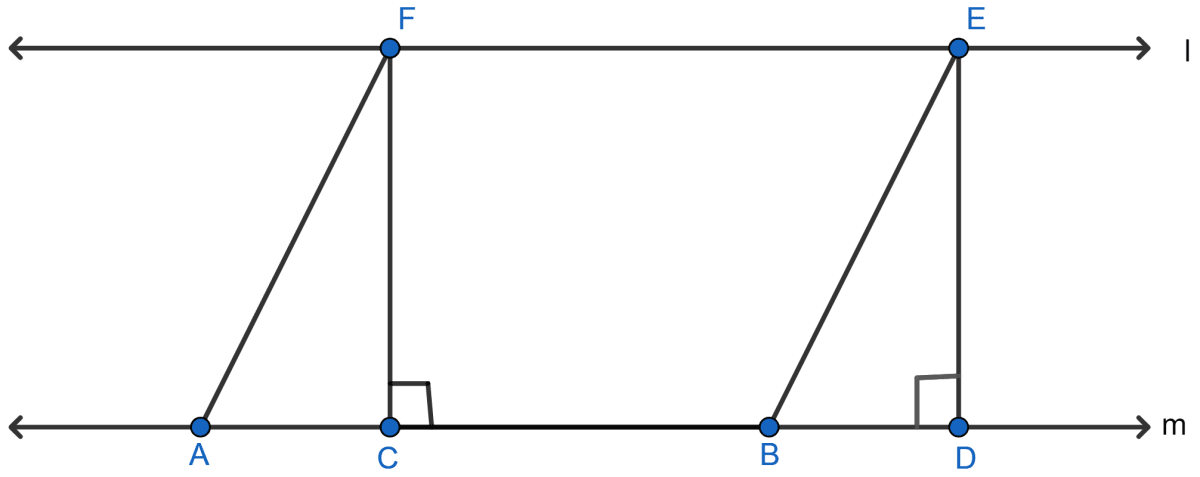
In the adjoining figure, if l || m, AF || BE, FC ⊥ m and ED ⊥ m, then the correct statement is
area of || ABEF = area of rect. CDEF
area of || ABEF = area of quad. CBEF
area of || ABEF = 2 area of △ACF
area of || ABEF = 2 area of △EBD
Answer
We know that,
A parallelogram and a rectangle on the same base and between the same parallel lines are equal in area.
Since, || ABEF and rectangle CDEF are on same base EF and between same parallel lines l and m.
∴ area of || ABEF = area of rect. CDEF.
Hence, Option 1 is the correct option.
Two parallelograms are on equal bases and between the same parallels. The ratio of their areas is
1 : 2
1 : 1
2 : 1
3 : 1
Answer
We know that,
Two parallelograms on equal bases and between the same parallel lines have equal areas.
So, ratio of their areas = 1 : 1.
Hence, Option 2 is the correct option.
If a triangle and a parallelogram are on the same base and between same parallels, then the ratio of area of the triangle to the area of parallelogram is
1 : 3
1 : 2
3 : 1
1 : 4
Answer
We know that,
Area of a triangle is half that of a parallelogram on the same base and between the same parallel lines.
Let area of parallelogram be x so area of triangle = .
Ratio of area of the triangle to the area of the parallelogram =
Hence, Option 2 is the correct option.
A median of a triangle divides it into two
triangles of equal area
congruent triangles
right triangles
isosceles triangles
Answer
A median of a triangle divides it into two triangles of equal area.
Hence, Option 1 is the correct option.
In the adjoining figure, area of parallelogram ABCD is
AB × BM
BC × BN
DC × DL
AD × DL

Answer
Area of || gm = base × height.
From figure,
Base = DC and Height = DL.
∴ Area of || gm = DC × DL.
Hence, Option 3 is the correct option.
The mid-points of the sides of a triangle along with any of the vertices as the fourth point make a parallelogram of area equal to
area of △ABC
area of △ABC
area of △ABC
area of △ABC
Answer
Let CDEF be a parallelogram.
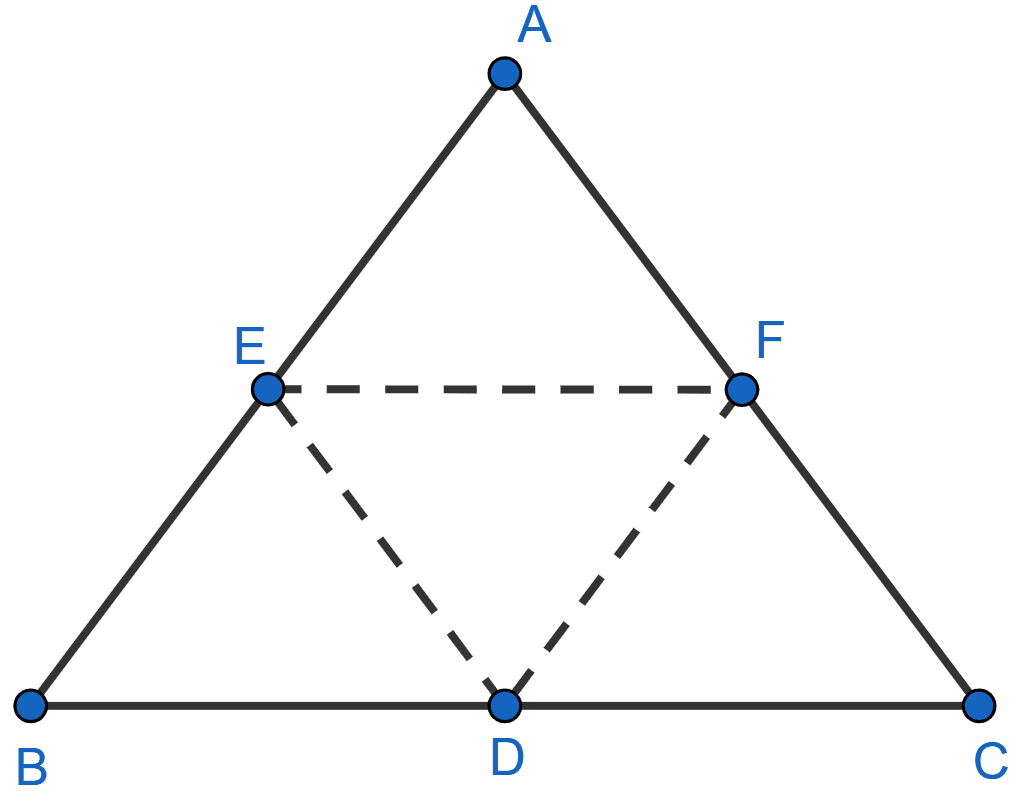
So, diagonal DF divides it into two triangles of equal area.
∴ area of △CDF = area of △EDF ........(i)
E and F are mid-points of side AB and AC respectively.
By mid-point theorem,
EF = BC = BD (As D is mid-point of BC) and EF || BC.
Since, FE || BC so from figure,
EF || BD and EF = BD.
So, EBDF is a paralleogram with diagonal ED dividing it into two triangles of equal area.
∴ area of △EBD = area of △EDF ........(ii)
E and D are mid-points of side AB and BC respectively.
By mid-point theorem,
ED = AC = AF (As F is mid-point of AC) and ED || AC.
Since, ED || AC so from figure,
ED || AF.
So, AEDF is a paralleogram with diagonal EF dividing it into two triangles of equal area.
∴ area of △AEF = area of △EDF ........(iii)
From (i), (ii) and (iii) we get,
area of △EDF = area of △CDF = area of △EBD = area of △AEF = x
From figure,
area of △ABC = area of △EDF + area of △CDF + area of △EBD + area of △AEF = 4x.
area of || gm EDCF = area of △EDF + area of △CDF = 2x.
So,
area of || gm EDCF = area of △ABC.
Hence, Option 1 is the correct option.
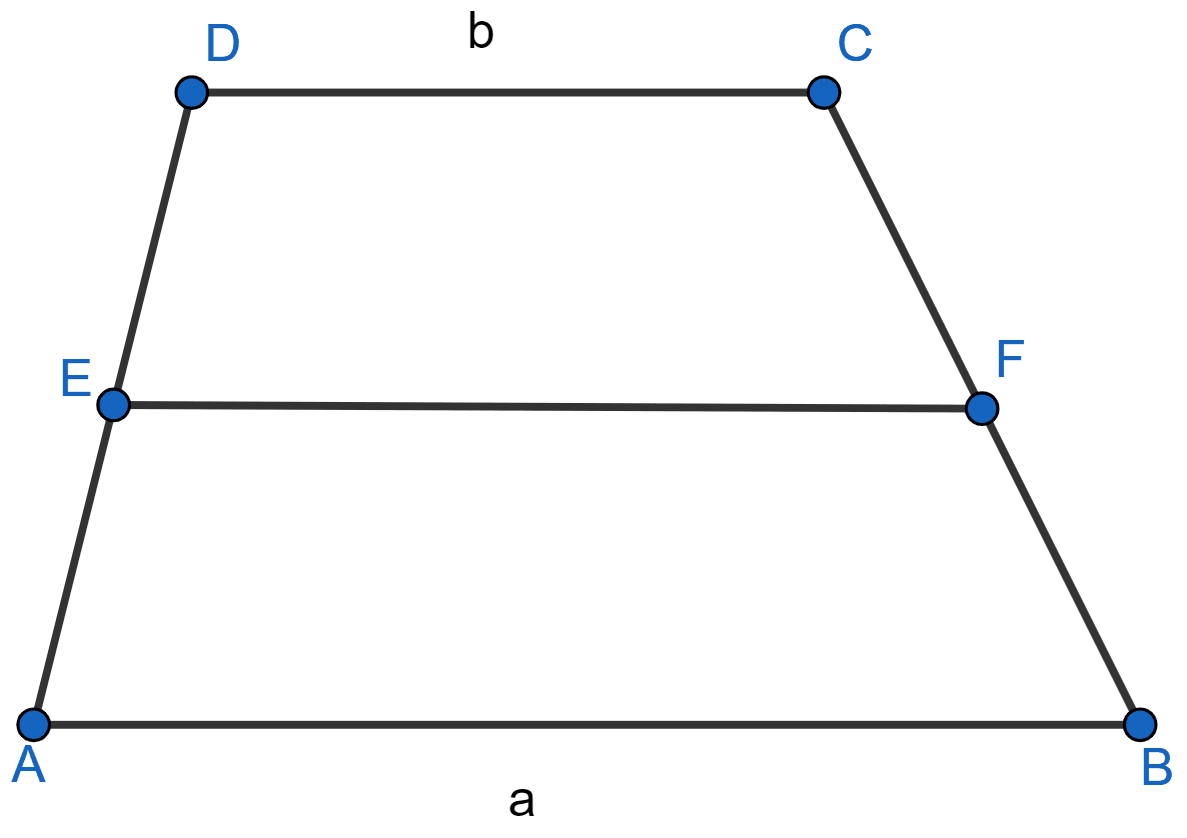
In the adjoining figure, ABCD is a trapezium with parallel sides AB = a cm and DC = b cm. E and F are mid-points of the non-parallel sides. The ratio of area of ABFE and area of EFCD is
a : b
(3a + b) : (a + 3b)
(a + 3b) : (3a + b)
(2a + b) : (3a + b)
Answer
It is given that
AB = a cm
DC = b cm
AB || DC
E and F are the mid-points of AD and BC
Consider h as the distance between AB, CD and EF
Now join BD which intersects EF at M
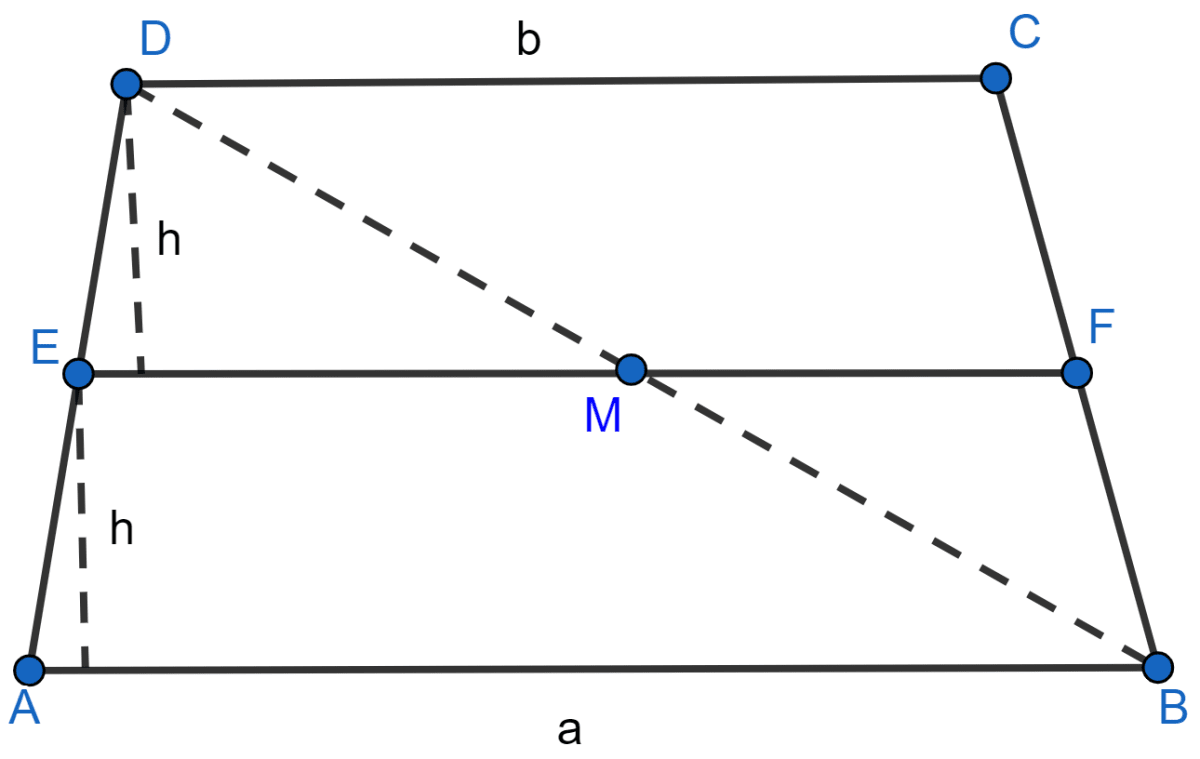
In ∆ABD,
E is the midpoint of AD and EM || AB
By midpoint theorem,
M is the midpoint of BD
and
EM = AB ........ (1)
In ∆CBD,
F is mid-point of BC and M is mid-point of BD so by mid-point theorem,
MF = CD ......... (2)
Adding equations (1) and (2)
EM + MF = AB + CD
EF = (AB + CD)
EF = (a + b)
Here,
Area of trapezium ABFE = [sum of parallel sides] × [distance between parallel sides]
Substituting the values,
Similarly,
Required ratio = Area of trapezium ABFE / Area of trapezium EFCD
By substituting the values,
Hence, Option 2 is the correct option.
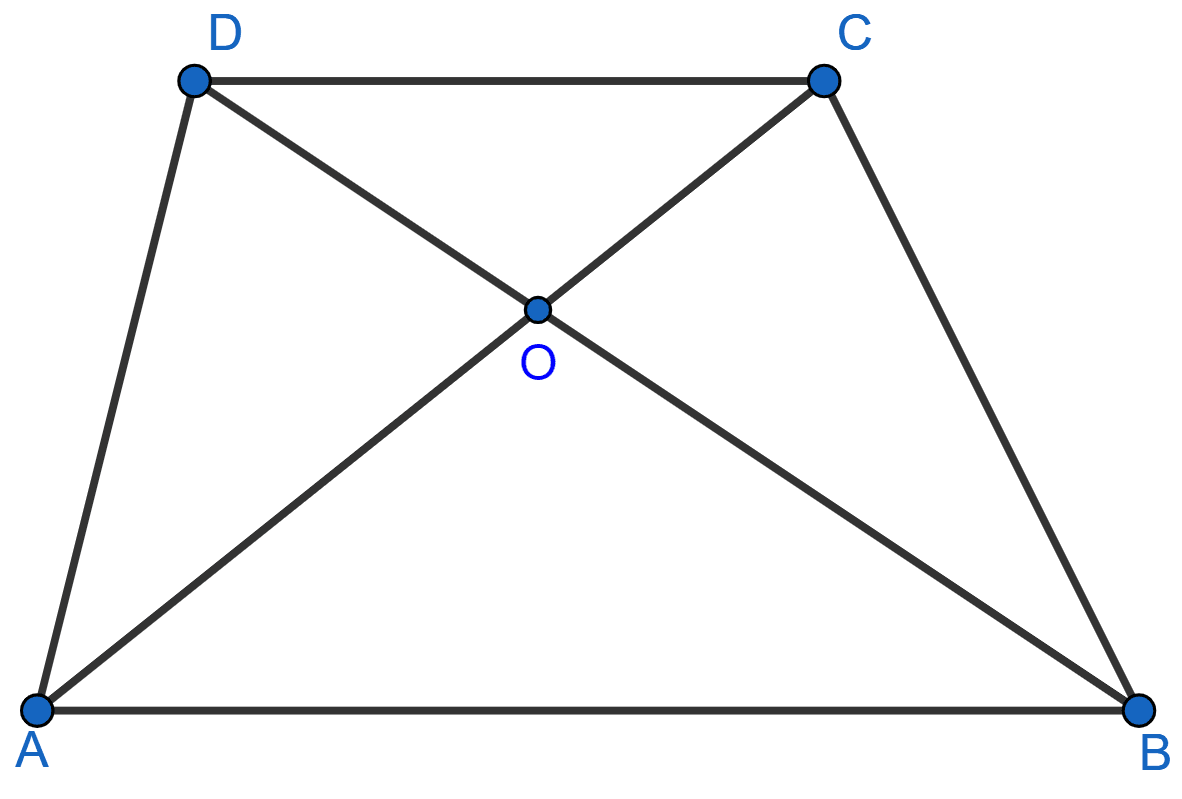
In the adjoining figure, AB || DC and AB ≠ DC. If the diagonals AC and BD of the trapezium ABCD intersect at O, then which of the following statements is not true ?
area of △ABC = area of △ABD
area of △ACD = area of △BCD
area of △OAB = area of △OCD
area of △OAD = area of △OBC
Answer
We know that,
Triangles on the same base and between same parallel lines are equal in area.
Hence,
⇒ area of △ABC = area of △ABD ........ (1)
⇒ area of △ACD = area of △BCD
From figure and eqn. (1),
area of (△AOB + △OAD) = area of (△AOB + △OBC)
⇒ area of △OAD = area of △OBC.
Hence, Option 3 is the correct option.
Consider the following two statements:
Statement 1: The line segment joining the mid-points of a pair of opposite sides of a parallelogram divides it into two equal parallelograms.
Statement 2: Diagonals of a parallelogram divide it into four triangles of equal area.
Which of the following is valid?
Both the statements are true.
Both the statements are false.
Statement 1 is true, and Statement 2 is false.
Statement 1 is false, and Statement 2 is true.
Answer
Let ABCD be a parallelogram in which E and F are mid-points of AB and CD respectively. Join EF.
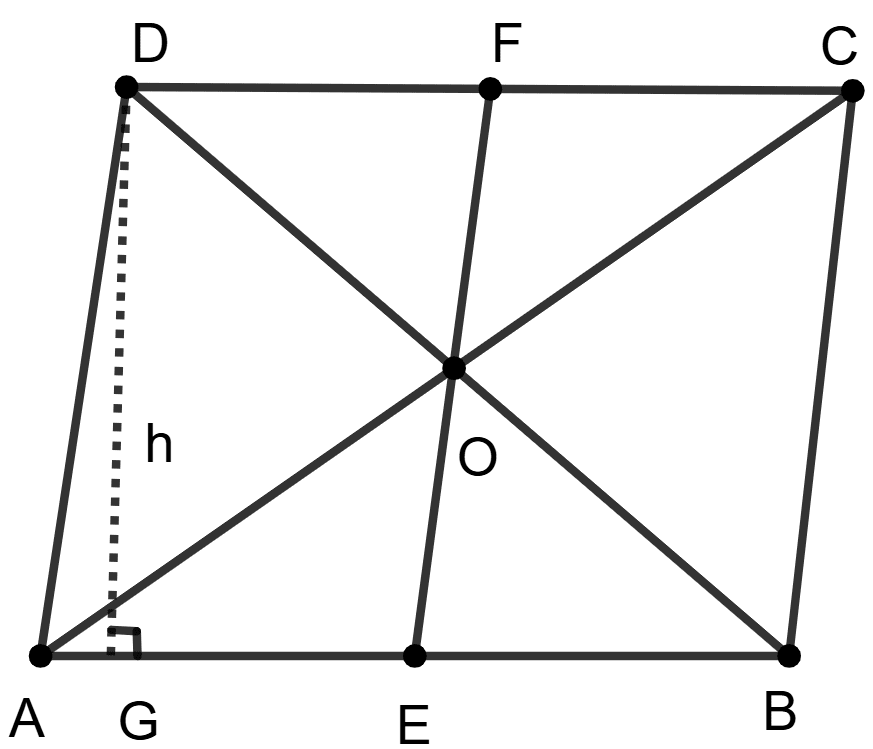
Let us construct DG ⊥ AB and let DG = h, where h is the altitude on side AB.
Area of || gm ABCD = base × height = AB × h
Area of ||gm AEFD = AE × h = × h ...................(1) [Since E is the mid-point of AB]
Area of ||gm EBCF = EB × h = × h ...................(2) [Since E is the mid-point of AB]
From (1) and (2),
Area of || gm AEFD = Area of || gm EBCF.
Thus, the line segment joining the mid-points of a pair of opposite sides of a parallelogram divides it into two equal parallelograms.
∴ Statement 1 is true.
From figure,
The diagonals AC and BD cut at point O.
In parallelogram, the diagonals bisect each other.
∴ AO = OC
In ∆ACD, O is the mid-point of AC.
∴ OD is the median.
Area of ∆AOD = Area of ∆COD ................. (3) [Median of ∆ divides it into two triangles of equal areas.]
Similarly, in ∆ABC
O is the mid-point of AC.
∴ OB is the median.
Area of ∆AOB = Area of ∆COB ................. (4) [Median of ∆ divides it into two triangles of equal areas.]
In ∆ADB,
O is the mid-point of BD.
∴ OA is the median.
Area of ∆AOD = Area of ∆AOB ................. (5)
From (3), (4) and (5) we get,
Area of ∆AOB = Area of ∆COB = Area of ∆COD = Area of ∆AOD
So proved, that the diagonals of a parallelogram divide it into four triangles of equal area.
∴ Statement 2 is true.
∴ Both the statements are true.
Hence, option 1 is the correct option.