
Assertion (A): In the adjoining figure, tan A = . Then AC = 2AB.
Reason (R): In right angled ΔABC, AC2 = AB2 + BC2
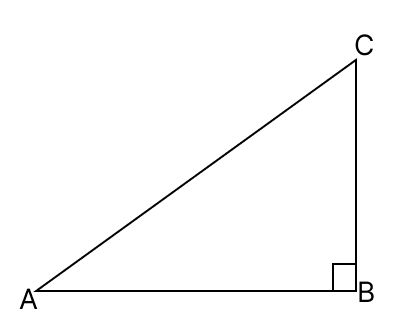
Assertion (A) is true, Reason (R) is false.
Assertion (A) is false, Reason (R) is true.
Both Assertion (A) and Reason (R) are true, and Reason (R) is the correct reason for Assertion (A).
Both Assertion (A) and Reason (R) are true, but Reason (R) is not the correct reason (or explanation) for Assertion (A).
Answer
Given, tan A =
As we know,
Let BC = k and AB = k
Since, ΔABC is a right angled triangle, using pythagoras theorem,
⇒ AC2 = AB2 + BC2
∴ Reason (R) is true.
Substituting values we get :
∴ Assertion (A) is false.
∴ Assertion (A) is false, Reason (R) is true.
Hence, option 2 is the correct option.
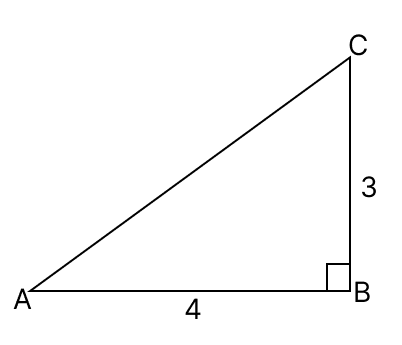
Assertion (A): In adjoining triangle ABC, sinA cosA = .
Reason (R): cos A = .
Assertion (A) is true, Reason (R) is false.
Assertion (A) is false, Reason (R) is true.
Both Assertion (A) and Reason (R) are true, and Reason (R) is the correct reason for Assertion (A).
Both Assertion (A) and Reason (R) are true, but Reason (R) is not the correct reason (or explanation) for Assertion (A).
Answer
In triangle ABC,
Using pythagoras theorem,
⇒ AC2 = AB2 + BC2
⇒ AC2 = 42 + 32
⇒ AC2 = 16 + 9
⇒ AC2 = 25
⇒ AC =
⇒ AC = 5
By formula,
By formula,
Substituting values we get,
sin A cos A = .
∴ Assertion (A) is true.
By formula,
= cosec A ≠ cos A
∴ Reason (R) is false.
∴ Assertion (A) is true, Reason (R) is false.
Hence, option 1 is the correct option.
Assertion (A): If x = a cos θ + b sin θ and y = a cos θ - b sin θ, then x2 + y2 = a2 + b2
Reason (R): cos2θ + sin2θ = 1.
Assertion (A) is true, Reason (R) is false.
Assertion (A) is false, Reason (R) is true.
Both Assertion (A) and Reason (R) are true, and Reason (R) is the correct reason for Assertion (A).
Both Assertion (A) and Reason (R) are true, but Reason (R) is not the correct reason (or explanation) for Assertion (A).
Answer
Given, x = a cos θ + b sin θ and y = a cos θ - b sin θ
⇒ x2 = (a cos θ + b sin θ)2
⇒ x2 = a2 cos2 θ + b2 sin2 θ + 2 ab cos θ sin θ .....................(1)
Similarly,
⇒ y2 = (a cos θ - b sin θ)2
⇒ y2 = a2 cos2 θ + b2 sin2 θ - 2 a b cos θ sin θ .....................(2)
Adding equations (1) and (2), we get :
⇒ x2 + y2 = (a2 cos2 θ + b2 sin2 θ + 2ab cos θ sin θ) + (a2 cos2 θ + b2 sin2 θ - 2ab cos θ sin θ)
⇒ x2 + y2 = (a2 cos2 θ + a2 cos2 θ) + (b2 sin2 θ + b2 sin2 θ) + (2ab cos θ sin θ - 2ab cos θ sin θ)
⇒ x2 + y2 = 2a2 cos2 θ + 2 b2 sin2 θ
⇒ x2 + y2 = 2(a2 cos2 θ + b2 sin2 θ)
∴ Assertion (A) is false.
cos2 θ + sin2 θ = 1
This is a fundamental Pythagorean trigonometric identity and is always true for any real value of θ.
∴ Reason (R) is true.
∴ Assertion (A) is false, Reason (R) is true.
Hence, option 2 is the correct option.