From the figure (i) given below, calculate all the six t-ratios for both acute angles.
Answer
In right angle triangle ABC,
By pythagoras theorem we get :
⇒ AC2 = AB2 + BC2
⇒ 32 = AB2 + 22
⇒ 9 = AB2 + 4
⇒ AB2 = 9 - 4
⇒ AB2 = 5
⇒ AB = 5 \sqrt{5} 5
For angle A,
⇒ sin A = Perpendicular Hypotenuse = B C A C = 2 3 . ⇒ cos A = Base Hypotenuse = A B A C = 5 3 . ⇒ tan A = Perpendicular Base = B C A B = 2 5 . ⇒ cot A = Base Perpendicular = A B B C = 5 2 . ⇒ sec A = Hypotenuse Base = A C A B = 3 5 . ⇒ cosec A = Hypotenuse Perpendicular = A C B C = 3 2 . \Rightarrow \text{sin A} = \dfrac{\text{Perpendicular}}{\text{Hypotenuse}} \\[1em] = \dfrac{BC}{AC} = \dfrac{2}{3}. \\[1em] \Rightarrow \text{cos A} = \dfrac{\text{Base}}{\text{Hypotenuse}} \\[1em] = \dfrac{AB}{AC} = \dfrac{\sqrt{5}}{3}. \\[1em] \Rightarrow \text{tan A} = \dfrac{\text{Perpendicular}}{\text{Base}} \\[1em] = \dfrac{BC}{AB} = \dfrac{2}{\sqrt{5}}. \\[1em] \Rightarrow \text{cot A} = \dfrac{\text{Base}}{\text{Perpendicular}} \\[1em] = \dfrac{AB}{BC} = \dfrac{\sqrt{5}}{2}. \\[1em] \Rightarrow \text{sec A} = \dfrac{\text{Hypotenuse}}{\text{Base}} \\[1em] = \dfrac{AC}{AB} = \dfrac{3}{\sqrt{5}}. \\[1em] \Rightarrow \text{cosec A} = \dfrac{\text{Hypotenuse}}{\text{Perpendicular}} \\[1em] = \dfrac{AC}{BC} = \dfrac{3}{2}. \\[1em] ⇒ sin A = Hypotenuse Perpendicular = A C BC = 3 2 . ⇒ cos A = Hypotenuse Base = A C A B = 3 5 . ⇒ tan A = Base Perpendicular = A B BC = 5 2 . ⇒ cot A = Perpendicular Base = BC A B = 2 5 . ⇒ sec A = Base Hypotenuse = A B A C = 5 3 . ⇒ cosec A = Perpendicular Hypotenuse = BC A C = 2 3 .
For angle C,
⇒ sin C = Perpendicular Hypotenuse = A B A C = 5 3 . ⇒ cos C = Base Hypotenuse = B C A C = 2 3 . ⇒ tan C = Perpendicular Base = A B B C = 5 2 . ⇒ cot C = Base Perpendicular = B C A B = 2 5 . ⇒ sec C = Hypotenuse Base = A C B C = 3 2 . ⇒ cosec C = Hypotenuse Perpendicular = A C A B = 3 5 . \Rightarrow \text{sin C} = \dfrac{\text{Perpendicular}}{\text{Hypotenuse}} \\[1em] = \dfrac{AB}{AC} = \dfrac{\sqrt{5}}{3}. \\[1em] \Rightarrow \text{cos C} = \dfrac{\text{Base}}{\text{Hypotenuse}} \\[1em] = \dfrac{BC}{AC} = \dfrac{2}{3}. \\[1em] \Rightarrow \text{tan C} = \dfrac{\text{Perpendicular}}{\text{Base}} \\[1em] = \dfrac{AB}{BC} = \dfrac{\sqrt{5}}{2}. \\[1em] \Rightarrow \text{cot C} = \dfrac{\text{Base}}{\text{Perpendicular}} \\[1em] = \dfrac{BC}{AB} = \dfrac{2}{\sqrt{5}}. \\[1em] \Rightarrow \text{sec C} = \dfrac{\text{Hypotenuse}}{\text{Base}} \\[1em] = \dfrac{AC}{BC} = \dfrac{3}{2}. \\[1em] \Rightarrow \text{cosec C} = \dfrac{\text{Hypotenuse}}{\text{Perpendicular}} \\[1em] = \dfrac{AC}{AB} = \dfrac{3}{\sqrt{5}}. \\[1em] ⇒ sin C = Hypotenuse Perpendicular = A C A B = 3 5 . ⇒ cos C = Hypotenuse Base = A C BC = 3 2 . ⇒ tan C = Base Perpendicular = BC A B = 2 5 . ⇒ cot C = Perpendicular Base = A B BC = 5 2 . ⇒ sec C = Base Hypotenuse = BC A C = 2 3 . ⇒ cosec C = Perpendicular Hypotenuse = A B A C = 5 3 .
From the figure (ii) given below, find the values of x and y in terms of t-ratios of θ.
Answer
From figure,
⇒ cot θ = Base Perpendicular ⇒ cot θ = A B B C ⇒ cot θ = x 10 ⇒ x = 10 cot θ . ⇒ cosec θ = Hypotenuse Perpendicular ⇒ cosec θ = A C B C ⇒ cosec θ = y 10 ⇒ y = 10 cosec θ . \Rightarrow \text{cot θ} = \dfrac{\text{Base}}{\text{Perpendicular}} \\[1em] \Rightarrow \text{cot θ} = \dfrac{AB}{BC} \\[1em] \Rightarrow \text{cot θ} = \dfrac{x}{10} \\[1em] \Rightarrow x = 10 \text{ cot θ}. \\[1em] \Rightarrow \text{cosec θ} = \dfrac{\text{Hypotenuse}}{\text{Perpendicular}} \\[1em] \Rightarrow \text{cosec θ} = \dfrac{AC}{BC} \\[1em] \Rightarrow \text{cosec θ} = \dfrac{y}{10} \\[1em] \Rightarrow y = 10 \text{ cosec θ}. ⇒ cot θ = Perpendicular Base ⇒ cot θ = BC A B ⇒ cot θ = 10 x ⇒ x = 10 cot θ . ⇒ cosec θ = Perpendicular Hypotenuse ⇒ cosec θ = BC A C ⇒ cosec θ = 10 y ⇒ y = 10 cosec θ .
Hence, x = 10 cot θ and y = 10 cosec θ.
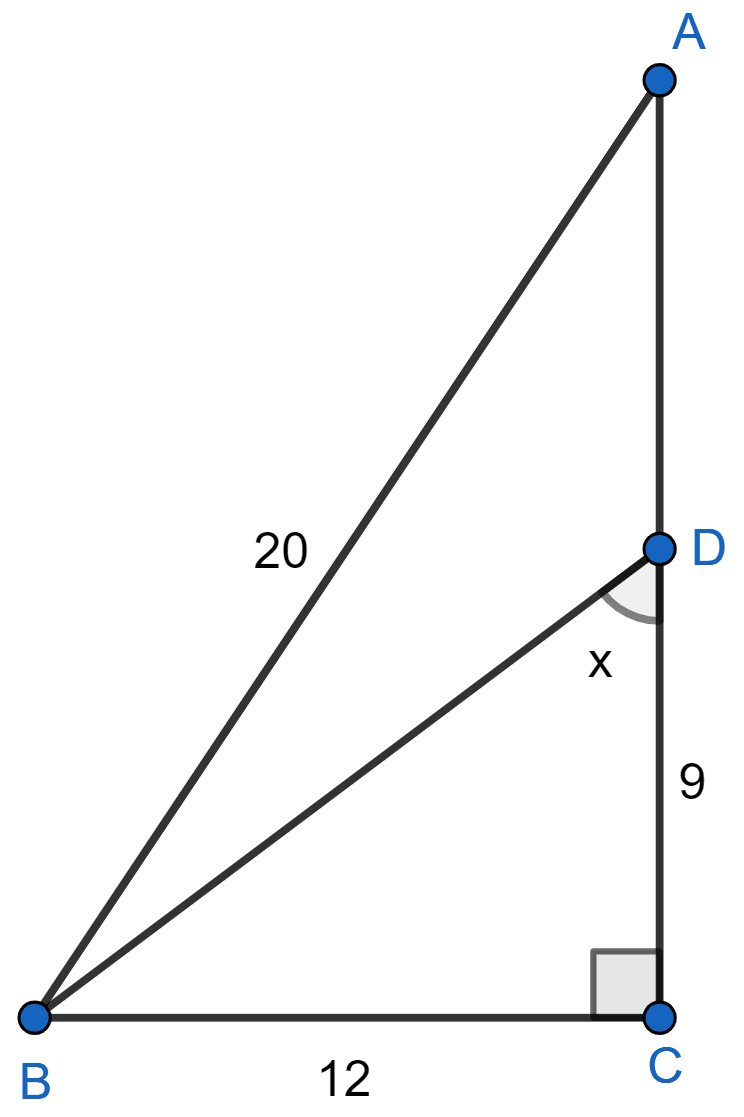
From the figure (1) given below, find the values of :
(i) sin ∠ABC
(ii) tan x - cos x + 3 sin x
Answer
(i) In right angle triangle ABC,
By pythagoras theorem we get :
⇒ AB2 = AC2 + BC2
⇒ 202 = AC2 + 122
⇒ 400 = AC2 + 144
⇒ AC2 = 400 - 144
⇒ AC2 = 256
⇒ AC = 256 \sqrt{256} 256
sin ∠ABC = Perpendicular Hypotenuse = A C A B = 16 20 = 4 5 . \text{sin ∠ABC} = \dfrac{\text{Perpendicular}}{\text{\text{Hypotenuse}}} \\[1em] = \dfrac{AC}{AB} \\[1em] = \dfrac{16}{20} = \dfrac{4}{5}. sin ∠ABC = Hypotenuse Perpendicular = A B A C = 20 16 = 5 4 .
Hence, sin ∠ABC = 4 5 \dfrac{4}{5} 5 4
(ii) In right angle triangle BCD,
By pythagoras theorem we get :
⇒ BD2 = BC2 + CD2
⇒ BD2 = 122 + 92
⇒ BD2 = 144 + 81
⇒ BD2 = 225
⇒ BD = 225 \sqrt{225} 225
⇒ BD = 15.
By formula,
tan x = Perpendicular Base = B C C D = 12 9 = 4 3 . cos x = Base Hypotenuse = C D B D = 9 15 = 3 5 . sin x = Perpendicular Hypotenuse = B C B D = 12 15 = 4 5 . \text{tan x } = \dfrac{\text{Perpendicular}}{\text{Base}} \\[1em] = \dfrac{BC}{CD} = \dfrac{12}{9} = \dfrac{4}{3}. \\[1em] \text{cos x } = \dfrac{\text{Base}}{\text{Hypotenuse}} \\[1em] = \dfrac{CD}{BD} = \dfrac{9}{15} = \dfrac{3}{5}. \\[1em] \text{sin x } = \dfrac{\text{Perpendicular}}{\text{Hypotenuse}} \\[1em] = \dfrac{BC}{BD} = \dfrac{12}{15} = \dfrac{4}{5}. \\[1em] tan x = Base Perpendicular = C D BC = 9 12 = 3 4 . cos x = Hypotenuse Base = B D C D = 15 9 = 5 3 . sin x = Hypotenuse Perpendicular = B D BC = 15 12 = 5 4 .
Substituting values in tan x - cos x + 3 sin x we get :
⇒ 4 3 − 3 5 + 3 × 4 5 ⇒ 4 3 − 3 5 + 12 5 ⇒ 20 − 9 + 36 15 ⇒ 47 15 ⇒ 3 2 15 . \Rightarrow \dfrac{4}{3} - \dfrac{3}{5} + 3 \times \dfrac{4}{5} \\[1em] \Rightarrow \dfrac{4}{3} - \dfrac{3}{5} + \dfrac{12}{5} \\[1em] \Rightarrow \dfrac{20 - 9 + 36}{15} \\[1em] \Rightarrow \dfrac{47}{15} \\[1em] \Rightarrow 3\dfrac{2}{15}. ⇒ 3 4 − 5 3 + 3 × 5 4 ⇒ 3 4 − 5 3 + 5 12 ⇒ 15 20 − 9 + 36 ⇒ 15 47 ⇒ 3 15 2 .
Hence, tan x - cos x + 3 sin x = 3 2 15 . 3\dfrac{2}{15}. 3 15 2 .
From the figure (2) given below, find the values of :
(i) 5 sin x
(ii) 7 tan x
(iii) 5 cos x - 17 sin y - tan x
Answer
(i) By formula,
sin x = Perpendicular Hypotenuse = A D A B = 15 25 = 3 5 . 5 sin x = 5 × 3 5 = 3. \text{sin x } = \dfrac{\text{Perpendicular}}{\text{Hypotenuse}} \\[1em] = \dfrac{AD}{AB} = \dfrac{15}{25} = \dfrac{3}{5}. \\[1em] 5\text{ sin x} = 5 \times \dfrac{3}{5} = 3. sin x = Hypotenuse Perpendicular = A B A D = 25 15 = 5 3 . 5 sin x = 5 × 5 3 = 3.
Hence, 5 sin x = 3.
(ii) In right angle triangle ABD,
⇒ AB2 = AD2 + BD2
⇒ 252 = 152 + BD2
⇒ 625 = 225 + BD2
⇒ BD2 = 625 - 225
⇒ BD2 = 400
⇒ BD = 400 \sqrt{400} 400
By formula,
tan x = Perpendicular Base = A D B D = 15 20 = 3 4 . 7 tan x = 7 × 3 4 = 21 4 = 5 1 4 . \text{tan x } = \dfrac{\text{Perpendicular}}{\text{Base}} \\[1em] = \dfrac{AD}{BD} = \dfrac{15}{20} = \dfrac{3}{4}. \\[1em] 7\text{ tan x} = 7 \times \dfrac{3}{4} = \dfrac{21}{4} = 5\dfrac{1}{4}. tan x = Base Perpendicular = B D A D = 20 15 = 4 3 . 7 tan x = 7 × 4 3 = 4 21 = 5 4 1 .
Hence, 7 tan x = 5 1 4 5\dfrac{1}{4} 5 4 1
(iii) In right angle triangle ADC,
⇒ AC2 = AD2 + DC2
⇒ 172 = 152 + DC2
⇒ 289 = 225 + DC2
⇒ DC2 = 289 - 225
⇒ DC2 = 64
⇒ DC = 64 \sqrt{64} 64
Solving,
5 cos x - 17 sin y - tan x = 5 × B D A B − 17 × C D A C − A D B D = 5 × 20 25 − 17 × 8 17 − 15 20 = 4 − 8 − 3 4 = − 4 − 3 4 = − 16 − 3 4 = − 19 4 = − 4 3 4 . \text{5 cos x - 17 sin y - tan x} = 5 \times \dfrac{BD}{AB} - 17 \times \dfrac{CD}{AC} - \dfrac{AD}{BD} \\[1em] = 5 \times \dfrac{20}{25} - 17 \times \dfrac{8}{17} - \dfrac{15}{20} \\[1em] = 4 - 8 - \dfrac{3}{4} \\[1em] = -4 - \dfrac{3}{4} \\[1em] = \dfrac{-16 - 3}{4}\\[1em] = -\dfrac{19}{4} \\[1em] = -4\dfrac{3}{4}. 5 cos x - 17 sin y - tan x = 5 × A B B D − 17 × A C C D − B D A D = 5 × 25 20 − 17 × 17 8 − 20 15 = 4 − 8 − 4 3 = − 4 − 4 3 = 4 − 16 − 3 = − 4 19 = − 4 4 3 .
Hence, 5 cos x - 17 sin y - tan x = -4 3 4 . 4\dfrac{3}{4}. 4 4 3 .
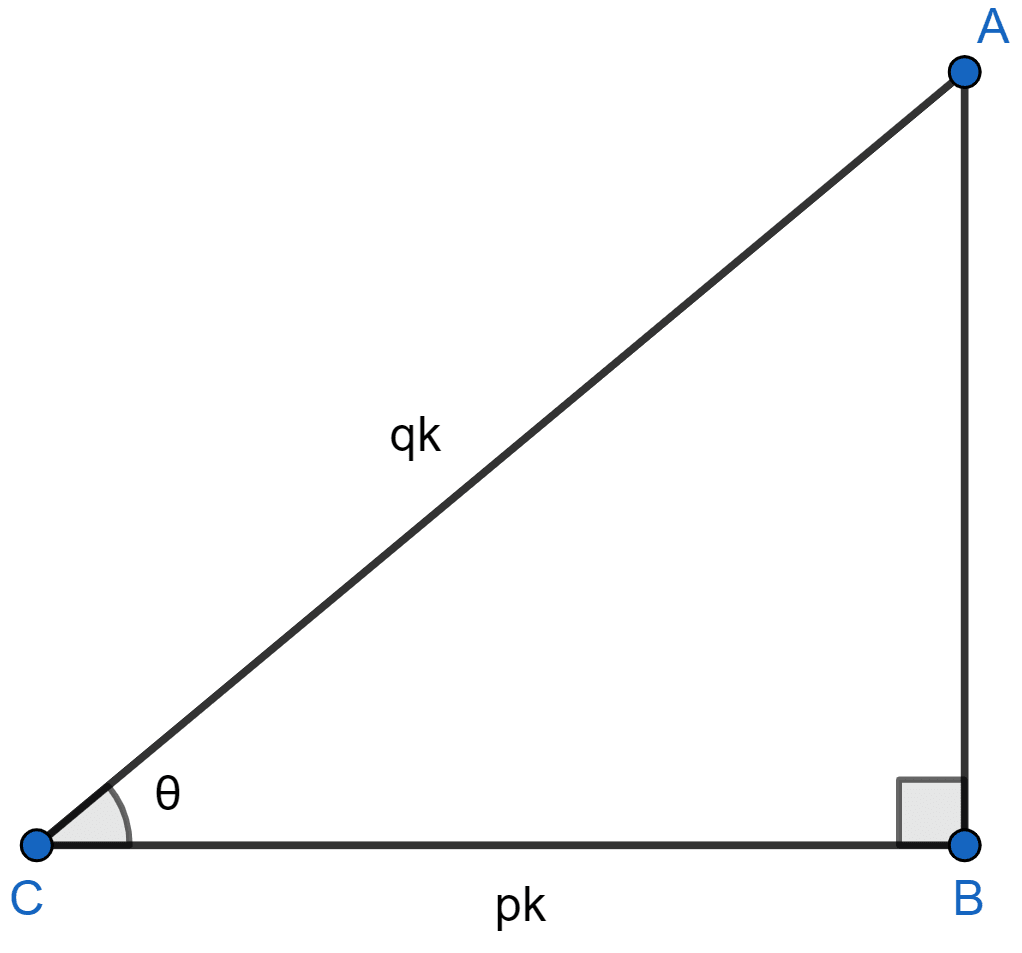
If q cos θ = p, find tan θ - cot θ in terms of p and q.
Answer
Let ABC be a right angle triangle with ∠B = 90° and ∠C = θ.
Given,
⇒ q cos θ = p
⇒ cos θ = p q \dfrac{p}{q} q p
By formula,
⇒ cos θ = Base Hypotenuse \dfrac{\text{Base}}{\text{Hypotenuse}} Hypotenuse Base
⇒ cos θ = B C A C \dfrac{BC}{AC} A C BC
Comparing equations (1) and (2) we get :
⇒ p q = B C A C \Rightarrow \dfrac{p}{q} = \dfrac{BC}{AC} ⇒ q p = A C BC
Let BC = pk and AC = qk.
In right angle triangle ABC,
⇒ AC2 = AB2 + BC2
⇒ (qk)2 = AB2 + (pk)2
⇒ AB2 = q2 k2 - p2 k2
⇒ AB2 = k2 (q2 - p2 )
⇒ AB = k 2 ( q 2 − p 2 ) = k q 2 − p 2 \sqrt{k^2(q^2 - p^2)} = k\sqrt{q^2 - p^2} k 2 ( q 2 − p 2 ) = k q 2 − p 2
By formula,
tan θ = Perpendicular Base = A B B C = k q 2 − p 2 p k = q 2 − p 2 p . cot θ = 1 tan θ = 1 q 2 − p 2 p = p q 2 − p 2 . \text{tan θ} = \dfrac{\text{Perpendicular}}{\text{Base}} \\[1em] = \dfrac{AB}{BC} = \dfrac{k\sqrt{q^2 - p^2}}{pk} \\[1em] = \dfrac{\sqrt{q^2 - p^2}}{p}. \\[1em] \text{cot θ} = \dfrac{1}{\text{tan θ}} \\[1em] = \dfrac{1}{\dfrac{\sqrt{q^2 - p^2}}{p}} \\[1em] = \dfrac{p}{\sqrt{q^2 - p^2}}. tan θ = Base Perpendicular = BC A B = p k k q 2 − p 2 = p q 2 − p 2 . cot θ = tan θ 1 = p q 2 − p 2 1 = q 2 − p 2 p .
Substituting values in tan θ - cot θ we get :
⇒ tan θ - cot θ = q 2 − p 2 p − p q 2 − p 2 = q 2 − p 2 q 2 − p 2 − p 2 p q 2 − p 2 = q 2 − p 2 − p 2 p q 2 − p 2 = q 2 − 2 p 2 p q 2 − p 2 . \Rightarrow \text{tan θ - cot θ} = \dfrac{\sqrt{q^2 - p^2}}{p} - \dfrac{p}{\sqrt{q^2 - p^2}} \\[1em] = \dfrac{\sqrt{q^2 - p^2}\sqrt{q^2 - p^2} - p^2}{p\sqrt{q^2 - p^2}} \\[1em] = \dfrac{q^2 - p^2 - p^2}{p\sqrt{q^2 - p^2}} \\[1em] = \dfrac{q^2 - 2p^2}{p\sqrt{q^2 - p^2}}. ⇒ tan θ - cot θ = p q 2 − p 2 − q 2 − p 2 p = p q 2 − p 2 q 2 − p 2 q 2 − p 2 − p 2 = p q 2 − p 2 q 2 − p 2 − p 2 = p q 2 − p 2 q 2 − 2 p 2 .
Hence, tan θ - cot θ = q 2 − 2 p 2 p q 2 − p 2 . \dfrac{q^2 - 2p^2}{p\sqrt{q^2 - p^2}}. p q 2 − p 2 q 2 − 2 p 2 .
Given 4 sin θ = 3 cos θ, find the values of :
(i) sin θ
(ii) cos θ
(iii) cot2 θ - cosec2 θ
Answer
Let ABC be a triangle with ∠B = 90° and ∠C = θ.
Given,
⇒ 4 sin θ = 3 cos θ
⇒ sin θ cos θ = 3 4 \dfrac{\text{sin θ}}{\text{cos θ}} = \dfrac{3}{4} cos θ sin θ = 4 3
⇒ tan θ = 3 4 \dfrac{3}{4} 4 3
From figure.
⇒ tan θ = Perpendicular Base = A B B C \dfrac{\text{Perpendicular}}{\text{Base}} = \dfrac{AB}{BC} Base Perpendicular = BC A B
From (1) and (2) we get :
A B B C = 3 4 \dfrac{AB}{BC} = \dfrac{3}{4} BC A B = 4 3
Let AB = 3x and BC = 4x.
In right angle triangle ABC,
⇒ AC2 = AB2 + BC2
⇒ AC2 = (3x)2 + (4x)2
⇒ AC2 = 9x2 + 16x2
⇒ AC2 = 25x2
⇒ AC2 = 25 x 2 \sqrt{25x^2} 25 x 2
⇒ AC = 5x.
(i) By formula,
⇒ sin θ = Perpendicular Hypotenuse = A B A C = 3 x 5 x = 3 5 \dfrac{\text{Perpendicular}}{\text{Hypotenuse}} = \dfrac{AB}{AC} = \dfrac{3x}{5x} = \dfrac{3}{5} Hypotenuse Perpendicular = A C A B = 5 x 3 x = 5 3
Hence, sin θ = 3 5 \dfrac{3}{5} 5 3
(ii) By formula,
⇒ cos θ = Base Hypotenuse = B C A C = 4 x 5 x = 4 5 \dfrac{\text{Base}}{\text{Hypotenuse}} = \dfrac{BC}{AC} = \dfrac{4x}{5x} = \dfrac{4}{5} Hypotenuse Base = A C BC = 5 x 4 x = 5 4
Hence, cos θ = 4 5 \dfrac{4}{5} 5 4
(iii) By formula,
⇒ cot θ = Base Perpendicular = B C A B = 4 x 3 x = 4 3 \dfrac{\text{Base}}{\text{Perpendicular}} = \dfrac{BC}{AB} = \dfrac{4x}{3x} = \dfrac{4}{3} Perpendicular Base = A B BC = 3 x 4 x = 3 4
⇒ cot2 θ = ( 4 3 ) 2 \Big(\dfrac{4}{3}\Big)^2 ( 3 4 ) 2 16 9 \dfrac{16}{9} 9 16
⇒ cosec θ = Hypotenuse Perpendicular = A C A B = 5 x 3 x = 5 3 \dfrac{\text{Hypotenuse}}{\text{Perpendicular}} = \dfrac{AC}{AB} = \dfrac{5x}{3x} = \dfrac{5}{3} Perpendicular Hypotenuse = A B A C = 3 x 5 x = 3 5
⇒ cosec2 θ = ( 5 3 ) 2 \Big(\dfrac{5}{3}\Big)^2 ( 3 5 ) 2 25 9 \dfrac{25}{9} 9 25
cot 2 θ − cosec 2 θ = 16 9 − 25 9 = 16 − 25 9 = − 9 9 = − 1. \text{cot}^2 \text{ θ} - \text{cosec}^2 \text{ θ} = \dfrac{16}{9} - \dfrac{25}{9} \\[1em] = \dfrac{16 - 25}{9} \\[1em] = -\dfrac{9}{9} \\[1em] = -1. cot 2 θ − cosec 2 θ = 9 16 − 9 25 = 9 16 − 25 = − 9 9 = − 1.
Hence, cot2 θ - cosec2 θ = -1.
If 2 cos θ = 3 \sqrt{3} 3 3 θ = 1.
Answer
Given,
⇒ 2 cos θ = 3 \sqrt{3} 3
⇒ cos θ = 3 2 \dfrac{\sqrt{3}}{2} 2 3
Squaring both sides we get :
⇒ cos2 θ = ( 3 2 ) 2 \Big(\dfrac{\sqrt{3}}{2}\Big)^2 ( 2 3 ) 2 3 4 \dfrac{3}{4} 4 3
⇒ 1 - sin2 θ = 3 4 \dfrac{3}{4} 4 3
⇒ sin2 θ = 1 − 3 4 1 - \dfrac{3}{4} 1 − 4 3
⇒ sin2 θ = 4 − 3 4 \dfrac{4 - 3}{4} 4 4 − 3
⇒ sin2 θ = 1 4 \dfrac{1}{4} 4 1
⇒ sin θ = 1 4 \sqrt{\dfrac{1}{4}} 4 1
⇒ sin θ = 1 2 \dfrac{1}{2} 2 1
Substituting values in L.H.S. of equation 3 sin θ - 4 sin3 θ = 1 we get :
⇒ 3 sin θ − 4 sin 3 θ ⇒ sin θ ( 3 − 4 sin 2 θ ) ⇒ 1 2 × ( 3 − 4 × 1 4 ) ⇒ 1 2 × ( 3 − 1 ) ⇒ 1 2 × 2 ⇒ 1. \Rightarrow 3\text{sin θ} - 4\text{ sin}^3 θ \\[1em] \Rightarrow \text{sin θ }(3 - 4\text{ sin}^2 θ) \\[1em] \Rightarrow \dfrac{1}{2} \times (3 - 4 \times \dfrac{1}{4}) \\[1em] \Rightarrow \dfrac{1}{2} \times (3 - 1) \\[1em] \Rightarrow \dfrac{1}{2} \times 2 \\[1em] \Rightarrow 1. ⇒ 3 sin θ − 4 sin 3 θ ⇒ sin θ ( 3 − 4 sin 2 θ ) ⇒ 2 1 × ( 3 − 4 × 4 1 ) ⇒ 2 1 × ( 3 − 1 ) ⇒ 2 1 × 2 ⇒ 1.
Since, L.H.S. = R.H.S.
Hence, proved that 3sin θ - 4 sin3 θ = 1.
If sec θ - tan θ sec θ + tan θ = 1 4 , \dfrac{\text{sec θ - tan θ}}{\text{sec θ + tan θ}} = \dfrac{1}{4}, sec θ + tan θ sec θ - tan θ = 4 1 ,
Answer
Given, sec θ - tan θ sec θ + tan θ = 1 4 . \dfrac{\text{sec θ - tan θ}}{\text{sec θ + tan θ}} = \dfrac{1}{4}. sec θ + tan θ sec θ - tan θ = 4 1 .
Solving above equation we get,
⇒ sec θ - tan θ sec θ + tan θ = 1 4 ⇒ 1 cos θ − sin θ cos θ 1 cos θ + sin θ cos θ ⇒ 1 - sin θ cos θ 1 + sin θ cos θ ⇒ 1 - sin θ 1 + sin θ = 1 4 ⇒ 4 ( 1 − sin θ ) = 1 + sin θ ⇒ 4 − 4 sin θ = 1 + sin θ ⇒ sin θ + 4 sin θ = 4 − 1 ⇒ 5 sin θ = 3 ⇒ sin θ = 3 5 . \Rightarrow \dfrac{\text{sec θ - tan θ}}{\text{sec θ + tan θ}} = \dfrac{1}{4} \\[1em] \Rightarrow \dfrac{\dfrac{1}{\text{cos θ}} - \dfrac{\text{sin θ}}{\text{cos θ}}}{\dfrac{1}{\text{cos θ}} + \dfrac{\text{sin θ}}{\text{cos θ}}} \\[1em] \Rightarrow \dfrac{\dfrac{\text{1 - sin θ}}{\text{cos θ}}}{\dfrac{\text{1 + sin θ}}{{\text{cos θ}}}} \\[1em] \Rightarrow \dfrac{\text{1 - sin θ}}{\text{1 + sin θ}} = \dfrac{1}{4} \\[1em] \Rightarrow 4(1 - \text{sin θ}) = 1 + \text{sin θ} \\[1em] \Rightarrow 4 - 4\text{ sin θ} = 1 + \text{sin θ} \\[1em] \Rightarrow \text{sin θ + 4 sin θ} = 4 - 1 \\[1em] \Rightarrow 5 \text{ sin θ} = 3 \\[1em] \Rightarrow \text{sin θ} = \dfrac{3}{5}. ⇒ sec θ + tan θ sec θ - tan θ = 4 1 ⇒ cos θ 1 + cos θ sin θ cos θ 1 − cos θ sin θ ⇒ cos θ 1 + sin θ cos θ 1 - sin θ ⇒ 1 + sin θ 1 - sin θ = 4 1 ⇒ 4 ( 1 − sin θ ) = 1 + sin θ ⇒ 4 − 4 sin θ = 1 + sin θ ⇒ sin θ + 4 sin θ = 4 − 1 ⇒ 5 sin θ = 3 ⇒ sin θ = 5 3 .
Hence, sin θ = 3 5 \dfrac{3}{5} 5 3
If sin θ + cosec θ = 3 1 3 3\dfrac{1}{3} 3 3 1 2 θ + cosec2 θ.
Answer
Given,
⇒ sin θ + cosec θ = 3 1 3 ⇒ sin θ + cosec θ = 10 3 \phantom{\Rightarrow} \text{sin θ + cosec θ} = 3\dfrac{1}{3} \\[1em] \Rightarrow \text{sin θ + cosec θ} = \dfrac{10}{3} \\[1em] ⇒ sin θ + cosec θ = 3 3 1 ⇒ sin θ + cosec θ = 3 10
Squaring both sides we get,
⇒ (sin θ + cosec θ) 2 = ( 10 3 ) 2 ⇒ sin 2 θ + cosec 2 θ + 2 sin θ.cosec θ = 100 9 ⇒ sin 2 θ + cosec 2 θ + 2 sin θ × 1 sin θ = 100 9 ⇒ sin 2 θ + cosec 2 θ + 2 = 100 9 ⇒ sin 2 θ + cosec 2 θ = 100 9 − 2 ⇒ sin 2 θ + cosec 2 θ = 100 − 18 9 ⇒ sin 2 θ + cosec 2 θ = 82 9 ⇒ sin 2 θ + cosec 2 θ = 9 1 9 \Rightarrow \text{(sin θ + cosec θ)}^2 = \Big(\dfrac{10}{3}\Big)^2 \\[1em] \Rightarrow \text{sin}^2 \text{ θ} + \text{cosec}^2 \text{ θ} + \text{ 2 sin θ.cosec θ} = \dfrac{100}{9} \\[1em] \Rightarrow \text{sin}^2 \text{ θ} + \text{cosec}^2 \text{ θ} + \text{2 sin θ} \times \dfrac{1}{\text{sin θ}} = \dfrac{100}{9} \\[1em] \Rightarrow \text{sin}^2 \text{ θ} + \text{cosec}^2 \text{ θ} + 2 = \dfrac{100}{9} \\[1em] \Rightarrow \text{sin}^2 \text{ θ} + \text{cosec}^2 \text{ θ} = \dfrac{100}{9} - 2 \\[1em] \Rightarrow \text{sin}^2 \text{ θ} + \text{cosec}^2 \text{ θ} = \dfrac{100 - 18}{9} \\[1em] \Rightarrow \text{sin}^2 \text{ θ} + \text{cosec}^2 \text{ θ} = \dfrac{82}{9} \\[1em] \Rightarrow \text{sin}^2 \text{ θ} + \text{cosec}^2 \text{ θ} = 9\dfrac{1}{9} ⇒ (sin θ + cosec θ) 2 = ( 3 10 ) 2 ⇒ sin 2 θ + cosec 2 θ + 2 sin θ.cosec θ = 9 100 ⇒ sin 2 θ + cosec 2 θ + 2 sin θ × sin θ 1 = 9 100 ⇒ sin 2 θ + cosec 2 θ + 2 = 9 100 ⇒ sin 2 θ + cosec 2 θ = 9 100 − 2 ⇒ sin 2 θ + cosec 2 θ = 9 100 − 18 ⇒ sin 2 θ + cosec 2 θ = 9 82 ⇒ sin 2 θ + cosec 2 θ = 9 9 1
Hence, sin2 θ + cosec2 θ = 9 1 9 9\dfrac{1}{9} 9 9 1
In the adjoining figure, cosec x = 13 5 \dfrac{13}{5} 5 13 8 17 \dfrac{8}{17} 17 8
Answer
By formula,
sin θ = Perpendicular Hypotenuse \dfrac{\text{Perpendicular}}{\text{Hypotenuse}} Hypotenuse Perpendicular
cosec θ = Hypotenuse Perpendicular \dfrac{\text{Hypotenuse}}{\text{Perpendicular}} Perpendicular Hypotenuse
In ΔABD,
⇒ cosec x = A B B D ⇒ 13 5 = 26 B D ⇒ B D = 26 × 5 13 ⇒ B D = 2 × 5 ⇒ B D = 10 cm . \Rightarrow \text{cosec x} = \dfrac{AB}{BD}\\[1em] \Rightarrow \dfrac{13}{5} = \dfrac{26}{BD}\\[1em] \Rightarrow BD = \dfrac{26 \times 5}{13}\\[1em] \Rightarrow BD = 2 \times 5\\[1em] \Rightarrow BD = 10 \text{ cm}. ⇒ cosec x = B D A B ⇒ 5 13 = B D 26 ⇒ B D = 13 26 × 5 ⇒ B D = 2 × 5 ⇒ B D = 10 cm .
Since, ΔABD is a right angled triangle. Using pythagoras theorem,
⇒ AB2 = BD2 + AD2
⇒ 262 = 102 + AD2
⇒ 676 = 100 + AD2
⇒ AD2 = 676 - 100
⇒ AD2 = 576
⇒ AD = 576 \sqrt{576} 576
⇒ AD = ± 24 cm
As length of side of a triangle cannot be negative. So, AD = 24 cm.
In ΔADC,
⇒ sin y = A D A C ⇒ 8 17 = 24 A C ⇒ A C = 24 × 17 8 ⇒ A C = 3 × 17 ⇒ A C = 51 cm . \Rightarrow \text{sin y} = \dfrac{AD}{AC}\\[1em] \Rightarrow \dfrac{8}{17} = \dfrac{24}{AC}\\[1em] \Rightarrow AC = \dfrac{24 \times 17}{8}\\[1em] \Rightarrow AC = 3 \times 17\\[1em] \Rightarrow AC = 51 \text{ cm}. ⇒ sin y = A C A D ⇒ 17 8 = A C 24 ⇒ A C = 8 24 × 17 ⇒ A C = 3 × 17 ⇒ A C = 51 cm .
Since, ΔADC is a right angled triangle. Using pythagoras theorem,
⇒ AC2 = AD2 + DC2
⇒ 512 = 242 + DC2
⇒ 2601 = 576 + DC2
⇒ DC2 = 2601 - 576
⇒ DC2 = 2025
⇒ DC = 2025 \sqrt{2025} 2025
⇒ DC = ± 45
As length of side of a triangle cannot be negative. So, DC = 45 cm.
From figure,
BC = BD + DC = 10 + 45 = 55 cm.
Hence, the length of BC = 55 cm.
In the adjoining figure, AB = 4 m and ED = 3 m. If sin α = 3 5 \dfrac{3}{5} 5 3 12 13 \dfrac{12}{13} 13 12
Answer
In △ABC,
By formula,
sin α = Perpendicular Hypotenuse \dfrac{\text{Perpendicular}}{\text{Hypotenuse}} Hypotenuse Perpendicular
Substituting values we get :
⇒ 3 5 = A B A C ⇒ 3 5 = 4 A C ⇒ A C = 20 3 \Rightarrow \dfrac{3}{5} = \dfrac{AB}{AC} \\[1em] \Rightarrow \dfrac{3}{5} = \dfrac{4}{AC} \\[1em] \Rightarrow AC = \dfrac{20}{3} ⇒ 5 3 = A C A B ⇒ 5 3 = A C 4 ⇒ A C = 3 20
In right angle triangle ABC,
By pythagoras theorem, we get :
⇒ AC2 = AB2 + BC2
⇒ ( 20 3 ) 2 = 4 2 + B C 2 ⇒ 400 9 = 16 + B C 2 ⇒ B C 2 = 400 9 − 16 ⇒ B C 2 = 400 − 144 9 ⇒ B C 2 = 256 9 ⇒ B C = 256 16 ⇒ B C = 16 3 m \Rightarrow \Big(\dfrac{20}{3}\Big)^2 = 4^2 + BC^2 \\[1em] \Rightarrow \dfrac{400}{9} = 16 + BC^2 \\[1em] \Rightarrow BC^2 = \dfrac{400}{9} - 16 \\[1em] \Rightarrow BC^2 = \dfrac{400 - 144}{9} \\[1em] \Rightarrow BC^2 = \dfrac{256}{9} \\[1em] \Rightarrow BC = \sqrt{\dfrac{256}{16}} \\[1em] \Rightarrow BC = \dfrac{16}{3} \text{ m} ⇒ ( 3 20 ) 2 = 4 2 + B C 2 ⇒ 9 400 = 16 + B C 2 ⇒ B C 2 = 9 400 − 16 ⇒ B C 2 = 9 400 − 144 ⇒ B C 2 = 9 256 ⇒ BC = 16 256 ⇒ BC = 3 16 m
In △CDE,
By formula,
cos β = Base Hypotenuse \dfrac{\text{Base}}{\text{Hypotenuse}} Hypotenuse Base
Substituting values we get :
⇒ 12 13 = C D C E \Rightarrow \dfrac{12}{13} = \dfrac{CD}{CE} ⇒ 13 12 = CE C D
Let CD = 12k and CE = 13k.
In right angle triangle ABC,
⇒ CE2 = CD2 + ED2
⇒ (13k)2 = (12k)2 + 32
⇒ 169k2 = 144k2 + 32
⇒ 32 = 169k2 - 144k2
⇒ 9 = 25 k 2 25k^2 25 k 2
⇒ k = 9 25 = 3 5 k = \sqrt{\dfrac{9}{25}} = \dfrac{3}{5} k = 25 9 = 5 3
CD = 12k = 12 × 3 5 = 36 5 12 \times \dfrac{3}{5} = \dfrac{36}{5} 12 × 5 3 = 5 36
From figure,
B D = B C + C D = 16 3 + 36 5 = 80 + 108 15 = 188 15 = 12 8 15 m . BD = BC + CD = \dfrac{16}{3} + \dfrac{36}{5} \\[1em] = \dfrac{80 + 108}{15} \\[1em] = \dfrac{188}{15} \\[1em] = 12\dfrac{8}{15} \text{ m}. B D = BC + C D = 3 16 + 5 36 = 15 80 + 108 = 15 188 = 12 15 8 m .
Hence, BD = 12 8 15 12\dfrac{8}{15} 12 15 8