
Area of a triangle is 30 cm2. If its base is 10 cm, then its height is
5 cm
6 cm
7 cm
8 cm
Answer
By formula,
Area of triangle = × base × height.
Substituting values we get,
30 = × 10 × height
height = = 6 cm.
Hence, Option 2 is the correct option.
If the perimeter of a square is 80 cm, then its area is
800 cm2
600 cm2
400 cm2
200 cm2
Answer
By formula,
Perimeter of square = 4 × side
Substituting values we get,
80 = 4 × side
side = = 20 cm.
By formula,
Area of square = side × side = 20 × 20 = 400 cm2.
Hence, Option 3 is the correct option.
Area of a parallelogram is 48 cm2. If its height is 6 cm then its base is
8 cm
4 cm
16 cm
None of these
Answer
By formula,
Area of parallelogram = base × height
Substituting values we get,
⇒ 48 = base × 6
⇒ base = = 8 cm.
Hence, Option 1 is the correct option.
If d is the diameter of a circle, then its area is
πd2
2πd2
Answer
r = .
By formula,
Area of circle = πr2 =
Hence, Option 3 is the correct option.
If the area of trapezium is 64 cm2 and the distance between parallel sides is 8 cm, then sum of its parallel sides is
8 cm
4 cm
32 cm
16 cm
Answer
By formula,
Area of trapezium = × sum of parallel sides × distance between them
Substituting values we get,
⇒ 64 = × sum of parallel sides × 8
⇒ 64 = 4 × sum of parallel sides
⇒ sum of parallel sides = = 16 cm.
Hence, Option 4 is the correct option.
Area of a rhombus whose diagonals are 8 cm and 6 cm is
48 cm2
24 cm2
12 cm2
96 cm2
Answer
By formula,
Area of rhombus = × d1 × d2
Substituting values we get,
⇒ Area of rhombus = × 8 × 6 = 24 cm2.
Hence, Option 2 is the correct option.
If the lengths of diagonals of a rhombus is doubled, then area of rhombus will be
doubled
tripled
four times
remains same
Answer
Let diagonals be d1 and d2.
By formula,
Area of rhombus = × d1 × d2
If doubled, diagonals = 2d1 and 2d2.
Area of new rhombus = × 2d1 × 2d2
= 4 × × d1 × d2
= 4 × Area of rhombus.
Hence, Option 3 is the correct option.
If the length of a diagonal of a quadrilateral is 10 cm and lengths of the perpendiculars on it from opposite vertices are 4 cm and 6 cm, then area of quadrilateral is
100 cm2
200 cm2
50 cm2
None of these.
Answer
Let ABCD be the quadrilateral with diagonal BD.

Let AM and CN be the perpendiculars from A and C on diagonal BD.
From figure,
BD divides quadrilateral in two triangles.
Area of △ABD = × base × height
= × BD × AM
= × 10 × 4
= 20 cm2.
Area of △BCD = × base × height
= × BD × CN
= × 10 × 6
= 30 cm2.
Area of quadrilateral = Area of △ABD + Area of △BCD
= 20 + 30 = 50 cm2.
Hence, Option 3 is the correct option.
Area of a rhombus is 90 cm2. If the length of one diagonal is 10 cm then the length of other diagonal is
18 cm
9 cm
36 cm
4.5 cm
Answer
Let diagonals be d1 and d2.
By formula,
Area of rhombus = × d1 × d2
Substituting values we get,
⇒ 90 = × 10 × d2
⇒ d2 =
⇒ d2 = 18 cm.
Hence, Option 1 is the correct option.
In the adjoining figure, OACB is a quadrant of a circle of radius 7 cm. The perimeter of the quadrant is
11 cm
18 cm
25 cm
36 cm

Answer
Perimeter of quadrant =
Hence, Option 3 is the correct option.
In the adjoining figure, OABC is a square of side 7 cm. OAC is a quadrant of a circle with O as center. The area of the shaded region is
10.5 cm2
38.5 cm2
49 cm2
11.5 cm2

Answer
Area of square OABC = (7)2 = 49 cm2.
Area of quadrant OAC =
Area of shaded region = Area of square OABC - Area of quadrant OAC
= 49 - 38.5 = 10.5 cm2.
Hence, Option 1 is the correct option.
The adjoining figure shows a rectangle and a semicircle. The perimeter of the shaded region is
70 cm
56 cm
78 cm
46 cm

Answer
From figure,
Let length = 14 cm and breadth = 10 cm.
Diameter of semi-circle = 14 cm and radius = 7 cm.
Perimeter of shaded region = length + breadth + breadth + πr.
= 14 + 10 + 10 +
= 34 + 22 = 56 cm.
Hence, Option 2 is the correct option.
The area of the shaded region shown in the below figure is
140 cm2
77 cm2
294 cm2
217 cm2
Answer
Area of shaded region = Area of rectangle + Area of semi-circle
= length × breadth +
= 14 × 10 +
= 140 +
= 140 + 77
= 217 cm2.
Hence, Option 4 is the correct option.
In the adjoining figure, the boundary of the shaded region consists of semicircular arcs. The area of the shaded region is equal to
616 cm2
385 cm2
231 cm2
308 cm2
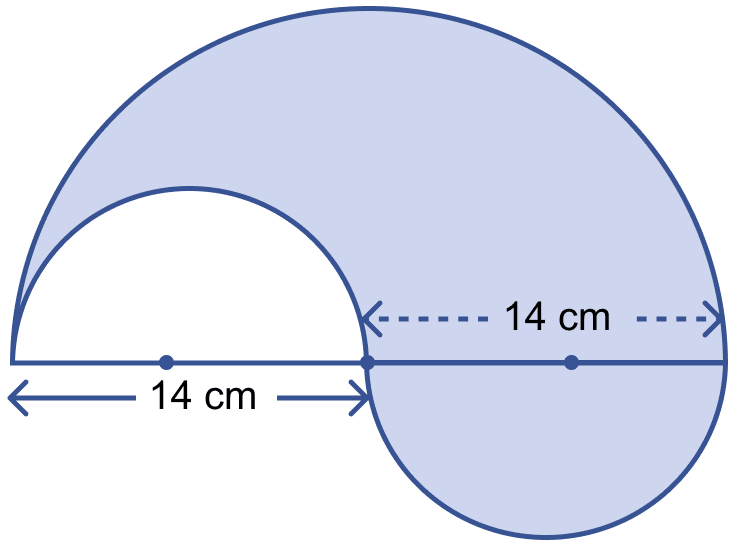
Answer
From figure,
Radius of larger circle (R) = 14 cm.
Area of shaded region = Area of larger circle - Area of 1st smaller circle + Area of 2nd smaller circle .......(1)
From figure,
Diameter of both the smaller semi-circles = 14 cm.
∴ Radius = 7 cm and area of both the circle are equal.
∴ Area of shaded region = Area of larger circle =
Hence, Option 4 is the correct option.
The perimeter of the shaded region shown in the below figure is
44 cm
88 cm
66 cm
132 cm
Answer
Radius of larger semi-circle (R) = 14 cm and radius of smaller semi-circle (r) = 7 cm.
From figure,
Perimeter of shaded region = Circumference of larger semi-circle + 2 × Circumference of smaller semi-circle
= πR + 2πr
=
= 44 + 44 = 88 cm.
Hence, Option 2 is the correct option.
In the adjoining figure, ABC is a right angled triangle at B. A semicircle is drawn on AB as diameter. If AB = 12 cm and BC = 5 cm, then the area of the shaded region is
(60 + 18π) cm2
(30 + 36π) cm2
(30 + 18π) cm2
(30 + 9π) cm2

Answer
Area of right angle triangle ABC = × base × height
= × AB × BC
= × 12 × 5
= 30 cm2.
From figure,
AB = 12 cm is the diameter of circle.
Radius = = 6 cm.
Area of semi-circle = = 18π cm2.
Area of shaded region = Area of right angle triangle ABC + Area of semi-circle
= (30 + 18π) cm2.
Hence, Option 3 is the correct option.
The perimeter of the shaded region shown in the below figure is
(30 + 6π) cm
(30 + 12π) cm
(18 + 12π) cm
(18 + 6π) cm
Answer
In right angle triangle ABC,
⇒ AC2 = AB2 + BC2
⇒ AC2 = (12)2 + (5)2
⇒ AC2 = 144 + 25
⇒ AC2 = 169
⇒ AC = = 13 cm.
From figure,
radius of semi-circle (r) = = 6 cm.
Perimeter of shaded region = AC + CB + Circumference of semi-circle
= 13 + 5 + πr
= (18 + 6π) cm.
Hence, Option 4 is the correct option.
If the volume of a cube is 729 m3, then its surface area is
486 cm2
324 cm2
162 cm2
None of these
Answer
By formula,
Volume of cube = (Side)3
∴ (Side)3 = 729
Side = = 9 cm.
⇒ Surface area of cube = 6(side)2
= 6(9)2
= 6 × 81 = 486 cm2.
Hence, Option 1 is the correct option.
If the total surface area of a cube is 96 cm2, then the volume of cube is
8 cm3
512 cm3
64 cm3
27 cm3
Answer
Let side of cube = x cm.
Given,
Surface area of cube = 96 cm2
By formula,
Surface area of a cube = 6x2
∴ 6x2 = 96
⇒ x2 = 16
⇒ x = = 4 cm.
Volume of cube = (side)3
= (x)3
= 43 = 64 cm3.
Hence, Option 3 is the correct option.
The length of the longest pole that can be put in a room of dimensions (10 m × 10 m × 5 m) is
15 m
16 m
10 m
12 m
Answer
The longest pole in a cuboid is equal to the diagonal of cuboid.
Diagonal of cuboid =
Hence, Option 1 is the correct option.
The lateral surface area of a cube is 256 m2. The volume of the cube is
512 m3
64 m3
216 m3
256 m3
Answer
By formula,
Lateral surface area of cube = 4(side)2
⇒ 4(side)2 = 256
⇒ (side)2 = 64
⇒ side = = 8 m.
Volume of cube = (side)3
= 83 = 512 m3.
Hence, Option 1 is the correct option.
If the perimeter of one face of a cube is 40 cm, then the sum of lengths of its edge is
80 cm
120 cm
160 cm
240 cm
Answer
Each face of cube is a square. Let length of each side = x cm.
Given, perimeter = 40 cm.
∴ 4x = 40 cm
⇒ x = 10 cm.
There are 12 edges in a cube.
Sum of edges = 12 × 10 = 120 cm.
Hence, Option 2 is the correct option.
A cuboid container has the capacity to hold 50 small boxes. If all the dimensions of the container are doubled, then it can hold (small boxes of same size)
100 boxes
200 boxes
400 boxes
800 boxes
Answer
Let l, b and h be the length, breadth and height of the cuboid container.
Volume = l × b × h = lbh.
If they are doubled then,
New Volume = 2l × 2b × 2h = 8lbh
Hence, volume becomes 8 times.
So, capacity becomes 8 times.
So, container can hold 50 × 8 = 400 boxes.
Hence, Option 3 is the correct option.
The number of planks of dimensions (4 m × 50 cm × 20 cm) that can be stored in a pit which is 16 m long, 12 m wide and 4 m deep is
1900
1920
1800
1840
Answer
Volume of plank = 4 m × 50 cm × 20 cm
= 4 m × 0.50 m × 0.20 m
= 0.4 m3.
Volume of pit = 16 m × 12 m × 4 m
= 768 m3.
No. of planks that can be stored in pit = = 1920.
Hence, Option 2 is the correct option.
Consider the following two statements:
Statement 1: If the circumference of a circle is 10π cm, then its area is 25π cm2.
Statement 2: The area of a circle is π times its circumference.
Which of the following is valid?
Both the statements are true.
Both the statements are false.
Statement 1 is true, and Statement 2 is false.
Statement 1 is false, and Statement 2 is true.
Answer
Given that the circumference is 10π cm.
⇒ 2πr = 10π
⇒ r =
⇒ r = 5 cm
Now, calculate the area using this radius,
⇒ A = πr2
= π.52
= 25π cm2.
∴ Statement 1 is true.
We know that,
Circumference of the circle = 2πr
2πr × π = 2π2r ≠ πr2.
∴ Statement 2 is false.
∴ Statement 1 is true, and Statement 2 is false.
Hence, option 3 is the correct option.