
Find the surface area and volume of a cube whose one edge is 7 cm.
Answer
Given,
Length of edge of cube (a) = 7 cm
By formula,
Surface area of cube = 6a2
= 6 × (7)2
= 6 × 7 × 7
= 294 cm2.
Volume of cube = a3
= (7)3
= 7 × 7 × 7
= 343 cm3.
Hence, surface area and volume of cube = 294 cm2 and 343 cm3 respectively.
Find the surface area and the volume of a rectangular solid measuring 5 m by 4 m by 3 m. Also find the length of a diagonal.
Answer
In a rectangular solid,
Let l = 5 m, b = 4 m and h = 3 m
By formula,
Surface area of rectangular solid = 2(lb + bh + lh)
= 2(5 × 4 + 4 × 3 + 5 × 3)
= 2(20 + 12 + 15)
= 2 × 47
= 94 m2
Volume of rectangular solid = l × b × h
= 5 × 4 × 3
= 60 m3.
Diagonal of cuboid =
Hence, surface area = 94 m2, volume = 60 m3 and the length of diagonal is 7.07 m.
The length and breadth of a rectangular solid are respectively 25 cm and 20 cm. If the volume is 7000 cm3, find its height.
Answer
Given,
Length of rectangular solid = 25 cm
Breadth of rectangular solid = 20 cm
Volume of rectangular solid = 7000 cm3
Let height of rectangular solid = h cm.
By formula,
Volume = l × b × h
Substituting the values we get,
⇒ 7000 = 25 × 20 × h
⇒ 500 × h = 7000
⇒ h =
⇒ h = 14 cm.
Hence, height of rectangular solid is 14 cm.
A class room is 10 m long, 6 m broad and 4 m high. How many students can it accommodate if one student needs 1.5 m2 of floor area? How many cubic metres of air will each student have?
Answer
The given dimensions of class room are
Length (l) = 10 m
Breadth (b) = 6 m
Height (h) = 4 m
We know that,
Floor area of class room = l × b = 10 × 6 = 60 m2.
Given,
One student needs 1.5 m2 floor area.
So, the number of students = = 40.
By formula,
Volume of class room = l × b × h
= 10 × 6 × 4
= 240 m3.
Cubic metres of air for each student =
=
= 6 m3.
Hence, the classroom can accommodate 40 students and each student will have 6 m3 of air.
The volume of a cuboid is 1440 cm3. Its height is 10 cm and the cross-section is a square. Find the side of the square.
Answer
(a) Given,
Volume of cuboid = 1440 cm3
Height of cuboid = 10 cm.
Given, cross section is a square.
∴ length = breadth = x cm (let).
By formula,
Volume of cuboid = area of square × height
Substituting the values we get,
⇒ 1440 = × × 10
⇒ =
⇒ = 144
⇒ = = 12 cm.
Hence, the side of square is 12 cm.
The perimeter of one face of a cube is 20 cm. Find the surface area and the volume of the cube.
Answer
Given,
Perimeter of one face of a cube = 20 cm
Perimeter of one face of a cube = 4 × side (As it is a square)
⇒ 20 = 4 × side
⇒ Side = = 5 cm
Surface area of cube = 6(side)2
= 6(5)2
= 6 × 5 × 5 = 150 cm2
Volume of cube = side × side × side
= 5 × 5 × 5
= 125 cm3.
Hence, surface area of cube = 150 cm2 and volume = 125 cm3.
Mary wants to decorate her Christmas tree. She wants to place the tree on a wooden box covered with coloured papers with pictures of Santa Claus. She must know the exact quantity of paper to buy for this purpose. If the box has length 80 cm, breadth 40 cm and height 20 cm respectively, then how many square sheets of paper of side 40 cm would she require?
Answer
By formula,
Surface area of the cuboid (box) = 2(lh + bh + hl)
= 2(80 × 40 + 40 × 20 + 20 × 80)
= 2(3200 + 800 + 1600)
= 2 × 5600
= 11200 cm2.
Area of square sheet = (side)2
= 402
= 1600 cm2
Let no. of sheets required to cover be n.
So, total area of square sheets = 1600n cm2.
In order to cover the box with square sheets, their areas must be equal.
∴ 1600n = 11200
⇒ n = = 7.
Hence, 7 square sheets will be required.
The volume of a cuboid is 3600 cm3 and its height is 12 cm. The cross-section is a rectangle whose length and breadth are in the ratio 4 : 3. Find the perimeter of the cross-section.
Answer
Given,
Volume of a cuboid = 3600 cm3
Height of cuboid = 12 cm
Cross section is a rectangle with length and breadth in ratio 4 : 3.
Let length = 4x cm and breadth = 3x cm.
By formula,
Volume of cuboid = length × breadth × height
⇒ 3600 = 4x × 3x × 12
⇒ 144x2 = 3600
⇒ x2 =
⇒ x2 = 25
⇒ x = = 5 cm.
So.
Length of rectangle = 4x = 4 × 5 = 20 cm
Breadth of rectangle = 3x = 3 × 5 = 15 cm
Perimeter of the cross section = 2(l + b)
= 2(20 + 15)
= 2 × 35
= 70 cm.
Hence, perimeter of cross-section = 70 cm.
The volume of a cube is 729 cm3. Find its surface area and the length of a diagonal.
Answer
Given,
Volume of a cube = 729 cm3.
By formula,
Volume of a cube = (side)3
∴ (side)3 = 729
⇒ (side)3 = (9)3
⇒ side = 9 cm
By formula,
Surface area of cube = 6(side)2
= 6 × (9)2
= 6 × 9 × 9
= 486 cm2.
So the length of a diagonal = × side
= × 9
= 1.732 × 9
= 15.57 cm.
Hence, surface area = 486 cm2 and length of diagonal = 15.57 cm.
The length of the longest rod which can be kept inside a rectangular box is 17 cm. If the inner length and breadth of the box are 12 cm and 8 cm respectively, find its inner height.
Answer
The longest rod which can be kept inside a rectangular box will be equal to the diagonal of the box.
Let h cm be the inner height of box.
By formula,
Length of diagonal =
∴ 17 =
Squaring both sides,
⇒ 172 = 122 + 82 + h2
⇒ 289 = 144 + 64 + h2
⇒ 289 = 208 + h2
⇒ h2 = 289 - 208
⇒ h2 = 81
⇒ h = = 9 cm.
Hence, the inner height of rectangular box is 9 cm.
A closed rectangular box has inner dimensions 90 cm by 80 cm by 70 cm. Calculate its capacity and the area of tin-foil needed to line its inner surface.
Answer
Given,
Inner length of rectangular box = 90 cm
Inner breadth of rectangular box = 80 cm
Inner height of rectangular box = 70 cm
We know that
Capacity of rectangular box = volume of rectangular box = l × b × h
= 90 × 80 × 70
= 504000 cm3.
Area of tin foil = Surface area of box = 2(lb + bh + lh)
= 2(90 × 80 + 80 × 70 + 90 × 70)
= 2(7200 + 5600 + 6300)
= 2 × 19100
= 38200 cm2.
Hence, capacity of box = 504000 cm3 and area of tin-foil needed = 38200 cm2.
The internal measurements of a box are 20 cm long, 16 cm wide and 24 cm high. How many 4 cm cubes could be put into the box?
Answer
By formula,
Volume of cuboidal box = l × b × h
Substituting values we get,
Volume of box = 20 cm × 16 cm × 24 cm = 7680 cm3
By formula,
Volume of cube = (side)3
Substituting values we get,
Volume of cubes = 4 cm × 4 cm × 4 cm = 64 cm3
Let no. of cubes be n.
So, total volume of cubes = 64n cm3.
In order to fill the box with cubes,
Volume of cubes = Volume of box
∴ 64n = 7680
⇒ n = = 120.
Hence, 120 cubes can be put into the box.
The internal measurements of a box are 10 cm long, 8 cm wide and 7 cm high. How many cubes of side 2 cm can be put into the box?
Answer
Since the height of the box is 7 cm, so only 3 cubes can be put height-wise. (If we put 4 cubes, the height becomes 8 cm which is more than the height of the box.)
Height of 3 cubes = 3 x 2 = 6 cm
∴ We will only consider height of box up to 6 cm for placing the cubes inside it.
By formula,
Volume of cuboidal box = l × b × h
Substituting values we get,
Volume of box = 10 cm × 8 cm × 6 cm = 480 cm3
By formula,
Volume of cube = (side)3
Substituting values we get,
Volume of cubes = 2 cm × 2 cm × 2 cm = 8 cm3
Let no. of cubes be n.
So, total volume of cubes = 8n cm3.
In order to fill the box with cubes,
Volume of cubes = Volume of box
∴ 8n = 480
⇒ n = = 60.
Hence, 60 cubes can be put into the box.
A certain quantity of wood costs ₹ 25,000 per m3. A solid cubical block of such wood is bought for ₹ 18,225. Calculate the volume of the block and use the method of factor to find the length of one edge of the block.
Answer
Given,
Cost of 1 m3 wood = ₹ 25,000
Cost of a solid cubical block = ₹ 18,225
As we know that, cost of a solid cubical block = volume of block x cost of 1 m3 wood
By formula,
Volume of cuboidal block = (side)3
∴ (side)3 = 0.729 m3
On factorising 729 and 1000 we get,
Hence, volume of block = 0.729 m3 and the length of one edge of the block is 0.9 m.
A cube of 11 cm edge is immersed completely in a rectangular vessel containing water. If the dimensions of the base of the vessel are 15 cm × 12 cm, find the rise in the water level in centimeters correct to 2 decimal places, assuming that no water over flows.
Answer
Let rise in height of water be h cm.
The volume of water rising will be equal to volume of cube.
∴ 15 × 12 × h = 11 × 11 × 11
180h = 1331
h = = 7.39 cm.
Hence, the rise in the water level is 7.39 cm.
A rectangular container, whose base is a square of side 6 cm, stands on a horizontal table and holds water up to 1 cm from the top. When a cube is placed in the water and is completely submerged, the water rises to the top and 2 cm3 of water over flows. Calculate the volume of the cube.
Answer
Given, the base of rectangular container is a square
∴ l = 6 cm and b = 6 cm

When a cube is placed in it, water rises to top i.e. through height 1 cm and 2 cm3 of water overflows.
We know that,
Volume of cube = Volume of water displaced
= 6 × 6 × 1 + 2
= 36 + 2
= 38 cm3
Hence, volume of cube = 38 cm3.
Two cubes, each with 12 cm edge, are joined end to end. Find the surface area of the resulting cuboid.
Answer
From figure,

length of cuboid = 12 + 12 = 24 cm
breadth of cuboid = 12 cm
height of cuboid = 12 cm
By formula,
Total surface area of cuboid = 2(lb + bh + hl)
= 2(24 × 12 + 12 × 12 + 12 × 24)
= 2(288 + 144 + 288)
= 2 × 720
= 1440 cm2.
Hence, surface area of resulting cuboid = 1440 cm2.
A cube of a metal of 6 cm edge is melted and cast into a cuboid whose base is 9 cm × 8 cm. Find the height of the cuboid.
Answer
Side of a cube = 6 cm
Volume of cube = (side)3 = 63 = 216 cm3.
Since, the same metal is melted and casted into cuboid so,
Volume of cuboid = Volume of cube.
By formula,
Volume of cuboid = l × b × h
Substituting values we get,
⇒ 216 = 9 × 8 × h
⇒ h = = 3.
Hence, height of cuboid = 3 cm.
The area of a playground is 4800 m2. Find the cost of covering it with gravel 1 cm deep, if the gravel costs ₹260 per cubic metre.
Answer
Given,
Area of playground = 4800 m2
We can write it as,
l × b = 4800
Given,
Depth of level = 1 cm
∴ h = 1 cm = m
By formula,
Volume of gravel needed = l × b × h
= 4800 ×
= 48 m3
Cost of gravel = ₹260 per cubic metre
So the total cost = 260 × 48 = ₹12480
Hence, cost of covering the playground with 1 cm deep gravel = ₹12480.
A field is 30 m long and 18 m broad. A pit 6 m long, 4 m wide and 3 m deep is dug out from the middle of the field and the earth removed is evenly spread over the remaining area of the field. Find the rise in the level of the remaining part of the field in centimeters correct to two decimal places.
Answer
From figure,
ABCD is a field.
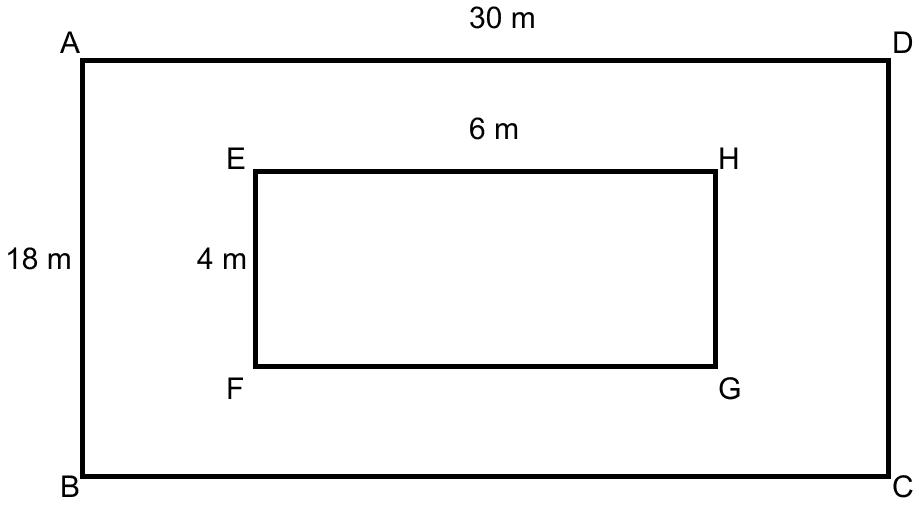
Volume of the earth dug out = 6 × 4 × 3 = 72 m3
Area of field ABCD = AB × BC = 18 × 30 = 540 m2.
Area of pit EFGH = EF × FG = 4 × 6 = 24 m2.
Area of remaining field = 540 - 24 = 516 m2.
Let h metres is the level raised over the field uniformly.
Volume of rise in level = Volume of earth dug out
∴ Area of remaining field × h = 72
516h = 72
h = m = 13.95 cm
Hence, the level of the remaining field has been raised by 13.95 cm.
A rectangular plot is 24 m long and 20 m wide. A cubical pit of edge 4 m is dug at each of the four corners of the field and the soil removed is evenly spread over the remaining part of the plot. By what height does the remaining plot get raised?
Answer
Let ABCD be the rectangular plot.

Given,
Length of plot (l) = 24 m
Width of plot (b) = 20 m
So, the area of plot = l × b = 24 × 20 = 480 m2.
We know that,
Side of cubical pit = 4 m
Volume of each pit = 43 = 64 m3.
Volume of 4 pits at the corners = 4 × 64 = 256 m3.
Surface area of each pit = 4(side)2
= 4 × 42
= 64 m2
So, the area of remaining plot = 480 – 64 = 416 m2.
Let height of soil be h meters spread over remaining land.
So, the volume of soil raised = Volume of soil dug
∴ 416 × h = 256
h = metre.
Hence, remaining plot gets raised by metre.
The inner dimensions of a closed wooden box are 2 m, 1.2 m and 0.75 m. The thickness of the wood is 2.5 cm. Find the cost of wood required to make the box if 1 m3 of wood costs ₹ 22,000.
Answer
Given,
Inner dimensions of wooden box are 2 m, 1.2 m and 0.75 m.
Thickness of the wood = 2.5 cm = = 0.025 m.
So the external dimensions of wooden box are,
⇒ (2 + 2 × 0.025), (1.2 + 2 × 0.025), (0.75 + 2 × 0.025)
⇒ (2 + 0.05), (1.2 + 0.05), (0.75 + 0.5)
⇒ 2.05 m, 1.25 m, 0.80 m.
By formula,
Volume of solid = External volume of box – Internal volume of box
Substituting the values we get,
Volume of solid = (2.05 × 1.25 × 0.80) – (2 × 1.2 × 0.75)
= 2.05 – 1.80
= 0.25 m3.
Cost of box = Cost per m3 × Volume of box
= ₹ 22,000 × 0.25
= ₹ 22,000 x
= ₹ 5,500.
Hence, cost of wood required to make the box is ₹ 5,500.
A cubical wooden box of internal edge 1 m is made of 5 cm thick wood. The box is open at the top. If the wood costs ₹ 28,800 per cubic metre, find the cost of the wood required to make the box. Calculate the cost to nearest hundred rupees.
Answer
Given,
Internal edge of cubical wooden box = 1 m
Thickness of wood = 5 cm = m = 0.05 m
We know that,
External length = (1 + 0.05 × 2) = 1.1 m
External Breadth = (1 + 0.05 × 2) = 1.1 m
External Height = (1 + 0.05) = 1.05 m [Since, box is open at top]
By formula,
Volume of the wood used = Outer volume – Inner volume
Substituting the values we get,
Volume of the wood used = 1.1 × 1.1 × 1.05 – 1 × 1 × 1
= 1.2705 – 1
= 0.2705 m3
Given,
Cost of 1 m3 of wood = ₹ 28,800
Cost of the wood required to make the box = Cost of wood per m3 × Volume of wood
= ₹ 28,800 × 0.2705
= ₹ 7,790.40
≈ ₹ 7,800 (to nearest hundred)
Hence, cost of wood required to make the box = ₹ 7,800.
A square brass plate of side x cm is 1 mm thick and weighs 4725 g. If one cc of brass weights 8.4 g, find the value of x.
Answer
Given,
Side of square brass plate = cm
Here, l = cm and b = cm
Thickness of plate = 1 mm = = 0.1 cm
We know that,
Volume of the plate = l × b × h
Substituting the values
= × × 0.1
= cm3
Given,
Weight of 1 cm3 of brass = 8.4 g
∴ Weight of cm3 of brass = 8.4 x g
But weight of square brass plate is given as 4725 g
Hence, x = 75.
Three cubes whose edges are x cm, 8 cm and 10 cm respectively are melted and recast into a single cube of edge 12 cm. Find x.
Answer
Since, cubes are melted and recasted into a single cube.
∴ Total volume of three cubes = Volume of new single cube
Substituting values we get,
Hence, x = 6.
The area of cross-section of a pipe is 3.5 cm2 and water is flowing out of pipe at the rate of 40 cm/s. How much water is delivered by the pipe in one minute?
Answer
It is given that
Area of cross-section of pipe = 3.5 cm2
Speed of water = 40 cm/s
Length of water column in 1 sec = 40 cm
We know that,
Volume of water flowing in 1 second = Area of cross section × length
= 3.5 × 40
= 140 cm3.
So, the volume of water flowing in 1 minute i.e., 60 sec = 140 × 60 = 8400 cm3.
1 cm3 = litre
∴ 8400 cm3 = = 8.4 litres.
Hence, 8.4 litres of water is delivered by the pipe in one minute.
The figure (i) given below shows a solid of uniform cross-section. Find the volume of the solid. All measurements are in cm and all angles in the figure are right angles.

Answer
(a) From figure,

The line AB divides the figure, into two cuboids vertical and horizontal.
Volume of solid = Volume of vertical cuboid + Volume of horizontal cuboid
= 4 × 2 × 6 + 4 × 4 × 2
= 48 + 32
= 80 cm3
Hence, volume of solid = 80 cm3.
The figure (ii) given below shows the cross section of a concrete wall to be constructed. It is 2 m wide at the top, 3.5 m wide at the bottom and its height is 6 m and its length is 400 m. Calculate
(i) the cross sectional area and
(ii) volume of concrete in the wall.

Answer
Figure (ii) is a trapezium with parallel sides 2 m and 3.5 m
(i) Area of cross section = (sum of parallel sides) × height
= (2 + 3.5) × 6
= × 5.5 × 6
= 5.5 × 3
= 16.5 m2.
Hence, area of cross-section = 16.5 m2.
(ii) Volume of concrete in the wall = Area of cross section × length
= 16.5 × 400
= 6600 m3.
Hence, volume of concrete wall = 6600 m3.
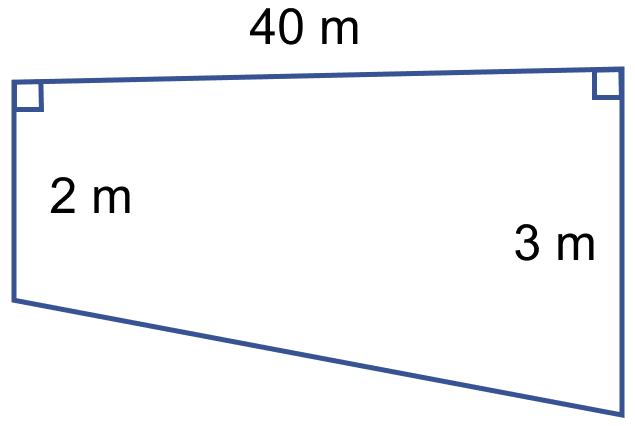
The figure (iii) given below show the cross-section of a swimming pool 10 m broad, 2 m deep at one end and 3 m deep at the other end. Calculate the volume of water it will hold when full, given that its length is 40 m.
Answer
Figure (iii) is a trapezium with parallel sides 2 m and 3m.
By formula,
Area of cross section = (sum of parallel sides) × distance between them
= (2 + 3) × 40
= × 5 × 40
= 100 m2.
So, the volume of water it will hold when full = area of cross section × width
= 100 × 10
= 1000 m3.
Hence, swimming pool will hold 1000 m3 of water.
A swimming pool is 50 metres long and 15 metres wide. Its shallow and deep ends are metres and metres deep respectively. If the bottom of the pool slopes uniformly, find the amount of water required to fill the pool.
Answer
Given,
Length of swimming pool = 50 m
Width of swimming pool = 15 m
Its shallow and deep ends are 1.5 m and 4.5 m deep

By formula,
Area of cross section of swimming pool = (sum of parallel sides) × length
=
= × 6 × 50
= 150 m2.
Amount of water required to fill pool = Area of cross section × width
= 150 × 15
= 2250 m3.
Hence, amount of water required to fill pool 2250 m3.