
Find the length of the diameter of a circle whose circumference is 44 cm.
Answer
Let radius = r cm.
By formula,
Circumference = 2πr
2πr = 44
Diameter = 2r = 2 × 7 = 14 cm.
Hence, length of the diameter of the circle = 14 cm.
Find the radius and area of a circle if its circumference is 18π cm.
Answer
Let radius = r cm.
By formula,
Circumference = 2πr
⇒ 2πr = 18π
⇒ 2r = 18
⇒ r = 9 cm.
Area of circle = πr2
=
= cm2.
Hence, radius = 9 cm and area = cm2.
Find the perimeter of a semicircular plate of radius 3.85 cm.
Answer
Perimeter of semicircular plate = (π + 2)r
Hence, perimeter of a semicircular plate = 19.8 cm.
Find the radius and circumference of a circle whose area is 144π cm2.
Answer
Let radius = r cm.
Area of circle = πr2
⇒ 144π = πr2
⇒ r2 = 144
⇒ r = = 12 cm.
Circumference of a circle = 2πr
=
= cm.
Hence, radius = 12 cm and circumference = cm.
A sheet is 11 cm long and 2 cm wide. Circular pieces 0.5 cm in diameter are cut from it to prepare discs. Calculate the number of discs that can be prepared.
Answer
Given,
Diameter of circle = 0.5 cm.

From figure,
Area of sheet required to cut a circle = area of a square with length of side equal to diameter.
∴ No. of discs prepared = No. of squares formed from sheet.
No. of squares that will be formed from sheet =
Hence, no. of discs that can be prepared = 88.
If the area of the semi-circular region is 77 cm2, find its perimeter.
Answer
Let radius = r cm.
Given,
Area of semi-circular region = 77 cm2
Perimeter of semi-circle = (π + 2) = πr + 2r
=
= 22 + 14
= 36 cm.
Hence, perimeter of circle = 36 cm.
In the figure (i) given below, AC and BD are two perpendicular diameters of a circle ABCD. Given that the area of shaded portion is 308 cm2, calculate :
(i) the length of AC and
(ii) the circumference of the circle.

Answer
(i) Let r be the radius of the circle. We know that,
Diameters of the circle divide circle into 4 equal quadrants.
Hence, area of each quadrant = πr2.
Since, 2 quadrants are shaded.
∴ Area of shaded region = πr2
⇒ 308 = r2
⇒ r2 =
⇒ r2 = 14 × 14 = 196
⇒ r = = 14 cm.
Since, AC is the diameter of circle so,
⇒ AC = 2r = 28 cm.
Hence, AC = 28 cm.
(ii) Circumference of circle = 2πr
=
= 88 cm.
Hence, circumference of circle = 88 cm.
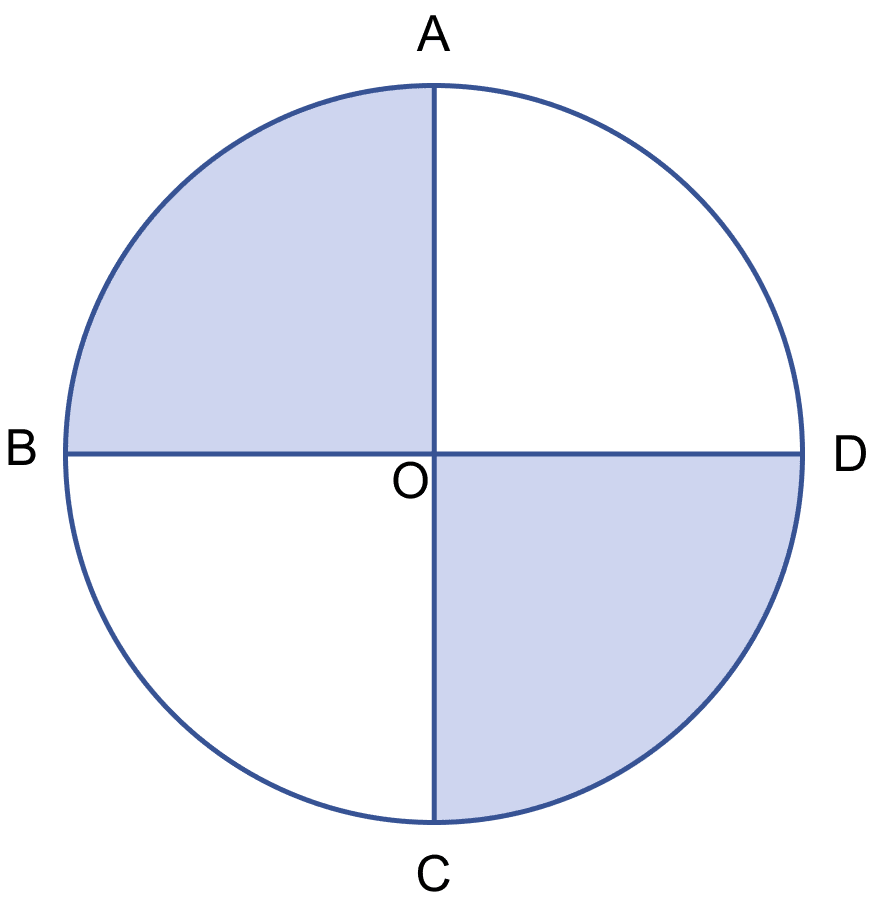
In the figure (ii) given below, AC and BD are two perpendicular diameters of a circle with center O. If AC = 16 cm, calculate the area and perimeter of the shaded part. (Take π = 3.14)
Answer
Given,
AC = 16 cm, AO = = 8 cm.
The diameters of the circle divide circle into 4 quadrants.
Area of each quadrant =
Area of quadrant AOD + Area of quadrant BOC = 50.24 + 50.24 = 100.48 cm2.
Perimeter of each quadrant =
Perimeter of both quadrants = 2 × 28.56 = 57.12 cm.
Hence, area of shaded region = 100.48 cm2 and perimeter of shaded region = 57.12 cm.
A bucket is raised from a well by means of a rope which is wound round a wheel of diameter 77 cm. Given that the bucket ascends in 1 minute 28 seconds with a uniform speed of 1.1 m/sec, calculate the number of complete revolutions the wheel makes in raising the bucket.
Answer
Time in which bucket ascends = 1 minute 28 seconds = 60 + 28 = 88 seconds.
Speed of bucket = 1.1 m/sec
Distance covered by bucket while ascending = Speed × Time = 1.1 × 88 = 96.8 m.
Radius of wheel = = 38.5 cm.
Circumference of circle = 2πr = = 242 cm = 2.42 m.
Let n be the no. of revolutions of wheel.
Distance covered by bucket = Distance covered by wheel
⇒ 96.8 = 2.42 × n
⇒ n = = 40.
Hence, wheel makes 40 revolutions in raising the bucket.
The wheel of a cart is making 5 revolutions per second. If the diameter of the wheel is 84 cm, find its speed in km/hr. Give your answer, correct to the nearest km.
Answer
Radius of wheel = = 42 cm.
Distance covered by wheel in 1 revolution = Circumference of wheel = 2πr
=
= 264 cm.
Distance covered by wheel in 5 revolutions = 5 × 264 = 1320 cm.
∴ Wheel covers 1320 cm in 1 second.
Hence, speed of wheel = 48 km/hr.
The circumference of a circle is 123.2 cm. Calculate :
(i) the radius of the circle in cm.
(ii) the area of the circle in cm2, correct to nearest cm2.
(iii) the effect on the area of the circle if the radius is doubled.
Answer
(i) Let radius = r cm.
By formula,
Circumference = 2πr
2πr = 123.2
Hence, radius = 19.6 cm.
(ii) By formula,
Area of circle = πr2
Hence, area of circle = 1207 cm2.
(iii) We know that,
Area of circle = πr2, where r is the radius.
If radius is doubled so new radius = 2r cm.
New area of circle = π(2r)2 = 4πr2.
Change in area =
Hence, area becomes 4 times.
In the figure (i) given below, the area enclosed between the concentric circles is 770 cm2. Given that the radius of the outer circle is 21 cm, calculate the radius of the inner circle.

Answer
Let radius of inner circle = r cm.
From figure,
Area of shaded region = Area of outer circle - Area of inner circle
⇒ 770 = π(21)2 - πr2
⇒ 770 = 441π - πr2
⇒ 770 = π(441 - r2)
⇒ 441 - r2 =
⇒ 441 - r2 =
⇒ 441 - r2 =
⇒ 441 - r2 = 245
⇒ r2 = 441 - 245
⇒ r2 = 196
⇒ r = = 14 cm.
Hence, radius of inner circle = 14 cm.
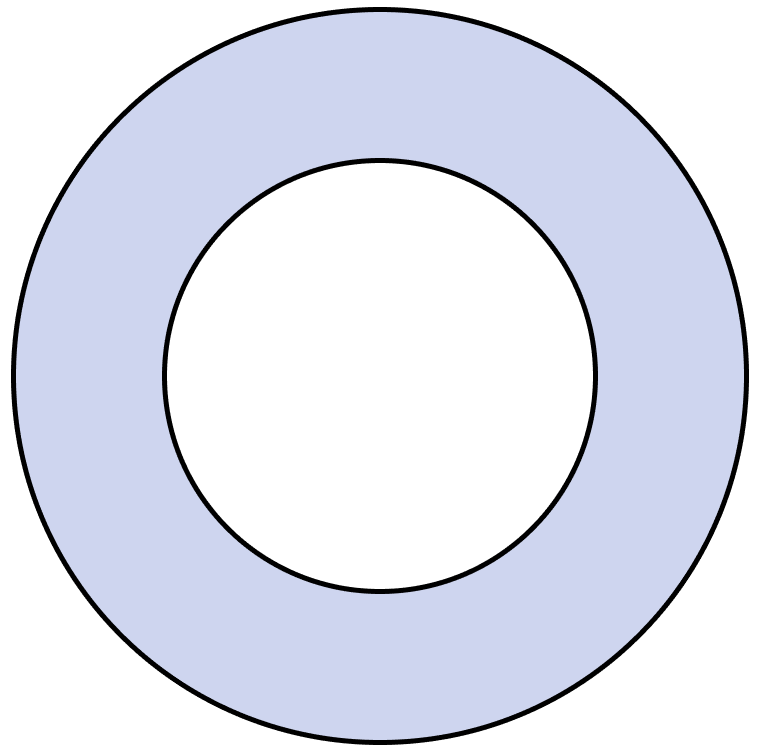
In the figure (ii) given below, the area enclosed between the circumferences of two concentric circles is 346.5 cm2. The circumference of the inner circle is 88 cm. Calculate the radius of the outer circle.
Answer
Let radius of inner circle = r cm.
Circumference = 2πr
⇒ 88 = 2πr
⇒ r =
⇒ r =
⇒ r =
⇒ r = 2 × 7 = 14 cm.
Let radius of outer circle = R cm.
From figure,
Area of shaded region = Area of outer circle - Area of inner circle
⇒ 346.5 = π(R)2 - πr2
⇒ 346.5 = π(R)2 - π(14)2
⇒ 346.5 = π(R2 - 196)
⇒ R2 - 196 =
⇒ R2 - 196 =
⇒ R2 - 196 =
⇒ R2 - 196 = 110.25
⇒ R2 = 110.25 + 196
⇒ R2 = 306.25
⇒ R =
⇒ R = 17.5 cm
Hence, radius of outer circle = 17.5 cm.
A road 3.5 m wide surrounds a circular plot whose circumference is 44 m. Find the cost of paving the road at ₹ 200 per m2.
Answer
Let the radius of circular plot = R meters.
Given,
Circumference of circular plot = 44 m
2πR = 44
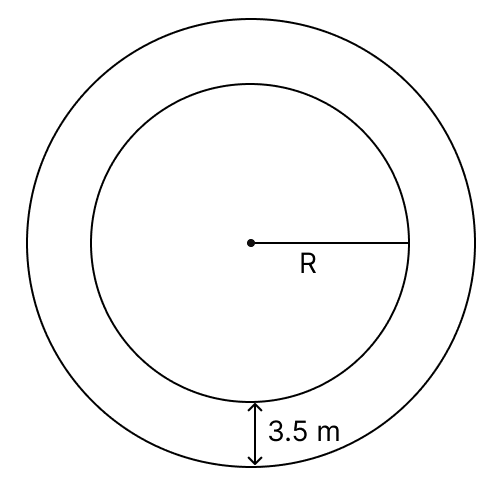
From figure,
Radius of outer circle = R + 3.5 = 7 + 3.5 = 10.5 m.
Area of road = Area of outer circle - Area of inner circle
= π(10.5)2 - π(7)2
= 110.25π - 49π
= 61.25π
= x 61.25
= 192.50 m2
Rate of paving the road = ₹ 200 per m2
Cost of paving road = Area of road × Rate of paving the road
= 192.5 × 200
= ₹ 38,500.
Hence, cost of paving the road = ₹ 38,500.
The sum of diameters of two circles is 14 cm and the difference of their circumferences is 8 cm. Find the circumferences of the two circles.
Answer
Let radius of larger circle be R cm and smaller circle r cm.
Diameter = 2R and 2r
Given, sum of diameters of two circles is 14 cm
⇒ 2r + 2R = 14
⇒ r + R = 7 ...........(1)
Given, difference in circumferences is 8 cm
⇒ 2πR - 2πr = 8
⇒ 2π(R - r) = 8
⇒ π(R - r) = 4
⇒
⇒ .........(2)
Adding equation 1 and 2,
Substituting value of R in Eq 2 we get,
Circumference of larger circle = 2πR
=
= 2 x 13
= 26 cm.
Circumference of smaller circle = 2πr
=
= 2 x 9
= 18 cm.
Hence, circumference of larger circle = 26 cm and smaller circle = 18 cm.
Find the circumference of the circle whose area is equal to the sum of the areas of three circles with radius 2 cm, 3 cm and 6 cm.
Answer
Let the radius of resultant circle be r cm.
Given,
Area of resultant circle is equal to the sum of the areas of three circles with radius 2 cm, 3 cm and 6 cm.
⇒ πr2 = π(2)2 + π(3)2 + π(6)2
⇒ πr2 = π[(2)2 + (3)2 + (6)2]
⇒ r2 = 22 + 32 + 62
⇒ r2 = 4 + 9 + 36
⇒ r2 = 49
⇒ r = = 7 cm.
Circumference of circle = 2πr
=
= 44 cm.
Hence, circumference of circle = 44 cm.
A copper wire when bent in the form of a square encloses an area of 121 cm2. If the same wire is bent into the form of a circle, find the area of the circle.
Answer
Area of square = (side)2
Given,
Area of square = 121 cm2
∴ (side)2 = 121
⇒ (side)2 = (11)2
⇒ side = 11 cm.
Perimeter of square = 4 × side = 4 × 11 = 44 cm.
Circumference of the circle of same wire = Perimeter of square of same wire
Let radius of circle formed = r cm.
∴ 2πr = 44
⇒ r =
= 7 cm.
Area of circle = πr2
=
= 154 cm2.
Hence, area of circle = 154 cm2.
A copper wire when bent in the form of an equilateral triangle has area cm2. If the same wire is bent in the form of a circle, find the area enclosed by the wire.
Answer
Area of equilateral triangle = (side)2
Given,
Area of equilateral triangle = cm2
Perimeter of equilateral triangle = 3 x side
= 3 x 22 = 66 cm.
Circumference of the circle of same wire = Perimeter of triangle of same wire
Let radius of circle formed = r cm.
∴ 2πr = 66
Area of circle = πr2
=
= 346.5 cm2.
Hence, area of circle = 346.5 cm2.
Find the circumference of the circle whose area is 16 times the area of the circle with diameter 7 cm.
Answer
Let area of larger circle be r cm.
Radius of circle with diameter 7 cm = = 3.5 cm.
Given,
Area of larger circle is 16 times the area of the circle with diameter 7 cm.
⇒ πr2 = 16 x π x (3.5)2
⇒ r2 = 196
⇒ r = = 14 cm.
Circumference = 2πr = = 88 cm.
Hence, circumference of circle = 88 cm.
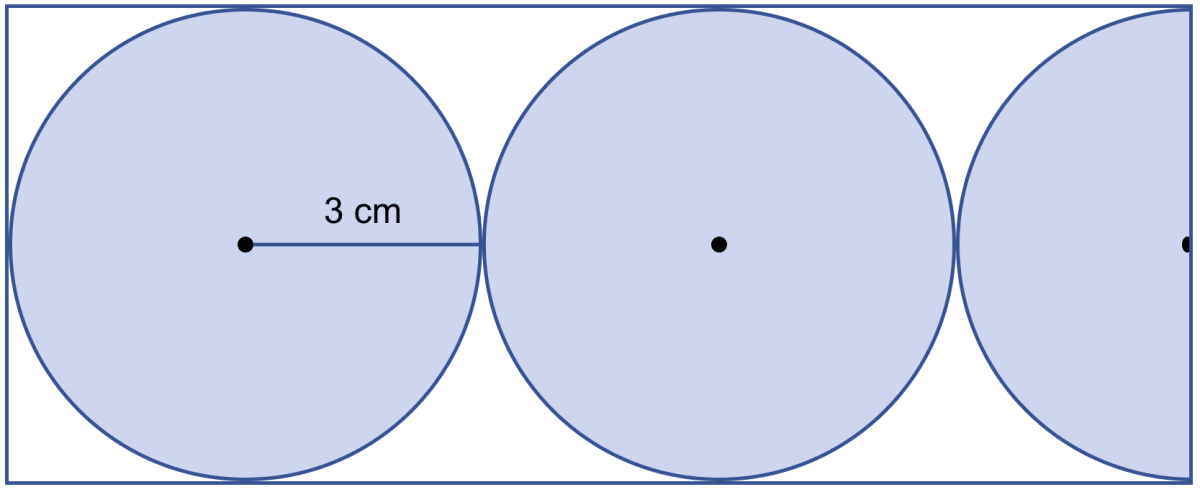
In the given figure, find the area of the unshaded portion within the rectangle.
(Take π = 3.14)
Answer
Let ABCD be a rectangle.
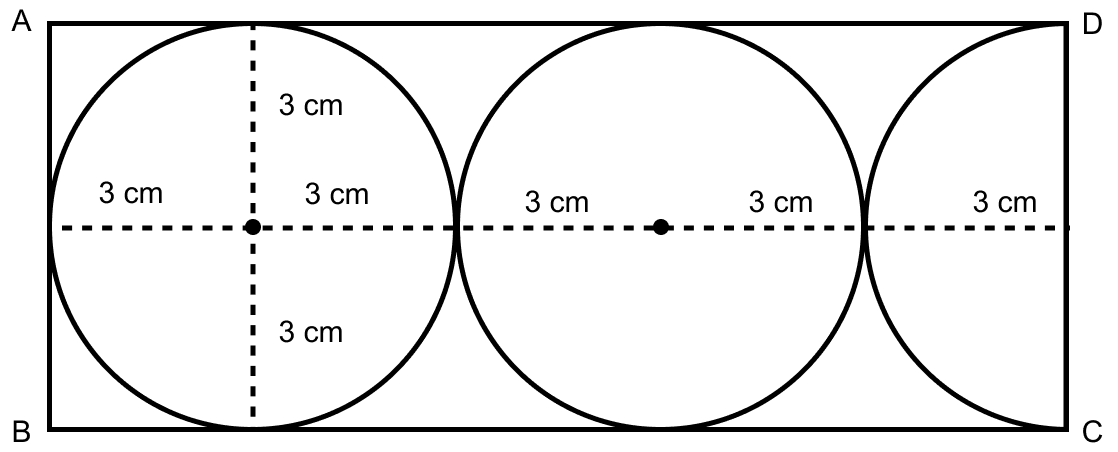
From figure,
AB = CD = 6 cm and,
AD = BC = 15 cm.
Area of rectangle = l × b = AD × AB = 15 × 6 = 90 cm2.
Area of shaded portion = π(3)2 + π(3)2 +
Area of unshaded region = Area of rectangle - Area of shaded region
= 90 - 70.65 = 19.35 cm2.
Hence, area of unshaded region = 19.35 cm2.
In the adjoining figure, ABCD is a square of side 21 cm. AC and BD are two diagonals of the square. Two semicircle are drawn with AD and BC as diameters. Find the area of the shaded region. Take π = .
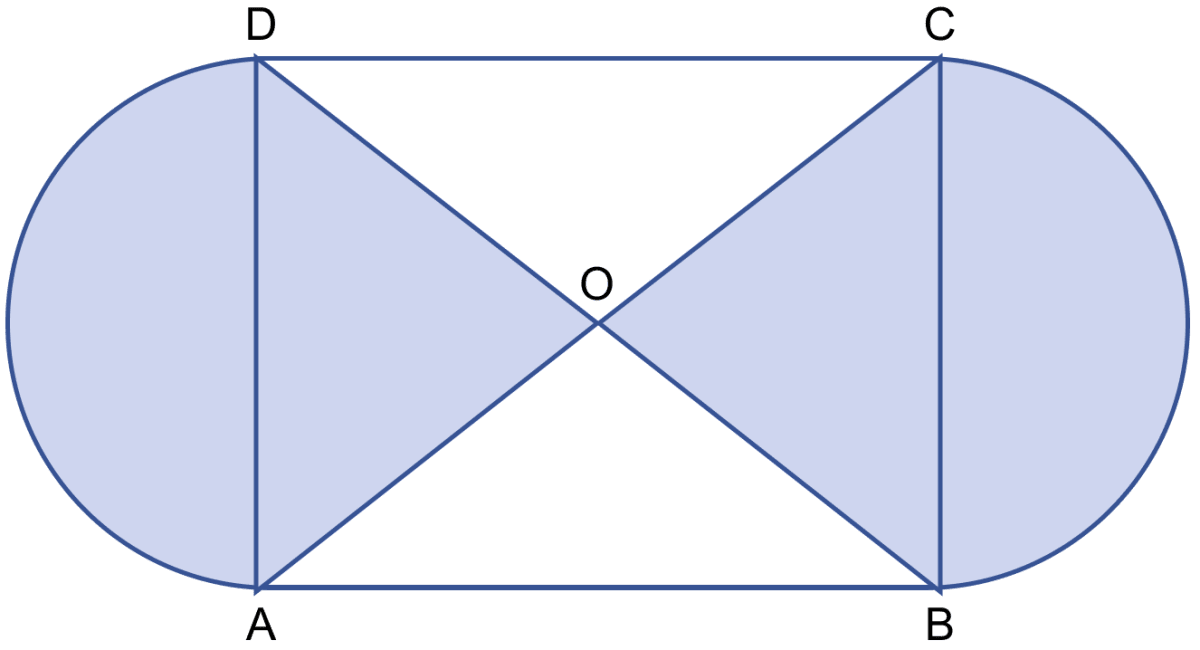
Answer
Area of square = (side)2 = 212 = 441 cm2.
We know that,
Diagonals of a square divide it into four triangles of equal area.
Area of a triangle = = 110.25 cm2.
Area of △AOD + Area of △BOC = 110.25 + 110.25 = 220.50 cm2
Diameter of each semicircle = 21 cm
∴ Radius = = 10.5 cm.
Area of each semicircle =
From figure,
Area of shaded region = Area of both semicircles + Area of △AOD + Area of △BOC
= (2 × 173.25) + 220.50
= 346.50 + 220.50
= 567 cm2.
Hence, area of shaded region = 567 cm2.
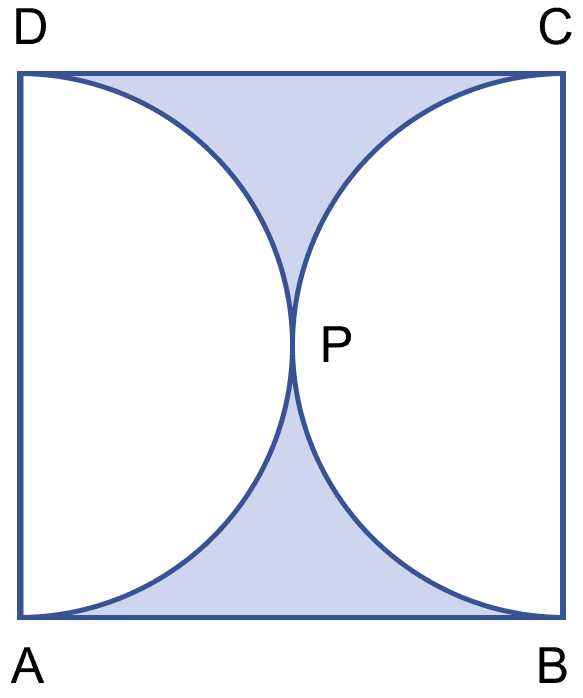
In the figure (i) given below, ABCD is a square of side 14 cm and APD and BPC are semicircles. Find the area and the perimeter of the shaded region.
Answer
Area of square = (side)2 = 142 = 196 cm2.
From figure,
Diameter of both semicircle = side of square = 14 cm.
∴ Radius (r) = = 7 cm.
Area of both the semi-circles =
Area of shaded region = Area of square - Area of semi-circles
= 196 - 154 = 42 cm2.
From figure,
Perimeter = arc DPA + DC + arc CPB + AB
= πr + 14 + πr + 14
= 2πr + 28
= + 28
= 44 + 28 = 72 cm.
Hence, area of shaded region = 42 cm2 and perimeter = 72 cm.
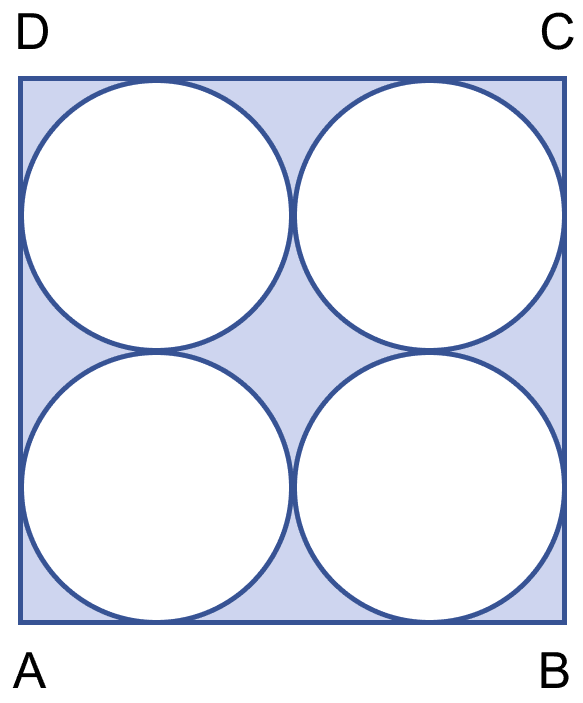
In the figure (ii) given below, ABCD is a square of side 14 cm. Find the area of the shaded region.
Answer
Let radius of each circle be r cm.
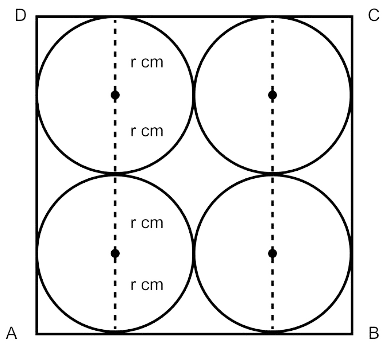
From figure,
⇒ r + r + r + r = 14
⇒ 4r = 14
⇒ r = 3.5 cm.
Since, radius is same so, each circle will have same area.
Area of each circle = πr2
=
=
= 22 × 0.5 × 3.5
= 38.5 cm2
Area of square = (side)2 = 142 = 196 cm2.
Area of shaded region = Area of square - Area of circles
= 196 - 4 × 38.5
= 196 - 154
= 42 cm2.
Hence, area of shaded region = 42 cm2.
In the figure (iii) given below, the diameter of the semicircle is equal to 14 cm. Calculate the area of the shaded region. Take π = .
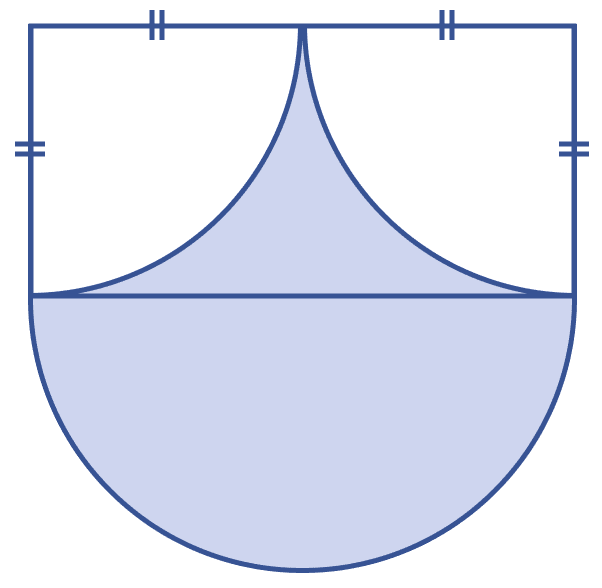
Answer
From figure,
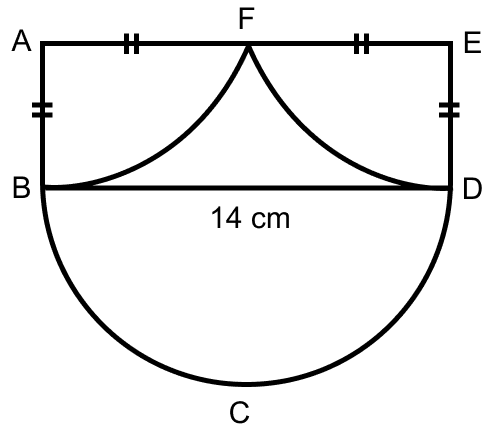
BD = 14 cm (Diameter of semi-circle)
AF = FE = x (let)
⇒ BD = AF + FE
⇒ 14 = x + x
⇒ 2x = 14
⇒ x = 7 cm.
Area of semi-circle BCD =
Area of quadrant ABF = Area of quadrant EDF =
From figure, AB = ED = AF = FE = 7 cm.
Area of rectangle ABDE= AB × BD = 7 × 14 = 98 cm2.
Area of shaded region = Area of rectangle ABDE + Area of semi-circle BCD - Area of quadrant ABF - Area of quadrant EDF
= 98 + 77 - 38.5 - 38.5
= 98 cm2.
Hence, area of shaded region = 98 cm2.
Find the area and the perimeter of the shaded region in figure (i) given below. The diamensions are in centimeters.

Answer
From figure,
Radius of larger semi-circle (R) = 14 cm.
Area of larger semi-circle =
= 22 × 14
= 308 cm2.
Diameter of smaller semi-circle = 14 cm; radius (r) = = 7 cm.
Area of smaller semi-circle =
= 11 × 7
= 77 cm2.
From figure,
Area of shaded region = Area of larger semi-circle - Area of smaller semi-circle
= 308 - 77
= 231 cm2.
From figure,
Perimeter of shaded region = Circumference of larger semi-circle + Circumference of smaller circle + 14
= πR + πr + 14
=
= 44 + 22 + 14
= 80 cm.
Hence, area of shaded region = 231 cm2 and perimeter = 80 cm.
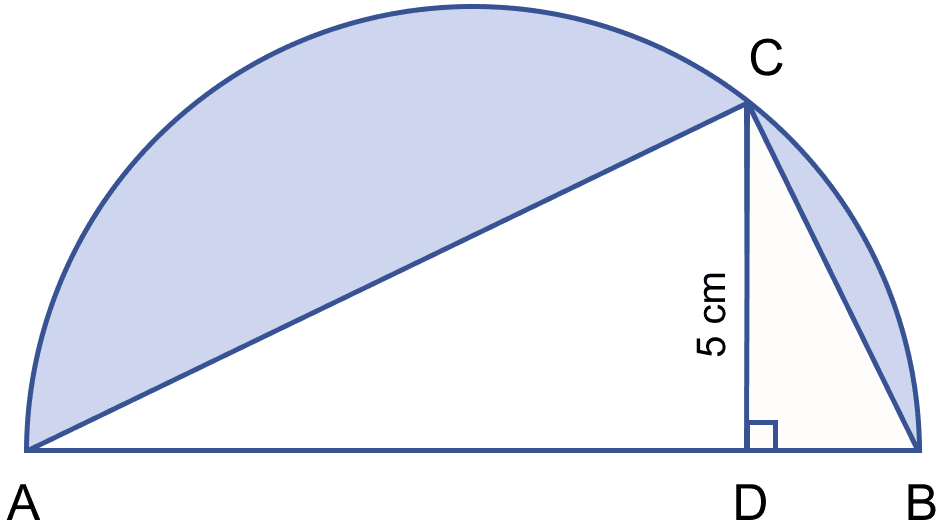
In the figure (ii) given below, area of △ABC = 35 cm2. Find the area of the shaded region.
Answer
From figure,
Area of △ABC = base × height
Substituting values we get,
⇒ AB × CD = 35
⇒ AB × 5 = 35
⇒ AB = = 14 cm.
From figure,
AB is the diameter of semicircle.
Radius = = 7 cm.
Area of semi-circle =
= 11 × 7
= 77 cm2.
Area of shaded region = Area of semi-circle - Area of △ABC
= 77 - 35
= 42 cm2.
Hence, area of shaded region = 42 cm2.
In the figure (i) given below, AOBC is a quadrant of a circle of radius 10 m. Calculate the area of the shaded portion. Take π = 3.14 and give your answer correct to two significant figures.
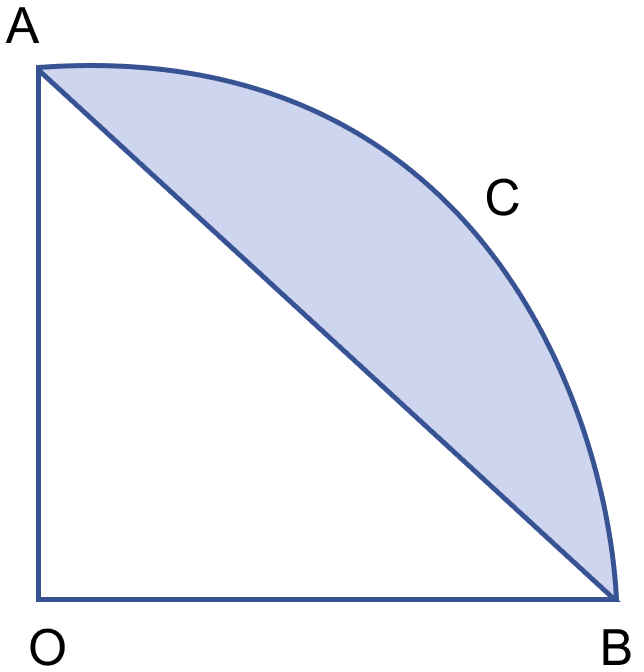
Answer
Area of quadrant =
Area of triangle AOB =
Area of shaded region = Area of quadrant - Area of triangle
= 78.5 - 50
= 28.5 ≈ 29 m2.
Hence, area of shaded region = 29 m2.
In the figure (ii) given below, OAB is a quadrant of a circle. The radius OA = 7 cm and OD = 4 cm. Calculate the area of the shaded portion.
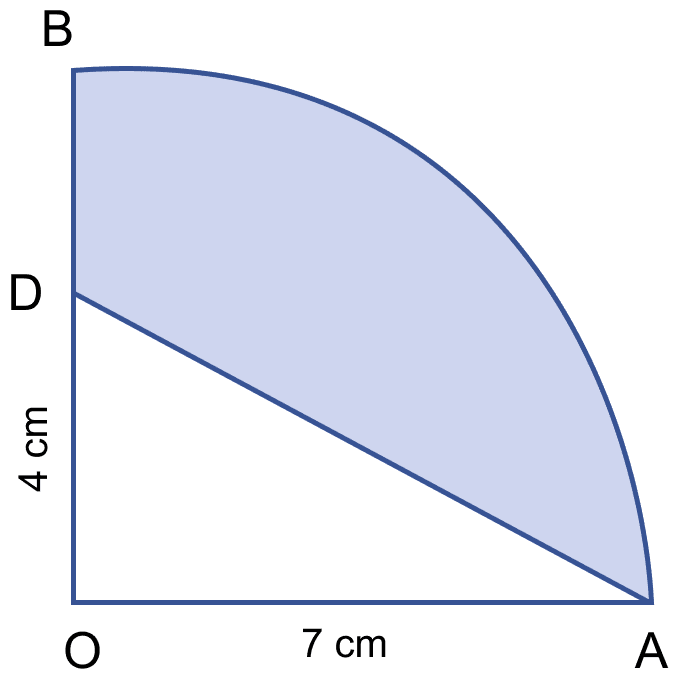
Answer
Area of quadrant =
Area of triangle AOD =
Area of shaded region = Area of quadrant - Area of triangle
= 38.5 - 14
= 24.5 cm2.
Hence, area of shaded region = 24.5 cm2.
A student takes a rectangular piece of paper 30 cm long and 21 cm wide. Find the area of the biggest circle that can be cut out from the paper. Also find the area of the paper left after cutting out the circle.
Answer
From figure,
Let ABCD be the rectangular piece.

Area of rectangular piece = 30 × 21 = 630 cm2
From figure,
Radius of the biggest circle that can be cut from the rectangular piece = = 10.5 cm
Area of circle = πr2
=
=
= 22 × 15.75
= 346.5 cm2.
Area of paper left = Area of rectangular piece - Area of circle
= 630 - 346.5
= 283.5 cm2.
Hence, the area of the biggest circle that can be cut from the rectangular piece = 346.5 cm2 and area of remaining paper = 283.5 cm2.
A rectangle with one side 4 cm is inscribed in a circle of radius 2.5 cm. Find the area of the rectangle.
Answer
Let ABCD be a rectangle with AB = 4 cm.

From figure,
Diameter of circle, AC = AO + OC = 2.5 + 2.5 = 5 cm.
In right angle triangle ABC,
⇒ AC2 = AB2 + BC2
⇒ 52 = 42 + BC2
⇒ BC2 = 52 - 42
⇒ BC2 = 25 - 16 = 9
⇒ BC = = 3 cm.
By formula,
Area of rectangle = l × b
= AB × BC
= 4 × 3
= 12 cm2.
Hence, area of rectangle = 12 cm2.
In the figure (i) given below, calculate the area of the shaded region correct to two decimal places. (Take π = 3.142)
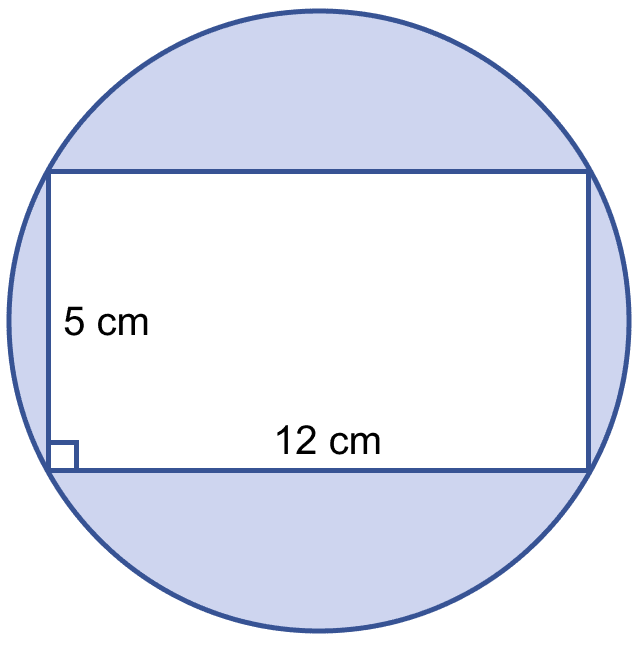
Answer
From figure,
O is the center. In right angle triangle ABC,
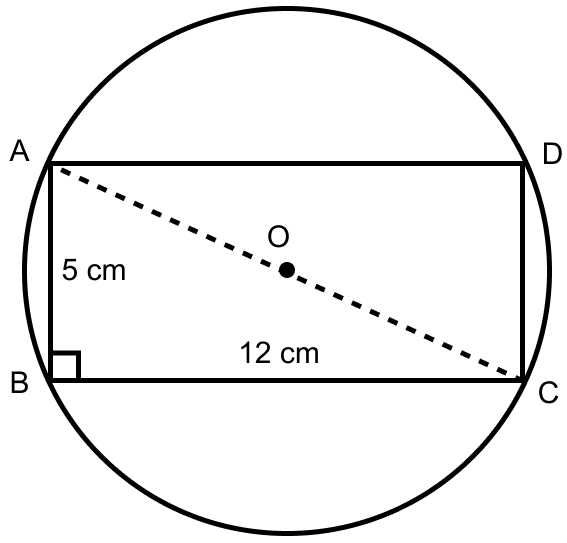
Using pythagoras theorem,
⇒ AC2 = AB2 + BC2
⇒ AC2 = 52 + 122
⇒ AC2 = 25 + 144 = 169
⇒ AC = = 13 cm.
From figure,
AC is the diameter and OA is the radius = = 6.5 cm.
Area of circle = πr2
= 3.142 × (6.5)2
= 3.142 × 42.25
= 132.75 cm2.
Area of rectangle = l × b
= 12 × 5 = 60 cm2.
Area of shaded region = Area of circle - Area of rectangle
= 132.75 - 60
= 72.75 cm2.
Hence, area of shaded region = 72.75 cm2.
In the figure (ii) given below, ABC is an isosceles right angled triangle with ∠ABC = 90°. A semicircle is drawn with AC as diameter. If AB = BC = 7 cm, find the area of the shaded region. Take π = .
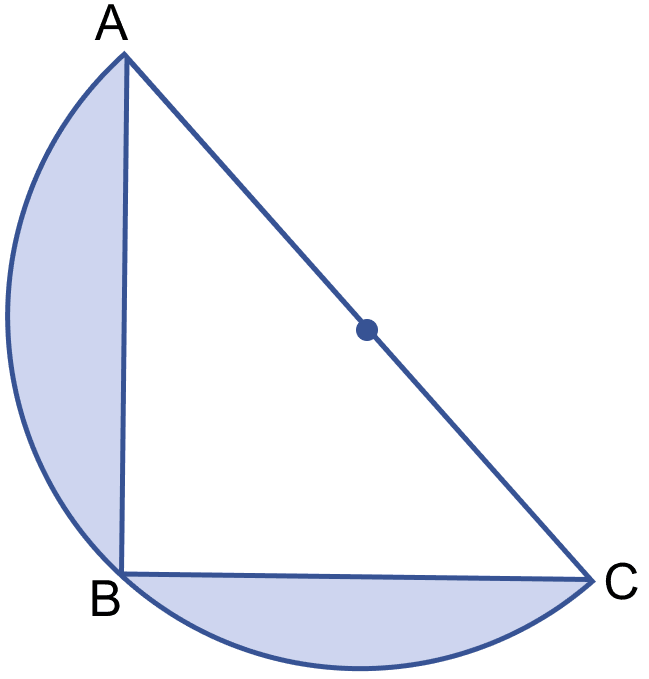
Answer
By formula,
Area of △ABC = × base × height
= × BC × AB
= × 7 × 7
= = 24.5 cm2.
In right angle triangle,
Using pythagoras theorem,
⇒ AC2 = AB2 + BC2
⇒ AC2 = 72 + 72
⇒ AC2 = 49 + 49 = 98
⇒ AC = cm.
From figure,
Radius of semi-circle (r) =
By formula,
Area of semi-circle =
Area of the shaded region = Area of the semi-circle – Area of △ABC
= 38.5 - 24.5
= 14 cm2.
Hence, area of the shaded region = 14 cm2.
A circular field has perimeter 660 m. A plot in the shape of a square having its vertices on the circumference is marked in the field. Calculate the area of the square field.
Answer
By formula,
Perimeter = 2πr
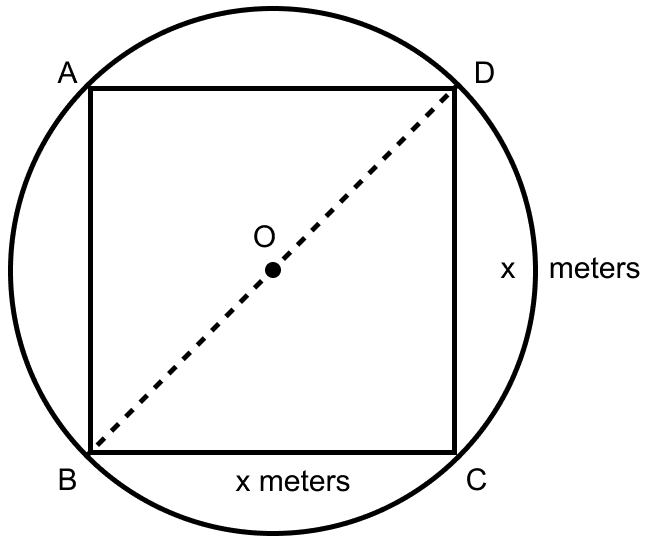
From figure,
BD = BO + OD = r + r = 2r = 2 × 105 = 210 m.
Let O be the center of the circle and ABCD be square of side x metres.
Area of square = (side)2 = x2.
In right angle triangle BCD,
⇒ BD2 = BC2 + CD2
⇒ 2102 = x2 + x2
⇒ 2x2 = 44100
⇒ x2 = = 22050 m2.
Hence, area of square = 22050 m2.
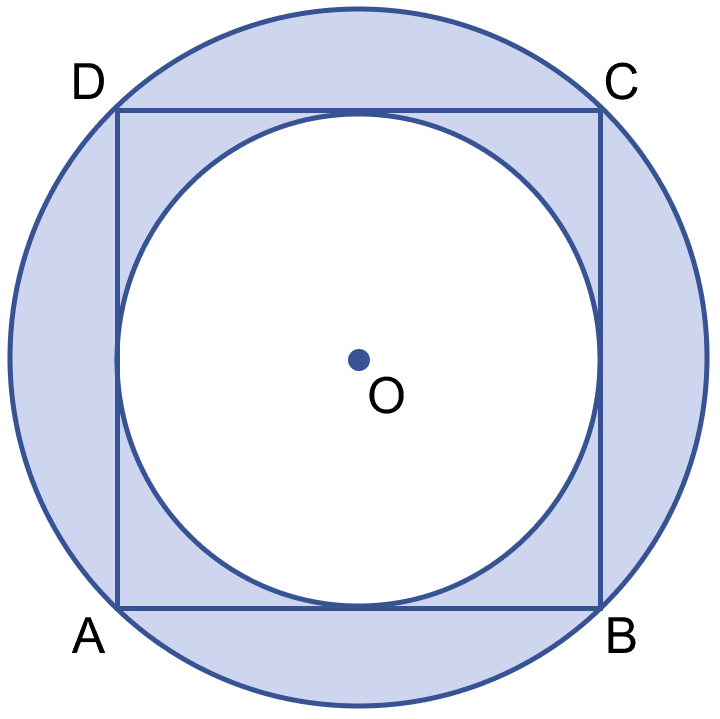
In the adjoining figure, ABCD is a square. Find the ratio between
(i) the circumferences
(ii) the areas of the incircle and the circumcircle of the square.
Answer
(i) Let side of the square be 2a units.
From figure,
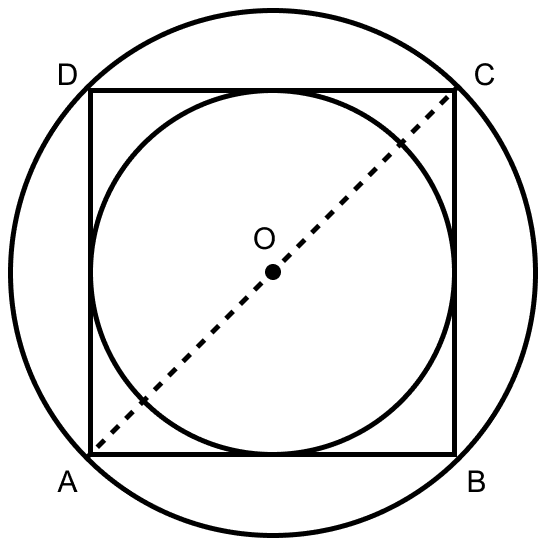
AD = Diameter of incircle.
Radius of incircle (r) = = a units.
In right angle triangle ABC,
Using pythagoras theorem,
AC2 = AB2 + BC2
AC2 = (2a)2 + (2a)2
AC2 = 4a2 + 4a2
AC2 = 8a2
AC = units.
From figure,
AC is the diameter of circumcircle and AO is radius.
AO (R) = a units.
Hence, ratio between circumferences = .
(ii)
Hence, ratio between areas = 1 : 2.
The figure (i) given below shows a running track surrounding a grassed enclosure PQRSTU. The enclosure consists of a rectangle PQST with a semicircular region at each end. PQ = 200 m; PT = 70 m.
(i) Calculate the area of the grassed enclosure in m2.
(ii) Given that the track is of constant width 7 m, calculate the outer perimeter ABCDEF of the track.
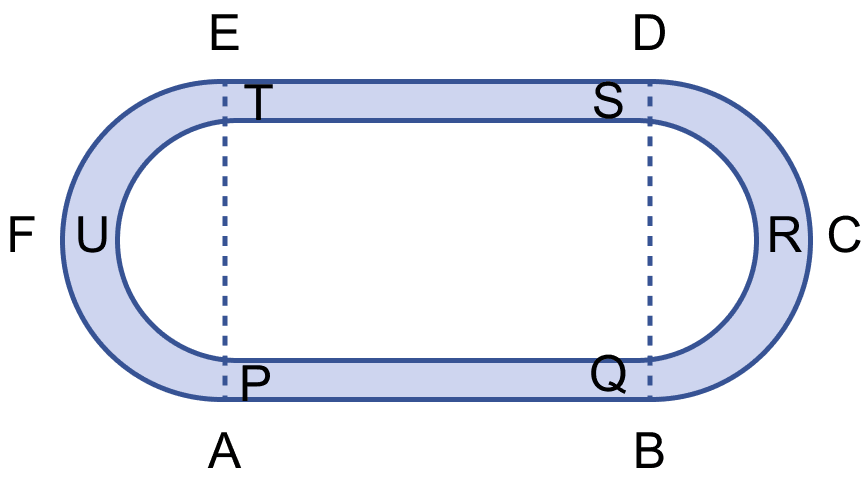
Answer
Given,
PQ = 200 m and PT = 70 m.
(i) By formula,
Area of rectangle PQST = l × b
= 200 × 70
= 14000 m2.
Radius of each semi-circular part on either side of rectangle = = 35 m.
Area of both semi-circular parts = 2 × = πr2
=
= 22 × 5 × 35
= 3850 m2.
So, the total area of grassed enclosure = 14000 + 3850 = 17850 m2.
Hence, area of glassed enclosure = 17850 m2.
(ii) Given,
Width of track around the enclosure = 7 m.
From figure,
AB = PQ = 200 m
ED = ST = 200 m
EA = PT + ET + AP = 70 + 7 + 7 = 84 m
BD = DS + QS + BQ = 70 + 7 + 7 = 84 m
Outer radius of semi-circle (R) = = 42 m.
Circumference of both semi-circular part = πR + πR = 2πR.
=
= 264 m.
From figure,
Outer perimeter = Circumference of both semi-circular part + ED + AB
= 264 + 200 + 200
= 664 m.
Hence, perimeter of outer track ABCDEF = 664 m.
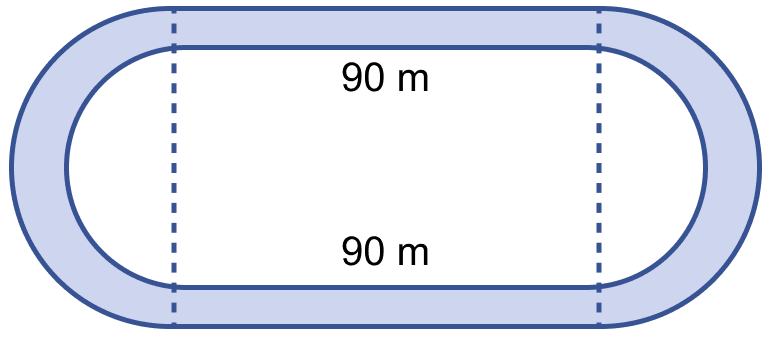
In the figure (ii) given below, the inside perimeter of a practice running track with semi-circular ends and straight parallel sides is 312 m. The length of the straight portion of the track is 90 m. If the track has a uniform width of 2 m throughout, find its area.
Answer
Given,
Perimeter of inside semi-circular track = 312 m.
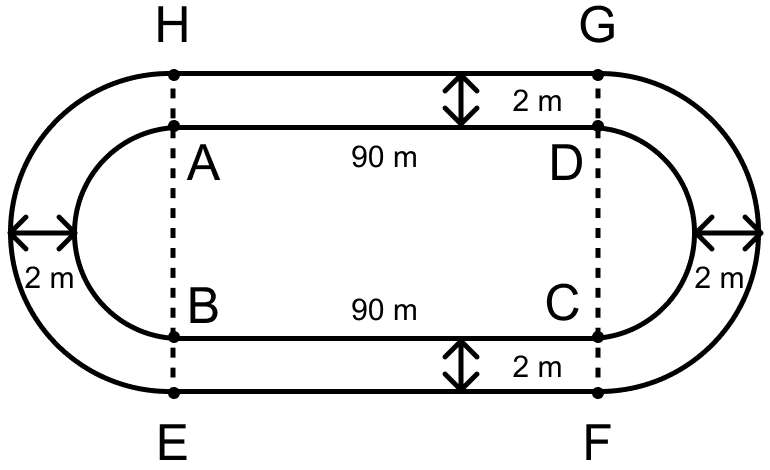
⇒ 90 + πr + 90 + πr = 312
⇒ 2πr + 180 = 312
⇒ 2πr = 312 - 180
⇒ 2πr = 132
⇒ πr =
⇒ πr = 66
⇒ r = m.
So, length of AB = 2r = 2 × 21 = 42 m.
Since, width of track = 2 m.
So, HE = GF = 42 + 2 + 2 = 46 m.
Radius of outer semi-circle (R) = = 23 m.
From figure,
Area of track = Area of outer semi-circle (with diametre HE) + Area of outer semi-circle( with diametre GF) + Area of outer rectangle (EFGH) - [Area of inner semi-circle (with diameter AB) + Area of inner semi-circle (with diameter DC) + Area of inner rectangle ABCD]
Hence, area of semi-circular track = m2.
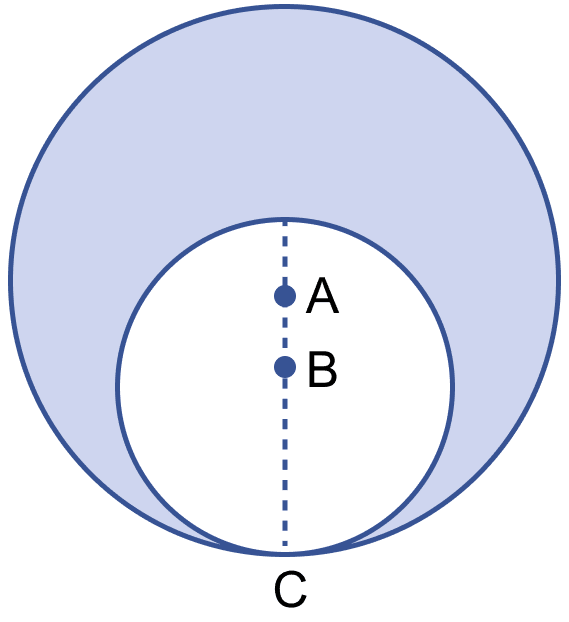
In the figure (i) given below, two circles with centres A and B touch each other at the point C. If AC = 8 cm and AB = 3 cm, find the area of the shaded region.
Answer
Radius of circle with center A = AC = 8 cm.
Area of circle with center A = πr2
=
= = 201.14 cm2.
From figure,
BC = AC - AB = 8 - 3 = 5 cm.
Area of circle with center B = πr2
=
= = 78.57 cm2.
Area of shaded region = Area of circle with center A - Area of circle with center B
= 201.14 - 78.57
= 122.57 cm2.
Hence, area of shaded region = 122.57 cm2.
The quadrants shown in the figure (ii) given below are each of radius 7 cm. Calculate the area of the shaded portion.

Answer
Given,
Radius of each quadrant = 7 cm

From figure,
Area of shaded region = Area of square – 4 area of each quadrant
= (side)2 – 4 ×
= 142 –
= 196 – 154
= 42 cm2.
Hence, area of shaded region = 42 cm2.
In the figure (i) given below, two circular flower beds have been shown on the two sides of a square lawn ABCD of side 56 m. If the centre of each circular flower bed is the point of intersection O of the diagonals of the square lawn, find the sum of the areas of the lawn and the flower beds.
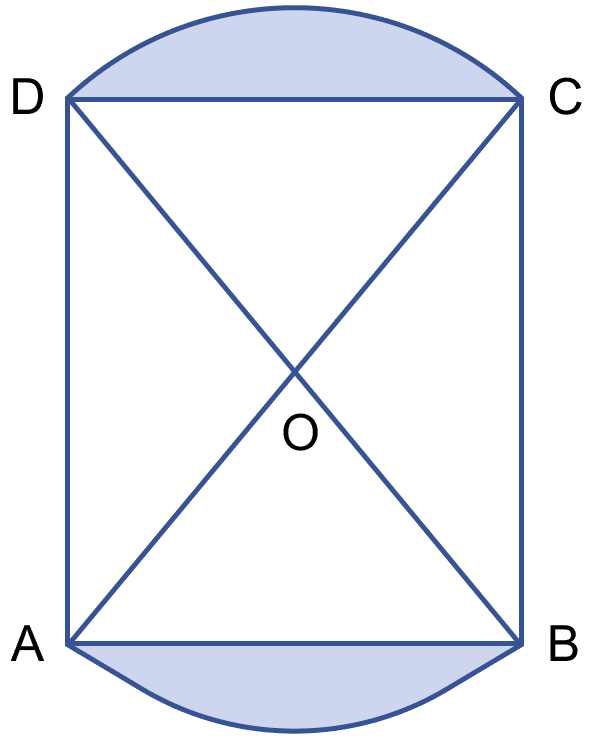
Answer
Area of lawn ABCD = (side)2
= (56)2 = 3136 m2.
In square,
Length of diagonal (AC) = side = m.
Since, diagonals of square are equal and bisect each other,
∴ AO = OC = OD = OB.
Radius of quadrant ODC = Radius of quadrant OAB = m.
Area of quadrant ODC = Area of quadrant OAB =
Since, diagonals of square divide it into four equal triangles.
Area of △ODC = Area of △OAB = = 784 m2.
From figure,
Area of flower bed = Area of quadrant ODC - Area of △ODC
= 1232 - 784 = 448 m2.
Since there are two flower beds so area = 2 × 448 = 896 m2.
Area of lawn and flower beds = 3136 + 896 = 4032 m2.
Hence, sum of the areas of the lawn and the flower beds = 4032 m2.
In the figure (ii) given below, a square OABC is inscribed in a quadrant OPBQ of a circle. If OA = 20 cm, find the area of the shaded region. (π = 3.14)

Answer
Given, length of each side of square = 20 cm.

We know that,
Length of diagonal of a square = side = cm.
∴ OB = cm.
From figure,
OB is the radius of the quadrant OPBQ.
Area of quadrant OPBQ =
Area of square OABC = (side)2
= (20)2 = 400 cm2.
Area of shaded region = Area of quadrant OPBQ - Area of square OABC
= 628 - 400
= 228 cm2.
Hence, area of shaded region = 228 cm2.
In the figure (i) given below, ABCD is a rectangle, AB = 14 cm and BC = 7 cm. Taking DC, BC and AD as diameters, three semicircles are drawn as shown in the figure. Find the area of the shaded portion.
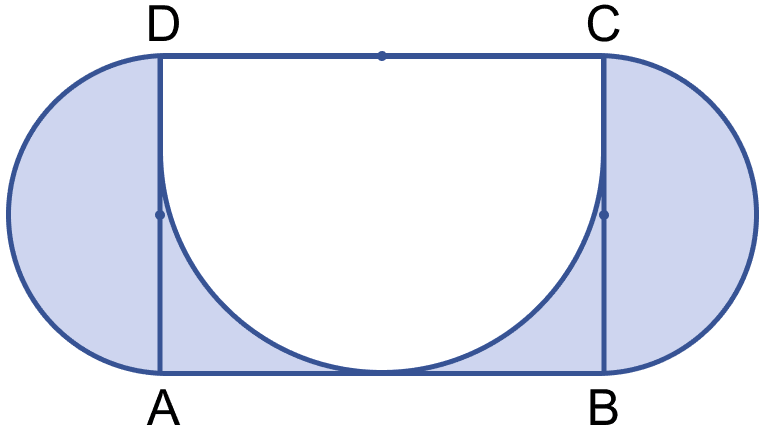
Answer
Since, ABCD is a rectangle.
AD = BC = 7 cm.
CD = AB = 14 cm.
From figure,
AD and BC are diameters of smaller circles.
Radius = = 3.5 cm.
Area of each small semi-circle =
=
= 19.25 cm2.
From figure,
CD is the diameter of the larger semi-circle.
Radius = = 7 cm.
Area of larger semi-circle =
=
= 77 cm2.
Area of rectangle ABCD = AB × BC
= 14 × 7
= 98 cm2.
From figure,
Area of shaded region = Area of rectangle ABCD + 2 × Area of each smaller semi-circle - Area of larger semi-circle
= 98 + (2 × 19.25) - 77
= 98 + 38.5 - 77
= 59.5 cm2.
Hence, area of shaded region = 59.5 cm2.
In the figure (ii) given below, O is the centre of a circle with AC = 24 cm, AB = 7 cm and ∠BOD = 90°. Find the area of the shaded region. (Use π = 3.14)
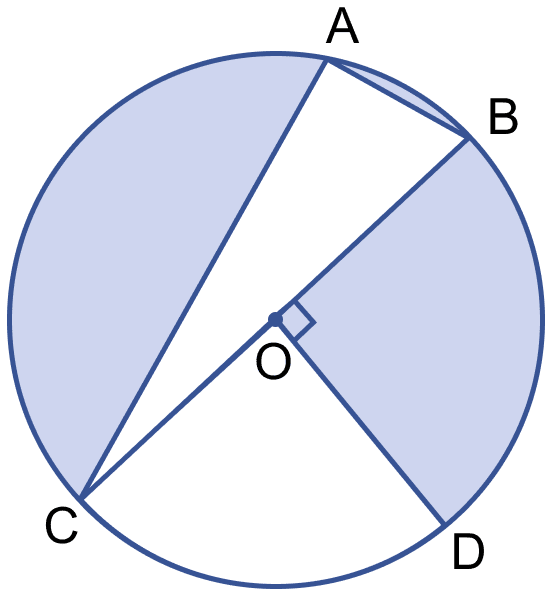
Answer
We know that,
Angle in semi-circle = 90°.
∴ ∠A = 90°.
In right angle △ABC
Using Pythagoras theorem,
⇒ BC2 = AC2 + AB2
⇒ BC2 = 242 + 72
⇒ BC2 = (576 + 49) = 625
⇒ BC = = 25 cm.
From figure,
Radius of circle (OB) = = 12.5 cm.
By formula,
Area of △ABC = × AB × AC
= × 7 × 24
= 84 cm2.
Area of circle = πr2
= 3.14 × 12.5 × 12.5
= 490.63 cm2.
Area of quadrant COD = = 122.66 cm2.
Area of shaded portion = Area of circle – (Area of △ABC + Area of quadrant COD)
= 490.63 – (84 + 122.66)
= 490.63 – 206.66
= 283.97 cm2.
Hence, area of shaded portion = 283.97 cm2.
In the figure (i) given below, ABCD is a square of side 14 cm. A, B, C and D are centres of the equal circles which touch externally in pairs. Find the area of the shaded region.

Answer
Let r cm be the radius of each circle.
From figure,
⇒ r + r = AD
⇒ 2r = 14
⇒ r = 7 cm.
Hence, radius of each circle = 7 cm.
Area of each circle = πr2
=
=
= 22 x 7
= 154 cm2.
Area of 4 circles = 4 × 154 = 616 cm2.
From figure,
Radius of each quadrant in square ABCD = 7 cm.
Area of each quadrant =
=
= 38.5 cm2.
Area of 4 quadrants = 4 × 38.5 = 154 cm2.
Area of square = (side)2
= (14)2 = 196 cm2.
Area of shaded region = (Area of 4 circles - Area of 4 quadrants) + (Area of square - Area of 4 quadrants)
= (616 - 154) + (196 - 154)
= 462 + 42
= 504 cm2.
Hence, area of shaded region = 504 cm2.
In the figure (ii) given below, the boundary of the shaded region in the given diagram consists of three semicircular arcs, the smaller being equal. If the diameter of the larger one is 10 cm, calculate.
(i) the length of the boundary.
(ii) the area of the shaded region. (Take π to be 3.14)
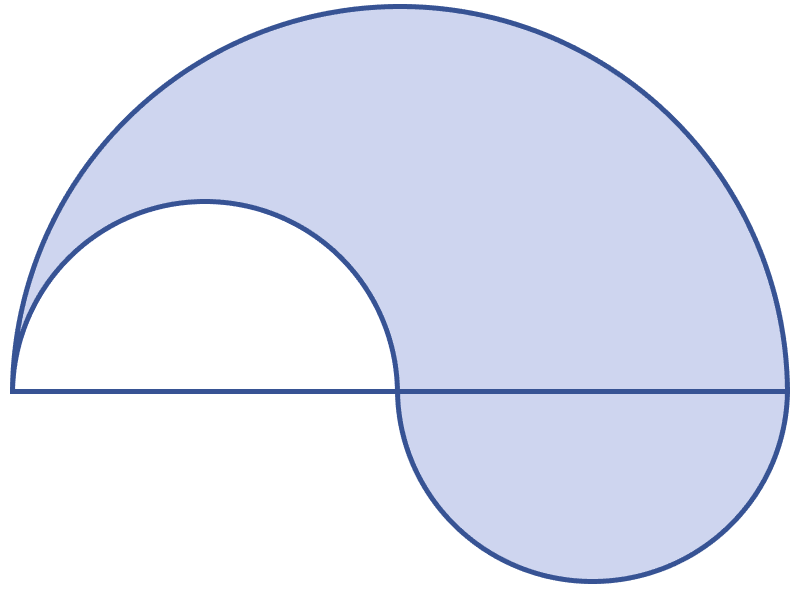
Answer
From figure,
Diameter of big semi-circle = 10 cm.
Radius of big semi-circle (R) = = 5 cm,
Diameter of small semi-circle = 5 cm.
Radius of each smaller semi-circle (r) = = 2.5 cm.
(i) Length of boundary = Circumference of bigger semi-circle + 2 x circumference of smaller semi-circles
= πR + πr + πr
= π(R + 2r)
= 3.14(5 + 2 × )
= 3.14(5 + 5)
= 3.14 × 10
= 31.4 cm.
Hence, length of boundary = 31.4 cm.
(ii) From figure,
Area of shaded region = Area of bigger semi-circle + Area of one smaller semi-circle – Area of other smaller semi-circle
Hence, area of shaded region = 39.25 cm2.
In the figure (i) given below, the points A, B and C are centres of arcs of circles of radii 5 cm, 3 cm and 2 cm respectively. Find the perimeter and the area of the shaded region. (Take π = 3.14)
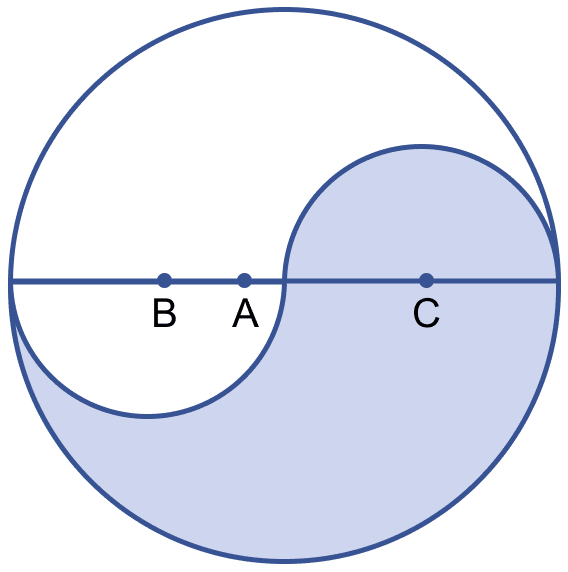
Answer
Let r1 = 5 cm, r2 = 3 cm and r3 = 2 cm.
Perimeter of shaded region = Circumference of largest semi-circle + Circumference of smaller semi-circle + Circumference of smallest semi-circle
= πr1 + πr2 + πr3
= π(5 + 3 + 2)
= 10π
= 10 x 3.14
= 31.4 cm.
Area of shaded region = Area of largest semi-circle - Area of smaller semi-circle + Area of smallest semi-circle
Hence, perimeter of shaded region = 31.4 cm and area of shaded region = 31.4 cm2.
In the figure (ii) given below, ABCD is a square of side 4 cm. At each corner of the square a quarter circle of radius 1 cm, and at the centre a circle of diameter 2 cm are drawn. Find the area of the shaded region. Take π = 3.14.
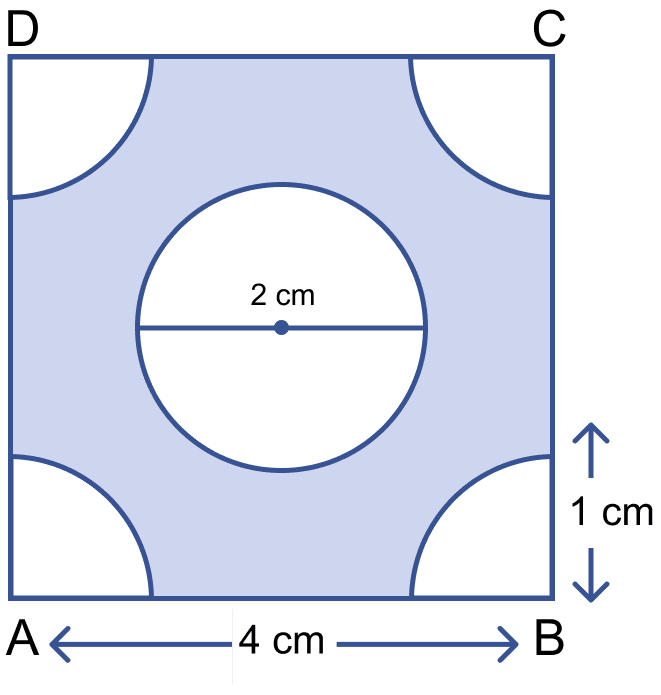
Answer
We know that,
Side of square ABCD = 4 cm
Radius of each quadrant circle (r) = 1 cm
Given,
Diameter of circle in the center = 2 cm
∴ Radius of circle in center (r1) = = 1 cm.
From figure,
Area of shaded region = Area of square – Area of 4 quadrants – Area of circle at center
Hence, area of shaded region = 9.72 cm2.
In the figure (i) given below, ABCD is a rectangle. AB = 14 cm, BC = 7 cm. From the rectangle, a quarter circle BFEC and a semicircle DGE are removed. Calculate the area of the remaining piece of the rectangle.

Answer
Area of rectangle = AB × BC = 14 × 7 = 98 cm2.
Since, ABCD is a rectangle.
∴ CD = AB = 14 cm.
BFEC is a quadrant of radius, BC = r1 = 7 cm.
∴ CE = 7 cm.
From figure,
DE = CD - CE = 14 - 7 = 7 cm.
From figure,
DE is the diameter of semi-circle DGE.
So, radius (r) = = 3.5 cm.
Area of semi-circle =
Area of quadrant BFEC =
Area of remaining piece of rectangle = Area of rectangle - Area of semicircle DGE - Area of quadrant BFEC
= 98 - 19.25 - 38.5
= 40.25 cm2.
Hence, area of remaining piece of rectangle = 40.25 cm2.
The figure (ii) given below shows a kite, in which BCD is in the shape of a quadrant of a circle of radius 42 cm. ABCD is a square and △CEF is an isosceles right angled triangle whose equal sides are 6 cm long. Find the area of the shaded region.
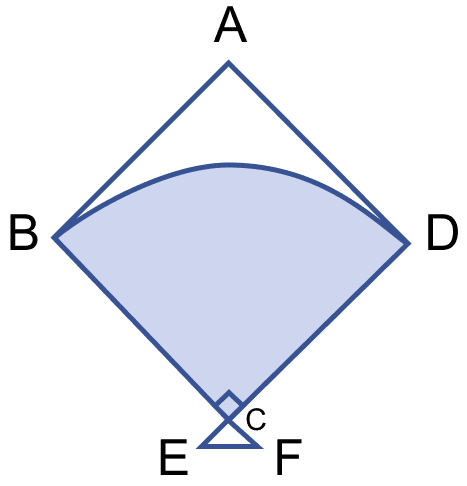
Answer
From figure,
∠ECF = ∠BCD = 90°.
Area of right angle △ECF = CF × EC
=
= 18 cm2.
Area of quadrant BCD =
Area of shaded region = Area of quadrant BCD + Area of right angle △ECF
= 18 + 1386 = 1404 cm2.
Hence, area of shaded region = 1404 cm2.
In the figure (i) given below, the boundary of the shaded region in the given diagram consists of four semicircular arcs, the smallest two being equal. If the diameter of the largest is 14 cm and of the smallest is 3.5 cm, calculate
(i) the length of the boundary.
(ii) the area of the shaded region.

Answer
(i) From figure,

OA = = 7 cm.
OB = OA - AB = 7 - 3.5 = 3.5 cm.
Radius of smallest semi-circle = = 1.75 cm.
Circumference of semi-circle = πr.
Length of boundary = Circumference of largest semi-circle + Circumference of smaller semi-circle + 2 × Circumference of smallest semi-circle
= 7π + 3.5π + (2 x 1.75π)
= 7π + 3.5π + 3.5π
= 14π
=
= 2 × 22
= 44 cm.
Hence, length of boundary = 44 cm.
(ii) Area of shaded region = Area of large semi-circle + Area of smaller semi-circle - 2 × Area of smallest semi-circle
Hence, area of shaded region = 86.625 cm2.
In the figure (ii) given below, a piece of cardboard, in the shape of a trapezium ABCD and AB || CD and ∠BCD = 90°, quarter circle BFEC is removed. Given AB = BC = 3.5 cm and DE = 2 cm. Calculate the area of the remaining piece of the cardboard.
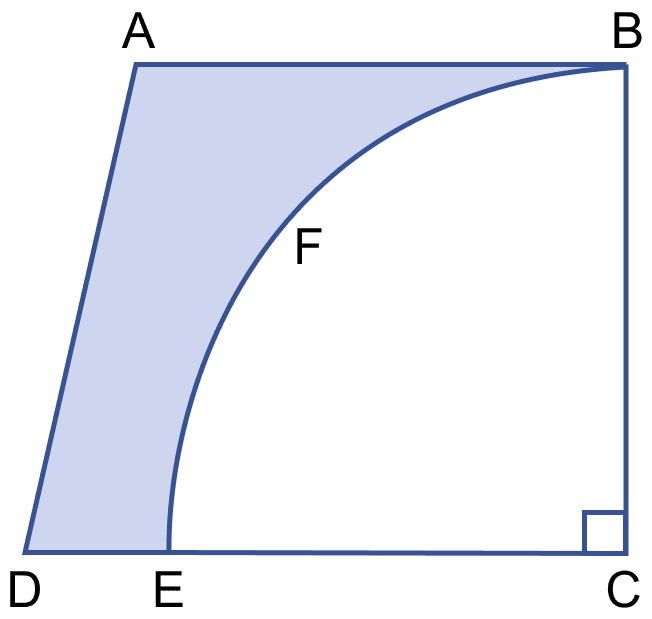
Answer
From figure,
Radius of quadrant = BC = 3.5 cm.
EC = BC = 3.5 cm (As both equal to radius of quadrant BFEC)
By formula,
Area of trapezium = × (Sum of || sides) × distance between them
= × (AB + DC) × BC
= × (AB + EC + DE) × BC
= × (3.5 + 3.5 + 2) × 3.5
= × 9 × 3.5
= 4.5 × 3.5
= 15.75 cm2.
So, the area of quadrant BCEF =
Area of shaded portion = Area of trapezium - Area of quadrant
= 15.75 – 9.625 = 6.125 cm2.
Hence, area of shaded portion = 6.125 cm2.
In the figure (i) given below, ABC is a right angled triangle, ∠B = 90°, AB = 28 cm and BC = 21 cm. With AC as diameter a semi-circle is drawn and with BC as radius a quarter circle is drawn. Find the area of the shaded region correct to two decimal places.
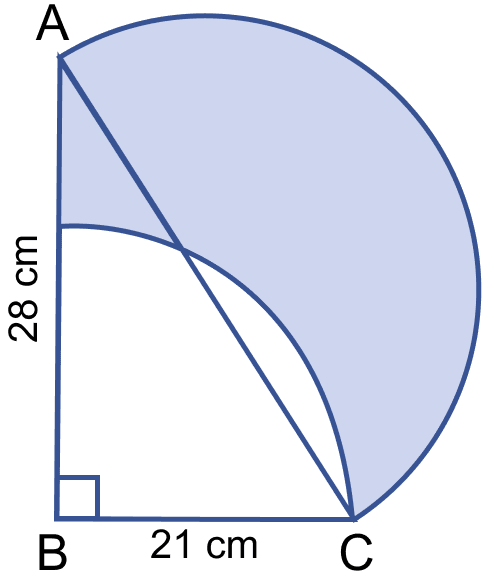
Answer
In right angle △ABC,
Using Pythagoras theorem,
⇒ AC2 = AB2 + BC2
⇒ AC2 = 282 + 212
⇒ AC2 = 784 + 441
⇒ AC2 = 1225
⇒ AC = = 35 cm.
Radius of semi-circle (R) = = 17.5 cm.
Radius of quadrant (r) = BC = 21 cm.
From figure,
Area of shaded region = Area of △ABC + Area of semi-circle – Area of quadrant
Hence, area of shaded region = 428.75 cm2.
In the figure (ii) given below, ABC is an equilateral triangle of side 8 cm. A, B and C are the centers of circular arcs of equal radius. Find the area of the shaded region correct upto 2 decimal places.
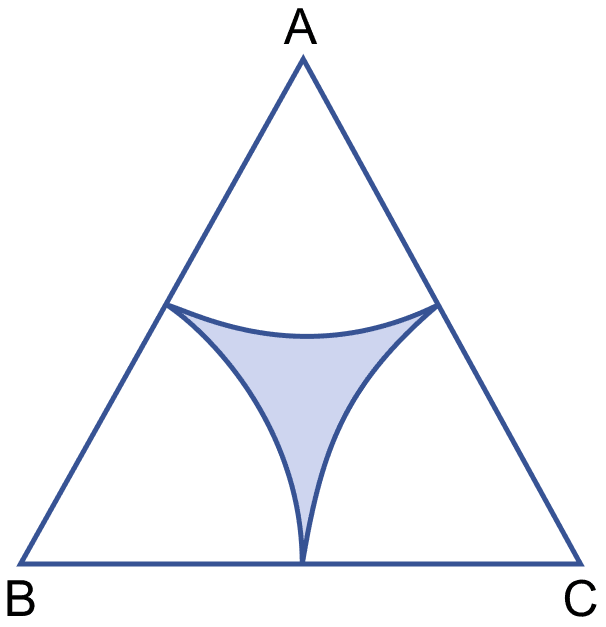
Answer
We know that
△ABC is an equilateral triangle of side 8 cm
A, B, C are the centres of three circular arcs of equal radius
Radius = = 4 cm
By formula,
Area of △ABC =
= × 8 × 8
=
=
= 16 × 1.732
= 27.712 cm2.
So, the area of 3 equal sectors of 60° whose radius is 4 cm = 3 × πr2 ×
= 3 × 3.142 × 4 × 4 ×
= 3.142 × 8
= 25.136 cm2.
Area of shaded region = Area of equilateral triangle - Area of 3 sectors
= 27.712 – 25.136
= 2.576 ≈ 2.58 cm2.
Hence, area of shaded region = 2.58 cm2.
A circle is inscribed in a regular hexagon of side cm. Find
(i) the circumference of the inscribed circle
(ii) the area of the inscribed circle
Answer
(i) Side of the regular hexagon (a) = cm.
Now since a regular hexagon has 6 sides, hence we can say the central angle of a hexagon = = 60°.
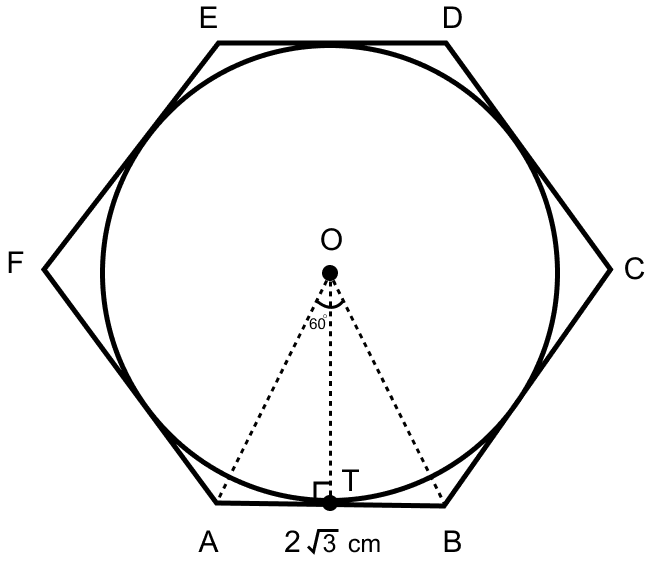
From figure,
∠AOB = 60°.
Now in the ΔAOB,
Since the total sum of the angles of a triangle is equal to 180°
∴ ∠AOB + ∠OAB + ∠OBA = 180° .......(1)
Since, OA = OB = radius of circle,
So, ∠OAB = ∠OBA = x (let) (Angles opposite to equal sides are equal).
Substituting value in equation 1 we get,
⇒ 60° + x + x = 180°
⇒ 2x + 60° = 180°
⇒ 2x = 120°
⇒ x = 60°.
Now since all the angles of the triangle are equal hence we can say the triangle is an equilateral triangle. So, all the sides of the triangle will also be equal.
∴ AO = BO = AB = cm.
Draw perpendicular from O to AB.
From figure,
AT = BT = cm. (As altitude and median are same in equilateral triangle.)
From figure,
In right angle triangle OAT,
Hence, radius of circle = OT = 3 cm.
We know the circumference of a circle is given by the formula,
Circumference = 2πr
=
= cm.
Hence, circumference of inscribed circle = cm.
(ii) Area of inscribed circle = πr2
=
= cm2.
Hence, area of inscribed circle = cm2.
In the adjoining figure, a chord AB of a circle of radius 10 cm subtends a right angle at the centre O. Find the area of the sector OACB and of the major segment. Take π = 3.14.
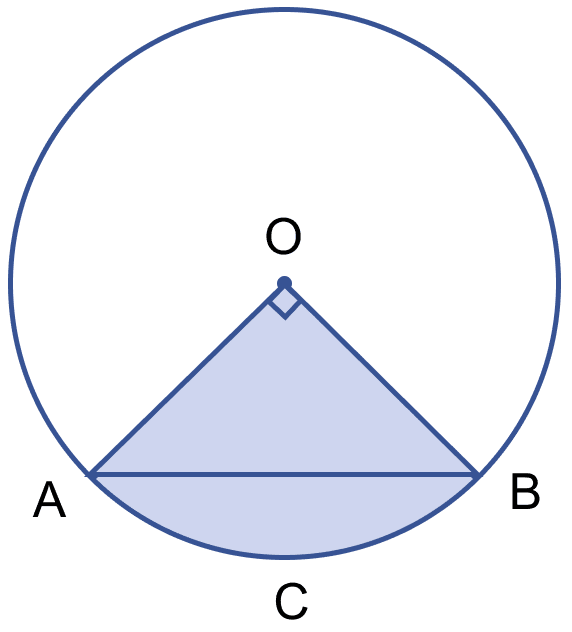
Answer
Given,
Radius of the circle = 10 cm
Angle at the centre subtended by a chord AB = 90°.
We know that,
Area of sector OACB =
= 3.14 × 10 × 10 ×
=
= 78.5 cm2.
In right angle △OAB,
Area of △OAB = × OA × OB
= × 10 × 10
= 50 cm2.
Area of minor segment = Area of sector OACB – Area of △OAB
= 78.5 - 50
= 28.5 cm2.
Area of circle = πr2
= 3.14 × 10 × 10
= 314 cm2.
Area of major segment = Area of circle – Area of minor segment
= 314 - 28.5
= 285.5 cm2.
Hence, area of sector OACB = 78.5 cm2 and area of major segment = 285.5 cm2.