
Find the area of quadrilateral whose one diagonal is 20 cm long and the perpendiculars to this diagonal from other vertices are of length 9 cm and 15 cm.
Answer
Consider ABCD as a quadrilateral in which BD = 20 cm, AY = 15 cm and CX = 9 cm.

Area of quadrilateral ABCD = Area of triangle ABD + Area of triangle BCD
Area of triangle = × base × height
∴ Area of quadrilateral ABCD = × BD × AY + × BD × CX
Substituting the values we get,
Area of quadrilateral ABCD = x BD x (AY + CX)
= x 20 x (15 + 9)
= 10 x 24
= 240 cm2
Hence, area of quadrilateral = 240 cm2.
Find the area of a quadrilateral whose diagonals are of length 18 cm and 12 cm and they intersect each other at right angles.
Answer
Consider ABCD as a quadrilateral in which the diagonals AC and BD intersect each other at M at right angles.

From figure,
AC = 18 cm and BD = 12 cm
When diagonals of a quadrilateral intersect at right angles,
Area of quadrilateral = x d1 x d2, where d1 and d2 are diagonals.
Substituting the values we get,
Area of quadrilateral ABCD = x 12 x 18
= 6 x 18
= 108 cm2
Hence, area of quadrilateral = 108 cm2.
Find the area of the quadrilateral field ABCD whose sides AB = 40 m, BC = 28 m, CD = 15 m, AD = 9 m and ∠A = 90°.
Answer
From figure,
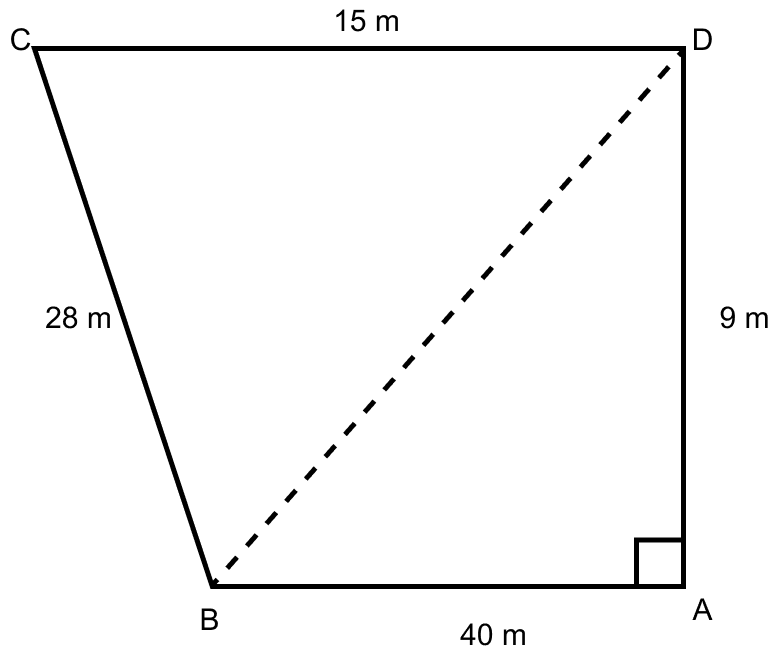
ABCD is a quadrilateral field.
In triangle BAD,
∠A = 90°
Using the Pythagoras Theorem
⇒ BD2 = AB2 + AD2
Substituting the values we get,
⇒ BD2 = 402 + 92
⇒ BD2 = 1600 + 81 = 1681
⇒ BD = = 41 m
We know that,
Area of quadrilateral ABCD = Area of △BAD + Area of △BDC
Calculating area of △BDC,
In △BDC,
Let a = BD = 41 m, b = BC = 28 m and c = CD = 15 m.
Semi-perimeter (s) = = 42 m.
By Heron's formula,
Area of triangle =
Substituting values we get,
Calculating area of △BAD,
Area of quadrilateral ABCD = Area of △BAD + Area of △BDC
= 180 + 126
= 306 m2.
Hence, area of quadrilateral ABCD = 306 m2.
Find the area of the quadrilateral ABCD in which ∠BCA = 90°, AB = 13 cm and ACD is an equilateral triangle of side 12 cm.
Answer
In right-angled △ABC,
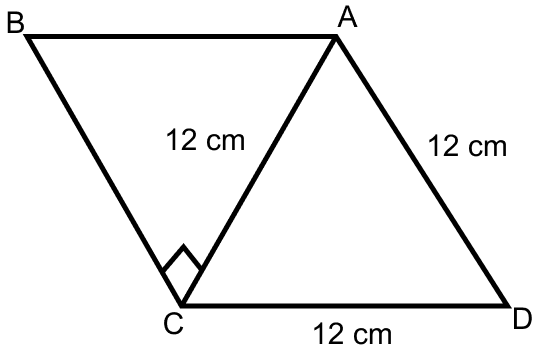
Using Pythagoras theorem,
⇒ AB2 = AC2 + BC2
Substituting the values we get,
⇒ 132 = 122 + BC2
⇒ BC2 = 132 – 122
⇒ BC2 = 169 – 144 = 25
⇒ BC = = 5 cm.
Calculating area of △BCA,
Calculating area of △ACD,
From figure,
Area of quadrilateral ABCD = Area of △BCA + Area of △ACD
= 30 cm2 + 62.35 cm2
= 92.35 cm2.
Hence, area of quadrilateral ABCD = 92.35 cm2.
Find the area of quadrilateral ABCD in which ∠B = 90° , AB = 6 cm, BC = 8 cm and CD = AD = 13 cm.
Answer
In △ABC,
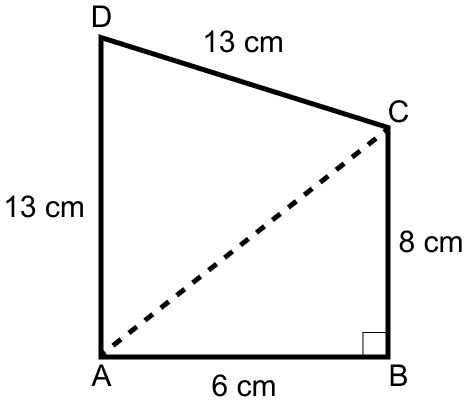
Using Pythagoras theorem,
AC2 = AB2 + BC2
Substituting the values we get,
⇒ AC2 = 62 + 82
⇒ AC2 = 36 + 64 = 100
⇒ AC2 = 102
⇒ AC = 10 cm
Calculating area of △ADC,
In △ADC,
Let a = AD = 13 cm, b = DC = 13 cm and c = AC = 10 cm.
Semi-perimeter (s) = = 18 cm.
By Heron's formula,
Area of triangle =
Substituting values we get,
Calculating area of △ABC,
From figure,
Area of quadrilateral ABCD = Area of △ADC + Area of △ABC
= 60 + 24
= 84 cm2.
Hence, area of quadrilateral ABCD = 84 cm2.
The perimeter of a rectangular cardboard is 96 cm; if its breadth is 18 cm, find the length and the area of the cardboard.
Answer
We know that,
Perimeter of rectangle = 2 × (l + b) = 96 cm
Substituting the values we get,
⇒ 2(l + 18) = 96
⇒ (l + 18) = 48
⇒ l = 48 - 18 = 30 cm.
Area of rectangular cardboard = l × b
Substituting the values we get,
Area = 30 × 18 = 540 cm2.
Hence, length = 30 cm and area of rectanglular cardboard = 540 cm2.
The length of a rectangular hall is 5 m more than its breadth. If the area of the hall is 594 m2, find its perimeter.
Answer
Let breadth = x meters
So, length = (x + 5) meters
We know that,
Area of rectangular hall = length × breadth
Substituting the values we get,
⇒ 594 = x(x + 5)
⇒ 594 = x2 + 5x
⇒ x2 + 5x – 594 = 0
⇒ x2 + 27x – 22x – 594 = 0
⇒ x(x + 27) – 22(x + 27) = 0
⇒ (x – 22)(x + 27) = 0
⇒ x – 22 = 0 or x + 27 = 0
⇒ x = 22 or x = -27.
Since, length of side cannot be negative so, x ≠ -27.
∴ Breadth = x = 22 m and Length = (x + 5) = 22 + 5 = 27 m.
Perimeter = 2(l + b)
Substituting the values we get,
Perimeter = 2(27 + 22) = 2 × 49 = 98 m.
Hence, perimeter of hall = 98 m.
The diagram (i) given below shows two paths drawn inside a rectangular field 50 m long and 35 m wide. The width of each path is 5 metres. Find the area of the shaded portion.

Answer
We know that,
Area of rectangle = length × breadth
Area of square = side × side.

From figure,
Area of shaded portion = Area of rectangle ABCD + Area of rectangle PQRS – Area of square LMNO
Substituting values we get,
Area of shaded portion = AB × AD + PR × RS - LM × MN
= 50 × 5 + 35 × 5 - 5 × 5
= 250 + 175 - 25
= 400 m2.
Hence, area of shaded region = 400 m2.
In the diagram (ii) given below, calculate the area of the shaded portion. All measurements are in centimetres.

Answer
We know that,
Area of rectangle = length × breadth
Area of square = side × side.
From figure,
Area of shaded portion = Area of large rectangle - 5 × Area of a small square.
Substituting values we get,
Area of shaded portion = (8 × 6) - (5 × 2 × 2)
= 48 - 20
= 28 cm2.
Hence, area of shaded region = 28 cm2.
A rectangular plot 20 m long and 14 m wide is to be covered with grass leaving 2 m all around. Find the area to be laid with grass.
Answer
Consider ABCD as a plot.

Length of plot = 20 m and breadth of plot = 14 m.
Let PQRS be the plot to be covered with grass.
From figure,
PQ = 20 - (2 × 2)
= 20 - 4
= 16 m
QR = 14 - (2 × 2)
= 14 - 4
= 10 m
Area of rectangular plot PQRS = length × breadth
Substituting the values we get,
Area = 16 × 10 = 160 m2.
Hence, area to be laid with grass = 160 m2.
The shaded region of the given diagram represents the lawn in front of a house. On three sides of the lawn there are flower beds of width 2 m.
(i) Find the length and the breadth of the lawn.
(ii) Hence, or otherwise, find the area of the flower–beds.
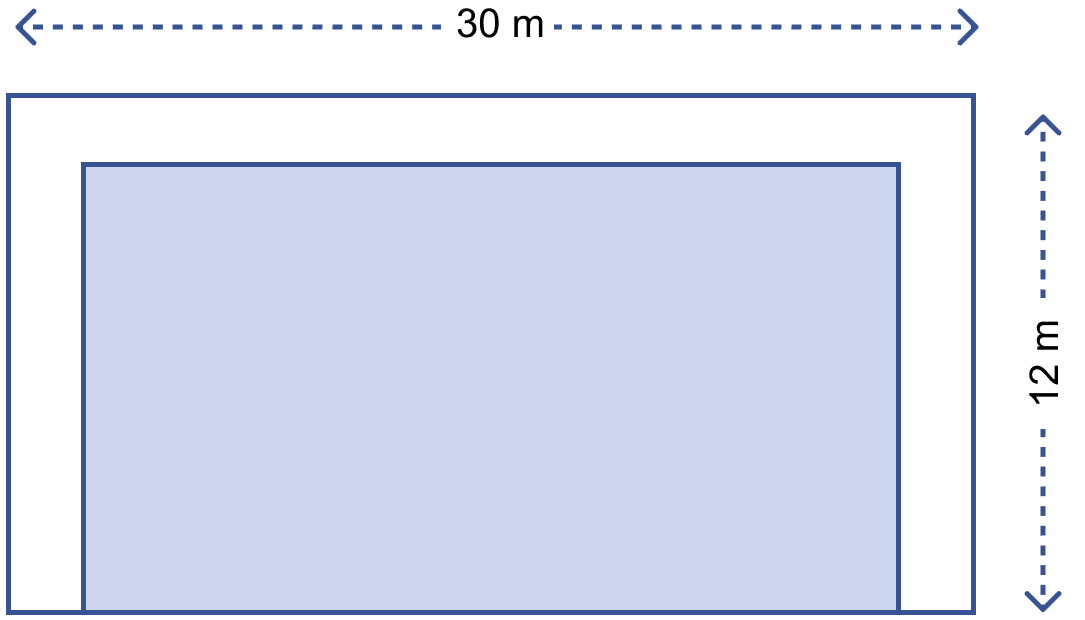
Answer
(i) Let PQRS be the lawn.
From figure,
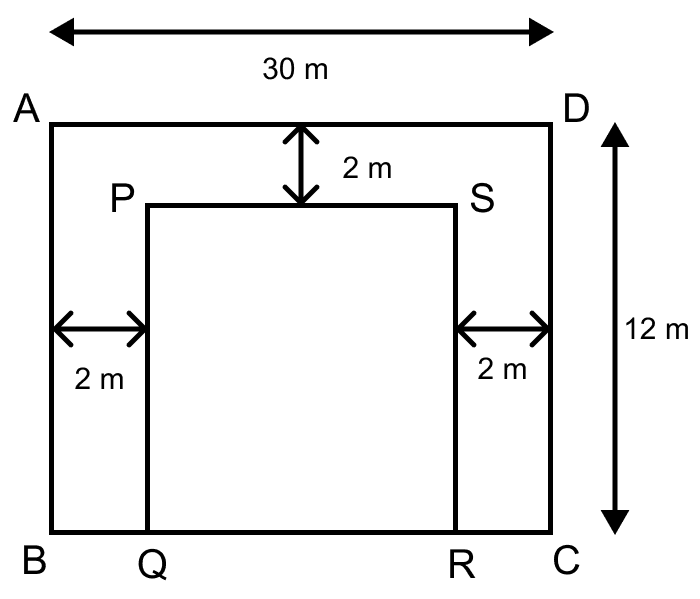
QR = BC - BQ - RC = 30 - 2 - 2 = 26 m.
SR = CD - DS = 12 - 2 = 10 m.
Length of PQRS = QR = 26 m and,
Breadth of PQRS = SR = 10 m.
Hence, length and breadth of lawn are 26 m and 10 m respectively.
(ii) From figure,
Area of flower beds = Area of rectangle ABCD - Area of rectangle PQRS
= (AD × DC) - (QR × SR)
= (30 × 12) - (26 × 10)
= 360 - 260
= 100 m2.
Hence, area of flower-beds = 100 m2.
A footpath of uniform width runs all around the inside of a rectangular field 50 m long and 38 m wide. If the area of the path is 492 m2, find its width.
Answer
Consider ABCD as a rectangular field having, length = 50 m and breadth = 38 m.
Let x meters be the width of foot path.
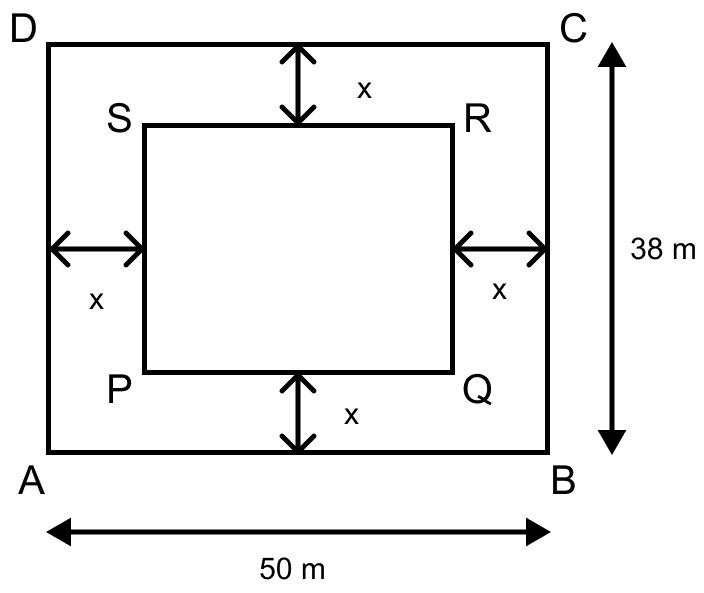
We know that,
Area of rectangular = l × b
From figure,
Area of path = Area of rectangle ABCD - Area of rectangle PQRS
Substituting the values we get,
Area of path = (AB × BC) - (PQ × QR) ........(1)
From figure,
PQ = AB - x - x = (50 - 2x) m,
QR = BC - x - x = (BC - 2x) m.
Substituting the values in equation 1 we get,
⇒ 492 = (50 × 38) - (50 - 2x) (38 - 2x)
⇒ 492 = 1900 - [50(38 - 2x) - 2x(38 - 2x)]
⇒ 492 = 1900 - (1900 - 100x - 76x + 4x2)
⇒ 492 = 1900 - 1900 + 100x + 76x - 4x2
⇒ 492 = 176x - 4x2
⇒ 492 = 4(44x - x2)
⇒ 123 = 44x - x2
⇒ x2 - 44x + 123 = 0
⇒ x2 - 41x - 3x + 123 = 0
⇒ x(x - 41) - 3(x - 41) = 0
⇒ (x - 3)(x - 41) = 0
⇒ x - 3 = 0 or x - 41 = 0
⇒ x = 3 m or x = 41 m.
Since, width of path cannot be greater than breadth of field,
So, x ≠ 41 m.
Hence, width of the footpath is 3 m.
The cost of enclosing a rectangular garden with a fence all around at the rate of ₹ 150 per metre is ₹ 54,000. If the length of the garden is 100 m, find the area of the garden.
Answer
Given,
Length = 100 m.
Let breadth = x meters.
By formula,
Perimeter of rectangle = 2(l + b)
Substituting the values we get,
Perimeter of rectangular garden = 2(100 + x) = (200 + 2x) m.
Given,
Cost of enclosing fence = ₹ 150 per meter.
∴ Cost of enclosing fence all round the rectangular garden = ₹150(200 + 2x) = ₹(30,000 + 300x).
Given, total cost of fencing = ₹ 54,000
∴ 30,000 + 300x = 54,000
⇒ 300x = 54,000 – 30,000
⇒ 300x = 24,000
⇒ x =
⇒ x = 80 m.
∴ Breadth of garden = 80 m.
So, the area of rectangular garden = length × breadth
= 100 × 80
= 8000 m2.
Hence, the area of rectangular garden = 8000 m2.
A rectangular floor which measures 15 m × 8 m is to be laid with tiles measuring 50 cm × 25 cm. Find the number of tiles required. Further, if a carpet is laid on the floor so that a space of 1 m exists between its edges and the edges of the floor, what fraction of the floor is uncovered?
Answer
Let ABCD be the rectangular floor and PQRS be the carpet.
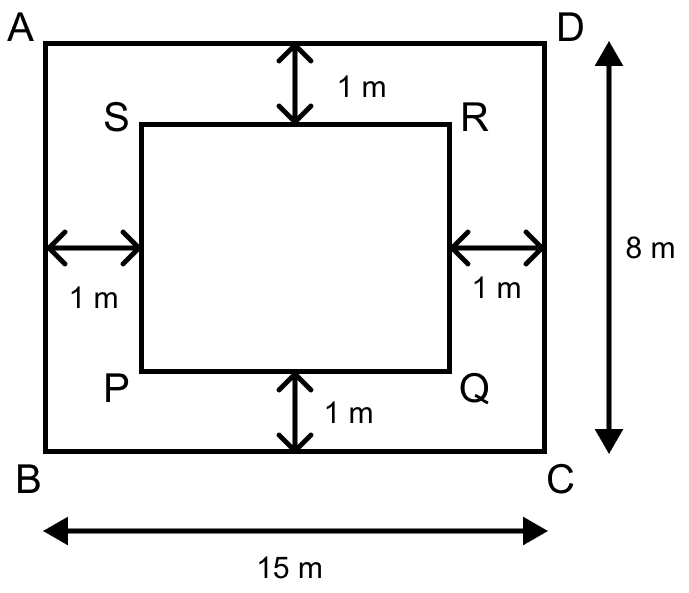
Area of floor = l × b = 15 × 8 = 120 m2 = 120 × (100 cm)2 = 1200000 cm2
Area of a tile = 50 cm × 25 cm = 1250 cm2
No. of required tiles =
Substituting the values we get,
No. of required tiles = = 960.
From figure,
Length of carpet (PQ) = 15 – 1 – 1
= 15 – 2
= 13 m
Breadth of carpet (QR) = 8 – 1 – 1
= 8 – 2
= 6 m
Area of carpet = l × b
= 13 × 6
= 78 m2.
Area of floor which is uncovered by carpet = Area of floor – Area of carpet
= 120 – 78
= 42 m2
Fraction of floor uncovered =
= .
Hence, number of tiles required to cover the floor = 960 tiles and is the fraction of floor uncovered.
The width of a rectangular room is of its length metres. If its perimeter is metres, write an equation connecting and . Find the floor area of the room if its perimeter is 32 m.
Answer
Given,
Length of rectangular room = x meters
Width of rectangular room = meters.
Perimeter = y meters.
We know that,
Perimeter = 2(l + b)
Substituting the values we get,
The above equation is the required relation between x and y.
Given, perimeter = y = 32 m.
Now substituting the value of y in equation (1)
⇒ 16x = 5 × 32
⇒ x = = 10 m,
⇒ Breadth = = 6 m.
Floor area of the room = l × b
= 10 × 6
= 60 m2.
Hence, 16x = 5y is the equation connecting x and y and the floor area of room = 60 m2.
A rectangular garden 10 m by 16 m is to be surrounded by a concrete walk of uniform width. Given that the area of the walk is 120 square metres, assuming the width of the walk to be x, form an equation in x and solve it to find the value of x.
Answer
Let ABCD be a rectangular garden.
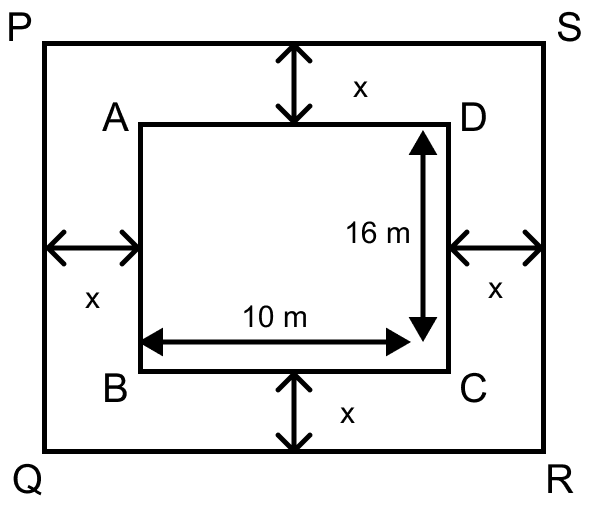
Length = 10 m and Breadth = 16 m.
Area of garden ABCD = l × b
= 10 × 16 = 160 m2
Given, width of the walk = x meters.
From figure,
Length of rectangular garden PQRS = 10 + x + x = (10 + 2x) m
Breadth of rectangular garden PQRS = 16 + x + x = (16 + 2x) m
From figure,
⇒ Area of walk = Area of rectangle PQRS - Area of rectangle ABCD
⇒ 120 = (10 + 2x)(16 + 2x) - 160
⇒ 120 = 160 + 20x + 32x + 4x2 - 160
⇒ 120 = 4x2 + 52x
⇒ 4x2 + 52x - 120 = 0
⇒ 4(x2 + 13x - 30) = 0
⇒ x2 + 13x - 30 = 0
The above equation is the equation in x.
Solving further,
⇒ x2 + 15x - 2x - 30 = 0
⇒ x(x + 15) - 2(x + 15) = 0
⇒ (x - 2)(x + 15) = 0
⇒ x = 2 or x = -15.
Since, length cannot be negative.
∴ x = 2.
Hence, equation is x2 + 13x - 30 = 0 and x = 2 metres.
A rectangular room is 6 m long, 4.8 m wide and 3.5 m high. Find the inner surface area of the four walls.
Answer
It is given that
Length of rectangular room = 6 m
Breadth of rectangular room = 4.8 m
Height of rectangular room = 3.5 m
By formula,
Inner surface area of four walls = 2(l + b) × h
= 2(6 + 4.8) × 3.5
= 2 × 10.8 × 3.5
= 21.6 × 3.5
= 75.6 m2.
Hence, inner surface area of four walls = 75.6 m2.
A rectangular plot of land measures 41 metres in length and 22.5 metres in width. A boundary wall 2 metres high is built all around the plot at a distance of 1.5 m from the plot. Find the inner surface area of the boundary wall.
Answer
Let ABCD be the rectangular plot.

Given,
Length of rectangular plot = 41 metres,
Breadth of rectangular plot = 22.5 metres.
Height of boundary wall = 2 metres.
Boundary wall is built at a distance of 1.5 m. It means wall is built on base PQRS.
From figure,
Length of plot PQRS = 41 + 1.5 + 1.5 = 44 m.
Breadth of plot PQRS = 22.5 + 1.5 + 1.5 = 25.5 m.
By formula,
Inner surface area of the boundary wall = 2(l + b) × h
= 2 (44 + 25.5) × 2
= 2 × 69.5 × 2
= 278 m2.
Hence, inner surface area of boundary wall = 278 m2.
Find the perimeter and area of the figure (i) given below in which all corners are right angles.

Answer
From figure,

Area of rectangle ABFG = l × b
= BF × AB
= (BC + CF) × AB
= (4 + 1.5) × 2
= 5.5 × 2
= 11 m2.
Area of rectangle CDEF = l × b
= CD × DE
= 4 × 1.5
= 6 m2.
Total Area = Area of rectangle ABFG + Area of rectangle CDEF
= 11 + 6 = 17 m2.
From figure,
AG = BF, GF = AB and FE = CD (As opposite sides of rectangle are equal.)
Perimeter of figure = AB + BC + CD + DE + EF + FG + AG
= 2 + 4 + 4 + 1.5 + 4 + 2 + 5.5
= 23 m.
Hence, perimeter = 23 m and area = 17 m2.
Find the perimeter and area of the figure (ii) given below in which all corners are right angles.

Answer
The points are labelled on the figure as shown below:

Area of rectangle ABIJ = l × b
= AB × BI
= AB × (BC + CI)
= 3 × (5 + 2)
= 3 × 7 = 21 m2.
Area of rectangle EFGH = l × b
= EF × FG
= 2 × 7 = 14 m2.
Area of rectangle CDHI = l × b
= CD × DH
= 8 × 2 = 16 m2.
Total area = Area of rectangle ABIJ + Area of rectangle EFGH + Area of rectangle CDHI
= 21 + 14 + 16
= 51 m2.
Perimeter of figure = AB + BC + CD + DE + EF + FG + GH + HI + IJ + JA
= 3 + 5 + 8 + 5 + 2 + 7 + 2 + 8 + 3 + 7
= 50 m.
Hence, perimeter = 50 m and area = 51 m2.
Find the area and perimeter of the figure (iii) given below in which all corners are right angles and all measurements are in cm.

Answer
The points are labelled on the figure as shown below:

Area of rectangle BCDE = l × b
= ED × CD
= 5 × 2
= 10 cm2.
Area of rectangle FGHI = l × b
= FG × GH
= 3 × 2
= 6 cm2.
Area of rectangle JKLM = l × b
= JK × KL
= 5 × 2
= 10 cm2.
Area of rectangle ABMN = l × b
= AB × AN
(From figure AB = AC - BC = 7 - 5 = 2 cm.)
= 2 × 12
= 24 cm2.
From figure,
Total area = Area of rectangle BCDE + Area of rectangle FGHI + Area of rectangle JKLM + Area of rectangle ABMN
= 10 + 6 + 10 + 24
= 50 cm2.
From figure,
The vertical distance between C and L will be equal to vertical distance between A and N,
So ignoring the vertical sides in right side and replacing it will CL.
Perimeter = AC + DE + FG + HI + JK + LN + NA + CL
= 7 + 5 + 3 + 3 + 5 + 7 + 12 + 12
= 54 cm.
Hence, area = 50 cm2 and perimeter = 54 cm.
The length and the breadth of a rectangle are 12 cm and 9 cm respectively. Find the height of a triangle whose base is 9 cm and whose area is one-third that of rectangle.
Answer
Area of rectangle = l × b = 12 × 9
= 108 cm2.
Given,
Area of triangle = one-third the area of rectangle.
Substituting the values we get,
Area of triangle = × 108 = 36 cm2.
Consider h cm as the height of triangle.
By formula,
Area of triangle = × base × height
Substituting the values we get,
⇒ 36 = × 9 × h
⇒ 36 × 2 = 9 × h
⇒ h =
⇒ h = 8 cm.
Hence, height of triangle is 8 cm.
The area of a square plot is 484 m2. Find the length of its one side and the length of its one diagonal.
Answer
Let ABCD be the square plot having area 484 m2.

Let length of each side of the plot be x meters.
We know that,
Area of square = side × side
Substituting the values we get,
⇒ 484 = (x)2
⇒ x = = 22 m.
Since, each angle = 90° in a square.
In right angle triangle ABC,
Using Pythagoras Theorem,
⇒ AC2 = AB2 + BC2
⇒ AC2 = 222 + 222
⇒ AC2 = 484 + 484 = 968
⇒ AC =
⇒ AC = 22 × 1.414 = 31.11 m.
Hence, length of side = 22 m and length of diagonal = 31.11 m.
A square has the perimeter 56 m. Find its area and the length of one diagonal correct up to two decimal places.
Answer
Let ABCD be a square with side x metres.

Perimeter of square = 4 × side
Substituting the values we get,
⇒ 56 = 4x
⇒ x = = 14 m.
Since, each angle = 90° in a square.
In right angle triangle ABC
Using Pythagoras theorem,
⇒ AC2 = AB2 + BC2
⇒ AC2 = 142 + 142
⇒ AC2 = 196 + 196 = 392
⇒ AC =
⇒ AC = = 14 × 1.414 = 19.80 m.
Area of square = (side)2
= 142 = 196 m2.
Hence, the area of square = 196 m2 and length of diagonal = 19.80 m.
A wire when bent in the form of an equilateral triangle encloses an area of cm2. Find the area enclosed by the same wire when bent to form:
(i) a square, and
(ii) a rectangle whose length is 2 cm more than its width.
Answer
Given,
Area of equilateral triangle = cm2
Consider x cm as the side of equilateral triangle
We know that,
Area of an equilateral triangle =
Substituting the values we get,
By formula,
Perimeter of equilateral triangle = 3 × side = 3 × 12 = 36 cm.
(i) As the same wire is now bent to form a square.
∴ Perimeter of equilateral triangle = Perimeter of square
36 = 4 × side
Side = = 9 cm.
Area of square = side × side = 9 × 9 = 81 cm2.
Hence, area enclosed by wire in form of square = 81 cm2.
(ii) As the same wire is now bent to form a rectangle.
∴ Perimeter of triangle = Perimeter of rectangle ........(1)
According to the condition given for rectangle,
Length is 2 cm more than its width
Let width of rectangle = x cm
∴ Length of rectangle = (x + 2) cm
Perimeter of rectangle = 2(l + b)
Substituting the values in equation 1 we get,
⇒ 36 = 2[(x + 2) + x]
⇒ 36 = 2[2x + 2]
⇒ 4x + 4 = 36
⇒ 4x = 32
⇒ x = 8 cm.
∴ Length of rectangle = x + 2 = 8 + 2 = 10 cm and Breadth of rectangle = x = 8 cm.
By formula,
Area of rectangle = length × breadth
= 10 × 8
= 80 cm2.
Hence, area enclosed by wire in form of square = 80 cm2.
Two adjacent sides of a parallelogram are 15 cm and 10 cm. If the distance between the longer sides is 8 cm, find the area of the parallelogram. Also find the distance between shorter sides.
Answer
Let ABCD be a parallelogram with side AB = 15 cm and side BC = 10 cm.

Distance between longer side DM = 8 cm
Consider DN as the distance between the shorter side
Area of parallelogram ABCD = base × height
= AB × DM = 15 × 8 = 120 cm2.
Considering base BC and height DN
Area of parallelogram = BC × DN
⇒ 120 = 10 × DN
⇒ DN = = 12 cm.
Hence, the area of parallelogram = 120 cm2 and the distance between shorter side = 12 cm.
ABCD is a parallelogram with sides AB = 12 cm, BC = 10 cm and diagonal AC = 16 cm. Find the area of the parallelogram. Also find the distance between its shorter sides.
Answer
In triangle ABC,
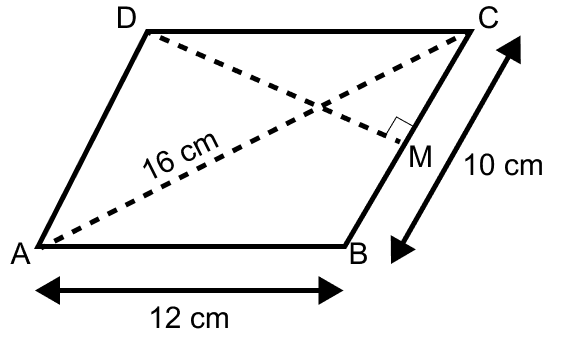
Let,
BC = a = 10 cm, AC = b = 16 cm and AB = c = 12 cm.
We know that,
Semi-perimeter (s) =
= = 19 cm.
By Heron's formula,
We know that,
Diagonal of a parallelogram divides it into two triangles of equal area.
∴ Area of triangle ABC = Area of triangle ADC
∴ Area of parallelogram = 2 × Area of triangle ABC.
= 2 × 59.9
= 119.8 cm2.
Let DM be the distance between the shorter sides of the parallelogram.
By formula,
Area of parallelogram = base × height = BC × DM
Substituting the values we get,
⇒ 119.8 = 10 × DM
⇒ DM =
⇒ DM = 11.98 cm.
Hence, the distance between shorter sides = 11.98 cm and area of parallelogram = 119.8 cm2.
Diagonals AC and BD of a parallelogram ABCD intersect at O. Given that AB = 12 cm and perpendicular distance between AB and DC is 6 cm. Calculate the area of the triangle AOD.
Answer
Let ABCD be a parallelogram with AC and BD the diagonals intersecting at O.
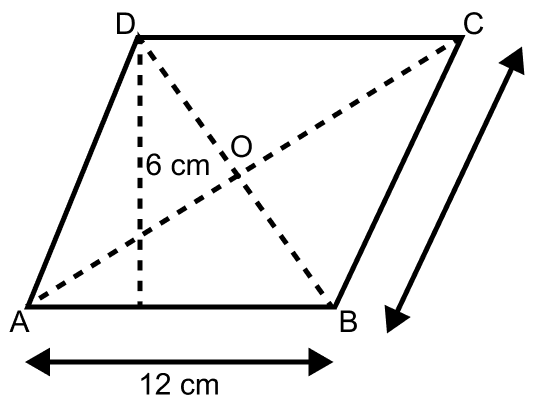
From figure,
AB = 12 cm and DM = 6 cm.
By formula,
Area of parallelogram ABCD = base × height = AB × DM
= 12 × 6
= 72 cm2.
Since, diagonals of parallelogram intersect each other so O is the mid-point of BD.
∴ AO is the median of the △ABD.
Since, median divides the triangle into two triangles of equal area,
∴ Area of △AOD = × Area of △ABD ......(1)
Since, diagonal of a parallelogram divides it into two triangles of equal area.
∴ Area of △ABD = × Area of || gm ABCD.
Substituting above value of △ABD in equation 1 we get,
Area of △AOD = Area of || gm ABCD
= = 18 cm2.
Hence, area of △AOD = 18 cm2.
ABCD is a parallelogram with side AB = 10 cm. Its diagonals AC and BD are of length 12 cm and 16 cm respectively. Find the area of the parallelogram ABCD.
Answer
Let ABCD be a parallelogram with diagonals intersecting at O.
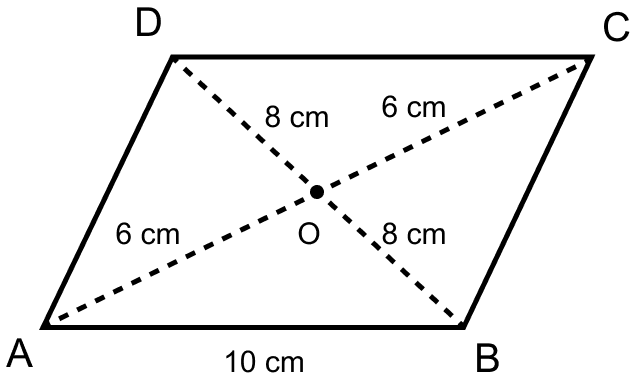
Since, diagonals of a parallelogram bisect each other.
∴ AO = = 6 cm and OB = = 8 cm.
In triangle AOB,
Let AB = a = 10 cm, BO = b = 8 cm and OA = c = 6 cm.
We know that,
Semi-perimeter (s) =
= = 12 cm.
By Heron's formula,
Since, diagonals of parallelogram intersect each other so O is the mid-point of BD.
∴ AO is the median of the △ABD.
Since, median divides the triangle into two triangles of equal area.
∴ Area of △AOB = × Area of △ABD ......(1)
Since, diagonal of a parallelogram divides it into two triangles of equal area.
∴ Area of △ABD = × Area of || gm ABCD.
Substituting above value of △ABD in equation 1 we get,
Area of △AOB = Area of || gm ABCD
Substituting values in above equation we get,
24 = Area of || gm ABCD
⇒ Area of || gm ABCD = 24 × 4 = 96 cm2.
Hence, area of || gm ABCD = 96 cm2.
The area of a parallelogram is p cm2 and its height is q cm. A second parallelogram has equal area but its base is r cm more than that of the first. Obtain an expression in terms of p, q and r for the height h of the second parallelogram.
Answer
By formula,
Area of a parallelogram = base × height ........(1)
Substituting values of 1st || gm in above equation,
⇒ p = base × q
⇒ base = cm.
Given,
Base of 2nd || gm is r cm more than the base of 1st || gm.
∴ Base of 2nd || gm = cm.
Given,
Height of second parallelogram = h cm
Substituting the values of 2nd || gm in equation 1,
Hence, h = cm.
What is the area of a rhombus whose diagonals are 12 cm and 16 cm?
Answer
By formula,
Area of rhombus = × d1 × d2, where d1 and d2 are diagonals.
Substituting the values we get,
Area of rhombus = × 16 × 12
= 8 × 12 = 96 cm2.
Hence, area of rhombus = 96 cm2.
The area of a rhombus is 98 cm2. If one of its diagonal is 14 cm, what is the length of the other diagonal?
Answer
By formula,
Area of rhombus = × d1 × d2, where d1 and d2 are diagonals.
Substituting the values we get,
⇒ 98 = × 14 × d2
⇒ d2 = = 14 cm.
Hence, the length of other diagonal = 14 cm.
The perimeter of a rhombus is 45 cm. If its height is 8 cm, calculate its area.
Answer
Let length of each side of rhombus = x cm.
Given,
Perimeter = 45 cm
⇒ x + x + x + x = 45
⇒ 4x = 45
⇒ x = cm
By formula,
Area of rhombus = base × height
Substituting the values we get,
Area of rhombus = × 8 = 90 cm2.
Hence, area of rhombus = 90 cm2.
PQRS is a rhombus. If it is given that PQ = 3 cm and the height of the rhombus is 2.5 cm, calculate its area.
Answer
From figure,
PQ is the base of rhombus PQRS and SM is the height of rhombus.

By formula,
Area of rhombus PQRS = base × height
= 3 × 2.5
= 7.5 cm2.
Hence, area of rhombus PQRS = 7.5 cm2.
If the diagonals of a rhombus are 8 cm and 6 cm, find its perimeter.
Answer
Let ABCD be a rhombus with AC and BD as two diagonals.

Let AC = 8 cm and BD = 6 cm.
Since, diagonals of a rhombus bisect each other at right angles.
∴ AO = 4 cm and BO = 3 cm.
In right angle triangle AOB,
Using Pythagoras theorem
⇒ AB2 = AO2 + BO2
⇒ AB2 = 42 + 32
⇒ AB2 = 16 + 9 = 25
⇒ AB = = 5 cm.
Side of rhombus ABCD = 5 cm
By formula,
Perimeter of rhombus = 4 × side = 4 × 5 = 20 cm.
Hence, perimeter of rhombus = 20 cm.
If the sides of a rhombus are 5 cm each and one diagonal is 8 cm, calculate
(i) the length of the other diagonal, and
(ii) the area of the rhombus.
Answer
(i) Let ABCD be a rhombus with AC and BD diagonals and each side = 5 cm.

Let AC = 8 cm.
Since, diagonals of rhombus bisect each other at right angles.
∴ AO = 4 cm.
In right angle triangle AOB
Using Pythagoras theorem,
⇒ AB2 = AO2 + BO2
⇒ 52 = 42 + BO2
⇒ 25 = 16 + BO2
⇒ BO2 = 25 – 16 = 9
⇒ BO = = 3 cm.
⇒ BD = 2 × BO = 2 × 3 = 6 cm.
Hence, length of other diagonal = 6 cm.
(ii) Area of rhombus = × product of diagonals
= × 8 × 6
= 4 × 6
= 24 cm2.
Hence, area of rhombus = 24 cm2.
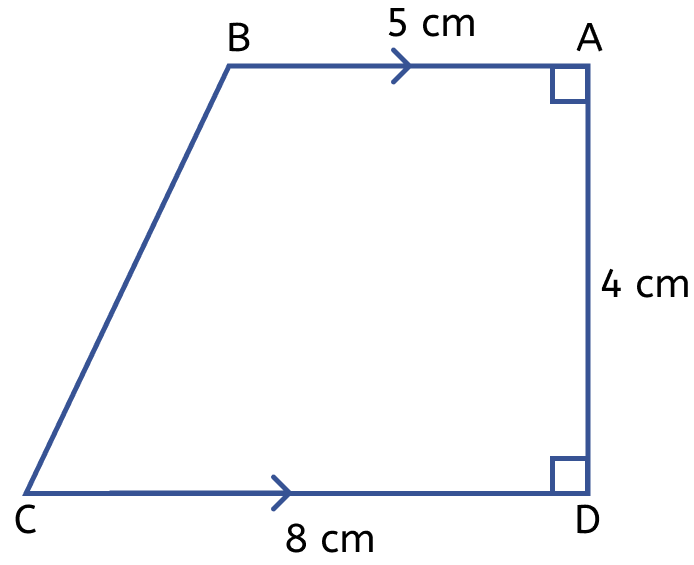
The figure (i) given below is a trapezium. Find the length of BC and the area of the trapezium. Assume AB = 5 cm, AD = 4 cm, CD = 8 cm.
Answer
(a) Construct BN perpendicular to CD.
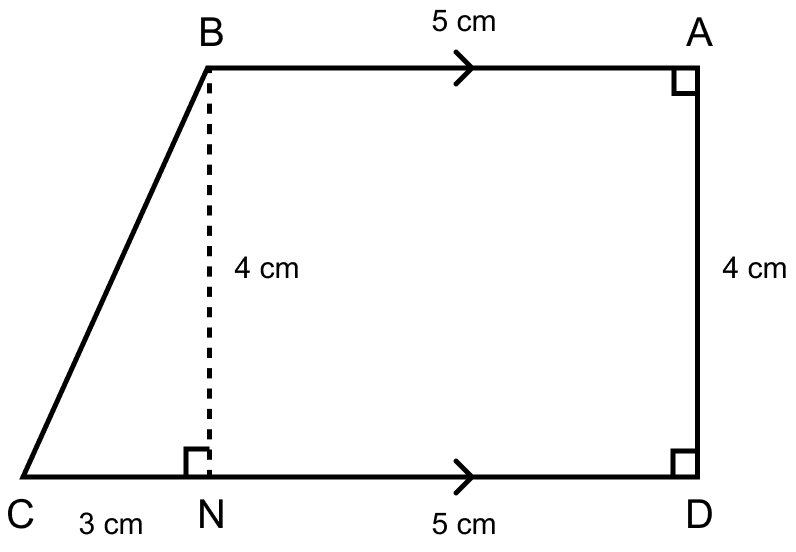
So, BADN is a rectangle.
As opposite sides of rectangle are equal.
∴ BN = AD = 4 cm and ND = BA = 5 cm.
From figure,
CN = CD – ND = 8 - 5 = 3 cm.
In right angle triangle BCN,
Using Pythagoras theorem,
⇒ BC2 = BN2 + CN2
⇒ BC2 = 42 + 32
⇒ BC2 = 16 + 9 = 25
⇒ BC = = 5 cm.
By formula,
Area of trapezium = × sum of parallel sides × height
= × (AB + CD) × AD
= × (5 + 8) × 4
= 13 × 2 = 26 cm2.
Hence, BC = 5 cm and area of trapezium = 26 cm2.
The figure (ii) given below is a trapezium. Find
(i) AB
(ii) area of trapezium ABCD.
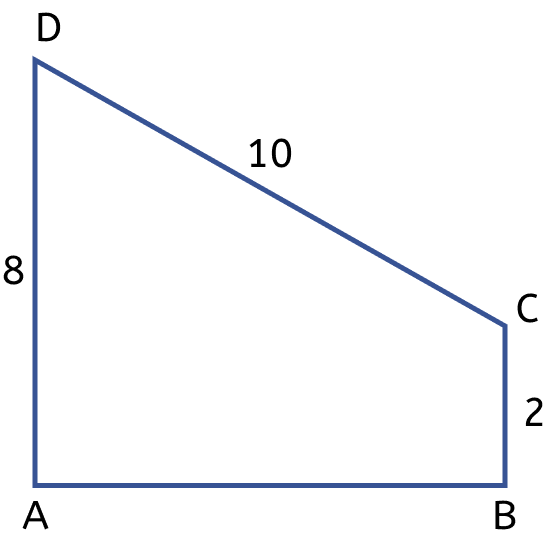
Answer
(i) Construct a perpendicular from C to AD parallel to AB.
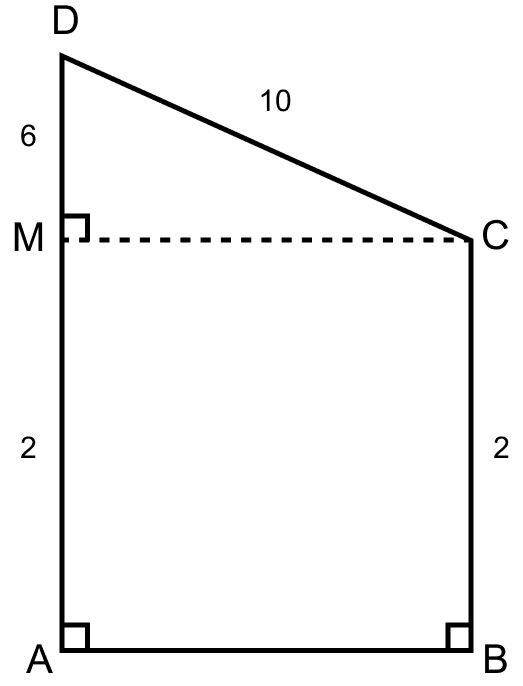
So, ABCM is a rectangle. Since, opposite sides of a rectangle are equal.
∴ AM = CB = 2 units.
From figure,
⇒ AD = AM + MD
⇒ MD = AD - AM = 8 - 2 = 6 units.
In right angle triangle MDC,
⇒ CD2 = MD2 + CM2
⇒ 102 = 62 + CM2
⇒ 100 = 36 + CM2
⇒ CM2 = 64
⇒ CM = = 8 units.
Since, ABCM is a rectangle.
∴ AB = CM = 8 units.
Hence, AB = 8 units.
(ii) Area of trapezium ABCD = × (sum of || sides) × distance between them
= × (AD + BC) × AB
= × (8 + 2) × 8
= 40 sq. units.
Hence, area of trapezium ABCD = 40 sq. units.
The cross-section of a canal is shown in figure (iii) given below. If the canal is 8 m wide at the top and 6 m wide at the bottom and the area of the cross-section is 16.8 m2, calculate its depth.

Answer
Consider ABCD as the cross section of canal in the shape of trapezium.
Draw a perpendicular AM from A to CD.
So, AM is the depth of canal.

Given, the area of cross-section of canal = 16.8 m2.
∴ × sum of parallel sides × depth = 16.8
⇒ × (AB + DC) × AM = 16.8
⇒ × (6 + 8) × AM = 16.8
⇒ × 14 × AM = 16.8
⇒ AM =
⇒ AM = = 2.4 m
Hence, depth of canal = 2.4 meters.
The distance between parallel sides of a trapezium is 12 cm and the distance between mid-points of other sides is 18 cm. Find the area of the trapezium.
Answer
Let ABCD be the trapezium in which AB || DC. Let E and F be mid-points of sides AD and BC respectively, then EF = 18 cm.

Given,
Distance between parallel sides of a trapezium is 12 cm.
∴ Height = 12 cm.
By formula,
Sum of the lengths of two parallel sides = 2 × Distance between mid-points of two non-parallel sides
⇒ AB + CD = 2 × EF = 2 × 18 = 36 cm.
Area of trapezium = × (Sum of parallel sides) × height
= × (AB + CD) × 12
= × 36 × 12
= 18 × 12
= 216 cm2.
Hence, area of trapezium = 216 cm2.
The area of a trapezium is 540 cm2. If the ratio of parallel sides is 7 : 5 and the distance between them is 18 cm, find the length of parallel sides.
Answer
Given,
Area of trapezium = 540 cm2
Ratio of parallel sides = 7 : 5
Let the sides be 7x and 5x cm.
Distance between the parallel sides = height = 18 cm
By formula,
Area of trapezium = × sum of parallel sides × height
⇒ 540 = × (7x + 5x) × 18
⇒ 540 = × 12x × 18
⇒ 540 = 6x × 18
⇒ 540 = 108x
⇒ x = = 5 cm.
⇒ 7x = 7 × 5 = 35 cm and 5x = 5 × 5 = 25 cm.
Hence, the length of parallel sides are 25 cm and 35 cm.
The parallel sides of an isosceles trapezium are in the ratio 2 : 3. If its height is 4 cm and area is 60 cm2, find the perimeter.
Answer
Since, ABCD is an isosceles trapezium so, BC = AD.
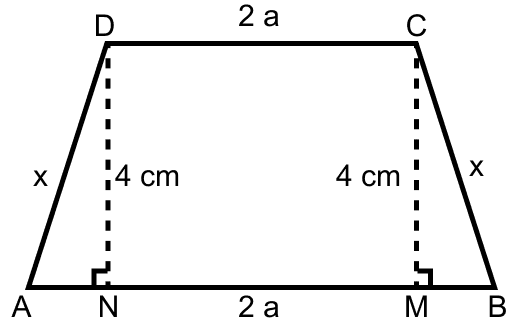
Since, parallel sides of an isosceles trapezium are in the ratio 2 : 3.
∴ CD = 2a and AB = 3a.
Construct perpendicular DN from D to AB and perpendicular CM from C to AB.
Given,
Area = 60 cm2
By formula,
Area of trapezium = × sum of parallel sides × height
⇒ 60 = × (AB + DC) × DN
⇒ 60 = × (3a + 2a) × 4
⇒ 60 = 2 × 5a
⇒ 10a = 60
⇒ a = 6 cm.
⇒ AB = 3a = 3 × 6 = 18 cm and CD = 2a = 2 × 6 = 12 cm.
In △ADN and △BCM,
⇒ ∠AND = ∠CMB = 90°
⇒ DN = CM = 4 cm
⇒ AD = CB = x cm (let) (As ABCD is an isosceles trapezium).
∴ △ADN ≅ △BCM by RHS axiom.
∴ AN = MB ........(1)
Since, DNMC is a rectangle.
∴ NM = DC = 12 cm. (As opposite sides of a rectangle are equal.)
From figure,
⇒ AN + NM + MB = 18
⇒ AN + 12 + MB = 18
⇒ AN + MB = 6
⇒ 2AN = 6 (As AN = MB)
⇒ AN = = 3 cm.
⇒ MB = 3 cm.
In right angle triangle AND,
⇒ AD2 = AN2 + DN2
⇒ x2 = 42 + 32
⇒ x2 = 16 + 9
⇒ x2 = 25
⇒ x = = 5 cm.
From figure,
Perimeter = AB + BC + CD + DA
= 18 + 5 + 12 + 5
= 40 cm.
Hence, perimeter of trapezium = 40 cm.
The area of a parallelogram is 98 cm2. If one altitude is half the corresponding base, determine the base and the altitude of the parallelogram.
Answer
Let base = x cm
Corresponding altitude = cm
By formula,
Area of parallelogram = base × altitude
Substituting the values we get,
⇒ 98 =
⇒ 98 =
⇒ x2 = 98 × 2 = 196
⇒ x = = 14 cm
⇒ Base = x = 14 cm
⇒ Altitude = = 7 cm.
Hence, base = 14 cm and altitude = 7 cm.
The length of a rectangular garden is 12 m more than its breadth. The numerical value of its area is equal to 4 times the numerical value of its perimeter. Find the dimensions of the garden.
Answer
Let breadth of rectangular garden = x meters,
∴ Length = (x + 12) meters.
Area of garden = length × breadth = x(x + 12) m2
Perimeter of garden = 2(l + b)
= 2[(x + 12) + x]
= 2[2x + 12] = (4x + 24) meters.
According to question,
⇒ Area of garden = 4 × Perimeter of garden
⇒ x(x + 12) = 4 × (4x + 24)
⇒ x2 + 12x = 16x + 96
⇒ x2 + 12x - 16x - 96 = 0
⇒ x2 - 4x - 96 = 0
⇒ x2 - 12x + 8x - 96 = 0
⇒ x(x - 12) + 8(x - 12) = 0
⇒ (x + 8)(x - 12) = 0
⇒ x + 8 = 0 or x - 12 = 0
⇒ x = -8 or x = 12.
Since, breadth cannot be negative.
∴ x ≠ -8.
Breadth = x = 12 m and Length = (x + 12) = (12 + 12) = 24 m.
Hence, length and breadth of garden are 24 m and 12 m respectively.
If the perimeter of a rectangular plot is 68 m and length of its diagonal is 26 m, find its area.
Answer
Let ABCD be a rectangular plot of length x m and breadth y m.
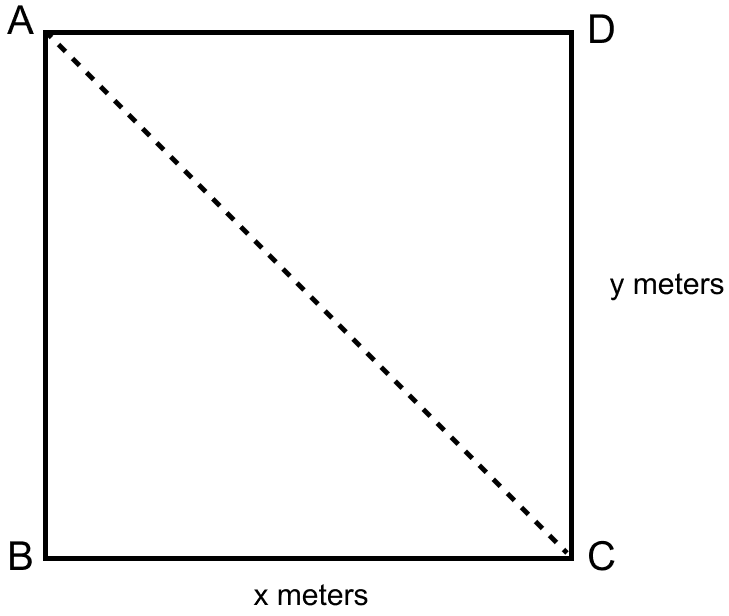
By formula,
Perimeter = 2(length + breadth)
Substituting the values we get,
⇒ 68 = 2(x + y)
⇒ 34 = x + y
⇒ x = 34 - y ......... (1)
In right angle triangle ABC
⇒ AC2 = AB2 + BC2 (By pythagoras theorem)
⇒ 262 = x2 + y2
⇒ x2 + y2 = 676
Substituting the value of x from equation (1),
⇒ (34 – y)2 + y2 = 676
⇒ 1156 + y2 – 68y + y2 = 676
⇒ 2y2 – 68y + 1156 – 676 = 0
⇒ 2y2 – 68y + 480 = 0
⇒ 2(y2 – 34y + 240) = 0
⇒ y2 – 34y + 240 = 0
⇒ y2 – 24y – 10y + 240 = 0
⇒ y(y – 24) – 10(y – 24) = 0
⇒ (y – 10)(y – 24) = 0
⇒ y – 10 = 0 or y – 24 = 0
⇒ y = 10 m or y = 24 m.
Now substituting the value of y in equation (1)
⇒ y = 10 m, x = 34 – 10 = 24 m
⇒ y = 24 m, x = 34 – 24 = 10 m
Area in both cases = xy
= 24 × 10 or 10 × 24
= 240 m2.
Hence, the area of the rectangular block is 240 m2.
A rectangle has twice the area of a square. The length of the rectangle is 12 cm greater and the width is 8 cm greater than a side of a square. Find the perimeter of the square.
Answer
Let length of a side of a square = x cm.
According to question,
Length of rectangle = (x + 12) cm
Breadth of rectangle = (x + 8) cm
Given,
⇒ Area of rectangle = 2 × area of square
⇒ (x + 12)(x + 8) = 2 × (x × x)
⇒ x(x + 8) + 12(x + 8) = 2x2
⇒ x2 + 8x + 12x + 96 = 2x2
⇒ x2 – 2x2 + 8x + 12x + 96 = 0
⇒ -x2 + 20x + 96 = 0
⇒ x2 – 20x – 96 = 0
⇒ x2 – 24x + 4x – 96 = 0
⇒ x(x - 24) + 4(x - 24) = 0
⇒ (x + 4)(x – 24) = 0
⇒ x + 4 = 0 or x - 24 = 0
⇒ x = -4 or x = 24 cm
Since, side of a square cannot be negative.
∴ x ≠ -4.
Side of square = 24 cm
Perimeter of square = 4 × side = 4 × 24
= 96 cm.
Hence, perimeter of square = 96 cm.
The perimeter of a square is 48 cm. The area of a rectangle is 4 cm2 less than the area of the square. If the length of the rectangle is 4 cm greater than its breadth, find the perimeter of the rectangle.
Answer
Perimeter of a square = 48 cm
Length of side of square = = 12 cm.
By formula,
Area = (side)2 = 122 = 144 cm2.
∴ Area of rectangle = 144 – 4 = 140 cm2
Let breadth of rectangle = x cm
∴ Length of rectangle = (x + 4) cm
Area of rectangle = l × b = x(x + 4) cm2
Substituting the values we get,
⇒ x(x + 4) = 140
⇒ x2 + 4x – 140 = 0
⇒ x2 + 14x – 10x – 140 = 0
⇒ x(x + 14) – 10(x + 14) = 0
⇒ (x + 14)(x – 10) = 0
⇒ x + 14 = 0 or x - 10 = 0
⇒ x = -14 or x = 10
Since, breadth cannot be negative.
∴ x ≠ -14.
Breadth = x = 10 cm and Length = x + 4 = 10 + 4 = 14 cm
Perimeter of rectangle = 2(l + b)
= 2(14 + 10)
= 2 × 24 = 48 cm.
Hence, perimeter of rectangle = 48 cm.
In the adjoining figure, ABCD is a rectangle with sides AB = 10 cm and BC = 8 cm. HAD and BFC are equilateral triangles; AEB and DCG are right angled isosceles triangles. Find the area of the shaded region and the perimeter of the figure.
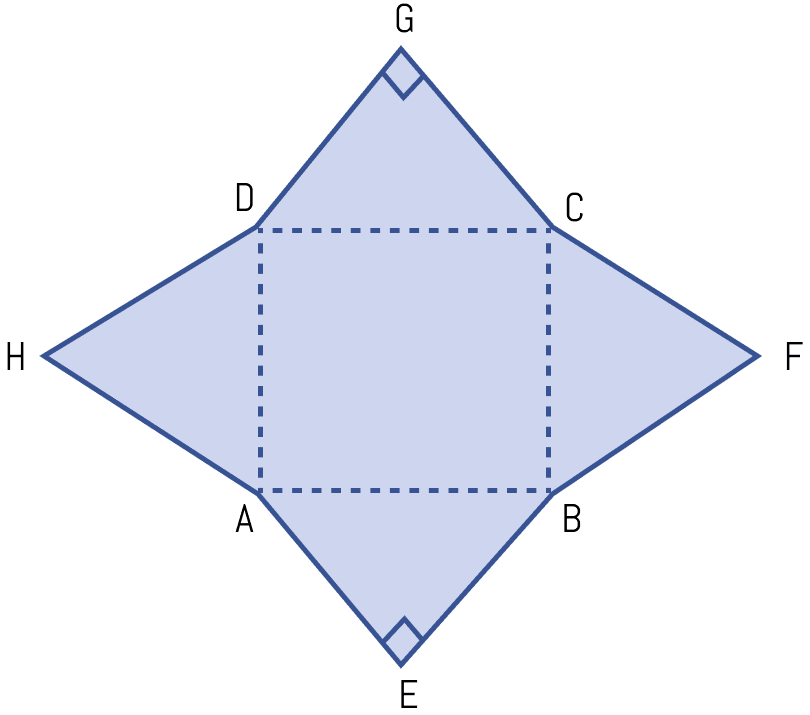
Answer
In △AEB,
Let AE = BE = x cm, then from right angled triangle AEB,
⇒ AB2 = AE2 + EB2
⇒ 102 = x2 + x2
⇒ 2x2 = 100
⇒ x2 = 50
⇒ x = cm.
Area of right angled △AEB = × base × height
In △DGC,
Let DG = GC = y cm, then from right angled triangle DGC,
⇒ DC2 = DG2 + GC2
⇒ 102 = y2 + y2
⇒ 2y2 = 100
⇒ y2 = 50
⇒ y = cm
Area of right angled △DCG = × base × height
Since, HAD and BFC are equilateral triangle with side = 8 cm.
Area of HAD = Area of BFC = × (side)2
=
= cm2
Area of rectangle ABCD = l × b = AB × CD
= 10 × 8 = 80 cm2
From figure,
Area of shaded region = Area of (△DGC + △BFC + △AEB + △HAD + rectangle ABCD)
= cm2.
Perimeter of figure = (AE + EB + BF + FC + CG + GD + DH + HA)
=
= cm.
Hence, area of shaded region = and perimeter = cm.
Find the area enclosed by the figure (i) given below, where ABC is an equilateral triangle and DEFG is an isosceles trapezium. All measurements are in centimeters.
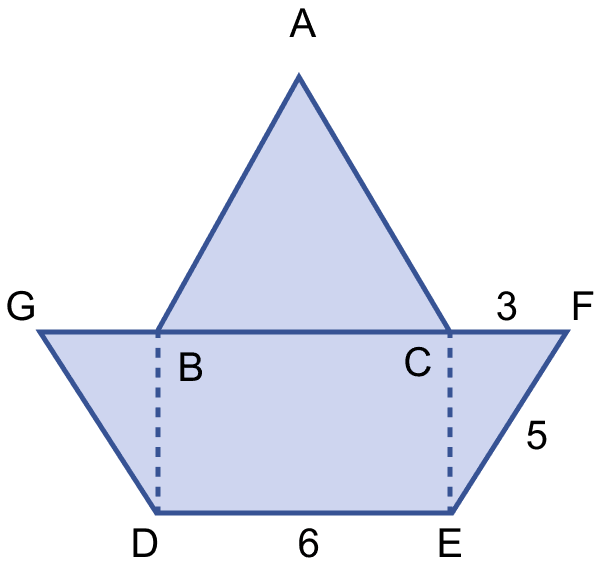
Answer
In right angle triangle ECF,
Using pythagoras theorem,
⇒ EF2 = EC2 + CF2
⇒ 52 = EC2 + 32
⇒ EC2 = 52 - 32
⇒ EC2 = 25 - 9 = 16
⇒ EC = = 4 cm.
Since, DEFG is an isosceles trapezium.
∴ GD = EF= 5 cm.
Since, BDEC is a rectangle,
∴ BD = EC = 4 cm and BC = DE = 6 cm.
In right angle triangle DBG,
Using pythagoras theorem,
⇒ GD2 = BD2 + GB2
⇒ 52 = 42 + GB2
⇒ GB2 = 52 - 42
⇒ GB2 = 25 - 16 = 9
⇒ GB = = 3 cm.
In trapezium,
GF = GB + BC + CF = 3 + 6 + 3 = 12 cm.
Area of trapezium DEFG = (sum of parallel sides) × distance between them
=
= 18 × 2
= 36 cm2.
Area of equilateral triangle ABC =
=
=
= 1.732 × 9
= 15.59 cm2
Area of figure = Area of trapezium DEFG + Area of equilateral triangle ABC
= 36 + 15.59 = 51.59 cm2.
Hence, area of figure = 51.59 cm2.
Find the area enclosed by the figure (ii) given below. All measurements are in centimeters.

Answer
From figure,

BJ = 2 + 2 + 2 + 2 = 8 cm.
Area of rectangle ABJK = l × b
= AB × BJ = 2 × 8
= 16 cm2.
From figure,
JH = KH - KI = 6 - 2 = 4 cm.
Area of trapezium FGHI = (sum of parallel sides) × distance between them
= × (FI + GH) × JH
= × (2 + 2) × 4
= × 4 × 4 = 8 cm2.
Area of trapezium CDEF = (sum of parallel sides) × distance between them
= × (CF + DE) × BD
= × (2 + 2) × 4
= × 4 × 4 = 8 cm2.
Total area enclosed = Area of rectangle ABJK + Area of trapezium FGHI + Area of trapezium CDEF
= 16 + 8 + 8
= 32 cm2.
Hence, area enclosed by figure = 32 cm2.
In the figure (iii) given below, from a 24 cm × 24 cm piece of cardboard, a block in the shape of letter M is cut off. Find the area of the cardboard left over, all measurements are in centimetres.

Answer
From figure,

Area of rectangle (I) = length × breadth
= 24 × 6
= 144 cm2.
Area of rectangle (II) = length × breadth
= 24 × 6
= 144 cm2.
Area of parallelogram (III) = base × height
= 8 × 6
= 48 cm2.
Area of parallelogram (IV) = base × height
= 8 × 6
= 48 cm2.
Area of figure M = Area of rectangle (I) + Area of rectangle (II) + Area of parallelogram (III) + Area of parallelogram (IV)
= 144 + 144 + 48 + 48
= 384 cm2.
Area of cardboard = 24 × 24
= 576 cm2.
Area of cardboard left = Area of cardboard - Area of figure M
= 576 - 384
= 192 cm2.
Hence, area of cardboard left = 192 cm2.
The figure (i) given below shows the cross-section of the concrete structure with the measurements as given. Calculate the area of cross-section.

Answer
From figure,

The figure consist of a trapezium and a rectangle.
Area of trapezium = (sum of parallel sides) × distance between them
= × (0.6 + 1.5) × (1.2 + 2.4)
= × 2.1 × 3.6
= 2.1 × 1.8
= 3.78 m2.
Area of rectangle = l × b
= 2.4 × 0.3 = 0.72 m2.
Area of cross section = Area of trapezium + Area of rectangle
= 3.78 + 0.72 = 4.5 m2.
Hence, area of cross-section = 4.5 m2.
The figure (ii) given below shows a field with the measurements given in metres. Find the area of the field.

Answer
From figure,
Area of right angled △AXB = × base × height
= × BX × AX
= × 30 × 12
= 180 m2.
Area of trapezium XZCB = (sum of parallel sides) × distance between them
= × (BX + CZ) × 15
= × (30 + 25) × 15
= × 55 × 15
= 412.5 m2.
Area of right angled △CZD = × base × height
= × CZ × ZD
= × 25 × 10
= 125 m2.
Area of △AED = × base × height
= × AD × EY
= × 37 × 20
= 370 m2.
Area of field = Area of right angled △AXB + Area of trapezium XZCB + Area of right angled △CZD + Area of △AED
= 180 + 412.5 + 125 + 370 = 1087.5 m2.
Hence, area of field = 1087.5 m2.
Calculate the area of the pentagon ABCDE shown in fig (iii) below, given that AX = BX = 6 cm, EY = CY = 4 cm, DE = DC = 5 cm, DX = 9 cm and DX is perpendicular to EC and AB.
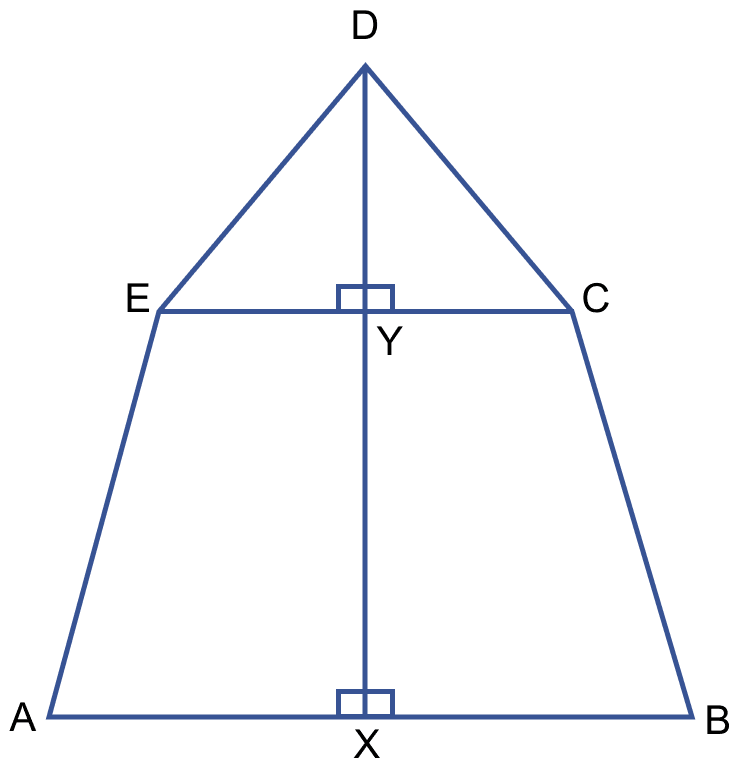
Answer
From figure,
In right angled △DEY,
⇒ DE2 = DY2 + EY2
⇒ 52 = DY2 + 42
⇒ DY2 = 52 - 42
⇒ DY2 = 25 - 16 = 9
⇒ DY = = 3 cm.
Area of right angled △DEY = × base × height
= × EY × DY
= × 4 × 3
= 6 cm2.
Area of right angle △DYC = × base × height
= × CY × DY
= × 4 × 3
= 6 cm2.
From figure,
XY = DX - DY = 9 - 3 = 6 cm.
Area of trapezium ECBA = (sum of parallel sides) × distance between them
= × (EC + AB) × XY
= × [(EY + CY) + (AX + BX)] × XY
= × [(4 + 4) + (6 + 6)] × 6
= × 20 × 6
= 60 cm2.
Area of pentagon = Area of right angled △DEY + Area of right angled △DYC + Area of trapezium ECBA
= 6 + 6 + 60
= 72 cm2.
Hence, area of trapezium = 72 cm2.
If the length and the breadth of a room are increased by 1 metre, the area is increased by 21 square metres. If the length is increased by 1 metre and breadth is decreased by 1 metre the area is decreased by 5 square metres. Find the perimeter of the room.
Answer
Let length = l metres and breadth = b metres.
Area = lb m2
Given,
If the length and the breadth of a room are increased by 1 metre, the area is increased by 21 square metres,
∴ (l + 1)(b + 1) - lb = 21
⇒ lb + l + b + 1 - lb = 21
⇒ l + b = 21 - 1
⇒ l + b = 20 ..........(1)
Given,
If the length is increased by 1 metre and breadth is decreased by 1 metre the area is decreased by 5 square metres.
∴ lb - (l + 1)(b - 1) = 5
⇒ lb - (lb - l + b - 1) = 5
⇒ lb - lb + l - b + 1 = 5
⇒ l - b = 4 ..........(2)
Adding equation (1) and (2) we get,
⇒ l + b + l - b = 20 + 4
⇒ 2l = 24
⇒ l = 12 m.
Substituting value of l in (2) we get,
⇒ 12 - b = 4
⇒ b = 12 - 4 = 8 m.
Perimeter of room = 2(l + b) = 2 × 20 = 40 m.
Hence, perimeter of room = 40 m.
A triangle and a parallelogram have the same base and same area. If the sides of the triangle are 26 cm, 28 cm and 30 cm, and the parallelogram stands on the base 28 cm, find the height of the parallelogram.
Answer
Let a = 26 cm, b = 28 cm and c = 30 cm.
Semi-perimeter (s) = = 42 cm.
Area of triangle =
Since, area of parallelogram = area of triangle.
∴ Area of parallelogram = 336
⇒ base × height = 336
⇒ 28 × height = 336
⇒ height = cm.
Hence, height of parallelogram = 12 cm.
A rectangle of area 105 cm2 has its length equal to x cm. Write down its breadth in terms of x. Given that its perimeter is 44 cm, write down an equation in x and solve it to determine the dimensions of the rectangle.
Answer
Given,
Area of rectangle = 105 cm2
Length of rectangle = x cm
By formula,
Area of rectangle = length × breadth
Substituting the values we get,
105 = x × breadth
Breadth = cm.
Perimeter of rectangle = 44 cm
If x = 7 cm,
Breadth = = 15 cm
If x = 15 cm,
Breadth = = 7 cm
Hence, breadth = , equation : 44 = and the required dimensions of rectangle are 15 cm and 7 cm.
The perimeter of a rectangular plot is 180 m and its area is 1800 m2. Take the length of plot as x m. Use the perimeter 180 m to write the value of the breadth in terms of x. Use the value of the length, breadth and the area to write an equation in x. Solve the equation to calculate the length and breadth of the plot.
Answer
Let length of rectangle be x meters.
Given,
Perimeter = 180 m
∴ 2(l + b) = 180
⇒ 2(x + b) = 180
⇒ x + b = 90
⇒ b = (90 - x) m.
Area = l × b
∴ x(90 - x) = 1800
⇒ 90x - x2 = 1800
⇒ x2 - 90x + 1800 = 0
⇒ x2 - 60x - 30x + 1800 = 0
⇒ x(x - 60) - 30(x - 60) = 0
⇒ (x - 30)(x - 60) = 0
⇒ x - 30 = 0 or x - 60 = 0
⇒ x = 30 or x = 60.
If x = 30, 90 - x = 60 and x = 60, 90 - x = 30.
Hence, breadth = (90 - x) m, equation : x(90 - x) = 1800 and length of rectangle = 60 m and breadth = 30 m.