
The area of a base of a cuboidal water tank is 6500 cm2 and the volume of water contained in it is 2.6 m3. The depth of the water is :
5 m
4 m
3.5 m
3 m
Answer
Given,
Volume of water (V) = 2.6 m3
Base area (A) = 6500 cm2
= = 0.65 m2.
Let the depth of the water be 'd'.
Calculating the depth of the water,
Volume of water = Base area × Depth of water
⇒ 2.6 = 0.65 × d
⇒ d = = 4 m.
Hence, option 2 is the correct option.
The volume of a cuboid of dimensions x, y and z is V and its surface area is S. The value of is :
Answer
Given,
Volume of cuboid = V
Surface area of cuboid = S
Dimensions of cuboid = x, y, z
Volume of cuboid = length × breadth × height
V = xyz
Addition of the reciprocal values of the given dimensions,
⇒ =
By substituting the value V = xyz, we get
⇒ =
⇒ V = yz + xz + xy ..........(1)
We know that,
Surface area of cuboid = 2 (lb + bh + hl)
S = 2(xy + yz + zx)
⇒ = xy + yz + zx
By substituting the value of xy + yz + zx in equation (1), we get :
Hence, option 1 is the correct option.
If a cube has surface area S and volume V, then the volume of the cube of surface area 2S is :
2V
Answer
Let the side of the first cube be a units and volume be V cubic units.
We know that,
Surface area of the cube = 6a2
⇒ S = 6a2
⇒ a2 =
⇒ a =
Calculating the volume of first cube,
Volume of cube (V) = a3
Substituting the value of a, we get,
V =
V = .......(1)
Let the side of second cube be b units and volume be V' cubic units.
Surface area = 6b2
⇒ 2S = 6b2
⇒ S = 3b2
⇒ b2 =
⇒ b =
Volume of second cube (V') = b3
Substituting the value of b, we get
V' =
V' = .......(2)
Taking the ratio of equation (1) and (2) we get,
Hence, option 3 is the correct option.
In the figure, four faces of the solid are shaded. The shaded area is :
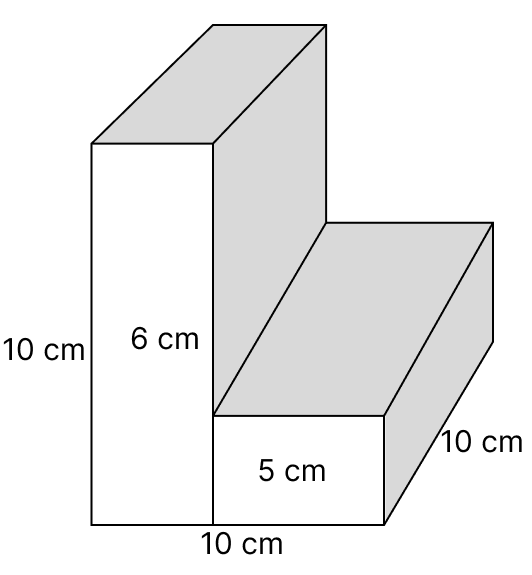
100 cm2
150 cm2
200 cm2
300 cm2
Answer
Given,
Total height = 10 cm
Inner vertical step height = 6 cm
So lower height = 10 - 6 = 4 cm
Total front width = 10 cm
Top block width = 5 cm
Bottom block width = 5 cm.
Calculating the area of top face of the tall block,
Area of rectangle = length × breadth
= 5 × 10 = 50 cm2.
Calculating the area of top face of the lower block,
Area of rectangle = 5 × 10 = 50 cm2.
Calculating the vertical inner face (step)
Length = 6 cm
Breadth = 10 cm
Area = 6 × 10 = 60 cm2.
Calculating the area of bottom side outer face,
Length = 10 cm
Breadth = 4 cm
Area = 4 × 10 = 40 cm2.
Total shaded area = 50 + 50 + 60 + 40
= 200 cm2.
Hence, option 3 is the correct option.
In the figure, there are fifty, 500 rupee notes in the bundle. Volume of the bundle is 98 cm3, length = 14 cm and breadth = 7 cm. The thickness of 1 note is :
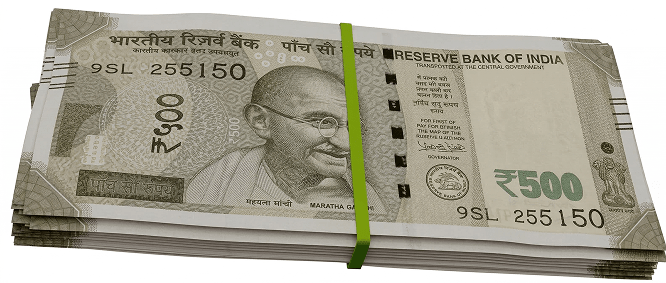
1 mm
0.1 mm
2 mm
0.2 mm
Answer
Given,
Number of notes = 50
Volume of bundle = 98 cm3
Length (l) = 14 cm
Breadth (b) = 7 cm
Let the thickness of the bundle be h cm.
Calculating the thickness of the bundle,
Volume of cuboid = length × breadth × height
⇒ 98 = 14 × 7 × h
⇒ 98 = 98 × h
⇒ h = = 1 cm.
So total thickness of 50 notes = 1 cm.
∴ Thickness of 1 note = cm = 0.02 cm.
1 cm = 10 mm
∴ 0.02 cm = 0.02 × 10 = 0.2 mm.
Hence, option 4 is the correct option.
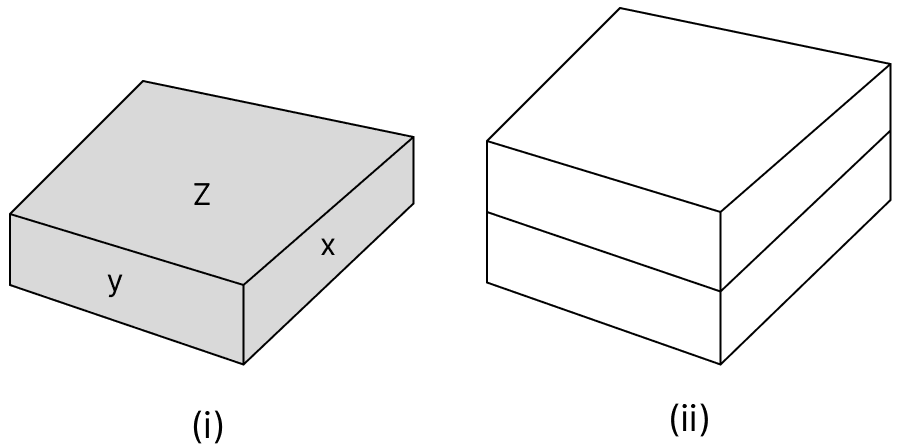
In the figure (i) below, a cuboid is shown. The surface area of three faces are marked as x, y and z. In figure (ii), two such cuboids are stacked. Find the surface area of the new cuboid in figure (ii) in terms of x, y and z.
Answer
Given,
Let the dimensions of the cuboid be :
Length = l
Breadth = b
Height = h
From the figure (i) the three faces have areas:
x = length × height = lh
y = breadth × height = bh
z = length × breadth = lb
When two identical cuboids, are stacked the height is doubled (2h), length (l) and breadth (b) will remain same.
In (ii) figure,
Surface area of top face = length × breadth = lb = z
Surface area of right vertical face = length × height = 2lh = 2x
Surface area of left vertical face = breadth × height = 2bh = 2y
Total surface area = 2x + 2y + z.
Hence, surface area of new cuboid = 2x + 2y + z.
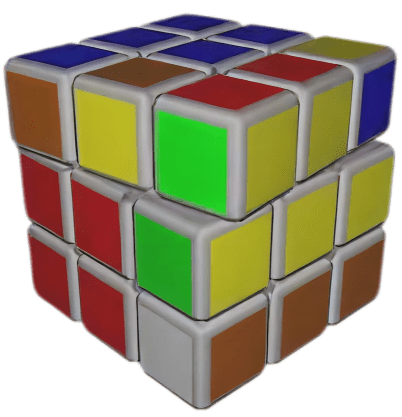
A Rubik's cube is made up of several small cubes. Side lengths of each small cube is x. Find the outer surface area of the cube present at one of the corners of the Rubik's cube.
Answer
Given,
Side lengths of each small cube = x units.
From figure,
At each corner of a Rubik's cube is a small cube of length x units.
Outer surface area of cube = 6x2
Hence, outer surface area of the cube at one of the corners = 6x2 sq. units.