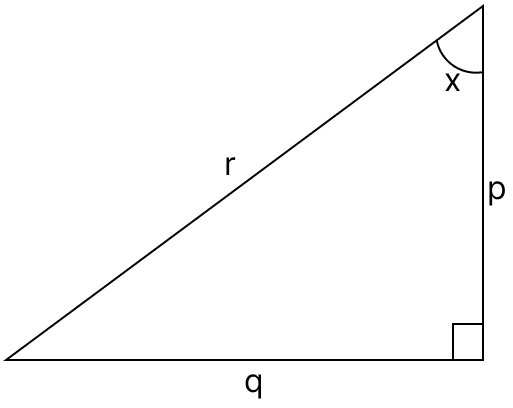
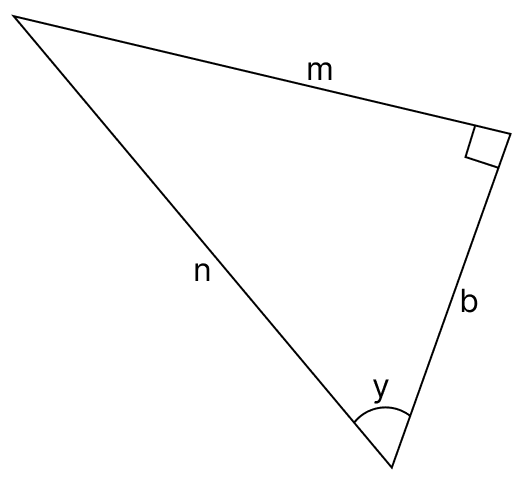
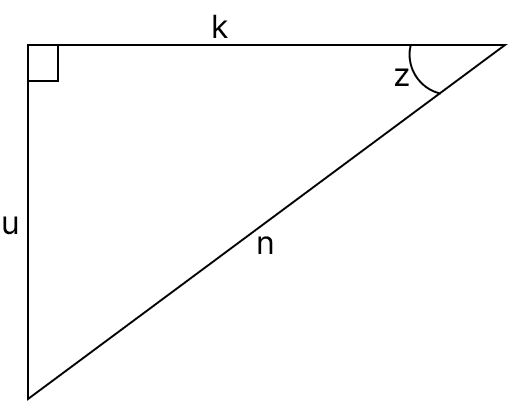
Look at the figures given below :
From these figures, write down the values of :
(i) sin x
(ii) tan x
(iii) sec x
(iv) cos y
(v) cot y
(vi) cosec y
(vii) sin z
(viii) cos z
(ix) tan z
Answer
(i) sin x = perpendicular hypotenuse = q r \dfrac{\text{perpendicular}}{\text{hypotenuse}} = \dfrac{q}{r} hypotenuse perpendicular = r q
(ii) tan x = perpendicular base = q p \dfrac{\text{perpendicular}}{\text{base}} = \dfrac{q}{p} base perpendicular = p q
(iii) sec x = hypotenuse base = r p \dfrac{\text{hypotenuse}}{\text{base}} = \dfrac{r}{p} base hypotenuse = p r
(iv) cos y = base hypotenuse = b n \dfrac{\text{base}}{\text{hypotenuse}} = \dfrac{b}{n} hypotenuse base = n b
(v) cot y = base perpendicular = b m \dfrac{\text{base}}{\text{perpendicular}} = \dfrac{b}{m} perpendicular base = m b
(vi) cosec y = hypotenuse perpendicular = n m \dfrac{\text{hypotenuse}}{\text{perpendicular}} = \dfrac{n}{m} perpendicular hypotenuse = m n
(vii) sin z = perpendicular hypotenuse = u n \dfrac{\text{perpendicular}}{\text{hypotenuse}} = \dfrac{u}{n} hypotenuse perpendicular = n u
(viii) cos z = base hypotenuse = k n \dfrac{\text{base}}{\text{hypotenuse}} = \dfrac{k}{n} hypotenuse base = n k
(ix) tan z = perpendicular base = u k \dfrac{\text{perpendicular}}{\text{base}} = \dfrac{u}{k} base perpendicular = k u
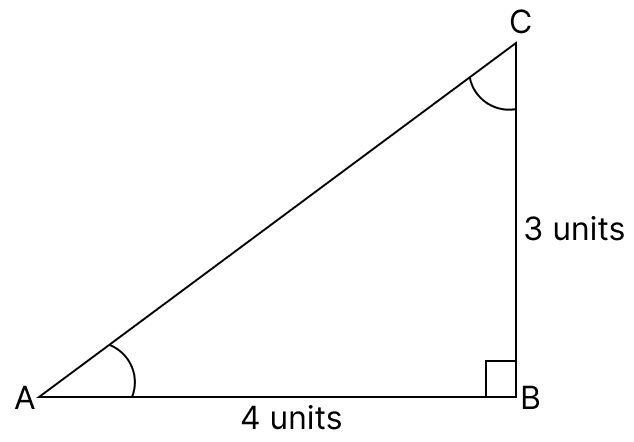
In the given figure, ∠B = 90°, AB = 4 units and BC = 3 units. Find:
(i) sin A
(ii) cos A
(iii) cot A
(iv) sin C
(v) sec C
(vi) tan C
Answer
In triangle ABC,
By pythagoras theorem,
AC2 = AB2 + BC2
AC2 = 42 + 32
AC2 = 16 + 9
AC2 = 25
AC = 25 \sqrt{25} 25
AC = 5 units
(i) sin A = perpendicular hypotenuse = B C A C = 3 5 \dfrac{\text{perpendicular}}{\text{hypotenuse}} = \dfrac{BC}{AC} = \dfrac{3}{5} hypotenuse perpendicular = A C BC = 5 3
(ii) cos A = base hypotenuse = A B A C = 4 5 \dfrac{\text{base}}{\text{hypotenuse}} = \dfrac{AB}{AC} = \dfrac{4}{5} hypotenuse base = A C A B = 5 4
(iii) cot A = base perpendicular = A B B C = 4 3 \dfrac{\text{base}}{\text{perpendicular}} = \dfrac{AB}{BC} = \dfrac{4}{3} perpendicular base = BC A B = 3 4
(iv) sin C = perpendicular hypotenuse = A B A C = 4 5 \dfrac{\text{perpendicular}}{\text{hypotenuse}} = \dfrac{AB}{AC} = \dfrac{4}{5} hypotenuse perpendicular = A C A B = 5 4
(v) sec C = hypotenuse base = A C B C = 5 3 \dfrac{\text{hypotenuse}}{\text{base}} = \dfrac{AC}{BC} = \dfrac{5}{3} base hypotenuse = BC A C = 3 5
(vi) tan C = perpendicular base = A B B C = 4 3 \dfrac{\text{perpendicular}}{\text{base}} = \dfrac{AB}{BC} = \dfrac{4}{3} base perpendicular = BC A B = 3 4
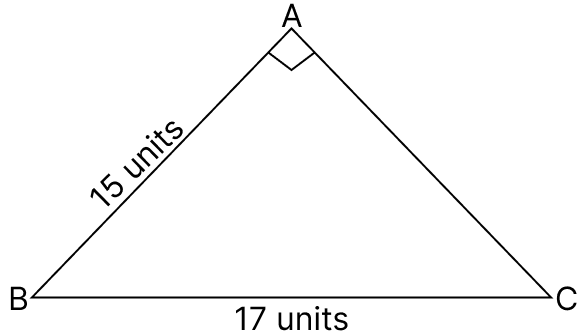
From the given figure, write down the values of :
(i) sin B
(ii) tan B
(iii) cos C
(iv) cot C
(v) (sin B cos C + cos B sin C)
(vi) (sec2 C - tan2 C)
Answer
Given a right triangle ABC with hypotenuse BC = 17 units and AB = 15 units.
First, find AC using the Pythagoras theorem :
BC2 = AB2 + AC2
AC2 = BC2 - AB2
AC2 = 172 - 152
AC2 = 289 - 225
AC2 = 64
AC = 64 \sqrt{64} 64
AC = 8 units
(i) sin B = perpendicular hypotenuse = A C B C = 8 17 \dfrac{\text{perpendicular}}{\text{hypotenuse}} = \dfrac{AC}{BC} = \dfrac{8}{17} hypotenuse perpendicular = BC A C = 17 8
(ii) tan B = perpendicular base = A C A B = 8 15 \dfrac{\text{perpendicular}}{\text{base}} = \dfrac{AC}{AB} = \dfrac{8}{15} base perpendicular = A B A C = 15 8
(iii) cos C = base hypotenuse = A C B C = 8 17 \dfrac{\text{base}}{\text{hypotenuse}} = \dfrac{AC}{BC} = \dfrac{8}{17} hypotenuse base = BC A C = 17 8
(iv) cot C = base perpendicular = A C A B = 8 15 \dfrac{\text{base}}{\text{perpendicular}} = \dfrac{AC}{AB} = \dfrac{8}{15} perpendicular base = A B A C = 15 8
(v) We have to find
sin B cos C + cos B sin C
First we will find the values of cos B & sin C
cos B = base hypotenuse = A B B C = 15 17 \dfrac{\text{base}}{\text{hypotenuse}} = \dfrac{AB}{BC} = \dfrac{15}{17} hypotenuse base = BC A B = 17 15
sin C = perpendicular hypotenuse = A B B C = 15 17 \dfrac{\text{perpendicular}}{\text{hypotenuse}} = \dfrac{AB}{BC} = \dfrac{15}{17} hypotenuse perpendicular = BC A B = 17 15
Substituting the values, we get :
sin B cos C + cos B sin C = 8 17 × 8 17 + 15 17 × 15 17 = 64 289 + 225 289 = 289 289 = 1. \text{sin B cos C + cos B sin C} = \dfrac{8}{17}\times \dfrac{8}{17} + \dfrac{15}{17} \times \dfrac{15}{17} \\[1em] = \dfrac{64}{289} + \dfrac{225}{289} \\[1em] = \dfrac{289}{289} \\[1em] = 1. sin B cos C + cos B sin C = 17 8 × 17 8 + 17 15 × 17 15 = 289 64 + 289 225 = 289 289 = 1.
Hence, sin B cos C + cos B sin C = 1.
(vi) We have to find out
sec2 C - tan2 C
First we will find out the values of sec C & tan C
sec C = hypotenuse base = B C A C = 17 8 \dfrac{\text{hypotenuse}}{\text{base}} = \dfrac{BC}{AC} = \dfrac{17}{8} base hypotenuse = A C BC = 8 17
tan C = perpendicular base = A B A C = 15 8 \dfrac{\text{perpendicular}}{\text{base}} = \dfrac{AB}{AC} = \dfrac{15}{8} base perpendicular = A C A B = 8 15
Now putting the values of sec C & tan C
sec2 C - tan2 C
= ( 17 8 ) 2 − ( 15 8 ) 2 \Big(\dfrac{17}{8}\Big)^2 - \Big(\dfrac{15}{8}\Big)^2 ( 8 17 ) 2 − ( 8 15 ) 2
= 289 64 − 225 64 = 289 − 225 64 \dfrac{289}{64} - \dfrac{225}{64} = \dfrac{289 - 225}{64} 64 289 − 64 225 = 64 289 − 225
= 64 64 \dfrac{64}{64} 64 64
= 1.
Hence, sec2 C - tan2 C = 1.
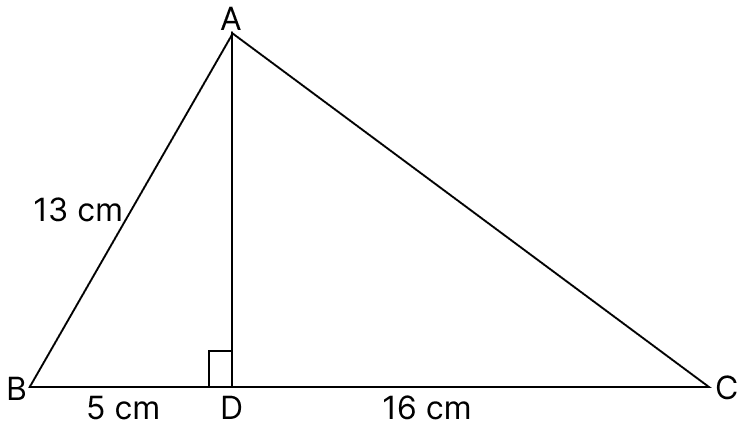
In the given figure, AD ⊥ BC.
If AB = 13 cm, BD = 5 cm and DC = 16 cm, find the values of :
(i) sin B
(ii) sec B
(iii) cot B
(iv) cos C
(v) cosec C
(vi) tan C
Answer
Using pythagoras theorem in right angled triangle ADB
AB2 = BD2 + AD2
AD2 = AB2 - BD2
AD2 = 132 - 52
AD2 = 169 - 25
AD2 = 144
AD = 144 \sqrt{144} 144
AD = 12 cm
Now we will find out AC using pythagoras theorem in right angled triangle ADC,
AC2 = DC2 + AD2
AC2 = 162 + 122
AC2 = 256 + 144
AC2 = 400
AC = 400 \sqrt{400} 400
AC = 20 cm
Now,
(i) sin B = perpendicular hypotenuse = A D A B = 12 13 \dfrac{\text{perpendicular}}{\text{hypotenuse}} = \dfrac{AD}{AB} = \dfrac{12}{13} hypotenuse perpendicular = A B A D = 13 12
(ii) sec B = hypotenuse base = A B B D = 13 5 \dfrac{\text{hypotenuse}}{\text{base}} = \dfrac{AB}{BD} = \dfrac{13}{5} base hypotenuse = B D A B = 5 13
(iii) cot B = base perpendicular = B D A D = 5 12 \dfrac{\text{base}}{\text{perpendicular}} = \dfrac{BD}{AD} = \dfrac{5}{12} perpendicular base = A D B D = 12 5
(iv) cos C = base hypotenuse = D C A C = 16 20 = 4 5 \dfrac{\text{base}}{\text{hypotenuse}} = \dfrac{DC}{AC} = \dfrac{16}{20} = \dfrac{4}{5} hypotenuse base = A C D C = 20 16 = 5 4
(v) cosec C = hypotenuse perpendicular = A C A D = 20 12 = 5 3 \dfrac{\text{hypotenuse}}{\text{perpendicular}} = \dfrac{AC}{AD} = \dfrac{20}{12} = \dfrac{5}{3} perpendicular hypotenuse = A D A C = 12 20 = 3 5
(vi) tan C = perpendicular base = A D D C = 12 16 = 3 4 \dfrac{\text{perpendicular}}{\text{base}} = \dfrac{AD}{DC} = \dfrac{12}{16} = \dfrac{3}{4} base perpendicular = D C A D = 16 12 = 4 3
If sin θ = 1 2 \dfrac{1}{\sqrt{2}} 2 1 , find the values of other trigonometrical ratios for θ.
Answer
sin θ = perpendicular hypotenuse = 1 2 \dfrac{\text{perpendicular}}{\text{hypotenuse}} = \dfrac{1}{\sqrt{2}} hypotenuse perpendicular = 2 1
Let perpendicular = x and hypotenuse = 2 x \sqrt{2}x 2 x
By using Pythagoras theorem, we get :
Hypotenuse2 = Base2 + Perpendicular2
Base2 = Hypotenuse2 - Perpendicular2
Base2 = ( 2 x ) 2 (\sqrt{2}x)^2 ( 2 x ) 2 - x2
Base2 = 2x2 - x2
Base2 = x2
Base = x
Now, calculating the remaining trigonometric ratios :
cos θ = base hypotenuse = x 2 x = 1 2 \dfrac{\text{base}}{\text{hypotenuse}} = \dfrac{x}{\sqrt{2}x} = \dfrac{1}{\sqrt{2}} hypotenuse base = 2 x x = 2 1
tan θ = perpendicular base = x x = 1 \dfrac{\text{perpendicular}}{\text{base}} = \dfrac{x}{x} = 1 base perpendicular = x x = 1
cot θ = base perpendicular = x x = 1 \dfrac{\text{base}}{\text{perpendicular}} = \dfrac{x}{x} = 1 perpendicular base = x x = 1
sec θ = hypotenuse base = 2 x x = 2 \dfrac{\text{hypotenuse}}{\text{base}} = \dfrac{\sqrt{2}x}{x} = \sqrt{2} base hypotenuse = x 2 x = 2
cosec θ = hypotenuse perpendicular = 2 x x = 2 \dfrac{\text{hypotenuse}}{\text{perpendicular}} = \dfrac{\sqrt{2}x}{x} = \sqrt{2} perpendicular hypotenuse = x 2 x = 2
If tan θ = 8 15 \dfrac{8}{15} 15 8 , find the values of other trigonometrical ratios for θ.
Answer
tan θ = Perpendicular Base = 8 15 \dfrac{\text{Perpendicular}}{\text{Base}} = \dfrac{8}{15} Base Perpendicular = 15 8
Let perpendicular = 8x and base = 15x
By pythagoras theorem, we get :
Hypotenuse2 = Base2 + Perpendicular2
Hypotenuse2 = (15x)2 + (8x)2
Hypotenuse2 = 225x2 + 64x2
Hypotenuse2 = 289x2
Hypotenuse = 289 x 2 \sqrt{289x^2} 289 x 2
Hypotenuse = 17x
Now, calculating the remaining trigonometric ratios :
sin θ = Perpendicular Hypotenuse = 8 x 17 x = 8 17 \dfrac{\text{Perpendicular}}{\text{Hypotenuse}} = \dfrac{8x}{17x} = \dfrac{8}{17} Hypotenuse Perpendicular = 17 x 8 x = 17 8 .
cos θ = Base Hypotenuse = 15 x 17 x = 15 17 \dfrac{\text{Base}}{\text{Hypotenuse}} = \dfrac{15x}{17x} = \dfrac{15}{17} Hypotenuse Base = 17 x 15 x = 17 15
cot θ = Base Perpendicular = 15 x 8 x = 15 8 \dfrac{\text{Base}}{\text{Perpendicular}} = \dfrac{15x}{8x} = \dfrac{15}{8} Perpendicular Base = 8 x 15 x = 8 15
sec θ = Hypotenuse Base = 17 x 15 x = 17 15 \dfrac{\text{Hypotenuse}}{\text{Base}} = \dfrac{17x}{15x}= \dfrac{17}{15} Base Hypotenuse = 15 x 17 x = 15 17
cosec θ = Hypotenuse Perpendicular = 17 x 8 x = 17 8 \dfrac{\text{Hypotenuse}}{\text{Perpendicular}} = \dfrac{17x}{8x} = \dfrac{17}{8} Perpendicular Hypotenuse = 8 x 17 x = 8 17
If cosec θ = 10 \sqrt{10} 10 , find the values of other trigonometrical ratios for θ.
Answer
cosec θ = hypotenuse perpendicular = 10 1 \dfrac{\text{hypotenuse}}{\text{perpendicular}} = \dfrac{\sqrt{10}}{1} perpendicular hypotenuse = 1 10 .
Let hypotenuse = 10 x \sqrt{10}x 10 x and perpendicular = x.
By pythagoras theorem, we get :
Hypotenuse2 = Base2 + Perpendicular2
Base2 = Hypotenuse2 - Perpendicular2
Base2 = ( 10 x ) 2 (\sqrt{10}x)^2 ( 10 x ) 2 - x2
Base2 = 10x2 - x2
Base2 = 9x2
Base = ( 9 x 2 ) (\sqrt{9x^2}) ( 9 x 2 )
Base = 3x
sin θ = perpendicular hypotenuse = x 10 x = 1 10 \dfrac{\text{perpendicular}}{\text{hypotenuse}} = \dfrac{x}{\sqrt{10}x} = \dfrac{1}{\sqrt{10}} hypotenuse perpendicular = 10 x x = 10 1
cos θ = base hypotenuse = 3 x 10 x = 3 10 \dfrac{\text{base}}{\text{hypotenuse}} = \dfrac{3x}{\sqrt{10}x} = \dfrac{3}{\sqrt{10}} hypotenuse base = 10 x 3 x = 10 3
tan θ = perpendicular base = x 3 x = 1 3 \dfrac{\text{perpendicular}}{\text{base}} = \dfrac{x}{3x} = \dfrac{1}{3} base perpendicular = 3 x x = 3 1
cot θ = base perpendicular = 3 x x = 3 \dfrac{\text{base}}{\text{perpendicular}} = \dfrac{3x}{x} = 3 perpendicular base = x 3 x = 3
sec θ = hypotenuse base = 10 x 3 x = 10 3 \dfrac{\text{hypotenuse}}{\text{base}} = \dfrac{\sqrt{10}x}{3x} = \dfrac{\sqrt{10}}{3} base hypotenuse = 3 x 10 x = 3 10
If sin θ = 3 5 \dfrac{3}{5} 5 3 and θ is an acute angle, find the values of cos θ and tan θ.
Answer
sin θ = perpendicular hypotenuse = 3 5 \dfrac{\text{perpendicular}}{\text{hypotenuse}} = \dfrac{3}{5} hypotenuse perpendicular = 5 3
Let perpendicular = 3x and hypotenuse = 5x
By using Pythagoras theorem, we get :
Hypotenuse2 = Base2 + Perpendicular2
Base2 = Hypotenuse2 - Perpendicular2
Base2 = (5x)2 - (3x)2
Base2 = 25x2 - 9x2
Base2 = 16x2
Base = 4x
cos θ = base hypotenuse = 4 x 5 x = 4 5 \dfrac{\text{base}}{\text{hypotenuse}} = \dfrac{4x}{5x} = \dfrac{4}{5} hypotenuse base = 5 x 4 x = 5 4
tan θ = perpendicular base = 3 x 4 x = 3 4 \dfrac{\text{perpendicular}}{\text{base}} = \dfrac{3x}{4x} = \dfrac{3}{4} base perpendicular = 4 x 3 x = 4 3
If tan θ = 5 12 \dfrac{5}{12} 12 5 and θ is acute, find the values of sin θ and cos θ.
Answer
tan θ = perpendicular base = 5 12 \dfrac{\text{perpendicular}}{\text{base}} = \dfrac{5}{12} base perpendicular = 12 5
Let perpendicular = 5x and base = 12x
By pythagoras theorem, we get :
Hypotenuse2 = Base2 + Perpendicular2
Hypotenuse2 = (12x)2 + (5x)2
Hypotenuse2 = 144x2 + 25x2
Hypotenuse2 = 169x2
Hypotenuse = 169 x 2 \sqrt{169x^2} 169 x 2
Hypotenuse = 13x
sin θ = perpendicular hypotenuse = 5 x 13 x = 5 13 \dfrac{\text{perpendicular}}{\text{hypotenuse}} = \dfrac{5x}{13x} = \dfrac{5}{13} hypotenuse perpendicular = 13 x 5 x = 13 5
cos θ = base hypotenuse = 12 x 13 x = 12 13 \dfrac{\text{base}}{\text{hypotenuse}} = \dfrac{12x}{13x} = \dfrac{12}{13} hypotenuse base = 13 x 12 x = 13 12
If sin θ = 3 2 \dfrac{\sqrt{3}}{2} 2 3 , find the value of (cosec θ + cot θ).
Answer
sin θ = perpendicular hypotenuse = 3 2 \dfrac{\text{perpendicular}}{\text{hypotenuse}} =\dfrac{\sqrt{3}}{2} hypotenuse perpendicular = 2 3
Let perpendicular = 3 x \sqrt{3}x 3 x and hypotenuse = 2x
We will find the value of base using pythagoras theorem
Hypotenuse2 = Base2 + Perpendicular2
Base2 = Hypotenuse2 - Perpendicular2
Base2 = (2x)2 - ( 3 x ) 2 (\sqrt{3}x)^2 ( 3 x ) 2
Base2 = 4x2 - 3x2
Base2 = x2
Base = x
cosec θ = hypotenuse perpendicular = 2 x 3 x = 2 3 \dfrac{\text{hypotenuse}}{\text{perpendicular}} = \dfrac{2x}{\sqrt{3}x} = \dfrac{2}{\sqrt{3}} perpendicular hypotenuse = 3 x 2 x = 3 2
cot θ = base perpendicular = x 3 x = 1 3 \dfrac{\text{base}}{\text{perpendicular}} = \dfrac{x}{\sqrt{3}x} = \dfrac{1}{\sqrt{3}} perpendicular base = 3 x x = 3 1
Substituting above values in cosec θ + cot θ, we get :
cosec θ + cot θ = 2 3 + 1 3 \dfrac{2}{\sqrt{3}} + \dfrac{1}{\sqrt{3}} 3 2 + 3 1
= 3 3 = 3 \dfrac{3}{\sqrt{3}} = {\sqrt{3}} 3 3 = 3 .
Hence, cosec θ + cot θ = 3 \sqrt{3} 3 .
If 13 sin θ = 5, find the value of
5 sin θ - 2 cos θ tan θ \dfrac{\text{5 sin θ - 2 cos θ}}{\text{tan θ}} tan θ 5 sin θ - 2 cos θ
Answer
13 sin θ = 5
sin θ = 5 13 \dfrac{5}{13} 13 5
sin θ = perpendicular hypotenuse = 5 13 \dfrac{\text{perpendicular}}{\text{hypotenuse}} =\dfrac{\text{5}}{\text{13}} hypotenuse perpendicular = 13 5
Let perpendicular = 5x and hypotenuse = 13x
By pythagoras theorem, we get :
Hypotenuse2 = Base2 + Perpendicular2
Base2 = Hypotenuse2 - Perpendicular2
Base2 = (13x)2 - (5x)2
Base2 = 169x2 - 25x2
Base2 = 144x2
Base = 144 x 2 \sqrt{144x^2} 144 x 2
Base = 12x
cos θ = base hypotenuse = 12 x 13 x = 12 13 \dfrac{\text{base}}{\text{hypotenuse}} = \dfrac{12x}{13x} = \dfrac{12}{13} hypotenuse base = 13 x 12 x = 13 12
tan θ = perpendicular base = 5 x 12 x = 5 12 \dfrac{\text{perpendicular}}{\text{base}} = \dfrac{5x}{12x} = \dfrac{5}{12} base perpendicular = 12 x 5 x = 12 5
Substituting values, we get :
⇒ 5 sin θ - 2 cos θ tan θ = 5 × 5 13 − 2 × 12 13 5 12 = 25 13 − 24 13 5 12 = 1 13 5 12 = 12 65 . \Rightarrow \dfrac{\text{5 sin θ - 2 cos θ}}{\text{tan θ}} = \dfrac{5 \times \dfrac{5}{13} - 2 \times \dfrac{12}{13}}{\dfrac{5}{12}} \\[1em] = \dfrac{\dfrac{25}{13} - \dfrac{24}{13}}{\dfrac{5}{12}} \\[1em] = \dfrac{\dfrac{1}{13}}{\dfrac{5}{12}} \\[1em] = \dfrac{12}{65}. ⇒ tan θ 5 sin θ - 2 cos θ = 12 5 5 × 13 5 − 2 × 13 12 = 12 5 13 25 − 13 24 = 12 5 13 1 = 65 12 .
Hence, 5 sin θ - 2 cos θ tan θ = 12 65 \dfrac{\text{5 sin θ - 2 cos θ}}{\text{tan θ}} = \dfrac{12}{65} tan θ 5 sin θ - 2 cos θ = 65 12 .
If cot θ = 1 3 \dfrac{1}{\sqrt{3}} 3 1 , show that ( 1 − cos 2 θ 2 − sin 2 θ ) = 3 5 \Big(\dfrac{1 - \text{cos}^2θ}{2 - \text{sin}^2θ}\Big) = \dfrac{3}{5} ( 2 − sin 2 θ 1 − cos 2 θ ) = 5 3 .
Answer
cot θ = base perpendicular = 1 3 \dfrac{\text{base}}{\text{perpendicular}} = \dfrac{1}{\sqrt{3}} perpendicular base = 3 1
Let base = x and perpendicular = 3 \sqrt{3} 3 x
By using pythagoras theorem, we get :
Hypotenuse2 = Base2 + Perpendicular2
Hypotenuse2 = (x)2 + ( 3 x ) 2 (\sqrt{3}x)^2 ( 3 x ) 2
Hypotenuse2 = x2 + 3x2
Hypotenuse2 = 4x2
Hypotenuse = 4 x 2 \sqrt{4x^2} 4 x 2
Hypotenuse = 2x
Now
sin θ = perpendicular hypotenuse = 3 x 2 x = 3 2 \dfrac{\text{perpendicular}}{\text{hypotenuse}} = \dfrac{\sqrt{3}x}{2x} = \dfrac{\sqrt{3}}{2} hypotenuse perpendicular = 2 x 3 x = 2 3
cos θ = base hypotenuse = x 2 x = 1 2 \dfrac{\text{base}}{\text{hypotenuse}} = \dfrac{x}{2x} = \dfrac{1}{2} hypotenuse base = 2 x x = 2 1
Substituting values we get :
⇒ ( 1 − cos 2 θ 2 − sin 2 θ ) = 1 − ( 1 2 ) 2 2 − ( 3 2 ) 2 = 1 − 1 4 2 − 3 4 = 4 − 1 4 8 − 3 4 = 3 4 5 4 = 3 5 . \Rightarrow \Big(\dfrac{1 - \text{cos}^2θ}{2 - \text{sin}^2θ}\Big) = \dfrac{1 - \Big(\dfrac{1}{2}\Big)^2}{2 - \Big(\dfrac{\sqrt{3}}{2}\Big)^2} \\[1em] = \dfrac{1 - \dfrac{1}{4}}{2 - \dfrac{3}{4}} \\[1em] = \dfrac{\dfrac{4 - 1}{4}}{\dfrac{8 - 3}{4}} \\[1em] = \dfrac{\dfrac{3}{4}}{\dfrac{5}{4}} \\[1em] = \dfrac{3}{5}. ⇒ ( 2 − sin 2 θ 1 − cos 2 θ ) = 2 − ( 2 3 ) 2 1 − ( 2 1 ) 2 = 2 − 4 3 1 − 4 1 = 4 8 − 3 4 4 − 1 = 4 5 4 3 = 5 3 .
Hence, ( 1 − cos 2 θ 2 − sin 2 θ ) = 3 5 \Big(\dfrac{1 - \text{cos}^2θ}{2 - \text{sin}^2θ}\Big) = \dfrac{3}{5} ( 2 − sin 2 θ 1 − cos 2 θ ) = 5 3 .
If sec θ = 13 5 \dfrac{13}{5} 5 13 , show that 2 sin θ - 3 cos θ 4 sin θ - 9 cos θ \dfrac{\text{2 sin θ - 3 cos θ}}{\text{4 sin θ - 9 cos θ}} 4 sin θ - 9 cos θ 2 sin θ - 3 cos θ = 3.
Answer
sec θ = hypotenuse base = 13 5 \dfrac{\text{hypotenuse}}{\text{base}} =\dfrac{13}{5} base hypotenuse = 5 13
Let hypotenuse = 13x and base = 5x
We will find perpendicular by using pythagoras theorem
Hypotenuse2 = Base2 + Perpendicular2
Perpendicular2 = Hypotenuse2 - Base2
Perpendicular2 = (13x)2 - (5x)2
Perpendicular2 = 169x2 - 25x2
Perpendicular2 = 144x2
Perpendicular = 144 x 2 \sqrt{144x^2} 144 x 2
Perpendicular = 12x
Now
sin θ = perpendicular hypotenuse = 12 x 13 x = 12 13 \dfrac{\text{perpendicular}}{\text{hypotenuse}}= \dfrac{12x}{13x} = \dfrac{12}{13} hypotenuse perpendicular = 13 x 12 x = 13 12
cos θ = base hypotenuse = 5 x 13 x = 5 13 \dfrac{\text{base}}{\text{hypotenuse}} = \dfrac{5x}{13x} = \dfrac{5}{13} hypotenuse base = 13 x 5 x = 13 5
Substituting values we get :
⇒ 2 sin θ - 3 cos θ 4 sin θ - 9 cos θ = 2 × 12 13 − 3 × 5 13 4 × 12 13 − 9 × 5 13 = 24 13 − 15 13 48 13 − 45 13 = 9 13 3 13 = 9 3 = 3. \Rightarrow \dfrac{\text{2 sin θ - 3 cos θ}}{\text{4 sin θ - 9 cos θ}} = \dfrac{2 \times \dfrac{12}{13} - 3 \times \dfrac{5}{13}}{4 \times \dfrac{12}{13} - 9 \times \dfrac{5}{13}} \\[1em] = \dfrac{\dfrac{24}{13} - \dfrac{15}{13}}{\dfrac{48}{13} - \dfrac{45}{13}} \\[1em] = \dfrac{\dfrac{9}{13}}{\dfrac{3}{13}} \\[1em] = \dfrac{9}{3} \\[1em] = 3. ⇒ 4 sin θ - 9 cos θ 2 sin θ - 3 cos θ = 4 × 13 12 − 9 × 13 5 2 × 13 12 − 3 × 13 5 = 13 48 − 13 45 13 24 − 13 15 = 13 3 13 9 = 3 9 = 3.
Hence, proved that 2 sin θ - 3 cos θ 4 sin θ - 9 cos θ = 3 \dfrac{\text{2 sin θ - 3 cos θ}}{\text{4 sin θ - 9 cos θ}} = 3 4 sin θ - 9 cos θ 2 sin θ - 3 cos θ = 3 .
If 3 tan θ = 4, show that ( 3 sin θ + 2 cos θ 3 sin θ − 2 cos θ ) \Big(\dfrac{3\sin θ + 2\cos θ}{3\sin θ - 2\cos θ}\Big) ( 3 sin θ − 2 cos θ 3 sin θ + 2 cos θ ) = 3.
Answer
tan θ = perpendicular base = 4 3 \dfrac{\text{perpendicular}}{\text{base}}=\dfrac{4}{3} base perpendicular = 3 4
Let Perpendicular = 4x and Base = 3x
We will find hypotenuse by using pythagoras theorem
Hypotenuse2 = Perpendicular2 + Base2
Hypotenuse2 = (4x)2 + (3x)2
Hypotenuse2 = 16x2 + 9x2
Hypotenuse2 = 25x2
Hypotenuse = 5x
Now
sin θ = perpendicular hypotenuse = 4 x 5 x = 4 5 \dfrac{\text{perpendicular}}{\text{hypotenuse}}= \dfrac{4x}{5x} = \dfrac{4}{5} hypotenuse perpendicular = 5 x 4 x = 5 4
cos θ = base hypotenuse = 3 x 5 x = 3 5 \dfrac{\text{base}}{\text{hypotenuse}}= \dfrac{3x}{5x} = \dfrac{3}{5} hypotenuse base = 5 x 3 x = 5 3
Substituting values we get :
⇒ 3 sin θ + 2 cos θ 3 sin θ - 2 cos θ = 3 × 4 5 + 2 × 3 5 3 × 4 5 − 2 × 3 5 = 12 5 + 6 5 12 5 − 6 5 = 12 + 6 5 12 − 6 5 = 18 5 6 5 = 18 × 5 5 × 6 = 18 6 = 3 \Rightarrow \dfrac{\text{3 sin θ + 2 cos θ}}{\text{3 sin θ - 2 cos θ}} \\[1em] = \dfrac{3\times\dfrac{4}{5} + 2\times\dfrac{3}{5}}{3\times\dfrac{4}{5} -2\times\dfrac{3}{5}} \\[1em] = \dfrac{\dfrac{12}{5} + \dfrac{6}{5}}{\dfrac{12}{5} -\dfrac{6}{5}}\\[1em] = \dfrac{\dfrac{12+6}{5}}{\dfrac{12-6}{5}} \\[1em] = \dfrac{\dfrac{18}{5}}{\dfrac{6}{5}} \\[1em] = \dfrac{18\times5}{5\times6}\\[1em] = \dfrac{18}{6} = 3 ⇒ 3 sin θ - 2 cos θ 3 sin θ + 2 cos θ = 3 × 5 4 − 2 × 5 3 3 × 5 4 + 2 × 5 3 = 5 12 − 5 6 5 12 + 5 6 = 5 12 − 6 5 12 + 6 = 5 6 5 18 = 5 × 6 18 × 5 = 6 18 = 3
Hence, proved that ( 3 sin θ + 2 cos θ 3 sin θ − 2 cos θ ) \Big(\dfrac{3\sin θ + 2\cos θ}{3\sin θ - 2\cos θ}\Big) ( 3 sin θ − 2 cos θ 3 sin θ + 2 cos θ ) = 3.
If cot θ = q p \dfrac{q}{p} p q , show that ( p sin θ − q cos θ p sin θ + q cos θ ) = p 2 − q 2 p 2 + q 2 \Big(\dfrac{p\sin θ - q\cos θ}{p\sin θ+ q\cos θ}\Big)= \dfrac{p^2 - q^2}{p^2 + q^2} ( p sin θ + q cos θ p sin θ − q cos θ ) = p 2 + q 2 p 2 − q 2 .
Answer
cot θ = base perpendicular = q p \dfrac{\text{base}}{\text{perpendicular}} = \dfrac{q}{p} perpendicular base = p q
Let base = qx and perpendicular = px
We will find hypotenuse by using pythagoras theorem
Hypotenuse2 = Base2 + Perpendicular2
Hypotenuse2 = (qx)2 + (px)2
Hypotenuse2 = (q2 + p2 )x2
Hypotenuse = ( q 2 + p 2 ) x 2 \sqrt{(q^2 + p^2)x^2} ( q 2 + p 2 ) x 2
Hypotenuse = ( q 2 + p 2 ) x \sqrt{(q^2 + p^2)}x ( q 2 + p 2 ) x
Now,
sin θ = perpendicular hypotenuse = p x ( p 2 + q 2 ) x = p p 2 + q 2 \dfrac{\text{perpendicular}}{\text{hypotenuse}}= \dfrac{px}{\sqrt{(p^2 + q^2)}x} = \dfrac{p}{\sqrt{p^2 + q^2}} hypotenuse perpendicular = ( p 2 + q 2 ) x p x = p 2 + q 2 p
cos θ = base hypotenuse = q x ( p 2 + q 2 ) x = q p 2 + q 2 \dfrac{\text{base}}{\text{hypotenuse}}= \dfrac{qx}{\sqrt{(p^2 + q^2)}x} = \dfrac{q}{\sqrt{p^2 + q^2}} hypotenuse base = ( p 2 + q 2 ) x q x = p 2 + q 2 q
Substituting values we get :
⇒ p sin θ − q cos θ p sin θ + q cos θ = p × p p 2 + q 2 − q × q p 2 + q 2 p × p p 2 + q 2 + q × q p 2 + q 2 = p 2 p 2 + q 2 − q 2 p 2 + q 2 p 2 p 2 + q 2 + q 2 p 2 + q 2 = p 2 − q 2 p 2 + q 2 p 2 + q 2 p 2 + q 2 = ( p 2 − q 2 ) × p 2 + q 2 ( p 2 + q 2 ) × p 2 + q 2 = p 2 − q 2 p 2 + q 2 . \Rightarrow \dfrac{p\sin θ - q\cos θ}{p\sin θ+ q\cos θ}\\[1em] = \dfrac{p\times\dfrac{p}{\sqrt{p^2 + q^2}} - q\times\dfrac{q}{\sqrt{p^2 + q^2}}}{p\times\dfrac{p}{\sqrt{p^2 + q^2}} + q\times\dfrac{q}{\sqrt{p^2 + q^2}} }\\[1em] = \dfrac{\dfrac{p^2}{\sqrt{p^2 + q^2}} - \dfrac{q^2}{\sqrt{p^2 + q^2}} }{\dfrac{p^2}{\sqrt{p^2 + q^2}} + \dfrac{q^2}{\sqrt{p^2 + q^2}}}\\[1em] = \dfrac{\dfrac{p^2 - q^2}{\sqrt{p^2 + q^2}}}{\dfrac{p^2 + q^2}{\sqrt{p^2 + q^2}} }\\[1em] = \dfrac{(p^2 - q^2)\times {\sqrt{p^2 + q^2}} }{(p^2 + q^2)\times {\sqrt{p^2 + q^2}} }\\[1em] = \dfrac{p^2 - q^2}{p^2 + q^2}. ⇒ p sin θ + q cos θ p sin θ − q cos θ = p × p 2 + q 2 p + q × p 2 + q 2 q p × p 2 + q 2 p − q × p 2 + q 2 q = p 2 + q 2 p 2 + p 2 + q 2 q 2 p 2 + q 2 p 2 − p 2 + q 2 q 2 = p 2 + q 2 p 2 + q 2 p 2 + q 2 p 2 − q 2 = ( p 2 + q 2 ) × p 2 + q 2 ( p 2 − q 2 ) × p 2 + q 2 = p 2 + q 2 p 2 − q 2 .
Hence, proved that p sin θ − q cos θ p sin θ + q cos θ \dfrac{p\sin θ - q\cos θ}{p\sin θ+ q\cos θ} p sin θ + q cos θ p sin θ − q cos θ = p 2 − q 2 p 2 + q 2 \dfrac{p^2 - q^2}{p^2 + q^2} p 2 + q 2 p 2 − q 2 .
If 4 cot θ = 3, show that ( sin θ − cos θ sin θ + cos θ ) = 1 7 \Big(\dfrac{\sin θ - \cos θ}{\sin θ+ \cos θ}\Big) = \dfrac{1}{7} ( sin θ + cos θ sin θ − cos θ ) = 7 1 .
Answer
cot θ = base perpendicular = 3 4 \dfrac{\text{base}}{\text{perpendicular}}=\dfrac{3}{4} perpendicular base = 4 3
Let base = 3x and perpendicular = 4x
We will find hypotenuse by using pythagoras theorem
Hypotenuse2 = Base2 + Perpendicular2
Hypotenuse2 = (3x)2 + (4x)2
Hypotenuse2 = 9x2 + 16x2
Hypotenuse2 = 25x2
Hypotenuse = 5x
Now
sin θ = perpendicular hypotenuse = 4 x 5 x = 4 5 \dfrac{\text{perpendicular}}{\text{hypotenuse}}= \dfrac{4x}{5x} = \dfrac{4}{5} hypotenuse perpendicular = 5 x 4 x = 5 4
cos θ = base hypotenuse = 3 x 5 x = 3 5 \dfrac{\text{base}}{\text{hypotenuse}}= \dfrac{3x}{5x} = \dfrac{3}{5} hypotenuse base = 5 x 3 x = 5 3
Substituting values we get :
⇒ sin θ − cos θ sin θ + cos θ = 4 5 − 3 5 4 5 + 3 5 = 4 − 3 5 4 + 3 5 = 1 5 7 5 = 1 5 × 5 7 = 1 7 . \Rightarrow \dfrac{\sin θ - \cos θ}{\sin θ+ \cos θ}\\[1em] = \dfrac{\dfrac{4}{5} -\dfrac{3}{5}}{\dfrac{4}{5} + \dfrac{3}{5}}\\[1em] = \dfrac{\dfrac{4-3}{5}}{\dfrac{4+3}{5}}\\[1em] = \dfrac{\dfrac{1}{5}}{\dfrac{7}{5}}\\[1em] = \dfrac{1}{5}\times\dfrac{5}{7}\\[1em] = \dfrac{1}{7}. ⇒ sin θ + cos θ sin θ − cos θ = 5 4 + 5 3 5 4 − 5 3 = 5 4 + 3 5 4 − 3 = 5 7 5 1 = 5 1 × 7 5 = 7 1 .
Hence, proved that sin θ − cos θ sin θ + cos θ \dfrac{\sin θ - \cos θ}{\sin θ+ \cos θ} sin θ + cos θ sin θ − cos θ = 1 7 \dfrac{1}{7} 7 1
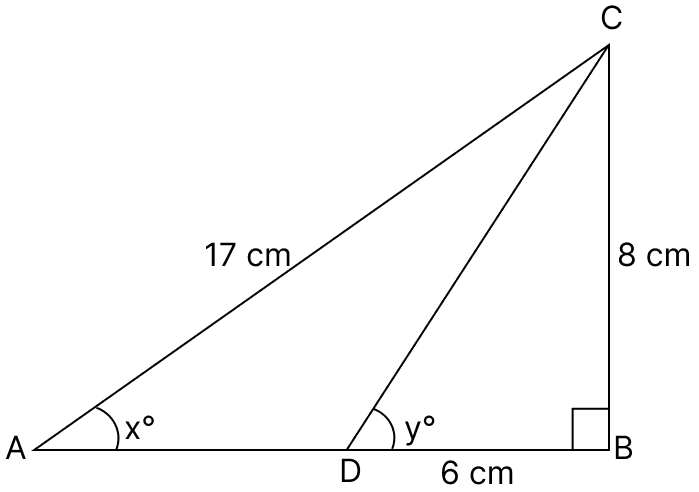
Use the adjoining figure and write the values of :
(i) sin x°
(ii) cos y°
(iii) 3 tan x° - 2 sin y° + 4 cos y°
Answer
In right angled triangle DBC,
Perpendicular = BC = 8 cm
Base = DB = 6 cm
Then we will find hypotenuse (CD) by pythagoras theorem,
Hypotenuse2 = Base2 + Perpendicular2
Hypotenuse2 = 62 + 82
Hypotenuse2 = 36 + 64
Hypotenuse2 = 100
Hypotenuse = 10 cm
In right angled triangle ABC,
Perpendicular = CB = 8 cm
Hypotenuse = AC = 17 cm
Let AD = m
Base (AB) = AD + DB = m + DB
By pythagoras theorem,
Base2 = Hypotenuse2 - Perpendicular2
(m + 6)2 = 172 - 82
m2 + 36 + 12m = 289 - 64
m2 + 36 + 12m = 225
m2 + 12m + 36 - 225 = 0
m2 + 12m - 189 = 0
m2 + 21m - 9m - 189 =0
m(m + 21) - 9(m + 21) = 0
(m + 21)(m - 9) = 0
m = -21 or m = 9
Sicne, length can't be negative.
so, m = 9 cm
AB = m + 6 = 9 + 6 = 15 cm
(i) sin x° = perpendicular hypotenuse = B C A C = 8 17 \dfrac{\text{perpendicular}}{\text{hypotenuse}} = \dfrac{BC}{AC} = \dfrac{8}{17} hypotenuse perpendicular = A C BC = 17 8 .
(ii) cos y° = base hypotenuse = D B D C = 6 10 = 3 5 \dfrac{\text{base}}{\text{hypotenuse}}= \dfrac{DB}{DC} = \dfrac{6}{10} = \dfrac{3}{5} hypotenuse base = D C D B = 10 6 = 5 3 .
(iii) 3 tan x° - 2 sin y° + 4 cos y°
tan x° = perpendicular base = B C A B = 8 15 \dfrac{\text{perpendicular}}{\text{base}} = \dfrac{BC}{AB} = \dfrac{8}{15} base perpendicular = A B BC = 15 8
sin y° = perpendicular hypotenuse = B C D C = 8 10 = 4 5 \dfrac{\text{perpendicular}}{\text{hypotenuse}}= \dfrac{BC}{DC} = \dfrac{8}{10} = \dfrac{4}{5} hypotenuse perpendicular = D C BC = 10 8 = 5 4
Putting values of tan x°, sin y°, cos y° in 3 tan x° - 2 sin y° + 4 cos y°
= 3 × 8 15 − 2 × 4 5 + 4 × 3 5 3\times\dfrac{8}{15} - 2\times\dfrac{4}{5} + 4\times\dfrac{3}{5} 3 × 15 8 − 2 × 5 4 + 4 × 5 3
= 8 5 − 8 5 + 12 5 \dfrac{8}{5} - \dfrac{8}{5} + \dfrac{12}{5} 5 8 − 5 8 + 5 12
= 12 5 = 2 2 5 \dfrac{12}{5} = 2\dfrac{2}{5} 5 12 = 2 5 2 .
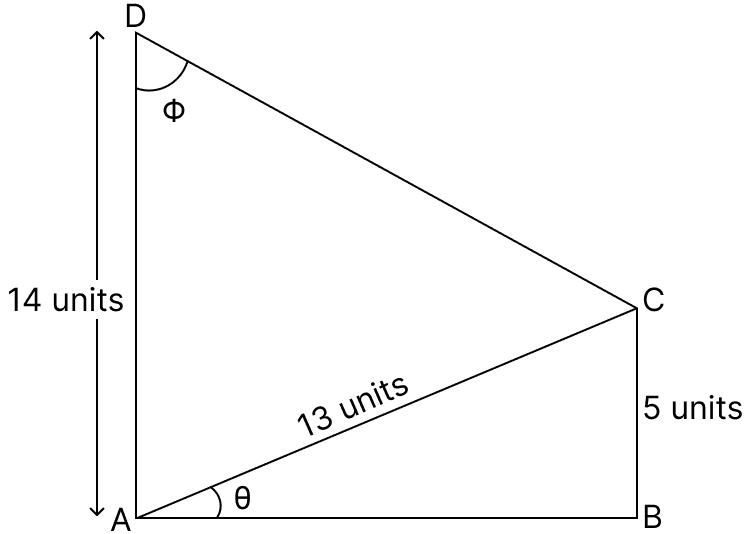
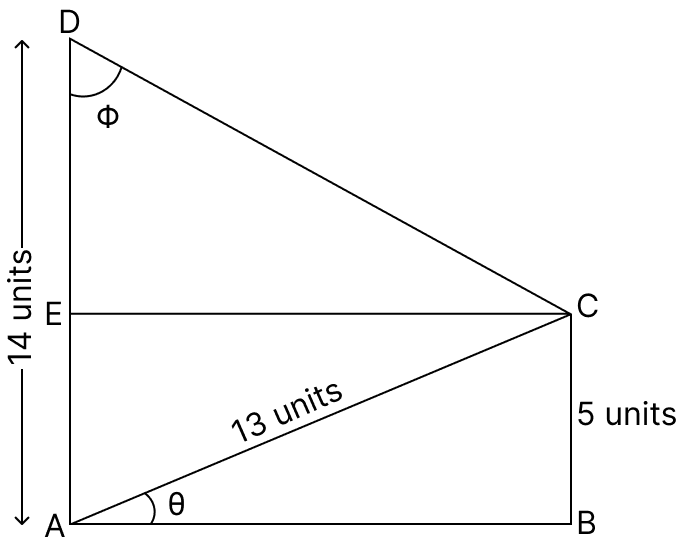
Using the adjoining figure, calculate the values of :
(i) cos θ
(ii) tan Φ
(iii) cosec Φ
Answer
In right angled triangle ABC,
Hypotenuse = AC = 13 units
Perpendicular = BC = 5 units
By pythagoras theorem,
Base2 = Hypotenuse2 - Perpendicular2
Base2 = 132 - 52
Base2 = 169 - 25
Base2 = 144
Base = 12 units
AB = 12 units.
Draw a perpendicular CE on AD.
In triangle CED,
CE = AB = 12 units and AE = BC = 5 units
From figure,
AD = DE + AE
DE = AD - AE = 14 - 5 = 9 units
In Triangle CED,
By pythagoras theorem,
CD2 = CE2 + ED2
CD2 = 122 + 92
CD2 = 144 + 81
CD2 = 225
CD = 225 \sqrt{225} 225 = 15 units.
(i) cos θ = base hypotenuse = A B A C = 12 13 \dfrac{\text{base}}{\text{hypotenuse}}= \dfrac{AB}{AC} = \dfrac{12}{13} hypotenuse base = A C A B = 13 12 .
(ii) tan Φ = perpendicular base = C E D E = 12 9 = 4 3 \dfrac{\text{perpendicular}}{\text{base}}= \dfrac{CE}{DE} = \dfrac{12}{9} = \dfrac{4}{3} base perpendicular = D E CE = 9 12 = 3 4 .
(iii) cosec Φ = hypotenuse perpendicular = C D C E = 15 12 = 5 4 \dfrac{\text{hypotenuse}}{\text{perpendicular}} = \dfrac{CD}{CE} = \dfrac{15}{12} = \dfrac{5}{4} perpendicular hypotenuse = CE C D = 12 15 = 4 5 .
If (tan θ + cot θ) = 5, find the value of (tan2 θ + cot2 θ).
Answer
As, (tan θ + cot θ) = 5
Squaring both sides, we get :
⇒ (tan θ + cot θ)2 = 52
⇒ tan2 θ + cot2 θ + 2 tan θ cot θ = 25
⇒ tan2 θ + cot2 θ + 2 tan θ × 1 tan θ 2\tan \theta \times \dfrac{1}{\tan \theta} 2 tan θ × tan θ 1 = 25
⇒ tan2 θ + cot2 θ + 2 = 25
⇒ tan2 θ + cot2 θ = 25 - 2
⇒ tan2 θ + cot2 θ = 23.
Hence, tan2 θ + cot2 θ = 23.
If (cos θ + sec θ ) = 5 2 \dfrac{5}{2} 2 5 , find the value of (cos2 θ + sec2 θ).
Answer
Given,
(cos θ + sec θ ) = 5 2 \dfrac{5}{2} 2 5
Squaring both sides,
cos2 θ + sec2 θ + 2cos θ sec θ = 25 4 \dfrac{25}{4} 4 25
As we know cos θ = 1 sec θ \dfrac{1}{\sec θ } sec θ 1
cos2 θ + sec2 θ + 2 = 25 4 \dfrac{25}{4} 4 25
⇒ cos 2 θ + sec 2 θ = 25 4 − 2 \Rightarrow \cos^2θ + \sec^2θ = \dfrac{25}{4} - 2 ⇒ cos 2 θ + sec 2 θ = 4 25 − 2
⇒ 25 − 8 4 = 17 4 \Rightarrow \dfrac{25 - 8}{4} = \dfrac{17}{4} ⇒ 4 25 − 8 = 4 17
Hence, cos2 θ + sec2 θ = 17 4 \dfrac{17}{4} 4 17 .
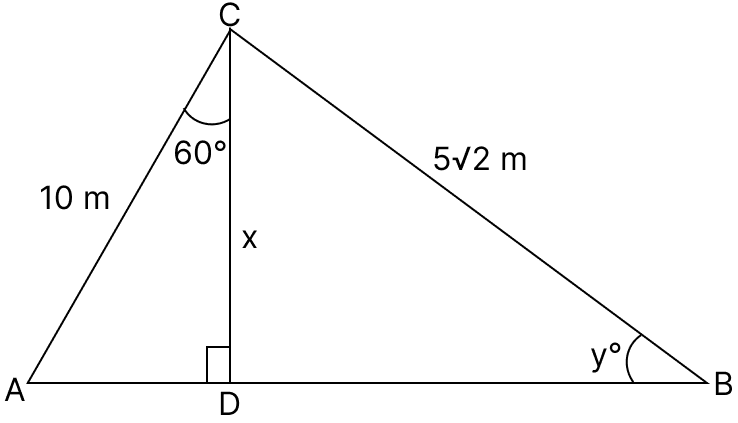
Evaluate x and y from the given figure.
Answer
In the given figure there are two right angled triangles, △ADC and △BDC.
In △ADC,
∠ACD = 60° and AC = 10 m, CD = x m
cos 60° = base hypotenuse \dfrac{\text{base}}{\text{hypotenuse}} hypotenuse base
1 2 = C D A C \dfrac{1}{2} = \dfrac{CD}{AC} 2 1 = A C C D
1 2 = x 10 \dfrac{1}{2} = \dfrac{x}{10} 2 1 = 10 x
x = 5 m.
In △BDC,
BC = 5 2 5\sqrt{2} 5 2 m
CD = x = 5 m
sin y° = perpendicular hypotenuse = D C B C = 5 5 2 = 1 2 \dfrac{\text{perpendicular}}{\text{hypotenuse}}= \dfrac{DC}{BC} = \dfrac{5}{5\sqrt{2}} = \dfrac{1}{\sqrt{2}} hypotenuse perpendicular = BC D C = 5 2 5 = 2 1
sin y° = 1 2 \dfrac{1}{\sqrt{2}} 2 1
sin y° = sin 45°
y° = 45°.
Hence, x = 5 m and y° = 45°.
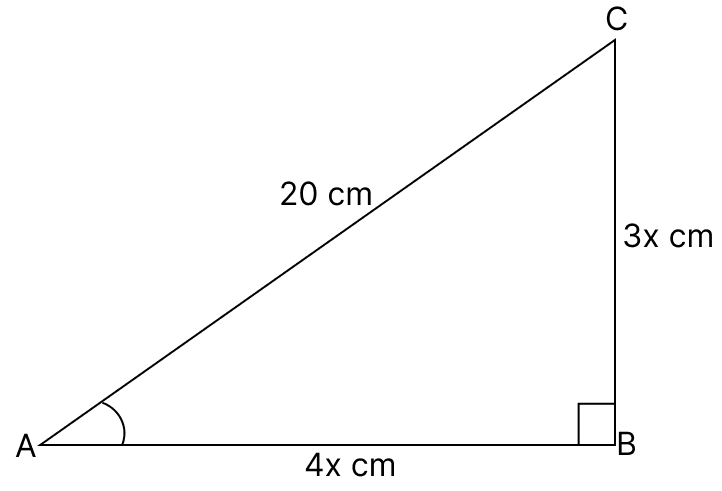
In the given figure, △ABC is right angled at B.
If AC = 20 cm and tan A = 3 4 \dfrac{3}{4} 4 3 , find the lengths of AB and BC.
Answer
tan A = perpendicular base = B C A B \dfrac{\text{perpendicular}}{\text{base}} = \dfrac{BC}{AB} base perpendicular = A B BC
Given,
tan A = 3 4 \dfrac{3}{4} 4 3
Let BC = 3x and AB = 4x.
Now by pythagoras theorem
AC2 = BC2 + AB2
(20)2 = (3x)2 + (4x)2
400 = 9x2 + 16x2
25x2 = 400
x2 = 16
x = 16 \sqrt{16} 16 = 4
AB = 4x = 16 cm and BC = 3x = 12 cm.
Hence, length of AB = 16 cm and BC = 12 cm.
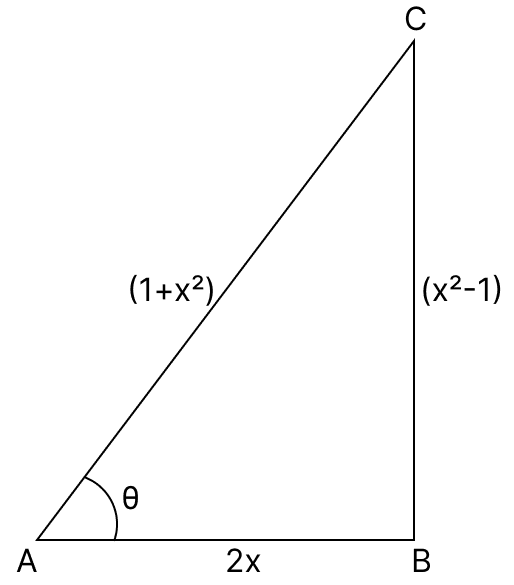
If cos θ = 2 x 1 + x 2 \dfrac{2x}{1 + x^2} 1 + x 2 2 x , find the values of sin θ and tan θ in terms of x.
Answer
cos θ = base hypotenuse = 2 x 1 + x 2 \dfrac{\text{base}}{\text{hypotenuse}} = \dfrac{2x}{1 + x^2} hypotenuse base = 1 + x 2 2 x
Let base = 2x and hypotenuse = 1 + x2
Now we will find perpendicular by using pythagoras theorem
Perpendicular2 = Hypotenuse2 - Base2
Perpendicular2 = (1 + x2 )2 - (2x)2
Perpendicular2 = 1 + x4 + 2x2 - 4x2
Perpendicular2 = 1 + x4 - 2x2
Perpendicular2 = (x2 - 1)2
Perpendicular = (x2 - 1)
Now,
sin θ = perpendicular hypotenuse = x 2 − 1 1 + x 2 \dfrac{\text{perpendicular}}{\text{hypotenuse}} = \dfrac{x^2 - 1}{1 + x^2} hypotenuse perpendicular = 1 + x 2 x 2 − 1
tan θ = perpendicular base = x 2 − 1 2 x \dfrac{\text{perpendicular}}{\text {base}} = \dfrac{x^2 - 1}{2x} base perpendicular = 2 x x 2 − 1
Without using trigonometric table, find the values of:
(i) sin 60° cos 30° + cos 60° sin 30°
(ii) sin 45° cos 30° - cos 45° sin 30°
(iii) cos 60° cos 45° + sin 60° sin 45°
(iv) cos 90° + cos2 45° sin 30° tan 45°
Answer
(i) sin 60° cos 30° + cos 60° sin 30°
= 3 2 × 3 2 + 1 2 × 1 2 \dfrac{\sqrt{3}}{2}\times\dfrac{\sqrt{3}}{2} + \dfrac{1}{2}\times\dfrac{1}{2} 2 3 × 2 3 + 2 1 × 2 1
= 3 4 + 1 4 \dfrac{3}{4} + \dfrac{1}{4} 4 3 + 4 1
= 3 + 1 4 = 4 4 \dfrac{3+1}{4} = \dfrac{4}{4} 4 3 + 1 = 4 4
= 1.
Hence, sin 60° cos 30° + cos 60° sin 30° = 1.
(ii) sin 45° cos 30° - cos 45° sin 30°
= 1 2 × 3 2 − 1 2 × 1 2 \dfrac{1}{\sqrt{2}}\times\dfrac{\sqrt{3}}{2} - \dfrac{1}{\sqrt{2}} \times\dfrac{1}{2} 2 1 × 2 3 − 2 1 × 2 1
= 3 2 2 − 1 2 2 \dfrac{\sqrt{3}}{2\sqrt{2}} - \dfrac{1}{2\sqrt{2}} 2 2 3 − 2 2 1
= 3 − 1 2 2 \dfrac{\sqrt{3}-1}{2\sqrt{2}} 2 2 3 − 1 .
Hence, sin 45° cos 30° - cos 45° sin 30° = 3 − 1 2 2 \dfrac{\sqrt{3}-1}{2\sqrt{2}} 2 2 3 − 1 .
(iii) cos 60° cos 45° + sin 60° sin 45°
= 1 2 × 1 2 + 3 2 × 1 2 \dfrac{1}{2}\times\dfrac{1}{\sqrt{2}} + \dfrac{\sqrt{3}}{2}\times\dfrac{1}{\sqrt2} 2 1 × 2 1 + 2 3 × 2 1
= 1 2 2 + 3 2 2 \dfrac{1}{2\sqrt{2}} + \dfrac{\sqrt{3}}{2\sqrt{2}} 2 2 1 + 2 2 3
= 1 + 3 2 2 \dfrac{1 + \sqrt{3}}{2\sqrt{2}} 2 2 1 + 3 .
Hence, cos 60° cos 45° + sin 60° sin 45° = 1 + 3 2 2 \dfrac{1 + \sqrt{3}}{2\sqrt{2}} 2 2 1 + 3 .
(iv) cos 90° + cos2 45° sin 30° tan 45°
As, cos2 45° = (cos 45°)2 = ( 1 2 ) 2 = 1 2 \Big(\dfrac{1}{\sqrt{2}}\Big)^2 = \dfrac{1}{2} ( 2 1 ) 2 = 2 1
Therefore,
cos 90° + cos2 45° sin 30° tan 45°
= 0 + 1 2 × 1 2 × 1 \dfrac{1}{2}\times\dfrac{1}{2}\times1 2 1 × 2 1 × 1
= 1 4 \dfrac{1}{4} 4 1 .
Hence, cos 90° + cos2 45° sin 30° tan 45° = 1 4 \dfrac{1}{4} 4 1 .
Without using trigonometric tables, find the values of;
(i) (3sin2 45° + 2cos2 60°)
(ii) (3cos2 30° + tan2 60°)
(iii) (cos 0° + sin 45° + sin 30°)(sin 90° - cos 45° + cos 60°)
(iv) 2 2 \sqrt{2} 2 cos 45°cos 60° + 2 3 \sqrt{3} 3 sin 30° tan 60° - cos 0°
(v) 4 3 \dfrac{4}{3} 3 4 tan2 30°+ sin2 60° - 3 cos2 60°+ 3 4 \dfrac{3}{4} 4 3 tan2 60°- 2 tan2 45°
(vi) sin 2 45 ∘ + cos 2 45 ∘ tan 2 60 ∘ \dfrac{\sin^2 45^\circ + \cos^2 45^\circ}{\tan^2 60^\circ} tan 2 6 0 ∘ sin 2 4 5 ∘ + cos 2 4 5 ∘
Answer
(i) As,
sin2 45° = (sin 45°)2 = ( 1 2 ) 2 = 1 2 \Big(\dfrac{1}{\sqrt{2}}\Big)^2 = \dfrac{1}{2} ( 2 1 ) 2 = 2 1
and
cos2 60° = (cos 60°)2 = ( 1 2 ) 2 = 1 4 \Big(\dfrac{1}{2}\Big)^2 = \dfrac{1}{4} ( 2 1 ) 2 = 4 1
Substituting values we get :
(3sin2 45° + 2cos2 60°)
= 3 × 1 2 + 2 × 1 4 3\times\dfrac{1}{2} + 2\times\dfrac{1}{4} 3 × 2 1 + 2 × 4 1
= 3 2 + 2 4 = 3 2 + 1 2 \dfrac{3}{2} + \dfrac{2}{4} = \dfrac{3}{2} + \dfrac{1}{2} 2 3 + 4 2 = 2 3 + 2 1
= 3 + 1 2 = 4 2 \dfrac{3+1}{2} = \dfrac{4}{2} 2 3 + 1 = 2 4 = 2.
Hence, 3 sin2 45° + 2 cos2 60° = 2.
(ii) As,
cos2 30° = (cos 30°)2 = ( 3 2 ) 2 = 3 4 \Big(\dfrac{\sqrt{3}}{2}\Big)^2 = \dfrac{3}{4} ( 2 3 ) 2 = 4 3
and
tan2 60° = (tan 60°)2 = ( 3 ) 2 (\sqrt{3})^2 ( 3 ) 2 = 3
Therefore,
3cos2 30° + tan2 60°
= 3 × 3 4 3\times \dfrac{3}{4} 3 × 4 3 + 3
= 9 4 \dfrac{9}{4} 4 9 + 3
= 9 + 12 4 = 21 4 = 5 1 4 \dfrac{9 + 12}{4} = \dfrac{21}{4} = 5\dfrac{1}{4} 4 9 + 12 = 4 21 = 5 4 1 .
Hence, 3cos2 30° + tan2 60° = 5 1 4 5\dfrac{1}{4} 5 4 1 .
(iii) (cos 0° + sin 45° + sin 30°)(sin 90° - cos 45° + cos 60°)
= ( 1 + 1 2 + 1 2 ) ( 1 − 1 2 + 1 2 ) = ( 2 2 + 2 + 2 2 2 ) ( 2 2 − 2 + 2 2 2 ) = ( 3 2 + 2 2 2 ) ( 3 2 − 2 2 2 ) = ( ( 3 2 ) 2 − ( 2 ) 2 2 2 × 2 2 ) = ( 18 − 4 8 ) = 14 8 = 7 4 = 1 3 4 . = \Big( 1 + \dfrac{1}{\sqrt{2}} + \dfrac{1}{2} \Big)\Big(1 - \dfrac{1}{\sqrt{2}} + \dfrac{1}{2}\Big)\\[1em] = \Big(\dfrac{2\sqrt{2}+ 2 + \sqrt{2}}{2\sqrt{2}}\Big)(\dfrac{2\sqrt{2} - 2 + \sqrt{2}}{2\sqrt{2}}\Big)\\[1em] = \Big(\dfrac{3\sqrt{2}+ 2}{2\sqrt{2}}\Big)\Big(\dfrac{3\sqrt{2}- 2}{2\sqrt{2}}\Big)\\[1em] = \Big(\dfrac{(3\sqrt{2})^2- (2)^2 }{2\sqrt{2}\times {2\sqrt{2}}}\Big)\\[1em] = \Big(\dfrac{18-4}{8}\Big) \\[1em] = \dfrac{14}{8} \\[1em] = \dfrac{7}{4} \\[1em] = 1\dfrac{3}{4}. = ( 1 + 2 1 + 2 1 ) ( 1 − 2 1 + 2 1 ) = ( 2 2 2 2 + 2 + 2 ) ( 2 2 2 2 − 2 + 2 ) = ( 2 2 3 2 + 2 ) ( 2 2 3 2 − 2 ) = ( 2 2 × 2 2 ( 3 2 ) 2 − ( 2 ) 2 ) = ( 8 18 − 4 ) = 8 14 = 4 7 = 1 4 3 .
Hence, (cos 0° + sin 45° + sin 30°)(sin 90° - cos 45° + cos 60°) = 1 3 4 1\dfrac{3}{4} 1 4 3 .
(iv) 2 2 2\sqrt{2} 2 2 cos 45°cos 60° + 2 3 \sqrt{3} 3 sin 30° tan 60° - cos 0°
= 2 2 × 1 2 × 1 2 + 2 3 × 1 2 × 3 − 1 \sqrt{2}\times\dfrac{1}{\sqrt{2}}\times\dfrac{1}{2} + 2\sqrt{3}\times\dfrac{1}{2}\times\sqrt{3} - 1 2 × 2 1 × 2 1 + 2 3 × 2 1 × 3 − 1
= 1 + 3 - 1
= 3.
Hence, 2 2 \sqrt{2} 2 cos 45°cos 60° + 2 3 \sqrt{3} 3 sin 30° tan 60° - cos 0° = 3.
(v) As,
cos2 60° = (cos 60°)2 = ( 1 2 ) 2 = 1 4 \Big(\dfrac{1}{2}\Big)^2 = \dfrac{1}{4} ( 2 1 ) 2 = 4 1
and
tan2 30° = (tan 30°)2 = ( 1 3 ) 2 = 1 3 \Big(\dfrac{1}{\sqrt{3}}\Big)^2 = \dfrac{1}{3} ( 3 1 ) 2 = 3 1
tan2 45° = (tan 45°)2 = 1
tan2 60° = (tan 60°)2 = (3 \sqrt{3} 3 )2 = 3
sin2 60° = (sin 60°)2 = ( 3 2 ) 2 = 3 4 \Big(\dfrac{\sqrt{3}}{2}\Big)^2 = \dfrac{3}{4} ( 2 3 ) 2 = 4 3
Therefore,
4 3 \dfrac{4}{3} 3 4 tan2 30°+ sin2 60° - 3 cos2 60°+ 3 4 \dfrac{3}{4} 4 3 tan2 60°- 2 tan2 45°
4 3 × 1 3 + 3 4 − 3 × 1 4 + 3 4 × 3 − 2 × 1 = 4 9 + 3 4 − 3 4 + 9 4 − 2 = 4 9 + 9 4 − 2 = 16 + 81 − 72 36 = 25 36 . \dfrac{4}{3}\times\dfrac{1}{3}+ \dfrac{3}{4} - 3 \times\dfrac{1}{4} + \dfrac{3}{4}\times 3- 2 \times 1 \\[1em] = \dfrac{4}{9}+ \dfrac{3}{4} -\dfrac{3}{4} + \dfrac{9}{4}- 2 \\[1em] = \dfrac{4}{9} + \dfrac{9}{4} - 2 \\[1em] = \dfrac{16 + 81 - 72}{36}\\[1em] = \dfrac{25}{36}. 3 4 × 3 1 + 4 3 − 3 × 4 1 + 4 3 × 3 − 2 × 1 = 9 4 + 4 3 − 4 3 + 4 9 − 2 = 9 4 + 4 9 − 2 = 36 16 + 81 − 72 = 36 25 .
Hence, 4 3 \dfrac{4}{3} 3 4 tan2 30°+ sin2 60° - 3 cos2 60°+ 3 4 \dfrac{3}{4} 4 3 tan2 60°- 2 tan2 45° = 25 36 \dfrac{25}{36} 36 25 .
(vi) As,
cos2 45° = (cos 45°)2 = ( 1 2 ) 2 = 1 2 \Big(\dfrac{1}{\sqrt{2}}\Big)^2 = \dfrac{1}{2} ( 2 1 ) 2 = 2 1
sin2 45° = (sin 45°)2 = ( 1 2 ) 2 = 1 2 \Big(\dfrac{1}{\sqrt{2}}\Big)^2 = \dfrac{1}{2} ( 2 1 ) 2 = 2 1
tan2 60° = (tan 60°)2 = (3 \sqrt{3} 3 )2 = 3
Therefore,
sin 2 45 ∘ + cos 2 45 ∘ tan 2 60 ∘ \dfrac{\sin^2 45^\circ + \cos^2 45^\circ}{\tan^2 60^\circ} tan 2 6 0 ∘ sin 2 4 5 ∘ + cos 2 4 5 ∘
= 1 2 + 1 2 3 \dfrac{\dfrac{1}{2}+\dfrac{1}{2}}{3} 3 2 1 + 2 1
= 1 3 \dfrac{1}{3} 3 1
Hence, sin 2 45 ∘ + cos 2 45 ∘ tan 2 60 ∘ = 1 3 \dfrac{\sin^2 45^\circ + \cos^2 45^\circ}{\tan^2 60^\circ} = \dfrac{1}{3} tan 2 6 0 ∘ sin 2 4 5 ∘ + cos 2 4 5 ∘ = 3 1 .
Without using trigonometric tables, find the values of;
(i) sin 30 ∘ − sin 90 ∘ + 2 × cos 0 ∘ tan 30 ∘ × tan 60 ∘ \dfrac{\sin 30^\circ - \sin 90^\circ +2\times \cos 0^\circ}{\tan 30^\circ \times \tan 60^\circ} tan 3 0 ∘ × tan 6 0 ∘ sin 3 0 ∘ − sin 9 0 ∘ + 2 × cos 0 ∘
(ii) 5 sin 2 30 ∘ + cos 2 45 ∘ − 4 tan 2 30 ∘ 2 sin 30 ∘ cos 30 ∘ + tan 45 ∘ \dfrac{5 \sin^2 30^\circ + \cos^2 45^\circ- 4 \tan^2 30^\circ}{2 \sin 30^\circ \cos 30^\circ+ \tan 45^\circ} 2 sin 3 0 ∘ cos 3 0 ∘ + tan 4 5 ∘ 5 sin 2 3 0 ∘ + cos 2 4 5 ∘ − 4 tan 2 3 0 ∘
(iii) tan 2 60 ∘ + 4 cos 2 45 ∘ + sec 2 30 ∘ + 5 cos 2 90 ∘ cosec 30 ∘ + sec 60 ∘ − cot 2 30 ∘ \dfrac{\tan^2 60^\circ + 4 \cos^2 45^\circ + \sec^2 30^\circ + 5 \cos^2 90^\circ}{\cosec 30^\circ + \sec 60^\circ - \cot^2 30^\circ} cosec 3 0 ∘ + sec 6 0 ∘ − cot 2 3 0 ∘ tan 2 6 0 ∘ + 4 cos 2 4 5 ∘ + sec 2 3 0 ∘ + 5 cos 2 9 0 ∘
(iv) 4(sin4 30° + cos4 60°) - 3 (cos2 45° - sin2 90°)
Answer
(i) Solving,
sin 30 ∘ − sin 90 ∘ + 2 × cos 0 ∘ tan 30 ∘ × tan 60 ∘ = 1 2 − 1 + 2 × 1 1 3 × 3 = 1 2 − 1 + 2 1 3 × 3 = 1 2 + 1 1 = 3 2 . \dfrac{\sin 30^\circ - \sin 90^\circ +2\times \cos 0^\circ}{\tan 30^\circ \times \tan 60^\circ}\\[1em] = \dfrac{\dfrac{1}{2} - 1 +2\times1}{\dfrac{1}{\sqrt{3}}\times {\sqrt{3}}}\\[1em] = \dfrac{\dfrac{1}{2} - 1 + 2}{\dfrac{1}{\sqrt{3}}\times {\sqrt{3}}}\\[1em] = \dfrac{\dfrac{1}{2} + 1}{1}\\[1em] = \dfrac{3}{2}. tan 3 0 ∘ × tan 6 0 ∘ sin 3 0 ∘ − sin 9 0 ∘ + 2 × cos 0 ∘ = 3 1 × 3 2 1 − 1 + 2 × 1 = 3 1 × 3 2 1 − 1 + 2 = 1 2 1 + 1 = 2 3 .
Hence, the required value = 3 2 \dfrac{3}{2} 2 3 .
(ii) As,
sin2 30° = (sin 30°)2 = ( 1 2 ) 2 = 1 4 \Big(\dfrac{1}{2}\Big)^2 = \dfrac{1}{4} ( 2 1 ) 2 = 4 1
cos2 45° = (cos 45°)2 = ( 1 2 ) 2 = 1 2 \Big(\dfrac{1}{\sqrt{2}}\Big)^2 = \dfrac{1}{2} ( 2 1 ) 2 = 2 1
tan2 30° = (tan 30°)2 = ( 1 3 ) 2 = 1 3 \Big(\dfrac{1}{\sqrt{3}}\Big)^2 = \dfrac{1}{3} ( 3 1 ) 2 = 3 1
Therefore,
5 sin 2 30 ∘ + cos 2 45 ∘ − 4 tan 2 30 ∘ 2 sin 30 ∘ cos 30 ∘ + tan 45 ∘ = 5 × 1 4 + 1 2 − 4 × 1 3 2 × 1 2 × 3 2 + 1 = 5 4 + 1 2 − 4 3 3 2 + 1 = 15 + 6 − 16 12 3 2 + 1 = 5 12 3 + 2 2 = 5 6 ( 2 + 3 ) . \dfrac{5 \sin^2 30^\circ + \cos^2 45^\circ- 4 \tan^2 30^\circ}{2 \sin 30^\circ \cos 30^\circ+ \tan 45^\circ}\\[1em] =\dfrac{5\times\dfrac{1}{4} + \dfrac{1}{2} - 4\times\dfrac{1}{3}}{2\times\dfrac{1}{2} \times\dfrac{\sqrt{3}}{2}+ 1 }\\[1em] = \dfrac{\dfrac{5}{4} + \dfrac{1}{2} -\dfrac{4}{3}}{\dfrac{\sqrt{3}}{2}+1}\\[1em] = \dfrac{\dfrac{15 + 6 - 16}{12}}{\dfrac{\sqrt{3}}{2}+1}\\[1em] = \dfrac{\dfrac{5}{12}}{\dfrac{\sqrt{3} + 2}{2}} \\[1em] = \dfrac{5}{6(2 + \sqrt{3})}. 2 sin 3 0 ∘ cos 3 0 ∘ + tan 4 5 ∘ 5 sin 2 3 0 ∘ + cos 2 4 5 ∘ − 4 tan 2 3 0 ∘ = 2 × 2 1 × 2 3 + 1 5 × 4 1 + 2 1 − 4 × 3 1 = 2 3 + 1 4 5 + 2 1 − 3 4 = 2 3 + 1 12 15 + 6 − 16 = 2 3 + 2 12 5 = 6 ( 2 + 3 ) 5 .
Hence, 5 sin 2 30 ∘ + cos 2 45 ∘ − 4 tan 2 30 ∘ 2 sin 30 ∘ cos 30 ∘ + tan 45 ∘ = 5 6 ( 2 + 3 ) \dfrac{5 \sin^2 30^\circ + \cos^2 45^\circ- 4 \tan^2 30^\circ}{2 \sin 30^\circ \cos 30^\circ+ \tan 45^\circ} = \dfrac{5}{6(2 + \sqrt{3})} 2 sin 3 0 ∘ cos 3 0 ∘ + tan 4 5 ∘ 5 sin 2 3 0 ∘ + cos 2 4 5 ∘ − 4 tan 2 3 0 ∘ = 6 ( 2 + 3 ) 5 .
(iii) As,
tan2 60° = (tan 60°)2 = (3 \sqrt{3} 3 )2 = 3
cos2 45° = (cos 45°)2 = ( 1 2 ) 2 = 1 2 \Big(\dfrac{1}{\sqrt{2}}\Big)^2 = \dfrac{1}{2} ( 2 1 ) 2 = 2 1
sec2 30° = (sec 30°)2 = ( 2 3 ) 2 = 4 3 \Big(\dfrac{2}{\sqrt{3}}\Big)^2 = \dfrac{4}{3} ( 3 2 ) 2 = 3 4
cos2 90° = (cos 90°)2 = 0
cot2 30° = (cot 30°)2 = (3 \sqrt{3} 3 )2 = 3
Therefore,
tan 2 60 ∘ + 4 cos 2 45 ∘ + sec 2 30 ∘ + 5 cos 2 90 ∘ cosec 30 ∘ + sec 60 ∘ − cot 2 30 ∘ = 3 + 4 × 1 2 + 4 3 + 0 2 + 2 − 3 = 3 + 2 + 4 3 + 0 1 = 5 + 4 3 = 19 3 = 6 1 3 . \dfrac{\tan^2 60^\circ + 4 \cos^2 45^\circ + \sec^2 30^\circ + 5 \cos^2 90^\circ}{\cosec 30^\circ + \sec 60^\circ - \cot^2 30^\circ}\\[1em] = \dfrac{3 + 4\times\dfrac{1}{2} + \dfrac{4}{3} + 0}{2 + 2 - 3}\\[1em] = \dfrac{3 + 2 + \dfrac{4}{3} + 0}{1}\\[1em] = 5+ \dfrac{4}{3}\\[1em] = \dfrac{19}{3} \\[1em] = 6\dfrac{1}{3}. cosec 3 0 ∘ + sec 6 0 ∘ − cot 2 3 0 ∘ tan 2 6 0 ∘ + 4 cos 2 4 5 ∘ + sec 2 3 0 ∘ + 5 cos 2 9 0 ∘ = 2 + 2 − 3 3 + 4 × 2 1 + 3 4 + 0 = 1 3 + 2 + 3 4 + 0 = 5 + 3 4 = 3 19 = 6 3 1 .
Hence, tan 2 60 ∘ + 4 cos 2 45 ∘ + sec 2 30 ∘ + 5 cos 2 90 ∘ cosec 30 ∘ + sec 60 ∘ − cot 2 30 ∘ = 19 3 \dfrac{\tan^2 60^\circ + 4 \cos^2 45^\circ + \sec^2 30^\circ + 5 \cos^2 90^\circ}{\cosec 30^\circ + \sec 60^\circ - \cot^2 30^\circ} = \dfrac{19}{3} cosec 3 0 ∘ + sec 6 0 ∘ − cot 2 3 0 ∘ tan 2 6 0 ∘ + 4 cos 2 4 5 ∘ + sec 2 3 0 ∘ + 5 cos 2 9 0 ∘ = 3 19
(iv) As,
sin4 30° = (sin 30°)4 = ( 1 2 ) 4 = 1 16 \Big(\dfrac{1}{2}\Big)^4 = \dfrac{1}{16} ( 2 1 ) 4 = 16 1
cos4 60° = (cos 60°)4 = ( 1 2 ) 4 = 1 16 \Big(\dfrac{1}{2}\Big)^4 = \dfrac{1}{16} ( 2 1 ) 4 = 16 1
cos2 45° = (cos 45°)2 = ( 1 2 ) 2 = 1 2 \Big(\dfrac{1}{\sqrt{2}}\Big)^2 = \dfrac{1}{2} ( 2 1 ) 2 = 2 1
sin2 90° = (sin 90°)2 = 1
Therefore,
4 (sin4 30° + cos4 60°) - 3 (cos2 45° - sin2 90°)
= 4 ( 1 16 + 1 16 ) − 3 ( 1 2 − 1 ) 4\Big(\dfrac{1}{16} + \dfrac{1}{16}\Big) - 3 \Big(\dfrac{1}{2} - 1\Big) 4 ( 16 1 + 16 1 ) − 3 ( 2 1 − 1 )
= 4 ( 2 16 ) − 3 ( − 1 2 ) 4\Big(\dfrac{2}{16}\Big) - 3 \Big(\dfrac{-1}{2}\Big) 4 ( 16 2 ) − 3 ( 2 − 1 )
= 1 2 + 3 2 \dfrac{1}{2} + \dfrac{3}{2} 2 1 + 2 3
= 2.
Hence, 4 (sin4 30° + cos4 60°) - 3 (cos2 45° - sin2 90°) = 2.
Verify each of the following :
(i) cos 60° cos 30° - sin 60° sin 30° = 0
(ii) cos 60° = (1 - 2 sin2 30°) = (2 cos2 30° - 1)
(iii) tan 30° = ( tan 60 ∘ − tan 30 ∘ 1 + tan 60 ∘ tan 30 ∘ ) \Big(\dfrac{\tan 60^\circ - \tan 30^\circ}{1 + \tan 60^\circ \tan 30^\circ}\Big) ( 1 + tan 6 0 ∘ tan 3 0 ∘ tan 6 0 ∘ − tan 3 0 ∘ )
Answer
(i) cos 60° cos 30° - sin 60° sin 30°
= 1 2 × 3 2 − 3 2 × 1 2 \dfrac{1}{2}\times \dfrac{\sqrt{3}}{2} - \dfrac{\sqrt{3}}{2}\times\dfrac{1}{2} 2 1 × 2 3 − 2 3 × 2 1
= 0.
Hence, proved that cos 60° cos 30° - sin 60° sin 30° = 0.
(ii) As,
sin2 30° = (sin 30°)2 = ( 1 2 ) 2 = 1 4 \Big(\dfrac{1}{2}\Big)^2= \dfrac{1}{4} ( 2 1 ) 2 = 4 1
cos2 30° = (cos 30°)2 = ( 3 2 ) 2 = 3 4 \Big(\dfrac{\sqrt{3}}{2}\Big)^2 = \dfrac{3}{4} ( 2 3 ) 2 = 4 3
Therefore
Left Hand Side :
cos 60° = 1 2 \dfrac{1}{2} 2 1
Right Hand Side :
(1 - 2 sin2 30°)
=1 - 2 × 1 4 = 1 2 \times \dfrac{1}{4} = \dfrac{1}{2} × 4 1 = 2 1
(2 cos2 30° - 1)
= 2 × 3 4 \times\dfrac{3}{4} × 4 3 - 1 = 1 2 \dfrac{1}{2} 2 1
Hence proved that cos 60° = (1 - 2 sin2 30°) = (2 cos2 30° - 1).
(iii) Left Hand Side :
tan 30° = 1 3 \dfrac{1}{\sqrt{3}} 3 1
Right Hand Side
( tan 60 ∘ − tan 30 ∘ 1 + tan 60 ∘ tan 30 ∘ ) = 3 − 1 3 1 + 3 × 1 3 = 3 − 1 3 1 + 1 = 2 3 2 = 1 3 . \Big(\dfrac{\tan 60^\circ - \tan 30^\circ}{1 + \tan 60^\circ \tan 30^\circ}\Big) = \dfrac{\sqrt{3} - \dfrac{1}{\sqrt{3}}}{1 + \sqrt{3}\times\dfrac{1}{\sqrt{3}}}\\[1em] =\dfrac{\dfrac{3-1}{\sqrt{3}}}{1 + 1}\\[1em] =\dfrac{\dfrac{2}{\sqrt{3}}}{2}\\[1em] = \dfrac{1}{\sqrt{3}}. ( 1 + tan 6 0 ∘ tan 3 0 ∘ tan 6 0 ∘ − tan 3 0 ∘ ) = 1 + 3 × 3 1 3 − 3 1 = 1 + 1 3 3 − 1 = 2 3 2 = 3 1 .
Hence proved that tan 30° = ( tan 60 ∘ − tan 30 ∘ 1 + tan 60 ∘ tan 30 ∘ ) \Big(\dfrac{\tan 60^\circ - \tan 30^\circ}{1 + \tan 60^\circ \tan 30^\circ}\Big) ( 1 + tan 6 0 ∘ tan 3 0 ∘ tan 6 0 ∘ − tan 3 0 ∘ )
Verify each of the following :
(i) sin 60° cos 30° - cos 60° sin 30° = sin 30°
(ii) 2 sin 30° cos 30° = sin 60°
(iii) 2 sin 45° cos 45° = sin 90°
Answer
(i) Left Hand Side :
sin 60° cos 30° - cos 60° sin 30°
= 3 2 × 3 2 − 1 2 × 1 2 \dfrac{\sqrt{3}}{2}\times \dfrac{\sqrt{3}}{2} -\dfrac{1}{2}\times \dfrac{1}{2} 2 3 × 2 3 − 2 1 × 2 1
= 3 4 − 1 4 = 2 4 \dfrac{3}{4} -\dfrac{1}{4} = \dfrac{2}{4} 4 3 − 4 1 = 4 2
= 1 2 \dfrac{1}{2} 2 1 .
Right Hand Side :
sin 30° = 1 2 \dfrac{1}{2} 2 1
Hence, proved that sin 60° cos 30° - cos 60° sin 30° = sin 30°.
(ii) Left Hand Side :
2 sin 30° cos 30°
= 2 × 1 2 × 3 2 2\times\dfrac{1}{2} \times \dfrac{\sqrt{3}}{2} 2 × 2 1 × 2 3
= 3 2 \dfrac{\sqrt{3}}{2} 2 3
Right Hand Side :
sin 60° = 3 2 \dfrac{\sqrt{3}}{2} 2 3
Hence, proved that 2 sin 30° cos 30° = sin 60°.
(iii) Left Hand Side :
2 sin 45° cos 45°
= 2 × 1 2 × 1 2 2\times\dfrac{1}{\sqrt2} \times \dfrac{1}{\sqrt2} 2 × 2 1 × 2 1
= 1
Right Hand Side :
sin 90° = 1
Hence, proved that 2 sin 45° cos 45° = sin 90°.
If A = 45°, verify that :
(i) sin 2A = 2 sin A cos A
(ii) cos 2A = (2 cos2 A - 1) = (1 - 2 sin2 A)
Answer
(i) L.H.S. :
sin 2A = sin 2(45°) = sin 90°
= 1
R.H.S. :
2 sin A cos A = 2 sin 45° cos 45°
= 2 × 1 2 × 1 2 2\times\dfrac{1}{\sqrt{2}}\times\dfrac{1}{\sqrt{2}} 2 × 2 1 × 2 1
= 1.
Hence, proved that sin 2A = 2 sin A cos A.
(ii) Substituting value of A = 45° in cos 2A, we get :
cos 2A = cos 2(45°)
= cos 90°
= 0.
Substituting value of A = 45° in 2 cos2 A - 1, we get :
⇒ 2 cos2 A - 1
= 2 cos2 45° - 1
= 2 (cos 45°)2 - 1
= 2 ( 1 2 ) 2 2\Big(\dfrac{1}{\sqrt{2}}\Big)^2 2 ( 2 1 ) 2 - 1
= 2 × 1 2 − 1 2 \times \dfrac{1}{2} - 1 2 × 2 1 − 1
= 1 - 1
= 0.
Substituting value of A = 45° in 1 - 2 sin2 A, we get :
⇒ 1 - 2 sin2 A
= 1 - 2 sin2 45°
= 1 - 2 (sin 45°)2
= 1 - 2 ( 1 2 ) 2 2\Big(\dfrac{1}{\sqrt{2}}\Big)^2 2 ( 2 1 ) 2
= 1 - 2 × 1 2 2 \times \dfrac{1}{2} 2 × 2 1
= 1 - 1
= 0.
Hence, proved that cos 2A = (2 cos2 A - 1) = (1 - 2 sin2 A).
If A = 30°, prove that :
(i) sin 2A = 2 tan A 1 + tan 2 A \dfrac{2 \tan A}{1 + \tan^2A} 1 + tan 2 A 2 tan A
(ii) cos 2A = ( 1 − tan 2 A 1 + tan 2 A ) \Big(\dfrac{1 - \tan^2A}{1 + \tan^2A}\Big) ( 1 + tan 2 A 1 − tan 2 A )
Answer
(i) Left Hand Side:
sin 2A = sin 2(30°) = sin 60°
= 3 2 \dfrac{\sqrt{3}}{2} 2 3
Right Hand Side:
2 tan A 1 + tan 2 A = 2 × 1 3 1 + 1 3 = 2 3 4 3 = 2 3 × 3 4 = 3 2 . \dfrac{2 \tan A}{1 + \tan^2A} = \dfrac{2\times \dfrac{1}{\sqrt{3}}}{1 + \dfrac{1}{3}}\\[1em] = \dfrac{\dfrac{2}{\sqrt{3}}}{\dfrac{4}{3}}\\[1em] = \dfrac{2}{\sqrt{3}}\times \dfrac{3}{4}\\[1em] = \dfrac{\sqrt{3}}{2}. 1 + tan 2 A 2 tan A = 1 + 3 1 2 × 3 1 = 3 4 3 2 = 3 2 × 4 3 = 2 3 .
Hence, proved that sin 2A = 2 tan A 1 + tan 2 A \dfrac{2 \tan A}{1 + \tan^2A} 1 + tan 2 A 2 tan A
(ii) Left Hand Side :
cos 2A = cos 2(30°) = cos 60°
= 1 2 \dfrac{1}{2} 2 1
Right Hand Side :
1 − tan 2 A 1 + tan 2 A = 1 − tan 2 30 ° 1 + tan 2 30 ° = 1 − ( 1 3 ) 2 1 + ( 1 3 ) 2 = 1 − 1 3 1 + 1 3 = 2 3 4 3 = 1 2 . \dfrac{1 - \tan^2A}{1 + \tan^2A} \\[1em] = \dfrac{1 - \tan^230°}{1 + \tan^230°} \\[1em] =\dfrac{1 - \Big(\dfrac{1}{\sqrt{3}}\Big)^2}{1 + \Big(\dfrac{1}{\sqrt{3}}\Big)^2}\\[1em] = \dfrac{1 - \dfrac{1}{3}}{1 + \dfrac{1}{3}} \\[1em] = \dfrac{\dfrac{2}{3}}{\dfrac{4}{3}}\\[1em] = \dfrac{1}{2}. 1 + tan 2 A 1 − tan 2 A = 1 + tan 2 30° 1 − tan 2 30° = 1 + ( 3 1 ) 2 1 − ( 3 1 ) 2 = 1 + 3 1 1 − 3 1 = 3 4 3 2 = 2 1 .
Hence, proved that cos 2A = ( 1 − tan 2 A 1 + tan 2 A ) \Big(\dfrac{1 - \tan^2A}{1 + \tan^2A}\Big) ( 1 + tan 2 A 1 − tan 2 A ) .
If A = B = 45°, show that :
(i) sin(A - B) = sin A cos B - cos A sin B
(ii) cos(A + B) = cosA cosB - sin A sin B
Answer
(i) Left Hand Side :
sin(A - B) = sin (45° - 45°) = sin 0
= 0
Right Hand Side :
sin A cos B - cos A sin B
= sin 45° cos 45° - cos 45° sin 45°
= 1 2 × 1 2 − 1 2 × 1 2 \dfrac{1}{\sqrt{2}}\times\dfrac{1}{\sqrt{2}} - \dfrac{1}{\sqrt{2}}\times\dfrac{1}{\sqrt{2}} 2 1 × 2 1 − 2 1 × 2 1
= 0.
Hence, proved that sin(A - B) = sin A cos B - cos A sin B.
(ii) Left Hand Side :
cos(A + B) = cos (45° + 45°) = cos 90°
= 0.
Right Hand Side :
cos A cos B - sin A sin B
= cos 45° cos 45° - sin 45° sin 45°
= 1 2 × 1 2 − 1 2 × 1 2 \dfrac{1}{\sqrt{2}}\times\dfrac{1}{\sqrt{2}} - \dfrac{1}{\sqrt{2}}\times\dfrac{1}{\sqrt{2}} 2 1 × 2 1 − 2 1 × 2 1
= 1 2 − 1 2 \dfrac{1}{2} - \dfrac{1}{2} 2 1 − 2 1
= 0.
Hence, proved that cos(A + B) = cosA cosB - sin A sin B.
If A = 60° and B = 30°, show that :
(sin A cos B + cos A sin B)2 + (cos A cos B - sin A sin B)2 = 1
Answer
Left Hand Side :
(sin A cos B + cos A sin B)2 + (cos A cos B - sin A sin B)2
= (sin 60° cos 30° + cos 60° sin 30°)2 + (cos 60° cos 30° - sin 60° sin 30°)2
= ( 3 2 × 3 2 + 1 2 × 1 2 ) 2 + ( 1 2 × 3 2 − 3 2 × 1 2 ) 2 \Big(\dfrac{\sqrt{3}}{2}\times\dfrac{\sqrt{3}}{2} + \dfrac{1}{2}\times\dfrac{1}{2}\Big)^2 + \Big(\dfrac{1}{2}\times\dfrac{\sqrt{3}}{2} - \dfrac{\sqrt{3}}{2}\times\dfrac{1}{2}\Big)^2 ( 2 3 × 2 3 + 2 1 × 2 1 ) 2 + ( 2 1 × 2 3 − 2 3 × 2 1 ) 2
= ( 3 4 + 1 4 ) 2 + ( 3 4 − 3 4 ) 2 \Big(\dfrac{3}{4} + \dfrac{1}{4})^2 + \Big(\dfrac{\sqrt{3}}{4}- \dfrac{\sqrt{3}}{4}\Big)^2 ( 4 3 + 4 1 ) 2 + ( 4 3 − 4 3 ) 2
= 1 + 0 = 1.
Right Hand Side = 1
Hence, proved that (sin A cos B + cos A sin B)2 + (cos A cos B - sin A sin B)2 = 1.
If A = 60° and B = 30°, prove that :
(i) sin (A + B) = sin A cos B + cos A sin B
(ii) cos (A + B) = cos A cos B - sin A sin B
(iii) cos (A - B) = cos A cos B + sin A sin B
(iv) tan (A - B) = tan A − tan B 1 + tan A tan B \dfrac{\tan A - \tan B}{1 + \tan A \tan B} 1 + tan A tan B tan A − tan B
Answer
(i) Left Hand Side
sin (A + B) = sin (60° + 30°) = sin 90°
= 1
Right Hand Side
sin A cos B + cos A sin B
= sin 60° cos 30° + cos 60° sin 30°
= 3 2 × 3 2 + 1 2 × 1 2 \dfrac{\sqrt{3}}{2}\times\dfrac{\sqrt{3}}{2} + \dfrac{1}{2}\times\dfrac{1}{2} 2 3 × 2 3 + 2 1 × 2 1
= 3 4 + 1 4 \dfrac{3}{4} + \dfrac{1}{4} 4 3 + 4 1
= 1
Hence, proved that sin (A + B) = sin A cos B + cos A sin B.
(ii) Left Hand Side
cos (A + B) = cos (60° + 30°) = cos 90°
= 0
Right Hand Side
cos A cos B - sin A sin B
= cos 60° cos 30° - sin 60° sin 30°
= 1 2 × 3 2 − 3 2 × 1 2 \dfrac{1}{2}\times\dfrac{\sqrt{3}}{2} - \dfrac{\sqrt{3}}{2}\times\dfrac{1}{2} 2 1 × 2 3 − 2 3 × 2 1
= 3 4 − 3 4 \dfrac{\sqrt{3}}{4} - \dfrac{\sqrt{3}}{4} 4 3 − 4 3
= 0.
Hence, proved that cos (A + B) = cos A cos B - sin A sin B.
(iii) Left Hand Side
cos (A - B) = cos (60° - 30°) = cos 30°
= 3 2 \dfrac{\sqrt{3}}{2} 2 3
Right Hand Side
cos A cos B + sin A sin B
= cos 60° cos 30° + sin 60° sin 30°
1 2 × 3 2 + 3 2 × 1 2 = 3 4 + 3 4 = 2 3 4 = 3 2 \dfrac{1}{2}\times\dfrac{\sqrt{3}}{2} + \dfrac{\sqrt{3}}{2}\times\dfrac{1}{2}\\[1em] = \dfrac{\sqrt{3}}{4} + \dfrac{\sqrt{3}}{4}\\[1em] = \dfrac{2\sqrt{3}}{4}\\[1em] =\dfrac{\sqrt{3}}{2} 2 1 × 2 3 + 2 3 × 2 1 = 4 3 + 4 3 = 4 2 3 = 2 3
Hence, proved that cos (A - B) = cos A cos B + sin A sin B.
(iv) Left Hand Side :
tan (A - B) = tan (60° - 30°) = tan 30°
= 1 3 \dfrac{1}{\sqrt{3}} 3 1
Right Hand Side
⇒ ( tan A − tan B 1 + tan A tan B ) = ( tan 60 ∘ − tan 30 ∘ 1 + tan 60 ∘ tan 30 ∘ ) = 3 − 1 3 1 + 3 × 1 3 = 3 − 1 3 1 + 1 = 2 3 2 = 1 3 . \Rightarrow \Big(\dfrac{\tan A - \tan B}{1 + \tan A \tan B}\Big)\\[1em] = \Big(\dfrac{\tan 60^\circ - \tan 30^\circ}{1 + \tan 60^\circ \tan 30^\circ}\Big)\\[1em] = \dfrac{\sqrt{3} - \dfrac{1}{\sqrt{3}}}{1 + \sqrt{3}\times\dfrac{1}{\sqrt{3}}}\\[1em] =\dfrac{\dfrac{3-1}{\sqrt{3}}}{1 + 1}\\[1em] =\dfrac{\dfrac{2}{\sqrt{3}}}{2}\\[1em] = \dfrac{1}{\sqrt{3}}. ⇒ ( 1 + tan A tan B tan A − tan B ) = ( 1 + tan 6 0 ∘ tan 3 0 ∘ tan 6 0 ∘ − tan 3 0 ∘ ) = 1 + 3 × 3 1 3 − 3 1 = 1 + 1 3 3 − 1 = 2 3 2 = 3 1 .
Hence, proved that tan (A - B) = tan A − tan B 1 + tan A tan B \dfrac{\tan A - \tan B}{1 + \tan A \tan B} 1 + tan A tan B tan A − tan B .
Evaluate : cos 3 A + 2 cos 4 A sin 3 A + 2 sin 4 A \dfrac{\cos 3A + 2 \cos 4A}{\sin 3A + 2\sin 4A} sin 3 A + 2 sin 4 A cos 3 A + 2 cos 4 A , when A = 15°.
Answer
Solving,
⇒ cos 3 A + 2 cos 4 A sin 3 A + 2 sin 4 A = cos 3 ( 15 ∘ ) + 2 cos 4 ( 15 ∘ ) sin 3 ( 15 ∘ ) + 2 sin 4 ( 15 ∘ ) = cos 45 ∘ + 2 cos 60 ∘ sin 45 ∘ + 2 sin 60 ∘ = 1 2 + 2 × 1 2 1 2 + 2 × 3 2 = 1 2 + 1 1 2 + 3 = 1 + 2 2 1 + 6 2 = 1 + 2 1 + 6 . \Rightarrow \dfrac{\cos 3A + 2 \cos 4A}{\sin 3A + 2\sin 4A}\\[1em] = \dfrac{\cos 3(15^\circ) + 2 \cos 4(15^\circ)}{\sin 3(15^\circ) + 2\sin 4(15^\circ)}\\[1em] = \dfrac{\cos 45^\circ + 2 \cos 60^\circ}{\sin 45^\circ + 2\sin 60^\circ}\\[1em] = \dfrac{\dfrac{1}{\sqrt{2}}+ 2\times\dfrac{1}{2}}{\dfrac{1}{\sqrt{2}}+ 2\times\dfrac{\sqrt{3}}{2}}\\[1em] = \dfrac{\dfrac{1}{\sqrt{2}}+ 1 }{\dfrac{1}{\sqrt{2}}+ {\sqrt{3}}}\\[1em] = \dfrac{\dfrac{1 + \sqrt{2}}{\sqrt{2}}}{\dfrac{1 + \sqrt{6}}{\sqrt{2}}}\\[1em] = \dfrac{1 + \sqrt{2}}{1 + \sqrt{6}}. ⇒ sin 3 A + 2 sin 4 A cos 3 A + 2 cos 4 A = sin 3 ( 1 5 ∘ ) + 2 sin 4 ( 1 5 ∘ ) cos 3 ( 1 5 ∘ ) + 2 cos 4 ( 1 5 ∘ ) = sin 4 5 ∘ + 2 sin 6 0 ∘ cos 4 5 ∘ + 2 cos 6 0 ∘ = 2 1 + 2 × 2 3 2 1 + 2 × 2 1 = 2 1 + 3 2 1 + 1 = 2 1 + 6 2 1 + 2 = 1 + 6 1 + 2 .
Hence, cos 3 A + 2 cos 4 A sin 3 A + 2 sin 4 A = 1 + 2 1 + 6 \dfrac{\cos 3A + 2 \cos 4A}{\sin 3A + 2\sin 4A} = \dfrac{1 + \sqrt{2}}{1 + \sqrt{6}} sin 3 A + 2 sin 4 A cos 3 A + 2 cos 4 A = 1 + 6 1 + 2 .
Evaluate : 3 sin 3 A + 2 cos ( 2 A + 5 ∘ ) 2 cos 3 A − sin ( 2 A − 10 ∘ ) \dfrac{3\sin 3A + 2\cos (2A + 5^\circ)}{2\cos 3A - \sin (2A - 10^\circ)} 2 cos 3 A − sin ( 2 A − 1 0 ∘ ) 3 sin 3 A + 2 cos ( 2 A + 5 ∘ ) , when A = 20°.
Answer
Solving,
⇒ 3 sin 3 ( 20 ∘ ) + 2 cos ( 2 ( 20 ∘ ) + 5 ∘ ) 2 cos 3 ( 20 ∘ ) − sin ( 2 ( 20 ∘ ) − 10 ∘ ) = 3 sin 60 ∘ + 2 cos 45 ∘ 2 cos 60 ∘ − sin 30 ∘ = 3 × 3 2 + 2 × 1 2 2 × 1 2 − 1 2 = 3 3 2 + 2 2 1 2 = 3 3 2 + 2 1 2 = 3 3 + 2 2 2 × 2 1 = 3 3 + 2 2 . \Rightarrow \dfrac{3\sin 3(20^\circ) + 2 \cos (2(20^\circ)+ 5^\circ)}{2 \cos 3(20^\circ) - \sin (2(20^\circ) - 10^\circ)}\\[1em] = \dfrac{3 \sin 60^\circ + 2 \cos 45^\circ}{2 \cos 60^\circ - \sin 30^\circ}\\[1em] = \dfrac{3\times\dfrac{\sqrt{3}}{2} + 2\times\dfrac{1}{\sqrt{2}}}{2\times\dfrac{1}{2} - \dfrac{1}{2}} \\[1em] = \dfrac{\dfrac{3\sqrt{3}}{2} + \dfrac{2}{\sqrt{2}}}{\dfrac{1}{{2}}}\\[1em] = \dfrac{\dfrac{3\sqrt{3}}{2} + {\sqrt{2}}}{\dfrac{1}{2}}\\[1em] = \dfrac{3\sqrt{3}+2\sqrt{2}}{2}\times\dfrac{2}{1}\\[1em] = {3\sqrt{3} + 2\sqrt{2}}. ⇒ 2 cos 3 ( 2 0 ∘ ) − sin ( 2 ( 2 0 ∘ ) − 1 0 ∘ ) 3 sin 3 ( 2 0 ∘ ) + 2 cos ( 2 ( 2 0 ∘ ) + 5 ∘ ) = 2 cos 6 0 ∘ − sin 3 0 ∘ 3 sin 6 0 ∘ + 2 cos 4 5 ∘ = 2 × 2 1 − 2 1 3 × 2 3 + 2 × 2 1 = 2 1 2 3 3 + 2 2 = 2 1 2 3 3 + 2 = 2 3 3 + 2 2 × 1 2 = 3 3 + 2 2 .
Hence, 3 sin 3 A + 2 cos ( 2 A + 5 ∘ ) 2 cos 3 A − sin ( 2 A − 10 ∘ ) = 3 3 + 2 2 . \dfrac{3\sin 3A + 2\cos (2A + 5^\circ)}{2\cos 3A - \sin (2A - 10^\circ)} = {3\sqrt{3} + 2\sqrt{2}}. 2 cos 3 A − sin ( 2 A − 1 0 ∘ ) 3 sin 3 A + 2 cos ( 2 A + 5 ∘ ) = 3 3 + 2 2 .
Show that 4(sin4 30° + cos4 60°) - 3(cos2 45° - sin2 90°) = 2.
Answer
sin 30° = 1 2 \dfrac{1}{2} 2 1
sin4 30° = (sin 30°)4 = 1 16 \dfrac{1}{16} 16 1
cos 60° = 1 2 \dfrac{1}{2} 2 1
cos4 60° = (cos 60°)4 = 1 16 \dfrac{1}{16} 16 1
sin 45° = 1 2 \dfrac{1}{\sqrt{2}} 2 1
cos2 45° = (cos 45°)2 = 1 2 \dfrac{1}{2} 2 1
sin2 90° = (sin 90°)2 = 1
Left Hand Side
4(sin4 30° + cos4 60°)- 3(cos2 45°- sin2 90°)
= 4 ( 1 16 + 1 16 ) − 3 ( 1 2 − 1 ) 4\Big(\dfrac{1}{16}+\dfrac{1}{16}\Big) - 3 \Big(\dfrac{1}{2}- 1\Big) 4 ( 16 1 + 16 1 ) − 3 ( 2 1 − 1 )
= 4 ( 2 16 ) − 3 ( − 1 2 ) 4\Big(\dfrac{2}{16}\Big) - 3 \Big(\dfrac{-1}{2}\Big) 4 ( 16 2 ) − 3 ( 2 − 1 )
= 1 2 + 3 2 \dfrac{1}{2} + \dfrac{3}{2} 2 1 + 2 3
= 2.
Right Hand Side = 2
Hence, proved that 4(sin4 30° + cos4 60°) - 3(cos2 45°- sin2 90°) = 2.
Without using tables, verify that :
(i) cos 60° = (cos2 30° - sin2 30)
(ii) sin 60° = 2 tan 30 ∘ 1 + tan 2 30 ∘ = 3 2 \dfrac{2\tan 30^\circ}{1 + \tan^2 30^\circ} = \dfrac{\sqrt{3}}{2} 1 + tan 2 3 0 ∘ 2 tan 3 0 ∘ = 2 3
(iii) cos 60° = 1 − tan 2 30 ∘ 1 + tan 2 30 ∘ = 1 2 \dfrac{1 -\tan^2 30^\circ}{1 + \tan^2 30^\circ} = \dfrac{1}{2} 1 + tan 2 3 0 ∘ 1 − tan 2 3 0 ∘ = 2 1
Answer
(i) cos2 30° = (cos 30°)2 = ( 3 2 ) 2 = 3 4 \Big(\dfrac{\sqrt{3}}{2}\Big)^2 = \dfrac{3}{4} ( 2 3 ) 2 = 4 3
sin2 30° = (sin 30°)2 = ( 1 2 ) 2 = 1 4 \Big(\dfrac{1}{2}\Big)^2 = \dfrac{1}{4} ( 2 1 ) 2 = 4 1
Left Hand Side
cos 60° = 1 2 \dfrac{1}{2} 2 1
Right Hand Side
cos2 30° - sin2 30°
= 3 4 − 1 4 = 1 2 \dfrac{3}{4} - \dfrac{1}{4} = \dfrac{1}{2} 4 3 − 4 1 = 2 1
Hence, proved that cos 60° = (cos2 30° - sin2 30).
(ii) Left Hand Side :
sin 60° = 3 2 \dfrac{\sqrt{3}}{2} 2 3
Right Hand Side :
tan2 30° = (tan 30°)2 = ( 1 3 ) 2 = 1 3 \Big(\dfrac{1}{\sqrt{3}}\Big)^2 = \dfrac{1}{3} ( 3 1 ) 2 = 3 1
⇒ 2 tan 30 ∘ 1 + tan 2 30 ∘ = 2 × 1 3 1 + 1 3 = 2 3 4 3 = 2 3 × 3 4 = 3 2 . \Rightarrow \dfrac{2\tan 30^\circ}{1 + \tan^2 30^\circ}\\[1em] =\dfrac{2\times\dfrac{1}{\sqrt{3}}}{1 + \dfrac{1}{3}}\\[1em] = \dfrac{\dfrac{2}{\sqrt{3}}}{\dfrac{4}{3}}\\[1em] = \dfrac{2}{\sqrt{3}}\times\dfrac{3}{4}\\[1em] = \dfrac{\sqrt{3}}{2}. ⇒ 1 + tan 2 3 0 ∘ 2 tan 3 0 ∘ = 1 + 3 1 2 × 3 1 = 3 4 3 2 = 3 2 × 4 3 = 2 3 .
Hence, proved that sin 60° = 2 tan 30 ∘ 1 + tan 2 30 ∘ = 3 2 \dfrac{2\tan 30^\circ}{1 + \tan^2 30^\circ} = \dfrac{\sqrt{3}}{2} 1 + tan 2 3 0 ∘ 2 tan 3 0 ∘ = 2 3 .
(iii) Left Hand Side
cos 60° = 1 2 \dfrac{1}{2} 2 1
Right Hand Side
1 − tan 2 30 ∘ 1 + tan 2 30 ∘ = 1 − 1 3 1 + 1 3 = 3 − 1 3 3 + 1 3 = 2 4 = 1 2 . \dfrac{1 -\tan^2 30^\circ}{1 + \tan^2 30^\circ}\\[1em] =\dfrac{1 -\dfrac{1}{3}}{1 + \dfrac{1}{{3}}}\\[1em] = \dfrac{\dfrac{{3} - 1}{{3}}}{\dfrac{{3} + 1}{{3}}}\\[1em] =\dfrac{2}{4} \\[1em] = \dfrac{1}{2}. 1 + tan 2 3 0 ∘ 1 − tan 2 3 0 ∘ = 1 + 3 1 1 − 3 1 = 3 3 + 1 3 3 − 1 = 4 2 = 2 1 .
Hence, proved that cos 60° = 1 − tan 2 30 ∘ 1 + tan 2 30 ∘ = 1 2 \dfrac{1 -\tan^2 30^\circ}{1 + \tan^2 30^\circ} = \dfrac{1}{2} 1 + tan 2 3 0 ∘ 1 − tan 2 3 0 ∘ = 2 1 .
If 0° ≤ x ≤ 90°, state the numerical value of x for which sin x° = cos x°.
Answer
sin 45° = cos 45° = 1 2 \dfrac{1}{\sqrt{2}} 2 1 .
x = 45 is the only value for which sin x° = cos x°.
Without using trigonometric tables, evaluate :
(i) sin 27 ∘ cos 63 ∘ \dfrac{\sin 27^\circ}{\cos 63^\circ} cos 6 3 ∘ sin 2 7 ∘
(ii) sec 38 ∘ cosec 52 ∘ \dfrac{\sec 38^\circ}{\cosec 52^\circ} cosec 5 2 ∘ sec 3 8 ∘
(iii) tan 19 ∘ cot 71 ∘ \dfrac{\tan 19^\circ}{\cot 71^\circ} cot 7 1 ∘ tan 1 9 ∘
Answer
(i) sin 27 ∘ cos 63 ∘ = sin ( 90 ∘ − 63 ∘ ) cos 63 ∘ \dfrac{\sin 27^\circ}{\cos 63^\circ} = \dfrac{\sin (90^\circ - 63^\circ)}{\cos 63^\circ} cos 6 3 ∘ sin 2 7 ∘ = cos 6 3 ∘ sin ( 9 0 ∘ − 6 3 ∘ )
= cos 63 ∘ cos 63 ∘ \dfrac{\cos 63^\circ}{\cos 63^\circ} cos 6 3 ∘ cos 6 3 ∘
= 1.
(ii) sec 38 ∘ cosec 52 ∘ \dfrac{\sec 38^\circ}{\cosec 52^\circ} cosec 5 2 ∘ sec 3 8 ∘
= sec ( 90 ∘ − 52 ∘ ) cosec 52 ∘ \dfrac{\sec (90^\circ - 52^\circ)}{\cosec 52^\circ} cosec 5 2 ∘ sec ( 9 0 ∘ − 5 2 ∘ )
= cosec 52 ∘ cosec 52 ∘ \dfrac{\cosec 52^\circ}{\cosec 52^\circ} cosec 5 2 ∘ cosec 5 2 ∘
= 1.
(iii) tan 19 ∘ cot 71 ∘ \dfrac{\tan 19^\circ}{\cot 71^\circ} cot 7 1 ∘ tan 1 9 ∘
= tan ( 90 ∘ − 71 ∘ ) cot 71 ∘ \dfrac{\tan (90^\circ - 71^\circ)}{\cot 71^\circ} cot 7 1 ∘ tan ( 9 0 ∘ − 7 1 ∘ )
= cot 71 ∘ cot 71 ∘ \dfrac{\cot 71^\circ}{\cot 71^\circ} cot 7 1 ∘ cot 7 1 ∘
= 1.
Without using trigonometric tables, evaluate :
(i) sin 72 ∘ cos 18 ∘ − sec 32 ∘ cosec 58 ∘ \dfrac{\sin 72^\circ}{\cos 18^\circ} - \dfrac{\sec 32^\circ}{\cosec 58^\circ} cos 1 8 ∘ sin 7 2 ∘ − cosec 5 8 ∘ sec 3 2 ∘
(ii) 2 tan 53 ∘ cot 37 ∘ − cot 80 ∘ tan 10 ∘ \dfrac{2 \tan 53^\circ}{\cot 37^\circ} - \dfrac{\cot 80^\circ}{\tan 10^\circ} cot 3 7 ∘ 2 tan 5 3 ∘ − tan 1 0 ∘ cot 8 0 ∘
Answer
(i) sin 72 ∘ cos 18 ∘ − sec 32 ∘ cosec 58 ∘ \dfrac{\sin 72^\circ}{\cos 18^\circ} - \dfrac{\sec 32^\circ}{\cosec 58^\circ} cos 1 8 ∘ sin 7 2 ∘ − cosec 5 8 ∘ sec 3 2 ∘
= sin ( 90 ∘ − 18 ∘ ) cos 18 ∘ − sec ( 90 ∘ − 58 ∘ ) cosec 58 ∘ \dfrac{\sin (90^\circ - 18^\circ)}{\cos 18^\circ} - \dfrac{\sec (90^\circ - 58^\circ)}{\cosec 58^\circ} cos 1 8 ∘ sin ( 9 0 ∘ − 1 8 ∘ ) − cosec 5 8 ∘ sec ( 9 0 ∘ − 5 8 ∘ )
= cos 18 ∘ cos 18 ∘ − cosec 58 ∘ cosec 58 ∘ \dfrac{\cos 18^\circ}{\cos 18^\circ} - \dfrac{\cosec 58^\circ}{\cosec 58^\circ} cos 1 8 ∘ cos 1 8 ∘ − cosec 5 8 ∘ cosec 5 8 ∘
= 1 - 1
= 0.
(ii) 2 tan 53 ∘ cot 37 ∘ − cot 80 ∘ tan 10 ∘ \dfrac{2 \tan 53^\circ}{\cot 37^\circ} - \dfrac{\cot 80^\circ}{\tan 10^\circ} cot 3 7 ∘ 2 tan 5 3 ∘ − tan 1 0 ∘ cot 8 0 ∘
= 2 tan ( 90 ∘ − 37 ∘ ) cot 37 ∘ − cot ( 90 ∘ − 10 ∘ ) tan 10 ∘ \dfrac{2\tan (90^\circ - 37^\circ)}{\cot 37^\circ} - \dfrac{\cot (90^\circ - 10^\circ)}{\tan 10^\circ} cot 3 7 ∘ 2 tan ( 9 0 ∘ − 3 7 ∘ ) − tan 1 0 ∘ cot ( 9 0 ∘ − 1 0 ∘ )
= 2 cot 37 ∘ cot 37 ∘ − tan 10 ∘ tan 10 ∘ \dfrac{2 \cot 37^\circ}{\cot 37^\circ} - \dfrac{\tan 10^\circ}{\tan 10^\circ} cot 3 7 ∘ 2 cot 3 7 ∘ − tan 1 0 ∘ tan 1 0 ∘
= 2 - 1
= 1.
Without using trigonometric tables, evaluate:
(i) sin 80 ∘ cos 10 ∘ \dfrac{\sin 80^\circ}{\cos 10^\circ} cos 1 0 ∘ sin 8 0 ∘ + sin 59° sec 31°
(ii) cos 35 ∘ sin 55 ∘ + sin 11 ∘ cos 79 ∘ \dfrac{\cos 35^\circ}{\sin 55^\circ} + \dfrac{\sin 11^\circ}{\cos 79^\circ} sin 5 5 ∘ cos 3 5 ∘ + cos 7 9 ∘ sin 1 1 ∘ - cos 28° cosec 62°
Answer
(i) sin 80 ∘ cos 10 ∘ \dfrac{\sin 80^\circ}{\cos 10^\circ} cos 1 0 ∘ sin 8 0 ∘ + sin 59° sec 31°
= sin ( 90 ∘ − 10 ∘ ) cos 10 ∘ \dfrac{\sin (90^\circ - 10^\circ)}{\cos 10^\circ} cos 1 0 ∘ sin ( 9 0 ∘ − 1 0 ∘ ) + sin (90° - 31°) sec 31°
= cos 10 ∘ cos 10 ∘ \dfrac{\cos10^\circ}{\cos 10^\circ} cos 1 0 ∘ cos 1 0 ∘ + cos 31° sec 31°
= 1 + 1 sec 31 ∘ × sec 31 ∘ \dfrac{1}{\sec 31^\circ}\times \sec 31^\circ sec 3 1 ∘ 1 × sec 3 1 ∘
= 1 + 1
= 2.
(ii) cos 35 ∘ sin 55 ∘ + sin 11 ∘ cos 79 ∘ \dfrac{\cos 35^\circ}{\sin 55^\circ} + \dfrac{\sin 11^\circ}{\cos 79^\circ} sin 5 5 ∘ cos 3 5 ∘ + cos 7 9 ∘ sin 1 1 ∘ - cos 28° cosec 62°
= cos ( 90 ∘ − 55 ∘ ) sin 55 ∘ + sin ( 90 ∘ − 79 ∘ ) cos 79 ∘ \dfrac{\cos (90^\circ - 55^\circ)}{\sin 55^\circ} + \dfrac{\sin (90^\circ - 79^\circ)}{\cos 79^\circ} sin 5 5 ∘ cos ( 9 0 ∘ − 5 5 ∘ ) + cos 7 9 ∘ sin ( 9 0 ∘ − 7 9 ∘ ) - cos (90°- 62°) cosec 62°
= sin 55 ∘ sin 55 ∘ + cos 79 ∘ cos 79 ∘ \dfrac{\sin 55^\circ}{\sin 55^\circ} + \dfrac{\cos 79^\circ}{\cos 79^\circ} sin 5 5 ∘ sin 5 5 ∘ + cos 7 9 ∘ cos 7 9 ∘ - sin 62° cosec 62°
= 1 + 1 - 1 cosec 62 ∘ × cosec 62 ∘ \dfrac{1}{\cosec 62^\circ}\times \cosec 62^\circ cosec 6 2 ∘ 1 × cosec 6 2 ∘
= 1 + 1 - 1
= 1.
Without using trigonometric tables, evaluate :
(i) ( sin 39 ∘ cos 51 ∘ ) 2 + ( cos 51 ∘ sin 39 ∘ ) 2 \Big(\dfrac{\sin 39^\circ}{\cos 51^\circ}\Big)^2 + \Big(\dfrac{\cos 51^\circ}{\sin 39^\circ}\Big)^2 ( cos 5 1 ∘ sin 3 9 ∘ ) 2 + ( sin 3 9 ∘ cos 5 1 ∘ ) 2
(ii) ( cosec 34 ∘ sec 56 ∘ ) 2 + ( cot 81 ∘ tan 9 ∘ ) 2 \Big(\dfrac{\cosec 34^\circ}{\sec 56^\circ}\Big)^2 + \Big(\dfrac{\cot 81^\circ}{\tan 9^\circ}\Big)^2 ( sec 5 6 ∘ cosec 3 4 ∘ ) 2 + ( tan 9 ∘ cot 8 1 ∘ ) 2
Answer
(i) ( sin 39 ∘ cos 51 ∘ ) 2 + ( cos 51 ∘ sin 39 ∘ ) 2 \Big(\dfrac{\sin 39^\circ}{\cos 51^\circ}\Big)^2 + \Big(\dfrac{\cos 51^\circ}{\sin 39^\circ}\Big)^2 ( cos 5 1 ∘ sin 3 9 ∘ ) 2 + ( sin 3 9 ∘ cos 5 1 ∘ ) 2
= ( sin ( 90 ∘ − 51 ∘ ) cos 51 ∘ ) 2 + ( cos ( 90 ∘ − 39 ∘ ) sin 39 ∘ ) 2 \Big(\dfrac{\sin (90^\circ - 51^\circ)}{\cos 51^\circ}\Big)^2 + \Big(\dfrac{\cos (90^\circ - 39^\circ)}{\sin 39^\circ}\Big)^2 ( cos 5 1 ∘ sin ( 9 0 ∘ − 5 1 ∘ ) ) 2 + ( sin 3 9 ∘ cos ( 9 0 ∘ − 3 9 ∘ ) ) 2
= ( cos 51 ∘ cos 51 ∘ ) 2 + ( sin 39 ∘ sin 39 ∘ ) 2 \Big(\dfrac{\cos 51^\circ}{\cos 51^\circ}\Big)^2 + \Big(\dfrac{\sin 39^\circ}{\sin 39^\circ}\Big)^2 ( cos 5 1 ∘ cos 5 1 ∘ ) 2 + ( sin 3 9 ∘ sin 3 9 ∘ ) 2
= 12 + 12
= 2.
(ii) ( cosec 34 ∘ sec 56 ∘ ) 2 + ( cot 81 ∘ tan 9 ∘ ) 2 \Big(\dfrac{\cosec 34^\circ}{\sec 56^\circ}\Big)^2 + \Big(\dfrac{\cot 81^\circ}{\tan 9^\circ}\Big)^2 ( sec 5 6 ∘ cosec 3 4 ∘ ) 2 + ( tan 9 ∘ cot 8 1 ∘ ) 2
= ( cosec ( 90 ∘ − 56 ∘ ) sec 56 ∘ ) 2 + ( cot ( 90 ∘ − 9 ∘ ) tan 9 ∘ ) 2 \Big(\dfrac{\cosec (90^\circ -56^\circ)}{\sec 56^\circ}\Big)^2 + \Big(\dfrac{\cot (90^\circ - 9^\circ)}{\tan 9^\circ}\Big)^2 ( sec 5 6 ∘ cosec ( 9 0 ∘ − 5 6 ∘ ) ) 2 + ( tan 9 ∘ cot ( 9 0 ∘ − 9 ∘ ) ) 2
= ( sec 56 ∘ sec 56 ∘ ) 2 + ( tan 9 ∘ tan 9 ∘ ) 2 \Big(\dfrac{\sec 56^\circ}{\sec 56^\circ}\Big)^2 + \Big(\dfrac{\tan 9^\circ}{\tan 9^\circ}\Big)^2 ( sec 5 6 ∘ sec 5 6 ∘ ) 2 + ( tan 9 ∘ tan 9 ∘ ) 2
= 1 + 1
= 2.
Without using trigonometric tables, evaluate:
(i) 3 cos 80° cosec 10° + 2 cos 59°cosec 31°
(ii) 5 sin 70° sec 20° - 3 sin 50° sec 40°
Answer
(i) 3 cos 80° cosec 10° + 2 cos 59° cosec 31°
= 3 cos (90° - 10°) cosec 10° + 2 cos (90° - 31°) cosec 31°
= 3 sin 10° cosec 10° + 2 sin 31°cosec 31°
= 3 × 1 cosec 10 ∘ × cosec 10 ∘ + 2 × 1 cosec 31 ∘ × cosec 31 ∘ 3\times\dfrac{1}{\cosec 10^\circ}\times \cosec 10^\circ + 2\times \dfrac{1}{\cosec 31^\circ}\times \cosec 31^\circ 3 × cosec 1 0 ∘ 1 × cosec 1 0 ∘ + 2 × cosec 3 1 ∘ 1 × cosec 3 1 ∘
= 3 + 2
= 5.
(ii) 5 sin 70° sec 20° - 3 sin 50° sec 40°
= 5 sin (90° - 20°) sec 20° - 3 sin (90° - 40°) sec 40°
= 5 cos 20° sec 20° - 3 cos 40° sec 40°
= 5 × 1 sec 20 ∘ × sec 20 ∘ − 3 × 1 sec 40 ∘ × sec 40 ∘ 5\times\dfrac{1}{\sec 20^\circ}\times \sec 20^\circ - 3\times \dfrac{1}{\sec 40^\circ}\times \sec 40^\circ 5 × sec 2 0 ∘ 1 × sec 2 0 ∘ − 3 × sec 4 0 ∘ 1 × sec 4 0 ∘
= 5 - 3
= 2.
Without using trigonometric tables, evaluate:
(i) sin 35 ∘ cos 55 ∘ + cos 35 ∘ sin 55 ∘ cosec 2 10 ∘ − tan 2 80 ∘ \dfrac{\sin 35^\circ \cos 55^\circ + \cos 35^\circ \sin 55^\circ}{\cosec^2 10^\circ - \tan^2 80^\circ} cosec 2 1 0 ∘ − tan 2 8 0 ∘ sin 3 5 ∘ cos 5 5 ∘ + cos 3 5 ∘ sin 5 5 ∘
(ii) 4 tan 60° sec 30° + sin 31 ∘ sec 59 ∘ + cot 59 ∘ cot 31 ∘ 8 sin 2 30 ∘ − tan 2 45 ∘ \dfrac{\sin 31^\circ \sec 59^\circ + \cot 59^\circ \cot 31^\circ}{8 \sin^2 30^\circ - \tan^2 45^\circ} 8 sin 2 3 0 ∘ − tan 2 4 5 ∘ sin 3 1 ∘ sec 5 9 ∘ + cot 5 9 ∘ cot 3 1 ∘
Answer
(i) Solving,
sin 35 ∘ cos 55 ∘ + cos 35 ∘ sin 55 ∘ cosec 2 10 ∘ − tan 2 80 ∘ = sin ( 90 ∘ − 55 ∘ ) cos 55 ∘ + cos ( 90 ∘ − 55 ∘ ) sin 55 ∘ cosec 2 ( 90 ∘ − 80 ∘ ) − tan 2 80 ∘ = cos 55 ∘ cos 55 ∘ + sin 55 ∘ sin 55 ∘ sec 2 80 ∘ − tan 2 80 ∘ = cos 2 55 ∘ + sin 2 55 ∘ 1 = 1. \dfrac{\sin 35^\circ \cos 55^\circ + \cos 35^\circ \sin 55^\circ}{\cosec^2 10^\circ - \tan^2 80^\circ}\\[1em] = \dfrac{\sin (90^\circ - 55^\circ) \cos 55^\circ + \cos (90^\circ - 55^\circ) \sin 55^\circ}{\cosec^2 (90^\circ - 80^\circ) - \tan^2 80^\circ}\\[1em] = \dfrac{\cos 55^\circ \cos 55^\circ + \sin 55^\circ \sin 55^\circ}{\sec^2 80^\circ - \tan^2 80^\circ}\\[1em] = \dfrac{\cos^2 55^\circ + \sin^2 55^\circ}{1} \\[1em] = 1. cosec 2 1 0 ∘ − tan 2 8 0 ∘ sin 3 5 ∘ cos 5 5 ∘ + cos 3 5 ∘ sin 5 5 ∘ = cosec 2 ( 9 0 ∘ − 8 0 ∘ ) − tan 2 8 0 ∘ sin ( 9 0 ∘ − 5 5 ∘ ) cos 5 5 ∘ + cos ( 9 0 ∘ − 5 5 ∘ ) sin 5 5 ∘ = sec 2 8 0 ∘ − tan 2 8 0 ∘ cos 5 5 ∘ cos 5 5 ∘ + sin 5 5 ∘ sin 5 5 ∘ = 1 cos 2 5 5 ∘ + sin 2 5 5 ∘ = 1.
Hence, sin 35 ∘ cos 55 ∘ + cos 35 ∘ sin 55 ∘ cosec 2 10 ∘ − tan 2 80 ∘ = 1. \dfrac{\sin 35^\circ \cos 55^\circ + \cos 35^\circ \sin 55^\circ}{\cosec^2 10^\circ - \tan^2 80^\circ} = 1. cosec 2 1 0 ∘ − tan 2 8 0 ∘ sin 3 5 ∘ cos 5 5 ∘ + cos 3 5 ∘ sin 5 5 ∘ = 1.
(ii) Solving,
⇒ 4 × tan 60 ∘ sec 30 ∘ + sin 31 ∘ sec 59 ∘ + cot 59 ∘ cot 31 ∘ 8 sin 2 30 ∘ − tan 2 45 ∘ ⇒ 4 × sin 60 ∘ cos 60 ∘ × 1 cos 30 ∘ + sin ( 90 ∘ − 59 ∘ ) 1 cos 59 ∘ + cot ( 90 ∘ − 31 ∘ ) cot 31 ∘ 8 sin 2 30 ∘ − sin 2 45 ∘ cos 2 45 ∘ ⇒ 4 × sin ( 90 ∘ − 30 ∘ ) cos 60 ∘ × 1 cos 30 ∘ + cos 59 ∘ × 1 cos 59 ∘ + tan 31 ∘ cot 31 ∘ 8 sin 2 30 ∘ − sin 2 ( 90 ∘ − 45 ∘ ) cos 2 45 ∘ ⇒ 4 × cos 30 ∘ cos 60 ∘ × 1 c o s 30 ∘ + 1 + 1 8 sin 2 30 ∘ − cos 2 45 ∘ cos 2 45 ∘ ⇒ 4 × 1 cos 60 ∘ + 1 + 1 8 sin 2 30 ∘ − 1 ⇒ 4 × sec 60 ∘ + 2 8 × 1 4 − 1 ⇒ 4 × 2 + 2 2 − 1 ⇒ 8 + 2 ⇒ 10. \Rightarrow 4 \times \tan 60^\circ \sec 30^\circ + \dfrac{\sin 31^\circ \sec 59^\circ + \cot 59^\circ \cot 31^\circ}{8 \sin^2 30^\circ - \tan^2 45^\circ}\\[1em] \Rightarrow 4 \times\dfrac{\sin 60^\circ}{\cos 60^\circ} \times \dfrac{1}{\cos 30^\circ} + \dfrac{\sin (90^\circ - 59^\circ) \dfrac{1}{\cos 59^\circ }+ \cot (90^\circ - 31^\circ) \cot 31^\circ}{8 \sin^2 30^\circ - \dfrac{\sin^2 45^\circ}{\cos^2 45^\circ}}\\[1em] \Rightarrow 4 \times\dfrac{\sin (90^\circ -30^\circ)}{\cos 60^\circ} \times \dfrac{1}{\cos 30^\circ} + \dfrac{\cos 59^\circ \times \dfrac{1}{\cos 59^\circ }+ \tan 31^\circ \cot 31^\circ}{8 \sin^2 30^\circ - \dfrac{\sin^2 (90^\circ - 45^\circ)}{\cos^2 45^\circ}}\\[1em] \Rightarrow 4 \times\dfrac{\cos 30^\circ}{\cos 60^\circ} \times \dfrac{1}{cos 30^\circ} + \dfrac{1 + 1}{8 \sin^2 30^\circ - \dfrac{\cos^2 45^\circ}{\cos^2 45^\circ}}\\[1em] \Rightarrow 4 \times\dfrac{1}{\cos 60^\circ} + \dfrac{1 + 1}{8 \sin^2 30^\circ - 1}\\[1em] \Rightarrow 4 \times \sec 60^\circ + \dfrac{2}{8 \times \dfrac{1}{4} - 1}\\[1em] \Rightarrow 4 \times 2 + \dfrac{2}{2 - 1}\\[1em] \Rightarrow 8 + 2 \\[1em] \Rightarrow 10. ⇒ 4 × tan 6 0 ∘ sec 3 0 ∘ + 8 sin 2 3 0 ∘ − tan 2 4 5 ∘ sin 3 1 ∘ sec 5 9 ∘ + cot 5 9 ∘ cot 3 1 ∘ ⇒ 4 × cos 6 0 ∘ sin 6 0 ∘ × cos 3 0 ∘ 1 + 8 sin 2 3 0 ∘ − cos 2 4 5 ∘ sin 2 4 5 ∘ sin ( 9 0 ∘ − 5 9 ∘ ) cos 5 9 ∘ 1 + cot ( 9 0 ∘ − 3 1 ∘ ) cot 3 1 ∘ ⇒ 4 × cos 6 0 ∘ sin ( 9 0 ∘ − 3 0 ∘ ) × cos 3 0 ∘ 1 + 8 sin 2 3 0 ∘ − cos 2 4 5 ∘ sin 2 ( 9 0 ∘ − 4 5 ∘ ) cos 5 9 ∘ × cos 5 9 ∘ 1 + tan 3 1 ∘ cot 3 1 ∘ ⇒ 4 × cos 6 0 ∘ cos 3 0 ∘ × cos 3 0 ∘ 1 + 8 sin 2 3 0 ∘ − cos 2 4 5 ∘ cos 2 4 5 ∘ 1 + 1 ⇒ 4 × cos 6 0 ∘ 1 + 8 sin 2 3 0 ∘ − 1 1 + 1 ⇒ 4 × sec 6 0 ∘ + 8 × 4 1 − 1 2 ⇒ 4 × 2 + 2 − 1 2 ⇒ 8 + 2 ⇒ 10.
Hence, 4 tan 60° sec 30° + sin 31 ∘ sec 59 ∘ + cot 59 ∘ cot 31 ∘ 8 sin 2 30 ∘ − tan 2 45 ∘ \dfrac{\sin 31^\circ \sec 59^\circ + \cot 59^\circ \cot 31^\circ}{8 \sin^2 30^\circ - \tan^2 45^\circ} 8 sin 2 3 0 ∘ − tan 2 4 5 ∘ sin 3 1 ∘ sec 5 9 ∘ + cot 5 9 ∘ cot 3 1 ∘ = 10.
Without using trigonometric tables, evaluate:
(i) sin 29 ∘ 31 ′ cos 60 ∘ 29 ′ \dfrac{\sin 29^\circ 31'}{\cos 60^\circ 29'} cos 6 0 ∘ 2 9 ′ sin 2 9 ∘ 3 1 ′
(ii) tan 20 ∘ 43 ′ cot 69 ∘ 17 ′ \dfrac{\tan 20^\circ 43'}{\cot 69^\circ 17'} cot 6 9 ∘ 1 7 ′ tan 2 0 ∘ 4 3 ′
(iii) sin 28 ∘ 54 ′ sec 61 ∘ 6 ′ + cos 28 ∘ 54 ′ cosec 61 ∘ 6 ′ \dfrac{\sin 28^\circ 54'}{\sec 61^\circ 6'} + \dfrac{\cos 28^\circ 54'}{\cosec 61^\circ 6'} sec 6 1 ∘ 6 ′ sin 2 8 ∘ 5 4 ′ + cosec 6 1 ∘ 6 ′ cos 2 8 ∘ 5 4 ′
Answer
(i) sin 29 ∘ 31 ′ cos 60 ∘ 29 ′ \dfrac{\sin 29^\circ 31'}{\cos 60^\circ 29'} cos 6 0 ∘ 2 9 ′ sin 2 9 ∘ 3 1 ′
= sin ( 90 ∘ − 60 ∘ 29 ′ ) cos 60 ∘ 29 ′ \dfrac{\sin (90^\circ - 60^\circ 29')}{\cos 60^\circ 29'} cos 6 0 ∘ 2 9 ′ sin ( 9 0 ∘ − 6 0 ∘ 2 9 ′ )
= cos 60 ∘ 29 ′ cos 60 ∘ 29 ′ \dfrac{\cos 60^\circ 29'}{\cos 60^\circ 29'} cos 6 0 ∘ 2 9 ′ cos 6 0 ∘ 2 9 ′
= 1.
(ii) tan 20 ∘ 43 ′ cot 69 ∘ 17 ′ \dfrac{\tan 20^\circ 43'}{\cot 69^\circ 17'} cot 6 9 ∘ 1 7 ′ tan 2 0 ∘ 4 3 ′
= tan ( 90 ∘ − 69 ∘ 17 ′ ) cot 69 ∘ 17 ′ \dfrac{\tan (90^\circ - 69^\circ 17')}{\cot 69^\circ 17'} cot 6 9 ∘ 1 7 ′ tan ( 9 0 ∘ − 6 9 ∘ 1 7 ′ )
= cot 69 ∘ 17 ′ cot 69 ∘ 17 ′ \dfrac{\cot 69^\circ 17'}{\cot 69^\circ 17'} cot 6 9 ∘ 1 7 ′ cot 6 9 ∘ 1 7 ′
= 1.
(iii) sin 28 ∘ 54 ′ sec 61 ∘ 6 ′ + cos 28 ∘ 54 ′ cosec 61 ∘ 6 ′ \dfrac{\sin 28^\circ 54'}{\sec 61^\circ 6'} + \dfrac{\cos 28^\circ 54'}{\cosec 61^\circ 6'} sec 6 1 ∘ 6 ′ sin 2 8 ∘ 5 4 ′ + cosec 6 1 ∘ 6 ′ cos 2 8 ∘ 5 4 ′
= sin ( 90 ∘ − 61 ∘ 6 ′ ) sec 61 ∘ 6 ′ + cos ( 90 ∘ − 61 ∘ 6 ′ ) cosec 61 ∘ 6 ′ \dfrac{\sin (90^\circ - 61^\circ 6')}{\sec 61^\circ 6'} + \dfrac{\cos (90^\circ - 61^\circ 6')}{\cosec 61^\circ 6'} sec 6 1 ∘ 6 ′ sin ( 9 0 ∘ − 6 1 ∘ 6 ′ ) + cosec 6 1 ∘ 6 ′ cos ( 9 0 ∘ − 6 1 ∘ 6 ′ )
= cos 61 ∘ 6 ′ sec 61 ∘ 6 ′ + sin 61 ∘ 6 ′ cosec 61 ∘ 6 ′ \dfrac{\cos 61^\circ 6'}{\sec 61^\circ 6'} + \dfrac{\sin 61^\circ 6'}{\cosec 61^\circ 6'} sec 6 1 ∘ 6 ′ cos 6 1 ∘ 6 ′ + cosec 6 1 ∘ 6 ′ sin 6 1 ∘ 6 ′
= cos 61°6' cos 61°6' + sin 61°6' sin 61°6'
= cos2 61°6' + sin2 61°6'
= 1.
Without using trigonometric tables, evaluate:
(i) sin 37° - cos 53°
(ii) cos2 25° - sin2 65°
(iii) sin2 23° + sin2 67°
Answer
(i) sin 37° - cos 53°
= sin(90° - 53°) - cos 53°
= cos 53° - cos 53°
= 0.
(ii) cos2 25° - sin2 65°
= cos2 (90° -65°) - sin2 65°
= sin2 65° - sin2 65°
= 0.
(iii) sin2 23° + sin2 67°
= sin2 (90° - 67°) + sin2 67°
= cos2 67° + sin2 67°
= 1.
Without using trigonometric tables, evaluate :
(i) sec2 36° - cot2 54°
(ii) cosec2 38° - tan2 52°
(iii) cos2 24° + cos2 66°
Answer
(i) sec2 36° - cot2 54°
= sec2 (90° - 54°) - cot2 54°
= cosec2 54° - cot2 54°
= 1.
(ii) cosec2 38° - tan2 52°
= cosec2 (90° - 52°) - tan2 52°
= sec2 52° - tan2 52°
= 1.
(iii) cos2 24° + cos2 66°
= cos2 (90° - 66°) + cos2 66°
= sin2 66° + cos2 66°
= 1.
Without using trigonometric tables, evaluate:
(i) cos 2 34 ∘ + cos 2 56 ∘ sin 2 59 ∘ + sin 2 31 ∘ \dfrac{\cos^2 34^\circ + \cos^2 56^\circ}{\sin^2 59^\circ + \sin^2 31^\circ} sin 2 5 9 ∘ + sin 2 3 1 ∘ cos 2 3 4 ∘ + cos 2 5 6 ∘
(ii) cosec 2 67 ∘ − tan 2 23 ∘ sec 2 20 ∘ − cot 2 70 ∘ \dfrac{\cosec^2 67^\circ - \tan^2 23^\circ}{\sec^2 20^\circ - \cot^2 70^\circ} sec 2 2 0 ∘ − cot 2 7 0 ∘ cosec 2 6 7 ∘ − tan 2 2 3 ∘
Answer
(i) cos 2 34 ∘ + cos 2 56 ∘ sin 2 59 ∘ + sin 2 31 ∘ \dfrac{\cos^2 34^\circ + \cos^2 56^\circ}{\sin^2 59^\circ + \sin^2 31^\circ} sin 2 5 9 ∘ + sin 2 3 1 ∘ cos 2 3 4 ∘ + cos 2 5 6 ∘
= cos 2 ( 90 ∘ − 56 ∘ ) + cos 2 56 ∘ sin 2 ( 90 ∘ − 31 ∘ ) + sin 2 31 ∘ \dfrac{\cos^2 (90^\circ - 56^\circ) + \cos^2 56^\circ}{\sin^2 (90^\circ - 31^\circ) + \sin^2 31^\circ} sin 2 ( 9 0 ∘ − 3 1 ∘ ) + sin 2 3 1 ∘ cos 2 ( 9 0 ∘ − 5 6 ∘ ) + cos 2 5 6 ∘
= sin 2 56 ∘ + cos 2 56 ∘ cos 2 31 ∘ + sin 2 31 ∘ \dfrac{\sin^2 56^\circ + \cos^2 56^\circ}{\cos^2 31^\circ + \sin^2 31^\circ} cos 2 3 1 ∘ + sin 2 3 1 ∘ sin 2 5 6 ∘ + cos 2 5 6 ∘
= 1.
(ii) cosec 2 67 ∘ − tan 2 23 ∘ sec 2 20 ∘ − cot 2 70 ∘ \dfrac{\cosec^2 67^\circ - \tan^2 23^\circ}{\sec^2 20^\circ - \cot^2 70^\circ} sec 2 2 0 ∘ − cot 2 7 0 ∘ cosec 2 6 7 ∘ − tan 2 2 3 ∘
= cosec 2 ( 90 ∘ − 23 ∘ ) − tan 2 23 ∘ sec 2 ( 90 ∘ − 70 ∘ ) − cot 2 70 ∘ \dfrac{\cosec^2 (90^\circ - 23^\circ) - \tan^2 23^\circ}{\sec^2 (90^\circ - 70^\circ) - \cot^2 70^\circ} sec 2 ( 9 0 ∘ − 7 0 ∘ ) − cot 2 7 0 ∘ cosec 2 ( 9 0 ∘ − 2 3 ∘ ) − tan 2 2 3 ∘
= sec 2 23 ∘ − tan 2 23 ∘ cosec 2 70 ∘ − cot 2 70 ∘ \dfrac{\sec^2 23^\circ - \tan^2 23^\circ}{\cosec^2 70^\circ - \cot^2 70^\circ} cosec 2 7 0 ∘ − cot 2 7 0 ∘ sec 2 2 3 ∘ − tan 2 2 3 ∘
= 1.
Without using trigonometric tables, prove that :
(i) sin 73° cos 17° + cos 73° sin 17° = 1
(ii) sin 40° sec 50° + cos 40° cosec 50° = 2
(iii) sec2 75° - cot2 15° = 1
(iv) cos2 23° + cos2 67° = 1
(v) cosec2 56° - tan2 34° = 1
(vi) tan 10° tan 15° tan 75° tan 80° = 1
Answer
(i) sin 73° cos 17° + cos 73° sin 17° = 1
Solving L.H.S.,
sin 73° cos 17° + cos 73° sin 17°
= sin (90° - 17°) cos 17° + cos (90° - 17°) sin 17°
= cos 17° cos 17° + sin 17° sin 17°
= cos2 17° + sin2 17°
= 1.
Since, L.H.S. = R.H.S.
Hence, proved that sin 73° cos 17° + cos 73° sin 17° = 1.
(ii) sin 40° sec 50° + cos 40° cosec 50° = 2
Solving L.H.S.
sin (90° - 50°) sec 50° + cos (90° - 50°) cosec 50°
= cos 50° sec 50° + sin 50° cosec 50°
= 1 sec 50 ∘ × sec 50 ∘ + 1 cosec 50 ∘ × cosec 50 ∘ \dfrac{1}{\sec 50^\circ}\times \sec 50^\circ + \dfrac{1}{\cosec 50^\circ}\times \cosec 50^\circ sec 5 0 ∘ 1 × sec 5 0 ∘ + cosec 5 0 ∘ 1 × cosec 5 0 ∘
= 1 + 1 = 2
Since, L.H.S. = R.H.S.
Hence, proved that sin 40° sec 50° + cos 40° cosec 50° = 2.
(iii) sec2 75° - cot2 15° = 1
Solving L.H.S.
= sec2 75° - cot2 15°
= sec2 (90° - 15°) - cot2 15°
= cosec2 15° - cot2 15°
= 1
Since, L.H.S. = R.H.S.
Hence, proved that sec2 75° - cot2 15° = 1.
(iv) cos2 23° + cos2 67° = 1
Solving L.H.S.
cos2 23° + cos2 67°
= cos2 (90° - 67°) + cos2 67°
= sin2 67° + cos2 67°
= 1
Since, L.H.S. = R.H.S.
Hence, proved that cos2 23° + cos2 67° = 1.
(v) cosec2 56° - tan2 34° = 1
Solving L.H.S.
cosec2 56° - tan2 34°
= cosec2 (90° - 34°) - tan2 34°
= sec2 34° - tan2 34°
= 1
Since, L.H.S. = R.H.S.
Hence, proved that cosec2 56° - tan2 34° = 1.
(vi) tan 10° tan 15° tan 75° tan 80° = 1
Solving L.H.S.
tan 10° tan 15° tan 75° tan 80°
= tan (90° - 80°) tan (90°- 75°) tan 75° tan 80°
= cot 80° cot 75° tan 75° tan 80°
= 1 tan 80 ∘ × tan 80 ∘ × 1 tan 75 ∘ × tan 75 ∘ \dfrac{1}{\tan80^\circ}\times \tan 80^\circ \times \dfrac{1}{\tan 75^\circ}\times \tan 75^\circ tan 8 0 ∘ 1 × tan 8 0 ∘ × tan 7 5 ∘ 1 × tan 7 5 ∘
= 1
Since, L.H.S. = R.H.S.
Hence, proved that tan 10° tan 15° tan 75° tan 80° = 1.
Express each of the following in terms of trigonometric ratios of angles between 0° and 45°.
(i) cos 81° + cot 81°
(ii) cos 76° + sec 76°
(iii) sec 63° + cosec 49°
(iv) sin 59° + cos 56°
Answer
(i) cos 81° + cot 81°
= cos (90° - 9°) + cot (90° - 9°)
= sin 9° + tan 9°
Hence, cos 81° + cot 81° = sin 9° + tan 9°.
(ii) cos 76° + sec 76°
= cos (90° - 14°) + sec (90° - 14°)
= sin 14° + cosec 14°
Hence, cos 76° + sec 76° = sin 14° + cosec 14°.
(iii) sec 63° + cosec 49°
= sec (90° - 27°) + cosec (90° - 41°)
= cosec 27° + sec 41°
Hence, sec 63° + cosec 49° = cosec 27° + sec 41°.
(iv) sin 59° + cos 56°
= sin (90° - 31°) + cos (90° - 34°)
= cos 31° + sin 34°
Hence, sin 59° + cos 56° = cos 31° + sin 34°.
If 0° < θ < 25°, prove that cos(65° + θ) - sin (25° - θ) = 0.
Answer
As,
cos θ = sin (90° - θ)
Solving,
cos(65° + θ) - sin (25° - θ)
= sin (90° - (65° + θ)) - sin(25° - θ)
= sin (90° - 65° - θ) - sin(25° - θ)
= sin (25° - θ) - sin (25° - θ)
= 0.
Hence, proved that cos(65° + θ) - sin (25° - θ) = 0.
Prove that :
sin (50° + θ) - cos (40° - θ) = 0
Answer
Solving,
sin (50° + θ) - cos (40° - θ)
= cos (90° - (50° + θ)) - cos (40° - θ)
= cos (90° - 50° - θ) - cos (40° - θ)
= cos (40° - θ) - cos (40° - θ)
= 0.
Hence, proved that sin (50° + θ) - cos (40° - θ) = 0.
Prove that : tan(45° - A) tan(45° + A) = 1.
Answer
Solving,
tan(45° - A) tan(45° + A)
= tan[90° - (45° + A)] tan(45° + A)
= cot(45° + A) tan(45° + A)
= 1 tan ( 45 ∘ + A ) × tan ( 45 ∘ + A ) \dfrac{1}{\tan(45^\circ + A)}\times \tan(45^\circ + A) tan ( 4 5 ∘ + A ) 1 × tan ( 4 5 ∘ + A )
= 1.
Hence, proved that tan(45° - A) tan(45° + A) = 1.
Prove that :
(i) cos A sin ( 90 ∘ − A ) + sin A cos ( 90 ∘ − A ) \dfrac{\cos A}{\sin(90^\circ - A)} + \dfrac{\sin A}{\cos (90^\circ - A)} sin ( 9 0 ∘ − A ) cos A + cos ( 9 0 ∘ − A ) sin A = 2
(ii) sin A sin ( 90 ∘ − A ) + cos A cos ( 90 ∘ − A ) \dfrac{\sin A}{\sin(90^\circ - A)} + \dfrac{\cos A}{\cos (90^\circ - A)} sin ( 9 0 ∘ − A ) sin A + cos ( 9 0 ∘ − A ) cos A = sec(90° - A) cosec(90° - A)
(iii) sin(90° - A) cos(90° - A) = tan A 1 + tan 2 A \dfrac{\tan A}{1 + \tan^2 A} 1 + tan 2 A tan A
Answer
(i) cos A sin ( 90 ∘ − A ) + sin A cos ( 90 ∘ − A ) \dfrac{\cos A}{\sin(90^\circ - A)} + \dfrac{\sin A}{\cos (90^\circ - A)} sin ( 9 0 ∘ − A ) cos A + cos ( 9 0 ∘ − A ) sin A = 2
Solving L.H.S.,
cos A sin ( 90 ∘ − A ) + sin A cos ( 90 ∘ − A ) \dfrac{\cos A}{\sin(90^\circ - A)} + \dfrac{\sin A}{\cos (90^\circ - A)} sin ( 9 0 ∘ − A ) cos A + cos ( 9 0 ∘ − A ) sin A
= cos A cos A + sin A sin A \dfrac{\cos A}{\cos A} + \dfrac{\sin A}{\sin A} cos A cos A + sin A sin A
= 1 + 1
= 2.
Hence, proved that cos A sin ( 90 ∘ − A ) + sin A cos ( 90 ∘ − A ) \dfrac{\cos A}{\sin(90^\circ - A)} + \dfrac{\sin A}{\cos (90^\circ - A)} sin ( 9 0 ∘ − A ) cos A + cos ( 9 0 ∘ − A ) sin A = 2.
(ii) sin A sin ( 90 ∘ − A ) + cos A cos ( 90 ∘ − A ) \dfrac{\sin A}{\sin(90^\circ - A)} + \dfrac{\cos A}{\cos (90^\circ - A)} sin ( 9 0 ∘ − A ) sin A + cos ( 9 0 ∘ − A ) cos A = sec(90° - A) cosec(90° - A)
Solving L.H.S.,
⇒ sin A sin ( 90 ∘ − A ) + cos A cos ( 90 ∘ − A ) = sin A cos A + cos A sin A = sin 2 A + cos 2 A cos A sin A = 1 sin A cos A = cosec A sec A = sec ( 90 ∘ − A ) cosec ( 90 ∘ − A ) . \Rightarrow\dfrac{\sin A}{\sin(90^\circ - A)} + \dfrac{\cos A}{\cos (90^\circ - A)}\\[1em] = \dfrac{\sin A}{\cos A} + \dfrac{\cos A}{\sin A} \\[1em] = \dfrac{\sin^2 A + \cos^2 A}{\cos A \sin A} \\[1em] = \dfrac{1}{\text{sin A cos A}}\\[1em] = \cosec A \sec A\\[1em] = \sec(90^\circ - A) \cosec(90^\circ - A). ⇒ sin ( 9 0 ∘ − A ) sin A + cos ( 9 0 ∘ − A ) cos A = cos A sin A + sin A cos A = cos A sin A sin 2 A + cos 2 A = sin A cos A 1 = cosec A sec A = sec ( 9 0 ∘ − A ) cosec ( 9 0 ∘ − A ) .
Hence, proved that sin A sin ( 90 ∘ − A ) + cos A cos ( 90 ∘ − A ) \dfrac{\sin A}{\sin(90^\circ - A)} + \dfrac{\cos A}{\cos (90^\circ - A)} sin ( 9 0 ∘ − A ) sin A + cos ( 9 0 ∘ − A ) cos A = sec(90° - A) cosec(90° - A).
(iii) sin(90° - A) cos(90° - A) = tan A 1 + tan 2 A \dfrac{\tan A}{1 + \tan^2 A} 1 + tan 2 A tan A
Solving L.H.S.,
sin(90° - A) cos(90° - A)
= cos A sin A
Solving R.H.S.,
⇒ tan A 1 + tan 2 A = sin A cos A 1 + sin 2 A cos 2 A = sin A cos A cos 2 A + sin 2 A cos 2 A = sin A cos A 1 cos 2 A = sin A cos A × cos 2 A = sin A cos A . \Rightarrow \dfrac{\tan A}{1 + \tan^2 A} \\[1em] = \dfrac{\dfrac{\sin A}{\cos A}}{1+ \dfrac{\sin^2 A}{\cos^2 A}}\\[1em] = \dfrac{\dfrac{\sin A}{\cos A}}{ \dfrac{\cos^2 A + \sin^2 A}{\cos^2 A}}\\[1em] = \dfrac{\dfrac{\sin A}{\cos A}}{ \dfrac{1}{\cos^2 A}}\\[1em] = \dfrac{\sin A}{\cos A}\times\cos^2 A\\[1em] = \sin A \cos A. ⇒ 1 + tan 2 A tan A = 1 + cos 2 A sin 2 A cos A sin A = cos 2 A cos 2 A + sin 2 A cos A sin A = cos 2 A 1 cos A sin A = cos A sin A × cos 2 A = sin A cos A .
Since, L.H.S. = R.H.S. = sin A. cos A
Hence, proved that sin(90° - A) cos(90° - A) = tan A 1 + tan 2 A \dfrac{\tan A}{1 + \tan^2 A} 1 + tan 2 A tan A .
A balloon is connected to a meterological station by a cable of length 200 metres, inclined at 60° to the horizontal. Determine the height of the balloon from the ground, assuming that there is no slack in the string. (Take 3 \sqrt{3} 3 = 1.73)
Answer
Let A be the position of balloon and C be the position of meterological station. Then length of cable (AC) = 200 m.
Let height of the ballon from the ground = x
In triangle ABC,
sin 60° = Perpendicular Hypotenuse \dfrac{\text{Perpendicular}}{\text{Hypotenuse}} Hypotenuse Perpendicular
3 2 = x 200 \dfrac{\sqrt{3}}{2} = \dfrac{x}{200} 2 3 = 200 x
x = 200 3 2 \dfrac{200 \sqrt{3}}{2} 2 200 3
x = 100 3 100\sqrt{3} 100 3
x = 100(1.73)
x = 173 m.
Hence, height of the balloon from the ground = 173 m.
A ladder leaning against a wall, makes an angle of 60° with the horizontal and the foot of tha ladder is 9.5 metres away from the wall. Find the length of the ladder.
Answer
Let AB be the wall and AC be the ladder.
In triangle ABC,
⇒ cos 60 ∘ = B C A C ⇒ 1 2 = 9.5 A C ⇒ A C = 2 × 9.5 = 19 m . \Rightarrow \cos 60^\circ = \dfrac{BC}{AC} \\[1em] \Rightarrow \dfrac{1}{2} = \dfrac{9.5}{AC} \\[1em] \Rightarrow AC = 2 \times 9.5 = 19 \text{ m}. ⇒ cos 6 0 ∘ = A C BC ⇒ 2 1 = A C 9.5 ⇒ A C = 2 × 9.5 = 19 m .
Hence, length of ladder = 19 m.
A kite is flying with a thread 150 m long. If the thread is assumed stretched straight and makes an angle of 60° with the horizontal, find the height of the kite above the ground. (Take 3 \sqrt{3} 3 = 1.73)
Answer
Let position of kite be A and C be the point on ground.
AC = length of string = 150 m.
AB = Height of the kite above the ground
sin 60° = A B A C \dfrac{AB}{AC} A C A B
3 2 = A B 150 \dfrac{\sqrt{3}}{2} = \dfrac{AB}{150} 2 3 = 150 A B
AB = 75 3 = 75 × 1.73 75\sqrt{3} = 75 \times 1.73 75 3 = 75 × 1.73 = 129.75 m
Hence, height of the kite above ground = 129.75 m.
A kite is flying at a height of 120 m from the level ground. It is attached to a string inclined at 60° to the horizontal. Find the length of the string. (Take 3 \sqrt{3} 3 = 1.73)
Answer
Let A be the position of kite and C be the point from where string is attached.
AB = 120 m
In triangle ABC,
⇒ sin 60 ∘ = A B A C ⇒ 3 2 = 120 A C ⇒ A C = 120 × 2 3 ⇒ A C = 240 3 ⇒ A C = 240 × 3 3 × 3 ⇒ A C = 240 3 3 ⇒ A C = 80 3 = 138.4 m . \Rightarrow \sin 60^\circ = \dfrac{AB}{AC} \\[1em] \Rightarrow \dfrac{\sqrt{3}}{2} = \dfrac{120}{AC} \\[1em] \Rightarrow AC = \dfrac{120 \times 2}{\sqrt{3}} \\[1em] \Rightarrow AC = \dfrac{240}{\sqrt{3}} \\[1em] \Rightarrow AC = \dfrac{240 \times \sqrt{3}}{\sqrt{3} \times \sqrt{3}} \\[1em] \Rightarrow AC = \dfrac{240\sqrt{3}}{3} \\[1em] \Rightarrow AC = 80\sqrt{3} = 138.4 \text{ m}. ⇒ sin 6 0 ∘ = A C A B ⇒ 2 3 = A C 120 ⇒ A C = 3 120 × 2 ⇒ A C = 3 240 ⇒ A C = 3 × 3 240 × 3 ⇒ A C = 3 240 3 ⇒ A C = 80 3 = 138.4 m .
Hence, length of the string = 138.4 m.
In a △ABC, right angled at B, if ∠A = 30° and BC = 8 cm, find the remaining angles and sides.
Answer
Given,
∠A = 30°, BC = 8 cm
sin 30° = Perpendicular Hypotenuse \dfrac{\text{Perpendicular}}{\text{Hypotenuse}} Hypotenuse Perpendicular
1 2 = B C A C \dfrac{1}{2} = \dfrac{BC}{AC} 2 1 = A C BC
1 2 = 8 A C \dfrac{1}{2} = \dfrac{8}{AC} 2 1 = A C 8
AC = 16 cm
Now,
cos 30° = Base Hypotenuse \dfrac{\text{Base}}{\text{Hypotenuse}} Hypotenuse Base
3 2 = A B A C \dfrac{\sqrt{3}}{2} = \dfrac{AB}{AC} 2 3 = A C A B
3 2 = A B 16 \dfrac{\sqrt{3}}{2} = \dfrac{AB}{16} 2 3 = 16 A B
AB = 8 3 8\sqrt{3} 8 3 cm
By angle sum property of triangle,
∠A + ∠B + ∠C = 180°
30° + 90° + ∠C = 180°
∠C + 120° = 180°
∠C = 180° - 120° = 60°
Hence, ∠C = 60°, AC = 16 cm and AB = 8 3 8\sqrt{3} 8 3 cm.
In a rectangle ABCD, AB = 12 cm and ∠BAC = 30°. Calculate the lengths of side BC and diagonal AC.
Answer
In △BAC,
Base = AB = 12 cm and ∠BAC = 30°
Perpendicular = BC
tan 30° = B C A B \dfrac{BC}{AB} A B BC
1 3 = B C 12 \dfrac{1}{\sqrt{3}} = \dfrac{BC}{12} 3 1 = 12 BC
BC = 12 3 = 4 3 \dfrac{12}{\sqrt{3}} = 4\sqrt{3} 3 12 = 4 3 cm
Now,
cos 30° = A B A C \dfrac{AB}{AC} A C A B
3 2 = 12 A C \dfrac{\sqrt{3}}{2} = \dfrac{12}{AC} 2 3 = A C 12
AC = 24 3 = 8 3 \dfrac{24}{\sqrt{3}} = 8\sqrt{3} 3 24 = 8 3 cm.
Hence, BC = 4 3 4\sqrt{3} 4 3 cm and AC = 8 3 8\sqrt{3} 8 3 cm.
Multiple Choice Questions
If θ is an acute angle and sin(θ - 15°) = 1 2 \dfrac{1}{2} 2 1 , then cos(θ - 15°) =
1 2 \dfrac{1}{2} 2 1
3 2 \dfrac{\sqrt{3}}{2} 2 3
1 2 \dfrac{1}{\sqrt{2}} 2 1
1
Answer
Given,
sin(θ - 15°)= 1 2 \dfrac{1}{2} 2 1
sin(θ - 15°) = sin 30°
θ - 15° = 30°
θ = 30° + 15° = 45°
so,
cos(θ - 15°) = cos(45° - 15°) = cos 30° = 3 2 \dfrac{\sqrt{3}}{2} 2 3
Hence, option 2 is the correct option.
If 0° ≤θ ≤ 90° and cos(θ - 30°) = 1 2 \dfrac{1}{2} 2 1 , then tan θ =
3 \sqrt{3} 3
1
1 2 \dfrac{1}{\sqrt{2}} 2 1
undefined
Answer
Given,
cos(θ - 30°) = 1 2 \dfrac{1}{2} 2 1
cos(θ - 30°) = cos 60°
θ - 30° = 60°
θ = 60° + 30° = 90°
Then,
tan θ = tan 90° = undefined.
Hence, option 4 is the correct option.
If x tan 30° = cos 60°, then x =
2
2 3 \dfrac{2}{\sqrt{3}} 3 2
3 2 \dfrac{\sqrt{3}}{2} 2 3
1 2 \dfrac{1}{2} 2 1
Answer
Given,
x tan 30° = cos 60°
x × 1 3 = 1 2 x \times \dfrac{1}{\sqrt{3}} = \dfrac{1}{2} x × 3 1 = 2 1
x = 3 2 \dfrac{\sqrt{3}}{2} 2 3
Hence, option 3 is the correct option.
If 0° ≤θ ≤ 90° and tan (θ + 15°)= 1, then cos 2θ =
1 2 \dfrac{1}{2} 2 1
3 2 \dfrac{\sqrt{3}}{2} 2 3
1 2 \dfrac{1}{\sqrt{2}} 2 1
0
Answer
tan (θ + 15°) = 1
tan (θ + 15°) = tan 45°
θ + 15° = 45°
θ = 45° - 15°= 30°
Then
cos 2θ = cos 2(30°) = cos 60° = 1 2 \dfrac{1}{2} 2 1 .
Hence, option 1 is the correct option.
If sin θ = cos θ, then sec (θ + 15°) =
2 \sqrt{2} 2
2
2 3 \dfrac{2}{\sqrt{3}} 3 2
1
Answer
Given,
sin θ = cos θ
This is possible in case of θ = 45° as sin 45° = cos 45° = 1 2 \dfrac{1}{\sqrt{2}} 2 1 .
θ = 45°
Then,
sec (θ + 15°) = sec (45° + 15°)
= sec 60°
= 2.
Hence, option 2 is the correct option.
If cos 2θ = 0 and θ is an acute angle, then cot(θ - 15°) =
1 3 \dfrac{1}{\sqrt{3}} 3 1
1
3 \sqrt{3} 3
undefined
Answer
Given,
cos 2θ = 0
cos 2θ = cos 90°
2θ = 90°
θ = 45°
Then,
cot(θ - 15°) = cot (45° - 15°) = cot 30° = 3 \sqrt{3} 3 .
Hence, option 3 is the correct option.
If θ is an acute angle and sin (θ + 18°) = 1 2 \dfrac{1}{2} 2 1 , then cosec 5θ =
2
2 \sqrt{2} 2
1
2 3 \dfrac{2}{\sqrt{3}} 3 2
Answer
Given,
sin(θ + 18°) = 1 2 \dfrac{1}{2} 2 1
sin(θ + 18°) = sin 30°
θ + 18° = 30°
θ = 30° - 18° = 12°
Then,
cosec 5θ = cosec 5(12°) = cosec 60° = 2 3 \dfrac{2}{\sqrt{3}} 3 2 .
Hence, option 4 is the correct option.
If sin θ = 8 17 \dfrac{8}{17} 17 8 , then cot θ =
15 8 \dfrac{15}{8} 8 15
15 17 \dfrac{15}{17} 17 15
8 15 \dfrac{8}{15} 15 8
17 8 \dfrac{17}{8} 8 17
Answer
sin θ = 8 17 \dfrac{8}{17} 17 8
sin θ = Perpendicular Hypotenuse \dfrac{\text{Perpendicular}}{\text{Hypotenuse}} Hypotenuse Perpendicular
Let Perpendicular = 8x and Hypotenuse = 17x
We will find Base by using Pythagoras Theorem,
Hypotenuse2 = Base2 + Perpendicular2
Base2 = Hypotenuse2 - Perpendicular2
Base2 = (17x)2 - (8x)2
Base2 = 289x2 - 64x2
Base2 = 225x2
Base = 15x
Then,
cot θ = Base Perpendicular \dfrac{\text{Base}}{\text{Perpendicular}} Perpendicular Base
= 15 x 8 x = 15 8 \dfrac{15x}{8x} = \dfrac{15}{8} 8 x 15 x = 8 15 .
Hence, option 1 is the correct option.
If sin θ = 1 2 \dfrac{1}{2} 2 1 , then (3cos θ - 4 cos3 θ)=
0
1 2 \dfrac{1}{2} 2 1
1 6 \dfrac{1}{6} 6 1
-1
Answer
sin θ = 1 2 \dfrac{1}{2} 2 1
sin 30° = 1 2 \dfrac{1}{2} 2 1
sin θ = sin 30°
θ = 30°
Then,
3cos θ - 4 cos3 θ = 3 cos 30° - 4 (cos 30°)3
= 3 × 3 2 − 4 × ( 3 2 ) 3 3\times \dfrac{\sqrt{3}}{2}- 4 \times \Big(\dfrac{\sqrt{3}}{2}\Big)^3 3 × 2 3 − 4 × ( 2 3 ) 3
= 3 3 2 − 12 3 8 \dfrac{3\sqrt{3}}{2}- \dfrac{12\sqrt{3}}{8} 2 3 3 − 8 12 3
= 3 3 2 − 3 3 2 \dfrac{3\sqrt{3}}{2}- \dfrac{3\sqrt{3}}{2} 2 3 3 − 2 3 3
= 0.
Hence, option 1 is the correct option.
If 5 cot θ = 3, then ( 5 sin θ − 3 cos θ ) ( 4 sin θ + 3 cos θ ) \dfrac{(5 \sin θ - 3 \cos θ)}{(4 \sin θ + 3 \cos θ)} ( 4 sin θ + 3 cos θ ) ( 5 sin θ − 3 cos θ ) =
11 18 \dfrac{11}{18} 18 11
16 29 \dfrac{16}{29} 29 16
14 27 \dfrac{14}{27} 27 14
29 16 \dfrac{29}{16} 16 29
Answer
Given,
5 cot θ = 3
cot θ = 3 5 \dfrac{3}{5} 5 3
cot θ = cos θ sin θ \dfrac{\cos θ}{\sin θ} sin θ cos θ
Given,
( 5 sin θ − 3 cos θ ) ( 4 sin θ + 3 cos θ ) \dfrac{(5 \sin θ - 3 \cos θ)}{(4 \sin θ + 3 \cos θ)} ( 4 sin θ + 3 cos θ ) ( 5 sin θ − 3 cos θ )
Dividing above equation by sin θ, we get :
⇒ 5 sin θ − 3 cos θ sin θ 4 sin θ + 3 cos θ sin θ ⇒ ( 5 − 3 cot θ ) ( 4 + 3 cot θ ) = ( 5 − 3 × 3 5 ) ( 4 + 3 × 3 5 ) = ( 5 − 9 5 ) ( 4 + 9 5 ) = ( 25 − 9 5 ) ( 20 + 9 5 ) = ( 16 5 ) ( 29 5 ) = 16 5 × 5 29 = 16 29 . \Rightarrow \dfrac{\dfrac{5\sin θ - 3\cos θ}{\sin θ}}{\dfrac{4\sin θ + 3 \cos θ}{\sin θ}} \\[1em] \Rightarrow \dfrac{(5 - 3 \cot θ)}{(4 + 3 \cot θ)}\\[1em] = \dfrac{\Big(5 - 3\times \dfrac{3}{5}\Big)}{\Big(4 + 3\times \dfrac{3}{5}\Big)}\\[1em] = \dfrac{\Big(5 - \dfrac{9}{5}\Big)}{\Big(4 + \dfrac{9}{5}\Big)}\\[1em] = \dfrac{\Big(\dfrac{{25 -9}}{5}\Big)}{\Big( \dfrac{20 + 9}{5}\Big)}\\[1em] = \dfrac{\Big(\dfrac{{16}}{5}\Big)}{\Big( \dfrac{29}{5}\Big)}\\[1em] = \dfrac{16}{5}\times \dfrac{5}{29}\\[1em] = \dfrac{16}{29}. ⇒ sin θ 4 sin θ + 3 cos θ sin θ 5 sin θ − 3 cos θ ⇒ ( 4 + 3 cot θ ) ( 5 − 3 cot θ ) = ( 4 + 3 × 5 3 ) ( 5 − 3 × 5 3 ) = ( 4 + 5 9 ) ( 5 − 5 9 ) = ( 5 20 + 9 ) ( 5 25 − 9 ) = ( 5 29 ) ( 5 16 ) = 5 16 × 29 5 = 29 16 .
Hence, option 2 is the correct option.
In △ABC, ∠B = 90°, AB = 5 cm and BC = 12 cm. Then sin C =
12 13 \dfrac{12}{13} 13 12
5 13 \dfrac{5}{13} 13 5
5 12 \dfrac{5}{12} 12 5
13 5 \dfrac{13}{5} 5 13
Answer
Perpendicular = AB = 5 cm
Base = BC = 12 cm
By using Pythagoras theorem,
Hypotenuse2 = Perpendicular2 + Base2
Hypotenuse2 = (5)2 + (12)2
Hypotenuse2 = 252 + 1442
Hypotenuse2 = 1692
Hypotenuse = 13 cm
AC = 13 cm
sin C = Perpendicular Hypotenuse \dfrac{\text{Perpendicular}}{\text{Hypotenuse}} Hypotenuse Perpendicular
= 5 13 \dfrac{5}{13} 13 5 .
Hence, option 2 is the correct option.
The value of sin θ cos (90° - θ) + cos θ sin(90° - θ) =
0
1
2
3 2 \dfrac{3}{2} 2 3
Answer
Solving,
⇒ sin θ cos (90° - θ) + cos θ sin(90° - θ)
⇒ sin θ sin θ + cos θ cos θ
⇒ sin2 θ + cos2 θ
⇒ 1.
Hence, option 2 is the correct option.
The value of sin2 25° + sin2 65° =
90
40
0
1
Answer
⇒ sin2 25° + sin2 65°
⇒ sin2 25° + sin2 (90° - 25°)
⇒ sin2 25° + cos2 25°
⇒ 1.
Hence, option 4 is the correct option.
The value of tan 35 ∘ cot 55 ∘ + cot 78 ∘ tan 12 ∘ \dfrac{\tan 35^\circ}{\cot 55^\circ} + \dfrac{\cot 78^\circ}{\tan 12^\circ} cot 5 5 ∘ tan 3 5 ∘ + tan 1 2 ∘ cot 7 8 ∘ =
0
2
1
3
Answer
Given,
⇒ tan 35 ∘ cot 55 ∘ + cot 78 ∘ tan 12 ∘ \Rightarrow \dfrac{\tan 35^\circ}{\cot 55^\circ} + \dfrac{\cot 78^\circ}{\tan 12^\circ} ⇒ cot 5 5 ∘ tan 3 5 ∘ + tan 1 2 ∘ cot 7 8 ∘
= tan 35 ∘ cot ( 90 ∘ − 35 ∘ ) + cot ( 90 ∘ − 12 ∘ ) tan 12 ∘ \dfrac{\tan 35^\circ}{\cot (90^\circ - 35^\circ)} + \dfrac{\cot (90^\circ - 12^\circ)}{\tan 12^\circ} cot ( 9 0 ∘ − 3 5 ∘ ) tan 3 5 ∘ + tan 1 2 ∘ cot ( 9 0 ∘ − 1 2 ∘ )
= tan 35 ∘ tan 35 ∘ + tan 12 ∘ tan 12 ∘ \dfrac{\tan 35^\circ}{\tan 35^\circ} + \dfrac{\tan 12^\circ}{\tan 12^\circ} tan 3 5 ∘ tan 3 5 ∘ + tan 1 2 ∘ tan 1 2 ∘
= 1 + 1 = 2.
Hence, option 2 is the correct option.
If 3 sin θ + 4 cos θ = 5, then the value of sin θ is :
3 4 \dfrac{3}{4} 4 3
3 5 \dfrac{3}{5} 5 3
4 5 \dfrac{4}{5} 5 4
5 3 \dfrac{5}{3} 3 5
Answer
3 sin θ + 4 cos θ = 5
4 cos θ = 5 - 3 sin θ
Squaring Both Sides,
(4 cos θ)2 = (5 - 3 sin θ)2
16 cos2 θ = 25 + 9 sin2 θ - 30 sin θ
Putting cos2 θ = 1 - sin2 θ
16 ( 1 - sin2 θ) = 25 + 9 sin2 θ - 30 sin θ
16 - 16 sin2 θ = 25 + 9 sin2 θ - 30 sin θ
25 + 9 sin2 θ - 30 sin θ - 16 + 16 sin2 θ = 0
25 sin2 θ - 30 sin θ + 9 = 0
25 sin2 θ - 15 sin θ - 15 sin θ + 9 = 0
5 sin θ(5sin θ - 3) - 3(5sin θ - 3) = 0
(5 sin θ - 3)(5sin θ - 3)= 0
(5 sin θ - 3)2 = 0
5 sin θ - 3 = 0
⇒ sin θ = 3 5 \Rightarrow \sin θ = \dfrac{3}{5} ⇒ sin θ = 5 3
Hence, option 2 is the correct option.
The value of tan 5° tan 25° tan 30° tan 65° tan 85° =
1
3 \sqrt{3} 3
1 3 \dfrac{1}{\sqrt{3}} 3 1
2
Answer
Solving,
⇒ tan 5° tan 25° tan 30° tan 65° tan 85°
⇒ tan 5° tan 85° tan 25° tan 65° tan 30°
⇒ tan 5° tan (90° - 5°) tan 25° tan (90° - 25°) tan 30°
⇒ tan 5° cot 5° tan 25° cot 25° tan 30°
⇒ 1 × 1 × 1 \times 1 \times 1 × 1 × tan 30°
⇒ 1 3 \dfrac{1}{\sqrt{3}} 3 1 .
Hence, option 3 is the correct option.
The value of (cos 0° + sin 45° + sin 30°)(sin 90° - cos 45° + cos 60°) =
3 5 \dfrac{3}{5} 5 3
5 6 \dfrac{5}{6} 6 5
7 4 \dfrac{7}{4} 4 7
5 8 \dfrac{5}{8} 8 5
Answer
(cos 0° + sin 45° + sin 30°)(sin 90° - cos 45° + cos 60°)
⇒ ( 1 + 1 2 + 1 2 ) ( 1 − 1 2 + 1 2 ) = ( 3 2 + 1 2 ) ( 3 2 − 1 2 ) = ( 3 2 ) 2 − ( 1 2 ) 2 = 9 4 − 1 2 = 9 − 2 4 = 7 4 \Rightarrow \Big(1 + \dfrac{1}{\sqrt{2}} + \dfrac{1}{2}\Big) \Big(1 - \dfrac{1}{\sqrt{2}} + \dfrac{1}{2}\Big)\\[1em] = \big(\dfrac{3}{2} + \dfrac{1}{\sqrt{2}}\Big) \Big(\dfrac{3}{2} - \dfrac{1}{\sqrt{2}}\Big)\\[1em] = \Big(\dfrac{3}{2}\Big)^2 - \Big(\dfrac{1}{\sqrt{2}}\Big)^2\\[1em] = \dfrac{9}{4} - \dfrac{1}{2}\\[1em] = \dfrac{9 - 2}{4} = \dfrac{7}{4} ⇒ ( 1 + 2 1 + 2 1 ) ( 1 − 2 1 + 2 1 ) = ( 2 3 + 2 1 ) ( 2 3 − 2 1 ) = ( 2 3 ) 2 − ( 2 1 ) 2 = 4 9 − 2 1 = 4 9 − 2 = 4 7
Hence, option 3 is the correct option.
Case Study Based Questions
Case Study:
One day three friends Amit(A), Binay(B) and Chanchal(C) were playing hide and seek game in the park of their society. Amit and Binay hide in the shrubs and Chanchal has to find both of them. If the position of three friends are at A, B and C respectively, as shown in the figure and forms a right angled triangle ABC such that AB = 6 m, BC = 2 3 2\sqrt{3} 2 3 m and ∠B = 90°.
Based on the above information answer the following questions:
The length of AC is : (a) 4 m (b) 8 3 8\sqrt{3} 8 3 m (c) 5 3 5\sqrt{3} 5 3 m (d) 4 3 4\sqrt{3} 4 3 m
The measure of ∠A is : (a) 30° (b) 45° (c) 60° (d) 90°
The measure of ∠C is : (a) 30° (b) 45° (c) 60° (d) 90°
cos 2A is equal to : (a) 1 (b) 1 2 \dfrac{1}{2} 2 1 (c) 3 2 \dfrac{\sqrt{3}}{2} 2 3 (d) 3 \sqrt{3} 3
2 sin ( C 2 ) 2\sin(\dfrac{C}{2}) 2 sin ( 2 C ) is equal to : (a) 1 (b) 1 2 \dfrac{1}{2} 2 1 (c) 3 \sqrt{3} 3 (d) 3 2 \dfrac{\sqrt{3}}{2} 2 3
Answer
Perpendicular = BC = 2 3 2\sqrt{3} 2 3 m and Base = AB = 6 m Hypotenuse = AC
We will find Hypotenuse by using Pythagoras Theorem,
Hypotenuse2 = Perpendicular2 + Base2
Hypotenuse2 = ( 2 3 ) 2 (2\sqrt{3})^2 ( 2 3 ) 2 + 62
Hypotenuse2 = 12 + 36
Hypotenuse2 = 48
Hypotenuse = 48 = 4 3 \sqrt{48} = 4\sqrt{3} 48 = 4 3 m
Hence, option (d) is the correct option.
2. sin A = Perpendicular Hypotenuse \dfrac{\text{Perpendicular}}{\text{Hypotenuse}} Hypotenuse Perpendicular
sin A = B C A C = 2 3 4 3 \dfrac{BC}{AC} = \dfrac{2\sqrt{3}}{4\sqrt{3}} A C BC = 4 3 2 3
sin A = 1 2 \dfrac{1}{2} 2 1
sin A = sin 30°
A = 30°
Hence, option (a) is the correct option.
3. sin C = Perpendicular Hypotenuse \dfrac{\text{Perpendicular}}{\text{Hypotenuse}} Hypotenuse Perpendicular
sin C = A B A C = 6 4 3 \dfrac{AB}{AC} = \dfrac{6}{4\sqrt{3}} A C A B = 4 3 6
sin C = 3 2 \dfrac{\sqrt{3}}{2} 2 3
sin C = sin 60°
C = 60°
Hence, option (c) is the correct option.
4. As, A = 30°
cos 2(30°) = cos 60° = 1 2 \dfrac{1}{2} 2 1
Hence, option (b) is the correct option.
5. As, C = 60°
2 sin ( C 2 ) = 2 sin ( 60 2 ) 2\sin(\dfrac{C}{2}) = 2\sin(\dfrac{60}{2}) 2 sin ( 2 C ) = 2 sin ( 2 60 )
= 2 sin 30°
= 2 × 1 2 2 \times \dfrac{1}{2} 2 × 2 1
= 1.
Hence, option (a) is the correct option.
Case Study:
In the figure given below, the rod AB of length 4 inches of a TV disc antena is fixed at right angle to the wall and a rod BC of length 8 inches is supporting the disc.
Based on the above information answer the following questions:
The measure of ∠ACB is : (a) 30° (b) 45° (c) 60° (d) 90°
The value of tan ∠ABC is : (a) 1 3 \dfrac{1}{\sqrt{3}} 3 1 (b) 3 \sqrt{3} 3 (c) 1 (d) 0
The value of sin2 ∠ACB + sin2 ∠ABC is : (a) 1 2 \dfrac{1}{2} 2 1 (b) 0 (c) 1 (d) not defined
The length of AC is : (a) 6 inches (b) 5 3 5\sqrt{3} 5 3 inches (c) 4 2 4\sqrt{2} 4 2 inches (d) 4 3 4\sqrt{3} 4 3 inches
The value of sin ∠ACB + cos ∠ABC + cot ∠BAC is : (a) 0 (b) 1 (c) 2 (d) not defined
Answer
1. AB = Perpendicular = 4 inches
BC = Hypotenuse = 8 inches
sin∠ACB = P e r p e n d i c u l a r H y p o t e n u s e \dfrac{\text Perpendicular}{\text Hypotenuse} H y p o t e n u se P er p e n d i c u l a r
sin∠ACB = 4 8 = 1 2 \dfrac{4}{8} = \dfrac{1}{2} 8 4 = 2 1
sin∠ACB = sin 30°
∠ACB = 30°
Hence, option (a) is the correct option.
2. ∠ABC + ∠BAC + ∠ACB = 180°
∠ABC + 90° + 30° = 180°
∠ABC = 180° - 120° = 60°
tan ∠ABC = tan 60° = 3 \sqrt{3} 3 .
Hence, option (b) is the correct option.
3. sin2 ∠ACB + sin2 ∠ABC
= sin2 30° + sin2 60°
= ( 1 2 ) 2 + ( 3 2 ) 2 \Big(\dfrac{1}{2}\Big)^2 + \Big(\dfrac{\sqrt{3}}{2}\Big)^2 ( 2 1 ) 2 + ( 2 3 ) 2
= 1 4 + 3 4 \dfrac{1}{4} + \dfrac{3}{4} 4 1 + 4 3
= 4 4 \dfrac{4}{4} 4 4
= 1.
Hence, option (c) is the correct option.
4. AC = Base
By pythagoras theorem,
Hypotenuse2 = Base2 + Perpendicular2
Base2 = Hypotenuse2 - Perpendicular2
AC2 = BC2 - AB2
AC2 = 82 - 42
AC2 = 64 - 16
AC2 = 48
AC = 48 \sqrt{48} 48
AC = 4 3 4\sqrt{3} 4 3 inches.
Hence, option (d) is the correct option.
5. Solving,
sin ∠ACB + cos ∠ABC + cot ∠BAC
= sin 30° + cos 60° + cot 90°
= 1 2 + 1 2 + 0 \dfrac{1}{2} + \dfrac{1}{2} + 0 2 1 + 2 1 + 0
= 1.
Hence, option (b) is the correct option.
Assertion-Reason Questions
Assertion (A): The value of sin 60° cos 30° + cos 60° sin 30° is 0.
Reason (R): sin 90° = 0 and sin 0° = 1.
A is true, R is false.
A is false, R is true.
Both A and R are true.
Both A and R are false.
Answer
Given,
⇒ sin 60 ∘ cos 30 ∘ + cos 60 ∘ sin 30 ∘ ⇒ 3 2 × 3 2 + 1 2 × 1 2 ⇒ 3 4 + 1 4 ⇒ 4 4 = 1. \Rightarrow \sin 60^\circ \cos 30^\circ + \cos 60^\circ \sin 30^\circ\\[1em] \Rightarrow \dfrac{\sqrt{3}}{2} \times \dfrac{\sqrt{3}}{2} + \dfrac{1}{2} \times \dfrac{1}{2}\\[1em] \Rightarrow \dfrac{3}{4} + \dfrac{1}{4}\\[1em] \Rightarrow \dfrac{4}{4}\\[1em] = 1. ⇒ sin 6 0 ∘ cos 3 0 ∘ + cos 6 0 ∘ sin 3 0 ∘ ⇒ 2 3 × 2 3 + 2 1 × 2 1 ⇒ 4 3 + 4 1 ⇒ 4 4 = 1.
Assertion (A) is false.
As,
sin 90° = 1 and sin 0° = 0.
So,
Reason (R) is false.
Hence, Option 4 is the correct option.
Assertion (A): In a right angled △ABC, if ∠ABC = 90°, AB = 3 cm, BC = 4 cm, then sin A = cos C.
Reason (R): sin θ cos θ \dfrac{\sin θ}{\cos θ} cos θ sin θ = tan θ and sin θ × \times × cos θ = cot θ.
A is true, R is false.
A is false, R is true.
Both A and R are true.
Both A and R are false.
Answer
In a right angled △ABC,
∠ABC = 90°, AB = 3 cm, BC = 4 cm
By pythagoras theorem,
Hypotenuse2 = Perpendicular2 + Base2
AC2 = (BC)2 + (AB)2
AC2 = 42 + 32
AC2 = 16 + 9
AC2 = 25
AC = 25 \sqrt{25} 25
AC = 5 cm.
⇒ sin A = perpendicular hypotenuse = B C A C = 4 5 ⇒ cos C = base hypotenuse = B C A C = 4 5 ⇒ sin A = cos C \Rightarrow \sin A = \dfrac{\text{perpendicular}}{\text{hypotenuse}} = \dfrac{BC}{AC} = \dfrac{4}{5}\\[1em] \Rightarrow \cos C = \dfrac{\text{base}}{\text{hypotenuse}} = \dfrac{BC}{AC} = \dfrac{4}{5}\\[1em] \Rightarrow \sin A = \cos C ⇒ sin A = hypotenuse perpendicular = A C BC = 5 4 ⇒ cos C = hypotenuse base = A C BC = 5 4 ⇒ sin A = cos C
Assertion (A) is true.
As, sin θ cos θ \dfrac{\sin θ}{\cos θ} cos θ sin θ = tan θ
but sin θ × \times × cos θ is not equal to cot θ.
So, Reason (R) is false.
Hence, Option 1 is the correct option.
Assertion (A): sin 27 ∘ cos 63 ∘ \dfrac{\sin 27^\circ}{\cos 63^\circ} cos 6 3 ∘ sin 2 7 ∘ = 1.
Reason (R): sin(90° - θ) = cos θ and cos(90° - θ) = sin θ.
A is true, R is false.
A is false, R is true.
Both A and R are true.
Both A and R are false.
Answer
⇒ sin 27 ∘ cos 63 ∘ = sin ( 90 ∘ − 63 ∘ ) cos 63 ∘ = cos 63 ∘ cos 63 ∘ = 1 \Rightarrow \dfrac{\sin 27^\circ}{\cos 63^\circ}\\[1em] = \dfrac{\sin (90^\circ - 63^\circ)}{\cos 63^\circ}\\[1em] = \dfrac{\cos 63^\circ}{\cos 63^\circ}\\[1em] = 1 ⇒ cos 6 3 ∘ sin 2 7 ∘ = cos 6 3 ∘ sin ( 9 0 ∘ − 6 3 ∘ ) = cos 6 3 ∘ cos 6 3 ∘ = 1
Assertion (A) is true.
As, sin(90° - θ) = cos θ
and
cos(90° - θ) = sin θ
So,
Reason (R) is true.
Hence, Option 3 is the correct option.