
Find the volume, the total surface area and the lateral surface of a rectangular solid having :
(i) length = 8.5 m, breadth = 6.4 m and height = 50 cm.
(ii) length = 5.6 dm, breadth = 2.5 dm and height = 1 m.
Answer
(i) Given,
Length = 8.5 m
Breadth = 6.4 m
Height = 50 cm = 0.5 m.
Volume of rectangular solid = l × b × h
= 8.5 × 6.4 × 0.5
= 27.2 m3.
Total surface area of the rectangular solid = 2(lb + bh + hl)
= 2(8.5 × 6.4 + 6.4 × 0.5 + 0.5 × 8.5)
= 2(54.4 + 3.2 + 4.25)
= 2(61.85)
= 123.70 m2.
Lateral surface area of the solid = [2(l + b)h]
= [2(8.5 + 6.4) × 0.5]
= [2(14.9) × 0.5]
= 14.9 m2.
Hence, volume = 27.2 m3, TSA = 123.7 m2 and LSA = 14.9 m2.
(ii) Given,
Length = 5.6 dm
Breadth = 2.5 dm
Height = 1 m = 10 dm
Volume of rectangular solid = l × b × h
= 5.6 × 2.5 × 10
= 140 dm3.
Total surface area of the solid = 2(lb + bh + hl)
= 2(5.6 × 2.5 + 2.5 × 10 + 10 × 5.6)
= 2(14 + 25 + 56)
= 2(95)
= 190 dm2.
Lateral surface area of the solid = [2(l + b)h]
= [2(5.6 + 2.5) × 10]
= [2(8.1) × 10]
= 162 dm2.
Hence, volume = 140 dm3, TSA = 190 dm2 and LSA = 162 dm2.
The volume of a rectangular wall is 33 m3. If its length is 16.5 m and height 8 m, find the width of the wall.
Answer
Given,
Volume = 33 m3
Length = 16.5 m
Height = 8 m
Volume of rectangular solid = l × b × h
⇒ 33 = 16.5 × b × 8
⇒ 33 = 132 × b
⇒ b =
⇒ b = 0.25 m
⇒ b = 0.25 × 100 cm = 25 cm.
Hence, width = 25 cm.
Find the number of bricks, each measuring 25 cm × 12.5 cm × 7.5 cm, required to construct a wall 6 m long, 5 m high and 50 cm thick, while the cement and the sand mixture occupies of the volume of the wall.
Answer
Given,
Dimensions of wall :
Length = 6 m = 600 cm.
Height = 5 m = 500 cm
Thickness = 50 cm.
Dimension of brick :
Length = 25 cm
Breadth = 12.5 cm
Height = 7.5 cm
Calculating the volume of the wall,
Total volume of the wall = l × b × h
= 600 × 500 × 50
= 1,50,00,000 cm3.
Calculating the volume of bricks,
Volume of bricks = Volume of the wall - th volume of the wall (occupied by sand and cement)
= 1,50,00,000 - × 1,50,00,000
= 1,50,00,000 - 7,50,000
= 1,42,50,000 cm3.
Calculating volume of one brick,
Volume of one brick = l × b × h
= 25 × 12.5 × 7.5
= 2343.75 cm3.
Number of bricks =
=
= 6080.
Hence, number of bricks = 6080.
A class room is 12.5 m long, 6.4 m broad and 5 m high. How many students can it accommodate, if each student needs 1.6 m2 of floor area ? How many cubic metres of air would each student get?
Answer
Given,
Room dimensions :
Length = 12.5 m
Breadth = 6.4 m
Height = 5 m
Students per floor area = 1.6 m2
Calculating the floor area,
Floor area = l × b = 12.5 × 6.4 = 80 m2.
Number of students =
=
= 50.
Calculating the Volume of the room,
Volume = l × b × h
= 12.5 × 6.4 × 5
= 400 m3.
Air per student =
=
= 8 m3.
Hence, number of students = 50 and air per student = 8 m3.
Find the length of the longest rod that can be placed in a room measuring 12 m × 9 m × 8 m.
Answer
The dimensions of room :
Length = 12 m
Breadth = 9 m
Height = 8 m
Calculating the Diagonal of room,
Length of the longest rod that can be placed in a room = Length of the diagonal of the room.
∴ Length of the rod = 17 m.
Hence, length of the rod = 17 m.
The volume of a cuboid is 14400 cm3 and its height is 15 cm. The cross-section of the cuboid is a rectangle having its sides in the ratio 5 : 3. Find the perimeter of the cross-section.
Answer
Given,
Volume of cuboid = 14400 cm3
Height = 15 cm
Given,
The cross-section of the cuboid is a rectangle having its sides in the ratio 5 : 3.
Let length = 5x and breadth = 3x.
We know that,
Volume of cuboid = l × b × h
⇒ 14400 = 5x × 3x × 15
⇒ 15x2 =
⇒ 15x2 = 960
⇒ x2 =
⇒ x2 = 64
⇒ x =
⇒ x = 8.
∴ Sides of the rectangle :
⇒ Length = 5x = 5 × 8 = 40 cm.
⇒ Breadth = 3x = 3 × 8 = 24 cm
Perimeter of cross-section = 2(l + b)
= 2(40 + 24)
= 2(64)
= 128 cm.
Hence, perimeter of cross section = 128 cm.
The area of a path is 6500 m2. Find the cost of covering it with gravel 14 cm deep at the rate of ₹ 5.60 per cubic metre.
Answer
Given,
Area of path = 6500 m2.
Rate of gravelling = ₹ 5.60 per m3.
Depth = 14 cm = 0.14 m.
Calculating the volume of the gravel,
Volume = Area × Depth
= 6500 × 0.14
= 910 m3.
Calculating total cost of the gravel,
Total cost = Volume × Rate
= 910 × 5.60
= ₹ 5,096.
Hence, cost of covering the path with gravel = ₹ 5,096.
The cost of papering the four walls of a room 12 m long at ₹ 6.50 per square metre is ₹ 1,638 and the cost of matting the floor at ₹ 3.50 per square metre is ₹ 378. Find the height of the room.
Answer
Given,
Length = 12 m
Cost of papering (4 walls) = ₹ 1,638 at ₹ 6.50 per m2.
Cost of matting (Floor) = ₹ 378 at ₹ 3.50 per m2.
Calculating the floor area,
Floor area =
=
= 108 m2.
Calculating width of the room,
Floor area = l × b
⇒ 108 = 12 × b
⇒ b = = 9 m
Calculating the area of four walls,
Area of four walls =
=
= 252 m2.
Calculating the height of the room,
Area of four walls = [2(l + b)h]
⇒ 252 = [2(12 + 9) × h]
⇒ 252 = 2(21) × h
⇒ 252 = 42 × h
⇒ h =
⇒ h = 6 m.
Hence, height of the room = 6 m.
The dimensions of a field are 15 m × 12 m. A pit 7.5 m × 6 m × 1.5 m is dug in one corner of the field and the earth removed from it, is evenly spread over the remaining area of the field. Calculate, by how much the level of the field is raised.
Answer
Given,
Field dimension = 15 m × 12 m
Pit dimension = 7.5 m × 6 m × 1.5 m
Calculating the volume of the earth dug out,
Volume = 7.5 × 6 × 1.5
= 67.5 m3.
Calculating the remaining area,
Total area of the field = 15 × 12 = 180 m2.
Area of pit opening = 7.5 × 6 = 45 m2.
Remaining area = 180 - 45 = 135 m2.
Calculating the rise in field level,
Rise in level =
=
= 0.50 m
= 0.50 × 100 = 50 cm.
Hence, rise in field level = 50 cm.
The sum of the length, breadth and depth of cuboid is 19 cm and the length of its diagonal is 11 cm. Find the surface area of the cuboid.
Answer
Given,
l + b + h = 19 cm ........(1)
Diagonal = 11 cm.
By formula,
Diagonal of a cuboid =
⇒ 11 =
⇒ 112 = l2 + b2 + h2
⇒ 121 = l2 + b2 + h2 .........(2)
By formula,
(l + b + h)2 = l2 + b2 + h2 + 2(lb + bh + hl)
Substituting the values from equation (1) and (2) in above equation, we get :
⇒ (19)2 = 121 + 2(lb + bh + hl)
⇒ 361 = 121 + 2(lb + bh + hl)
⇒ 2(lb + bh + hl) = 361 - 121
⇒ 2(lb + bh + hl) = 240
We know that,
Surface area of the cuboid = 2(lb + bh + hl)
Hence, surface area of the cuboid = 240 cm2.
Three cubes, each of side 6 cm, are joined end to end. Find the surface area of resulting cuboid.
Answer
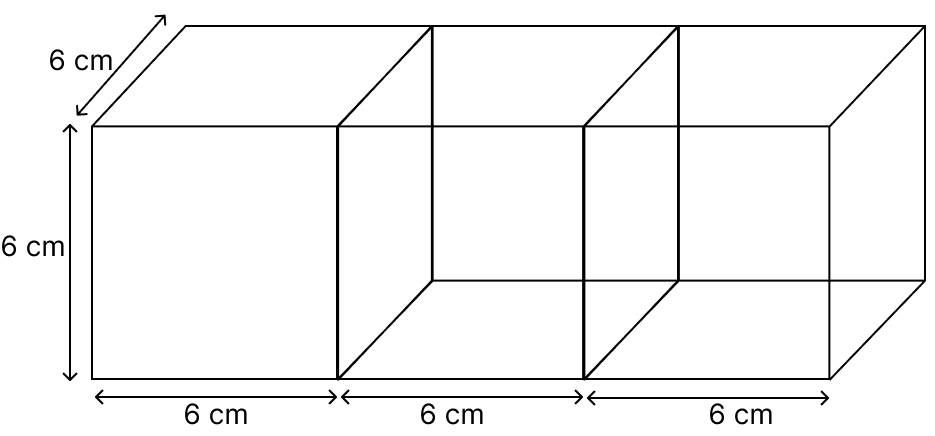
Given,
Side = 6 cm
When three identical cubes are joined end to end they form a cuboid.
∴ New length = 6 + 6 + 6 = 18 cm.
Breadth = 6 cm.
Height = 6 cm.
Total Surface area of cuboid = 2(lb + bh + hl)
= 2(18 × 6 + 6 × 6 + 6 × 18)
= 2(108 + 36 + 108)
= 2(252)
= 504 cm2.
Hence, surface area of cuboid = 504 cm2.
Find :
(i) the volume
(ii) the total surface area
(iii) the lateral surface area and
(iv) the length of the diagonal of a cube of side 10 cm.
Answer
Let 'a' be the side of a cube.
(i) Volume of cube = (a)3
= (10)3
= 1000 cm3.
Hence, volume = 1000 cm3.
(ii) By formula,
Total surface area of cube = 6a2
= 6 × 102
= 600 cm2.
Hence, total surface area of cube = 600 cm2.
(iii) By formula,
Lateral surface area of cube = 4a2
= 4 × 102
= 400 cm2.
Hence, lateral surface area of cube = 400 cm2.
(iv) By formula,
Diagonal of cube =
=
= 10 × 1.732
= 17.32 cm.
Hence, diagonal of cube = 17.32 cm.
The surface area of a cube is 1536 cm2. Find :
(i) the length of its edge
(ii) its volume
(iii) the volume of its material whose thickness is 5 mm.
Answer
Let 'a' be the length of the edge (side of a cube).
(i) Total surface area of cube = 6a2
⇒ 1536 = 6a2
⇒ a2 =
⇒ a2 = 256
⇒ a =
⇒ a = 16 cm.
Hence, length of the edge = 16 cm.
(ii) By formula,
Volume of cube = a3
= 163
= 4096 cm3.
Hence, volume of cube = 4096 cm3.
(iii) Material thickness = 5 mm = 0.5 cm
Outer edge = 16 cm
Inner edge = 16 - (0.5 + 0.5) = 16 - 1 = 15 cm.
Volume of the material = (outer edge)3 - (inner edge)3
= (16)3 - (15)3
= 4096 - 3375
= 721 cm3.
Hence, volume of the material = 721 cm3.
Two cubes, each of volume 512 cm3 are joined end to end. Find the surface area of the resulting cuboid.
Answer
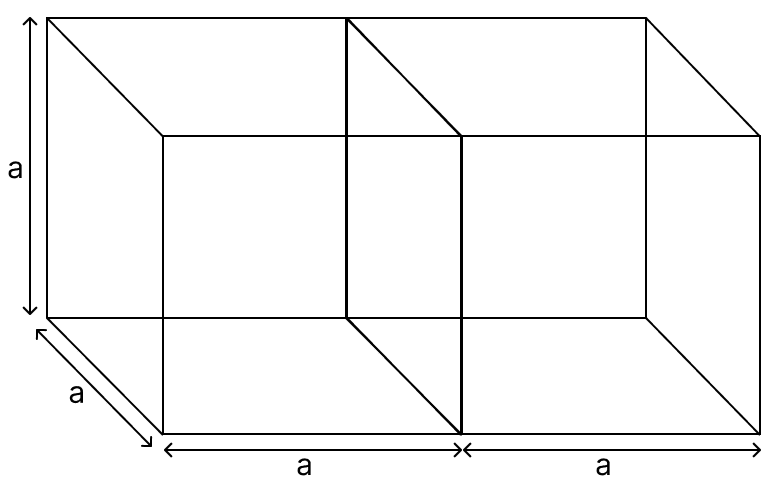
Let length of each side of cube be a cm.
Given,
Volume of each cube = 512 cm3.
Calculating the side of cube,
Volume of cube = a3
512 = a3
a =
a = 8 cm.
Two cubes are joined end to end to form a cuboid.
∴ Length (l) = a + a = 8 + 8 = 16 cm
Breadth (b) = a = 8 cm
Height (h) = a = 8 cm
Total surface of cuboid = 2(lb + bh + hl)
= 2(16 × 8 + 8 × 8 + 8 × 16)
= 2(128 + 64 + 128)
= 2(320)
= 640 cm2.
Hence, total surface area of cuboid = 640 cm2.
(i) How many cubic cm of iron are there in an open box whose external dimensions are 36 cm, 25 cm and 16.5 cm, the iron being 1.5 cm thick throughout ?
(ii) If 1 cm3 of iron weighs 15 g, find the weight of the empty box in kg.
Answer
(i) Given,
External dimensions :
Length (L) = 36 cm
Breadth (B) = 25 cm
Height (H) = 16.5 cm
Internal dimensions:
Since the thickness = 1.5 cm
∴ Length (l) = 36 - (1.5 + 1.5) = 36 - 3 = 33 cm
Breadth (b) = 25 - (1.5 + 1.5) = 25 - 3 = 22 cm
Height (h) = 16.5 - 1.5 = 15 cm (Since, box is open)
Calculating the external volume,
Volume = L × B × H
= 36 × 25 × 16.5
= 14,850 cm3.
Calculating internal volume,
Volume = l × b × h
= 33 × 22 × 15
= 10,890 cm3
Calculating volume of iron,
Volume of iron = External volume - Internal volume
= 14,850 - 10,890
= 3,960 cm3.
Hence, volume of iron = 3,960 cm3.
(ii) Given,
Weight of iron = 15 g
Total weight of the box = Volume of iron × weight of iron.
= 3,960 × 15 g
= 59,400 g.
1000 g = 1 kg
∴ 59,400 g = kg
= 59.4 kg
Hence, weight of the box = 59.4 kg.
A metal cube of edge 12 cm is melted and formed into three smaller cubes. If the edges of two smaller cubes are 6 cm and 8 cm, find the edge of third smaller cube.
Answer
Given,
Edge of largest cube = 12 cm
Edge of 1st smaller cube = 6 cm
Edge of 2nd smaller cube = 8 cm.
Let the edge of 3rd smaller cube = x cm
Calculating the volume of larger cube,
Volume = a3
= (12)3
= 1728 cm3.
Calculating the volume of smaller cubes,
Volume of 1st smaller cube = 63 = 216 cm3.
Volume of 2nd smaller cube = 83 = 512 cm3.
Volume of 3rd smaller cube = x3.
Since larger cube melts to form a smaller cubes,
∴ Volume of larger cube = Total volume of smaller cubes.
⇒ 1728 = 216 + 512 + x3
⇒ 1728 = 728 + x3
⇒ x3 = 1728 - 728
⇒ x3 = 1000
⇒ x =
⇒ x = 10 cm.
Hence, edge of third smaller cube = 10 cm.
The dimensions of a metallic cuboid are 100 cm × 80 cm × 64 cm. It is melted and recast into a cube. Find :
(i) the edge of the cube,
(ii) the surface area of the cube.
Answer
(i) Given,
Length = 100 cm
Breadth = 80 cm
Height = 64 cm
Calculating the volume of the cube,
Volume of cube = l × b × h
= 100 × 80 × 64
= 512000 cm3.
Let the edge of cube be a cm,
⇒ a3 = 512000
⇒ a =
⇒ a = 80 cm.
Hence, edge of the cube = 80 cm.
(ii) Surface area of the cube = 6a2.
= 6 × (80)2
= 6 × 6400
= 38400 cm2.
Hence, surface area of the cube = 38400 cm2.
The square on the diagonal of a cube has an area of 1875 cm2. Calculate :
(i) the side of the cube,
(ii) the surface area of the cube.
Answer
(i) Given,
Area = 1875 cm2.
We know that,
Diagonal of cube (d) = a
The square on the diagonal means a square whose side is equal to the diagonal of the cube.
∴ Area of square = (diagonal)2
⇒ 1875 = (a 2
⇒ 1875 = 3a2
⇒ a2 =
⇒ a2 = 625
⇒ a =
⇒ a = 25 cm.
Hence, side of cube = 25 cm.
(ii) Given,
Total surface area of cube = 6a2.
= 6 × (25)2
= 6 × 625
= 3750 cm2.
Hence, surface area of the cube = 3750 cm2.
The areas of three adjacent faces of a cuboid are x, y and z sq. units. If the volume is V cubic units, prove that V2 = xyz.
Answer
Let the dimensions of cuboid be,
Length = l
Breadth = b
Height = h
We know that,
Volume of cuboid (V) = l × b × h
Areas of three adjacent faces :
x = l × b
y = b × h
z = h × l
Multiplying these three areas :
xyz = (l × b) × (b × h) × (h × l)
xyz = l2 × b2 × h2
xyz = (l × b × h)2
Substituting the value of V = l × b × h
∴ xyz = V2.
Hence, proved that V2 = xyz.
The diagonal of a cube is cm. Find its surface area and volume.
Answer
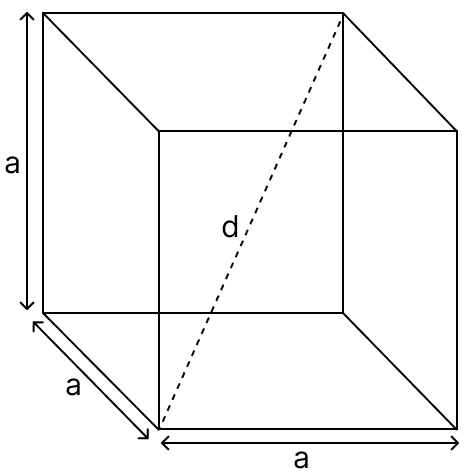
Let the side of a cube = a cm and diagonal = d cm.
Given,
Diagonal of cube = cm.
By formula,
Diagonal of cube (d) =
∴
a = 16 cm.
Calculating the total surface area of cube,
Total surface area of cube = 6a2.
= 6 × 162
= 6 × 256
= 1536 cm2.
Calculating the volume of the cube,
Volume of a cube = a3
= 163
= 4096 cm3.
Hence, surface area = 1536 cm2 and volume = 4096 cm3.
Water flows into a tank 150 m long and 100 m broad through a rectangular pipe whose cross section is 5 dm × 3.5 dm, at the speed of 15 km/hr. In what time, will the water be 7 m deep?
Answer
Given,
Tank dimension :
Length = 150 m
Breadth = 100 m
Depth = 7 m
Cross section of pipe = 5 dm × 3.5 dm
= 0.5 m × 0.35 m.
Speed of water = 15 km/hr = 15000 m/hr.
Let time taken by pipe to fill the tank be x hours.
⇒ Volume of tank = Time × Volume of water discharged by pipe (per hour)
⇒ 150 × 100 × 7 = x × (Cross section of pipe × Speed of water)
⇒ 150 × 100 × 7 = x × 0.5 × 0.35 × 15000
⇒ 105000 = x × 2625
⇒ x =
⇒ x = 40 hours.
Hence, time taken = 40 hours.
A rectangular tank is 25 m long and 7.5 m deep. If 540 m3 of water be drawn off the tank, the level of water in the tank goes down by 1.8 m. Calculate :
(i) the width of the tank
(ii) the capacity of the tank.
Answer
Given,
Tank dimension:
Length (l) = 25 m
Depth (h) = 7.5 m
Drop in level = 1.8 m
Volume removed = 540 m3.
(i) Volume removed = length × width × drop in level
⇒ 540 = 25 × width × 1.8
⇒ 540 = width × 45
⇒ Width = = 12 m.
Hence, width of the tank = 12 m.
(ii) Calculating the capacity of the tank,
Capacity of the tank = Length × Width × Depth
= 25 × 12 × 7.5
= 300 × 7.5
= 2250 m3.
Hence, capacity of tank = 2250 m3.
A swimming pool is 30 m long and 12 m broad. Its shallow and deep ends are 1.5 m and 3.5 m deep respectively. If the bottom of the pool slopes uniformly, how many litres of water will fill the pool?
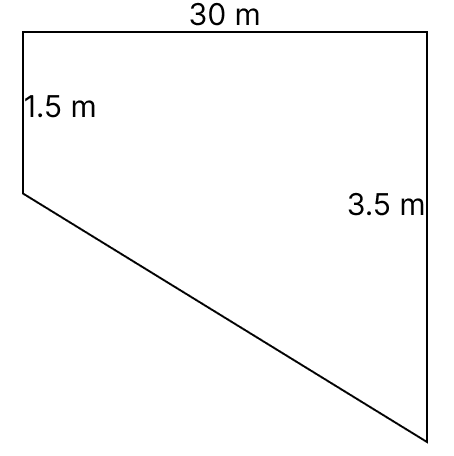
Answer
From figure,
The swimming pool cross-section is in the shape of trapezium.
Area of cross-section =
=
= 75 m2.
Volume of pool = Area of cross-section × breadth
= 75 × 12
= 900 m3
= 900 × 1000 litres
= 900000 litres.
Hence, 900000 litres of water will fill the pool.
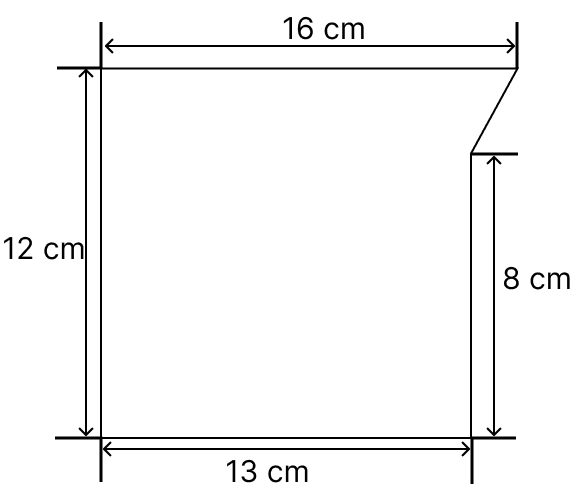
The cross-section of a piece of metal 2 m in length is shown in the adjoining figure. Calculate :
(i) the area of its cross-section;
(ii) the volume of piece of metal;
(iii) the weight of piece of metal to the nearest kg, if 1 cm3 of the metal weighs 6.5 g.
Answer
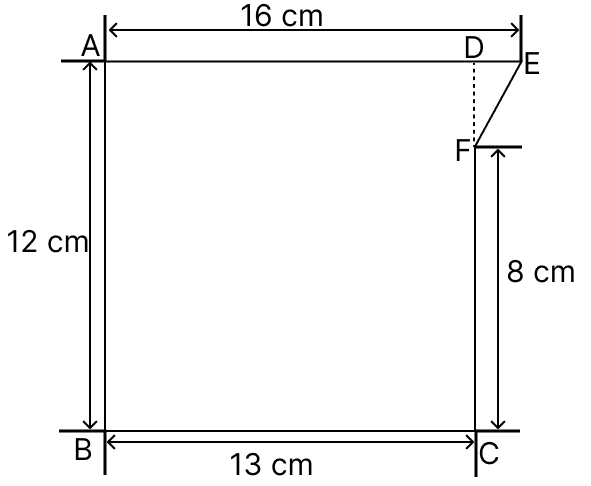
Given,
Length of the metal piece = 2 m = 200 cm.
(i) From figure,
Rectangle ABCD :
Length (AB = CD) = 12 cm
Breadth (BC = AD) = 13 cm.
Area of rectangle ABCD = length × breadth
= 12 × 13 = 156 cm2.
Triangle DEF :
Height (DF) = DC - FC = 12 - 8 = 4 cm.
Base (DE) = AE - AD = 16 - 13 = 3 cm.
Area of triangle DEF = × Base × Height
= × 3 × 4
= 6 cm2.
Total cross-section area = 156 + 6 = 162 cm2.
Hence, area of cross-section = 162 cm2.
(ii) Calculating the volume of metal piece,
Volume of metal piece = Area of cross section × Length
= 162 × 200
= 32400 cm3.
Hence, volume of metal piece = 32400 cm3.
(iii) Given,
1 cm3 of metal = 6.5 g.
Calculating the weight of the metal piece,
Total weight of the metal piece = Volume × Weight of metal at 1 cm3
= 32400 × 6.5
= 210600 g.
1000 g = 1 kg
∴ 210600 g = kg
= 210.6 kg ≈ 211 kg.
Hence, weight of the piece of the metal = 211 kg.
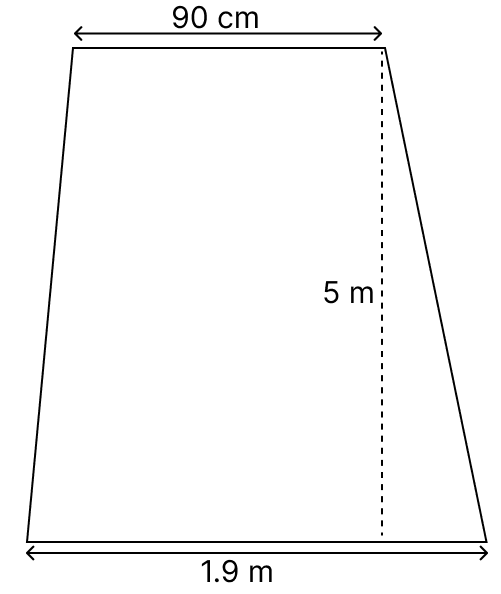
The adjoining figure shows the cross-section of a concrete wall to be constructed. It is 1.9 m wide at the bottom, 90 cm wide at the top and 5 m high. If its length is 20 m, find :
(i) the cross-sectional area;
(ii) the volume of the concrete in the wall.
Answer
Let the bottom width be 'a' and top width be 'b'.
Given,
Bottom width (a) = 1.9 m
Top width (b) = 90 cm = 0.9 m
Height (h) = 5 m
Length = 20 m
(i) Cross-sectional area :
Hence, area of cross-section = 7 m2.
(ii) Volume of concrete :
Volume of concrete = Area of cross-section × Length of the wall.
= 7 × 20
= 140 m3.
Hence, volume of concrete = 140 m3.
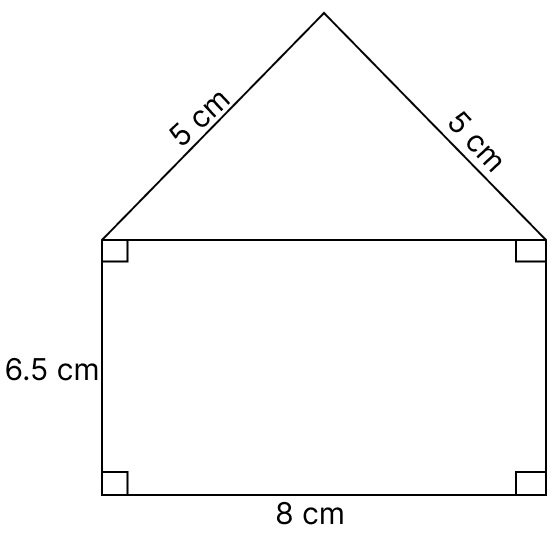
The cross-section of a 6 m long piece of metal is shown in the figure. Calculate :
(i) the area of the cross-section
(ii) the volume of the piece of metal in cubic centimeters.
Answer
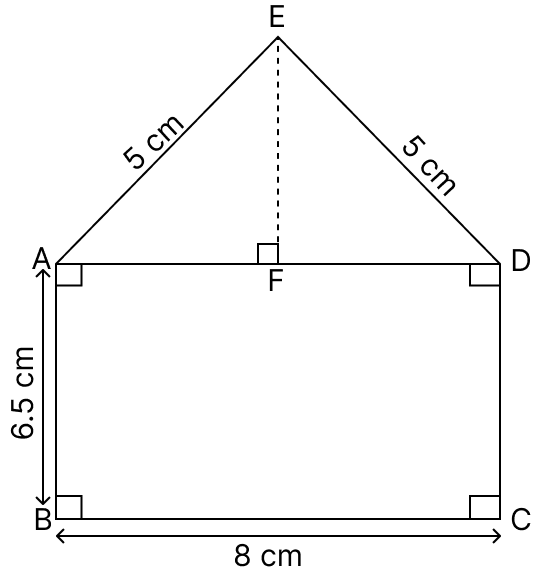
From figure,
AD = BC = 8 cm
AB = CD = 6.5 cm
Triangle sides = AE = 5 cm & DE = 5 cm
Triangle base (AD) = 8 cm.
Length of metal piece = 6 m = 600 cm.
(i) Area of cross section :
Calculating the area of rectangle ABCD,
Area of rectangle ABCD = length × breadth
= 8 × 6.5
= 52 cm2.
EAD is an isosceles triangle,
In an isosceles triangle, the perpendicular drawn from common vertex to the base, bisects the base.
AF = FD = = 4 cm.
By using pythagoras theorem for the triangle EFD,
⇒ Hypotenuse2 = Base2 + Height2
⇒ ED2 = FD2 + EF2
⇒ 52 = 42 + EF2
⇒ 25 = 16 + EF2
⇒ EF2 = 25 - 16
⇒ EF2 = 9
⇒ EF =
⇒ EF = 3 cm.
∴ Height (EF) = 3 cm
Area of △ EAD = × Base × Height
= × AD × EF
= × 8 × 3
= 4 × 3
= 12 cm2.
Total area = Area of rectangle ABCD + Area of triangle EAD
= 52 + 12 = 64 cm2.
Hence, area of cross-section = 64 cm2.
(ii) Volume of metal:
Volume of metal = Area of cross-section × Length of the metal piece
= 64 × 600
= 38400 cm3.
Hence, volume of metal = 38400 cm3.
The square brass plate of side x cm is 1 mm thick and weighs 5.44 kg. If 1 cm3 of brass weighs 8.5 g, find the value of x.
Answer
Given,
Side of square = x cm.
Thickness of brass = 1 mm = 0.1 cm
Total weight = 5.44 kg = 5440 g
1 cm3 of brass weighs 8.5 g
Density = 8.5 g/cm3
Calculating the volume of the brass,
Volume of the brass =
=
= 640 cm3.
Calculating the area of the plate,
Area of the plate = length × breadth
= x × x = x2
We know that,
Volume = Area of the plate × Thickness of the brass.
⇒ 640 = x2 × 0.1
⇒ x2 =
⇒ x2 = 6400
⇒ x =
⇒ x = 80 cm.
Hence, x = 80 cm.
The area of cross-section of a rectangular pipe is 5.4 cm2 and water is pumped out of it at the rate of 27 kmph. Find, in litres, the volume of water which flows out of the pipe in 1 minute.
Answer
Given,
Area of cross-section of rectangular pipe = 5.4 cm2.
Speed of water = 27 km/hr = 2700000 cm/hr
1 hr = 60 minutes
∴ Speed of water = = 45000 cm/min.
Calculating the distance traveled by water in 1 minute,
Distance = Speed × time
= 45000 × 1 = 45000 cm.
Calculating the volume of water,
Volume of water which flows out of pipe in 1 min = Area of cross-section × Distance traveled by water in 1 min
= 5.4 × 45000
= 243000 cm3.
1000 cm3 = 1 litre
∴ 243000 cm3 = liters = 243 litres.
Hence, 243 litres of water flows out of the pipe in 1 minute.
The adjoining figure shows a solid of uniform cross section. Find the volume of the solid. It is being given that all the measurements are in cm and each angle in the figure is a right angle.
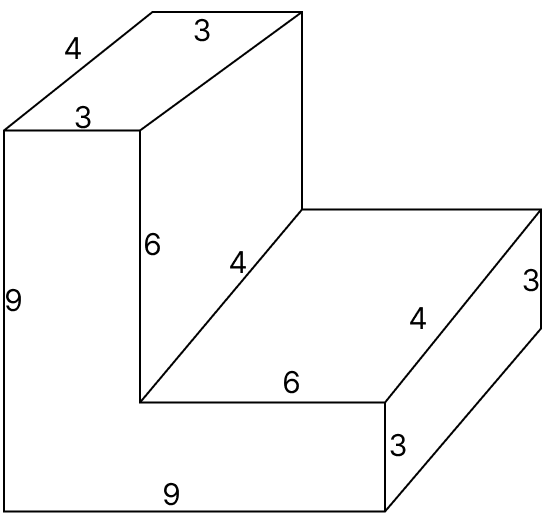
Answer
Given solid figure consists of two cuboids.
Cuboid 1:
Length (l) = 4 cm
Breadth (b) = 6 cm
Height (h) = 3 cm
Cuboid 2:
Length (l) = 4 cm
Breadth (b) = 3 cm
Height (h) = 9 cm
Calculating the volume of cuboid 1,
Volume of cuboid 1 = length × breadth × height
= 4 × 6 × 3
= 72 cm3.
Calculating the volume of cuboid 2,
Volume of cuboid 2 = length × breadth × height
= 4 × 3 × 9
= 108 cm3.
∴ Total volume = 72 + 108
= 180 cm3.
Hence, volume of solid = 180 cm3.
The cross-section of a tunnel, perpendicular to its length is a trapezium ABCD in which AB = 8 m, DC = 6 m and AL = BM. The height of the tunnel is 2.4 m and its length is 40 m. Find :
(i) the cost of paving the floor of the tunnel at ₹ 16 per m2.
(ii) the cost of painting the internal surface of the tunnel, excluding the floor at the rate of ₹ 5 per m2.
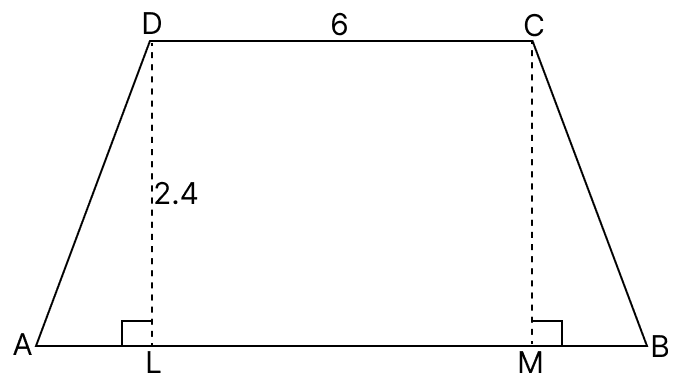
Answer
Given,
AB = 8 m
DC = 6 m
Height = 2.4 m
Length of the tunnel = 40 m
AL = BM
From figure, LM = DC = 6 m (since perpendiculars drop from D and C).
From figure,
⇒ AB = AL + LM + MB
⇒ 8 = AL + 6 + BM
Since, AL = BM
∴ 8 = 2AL + 6
⇒ 2AL = 8 - 6
⇒ 2AL = 2
⇒ AL = = 1 m
∴ AL = BM = 1 m.
Calculating the lengths of the sloping sides AD and BC,
In right triangle ALD,
AL = 1 m
DL = 2.4 m
Using pythagoras theorem for the triangle ALD,
⇒ Hypotenuse2 = Base2 + Height2
⇒ AD2 = AL2 + DL2
⇒ AD2 = 12 + (2.4)2
⇒ AD2 = 1 + 5.76
⇒ AD2 = 6.76
⇒ AD =
⇒ AD = 2.6 m.
∴ AD = BC = 2.6 m.
(i) Cost of paving the floor:
Area of tunnel = AB × length
= 8 × 40
= 320 m2.
Total cost = Area × cost per m2
= 320 × 16
= ₹ 5,120.
Hence, cost of paving the floor = ₹ 5,120.
(ii) Cost of painting internal surface (excluding floor)
Area to be painted are :
Roof DC and Two sloping sides AD and BC.
Calculating the area of DC,
Area = length × DC
= 40 × 6 = 240 m2.
Calculating the area of slope AD,
Area = length × AD
= 40 × 2.6 = 104 m2.
Calculating the area of slope BC,
Area = Length × BC
= 40 × 2.6 = 104 m2.
Total area = 240 + 104 + 104
= 448 m2.
Cost rate = ₹ 5 per m2
Calculating the cost of painting the internal surface of the tunnel,
Total cost = Total area × Cost
= 448 × 5
= ₹ 2,240.
Hence, cost = ₹ 2,240.