KnowledgeBoat Logo
|
OPEN IN APP

Chapter 18

Circumference & Area of a Circle

Class - 9 RS Aggarwal Mathematics Solutions


Exercise 18

Question 1

A sheet is 11 cm long and 2 cm wide. Circular pieces 0.5 cm in diameter are cut from it to prepare discs. Calculate the number of discs that can be prepared.

Answer

Number of disc along the length of sheet :

= Length of sheetDiameter of disc=110.5\dfrac{\text{Length of sheet}}{\text{Diameter of disc}} = \dfrac{11}{0.5} = 22 discs.

Number of disc along the width of sheet :

= Width of sheetDiameter of disc=20.5\dfrac{\text{Width of sheet}}{\text{Diameter of disc}} = \dfrac{2}{0.5} = 4 discs.

Total number of discs = 22 × 4 = 88.

Hence, number of discs formed = 88.

Question 2

Find the circumference and area of a circle of radius 17.5 cm.

Answer

Circumference of circle = 2πr = 2 × π × 17.5

= 2 × 227\dfrac{22}{7} × 17.5

= 2 × 22 × 2.5

= 22 × 5 = 110 cm.

Area of circle = πr2

= 227\dfrac{22}{7} × (17.5)2

= 227\dfrac{22}{7} × 17.5 × 17.5

= 22 × 2.5 × 17.5

= 962.5 cm2.

Hence, circumference = 110 cm and area = 962.5 cm2.

Question 3

Find the circumference and area of a circle of radius 15 cm.

Answer

Circumference of circle = 2πr = 2 × π × 15

= 2 × 3.14 × 15

= 3.14 × 30

= 94.2 cm.

Area of circle = πr2

= 3.14 × (15)2

= 3.14 × 225

= 706.5 cm2.

Hence, circumference = 94.2 cm and area = 706.5 cm2.

Question 4

The circumference of a circle is 123.2 cm. Calculate :

(i) the radius of the circle in cm;

(ii) the area of the circle to the nearest cm2;

(iii) the effect on the area of the circle if the radius is doubled.

Answer

Let the radius of circle be r cm.

(i) Circumference of circle = 2πr

⇒ 123.2 = 2 × 227\dfrac{22}{7} × r

⇒ r = 123.2×72×22\dfrac{123.2 × 7}{2 × 22}

⇒ r = 862.444\dfrac{862.4}{44} = 19.6 cm.

Hence, radius of circle = 19.6 cm.

(ii) Area of circle = πr2

= 227\dfrac{22}{7} × (19.6)2

= 227\dfrac{22}{7} × 19.6 × 19.6

= 22 × 2.8 × 19.6

= 1207.36

≈ 1207 cm2.

Hence, area of circle = 1207 cm2.

(iii) Area of circle = π(radius)2

If radius is double then it will become 2r.

New area = π(2r)2

= π × 4r2

= 4 × πr2.

Hence, new area becomes 4 times the old area.

Question 5

Find the length of a rope by which a cow must be tethered in order that it may be able to graze an area of 9856 m2.

Answer

Given,

Grazed area = 9856 m2

Radius of circular field = Length of the rope

A cow tethered to a fixed point by a rope will graze in a circular pattern.

Area of circle = πr2

⇒ 9856 = 227\dfrac{22}{7} × r2

⇒ r2 = 9856×722\dfrac{9856 × 7}{22}

⇒ r2 = 6899222\dfrac{68992}{22}

⇒ r2 = 3136

⇒ r = 3136\sqrt{3136} = 56 m.

Hence, length of the rope = 56 m.

Question 6

The area of a circle is 394.24 cm2. Calculate :

(i) the radius of the circle,

(ii) the circumference of the circle.

Answer

(i) Let the radius of circle be r cm.

Given,

Area = 394.24 cm2

Area of circle = πr2

⇒ 394.24 = 227\dfrac{22}{7} × r2

⇒ r2 = 394.24×722\dfrac{394.24 × 7}{22}

⇒ r2 = 125.44

⇒ r = 125.44\sqrt{125.44}

⇒ r = 11.2 cm.

Hence, radius = 11.2 cm.

(ii) Circumference of circle = 2πr

= 2 × 227\dfrac{22}{7} × 11.2

= 2 × 22 × 1.6

= 70.4 cm.

Hence, circumference = 70.4 cm.

Question 7

Find the perimeter and area of a semi-circular plate of radius 25 cm.

Answer

Given,

Radius = 25 cm

Area of full circle = πr2

= 3.14 × (25)2

= 3.14 × 625

= 1962.5 cm2.

Area of semicircle = 12\dfrac{1}{2} × 1962.5

= 981.25 cm2.

Arc length of semi-circle = 12\dfrac{1}{2} × 2πr = πr

Perimeter = Circumference of semi-circle + diameter

= πr + 2r

= 3.14 × 25 + 2 × 25

= 78.5 + 50 = 128.5 cm.

Hence, area = 981.25 cm2 and perimeter = 128.5 cm respectively.

Question 8

The perimeter of a semi-circular metallic plate is 86.4 cm. Calculate the radius and area of the plate.

Answer

Perimeter of semicircular plate = Circumference of semicircle + diameter

= πr + 2r

= r(π + 2).

Thus,

86.4=r(π+2)r=86.4π+2r=86.43.14+2r=86.45.1416.8 cm.\Rightarrow 86.4 = r(π + 2) \\[1em] \Rightarrow r = \dfrac{86.4}{π + 2} \\[1em] \Rightarrow r = \dfrac{86.4}{3.14 + 2} \\[1em] \Rightarrow r = \dfrac{86.4}{5.14} \approx 16.8 \text{ cm}.

Area of semi-circular plate = 12\dfrac{1}{2} πr2

= 12\dfrac{1}{2} × 3.14 × (16.8)2

= 443.12 cm2.

Hence, radius of plate = 16.8 cm and area = 443.12 cm2.

Question 9

The circumference of a circle exceeds its diameter by 180 cm. Calculate :

(i) the radius

(ii) the circumference and

(iii) the area of the circle.

Answer

(i) Given,

Circumference of a circle exceeds diameter by 180 cm.

So, Circumference = Diameter + 180

Circumference - Diameter = 180

2πr2r=1802r(π1)=1802r(2271)=1802r(2277)=1802r(157)=18030r=180×730r=1260r=126030r=42 cm.\Rightarrow 2\pi r - 2r = 180 \\[1em] \Rightarrow 2r(\pi - 1) = 180 \\[1em] \Rightarrow 2r\Big(\dfrac{22}{7} - 1\Big) = 180 \\[1em] \Rightarrow 2r\Big(\dfrac{22 - 7}{7}\Big) = 180 \\[1em] \Rightarrow 2r\Big(\dfrac{15}{7}\Big) = 180 \\[1em] \Rightarrow 30r = 180 × 7 \\[1em] \Rightarrow 30r = 1260 \\[1em] \Rightarrow r = \dfrac{1260}{30} \\[1em] \Rightarrow r = 42 \text{ cm}.

Hence, radius = 42 cm.

(ii) As calculated,

Radius = 42 cm.

Circumference of circle = 2πr

= 2 × 227\dfrac{22}{7} × 42

= 2 × 22 × 6

= 44 × 6 = 264 cm.

Hence, circumference of circle = 264 cm.

(iii) By formula,

Area of circle = πr2

= 227\dfrac{22}{7} × (42)2

= 227\dfrac{22}{7} × 1764

= 22 × 252

= 5544 cm2.

Hence, area of circle = 5544 cm2.

Question 10

A copper wire when bent in the form of a square encloses an area of 272.25 cm2. If the same wire is bent into the form of circle, what will be the area enclosed by the wire?

Answer

By formula,

Area of square = (side)2

Given,

Area of square = 272.25 cm2.

∴ (side)2 = 272.25

⇒ side = 272.25\sqrt{272.25}

⇒ side = 16.5 cm.

Perimeter of square = 4 × side = 4 × 16.5 = 66 cm.

Circumference of circle of same wire = Perimeter of square of same wire.

Let radius of circle be r cm.

2πr=662×227×r=6644×r=66×7r=66×744r=212=10.5 cm.\therefore 2πr = 66 \\[1em] \Rightarrow 2 \times \dfrac{22}{7} \times r = 66 \\[1em] \Rightarrow 44 \times r = 66 \times 7 \\[1em] \Rightarrow r = \dfrac{66 \times 7}{44} \\[1em] \Rightarrow r = \dfrac{21}{2} = 10.5 \text{ cm}.

By formula,

Area of circle = πr2

= 227\dfrac{22}{7} × (10.5)2

= 227\dfrac{22}{7} × 10.5 × 10.5

= 22 × 1.5 × 10.5

= 346.5 cm2.

Hence, area enclosed by the wire in the form of a circle = 346.5 cm2.

Question 11

A copper wire when bent in the form of an equilateral triangle has an area of 1213121\sqrt{3} cm2. If the same wire is bent into the form of a circle, find the area enclosed by the wire.

Answer

By formula,

Area of equilateral triangle = 34\dfrac{\sqrt{3}}{4} (side)2

Given,

Area of equilateral triangle = 1213121\sqrt{3} cm2

1213=34 (side)2\therefore 121\sqrt{3} = \dfrac{\sqrt{3}}{4} \text{ (side)}^2

⇒(side)2 = 1213×43\dfrac{121 \sqrt{3} × 4}{\sqrt{3}}

⇒ (side)2 = 121 × 4

⇒ (side)2 = 484

⇒ side = 484\sqrt{484}

⇒ side = 22 cm.

Perimeter of equilateral triangle = 3 x side = 3 x 22 = 66 cm.

Circumference of circle of same wire = Perimeter of triangle of same wire

Let radius of circle be r cm.

∴ 2πr = 66

⇒ 2 × 227\dfrac{22}{7} × r = 66

⇒ 44 × r = 66 × 7

⇒ r = 66×744\dfrac{66 \times 7}{44}

⇒ r = 212\dfrac{21}{2} = 10.5 cm

Area of circle = πr2

= 227\dfrac{22}{7} × (10.5)2

= 227\dfrac{22}{7} × 10.5 × 10.5

= 22 × 1.5 × 10.5 = 346.5 cm2.

Hence, area = 346.5 cm2.

Question 12

The sum of the radii of two circles is 140 cm and the difference of their circumference is 88 cm. Find the radii of the two circles.

Answer

Let r1 and r2 be the radii of the two circles.

Given,

Sum of the radii of two circles is 140 cm.

r1 + r2 = 140 .......(1)

Circumference of circle1 - Circumference of circle2 = 88

⇒ 2πr1 - 2πr2 = 88

⇒ 2π(r1 - r2) = 88

⇒ r1 - r2 = 882π\dfrac{88}{2π}

⇒ r1 - r2 = 882×227\dfrac{88}{2 \times \dfrac{22}{7}}

⇒ r1 - r2 = 88×72×22\dfrac{88 \times 7}{2 \times 22}

⇒ r1 - r2 = 14 ..........(2)

Adding equation (1) and (2), we get :

⇒ r1 + r2 + r1 - r2 = 140 + 14

⇒ 2r1 = 140 + 14

⇒ 2r1 = 154

⇒ r1 = 1542\dfrac{154}{2}

= 77 cm.

Substituting value of r1 in equation (1), we get :

⇒ 77 + r2 = 140

⇒ r2 = 140 - 77

⇒ r2 = 63 cm.

Hence, radii of the circles = 77 cm and 63 cm.

Question 13

The sum of the radii of two circles is 84 cm and the difference of their areas is 5544 cm2. Calculate the radii of the two circles.

Answer

Let r1 and r2 be the radii of the two circles.

Given,

Sum of the radii of two circles is 84 cm.

r1 + r2 = 84 .......(1)

Given,

Difference of their areas is 5544 cm2.

Area of circle1 - Area of circle2 = 5544

⇒ πr12 - πr22 = 5544

227\dfrac{22}{7} (r12 - r22) = 5544

⇒ r12 - r22 = 5544×722\dfrac{5544 × 7}{22}

⇒ r12 - r22 = 3880822\dfrac{38808}{22}

⇒ r12 - r22 = 1764

⇒ (r1 + r2) (r1 - r2) = 1764

Substituting the value from equation (1) in above equation, we get :

⇒ 84(r1 - r2) = 1764

⇒ r1 - r2 = 176484\dfrac{1764}{84}

⇒ r1 - r2 = 21 ......(2)

Adding equation (1) and (2), we get :

⇒ r1 + r2 + r1 - r2 = 84 + 21

⇒ 2r1 = 84 + 21

⇒ 2r1 = 105

⇒ r1 = 1052\dfrac{105}{2} = 52.5 cm

Substituting value of r1 in equation (1), we get :

⇒ r1 + r2 = 84

⇒ 52.5 + r2 = 84

⇒ r2 = 84 - 52.5

⇒ r2 = 31.5 cm.

Hence radii of the two circles = 52.5 cm and 31.5 cm.

Question 14

Two circles touch externally. The sum of their areas is 117π cm2 and the distance between their centres is 15 cm. Find the radii of the two circles.

Answer

Let x and y be the radii of the of two circles with centers A and B respectively.
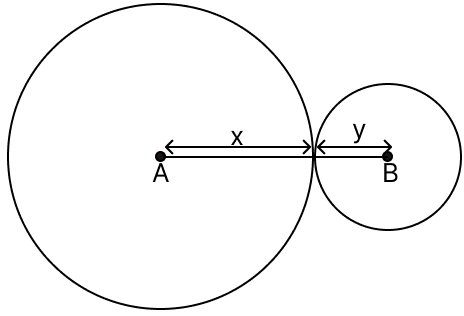
Two circles touch externally. The sum of their areas the distance between their centres is 15 cm. Find the radii of the two circles. Circumference & Area of a Circle, R.S. Aggarwal Mathematics Solutions ICSE Class 9.

By formula,

Area of a circle = π (radius)2

Given,

Sum of areas = 117π cm2

πx2 + πy2 = 117π

x2 + y2 = 117 .......(1)

Given,

Distance between centers = 15 cm

x + y = 15

x = 15 - y .......(2)

Substituting value of x from equation (2) in (1), we get :

⇒ (15 - y)2 + y2 = 117

⇒ 225 - 30y + y2 + y2 = 117

⇒ 2y2 - 30y + 225 - 117 = 0

⇒ 2y2 - 30y + 108 = 0

⇒ 2(y2 - 15y + 54) = 0

⇒ y2 - 15y + 54 = 0

⇒ y2 - 9y - 6y + 54 = 0

⇒ y(y - 9) - 6(y - 9) = 0

⇒ (y - 6)(y - 9) = 0

⇒ y - 6 = 0 or y - 9 = 0

⇒ y = 6 cm or y = 9 cm.

If y = 6 cm, then x = 15 - y = 9 cm.

If y = 9 cm, then x = 15 - y = 6 cm.

Since, x is the radius of circle with center A and from figure it is clear that A is the circle with greater radius thus, x = 9 cm and y = 6 cm.

Hence, the radii of two circles with centers A and B = 9 cm and 6 cm respectively.

Question 15

Two circles touch internally. The sum of their areas is 170π cm2 and the distance between their centres is 4 cm. Find the radii of the circles.

Answer

Let R be the radius of bigger circle and r be the radius of smaller circle.
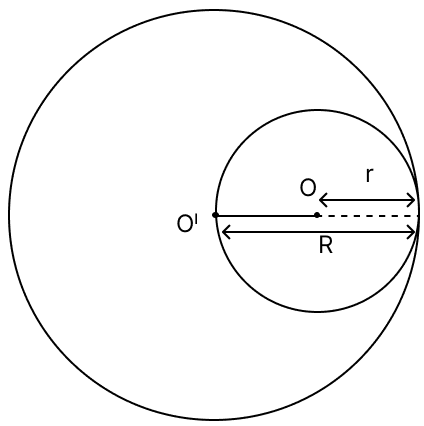
Two circles touch internally. The sum of their areas is 170π cm. Circumference & Area of a Circle, R.S. Aggarwal Mathematics Solutions ICSE Class 9.

Given,

Distance between centres (R - r) = 4 cm

Sum of areas = 170π cm2

If two circles touch internally then,

Distance between centres = R - r

∴ R - r = 4.....(1)

Given,

Sum of their areas = 170π

⇒ πR2 + πr2 = 170π

⇒ π(R2 + r2) = 170π

⇒ R2 + r2 = 170

Substituting the value R = r + 4

⇒ (r + 4)2 + r2 = 170

⇒ r2 + 16 + 2 × r × 4 + r2 = 170

⇒ 2r2 + 8r + 16 - 170 = 0

⇒ 2r2 + 8r - 154 = 0

⇒ r2 + 4r - 77 = 0

⇒ r2 + 11r - 7r - 77 = 0

⇒ r(r + 11) - 7(r + 11) = 0

⇒ (r - 7)(r + 11) = 0

⇒ r = 7 cm.

Substituting r = 7 in equation (1), we get :

R - 7 = 4

R = 4 + 7 = 11 cm.

Hence, radii of the two circles = 7 cm and 11 cm.

Question 16

Find the area of a ring whose outer and inner radii are 19 cm and 16 cm respectively.

Answer

Given,

Outer radius (R) = 19 cm

Inner radius (r) = 16 cm

Area of ring = Area of big circle − Area of small circle

Area of ring = πR2 - πr2

= π(R2 - r2)

= π(192 - 162)

= π(361 - 256)

= π(105)

= 227×105\dfrac{22}{7} \times 105

= 22 × 15

= 330 cm2.

Hence, area of the ring = 330 cm2.

Question 17

The areas of two concentric circles are 962.5 cm2 and 1386 cm2 respectively. Find the width of the ring.

Answer

Let radius of smaller circle be r cm and radius of bigger circle be R cm.

Given

Area of smaller circle = 962.5 cm2

Area of bigger circle = 1386 cm2

Width of ring = R − r

Area of bigger circle = πR2

1386=227×R2R2=1386×722R2=970222R2=441R=441=21 cm.\Rightarrow 1386 = \dfrac{22}{7} \times R^2 \\[1em] \Rightarrow R^2 = \dfrac{1386 × 7}{22} \\[1em] \Rightarrow R^2 = \dfrac{9702}{22} \\[1em] \Rightarrow R^2 = 441 \\[1em] \Rightarrow R = \sqrt{441} \\[1em] = 21 \text{ cm}.

Calculating the area of smaller circle,

Area of smaller circle=πr2962.5=227r2r2=962.5×722r2=6737.522r2=306.25r=306.25=17.5 cm.\text{Area of smaller circle} = πr^2 \\[1em] \Rightarrow 962.5 = \dfrac{22}{7} r^2 \\[1em] \Rightarrow r^2 = \dfrac{962.5 × 7}{22} \\[1em] \Rightarrow r^2 = \dfrac{6737.5}{22} \\[1em] \Rightarrow r^2 = 306.25 \\[1em] \Rightarrow r = \sqrt{306.25} \\[1em] = 17.5 \text{ cm}.

Width of the ring = R - r

= 21 - 17.5 = 3.5 cm.

Hence, width of the ring = 3.5 cm.

Question 18

The area enclosed between two concentric circles is 770 cm2. If the radius of the outer circle is 21 cm, calculate the radius of the inner circle.

Answer

Let radius of inner circle be r cm.

Given,

Area enclosed between two concentric circles is 770 cm2

Area enclosed between two concentric circles = Area of bigger circle - Area of smaller circle

⇒ 770 = π(21)2 - πr2

⇒ 770 = 441π - πr2

⇒ 770 = 227\dfrac{22}{7} (441 - r2)

⇒ 441 - r2 = 770×722\dfrac{770 × 7}{22}

⇒ 441 - r2 = 35 × 7

⇒ 441 - r2 = 245

⇒ r2 = 441 - 245

⇒ r2 = 196

⇒ r = 196\sqrt{196} = 14 cm.

Hence, radius of inner circle = 14 cm.

Question 19

In the given figure, the area enclosed between two concentric circles is 808.5 cm2. The circumference of the outer circle is 242 cm. Calculate :

(i) the radius of the inner circle,

(ii) the width of the ring.
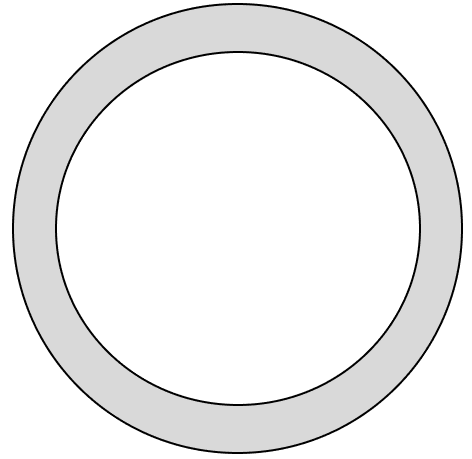
In the given figure, the area enclosed between two concentric circles is 808.5 cm. Circumference & Area of a Circle, R.S. Aggarwal Mathematics Solutions ICSE Class 9.

Answer

Let R be the radius of outer circle and r be the radius of inner circle.

(i) Given,

Circumference of outer circle = 242 cm.

2πR=2422×227×R=242447×R=242R=242×744=38.5 cm.\therefore 2πR = 242 \\[1em] \Rightarrow 2 \times \dfrac{22}{7} \times R = 242 \\[1em] \Rightarrow \dfrac{44}{7} \times R = 242 \\[1em] \Rightarrow R = \dfrac{242 × 7}{44} \\[1em] = 38.5 \text{ cm}.

Area enclosed between two concentric circles = Area of bigger circle - Area of smaller circle

= πR2 - πr2

= π(R2 - r2)

Given,

Area enclosed between two concentric circles = 808.5 cm2

⇒ 808.5 = 227\dfrac{22}{7} (R2 - r2)

⇒ (38.5)2 - r2 = 808.5×722\dfrac{808.5 × 7}{22}

⇒ 1482.25 - r2 = 5659.522\dfrac{5659.5}{22}

⇒ 1482.25 - r2 = 257.25

⇒ r2 = 1482.25 - 257.25

⇒ r2 = 1225

⇒ r = 1225\sqrt{1225} = 35 cm.

Hence, radius of inner circle = 35 cm.

(ii) Width of ring = R - r

= 38.5 - 35

= 3.5 cm.

Hence, width of the ring = 3.5 cm.

Question 20

AC and BD are two perpendicular diameters of a circle ABCD. Given that the area of the shaded portion is 308 cm2, calculate :

(i) the length of AC; and

(ii) the circumference of the circle.
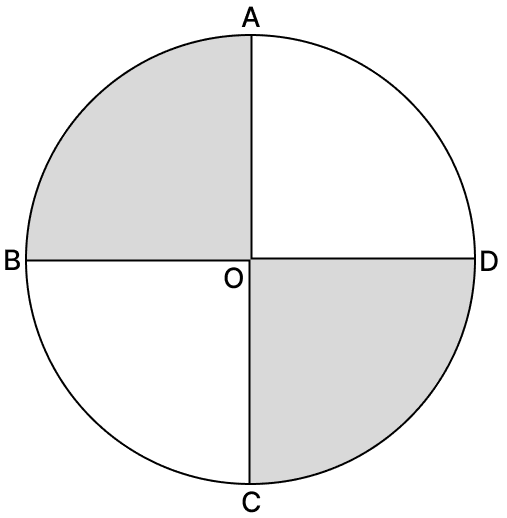
AC and BD are two perpendicular diameters of a circle ABCD. Given that the area of the shaded portion is 308 cm. Circumference & Area of a Circle, R.S. Aggarwal Mathematics Solutions ICSE Class 9.

Answer

Given,

Shaded region = 308 cm2

Area of circle = πr2

Two perpendicular diameters divide the circle into 4 quadrants.

Area of each quadrant = 14\dfrac{1}{4} Area of circle

Since, 2 quadrants are shaded. Thus,

Shaded area=2×14×Area of circle308=12×Area of circleArea of circle=616πr2=616227r2=616r2=616×722r2=431222r2=196r=196=14 cm.\therefore \text{Shaded area} = 2 \times \dfrac{1}{4} \times \text{Area of circle} \\[1em] \Rightarrow 308 = \dfrac{1}{2} \times \text{Area of circle} \\[1em] \Rightarrow \text{Area of circle} = 616 \\[1em] \Rightarrow πr^2 = 616 \\[1em] \Rightarrow \dfrac{22}{7} r^2 = 616 \\[1em] \Rightarrow r^2 = \dfrac{616 × 7}{22} \\[1em] \Rightarrow r^2 = \dfrac{4312}{22} \\[1em] \Rightarrow r^2 = 196 \\[1em] \Rightarrow r = \sqrt{196} = 14 \text{ cm}.

Diameter of circle = 2r = 28 cm.

(i) Length of AC = 28 cm.

Hence, length of AC = 28 cm.

(ii) Circumference of circle = 2πr

= 2 × 227\dfrac{22}{7} × 14

= 2 × 22 × 2 = 88 cm.

Hence, circumference of circle = 88 cm.

Question 21

AC and BD are two perpendicular diameters of a circle with centre O. If AC = 16 cm, calculate the area and perimeter of the shaded part.
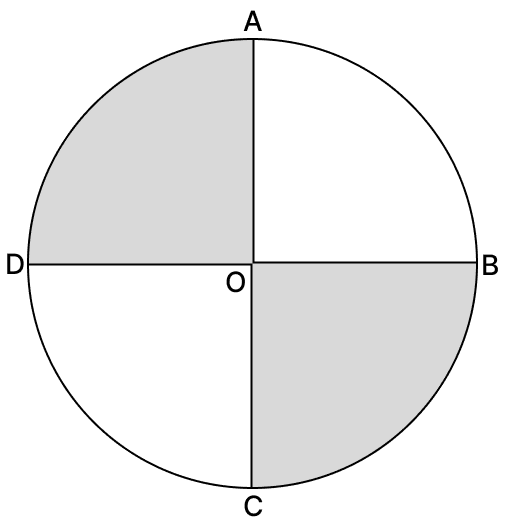
AC and BD are two perpendicular diameters of a circle with centre O. If AC = 16 cm, calculate the area and perimeter of the shaded part. Circumference & Area of a Circle, R.S. Aggarwal Mathematics Solutions ICSE Class 9.

Answer

Given,

AC = 16 cm (diameter)

Radius (r) = 162\dfrac{16}{2} = 8 cm.

Two perpendicular diameters divide the circle into 4 quadrants.

Area of each quadrant = 14\dfrac{1}{4} Area of circle

Since, 2 quadrants are shaded. Thus,

Area of shaded part=2×42πr2=12×3.14×82=12×3.14×64=3.14×32=100.48 cm2.\therefore \text{Area of shaded part} = 2 \times \dfrac{4}{2} πr^2 \\[1em] = \dfrac{1}{2} \times 3.14 \times 8^2 \\[1em] = \dfrac{1}{2} \times 3.14 \times 64 \\[1em] = 3.14 \times 32 \\[1em] = 100.48 \text{ cm}^2.

Full circumference = 2πr = 2 × 3.14 × 8 = 50.24 cm.

Only quarter arc is shaded.

AD = 14\dfrac{1}{4} × 50.24 = 12.56.

Perimeter of the shaded part = 2(OA + OD + arc AD)

Perimeter = 2(8 + 8 + 12.56)

= 2(16 + 12.56)

= 2(28.56) = 57.12 cm.

Hence, area = 100.48 cm2 and perimeter = 57.12 cm.

Question 22

Find the area of circle circumscribing an equilateral triangle of side 15 cm.

Answer

Given,

Side of an equilateral triangle = 15 cm.

For an equilateral,

Radius of circumcircle = Length of each side of triangle3\dfrac{\text{Length of each side of triangle}}{\sqrt{3}}

R = 153=53\dfrac{15}{\sqrt{3}} = 5\sqrt{3} cm.

Area of circle = πR2

= π(53)2\pi(5\sqrt{3})^2

= π × 25 × (3\sqrt{3})2

= π × 25 × 3

= 3.14 × 75 = 235.5 cm2.

Hence, area of circle = 235.5 cm2.

Question 23

Find the area of a circle inscribed in an equilateral triangle of side 18 cm.

Answer

For an equilateral triangle,

Radius of incircle = Length of each side of triangle23\dfrac{\text{Length of each side of triangle}}{2\sqrt{3}}

=1823=93=33 cm.= \dfrac{18}{2\sqrt{3}} \\[1em] = \dfrac{9}{\sqrt{3}} \\[1em] = 3\sqrt{3} \text{ cm}.

Area of circle = πr2

= 3.14×(33)23.14 \times (3\sqrt{3})^2

= 3.14 × 27

= 84.78 cm2.

Hence, area of circle = 84.78 cm2.

Question 24

The shape of the top of a table in a restaurant is that of a segment of a circle with centre O and ∠BOD = 90°. BO = OD = 60 cm. Find :

(i) the area of the top of the table;

(ii) the perimeter of the table.
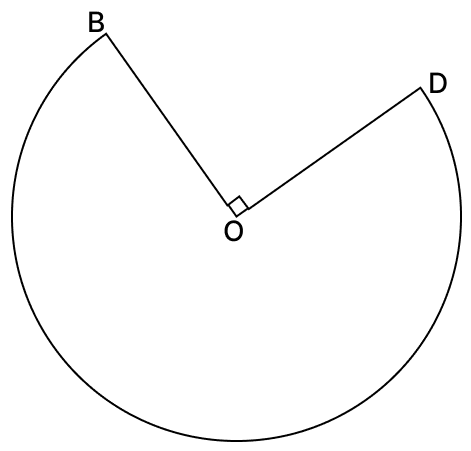
The shape of the top of a table in a restaurant is that of a segment of a circle with centre O and ∠BOD = 90. Circumference & Area of a Circle, R.S. Aggarwal Mathematics Solutions ICSE Class 9.

Answer

Since,

OB = OD = 60 cm

Thus, radius of circle (r) = 60 cm

∠BOD = 90°.

(i) Area of circle = πr2

= 3.14 × (60)2

= 3.14 × 3600 = 11304 cm2.

Area of sector of 90° = 90360\dfrac{90}{360} × πr2

= 14\dfrac{1}{4} × 11304 = 2826 cm2.

From figure,

Area of top of the table = Area of circle - Area of sector 90°

Area of top of the table = 11304 - 2826

= 8478 cm2.

Hence, area of top of the table = 8478 cm2.

(ii) Circumference of circle = 2πr

= 2 × 3.14 × 60 = 376.8 cm.

Length of 270° arc = 270360\dfrac{270}{360} × 376.8

= 34\dfrac{3}{4} × 376.8

= 3 × 94.2 = 282.6 cm.

From figure,

Perimeter of table top = Circumference of major arc (of 270°) + OB + OD

= 282.6 + 60 + 60

= 282.6 + 120

= 402.6 cm.

Hence, perimeter of the table = 402.6 cm.

Question 25

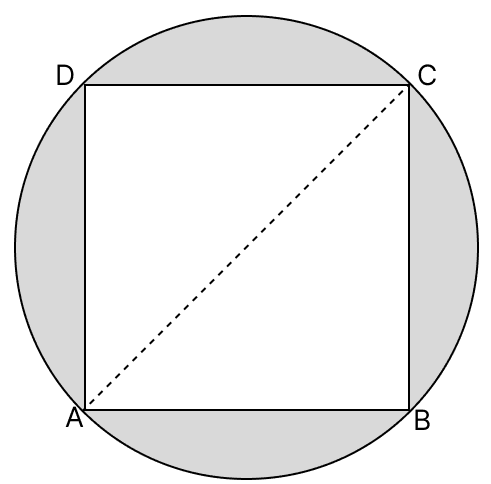
In the given figure, ABCD is a square of side 5 cm inscribed in a circle. Find :

(i) the radius of the circle,

(ii) the area of the shaded region.
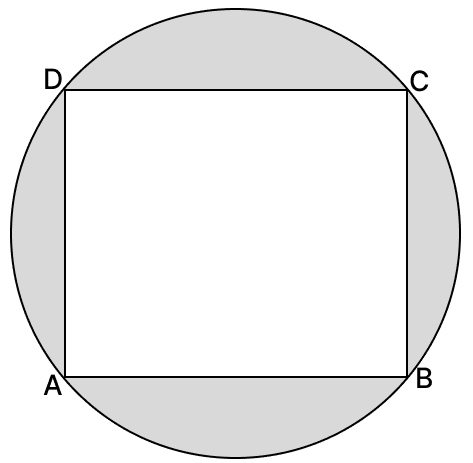
In the given figure, ABCD is a square of side 5 cm inscribed in a circle. Circumference & Area of a Circle, R.S. Aggarwal Mathematics Solutions ICSE Class 9.

Answer

In the given figure, ABCD is a square of side 5 cm inscribed in a circle. Circumference & Area of a Circle, R.S. Aggarwal Mathematics Solutions ICSE Class 9.

(i) Given,

Side of a square = 5 cm.

From figure,

Diagonal of square = Diameter of circle

Diagonal of square = 2\sqrt{2} × Side of square

= 525\sqrt{2} cm

∴ Radius = Diameter2=522\dfrac{\text{Diameter}}{2} = \dfrac{5\sqrt{2}}{2} cm.

Hence, radius of circle = 522\dfrac{5\sqrt{2}}{2} cm.

(ii) Area of shaded region = Area of circle - Area of square

=3.14×(522)252=3.14×50425=3.14×25225=39.2525=14.25 cm2.= 3.14 \times \Big(\dfrac{5\sqrt{2}}{2}\Big)^2 - 5^2 \\[1em] = 3.14 \times \dfrac{50}{4} - 25 \\[1em] = 3.14 \times \dfrac{25}{2} - 25 \\[1em] = 39.25 - 25 \\[1em] = 14.25 \text{ cm}^2.

Hence area of shaded region = 14.25 cm2.

Question 26

In the given figure, ABCD is a rectangle inscribed in a circle. If two adjacent sides of the rectangle be 8 cm and 6 cm, calculate :

(i) the radius of the circle; and

(ii) the area of the shaded region.
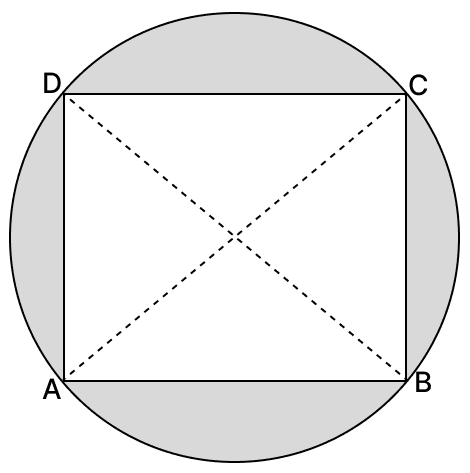
In the given figure, ABCD is a rectangle inscribed in a circle. If two adjacent sides of the rectangle be 8 cm and 6 cm, calculate. Circumference & Area of a Circle, R.S. Aggarwal Mathematics Solutions ICSE Class 9.

Answer

(i) Given,

Rectangle sides = 8 cm and 6 cm.

Let AB = 8 cm and BC = 6 cm

By pythagoras theorem,

AC2 = AB2 + BC2

AC2 = 82 + 62

AC2 = 64 + 36

AC2 = 100

AC = 100\sqrt{100} = 10 cm.

Diameter of circle = 10 cm

Radius = 102\dfrac{10}{2} = 5 cm.

Hence, radius of circle = 5 cm.

(ii) Shaded area = Area of circle - Area of rectangle

Area of circle = πr2

= 3.14 × 52

= 3.14 × 25 = 78.5 cm2.

Area of rectangle = 8 × 6 = 48 cm2.

Shaded area = 78.5 - 48 = 30.5 cm2.

Hence, shaded area = 30.5 cm2.

Question 27

Calculate the area of the shaded region, if the diameter of the semi-circle is 14 cm.
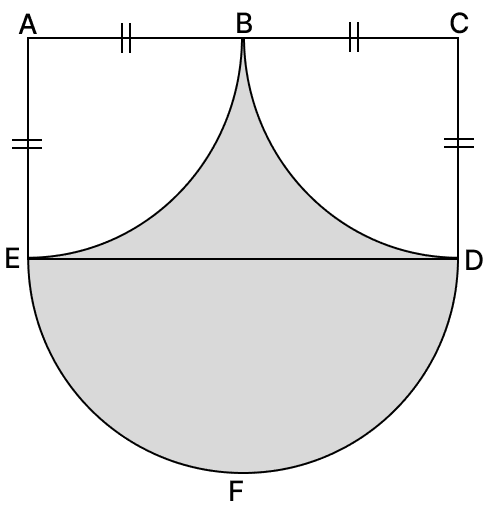
Calculate the area of the shaded region, if the diameter of the semi-circle is 14 cm.Circumference & Area of a Circle, R.S. Aggarwal Mathematics Solutions ICSE Class 9.

Answer

Given,

Diameter of semicircle = 14 cm

radius = 142\dfrac{14}{2} = 7 cm

Calculating the area of semi-circle EDF,

Area of semi-circle EDF=12×πr2=12×227×72=117×49=11×7=77 cm2.\text{Area of semi-circle EDF} = \dfrac{1}{2} \times πr^2 \\[1em] = \dfrac{1}{2} \times \dfrac{22}{7} \times 7^2 \\[1em] = \dfrac{11}{7} \times 49 \\[1em] = 11 \times 7 \\[1em] = 77 \text{ cm}^2.

From figure,

AC = ED = 14 cm

Since, AB = BC

Thus, AB = BC = AC2=142\dfrac{AC}{2} = \dfrac{14}{2} = 7 cm.

From figure,

AE = AB = 7 cm.

Area of rectangle ACDE = AC × AE

= 14 × 7 = 98 cm2.

ABE and BCD are two quadrants each with radius 7 cm.

Calculating the area of two quadrants,

Area of two quadrants=2×14πr2=12×227×72=117×49=11×7=77 cm2.\text{Area of two quadrants} = 2 \times \dfrac{1}{4}πr^2 \\[1em] = \dfrac{1}{2} \times \dfrac{22}{7} \times 7^2 \\[1em] = \dfrac{11}{7} \times 49 \\[1em] = 11 \times 7 \\[1em] = 77 \text{ cm}^2.

Area of shaded region = Area of semi-circle EDF + Area of rectangle ACDE - Area of two quadrants

= 77 + 98 - 77 = 98 cm2.

Hence, area of shaded region = 98 cm2.

Question 28

Find the area of the unshaded portion of the given figure within the rectangle.
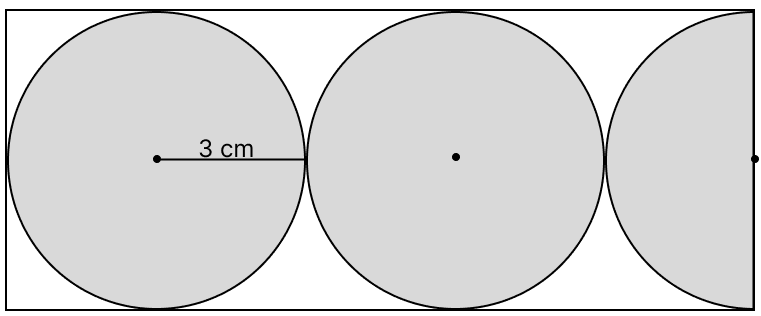
Find the area of the unshaded portion of the given figure within the rectangle. Circumference & Area of a Circle, R.S. Aggarwal Mathematics Solutions ICSE Class 9.

Answer

Given,

Radius of circle = 3 cm.

From figure,

Length of rectangle = Diameter of first circle + Diameter of second circle + Radius of third circle

= 6 + 6 + 3

= 15 cm.

Breadth of rectangle = Diameter of a circle = 6 cm.

Area of rectangle = length × bredath

= 15 × 6 = 90 cm2.

Area of 2 full circles = 2 × πr2

= 2 × 3.14 × 32

= 6.28 × 9

= 56.52 cm2.

Area of 1 semicircle = 12\dfrac{1}{2} × πr2

= 12\dfrac{1}{2} × 3.14 × 9 = 14.13 cm2.

From figure,

Area of unshaded portion = Area of rectangle - Area of 2 full circle - Area of semicircle

= 90 - 56.52 - 14.

= 90 - 70.65

= 19.35 cm2.

Hence area of unshaded region = 19.35 cm2.

Question 29

In an equilateral △ABC of side 14 cm, side BC is the diameter of a semi-circle as shown in the figure. Find the area of the shaded region.
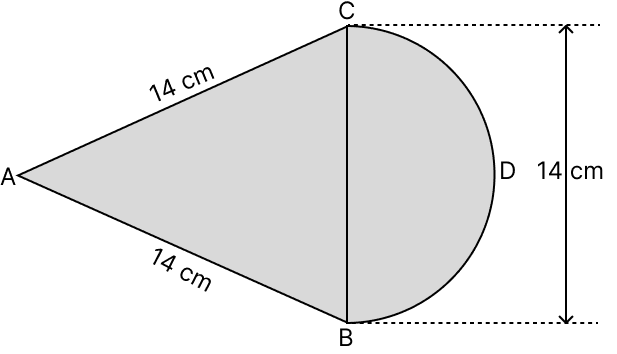
In an equilateral △ABC of side 14 cm, side BC is the diameter of a semi-circle as shown in the figure. Find the area of the shaded region. Circumference & Area of a Circle, R.S. Aggarwal Mathematics Solutions ICSE Class 9.

Answer

Given,

Equilateral triangle side = 14 cm.

BC = 14 cm is diameter of semi-circle.

∴ Radius = 142\dfrac{14}{2} = 7 cm.

Area of shaded region = Area of equilateral △ABC + Area of semi-circle BDC

Calculating the area of equilateral triangle ABC,

Area of equilateral triangle ABC=34×(side)2=34×142=34×196=1.732×49=84.868 cm2.\text{Area of equilateral triangle ABC} = \dfrac{\sqrt{3}}{4} \times \text{(side)}^2 \\[1em] = \dfrac{\sqrt{3}}{4} \times 14^2 \\[1em] = \dfrac{\sqrt{3}}{4} \times 196 \\[1em] = 1.732 \times 49 \\[1em] = 84.868 \text{ cm}^2.

Calculating the area of semi-circle BDC,

Area of semi-circle BDC=12πr2=12×227×72=12×227×49=11×7=77 cm2.\text{Area of semi-circle BDC} = \dfrac{1}{2} πr^2 \\[1em] = \dfrac{1}{2} \times \dfrac{22}{7} \times 7^2 \\[1em] = \dfrac{1}{2} \times \dfrac{22}{7} \times 49 \\[1em] = 11 \times 7 \\[1em] = 77 \text{ cm}^2.

Area of shaded region = Area of equilateral triangle ABC + Area of semi-circle BDC

= 84.868 + 77 = 161.868 cm2.

Hence, area of shaded region = 161.868 cm2.

Question 30

In the given figure, AB is the diameter of a circle with centre O and OA = 7 cm. Find the area of the shaded region.
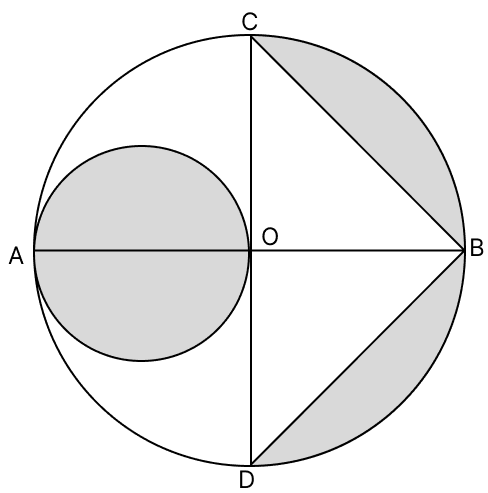
In the given figure, AB is the diameter of a circle with centre O and OA = 7 cm. Find the area of the shaded region. Circumference & Area of a Circle, R.S. Aggarwal Mathematics Solutions ICSE Class 9.

Answer

In the figure,

AB and CD both are diameter of circle and they intersect at 90°.

OA = OB = OC = OD = radius of big circle (R) = 7 cm.

∠BOC = 90°

In triangle BOC,

By pythagoras theorem,

BC2 = OB2 + OC2

BC2 = 72 + 72

BC2 = 49 + 49

BC2 = 98

BC = 98=72\sqrt{98} = 7\sqrt{2} cm.

In figure,

The smaller circle has diameter = OA = 7 cm, so radius (r) = 72\dfrac{7}{2} cm.

Calculating,

Area of smaller circle=πr2=227×(72)2=227×494=11×72=772=38.5 cm2.\text{Area of smaller circle} = πr^2 \\[1em] = \dfrac{22}{7} \times \Big(\dfrac{7}{2}\Big)^2 \\[1em] = \dfrac{22}{7} \times \dfrac{49}{4} \\[1em] = \dfrac{11 × 7}{2} \\[1em] = \dfrac{77}{2} \\[1em] = 38.5 \text{ cm}^2.

Calculating area of semi-circle CBD,

Area of semi-circle CBD=12πR2=12×227×72=117×49=11×7=77 cm2.\text{Area of semi-circle CBD} = \dfrac{1}{2}πR^2 \\[1em] = \dfrac{1}{2} \times \dfrac{22}{7} \times 7^2 \\[1em] = \dfrac{11}{7} \times 49 \\[1em] = 11 \times 7 \\[1em] = 77 \text{ cm}^2.

Calculating area of triangle DBC,

Area of △DBC=12×CD×OB=12×14×7=49 cm2.\text{Area of △DBC} = \dfrac{1}{2} \times CD \times OB \\[1em] = \dfrac{1}{2} \times 14 \times 7 \\[1em] = 49 \text{ cm}^2.

From figure,

Area of shaded area = Area of smaller circle + Area of semicircle - Area of triangle

= 38.5 + 77 - 49

= 115.5 - 49 = 66.5 cm2.

Hence, area of shaded region = 66.5 cm2.

Question 31

In the given figure, PQRS is a diameter of a circle of radius 6 cm. The lengths PQ, QR and RS are equal. Semi-circles are drawn on PQ and QS as diameters. If PS = 12 cm, find the perimeter and the area of the shaded region.
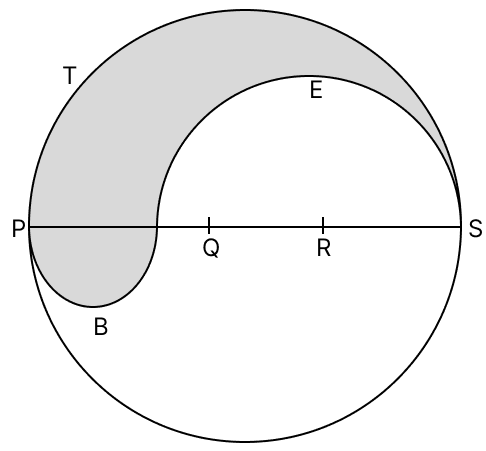
In the given figure, PQRS is a diameter of a circle of radius 6 cm. The lengths PQ, QR and RS are equal. Semi-circles are drawn on PQ and QS as diameters. If PS = 12 cm, find the perimeter and the area of the shaded region. Circumference & Area of a Circle, R.S. Aggarwal Mathematics Solutions ICSE Class 9.

Answer

Given,

PS = 12 cm

PQ = QR = RS = 123\dfrac{12}{3} = 4 cm, QS = 8 cm.

Perimeter of shaded region = Arc PTS + Arc PBQ + Arc QES

Radius of semi-circle PTS = 122\dfrac{12}{2} = 6 cm.

Arc PTS = 12\dfrac{1}{2} × 2π.radius

= πr

= 3.14 × 6 = 18.84 cm.

Radius of semi-circle PBQ = 42\dfrac{4}{2} = 2 cm.

Arc PBQ = π.radius

= 3.14 × 2 = 6.28 cm.

Radius of semi-circle QES = 82\dfrac{8}{2} = 4 cm.

Arc QES = π.radius

= 3.14 × 4 = 12.56 cm.

Perimeter of shaded region = Arc PTS + Arc PBQ + Arc QES

= 18.84 + 6.28 + 12.56

= 37.68 cm.

Area of shaded region = Area of big semicircle + Area of small semicircle on PQ - Area of semicircle on QS

Calculating area of big semicircle,

Area of big semicircle=12π.(radius)2=12×3.14×62=12×3.14×36=3.14×18=56.52 cm2.\text{Area of big semicircle} = \dfrac{1}{2}π.\text{(radius)}^2 \\[1em] = \dfrac{1}{2} \times 3.14 \times 6^2 \\[1em] = \dfrac{1}{2} \times 3.14 \times 36 \\[1em] = 3.14 × 18 \\[1em] = 56.52 \text{ cm}^2.

Area of small semicircle on PQ = 12\dfrac{1}{2} π.(radius)2

= 12\dfrac{1}{2} × 3.14 × 2^2

= 3.14 × 2 = 6.28 cm2.

Area of semicircle on QS = 12\dfrac{1}{2} π.(radius)2

= 12\dfrac{1}{2} × 3.14 × 42

= 3.14 × 8 = 25.12 cm2

Area of shaded region = 56.52 + 6.28 - 25.12

= 37.68 cm2.

Hence, area of shaded region = 37.68 cm2 and perimeter = 37.68 cm.

Question 32

In the given figure, ABCD is a piece of cardboard in the shape of trapezium in which AB || DC, ∠ABC = 90°. From this piece, quarter circle BEFC is removed. Given DC = BC = 4.2 cm and AE = 2 cm. Calculate the area of the remaining piece of the cardboard.
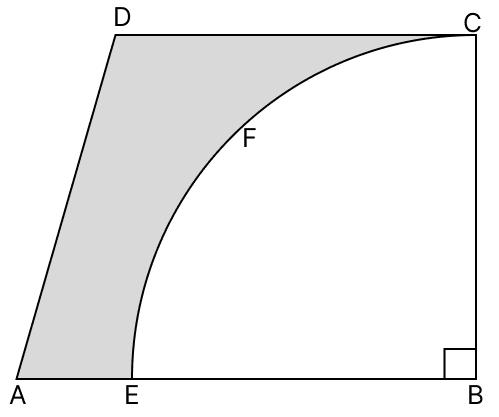
In the given figure, ABCD is a piece of cardboard in the shape of trapezium in which AB || DC, ∠ABC = 90. Circumference & Area of a Circle, R.S. Aggarwal Mathematics Solutions ICSE Class 9.

Answer

Given,

AB ∥ DC

∠ABC = 90°

DC = 4.2 cm

BC = 4.2 cm

AE = 2 cm

Quarter circle BEFC is removed.

Since it is a quarter circle with centre at B:

So, radius = BC = 4.2 cm

From figure,

AB = AE + EB

AB = 2 + 4.2 = 6.2 cm.

Calculating the area of trapezium ABCD,

Area of trapezium ABCD=12×(sum of parallel sides)×height=12×(6.2+4.2)×4.2=12×(10.4)×4.2=5.2×4.2=21.84 cm2.\text{Area of trapezium ABCD} = \dfrac{1}{2} \times \text{(sum of parallel sides)} \times \text{height} \\[1em] = \dfrac{1}{2} \times (6.2 + 4.2) \times 4.2 \\[1em] = \dfrac{1}{2} \times (10.4) \times 4.2 \\[1em] = 5.2 \times 4.2 \\[1em] = 21.84 \text{ cm}^2.

Calculating the area of quarter circle,

Area of quarter circle=14πr2=14×227×(4.2)2=112×7×17.64=11×1.26=13.86 cm2.\text{Area of quarter circle} = \dfrac{1}{4}πr^2 \\[1em] = \dfrac{1}{4} \times \dfrac{22}{7} \times (4.2)^2 \\[1em] = \dfrac{11}{2 × 7} \times 17.64 \\[1em] = 11 \times 1.26 \\[1em] = 13.86 \text{ cm}^2.

From figure,

Area of remaining piece of cardboard = Area of trapezium - Area of quarter circle

= 21.84 - 13.86

= 7.98 cm2.

Hence, area of remaining piece of cardboard = 7.98 cm2.

Question 33

Find the perimeter and area of the shaded region shown in the figure. The four corners are circle quadrants and at the centre, there is a circle.
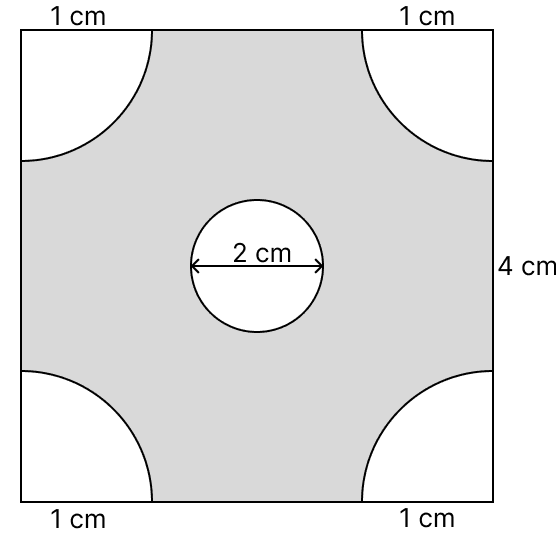
Find the perimeter and area of the shaded region shown in the figure. The four corners are circle quadrants and at the centre, there is a circle. Circumference & Area of a Circle, R.S. Aggarwal Mathematics Solutions ICSE Class 9.

Answer

4 quadrants = 1 full circle

Circumference of circle = 2πr

= 2 × 3.14 × 1

= 6.28 cm.

Length of each shaded straight sides = 4 - 1 - 1 = 2 cm.

Total length = 4 × 2 = 8 cm.

Central circle boundary :

radius = 22\dfrac{2}{2} = 1 cm.

Circumference of circle = 2πr

= 2 × 3.14 × 1

= 6.28 cm.

Total perimeter = 6.28 + 8 + 6.28 = 20.56 cm.

Area of shaded region = Area of the square - (Area removed at the corners - Area of central circle)

Area of square = (side)2 = 42 = 16 cm2.

Area removed at the corners :

Area of 1 quadrant = 14\dfrac{1}{4} πr2

= 14\dfrac{1}{4} × 3.14 × 12 = 0.785

∴ For 4 quadrants = 4 × 0.785 = 3.14 cm2.

Area of central circle = πr2

= 3.14 × 12 = 3.14 cm2.

Area of shaded region = Area of square - Area of central circle - Area of 4 quadrants

= 4 × 4 - (3.14 + 3.14)

= 16 - 6.28 = 9.72 cm2.

Hence, perimeter = 20.56 cm and area of shaded region = 9.72 cm2.

Question 34

Find the perimeter and area of the shaded region in the given figure.
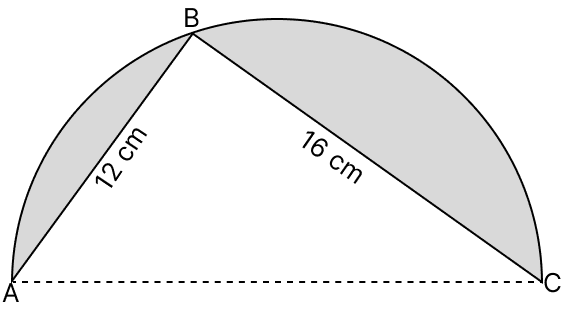
Find the perimeter and area of the shaded region in the given figure. Circumference & Area of a Circle, R.S. Aggarwal Mathematics Solutions ICSE Class 9.

Answer

Given,

AB = 12 cm

BC = 16 cm

AC is the diameter of the semicircle.

Angle in a semicircle is a right angle, thus, ABC = 90°

Using Pythagoras theorem in △ABC:

⇒ AC2 = AB2 + BC2

⇒ AC2 = 122 + 162

⇒ AC2 = 144 + 256

⇒ AC2 = 400

⇒ AC = 400\sqrt{400} = 20 cm.

So, radius = 202\dfrac{20}{2} = 10 cm.

Semicircle arc = πr = 3.14 × 10 = 31.4 cm

Perimeter = Semicircle arc + side AB + side BC

Perimeter = 31.4 + 12 + 16

= 59.4 cm

Area of shaded region = Area of semicircle - Area of triangle

Calculating the area of semicircle,

Area of semicircle=12πr2=12×3.14×102=12×3.14×100=3.14×50=157 cm2.\text{Area of semicircle} = \dfrac{1}{2} πr^2 \\[1em] = \dfrac{1}{2} \times 3.14 \times 10^2 \\[1em] = \dfrac{1}{2} \times 3.14 \times 100 \\[1em] = 3.14 \times 50 \\[1em] = 157 \text{ cm}^2.

Area of triangle = 12\dfrac{1}{2} × AB × BC

= 12\dfrac{1}{2} × 12 × 16

= 6 × 16 = 96 cm2.

Area of shaded region = 157 - 96 = 61 cm2.

Hence, perimeter of shaded region = 59.4 cm and area of shaded region = 61 cm2.

Question 35

In the given figure, ABCP is a quadrant of a circle of radius 14 cm. With AC as diameter, a semi-circle is drawn. Find the area of shaded region.
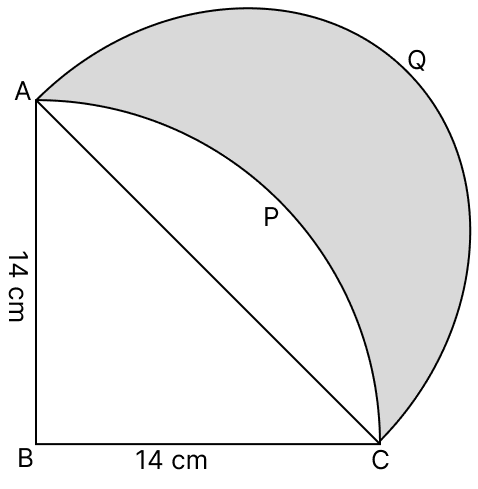
In the given figure, ABCP is a quadrant of a circle of radius 14 cm. With AC as diameter, a semi-circle is drawn. Find the area of shaded region. Circumference & Area of a Circle, R.S. Aggarwal Mathematics Solutions ICSE Class 9.

Answer

Given,

ABCP is a quadrant of radius = 14 cm

AB = BC = 14 cm

AC is the diameter of semicircle.

Using Pythagoras theorem in △ABC,

⇒ AC2 = AB2 + BC2

⇒ AC2 = 142 + 142

⇒ AC2 = 196 + 196

⇒ AC2 = 392

⇒ AC = 392=142\sqrt{392} = 14\sqrt{2} cm.

So, radius of semicircle = 1422=72\dfrac{14\sqrt{2}}{2} = 7\sqrt{2} cm.

Calculating area of semicircle :

Area of semicircle=12πr2=12×227×(72)2=117×49×2=11×7×2=154 cm2.\text{Area of semicircle} = \dfrac{1}{2}πr^2 \\[1em] = \dfrac{1}{2} \times \dfrac{22}{7} \times (7\sqrt{2})^2 \\[1em] = \dfrac{11}{7} \times 49 \times 2 \\[1em] = 11 \times 7 \times 2 \\[1em] = 154 \text{ cm}^2.

Calculating area of quadrant :

Area of quadrant=14πr2=14×227×142=1114×196=154 cm2.\text{Area of quadrant} = \dfrac{1}{4}πr^2 \\[1em] = \dfrac{1}{4} \times \dfrac{22}{7} \times 14^2 \\[1em] = \dfrac{11}{14} \times 196 \\[1em] = 154 \text{ cm}^2.

Calculating area of triangle :

Area of triangle ABC = 12\dfrac{1}{2} × AB × BC

= 12\dfrac{1}{2} × 14 × 14

= 7 × 14 = 98 cm2.

Shaded area = (Area of semicircle AQC) - [(Area of quadrant APCB) - (Area of triangle ABC)]

Area of shaded region = 154 - [(154 - 98)]

= 154 - 56 = 98 cm2.

Hence, area of shaded region = 98 cm2.

Question 36

In the given figure, ABCD is a square of side 14 cm and A, B, C, D are centres of circular arcs, each of radius 7 cm. Find the area of shaded region.
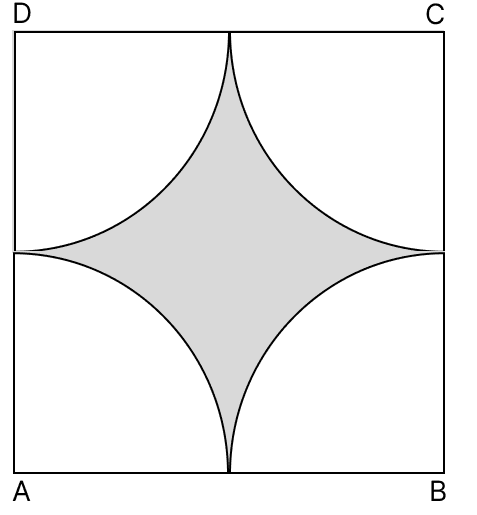
In the given figure, ABCD is a square of side 14 cm and A, B, C, D are centres of circular arcs, each of radius 7 cm. Find the area of shaded region. Circumference & Area of a Circle, R.S. Aggarwal Mathematics Solutions ICSE Class 9.

Answer

Given,

ABCD is a square.

Side = 14 cm

Arcs are drawn from A, B, C, D as centres.

Radius of each arc = 7 cm

Thus, each arc is a quarter circle of radius 7 cm.

Area of square = (side)2

= 142 = 196 cm2.

Area of four quarter circles:

Area of one quarter circle=14πr2=14×π×72=49π4 cm2.\text{Area of one quarter circle} = \dfrac{1}{4}πr^2 \\[1em] = \dfrac{1}{4} \times π \times 7^2 \\[1em] = \dfrac{49π}{4} \text{ cm}^2.

For 4 quarter circles, area = 4 × 49π4\dfrac{49π}{4}

= 49 × 227\dfrac{22}{7}

= 22 × 7 = 154

So, Area of four quarter circles = 154 cm2.

Area of shaded region = Area of square - Area of four quarter circles

Area of shaded region = 196 - 154 = 42 cm2.

Hence, area of shaded region = 42 cm2.

Question 37

In the given figure, ABCD is a square of side 7 cm and A, B, C, D are centres of equal circles which touch externally in pairs. Find the area of the shaded region.
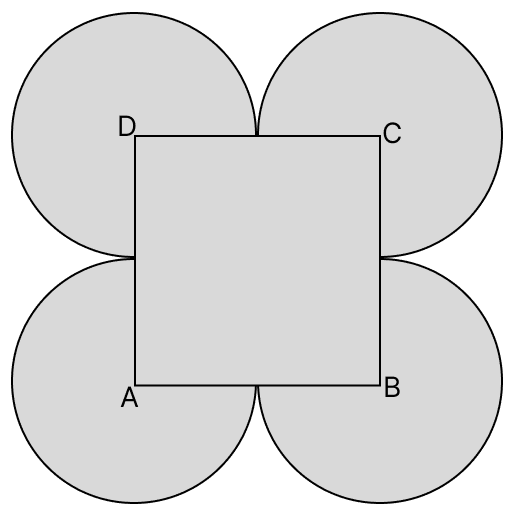
In the given figure, ABCD is a square of side 7 cm and A, B, C, D are centres of equal circles which touch externally in pairs. Find the area of the shaded region. Circumference & Area of a Circle, R.S. Aggarwal Mathematics Solutions ICSE Class 9.

Answer

Given,

ABCD is a square.

Side = 7 cm

Distance between centres of each circle = 7 cm

2r = 7

r = 72\dfrac{7}{2} = 3.5 cm.

Area of 4 circles:

Area of one circle = πr2

= 227\dfrac{22}{7} × (3.5)2

= 227\dfrac{22}{7} × 12.25

= 22 × 1.75 = 38.5

∴ For 4 circles, area = 4 × 38.5 = 154 cm2.

Area of square :

(side)2 = 72 = 49 cm2.

Area of 4 quadrants = Area of one circle = 38.5 cm2.

Area of shaded region = Area of square + Area of 4 circle - Area of 4 quadrants

= 49 + 154 - 38.5

= 164.5 cm2.

Hence, area of shaded region = 164.5 cm2.

Question 38

In the given figure, AB = 12BC\dfrac{1}{2}BC, where BC = 14 cm. Find :

(i) Area of quad. AEFD

(ii) Area of △ABC

(iii) Area of semicircle.

Hence, find the area of shaded region.
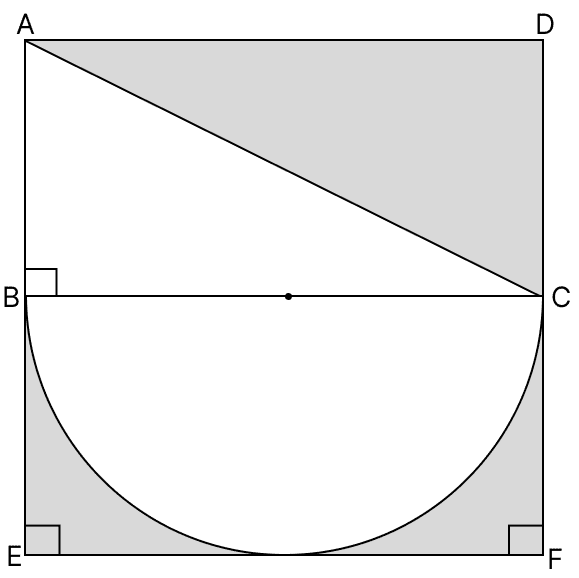
In the given figure, AB = 1/2 where BC = 14 cm. Find Circumference & Area of a Circle, R.S. Aggarwal Mathematics Solutions ICSE Class 9.

Answer

Given,

BC = 14 cm

AB = 12BC=12\dfrac{1}{2}BC = \dfrac{1}{2} × 14 = 7 cm.

BC is a diameter of the semicircle

So, radius = 12\dfrac{1}{2} × 14 = 7 cm.

(i) Area of quadrilateral AEFD:

Height (AE) = AB + BE = 7 + 7 = 14 cm.

Width : AD = BC = 14

Area of quad. AEFD = 14 × 14 = 196 cm2.

Hence, area of quad. AEFD = 196 cm2.

(ii) Area of △ABC:

Area = 12\dfrac{1}{2} × base × height

= 12\dfrac{1}{2} × BC × AB

= 12\dfrac{1}{2} × 14 × 7

= 7 × 7 = 49 cm2.

Hence area of △ABC = 49 cm2.

(iii) Calculating,

Area of semicircle=12πr2=12×227×72.=117×49=11×7=77 cm2.\text{Area of semicircle} = \dfrac{1}{2}πr^2 \\[1em] = \dfrac{1}{2} \times \dfrac{22}{7} \times 7^2. \\[1em] = \dfrac{11}{7} \times 49 \\[1em] = 11 \times 7 \\[1em] = 77 \text{ cm}^2.

Hence, area of semicircle = 77 cm2.

Area of shaded region = Area of quad. AEFD - (Area of triangle ABC + Area of semicircle)

= 196 - (49 + 77)

= 196 - 126

= 70 cm2.

Hence, area of shaded region = 70 cm2.

Question 39

In the adjoining figure, the inside perimeter of a running track with semi-circular ends and straight parallel sides is 312 m. The length of the straight portion of the track is 90 m. If the track has a uniform width of 2 m throughout, find its area.
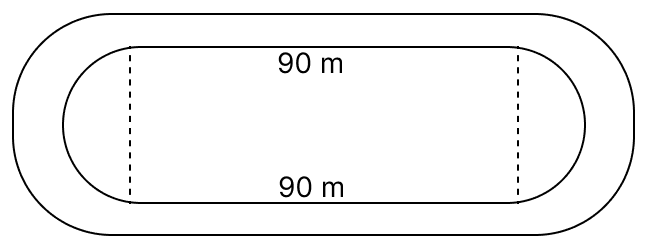
In the adjoining figure, the inside perimeter of a running track with semi-circular ends and straight parallel sides is 312 m. The length of the straight portion of the track is 90 m. If the track has a uniform width of 2 m throughout, find its area. Circumference & Area of a Circle, R.S. Aggarwal Mathematics Solutions ICSE Class 9.

Answer

Given,

Inside perimeter of the track = 312 m

Straight portions = 90 m each

Width of track = 2 m

Let inner radius be 'r' and outer radius be 'R'.

Inside perimeter consists of :

Two straights lengths = 90 + 90 = 180

Two semicircles = one full circle

So,

⇒ 180 + 2πr = 312

⇒ 2πr = 312 - 180

⇒ 2πr = 132

⇒ 2 × 227\dfrac{22}{7} × r = 132

⇒ r = 132×72×22\dfrac{132 \times 7}{2 \times 22}

⇒ r = 21 m.

Outer radius (R) = r + 2

= 21 + 2 = 23 m.

Area of straight rectangular parts:

Area = 2 × (90 × 2)

= 360 m2.

Area of curved part :

Area = π(R2 - r2)

= π(232 - 212)

= π(529 - 441)

= 88π

= 88 × 227\dfrac{22}{7} = 276.57 m2.

Total area of track = 360 + 276.57 = 636.57 m2.

Hence, area of track = 636.57 m2.

Question 40

The diameter of a wheel is 1.26 m. How far will it travel in 500 revolutions?

Answer

Given,

Diameter of wheel (d) = 1.26 m

Number of revolutions (n) = 500

Distance traveled in one revolution = Circumference of wheel

C = 2πr

= πd

= 227\dfrac{22}{7} × 1.26

= 3.96 m.

∴ For 500 revolutions distance is :

500 × 3.96 = 1980 m

Hence, distance covered = 1980 m.

Question 41

The wheel of the engine of a train 4274\dfrac{2}{7} m in circumference makes 7 revolutions in 3 seconds. Find the speed of the train in km per hour.

Answer

Given,

Circumference of wheel = 427 m=3074\dfrac{2}{7} \text{ m} = \dfrac{30}{7} m.

Number of revolutions = 7

Time = 3 seconds

We know that,

Distance = circumference × revolutions

= 307\dfrac{30}{7} × 7

= 30 m.

So the train moves 30 m in 3 seconds.

Speed = DistanceTime\dfrac{Distance}{Time}

= 303\dfrac{30}{3} = 10 m/s.

1 m/s = 3.6 km/h

10 m/s = 10 × 3.6 km/h = 36 km/h

Hence, speed of the train = 36 km per hour.

Question 42

A toothed wheel of diameter 50 cm is attached to a smaller wheel of diameter 30 cm. How many revolutions will the smaller wheel make when the larger one makes 30 revolutions?

Answer

Given,

Diameter of toothed larger wheel = 50 cm

Diameter of smaller wheel = 30 cm

Revolutions of larger wheel = 30

Distance covered by toothed larger wheel :

Distance in one revolution = circumference

C = 2πr = πd

C1 = π × 50

Distance covered in 30 revolutions = 30 × 50π

= 1500π cm

Distance covered by smaller wheel:

C2 = π × 30

Distance covered by smaller wheel in 1 revolution = 1 × 30π = 30π

Number of revolutions of the smaller vehicle

= Distance moved by toothed wheel in 30 revolutionsDistance moved by smaller wheel in 1 revolution\dfrac{\text{Distance moved by toothed wheel in 30 revolutions}}{\text{Distance moved by smaller wheel in 1 revolution}}

= 1500π30π\dfrac{1500π}{30π}

= 50.

Hence, number of revolutions = 50.

Question 43

A wheel makes 1000 revolutions in covering a distance of 88 km. Find the radius of the wheel.

Answer

Given,

Distance covered = 88 km = 88000 m

Number of revolutions = 1000

We know that,

Distance in one revolution = Circumference of wheel

C = 2πr

Circumference = Total distanceNumber of revolutions\dfrac{\text{Total distance}}{\text{Number of revolutions}}

= 880001000\dfrac{88000}{1000} = 88

So, 2πr = 88

⇒ 2 × 227\dfrac{22}{7} × r = 88

⇒ r = 88×744\dfrac{88 × 7}{44}

⇒ r = 2 × 7 = 14 m.

Hence, radius of the wheel = 14 m.

Multiple Choice Questions

Choose the correct option:

Question 1

If the ratio of the areas of two circles is 25 : 4, then the ratio of their diameters is :

  1. 5 : 2

  2. 25 : 4

  3. 625 : 16

  4. 16 : 625

Answer

Area of circle = πr2.

Given,

Ratio of areas of two circles = 25 : 4

πR12 : πR22 = 25 : 4

R12 : R22 = 25 : 4

Taking square root on both terms

R12:R22=25:4\sqrt{R_1^2} : \sqrt{R_2^2} = \sqrt{25} : \sqrt{4}

R1 : R2 = 5 : 2

Let R1 = 5a and R2 = 2a.

Diameter = 2 × Radius

D1 = 2 × R1 = 10a

D2 = 2 × R2 = 4a

D1 : D2 = 10a : 4a = 5 : 2.

Hence, option 1 is the correct option.

Question 2

If the length of a side of a square is same as length of the diameter of a circle, then the ratio of their areas is :

  1. 1 : π

  2. 2 : π

  3. 4 : π

  4. 8 : π

Answer

Given,

Diameter of circle = side of square = s

Area of square = s2

Radius = Diameter2=s2\dfrac{\text{Diameter}}{2} = \dfrac{s}{2}

Area of circle = πr2

= π(s2)2\pi \Big(\dfrac{s}{2}\Big)^2

= πs24\dfrac{πs^2}{4}

Area of square : Area of circle

= s2 : πs24\dfrac{πs^2}{4}

= s2πs24\dfrac{s^2}{\dfrac{πs^2}{4}}

= 4π\dfrac{4}{π}

= 4 : π.

Hence, option 3 is the correct option.

Question 3

The ratio of the numerical values of the circumference and area of a semicircle of radius 5 units is :

  1. 4 : 5

  2. 2 : 5

  3. 12 : 25

  4. 6 : 25

Answer

Circumference of semicircle = πr = 5π.

Area of semicircle=12πr2=12×π×52=25π2\text{Area of semicircle} = \dfrac{1}{2}πr^2 \\[1em] = \dfrac{1}{2} \times π \times 5^2 \\[1em] = \dfrac{25π}{2}

Required ratio = 5π25π2\dfrac{5π}{\dfrac{25π}{2}}

= 10π25π\dfrac{10π}{25π}

= 25\dfrac{2}{5}

= 2 : 5.

Hence, option 2 is the correct option.

Question 4

If the perimeters of a circle and a square are same, then the ratio of their areas is :

  1. 2 : π

  2. 4 : π

  3. 16 : π

  4. π : 4

Answer

Given,

Circumference of circle = 2πr

Perimeter of square = 4a

Given,

Perimeter of square = Circumference of circle

⇒ 4a = 2πr

⇒ 2a = πr

⇒ a = πr2\dfrac{πr}{2}

Area of circle = πr2

Area of square = a2

= (πr2)2\Big(\dfrac{πr}{2}\Big)^2

= π2r24\dfrac{π^2r^2}{4}

⇒ Area of circle : Area of square

= πr2 : π2r24\dfrac{π^2r^2}{4}

= πr2π2r24\dfrac{πr^2}{\dfrac{π^2r^2}{4}}

= 4πr2π2r2\dfrac{4πr^2}{π^2r^2}

= 4π\dfrac{4}{π}

= 4 : π.

Hence, option 2 is the correct option.

Question 5

The area of the circumscribed circle of a square of each side p units is :

  1. 2πp2 sq units

  2. πp24\dfrac{πp^2}{4} sq units

  3. πp22\dfrac{πp^2}{2} sq units

  4. πp2 sq units

Answer

Find the perimeter and area of quadrilateral ABCD in which AB = 9 cm, AD = 12 cm, BD = 15 cm, CD = 17 cm and ∠CBD = 90. Circumference & Area of a Circle, R.S. Aggarwal Mathematics Solutions ICSE Class 9.

ABCD is a square with diagonal 'd' units and side 'p' units.

From figure,

Diameter of the circle = diagonal of the square.

Side of square = p units.

Diagonal of square (d)=p2+p2=2p2=p2\text{Diagonal of square (d)} = \sqrt{p^2 + p^2} \\[1em] = \sqrt{2p^2} \\[1em] = p\sqrt{2}

Radius of circle = d2=p22\dfrac{d}{2} = \dfrac{p\sqrt{2}}{2} units.

Calculating,

Area of circle=πr2=π(p22)2=π×p2×24=πp22 sq units.\text{Area of circle} = πr^2 \\[1em] = π\Big(\dfrac{p\sqrt{2}}{2}\Big)^2 \\[1em] = π \times \dfrac{p^2 × 2}{4} \\[1em] = \dfrac{πp^2}{2} \text{ sq units}.

Hence, option 3 is the correct option.

Question 6

The radius of a circle whose area is equal to the sum of the areas of two circles of radii 7 cm and 24 cm respectively is :

  1. 31 cm

  2. 28 cm

  3. 27 cm

  4. 25 cm

Answer

Let A1 and A2 be the areas of two circles.

Area = πr2

Areas of the two circles:

⇒ A1 = π.(7)2 = 49π.

⇒ A2 = π.(24)2 = 576π

∴ Sum of the areas of the two circles = 49π + 576π = 625π.

Let the radius of new circle be 'R' cm.

⇒ πR2 = 625π

⇒ R2 = 625

⇒ R = 625\sqrt{625} = 25 cm.

Hence, option 4 is the correct option.

Question 7

The radius of the circle whose area is equal to the sum of areas of two circles of radii 9 cm and 12 cm respectively is :

  1. 11 cm

  2. 12 cm

  3. 14 cm

  4. 15 cm

Answer

Let A1 and A2 be the areas of two circles.

Area = πr2

Areas of the two circles:

⇒ A1 = π.(9)2 = 81π.

⇒ A2 = π.(12)2 = 144π

∴ Sum of the areas of the two circles = 81π + 144π = 225π.

Let the radius of new circle be R cm.

⇒ πR2 = 225π

⇒ R2 = 225

⇒ R = 225\sqrt{225} = 15 cm.

Hence, option 4 is the correct option.

Question 8

The area of a circular garden is 55.44 m2. How long wire is needed for fencing the garden ?

  1. 21.4 m

  2. 22.4 m

  3. 24.6 m

  4. 26.4 m

Answer

Given,

Area of circle = 55.44 m2.

By formula,

Area of circle=πr255.44=πr2227×r2=55.44r2=55.44×722r2=17.64r=17.64r=4.2 m.\text{Area of circle} = πr^2 \\[1em] \Rightarrow 55.44 = πr^2 \\[1em] \Rightarrow \dfrac{22}{7} \times r^2 = 55.44 \\[1em] \Rightarrow r^2 = \dfrac{55.44 × 7}{22} \\[1em] \Rightarrow r^2 = 17.64 \\[1em] \Rightarrow r = \sqrt{17.64} \\[1em] \Rightarrow r = 4.2 \text{ m}.

Wire length = Circumference of the circle

= 2πr

= 2 × 227\dfrac{22}{7} × 4.2

= 26.4 m.

Hence, option 4 is the correct option.

Question 9

The sum of the lengths of a semicircular bow and its string is 360 cm. The length of the bow is :

  1. 214 cm

  2. 216 cm

  3. 218 cm

  4. 220 cm

Answer

Given,

The sum of the lengths of a semicircular bow and its string is 360 cm.

∴ Arc length + Diameter = 360

πr+2r=360227×r+2r=36022r+14r7=36036r7=360r=70 cm.\Rightarrow πr + 2r = 360 \\[1em] \Rightarrow \dfrac{22}{7} \times r + 2r = 360 \\[1em] \Rightarrow \dfrac{22r + 14r}{7} = 360 \\[1em] \Rightarrow \dfrac{36r}{7} = 360 \\[1em] \Rightarrow r = 70 \text{ cm}.

Length of the bow = πr

= 227\dfrac{22}{7} × 70

= 220 cm.

Hence, option 4 is the correct option.

Question 10

Each side of a square formed by a wire is 14 cm. The area of the circle that can be formed by this wire is :

  1. 144 cm2

  2. 154 cm2

  3. 164 cm2

  4. 249.45 cm2

Answer

Given,

Each side of a square formed by a wire is 14 cm.

Total length of wire = Perimeter of square = 4 × 14 = 56 cm.

The circle formed with the wire will be having the circumference = 56 cm.

Let radius of circle be r cm.

2πr = 56

r = 562π=28π\dfrac{56}{2π} = \dfrac{28}{π}

Area of circle = πr2

=π×(28π)2=π×28π×28π=28×28π=28×28227=28×28×722=249.45 cm2= \pi \times \left(\dfrac{28}{π}\right)^2 \\[1em] = \pi \times \dfrac{28}{π} \times \dfrac{28}{π} \\[1em] = \dfrac{28 \times 28}{π} \\[1em] = \dfrac{28 \times 28}{\dfrac{22}{7}} \\[1em] = \dfrac{28 \times 28 \times 7}{22} \\[1em] = 249.45 \text{ cm}^2

Hence, option 4 is the correct option.

Question 11

If the difference between the circumference and the diameter of a circle is 30 cm, the circumference of the circle is :

  1. 44 cm

  2. 45 cm

  3. 46 cm

  4. 48 cm

Answer

Given,

Circumference of circle - Diameter of circle = 30

2πr2r=302r(π1)=302r(2271)=302r(2277)=302r×157=30r=30×72×15 cm.\Rightarrow 2πr - 2r = 30 \\[1em] \Rightarrow 2r(π - 1) = 30 \\[1em] \Rightarrow 2r\Big(\dfrac{22}{7} - 1\Big) = 30 \\[1em] \Rightarrow 2r(\dfrac{22 - 7}{7}) = 30 \\[1em] \Rightarrow 2r \times \dfrac{15}{7} = 30 \\[1em] \Rightarrow r = \dfrac{30 \times 7}{2 \times 15} \text{ cm}.

Circumference of circle = 2πr

= 2 × 227\dfrac{22}{7} × 7

= 2 × 22

= 44 cm.

Hence, option 1 is the correct option.

Question 12

If the area of the inscribed circle of a square is 154 cm2, then the area of a square is :

  1. 190 cm2

  2. 192 cm2

  3. 196 cm2

  4. 198 cm2

Answer

If the area of the inscribed circle of a square is 154 cm 2, then the area of a square is : Circumference & Area of a Circle, R.S. Aggarwal Mathematics Solutions ICSE Class 9.

ABCD is a square with inscribed circle having radius 'r' and center O.

Given,

Area of circle = 154 cm2.

We know that,

Area of circle=πr2πr2=154227×r2=154r2=154×722r2=49r=49=7 cm.\text{Area of circle} = πr^2 \\[1em] \Rightarrow πr^2 = 154 \\[1em] \Rightarrow \dfrac{22}{7} \times r^2 = 154 \\[1em] \Rightarrow r^2 = \dfrac{154 × 7}{22} \\[1em] \Rightarrow r^2 = 49 \\[1em] \Rightarrow r = \sqrt{49} = 7 \text{ cm}.

For a circle inscribed in a square,

Diameter of circle = Side of square

Side = 2r = 2 × 7 = 14 cm.

Area of square = (side)2

= (14)2

= 196 cm2.

Hence, option 3 is the correct option.

Question 13

If the total cost of mowing a circular field at the rate of ₹1.20 per square metre is ₹4,620, then the cost of fencing the field at the rate of ₹4 per metre is :

  1. ₹ 878

  2. ₹ 880

  3. ₹ 882

  4. ₹ 884

Answer

Given,

Rate of mowing = ₹ 1.20 per square metre.

Total cost = ₹4,620

Area = Total costRate\dfrac{\text{Total cost}}{\text{Rate}}

= 46201.20\dfrac{4620}{1.20} = 3850 m2.

Let radius of circular field be r meters.

πr2=3850227×r2=3850r2=3850×722r2=1225r=1225r=35 m.\Rightarrow πr^2 = 3850 \\[1em] \Rightarrow \dfrac{22}{7} \times r^2 = 3850 \\[1em] \Rightarrow r^2 = \dfrac{3850 \times 7}{22} \\[1em] \Rightarrow r^2 = 1225 \\[1em] \Rightarrow r = \sqrt{1225} \\[1em] \Rightarrow r = 35 \text{ m}.

Circumference of circle = 2πr

= 2 × 227\dfrac{22}{7} × 35

= 220 m.

Cost of fencing = Circumference of field × Rate of fencing

= 220 × 4 = ₹ 880.

Hence, option 2 is the correct option.

Question 14

There is a road of equal width all around a circular garden. The outer and inner circumferences of the road are 328 m and 200 m respectively. The area of the road will be :

  1. 5376 m2

  2. 5375 m2

  3. 5374 m2

  4. 5373 m2

Answer

There is a road of equal width all around a circular garden. The outer and inner circumferences of the road are 328 m and 200 m respectively. The area of the road will be. Circumference & Area of a Circle, R.S. Aggarwal Mathematics Solutions ICSE Class 9.

Outer circumference (C1) = 328 m

Inner circumference (C2) = 200 m

Circumference = 2π.radius

Let outre radius be R meters and inner radius be r meters.

Calculating outer circumference,

Outer circumference=2×227×R328=2×227×RR=328×744=57411 m\Rightarrow \text{Outer circumference} = 2 \times \dfrac{22}{7} \times R \\[1em] \Rightarrow 328 = 2 \times \dfrac{22}{7} \times R \\[1em] \Rightarrow R = \dfrac{328 \times 7}{44} = \dfrac{574}{11} \text{ m}

Calculating inner circumference,

Inner circumference=2×227×r200=2×227×rr=200×744r=35011 m.\Rightarrow \text{Inner circumference} = 2 \times \dfrac{22}{7} \times r \\[1em] \Rightarrow 200 = 2 \times \dfrac{22}{7} \times r \\[1em] \Rightarrow r = \dfrac{200 \times 7}{44} \\[1em] \Rightarrow r = \dfrac{350}{11} \text{ m}.

Area = π(R2 - r2)

= π(R + r)(R - r)

=227×(57411+35011)×(5741135011)=227×92411×22411=2×84×32=5376 m2.= \dfrac{22}{7} \times \Big(\dfrac{574}{11} + \dfrac{350}{11}\Big) \times \Big(\dfrac{574}{11} - \dfrac{350}{11}\Big) \\[1em] = \dfrac{22}{7} \times \dfrac{924}{11} \times \dfrac{224}{11} \\[1em] = 2 \times 84 \times 32 \\[1em] = 5376 \text{ m}^2.

Hence, option 1 is the correct option.

Question 15

The diameter of the front wheel and the rear wheel of the cycle are 70 cm and 168 cm respectively. In covering a certain distance, the front wheel makes 600 revolutions. The number of revolutions made by the rear wheel to cover the same distance is :

  1. 248

  2. 250

  3. 252

  4. 254

Answer

Circumference of circle = 2πr = πd

Front wheel circumference :

C1 = π × 70

Rear wheel circumference :

C2 = π × 168

Distance covered by front wheel in 600 revolutions = 600 × π × 70

Let rear wheel revolutions = x

Since both cover the same distance

∴ x × π × 168 = 600 × π × 70

x = 600×70168\dfrac{600 × 70}{168}

x = 42000168\dfrac{42000}{168} = 250.

Hence, option 2 is the correct option.

Case Study Based Questions

Question 1

Case Study
Mr Ranveer lives in Agra. He purchased a rectangular plot ABCD to build a house. He leaves a rectangular area ADEF for parking and two congruent semicircular areas to make lower beds, as shown in the figure.

Mr Ranveer lives in Agra. He purchased a rectangular plot ABCD to build a house. He leaves a rectangular area ADEF for parking and two congruent semicircular areas to make lower beds, as shown in the figure. Circumference & Area of a Circle, R.S. Aggarwal Mathematics Solutions ICSE Class 9.

Based on the above information, answer the following questions:

  1. Area of the plot left for parking is:
    (a) 24 m2
    (b) 48 m2
    (c) 60 m2
    (d) 63 m2

  2. Diameter of each semi-circle is:
    (a) 21 m
    (b) 10.5 m
    (c) 7 m
    (d) 3.5 m

  3. Total area of the two semi-circular flower beds is :
    (a) 80.6 m2
    (b) 82.625 m2
    (c) 86.625 m2
    (d) 90.625 m2

  4. Area of the plot BCEF is :
    (a) 441 m2
    (b) 400 m2
    (c) 380 m2
    (d) 350 m2

  5. Total length of the two semi-circular arcs is :
    (a) 33 m
    (b) 35 m
    (c) 16.5 m
    (d) 54 m

Answer

1. Area of plot left for parking is : ADEF

Area of rectangle ADEF = length × breadth

= 3 × 21 = 63 m2.

Hence, option (d) is the correct option.

2. The vertical line FE = 21 m.

Two semicircles are placed one above the other and are congruent.

Diameter of each = 212\dfrac{21}{2} = 10.5 m.

Hence, option (b) is the correct option.

3. Two semi-circles = one full circle

Diameter = 10.5

Radius = 10.52\dfrac{10.5}{2} = 5.25 m

Area of circle = πr2

= 227\dfrac{22}{7} × (5.25)2

= 227\dfrac{22}{7} × 27.5625

= 86.625 m2.

Hence, option (c) is the correct option.

4. Since,

BF = FE = EC = BC = 21 m.

Thus, BCEF is a square.

Area of square BCEF = (side)2

= (21)2

= 441 m2.

Hence, option (a) is the correct option.

5. Two semicircles = one circle

∴ Total length of two semicircular arcs = Circumference of one circle = 2πr = πd.

= 227\dfrac{22}{7} × 10.5

= 22 × 1.5

= 33 m.

Hence, option (a) is the correct option.

Question 2

Case Study
Some mementos are ordered by a school for awarding their students on the occasion of Annual Day. Each memento is designed as shown in the figure, where its base ABCD is silver plated from the front side at the rate of ₹50 per cm2.

Some mementos are ordered by a school for awarding their students on the occasion of Annual Day. Each memento is designed as shown in the figure, where its base ABCD is silver plated from the front side at the rate of ₹50 per cm. Circumference & Area of a Circle, R.S. Aggarwal Mathematics Solutions ICSE Class 9.

Based on the above information, answer the following questions:

  1. Area of △AOB is :
    (a) 50 cm2
    (b) 52 cm2
    (c) 56 cm2
    (d) 60 cm2

  2. Length of the arc CD is :
    (a) 44 cm
    (b) 22 cm
    (c) 15 cm
    (d) 11 cm

  3. Area of quadrant OCDO is :
    (a) 154 cm2
    (b) 77 cm2
    (c) 38.5 cm2
    (d) 30.5 cm2

  4. Area of major sector formed in the figure is :
    (a) 154 cm2
    (b) 77 cm2
    (c) 100.5 cm2
    (d) 115.5 cm2

  5. Total cost of silver plating is :
    (a) ₹575
    (b) ₹500
    (c) ₹450
    (d) ₹400

Answer

1. OA = OD + AD = 7 + 3 = 10 cm

OB = OC + CB = 7 + 3 = 10 cm

Area of right triangle △AOB = 12×OA×OB\dfrac{1}{2} × OA × OB

= 12\dfrac{1}{2} × 10 × 10

= 50 cm2.

Hence, option (a) is the correct option.

2. Arc CD subtends 90° at the centre.

∴ Arc length CD = 90°360°\dfrac{90°}{360°} × 2πr

= 14×2×227\dfrac{1}{4} × 2 × \dfrac{22}{7} × 7

= 11 cm.

Hence, option (d) is the correct option.

3. Calculating,

Area of quadrant OCD=90°360°×πr214×227×7211×7238.5 cm2.\Rightarrow \text{Area of quadrant OCD} = \dfrac{90°}{360°} \times πr^2 \\[1em] \Rightarrow \dfrac{1}{4} \times \dfrac{22}{7} \times 7^2 \\[1em] \Rightarrow \dfrac{11 × 7}{2} \\[1em] \Rightarrow 38.5 \text{ cm}^2.

Hence, option (c) is the correct option.

4. Major sector angle:

360° - 90° = 270°

Area of major sector=270360×πr2=34×227×72=34×22×7=3×1544=115.5 cm2.\Rightarrow \text{Area of major sector} = \dfrac{270}{360} \times πr^2 \\[1em] = \dfrac{3}{4} \times \dfrac{22}{7} \times 7^2 \\[1em] = \dfrac{3}{4} \times 22 \times 7 \\[1em] = \dfrac{3 × 154}{4} \\[1em] = 115.5 \text{ cm}^2.

Hence, option (d) is the correct option.

5. Area of plated region = Area of triangle AOB - Area of quadrant OCD

= 50 - 38.5

= 11.5 cm2

Total cost of silver plating = ₹50 × 11.5 = ₹ 575.

Hence, option (a) is the correct option.

Assertion-Reason Questions

Question 1

Assertion (A): Total surface area of semi-circle is 18.48 cm2. Its radius is 14 cm.

Reason (R): Total surface area of a semi-circle of radius r is given by 2πr2.

  1. A is true, R is false

  2. A is false, R is true

  3. Both A and R are true

  4. Both A and R are false

Answer

Total surface area of semicircle formula = 12πr2\dfrac{1}{2}πr^2

Considering radius = 14 cm

Total surface area of semicircle = 12×227\dfrac{1}{2} × \dfrac{22}{7} × 142

= 308 cm2.

But the given assertion says 18.48 cm2.

∴ Both Assertion and Reason are false.

Hence, option 4 is the correct option.

Question 2

Assertion (A): The diameter of a cycle wheel is 21 cm. It will make 2000 revolutions to cover a distance of 1.32 km.

Reason (R): Distance covered by a wheel of radius r in one revolution is given by 2πr.

  1. A is true, R is false

  2. A is false, R is true

  3. Both A and R are true

  4. Both A and R are false

Answer

Diameter of wheel = 21 cm

Distance covered in 1 revolution = Circumference of the wheel = 2πr

∴ Reason (R) is true.

We know that,

Circumference of wheel = 2πr = πd

= 227\dfrac{22}{7} × 21

= 66 cm.

Distance covered in 2000 revolutions

= 2000 × 66 = 132000 cm = 132000100000\dfrac{132000}{100000} = 1.32 km

∴ Assertion (A) is true.

Both Assertion and Reason are true.

Hence, option 3 is the correct option.

Competency Focused Questions

Question 1

The number of rounds that a wheel of diameter 711\dfrac{7}{11} m will make in going 4 km is :

  1. 1600

  2. 1800

  3. 1900

  4. 2000

Answer

Given,

Diameter of wheel (d) = 711\dfrac{7}{11} m

Distance = 4 km = 4000 m.

Distance covered in 1 round = Circumference

= 2πr

= πd

= 227×711\dfrac{22}{7} × \dfrac{7}{11}

= 2 m.

Number of rounds = Total distanceDistance covered in one round\dfrac{\text{Total distance}}{\text{Distance covered in one round}}

= 40002\dfrac{4000}{2}

= 2000.

Hence, option 4 is the correct option.

Question 2

Four circular cardboard pieces, each of radius 7 cm are placed in such a way that each piece touches two other pieces. The area of the space enclosed by the four pieces is :

  1. 42 cm2

  2. 40 cm2

  3. 21 cm2

  4. 18 cm2

Answer

Four circular cardboard pieces, each of radius 7 cm are placed in such a way that each piece touches two other pieces. The area of the space enclosed by the four pieces is. Circumference & Area of a Circle, R.S. Aggarwal Mathematics Solutions ICSE Class 9.

Given,

Radius = 7 cm

From figure,

Distance between centres of two touching circles = 2r = 2 × 7 = 14 cm.

So side of the square : AB = BC = CD = DA = 14 cm.

Area of square = (side)2

= (14)2 = 196 cm2.

At each corner of the square there is a quarter circle of radius 7 cm.

Four quarter circles together make one full circle.

Area of one full circle = πr2

= 227\dfrac{22}{7} × 72

= 22 × 7 = 154 cm2.

Area of enclosed space = Area of square - Area of four quarter circles

= 196 - 154

= 42 cm2.

Hence, option 1 is the correct option.

Question 3

In the figure, if the radius of each circle is 5 cm, then area of the shaded region is :

  1. (400 - 50π) cm2

  2. (400 + 100π) cm2

  3. (400 - 100π) cm2

  4. 231 cm2

In the figure, if the radius of each circle is 5 cm, then area of the shaded region is. Circumference & Area of a Circle, R.S. Aggarwal Mathematics Solutions ICSE Class 9.

Answer

In the figure, if the radius of each circle is 5 cm, then area of the shaded region is. Circumference & Area of a Circle, R.S. Aggarwal Mathematics Solutions ICSE Class 9.

There are 9 equal circles each with radius = 5 cm.The shaded region is the space between the four middle touching circles.

The centres of a the four middle circles form a square.

Diameter = 2r = 2 × 5 = 10 cm

Side of a square = 10 cm.

Area of square = (side)2

= 102 = 100 cm2.

Inside the square there are 4 quarter circles, which together to form one full circle of radius 5 cm.

∴ Area of circle = πr2

= π × 52 = 25π.

Area of one shaded region = 100 - 25π.

∴ For 4 identical shaded region

Total area = 4(100 - 25π)

= 400 - 100π cm2.

Hence, option 3 is the correct option.

Question 4

If sum of the areas of two circles with radii r1 and r2 is equal to the area of circle of radius r, then :

  1. r = r1 + r2

  2. r > r1 + r2

  3. r2 < r12 + r22

  4. r2 = r12 + r22

Answer

Given,

Sum of the areas of two circles with radii r1 and r2 is equal to the area of circle of radius r.

π(r1)2 + π(r2)2 = πr2

r12 + r22 = r2

Hence, option 4 is the correct option.

Question 5

Area of sector of central angle 200° of a circle is 770 cm2. The length of the corresponding arc of this sector is :

  1. 701270\dfrac{1}{2} cm

  2. 731373\dfrac{1}{3} cm

  3. 76 cm

  4. 801280\dfrac{1}{2} cm

Answer

Given,

Area of sector = 770 cm2

Central angle = 200°

We know that,

Area of sector=θ360°×πr2770=200°360°×227×r235=59×17×r2r2=7×9×7r2=441r=441r=21 cm.\Rightarrow \text{Area of sector} = \dfrac{\theta}{360°} \times πr^2 \\[1em] \Rightarrow 770 = \dfrac{200°}{360°} \times \dfrac{22}{7} \times r^2 \\[1em] \Rightarrow 35 = \dfrac{5}{9} \times \dfrac{1}{7} \times r^2 \\[1em] \Rightarrow r^2 = 7 \times 9 \times 7 \\[1em] \Rightarrow r^2 = 441 \\[1em] \Rightarrow r = \sqrt{441} \\[1em] \Rightarrow r = 21 \text{ cm}.

Calculating the arc length :

Arc length=θ360°×2πr=200°360°×2×227×21=59×132=6609=7313 cm.\Rightarrow \text{Arc length} = \dfrac{\theta}{360°} \times 2πr \\[1em] = \dfrac{200°}{360°} \times 2 \times \dfrac{22}{7} \times 21 \\[1em] = \dfrac{5}{9} \times 132 \\[1em] = \dfrac{660}{9} \\[1em] = 73\dfrac{1}{3} \text{ cm}.

Hence, option 2 is the correct option.

Question 6

Check whether the following statement is true or false. Justify your answer.
If the length of an arc of a circle of radius r is equal to that of an arc of a circle of radius 2r, then the angle of the corresponding sector of the first circle is double the angle of the corresponding sector of the other circle.

Answer

We know that,

Arc length = θ360\dfrac{\theta}{360} × 2πr

Let L1 and L2 be the arc length of first circle and second circle and θ1 and θ2 be the central angle of the sector for the first circle and second circle respectively.

Arc length for first circle (L1) = θ1360°\dfrac{\theta_1}{360°} × 2πr

Arc length for second circle (L2) = θ2360°\dfrac{\theta_2}{360}° × 2π(2r)

L2 = θ2360°\dfrac{\theta_2}{360°} × 4πr

According to question :

L1 = L2

θ1360°×2πr=θ2360°\dfrac{\theta_1}{360°} × 2πr = \dfrac{\theta_2}{360°} × 4πr

1 = 4θ2

θ1 = 2θ2

∴ Angle of the corresponding sector of the first circle is double the angle of the corresponding sector of the other circle.

Hence, the statement is True.

Question 7

In the figure, a circle is inscribed in a square of side 5 cm and another circle is circumscribing the square. Find the ratio of the area of the outer circle to that of the inner circle.

In the figure, a circle is inscribed in a square of side 5 cm and another circle is circumscribing the square. Find the ratio of the area of the outer circle to that of the inner circle. Circumference & Area of a Circle, R.S. Aggarwal Mathematics Solutions ICSE Class 9.

Answer

Given,

Side of square = 5 cm.

Let A1 and A2 be the areas of the inner and outer circle respectively.

Inner circle (inscribed in the square):

Diameter of the circle = side of the square

Diameter = 5 cm

So, radius = 52\dfrac{5}{2} = 2.5 cm.

Area of inner circle (A1) = πr2

= π(2.5)2

= 6.25π cm2

Outer circle (circumscribing the square)

Diameter of the outer circle = Diagonal of the square

Diameter of the outer circle = a2=52a\sqrt{2} = 5\sqrt{2} cm.

Radius of the outer circle = 522\dfrac{5\sqrt{2}}{2}

Area of outer circle (A2) = πr2

= π(522)2π\Big(\dfrac{5\sqrt{2}}{2}\Big)^2

= π × 25×24\dfrac{25 × 2}{4}

= 12.5π cm2.

Ratio of areas :

Outer area : Inner area

A2 : A1

12.5π : 6.25π

2 : 1.

Hence, ratio = 2 : 1.

PrevNext