KnowledgeBoat Logo
|
OPEN IN APP

Chapter 17

Perimeter & Area of Plane Figures

Class - 9 RS Aggarwal Mathematics Solutions


Exercise 17A

Question 1

Find the area of a triangle whose base is 15 cm and the corresponding height is 9.6 cm.

Answer

Given,

Base = 15 cm

Corresponding height = 9.6 cm

We know that

Area of triangle = 12\dfrac{1}{2} × Base × Corresponding height

= 12\dfrac{1}{2} × 15 × 9.6

= 15 × 4.8

= 72 cm2.

Hence, area of triangle = 72 cm2.

Question 2

Find the area of the triangle whose sides are 13 cm, 14 cm and 15 cm. Also, find the height of the triangle, corresponding to the longest side.

Answer

Let a = 13 cm, b = 14 cm and c = 15 cm.

Then,

s = 12(a+b+c)=12(13+14+15)=422\dfrac{1}{2}(a + b + c) = \dfrac{1}{2}(13 + 14 + 15) = \dfrac{42}{2} = 21 cm.

⇒ (s - a) = (21 - 13) cm = 8 cm.

⇒ (s - b) = (21 - 14) cm = 7 cm.

⇒ (s - c) = (21 - 15) cm = 6 cm.

We know that,

Area of triangle=s(sa)(sb)(sc)21×8×7×6705684 cm2.\Rightarrow \text{Area of triangle} = \sqrt{s(s - a)(s - b)(s - c)} \\[1em] \Rightarrow \sqrt{21 × 8 × 7 × 6} \\[1em] \Rightarrow \sqrt{7056} \\[1em] \Rightarrow 84 \text{ cm}^2.

Length of the longest side = 15 cm.

Let the corresponding height be x cm. Then,

Area=12× Base × Corresponding height 84=12×15×xx=1681511.2 cm.\Rightarrow Area = \dfrac{1}{2} \times \text{ Base } \times \text{ Corresponding height } \\[1em] \Rightarrow 84 = \dfrac{1}{2} \times 15 \times x \\[1em] \Rightarrow x = \dfrac{168}{15} \\[1em] \Rightarrow 11.2 \text{ cm}. \\[1em]

Hence, area of triangle = 84 cm2 and the height of the triangle = 11.2 cm.

Question 3

Find the area of the triangle whose sides are 30 cm, 24 cm and 18 cm. Also, find the length of the altitude corresponding to the smallest side of the triangle.

Answer

Let a = 30 cm, b = 24 cm, c = 18 cm.

Then,

s = 12(a+b+c)=12(30+24+18)=722\dfrac{1}{2}(a + b + c) = \dfrac{1}{2}(30 + 24 + 18) = \dfrac{72}{2} = 36 cm.

⇒ (s - a) = (36 - 30) cm = 6 cm.

⇒ (s - b) = (36 - 24) cm = 12 cm.

⇒ (s - c) = (36 - 18) cm = 18 cm.

We know that,

Area of triangle=s(sa)(sb)(sc)36×6×12×1846656216 cm2.\Rightarrow \text{Area of triangle} = \sqrt{s(s - a)(s - b)(s - c)} \\[1em] \Rightarrow \sqrt{36 × 6 × 12 × 18} \\[1em] \Rightarrow \sqrt{46656} \\[1em] \Rightarrow 216 \text{ cm}^2. \\[1em]

Length of the smallest side = 18 cm.

Let the length of altitude be x cm. Then,

Area=12× Base × Altitude 216=12×18×x216=9xx=216924 cm.\Rightarrow Area = \dfrac{1}{2} \times \text{ Base } \times \text{ Altitude } \\[1em] \Rightarrow 216 = \dfrac{1}{2} \times 18 \times x \\[1em] \Rightarrow 216 = 9x \\[1em] \Rightarrow x = \dfrac{216}{9} \\[1em] \Rightarrow 24 \text{ cm}. \\[1em]

Hence, area of triangle = 216 cm2 and altitude = 24 cm.

Question 4

The lengths of the sides of a triangle are in the ratio 3 : 4 : 5 and its perimeter is 144 cm. Find the area of the triangle.

Answer

It is given that the lengths of the sides of a triangle are in the ratio 3 : 4 : 5.

Let the lengths of the sides be 3x, 4x and 5x.

The perimeter of the triangle is 144 cm.

Perimeter = sum of all sides of triangle

⇒ 144 = 3x + 4x + 5x

⇒ 144 = 12x

⇒ x = 14412\dfrac{144}{12}

⇒ x = 12.

So the sides of a triangle are

⇒ 3x = 3 × 12 = 36 cm

⇒ 4x = 4 × 12 = 48 cm

⇒ 5x = 5 × 12 = 60 cm

Let a = 36 cm, b = 48 cm, c = 60 cm.

s = 12(a+b+c)=12(36+48+60)=1442\dfrac{1}{2}(a + b + c) = \dfrac{1}{2}(36 + 48 + 60) = \dfrac{144}{2} = 72 cm.

(s - a) = (72 - 36) cm = 36 cm.

(s - b) = (72 - 48) cm = 24 cm.

(s - c) = (72 - 60) cm = 12 cm.

We know that,

Area of triangle=s(sa)(sb)(sc)72×36×24×12746496864 cm2.\Rightarrow \text{Area of triangle} = \sqrt{s(s - a)(s - b)(s - c)} \\[1em] \Rightarrow \sqrt{72 × 36 × 24 × 12} \\[1em] \Rightarrow \sqrt{746496} \\[1em] \Rightarrow 864 \text{ cm}^2. \\[1em]

Hence, area of triangle = 864 cm2.

Question 5

The perimeter of a triangular field is 540 m and its sides are in the ratio 25 : 17 : 12. Find the area of the triangle. Also, find the cost of cultivating the field at ₹ 24.60 per 100 m2.

Answer

It is given that the sides of a triangular field are in the ratio 25 : 17 : 12.

Let the lengths of the sides be 25x, 17x and 12x.

Given,

The perimeter of a triangular field is 540 m.

Perimeter = sum of all sides of triangle

⇒ 540 = 25x + 17x + 12x

⇒ 540 = 54x

⇒ x = 54054\dfrac{540}{54}

⇒ x = 10.

So the sides of the triangle are

⇒ 25x = 25 × 10 = 250 m

⇒ 17x = 17 × 10 = 170 m

⇒ 12x = 12 × 10 = 120 m

Let a = 250 m, b = 170 m, c = 120 m.

s = 12(a+b+c)=12(250+170+120)=5402\dfrac{1}{2}(a + b + c) = \dfrac{1}{2}(250 + 170 + 120) = \dfrac{540}{2} = 270 m.

(s - a) = (270 - 250) m = 20 m.

(s - b) = (270 - 170) m = 100 m.

(s - c) = (270 - 120) m = 150 m.

We know that,

Area of triangle=s(sa)(sb)(sc)270×20×100×150810000009000 m2.\Rightarrow \text{Area of triangle} = \sqrt{s(s - a)(s - b)(s - c)} \\[1em] \Rightarrow \sqrt{270 × 20 × 100 × 150} \\[1em] \Rightarrow \sqrt{81000000} \\[1em] \Rightarrow 9000 \text{ m}^2. \\[1em]

Rate = ₹ 24.60 per 100 m2

= ₹ 24.60100\dfrac{24.60}{100} per m2.

Cost = Area of triangle × Rate

= 9000 × 24.60100\dfrac{24.60}{100}

= 24.60 × 90 = ₹ 2,214.

Hence, area of field = 9000 m2 & cost of cultivating the field = ₹ 2,214.

Question 6

The base of a triangular field is twice its altitude. If the cost of cultivating the field at ₹ 14.50 per 100 m2 is ₹ 52,200, find its base and altitude.

Answer

Given,

Rate of cultivation = ₹14.50 per 100 m2

= ₹ 14.50100\dfrac{14.50}{100} per m2.

Total cost = ₹52,200

Total cost=Area × Rate of cultivation52,200=Area ×14.50100Area=52200×10014.50Area=522000014.50Area=360000 m2.\Rightarrow \text{Total cost} = \text{Area } \times \text{ Rate of cultivation} \\[1em] \Rightarrow 52,200 = \text{Area } \times \dfrac{14.50}{100} \\[1em] \Rightarrow Area = \dfrac{52200 × 100}{14.50} \\[1em] \Rightarrow Area = \dfrac{5220000}{14.50} \\[1em] \Rightarrow Area = 360000 \text{ m}^2. \\[1em]

Let altitude be x meters and base be 2x meters.

We know that,

Area of a triangle = 12\dfrac{1}{2} × base × height

⇒ 360000 = 12\dfrac{1}{2} × 2x × x

⇒ x2 = 360000

⇒ x = 600.

∴ Altitude = x = 600 m and Base = 2x = 2 × 600 = 1200 m.

Hence, altitude = 600 m and base = 1200 m.

Question 7

The perimeter of a right triangle is 60 cm and its hypotenuse is 25 cm. Find the area of the triangle.

Answer

Let △ABC be the right triangle.
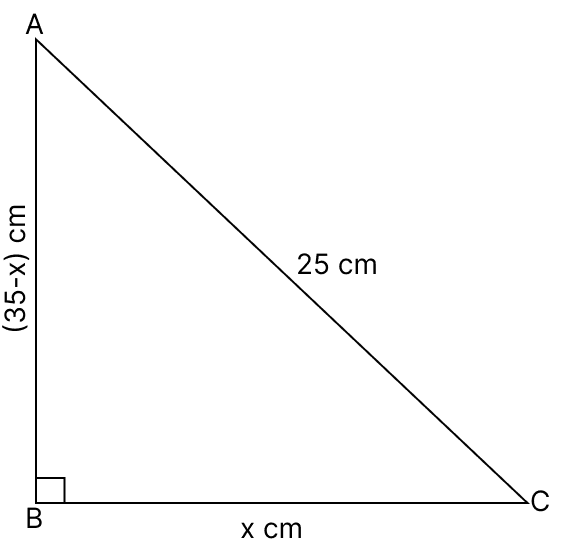
The perimeter of a right triangle is 60 cm and its hypotenuse is 25 cm. Find the area of the triangle. ARC Properties of Circle, R.S. Aggarwal Mathematics Solutions ICSE Class 9.

We know that,

Perimeter of a right-angled triangle = 60 cm

Hypotenuse = 25 cm

So, the sum of other two sides of triangle = 60 – 25 = 35 cm

Let, base (BC) = x cm

So, AB = (35 - x) cm

Using the Pythagoras theorem,

⇒ AC2 = AB2 + BC2

⇒ 252 = (35 - x)2 + x2

⇒ 625 = 1225 + x2 - 70x + x2

⇒ 2x2 - 70x + 600 = 0

Dividing by 2 on both sides,

⇒ x2 - 35x + 300 = 0

⇒ x2 - 15x - 20x + 300 = 0

⇒ x(x – 15) - 20(x - 15) = 0

⇒ (x - 15)(x - 20) = 0

⇒ x - 15 = 0 or x - 20 = 0

⇒ x = 15 or x = 20.

If x = 15, then 35 - x = 35 - 15 = 20 cm.

If x = 20, then 35 - x = 35 - 20 = 15 cm.

So, length of other two sides apart from hypotenuse are 15 cm and 20 cm.

Area of triangle = 12\dfrac{1}{2} × base × height

Substituting the values we get,

A = 12\dfrac{1}{2} × 15 × 20 = 150 cm2.

Hence, area of triangle = 150 cm2.

Question 8

Find the length of hypotenuse of an isosceles right angled triangle, having an area of 200 cm2.

Answer

Let ABC be an isosceles right-angled triangle.
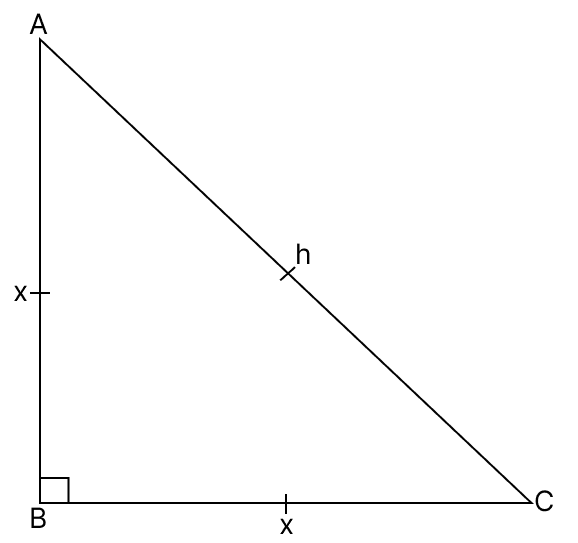
Find the length of hypotenuse of an isosceles right angled triangle, having an area of 200 cm. ARC Properties of Circle, R.S. Aggarwal Mathematics Solutions ICSE Class 9.

Area = 200 cm2

Let, side AB = BC = x cm and hypotenuse AC = h cm

We know that,

Area of triangle =12×base×heightArea of triangle =12×BC×ABArea of triangle =12×x×x200=12×x2x2=400x=400x=20 cm.\Rightarrow \text{Area of triangle } = \dfrac{1}{2} \times base \times height \\[1em] \Rightarrow \text{Area of triangle } = \dfrac{1}{2} \times BC \times AB \\[1em] \Rightarrow \text{Area of triangle } = \dfrac{1}{2} \times x \times x \\[1em] \Rightarrow 200 = \dfrac{1}{2} \times x^2 \\[1em] \Rightarrow x^2 = 400 \\[1em] \Rightarrow x = \sqrt{400} \\[1em] \Rightarrow x = 20 \text{ cm}.

Now, using the Pythagoras Theorem for the △ABC

⇒ AC2 = AB2 + BC2

⇒ AC2 = (20)2 + (20)2

⇒ AC2 = 400 + 400

⇒ AC2 = 800

⇒ AC = 800\sqrt{800}

⇒ AC = 400×2\sqrt{400 × 2}

⇒ AC = 20220\sqrt{2}

⇒ AC = 20 × 1.414

⇒ AC = 28.28 cm.

Hence, length of hypotenuse = 28.28 cm.

Question 9

Calculate the area and the height of an equilateral triangle whose perimeter is 60 cm.

Answer

Given:

Perimeter = 60 cm

Let the length of each side of an equilateral triangle be 'a' cm.

Perimeter = Sum of all sides

⇒ 60 = a + a + a

⇒ 60 = 3a

⇒ a = 603\dfrac{60}{3} = 20 cm.

Area of equilateral triangle=34× side2=34×202=34×400=1003=173.2 cm2.\Rightarrow \text{Area of equilateral triangle} = \dfrac{\sqrt{3}}{4} \times \text{ side}^2 \\[1em] = \dfrac{\sqrt{3}}{4} \times 20^2 \\[1em] = \dfrac{\sqrt{3}}{4} \times 400 \\[1em] = 100 \sqrt{3} \\[1em] = 173.2 \text{ cm}^2.

By formula,

Height of an equilateral triangle=32× side=32×20=103=17.32 cm.\text{Height of an equilateral triangle} = \dfrac{\sqrt{3}}{2} \times \text{ side} \\[1em] = \dfrac{\sqrt{3}}{2} \times 20 \\[1em] = 10 \sqrt{3} \\[1em] = 17.32 \text{ cm}.

Hence, the area of triangle = 173.2 cm2 and the height = 17.32 cm.

Question 10

Find the perimeter and area of an equilateral triangle whose height is 12 cm. Write your answers, correct to two decimal places.

Answer

Given,

Height (h) = 12 cm

Let the length of the side of an equilateral triangle be a cm.

We know that for an equilateral triangle,

Height=32a12=32aa=12×23=243a=2433=83 cm\Rightarrow \text{Height} = \dfrac{\sqrt{3}}{2}a \\[1em] \Rightarrow 12 = \dfrac{\sqrt{3}}{2}a \\[1em] \Rightarrow a = \dfrac{12 \times 2}{\sqrt{3}} = \dfrac{24}{\sqrt{3}} \\[1em] \Rightarrow a = \dfrac{24\sqrt{3}}{3} = 8\sqrt{3} \text{ cm}

Perimeter of an equilateral triangle = 3 × side

= 3 × 8 3\sqrt{3}

= 3 × 8 × 1.732

= 41.568 ≈ 41.57 cm.

Area of an equilateral triangle=34×(side)234×(83)234×64×33×481.732×4883.13683.14 cm2.\Rightarrow \text{Area of an equilateral triangle} = \dfrac{\sqrt{3}}{4} \times (side)^2 \\[1em] \Rightarrow \dfrac{\sqrt{3}}{4} \times (8 \sqrt{3})^2 \\[1em] \Rightarrow \dfrac{\sqrt{3}}{4} \times 64 \times 3 \\[1em] \Rightarrow \sqrt{3} \times 48 \\[1em] \Rightarrow 1.732 \times 48 \\[1em] \Rightarrow 83.136 \approx 83.14 \text{ cm}^2. \\[1em]

Hence, the perimeter = 41.57 cm and area = 83.14 cm2.

Question 11

The lengths of two sides of a right triangle containing the right angle differ by 2 cm. If the area of the triangle is 24 cm2, find the perimeter of the triangle.

Answer
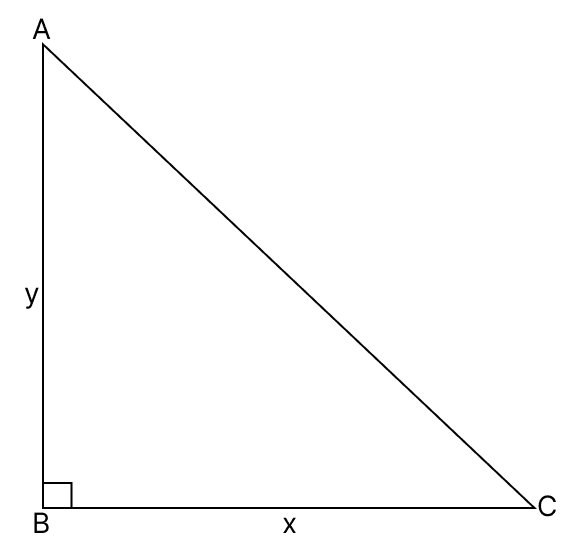
The lengths of two sides of a right triangle containing the right angle differ by 2 cm. If the area of the triangle is 24 cm. ARC Properties of Circle, R.S. Aggarwal Mathematics Solutions ICSE Class 9.

ABC is a right angled triangle with a right angle at B.

The area of the triangle is 24 cm2.

Let the lengths of BC and AB be x and y, respectively.

Given,

The difference between the two perpendicular sides is 2 cm.

x - y = 2

∴ y = x - 2

Area = 12\dfrac{1}{2} × base × height

⇒ 24 = 12\dfrac{1}{2} × BC × AB

⇒ 24 = 12\dfrac{1}{2} × x × (x - 2)

⇒ x × (x - 2) = 48

⇒ x2 - 2x = 48

⇒ x2 - 2x - 48 = 0

⇒ x2 - 8x + 6x - 48 = 0

⇒ x(x - 8) + 6(x - 8) = 0

⇒ (x - 8)(x + 6) = 0

⇒ (x - 8) = 0 or (x + 6) = 0

⇒ x = 8 or x = -6

Since length cannot be negative, ∴ x = 8 cm.

y = x - 2 = 8 - 2 = 6 cm.

Thus, AB = 6 cm and BC = 8 cm.

By using Pythagoras theorem,

Hypotenuse2 = Base2 + Height2

⇒ AC2 = BC2 + AB2

⇒ AC2 = 82 + 62

⇒ AC2 = 64 + 36

⇒ AC2 = 100

⇒ AC = 100\sqrt{100}

⇒ AC = 10 cm.

Perimeter of a triangle = Sum of all the sides of a triangle

= AB + BC + AC

= 10 + 8 + 6

= 24 cm.

Hence, perimeter of a triangle = 24 cm.

Question 12

The sides of a right-angled triangle containing the right angle are (5x) cm and (3x - 1) cm. If its area is 60 cm2, find its perimeter.

Answer

Let ABC be a right-angled triangle,
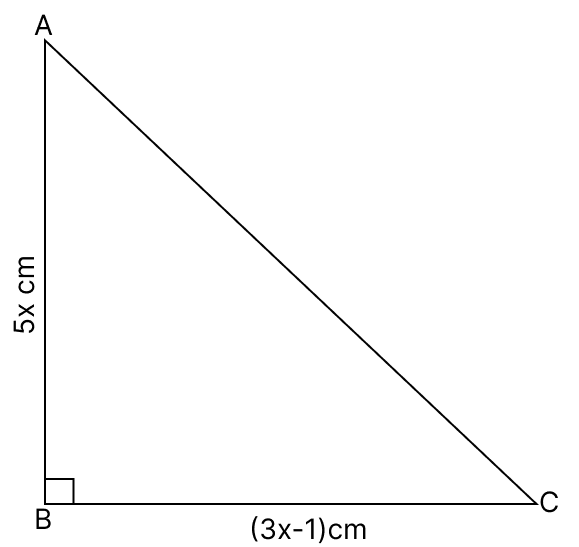
The sides of a right-angled triangle containing the right angle are (5x) cm and (3x - 1) cm. If its area is 60 cm. ARC Properties of Circle, R.S. Aggarwal Mathematics Solutions ICSE Class 9.

AB = 5x cm and BC = (3x – 1) cm

We know that,

Area of △ ABC = 12\dfrac{1}{2} × base × height

Substituting the values we get,

⇒ 60 = 12\dfrac{1}{2} × (3x - 1) × 5x

⇒ 120 = 5x(3x – 1)

⇒ 120 = 15x2 - 5x

⇒ 15x2 - 5x - 120 = 0

⇒ 5(3x2 - x - 24) = 0

⇒ 3x2 - x - 24 = 0

⇒ 3x2 – 9x + 8x – 24 = 0

⇒ 3x(x – 3) + 8(x - 3) = 0

⇒ (3x + 8)(x - 3) = 0

⇒ 3x + 8 = 0 or x - 3 = 0

⇒ 3x = -8 or x = 3

⇒ x = 83\dfrac{-8}{3} or x = 3.

Since, x cannot be negative. So, x = 3.

⇒ AB = 5 × 3 = 15 cm

⇒ BC = (3 × 3 – 1) = 9 – 1 = 8 cm

In right angled △ABC,

Using Pythagoras theorem,

AC2 = AB2 + BC2

Substituting the values we get,

⇒ AC2 = 152 + 82

⇒ AC2 = 225 + 64

⇒ AC2 = 289

⇒ AC = 289\sqrt{289}

⇒ AC = 17 cm.

Perimeter of a triangle = Sum of all the sides of a triangle

= AB + BC + AC

= 15 + 8 + 17

= 40 cm.

Hence, perimeter of the triangle = 40 cm.

Question 13

Each of the equal sides of an isosceles triangle is 2 cm more than its height and the base of the triangle is 12 cm. Find the area of the triangle.

Answer
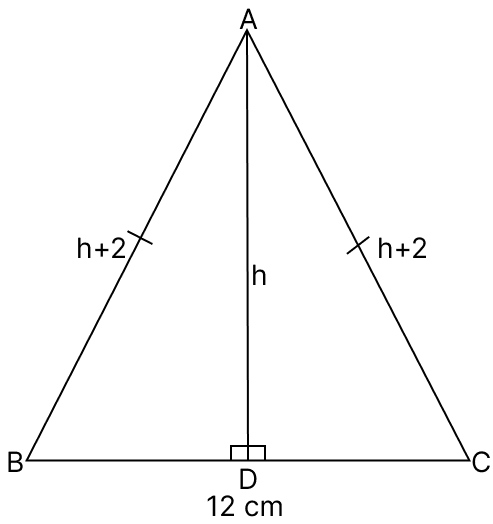
Each of the equal sides of an isosceles triangle is 2 cm more than its height and the base of the triangle is 12 cm. Find the area of the triangle. ARC Properties of Circle, R.S. Aggarwal Mathematics Solutions ICSE Class 9.

Let ABC be an isosceles triangle in which AB = AC, AD ⊥ BC and BC is the base.

Given,

Each of the equal sides of the isosceles triangle is 2 cm more than its height.

Let the height of the triangle be h cm.

Equal sides: AB = AC = h + 2

Base: BC = 12 cm

In Δ ABD and Δ ACD,

AD = AD [Common Side]

∠ADB = ∠ADC [Both equal to 90°]

AB = AC [Δ ABC is an isosceles triangle]

∴ Δ ABD ≅ Δ ACD [By R.H.S. axiom]

∴ BD = CD [C.P.C.T.C.]

∴ BD = CD = BC2=122\dfrac{BC}{2} = \dfrac{12}{2} = 6 cm.

By using the Pythagoras theorem in Δ ABD,

⇒ BD2 + AD2 = AB2

⇒ 62 + h2 = (h + 2)2

⇒ 36 + h2 = h2 + 4 + 2 × h × 2

⇒ 36 = 4 + 4h

⇒ 4h = 32

⇒ h = 324\dfrac{32}{4}

⇒ h = 8 cm.

Area of triangle ABC=12× base × height =12×BC×AD=12×12×8=6×8=48 cm2.\Rightarrow \text{Area of triangle ABC} = \dfrac{1}{2} \times \text{ base } \times \text{ height } \\[1em] = \dfrac{1}{2} \times BC \times AD \\[1em] = \dfrac{1}{2} \times 12 \times 8 \\[1em] = 6 \times 8 \\[1em] = 48 \text{ cm}^2.

Hence, area of the triangle = 48 cm2.

Question 14

Find the area of an isosceles triangle, each of whose equal sides is 13 cm and base 24 cm.

Answer

Each of equal sides (a) = 13 cm and base (b) = 24 cm

By formula,

Area of an isosceles triangle=14b4a2b214×24×4×1322426×6765766×1006×1060 cm2.\Rightarrow \text{Area of an isosceles triangle} = \dfrac{1}{4}b\sqrt{4a^2 - b^2} \\[1em] \Rightarrow \dfrac{1}{4} \times 24 \times \sqrt{4 × 13^2 - 24^2} \\[1em] \Rightarrow 6 \times \sqrt{676 - 576} \\[1em] \Rightarrow 6 \times \sqrt{100} \\[1em] \Rightarrow 6 \times 10 \\[1em] \Rightarrow 60 \text{ cm}^2.

Hence, area of the triangle = 60 cm2.

Question 15

The base of an isosceles triangle is 18 cm and its area is 108 cm2. Find its perimeter.

Answer

Given,

Base (b) = 18 cm

Area = 108 cm2.

Let the length of equal sides of the isosceles triangle be a cm.

By formula,

Area of an isosceles triangle=14b4a2b2108=14×18×4a2182432=18×4a23244a2324=432184a2324=244a2324=2424a2324=5764a2=576+3244a2=900a2=9004a2=225a=225a=15 cm.\Rightarrow \text{Area of an isosceles triangle} = \dfrac{1}{4}b\sqrt{4a^2 - b^2} \\[1em] \Rightarrow 108 = \dfrac{1}{4} \times 18 \times \sqrt{4a^2 - 18^2} \\[1em] \Rightarrow 432 = 18 \times \sqrt{4a^2 - 324} \\[1em] \Rightarrow \sqrt{4a^2 - 324} = \dfrac{432}{18} \\[1em] \Rightarrow \sqrt{4a^2 - 324} = 24 \\[1em] \Rightarrow 4a^2 - 324 = 24^2 \\[1em] \Rightarrow 4a^2 - 324 = 576 \\[1em] \Rightarrow 4a^2 = 576 + 324 \\[1em] \Rightarrow 4a^2 = 900 \\[1em] \Rightarrow a^2 = \dfrac{900}{4} \\[1em] \Rightarrow a^2 = 225 \\[1em] \Rightarrow a = \sqrt{225} \\[1em] \Rightarrow a = 15 \text{ cm}.

Perimeter = Sum of all sides of triangle

= 15 + 15 + 18

= 48 cm.

Hence, perimeter of the isosceles triangle = 48 cm.

Question 16

In the given figure, △ABC is an equilateral triangle having each side equal to 10 cm and △PBC is right angled at P in which PB = 8 cm. Find the area of the shaded region.
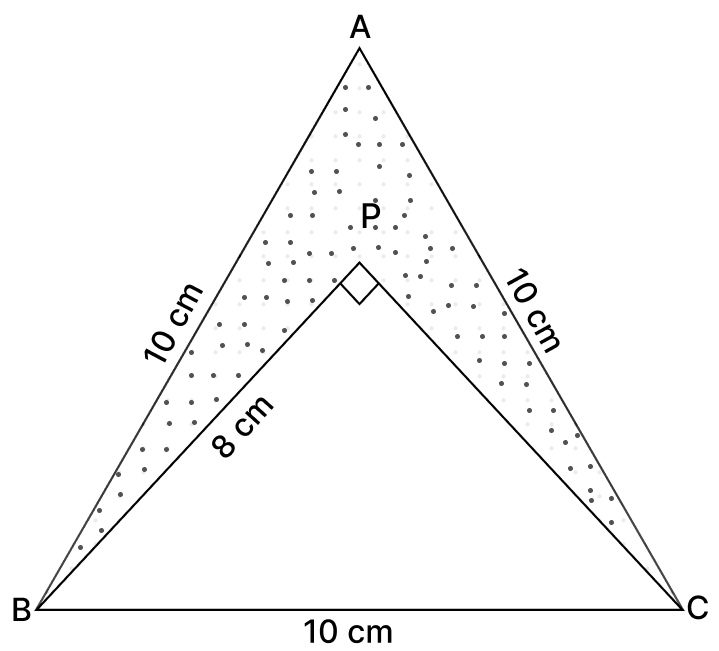
In the given figure, △ABC is an equilateral triangle having each side equal to 10 cm and △PBC is right angled at P in which PB = 8 cm. Find the area of the shaded region. ARC Properties of Circle, R.S. Aggarwal Mathematics Solutions ICSE Class 9.

Answer

Given,

△ABC is an equilateral triangle.

Each side = 10 cm

By formula,

Area of equilateral △ABC=34× (side)234×10234×10025343.3 cm2.\Rightarrow \text{Area of equilateral △ABC} = \dfrac{\sqrt{3}}{4} \times \text{ (side)}^2 \\[1em] \Rightarrow \dfrac{\sqrt{3}}{4} \times 10^2 \\[1em] \Rightarrow \dfrac{\sqrt{3}}{4} \times 100 \\[1em] \Rightarrow 25\sqrt{3} \\[1em] \Rightarrow 43.3 \text{ cm}^2.

Given,

PB = 8 cm and BC = 10 cm

By using the Pythagoras theorem in △PBC,

⇒ BC2 = PB2 + PC2

⇒ 102 = 82 + PC2

⇒ 100 = 64 + PC2

⇒ PC2 = 36

⇒ PC = 36\sqrt{36}

⇒ PC = 6 cm.

Area of triangle = 12\dfrac{1}{2} × base × height

Area of △PBC = 12\dfrac{1}{2} × PB × PC

= 12\dfrac{1}{2} × 8 × 6

= 4 × 6 = 24 cm2.

Shaded region = Area of △ABC − Area of △PBC

= 43.3 - 24

= 19.3 cm2.

Hence, area of shaded region = 19.3 cm2.

Question 17

If the area of an equilateral triangle is 81381\sqrt{3} cm2, find its perimeter.

Answer

Let the length of the side of an equilateral triangle be a cm.

Area of triangle=34×a2813=34×a2a2=81×4a2=324a=324a=18.\Rightarrow \text{Area of triangle} = \dfrac{\sqrt{3}}{4} \times a^2 \\[1em] \Rightarrow 81\sqrt{3} = \dfrac{\sqrt{3}}{4} \times a^2 \\[1em] \Rightarrow a^2 = 81 \times 4 \\[1em] \Rightarrow a^2 = 324 \\[1em] \Rightarrow a = \sqrt{324} \\[1em] \Rightarrow a = 18. \\[1em]

Perimeter = Sum of all sides of a triangle

= 3a

= 3 × 18

= 54 cm.

Hence, perimeter of the triangle = 54 cm.

Question 18

The base of a right-angled triangle is 24 cm and its hypotenuse is 25 cm. Find the area of the triangle.

Answer

Given,

Hypotenuse = 25 cm

Base = 24 cm

By using the Pythagoras theorem,

Hypotenuse2 = Base2 + Height2

⇒ 252 = 242 + Height2

⇒ 625 = 576 + Height2

⇒ Height2 = 625 - 576

⇒ Height2 = 49

⇒ Height = 49\sqrt{49}

⇒ Height = 7 cm.

Area = 12\dfrac{1}{2} × Base × Height

= 12\dfrac{1}{2} × 24 × 7

= 12 × 7 = 84 cm2.

Hence, area of the triangle = 84 cm2.

Question 19

The altitude drawn to the base of an isosceles triangle is 8 cm and the perimeter is 32 cm. Find the area of the triangle.

Answer

Let ABC be an isosceles triangle with AB = AC = a cm and BC = b cm.
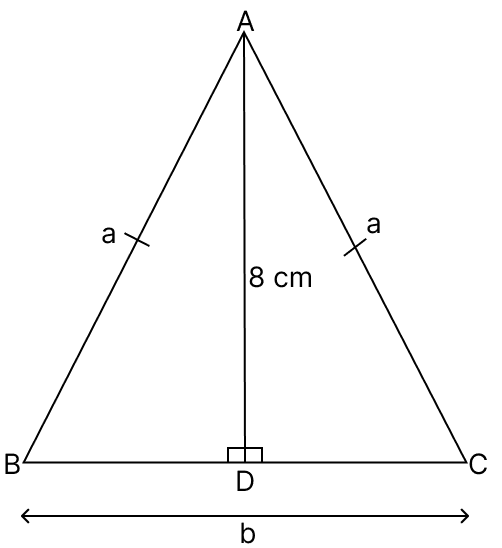
The altitude drawn to the base of an isosceles triangle is 8 cm and the perimeter is 32 cm. Find the area of the triangle. ARC Properties of Circle, R.S. Aggarwal Mathematics Solutions ICSE Class 9.

Altitude (AD) = 8 cm

Perimeter = 32 cm

Perimeter = sum of all sides of a triangle

⇒ 32 = a + a + b

⇒ 32 = 2a + b

⇒ b = 32 - 2a .........(1)

In an isosceles triangle, the altitude drawn from the common vertex bisects the base.

Thus, AD bisects BC.

So, BD = DC = b2\dfrac{b}{2}

∴ ∠ADC = ∠ADB = 90°.

In triangle ADB,

By pythagorean theorem,

AB2=AD2+DB2a2=82+(b2)2a2=64+b24a2=256+b244a2=256+b2\Rightarrow AB^2 = AD^2 + DB^2 \\[1em] \Rightarrow a^2 = 8^2 + \Big(\dfrac{b}{2}\Big)^2 \\[1em] \Rightarrow a^2 = 64 + \dfrac{b^2}{4} \\[1em] \Rightarrow a^2 = \dfrac{256 + b^2}{4} \\[1em] \Rightarrow 4a^2 = 256 + b^2

Substituting the value of b from equation (1) in above equation, we get :

4a2=256+(322a)24a2=256+1024128a+4a20=1280128a128a=1280a=1280128a=10 cm.\Rightarrow 4a^2 = 256 + (32 - 2a)^2 \\[1em] \Rightarrow 4a^2 = 256 + 1024 -128a + 4a^2 \\[1em] \Rightarrow 0 = 1280 - 128a \\[1em] \Rightarrow 128a = 1280 \\[1em] \Rightarrow a = \dfrac{1280}{128} \\[1em] \Rightarrow a = 10 \text{ cm}.

∴ b = 32 - 2(10)

⇒ b = 32 - 20

⇒ b = 12 cm.

Area of triangle ABC = 12\dfrac{1}{2} × Base × Height

= 12\dfrac{1}{2} × BC × AD

= 12\dfrac{1}{2} × 12 × 8

= 6 × 8 = 48 cm2.

Hence, area of triangle = 48 cm2.

Question 20

The area of a triangle is 216 cm2 and its sides are in the ratio 3 : 4 : 5. Find the perimeter of the triangle.

Answer

Given,

Area = 216 cm2

Sides = 3 : 4 : 5

Let the sides of a triangle be 3x, 4x and 5x.

Since 3 : 4 : 5 is a pythagorean triplet (32 + 42 = 52)

Thus, the triangle is a right angled triangle, and sides containing right angle are 3x cm and 4x cm.

Area of right angled triangle=12× (product of sides containg right angle)216=12×3x×4x432=12x2x2=36x=36x=6.\Rightarrow \text{Area of right angled triangle} = \dfrac{1}{2} \times \text{ (product of sides containg right angle)} \\[1em] \Rightarrow 216 = \dfrac{1}{2} \times 3x \times 4x \\[1em] \Rightarrow 432 = 12x^2 \\[1em] \Rightarrow x^2 = 36 \\[1em] \Rightarrow x = \sqrt{36} \\[1em] \Rightarrow x = 6.

∴ Sides of a triangle are

⇒ 3x = 3 × 6 = 18 cm

⇒ 4x = 4 × 6 = 24 cm

⇒ 5x = 5 × 6 = 30 cm

Perimeter = Sum of all sides of a triangle

= 18 + 24 + 30

= 72 cm.

Hence, perimeter of the triangle = 72 cm.

Exercise 17B

Question 1

Find the area of a quadrilateral one of whose diagonals is 25 cm and the lengths of perpendiculars from the other two vertices are 16.4 cm and 11.6 cm respectively.

Answer

A quadrilateral ABCD is shown in the figure below :

Find the area of a quadrilateral one of whose diagonals is 25 cm and the lengths of perpendiculars from the other two vertices are 16.4 cm and 11.6 cm respectively. ARC Properties of Circle, R.S. Aggarwal Mathematics Solutions ICSE Class 9.

AM and CN are the perpendiculars from A and C respectively to the diagonal BD.

Area of triangle = 12\dfrac{1}{2} × base × height

For △ABD,

Area = 12\dfrac{1}{2} × BD × AM

= 12\dfrac{1}{2} × 25 × 16.4

= 25 × 8.2

= 205 cm2.

For △CBD,

Area = 12\dfrac{1}{2} × BD × CN

= 12\dfrac{1}{2} × 25 × 11.6

= 25 × 5.8

= 145 cm2.

Area of quadrilateral ABCD = Area of triangle ABD + Area of triangle CBD

= 205 + 145

= 350 cm2.

Hence, area of quadrilateral = 350 cm2.

Question 2

The diagonals of a quadrilateral intersect each other at right angles. If the lengths of these diagonals be 14 cm and 19 cm respectively, find the area of the quadrilateral.

Answer

A quadrilateral ABCD is shown in the figure below:

The diagonals of a quadrilateral intersect each other at right angles. If the lengths of these diagonals be 14 cm and 19 cm respectively, find the area of the quadrilateral. ARC Properties of Circle, R.S. Aggarwal Mathematics Solutions ICSE Class 9.

The diagonals AC and BD intersect at O and are perpendiculars (90°)

Given,

AC = 14 cm

BD = 19 cm

When the diagonals of a quadrilateral intersect at right angles, the formula of area is:

Area = 12\dfrac{1}{2} × d1 × d2

where d1 and d2 are diagonals.

Area = 12\dfrac{1}{2} × 14 × 19

= 7 × 19

= 133 cm2.

Hence, area = 133 cm2.

Question 3

Find the area of quadrilateral ABCD in which AB = 29 cm, BC = 21 cm, AC = 20 cm, CD = 34 cm and DA = 42 cm.

Find the area of quadrilateral ABCD in which AB = 29 cm, BC = 21 cm, AC = 20 cm, CD = 34 cm and DA = 42 cm. ARC Properties of Circle, R.S. Aggarwal Mathematics Solutions ICSE Class 9.

Answer

From figure,

The diagonal AC divides the quadrilateral ABCD into two triangles : △ABC & △ACD

Area of △ABC :

Let sides AB = a = 29 cm, BC = b = 21 cm, AC = c = 20 cm

s = 29+21+202\dfrac{29 + 21 + 20}{2}

= 702\dfrac{70}{2} = 35.

By formula,

Area of triangle=s(sa)(sb)(sc)=35×(3529)×(3521)×(3520)=35×(6)×(14)×(15)=44100=210 cm2.\Rightarrow \text{Area of triangle} = \sqrt{s(s - a)(s - b)(s - c)} \\[1em] = \sqrt{35 \times (35 - 29) \times (35 - 21) \times (35 - 20)} \\[1em] = \sqrt{35 \times (6) \times (14) \times (15)} \\[1em] = \sqrt{44100} \\[1em] = 210 \text{ cm}^2.

Area of △ACD

Let sides be AD = a = 42 cm, CD = b = 34 cm, AC = c = 20 cm

s = 42+34+202\dfrac{42 + 34 + 20}{2}

= 962\dfrac{96}{2} = 48.

By formula,

Area of triangle=s(sa)(sb)(sc)=48×(4842)×(4834)×(4820)=48×(6)×(14)×(28)=112896=336 cm2.\Rightarrow \text{Area of triangle} = \sqrt{s(s - a)(s - b)(s - c)} \\[1em] = \sqrt{48 \times (48 - 42) \times (48 - 34) \times (48 - 20)} \\[1em] = \sqrt{48 \times (6) \times (14) \times (28)} \\[1em] = \sqrt{112896} \\[1em] = 336 \text{ cm}^2.

Area of quadrilateral ABCD = Area of △ABC + Area of △ACD

= 210 + 336

= 546 cm2.

Hence, area of quadrilateral = 546 cm2.

Question 4

Find the perimeter and area of quadrilateral ABCD in which AB = 9 cm, AD = 12 cm, BD = 15 cm, CD = 17 cm and ∠CBD = 90°.

Find the perimeter and area of quadrilateral ABCD in which AB = 9 cm, AD = 12 cm, BD = 15 cm, CD = 17 cm and ∠CBD = 90. ARC Properties of Circle, R.S. Aggarwal Mathematics Solutions ICSE Class 9.

Answer

Given,

AB = 9 cm

AD = 12 cm

BD = 15 cm

CD = 17 cm

∠CBD = 90°

Diagonal BD divides the quadrilateral into two triangles: △ABD and △BCD.

For △ABD,

Sides are 9 cm, 12 cm, 15 cm.

Since, 92 + 122 = 81 + 144 = 225 = 152.

So they are the pythagorean triplets.

So triangle △ABD is a right angled triangle.

Area of right angle triangle = 12\dfrac{1}{2} × Base × Height

Area of triangle ABD = 12\dfrac{1}{2} × AB × AD

= 12\dfrac{1}{2} × 9 × 12

= 9 × 6

= 54 cm2.

For △BCD,

Since, ∠CBD = 90°

∴ Applying Pythagoras theorem for the △BCD,

⇒ BD2 + BC2 = DC2

⇒ 152 + BC2 = 172

⇒ BC2 = 289 - 225

⇒ BC2 = 64

⇒ BC = 64\sqrt{64}

⇒ BC = 8 cm.

Area of △BCD = 12\dfrac{1}{2} × BC × BD

= 12\dfrac{1}{2} × 8 × 15

= 4 × 15

= 60 cm2.

Area of quadrilateral △ABCD = Area of △ABD + Area of △BCD

= 54 + 60

= 114 cm2.

Perimeter of quadrilateral ABCD = AB + BC + CD + DA

= 9 + 8 + 17 + 12

= 46 cm.

Hence, area = 114 cm2 and perimeter = 46 cm.

Question 5

Calculate the area of quadrilateral ABCD in which : AB = 24 cm, AD = 32 cm, ∠BAD = 90°, and BC = CD = 52 cm.

Calculate the area of quadrilateral ABCD in which AB = 24 cm, AD = 32 cm, ∠BAD = 90. ARC Properties of Circle, R.S. Aggarwal Mathematics Solutions ICSE Class 9.

Answer

Given,

AB = 24 cm

AD = 32 cm

∠BAD = 90°

BC = 52 cm

CD = 52 cm

Diagonal BD divides the quadrilateral into two triangles: △ABD and △BCD

Area of right angle △ABD = 12\dfrac{1}{2} × Base × Height

= 12\dfrac{1}{2} × AB × AD

= 12\dfrac{1}{2} × 24 × 32

= 12 × 32

= 384 cm2.

Since ∠BAD = 90°, by applying pythagoras theorem

⇒ BD2 = BA2 + AD2

⇒ BD2 = 242 + 322

⇒ BD2 = 576 + 1024

⇒ BD2 = 1600

⇒ BD = 1600\sqrt{1600}

⇒ BD = 40 cm.

Area of △BCD,

Let BC = a = 52 cm, CD = b = 52 cm, BD = c = 40 cm

s=a+b+c2s=52+52+402s=1442s=72 cm.\Rightarrow s = \dfrac{a + b + c}{2} \\[1em] \Rightarrow s = \dfrac{52 + 52 + 40}{2} \\[1em] \Rightarrow s = \dfrac{144}{2} \\[1em] \Rightarrow s = 72 \text{ cm}.

By formula,

Area of triangle=s(sa)(sb)(sc)=72×(7252)×(7252)×(7240)=72×(20)×(20)×(32)=921600=960 cm2.\Rightarrow \text{Area of triangle} = \sqrt{s(s - a)(s - b)(s - c)} \\[1em] = \sqrt{72 \times (72 - 52) \times (72 - 52) \times (72 - 40)} \\[1em] = \sqrt{72 \times (20) \times (20) \times (32)} \\[1em] = \sqrt{921600} \\[1em] = 960 \text{ cm}^2.

Area of quadrilateral ABCD = Area of triangle ABD + Area of triangle BCD

= 384 + 960

= 1344 cm2.

Hence, area of quadrilateral ABCD = 1344 cm2.

Question 6

Calculate the area of quadrilateral ABCD in which △BCD is equilateral with each side equal to 26 cm, ∠BAD = 90° and AD = 24 cm.

Calculate the area of quadrilateral ABCD in which △BCD is equilateral with each side equal to 26 cm, ∠BAD = 90. ARC Properties of Circle, R.S. Aggarwal Mathematics Solutions ICSE Class 9.

Answer

Given

△BCD is equilateral.

Each side = 26 cm

∠BAD = 90°

AD = 24 cm

Area of equilateral △BCD=34× (side)2=34×262=34×676=3×169=169×1.732292.71 cm2.\Rightarrow \text{Area of equilateral △BCD} = \dfrac{\sqrt{3}}{4} \times \text{ (side)}^2 \\[1em] = \dfrac{\sqrt{3}}{4} \times 26^2 \\[1em] = \dfrac{\sqrt{3}}{4} \times 676 \\[1em] = \sqrt{3} \times 169 \\[1em] = 169 \times 1.732 \approx 292.71 \text{ cm}^2.

Since ∠BAD = 90°

By applying pythagoras theorem in triangle BAD,

⇒ AB2 + AD2 = BD2

⇒ AB2 + 242 = 262

⇒ AB2 + 576 = 676

⇒ AB2 = 676 - 576

⇒ AB2 = 100

⇒ AB = 100\sqrt{100}

⇒ AB = 10 cm.

⇒ Area of right angle triangle ABD = 12\dfrac{1}{2} × Base × Height

= 12\dfrac{1}{2} × AB × AD

= 12\dfrac{1}{2} × 10 × 24

= 5 × 24 = 120.

⇒ Area of quadrilateral ABCD = Area of triangle ABD + Area of triangle BCD

= 120 + 292.71

= 412.71 cm2.

Hence, area = 412.71 cm2.

Question 7

In the adjoining figure, △ABC is right angled at A, BC = 7.5 cm and AB = 4.5 cm. If the area of quad. ABCD is 30 cm2 and DL is the altitude of △DAC, calculate the length DL.

In the adjoining figure, △ABC is right angled at A, BC = 7.5 cm and AB = 4.5 cm. If the area of quad. ARC Properties of Circle, R.S. Aggarwal Mathematics Solutions ICSE Class 9.

Answer

Given,

△ABC is right-angled at A.

BC = 7.5 cm (hypotenuse)

AB = 4.5 cm

Area of quadrilateral ABCD = 30 cm2

In △ABC,

By using pythagoras theorem,

⇒ BC2 = AB2 + AC2

⇒ (7.5)2 = (4.5)2 + AC2

⇒ 56.25 = 20.25 + AC2

⇒ AC2 = 56.25 - 20.25

⇒ AC2 = 36

⇒ AC = 36\sqrt{36} = 6 cm.

Area of right angle △ABC=12×Base×Height=12×AC×AB=12×6×4.5=3×4.5=13.5 cm2.\text{Area of right angle △ABC} = \dfrac{1}{2} \times \text{Base} \times \text{Height} \\[1em] = \dfrac{1}{2} \times AC \times AB \\[1em] = \dfrac{1}{2} \times 6 \times 4.5 \\[1em] = 3 \times 4.5 \\[1em] = 13.5 \text{ cm}^2.

From figure,

Area of △DAC = Area of quad. ABCD − Area of △ABC

= 30 - 13.5

= 16.5 cm2.

Area of △DAC=12×AC×DL16.5=12×6×DL33=6×DLDL=336DL=5.5 cm.\text{Area of △DAC} = \dfrac{1}{2} \times AC \times DL \\[1em] \Rightarrow 16.5 = \dfrac{1}{2} × 6 × DL \\[1em] \Rightarrow 33 = 6 \times DL \\[1em] \Rightarrow DL = \dfrac{33}{6} \\[1em] \Rightarrow DL = 5.5 \text{ cm}.

Hence, DL = 5.5 cm.

Question 8

The perimeter of a rectangle is 81 m and its breadth is 12 m. Find its length and area.

Answer

Given,

Perimeter = 81 m

Breadth (b) = 12 m

Let length of rectangle = l meters

By formula,

Perimeter = 2(l + b)

⇒ 81 = 2(l + 12)

⇒ l + 12 = 812\dfrac{81}{2}

⇒ l + 12 = 40.5

⇒ l = 40.5 - 12 = 28.5 m.

Area = l × b

= 28.5 × 12 = 342 m2.

Hence, length = 28.5 m and area = 342 m2.

Question 9

The perimeter of a rectangular field is 35\dfrac{3}{5} km and its length is twice breadth. Find the area of the field in m2.

Answer

Let length = l and breadth = b

Given,

Perimeter = 35km=30005m\dfrac{3}{5} \text{km} = \dfrac{3000}{5}m

l = 2b

By formula,

Perimeter = 2(l + b)

30005\dfrac{3000}{5} = 2(2b + b)

15005\dfrac{1500}{5} = 3b

⇒ 3b = 300

⇒ b = 100 m.

⇒ l = 2b = 2 × 100 = 200 m.

Area = l × b

= 200 × 100

= 20000 m2.

Hence, area of the field = 20000 m2.

Question 10

A rectangular plot 30 m long and 18 m wide is to be covered with grass leaving 2.5 m all around it. Find the area to be laid with grass.

Answer

A rectangular plot 30 m long and 18 m wide is to be covered with grass leaving 2.5 m all around it. Find the area to be laid with grass. ARC Properties of Circle, R.S. Aggarwal Mathematics Solutions ICSE Class 9.

ABCD is a rectangular plot and PQRS is an area that has to be laid with grass.

Given,

Length of plot = AD = BC = 30 m

Width of plot = AB = CD = 18 m

From figure,

PQ = AB - 2.5 - 2.5 = 18 - 5 = 13 m

PS = BC - 2.5 - 2.5 = 30 - 5 = 25 m

Area of the rectangle PQRS that has to be laid with grass = length × breadth

= PS × PQ

= 25 × 13

= 325 m2.

Hence, area to be laid with grass = 325 m2.

Question 11

A foot path of uniform width runs all around inside of a rectangular field 45 m long and 36 m wide. If the area of the path is 234 m2, find the width of the path.

Answer

Consider ABCD as a rectangular field having, length = 45 m and breadth = 36 m.

Let x meters be the width of foot path.

A foot path of uniform width runs all around inside of a rectangular field 45 m long and 36 m wide. ARC Properties of Circle, R.S. Aggarwal Mathematics Solutions ICSE Class 9.

We know that,

Area = length × breadth

From figure,

Area of path = Area of rectangle ABCD - Area of rectangle PQRS

Substituting the values we get,

Area of path = (AB × BC) - (PQ × QR).........(1)

From figure,

PQ = AB - x - x = (45 - 2x) m,

QR = BC - x - x = (36 - 2x) m.

Substituting the values in equation (1) we get,

⇒ 234 = (45 × 36) - (45 - 2x) (36 - 2x)

⇒ 234 = 1620 - [45(36 - 2x) - 2x(36 - 2x)]

⇒ 234 = 1620 - (1620 - 90x - 72x + 4x2)

⇒ 234 = 1620 - 1620 + 90x + 72x - 4x2

⇒ 234 = 162x - 4x2

⇒ 4x2 - 162x + 234 = 0

⇒ 4x2 - 156x - 6x + 234 = 0

⇒ 4x(x - 39) - 6(x - 39) = 0

⇒ (4x - 6)(x - 39) = 0

⇒ 4x - 6 = 0 or x - 39 = 0

⇒ 4x = 6 or x = 39

⇒ x = 64=32\dfrac{6}{4} = \dfrac{3}{2} = 1.5 or x = 39

Since, width of path cannot be greater than breadth of field,

So, x ≠ 39 m.

Hence, width of path = 1.5 m.

Question 12

The adjoining diagram shows two cross paths drawn inside a rectangular field 45 m long and 38 m wide, one parallel to length and the other parallel to breadth. The width of each path is 4 m. Find the cost of gravelling the paths at ₹ 5.60 per m2.

The adjoining diagram shows two cross paths drawn inside a rectangular field 45 m long and 38 m wide, one parallel to length and the other parallel to breadth. The width of each path is 4 m. Find the cost of gravelling the paths at ₹ 5.60 per m. ARC Properties of Circle, R.S. Aggarwal Mathematics Solutions ICSE Class 9.

Answer

Given,

Length of the field = 45 m

Width of the field = 38 m

Width of the each path = 4 m

Cost of gravelling = ₹ 5.60 per m2.

Area of path parallel to length:

⇒ Area = 45 × 4 = 180 m2.

Area of path parallel to breadth:

⇒ Area = 38 × 4 = 152 m2.

Since, both the path overlap in the middle :

⇒ So, the overlapped area = 4 × 4 = 16 m2.

⇒ Total area of paths = Area of first path + Area of second path - Overlapped area

= 180 + 152 - 16 = 316 m2.

⇒ Total cost = Area of paths × Cost per m2

= 316 × 5.60 = 1769.60

Hence, cost of gravelling the paths = ₹ 1,769.60

Question 13

A rectangle of area 144 cm2 has its length equal to x cm. Write down its breadth in terms of x. Given that its perimeter is 52 cm, write down an equation in x and solve it to determine the dimensions of the rectangle.

Answer

Given,

Area of rectangle = 144 cm2

Length = x cm

Perimeter = 52 cm

Area = length × breadth

⇒ 144 = x × breadth

⇒ Breadth = 144x\dfrac{144}{x} cm.

Perimeter = 2(l + b)

⇒ 52 = 2(x + 144x\dfrac{144}{x})

⇒ x + 144x\dfrac{144}{x} = 26

x2+144x=26\dfrac{x^2 + 144}{x} = 26

⇒ x2 + 144 = 26x

⇒ x2 - 26x + 144 = 0

⇒ x2 - 18x - 8x + 144 = 0

⇒ x(x - 18) - 8(x - 18) = 0

⇒ (x - 18)(x - 8) = 0

⇒ x = 18 or x = 8

If x = 18 then,

Length = x = 18 cm.

Breadth = 144x=14418\dfrac{144}{x} = \dfrac{144}{18} = 8 cm.

If x = 8 then,

Length = x = 8 cm.

Breadth = 144x=1448\dfrac{144}{x} = \dfrac{144}{8} = 18 cm.

Generally we consider length > breadth

Hence, length = 18 cm and breadth = 8 cm.

Question 14

The perimeter of a rectangular plot is 130 m and its area is 1000 m2. Take the length of the plot as x metres. Use the perimeter to write the value of breadth in terms of x. Use the values of length, breadth and area to write an equation in x. Solve the equation and calculate the length and breadth of the plot.

Answer

Given,

Perimeter = 130 m

Area = 1000 m2

Length = x meters

Let breadth = b meters

Perimeter = 2(length + breadth)

⇒ 130 = 2(x + b)

⇒ x + b = 65

⇒ b = 65 - x

Area = length × breadth

⇒ 1000 = x × (65 - x)

⇒ 1000 = 65x - x2

⇒ x2 - 65x + 1000 = 0

⇒ x2 - 40x - 25x + 1000 = 0

⇒ x(x - 40) - 25(x - 40) = 0

⇒ (x - 40) (x - 25) = 0

⇒ x = 40 or x = 25

If x = 40 then,

Length = x = 40 m

Breadth = 65 - x = 65 - 40 = 25 m

If x = 25 then,

Length = x = 25 m

Breadth = 65 - x = 65 - 25 = 40 m

Generally we consider length > breadth

Hence, length = 40 m and breadth = 25 m.

Question 15

If the length of a rectangle is increased by 10 cm and the breadth decreased by 5 cm, the area remains unchanged. If the length is decreased by 5 cm and the breadth is increased by 4 cm, even then the area remains unchanged. Find the dimensions of the rectangle.

Answer

Let length be = l cm and Breadth be = b cm

Area = length × breadth = lb

In first condition :

Length is increased by 10 cm

Breadth is decreased by 5 cm.

But area remains unchanged:

∴ lb = (l + 10)(b - 5)

⇒ lb = lb - 5l + 10b - 50

⇒ 0 = 10b - 5l - 50

⇒ 50 = 10b - 5l

Dividing by 5,

⇒ 10 = 2b - l

⇒ l = 2b - 10 ..........(1)

In second condition:

Length is decreased by 5 cm

Breadth is increased by 4 cm

Here also area remains unchanged.

∴ lb = (l - 5)(b + 4)

⇒ lb = lb + 4l - 5b - 20

⇒ 0 = 4l - 5b - 20

⇒ 4l - 5b = 20 .......(2)

Substituting the value of l from equation (1) in (2), we get :

⇒ 4(2b - 10) - 5b = 20

⇒ 8b - 40 - 5b = 20

⇒ 3b = 20 + 40

⇒ 3b = 60

⇒ b = 603\dfrac{60}{3} = 20 cm.

⇒ l = 2b - 10

= 2(20) - 10

= 40 - 10 = 30 cm.

Hence, length = 30 cm and breadth = 20 cm.

Question 16

A room is 13 m long and 9 m wide. Find the cost of carpeting the room with a carpet 75 cm wide at ₹ 12.50 per metre.

Answer

Given,

Room length = 13 m

Room width = 9 m

Carpet width = 75 cm = 0.75 m

Cost of carpet = ₹ 12.50 per metre.

Floor area = Room length × Room width

= 13 × 9 = 117 m2.

Floor area = Carpet length × Carpet width

117=Carpet length×0.75Carpet length=1170.75Carpet length=117×10075Carpet length=117×43Carpet length=39×4Carpet length=156 m.\Rightarrow 117 = \text{Carpet length} \times 0.75 \\[1em] \Rightarrow \text{Carpet length} = \dfrac{117}{0.75} \\[1em] \Rightarrow \text{Carpet length} = \dfrac{117 \times 100}{75} \\[1em] \Rightarrow \text{Carpet length} = \dfrac{117 \times 4}{3} \\[1em] \Rightarrow \text{Carpet length} = 39 \times 4 \\[1em] \Rightarrow \text{Carpet length} = 156 \text{ m}.

Total cost = Carpet length × Rate per meter

= 156 × ₹ 12.50

= ₹ 1,950.

Hence, total cost = ₹ 1,950.

Question 17

A rectangular courtyard 3.78 m long and 5.25 m broad is to be paved exactly with square tiles, all of the same size. What is the largest size of such a tile? Also, find the number of tiles.

Answer

Given,

Length = 3.78 m = 378 cm

Breadth = 5.25 m = 525 cm

The side of the largest square tile that can pave the floor exactly must be the HCF of the length and breadth of the courtyard.

HCF of 378 and 525 = 21 cm.

Number of tiles = Area of courtyardArea of each tile=378×52521×21\dfrac{\text{Area of courtyard}}{\text{Area of each tile}} = \dfrac{378 \times 525}{21 \times 21} = 450.

Hence, largest size of tile = 21 cm × 21 cm and total number of tiles = 450.

Question 18

The cost of cultivating a square field at the rate of ₹ 160 per hectare is ₹ 1,440. Find the cost of putting a fence around it at the rate of 75 paise per metre.

Answer

Given,

Rate of cultivation = ₹ 160 per hectare

Total cost = ₹ 1,440

Area of cultivation = Total costRate\dfrac{\text{Total cost}}{\text{Rate}}

= 1440160\dfrac{1440}{160} = 9 hectares.

1 hectare = 10,000 m2

9 hectares = 9 × 10,000 = 90,000 m2.

Area of square = (side)2

90,000 = (side)2

Side = 90,000\sqrt{90,000}

Side = 300 m.

Perimeter of square = 4 × side

= 4 × 300 = 1200 m

Total cost = Perimeter × Fencing rate

= 1200 × ₹ 0.75

= ₹ 900.

Hence, cost of fencing around the square field = ₹ 900.

Question 19

Find the area of parallelogram, if its two adjacent sides are 12 cm and 14 cm, and if the diagonal connecting their ends is 18 cm.

Find the area of parallelogram, if its two adjacent sides are 12 cm and 14 cm, and if the diagonal connecting their ends is 18 cm. ARC Properties of Circle, R.S. Aggarwal Mathematics Solutions ICSE Class 9.

Answer

By formula,

Area of triangle = s(sa)(sb)(sc)\sqrt{s(s - a)(s - b)(s - c)}

In triangle ABC,

Let, AB = a = 12 cm, BC = b = 14 cm, AC = c = 18 cm

s = a+b+c2=12+14+182\dfrac{a + b + c}{2} = \dfrac{12 + 14 + 18}{2} = 22 cm.

Substituting values we get :

Area of triangle ABC=22×(2212)×(2214)×(2218)=22×10×8×4=7040=83.9 cm2.\text{Area of triangle ABC} = \sqrt{22 \times (22 - 12) \times (22 - 14) \times (22 - 18)} \\[1em] = \sqrt{22 \times 10 \times 8 \times 4} \\[1em] = \sqrt{7040} \\[1em] = 83.9 \text{ cm}^2.

A diagonal of //gm divides it into triangles of equal area.

Thus, Area of //gm ABCD = 2.Area of triangle ABC

= 2 × 83.9

= 167.80 cm2.

Hence, area of parallelogram = 167.80 cm2.

Question 20

Find the length of a diagonal of a square of area 200 cm2.

Answer

ABCD is a square with diagonal BD = d cm.

Find the length of a diagonal of a square of area 200 cm. ARC Properties of Circle, R.S. Aggarwal Mathematics Solutions ICSE Class 9.

We know that,

Area of a square=12×(d)2200=12×(d)2d2=400d=400d=20 cm.\Rightarrow \text{Area of a square} = \dfrac{1}{2} \times (d)^2 \\[1em] \Rightarrow 200 = \dfrac{1}{2} \times (d)^2 \\[1em] \Rightarrow d^2 = 400 \\[1em] \Rightarrow d = \sqrt{400} \\[1em] \Rightarrow d = 20 \text{ cm}.

Hence, length of diagonal = 20 cm.

Question 21

The area of a square field is 8 hectare. How long would a man take to cross it diagonally by walking at the rate of 4 kmph?

Answer

Given,

Area of square field = 8 hectares

Speed of man = 4 kmph

We know,

1 hectare = 10,000 m2

8 hectares = 8 × 10,000 = 80,000 m2

Area of a square= (side)2(side)2=80,000 side=80000 side=8×10000 side=8×10000 side=22×100 side=2002 m.\Rightarrow \text{Area of a square} = \text{ (side)}^2 \\[1em] \Rightarrow \text{(side)}^2 = 80,000 \\[1em] \Rightarrow \text{ side} = \sqrt{80000} \\[1em] \Rightarrow \text{ side} = \sqrt{8 × 10000} \\[1em] \Rightarrow \text{ side} = \sqrt{8} \times \sqrt{10000} \\[1em] \Rightarrow \text{ side} = 2 \sqrt{2} \times 100 \\[1em] \Rightarrow \text{ side} = 200 \sqrt{2} \text{ m}.

Diagonal of a square = side × 2\sqrt{2}

= 200 2×2\sqrt{2} \times \sqrt{2}

= 200 × 2 = 400 m = 4001000\dfrac{400}{1000} = 0.4 km

We know that,

Time = DistanceSpeed=0.44=110\dfrac{\text{Distance}}{\text{Speed}} = \dfrac{0.4}{4} = \dfrac{1}{10} hr.

1 hr = 60 min

110 hr=110\dfrac{1}{10} \text{ hr} = \dfrac{1}{10} × 60 min = 6 minutes.

Hence, a man takes 6 min to cross it diagonally.

Question 22

Find the area and perimeter of a square plot of land whose diagonal is 15 m. Give your answer correct to two decimal places.

Answer

Given:

Diagonal of the square = 15 m

Let 'a' be the length of side of the square.

Find the area and perimeter of a square plot of land whose diagonal is 15 m. Give your answer correct to two decimal places. ARC Properties of Circle, R.S. Aggarwal Mathematics Solutions ICSE Class 9.

Using the Pythagoras theorem in square,

⇒ Diagonal2 = side2 + side2

⇒ 152 = 2 × side2

⇒ 225 = 2 × a2

⇒ a2 = 2252\dfrac{225}{2}

⇒ a2 = 112.5

⇒ a = 112.5\sqrt{112.5} = 10.606 m.

Area of square = side2 = a2

= 112.50 m2.

Perimeter = 4 × side

= 4 × 10.606 = 42.42 ≈ 42.42 m.

Hence, area = 112.50 m2 and perimeter = 42.42 m.

Question 23

The area of a parallelogram is 338 m2. If its altitude is twice the corresponding base, determine the base and the altitude.

Answer

ABCD is a parallelogram given below:

The area of a parallelogram is 338. If its altitude is twice the corresponding base, determine the base and the altitude. ARC Properties of Circle, R.S. Aggarwal Mathematics Solutions ICSE Class 9.

Given,

Area of parallelogram = 338 m2

Let base BC = x

∴ Altitude (height) = AE = 2x

Area of parallelogram = Base × Height

⇒ 338 = x × 2x

⇒ 2x2 = 338

⇒ x2 = 3382\dfrac{338}{2}

⇒ x2 = 169

⇒ x = 169\sqrt{169} = 13 m

∴ Base (BC) = x = 13 m.

Altitude (AE) = 2x = 2 × 13 = 26 m.

Hence, base = 13 m and altitude = 26 m.

Question 24

Find the area of a rhombus one side of which measures 20 cm and the one of whose diagonals is 24 cm.

Answer

ABCD is a rhombus with diagonals BD and AC.

Find the area of a rhombus one side of which measures 20 cm and the one of whose diagonals is 24 cm. ARC Properties of Circle, R.S. Aggarwal Mathematics Solutions ICSE Class 9.

DC = 20 cm

BD = 24 cm

Diagonals of a rhombus bisect each other at 90°.

DE = BD2=242\dfrac{BD}{2} = \dfrac{24}{2} = 12 cm.

In a right triangle DEC,

Hypotenuse (DC) = 20 cm

DE = 12 cm.

By using pythagoras theorem for the right triangle DEC,

⇒ DC2 = DE 2 + EC2

⇒ 202 = 122 + EC2

⇒ EC2 = 202 - 122

⇒ EC2 = 400 - 144

⇒ EC2 = 256

⇒ EC = 256\sqrt{256}

⇒ EC = 16 cm.

AC = 2 × EC

= 2 × 16 = 32 cm.

Area of rhombus = 12\dfrac{1}{2} × (product of diagonals)

= 12\dfrac{1}{2} × 24 × 32

= 12 × 32

= 384 cm2.

Hence, area of rhombus = 384 cm2.

Question 25

The two parallel sides of a trapezium are 58 m and 42 m long. The other two sides are equal, each being 17 m. Find its area.

Answer

ABCD is a trapezium.

The two parallel sides of a trapezium are 58 m and 42 m long. The other two sides are equal, each being 17 m. Find its area. ARC Properties of Circle, R.S. Aggarwal Mathematics Solutions ICSE Class 9.

AB = 42 m

CD = 58 m

AD = BC = 17 m

From A and B drop perpendiculars AE and BF respectively to DC.

From figure,

EF = AB = 42 m

Since, AD = BC (given) and AE = BF (perpendicular between same parallels)

Thus,

DE = FC = x (let)

From figure,

⇒ DE + FC + EF = DC

⇒ x + x + 42 = 58

⇒ 2x = 58 - 42

⇒ 2x = 16

⇒ x = 8 meters.

In △ AED,

Using pythagoras theorem,

⇒ AD2 = AE2 + ED2

⇒ 172 = AE2 + 82

⇒ AE2 = 172 - 82

⇒ AE2 = 289 - 64

⇒ AE2 = 225

⇒ AE = 225\sqrt{225} = 15 m.

Height = AE = 15 m.

By formula,

Area of trapezium = 12× (sum of // sides)× (distance between them)\dfrac{1}{2} \times \text{ (sum of // sides)} \times \text{ (distance between them)}

Area of trapezium ABCD =12×(AB+CD)×AE=12×(42+58)×15=12×100×15=750 m2.\text{Area of trapezium ABCD } = \dfrac{1}{2} \times (AB + CD) \times AE \\[1em] = \dfrac{1}{2} \times (42 + 58) \times 15 \\[1em] = \dfrac{1}{2} \times 100 \times 15 \\[1em] = 750 \text{ m}^2.

Hence, area = 750 m2.

Question 26

The perimeter of a rhombus is 52 cm. If one of its diagonals is 24 cm long, find:

(i) the length of the other diagonal,

(ii) the area of the rhombus.

Answer

(i) Let ABCD be a rhombus.

The perimeter of a rhombus is 52 cm. If one of its diagonals is 24 cm long, find: ARC Properties of Circle, R.S. Aggarwal Mathematics Solutions ICSE Class 9.

Perimeter of the rhombus = 52 cm

One diagonal BD = 24 cm

Let a be the length of a side of the rhombus.

Perimeter of a rhombus = 4 x Side

⇒ 4 x a = 52

⇒ a = 524\dfrac{52}{4}

⇒ a = 13 cm.

BD = 24 cm

Since the diagonals of a rhombus bisect at 90°.

Then, OB = OD = 242\dfrac{24}{2} = 12 cm.

Applying pythagoras theorem for △AOB, we get:

⇒ AB2 = OA2 + OB2

⇒ (13)2 = OA2 + (12)2

⇒ 169 = OA2 + 144

⇒ OA2 = 169 - 144

⇒ OA2 = 25

⇒ OA = 25\sqrt{25}

⇒ OA = 5 cm.

⇒ AC = 2 x OA = 2 x 5 cm = 10 cm.

Hence, the length of the other diagonal = 10 cm.

(ii) By formula,

Area of rhombus = 12\dfrac{1}{2} x product of diagonals

= 12\dfrac{1}{2} x 24 x 10

= 12 x 10 = 120 cm2.

Hence, area of the rhombus = 120 cm2.

Question 27

The area of a rhombus is 216 cm2 and one of its diagonals measures 24 cm. Find:

(i) the length of the other diagonal,

(ii) the length of each of its sides,

(iii) its perimeter.

Answer

(i) Given:

Area of rhombus = 216 cm2

One diagonal = 24 cm

Let 'd' be the other diagonal of rhombus.

Area of rhombus =12×product of diagonals216=12×24×d216=12×dd=21612d=18 cm.\Rightarrow \text{Area of rhombus } = \dfrac{1}{2} \times \text{product of diagonals} \\[1em] \Rightarrow 216 = \dfrac{1}{2} \times 24 \times d \\[1em] \Rightarrow 216 = 12 \times d \\[1em] \Rightarrow d = \dfrac{216}{12} \\[1em] \Rightarrow d = 18 \text{ cm}.

Hence the length of the other diagonal = 18 cm.

(ii) The rhombus is shown in the figure below:

The area of a rhombus is 216 cm2 and one of its diagonals measures 24 cm. Find. ARC Properties of Circle, R.S. Aggarwal Mathematics Solutions ICSE Class 9.

Diagonal AC = 24 cm.

The diagonals of a rhombus bisect each other at right angle.

Then, OA = OC = 242\dfrac{24}{2} = 12 cm

Diagonal, BD = 18 cm

Then, OB = OD = 182\dfrac{18}{2} = 9 cm

Applying pythagoras theorem for △AOB, we get:

⇒ AB2 = OA2 + OB2

⇒ AB2 = (12)2 + (9)2

⇒ AB2 = 144 + 81

⇒ AB2 = 225

⇒ AB = 225\sqrt{225}

⇒ AB = 15 cm.

Hence, the length of the each of its side = 15 cm.

(iii) Perimeter of rhombus = 4 × side

= 4 × 15

= 60 cm.

Hence, perimeter of the rhombus = 60 cm.

Question 28

Two adjacent sides of a parallelogram are 36 cm and 25 cm. If the distance between longer sides is 15 cm, find the distance between the shorter sides.

Answer

Let ABCD be a parallelogram with side AB = 36 cm and side BC = 25 cm.

Two adjacent sides of a parallelogram are 36 cm and 25 cm. If the distance between longer sides is 15 cm, find the distance between the shorter sides. ARC Properties of Circle, R.S. Aggarwal Mathematics Solutions ICSE Class 9.

Distance between longer side DM = 15 cm

Consider DN as the distance between the shorter sides.

Area of parallelogram ABCD = base × height

= AB × DM = 36 × 15 = 540 cm2.

Considering base BC and height DN.

Area of parallelogram ABCD = BC × DN

⇒ 540 = 25 × DN

⇒ DN = 54025\dfrac{540}{25} = 21.6 cm.

Hence, the distance between shorter sides = 21.6 cm.

Question 29

In the given figure, ABCD is a trapezium in which AD = 13 cm, BC = 5 cm, CD = 17 cm and ∠A = ∠B = 90°. Calculate :

(i) AB

(ii) Area of trap. ABCD

In the given figure, ABCD is a trapezium in which AD = 13 cm, BC = 5 cm, CD = 17 cm and ∠A = ∠B = 90. ARC Properties of Circle, R.S. Aggarwal Mathematics Solutions ICSE Class 9.

Answer

(i) Draw CE ⊥ AD.

Join first end point with mid-point of class -5.5 - 0.5 with zero frequency and join the other end with mid-point of class 25.5 - 30.5 with zero frequency. ARC Properties of Circle, R.S. Aggarwal Mathematics Solutions ICSE Class 9.

∴ DE = 13 - 5 = 8 cm.

In triangle DEC,

By pythagoras theorem,

⇒ CD2 = EC2 + DE2

⇒ 172 = EC2 + 82

⇒ EC2 = 172 - 82

⇒ EC2 = 289 - 64

⇒ EC2 = 225

⇒ EC = 225\sqrt{225}

⇒ EC = 15 cm

From figure,

AB = EC = 15 cm.

Hence, AB = 15 cm.

(ii) Area of trapezium = 12\dfrac{1}{2} × (sum of parallel sides) × distance between them

= 12\dfrac{1}{2} × (AD + BC) × EC

= 12\dfrac{1}{2} × (13 + 5) × 15

= 12\dfrac{1}{2} × 18 × 15

= 9 × 15 = 135 cm2.

Hence, area of trapezium = 135 cm2.

Question 30

The adjoining figure shows a field with the measurement given in metres. Find the area of the field.

The adjoining figure shows a field with the measurement given in metres. Find the area of the field. ARC Properties of Circle, R.S. Aggarwal Mathematics Solutions ICSE Class 9.

Answer

Calculating the area of triangle DXC,

Area of △DXC=12×CX×DX=12×30×12=15×12=180 m2.\text {Area of △DXC} = \dfrac{1}{2} \times CX \times DX \\[1em] = \dfrac{1}{2} \times 30 \times 12 \\[1em] = 15 \times 12 \\[1em] = 180 \text{ m}^2.

Calculating the area of trapezium CXZB,

Area of trapezium CXZB=12×(sum of parallel lines)×distance between them=12×(CX+BZ)×XZ=12×(30+25)×15=12×55×15=27.5×15=412.5 m2.\text {Area of trapezium CXZB} = \dfrac{1}{2} \times \text{(sum of parallel lines)} \times \text{distance between them} \\[1em] = \dfrac{1}{2} \times (CX + BZ) \times XZ \\[1em] = \dfrac{1}{2} \times (30 + 25) \times 15 \\[1em] = \dfrac{1}{2} \times 55 \times 15 \\[1em] = 27.5 \times 15 \\[1em] = 412.5 \text{ m}^2.

Calculating the area of triangle AZB,

Area of △ AZB=12× base × height =12×BZ×AZ=12×25×10=25×5=125 m2.\text {Area of △ AZB} = \dfrac{1}{2} \times \text{ base } \times \text{ height } \\[1em] = \dfrac{1}{2} \times BZ \times AZ \\[1em] = \dfrac{1}{2} \times 25 \times 10 \\[1em] = 25 \times 5 \\[1em] = 125 \text{ m}^2.

From figure,

AD = 12 + 15 + 10 = 37 m.

Calculating the area of triangle AED,

Area of △AED=12× base × height =12×AD×EY=12×37×20=37×10=370 m2.\text {Area of △AED} = \dfrac{1}{2} \times \text{ base } \times \text{ height } \\[1em] = \dfrac{1}{2} \times AD \times EY \\[1em] = \dfrac{1}{2} \times 37 \times 20 \\[1em] = 37 \times 10 \\[1em] = 370 \text{ m}^2.

Total area = 180 + 412.5 + 125 + 370 = 1087.5 m2.

Hence, area of the figure = 1087.5 m2.

Multiple Choice Questions

Question 1

The area of an equilateral triangle is 16316\sqrt{3} cm2. The length of its each side is :

  1. 4 cm

  2. 6 cm

  3. 8 cm

  4. 9 cm

Answer

Let each side of equilateral triangle be a cm.

Area of equilateral triangle = 34\dfrac{\sqrt{3}}{4} a2

163=3416\sqrt{3} = \dfrac{\sqrt{3}}{4} a2

⇒ 64 = a2

⇒ a = 64\sqrt{64}

⇒ a = 8 cm.

Hence, option 3 is the correct option.

Question 2

The length of the base and the area of an isosceles triangle are respectively 8 cm and 12 cm2. The length of each equal side is :

  1. 15 cm

  2. 10 cm

  3. 6 cm

  4. 5 cm

Answer

ABC is an isosceles triangle with AB = AC and base (BC) = 8 cm.

The length of the base and the area of an isosceles triangle are respectively 8 cm and 12. ARC Properties of Circle, R.S. Aggarwal Mathematics Solutions ICSE Class 9.

Area of a triangle = 12\dfrac{1}{2} × base × height

Area of triangle ABC = 12\dfrac{1}{2} × BC × AD

⇒ 12 = 12\dfrac{1}{2} × 8 × AD

⇒ AD = 248\dfrac{24}{8} = 3 cm.

In an isosceles triangle, the perpendicular from the common vertex to the base, bisects the base.

∴ BD = DC = BC2=82\dfrac{BC}{2} = \dfrac{8}{2} = 4 cm.

In triangle ABD,

⇒ Hypotenuse2 = Base2 + Height2

⇒ AB2 = BD2 + AD2

⇒ AB2 = 42 + 32

⇒ AB2 = 16 + 9

⇒ AB2 = 25

⇒ AB = 25\sqrt{25}

⇒ AB = 5 cm.

∴ AB = AC = 5 cm.

Hence, option 4 is the correct option.

Question 3

The length of the base of an isosceles triangle is 24 cm and the length of each equal side is 13 cm. The area of the triangle is :

  1. 60 cm2

  2. 120 cm2

  3. 156 cm2

  4. 164 cm2

Answer

Given,

Length of each equal side (a) = 13 cm and base (b) = 24 cm.

By formula,

Area of isosceles triangle=14b4a2b2=2444(13)2242=64×169576=6676576=6100=6×10=60 cm2.\Rightarrow \text{Area of isosceles triangle} = \dfrac{1}{4}b \sqrt{4a^2 - b^2} \\[1em] = \dfrac{24}{4} \sqrt{4(13)^2 - 24^2} \\[1em] = 6 \sqrt{4 × 169 - 576} \\[1em] = 6 \sqrt{676 - 576} \\[1em] = 6 \sqrt{100} \\[1em] = 6 × 10 \\[1em] = 60 \text{ cm}^2.

Hence, option 1 is the correct option.

Question 4

One side of a parallelogram is 6 m. If the area of a parallelogram is 30 m2, then its height corresponding to the side is :

  1. 10 m

  2. 5 m

  3. 12 m

  4. 14 m

Answer

Area of //gm = Base × Height

⇒ 30 = 6 × Height

⇒ Height = 306\dfrac{30}{6} = 5 m.

Hence, option 2 is the correct option.

Question 5

The length of a diagonal of a square is 8 cm. The area of the square is :

  1. 64 cm2

  2. 32 cm2

  3. 128 cm2

  4. 256 cm2

Answer

Area of square = 12\dfrac{1}{2} × (diagonals)2

= 12\dfrac{1}{2} × (8)2

= 12\dfrac{1}{2} × 64

= 32 cm2.

Hence, option 2 is the correct option.

Question 6

The length of one diagonal of a rhombus of area 24 cm2 is 6 cm. The length of the other diagonal is :

  1. 4 cm

  2. 8 cm

  3. 12 cm

  4. 16 cm

Answer

By formula,

Area of rhombus = 12\dfrac{1}{2} × d1 × d2

⇒ 24 = 12\dfrac{1}{2} × 6 × d2

⇒ d2 = 486\dfrac{48}{6} = 8 cm.

Hence, option 2 is the correct option.

Question 7

The distance between the parallel sides of a trapezium of area 27.5 cm2 is 5 cm. If the length of one of those two parallel sides is 7.5 cm, then the length of the other side is :

  1. 3.5 cm

  2. 7 cm

  3. 8.5 cm

  4. 9 cm

Answer

Let the length of other parallel side be a cm.

By formula,

Area of trapezium = 12\dfrac{1}{2} × (sum of parallel sides) × distance between parallel sides

⇒ 27.5 = 12\dfrac{1}{2} × (7.5 + a) × 5

⇒ 55 = (7.5 + a) × 5

⇒ 7.5 + a = 555\dfrac{55}{5}

⇒ 7.5 + a = 11

⇒ a = 11 - 7.5 = 3.5 cm.

Hence, option 1 is the correct option.

Question 8

The area of the triangle whose three sides are 13 cm, 14 cm and 15 cm, is :

  1. 72 cm2

  2. 84 cm2

  3. 92 cm2

  4. 96 cm2

Answer

Let a = 13 cm, b = 14 cm and c = 15 cm.

s = a+b+c2\dfrac{a + b + c}{2}

= 13+14+152\dfrac{13 + 14 + 15}{2}

= 422\dfrac{42}{2} = 21.

By formula,

Area of triangle = s(sa)(sb)(sc)\sqrt{s(s - a)(s - b)(s - c)}

=21(2113)×(2114)×(2115)=21×(8)×(7)×(6)=7056=84 cm2.= \sqrt{21(21 - 13) \times (21 - 14) \times (21 - 15)} \\[1em] = \sqrt{21 \times (8) \times (7) \times (6)} \\[1em] = \sqrt{7056} \\[1em] = 84 \text{ cm}^2.

Hence, option 2 is the correct option.

Question 9

The area of the equilateral triangle of side 4 cm is :

  1. 6.928 cm2

  2. 6.298 cm2

  3. 5.928 cm2

  4. 5.528 cm2

Answer

Side (a) = 4 cm.

Area of an equilateral triangle = 34\dfrac{\sqrt{3}}{4} × a2

= 34\dfrac{\sqrt{3}}{4} × (4)2

= 34\dfrac{\sqrt{3}}{4} × 16

= 434\sqrt{3}

= 4 × 1.732 = 6.928 cm2.

Hence, option 1 is the correct option.

Question 10

If the height of an equilateral triangle is 12312\sqrt{3} cm, then its area is :

  1. 44344\sqrt{3} cm2

  2. 1443144\sqrt{3} cm2

  3. 1403140\sqrt{3} cm2

  4. 1323132\sqrt{3} cm2

Answer

Let the length of each side of the equilateral triangle be a cm.

We know that,

Height of an equilateral triangle = 32\dfrac{\sqrt{3}}{2} side

123=32a12\sqrt{3} = \dfrac{\sqrt{3}}{2}a

⇒ a = 24 cm.

Area of an equilateral triangle=34×a2=34×(24)2=34×24×24=3×24×6=1443 cm2.\Rightarrow \text{Area of an equilateral triangle} = \dfrac{\sqrt{3}}{4} \times a^2 \\[1em] = \dfrac{\sqrt{3}}{4} \times (24)^2 \\[1em] = \dfrac{\sqrt{3}}{4} \times 24 \times 24 \\[1em] = \sqrt{3} \times 24 \times 6 \\[1em] = 144 \sqrt{3} \text{ cm}^2.

Hence, option 2 is the correct option.

Question 11

The lengths of two adjacent sides of a parallelogram are 12 cm and 10 cm respectively. If the distance between the longer sides be 8 cm, then the distance between two shorter sides will be :

  1. 9.1 cm

  2. 9.2 cm

  3. 9.4 cm

  4. 9.6 cm

Answer

Longer side = 12 cm

Shorter side = 10 cm

Distance between longer sides (height corresponding to 12 cm) = 8 cm

Area of //gm = Base × Height

= 12 × 8 = 96 cm2.

Distance between the shorter side be h cm.

Area of //gm = Base × Height

⇒ 96 = 10 × h

⇒ h = 9610\dfrac{96}{10} = 9.6 cm.

Hence, option 4 is the correct option.

Question 12

The ratio of heights of two triangles is 2 : 3 and the ratio of their areas 3 : 2. The ratio of their bases is :

  1. 1 : 4

  2. 2 : 8

  3. 9 : 4

  4. 4 : 9

Answer

Let b1 and b2 be the bases of the triangles.

Heights (h1 : h2) = 2 : 3

Areas (A1 : A2) = 3 : 2

Area of a triangle = 12\dfrac{1}{2} × Base × Height

A1A2=12×b1×h112×b2×h232=b1b2×h1h232=b1b2×23b1b2=3×32×2b1b2=94b1:b2=9:4.\Rightarrow \dfrac{A_1}{A_2} = \dfrac{\dfrac{1}{2} \times b_1 × h_1}{\dfrac{1}{2} \times b_2 × h_2} \\[1em] \Rightarrow \dfrac{3}{2} = \dfrac{b_1}{b_2} \times \dfrac{h_1}{h_2} \\[1em] \Rightarrow \dfrac{3}{2} = \dfrac{b_1}{b_2} \times \dfrac{2}{3} \\[1em] \Rightarrow \dfrac{b_1}{b_2} = \dfrac{3 × 3}{2 × 2} \\[1em] \Rightarrow \dfrac{b_1}{b_2} = \dfrac{9}{4} \\[1em] \Rightarrow b_1 : b_2 = 9 : 4.

Hence, option 3 is the correct option.

Question 13

The perimeter of a rectangle is 26 m. If the length of the rectangle is 3 m more than its breadth, then its area will be :

  1. 36 m2

  2. 38 m2

  3. 40 m2

  4. 42 m2

Answer

By formula,

Perimeter of a rectangle = 2(l + b)

⇒ 26 = 2(3 + b + b)

⇒ 26 = 2(3 + 2b)

⇒ 3 + 2b = 262\dfrac{26}{2}

⇒ 3 + 2b = 13

⇒ 2b = 13 - 3

⇒ 2b = 10

⇒ b = 102\dfrac{10}{2} = 5 m.

⇒ l = 3 + b = 3 + 5 = 8 m.

Area of rectangle = l × b

= 8 × 5 = 40 m2.

Hence, option 3 is the correct option.

Question 14

If the length of two diagonals of a rhombus are 6 cm and 4 cm, then its area is :

  1. 10 cm2

  2. 12 cm2

  3. 14 cm2

  4. 16 cm2

Answer

Area of rhombus = 12\dfrac{1}{2} × d1 × d2

= 12\dfrac{1}{2} × 6 × 4

= 3 × 4 = 12 cm2.

Hence, option 2 is the correct option.

Case Study Based Questions

Question 1

Case Study:
In most of the Indian metropolitan cities, government has made many flyovers to regulate the traffic flow. One of such flyover is shown below. The triangular side walls of the flyover have been used for advertisements. One of such side walls has lengths 122 m, 120 m and 22 m. The rate of advertisement on this wall is ₹ 1,000 per m2 per year. A private company hired this wall for 4 months.

In most of the Indian metropolitan cities, government has made many flyovers to regulate the traffic flow. One of such flyover is shown below. ARC Properties of Circle, R.S. Aggarwal Mathematics Solutions ICSE Class 9.

Based on the above information, answer the following questions:

  1. Semi-perimeter of the triangular wall is :
    (a) 130 m
    (b) 132 m
    (c) 134 m
    (d) 135 m

  2. Area of the triangular wall is :
    (a) 1400 m2
    (b) 1350 m2
    (c) 1340 m2
    (d) 1320 m2

  3. Total amount paid by the company as rent for the wall is:
    (a) ₹4,00,000
    (b) ₹4,20,000
    (c) ₹4,40,000
    (d) ₹13,20,000

  4. Another company paid ₹5,50,000 as a rent for the same wall. For how many months did the company hire the wall?
    (a) 5
    (b) 6
    (c) 7
    (d) 8

  5. Which of the following is the correct formula for finding the area of a triangle of sides x, y, z and semi perimeter p?
    (a) Area = p(p - x) (p - y) (p - z)
    (b) Area = p(p+x)(p+y)(p+z)\sqrt{p(p + x)(p + y)(p + z)}
    (c) Area = (px)(py)(pz)\sqrt{(p - x)(p - y)(p - z)}
    (d) Area = p(px)(py)(pz)\sqrt{p(p - x)(p - y)(p - z)}

Answer

1. Let a = 122, b = 120, c = 22.

s = a+b+c2=122+120+222\dfrac{a + b + c}{2} = \dfrac{122 + 120 + 22}{2}

= 2642\dfrac{264}{2} = 132 m.

Hence, option (b) is the correct option.

2. By formula,

Area of triangle=s(sa)(sb)(sc)=132(132122)(132120)(13222)=132(10)(12)(110)=1742400=1320 m2.\text{Area of triangle} = \sqrt{s(s - a)(s - b)(s - c)} \\[1em] = \sqrt{132(132 - 122)(132 - 120)(132 - 22)} \\[1em] = \sqrt{132(10)(12)(110)} \\[1em] = \sqrt{1742400} \\[1em] = 1320 \text{ m}^2.

Hence, option (d) is the correct option.

3. Rate per year = ₹ 1,000 per m2

Cost = Area × Rate per m2

= 1320 × 1000 = ₹ 13,20,000 per year.

For 4 months, cost will be :

⇒ 13,20,000 × 412\dfrac{4}{12}

⇒ 13,20,000 × 13\dfrac{1}{3}

⇒ ₹4,40,000.

Hence, option (c) is the correct option.

4. Yearly rent = ₹13,20,000

Monthly rent = 13,20,00012\dfrac{13,20,000}{12} = ₹1,10,000

∴ No. of months = Amount paidCharge per month=5,50,0001,10,000\dfrac{\text{Amount paid}}{\text{Charge per month}} = \dfrac{5,50,000}{1,10,000} = 5.

Hence, option (a) is the correct option.

5. By formula,

For a triangle with sides x, y, z and semi perimeter p.

Area = p(px)(py)(pz)\sqrt{p(p - x)(p - y)(p - z)}

Hence, option (d) is the correct option.

Assertion-Reason Questions

Question 1

Assertion (A): Length of the diagonal of a square field is 15215\sqrt{2} m. Cost of ploughing the field at ₹20 per m2 is ₹4,500.

Reason (R): Area of a Square=(Diagonal)24\text{Area of a Square} = \dfrac{(\text{Diagonal})^2}{4}

  1. A is true, R is false

  2. A is false, R is true

  3. Both A and R are true

  4. Both A and R are false

Answer

Diagonal length = 15215\sqrt{2} m

For square :

Side = diagonal2\dfrac{\text{diagonal}}{\sqrt{2}}

⇒ Side = 1522\dfrac{15\sqrt{2}}{\sqrt{2}}

⇒ Side = 15 m.

Area = (side)2

= 152 = 225 m2.

Cost of ploughing = ₹20 per m2

Total cost = Area × Cost per m2

= 225 × 20 = ₹4,500.

∴ Assertion (A) is true.

By formula,

Area of a Square=(Diagonal)22\text{Area of a Square} = \dfrac{(\text{Diagonal})^2}{2}

∴ Reason (R) is false.

Assertion (A) is true, reason (R) is false.

Hence, option 1 is the correct option.

Question 2

Assertion (A): An isosceles right triangle has area 8 cm2. The length of its hypotenuse is 4 cm.

Reason (R): Area of an isosceles triangle with sides a, a and b is given by 14b4a2+b2\dfrac{1}{4}b\sqrt{4a^2 + b^2}.

  1. A is true, R is false

  2. A is false, R is true

  3. Both A and R are true

  4. Both A and R are false

Answer

Let base and height of isosceles right triangle be a cm.

Area of triangle = 12× base× height\dfrac{1}{2} \times \text{ base} \times \text{ height}

⇒ 8 = 12×a×a\dfrac{1}{2} \times a \times a

⇒ 8 = 12×a2\dfrac{1}{2} \times a^2

⇒ a2 = 16

⇒ a = 4 cm.

By pythagoras theorem,

Hypotenuse2 = Base2 + Height2

⇒ Hypotenuse2 = 42 + 42

⇒ Hypotenuse2 = 16 + 16

⇒ Hypotenuse2 = 32

⇒ Hypotenuse = 32\sqrt{32}

⇒ Hypotenuse = 424\sqrt{2} cm.

∴ Assertion (A) is false.

Area of an isosceles triangle with sides a, a and b is given by 14b4a2b2\dfrac{1}{4}b\sqrt{4a^2 - b^2}.

∴ Reason (R) is false.

Hence, option 4 is the correct option.

Question 3

Assertion (A): The area of rhombus is 84 cm2. If its one diagonal is 7 cm, then side of the rhombus is 12 cm.

Reason (R): Area of rhombus is given by 12\dfrac{1}{2} × product of its diagonals.

  1. A is true, R is false

  2. A is false, R is true

  3. Both A and R are true

  4. Both A and R are false

Answer

By formula,

Area of rhombus=12×d1×d284=12×7×d2d2=1687d2=24 cm.\Rightarrow \text{Area of rhombus} = \dfrac{1}{2} \times d_1 \times d_2 \\[1em] \Rightarrow 84 = \dfrac{1}{2} × 7 × d_2 \\[1em] \Rightarrow d_2 = \dfrac{168}{7} \\[1em] \Rightarrow d_2 = 24 \text{ cm}.

Now in rhombus diagonals bisect each other at right angles.

Thus,

By pythagras theorem,

(Side)2 = (d12)2+(d22)2\Big(\dfrac{d_1}{2}\Big)^2 + \Big(\dfrac{d_2}{2}\Big)^2

(Side)2 = (72)2+(242)2\Big(\dfrac{7}{2}\Big)^2 + \Big(\dfrac{24}{2}\Big)^2

(Side)2 = (3.5)2 + (12)2

(Side)2 = 12.25 + 144

(Side)2 = 156.25

Side = 156.25\sqrt{156.25}

Side = 12.5 cm

∴ Assertion (A) is false.

By formula,

Area of rhombus = 12\dfrac{1}{2} × product of its diagonals

∴ Reason (R) is true.

Assertion (A) is false, reason (R) is true.

Hence, option 2 is the correct option.

Competency Focused Questions

Question 1

The area of a rectangle is thrice that of a square. Length of the rectangle is 40 cm and the breadth of the rectangle is 32\dfrac{3}{2} times that of the side of the square. The side of the square is:

  1. 15 cm

  2. 18 cm

  3. 20 cm

  4. 24 cm

Answer

Given,

Area of rectangle = 3 × Area of square ........(1)

Length of rectangle = 40 cm

Let side of square be x cm.

Breadth of rectangle = 32\dfrac{3}{2} × side of a square

= 1.5 × x = 1.5x

Area of square = side2 = x2 cm.

Area of rectangle = length × breadth

= 40 × 1.5x

= 60x.

Substituting values in equation (1), we get :

⇒ 60x = 3 × x2

⇒ 60 = 3x

⇒ x = 603\dfrac{60}{3} = 20 cm.

Hence, option 3 is the correct option.

Question 2

A field is in the shape of parallelogram, whose adjacent sides are 120 m and 170 m. If its one diagonal is 250 m, then cost of ploughing the field at ₹20 per sq m is :

  1. ₹ 90,000

  2. ₹ 1,20,000

  3. ₹ 1,80,000

  4. ₹ 3,60,000

Answer

Let ABCD be a field in the shape of a || gm .

A field is in the shape of parallelogram, whose adjacent sides are 120 m and 170 m. If its one diagonal is 250 m, then cost of ploughing the field at ₹20 per sq m is. ARC Properties of Circle, R.S. Aggarwal Mathematics Solutions ICSE Class 9.

Calculating area of triangle BCD,

CD = a = 120 m, BC = b = 170 m, BD = c = 250 m

Semi-perimeter (s)=a+b+c2=120+170+2502=5402=270 m.\text{Semi-perimeter (s)} = \dfrac{a + b + c}{2} \\[1em] = \dfrac{120 + 170 + 250}{2} \\[1em] = \dfrac{540}{2} \\[1em] = 270 \text{ m.}

By formula,

Area of triangle=s(sa)(sb)(sc)Area of triangle BCD=270(270120)(270170)(270250)=270(150)(100)(20)=81000000=9000 m2.\Rightarrow \text{Area of triangle} = \sqrt{s(s - a) (s - b) (s - c)} \\[1em] \Rightarrow \text{Area of triangle BCD} = \sqrt{270(270 - 120) (270 - 170) (270 - 250)} \\[1em] = \sqrt{270(150) (100) (20)} \\[1em] = \sqrt{81000000} \\[1em] = 9000 \text{ m}^2.

We know that,

In a parallelogram, the diagonal divides the parallelogram into two congruent triangles.

Thus, area of triangle ABD = area of triangle BCD = 9000 m2.

Area of parallelogram ABCD = Area of triangle ABD + Area of triangle BCD

= 9000 + 9000 = 18000 m2.

Given,

Cost of ploughing the field = ₹20 per sq m.

Total cost = Area × Cost per sq m = 18000 × ₹20 = ₹3,60,000.

Hence, option 4 is the correct option.

Question 3

The base of an isosceles triangle is 16 cm and its area is 48 cm2. The perimeter of the triangle is :

  1. 24 cm

  2. 30 cm

  3. 36 cm

  4. 42 cm

Answer

The base of an isosceles triangle is 16 cm and its area is 48 cm. The perimeter of the triangle is ARC Properties of Circle, R.S. Aggarwal Mathematics Solutions ICSE Class 9.

From figure,

ABC is an isosceles triangle with AM as the height and BC as the base.

Base (BC) = 16 cm

Area of triangle = 12\dfrac{1}{2} × base × height

⇒ 48 = 12\dfrac{1}{2} × 16 × AM

⇒ 48 = 8 × AM

⇒ AM = 488\dfrac{48}{8} = 6 cm.

In an isosceles triangle,

The altitude from the common vertex bisects the base.

In triangle ABC,

The altitude AM bisects the base BC.

So, BM = MC = BC2=162\dfrac{BC}{2} = \dfrac{16}{2} = 8 cm.

Using Pythagoras theorem for the △AMB,

Hypotenuse2 = Base2 + Height2

⇒ AB2 = BM2 + AM2

⇒ AB2 = 82 + 62

⇒ AB2 = 64 + 36

⇒ AB2 = 100

⇒ AB = 100\sqrt{100} = 10 cm.

∴ AC = AB = 10 cm.

Perimeter of triangle = Sum of all sides of the triangle

= AB + AC + BC

= 10 + 10 + 16 = 36 cm.

Hence, option 3 is the correct option.

Question 4

In the given figure, ABCD is a trapezium in which AB || CD. If area of △BEC is 12 cm2, then area of △EDC is :

In the given figure, ABCD is a trapezium in which AB || CD. If area of △BEC is 12 cm<sup>2</sup>, then area of △EDC is. ARC Properties of Circle, R.S. Aggarwal Mathematics Solutions ICSE Class 9.
  1. 12 cm2

  2. 6 cm2

  3. 24 cm2

  4. none of these

Answer

Since, AB || DC.

∴ Triangles BEC and EDC lie between the same parallel lines.

Both triangles have the same height (distance between AB and CD).

There bases are also equal:

Base of △BEC = EB = 6 cm

Base of △EDC = DC = 6 cm

We know that,

Area of triangle = 12\dfrac{1}{2} × base × height

Since both triangles (△BEC and △EDC) have same height and base.

So, there areas are also equal.

∴ Area of △BEC = Area of △EDC = 12 cm2.

Hence, option 1 is the correct option.

Question 5

A student wrote the Heron's Formula in his notebook as below.

Area of a triangle with sides a, b and c

= (a+b+c2)(a+b2)(b+c2)(a+c2)\sqrt{\Big (\dfrac{a + b + c}{2}\Big)\Big(\dfrac{a + b}{2}\Big)\Big(\dfrac{b + c}{2}\Big)\Big(\dfrac{a + c}{2}\Big)}.

Is it correct?

Answer

We know that,

For sides with a, b, c and semi-perimeter 's', Heron's Formula for area of triangle is :

Area of triangle = s(sa)(sb)(sc)\sqrt{s(s - a) (s - b) (s - c)} (a+b+c2)(a+b+c2a)(a+b+c2b)(a+b+c2c)(a+b+c2)(a+b+c2a2)(a+b+c2b2)(a+b+c2c2)(a+b+c2)(b+ca2)(a+cb2)(a+bc2)\Rightarrow \sqrt{\Big (\dfrac{a + b + c}{2}\Big)\Big(\dfrac{a + b + c}{2} - a\Big)\Big(\dfrac{a + b + c}{2} - b\Big)\Big(\dfrac{a + b + c}{2} - c\Big)} \\[1em] \Rightarrow \sqrt{\Big (\dfrac{a + b + c}{2}\Big)\Big(\dfrac{a + b + c - 2a}{2}\Big)\Big(\dfrac{a + b + c - 2b}{2}\Big)\Big(\dfrac{a + b + c - 2c}{2}\Big)} \\[1em] \Rightarrow \sqrt{\Big (\dfrac{a + b + c}{2}\Big)\Big(\dfrac{b + c - a}{2}\Big)\Big(\dfrac{a + c - b}{2}\Big)\Big(\dfrac{a + b - c}{2}\Big)} \\[1em]

But the given formula is :

(a+b+c2)(a+b2)(b+c2)(a+c2)\sqrt{\Big (\dfrac{a + b + c}{2}\Big)\Big(\dfrac{a + b}{2}\Big)\Big(\dfrac{b + c}{2}\Big)\Big(\dfrac{a + c}{2}\Big)}.

Hence, the student wrote the incorrect formula.

Question 6

In the figure, semi perimeter of triangle I is known. Would you be able to find the area of triangle II using Heron's formula?

In the figure, semi perimeter of triangle I is known. Would you be able to find the area of triangle II using Heron's formula? ARC Properties of Circle, R.S. Aggarwal Mathematics Solutions ICSE Class 9.

Answer

In triangle I,

Only 2 sides are given, but with the help of semi-perimeter from triangle I we can find 3rd side of the triangle, which is the common side for both the triangles.

In triangle II,

2 sides are already given and we got the 3rd side, which is common side for both triangles.

Since, the length of all the sides of the triangle are known. Thus, by using Heron's Formula we can find the area of triangle II.

Hence, yes we can find area of triangle II using Heron's Formula.

Question 7

Look at the given triangles. A student argued that since the perimeter of △XYZ is more than that of △ABC, so area of △XYZ is also greater than that of △ABC. Is he right?

Look at the given triangles. A student argued that since the perimeter of △XYZ is more than that of △ABC, so area of △XYZ is also greater than that of △ABC. Is he right? ARC Properties of Circle, R.S. Aggarwal Mathematics Solutions ICSE Class 9.

Answer

From figure,

Perimeter of △ABC = AB + BC + CA = 5 + 5 + 6 = 16 cm

Perimeter of △XYZ = XY + YZ + ZX = 5 + 5 + 8 = 18 cm.

By formula,

Area of an isosceles triangle = 14b4a2b2\dfrac{1}{4}b\sqrt{4a^2 - b^2}, where a is the length of equal sides and b is the length of base.

Area of △ABC = 14×6×4(5)262\dfrac{1}{4} \times 6 \times \sqrt{4(5)^2 - 6^2}

=14×6×10036=14×6×64=14×6×8=12 cm2.= \dfrac{1}{4} \times 6 \times \sqrt{100 - 36} \\[1em] = \dfrac{1}{4} \times 6 \times \sqrt{64} \\[1em] = \dfrac{1}{4} \times 6 \times 8 \\[1em] = 12 \text{ cm}^2.

Area of △XYZ = 14×8×4(5)282\dfrac{1}{4} \times 8 \times \sqrt{4(5)^2 - 8^2}

=14×8×10064=14×8×36=14×8×6=12 cm2.= \dfrac{1}{4} \times 8 \times \sqrt{100 - 64} \\[1em] = \dfrac{1}{4} \times 8 \times \sqrt{36} \\[1em] = \dfrac{1}{4} \times 8 \times 6 \\[1em] = 12 \text{ cm}^2.

Although, perimeter of △XYZ is more than that of △ABC, but area of both the triangles are equal.

Hence, the student is wrong.

PrevNext