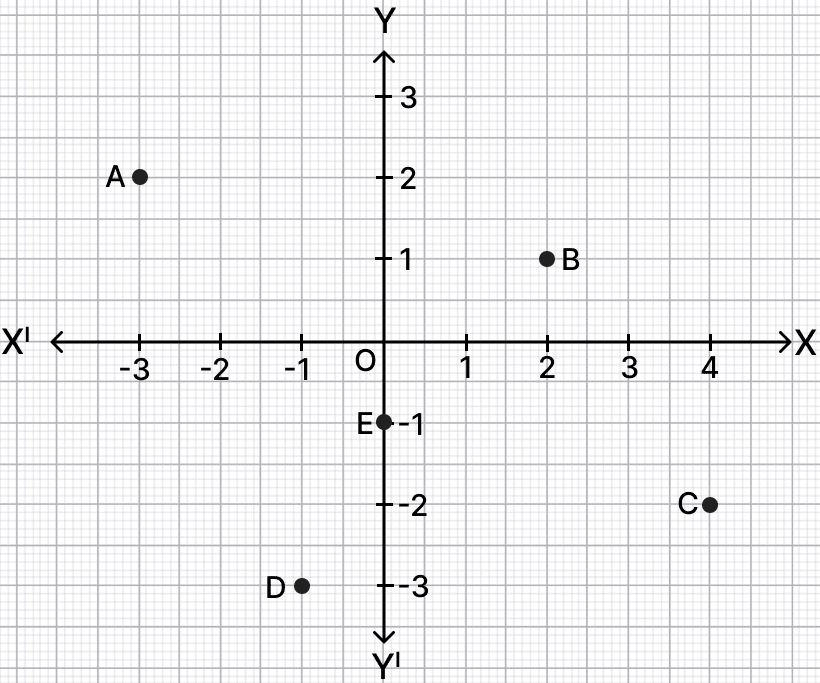
Write down the co-ordinates of each of the following points A, B, C, D, E shown below on the graph paper.
Answer
A(-3, 2)
B(2, 1)
C(4, -2)
D(-1, -3)
E(0, -1)
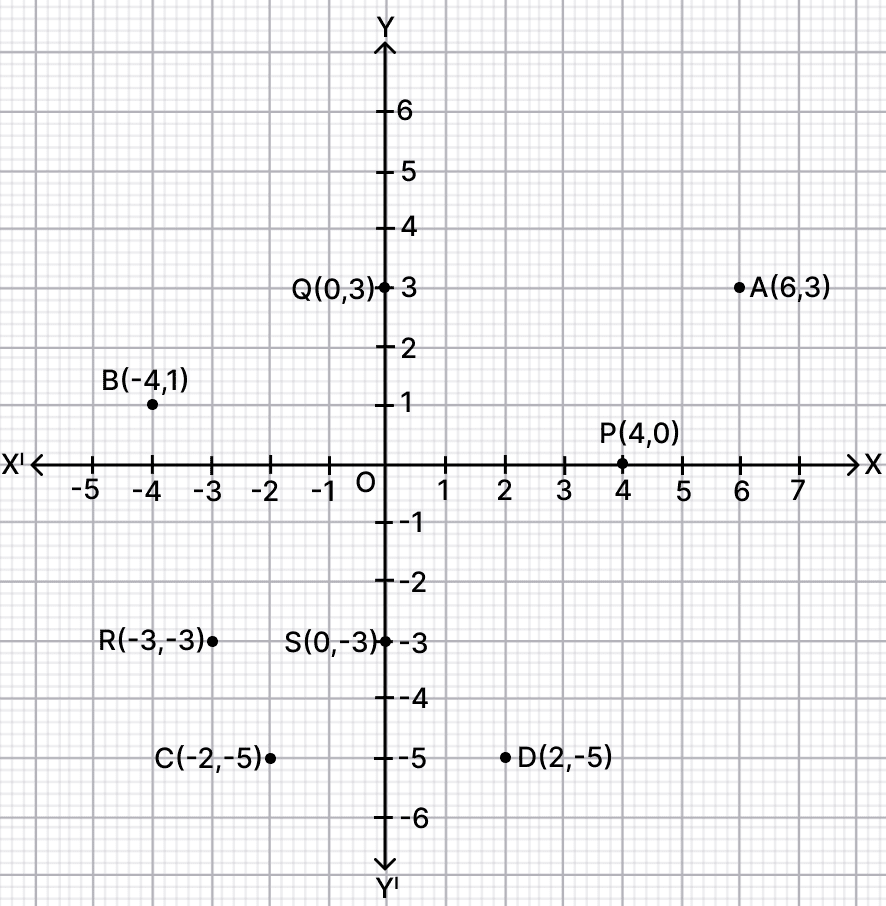
Plot each of the following points on a graph paper.
(i) A(6, 3)
(ii) B(-4, 1)
(iii) C(-2, -5)
(iv) D(2, -5)
(v) P(4, 0)
(vi) Q(0, 3)
(vii) R(-3, -3)
(viii) S(0, -3)
Answer
On which axis does the following point lie?
(i) (5, 0)
(ii) (0, -2)
(iii) (0, 3)
(iv) (-3, 0)
Answer
(i) (5, 0)
The point whose y-coordinate = 0, lies on the x-axis.
Hence, point (5, 0) lies on x-axis.
(ii) (0, -2)
The point whose x-coordinate = 0, lies on the y-axis.
Hence, point (0, -2) lies on y-axis.
(iii) (0, 3)
The point whose x-coordinate = 0, lies on the y-axis.
Hence, point (0, 3) lies on y-axis.
(iv) (-3, 0)
The point whose y-coordinate = 0, lies on the x-axis.
Hence, point (-3, 0) lies on x-axis.
In which quadrant does the given point lie?
(i) A(-3, 2)
(ii) B(-5, -3)
(iii) C(2, -7)
(iv) D(-2, -2)
Answer
(i) A(-3, 2)
Here, x is negative and y is positive.
Hence, point A lies in the 2nd quadrant.
(ii) B(-5, -3)
As x is negative, y is negative
Hence, point B lies in the 3rd quadrant.
(iii) C(2, -7)
As x is positive and y is negative
Hence, point C lies in the 4th quadrant.
(iv) D(-2, -2)
As x is negative, y is negative
Hence, point D lies in the 3rd quadrant.
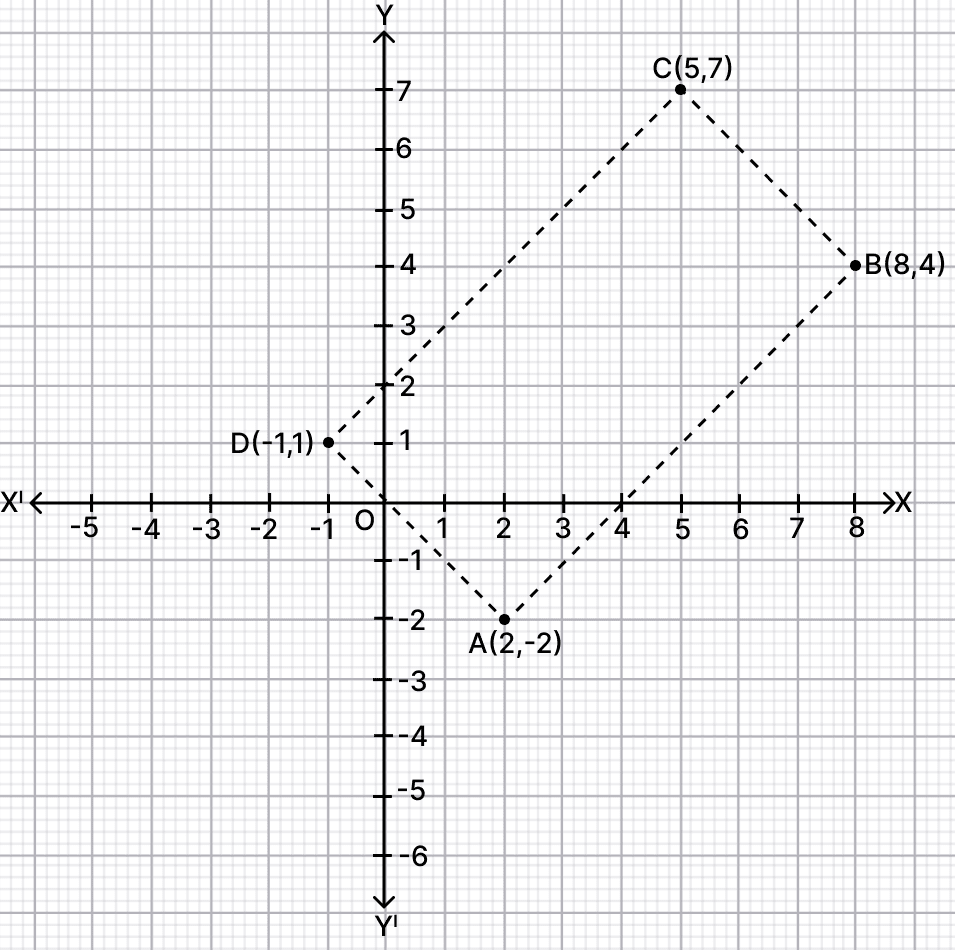
The points A(2, -2), B(8, 4) and C(5, 7) are three vertices of a rectangle ABCD. Plot these points on a graph paper and hence, find the co-ordinates of its fourth vertex D.
Answer
Given,
A(2, -2), B(8, 4) and C(5, 7) are three vertices of a rectangle ABCD.
As we know diagonals of a rectangle are equal and bisect each other.
Therefore,
Midpoint of AC = Midpoint of BD
Midpoint of AC =
=
Let D = (x, y)
Midpoint of BD:
Now Equating both midpoints
Solving for x,
8 + x = 7
x = 7 - 8
x = -1
Solving for y,
4 + y = 5
y = 1.
Hence, coordinates of D = (-1, 1).
The points A(3, 2), B(0, 5) and D(0, -1) are the three vertices of a square ABCD. Plot these points on a graph paper and hence find the co-ordinates of the vertex C.
Answer
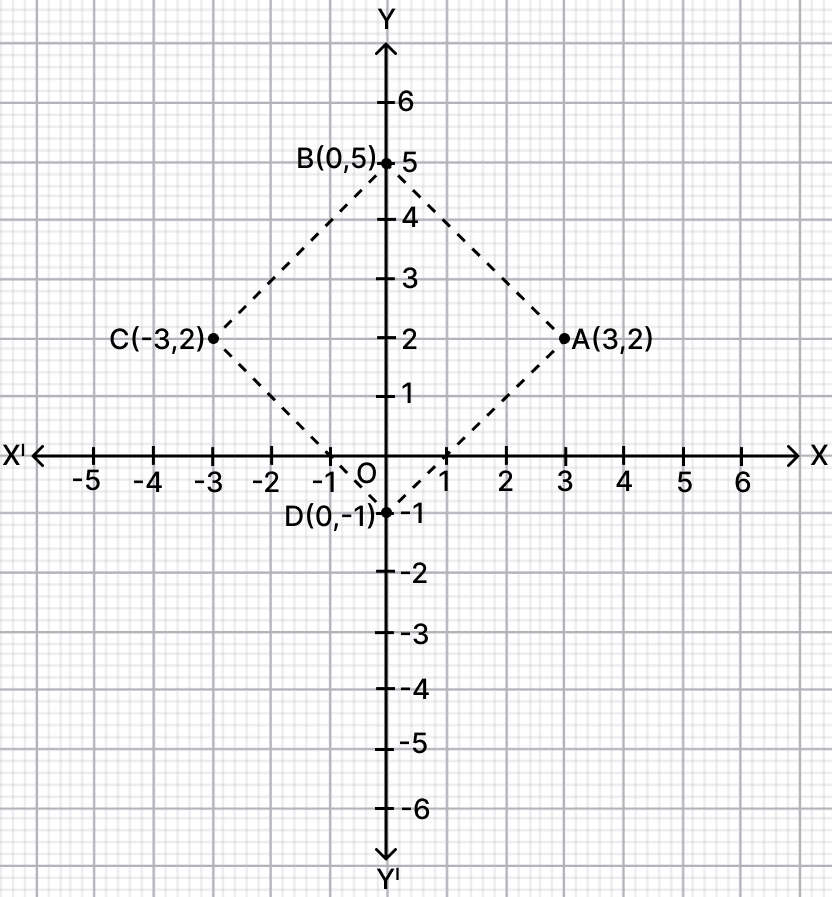
A(3, 2), B(0, 5) and D(0, -1) are the three vertices of a square ABCD.
As we know diagonals of square are equal and bisect each other.
Therefore,
Midpoint of AC = Midpoint of BD
Let C = (x, y)
Midpoint of AC =
Midpoint of BD :
(0, 2)
Now Equating both midpoints,
= 0
= 2
Solving for x,
= 0
3 + x = 0
x = -3
Solving for y,
= 2
2 + y = 4
y = 2.
Hence, coordinates of C = (-3, 2).
Draw the graph of :
x = 6
Answer

Draw the graph of :
x + 4 = 0
Answer
Given, equation :
⇒ x + 4 = 0
⇒ x = -4

Draw the graph of :
x - 5 = 0
Answer
Given, equation :
⇒ x - 5 = 0
⇒ x = 5

Draw the graph of :
y = 4
Answer

Draw the graph of :
y + 5 = 0
Answer
Given, equation :
⇒ y + 5 = 0
⇒ y = -5

Draw the graph of :
2y - 7 = 0
Answer
Given,
⇒ 2y - 7 = 0
⇒ 2y = 7
⇒ y = .

Draw the graph of :
y = x
Answer
Step 1 :
Give at least three suitable values to the variable x and find the corresponding values of y.
Let x = -1, then y = -1
Let x = 0, then y = 0
Let x = 1, then y = 1
Let x = 2, then y = 2
Step 2 :
Make a table for the corresponding values of x and y:
| x | y |
|---|---|
| -1 | -1 |
| 0 | 0 |
| 1 | 1 |
| 2 | 2 |

Step 3 :
Plot the points (-1, -1), (0, 0), (1, 1) and (2, 2) on a graph paper and then draw a straight line passing through the points plotted on the graph.
Draw the graph of :
y = -x
Answer
Step 1 :
Give at least three suitable values to the variable x and find the corresponding values of y.
Let x = -1, then y = 1
Let x = 0, then y = 0
Let x = -2, then y = 2
Let x = 2, then y = -2
Step 2 :
Make a table for the corresponding values of x and y:
| x | y |
|---|---|
| -1 | 1 |
| 0 | 0 |
| -2 | 2 |
| 2 | -2 |

Step 3 :
Plot the points (-1, 1), (0, 0), (-2, 2) and (2, -2) on a graph paper and then draw a straight line passing through the points plotted on the graph.
Draw the graph of :
y = 2x
Answer
Step 1 :
Give at least three suitable values to the variable x and find the corresponding values of y.
Let x = -1, then y = -2
Let x = 0, then y = 0
Let x = 1, then y = 2
Let x = 2, then y = 4
Step 2 :
Make a table for the corresponding values of x and y: :
| x | y |
|---|---|
| -1 | -2 |
| 0 | 0 |
| 1 | 2 |
| 2 | 4 |

Step 3 :
Plot the points (-1, -2), (0, 0), (1, 2) and (2, 4) on a graph paper and then draw a straight line passing through the points plotted on the graph.
Draw the graph of :
y = 3x + 2
Answer
Step 1 :
Give at least three suitable values to the variable x and find the corresponding values of y.
Let x = -1, then y = -1
Let x = 0, then y = 2
Let x = 1, then y = 5
Let x = -2, then y = -4
Step 2 :
Make a table for the corresponding values of x and y: :
| x | y |
|---|---|
| -1 | -1 |
| 0 | 2 |
| 1 | 5 |
| -2 | -4 |

Step 3 :
Plot the points (-1, -1), (0, 2), (1, 5) and (-2, -4) on a graph paper and then draw a straight line passing through the points plotted on the graph.
Draw the graph of :
y = 2x - 1
Answer
Step 1 :
Give at least three suitable values to the variable x and find the corresponding values of y.
Let x = 0, then y = -1
Let x = 1, then y = 1
Let x = 2, then y = 3
Step 2 :
Make a table for the corresponding values of x and y: :
| x | y |
|---|---|
| 0 | -1 |
| 1 | 1 |
| 2 | 3 |

Step 3 :
Plot the points (0, -1), (1, 1), (2, 3) on a graph paper and then draw a straight line passing through the points plotted on the graph.
Draw the graph of :
y - x = 5
Answer
Given,
y - x = 5
y = x + 5
Step 1 :
Give at least three suitable values to the variable x and find the corresponding values of y.
Let x = 0, then y = 5
Let x = -5, then y = 0
Let x = -2, then y = 3
Step 2 :
Make a table for the corresponding values of x and y: :
| x | y |
|---|---|
| 0 | 5 |
| -5 | 0 |
| -2 | 3 |

Step 3 :
Plot the points (0, 5), (-5, 0), (-2, 3) on a graph paper and then draw a straight line passing through the points plotted on the graph.
Draw the graph of the equation,
2x + y = 6.
Find the co-ordinates of the points, where the graph meets the co-ordinate axes.
Answer
Given,
2x + y = 6
y = 6 - 2x
Step 1 :
Give at least three suitable values to the variable x and find the corresponding values of y.
Let x = 0, then y = 6
Let x = 1, then y = 4
Let x = 2, then y = 2
Let x = 3, then y = 0
Step 2 :
Make a table for the corresponding values of x and y: :
| x | y |
|---|---|
| 0 | 6 |
| 1 | 4 |
| 2 | 2 |
| 3 | 0 |

Step 3 :
Plot the points (0, 6), (1, 4), (2, 2) and (3, 0) on a graph paper and then draw a straight line passing through the points plotted on the graph.
Graph meets x-axis at (3, 0).
Graph meets y-axis at (0, 6).
Draw the graph of the equation,
2x - 3y = 5.
(i) Find the value of y, when x = 4.
(ii) Find the value of x, when y = 3.
Answer
Given,
2x - 3y = 5
3y = 2x - 5
y =
Step 1 :
Give at least three suitable values to the variable x and find the corresponding values of y.
Let x = 4, then y = 1
Let x = 2.5, then y = 0
Let x = 1, then y = -1
Step 2 :
Make a table for the corresponding values of x and y: :
| x | y |
|---|---|
| 4 | 1 |
| 2.5 | 0 |
| 1 | -1 |

Step 3 :
Plot the points (4, 1), (2.5, 0), (1, -1) on a graph paper and then draw a straight line passing through the points plotted on the graph.
(i) To find the value of y, when x = 4 :
Through the point x = 4, draw a vertical straight line which meets the line 2x - 3y = 5 at point C.
Through point C, draw a horizontal line which meets the y-axis at y = 1.
Hence, the value of y = 1, when x = 4.
(ii) To find the value of x, when y = 3 :
Through the point y = 3, draw a horizontal straight line which meets the line 2x - 3y = 5 at point D.
Through point D, draw a vertical line which meets the x-axis at x = 7.
Hence, the value of x = 7, when y = 3.
Solve the simultaneous equations graphically:
y = 2x + 3 and y = 3x + 1
Answer
First Equation : y = 2x + 3
Step 1 :
Give at least three suitable values to the variable x and find the corresponding values of y.
Let x = -1.5, then y = 0
Let x = 0, then y = 3
Let x = 2, then y = 7
Step 2 :
Make a table for the corresponding values of x and y: :
| x | y |
|---|---|
| -1.5 | 0 |
| 0 | 3 |
| 2 | 7 |
Step 3 :
Plot the points (-1.5, 0), (0, 3), (2, 7) on a graph paper and then draw a straight line passing through the points plotted on the graph.
Second Equation : y = 3x + 1
Step 1 :
Give at least three suitable values to the variable x and find the corresponding values of y.
Let x = 0, then y = 1
Let x = 1, then y = 4
Let x = 2, then y = 7
Step 2 :
Make a table for the corresponding values of x and y: :
| x | y |
|---|---|
| 0 | 1 |
| 1 | 4 |
| 2 | 7 |
Step 3 :
Plot the points (0, 1), (1, 4), (2, 7) on a graph paper and then draw a straight line passing through the points plotted on the graph.

On the same graph paper, draw the graph for each given equation.
Both the straight lines drawn meet at a point. As it is clear from the graph, co-ordinates of the common point are (2, 7).
Hence, x = 2, y = 7.
Solve the simultaneous equations graphically:
x + y = 1 and 3x + 2y = 6
Answer
First Equation : x + y = 1
Step 1 :
Give at least three suitable values to the variable x and find the corresponding values of y.
Let x = 1, then y = 0
Let x = 0, then y = 1
Let x = 4, then y = -3
Step 2 :
Make a table for the corresponding values of x and y: :
| x | y |
|---|---|
| 1 | 0 |
| 0 | 1 |
| 4 | -3 |
Step 3 :
Plot the points (1, 0), (0, 1), (4, -3) on a graph paper and then draw a straight line passing through the points plotted on the graph.
Second Equation : 3x + 2y = 6
Step 1 :
Give at least three suitable values to the variable x and find the corresponding values of y.
Let x = 0, then y = 3
Let x = 2, then y = 0
Let x = 4, then y = -3
Step 2 :
Make a table for the corresponding values of x and y: :
| x | y |
|---|---|
| 0 | 3 |
| 2 | 0 |
| 4 | -3 |
Step 3 :
Plot the points (0, 3), (2, 0), (4, -3) on a graph paper and then draw a straight line passing through the points plotted on the graph.

On the same graph paper, draw the graph for each given equation.
Both the straight lines drawn meet at a point. As it is clear from the graph, co-ordinates of the common point are (4, -3).
Hence, x = 4, y = -3.
Solve the simultaneous equations graphically:
y - 2x = 1 and 5y - x = 14
Answer
First Equation : y - 2x = 1
Step 1 :
Give at least three suitable values to the variable x and find the corresponding values of y.
Let x = -1, then y = -1
Let x = 0, then y = 1
Let x = 1, then y = 3
Step 2 :
Make a table for the corresponding values of x and y: :
| x | y |
|---|---|
| -1 | -1 |
| 0 | 1 |
| 1 | 3 |
Step 3 :
Plot the points (-1, -1), (0, 1), (1, 3) on a graph paper and then draw a straight line passing through the points plotted on the graph.
Second Equation : 5y - x = 14
Step 1 :
Give at least three suitable values to the variable x and find the corresponding values of y.
Let x = 1, then y = 3
Let x = -4, then y = 2
Let x = 6, then y = 4
Step 2 :
Make a table for the corresponding values of x and y: :
| x | y |
|---|---|
| 1 | 3 |
| -4 | 2 |
| 6 | 4 |
Step 3 :
Plot the points (1, 3), (-4, 2), (6, 4) on a graph paper and then draw a straight line passing through the points plotted on the graph.

On the same graph paper, draw the graph for each given equation.
Both the straight lines drawn meet at a point. As it is clear from the graph, co-ordinates of the common point are (1, 3).
Hence, x = 1, y = 3.
Solve the simultaneous equations graphically:
x + 2y = 3 and 4x + 3y = 2
Answer
First Equation : x + 2y = 3
Step 1 :
Give at least three suitable values to the variable x and find the corresponding values of y.
Let x = 1, then y = 1
Let x = 3, then y = 0
Let x = -1, then y = 2
Step 2 :
Make a table for the corresponding values of x and y: :
| x | y |
|---|---|
| 1 | 1 |
| 3 | 0 |
| -1 | 2 |
Step 3 :
Plot the points (1, 1), (3, 0), (-1, 2) on a graph paper and then draw a straight line passing through the points plotted on the graph.
Second Equation : 4x + 3y = 2
Step 1 :
Give at least three suitable values to the variable x and find the corresponding values of y.
Let x = 0.5, then y = 0
Let x = -1, then y = 2
Let x = 2, then y = -2
Step 2 :
Make a table for the corresponding values of x and y: :
| x | y |
|---|---|
| 0.5 | 0 |
| -1 | 2 |
| 2 | -2 |
Step 3 :
Plot the points (0.5, 0), (-1, 2), (2, -2) on a graph paper and then draw a straight line passing through the points plotted on the graph.

On the same graph paper, draw the graph for each given equation.
Both the straight lines drawn meet at a point. As it is clear from the graph, co-ordinates of the common point are (-1, 2).
Hence, x = -1, y = 2.
Solve the simultaneous equations graphically:
2x + 3y = 2 and x - 2y = 8
Answer
First Equation : 2x + 3y = 2
Step 1 :
Give at least three suitable values to the variable x and find the corresponding values of y.
Let x = 1, then y = 0
Let x = -2, then y = 2
Let x = 4, then y = -2
Step 2 :
Make a table for the corresponding values of x and y: :
| x | y |
|---|---|
| 1 | 0 |
| -2 | 2 |
| 4 | -2 |
Step 3 :
Plot the points (1, 0), (-2, 2), (4, -2) on a graph paper and then draw a straight line passing through the points plotted on the graph.
Second Equation : x - 2y = 8
Step 1 :
Give at least three suitable values to the variable x and find the corresponding values of y.
Let x = 0, then y = -4
Let x = 8, then y = 0
Let x = 4, then y = -2
Step 2 :
Make a table for the corresponding values of x and y: :
| x | y |
|---|---|
| 0 | -4 |
| 8 | 0 |
| 4 | -2 |
Step 3 :
Plot the points (0, -4), (8, 0), (4, -2) on a graph paper and then draw a straight line passing through the points plotted on the graph.

On the same graph paper, draw the graph for each given equation.
Both the straight lines drawn meet at a point. As it is clear from the graph, co-ordinates of the common point are (4, -2).
Hence, x = 4, y = -2.
Find the distance between the points :
(i) A(7, 13) and B(10, 9)
(ii) P(-4, 7) and Q(2, -5)
(iii) C(4, -5) and D(12, -11)
(iv) E(-6, -4) and F(9, -12)
Answer
(i) A(7, 13) and B(10, 9)
By distance formula,
Distance between two points =
Substituting values we get :
Hence, AB = 5 units.
(ii) P(-4, 7) and Q(2, -5)
By distance formula,
Distance between two points =
Substituting values we get :
Hence, PQ = units.
(iii) C(4, -5) and D(12, -11)
By distance formula,
Distance between two points =
Substituting values we get :
Hence, CD = 10 units.
(iv) E(-6, -4) and F(9, -12)
By distance formula,
Distance between two points =
Substituting values we get :
Hence, EF = 17 units.
Find the distance of each of the following points from the origin :
(i) A(6, -6)
(ii) B(-5, 5)
(iii) C(4, -6)
Answer
(i) A(6, -6)
Origin = O(0, 0)
By distance formula,
Distance between two points =
Substituting values we get :
Hence, OA = units.
(ii) B(-5, 5)
Let origin = O(0, 0)
By distance formula,
Distance between two points =
Substituting values we get :
Hence, OB = units.
(iii) C(4, -6)
Let origin = O(0, 0)
By distance formula,
Distance between two points =
Substituting values we get :
Hence OC = units.
Find the point on the x-axis, which is equidistant from the points A(2, -5) and B(-2, 9).
Answer
Let the point on x-axis which is equidistant from the points A(2, -5) and B(-2, 9) be P(x, 0).
As point is equidistant from the points A and B.
Distance of A and P = Distance of P and B
AP = PB
Squaring both sides, we get :
⇒ (x - 2)2 + 52 = (-2 - x)2 + 92
⇒ x2 + 4 - 4x + 25 = x2 + 4 + 4x + 81
⇒ -4x + 25 = 4x + 81
⇒ -4x - 4x + 25 - 81 = 0
⇒ -8x - 56 = 0
⇒ -8x = 56
⇒ x = -7.
Hence, P(-7, 0) is the point on x-axis which is equidistant from the points A(2, -5) and B(-2, 9).
Find the point on the y-axis, which is equidistant from the points A(-3, 2) and B(5, -2).
Answer
Let the point on y-axis which is equidistant from the points A(-3, 2) and B(5, -2) be P(0, y).
As point is equidistant from the points A and B.
Distance of A and P = Distance of P and B
AP = PB
Squaring both sides, we get :
⇒ 32 + (y - 2)2 = 52 + (-2 -y)2
⇒ 9 + y2 + 4 - 4y = 25 + y2 + 4 + 4y
⇒ y2 - 4y + 13 = y2 + 4y + 29
⇒ y2 - y2 + 4y + 4y = 13 - 29
⇒ 8y = -16
⇒ y = -2.
Hence, P(0, -2) is the point on y-axis which is equidistant from the points A(-3, 2) and B(5, -2).
Show that the points A(3, 0), B(6, 4) and C(-1, 3) are the vertices of an isosceles right-angled triangle.
Answer
We will find the length of all sides of the triangle ABC by using distance formula,
Distance between two points =
Substituting values we get :
⇒ AB = AC
Also,
AB2 + AC2 = 52 + 52
= 25 + 25
= 50.
BC2 = = 50.
Since,
AB2 + AC2 = BC2
⇒ △ABC is right angled triangle at A.
As two sides are equal.
⇒ △ABC is an isosceles right angled triangle.
Hence, proved that the points A(3, 0), B(6, 4) and C(-1, 3) are the vertices of an isosceles right-angled triangle.
Show that the points O(0, 0), A(3, ) and B(3, -) are the vertices of an equilateral triangle.
Answer
Using distance formula,
Since OA = AB = OB, all the sides of the triangle are equal.
Hence, the points O(0, 0), A(3, ) and B(3, -) are the vertices of an equilateral triangle.
Show that the points A(1, 1), B(-1, 5), C(7, 9) and D(9, 5) are the vertices of a rectangle ABCD.
Answer
We will find the length of all sides by using distance formula.
⇒ AB = CD and BC = AD
Now,
We will find the length of diagonals AC and BD.
⇒ AC = BD
Since, opposite sides are equal and diagonals are also equal.
⇒ ABCD is a rectangle.
Hence, the points A(1, 1), B(-1, 5), C(7, 9) and D(9, 5) are the vertices of a rectangle ABCD.
Show that the points A(1, 2), B(5, 4), C(3, 8) and D(-1, 6) are the vertices of a square.
Answer
We will find the length of all sides by using distance formula.
⇒ AB = BC = CD = AD
Now,
We will find the length of diagonals AC and BD.
⇒ AC = BD
Since, all sides are equal and diagonals are also equal.
⇒ ABCD is a square.
Hence, the points A(1, 2), B(5, 4), C(3, 8) and D(-1, 6) are the vertices of a square.
Show that the points A(2, -1), B(3, 4), C(-2, 3) and D(-3, -2) are the vertices of a rhombus.
Answer
By distance formula,
Distance between two points =
Calculate the lengths :
As, AB = BC = CD = AD
Hence, the points A(2, -1), B(3, 4), C(-2, 3) and D(-3, -2) are the vertices of a rhombus.
Which point lies on x-axis?
(3, 2)
(-3, 2)
(2, 0)
(-1, -2)
Answer
As y = 0 on x-axis, the point (2, 0) lies on x-axis.
Hence, option 3 is the correct option.
Which point lies on y-axis?
(1, 3)
(0, 3)
(5, 2)
(-2, -3)
Answer
As x = 0 on y-axis, the point (0, 3) lies on y-axis.
Hence, option 2 is the correct option.
Which point lies in IV quadrant?
(-2, -3)
(1, -4)
(-2, 3)
(0, 1)
Answer
In the IV quadrant, x is positive and y is negative.
So, the point (1, -4) lies in the IV quadrant.
Hence, option 2 is the correct option.
Which point lies in III quadrant?
(0, 3)
(2, 0)
(7, 2)
(-2, -3)
Answer
In the III quadrant, both x and y are negative.
So, the point (-2, -3) lies in the III quadrant.
Hence, option 4 is the correct option.
Which graph is parallel to x-axis?
y = x + 1
y = 2
x = 3
x = 2y
Answer
A line parallel to the x-axis has the form y = constant.
So, y = 2 is parallel to x-axis.
Hence, option 2 is the correct option.
P is a point on x-axis at a distance of 3 units from y-axis to its right. The coordinates of P are :
(3, 0)
(0, 3)
(3, 3)
(-3, 3)
Answer
P is on x-axis, then its y coordinate is 0.
Distance is 3 units from y-axis to its right.
Thus, x-coordinate is positive.
⇒ x = 3
So, coordinates of P = (3, 0).
Hence, option 1 is the correct option.
The distance of the point P(4, -3) from the origin is :
1 unit
7 units
5 units
3 units
Answer
Let O(0, 0) be the origin.
Using distance formula,
PO =
=
=
= 5 units.
Hence, option 3 is the correct option.
What point on x-axis is equidistant from the points A(7, 6) and B(-3, 4)?
(0, 4)
(-4, 0)
(3, 0)
(0, 3)
Answer
Let the point on x-axis be P(x, 0) which is equidistant from the points A(7, 6) and B(-3, 4).
As point is equidistant from the points A and B.
Distance of A and P = Distance of P and B
AP = PB
Squaring both sides, we get :
⇒ (x - 7)2 + (-6)2 = (-3 - x)2 + 42
⇒ x2 + 49 - 14x + 36 = x2 + 9 + 6x + 16
⇒ -14x + 85 = 6x + 25
⇒ -14x - 6x - 25 + 85 = 0
⇒ -20x + 60 = 0
⇒ 20x = 60
⇒ x = 3
∴ P(3, 0) is the point on x-axis which is equidistant from the points A(7, 6) and B(-3, 4).
Hence, option 3 is the correct option.
Case Study:
One day during the rehearsal for Republic Day programmes, the teacher arranged five students Dinesh, Mamta, Kavita, Rishabh and Seema on the ground using the concept of coordinate geometry. On the graph, the position of a student is represented by the first letter of his/her name, e.g., D for Dinesh, M for Mamta and so on.
Based on the above information answer the following questions:

The coordinates of S are :
(a) (-2, 3)
(b) (2, -3)
(c) (3, -2)
(d) (-2, -3)The abscissa of the point M is :
(a) 2
(b) 3
(c) -2
(d) -3The perpendicular distance of the position of Dinesh from x-axis is :
(a) 1 unit
(b) 5 units
(c) 2 units
(d) 3 unitsThe sum of the abscissa and ordinate of the position of Rishabh is :
(a) 0
(b) 1
(c) 2
(d) -2The student who is nearest to the x-axis :
(a) Mamta
(b) Kavita
(c) Rishabh
(d) Dinesh
Answer
1. From graph,
The coordinates of S are (-2, 3).
Hence, option (a) is the correct option.
2. As abscissa is the x-coordinate of a point.
M = (3, 1).
So, the abscissa of the point M is 3.
Hence, option (b) is the correct option.
3. As Dinesh is represented by D.
Coordinates of D = (5, -2)
The perpendicular distance from the x-axis is the absolute value of the y-coordinate = 2 units.
Hence, option (c) is the correct option.
4. Rishabh is represented by R.
The coordinates of R = (-1, -1)
Sum = Abscissa + ordinate = -1 + (-1) = -2.
Hence, option (d) is the correct option.
5. Kavita's position is on the x-axis and coordinates are (-4, 0).
Therefore, Kavita is nearest to the x-axis.
Hence, option (b) is the correct option.
Case Study:
Saumya studies in class IX. One day, she drew the sketch of table tennis racket on a graph paper, as shown alongside. Observe these sketches and answer the questions given below :
Based on the above information answer the following questions:

The distance of the point S from y-axis is :
(a) 10 units
(b) 8 units
(c) 6 units
(d) 12 unitsThe distance between the points D and R is :
(a) 116 units
(b) units
(c) units
(d) unitsThe length of diagonal SQ is :
(a) units
(b) units
(c) units
(d) unitsABCD is a :
(a) square
(b) rectangle
(c) rhombus
(d) kitePQRS is a :
(a) square
(b) rectangle
(c) rhombus
(d) kite
Answer
1. The distance of a point from the y-axis is given by the absolute value of its x-coordinate.
Coordinates of S = (12, 8)
⇒ Distance of the point S from y-axis is 12 units.
Hence, option (d) is the correct option.
2. Coordinates of D = (4, 4)
Coordinates of R = (14, 8)
We will find distance between the points D and R by using distance formula,
Distance between two points =
Substituting values we get :
DR = units
Hence, option (b) is the correct option.
3. Coordinates of S = (12, 8)
Coordinates of Q = (14, 4)
We will find the length of diagonal SQ by using distance formula,
Distance between two points =
Substituting values we get :
SQ = units
Hence, option (c) is the correct option.
4. As,
Coordinates of A = (4, 2)
Coordinates of B = (6, 2)
Coordinates of C = (6, 4)
Coordinates of D = (4, 4)
We will find out the length of all sides of ABCD by using distance formula,
⇒ AB = BC = CD = AD
Now we will check for Diagonals,
⇒ Diagonal AC and BD are also equal.
⇒ ABCD is a square.
Hence, option (a) is the correct option.
5. As,
Coordinates of P = (12, 4)
Coordinates of Q = (14, 4)
Coordinates of R = (14, 8)
Coordinates of S = (12, 8)
We will find out the length of all sides of PQRS by using distance formula,
⇒ PQ = RS and QR = SP
⇒ Opposite sides are equal.
Now we will check for Diagonals,
⇒ Diagonal PR and SQ are also equal.
⇒ PQRS is a rectangle.
Hence, option (b) is the correct option.
Assertion (A): The coordinates of a point P are (7, 3). The distance of point P from x-axis is 7 units and that from y-axis is 3 units.
Reason (R): x-coordinate of a point is called abscissa and y-coordinate is called ordinate.
A is true, R is false
A is false, R is true
Both A and R are true.
Both A and R are false.
Answer
As coordinates of P are (7, 3)
So, the distance from x-axis 3 and distance from y-axis is 7.
⇒ Assertion (A) is false .
As x-coordinate of a point is called abscissa and y-coordinate is called ordinate.
⇒ Reason (R) is true.
Hence, option 2 is the correct option.
Assertion (A): The distance between origin (O) and P(4, 3) is given by
OP = = 5 units
Reason (R): The distance between the points A(x1, y1) and B(x2, y2) is given by
AB =
A is true, R is false
A is false, R is true
Both A and R are true.
Both A and R are false.
Answer
We will find distance between O and P by using distance formula,
⇒ Assertion (A) is true.
As Distance Formula for two points A and B is
AB =
⇒ Reason (R) is correct.
Hence, option 3 is the correct option.
Assertion (A): The point (0, -2) lies on y-axis.
Reason (R): Any point of the form (0, y) lies on x-axis.
A is true, R is false
A is false, R is true
Both A and R are true
Both A and R are false
Answer
As, x = 0 and y = -2
Thus, the point (0, -2) lies on y-axis.
⇒ Assertion (A) is true.
Reason (R) states that any point of the form (0, y) lies on the x-axis, which is false. In fact, any point of the form (0, y) lies on the y-axis.
⇒ Reason (R) is false.
Hence, option 1 is the correct option.
The coordinates of a point are (2, 8). Its distance from x-axis is :
2 units
8 units
(2 + 8) units
units
Answer
Point = (2, 8)
Distance from x-axis = 8 units
Hence, option 2 is the correct option.
A point is 4 units away from the origin. If it lies in the first quadrant, how many such points exist?
One
Two
Four
Infinitely many
Answer
A point is 4 units from the origin.
⇒ All points lie on a circle of radius 4.
⇒ In the first quadrant, there are infinitely many points on that arc.
Hence, option 4 is the correct option.
The coordinates of two points A and B are (5, 7) and (5, -5). The length of the line segment AB is 7 - (-5) units. This statement is :
true
false
can't say
none of these
Answer
According to question :
Length of AB = 7 - (-5) = 7 + 5 = 12.
We will find the length of AB by using distance formula,
Hence, option 1 is the correct option.
Which of the following points does not lie in any quadrant?
(1, 2)
(4, 4)
(-2, -1)
(0, 5)
Answer
As the point (0, 5) lies on y-axis.
⇒ It does not lie in any quadrant.
Hence, option 4 is the correct option.
A point on the coordinate plane is 3 units far from x-axis and 4 units far from y-axis. Which of the following can be the coordinates of the point?
(3, 4)
(-3, -4)
both (a) and (b)
none of these
Answer
As, distance from x-axis is 3 units.
⇒ |y| = 3
Distance from y-axis is 4 units.
⇒ |x| = 4
Thus, the points can be (4, 3), (4, -3), (-4, 3), (-4, -3).
Hence, option 4 is the correct option.
Which of the following points is nearest to x-axis?
(-1, 4)
(4, -3)
(2, 2)
(1, -4)
Answer
Distance from x-axis = Absolute value of y coordinate
Smallest distance = 2
⇒ (2, 2) is the nearest point to x-axis.
Hence, option 3 is the correct option.
A circle is drawn with origin (O) as centre and radius 4 units. Among the points (4, 2), (2, 2), (-5, 1), (-1, -2), (-4, 1), (1, 1), (-2, 4), state which lie inside the circle and which lie outside the circle.
Answer
Centre = O(0, 0)
Radius = 4
Equation of circle :
x2 + y2 = radius2
x2 + y2 = 42
x2 + y2 = 16
If point lies inside the circle,
Equation will be :
x2 + y2 < 16
If point lies outside the circle,
Equation will be :
x2 + y2 > 16
Now, we will check for each point.
1. (4, 2)
42 + 22 = 16 + 4 = 20
20 > 16
So, point is outside the circle.
2. (2, 2)
22 + 22 = 4 + 4 = 8
8 < 16
So, point is inside the circle.
3. (-5, 1)
(-5)2 + 12 = 25 + 1 = 26
26 > 16
So, point is outside the circle.
4. (-1, -2)
(-1)2 + (-2)2 = 1 + 4 = 5
5 < 16
So, point is inside the circle.
5. (-4, 1)
(-4)2 + 12 = 16 + 1 = 17
17 > 16
So, point is outside the circle.
6. (1, 1)
12 + 12 = 1 + 1 = 2
2 < 16
So, point is inside the circle.
7. (-2, 4)
(-2)2 + 42 = 4 + 16 = 20
20 > 16
So, point is outside the circle.
Hence, points lying
Inside the circle :(2, 2), (-1, -2), (1, 1)
Outside the circle : (4, 2), (-5, 1), (-4, 1), (-2, 4)
A right angled triangle ABC is drawn on the coordinate plane as shown below. Find the area of the right triangle.

Answer
From graph,
A = (-2, 5) and B = (7, -3)
As,
x-coordinate of point C = x-coordinate of point A
y-coordinate of point C = y-coordinate of point B
Coordinates of C = (-2, -3)
Now,
Area of right triangle =
We will find base and height by using distance formula,
Distance between two points =
Base = CB
Base = 9 units
Height = AC
Height = 8 units
Area of right triangle ABC =
=
= 36 sq. units
Hence, area of triangle = 36 sq. units.