
Area of the rhombus whose diagonals are 16 cm and 24 cm will be :
182 cm2
202 cm2
92 cm2
192 cm2
Answer
We know that,
Area of the rhombus = × Product of diagonals
= × 16 × 24
= 8 × 24
= 192 cm2
Hence, option 4 is the correct option.
The area of the trapezium whose parallel sides are 9 cm and 6 cm respectively and distance between these sides is 8 cm, will be :
50 cm2
60 cm2
70 cm2
80 cm2
Answer
We know that,
Area of the trapezium = × sum of parallel sides × height
= × (9 + 6) × 8
= 15 × 4
= 60 cm2
Hence, option 2 is the correct option.
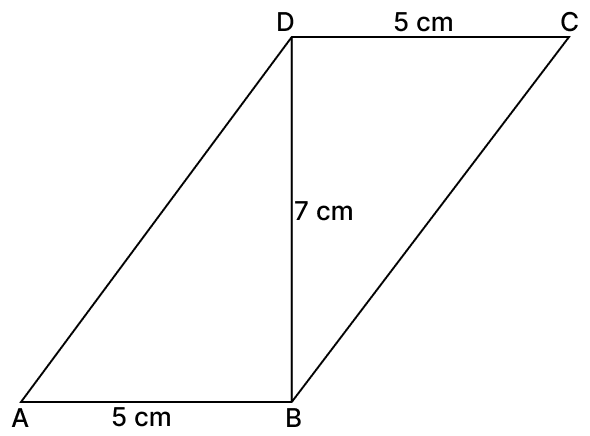
Area of parallelogram ABCD in the figure will be :
15 cm2
25 cm2
35 cm2
45 cm2
Answer
We know that,
Area of ∥gm = Base × Height
= AB × DB
= 5 × 7
= 35 cm2.
Hence, option 3 is the correct option.
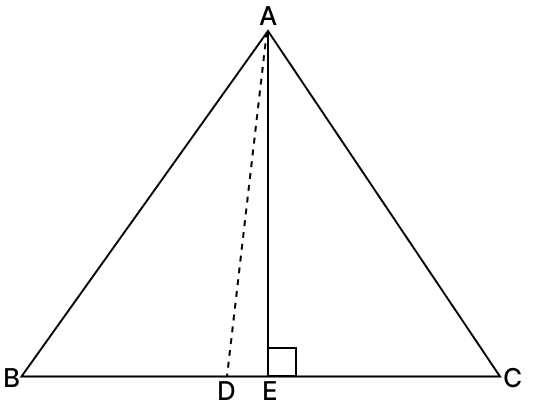
In the given figure, if AD is median on BC and AE ⟂ BC, then ar (ΔADC) =
ar (ΔADE)
ar (ΔABD)
ar (ΔAEC)
ar (ΔBCA)
Answer
Median AD divides ΔABC into two Δs of equal area.
ar (ΔADC) = ar (ΔABD)
Hence, option 2 is the correct option.
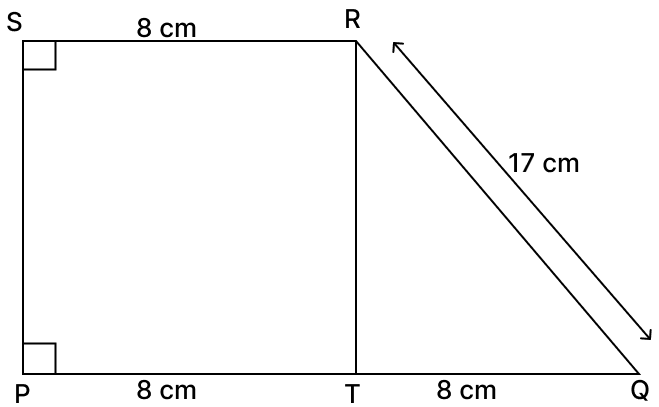
The area of trapezium PQRS will be :
170 cm2
180 cm2
160 cm2
190 cm2
Answer
In triangle RTQ,
RQ2 = RT2 + QT2
(17)2 = RT2 + (8)2
RT2 = 289 - 64
RT2 = 225
RT = = 15 cm.
We know that,
Area of the trapezium = × sum of parallel sides × height
= × (8 + 16) × 15
= × (24) × 15
= 15 × 12
= 180 cm2.
Hence, option 2 is the correct option.
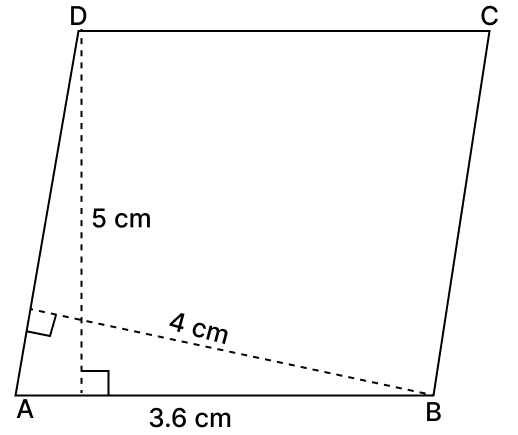
ABCD is a parallelogram. If AB = 3.6 cm and altitude corresponding to sides AB and AD are respectively 5 cm and 4 cm, then AD will be :
5.5 cm
3.5 cm
2.5 cm
4.5 cm
Answer
We know that,
Area of ∥gm = Base × Height
Area of ∥gm ABCD using base AB = 3.6 × 5 = 18 cm2
Area of ∥gm ABCD using base AD = AD × 4
18 = AD × 4
AD =
AD = 4.5 cm.
Hence, option 4 is the correct option.
A triangle, a parallelogram and a rectangle have the same base and are situated between the same parallels. The ratio of their areas is :
2 : 1 : 2
2 : 2 : 1
1 : 2 : 3
1 : 2 : 2
Answer
Let the common base be b and the common height be h.
Area of triangle = × b × h
Area of parallelogram = b × h
Area of rectangle = b × h
Ratio of areas of triangle, parallelogram and rectangle:
= × b × h : b × h : b × h
= 1 : 2 : 2.
Hence, option 4 is the correct option.
If the area of the parallelogram ABCD is 10 cm2, then the area of ΔBCD is :
10 cm2
5 cm2
20 cm2
25 cm2
Answer
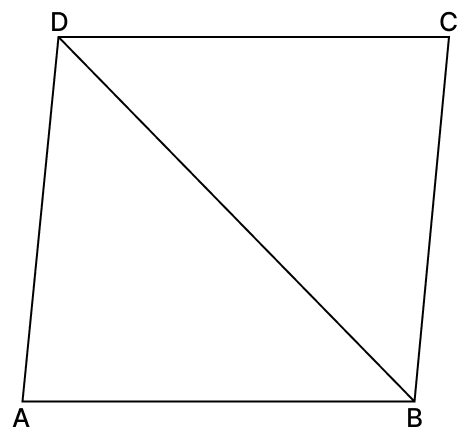
Diagonal BD divides it into triangles ABD and BCD of equal area.
ar(ΔBCD) = ar(∥gm ABCD)
=
= 5 cm2.
Hence, option 2 is the correct option.
A triangle and a parallelogram, both having base 5 cm, are situated between the same parallels. If the height of the triangle is 4 cm, then the area of the parallelogram is :
20 cm2
40 cm2
10 cm2
5 cm2
Answer
Area of triangle = × base × height
= × 5 × 4
= 10 cm2
A triangle and a parallelogram, both have same base and are between the same parallels.
Area of triangle = ar(∥gm ABCD)
10 = ar(∥gm ABCD)
ar(∥gm ABCD) = 10(2)
ar(∥gm ABCD) = 20 cm2
Hence, option 1 is the correct option.
The area of the parallelogram PQRS is 16 sq. units. If M is the mid-point of PQ, then the area of ΔQMR is :
16 sq. units
8 sq. units
4 sq. units
2 sq. units
Answer
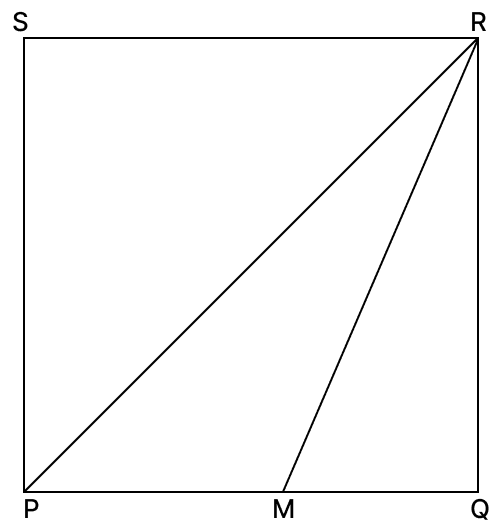
ΔPQR and parallelogram PQRS, both have same base PQ and are between the same parallels PQ and SR.
Area of △PQR = Area of parallelogram PQRS
=
= 8 sq.units.
M is the mid-point of PQ, QM = PQ
Thus, RM is the median of a triangle PQR, and divides it into two triangles of equal area.
Area of △QMR = Area of triangle PQR
=
= 4 sq. units.
Hence, option 3 is the correct option.
ABCD is a rectangle and ABQC is a parallelogram. If the area of ΔABD is 5 sq. cm, then the area of the parallelogram is :
5 sq. cm
10 sq. cm
20 sq. cm
30 sq. cm
Answer
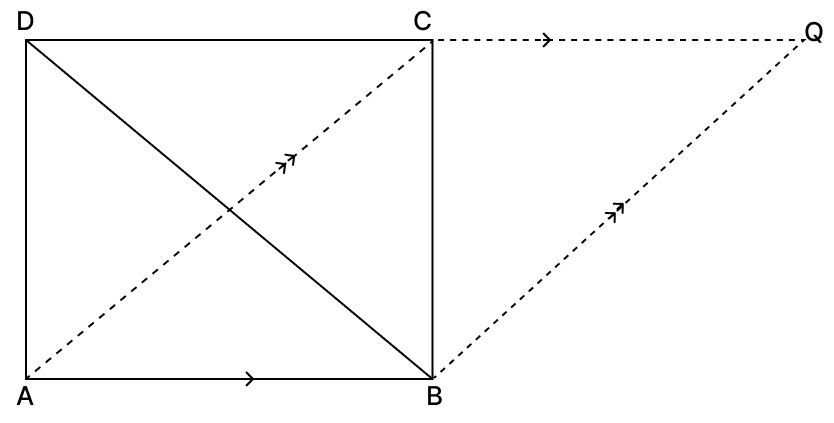
In a rectangle, a diagonal divides it into two equal triangles.
So,
Area of rectangle ABCD = 2 × Area of △ABD
= 2 × 5
= 10 cm2.
Rectangle ABCD and parallelogram ABQC are on the same base AB and between the same parallel lines AB and DQ.
Area of the parallelogram ABQC = Area of rectangle ABCD = 10 cm2.
Hence, option 2 is the correct option.
P and Q are two points on the side DC of a ∥ gm ABCD. If the area of ΔPAB is 10 cm2, then the area of ΔQAB is :
5 cm2
10 cm2
15 cm2
20 cm2
Answer
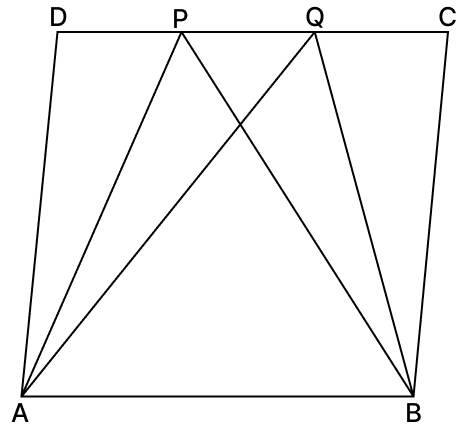
Triangles PAB and QAB have the same base AB and lie between the same parallels AB and DC.
ar(△QAB) = ar(△PAB) = 10 cm2
Hence, option 2 is the correct option.
Two diagonals of a parallelogram ABCD intersect at O. If the area of the parallelogram is 20 cm2, then the area of ΔAOB is :
20 cm2
15 cm2
10 cm2
5 cm2
Answer
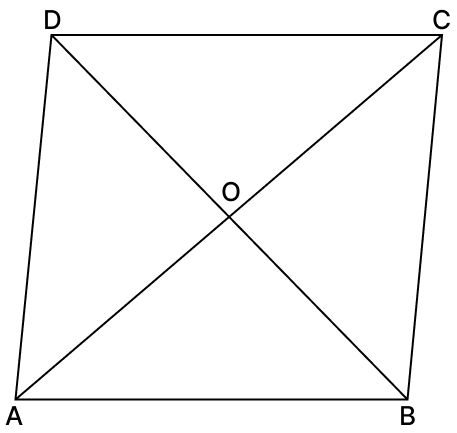
The diagonals of a parallelogram divide it into four triangles of equal area.
So, Area(ΔAOB) = Area(∥gm ABCD)
=
= 5 cm 2.
Hence, option 4 is the correct option.
E is the mid-point of the side AB of a parallelogram ABCD. If the area of the ABCD is 60 sq. cm, then the area of ΔBDE is :
60 sq. cm
30 sq. cm
15 sq. cm
10 sq. cm
Answer
Draw diagonal BD.
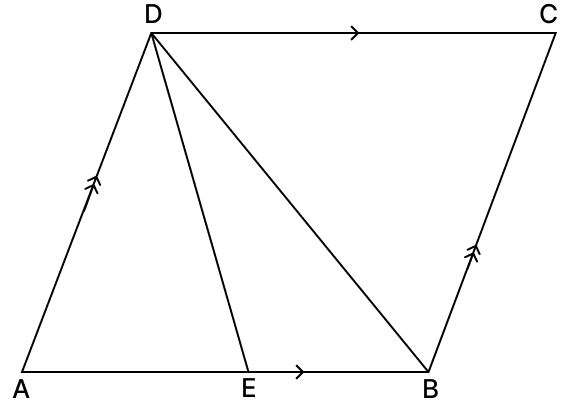
A diagonal of a parallelogram divides it into two triangles of equal area :
Area (ΔABD) = Area(∥gm ABCD)
= (60)
= 30 cm2.
Point E is the midpoint of AB, so:
BE = AB
A median of a triangle divides it into two triangles of equal area.
Area(ΔBDE) = Area(ΔABD)
= (30)
= 15 cm2.
Hence, option 3 is the correct option.