
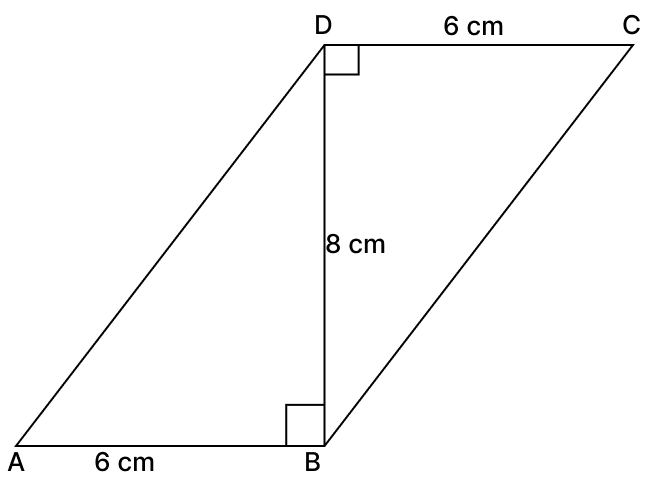
In adjoining figure, BD is a diagonal of quad. ABCD. Show that ABCD is a parallelogram and calculate the area of ∥ gm ABCD.
Answer
Given,
BD = 8 cm
AB = DC = 6 cm.
∠DBA = ∠BDC = 90°
Thus, BD is perpendicular to both AB and DC.
∴ AB ∥ DC
Since one pair of opposite sides are equal and parallel, thus ABCD is a parallelogram.
We know that,
Area of ∥gm = Base × Height
Area of ∥gm ABCD = AB × BD
= 6 × 8
= 48 cm2.
Hence, proved that ABCD is a parallelogram and area of ∥gm ABCD is 48 cm2.
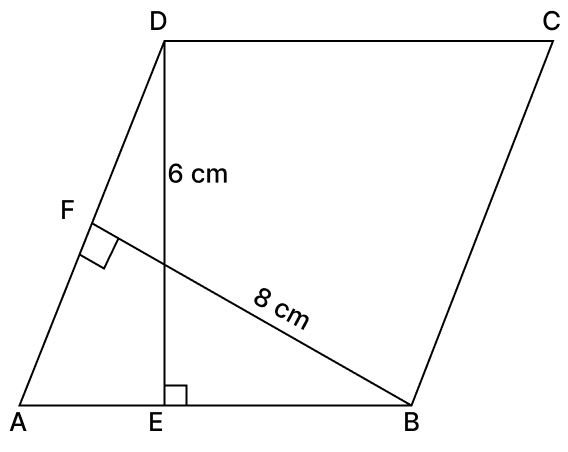
In a ∥gm ABCD, it is given that AB = 16 cm and the altitudes corresponding to sides AB and AD are 6 cm and 8 cm respectively. Find the length of AD.
Answer
Given,
AB = 16 cm
BF = 8 cm
DE = 6 cm
We know that,
Area of ∥gm = Base × Height
Area of ∥gm ABCD = AB × DE
= 16 × 6
= 96 cm2.
Considering side AD,
Area of ∥gm ABCD = Base × Height
96 = AD × BF
96 = AD × 8
AD =
AD = 12 cm.
Hence, length of AD is 12 cm.
Find area of rhombus, the lengths of whose diagonals are 18 cm and 24 cm respectively.
Answer
We know that,
Area of rhombus = × Product of diagonals
= × 18 × 24
= 9 × 24
= 216 cm2.
Hence, area of rhombus is 216 cm2.
Find area of trapezium, whose parallel sides measure 10 cm and 8 cm respectively and the distance between these sides is 6 cm.
Answer
We know that,
Area of trapezium = × (sum of parallel sides) × Height
= × (10 + 8) × 6
= × (18) × 6
= 9 × 6
= 54 cm2.
Hence, area of trapezium is 54 cm2.
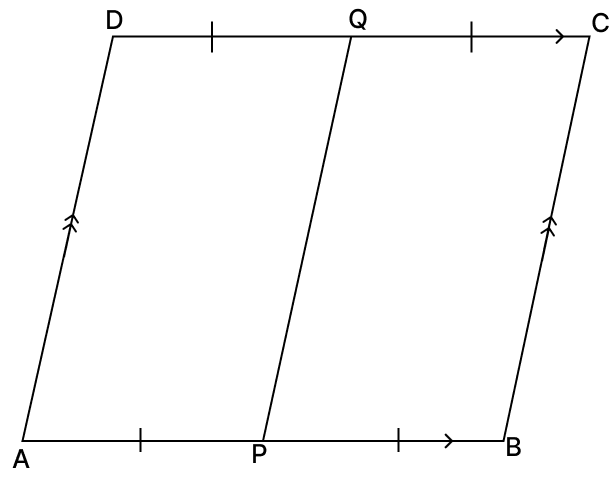
Show that the line segment joining the mid-points of a pair of opposite sides of a parallelogram, divides it into two equal parallelogram.
Answer
Given,
ABCD be a parallelogram in which P and Q are mid-points of AB and CD respectively.
Let us construct DG ⊥ AB and let DG = h, where h is the altitude on side AB.
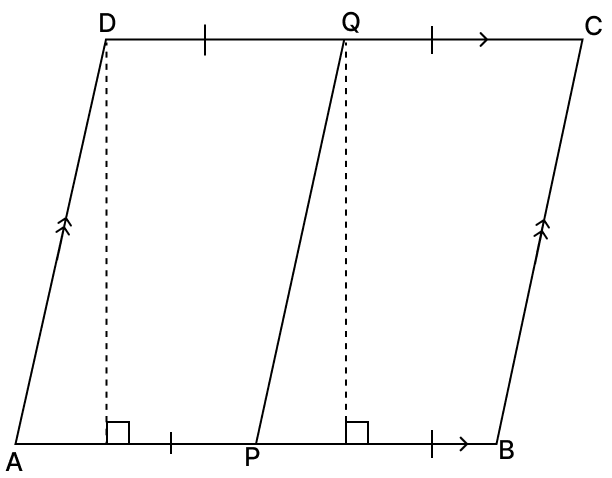
Area of ||gm ABCD = base × height = AB × h
Area of ||gm APQD = AP × h = × h ......(1) [Since P is the mid-point of AB]
The perpendicular distance between two parallel lines is always same everywhere, DG = QR = h.
Area of ||gm PBCQ = PB × h = × h ......(2) [Since P is the mid-point of AB]
From (1) and (2)
Area of ||gm APQD = Area of ||gm PBCQ.
Hence proved, that the line segment joining the mid-points of a pair of opposite sides of a parallelogram divides it into two equal parallelograms.
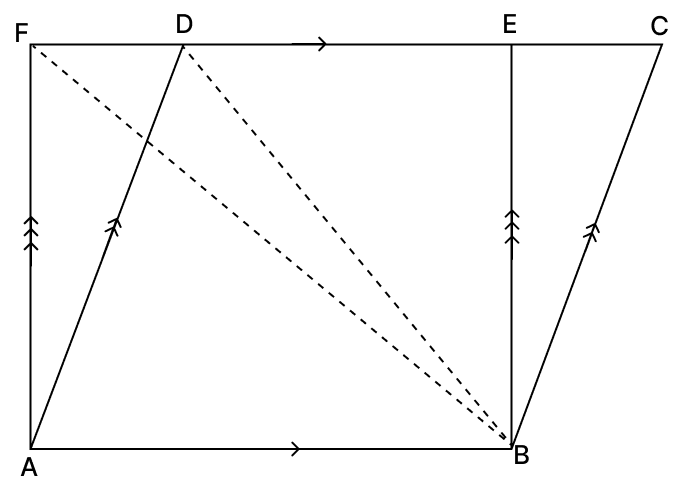
In the given figure, the area of ||gm ABCD is 90 cm2. State giving reasons:
(i) ar (||gm ABEF)
(ii) ar (△ABD)
(iii) ar (△BEF)
Answer
(i) ar (||gm ABEF)
||gm ABCD and ||gm ABEF lie on the same base AB and between the same parallels AB and FC.
∴ ar(||gm ABEF) = ar(||gm ABCD) = 90 cm2.
Hence, ar(||gm ABEF) = 90 cm2.
(ii) Triangle ABD and parallelogram ABCD are on the same base AB and between the same parallels AB and CD, then area of triangle is equal to half of the area of the parallelogram.
ar (△ABD) = ar(||gm ABCD)
=
= 45 cm2.
Hence, ar (△ABD) = 45 cm2.
(iii) Triangle BEF and a parallelogram ABEF are on the same base EF and between the same parallels AB and EF, then area of triangle is equal to half of the area of the parallelogram.
ar (△BEF) = ar(||gm ABEF)
=
= 45 cm2.
Hence, ar (△BEF) = 45 cm2.
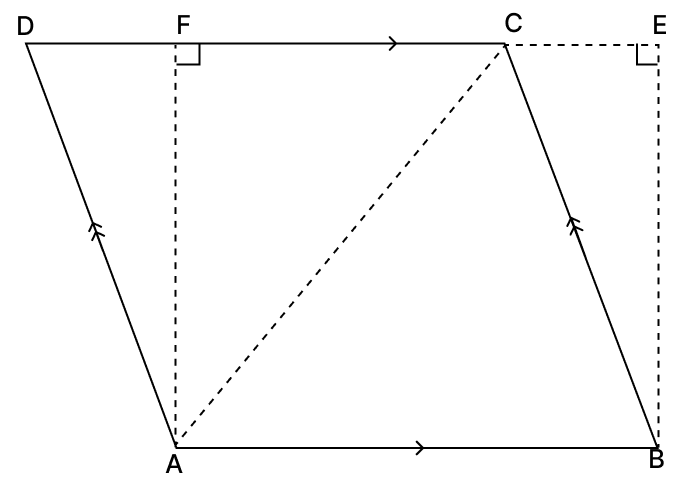
In the given figure, the area of △ABC is 64 cm2. State giving reasons:
(i) ar(||gm ABCD)
(ii) ar (rect. ABEF)
Answer
(i) Triangle ABC and a parallelogram ABCD are on the same base AB and between the same parallels AB and CD, then area of triangle is equal to half of the area of the parallelogram.
ar (△ABD) = ar(||gm ABCD)
64 = ar(||gm ABCD)
ar (||gm ABCD) = 64(2)
ar (||gm ABCD) = 128 cm2.
Hence, ar(||gm ABCD) = 128 cm2.
(ii) ||gm ABCD and rectangle ABEF lie on the same base AB and between the same parallels AB and ED.
∴ar (||gm ABCD) = ar (rect. ABEF)
ar (rect. ABEF) = 128 cm2.
Hence, ar(rect. ABEF) = 128 cm2.
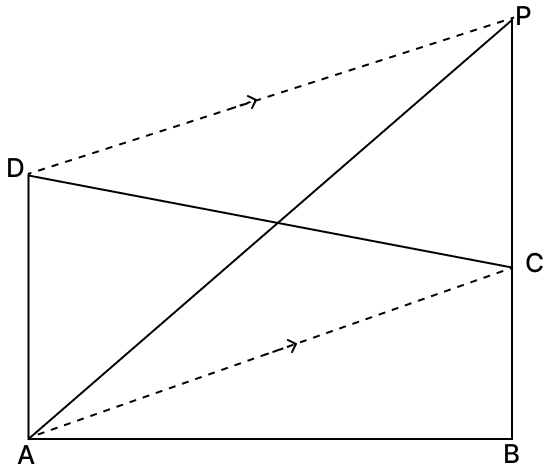
In the given figure, ABCD is a quadrilateral. A line through D, parallel to AC, meets BC produced in P. Prove that: ar (△ABP) = ar (quad.ABCD)
Answer
Triangles △ ACD and △ ACP on the same base AC and between same parallels AC and DP.
∴ ar (△ACD) = ar (△ACP)
Add the common ar(△ABC) to both sides
ar (△ACD) + ar(△ABC) = ar (△ACP) + ar(△ABC)
From figure,
∴ ar (quad.ABCD) = ar (△ABP)
Hence, proved that ar (△ABP) = ar (quad. ABCD).
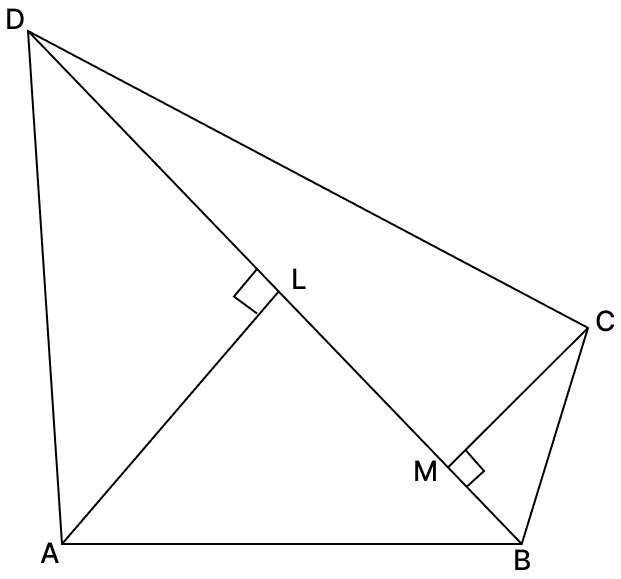
ABCD is a quadrilateral. If AL ⊥ BD and CM ⊥ BD, prove that : ar (quad.ABCD) = × BD × (AL + CM).
Answer
We know that,
Area of triangle = × Base × Height
Area of triangle ABD = × BD × AL
Area of triangle CBD = × BD × CM
We know that,
Area of quadrilateral ABCD = Area of △ ABD + Area of △ CBD
= × BD × AL + × BD × CM
= × BD × (AL + CM).
Hence, proved that ar (quad. ABCD) = × BD × (AL + CM).
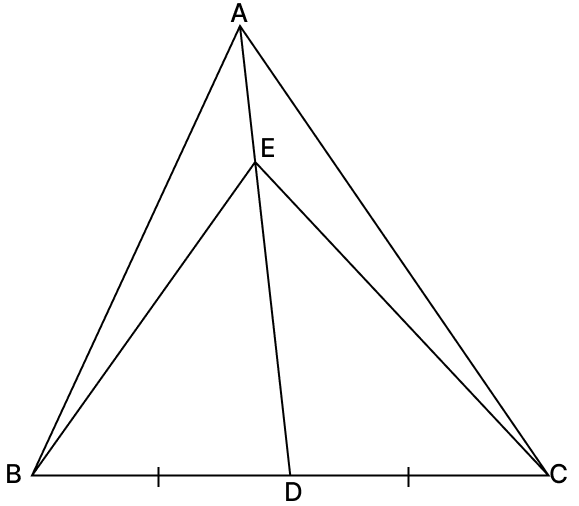
In the given figure, D is the mid-point of BC and E is any point on AD. Prove that :
(i) ar (△EBD) = ar (△EDC)
(ii) ar (△ABE) = ar (△ACE)
Answer
(i) Given,
BD = DC
Thus, ED is the median of triangle EBC.
We know that,
Median ED divides a triangle EBC into two triangles EBD and ECD of equal area.
∴ ar (△EBD) = ar (△EDC)
Hence, proved that ar (△EBD) = ar (△EDC).
(ii) Given,
BD = DC
Thus, AD is the median of triangle ABC.
Median AD divides a triangle ABC into two triangles ABD and ADC of equal area.
ar (△ABD) = ar (△ADC)
ar (△ABE) + ar (△EDB) = ar (△ACE) + ar (△EDC)
ar (△ABE) + ar (△EDB) = ar (△ACE) + ar (△EDB) [ar (△EBD) = ar (△EDC)]
ar (△ABE) + ar (△EDB) - ar (△EDB) = ar (△ACE)
ar (△ABE) = ar (△ACE).
Hence, proved that ar (△ABE) = ar (△ACE).
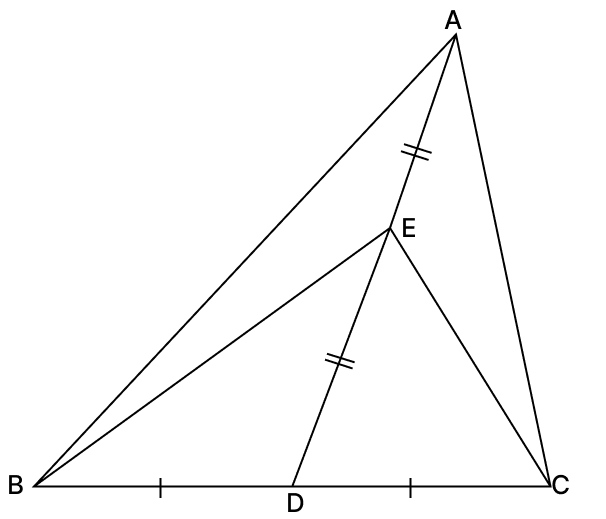
In the given figure, D is the mid-point of BC and E is the mid-point of AD. Prove that :
ar (ΔABE) = ar (ΔABC).
Answer
Median AD divides triangle ABC into two triangles ABD and ACD of equal area.
ar (△ABD) = ar (△ABC) .....(1)
Since E is the mid-point of AD, BE is the median of ΔABD.
ar (△ABE) = ar (△ABD) .....(2)
Substituting value from equation 1 in equation 2, we get :
ar (△ABE) =
ar (△ABE) = ar (△ABC).
Hence, proved that ar (△ABE) = ar (△ABC).
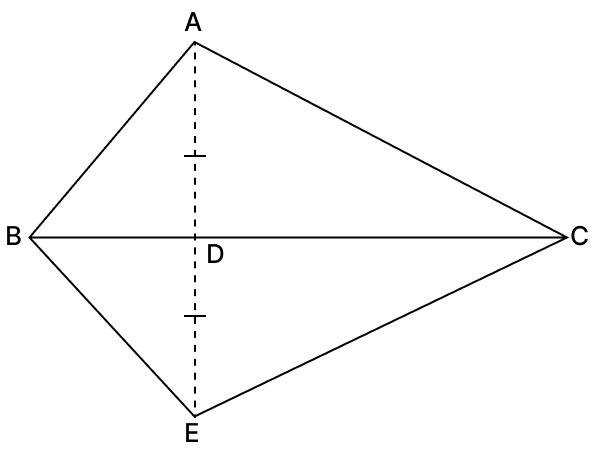
In the given figure, a point D is taken on side BC of ΔABC and AD is produced to E, making DE = AD. Show that :
ar (ΔBEC) = ar (ΔABC).
Answer
Since, AD = DE thus, D is the mid-point of AE.
Median BD divides ΔABE into two Δs of equal area.
ar (ΔABD) = ar (ΔEBD) ....(1)
Median CD divides ΔACE into two Δs of equal area.
ar (ΔACD) = ar (ΔECD) ....(2)
Adding the Equations:
ar (ΔABD) + ar (ΔACD) = ar (ΔEBD) + ar (ΔECD)
∴ ar (ΔABC) = ar (ΔBEC)
Hence, proved that ar (ΔBEC) = ar (ΔABC).
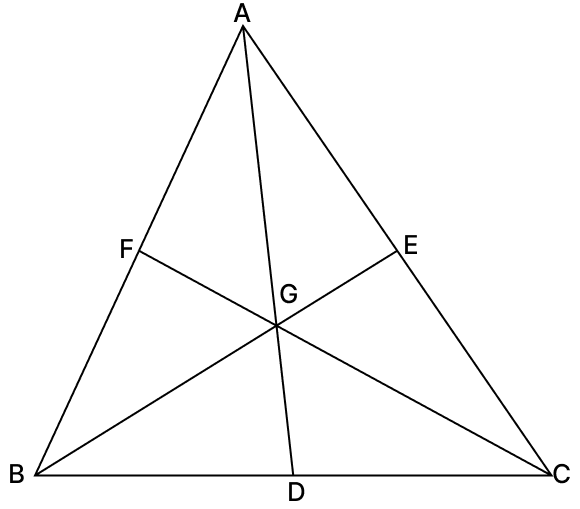
If the medians of a ΔABC intersect at G, show that :
ar (ΔAGB) = ar (ΔAGC) = ar (ΔBGC) = ar (ΔABC).
Answer
In ΔABC,
Median AD divides ΔABC into two Δs of equal area.
∴ ar (ΔABD) = ar (ΔACD) ....(1)
In ΔGBC,
Median GD divides ΔGBC into two Δs of equal area.
∴ ar (ΔGBD) = ar (ΔGCD) ....(2)
Subtracting equation (2) from equation (1), we get :
ar (ΔABD) − ar (ΔGBD) = ar (ΔACD) − ar (ΔGCD)
ar (ΔAGB) = ar (ΔAGC) ...........(3)
In ΔABC,
Median BE divides ΔABC into two Δs of equal area.
∴ ar (ΔABE) = ar (ΔBCE) ....(4)
In ΔGAC,
Median GE divides ΔGAC into two Δs of equal area.
∴ ar (ΔGEA) = ar (ΔGEC) ....(5)
Subtracting equation (5) from equation (4), we get :
ar (ΔABE) − ar (ΔGEA) = ar (ΔBCE) − ar (ΔGEC)
ar (ΔAGB) = ar (ΔBGC) ...........(6)
From equation (3) and (6), we get :
∴ ar (ΔAGB) = ar (ΔAGC) = ar (ΔBGC)
From figure,
ar (ΔAGB) + ar (ΔAGC) + ar (ΔBGC) = ar (ΔABC)
3ar (ΔAGB) = ar (ΔABC)
ar (ΔAGB) = × ar (ΔABC)
Hence, proved that ar (ΔAGB) = ar (ΔAGC) = ar (ΔBGC) = ar (ΔABC).
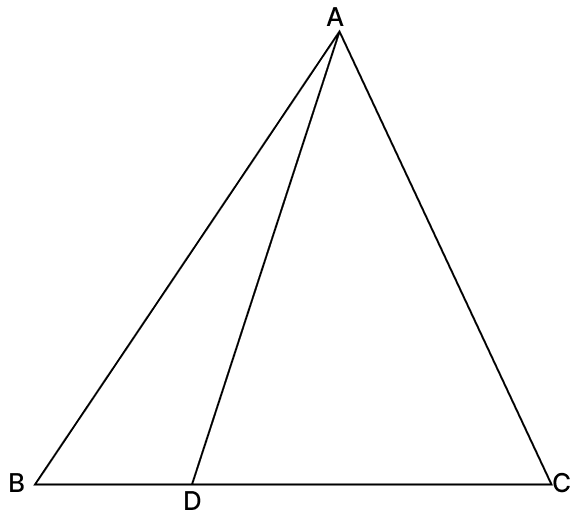
D is a point on base BC of a ΔABC such that 2BD = DC. Prove that :
ar (ΔABD) = ar (ΔABC).
Answer
Given,
2BD = DC
We know that,
Ratio of the area of triangles with same vertex and bases along the same line is equal to the ratio of their respective bases.
From figure,
⇒ Area of Δ ABC = Area of Δ ABD + Area of Δ ADC
⇒ Area of Δ ABC = Area of Δ ABD + 2 Area of Δ ABD
⇒ Area of Δ ABC = 3 Area of Δ ABD
⇒ Area of Δ ABD = ar (ΔABC).
Hence, proved that Area of Δ ABD = ar (ΔABC).
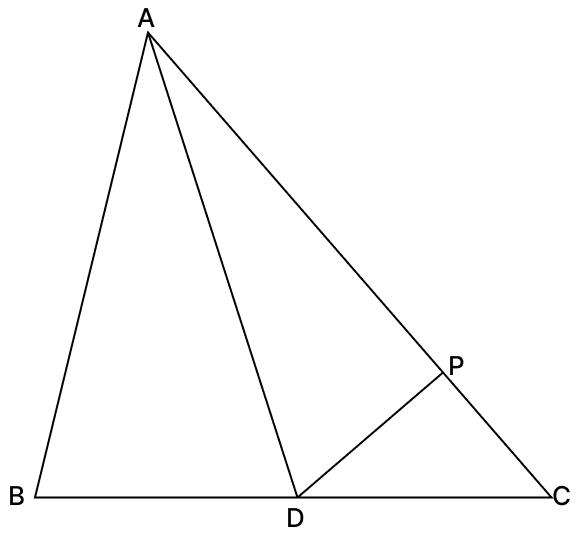
In the given figure, AD is a median of ΔABC and P is a point on AC such that :
ar (ΔADP) : ar (ΔABD) = 2 : 3.
Find :
(i) AP : PC
(ii) ar (ΔPDC) : ar (ΔABC)
Answer
(i) From figure,
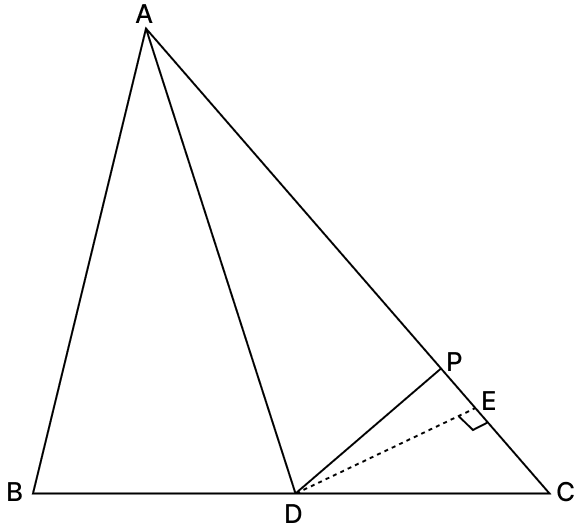
Let DE be altitude on base AC.
Median divides a triangle into two triangles of equal area.
AD is the median of ∆ABC,
Area of ∆ABD = Area of ∆ADC = Area of ∆ABC .....(1)
It is given that,
⇒ area of ∆ADP : area of ∆ABD = 2 : 3
⇒ area of ∆ADP : area of ∆ADC = 2 : 3
Let AP = 2x and AC = 3x.
From figure,
PC = AC - AP = 3x - 2x = x.
.
Hence, AP : PC = 2 : 1.
(ii) We know that,
PC : AC = x : 3x = 1 : 3
So,
Since, AD is median of ∆ABC so,
area of Δ ADC = area of Δ ABC
Substituting above value in equation (2) we get,
Hence, proved that area of △PDC : area of △ABC = 1 : 6.
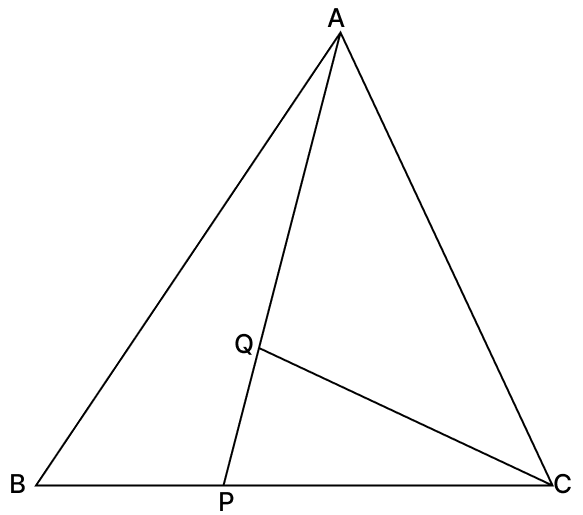
In the given figure, P is a point on side BC of ΔABC such that BP : PC = 1 : 2 and Q is a point on AP such that PQ : QA = 2 : 3. Show that :
ar (ΔAQC) : ar (ΔABC) = 2 : 5.
Answer
Given,
BP : PC = 1 : 2
PC = 2BP
From figure,
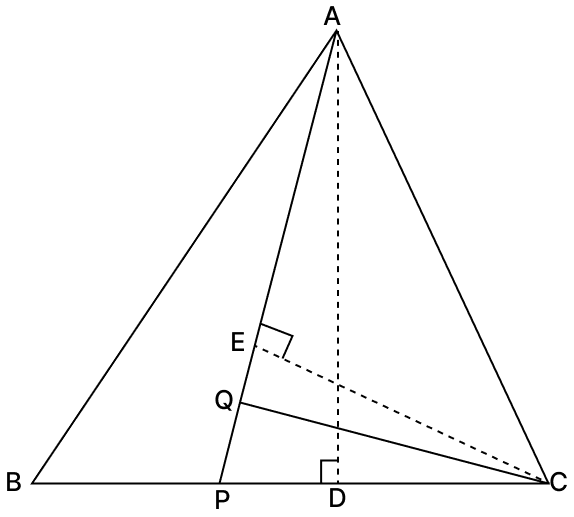
BC = BP + PC = BP + 2BP = 3BP.
.
PC = BC
Let AD be the altitude on BC.
Area of △ABC = × BC × AD ......(1)
Dividing equation (2) by equation (1) we get,
Given,
PQ : AQ = 2 : 3
Let PQ = 2x and AQ = 3x
From figure,
AP = PQ + AQ = 2x + 3x = 5x.
AQ =
Let CE be the altitude on side AP.
Area of △AQC = × AQ × CE .....(4)
Area of △APC = × AP × CE ......(5)
Dividing equation (4) by equation (5) we get,
Hence, proved that ar (ΔAQC) : ar (ΔABC) = 2 : 5.
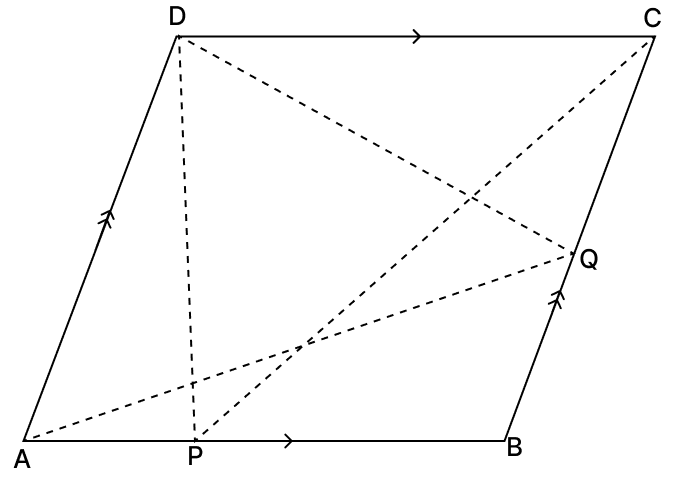
In the adjoining figure, ABCD is a parallelogram. P and Q are any two points on the sides AB and BC respectively. Prove that :
ar (ΔCPD) = ar (ΔAQD).
Answer
∆CPD and ||gm ABCD are on the same base CD and between the same parallel lines AB and CD.
Area of ∆CPD = Area of ||gm ABCD ......(1)
∆AQD and ||gm ABCD are on the same base AD and between the same parallel lines AD and BC.
Area of ∆AQD = Area of ||gm ABCD ......(2)
From equations (1) and (2), we get :
Area of ∆CPD = Area of ∆AQD.
Hence, proved that area of ∆CPD = area of ∆AQD.
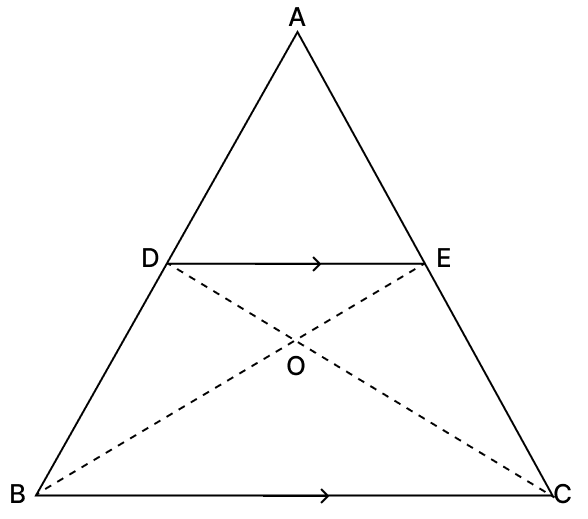
In the adjoining figure, DE ∥ BC. Prove that :
(i) ar (ΔABE) = ar (ΔACD)
(ii) ar (ΔOBD) = ar (ΔOCE)
Answer
(i) We know that,
Triangles on the same base and between the same parallel lines are equal in area.
∆BCD and ∆BCE are on the same base BC and between the same || lines DE and BC.
⇒ Area of ∆BCD = Area of ∆BCE
Subtracting area of ∆BCD and ∆BCE from area of ∆ABC
⇒ Area of ∆ABC - Area of ∆BCD = Area of ∆ABC - Area of ∆BCE
⇒ Area of ∆ACD = Area of ∆ABE.
Hence proved, that area of ∆ACD = area of ∆ABE.
(ii) We know that,
⇒ Area of ∆BCD = Area of ∆BCE
Subtracting area of ∆OBC from above equation we get,
⇒ Area of ∆BCD - Area of ∆OBC = Area of ∆BCE - Area of ∆OBC
⇒ Area of ∆OBD = Area of ∆OCE.
Hence proved, that area of ∆OBD = area of ∆OCE.
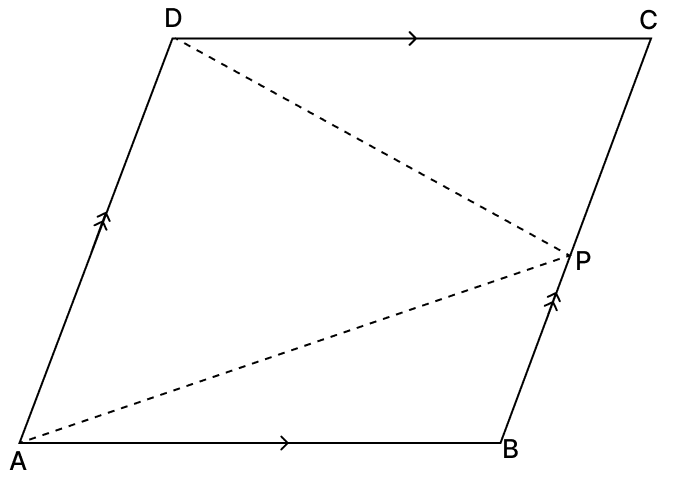
In the given figure, ABCD is a parallelogram and P is a point on BC. Prove that :
ar (ΔABP) + ar (ΔDPC) = ar (ΔAPD).
Answer
We know that,
Area of a triangle is half that of a parallelogram on the same base and between the same parallel lines.
∆APD and ||gm ABCD are on the same base AD and between the same ∥ lines AD and BC,
Area of ∆APD = Area of ||gm ABCD ....(1)
From figure,
Area of ||gm ABCD = Area of ∆APD + Area of ∆ABP + Area of ∆DPC
Dividing the above equation by 2 we get,
Hence, proved that Area of ∆ABP + Area of ∆DPC = Area of ∆APD.
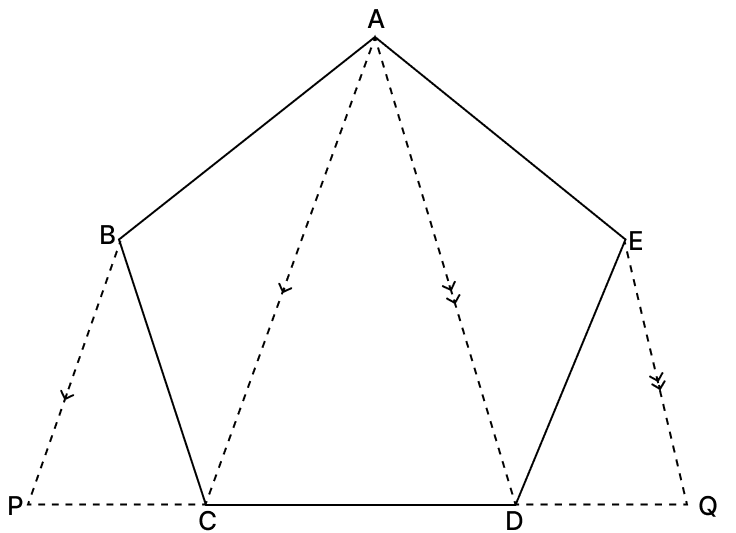
In the adjoining figure, ABCDE is a pentagon. BP drawn parallel to AC meets DC produced at P and EQ drawn parallel to AD meets CD produced at Q. Prove that : ar (Pentagon ABCDE) = ar (ΔAPQ).
Answer
Join AP and AQ.
We know that,
Triangles on the same base and between the same parallel lines are equal in area.
Since, triangle ABP and BPC lie on the same base BP and between the same parallel lines BP and AC.
∴ Area of △ ABP = Area of △ BPC
Subtracting △ BOP from both sides, we get :
⇒ Area of △ ABP - Area of △ BOP = Area of △ BPC - Area of △ BOP
⇒ Area of △ AOB = Area of △ POC .......(1)
Since, triangle AEQ and EDQ lie on the same base EQ and between the same parallel lines EQ and AD.
∴ Area of △ AEQ = Area of △ EDQ
Subtracting △EXQ from both sides, we get :
⇒ Area of △ AEQ - Area of △ EXQ = Area of △ EDQ - Area of △ EXQ
⇒ Area of △ AXE = Area of △ DQX .......(2)
From figure,
⇒ Area of △ APQ = Area of △ POC + Area of △ DQX + Area of pentagon CDXAO
⇒ Area of △ APQ = Area of △ AOB + Area of △ AXE + Area of pentagon CDXAO
⇒ Area of △ APQ = Area of pentagon ABCDE.
Hence, proved that area of pentagon ABCDE is equal to the area of triangle APQ.
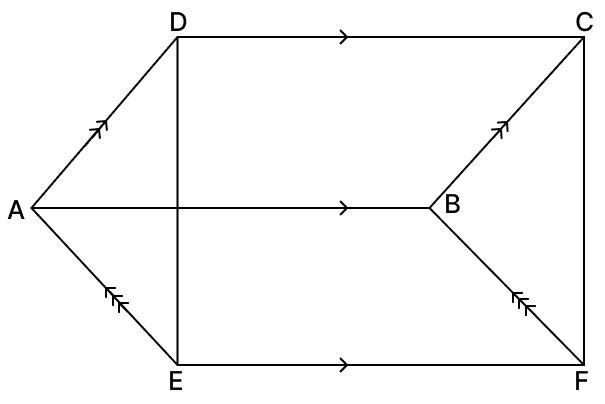
In the adjoining figure, two parallelograms ABCD and AEFB are drawn on opposite sides of AB. Prove that : ar (∥ gm ABCD) + ar (∥ gm AEFB) = ar (∥ gm EFCD).
Answer
Parallelogram ABCD and Parallelogram AEFB are on opposite sides of the common base AB.
Let h1 be the distance between parallel lines AB and CD, h2 be the distance between parallel lines AB and EF.
Area of ||gm = Base × Height
ar (∥ gm ABCD) = AB × h1
ar (∥ gm AEFB) = AB × h2
ar (∥ gm ABCD) + ar(∥ gm AEFB) = AB × h1 + AB × h2
ar (∥ gm ABCD) + ar(∥ gm AEFB) = AB × (h1 + h2) ......(1)
From figure,
In ∥ gm EFCD,
Height = Height of ||gm ABCD + Height of ||gm AEFB = h1 + h2
ar (∥ gm EFCD) = DC × (h1 + h2)
Since, AB = DC [Opposite sides of parallelogram are equal]
ar (∥ gm EFCD) = AB × (h1 + h2).....(2)
From equation (1) and (2),
ar(∥ gm ABCD) + ar(∥ gm AEFB) = ar (∥ gm EFCD)
Hence, proved that ar(∥ gm ABCD) + ar(∥ gm AEFB) = ar (∥ gm EFCD).
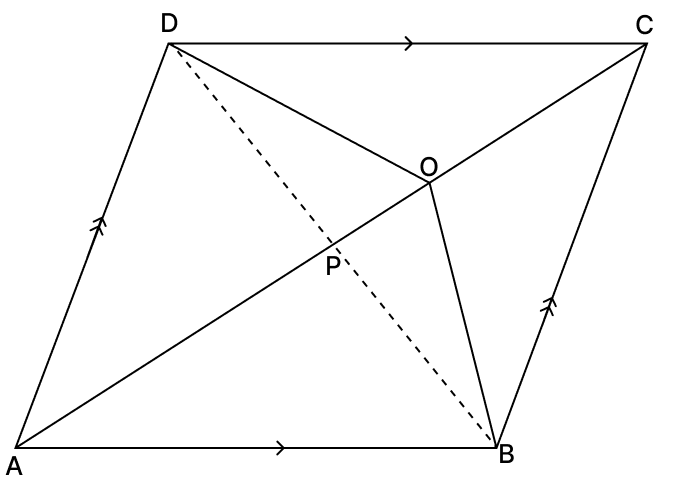
In the adjoining figure, ABCD is a parallelogram and O is any point on its diagonal AC. Show that : ar (ΔAOB) = ar (ΔAOD).
Answer
In ∆ABD, AP is the median (As P is mid-point of BD because diagonals of ||gm bisect each other).
Since, median of triangle divides it into two triangles of equal area.
∴ Area of ∆ABP = Area of ∆ADP ......(1)
Similarly,
PO is median of ∆BOD,
∴ Area of ∆BOP = Area of ∆POD ......(2)
Now, adding equations (1) and (2), we get :
⇒ Area of ∆ABP + Area of ∆BOP = Area of ∆ADP + Area of ∆POD
⇒ Area of ∆AOB = Area of ∆AOD.
Hence, proved that area of ∆AOB = area of ∆AOD.
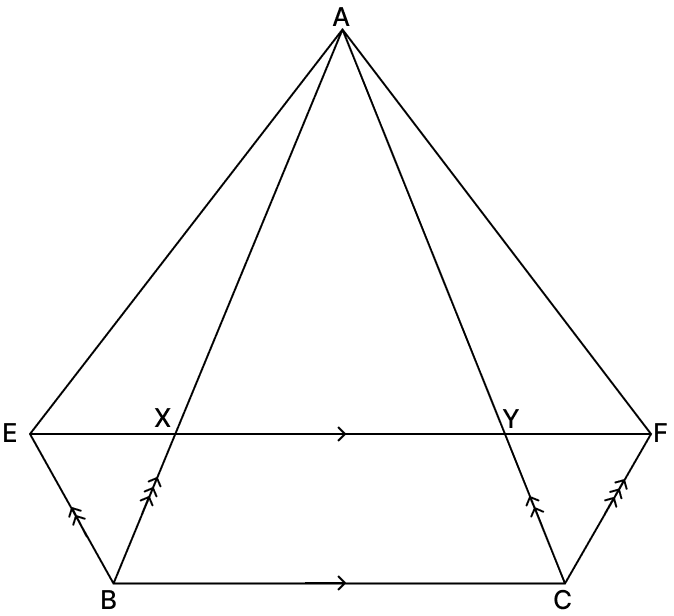
In the given figure, XY || BC, BE || CA and FC || AB. Prove that : ar (ΔABE) = ar (ΔACF).
Answer
Parallelograms BCYE and BCFX stand on the same base BC and lie between the same parallels BC and XY.
ar (∥ gm BCYE) = ar (∥ gm BCFX) = x (let) .....(1)
Δ ABE shares the base BE with parallelogram BCYE and lies between the same parallels BE and AC.
ar (Δ ABE) = ar (∥ gm BCYE) = .....(2)
Δ ACF shares the base CF with parallelogram BCFX and lies between the same parallels CF and AB.
ar (Δ ACF) = ar (∥ gm BCFX) = .....(3)
From equation (2) and (3), we get :
ar (Δ ABE) = ar (Δ ACF)
Hence, proved that ar (Δ ABE) = ar (Δ ACF).
In the given figure, the side AB of ∥ gm ABCD is produced to a point P. A line through A drawn parallel to CP meets CB produced in Q and the parallelogram PBQR is completed. Prove that : ar (∥ gm ABCD) = ar (∥ gm BPRQ).
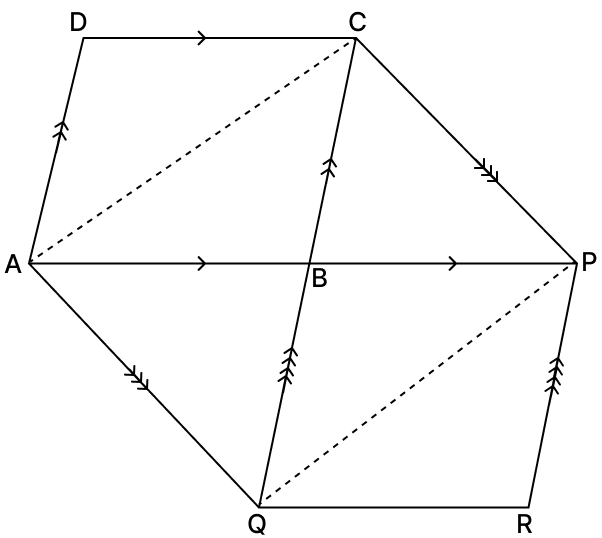
Answer
Δ AQC and Δ AQP shares the base AQ lies between the same parallels AQ and CP.
ar (ΔAQC) = ar (ΔAQP) ......(1)
Both triangles share a common part, which is Δ AQB. Subtract this area from both sides of Equation (1):
ar (ΔAQC) - ar (ΔAQB) = ar (ΔAQP) - ar (ΔAQB)
ar (ΔABC) = ar (ΔQPB) .......(2)
We know that a diagonal of a parallelogram divides it into two triangles of equal area.
In parallelogram ABCD, AC is the diagonal,
ar(Δ ABC) = ar(∥ gm ABCD)
In parallelogram BPRQ, QP is the diagonal,
ar(Δ QPB) = ar(∥ gm BPRQ)
Substituting the values in equation (2), we get :
ar(∥ gm ABCD) = ar(∥ gm BPRQ)
ar(∥ gm ABCD) = ar(∥ gm BPRQ).
Hence, proved that ar(∥ gm ABCD) = ar(∥ gm BPRQ).
In the adjoining figure, CE is drawn parallel to DB to meet AB produced at E. Prove that : ar (quad. ABCD) = ar (ΔDAE).
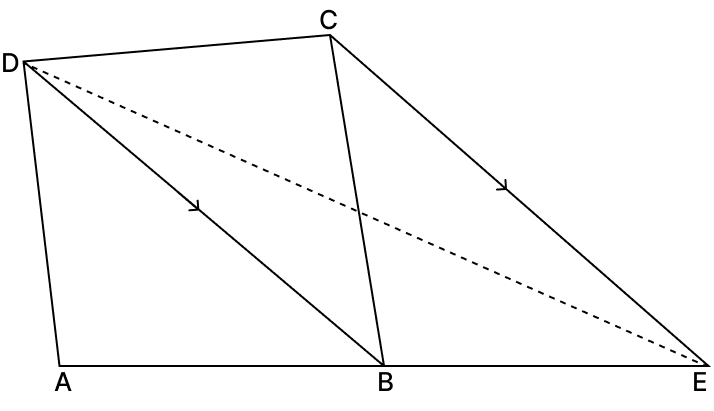
Answer
We know that,
Triangles on the same base and between the same parallel lines are equal in area.
△ BDE and △ BDC lie on the same base BD and along the same parallel lines DB and CE.
∴ Area of △ BDE = Area of △ BDC .....(1)
From figure,
⇒ Area of △ ADE = Area of △ ADB + Area of △ BDE
⇒ Area of △ ADE = Area of △ ADB + Area of △ BDC [From equation (1)]
⇒ Area of △ ADE = Area of quadrilateral ABCD.
Hence, proved that △ ADE and quadrilateral ABCD are equal in area.
In the adjoining figure, ABCD is a parallelogram. AB is produced to a point P and DP intersects BC at Q. Prove that : ar (ΔAPD) = ar (quad. BPCD).
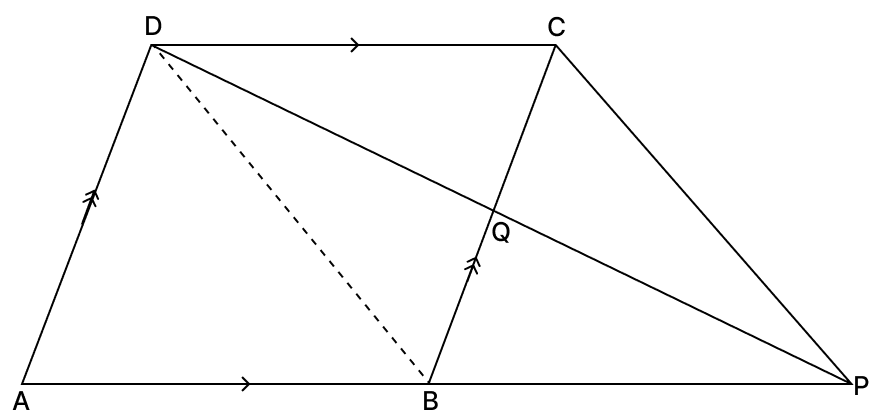
Answer
From figure,
AB // DC thus, AP // DC since AP is a straight line.
In parallelogram ABCD, the diagonal BD divides it into two triangles of equal area.
ar (ΔABD) = ar (ΔDBC) .....(1)
△ BPD and △ BPC lie on the same base BP and along the same parallel lines AP and DC.
ar (ΔBPD) = ar (ΔBPC) ....(2)
From figure,
ar (ΔAPD) = ar (ΔABD) + ar (ΔBPD)
Substituting values from equations (1) and (2) in above equation, we get :
ar (ΔAPD) = ar (ΔDBC) + ar (ΔBPC) ....(3)
From figure,
ar(quad. BPCD) = ar(△DBC) + ar(△BPC) ....(4)
From equations (3) and (4), we get :
∴ ar (ΔAPD) = ar(quad. BPCD)
Hence, proved that ar (ΔAPD) = ar(quad. BPCD).
In the adjoining figure, ABCD is a parallelogram. Any line through A cuts DC at a point P and BC produced at Q. Prove that : ar (ΔBPC) = ar (ΔDPQ).
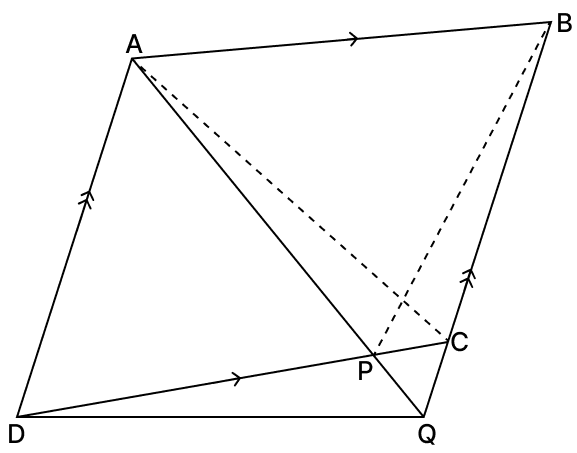
Answer
We know that,
Area of a triangle is half that of a parallelogram on the same base and between the same parallels.
Since, triangle APB and parallelogram ABCD are on the same base AB and between the same parallels AB and DC.
∴ Area of △ APB = Area of ||gm ABCD .....(1)
Since, triangle ADQ and parallelogram ABCD are on the same base AD and between the same parallels AD and BQ.
∴ Area of △ ADQ = Area of ||gm ABCD .....(2)
Adding equations (1) and (2), we get :
⇒ Area of △ APB + Area of △ ADQ = Area of ||gm ABCD + Area of ||gm ABCD
⇒ Area of △ APB + Area of △ ADQ = Area of ||gm ABCD .....(3)
From figure,
⇒ Area of △ APB + Area of △ ADQ = Area of quadrilateral ADQB - Area of △ BPQ ......(4)
From equation (3) and (4), we get :
⇒ Area of quadrilateral ADQB - Area of △ BPQ = Area of ||gm ABCD
⇒ Area of quadrilateral ADQB - Area of △ BPQ = Area of quadrilateral ADQB - Area of △ DCQ
⇒ Area of △ BPQ = Area of △ DCQ
⇒ Area of △ BPQ - Area of △ PCQ = Area of △ DCQ - Area of △ PCQ
⇒ Area of △ BCP = Area of △ DPQ.
Hence, proved that area of △ BCP = area of △ DPQ.
In the adjoining figure, ABCD is a parallelogram. P is a point on BC such that BP : PC = 1 : 2. DP produced meets AB produced at Q. Given ar (ΔCPQ) = 20 cm2. Calculate :
(i) ar (ΔCDP)
(ii) ar (∥ gm ABCD)
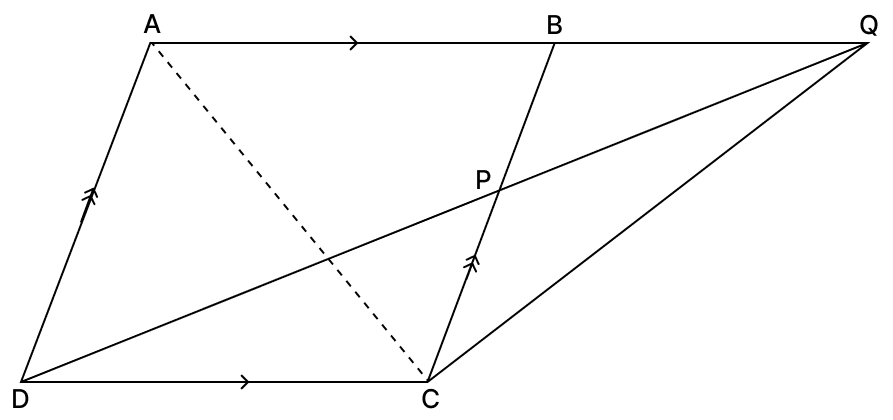
Answer
(i) Draw QN perpendicular CB as shown in the figure below :
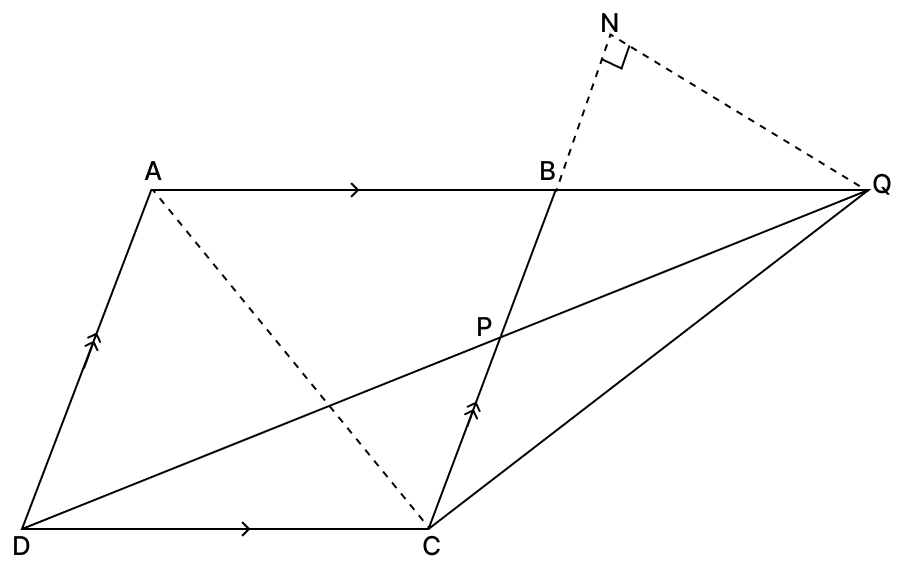
Considering △CDP and △BQP,
∠CPD = ∠QPB (Vertically opposite angles are equal)
∠PDC = ∠PQB (Alternate angles are equal)
Hence, by AA axiom △CDP ~ △BQP.
We know that, the ratio of the areas of two similar triangles is equal to the ratio of the square of their corresponding sides.
∴ Area of △CDP = 4 × Area of △BQP = 4 × 10 = 40 cm2.
Hence, the area of △CDP = 40 cm2.
(ii) Area of ||gm ABCD = 2 Area of △DCQ (As △DCQ and ||gm ABCD have same base DC and are between same parallels AQ and DC)
= 2(Area of △CDP + Area of △CPQ)
= 2(40 + 20)
= 2 × 60
= 120 cm2.
Hence, the area of ||gm ABCD = 120 cm2.
In the adjoining figure, ABCD is a parallelogram. P is a point on DC such that ar (ΔAPD) = 25 cm2 and ar (ΔBPC) = 15 cm2. Calculate :
(i) ar (∥ gm ABCD)
(ii) DP : PC
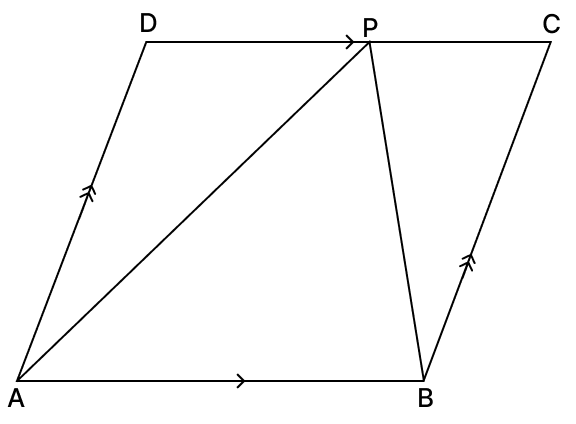
Answer
(i) Since,
∆APB and ||gm ABCD have same base AB and are between same parallel lines AB and DC. So,
area of ∆APB = area of ||gm ABCD
From figure,
⇒ area of ||gm ABCD = area of (∆DAP + ∆BCP)
⇒ area of ||gm ABCD = 25 + 15
⇒ area of ||gm ABCD = 40
⇒ area of ||gm ABCD = 2 × 40 = 80 cm2.
Hence, area of ||gm ABCD = 80 cm2.
(ii) From figure,
∆DAP and ∆BCP are on the same base CD and between the same parallel lines CD and AB.
Hence, DP : PC = 5 : 3.
In the given figure, AB ∥ DC ∥ EF, AD ∥ BE and DE ∥ AF. Prove that : ar (∥ gm DEFH) = ar (∥ gm ABCD).
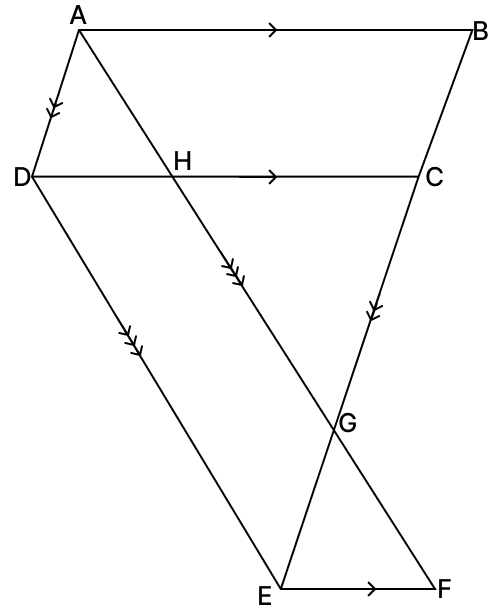
Answer
We know that,
AD || BE ⇒ AD || EG
ED || FA ⇒ ED || GA
Since, opposite sides are parallel.
Hence, ADEG is a parallelogram.
Since ||gm ABCD and ||gm ADEG lie on same base AD and between same parallel lines AD and EB,
area of ||gm ABCD = area of ||gm ADEG .......(1)
We know that,
ED || FA ⇒ DE || FH
DC || EF ⇒ DH || EF
Since, opposite sides are parallel.
Hence, DEFH is a parallelogram.
Since ||gm DEFH and ||gm ADEG lie on same base DE and between same parallel lines DE and FA,
area of ||gm DEFH = area of ||gm ADEG ........(2)
From (1) and (2) we get,
⇒ area of ||gm ABCD = area of ||gm DEFH
Hence, proved that area of ||gm ABCD = area of ||gm DEFH.
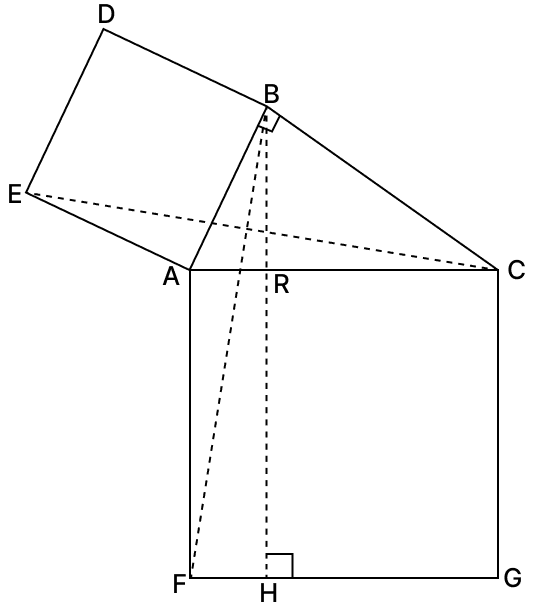
In the given figure, squares ABDE and AFGC are drawn on the side AB and hypotenuse AC of right triangle ABC and BH ⟂ FG. Prove that :
(i) ∠EAC = ∠BAF
(ii) ar (sq. ABDE) = ar (rect. ARHF)
Answer
(i) From figure,
⇒ ∠EAC = ∠EAB + ∠BAC
⇒ ∠EAC = 90° + ∠BAC (As, ABDE is a square and each angle of square equal to 90°) .......(1)
Also,
⇒ ∠BAF = ∠FAC + ∠BAC
⇒ ∠BAF = 90° + ∠BAC (As, AFGC is a square and each angle of square equal to 90°) .......(2)
From equation (1) and (2),
⇒ ∠EAC = ∠BAF
Hence, proved that ∠EAC = ∠BAF.
(ii) From figure,
ABC is a right angled triangle.
⇒ AC2 = AB2 + BC2 [By pythagoras theorem]
⇒ AB2 = AC2 - BC2
⇒ AB2 = (AR + RC)2 - (BR2 + RC2)
⇒ AB2 = AR2 + RC2 + 2.AR.RC - BR2 - RC2
⇒ AB2 = AR2 + RC2 + 2.AR.RC - (AB2 - AR2) - RC2 [Using pythagoras theorem in △ ABR]
⇒ AB2 = AR2 + RC2 + 2.AR.RC - AB2 + AR2 - RC2
⇒ AB2 + AB2 = AR2 + AR2 + RC2 - RC2 + 2.AR.RC
⇒ 2AB2 = 2AR2 + 2.AR.RC
⇒ 2AB2 = 2AR(AR + RC)
⇒ AB2 = AR(AR + RC)
⇒ AB2 = AR.AC
⇒ AB2 = AR.AF (As, AC = AF, sides of same sqaure)
∴ Area of square ABDE = Area of rectangle ARFH.
Hence, proved that area of square ABDE = area of rectangle ARFH.
Construct a quadrilateral ABCD in which AB = 3.2 cm, BC = 2.8 cm, CD = 4 cm, DA = 4.5 cm and BD = 5.3 cm. Also construct a triangle equal in area to this quadrilateral.
Answer
Steps of construction:
Draw AB = 3.2 cm.
With A as centre and radius 4.5 cm, draw an arc.
With B as centre and radius 5.3 cm draw another arc, cutting the previous arc at D.
Join AD.
With D as centre and radius 4 cm, draw an arc.
With B as centre and radius 2.8 cm, draw another arc cutting the previous arc at C.
Join BC and DC, to form quadrilateral ABCD.
Join BD and through C, construct a straight line parallel to DB to meet AB produced at E.
Join DE.
Since △DBC and △DBE have same base DB and are between the same parallels BD and EC, we have;
ar(△DBC) = ar(△DBE)
ar(quad ABCD) = ar(△ABD) + ar(△DBC)
ar(quad ABCD) = ar(△ABD) + ar(△DBE)
ar(quad ABCD) = ar(△AED)
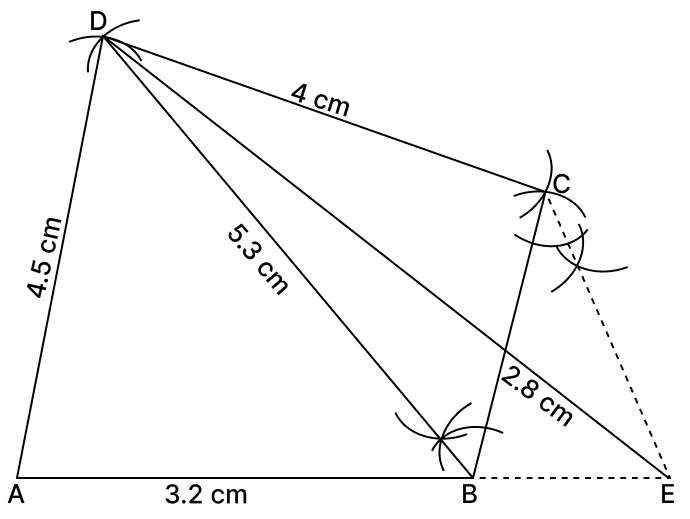
Hence, triangle AED is the required triangle whose area is equal to the area of the quadrilateral ABCD.